

ISO/TS 5044:2023
(Main)Health informatics — Information model for quality control of traditional Chinese medicinal products
General Information
- Abstract
This document specifies an information model representing the quality control of the manufacturing process of traditional Chinese medicinal products by defining a set of domain constraints of sanctioned characteristics, each composed of a relationship. It is applicable to the quality supervision and management of manufacturing process of Chinese materia medica. Japanese KAMPO medicine is outside the scope of this document.
- Status
- Published
- Publication Date
- 22-Jun-2023
- Technical Committee
- ISO/TC 215 - Health informatics
- Current Stage
- 9060 - Close of review
- Start Date
- 03-Sep-2026
- Completion Date
- 02-Sep-2026


Overview
ISO/TS 5044:2023 - Health informatics - Information model for quality control of traditional Chinese medicinal products - defines an information model for the quality control of the manufacturing process of traditional Chinese medicinal products (Chinese materia medica). Published as a Technical Specification in 2023, the document specifies domain constraints made up of sanctioned characteristics and their relationships, to support consistent description, supervision and management of production quality. Japanese KAMPO medicine is excluded from the scope.
Key topics and technical requirements
- Information model structure: graphical and textual representation of entities and their relationships (concepts, categories, characteristics).
- Domain constraints: sanctioned characteristics used to represent quality attributes and process controls; each characteristic is composed of one or more defined relationships.
- Semantic links (relationship types): standardized directed relations used in the model, including measure, consist of, characterize, affect, be processed into, have attribute of, include, and evaluate.
- Characterizing categories: defined testing and quality dimensions relevant to Chinese materia medica, e.g. chemical analysis, bioanalysis, character analysis, impurities, effective constituents, endogenous/exogenous toxic components, heavy metals, pesticide residue, microbiological detection, fingerprint (chromatogram), moisture/ash/residual solvent/pH.
- Manufacturing context: links quality attributes with production concepts such as formula, prescription dosage, production, equipment, critical process parameters, adjuvant material, and other process metadata to enable traceable quality supervision.
- Terminology governance: clarifies terms and definitions to reduce ambiguity across jurisdictions and support interoperable data exchange.
Applications and who uses it
ISO/TS 5044 is designed for organizations involved in the manufacture, testing, regulation and informatics of traditional Chinese medicinal products:
- Manufacturers - to model and document critical quality attributes (CQAs) and critical process parameters (CPPs) across production workflows.
- Quality assurance & regulatory authorities - to standardize supervision, inspections and cross-border quality assessment.
- Analytical laboratories - to align test descriptors (fingerprints, HPLC, MS, microbiology) with manufacturing records.
- Health informatics and standards teams - to implement interoperable data models that support quality management systems and reporting.
Related standards
Standards referenced or aligned in the text include ISO/IEC 19763-12, ISO 18668-1, ISO 11238, ISO 15206 and ISO 17115. Implementers should review these for terminology, data-modeling and regulatory mapping.
Keywords: ISO/TS 5044, health informatics, information model, quality control, traditional Chinese medicinal products, Chinese materia medica, manufacturing quality, semantic links.
Get Certified
Connect with accredited certification bodies for this standard

BSI Group
BSI (British Standards Institution) is the business standards company that helps organizations make excellence a habit.

NYCE
Mexican standards and certification body.
Sponsored listings
Frequently Asked Questions
ISO/TS 5044:2023 is a technical specification published by the International Organization for Standardization (ISO). Its full title is "Health informatics — Information model for quality control of traditional Chinese medicinal products". This standard covers: This document specifies an information model representing the quality control of the manufacturing process of traditional Chinese medicinal products by defining a set of domain constraints of sanctioned characteristics, each composed of a relationship. It is applicable to the quality supervision and management of manufacturing process of Chinese materia medica. Japanese KAMPO medicine is outside the scope of this document.
This document specifies an information model representing the quality control of the manufacturing process of traditional Chinese medicinal products by defining a set of domain constraints of sanctioned characteristics, each composed of a relationship. It is applicable to the quality supervision and management of manufacturing process of Chinese materia medica. Japanese KAMPO medicine is outside the scope of this document.
ISO/TS 5044:2023 is classified under the following ICS (International Classification for Standards) categories: 35.240.80 - IT applications in health care technology. The ICS classification helps identify the subject area and facilitates finding related standards.
ISO/TS 5044:2023 is available in PDF format for immediate download after purchase. The document can be added to your cart and obtained through the secure checkout process. Digital delivery ensures instant access to the complete standard document.
Standards Content (Sample)
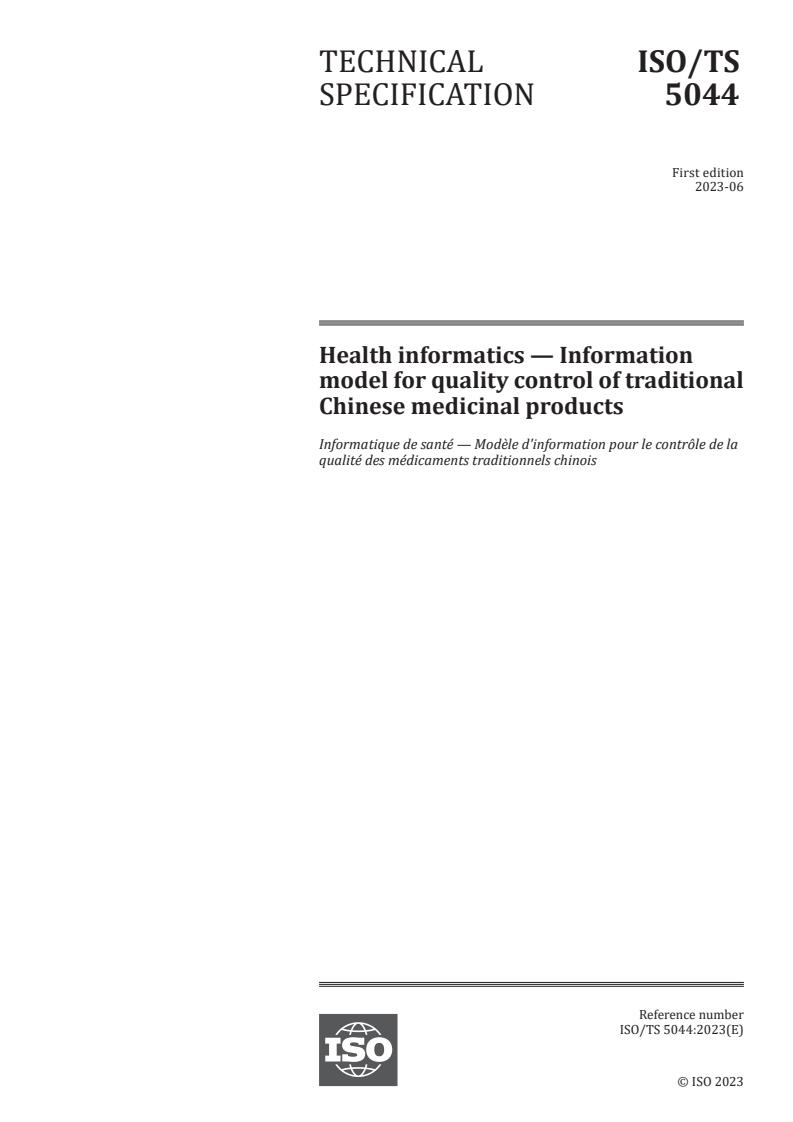
TECHNICAL ISO/TS
SPECIFICATION 5044
First edition
2023-06
Health informatics — Information
model for quality control of traditional
Chinese medicinal products
Informatique de santé — Modèle d'information pour le contrôle de la
qualité des médicaments traditionnels chinois
Reference number
© ISO 2023
All rights reserved. Unless otherwise specified, or required in the context of its implementation, no part of this publication may
be reproduced or utilized otherwise in any form or by any means, electronic or mechanical, including photocopying, or posting on
the internet or an intranet, without prior written permission. Permission can be requested from either ISO at the address below
or ISO’s member body in the country of the requester.
ISO copyright office
CP 401 • Ch. de Blandonnet 8
CH-1214 Vernier, Geneva
Phone: +41 22 749 01 11
Email: copyright@iso.org
Website: www.iso.org
Published in Switzerland
ii
Contents Page
Foreword .iv
Introduction .v
1 Scope . 1
2 Normative references . 1
3 Terms and definitions . 1
3.1 General . 1
3.2 Characterizing categories . 2
4 Categorial structure . 6
4.1 Information model for quality control of traditional Chinese medicinal products . 6
4.2 Semantic link . 8
4.2.1 measure . 8
4.2.2 consist of . 8
4.2.3 characterize . 8
4.2.4 affect . 8
4.2.5 be processed into . 8
4.2.6 have attribute of . 8
4.2.7 include . . 8
4.2.8 evaluate . 9
Bibliography .10
iii
Foreword
ISO (the International Organization for Standardization) is a worldwide federation of national standards
bodies (ISO member bodies). The work of preparing International Standards is normally carried out
through ISO technical committees. Each member body interested in a subject for which a technical
committee has been established has the right to be represented on that committee. International
organizations, governmental and non-governmental, in liaison with ISO, also take part in the work.
ISO collaborates closely with the International Electrotechnical Commission (IEC) on all matters of
electrotechnical standardization.
The procedures used to develop this document and those intended for its further maintenance are
described in the ISO/IEC Directives, Part 1. In particular, the different approval criteria needed for the
different types of ISO document should be noted. This document was drafted in accordance with the
editorial rules of the ISO/IEC Directives, Part 2 (see www.iso.org/directives).
ISO draws attention to the possibility that the implementation of this document may involve the use
of (a) patent(s). ISO takes no position concerning the evidence, validity or applicability of any claimed
patent rights in respect thereof. As of the date of publication of this document, ISO had not received
notice of (a) patent(s) which may be required to implement this document. However, implementers are
cautioned that this may not represent the latest information, which may be obtained from the patent
database available at www.iso.org/patents. ISO shall not be held responsible for identifying any or all
such patent rights.
Any trade name used in this document is information given for the convenience of users and does not
constitute an endorsement.
For an explanation of the voluntary nature of standards, the meaning of ISO specific terms and
expressions related to conformity assessment, as well as information about ISO's adherence to
the World Trade Organization (WTO) principles in the Technical Barriers to Trade (TBT), see
www.iso.org/iso/foreword.html.
This document was prepared by Technical Committee ISO/TC 215, Health informatics, in collaboration
with Technical Committee ISO/TC 249, Traditional Chinese medicine.
Any feedback or questions on this document should be directed to the user’s national standards body. A
complete listing of these bodies can be found at www.iso.org/members.html.
iv
Introduction
Chinese materia medica, especially traditional Chinese medicinal products are widely utilized as a part
of complementary and alternative medicine throughout East Asia and western countries. In order to
guarantee quality and therapeutic effects, quality control of traditional Chinese medicinal products is
very significant and valuable.
Quality control of traditional Chinese medicinal products is very difficult. This is due to five main
reasons: firstly, a wide variety of dosage forms and the manufacturing processes are difficult to
accurately classify; secondly, the influencing factors in the manufacturing process are very complicated,
which are difficult to be accurately described and controlled; thirdly, an information model of the
preparation of Chinese materia medica has not been described and published; fourthly, the therapeutic
effect of Chinese medicine is the comprehensive result of multi-component material based on biological
metabolism engineering, and the quality control technology of Chinese medicine is often unable to
meet the practical needs due to its complex mechanism; fifthly, the requirements for quality control of
traditional Chinese medicinal products and relevant regulations vary greatly from country to country,
resulting in various and inconsistent standards for traditional Chinese medicinal products and the
inability to achieve drug circulation and resource sharing.
The wide range of disciplines and the specific national usages have led to different meanings being
attributed to particular terms and different terms being used to describe the same concept. To avoid
the consequent misunderstandings and to facilitate the exchange of information, it is essential to clarify
the concepts, to establish the correct terms for use, and to establish their definitions.
v
TECHNICAL SPECIFICATION ISO/TS 5044:2023(E)
Health informatics — Information model for quality
control of traditional Chinese medicinal products
1 Scope
This document specifies an information model representing the quality control of the manufacturing
process of traditional Chinese medicinal products by defining a set of domain constraints of sanctioned
characteristics, each composed of a relationship.
It is applicable to the quality supervision and management of manufacturing process of Chinese materia
medica.
Japanese KAMPO medicine is outside the scope of this document.
2 Normative references
There are no normative references in this document.
3 Terms and definitions
For the purposes of this document, the following terms and definitions apply.
ISO and IEC maintain terminology databases for use in standardization at the following addresses:
— ISO Online browsing platform: available at https:// www .iso .org/ obp
— IEC Electropedia: available at https:// www .electropedia .org/
3.1 General
3.1.1
concept
unit of knowledge created by a unique combination of characteristics
Note 1 to entry: A concept can have one or more names. It can be represented using one or more terms, pictures,
icons or sounds.
3.1.2
category
division of sets of entities regarded as having particular shared characteristics
EXAMPLE Freeze drying, spray drying and all other drying share characteristics particular to the category
drying.
Note 1 to entry: Categories can be more or less general. Where one category is subsumed by another, a relation
is asserted to obtain a hierarchy between the more specific or subsumed category and the more general or
subsuming category. For example, "parenteral route" is more general than "intravenous route".
3.1.3
information model
graphical and textual representation of entities and the relationships between them
Note 1 to entry: Can also be known as a data model, a conceptual data model, a logical data model, an entity
relationship model, an object class diagram, or a database definition.
[SOURCE: ISO/IEC 19763-12: 2015, 4.2.24]
3.1.4
characteristic
abstraction of a property of an object or of a set of objects
EXAMPLE Fever is a characteristic symptom of the flu.
Note 1 to entry: Characteristics are used for describing concepts (3.1.1) and for differentiating categories (3.1.2).
3.1.5
semantic link
formal representation of a directed associative relation or partitive relation between two concepts
EXAMPLE Is cause of (with inverse has cause); has Location (with inverse is Location Of).
Note 1 to entry: This includes all relations except the generic relation.
Note 2 to entry: A semantic link always has an inverse, i.e. another semantic link with the opposite direction.
[SOURCE: ISO 17115:2020, 3.2.5, modified — Example has been changed.]
3.1.6
Chinese medicine
substance or combination of substances used under the guidance of traditional Chinese medicine (TCM)
theory for medical care and the prevention and treatment of disease
Note 1 to entry: This includes Chinese materia medica, decoction pieces, granule forms of individual medicinals
for prescriptions (GFIMP) and Chinese patent medicines (CPM).
[SOURCE: ISO 18668-1:2016, 3.1]
3.2 Characterizing categories
3.2.1
chemical analysis
qualitative and quantitative analysis based on the chemical reactions of substances
EXAMPLE HPLC, MS, NMR, IR, UV, GC, CE and other combined techniques were used for the quantitative
determination of active ingredients or index components
3.2.2
bioanalysis
analysis of the biological activity (including efficacy and toxicity) of dr
...