

ISO 18074:2015
(Main)Textiles — Identification of some animal fibres by DNA analysis method — Cashmere, wool, yak and their blends
General Information
- Abstract
ISO 18074:2015 specifies a testing method for DNA analysis of some animal fibres to identify cashmere, wool, yak, and their blends by using extraction, amplification by the polymerase chain reaction (PCR) method and DNA detection processes. ISO 18084:2015 is applicable to cashmere, yak, and wool and their blends as a qualitative method.
- Status
- Published
- Publication Date
- 18-Nov-2015
- Technical Committee
- ISO/TC 38 - Textiles
- Drafting Committee
- ISO/TC 38/WG 22 - Composition and chemical testing
- Current Stage
- 9093 - International Standard confirmed
- Start Date
- 24-Sep-2026
- Completion Date
- 26-Sep-2026
Buy Documents

ISO 18074:2015 - Textiles -- Identification of some animal fibres by DNA analysis method -- Cashmere, wool, yak and their blends

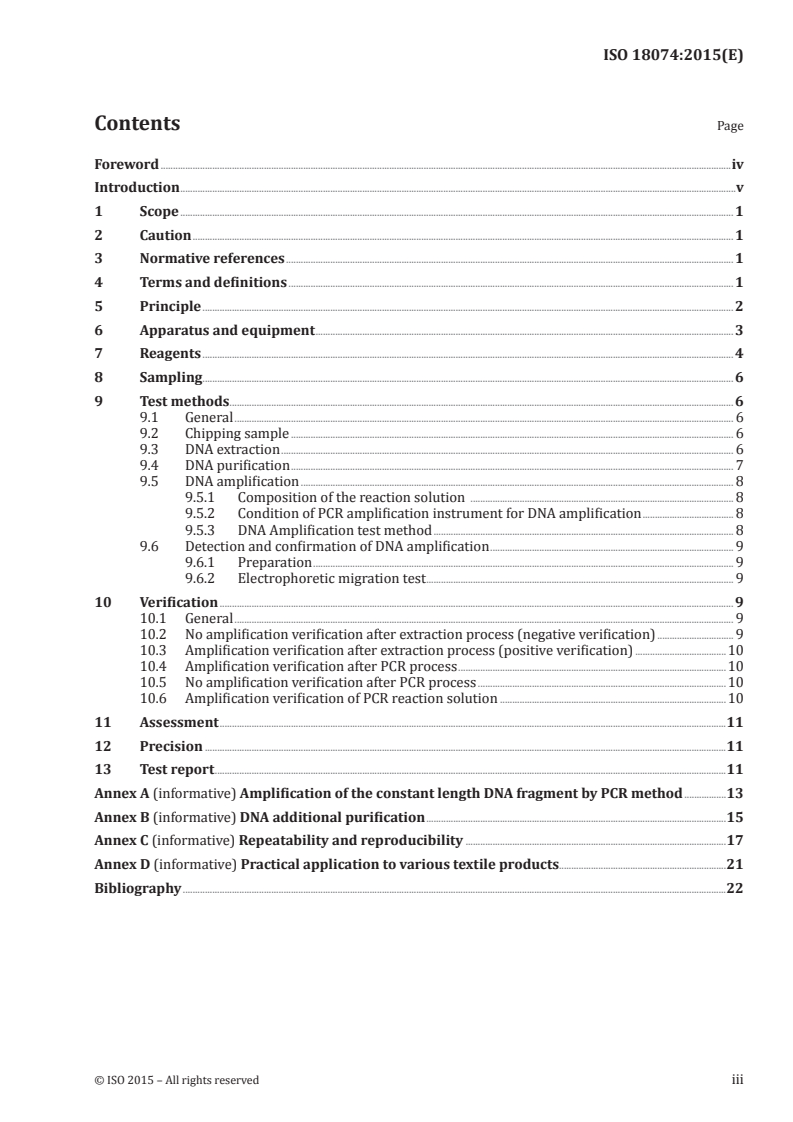
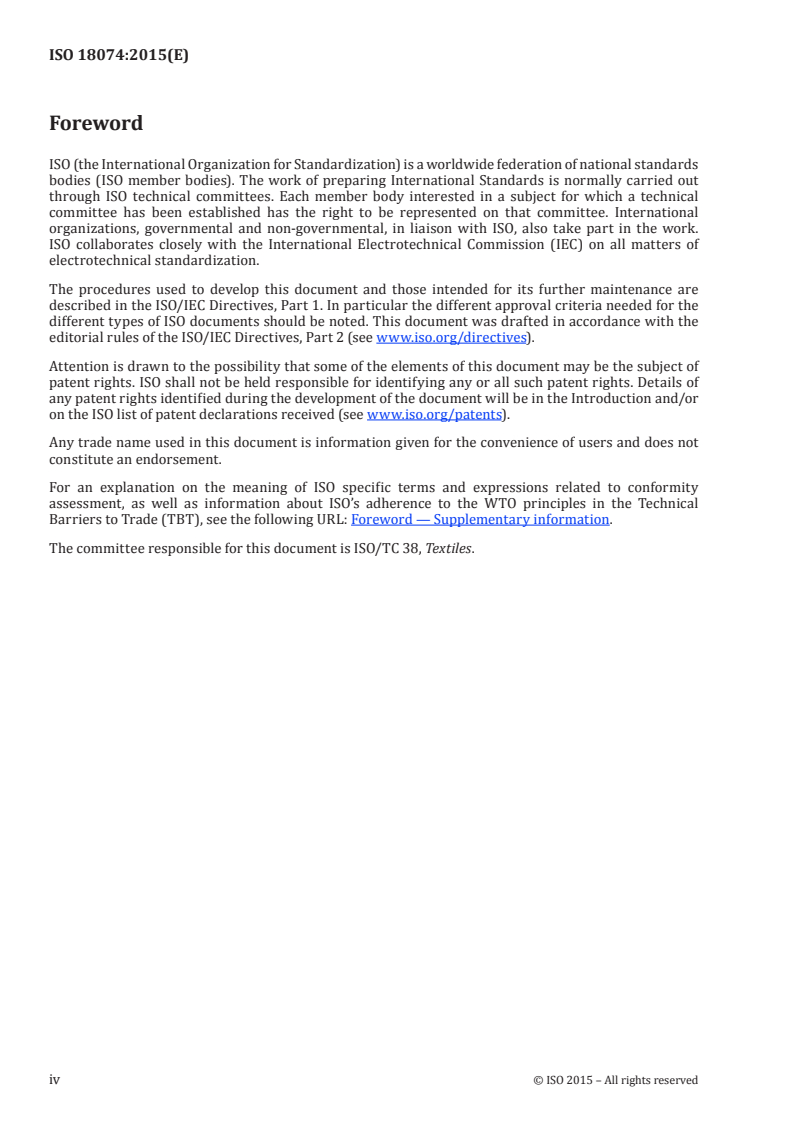
ISO 18074:2015 - Textiles — Identification of some animal fibres by DNA analysis method — Cashmere, wool, yak and their blends/19/2015
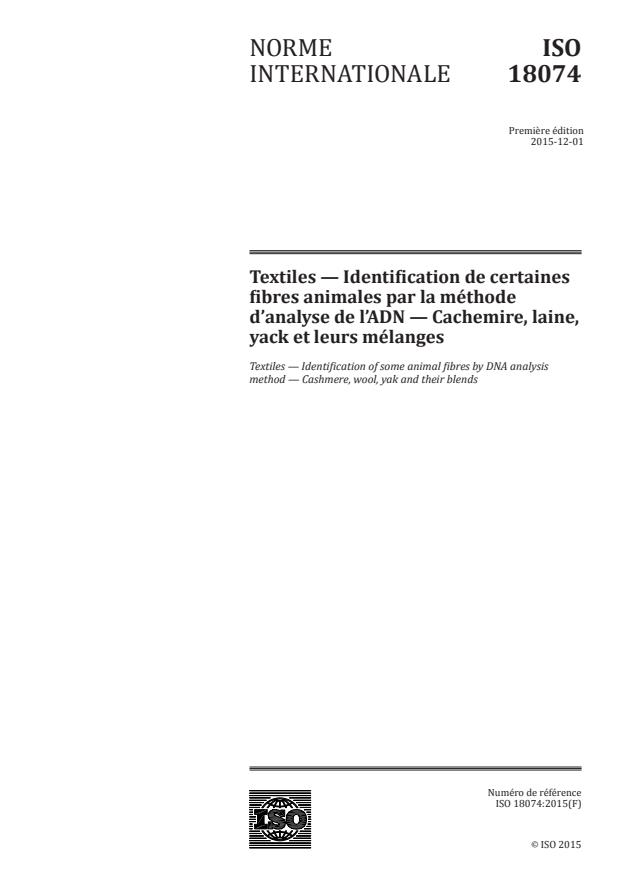

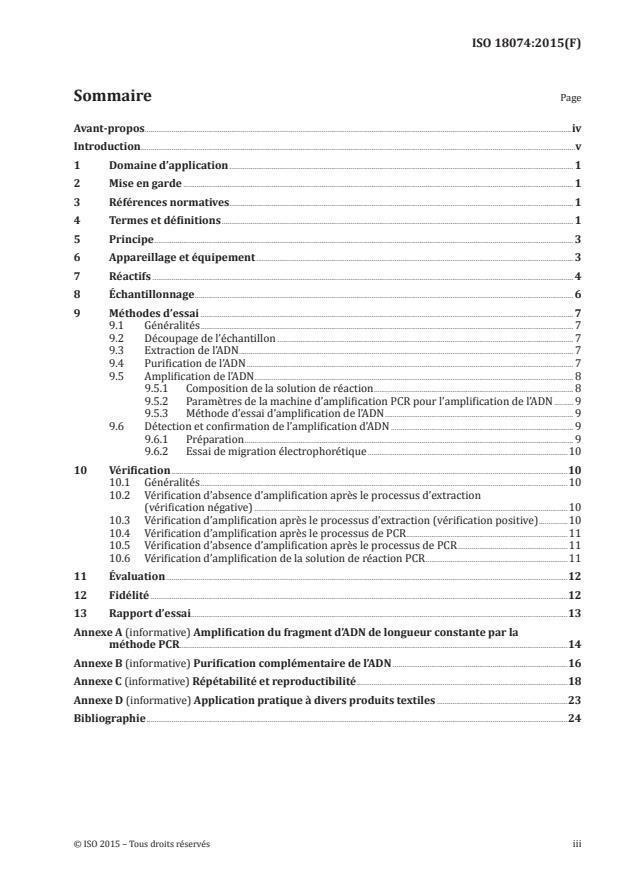
ISO 18074:2015 - Textiles -- Identification de certaines fibres animales par la méthode d'analyse de l'ADN -- Cachemire, laine, yack et leurs mélanges
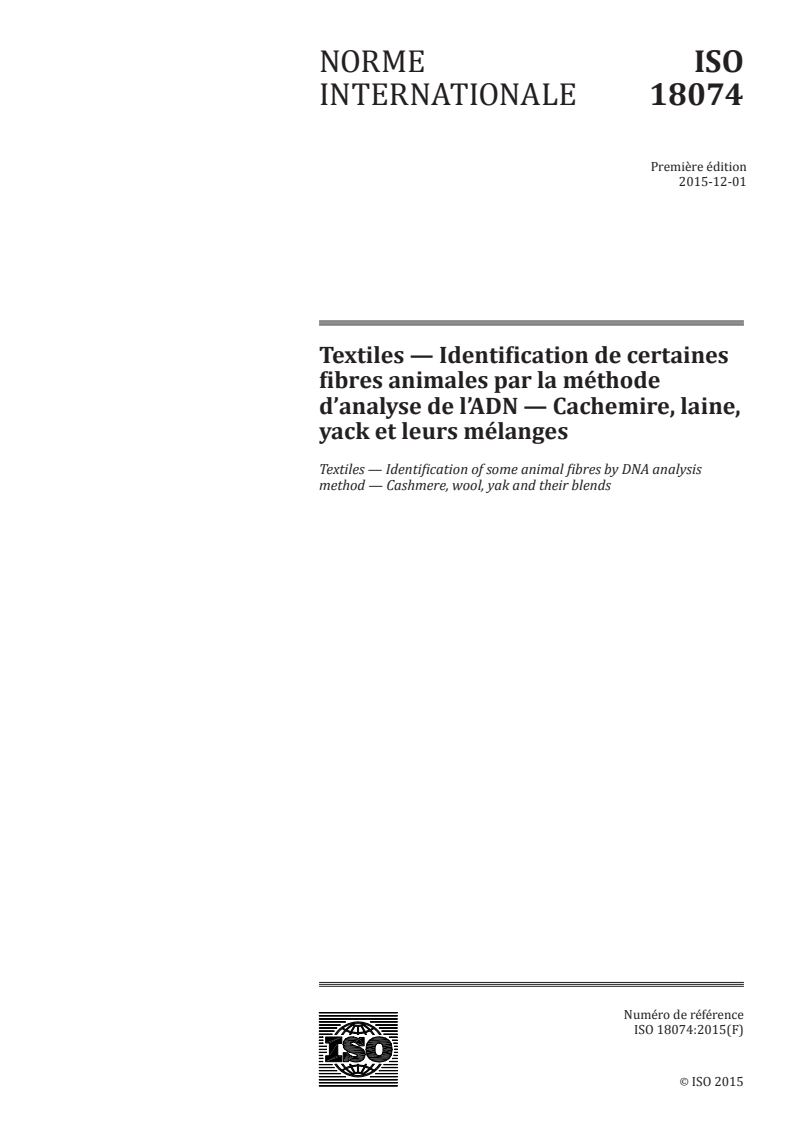

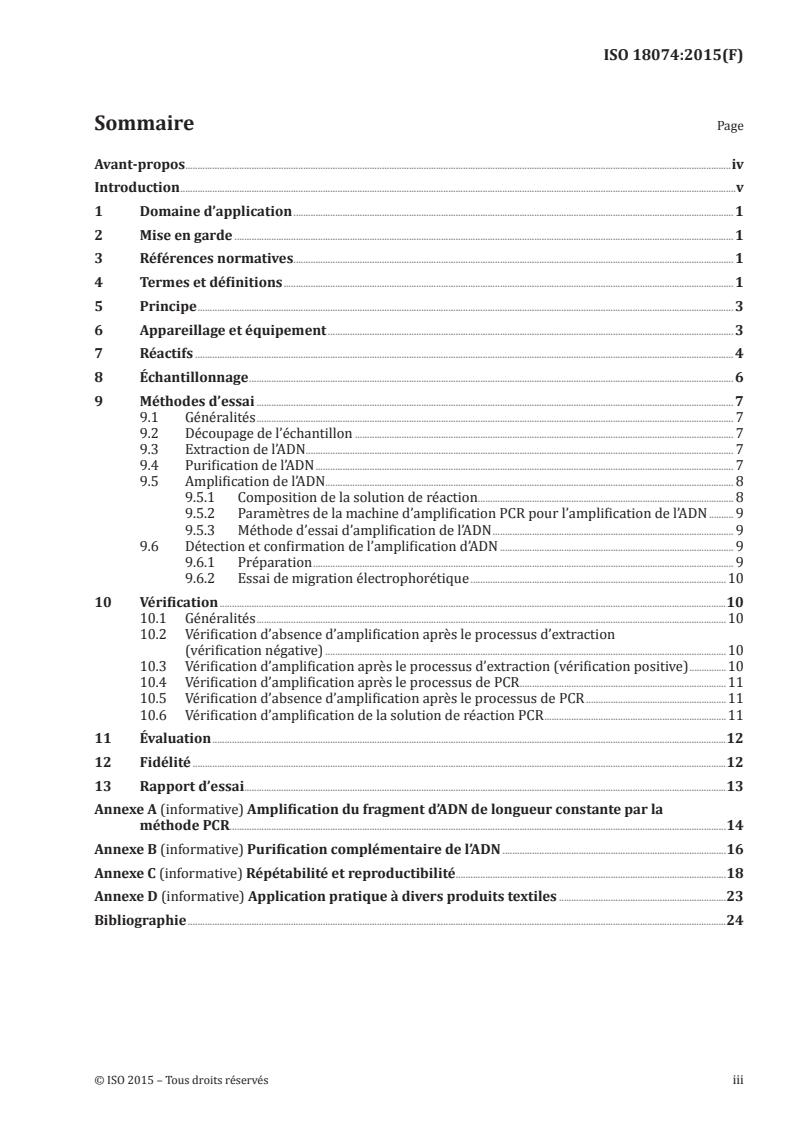
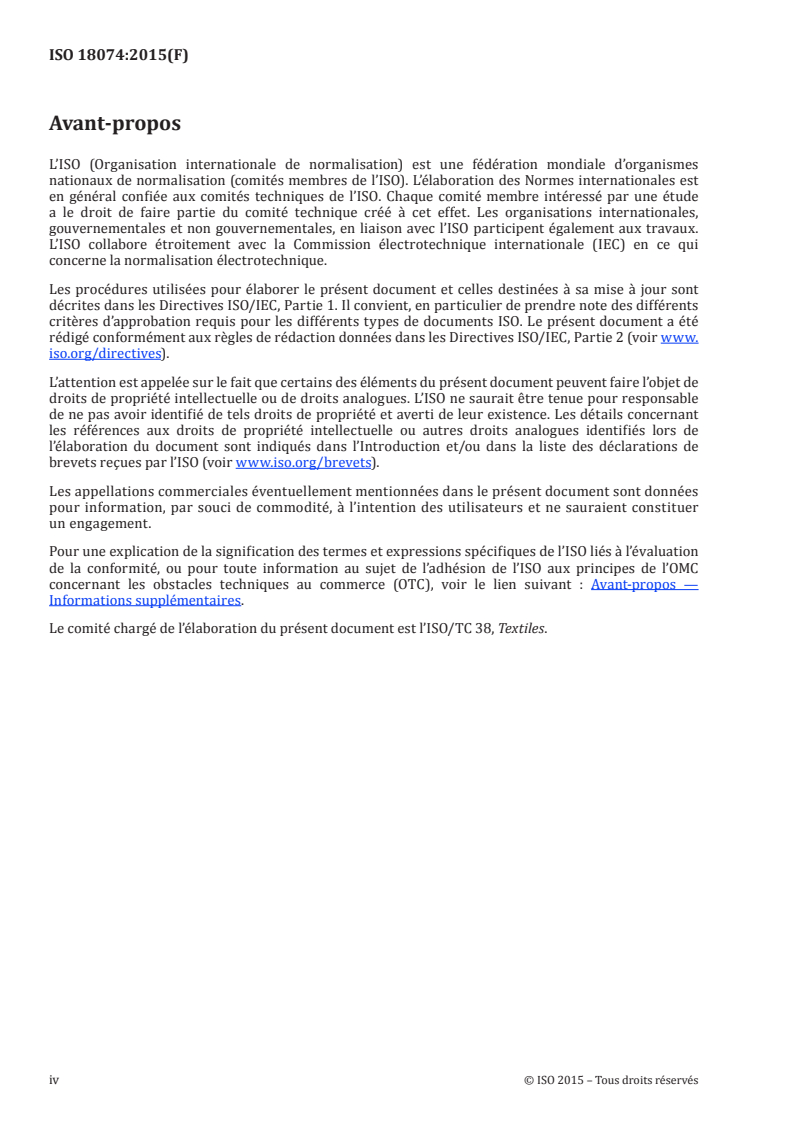
ISO 18074:2015 - Textiles — Identification de certaines fibres animales par la méthode d'analyse de l'ADN — Cachemire, laine, yack et leurs mélanges/19/2015
Overview
ISO 18074:2015 - Textiles: Identification of some animal fibres by DNA analysis method - Cashmere, wool, yak and their blends specifies a qualitative laboratory method to identify cashmere, wool and yak fibres (and their blends) using DNA analysis. The procedure relies on mitochondrial DNA extraction, PCR (polymerase chain reaction) amplification with species-specific primers and detection of the amplified constant-length fragments (typically by gel electrophoresis). The standard is intended for textile testing where microscopic identification is insufficient or ambiguous.
Key topics and technical requirements
- Scope: Qualitative identification of cashmere, wool and yak fibres and their blends using DNA-PCR techniques.
- Test principle: Extract mitochondrial DNA from fibre samples → purify → amplify target fragment with species-specific primers → detect amplification products to confirm species identity.
- Main test stages: Sampling, chipping/homogenization, DNA extraction, DNA purification, PCR amplification, electrophoretic detection and verification.
- Equipment & reagents: PCR instrument, heat block, centrifuge (≥14 000 g), microtubes, gel electrophoresis apparatus, UV illuminator, species-specific primers, nuclease-free water and standard chemical reagents.
- Verification & quality control: Positive and negative controls, amplification verification, and procedures to confirm no cross-contamination. Annexes provide guidance on amplification of constant-length fragments, additional purification, repeatability/reproducibility and practical application to textile products.
- Limitations & caution: High-temperature processing, heavy dyeing or aggressive finishes can damage mitochondrial DNA and impede amplification. Surface contamination (e.g., cashmere grease on wool) can affect results and may require microscopy cross-checks.
Applications and users
- Textile testing laboratories performing fibre composition verification and forensic fibre identification.
- Quality control teams in textile manufacturing and processing (cashmere, wool, yak products).
- Certification bodies and compliance laboratories verifying labelling and claims for animal fibre content.
- Customs and regulatory agencies handling provenance or mislabeling investigations in apparel and home textiles.
Practical benefits include higher specificity than purely microscopic methods for distinguishing closely related animal fibres and robust identification of blends when DNA is intact.
Related standards
- ISO 17751 - Microscopy-based identification of animal fibres (complementary method)
- ISO 3696 - Water for analytical laboratory use (reagent quality)
- ISO 8655-2 - Piston-operated volumetric apparatus (pipette performance)
- ISO/TC 38 - Technical committee responsible for textile standards
Keywords: ISO 18074, DNA analysis, cashmere identification, textile testing, PCR method, mitochondrial DNA, yak wool blends, gel electrophoresis.
Buy Documents
ISO 18074:2015 - Textiles -- Identification of some animal fibres by DNA analysis method -- Cashmere, wool, yak and their blends
ISO 18074:2015 - Textiles — Identification of some animal fibres by DNA analysis method — Cashmere, wool, yak and their blends/19/2015
ISO 18074:2015 - Textiles -- Identification de certaines fibres animales par la méthode d'analyse de l'ADN -- Cachemire, laine, yack et leurs mélanges
ISO 18074:2015 - Textiles — Identification de certaines fibres animales par la méthode d'analyse de l'ADN — Cachemire, laine, yack et leurs mélanges/19/2015
Get Certified
Connect with accredited certification bodies for this standard

Control Union Certifications
Global certification for agriculture and sustainability.

Hohenstein Institut
Textile testing and certification.

Bureau Veritas Bangladesh
Bureau Veritas certification services in Bangladesh.
Sponsored listings
Frequently Asked Questions
ISO 18074:2015 is a standard published by the International Organization for Standardization (ISO). Its full title is "Textiles — Identification of some animal fibres by DNA analysis method — Cashmere, wool, yak and their blends". This standard covers: ISO 18074:2015 specifies a testing method for DNA analysis of some animal fibres to identify cashmere, wool, yak, and their blends by using extraction, amplification by the polymerase chain reaction (PCR) method and DNA detection processes. ISO 18084:2015 is applicable to cashmere, yak, and wool and their blends as a qualitative method.
ISO 18074:2015 specifies a testing method for DNA analysis of some animal fibres to identify cashmere, wool, yak, and their blends by using extraction, amplification by the polymerase chain reaction (PCR) method and DNA detection processes. ISO 18084:2015 is applicable to cashmere, yak, and wool and their blends as a qualitative method.
ISO 18074:2015 is classified under the following ICS (International Classification for Standards) categories: 59.080.01 - Textiles in general. The ICS classification helps identify the subject area and facilitates finding related standards.
ISO 18074:2015 is available in PDF format for immediate download after purchase. The document can be added to your cart and obtained through the secure checkout process. Digital delivery ensures instant access to the complete standard document.
Standards Content (Sample)
INTERNATIONAL ISO
STANDARD 18074
First edition
2015-12-01
Textiles — Identification of some
animal fibres by DNA analysis method
— Cashmere, wool, yak and their
blends
Textiles — Identification de certaines fibres animales par la
méthode d’analyse de l’ADN — Cachemire, laine, yack et leurs
mélanges
Reference number
©
ISO 2015
COPYRIGHT PROTECTED DOCUMENT
© ISO 2015, Published in Switzerland
All rights reserved. Unless otherwise specified, no part of this publication may be reproduced or utilized otherwise in any form
or by any means, electronic or mechanical, including photocopying, or posting on the internet or an intranet, without prior
written permission. Permission can be requested from either ISO at the address below or ISO’s member body in the country of
the requester.
ISO copyright office
Ch. de Blandonnet 8 • CP 401
CH-1214 Vernier, Geneva, Switzerland
Tel. +41 22 749 01 11
Fax +41 22 749 09 47
copyright@iso.org
www.iso.org
ii © ISO 2015 – All rights reserved
Contents Page
Foreword .iv
Introduction .v
1 Scope . 1
2 Caution . 1
3 Normative references . 1
4 Terms and definitions . 1
5 Principle . 2
6 Apparatus and equipment . 3
7 Reagents . 4
8 Sampling . 6
9 Test methods . 6
9.1 General . 6
9.2 Chipping sample . 6
9.3 DNA extraction . 6
9.4 DNA purification . 7
9.5 DNA amplification . 8
9.5.1 Composition of the reaction solution . 8
9.5.2 Condition of PCR amplification instrument for DNA amplification . 8
9.5.3 DNA Amplification test method . 8
9.6 Detection and confirmation of DNA amplification . 9
9.6.1 Preparation . 9
9.6.2 Electrophoretic migration test . 9
10 Verification . 9
10.1 General . 9
10.2 No amplification verification after extraction process (negative verification) . 9
10.3 Amplification verification after extraction process (positive verification) .10
10.4 Amplification verification after PCR process .10
10.5 No amplification verification after PCR process .10
10.6 Amplification verification of PCR reaction solution .10
11 Assessment .11
12 Precision .11
13 Test report .11
Annex A (informative) Amplification of the constant length DNA fragment by PCR method .13
Annex B (informative) DNA additional purification .15
Annex C (informative) Repeatability and reproducibility .17
Annex D (informative) Practical application to various textile products.21
Bibliography .22
Foreword
ISO (the International Organization for Standardization) is a worldwide federation of national standards
bodies (ISO member bodies). The work of preparing International Standards is normally carried out
through ISO technical committees. Each member body interested in a subject for which a technical
committee has been established has the right to be represented on that committee. International
organizations, governmental and non-governmental, in liaison with ISO, also take part in the work.
ISO collaborates closely with the International Electrotechnical Commission (IEC) on all matters of
electrotechnical standardization.
The procedures used to develop this document and those intended for its further maintenance are
described in the ISO/IEC Directives, Part 1. In particular the different approval criteria needed for the
different types of ISO documents should be noted. This document was drafted in accordance with the
editorial rules of the ISO/IEC Directives, Part 2 (see www.iso.org/directives).
Attention is drawn to the possibility that some of the elements of this document may be the subject of
patent rights. ISO shall not be held responsible for identifying any or all such patent rights. Details of
any patent rights identified during the development of the document will be in the Introduction and/or
on the ISO list of patent declarations received (see www.iso.org/patents).
Any trade name used in this document is information given for the convenience of users and does not
constitute an endorsement.
For an explanation on the meaning of ISO specific terms and expressions related to conformity
assessment, as well as information about ISO’s adherence to the WTO principles in the Technical
Barriers to Trade (TBT), see the following URL: Foreword — Supplementary information.
The committee responsible for this document is ISO/TC 38, Textiles.
iv © ISO 2015 – All rights reserved
Introduction
The composition of fibres in textile products is one of the most important properties. Labelling of
composition of textile products is required globally by legislation or by voluntary regulation for fair trade.
The testing method to determine the composition of some animal fibres in the textile products has been
[3]
developed as ISO 17751 . This is only one method to determine the animal fibre composition currently
available. In this method, animal fibres are observed by microscope and identified from the shape of
scales by experienced examiners. Many samples can be tested with a high degree of efficiency using this
method. However, even experienced examiners have difficulties in identifying fibres, because textile
products have a broad variety of colours and finishings, and there are many blends in animal fibres.
Given this situation, several testing methods to obtain the more accurate results have been investigated
and developed. Among those methods, the DNA (deoxyribonucleic acid) analysis method has been found
to be a practical and feasible method to identify the inherent type of animal fibres.
As it is well known, DNA is specific for animals. The DNA-PCR (polymerase chain reaction) method has
recently been developed with high accuracy. A very trivial quantity of the DNA extracted from animal
fibres is amplified by PCR to yield a huge quantity of copy DNA. Mitochondrial DNA is used for this
analysis because it provides greater numbers than nuclear DNA.
INTERNATIONAL STANDARD ISO 18074:2015(E)
Textiles — Identification of some animal fibres by DNA
analysis method — Cashmere, wool, yak and their blends
WARNING — The use of this International Standard can involve hazardous materials,
operations, and equipment. This International Standard does not purport to address all of the
safety problems associated with its use. It is the responsibility of the user of this International
Standard to establish appropriate safety and health practices and determine the applicability of
regulatory limitations and supplier’s requirement for safety prior to use.
1 Scope
This International Standard specifies a testing method for DNA analysis of some animal fibres to
identify cashmere, wool, yak, and their blends by using extraction, amplification by the polymerase
chain reaction (PCR) method and DNA detection processes.
This International Standard is applicable to cashmere, yak, and wool and their blends as a
qualitative method.
2 Caution
Test results for fibre identification by the DNA analysis method can be obtained with a high accuracy
for the above-mentioned textile products which were processed at lower dye concentration levels or
dyed in light colours.
However, when such textile products were processed under severe conditions or high temperatures,
the mitochondrial DNA could have been damaged. In such cases, identification can be difficult because
amplification of DNA by PCR cannot take place. If textile products were contaminated by using products
from another species, such as cashmere grease on wool fibres, this situation may be solved by checking
using microscopy techniques.
3 Normative references
The following documents, in whole or in part, are normatively referenced in this document and are
indispensable for its application. For dated references, only the edition cited applies. For undated
references, the latest edition of the referenced document (including any amendments) applies.
ISO 3696, Water for analytical laboratory use — Specification and test methods
ISO 8655-2, Piston-operated volumetric apparatus — Part 2: Piston pipettes
4 Terms and definitions
For the purposes of this document, the following terms and definitions apply.
4.1
DNA
deoxyribonucleic acid, that exists in nuclei and in mitochondria of animal fibre cells and is composed of
a linear array of 4 bases (Adenine: A, Thymine: T, Guanine: G and Cytosine: C)
Note 1 to entry: The DNA sequence is identical and intrinsic for each animal fibre.
4.2
animal fibres
cashmere, wool, or yak fibres
4.3
buffer solution
solution used to maintain pH of reaction solution at required value
4.4
reducing agent
agent that degrades animal fibres through reductive cleavage of S-S bonds in the fibres
4.5
DNA amplification
amplification of the specific fragment of DNA by the PCR method
4.6
PCR method
method of the polymerase chain reaction
Note 1 to entry: The amplification process of the DNA fragment with a constant length is explained in Annex A.
4.7
DNA polymerase for PCR method
heat-stable DNA polymerase that is used for PCR and has no proof reading activity
4.8
primer
short length fragment of a single strand DNA which is a reaction initiator and designed as the identical
sequence of 18-30 bases to DNA of the animal fibre
4.9
primer set
set of primer with the reaction direction of forward and reverse
4.10
primer for cashmere
primer with an identical base sequence of mitochondrial DNA of cashmere
Note 1 to entry: The sequence of base for primers will be submitted to the public database.
4.11
primer for wool
primer with an identical base sequence to mitochondrial DNA of wool
4.12
primer for yak
primer DNA with an identical base sequence to mitochondrial DNA of yak
Note 1 to entry: Information concerning the primers may be obtained from ISO/TC 38 secretariat.
4.13
gel electrophoresis migration
method to detect the amplified constant length DNA fragments
5 Principle
Mitochondrial DNA is extracted from animal fibre samples by using a chemical and enzyme reaction.
The extracted DNA is purified by using a precipitation method and centrifuge. The purified DNA is
applied for the amplification reaction of PCR method. In the PCR method, primers for cashmere, yak and
wool are respectively tested. If the sample is cashmere, only cashmere primer can amplify the constant
length of DNA fragments. Then, the constant length of DNA fragments is detected by the electrophoretic
migration method.
2 © ISO 2015 – All rights reserved
The sample fibres are identified by knowing whether amplification was observed or not for the tests
using all primers respectively.
6 Apparatus and equipment
6.1 Pipettes, capable of measuring and taking (0 to 20) μl (±0,20 µl), (20 to 200) μl (±1,60 µl), (200 to
1 000) μl (±8 µl) within systematic errors defined in ISO 8655-2.
6.2 Micro tube, capable of withstanding the centrifugation of 14 000g and autoclave.
The capacity is 2 ml for purification and 0,2 ml for PCR method. A tube of 0,2 ml for PCR method should
follow the manufacturer’s recommendation of the PCR instrument.
6.3 Cap lock, use for micro tube.
6.4 Heat block, with mounting holes for micro tubes and capable of heating up to about 80 °C (±1,0 °C).
6.5 Shaking agitator, capable of heating up to 50 °C and maintaining at the temperature of 50 °C and
shaking micro tube at around 500 r/min or higher.
6.6 Shaking machine, capable of mounting micro tubes and shaking at around 500 times/min or higher.
This machine can be replaced by an equivalent instrument such as microtube rotator which is possible
to rotate at 30 r/min or higher.
6.7 Centrifuge, capable of centrifuging of 14 000g or higher, setting up temperature from 0 °C to room
temperature and mounting micro tubes or units of centrifugal ultrafiltration.
1)
6.8 Unit of centrifugal ultrafiltration , capable of capturing molecules with the molecular weight of
100 kDa (Dalton) or more.
2)
6.9 PCR instrument , capable of programing for temperature and time.
6.10 UV illuminator, UV irradiator.
6.11 Photo booth.
6.12 Generic plastic box with a resealable lid.
6.13 Comb, used for making wells in the agarose gel of the gel electrophoresis migration test.
6.14 Mixer mill, used for mixing and homogenizing animal fibres.
6.15 Erlenmeyer flask, with capacity 200 ml.
1) Amicon Ultra is an example of a suitable product available commercially. This information is given for the
convenience of users of this document and does not constitute an endorsement by ISO of this product.
2) Life Technologies Corporation is a provider of a suitable product available commercially. This information is
given for the convenience of users of this document and does not constitute an endorsement by ISO of this product.
Equivalent products may be used if they can be shown to lead to the same results.
7 Reagents
7.1 Pure water.
Use pure water as defined in ISO 3696 with the purity of Grade 1. This water should not have DNase
(DNA digesting) activity. It should not contain a significant amount of DNA which can be amplified by
primers and should not show inhibitory effects for this testing method.
7.2 Chloroform/isoamyl alcohol reagent.
100 % concentration of the highest grade.
— Chloroform 9,6 ml
— Isoamyl alcohol 400 μl
7.3 Sodium perchlorate solution.
— Sodium perchlorate 6,1 g
Make the solution up to 10 ml by adding pure water.
7.4 1 mol/l Tris – HCl [tris(hydroxymethyl)aminomethane].
Dissolve 12,1 g of tris(hydroxymethyl)aminomethane in 800 ml of pure water, then adjust the pH to 8,0
by adding HCl and using a pH-meter. Then, make it up to 1 000 ml by adding pure water.
7.5 500 mmol/l EDTA (ethylenediaminetetraacetic acid).
Dissolve 186,1 g of EDTA·Na ·2H O (disodium salt-dihydrate of EDTA) in 800 ml pure water, then adjust
2 2
pH to 8,0 by adding NaOH and using a pH-meter. Then, make it up to 1 000 ml by adding pure water.
7.6 Buffer solution A.
— 1 mol/l Tris-HCL (7.4) 5 ml
— 500 mmol/l EDTA (7.5) 2 ml
— Sodium lauryl sulfate (SLS) (C H SO Na) 0,2 g
12 25 4
— Sucrose 1,2 g
— Sodium chloride 170 mg
— Dithiothreitol (DTT) 920 mg
Make it up to 10 ml by adding pure water. Prepare fresh before use.
Due to its volatile nature, DTT should be added after autoclaving, so that its effectiveness is not reduced.
7.7 Buffer solution B.
— 500 mmol/l EDTA (7.5) 0,2 ml
Make it up to 100 ml by adding pure water.
7.8 Protein resolving enzyme solution, the papain solution, with a papain of 10 units dissolved in
pure water (e.g. 10 units/20 μl).
4 © ISO 2015 – All rights reserved
7.9 Heat-stable DNA polymerase, without 3‘ to 5‘ exonuclease activity.
7.10 Animal fibre A primer 1, forward primers for cashmere, yak, and wool.
7.11 Animal fibre A primer 2, reverse primers for cashmere, yak, and wool.
7.12 DNA composition component, with a grade for the PCR method.
7.13 Buffer solution for polymerase, suitable for the polymerase of the PCR reaction.
This buffer solution may be designated by manufacturers of polymerase.
7.14 Salt, potassium chloride (KCl), used to stabilize the PCR reaction.
7.15 Magnesium chloride (MgCl ), used to stabilize the PCR reaction.
7.16 Gel electrophoretic migration marker.
7.17 Agarose, a kind of agar with a grade for DNA electrophoretic migration.
7.18 Buffer solution for loading on the electrophoretic migration.
— Glycerol 36 g
— 500 mmol/l EDTA (7.5) 6 ml
— Bromophenol Blue 0,25 g
— Xylene cyanol 0,25 g
Make it up to 100 ml by adding pure water. After adding the solution of more than 1/6 to the sample
reaction solution, load it on the gel.
7.19 Buffer solution for electrophoretic migration.
— tris(hydroxymethyl)aminomethane base (Triz- 242 g
ma base)
— Acetic acid (glacial acetic acid) 57,1 ml
— EDTA·2Na 7,43 g
Dissolve using pure water and make the solution up to 1 l by adding pure water. Then, dilute it 50 times
with pure water.
7.20 DNA dyeing colorant, ethidium bromide.
Ethidium bromide dissolves in the buffer solution for electrophoretic migration so as to be
approximately 5 μg/ml.
NOTE Other DNA intercalating agents can be used as substitute for ethidium bromide.
7.21 Common DNA fragment, primer.
Common DNA fragments are common base alignments existing in all the DNAs of cashmere, yak, and
wool. Common primer 1 is a forward primer; common primer 2 is a reverse primer.
NOTE Information on primers can be obtained from ISO/TC 38 secretariat.
8 Sampling
Animal fibre samples shall represent the textile products for test. If the textile product is composed by
several parts, separate them into identical parts and describe the details of the parts in the test report.
Avoid contamination among the parts.
Two test specimens are selected from the sample. When the two results are not consistent, do not adopt
the results and perform another test for two specimens again.
NOTE ISO 17751:2007, Annex B can be used as a reference for this procedure.
9 Test methods
9.1 General
The test should be performed in parallel for the primers for cashmere, yak, and wool.
9.2 Chipping sample
Chip the animal fibre sample of 100 mg with the length of less than 2 mm by scissors, mixer mill, or
3)
other instruments. Then, put the chipped sample of 50 mg into a micro tube with a 2,0 ml capacity.
9.3 DNA extraction
Follow the procedure described in 9.3.1 to 9.3.6.
9.3.1 Add 600 μl of buffer solution A (7.6) to the micro tube with the test sample (9.2).
9.3.2 Cap the micro tube and then tumble it by hand to immerse the sample in the buffer solution
perfectly.
9.3.3 Lock the cap of the micro tube using a cap lock. Then, heat the micro tube with the test specimen at
60 °C for 20 min using the heat block. Take out the micro tube at 3 min, 6 min, 9 min, and 15 min from the
heat block and tumble it for 10 s by hand. Then, put it back on the heat block again and continue heating.
9.3.4 After 20 min, take out the micro tube from the heat block and cool it down to room temperature.
9.3.5 Add 10 units of papain solution (7.8) to the micro tube with the test specimen. Then, heat up
the micro tube to 50 °C. Maintain the temperature at 50 °C and shake it at 500 r/min for 1 h using the
shaking agitator (6.5).
9.3.6 Add 10 units of papain solution (7.8) to the micro tube of 9.3.5. Maintain the temperature at
50 °C. Shake it at 500 r/min for over 12 h. Cool it down to room temperature.
3) Eppendorf tubes are an example of suitable products available commercially. This information is given for the
convenience of users of this document and does not constitute an endorsement by ISO of these products. Equivalent
products may be used if they can be shown to lead to the same results.
6 © ISO 2015 – All rights reserved
9.4 DNA purificat
...
INTERNATIONAL ISO
STANDARD 18074
First edition
2015-12-01
Textiles — Identification of some
animal fibres by DNA analysis method
— Cashmere, wool, yak and their
blends
Textiles — Identification de certaines fibres animales par la
méthode d’analyse de l’ADN — Cachemire, laine, yack et leurs
mélanges
Reference number
©
ISO 2015
COPYRIGHT PROTECTED DOCUMENT
© ISO 2015, Published in Switzerland
All rights reserved. Unless otherwise specified, no part of this publication may be reproduced or utilized otherwise in any form
or by any means, electronic or mechanical, including photocopying, or posting on the internet or an intranet, without prior
written permission. Permission can be requested from either ISO at the address below or ISO’s member body in the country of
the requester.
ISO copyright office
Ch. de Blandonnet 8 • CP 401
CH-1214 Vernier, Geneva, Switzerland
Tel. +41 22 749 01 11
Fax +41 22 749 09 47
copyright@iso.org
www.iso.org
ii © ISO 2015 – All rights reserved
Contents Page
Foreword .iv
Introduction .v
1 Scope . 1
2 Caution . 1
3 Normative references . 1
4 Terms and definitions . 1
5 Principle . 2
6 Apparatus and equipment . 3
7 Reagents . 4
8 Sampling . 6
9 Test methods . 6
9.1 General . 6
9.2 Chipping sample . 6
9.3 DNA extraction . 6
9.4 DNA purification . 7
9.5 DNA amplification . 8
9.5.1 Composition of the reaction solution . 8
9.5.2 Condition of PCR amplification instrument for DNA amplification . 8
9.5.3 DNA Amplification test method . 8
9.6 Detection and confirmation of DNA amplification . 9
9.6.1 Preparation . 9
9.6.2 Electrophoretic migration test . 9
10 Verification . 9
10.1 General . 9
10.2 No amplification verification after extraction process (negative verification) . 9
10.3 Amplification verification after extraction process (positive verification) .10
10.4 Amplification verification after PCR process .10
10.5 No amplification verification after PCR process .10
10.6 Amplification verification of PCR reaction solution .10
11 Assessment .11
12 Precision .11
13 Test report .11
Annex A (informative) Amplification of the constant length DNA fragment by PCR method .13
Annex B (informative) DNA additional purification .15
Annex C (informative) Repeatability and reproducibility .17
Annex D (informative) Practical application to various textile products.21
Bibliography .22
Foreword
ISO (the International Organization for Standardization) is a worldwide federation of national standards
bodies (ISO member bodies). The work of preparing International Standards is normally carried out
through ISO technical committees. Each member body interested in a subject for which a technical
committee has been established has the right to be represented on that committee. International
organizations, governmental and non-governmental, in liaison with ISO, also take part in the work.
ISO collaborates closely with the International Electrotechnical Commission (IEC) on all matters of
electrotechnical standardization.
The procedures used to develop this document and those intended for its further maintenance are
described in the ISO/IEC Directives, Part 1. In particular the different approval criteria needed for the
different types of ISO documents should be noted. This document was drafted in accordance with the
editorial rules of the ISO/IEC Directives, Part 2 (see www.iso.org/directives).
Attention is drawn to the possibility that some of the elements of this document may be the subject of
patent rights. ISO shall not be held responsible for identifying any or all such patent rights. Details of
any patent rights identified during the development of the document will be in the Introduction and/or
on the ISO list of patent declarations received (see www.iso.org/patents).
Any trade name used in this document is information given for the convenience of users and does not
constitute an endorsement.
For an explanation on the meaning of ISO specific terms and expressions related to conformity
assessment, as well as information about ISO’s adherence to the WTO principles in the Technical
Barriers to Trade (TBT), see the following URL: Foreword — Supplementary information.
The committee responsible for this document is ISO/TC 38, Textiles.
iv © ISO 2015 – All rights reserved
Introduction
The composition of fibres in textile products is one of the most important properties. Labelling of
composition of textile products is required globally by legislation or by voluntary regulation for fair trade.
The testing method to determine the composition of some animal fibres in the textile products has been
[3]
developed as ISO 17751 . This is only one method to determine the animal fibre composition currently
available. In this method, animal fibres are observed by microscope and identified from the shape of
scales by experienced examiners. Many samples can be tested with a high degree of efficiency using this
method. However, even experienced examiners have difficulties in identifying fibres, because textile
products have a broad variety of colours and finishings, and there are many blends in animal fibres.
Given this situation, several testing methods to obtain the more accurate results have been investigated
and developed. Among those methods, the DNA (deoxyribonucleic acid) analysis method has been found
to be a practical and feasible method to identify the inherent type of animal fibres.
As it is well known, DNA is specific for animals. The DNA-PCR (polymerase chain reaction) method has
recently been developed with high accuracy. A very trivial quantity of the DNA extracted from animal
fibres is amplified by PCR to yield a huge quantity of copy DNA. Mitochondrial DNA is used for this
analysis because it provides greater numbers than nuclear DNA.
INTERNATIONAL STANDARD ISO 18074:2015(E)
Textiles — Identification of some animal fibres by DNA
analysis method — Cashmere, wool, yak and their blends
WARNING — The use of this International Standard can involve hazardous materials,
operations, and equipment. This International Standard does not purport to address all of the
safety problems associated with its use. It is the responsibility of the user of this International
Standard to establish appropriate safety and health practices and determine the applicability of
regulatory limitations and supplier’s requirement for safety prior to use.
1 Scope
This International Standard specifies a testing method for DNA analysis of some animal fibres to
identify cashmere, wool, yak, and their blends by using extraction, amplification by the polymerase
chain reaction (PCR) method and DNA detection processes.
This International Standard is applicable to cashmere, yak, and wool and their blends as a
qualitative method.
2 Caution
Test results for fibre identification by the DNA analysis method can be obtained with a high accuracy
for the above-mentioned textile products which were processed at lower dye concentration levels or
dyed in light colours.
However, when such textile products were processed under severe conditions or high temperatures,
the mitochondrial DNA could have been damaged. In such cases, identification can be difficult because
amplification of DNA by PCR cannot take place. If textile products were contaminated by using products
from another species, such as cashmere grease on wool fibres, this situation may be solved by checking
using microscopy techniques.
3 Normative references
The following documents, in whole or in part, are normatively referenced in this document and are
indispensable for its application. For dated references, only the edition cited applies. For undated
references, the latest edition of the referenced document (including any amendments) applies.
ISO 3696, Water for analytical laboratory use — Specification and test methods
ISO 8655-2, Piston-operated volumetric apparatus — Part 2: Piston pipettes
4 Terms and definitions
For the purposes of this document, the following terms and definitions apply.
4.1
DNA
deoxyribonucleic acid, that exists in nuclei and in mitochondria of animal fibre cells and is composed of
a linear array of 4 bases (Adenine: A, Thymine: T, Guanine: G and Cytosine: C)
Note 1 to entry: The DNA sequence is identical and intrinsic for each animal fibre.
4.2
animal fibres
cashmere, wool, or yak fibres
4.3
buffer solution
solution used to maintain pH of reaction solution at required value
4.4
reducing agent
agent that degrades animal fibres through reductive cleavage of S-S bonds in the fibres
4.5
DNA amplification
amplification of the specific fragment of DNA by the PCR method
4.6
PCR method
method of the polymerase chain reaction
Note 1 to entry: The amplification process of the DNA fragment with a constant length is explained in Annex A.
4.7
DNA polymerase for PCR method
heat-stable DNA polymerase that is used for PCR and has no proof reading activity
4.8
primer
short length fragment of a single strand DNA which is a reaction initiator and designed as the identical
sequence of 18-30 bases to DNA of the animal fibre
4.9
primer set
set of primer with the reaction direction of forward and reverse
4.10
primer for cashmere
primer with an identical base sequence of mitochondrial DNA of cashmere
Note 1 to entry: The sequence of base for primers will be submitted to the public database.
4.11
primer for wool
primer with an identical base sequence to mitochondrial DNA of wool
4.12
primer for yak
primer DNA with an identical base sequence to mitochondrial DNA of yak
Note 1 to entry: Information concerning the primers may be obtained from ISO/TC 38 secretariat.
4.13
gel electrophoresis migration
method to detect the amplified constant length DNA fragments
5 Principle
Mitochondrial DNA is extracted from animal fibre samples by using a chemical and enzyme reaction.
The extracted DNA is purified by using a precipitation method and centrifuge. The purified DNA is
applied for the amplification reaction of PCR method. In the PCR method, primers for cashmere, yak and
wool are respectively tested. If the sample is cashmere, only cashmere primer can amplify the constant
length of DNA fragments. Then, the constant length of DNA fragments is detected by the electrophoretic
migration method.
2 © ISO 2015 – All rights reserved
The sample fibres are identified by knowing whether amplification was observed or not for the tests
using all primers respectively.
6 Apparatus and equipment
6.1 Pipettes, capable of measuring and taking (0 to 20) μl (±0,20 µl), (20 to 200) μl (±1,60 µl), (200 to
1 000) μl (±8 µl) within systematic errors defined in ISO 8655-2.
6.2 Micro tube, capable of withstanding the centrifugation of 14 000g and autoclave.
The capacity is 2 ml for purification and 0,2 ml for PCR method. A tube of 0,2 ml for PCR method should
follow the manufacturer’s recommendation of the PCR instrument.
6.3 Cap lock, use for micro tube.
6.4 Heat block, with mounting holes for micro tubes and capable of heating up to about 80 °C (±1,0 °C).
6.5 Shaking agitator, capable of heating up to 50 °C and maintaining at the temperature of 50 °C and
shaking micro tube at around 500 r/min or higher.
6.6 Shaking machine, capable of mounting micro tubes and shaking at around 500 times/min or higher.
This machine can be replaced by an equivalent instrument such as microtube rotator which is possible
to rotate at 30 r/min or higher.
6.7 Centrifuge, capable of centrifuging of 14 000g or higher, setting up temperature from 0 °C to room
temperature and mounting micro tubes or units of centrifugal ultrafiltration.
1)
6.8 Unit of centrifugal ultrafiltration , capable of capturing molecules with the molecular weight of
100 kDa (Dalton) or more.
2)
6.9 PCR instrument , capable of programing for temperature and time.
6.10 UV illuminator, UV irradiator.
6.11 Photo booth.
6.12 Generic plastic box with a resealable lid.
6.13 Comb, used for making wells in the agarose gel of the gel electrophoresis migration test.
6.14 Mixer mill, used for mixing and homogenizing animal fibres.
6.15 Erlenmeyer flask, with capacity 200 ml.
1) Amicon Ultra is an example of a suitable product available commercially. This information is given for the
convenience of users of this document and does not constitute an endorsement by ISO of this product.
2) Life Technologies Corporation is a provider of a suitable product available commercially. This information is
given for the convenience of users of this document and does not constitute an endorsement by ISO of this product.
Equivalent products may be used if they can be shown to lead to the same results.
7 Reagents
7.1 Pure water.
Use pure water as defined in ISO 3696 with the purity of Grade 1. This water should not have DNase
(DNA digesting) activity. It should not contain a significant amount of DNA which can be amplified by
primers and should not show inhibitory effects for this testing method.
7.2 Chloroform/isoamyl alcohol reagent.
100 % concentration of the highest grade.
— Chloroform 9,6 ml
— Isoamyl alcohol 400 μl
7.3 Sodium perchlorate solution.
— Sodium perchlorate 6,1 g
Make the solution up to 10 ml by adding pure water.
7.4 1 mol/l Tris – HCl [tris(hydroxymethyl)aminomethane].
Dissolve 12,1 g of tris(hydroxymethyl)aminomethane in 800 ml of pure water, then adjust the pH to 8,0
by adding HCl and using a pH-meter. Then, make it up to 1 000 ml by adding pure water.
7.5 500 mmol/l EDTA (ethylenediaminetetraacetic acid).
Dissolve 186,1 g of EDTA·Na ·2H O (disodium salt-dihydrate of EDTA) in 800 ml pure water, then adjust
2 2
pH to 8,0 by adding NaOH and using a pH-meter. Then, make it up to 1 000 ml by adding pure water.
7.6 Buffer solution A.
— 1 mol/l Tris-HCL (7.4) 5 ml
— 500 mmol/l EDTA (7.5) 2 ml
— Sodium lauryl sulfate (SLS) (C H SO Na) 0,2 g
12 25 4
— Sucrose 1,2 g
— Sodium chloride 170 mg
— Dithiothreitol (DTT) 920 mg
Make it up to 10 ml by adding pure water. Prepare fresh before use.
Due to its volatile nature, DTT should be added after autoclaving, so that its effectiveness is not reduced.
7.7 Buffer solution B.
— 500 mmol/l EDTA (7.5) 0,2 ml
Make it up to 100 ml by adding pure water.
7.8 Protein resolving enzyme solution, the papain solution, with a papain of 10 units dissolved in
pure water (e.g. 10 units/20 μl).
4 © ISO 2015 – All rights reserved
7.9 Heat-stable DNA polymerase, without 3‘ to 5‘ exonuclease activity.
7.10 Animal fibre A primer 1, forward primers for cashmere, yak, and wool.
7.11 Animal fibre A primer 2, reverse primers for cashmere, yak, and wool.
7.12 DNA composition component, with a grade for the PCR method.
7.13 Buffer solution for polymerase, suitable for the polymerase of the PCR reaction.
This buffer solution may be designated by manufacturers of polymerase.
7.14 Salt, potassium chloride (KCl), used to stabilize the PCR reaction.
7.15 Magnesium chloride (MgCl ), used to stabilize the PCR reaction.
7.16 Gel electrophoretic migration marker.
7.17 Agarose, a kind of agar with a grade for DNA electrophoretic migration.
7.18 Buffer solution for loading on the electrophoretic migration.
— Glycerol 36 g
— 500 mmol/l EDTA (7.5) 6 ml
— Bromophenol Blue 0,25 g
— Xylene cyanol 0,25 g
Make it up to 100 ml by adding pure water. After adding the solution of more than 1/6 to the sample
reaction solution, load it on the gel.
7.19 Buffer solution for electrophoretic migration.
— tris(hydroxymethyl)aminomethane base (Triz- 242 g
ma base)
— Acetic acid (glacial acetic acid) 57,1 ml
— EDTA·2Na 7,43 g
Dissolve using pure water and make the solution up to 1 l by adding pure water. Then, dilute it 50 times
with pure water.
7.20 DNA dyeing colorant, ethidium bromide.
Ethidium bromide dissolves in the buffer solution for electrophoretic migration so as to be
approximately 5 μg/ml.
NOTE Other DNA intercalating agents can be used as substitute for ethidium bromide.
7.21 Common DNA fragment, primer.
Common DNA fragments are common base alignments existing in all the DNAs of cashmere, yak, and
wool. Common primer 1 is a forward primer; common primer 2 is a reverse primer.
NOTE Information on primers can be obtained from ISO/TC 38 secretariat.
8 Sampling
Animal fibre samples shall represent the textile products for test. If the textile product is composed by
several parts, separate them into identical parts and describe the details of the parts in the test report.
Avoid contamination among the parts.
Two test specimens are selected from the sample. When the two results are not consistent, do not adopt
the results and perform another test for two specimens again.
NOTE ISO 17751:2007, Annex B can be used as a reference for this procedure.
9 Test methods
9.1 General
The test should be performed in parallel for the primers for cashmere, yak, and wool.
9.2 Chipping sample
Chip the animal fibre sample of 100 mg with the length of less than 2 mm by scissors, mixer mill, or
3)
other instruments. Then, put the chipped sample of 50 mg into a micro tube with a 2,0 ml capacity.
9.3 DNA extraction
Follow the procedure described in 9.3.1 to 9.3.6.
9.3.1 Add 600 μl of buffer solution A (7.6) to the micro tube with the test sample (9.2).
9.3.2 Cap the micro tube and then tumble it by hand to immerse the sample in the buffer solution
perfectly.
9.3.3 Lock the cap of the micro tube using a cap lock. Then, heat the micro tube with the test specimen at
60 °C for 20 min using the heat block. Take out the micro tube at 3 min, 6 min, 9 min, and 15 min from the
heat block and tumble it for 10 s by hand. Then, put it back on the heat block again and continue heating.
9.3.4 After 20 min, take out the micro tube from the heat block and cool it down to room temperature.
9.3.5 Add 10 units of papain solution (7.8) to the micro tube with the test specimen. Then, heat up
the micro tube to 50 °C. Maintain the temperature at 50 °C and shake it at 500 r/min for 1 h using the
shaking agitator (6.5).
9.3.6 Add 10 units of papain solution (7.8) to the micro tube of 9.3.5. Maintain the temperature at
50 °C. Shake it at 500 r/min for over 12 h. Cool it down to room temperature.
3) Eppendorf tubes are an example of suitable products available commercially. This information is given for the
convenience of users of this document and does not constitute an endorsement by ISO of these products. Equivalent
products may be used if they can be shown to lead to the same results.
6 © ISO 2015 – All rights reserved
9.4 DNA purificat
...
NORME ISO
INTERNATIONALE 18074
Première édition
2015-12-01
Textiles — Identification de certaines
fibres animales par la méthode
d’analyse de l’ADN — Cachemire, laine,
yack et leurs mélanges
Textiles — Identification of some animal fibres by DNA analysis
method — Cashmere, wool, yak and their blends
Numéro de référence
©
ISO 2015
DOCUMENT PROTÉGÉ PAR COPYRIGHT
© ISO 2015, Publié en Suisse
Droits de reproduction réservés. Sauf indication contraire, aucune partie de cette publication ne peut être reproduite ni utilisée
sous quelque forme que ce soit et par aucun procédé, électronique ou mécanique, y compris la photocopie, l’affichage sur
l’internet ou sur un Intranet, sans autorisation écrite préalable. Les demandes d’autorisation peuvent être adressées à l’ISO à
l’adresse ci-après ou au comité membre de l’ISO dans le pays du demandeur.
ISO copyright office
Ch. de Blandonnet 8 • CP 401
CH-1214 Vernier, Geneva, Switzerland
Tel. +41 22 749 01 11
Fax +41 22 749 09 47
copyright@iso.org
www.iso.org
ii © ISO 2015 – Tous droits réservés
Sommaire Page
Avant-propos .iv
Introduction .v
1 Domaine d’application . 1
2 Mise en garde . 1
3 Références normatives . 1
4 Termes et définitions . 1
5 Principe . 3
6 Appareillage et équipement . 3
7 Réactifs . 4
8 Échantillonnage . 6
9 Méthodes d’essai . 7
9.1 Généralités . 7
9.2 Découpage de l’échantillon . 7
9.3 Extraction de l’ADN . 7
9.4 Purification de l’ADN . 7
9.5 Amplification de l’ADN . 8
9.5.1 Composition de la solution de réaction . . 8
9.5.2 Paramètres de la machine d’amplification PCR pour l’amplification de l’ADN . 9
9.5.3 Méthode d’essai d’amplification de l’ADN . 9
9.6 Détection et confirmation de l’amplification d’ADN . 9
9.6.1 Préparation . 9
9.6.2 Essai de migration électrophorétique .10
10 Vérification .10
10.1 Généralités .10
10.2 Vérification d’absence d’amplification après le processus d’extraction
(vérification négative) .10
10.3 Vérification d’amplification après le processus d’extraction (vérification positive) .10
10.4 Vérification d’amplification après le processus de PCR .11
10.5 Vérification d’absence d’amplification après le processus de PCR .11
10.6 Vérification d’amplification de la solution de réaction PCR .11
11 Évaluation .12
12 Fidélité .12
13 Rapport d’essai .13
Annexe A (informative) Amplification du fragment d’ADN de longueur constante par la
méthode PCR.14
Annexe B (informative) Purification complémentaire de l’ADN .16
Annexe C (informative) Répétabilité et reproductibilité .18
Annexe D (informative) Application pratique à divers produits textiles .23
Bibliographie .24
Avant-propos
L’ISO (Organisation internationale de normalisation) est une fédération mondiale d’organismes
nationaux de normalisation (comités membres de l’ISO). L’élaboration des Normes internationales est
en général confiée aux comités techniques de l’ISO. Chaque comité membre intéressé par une étude
a le droit de faire partie du comité technique créé à cet effet. Les organisations internationales,
gouvernementales et non gouvernementales, en liaison avec l’ISO participent également aux travaux.
L’ISO collabore étroitement avec la Commission électrotechnique internationale (IEC) en ce qui
concerne la normalisation électrotechnique.
Les procédures utilisées pour élaborer le présent document et celles destinées à sa mise à jour sont
décrites dans les Directives ISO/IEC, Partie 1. Il convient, en particulier de prendre note des différents
critères d’approbation requis pour les différents types de documents ISO. Le présent document a été
rédigé conformément aux règles de rédaction données dans les Directives ISO/IEC, Partie 2 (voir www.
iso.org/directives).
L’attention est appelée sur le fait que certains des éléments du présent document peuvent faire l’objet de
droits de propriété intellectuelle ou de droits analogues. L’ISO ne saurait être tenue pour responsable
de ne pas avoir identifié de tels droits de propriété et averti de leur existence. Les détails concernant
les références aux droits de propriété intellectuelle ou autres droits analogues identifiés lors de
l’élaboration du document sont indiqués dans l’Introduction et/ou dans la liste des déclarations de
brevets reçues par l’ISO (voir www.iso.org/brevets).
Les appellations commerciales éventuellement mentionnées dans le présent document sont données
pour information, par souci de commodité, à l’intention des utilisateurs et ne sauraient constituer
un engagement.
Pour une explication de la signification des termes et expressions spécifiques de l’ISO liés à l’évaluation
de la conformité, ou pour toute information au sujet de l’adhésion de l’ISO aux principes de l’OMC
concernant les obstacles techniques au commerce (OTC), voir le lien suivant : Avant-propos —
Informations supplémentaires.
Le comité chargé de l’élaboration du présent document est l’ISO/TC 38, Textiles.
iv © ISO 2015 – Tous droits réservés
Introduction
La composition des fibres utilisées dans les produits textiles est l’une des propriétés les plus
importantes. L’étiquetage de la composition des produits textiles est exigé au niveau mondial par les
législations ou les réglementations volontaires liées au commerce équitable.
La méthode d’essai visant à déterminer la composition de certaines fibres animales utilisées dans les
[3]
produits textiles a été décrite dans l’ISO 17751. Il s’agit actuellement de la seule méthode permettant
de déterminer la composition de fibres animales. Dans cette méthode, les fibres animales sont observées
au microscope et identifiées en fonction de la forme de leurs écailles par des opérateurs expérimentés.
De cette manière, de nombreux échantillons peuvent être soumis à essai de façon très efficace. Toutefois,
des opérateurs, même expérimentés, peuvent rencontrer des difficultés dans l’identification de fibres,
car les produits textiles présentent une grande diversité de couleurs et de traitements d’ennoblissement,
et parce qu’il existe de nombreux mélanges de fibres animales.
C’est pourquoi plusieurs méthodes d’essai visant à obtenir des résultats plus précis ont été recherchées
et élaborées. Parmi elles, la méthode d’analyse de l’ADN (acide désoxyribonucléique) s’est révélée
pratique et facile à mettre en œuvre pour identifier la nature des fibres animales.
Il est bien connu que tous les animaux possèdent un ADN spécifique. La méthode d’amplification de
l’ADN par PCR (réaction de polymérisation en chaîne) a récemment évolué, atteignant une haute
précision. De très faibles quantités d’ADN extraites de fibres animales sont amplifiées par PCR afin
d’obtenir de grandes quantités d’ADN copié. Pour cette analyse, on utilise l’ADN mitochondrial, plutôt
que l’ADN nucléaire, car il engendre de plus grandes quantités.
NORME INTERNATIONALE ISO 18074:2015(F)
Textiles — Identification de certaines fibres animales par
la méthode d’analyse de l’ADN — Cachemire, laine, yack et
leurs mélanges
AVERTISSEMENT — L’utilisation de la présente Norme internationale peut impliquer des
matériaux, opérations et équipements dangereux. La présente Norme internationale n’a pas pour
objectif de traiter l’ensemble des problèmes de sécurité associés à son utilisation. L’utilisateur de
la présente Norme internationale est tenu, avant utilisation, d’établir des pratiques de sécurité
et d’hygiène appropriées et de déterminer l’applicabilité des limitations réglementaires et des
exigences du fournisseur en matière de sécurité.
1 Domaine d’application
La présente Norme internationale spécifie une méthode d’essai pour l’analyse de l’ADN de certaines
fibres animales afin d’identifier le cachemire, la laine, le yack et leurs mélanges au moyen d’une
extraction, d’une amplification par la méthode PCR (réaction par polymérisation en chaîne) et de
procédés de détection de l’ADN.
La présente Norme internationale s’applique au cachemire, au yack, à la laine et à leurs mélanges en tant
que méthode qualitative.
2 Mise en garde
Les résultats d’essai pour l’identification de fibres par la méthode d’analyse de l’ADN peuvent être
obtenus avec un haut degré de précision pour les produits textiles mentionnés ci-dessus ayant été
traités avec de faibles concentrations en colorants ou ayant été teints en couleurs claires.
En revanche, lorsque les produits textiles ont été traités dans des conditions plus agressives ou à
de hautes températures, l’ADN mitochondrial est susceptible d’avoir été endommagé. Dans ce cas,
l’identification peut s’avérer difficile car l’amplification de l’ADN par PCR peut être impossible. Dans
le cas où des produits textiles sont sujets à des contaminations par d’autres espèces, telles que la
présence de suint de cachemire sur des fibres de laine, cette situation peut trouver une solution par une
vérification utilisant les techniques de microscopie.
3 Références normatives
Les documents ci-après, dans leur intégralité ou non, sont des références normatives indispensables à
l’application du présent document. Pour les références datées, seule l’édition citée s’applique. Pour les
références non datées, la dernière édition du document de référence s’applique (y compris les éventuels
amendements).
ISO 3696, Eau pour laboratoire à usage analytique — Spécification et méthodes d’essai
ISO 8655-2, Appareils volumétriques à piston — Partie 2: Pipettes à piston
4 Termes et définitions
Pour les besoins du présent document, les termes et définitions suivants s’appliquent.
4.1
ADN
acide désoxyribonucléique, présent dans le noyau et les mitochondries des cellules composant les fibres
animales et constitué d’une chaîne linéaire de 4 bases : l’adénine (A), la thymine (T), la guanine (G) et
la cytosine (C)
Note 1 à l’article: à l’article : Chaque fibre animale possède une séquence d’ADN identique qui lui est propre.
4.2
fibres animales
fibres de cachemire, de laine ou de yack
4.3
solution tampon
solution utilisée afin de maintenir le pH de la solution de réaction à une valeur souhaitée
4.4
agent réducteur
agent dissolvant les fibres animales par décomposition réductrice des ponts disulfure de la protéine
4.5
amplification de l’ADN
amplification du fragment spécifique d’ADN par la méthode PCR
4.6
méthode PCR
méthode d’amplification en chaîne par polymérase
Note 1 à l’article: à l’article : Le procédé d’amplification du fragment d’ADN de longueur constante est expliqué
à l’Annexe A.
4.7
ADN polymérase pour la méthode PCR
ADN polymérase thermostable, sans la fonction de correction sur épreuves, spécifiée pour la méthode
PCR
4.8
amorce
fragment de courte taille d’ADN simple brin, initiateur de réaction et défini comme la séquence de
18-30 bases identique par rapport à l’ADN de la fibre animale
4.9
jeu d’amorces
ensemble d’amorces avec la réaction direction sens et anti-sens
4.10
amorce pour le cachemire
amorce présentant une séquence de bases identique à l’ADN mitochondrial du cachemire
Note 1 à l’article: à l’article : La séquence de bases pour les amorces sera déposée auprès de la base de
données publique.
Note 2 à l’article:
4.11
amorce pour la laine
amorce présentant une séquence de bases identique à l’ADN mitochondrial de la laine
2 © ISO 2015 – Tous droits réservés
4.12
amorce pour le yack
amorce d’ADN présentant une séquence de bases identique à l’ADN mitochondrial du yack
Note 1 à l’article: à l’article : Des informations sur les amorces peuvent être obtenues auprès du secrétariat
de l’ISO/TC 38.
4.13
migration par électrophorèse sur gel
méthode permettant de détecter les fragments d’ADN amplifié de longueur constante
5 Principe
L’ADN mitochondrial est extrait des échantillons de fibres animales à l’aide d’une réaction chimique et
enzymatique. L’ADN extrait est purifié au moyen d’une méthode de précipitation et par centrifugation.
L’ADN purifié est employé pour la réaction d’amplification de la méthode PCR. Dans la méthode PCR,
des amorces pour le cachemire, le yack et la laine sont respectivement soumises à essai. Si l’échantillon
est constitué de cachemire, seule l’amorce de cachemire permet d’amplifier les fragments d’ADN de
longueur constante. Ensuite, les fragments d’ADN de longueur constante sont détectés par la méthode
de migration électrophorétique.
Les fibres sont identifiées par l’observation d’amplification ou d’absence d’amplification dans les essais
effectués en utilisant successivement toutes les amorces.
6 Appareillage et équipement
6.1 Pipettes, permettant de mesurer et de prélever (0 à 20) μl (± 0,20 µl), (20 à 200) μl (± 1,60 µl),
(200 à 1 000) μl (± 8 µl) dans la limite des erreurs systématiques définies dans l’ISO 8655-2.
6.2 Microtube, capable de supporter une centrifugation de 14 000 g et le séjour en autoclave.
Des capacités de 2 ml et de 0,2 ml sont respectivement nécessaires pour la purification et pour la
méthode PCR. Il convient que les tubes de 0,2 ml utilisés pour la méthode PCR soient conformes aux
recommandations du fabricant de la machine PCR.
6.3 Capuchon vissant, pour le microtube.
6.4 Bloc thermique, muni d’orifices pour accueillir les microtubes et capable de chauffer jusqu’à
environ 80 °C (± 1,0 °C).
6.5 Agitateur vibrant avec dispositif chauffant, permettant de chauffer jusqu’à 50 °C et de maintenir
cette température, ainsi que d’appliquer au microtube une agitation d’environ 500 tr/min ou plus.
6.6 Agitateur, permettant d’accueillir les microtubes et de les agiter environ 500 fois/min ou plus.
Cette machine peut être remplacée par un instrument équivalent, par exemple un agitateur rotatif à
microtubes pouvant fonctionner à 30 tr/min ou plus.
6.7 Centrifugeuse, permettant de réaliser une centrifugation à 14 000 g ou plus, de passer de 0 °C à la
température ambiante et d’accueillir des microtubes ou des unités d’ultrafiltration par centrifugation.
1)
6.8 Unité d’ultrafiltration par centrifugation permettant de retenir les molécules présentant une
masse moléculaire de 100 kDa (Dalton) ou plus.
2)
6.9 Machine PCR , dont la température et la durée de fonctionnement sont programmables.
6.10 Illuminateur UV, émetteur d’UV.
6.11 Cabine photo.
6.12 Boîte plastique banalisée avec un couvercle refermable.
6.13 Peigne, utilisé pour former des puits dans le gel d’agarose employé dans l’essai de migration par
électrophorèse sur gel.
6.14 Broyeur, utilisé pour mélanger et homogénéiser les fibres animales.
6.15 Fiole Erlenmeyer, de capacité 200 ml.
7 Réactifs
7.1 Eau pure.
Utiliser de l’eau pure telle que définie dans l’ISO 3696, présentant une pureté correspondant à la
qualité 1. Il convient que cette eau ne présente aucune activité DNase (digestion de l’ADN). Il convient
qu’elle ne contienne pas d’ADN susceptible d’être amplifié par les amorces en quantité significative et
qu’elle ne présente aucun effet inhibiteur pour cette méthode d’essai.
7.2 Réactif chloroforme/alcool isoamylique.
Concentration à 100 % de la plus haute qualité.
— Chloroforme 9,6 ml
— Alcool isoamylique 400 μl
7.3 Solution de perchlorate de sodium.
— Perchlorate de sodium 6,1 g
Compléter la solution à 10 ml avec de l’eau pure.
7.4 Tris [tris(hydroxyméthyl)aminométhane] – HCl à 1 mol/l.
Dissoudre 12,1 g de tris(hydroxyméthyl)aminométhane dans 800 ml d’eau pure, puis ajuster le pH à une
valeur de 8,0 en ajoutant du HCl et à l’aide d’un pH-mètre. Compléter ensuite à 1 000 ml avec de l’eau pure.
1) Amicon Ultra est un exemple d’un produit approprié disponible dans le commerce. Cette information est
donnée par souci de commodité à l’intention des utilisateurs du présent document et ne saurait constituer un
engagement de l’ISO à l’égard de ce produit.
2) Life Technologies Corporation est le fournisseur d’un produit approprié disponible dans le commerce. Cette
information est donnée par souci de commodité à l’intention des utilisateurs du présent document et ne saurait
constituer un engagement de l’ISO à l’égard de ce produit. Des produits équivalents peuvent être utilisés s’il peut
être démontré qu’ils conduisent aux mêmes résultats.
4 © ISO 2015 – Tous droits réservés
7.5 EDTA (acide éthylène diamine tétraacétique) à 500 mmol/l.
Dissoudre 186,1 g d’EDTA·Na ·2H O (sel disodique dihydraté d’EDTA) dans 800 ml d’eau pure, puis
2 2
ajuster le pH à une valeur de 8,0 en ajoutant de la soude NaOH et à l’aide d’un pH-mètre. Compléter
ensuite à 1 000 ml avec de l’eau pure.
7.6 Solution tampon A.
— Tris-HCL à 1 mol/l (7.4) 5 ml
— EDTA à 500 mmol/l (7.5) 2 ml
— Laurylsulfate de sodium (LSS) (C H SO Na) 0,2 g
12 25 4
— Saccharose 1,2 g
— Chlorure de sodium 170 mg
— Dithiothréitol (DTT) 920 mg
Compléter à 10 ml avec de l’eau pure. Préparer directement avant utilisation.
En raison de sa nature volatile, il convient d’ajouter le DTT après le passage en autoclave, de façon à ce
que son efficacité ne soit pas réduite.
7.7 Solution tampon B.
— EDTA à 500 mmol/l (7.5) 0,2 ml
Compléter à 100 ml avec de l’eau pure.
7.8 Solution enzymatique d’extraction des protéines, solution papaïnique, avec 10 unités de
papaïne dissoutes dans de l’eau pure (par exemple, 10 unités/20 μl).
7.9 ADN polymérase thermostable, sans l’activité exonucléase 3’ à 5’.
7.10 Fibre animale A amorce 1, amorces sens pour le cachemire, le yack et la laine.
7.11 Fibre animale A amorce 2, amorces anti-sens pour le cachemire, le yack et la laine.
7.12 Élément de composition de l’ADN, de qualité adaptée à la méthode PCR.
7.13 Solution tampon pour la polymérase, adaptée à la polymérase de la réaction PCR.
Cette solution tampon peut être conçue par les personnes réalisant la polymérase.
7.14 Sel, chlorure de potassium (KCl), utilisé pour stabiliser la réaction PCR.
7.15 Chlorure de magnésium (MgCl ), utilisé pour stabiliser la réaction PCR.
7.16 Marqueur de migration électrophorétique sur gel.
7.17 Agarose, variété d’agar-agar de qualité adaptée pour la migration électrophorétique de l’ADN.
7.18 Solution tampon à charger pour la migration électrophorétique.
— Glycérol 36 g
— EDTA à 500 mmol/l (7.5) 6 ml
— Bleu de bromophénol 0,25 g
— Xylène cyanol 0,25 g
Compléter à 100 ml avec de l’eau pure. Après avoir ajouté plus de 1/6 de cette solution à la solution de
réaction de l’échantillon, la charger sur le gel.
7.19 Solution tampon pour la migration électrophorétique.
— Tris(hydroxyméthyl)aminométhane (Trizma base) 242 g
— Acide acétique (acide acétique glacial) 57,1 ml
— EDTA·2Na 7,43 g
Dissoudre dans de l’eau pure et compléter la solution à 1 l avec de l’eau pure. Ensuite, diluer 50 fois avec
de l’eau pure.
7.20 Colorant d’ADN, bromure d’éthidium.
Le bromure d’éthidium se dissout dans la solution tampon pour la migration électrophorétique, à raison
d’environ 5 μg/ml.
NOTE D’autres agents intercalant d’ADN peuvent se substituer au bromure d’éthidium.
7.21 Fragment d’ADN commun, amorce.
Les fragments d’ADN communs sont des enchaînements de bases communs à l’ADN du cachemire, du yack
et de la laine. L’amorce commune 1 est une amorce sens ; l’amorce commune 2 est une amorce anti-sens.
NOTE Des informations sur les amorces peuvent être obtenues auprès du secrétariat de l’ISO/TC 38.
8 Échantillonnage
Les échantillons de fibres animales doivent être représentatifs des produits textiles pour l’essai. Si le
produit textile est composé de plusieurs parties, séparer ces dernières en parties identiques et inclure
une description détaillée de ces parties dans le rapport d’essai. Éviter toute contamination entre les
différentes parties.
Deux éprouvettes d’essai sont prélevées sur l’échantillon. Lorsque les deux résultats ne sont pas cohérents,
ils ne doivent pas être retenus et un nouvel essai doit être effectué sur deux autres éprouvettes.
NOTE L’Annexe B de l’ISO 17751:2007 peut servir de référence pour ce mode opératoire.
6 © ISO 2015 – Tous droits réservés
9 Méthodes d’essai
9.1 Généralités
Il convient que l’essai soit mené parallèlement pour les amorces de cachemire, de yack et de laine.
9.2 Découpage de l’échantillon
Découper 100 mg d’échantillon de fibre animale en des fragments de moins de 2 mm de longueur au
moyen de ciseaux, d’un broyeur, ou de tout autre instrument. Ensuite, placer 50 mg de l’échantillon
3)
découpé dans un microtube d’une capacité de 2,0 ml.
9.3 Extraction de l’ADN
Suivre le mode opératoire décrit de 9.3.1 à 9.3.6.
9.3.1 Ajouter 600 µl de la solution tampon A (7.6) dans le microtube contenant l’échantillon pour
essai (9.2).
9.3.2 Fermer le microtube, puis le secouer à la main afin que l’échantillon soit entièrement plongé
dans la solution tampon.
9.3.3 Bloquer le capuchon vissant du microtube. Ensuite, chauffer le microtube contenant l’échantillon
à 60 °C pendant 20 min en utilisant le bloc thermique. Au bout de 3 min, 6 min, 9 min et 15 min de
chauffage, retirer le microtube du bloc thermique et le secouer à la main durant environ 10 s. Ensuite,
replacer le microtube dans le bloc thermique et poursuivre le chauffage.
9.3.4 Au bout de 20 min, retirer le microtube du bloc thermique et le refroidir à la température ambiante.
9.3.5 Ajouter 10 unités de la solution papaïnique (7.8) au microtube contenant l’échantillon. Ensuite,
chauffer le microtube à 50 °C. Maintenir sa température à 50 °C et procéder à son agitation à 500 tr/min
pendant 1 h à l’aide de l’agitateur vibrant (6.5).
9.3.6 Ajouter 10 unités de la solution papaïnique (7.8) dans le microtube décrit en 9.3.5. Maintenir
sa température à 50 °C. Procéder à son agitation à 500 tr/min pendant plus de 12 h. Refroidir à la
température ambiante.
9.4 Purification de l’ADN
Suivre le mode opératoire décrit de 9.4.1 à 9.4.13.
9.4.1 Ajouter 300 µl de la solution de perchlorate de sodium (7.3) dans le microtube décrit en 9.3.6.
Ensuite, procéder à son agitation à 500 tr/min pendant 10 min à l’aide de l’agitateur (6.6).
9.4.2 Ajouter 300 µl de chloroforme/alcool isoamylique (7.2) au microtube décrit en 9.4.1. Secouer à la
main pendant 10 s environ. Ensuite, procéder à son agitation pendant 10 min à l’aide de l’agitateur (6.6)
(par exemple, à 500 tr/min pour un agitateur rotatif ou à 100 tr/min pour un agitateur alternatif) ou d’un
instrument équivalent (par exemple, à 30 tr/min pour un agitateur rotatif vertical) afin que le contenu
soit bien mélangé. La solution va devenir claire.
3) Des tubes Eppendorf sont un exemple d’un produit approprié disponible dans le c
...
NORME ISO
INTERNATIONALE 18074
Première édition
2015-12-01
Textiles — Identification de certaines
fibres animales par la méthode
d’analyse de l’ADN — Cachemire, laine,
yack et leurs mélanges
Textiles — Identification of some animal fibres by DNA analysis
method — Cashmere, wool, yak and their blends
Numéro de référence
©
ISO 2015
DOCUMENT PROTÉGÉ PAR COPYRIGHT
© ISO 2015, Publié en Suisse
Droits de reproduction réservés. Sauf indication contraire, aucune partie de cette publication ne peut être reproduite ni utilisée
sous quelque forme que ce soit et par aucun procédé, électronique ou mécanique, y compris la photocopie, l’affichage sur
l’internet ou sur un Intranet, sans autorisation écrite préalable. Les demandes d’autorisation peuvent être adressées à l’ISO à
l’adresse ci-après ou au comité membre de l’ISO dans le pays du demandeur.
ISO copyright office
Ch. de Blandonnet 8 • CP 401
CH-1214 Vernier, Geneva, Switzerland
Tel. +41 22 749 01 11
Fax +41 22 749 09 47
copyright@iso.org
www.iso.org
ii © ISO 2015 – Tous droits réservés
Sommaire Page
Avant-propos .iv
Introduction .v
1 Domaine d’application . 1
2 Mise en garde . 1
3 Références normatives . 1
4 Termes et définitions . 1
5 Principe . 3
6 Appareillage et équipement . 3
7 Réactifs . 4
8 Échantillonnage . 6
9 Méthodes d’essai . 7
9.1 Généralités . 7
9.2 Découpage de l’échantillon . 7
9.3 Extraction de l’ADN . 7
9.4 Purification de l’ADN . 7
9.5 Amplification de l’ADN . 8
9.5.1 Composition de la solution de réaction . . 8
9.5.2 Paramètres de la machine d’amplification PCR pour l’amplification de l’ADN . 9
9.5.3 Méthode d’essai d’amplification de l’ADN . 9
9.6 Détection et confirmation de l’amplification d’ADN . 9
9.6.1 Préparation . 9
9.6.2 Essai de migration électrophorétique .10
10 Vérification .10
10.1 Généralités .10
10.2 Vérification d’absence d’amplification après le processus d’extraction
(vérification négative) .10
10.3 Vérification d’amplification après le processus d’extraction (vérification positive) .10
10.4 Vérification d’amplification après le processus de PCR .11
10.5 Vérification d’absence d’amplification après le processus de PCR .11
10.6 Vérification d’amplification de la solution de réaction PCR .11
11 Évaluation .12
12 Fidélité .12
13 Rapport d’essai .13
Annexe A (informative) Amplification du fragment d’ADN de longueur constante par la
méthode PCR.14
Annexe B (informative) Purification complémentaire de l’ADN .16
Annexe C (informative) Répétabilité et reproductibilité .18
Annexe D (informative) Application pratique à divers produits textiles .23
Bibliographie .24
Avant-propos
L’ISO (Organisation internationale de normalisation) est une fédération mondiale d’organismes
nationaux de normalisation (comités membres de l’ISO). L’élaboration des Normes internationales est
en général confiée aux comités techniques de l’ISO. Chaque comité membre intéressé par une étude
a le droit de faire partie du comité technique créé à cet effet. Les organisations internationales,
gouvernementales et non gouvernementales, en liaison avec l’ISO participent également aux travaux.
L’ISO collabore étroitement avec la Commission électrotechnique internationale (IEC) en ce qui
concerne la normalisation électrotechnique.
Les procédures utilisées pour élaborer le présent document et celles destinées à sa mise à jour sont
décrites dans les Directives ISO/IEC, Partie 1. Il convient, en particulier de prendre note des différents
critères d’approbation requis pour les différents types de documents ISO. Le présent document a été
rédigé conformément aux règles de rédaction données dans les Directives ISO/IEC, Partie 2 (voir www.
iso.org/directives).
L’attention est appelée sur le fait que certains des éléments du présent document peuvent faire l’objet de
droits de propriété intellectuelle ou de droits analogues. L’ISO ne saurait être tenue pour responsable
de ne pas avoir identifié de tels droits de propriété et averti de leur existence. Les détails concernant
les références aux droits de propriété intellectuelle ou autres droits analogues identifiés lors de
l’élaboration du document sont indiqués dans l’Introduction et/ou dans la liste des déclarations de
brevets reçues par l’ISO (voir www.iso.org/brevets).
Les appellations commerciales éventuellement mentionnées dans le présent document sont données
pour information, par souci de commodité, à l’intention des utilisateurs et ne sauraient constituer
un engagement.
Pour une explication de la signification des termes et expressions spécifiques de l’ISO liés à l’évaluation
de la conformité, ou pour toute information au sujet de l’adhésion de l’ISO aux principes de l’OMC
concernant les obstacles techniques au commerce (OTC), voir le lien suivant : Avant-propos —
Informations supplémentaires.
Le comité chargé de l’élaboration du présent document est l’ISO/TC 38, Textiles.
iv © ISO 2015 – Tous droits réservés
Introduction
La composition des fibres utilisées dans les produits textiles est l’une des propriétés les plus
importantes. L’étiquetage de la composition des produits textiles est exigé au niveau mondial par les
législations ou les réglementations volontaires liées au commerce équitable.
La méthode d’essai visant à déterminer la composition de certaines fibres animales utilisées dans les
[3]
produits textiles a été décrite dans l’ISO 17751. Il s’agit actuellement de la seule méthode permettant
de déterminer la composition de fibres animales. Dans cette méthode, les fibres animales sont observées
au microscope et identifiées en fonction de la forme de leurs écailles par des opérateurs expérimentés.
De cette manière, de nombreux échantillons peuvent être soumis à essai de façon très efficace. Toutefois,
des opérateurs, même expérimentés, peuvent rencontrer des difficultés dans l’identification de fibres,
car les produits textiles présentent une grande diversité de couleurs et de traitements d’ennoblissement,
et parce qu’il existe de nombreux mélanges de fibres animales.
C’est pourquoi plusieurs méthodes d’essai visant à obtenir des résultats plus précis ont été recherchées
et élaborées. Parmi elles, la méthode d’analyse de l’ADN (acide désoxyribonucléique) s’est révélée
pratique et facile à mettre en œuvre pour identifier la nature des fibres animales.
Il est bien connu que tous les animaux possèdent un ADN spécifique. La méthode d’amplification de
l’ADN par PCR (réaction de polymérisation en chaîne) a récemment évolué, atteignant une haute
précision. De très faibles quantités d’ADN extraites de fibres animales sont amplifiées par PCR afin
d’obtenir de grandes quantités d’ADN copié. Pour cette analyse, on utilise l’ADN mitochondrial, plutôt
que l’ADN nucléaire, car il engendre de plus grandes quantités.
NORME INTERNATIONALE ISO 18074:2015(F)
Textiles — Identification de certaines fibres animales par
la méthode d’analyse de l’ADN — Cachemire, laine, yack et
leurs mélanges
AVERTISSEMENT — L’utilisation de la présente Norme internationale peut impliquer des
matériaux, opérations et équipements dangereux. La présente Norme internationale n’a pas pour
objectif de traiter l’ensemble des problèmes de sécurité associés à son utilisation. L’utilisateur de
la présente Norme internationale est tenu, avant utilisation, d’établir des pratiques de sécurité
et d’hygiène appropriées et de déterminer l’applicabilité des limitations réglementaires et des
exigences du fournisseur en matière de sécurité.
1 Domaine d’application
La présente Norme internationale spécifie une méthode d’essai pour l’analyse de l’ADN de certaines
fibres animales afin d’identifier le cachemire, la laine, le yack et leurs mélanges au moyen d’une
extraction, d’une amplification par la méthode PCR (réaction par polymérisation en chaîne) et de
procédés de détection de l’ADN.
La présente Norme internationale s’applique au cachemire, au yack, à la laine et à leurs mélanges en tant
que méthode qualitative.
2 Mise en garde
Les résultats d’essai pour l’identification de fibres par la méthode d’analyse de l’ADN peuvent être
obtenus avec un haut degré de précision pour les produits textiles mentionnés ci-dessus ayant été
traités avec de faibles concentrations en colorants ou ayant été teints en couleurs claires.
En revanche, lorsque les produits textiles ont été traités dans des conditions plus agressives ou à
de hautes températures, l’ADN mitochondrial est susceptible d’avoir été endommagé. Dans ce cas,
l’identification peut s’avérer difficile car l’amplification de l’ADN par PCR peut être impossible. Dans
le cas où des produits textiles sont sujets à des contaminations par d’autres espèces, telles que la
présence de suint de cachemire sur des fibres de laine, cette situation peut trouver une solution par une
vérification utilisant les techniques de microscopie.
3 Références normatives
Les documents ci-après, dans leur intégralité ou non, sont des références normatives indispensables à
l’application du présent document. Pour les références datées, seule l’édition citée s’applique. Pour les
références non datées, la dernière édition du document de référence s’applique (y compris les éventuels
amendements).
ISO 3696, Eau pour laboratoire à usage analytique — Spécification et méthodes d’essai
ISO 8655-2, Appareils volumétriques à piston — Partie 2: Pipettes à piston
4 Termes et définitions
Pour les besoins du présent document, les termes et définitions suivants s’appliquent.
4.1
ADN
acide désoxyribonucléique, présent dans le noyau et les mitochondries des cellules composant les fibres
animales et constitué d’une chaîne linéaire de 4 bases : l’adénine (A), la thymine (T), la guanine (G) et
la cytosine (C)
Note 1 à l’article: à l’article : Chaque fibre animale possède une séquence d’ADN identique qui lui est propre.
4.2
fibres animales
fibres de cachemire, de laine ou de yack
4.3
solution tampon
solution utilisée afin de maintenir le pH de la solution de réaction à une valeur souhaitée
4.4
agent réducteur
agent dissolvant les fibres animales par décomposition réductrice des ponts disulfure de la protéine
4.5
amplification de l’ADN
amplification du fragment spécifique d’ADN par la méthode PCR
4.6
méthode PCR
méthode d’amplification en chaîne par polymérase
Note 1 à l’article: à l’article : Le procédé d’amplification du fragment d’ADN de longueur constante est expliqué
à l’Annexe A.
4.7
ADN polymérase pour la méthode PCR
ADN polymérase thermostable, sans la fonction de correction sur épreuves, spécifiée pour la méthode
PCR
4.8
amorce
fragment de courte taille d’ADN simple brin, initiateur de réaction et défini comme la séquence de
18-30 bases identique par rapport à l’ADN de la fibre animale
4.9
jeu d’amorces
ensemble d’amorces avec la réaction direction sens et anti-sens
4.10
amorce pour le cachemire
amorce présentant une séquence de bases identique à l’ADN mitochondrial du cachemire
Note 1 à l’article: à l’article : La séquence de bases pour les amorces sera déposée auprès de la base de
données publique.
Note 2 à l’article:
4.11
amorce pour la laine
amorce présentant une séquence de bases identique à l’ADN mitochondrial de la laine
2 © ISO 2015 – Tous droits réservés
4.12
amorce pour le yack
amorce d’ADN présentant une séquence de bases identique à l’ADN mitochondrial du yack
Note 1 à l’article: à l’article : Des informations sur les amorces peuvent être obtenues auprès du secrétariat
de l’ISO/TC 38.
4.13
migration par électrophorèse sur gel
méthode permettant de détecter les fragments d’ADN amplifié de longueur constante
5 Principe
L’ADN mitochondrial est extrait des échantillons de fibres animales à l’aide d’une réaction chimique et
enzymatique. L’ADN extrait est purifié au moyen d’une méthode de précipitation et par centrifugation.
L’ADN purifié est employé pour la réaction d’amplification de la méthode PCR. Dans la méthode PCR,
des amorces pour le cachemire, le yack et la laine sont respectivement soumises à essai. Si l’échantillon
est constitué de cachemire, seule l’amorce de cachemire permet d’amplifier les fragments d’ADN de
longueur constante. Ensuite, les fragments d’ADN de longueur constante sont détectés par la méthode
de migration électrophorétique.
Les fibres sont identifiées par l’observation d’amplification ou d’absence d’amplification dans les essais
effectués en utilisant successivement toutes les amorces.
6 Appareillage et équipement
6.1 Pipettes, permettant de mesurer et de prélever (0 à 20) μl (± 0,20 µl), (20 à 200) μl (± 1,60 µl),
(200 à 1 000) μl (± 8 µl) dans la limite des erreurs systématiques définies dans l’ISO 8655-2.
6.2 Microtube, capable de supporter une centrifugation de 14 000 g et le séjour en autoclave.
Des capacités de 2 ml et de 0,2 ml sont respectivement nécessaires pour la purification et pour la
méthode PCR. Il convient que les tubes de 0,2 ml utilisés pour la méthode PCR soient conformes aux
recommandations du fabricant de la machine PCR.
6.3 Capuchon vissant, pour le microtube.
6.4 Bloc thermique, muni d’orifices pour accueillir les microtubes et capable de chauffer jusqu’à
environ 80 °C (± 1,0 °C).
6.5 Agitateur vibrant avec dispositif chauffant, permettant de chauffer jusqu’à 50 °C et de maintenir
cette température, ainsi que d’appliquer au microtube une agitation d’environ 500 tr/min ou plus.
6.6 Agitateur, permettant d’accueillir les microtubes et de les agiter environ 500 fois/min ou plus.
Cette machine peut être remplacée par un instrument équivalent, par exemple un agitateur rotatif à
microtubes pouvant fonctionner à 30 tr/min ou plus.
6.7 Centrifugeuse, permettant de réaliser une centrifugation à 14 000 g ou plus, de passer de 0 °C à la
température ambiante et d’accueillir des microtubes ou des unités d’ultrafiltration par centrifugation.
1)
6.8 Unité d’ultrafiltration par centrifugation permettant de retenir les molécules présentant une
masse moléculaire de 100 kDa (Dalton) ou plus.
2)
6.9 Machine PCR , dont la température et la durée de fonctionnement sont programmables.
6.10 Illuminateur UV, émetteur d’UV.
6.11 Cabine photo.
6.12 Boîte plastique banalisée avec un couvercle refermable.
6.13 Peigne, utilisé pour former des puits dans le gel d’agarose employé dans l’essai de migration par
électrophorèse sur gel.
6.14 Broyeur, utilisé pour mélanger et homogénéiser les fibres animales.
6.15 Fiole Erlenmeyer, de capacité 200 ml.
7 Réactifs
7.1 Eau pure.
Utiliser de l’eau pure telle que définie dans l’ISO 3696, présentant une pureté correspondant à la
qualité 1. Il convient que cette eau ne présente aucune activité DNase (digestion de l’ADN). Il convient
qu’elle ne contienne pas d’ADN susceptible d’être amplifié par les amorces en quantité significative et
qu’elle ne présente aucun effet inhibiteur pour cette méthode d’essai.
7.2 Réactif chloroforme/alcool isoamylique.
Concentration à 100 % de la plus haute qualité.
— Chloroforme 9,6 ml
— Alcool isoamylique 400 μl
7.3 Solution de perchlorate de sodium.
— Perchlorate de sodium 6,1 g
Compléter la solution à 10 ml avec de l’eau pure.
7.4 Tris [tris(hydroxyméthyl)aminométhane] – HCl à 1 mol/l.
Dissoudre 12,1 g de tris(hydroxyméthyl)aminométhane dans 800 ml d’eau pure, puis ajuster le pH à une
valeur de 8,0 en ajoutant du HCl et à l’aide d’un pH-mètre. Compléter ensuite à 1 000 ml avec de l’eau pure.
1) Amicon Ultra est un exemple d’un produit approprié disponible dans le commerce. Cette information est
donnée par souci de commodité à l’intention des utilisateurs du présent document et ne saurait constituer un
engagement de l’ISO à l’égard de ce produit.
2) Life Technologies Corporation est le fournisseur d’un produit approprié disponible dans le commerce. Cette
information est donnée par souci de commodité à l’intention des utilisateurs du présent document et ne saurait
constituer un engagement de l’ISO à l’égard de ce produit. Des produits équivalents peuvent être utilisés s’il peut
être démontré qu’ils conduisent aux mêmes résultats.
4 © ISO 2015 – Tous droits réservés
7.5 EDTA (acide éthylène diamine tétraacétique) à 500 mmol/l.
Dissoudre 186,1 g d’EDTA·Na ·2H O (sel disodique dihydraté d’EDTA) dans 800 ml d’eau pure, puis
2 2
ajuster le pH à une valeur de 8,0 en ajoutant de la soude NaOH et à l’aide d’un pH-mètre. Compléter
ensuite à 1 000 ml avec de l’eau pure.
7.6 Solution tampon A.
— Tris-HCL à 1 mol/l (7.4) 5 ml
— EDTA à 500 mmol/l (7.5) 2 ml
— Laurylsulfate de sodium (LSS) (C H SO Na) 0,2 g
12 25 4
— Saccharose 1,2 g
— Chlorure de sodium 170 mg
— Dithiothréitol (DTT) 920 mg
Compléter à 10 ml avec de l’eau pure. Préparer directement avant utilisation.
En raison de sa nature volatile, il convient d’ajouter le DTT après le passage en autoclave, de façon à ce
que son efficacité ne soit pas réduite.
7.7 Solution tampon B.
— EDTA à 500 mmol/l (7.5) 0,2 ml
Compléter à 100 ml avec de l’eau pure.
7.8 Solution enzymatique d’extraction des protéines, solution papaïnique, avec 10 unités de
papaïne dissoutes dans de l’eau pure (par exemple, 10 unités/20 μl).
7.9 ADN polymérase thermostable, sans l’activité exonucléase 3’ à 5’.
7.10 Fibre animale A amorce 1, amorces sens pour le cachemire, le yack et la laine.
7.11 Fibre animale A amorce 2, amorces anti-sens pour le cachemire, le yack et la laine.
7.12 Élément de composition de l’ADN, de qualité adaptée à la méthode PCR.
7.13 Solution tampon pour la polymérase, adaptée à la polymérase de la réaction PCR.
Cette solution tampon peut être conçue par les personnes réalisant la polymérase.
7.14 Sel, chlorure de potassium (KCl), utilisé pour stabiliser la réaction PCR.
7.15 Chlorure de magnésium (MgCl ), utilisé pour stabiliser la réaction PCR.
7.16 Marqueur de migration électrophorétique sur gel.
7.17 Agarose, variété d’agar-agar de qualité adaptée pour la migration électrophorétique de l’ADN.
7.18 Solution tampon à charger pour la migration électrophorétique.
— Glycérol 36 g
— EDTA à 500 mmol/l (7.5) 6 ml
— Bleu de bromophénol 0,25 g
— Xylène cyanol 0,25 g
Compléter à 100 ml avec de l’eau pure. Après avoir ajouté plus de 1/6 de cette solution à la solution de
réaction de l’échantillon, la charger sur le gel.
7.19 Solution tampon pour la migration électrophorétique.
— Tris(hydroxyméthyl)aminométhane (Trizma base) 242 g
— Acide acétique (acide acétique glacial) 57,1 ml
— EDTA·2Na 7,43 g
Dissoudre dans de l’eau pure et compléter la solution à 1 l avec de l’eau pure. Ensuite, diluer 50 fois avec
de l’eau pure.
7.20 Colorant d’ADN, bromure d’éthidium.
Le bromure d’éthidium se dissout dans la solution tampon pour la migration électrophorétique, à raison
d’environ 5 μg/ml.
NOTE D’autres agents intercalant d’ADN peuvent se substituer au bromure d’éthidium.
7.21 Fragment d’ADN commun, amorce.
Les fragments d’ADN communs sont des enchaînements de bases communs à l’ADN du cachemire, du yack
et de la laine. L’amorce commune 1 est une amorce sens ; l’amorce commune 2 est une amorce anti-sens.
NOTE Des informations sur les amorces peuvent être obtenues auprès du secrétariat de l’ISO/TC 38.
8 Échantillonnage
Les échantillons de fibres animales doivent être représentatifs des produits textiles pour l’essai. Si le
produit textile est composé de plusieurs parties, séparer ces dernières en parties identiques et inclure
une description détaillée de ces parties dans le rapport d’essai. Éviter toute contamination entre les
différentes parties.
Deux éprouvettes d’essai sont prélevées sur l’échantillon. Lorsque les deux résultats ne sont pas cohérents,
ils ne doivent pas être retenus et un nouvel essai doit être effectué sur deux autres éprouvettes.
NOTE L’Annexe B de l’ISO 17751:2007 peut servir de référence pour ce mode opératoire.
6 © ISO 2015 – Tous droits réservés
9 Méthodes d’essai
9.1 Généralités
Il convient que l’essai soit mené parallèlement pour les amorces de cachemire, de yack et de laine.
9.2 Découpage de l’échantillon
Découper 100 mg d’échantillon de fibre animale en des fragments de moins de 2 mm de longueur au
moyen de ciseaux, d’un broyeur, ou de tout autre instrument. Ensuite, placer 50 mg de l’échantillon
3)
découpé dans un microtube d’une capacité de 2,0 ml.
9.3 Extraction de l’ADN
Suivre le mode opératoire décrit de 9.3.1 à 9.3.6.
9.3.1 Ajouter 600 µl de la solution tampon A (7.6) dans le microtube contenant l’échantillon pour
essai (9.2).
9.3.2 Fermer le microtube, puis le secouer à la main afin que l’échantillon soit entièrement plongé
dans la solution tampon.
9.3.3 Bloquer le capuchon vissant du microtube. Ensuite, chauffer le microtube contenant l’échantillon
à 60 °C pendant 20 min en utilisant le bloc thermique. Au bout de 3 min, 6 min, 9 min et 15 min de
chauffage, retirer le microtube du bloc thermique et le secouer à la main durant environ 10 s. Ensuite,
replacer le microtube dans le bloc thermique et poursuivre le chauffage.
9.3.4 Au bout de 20 min, retirer le microtube du bloc thermique et le refroidir à la température ambiante.
9.3.5 Ajouter 10 unités de la solution papaïnique (7.8) au microtube contenant l’échantillon. Ensuite,
chauffer le microtube à 50 °C. Maintenir sa température à 50 °C et procéder à son agitation à 500 tr/min
pendant 1 h à l’aide de l’agitateur vibrant (6.5).
9.3.6 Ajouter 10 unités de la solution papaïnique (7.8) dans le microtube décrit en 9.3.5. Maintenir
sa température à 50 °C. Procéder à son agitation à 500 tr/min pendant plus de 12 h. Refroidir à la
température ambiante.
9.4 Purification de l’ADN
Suivre le mode opératoire décrit de 9.4.1 à 9.4.13.
9.4.1 Ajouter 300 µl de la solution de perchlorate de sodium (7.3) dans le microtube décrit en 9.3.6.
Ensuite, procéder à son agitation à 500 tr/min pendant 10 min à l’aide de l’agitateur (6.6).
9.4.2 Ajouter 300 µl de chloroforme/alcool isoamylique (7.2) au microtube décrit en 9.4.1. Secouer à la
main pendant 10 s environ. Ensuite, procéder à son agitation pendant 10 min à l’aide de l’agitateur (6.6)
(par exemple, à 500 tr/min pour un agitateur rotatif ou à 100 tr/min pour un agitateur alternatif) ou d’un
instrument équivalent (par exemple, à 30 tr/min pour un agitateur rotatif vertical) afin que le contenu
soit bien mélangé. La solution va devenir claire.
3) Des tubes Eppendorf sont un exemple d’un produit approprié disponible dans le c
...