

ISO 8056-3:1987
(Main)Aircraft — Nickel-chromium and nickel-aluminium thermocouple extension cables — Part 3: Crimp-type ring terminal ends — Dimensions
General Information
- Abstract
Lays down the dimensions for these parts for use in temperature indicator and control systems with flexible thermocouple extension cables at nominal voltage of 600 V and a maximum frequency of 2 000 Hz. Gives conductor size range and cable insulation range.
- Status
- Published
- Publication Date
- 24-Jun-1987
- Technical Committee
- ISO/TC 20/SC 1 - Aerospace electrical requirements
- Drafting Committee
- ISO/TC 20/SC 1 - Aerospace electrical requirements
- Current Stage
- 9093 - International Standard confirmed
- Start Date
- 18-Jul-2025
- Completion Date
- 29-Aug-2026
Buy Documents

ISO 8056-3:1987 - Aircraft — Nickel-chromium and nickel-aluminium thermocouple extension cables — Part 3: Crimp-type ring terminal ends — Dimensions Released:6/25/1987

ISO 8056-3:1987 - Aéronefs — Câbles de compensation de couples thermoélectriques en nickel-chrome et en nickel-aluminium — Partie 3: Cosses rondes du type a sertir — Dimensions Released:6/25/1987
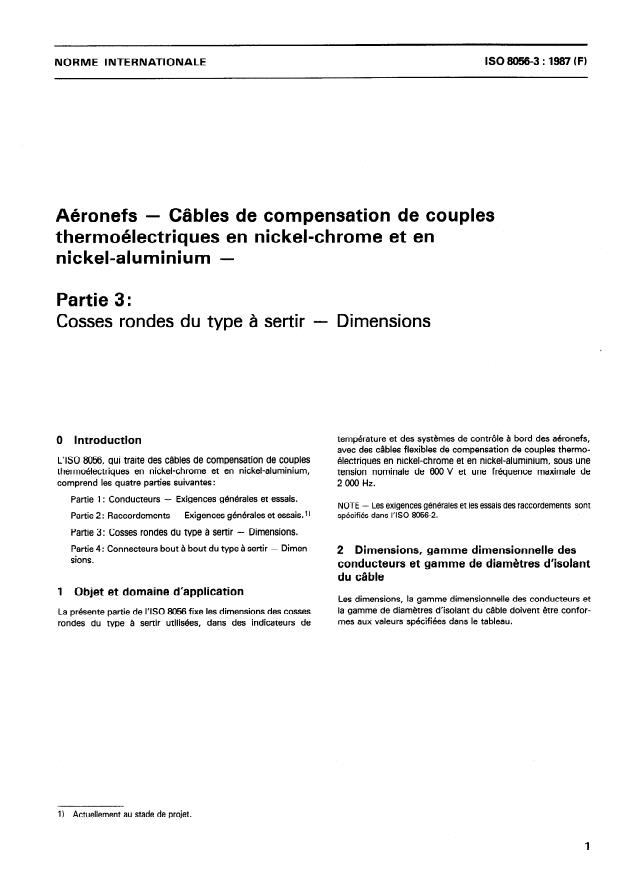

ISO 8056-3:1987 - Aéronefs — Câbles de compensation de couples thermoélectriques en nickel-chrome et en nickel-aluminium — Partie 3: Cosses rondes du type a sertir — Dimensions Released:6/25/1987
Overview - ISO 8056-3:1987 (thermocouple extension cables, crimp ring terminals)
ISO 8056-3:1987 is part of the ISO 8056 series that standardizes nickel‑chromium (Ni‑Cr) and nickel‑aluminium (Ni‑Al) thermocouple extension cables for aircraft. This Part 3 specifies the dimensions for crimp‑type ring terminal ends used with flexible thermocouple extension cables in aircraft temperature indicator and control systems. The standard applies to systems at a nominal voltage of 600 V and a maximum frequency of 2 000 Hz, and it defines conductor size ranges and cable insulation ranges for correct connector selection and installation.
Key topics and requirements
- Dimensional definitions for crimp‑type ring terminal ends (stud hole sizes and maximum/minimum body and sleeve dimensions).
- Conductor size range and corresponding cable insulation range to ensure reliable crimping and electrical continuity.
- Sleeve color coding and magnetic properties: Ni‑Al (green, magnetic) and Ni‑Cr (grey, antimagnetic) identification to prevent interchange of dissimilar thermocouple materials.
- Compatibility references: includes references to conductor sizing in AWG and metric threads (e.g., for M5 and M6 screws) where applicable.
- Interchangeability focus: ensures terminals fit the specified studs and achieve acceptable crimp mechanical and electrical performance when used with the listed cable types.
- Note: General requirements and test methods for terminations are covered in ISO 8056‑2; this document restricts itself to dimensional data.
Practical applications and users
Who uses ISO 8056-3:
- Aircraft electrical and systems engineers specifying thermocouple extension wiring and terminations.
- Cable and connector manufacturers producing crimp ring terminals for aviation thermocouple systems.
- Maintenance, inspection and avionics technicians performing installations or repairs on temperature sensor wiring.
- Procurement and quality assurance teams ensuring purchased components meet aircraft standards and are interchangeable.
Practical benefits:
- Guarantees mechanical fit and electrical compatibility between thermocouple extension cables and ring terminals.
- Reduces risk of misconnection of dissimilar thermocouple materials by color coding and magnetic designation.
- Simplifies certification and maintenance by referencing a recognized international dimensional standard.
Related standards
- ISO 8056‑1: Conductors (part of the same series)
- ISO 8056‑2: Terminations - General requirements and tests (important companion document)
- ISO 8056‑4: Crimp‑type butt connectors - Dimensions
Keywords: ISO 8056-3, thermocouple extension cables, crimp-type ring terminal ends, nickel-chromium, nickel-aluminium, aircraft, dimensions, conductor size, cable insulation, temperature control systems.
Buy Documents
ISO 8056-3:1987 - Aircraft — Nickel-chromium and nickel-aluminium thermocouple extension cables — Part 3: Crimp-type ring terminal ends — Dimensions Released:6/25/1987
ISO 8056-3:1987 - Aéronefs — Câbles de compensation de couples thermoélectriques en nickel-chrome et en nickel-aluminium — Partie 3: Cosses rondes du type a sertir — Dimensions Released:6/25/1987
ISO 8056-3:1987 - Aéronefs — Câbles de compensation de couples thermoélectriques en nickel-chrome et en nickel-aluminium — Partie 3: Cosses rondes du type a sertir — Dimensions Released:6/25/1987
Get Certified
Connect with accredited certification bodies for this standard

BUREAU VERITAS Certification Germany
Bureau Veritas certification in Germany.

Element Materials Technology
Materials testing and product certification.

AQMS Ltd.
AQMS provides ISO certification to SMEs across the UK.
Sponsored listings
Frequently Asked Questions
ISO 8056-3:1987 is a standard published by the International Organization for Standardization (ISO). Its full title is "Aircraft — Nickel-chromium and nickel-aluminium thermocouple extension cables — Part 3: Crimp-type ring terminal ends — Dimensions". This standard covers: Lays down the dimensions for these parts for use in temperature indicator and control systems with flexible thermocouple extension cables at nominal voltage of 600 V and a maximum frequency of 2 000 Hz. Gives conductor size range and cable insulation range.
Lays down the dimensions for these parts for use in temperature indicator and control systems with flexible thermocouple extension cables at nominal voltage of 600 V and a maximum frequency of 2 000 Hz. Gives conductor size range and cable insulation range.
ISO 8056-3:1987 is classified under the following ICS (International Classification for Standards) categories: 49.060 - Aerospace electric equipment and systems. The ICS classification helps identify the subject area and facilitates finding related standards.
ISO 8056-3:1987 is available in PDF format for immediate download after purchase. The document can be added to your cart and obtained through the secure checkout process. Digital delivery ensures instant access to the complete standard document.
Standards Content (Sample)
ISO
INTERNATIONAL STANDARD
8056-3
First edition
1987-07-0 1
INTERNATIONAL ORGANIZATION FOR STANDARDIZATION
ORGANISATION INTERNATIONALE DE NORMALISATION
MEXflYHAPOflHAR OPrAHM3A~Wl 110 CTAHfiAPTM3A~MM
Nickel-chromium and nickel-aluminium
Aircraft -
thermocouple extension cables -
Part 3:
Crimp-type ring terminal ends - Dimensions
A&onefs - Cables de compensation de couples thermo&ectrigues en nickel-chrome et en
nickel- aluminium -
Partie 3: Cosses rondes du type a sertir - Dimensions
Reference number
ISO 8056-3 : 1987 (E)
Foreword
ISO (the lnternational Organization for Standardization) is a worldwide federation of
national Standards bodies (ISO member bodies). The work of preparing International
Standards is normally carried out through ISO technical committees. Esch member
body interested in a subject for which a technical committee has been established has
the right to be represented on that committee. International organizations, govern-
mental and non-governmental, in liaison with ISO, also take part in the work.
Draft International Standards adopted by the technical committees are circulated to
the member bodies for approval before their acceptance as International Standards by
the ISO Council. They are approved in accordance with ISO procedures requiring at
least 75 % approval by the member bodies voting.
International Standard ISO 8056-3 was prepared by Technical Committee ISO/TC 20,
Aircraft and spare vehicles.
Users should note that all International Standards undergo revision from time to time
and that any reference made herein to any other International Standard implies its
latest edition, unless otherwise stated.
0 International Organkation for Standardization, 1987
Printed in Switzerland
ISO 8056-3 : 1987 (E)
INTERNATIONAL STANDARD
Aircraft - Nickel-chromium and nickel-aluminium
thermocouple extension cables -
Part 3:
Crimp-t
...
ISO
NORME INTERNATIONALE
8056-3
Première édition
1987-07-01
INTERNATIONAL ORGANIZATION FOR STANDARDIZATION
ORGANISATION INTERNATIONALE DE NORMALISATION
. MEXAYHAPOflHAfl OPrAHM3A~lM Il0 CTAH~APTM3A~MM
Aéronefs - Câbles de compensation de couples
thermoélectriques en nickel-chrome et en
nickel-aluminium -
Partie 3:
Cosses rondes du type à sertir - Dimensions
Nickel-chromium and nickel-aluminium thermocouple extension tables -
Aircraft -
.
Part 3: Crimp-type ring terminal en& - Dimensions
Numéro de référence
ISO 8056-3 : 1987 (F)
Avant-propos
L’ISO (Organisation internationale de normalisation) est une fédération mondiale
d’organismes nationaux de normalisation (comités membres de I’ISO). L’élaboration
des Normes internationales est normalement confiée aux comités techniques de I’ISO.
Chaque comité membre intéressé par une étude a le droit de faire partie du comité
technique créé à cet effet. Les organisations internationales, gouvernementales et non
gouvernementales, en liaison avec I’ISO participent également aux travaux.
Les projets de Normes internationales adoptés par les comités techniques sont soumis
aux comités membres pour approbation, avant leur acceptation comme Normes inter-
nationales par le Conseil de I’ISO. Les Normes internationales sont approuvées confor-
mément aux procédures de I’ISO qui requièrent l’approbation de 75 % au moins des
comités membres votants.
La Norme internalionale ISO 8056-3 a été élaborée par le comité technique ISO/TC 20,
Aéronautique et espace.
L’attention des utilisateurs est attirée sur le fait que toutes les Normes internationales
sont de temps en temps soumises à révision et que toute référence faite à une autre
Norme internationale dans le présent document implique qu’il s’agit, sauf indication
contraire, de la dernière édition.
0 Organisation internationale de normalisation, 1987 0
Imprimé en Suisse
ISO 8056-3 : 1987 (F)
NORME INTERNATIONALE
Aéronefs - Câbles de compensation de couples
thermoélectriques en nickel-chrome et en
nickel-aluminium -
Partie 3:
Cosses
...
ISO
NORME INTERNATIONALE
8056-3
Première édition
1987-07-01
INTERNATIONAL ORGANIZATION FOR STANDARDIZATION
ORGANISATION INTERNATIONALE DE NORMALISATION
. MEXAYHAPOflHAfl OPrAHM3A~lM Il0 CTAH~APTM3A~MM
Aéronefs - Câbles de compensation de couples
thermoélectriques en nickel-chrome et en
nickel-aluminium -
Partie 3:
Cosses rondes du type à sertir - Dimensions
Nickel-chromium and nickel-aluminium thermocouple extension tables -
Aircraft -
.
Part 3: Crimp-type ring terminal en& - Dimensions
Numéro de référence
ISO 8056-3 : 1987 (F)
Avant-propos
L’ISO (Organisation internationale de normalisation) est une fédération mondiale
d’organismes nationaux de normalisation (comités membres de I’ISO). L’élaboration
des Normes internationales est normalement confiée aux comités techniques de I’ISO.
Chaque comité membre intéressé par une étude a le droit de faire partie du comité
technique créé à cet effet. Les organisations internationales, gouvernementales et non
gouvernementales, en liaison avec I’ISO participent également aux travaux.
Les projets de Normes internationales adoptés par les comités techniques sont soumis
aux comités membres pour approbation, avant leur acceptation comme Normes inter-
nationales par le Conseil de I’ISO. Les Normes internationales sont approuvées confor-
mément aux procédures de I’ISO qui requièrent l’approbation de 75 % au moins des
comités membres votants.
La Norme internalionale ISO 8056-3 a été élaborée par le comité technique ISO/TC 20,
Aéronautique et espace.
L’attention des utilisateurs est attirée sur le fait que toutes les Normes internationales
sont de temps en temps soumises à révision et que toute référence faite à une autre
Norme internationale dans le présent document implique qu’il s’agit, sauf indication
contraire, de la dernière édition.
0 Organisation internationale de normalisation, 1987 0
Imprimé en Suisse
ISO 8056-3 : 1987 (F)
NORME INTERNATIONALE
Aéronefs - Câbles de compensation de couples
thermoélectriques en nickel-chrome et en
nickel-aluminium -
Partie 3:
Cosses
...