


ISO 8185:2007
(Main)Respiratory tract humidifiers for medical use — Particular requirements for respiratory humidification systems
Respiratory tract humidifiers for medical use — Particular requirements for respiratory humidification systems
ISO 8185:2007 is a particular standard based on IEC 60601-1:1988 and its Amendments, Amd. 1:1991 and Amd. 2:1995. ISO 8185:2007 includes requirements for the basic safety and essential performance of humidification systems. It also includes requirements for individual devices specified for use in humidification systems such as heated breathing tubes (heated-wire breathing tubes) and devices intended to control these heated breathing tubes (heated breathing tube controllers). ISO 5367 specifies other safety and performance requirements for breathing tubes. NOTE Heated breathing tubes are medical electrical equipment and are subject to the requirements of IEC 60601-1. ISO 8185:2007 also includes requirements for active HME (heat and moisture exchanger) devices, which actively add heat and moisture to increase the humidity level of the gas delivered from the HME to the patient. It is not applicable to passive HMEs, which return a portion of the patient's expired moisture and heat to the respiratory tract during inspiration without adding heat and moisture. ISO 9360-1 and ISO 9360-2 specify safety and performance requirements for passive HMEs and describe methods for testing performance. Respiratory tract humidifiers can be gas-powered, electrically-powered, or both. However, ISO 8185:2007 has been prepared as a particular standard based on IEC 60601-1, which gives general requirements for all aspects of safety, not only electrical safety, and many of the requirements are therefore applicable to humidifiers not powered by electricity. ISO 8185:2007 is not applicable to devices commonly referred to as "room humidifiers" or humidifiers used in heating, ventilation and air conditioning systems, or humidifiers incorporated into infant incubators. ISO 8185:2007 is not applicable to nebulizers used for the delivery of drugs to patients.
Humidificateurs respiratoires médicaux — Exigences spécifiques des systèmes d'humidification respiratoires
L'ISO 8185:2006 est une norme particulière basée sur la CEI 60601-1:1988 et ses amendements, Amd.1 :1991 et Amd.2 :1995. L'ISO 8185:2006 contient les exigences de sécurité de base et les exigences en matière de performances essentielles des systèmes d'humidification. Elle contient également des exigences applicables aux dispositifs particuliers destinés à être utilisés dans les systèmes d'humidification comme les tuyaux respiratoires chauffés (tuyaux respiratoires avec résistance chauffante) et les dispositifs destinés au contrôle de ces tuyaux respiratoires chauffés (commandes de tuyaux respiratoires chauffés). L'ISO 5367 spécifie d'autres exigences de sécurité et de performance pour les tuyaux respiratoires. NOTE Les tuyaux respiratoires sont des appareils électromédicaux et sont soumis aux exigences de la CEI 60601-1. L'ISO 8185:2006 contient également des exigences relatives aux dispositifs échangeurs de chaleur et d'humidité actifs qui ajoutent activement de la chaleur et de l'humidité afin d'augmenter le niveau d'humidité du gaz administré au patient. Elle ne s'applique pas aux échangeurs de chaleur et d'humidité passifs qui renvoient une partie de l'humidité et de la chaleur de l'air expiré par le patient aux voies respiratoires lors de l'inspiration, sans ajout de chaleur et d'humidité. L'ISO 9360-1 et l'ISO 9360-2 spécifient les exigences de sécurité et de performance pour les échangeurs de chaleur et d'humidité passifs et décrit les méthodes applicables aux essais de performance. Les humidificateurs des voies respiratoires peuvent fonctionner avec un gaz comprimé, à l'électricité ou les deux. Toutefois, l'ISO 8185:2006 a été élaborée comme une norme particulière basée sur la CEI 60601-1, qui donne des règles générales relatives à tous les aspects de la sécurité, pas seulement de la sécurité électrique, et de nombreuses exigences sont donc applicables aux humidificateurs qui ne fonctionnent pas à l'électricité. L'ISO 8185:2006 ne s'applique ni aux dispositifs servant à humidifier des locaux, ni aux humidificateurs utilisés pour le chauffage, la ventilation ou la climatisation, ni aux humidificateurs utilisés dans les couveuses. L'ISO 8185:2006 ne s'applique pas aux nébuliseurs utilisés pour administrer des médicaments aux patients.
General Information
- Status
- Withdrawn
- Publication Date
- 25-Jun-2007
- Withdrawal Date
- 25-Jun-2007
- Current Stage
- 9599 - Withdrawal of International Standard
- Start Date
- 18-May-2017
- Completion Date
- 12-Feb-2026
Relations
- Effective Date
- 12-Feb-2026
- Effective Date
- 04-Nov-2015
- Revises
ISO 8185:1997 - Humidifiers for medical use — General requirements for humidification systems - Effective Date
- 15-Apr-2008
- Effective Date
- 15-Apr-2008

ISO 8185:2007 - Respiratory tract humidifiers for medical use -- Particular requirements for respiratory humidification systems
ISO 8185:2007 - Humidificateurs respiratoires médicaux -- Exigences spécifiques des systemes d'humidification respiratoires
Get Certified
Connect with accredited certification bodies for this standard

BSI Group
BSI (British Standards Institution) is the business standards company that helps organizations make excellence a habit.

TÜV Rheinland
TÜV Rheinland is a leading international provider of technical services.

TÜV SÜD
TÜV SÜD is a trusted partner of choice for safety, security and sustainability solutions.
Sponsored listings
Frequently Asked Questions
ISO 8185:2007 is a standard published by the International Organization for Standardization (ISO). Its full title is "Respiratory tract humidifiers for medical use — Particular requirements for respiratory humidification systems". This standard covers: ISO 8185:2007 is a particular standard based on IEC 60601-1:1988 and its Amendments, Amd. 1:1991 and Amd. 2:1995. ISO 8185:2007 includes requirements for the basic safety and essential performance of humidification systems. It also includes requirements for individual devices specified for use in humidification systems such as heated breathing tubes (heated-wire breathing tubes) and devices intended to control these heated breathing tubes (heated breathing tube controllers). ISO 5367 specifies other safety and performance requirements for breathing tubes. NOTE Heated breathing tubes are medical electrical equipment and are subject to the requirements of IEC 60601-1. ISO 8185:2007 also includes requirements for active HME (heat and moisture exchanger) devices, which actively add heat and moisture to increase the humidity level of the gas delivered from the HME to the patient. It is not applicable to passive HMEs, which return a portion of the patient's expired moisture and heat to the respiratory tract during inspiration without adding heat and moisture. ISO 9360-1 and ISO 9360-2 specify safety and performance requirements for passive HMEs and describe methods for testing performance. Respiratory tract humidifiers can be gas-powered, electrically-powered, or both. However, ISO 8185:2007 has been prepared as a particular standard based on IEC 60601-1, which gives general requirements for all aspects of safety, not only electrical safety, and many of the requirements are therefore applicable to humidifiers not powered by electricity. ISO 8185:2007 is not applicable to devices commonly referred to as "room humidifiers" or humidifiers used in heating, ventilation and air conditioning systems, or humidifiers incorporated into infant incubators. ISO 8185:2007 is not applicable to nebulizers used for the delivery of drugs to patients.
ISO 8185:2007 is a particular standard based on IEC 60601-1:1988 and its Amendments, Amd. 1:1991 and Amd. 2:1995. ISO 8185:2007 includes requirements for the basic safety and essential performance of humidification systems. It also includes requirements for individual devices specified for use in humidification systems such as heated breathing tubes (heated-wire breathing tubes) and devices intended to control these heated breathing tubes (heated breathing tube controllers). ISO 5367 specifies other safety and performance requirements for breathing tubes. NOTE Heated breathing tubes are medical electrical equipment and are subject to the requirements of IEC 60601-1. ISO 8185:2007 also includes requirements for active HME (heat and moisture exchanger) devices, which actively add heat and moisture to increase the humidity level of the gas delivered from the HME to the patient. It is not applicable to passive HMEs, which return a portion of the patient's expired moisture and heat to the respiratory tract during inspiration without adding heat and moisture. ISO 9360-1 and ISO 9360-2 specify safety and performance requirements for passive HMEs and describe methods for testing performance. Respiratory tract humidifiers can be gas-powered, electrically-powered, or both. However, ISO 8185:2007 has been prepared as a particular standard based on IEC 60601-1, which gives general requirements for all aspects of safety, not only electrical safety, and many of the requirements are therefore applicable to humidifiers not powered by electricity. ISO 8185:2007 is not applicable to devices commonly referred to as "room humidifiers" or humidifiers used in heating, ventilation and air conditioning systems, or humidifiers incorporated into infant incubators. ISO 8185:2007 is not applicable to nebulizers used for the delivery of drugs to patients.
ISO 8185:2007 is classified under the following ICS (International Classification for Standards) categories: 11.040.10 - Anaesthetic, respiratory and reanimation equipment. The ICS classification helps identify the subject area and facilitates finding related standards.
ISO 8185:2007 has the following relationships with other standards: It is inter standard links to EN ISO 8185:2007, ISO 80601-2-74:2017, ISO 8185:1997, ISO 8185:1997/Cor 1:2001. Understanding these relationships helps ensure you are using the most current and applicable version of the standard.
ISO 8185:2007 is available in PDF format for immediate download after purchase. The document can be added to your cart and obtained through the secure checkout process. Digital delivery ensures instant access to the complete standard document.
Standards Content (Sample)
INTERNATIONAL ISO
STANDARD 8185
Third edition
2007-07-01
Corrected version
2008-06-15
Respiratory tract humidifiers for medical
use — Particular requirements for
respiratory humidification systems
Humidificateurs respiratoires médicaux — Exigences spécifiques des
systèmes d'humidification respiratoires
Reference number
©
ISO 2007
PDF disclaimer
This PDF file may contain embedded typefaces. In accordance with Adobe's licensing policy, this file may be printed or viewed but
shall not be edited unless the typefaces which are embedded are licensed to and installed on the computer performing the editing. In
downloading this file, parties accept therein the responsibility of not infringing Adobe's licensing policy. The ISO Central Secretariat
accepts no liability in this area.
Adobe is a trademark of Adobe Systems Incorporated.
Details of the software products used to create this PDF file can be found in the General Info relative to the file; the PDF-creation
parameters were optimized for printing. Every care has been taken to ensure that the file is suitable for use by ISO member bodies. In
the unlikely event that a problem relating to it is found, please inform the Central Secretariat at the address given below.
© ISO 2007
All rights reserved. Unless otherwise specified, no part of this publication may be reproduced or utilized in any form or by any means,
electronic or mechanical, including photocopying and microfilm, without permission in writing from either ISO at the address below or
ISO's member body in the country of the requester.
ISO copyright office
Case postale 56 • CH-1211 Geneva 20
Tel. + 41 22 749 01 11
Fax + 41 22 749 09 47
E-mail copyright@iso.org
Web www.iso.org
Published in Switzerland
ii © ISO 2007 – All rights reserved
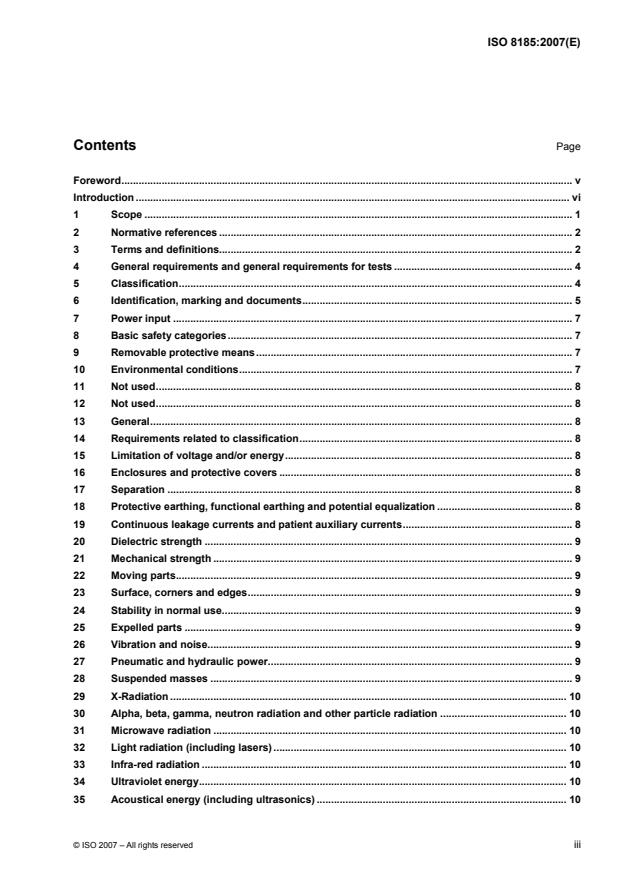
Contents Page
Foreword. v
Introduction . vi
1 Scope. 1
2 Normative references. 2
3 Terms and definitions. 2
4 General requirements and general requirements for tests . 4
5 Classification. 4
6 Identification, marking and documents. 5
7 Power input. 7
8 Basic safety categories. 7
9 Removable protective means . 7
10 Environmental conditions. 7
11 Not used. 8
12 Not used. 8
13 General. 8
14 Requirements related to classification. 8
15 Limitation of voltage and/or energy. 8
16 Enclosures and protective covers . 8
17 Separation. 8
18 Protective earthing, functional earthing and potential equalization . 8
19 Continuous leakage currents and patient auxiliary currents. 8
20 Dielectric strength. 9
21 Mechanical strength. 9
22 Moving parts. 9
23 Surface, corners and edges. 9
24 Stability in normal use. 9
25 Expelled parts. 9
26 Vibration and noise. 9
27 Pneumatic and hydraulic power. 9
28 Suspended masses. 9
29 X-Radiation. 10
30 Alpha, beta, gamma, neutron radiation and other particle radiation . 10
31 Microwave radiation. 10
32 Light radiation (including lasers) . 10
33 Infra-red radiation . 10
34 Ultraviolet energy. 10
35 Acoustical energy (including ultrasonics) . 10
36 Electromagnetic compatibility. 11
37 Locations and basic requirements. 11
38 Marking, accompanying documents. 11
39 Common requirements for category AP and category APG equipment . 11
40 Requirements and tests for category AP equipment, parts and components thereof. 11
41 Requirements and tests for category APG equipment, parts and components thereof . 11
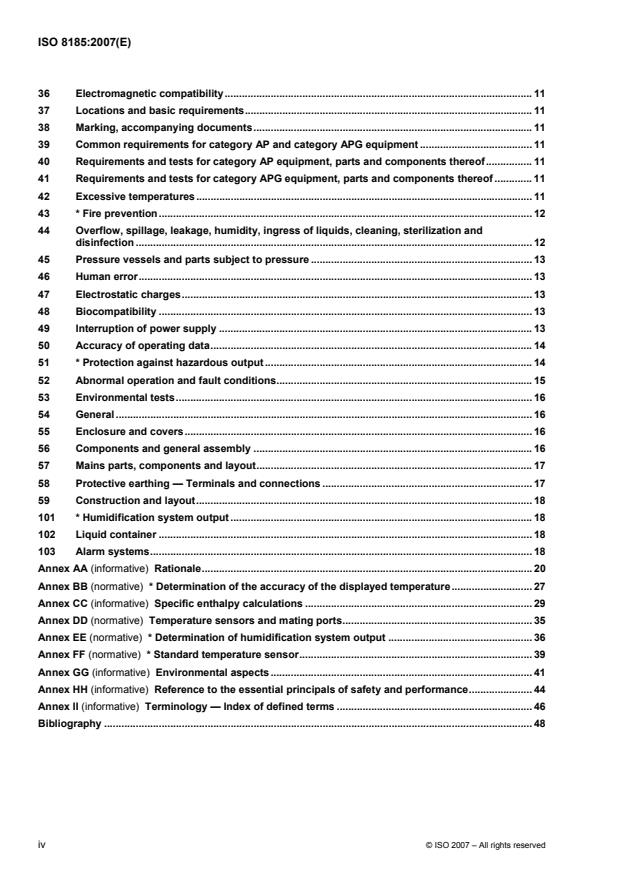
42 Excessive temperatures. 11
43 * Fire prevention. 12
44 Overflow, spillage, leakage, humidity, ingress of liquids, cleaning, sterilization and
disinfection . 12
45 Pressure vessels and parts subject to pressure . 13
46 Human error. 13
47 Electrostatic charges. 13
48 Biocompatibility . 13
49 Interruption of power supply . 13
50 Accuracy of operating data. 14
51 * Protection against hazardous output . 14
52 Abnormal operation and fault conditions. 15
53 Environmental tests. 16
54 General. 16
55 Enclosure and covers. 16
56 Components and general assembly . 16
57 Mains parts, components and layout. 17
58 Protective earthing — Terminals and connections . 17
59 Construction and layout. 18
101 * Humidification system output . 18
102 Liquid container . 18
103 Alarm systems. 18
Annex AA (informative) Rationale. 20
Annex BB (normative) * Determination of the accuracy of the displayed temperature. 27
Annex CC (informative) Specific enthalpy calculations . 29
Annex DD (normative) Temperature sensors and mating ports. 35
Annex EE (normative) * Determination of humidification system output . 36
Annex FF (normative) * Standard temperature sensor. 39
Annex GG (informative) Environmental aspects. 41
Annex HH (informative) Reference to the essential principals of safety and performance. 44
Annex II (informative) Terminology — Index of defined terms . 46
Bibliography . 48
iv © ISO 2007 – All rights reserved
Foreword
ISO (the International Organization for Standardization) is a worldwide federation of national standards bodies
(ISO member bodies). The work of preparing International Standards is normally carried out through ISO
technical committees. Each member body interested in a subject for which a technical committee has been
established has the right to be represented on that committee. International organizations, governmental and
non-governmental, in liaison with ISO, also take part in the work. ISO collaborates closely with the
International Electrotechnical Commission (IEC) on all matters of electrotechnical standardization.
International Standards are drafted in accordance with the rules given in the ISO/IEC Directives, Part 2.
The main task of technical committees is to prepare International Standards. Draft International Standards
adopted by the technical committees are circulated to the member bodies for voting. Publication as an
International Standard requires approval by at least 75 % of the member bodies casting a vote.
Attention is drawn to the possibility that some of the elements of this document may be the subject of patent
rights. ISO shall not be held responsible for identifying any or all such patent rights.
ISO 8185 was prepared by Technical Committee ISO/TC 121, Anaesthetic and respiratory equipment,
Subcommittee SC 3, Lung ventilators and related equipment.
This third edition cancels and replaces the second edition (ISO 8185:1997), which has been technically
revised. It also incorporates the Technical Corrigendum, ISO 8185:1997/Cor. 1:2001.
In this corrected version the macro expansion error on page 30 has been replaced with the correct equation
for the calculation of average specific enthalpy.
Introduction
This International Standard is a Particular Standard based on IEC 60601-1:1988, including Amendments 1
(1991) and 2 (1995), hereafter referred to as the General Standard. The General Standard is the basic
standard for the safety of all medical electrical equipment used by, or under the supervision of, qualified
personnel in the general medical and patient environment; it also contains certain requirements for reliable
operation to ensure safety.
The General Standard has associated Collateral Standards and Particular Standards. The Collateral
Standards include requirements for specific technologies and/or hazards and apply to all applicable
equipment, such as medical systems, EMC, radiation protection in diagnostic X-ray equipment, software, etc.
The Particular Standards apply to specific equipment types, such as medical electron accelerators, high
frequency surgical equipment, hospital beds, etc.
NOTE Definitions of Collateral Standard and Particular Standard are found in IEC 60601-1:1988, 1.5 and A.2,
respectively.
To facilitate the use of this International Standard, the following drafting conventions have been applied.
This International Standard uses the same main Clause titles and numbering as the General Standard, to
facilitate cross-referencing of the requirements. The changes to the text of the General Standard are specified
by the use of the following words.
⎯ “Replacement” means that the indicated Clause or Subclause of the General Standard is replaced
completely by the text of this International Standard.
⎯ “Addition” means that the relevant text of this International Standard is supplementary to the requirements
of the General Standard.
⎯ “Amendment” means that existing text of the General Standard is modified as indicated by the text of this
International Standard.
To avoid confusion with any amendments to the General Standard itself, a particular numbering has been
employed for elements added by this International Standard: subclauses, tables and figures are numbered
starting from 101; additional list items are lettered aa), bb), etc. and additional annexes are lettered AA, BB,
etc.
In this International Standard, the following print types are used:
⎯ requirements, compliance with which can be verified, and definitions: roman type;
⎯ notes and examples: smaller roman type;
⎯ description of type of document change and test methods: italic type;
⎯ terms defined in the General Standard IEC 60601-1:1988, Clause 2 or in this International Standard: bold
type.
Throughout this International Standard, text for which a rationale is provided in Annex AA is indicated by an
asterisk (*).
vi © ISO 2007 – All rights reserved
Humidifiers are used to raise the water content of gases delivered to patients. Gases available for medical
use do not contain sufficient moisture and can damage or irritate the respiratory tract or desiccate secretions
of patients whose upper airways have been bypassed. Reduction of the relative humidity at the patient
connection port can cause desiccation of tracheo-bronchial secretions in the tracheal or tracheostomy tube,
[19]
and consequently may cause narrowing or even obstruction of the airway . Heat can be employed to
increase the water output of the humidifier.
In addition, many humidifiers utilise heated breathing tubes in order to increase operating efficiency and
reduce water and heat loss. Ventilator and anaesthesia breathing tubes in common use might not withstand
the heat generated by humidifiers and heated breathing tube mechanisms.
Many humidifier manufacturers use off-the-shelf electrical connectors for their electrically-heated breathing
tubes. However, since different manufacturers have used the same electrical connector for different power
outputs, electrically-heated breathing tubes can be physically, but not electrically, interchangeable. Use of
improper electrically-heated breathing tubes has caused overheating, circuit melting, patient and operator
burns, and fires. It was not found practical to specify the interface requirements for electrical connectors to
ensure compatibility between humidifiers and breathing tubes produced by different manufacturers.
Since the safe use of a humidifier depends on the interaction of the humidifier with its many accessories,
this International Standard sets total-system performance requirements, applicable to accessories such as
breathing tubes (both heated and non-heated), temperature sensors, and devices intended to control the
environment within these breathing tubes.
INTERNATIONAL STANDARD ISO 8185:2007(E)
Respiratory tract humidifiers for medical use — Particular
requirements for respiratory humidification systems
1 Scope
IEC 60601-1:1988, Clause 1, applies, except as follows:
Amendment (add at the end of 1.1):
This International Standard includes requirements for the basic safety and essential performance of
humidification systems, as defined in 3.6. This International Standard also includes requirements for
individual devices specified for use in humidification systems such as heated breathing tubes (heated-wire
breathing tubes) and devices intended to control these heated breathing tubes (heated breathing tube
controllers). ISO 5367 specifies other safety and performance requirements for breathing tubes.
NOTE Heated breathing tubes are medical electrical equipment and are subject to the requirements of
IEC 60601-1.
* This International Standard also includes requirements for active HME (heat and moisture exchanger)
devices, which actively add heat and moisture to increase the humidity level of the gas delivered from the
HME to the patient. This International Standard is not applicable to passive HMEs, which return a portion of
the patient's expired moisture and heat to the respiratory tract during inspiration without adding heat and
moisture. ISO 9360-1 and ISO 9360-2 specify safety and performance requirements for passive HMEs and
describe methods for testing performance.
Respiratory tract humidifiers can be gas-powered, electrically-powered, or both. However, this International
Standard has been prepared as a Particular Standard based on IEC 60601-1, which gives general
requirements for all aspects of safety, not only electrical safety, and many of the requirements are therefore
applicable to humidifiers not powered by electricity. Where this International Standard specifies that a
Clause of IEC 60601-1 applies, it means that the Clause applies only if the requirement is relevant to the
humidification system under consideration.
This International Standard is not applicable to devices commonly referred to as "room humidifiers" or
humidifiers used in heating, ventilation and air conditioning systems, or humidifiers incorporated into infant
incubators.
This International Standard is not applicable to nebulizers used for the delivery of drugs to patients.
In the planning and design of products within the scope of this International Standard, it is advisable to give
due consideration to the environmental impact from the product during its life cycle. Environmental aspects
are addressed in Annex GG.
NOTE Additional aspects of environmental impact are addressed in ISO 14971.
2 Normative references
The following referenced documents are indispensable for the application of this document. For dated
references, only the edition cited applies. For undated references, the latest edition of the referenced
document (including any amendments) applies.
ISO 3744:1994, Acoustics — Determination of sound power levels of noise sources using sound pressure —
Engineering method in an essentially free field over a reflecting plane
ISO 4135:2001, Anaesthetic and respiratory equipment — Vocabulary
ISO 5356-1:2004, Anaesthetic and respiratory equipment — Conical connectors — Part 1: Cones and sockets
ISO 5367:2000, Breathing tubes intended for use with anaesthetic apparatus and ventilators
ISO 7396-1:2002, Medical gas pipeline systems — Part 1: Pipelines for compressed medical gases and
vacuum
ISO 9360-1:2000, Anaesthetic and respiratory equipment — Heat and moisture exchangers (HMEs) for
humidifying respired gases in humans — Part 1: HMEs for use with minimum tidal volumes of 250 ml
ISO 9360-2:2001, Anaesthetic and respiratory equipment — Heat and moisture exchangers (HMEs) for
humidifying respired gases in humans — Part 2: HMEs for use with tracheostomized patients having minimum
tidal volumes of 250 ml
ISO 10524-1:2006, Pressure regulators for use with medical gases — Part 1: Pressure regulators and
pressure regulators with flow-metering devices
IEC 60079-4:1975, Electrical apparatus for explosive gas atmospheres — Part 4: Method of test for ignition
temperature
IEC 60601-1:1988, Medical electrical equipment — Part 1: General requirements for safety, and its
Amendment 1:1991 and Amendment 2:1995
IEC 60601-1-2:2001, Medical electrical equipment — Part 1-2: General requirements for safety — Collateral
standard: Electromagnetic compatibility — Requirements and tests
IEC 60601-1-6:2004, Medical electrical equipment — Part 1-6: General requirements for safety — Collateral
standard: Usability
IEC 60601-1-8:2003, Medical electrical equipment — Part 1-8: General requirements for safety — Collateral
standard: General requirements, tests and guidance for alarm systems in medical electrical equipment and
medical electrical systems
IEC 60601-2-19:1990, Medical electrical equipment — Part 2: Particular requirements for safety of baby
incubators
3 Terms and definitions
For the purposes of this document, the terms and definitions given in Clause 2 of IEC 60601-1:1988,
IEC 60601-1-8:2003, ISO 4135:2001, and the following apply.
NOTE For convenience, the sources of all defined terms used in this International Standard are given in Annex II.
3.1
accessible surface temperature
temperature of any surface which can be touched by a hand or finger during normal use, which includes
filling and refilling of the humidifier
2 © ISO 2007 – All rights reserved
3.2
active HME
device where water, water vapour or heat is actively added to the heat and moisture exchanger (HME) to
increase the humidity level of the gas delivered from the HME to the patient
3.3
delivered gas temperature
temperature of the gas, or aerosol, or both, at the patient connection port
3.4
heated breathing tube controller
device which controls the temperature or the heating of a breathing tube
NOTE The controller can be either stand-alone or part of the humidifier.
3.5
humidification chamber
part of the humidifier in which vaporization or nebulization takes place
3.6
humidification system
complete system that comprises a humidifier and accessories
NOTE Accessories can include a breathing tube (heated or unheated), breathing tube heater, heated breathing
tube controller, and temperature sensor.
3.7
humidification system output
total mass of water (in the form of liquid and vapour) per unit volume of gas normalized to body temperature,
atmospheric pressure and saturated (BTPS), i.e. at 37 °C, 101,3 kPa (760 mmHg) and saturated with water
vapour at the patient connection port
3.8
humidifier
device that adds water in the form of droplets or vapour, or both, to the inspired gas
NOTE This term includes vaporizing, bubble-through and ultrasonic humidifiers and active heat and moisture
exchangers (HMEs).
3.9
liquid container
part of the humidifier which holds the liquid
NOTE 1 The liquid container can be accessible to the breathing gas.
NOTE 2 The liquid container can also be part of the humidification chamber.
NOTE 3 The liquid container can be detachable for filling.
3.10
liquid reservoir
part of the humidifier which replenishes the liquid container
3.11
maximum operating pressure
maximum pressure in the humidification chamber
3.12
measured gas temperature
temperature of the gas, or aerosol, or both, that the humidification system is measuring and, if applicable,
displaying
3.13
relative humidity
water vapour pressure, expressed as a percentage of the saturation vapour pressure, at a particular
temperature
3.14
set temperature
temperature at which the humidification system attempts to maintain measured gas temperature
NOTE The set temperature can be operator-adjustable.
4 General requirements and general requirements for tests
IEC 60601-1:1988, Clauses 3 and 4, apply, except as follows:
3.6
Addition:
aa) Operation of the humidifier without any liquid.
bb) If the humidifier includes a temperature sensor, any single fault condition with the temperature sensor.
For example:
⎯ temperature sensor single open-circuit;
⎯ temperature sensor single short-circuit;
⎯ temperature sensor disconnected from the humidifier control system; or
⎯ temperature sensor disconnected from breathing tube or humidifier.
cc) A safety hazard (e.g. thermal injury to the patient) resulting from software error.
4.6 Other conditions
Addition:
aa) The test gas shall be medical-grade air, medical-grade oxygen, or a mixture of the two.
NOTE Reference test gas to BTPS (37 °C, RH = 100 %, 101 kPa)
bb) Unless otherwise specified, the liquid container and liquid reservoir, if provided, shall be filled to
maximum capacity, as indicated in the instructions for use, at the beginning of a test with distilled water at
the ambient test temperature.
cc) For the purpose of checking compliance with requirements of this International Standard, the delivered
gas temperature shall be sensed in the breathing tube no more than 50 mm from the patient
connection port (see Annex BB).
5 Classification
IEC 60601-1:1988, Clause 5, applies.
4 © ISO 2007 – All rights reserved
6 Identification, marking and documents
IEC 60601-1:1988, Clause 6, applies, except as follows:
6.1 Markings on the outside of equipment or equipment parts
Amendment:
g) * Connection to the supply
NOTE A heated breathing tube connector to the humidifier or heated breathing tube controller is a connection to
the supply that can need this marking.
Amendment (add at end of item):
p) Output
NOTE The applied part electrical connector of a humidifier for heated breathing tubes is an output that needs this
marking.
Addition:
aa) The marking on the outside shall also include the following:
1) the maximum and minimum liquid levels, if these are necessary for the correct operation of the
humidifier;
2) the direction of flow, for a humidifier or humidification system with flow-direction-sensitive
components;
3) if a pressure-relief mechanism is provided, the pressure at which it opens. This marking shall be on
or near the pressure-relief device;
4) * if the humidifier is driven by compressed gas, the ranges of the supply flowrates and pressures
that are required;
5) the humidification system and its parts shall be marked with regard to proper disposal, as
appropriate.
6.8.2 Instruction for use
a) General Information
Amendment (add after the last bullet):
⎯ The instructions for use shall also include the following information:
1) * For a humidifier, identification of at least one set of accessories and, if applicable, a ventilator
necessary for its intended use, and a warning to the effect that it is potentially unsafe to configure a
humidifier with breathing tubes or accessories and a ventilator that are not specified for use with
the humidifier.
2) For breathing tubes or other accessories intended to be used within humidification systems,
identification of at least one humidifier that, when used with the breathing tube or accessories, will
meet the requirements of this International Standard.
3) * A warning to the effect that it is potentially unsafe to configure breathing tubes or accessories
with any humidifier and ventilator that are not specified for use with these breathing tubes or
accessories.
4) * If the humidifier entrains air for the purpose of diluting oxygen, the following shall be provided:
i) a statement to the effect that the oxygen concentration can be affected by a partial obstruction
downstream of the humidifier, e.g. when using accessory equipment;
ii) a recommendation that the oxygen concentration be measured at the point of delivery to the
patient.
5) The intended use of the humidification system, and whether or not the humidification system is
intended for use with a patient whose upper airways have been bypassed.
6) * If the humidifier is intended for use with patients whose upper airways are bypassed, the
operating range of gas flowrates and settings which provide a humidification system output of at
least 33 mg/l.
7) The maximum volume of water, expressed in millilitres, available for vaporization contained in the
liquid container and, if provided, in the liquid reservoir.
8) If the humidifier is powered by pressurized gas, the rated ranges of flowrates and supply pressures
and method(s) of connection.
9) The maximum operating pressure of the humidifier.
10) * The inspiratory and expiratory pressure drop, as a function of flowrate, across the humidification
system or individual components, as appropriate. The pressure drop should be determined in
accordance with ISO 5367 or an equivalent method. The pressure drop for active HMEs should be
determined in accordance with ISO 9360-1 and ISO 9360-2.
11) The gas leakage of the humidification system or individual components, as appropriate, at the
maximum operating pressure. The gas leakage should be determined in accordance with
ISO 5367 or an equivalent method. The gas leakage for active HMEs should be determined in
accordance with ISO 9360-1 and ISO 9360-2.
12) * The internal compliance of the humidification system or individual components, as appropriate. If
this internal compliance can be affected by the depletion of the liquid, the minimum and maximum
compliance values shall be disclosed. The internal compliance should be determined in accordance
with ISO 5367 or an equivalent method. The internal compliance for active HMEs should be
determined in accordance with ISO 9360-1 and ISO 9360-2.
13) The humidification system output and relative humidity over the recommended operating range
of gas flowrates and settings.
14) The time required (warm-up time) for the measured gas temperature to reach the set temperature
from a starting temperature of (23 ± 2) °C when operated in accordance with the accompanying
documents.
15) The maximum delivered gas temperature, if the humidification system is not provided with a
means of continuously indicating the measured gas temperature.
16) Appropriate warning about operation of the breathing tubes if they can be affected by normal clinical
procedures (e.g. tubes covered with a blanket or heated in an incubator or overhead heater for a
neonate).
17) The operating ambient temperature range and the operating gas inlet temperature range.
18) A warning if humidity performance of the device can be compromised when used outside the
specified ambient temperature range or humidity range.
6 © ISO 2007 – All rights reserved
19) Known adverse effects on the performance of the humidification system when exposed to, for
example, electrocautery, electrosurgery, defibrillation, X-ray (gamma radiation), infrared radiation,
conducted transient magnetic fields including magnetic resonance imaging (MRI), and
radiofrequency interference.
20) Information concerning the disposal of the humidification system or components thereof.
21) * The location in the humidification system to which the displayed gas temperature is referenced.
Replacement:
d) For components specified for reuse, which come into contact with the patient or breathing gases during
normal use, the instructions for use shall contain:
⎯ any details about cleaning and disinfection or cleaning and sterilisation methods that can be used
(see 44.7);
⎯ the list of the applicable parameters such as temperature, pressure, humidity, time limits and number
of cycles that such humidification system, parts or accessories can tolerate.
For non-patient contact parts, a list of cleaning solutions suitable for cleaning those parts.
7 Power input
IEC 60601-1:1988, Clause 7 applies.
8 Basic safety categories
IEC 60601-1:1988, Clause 8 applies.
9 Removable protective means
IEC 60601-1:1988, Clause 9 applies.
10 Environmental conditions
IEC 60601-1:1988, Clause 10 applies, except as follows:
10.2.1 Environment
Replacement:
a) An operating ambient temperature range as specified in the accompanying documents.
Addition:
10.2.101 Pneumatic power supply
If the humidifier is intended to be connected to a medical gas supply system (either a medical gas pipeline
system complying with ISO 7396-1 or a pressure regulator complying with ISO 10524-1) it shall operate and
meet the requirements of this International Standard for a pneumatic power supply range of 280 kPa to
600 kPa and shall not cause a safety hazard under the single fault condition when the medical gas supply
inlet pressure is 1000 kPa.
11 Not used
12 Not used
13 General
IEC 60601-1:1988, Clause 13 applies.
14 Requirements related to classification
IEC 60601-1:1988, Clause 14 applies, except as follows:
14.6 Types B, BF and CF equipment
Amendment [add at the end of the list element c)]:
Applied parts of humidifier shall be type BF or type CF applied parts.
15 Limitation of voltage and/or energy
IEC 60601-1:1988, Clause 15 applies.
16 Enclosures and protective covers
IEC 60601-1:1988, Clause 16 applies.
17 Separation
IEC 60601-1:1988, Clause 17 applies.
18 Protective earthing, functional earthing and potential equalization
IEC 60601-1:1988, Clause 18 applies.
19 Continuous leakage currents and patient auxiliary currents
IEC 60601-1:1988, Clause 19 applies, except as follows:
19.4 Tests
h) Measurement of the patient leakage current
8 © ISO 2007 – All rights reserved
Replacement:
9) The humidifier connected to the breathing tube and other necessary accessories shall be tested
using metal foil as described in 19.4 g) 5). Wrap the metal foil around the patient connection port.
See also Figure 25 of IEC 60601-1:1988.
20 Dielectric strength
IEC 60601-1:1988, Clause 20 applies.
21 Mechanical strength
IEC 60601-1:1988, Clause 21 applies.
22 Moving parts
IEC 60601-1:1988, Clause 22 applies.
23 Surface, corners and edges
IEC 60601-1:1988, Clause 23 applies.
24 Stability in normal use
IEC 60601-1:1988, Clause 24 applies.
25 Expelled parts
IEC 60601-1:1988, Clause 25 applies.
26 Vibration and noise
IEC 60601-1:1988, Clause 26 applies.
27 Pneumatic and hydraulic power
IEC 60601-1:1988, Clause 27 applies.
28 Suspended masses
IEC 60601-1:1988, Clause 28 applies.
29 X-Radiation
IEC 60601-1:1988, Clause 29 applies.
30 Alpha, beta, gamma, neutron radiation and other particle radiation
IEC 60601-1:1988, Clause 30 applies.
31 Microwave radiation
IEC 60601-1:1988, Clause 31 applies.
32 Light radiation (including lasers)
IEC 60601-1:1988, Clause 32 applies.
33 Infra-red radiation
IEC 60601-1:1988, Clause 33 applies.
34 Ultraviolet energy
IEC 60601-1:1988, Clause 34 applies.
35 Acoustical energy (including ultrasonics)
IEC 60601-1:1988, Clause 35 applies, except as follows:
Addition:
35.101 * Noise measurement
35.101.1 Steady-state noise for all humidifiers
The steady-state noise generated by a humidifier or humidification system shall not exceed 50 dB
(A-weighted) at any point 1 m from the humidifier.
Check compliance with the tests of ISO 3744.
35.101.2 Steady-state noise for humidifiers for use with incubators
A humidifier or humidification system intended for use with an incubator shall comply with the sound
pressure level requirements in IEC 60601-2-19:1990, 102.1.
Check compliance with the tests of IEC 60601-2-19.
10 © ISO 2007 – All rights reserved
36 Electromagnetic compatibility
IEC 60601-1:1988, Clause 36 applies, except as follows:
Addition:
A humidifier or humidification system shall not be considered life-supporting equipment or systems as
defined in IEC 60601-1-2:2001. A humidifier or humidification system shall meet the appropriate
requirements of IEC 60601-1-2:2001.
IEC 60601-1-2:2001, applies, except as follows:
36.202.1 General
j) Compliance criteria
Replacement:
j) Under the test conditions specified in 36.202, the humidifier or humidification system shall provide
essential performance and not create a safety hazard. If an anomaly occurs, such as display interruption,
false positive or negative alarm condition, or loss of function without the integrity of the associative
protective device being compromised, this shall not be considered a safety hazard, provided it is
possible to restore normal operation within 30 s after cessation of the electromagnetic disturbance.
37 Locations and basic requirements
IEC 60601-1:1988, Clause 37 applies.
38 Marking, accompanying documents
IEC 60601-1:1988, Clause 38 applies.
39 Common requirements for category AP and category APG equipment
IEC 60601-1:1988, Clause 39 applies.
40 Requirements and tests for category AP equipment, parts and components
thereof
IEC 60601-1:1988, Clause 40 applies.
41 Requirements and tests for category APG equipment, parts and components
thereof
IEC 60601-1:1988, Clause 41 applies.
42 Excessive temperatures
IEC 60601-1:1988, Clause 42 applies, except as follows:
Addition:
42.101 * The accessible surface temperature within 25 cm of the patient connection port shall not
exceed 44 °C.
43 * Fire prevention
IEC 60601-1:1988, Clause 43 applies, except as follows:
Addition:
43.101 Humidifier used in conjunction with oxidants
a) In order to reduce the risk of fire for patients, for other persons and for the surroundings, ignitable
material, under normal and single fault condition, shall not, at the same time, be subjected to
conditions in which
⎯ the temperature of the material is raised to its minimum ignition temperature, and
⎯ an oxidant is present.
EXAMPLE Nitrous oxide.
NOTE For partial pressures of oxygen up to 27,5 kPa, when no other oxidants are present, the requirements in the
IEC 60601-1:1988 are considered to be sufficient.
The minimum ignition temperature is determined in accordance with IEC 60079-4 using the oxidizing
conditions present under normal and single fault condition.
Check compliance by determining the temperature to which the material is raised under normal and single
fault condition.
b) If sparking can occur under normal or single fault condition, the material subjected the energy
dissipation of the spark shall not ignite under the oxidizing conditions present.
Check compliance by observing if ignition occurs under the most unfavourable combination of
normal conditions with a single fault.
44 Overflow, spillage, leakage, humidity, ingress of liquids, cleaning, sterilization
and disinfection
IEC 60601-1:1988, Clause 44 applies, except as follows:
Replacement:
44.2 * Overflow
Amendment (replace second sentence with):
When the humidifier is tilted through 20° in any direction from its normal operating position, and for an active
HME in its least favourable orientation, there shall be no spillage of water from the liquid container or liquid
reservoir into the breathing system when operated at the maximum flowrate stated in the accompanying
documents.
12 © ISO 2007 – All rights reserved
Amendment (replace second paragraph of the compliance test with):
Subsequently tilt the humidifier through an angle of 20° in the least favourable direction(s) and for an active
HME in its least favourable orientation, (if necessary with refilling) starting from the position of normal use
while it is operating at the maximum flowrate. Verify that no liquid spills into the breathing system.
44.7 Cleaning, sterilization and disinfection
Amendment:
All components specified for reuse in the instructions for use, which come into contact with the patient or
breathing gases in normal use shall be capable of being cleaned and disinfected or cleaned and sterilized.
Check compliance by reviewing the accompanying documents for methods of cleaning and disinfection or
sterilization [see 6.8.2 d)] and by inspection of the relevant validation reports.
44.8 Compatibility with substances used with the equipment
Addition:
The humidification system and parts thereof shall be designed and manufactured to minimize health risks
due to substances leached from the humidification system or its components during normal use.
Particular attention should be paid to the biocompatibility of materials and their compatibility with substances
and gases with which they
...
NORME ISO
INTERNATIONALE 8185
Troisième édition
2007-07-01
Humidificateurs respiratoires
médicaux — Exigences spécifiques des
systèmes d'humidification respiratoires
Respiratory tract humidifiers for medical use — Particular requirements
for respiratory humidification systems
Numéro de référence
©
ISO 2007
PDF – Exonération de responsabilité
Le présent fichier PDF peut contenir des polices de caractères intégrées. Conformément aux conditions de licence d'Adobe, ce fichier
peut être imprimé ou visualisé, mais ne doit pas être modifié à moins que l'ordinateur employé à cet effet ne bénéficie d'une licence
autorisant l'utilisation de ces polices et que celles-ci y soient installées. Lors du téléchargement de ce fichier, les parties concernées
acceptent de fait la responsabilité de ne pas enfreindre les conditions de licence d'Adobe. Le Secrétariat central de l'ISO décline toute
responsabilité en la matière.
Adobe est une marque déposée d'Adobe Systems Incorporated.
Les détails relatifs aux produits logiciels utilisés pour la création du présent fichier PDF sont disponibles dans la rubrique General Info
du fichier; les paramètres de création PDF ont été optimisés pour l'impression. Toutes les mesures ont été prises pour garantir
l'exploitation de ce fichier par les comités membres de l'ISO. Dans le cas peu probable où surviendrait un problème d'utilisation,
veuillez en informer le Secrétariat central à l'adresse donnée ci-dessous.
DOCUMENT PROTÉGÉ PAR COPYRIGHT
© ISO 2007
Droits de reproduction réservés. Sauf prescription différente, aucune partie de cette publication ne peut être reproduite ni utilisée sous
quelque forme que ce soit et par aucun procédé, électronique ou mécanique, y compris la photocopie et les microfilms, sans l'accord écrit
de l'ISO à l'adresse ci-après ou du comité membre de l'ISO dans le pays du demandeur.
ISO copyright office
Case postale 56 • CH-1211 Geneva 20
Tel. + 41 22 749 01 11
Fax. + 41 22 749 09 47
E-mail copyright@iso.org
Web www.iso.org
Publié en Suisse
ii © ISO 2007 – Tous droits réservés
Sommaire Page
Avant-propos. v
Introduction . vi
1 Domaine d'application. 1
2 Références normatives . 2
3 Termes et définitions. 2
4 Prescriptions générales et prescriptions relatives aux essais. 4
5 Classification. 5
6 Identification, marquage et documents d'accompagnement. 5
7 Puissance absorbée . 7
8 Catégories fondamentales de sécurité. 7
9 Moyens de protection amovibles. 7
10 Conditions d'environnement . 8
11 Non utilisé. 8
12 Non utilisé. 8
13 Généralités . 8
14 Prescriptions relatives à la classification . 8
15 Limitation des tensions et/ou de l'énergie . 8
16 Enveloppes et capots de protection. 8
17 Séparation . 8
18 Mise à la terre de protection, mise à la terre fonctionnelle et égalisation des potentiels. 9
19 Courants de fuite permanents et courant auxiliaire patient. 9
20 Tension de tenue . 9
21 Résistance mécanique . 9
22 Parties en mouvement. 9
23 Surfaces, angles et arêtes . 9
24 Stabilité en utilisation normale. 9
25 Projections d'objets. 9
26 Vibrations et bruit . 9
27 Puissance pneumatique et puissance hydraulique . 10
28 Masses suspendues. 10
29 Rayonnements X. 10
30 Rayonnements alpha, bêta, gamma, neutroniques et d'autres particules . 10
31 Rayonnements à micro-ondes . 10
32 Rayonnements lumineux (y compris les rayonnements lasers) . 10
33 Rayonnements infrarouges . 10
34 Rayonnements ultraviolets. 10
35 Énergie acoustique (y compris les ultrasons). 10
36 Compatibilité électromagnétique . 11
37 Localisation et prescriptions fondamentales. 11
38 Marquage et documents d'accompagnement. 11
39 Prescriptions communes aux appareils de la catégorie AP et de la catégorie APG . 11
40 Prescriptions et essais pour les appareils de la catégorie AP, parties et composants de
ceux-ci . 11
41 Prescriptions et essais pour les appareils de la catégorie APG, parties d'appareils et
composants de ceux-ci . 12
42 Températures excessives . 12
43 * Prévention du feu . 12
44 Débordements, renversements, fuites, humidité, pénétration de liquides, nettoyage,
stérilisation et désinfection. 13
45 Réservoirs et parties sous pression . 13
46 Erreurs humaines. 13
47 Charges électrostatiques . 14
48 Matériaux des parties appliquées en contact avec le corps du patient . 14
49 Coupure de l'alimentation . 14
50 Précision des caractéristiques de fonctionnement. 14
51 * Protection contre les caractéristiques de sortie présentant des risques . 15
52 Fonctionnement anormal et conditions de défaut. 16
53 Essais d'environnement. 16
54 Généralités. 16
55 Enveloppes et capots . 16
56 Composants et ensembles. 16
57 Parties reliées au réseau, composants et montage . 18
58 Mise à la terre de protection — Bornes et raccordements . 18
59 Construction et montage. 18
101 * Quantité délivrée par le système d'humidification. 18
102 Conteneur de liquide . 19
103 Systèmes d'alarme. 19
Annexe AA (informative) Justification. 20
Annexe BB (normative) * Détermination de l'exactitude de la température affichée . 28
Annexe CC (informative) Calculs de l'enthalpie massique . 30
Annexe DD (normative) Capteurs de température et orifices de raccordement. 36
Annexe EE (normative) * Détermination de la quantité délivrée par le système d'humidification . 38
Annexe FF (normative) * Capteur de température standard . 41
Annexe GG (informative) Aspects environnementaux . 43
Annexe HH (informative) Référence aux principes essentiels. 46
Annexe II (informative) Terminologie — Index des termes définis. 48
Bibliographie . 50
iv © ISO 2007 – Tous droits réservés
Avant-propos
L'ISO (Organisation internationale de normalisation) est une fédération mondiale d'organismes nationaux de
normalisation (comités membres de l'ISO). L'élaboration des Normes internationales est en général confiée
aux comités techniques de l'ISO. Chaque comité membre intéressé par une étude a le droit de faire partie du
comité technique créé à cet effet. Les organisations internationales, gouvernementales et non
gouvernementales, en liaison avec l'ISO participent également aux travaux. L'ISO collabore étroitement avec
la Commission électrotechnique internationale (CEI) en ce qui concerne la normalisation électrotechnique.
Les Normes internationales sont rédigées conformément aux règles données dans les Directives ISO/CEI,
Partie 2.
La tâche principale des comités techniques est d'élaborer les Normes internationales. Les projets de Normes
internationales adoptés par les comités techniques sont soumis aux comités membres pour vote. Leur
publication comme Normes internationales requiert l'approbation de 75 % au moins des comités membres
votants.
L'attention est appelée sur le fait que certains des éléments du présent document peuvent faire l'objet de
droits de propriété intellectuelle ou de droits analogues. L'ISO ne saurait être tenue pour responsable de ne
pas avoir identifié de tels droits de propriété et averti de leur existence.
L'ISO 8185 a été élaborée par le comité technique ISO/TC 121, Matériel d'anesthésie et de réanimation
respiratoire, sous-comité SC 3, Ventilateurs pulmonaires et équipements connexes.
Cette troisième édition annule et remplace la deuxième édition (ISO 8185:1997), qui a fait l'objet d'une
révision technique. Elle incorpore également le Rectificatif technique, ISO 8185:1997/Cor.1:2001.
Introduction
La présente Norme internationale est une norme particulière basée sur la CEI 60601-1:1988, y compris les
Amendements 1 (1991) et 2 (1995), ici dénommée «norme générale». La norme générale est la norme de
base pour la sécurité de tout appareil électromédical utilisé par un personnel qualifié, ou sous sa
supervision, dans l'environnement médical général et l'environnement du patient; elle comporte également
certaines exigences pour un fonctionnement fiable afin d'assurer la sécurité.
La norme générale est associée à des normes collatérales et à des normes particulières. Les normes
collatérales contiennent les exigences pour des technologies et/ou des dangers spécifiques et s'appliquent à
tout appareil comme les systèmes médicaux, à la CEM, à la radioprotection dans le domaine des appareils
radiologiques à usage diagnostique, aux logiciels, etc. Les normes particulières s'appliquent à des types
spécifiques d'appareils comme les accélérateurs d'électrons médicaux, les appareils chirurgicaux à haute
fréquence, les lits d'hôpitaux, etc.
NOTE Les définitions des normes collatérales et des normes particulières sont respectivement données dans la
CEI 60601-1:1988, 1.5 et A.2.
Pour faciliter l'utilisation de la présente Norme internationale, les conventions de rédaction suivantes ont été
adoptées.
Afin de faciliter l'utilisation des exigences, la présente Norme internationale utilise les mêmes titres d'articles
principaux et la même numérotation que la norme générale. Les modifications du texte de la norme générale
sont spécifiées à l'aide des termes suivants:
⎯ «Remplacement» signifie que l'article ou le paragraphe de la norme générale est remplacé complètement
par le texte de la présente Norme internationale.
⎯ «Ajout» signifie que le texte pertinent de la présente Norme internationale s'ajoute aux exigences de la
norme générale.
⎯ «Amendement» signifie que le texte existant de la norme générale est modifié par le texte de la présente
Norme internationale.
Afin d'éviter toute confusion avec l'un des amendements de la norme générale, une numérotation particulière
a été utilisée pour les éléments ajoutés par la présente Norme internationale: les paragraphes, les tableaux et
les figures sont numérotés à partir de 101; les points supplémentaires de liste sont identifiés par les lettres aa),
bb), etc. et les annexes supplémentaires sont identifiées par AA, BB, etc.
Dans la présente Norme internationale, les caractères d'imprimerie suivants sont employés:
⎯ exigences dont la conformité peut être vérifiée, et définitions: caractères romains;
⎯ notes et exemples: petits caractères romains;
⎯ description du type de modification du document et méthodes d'essai: caractères italiques;
⎯ termes définis dans la norme générale CEI 60601-1:1988, Article 2 ou dans la présente Norme
internationale: caractères gras.
Dans la présente Norme internationale, le texte pour lequel une justification est donnée dans l'Annexe AA est
signalé par un astérisque (*).
vi © ISO 2007 – Tous droits réservés
Les humidificateurs sont employés pour augmenter la teneur en eau des gaz administrés aux patients. Les
gaz disponibles pour usage médical ne sont pas suffisamment humides et peuvent endommager, irriter les
voies respiratoires supérieures ou dessécher les sécrétions des patients dont les voies respiratoires
supérieures ont été dérivées. Une diminution de l'humidité relative au niveau de l'orifice de raccordement
côté patient peut provoquer un dessèchement des sécrétions trachéo-bronchiques dans la sonde
endotrachéale ou le tube de trachéotomie et, ultérieurement, un rétrécissement ou même une obstruction de
[19]
la voie respiratoire . Il est possible d'utiliser la chaleur pour augmenter le débit d'eau de l'humidificateur.
En outre, de nombreux humidificateurs utilisent des tuyaux respiratoires chauffés afin d'augmenter
l'efficacité de fonctionnement et de réduire les pertes d'eau et de chaleur. Le ventilateur et les tuyaux
respiratoires d'anesthésie couramment employés peuvent ne pas résister à la chaleur produite par les
humidificateurs et les mécanismes des tuyaux respiratoires chauffés.
De nombreux fabricants d'humidificateurs utilisent des connecteurs électriques du commerce pour leurs
tuyaux respiratoires chauffés électriquement. Cependant, comme les différents fabricants ont utilisé le
même connecteur électrique pour différentes sorties d'alimentation, les tuyaux respiratoires chauffés
électriquement peuvent être physiquement interchangeables sans l'être électriquement. Un usage impropre
de tuyaux respiratoires chauffés électriquement a été à l'origine de problèmes de surchauffe, de fusion du
circuit, de brûlures du patient et de l'opérateur et d'incendies. Il n'a pas été jugé pratique de spécifier les
exigences d'interface applicables aux connecteurs électriques pour assurer la compatibilité entre les
humidificateurs et les tuyaux respiratoires produits par différents fabricants.
Comme l'utilisation sans risque d'un humidificateur dépend de l'interaction entre l'humidificateur et ses
nombreux accessoires, la présente Norme internationale établit des exigences de performance s'appliquant
à l'ensemble du système, notamment aux accessoires comme les tuyaux respiratoires (chauffés et non
chauffés), les capteurs de température et les dispositifs destinés à contrôler l'environnement à l'intérieur de
ces tuyaux respiratoires.
NORME INTERNATIONALE ISO 8185:2007(F)
Humidificateurs respiratoires médicaux — Exigences
spécifiques des systèmes d'humidification respiratoires
1 Domaine d'application
La CEI 60601-1:1988, Article 1 s'applique, sauf ce qui suit:
Amendement (ajouter à la fin de 1.1):
La présente Norme internationale contient les exigences de sécurité de base et les exigences en matière de
performances essentielles des systèmes d'humidification définis en 3.6. La présente Norme internationale
contient également des exigences applicables aux dispositifs particuliers destinés à être utilisés dans les
systèmes d'humidification comme les tuyaux respiratoires chauffés (tuyaux respiratoires avec
résistance chauffante) et les dispositifs destinés au contrôle de ces tuyaux respiratoires chauffés
(commandes de tuyaux respiratoires chauffés). L'ISO 5367 spécifie d'autres exigences de sécurité et de
performance pour les tuyaux respiratoires.
NOTE Les tuyaux respiratoires sont des appareils électromédicaux et sont soumis aux exigences de la
CEI 60601-1.
* La présente Norme internationale contient également des exigences relatives aux dispositifs échangeurs
de chaleur et d'humidité actifs qui ajoutent activement de la chaleur et de l'humidité afin d'augmenter le
niveau d'humidité du gaz administré au patient. La présente Norme internationale ne s'applique pas aux
échangeurs de chaleur et d'humidité passifs qui renvoient une partie de l'humidité et de la chaleur de l'air
expiré par le patient aux voies respiratoires lors de l'inspiration, sans ajout de chaleur et d'humidité.
L'ISO 9360 spécifie les exigences de sécurité et de performance pour les échangeurs de chaleur et d'humidité
passifs et décrit les méthodes applicables aux essais de performance.
Les humidificateurs des voies respiratoires peuvent fonctionner avec un gaz comprimé, à l'électricité ou les
deux. Toutefois, la présente Norme internationale a été élaborée comme une norme particulière basée sur la
CEI 60601-1, qui donne des règles générales relatives à tous les aspects de la sécurité, pas seulement de la
sécurité électrique, et de nombreuses exigences sont donc applicables aux humidificateurs qui ne
fonctionnent pas à l'électricité. Lorsque la présente Norme internationale indique qu'un article de la
CEI 60601-1 s'applique, cela signifie que l'article s'applique uniquement si l'exigence concerne le système
d'humidification en question.
La présente Norme internationale ne s'applique ni aux dispositifs servant à humidifier des locaux, ni aux
humidificateurs utilisés pour le chauffage, la ventilation ou la climatisation, ni aux humidificateurs utilisés dans
les couveuses.
La présente Norme internationale ne s'applique pas aux nébuliseurs utilisés pour administrer des
médicaments aux patients.
Lors du développement et de la conception de produits dans le cadre de la présente Norme internationale, il
convient de prendre en compte l'impact environnemental du produit pendant son cycle de vie. Les aspects
environnementaux sont traités dans l'Annexe GG.
NOTE Des aspects environnementaux supplémentaires sont traités dans l'ISO 14971.
2 Références normatives
Les documents de référence suivants sont indispensables pour l'application du présent document. Pour les
références datées, seule l'édition citée s'applique. Pour les références non datées, la dernière édition du
document de référence s'applique (y compris les éventuels amendements).
ISO 3744:1994, Acoustique — Détermination des niveaux de puissance acoustique émis par les sources de
bruit à partir de la pression acoustique — Méthode d'expertise dans des conditions approchant celles du
champ libre sur plan réfléchissant
ISO 4135:2001, Matériel d'anesthésie et de réanimation respiratoire — Vocabulaire
ISO 5356-1:2004, Matériel d'anesthésie et de réanimation respiratoire — Raccords coniques — Partie 1:
Raccords mâles et femelles
ISO 5367:2000, Tuyaux de ventilation destinés à être utilisés avec des appareils d'anesthésie et des
ventilateurs
ISO 7396-1:2002, Réseaux de distribution de gaz médicaux — Partie 1: Réseaux de distribution de gaz
médicaux comprimés et de vide
ISO 9360-1:2000, Matériel d'anesthésie et de réanimation respiratoire — Échangeurs de chaleur et d'humidité
(ECH) utilisés pour humidifier les gaz respirés par les êtres humains — Partie 1: ECH pour utilisation avec
des volumes courants d'au moins 250 ml
ISO 9360-2, Matériel d'anesthésie et de réanimation respiratoire — Échangeurs de chaleur et d'humidité
(ECH) utilisés pour humidifier les gaz respirés par les êtres humains — Partie 2: ECH pour utilisation avec
des patients trachéotomisés ayant des volumes courants d'au moins 250 ml
ISO 10524-1:2006, Détendeurs pour l'utilisation avec les gaz médicaux — Partie 1: Détendeurs et
détendeurs-débitmètres
CEI 60079-4:1975, Matériel électrique pour atmosphères explosives gazeuses — Partie 4: Méthode d'essai
pour la détermination de la température d'inflammation
CEI 60601-1:1988, Appareils électromédicaux — Partie 1: Prescriptions générales pour la sécurité de base et
les performances essentielles
CEI 60601-1-2:2001, Appareils électromédicaux — Partie 1-2: Règles générales de sécurité — Norme
collatérale: Compatibilité électromagnétique — Exigences et essais
CEI 60601-1-6:2004, Appareils électromédicaux — Partie 1-6: Règles générales de sécurité — Norme
collatérale: Aptitude à l'utilisation
CEI 60601-1-8:2003, Appareils électromédicaux — Partie 1-8: Règles générales de sécurité — Norme
collatérale: Règles générales, essais et recommandations pour les systèmes d'alarme des appareils et des
systèmes électromédicaux
CEI 60601-2-19:1990, Appareils électromédicaux — Partie 2: Règles particulières de sécurité des incubateurs
pour bébés
3 Termes et définitions
Pour les besoins du présent document, les termes et définitions donnés dans la CEI 60601-1:1988, dans la
CEI 60601-1-8:2003, dans l'ISO 4135:2001, ainsi que les suivants s'appliquent.
NOTE Pour des raisons pratiques, les sources de tous les termes définis utilisés dans la présente Norme
internationale sont données dans l'Annexe II.
2 © ISO 2007 – Tous droits réservés
3.1
température de surface accessible
température de toute surface pouvant être touchée du doigt ou de la main, en utilisation normale, y compris
lors des remplissages successifs de l'humidificateur
3.2
échangeur de chaleur et d'humidité actif
dispositif qui ajoute activement de l'eau, de la vapeur ou de la chaleur à l'échangeur de chaleur et d'humidité
afin d'augmenter le taux d'humidité du gaz administré au patient par l'échangeur de chaleur et d'humidité
3.3
température du gaz administré
température du gaz, de l'aérosol ou des deux, mesurée à l'orifice de raccordement côté patient
3.4
commande de tuyau respiratoire chauffé
dispositif qui contrôle la température ou le chauffage d'un tuyau respiratoire
NOTE La commande peut être séparée ou intégrée dans l'humidificateur.
3.5
chambre d'humidification
partie de l'humidificateur dans laquelle s'effectue la vaporisation ou la nébulisation
3.6
système d'humidification
système complet constitué d'un humidificateur et de ses accessoires
NOTE Les accessoires peuvent être un tuyau respiratoire (chauffé ou non chauffé), un chauffage de tuyau
respiratoire, une commande de tuyau respiratoire chauffé et un capteur de température.
3.7
quantité délivrée par le système d'humidification
masse totale d'eau (sous forme de liquide et de vapeur) par unité de volume de gaz ramené à la température
corporelle, à la pression atmosphérique, et saturé (conditions BTPS), c'est-à-dire à 37 °C, à 101,3 kPa
(760 mmHg) et saturé en vapeur d'eau au niveau de l'orifice de raccordement côté patient
3.8
humidificateur
dispositif qui ajoute au gaz inspiré de l'eau sous forme de gouttelettes ou de vapeur ou bien les deux
NOTE Ce terme recouvre les humidificateurs à vaporisation, à barbotage, à ultrasons et les échangeurs de
chaleur et d'humidité actifs.
3.9
conteneur de liquide
partie de l'humidificateur qui contient le liquide
NOTE 1 Le conteneur de liquide peut être accessible au gaz respiratoire.
NOTE 2 Le conteneur de liquide peut aussi faire partie de la chambre d'humidification.
NOTE 3 Le conteneur de liquide peut être amovible pour permettre le remplissage.
3.10
réservoir de liquide
partie de l'humidificateur qui permet le remplissage du conteneur de liquide
3.11
pression maximale de service
pression maximale dans la chambre d'humidification
3.12
température mesurée du gaz
température du gaz, de l'aérosol ou des deux, que le système d'humidification mesure et, le cas échéant,
affiche
3.13
humidité relative
pression de vapeur d'eau, exprimée en pourcentage de la pression de vapeur saturante, à une certaine
température
3.14
température réglée
température à laquelle le système d'humidification essaie de maintenir la température mesurée du gaz
NOTE La température réglée peut être réglable par l'opérateur.
4 Prescriptions générales et prescriptions relatives aux essais
La CEI 60601-1:1988, Articles 3 et 4 s'applique, sauf ce qui suit:
3.6
Ajout:
aa) Fonctionnement de l'humidificateur sans liquide.
bb) Si l'humidificateur comporte un capteur de température, toute condition de premier défaut avec le
capteur de température. Par exemple:
⎯ capteur de température en circuit ouvert simple;
⎯ capteur de température en court-circuit simple;
⎯ capteur de température déconnecté du système de contrôle de l'humidificateur; ou
⎯ capteur de température déconnecté du tuyau respiratoire ou de l'humidificateur.
cc) Risque (par exemple brûlure du patient) dû à une erreur du logiciel.
4.6 Autres situations
Ajout:
aa) Le gaz d'essai doit être de l'air de qualité médicale, de l'oxygène de qualité médicale ou un mélange des
deux.
NOTE Gaz d'essai de référence ramené aux conditions BTPS (37 °C, HR = 100 %, 101 kPa).
bb) Sauf spécification contraire, le conteneur de liquide et le réservoir de liquide, s'ils sont présents,
doivent, au début de l'essai, être remplis, à la capacité maximale, d'eau distillée à température ambiante,
comme indiqué dans le mode d'emploi.
cc) Pour la vérification de la conformité avec les exigences de la présente Norme internationale, la
température du gaz administré doit être mesurée dans le tuyau respiratoire à une distance maximale
de 50 mm de l'orifice de raccordement côté patient (voir l'Annexe BB).
4 © ISO 2007 – Tous droits réservés
5 Classification
La CEI 60601-1:1988, Article 5 s'applique.
6 Identification, marquage et documents d'accompagnement
La CEI 60601-1:1988, Article 6 s'applique, sauf ce qui suit:
6.1 Marquages à l'extérieur de l'appareil ou de composants de l'appareil
Amendement:
g) * Connexion à l'alimentation
NOTE Un connecteur de tuyau respiratoire chauffé assurant la connexion à l'humidificateur ou à une commande
de tuyau respiratoire chauffé est une connexion à l'alimentation qui peut nécessiter ce marquage.
Amendement (ajouter à la fin du point):
p) Sortie
NOTE Le connecteur électrique de la partie appliquée d'un humidificateur de tuyaux respiratoires chauffés est
une sortie qui nécessite ce marquage.
Ajout:
aa) Le marquage extérieur doit également comporter les informations suivantes:
1) les niveaux de liquide maximal et minimal, s'ils sont nécessaires au fonctionnement correct de
l'humidificateur;
2) le sens du débit dans le cas d'un humidificateur ou d'un système d'humidification muni de dispositifs
sensibles au sens du débit;
3) la pression d'ouverture si l'appareil est muni d'un mécanisme limiteur de pression. Ce marquage
doit se trouver sur le dispositif limiteur de pression ou à proximité;
4) * si c'est un gaz comprimé qui actionne l'humidificateur, les plages de débit et de pression
d'alimentation requises;
5) suivant le cas, le système d'humidification et ses composants doivent porter un marquage
indiquant leur mode d'élimination approprié.
6.8.2 Instructions d'utilisation
a) Informations générales
Amendement (ajouter après la dernière puce):
⎯ Les instructions d'utilisation doivent également comporter les informations suivantes:
1) * Pour un humidificateur, l'identification d'au moins un jeu d'accessoires et, le cas échéant, un
ventilateur nécessaire à l'utilisation prévue et un avertissement indiquant qu'il est potentiellement
dangereux de configurer un humidificateur avec des tuyaux respiratoires ou des accessoires et
un ventilateur qu'il n'est pas prévu d'utiliser avec l'humidificateur.
2) Pour les tuyaux respiratoires ou d'autres accessoires destinés à être utilisés avec des systèmes
d'humidification, l'identification d'au moins un humidificateur qui, lorsqu'il est utilisé avec le tuyau
respiratoire ou les accessoires, répond aux exigences de la présente Norme internationale.
3) * Un avertissement indiquant qu'il est potentiellement dangereux d'utiliser des tuyaux respiratoires
ou des accessoires avec un humidificateur et un ventilateur qu'il n'est pas prévu d'utiliser avec ces
tuyaux respiratoires ou accessoires.
4) * Si l'humidificateur comporte un dispositif d'entraînement d'air pour diluer l'oxygène, les
informations suivantes doivent être fournies:
i) une déclaration indiquant que la concentration d'oxygène peut être affectée par une obstruction
partielle en aval de l'humidificateur, par exemple en cas d'utilisation d'appareil accessoire;
ii) une mention recommandant de mesurer la concentration d'oxygène au niveau du point
d'administration au patient.
5) La destination prévue du système d'humidification et une indication précisant si le système
d'humidification est destiné ou non à être utilisé chez un patient qui a subi une dérivation des voies
respiratoires supérieures.
6) * Si l'humidificateur est destiné à être utilisé chez des patients ayant subi une dérivation des voies
respiratoires supérieures, la plage de débit et les réglages de fonctionnement qui permettent au
système d'humidification de délivrer au moins 33 mg/l.
7) Le volume maximal d'eau, exprimé en millilitres, disponible pour la vaporisation et contenu dans le
conteneur de liquide et, le cas échéant, dans le réservoir de liquide.
8) Si l'humidificateur est actionné par un gaz comprimé, les plages assignées des débits et des
pressions d'alimentation, ainsi que la ou les méthodes de connexion.
9) La pression maximale de service de l'humidificateur.
10) * La chute de pression inspiratoire et expiratoire en fonction du débit dans le système
d'humidification ou dans des composants individuels, suivant le cas. Il convient de déterminer la
chute de pression conformément à l'ISO 5367 ou selon une méthode équivalente. La chute de
pression pour les échangeurs de chaleur et d'humidité actifs doit être déterminée conformément
à l'ISO 9360-1 et l'ISO 9360-2.
11) La fuite de gaz du système d'humidification ou des composants individuels, suivant le cas, à la
pression maximale de service. Il convient de déterminer la fuite de gaz conformément à l'ISO 5367
ou selon une méthode équivalente. La fuite de gaz pour les échangeurs de chaleur et d'humidité
actifs doit être déterminée conformément à l'ISO 9360-1 et l'ISO 9360-2.
12) * La compliance interne du système d'humidification ou des composants individuels, suivant le cas.
Si la compliance interne peut être affectée par la diminution du liquide, il faut indiquer les valeurs de
conformité minimale et maximale. Il convient de déterminer la compliance interne conformément à
l'ISO 5367 ou par une méthode équivalente. La compliance interne des échangeurs de chaleur et
d'humidité actifs doit être déterminée conformément à l'ISO 9360-1 et l'ISO 9360-2.
13) La quantité délivrée par le système d'humidification et l'humidité relative dans la plage de
service recommandée de débit et de réglage.
14) La durée nécessaire (préchauffage) pour que la température mesurée du gaz atteigne la
température réglée, en partant d'une température de (23 ± 2) °C, dans des conditions de
fonctionnement conformément aux documents d'accompagnement.
15) La température du gaz administré maximale, si le système d'humidification n'est pas doté d'un
dispositif d'indication continue de la température mesurée du gaz.
6 © ISO 2007 – Tous droits réservés
16) Un avertissement approprié relatif au fonctionnement des tuyaux respiratoires si ces derniers
peuvent être affectés par des interventions cliniques normales (par exemple tuyaux placés sous une
couverture ou réchauffés en couveuse ou chauffage au plafond pour nouveau-né).
17) La plage de température ambiante de service et la plage de température de service pour l'arrivée de
gaz.
18) Un avertissement indiquant si les performances d'humidité de l'appareil peuvent être affectées en
cas d'utilisation en dehors de la plage de température ou d'humidité recommandée.
19) Les effets indésirables connus sur les performances du système d'humidification exposé, par
exemple, à un cautère ou à un bistouri électrique, à une défibrillation, à des rayons X (rayonnement
gamma), à un rayonnement infrarouge, à des champs magnétiques induits temporaires, notamment
à l'imagerie par résonance magnétique (IRM) et à une interférence de radiofréquence.
20) Informations relatives à l'élimination du système d'humidification ou de ses composants.
21) * L'emplacement dans le système d'humidification où la température du gaz affichée est
référencée.
Remplacement:
d) Pour les composants spécifiés réutilisables qui entrent au contact avec le patient ou les gaz respiratoires
pendant une utilisation normale, les instructions d'utilisation doivent comporter:
⎯ des informations détaillées relatives aux méthodes de nettoyage et de désinfection, ou de nettoyage
et de stérilisation, pouvant être employées (voir 44.7);
⎯ une liste des paramètres applicables comme la température, la pression, l'humidité, les limites de
durée et le nombre de cycles que peuvent tolérer le système d'humidification, les composants ou
accessoires.
Pour les composants qui ne sont pas en contact avec le patient, une liste des produits de nettoyage qui
conviennent à ces composants.
Ajout:
7 Puissance absorbée
La CEI 60601-1:1988, Article 7 s'applique.
8 Catégories fondamentales de sécurité
La CEI 60601-1:1988, Article 8 s'applique.
9 Moyens de protection amovibles
La CEI 60601-1:1988, Article 9 s'applique.
10 Conditions d'environnement
La CEI 60601-1:1988, Article 10 s'applique, sauf ce qui suit:
10.2.1 Environnement
Remplacement:
a) Une plage de température ambiante de service spécifiée dans les documents d'accompagnement.
Ajout:
10.2.101 Alimentation pneumatique
Si l'humidificateur est destiné à être connecté à un système d'alimentation en gaz médicaux (soit un réseau
de gaz médicaux conforme à l'ISO 7396-1, soit un détendeur conforme à l'ISO 10524-1), il doit fonctionner et
satisfaire aux exigences de la présente Norme internationale pour une alimentation pneumatique comprise
entre 280 kPa et 600 kPa et ne doit pas représenter un risque en condition de premier défaut quand la
pression d'arrivée de l'alimentation en gaz médical est de 1 000 kPa.
11 Non utilisé
12 Non utilisé
13 Généralités
La CEI 60601-1:1988, Article 13 s'applique.
14 Prescriptions relatives à la classification
La CEI 60601-1:1988, Article 14 s'applique, sauf ce qui suit:
14.6 Appareil du type B, BF et CF
Amendement [ajouter à la fin de l'élément de liste c)]:
Les parties appliquées de l'humidificateur doivent être de type BF ou de type CF.
15 Limitation des tensions et/ou de l'énergie
La CEI 60601-1:1988, Article 15 s'applique.
16 Enveloppes et capots de protection
La CEI 60601-1:1988, Article 16 s'applique.
17 Séparation
La CEI 60601-1:1988, Article 17 s'applique.
8 © ISO 2007 – Tous droits réservés
18 Mise à la terre de protection, mise à la terre fonctionnelle et égalisation des
potentiels
La CEI 60601-1:1988, Article 18 s'applique.
19 Courants de fuite permanents et courant auxiliaire patient
La CEI 60601-1:1988, Article 19 s'applique, sauf ce qui suit:
19.4 Essais
h) Mesurage du courant de fuite patient
Remplacement:
9) L'humidificateur raccordé au tuyau respiratoire et à d'autres accessoires nécessaires doit être
soumis à essai en utilisant une feuille métallique, comme décrit en 19.4 g) 5). Enrouler une feuille
métallique autour de l'orifice de raccordement côté patient.
Voir aussi la CEI 60601-1:1988, Figure 25.
20 Tension de tenue
La CEI 60601-1:1988, Article 20 s'applique.
21 Résistance mécanique
La CEI 60601-1:1988, Article 21 s'applique.
22 Parties en mouvement
La CEI 60601-1:1988, Article 22 s'applique.
23 Surfaces, angles et arêtes
La CEI 60601-1:1988, Article 23 s'applique.
24 Stabilité en utilisation normale
La CEI 60601-1:1988, Article 24 s'applique.
25 Projections d'objets
La CEI 60601-1:1988, Article 25 s'applique.
26 Vibrations et bruit
La CEI 60601-1:1988, Article 26 s'applique.
27 Puissance pneumatique et puissance hydraulique
La CEI 60601-1:1988, Article 27 s'applique.
28 Masses suspendues
La CEI 60601-1:1988, Article 28 s'applique.
29 Rayonnements X
La CEI 60601-1:1988, Article 29 s'applique.
30 Rayonnements alpha, bêta, gamma, neutroniques et d'autres particules
La CEI 60601-1:1988, Article 30 s'applique.
31 Rayonnements à micro-ondes
La CEI 60601-1:1988, Article 31 s'applique.
32 Rayonnements lumineux (y compris les rayonnements lasers)
La CEI 60601-1:1988, Article 32 s'applique.
33 Rayonnements infrarouges
La CEI 60601-1:1988, Article 33 s'applique.
34 Rayonnements ultraviolets
La CEI 60601-1:1988, Article 34 s'applique.
35 Énergie acoustique (y compris les ultrasons)
La CEI 60601-1:1988, Article 35 s'applique, sauf ce qui suit:
Ajout:
35.101 * Mesurage du bruit
35.101.1 Bruit en régime permanent pour tous les humidificateurs
Le bruit en régime permanent généré par un humidificateur ou un système d'humidification ne doit pas
dépasser 50 dB (pondéré A) en tout point situé à 1 m de l'humidificateur.
Vérifier la conformité avec les essais de l'ISO 3744.
10 © ISO 2007 – Tous droits réservés
35.101.2 Bruit en régime permanent pour les humidificateurs destinés à être utilisés avec des
couveuses
Un humidificateur ou un système d'humidification destiné à être utilisé avec une couveuse doit être
conforme aux exigences de niveau de pression acoustique de la CEI 60601-2-19:1990, 102.1.
Vérifier la conformité avec les essais de la CEI 60601-2-19.
36 Compatibilité électromagnétique
La CEI 60601-1:1988, Article 36 s'applique, sauf ce qui suit:
Ajout:
Un humidificateur ou un système d'humidification ne doit pas être considéré comme un système ou un
appareil de support de vie défini dans la CEI 60601-1-2:2001. Un humidificateur ou un système
d'humidification doit répondre aux exigences pertinentes de la CEI 60601-1-2:2001.
La CEI 60601-1-2:2001 s'applique, sauf ce qui suit:
36.202.1 Généralités
j) Critères de conformité
Remplacement:
j) Dans les conditions d'essai spécifiées en 36.202, l'humidificateur ou le système d'humidification doit
assurer les performances essentielles et ne pas entraîner de risque. En cas d'apparition d'une anomalie
comme une interruption de l'affichage, une condition d'alarme faussement pos
...
МЕЖДУНАРОДНЫЙ ISO
СТАНДАРТ 8185
Третье издание
2007-07-01
Увлажнители дыхательных путей
медицинского назначения. Частные
требования к дыхательным системам
увлажнения
Respiratory tract humidifiers for medical use — Particular requirements
for respiratory humidification systems
Ответственность за подготовку русской версии несёт GOST R
(Российская Федерация) в соответствии со статьёй 18.1 Устава ISO
Ссылочный номер
©
ISO 2007
Отказ от ответственности при работе в PDF
Настоящий файл PDF может содержать интегрированные шрифты. В соответствии с условиями лицензирования, принятыми
фирмой Adobe, этот файл можно распечатать или смотреть на экране, но его нельзя изменить, пока не будет получена
лицензия на интегрированные шрифты и они не будут установлены на компьютере, на котором ведется редактирование. В
случае загрузки настоящего файла заинтересованные стороны принимают на себя ответственность за соблюдение
лицензионных условий фирмы Adobe. Центральный секретариат ISO не несет никакой ответственности в этом отношении.
Adobe - торговый знак фирмы Adobe Systems Incorporated.
Подробности, относящиеся к программным продуктам, использованные для создания настоящего файла PDF, можно найти в
рубрике General Info файла; параметры создания PDF были оптимизированы для печати. Были приняты во внимание все
меры предосторожности с тем, чтобы обеспечить пригодность настоящего файла для использования комитетами-членами
ISO. В редких случаях возникновения проблемы, связанной со сказанным выше, просьба проинформировать Центральный
секретариат по адресу, приведенному ниже.
ДОКУМЕНТ ЗАЩИЩЕН АВТОРСКИМ ПРАВОМ
Все права сохраняются. Если не указано иное, никакую часть настоящей публикации нельзя копировать или использовать в
какой-либо форме или каким-либо электронным или механическим способом, включая фотокопии и микрофильмы, без
предварительного письменного согласия ISO по адресу ниже или представительства ISO в соответствующей стране.
Бюро авторского права ISO
Почтовый ящик 56 • CH-1211 Женева 20
Тел. + 41 22 749 01 11
Факс + 41 22 749 09 47
E-mail copyright@iso.org
Web www.iso.org
Опубликовано в Швейцарии
ii © ISO 2007 – Все права сохраняются
Содержание Страница
Предисловие .v
Введение .vi
1 Область применения .1
2 Нормативные ссылки .2
3 Термины и определения .3
4 Общие требования и общие требования к испытаниям.4
5 Классификация .5
6 Идентификация, маркировка и документы .5
7 Потребляемая мощность .8
8 Основные категории безопасности .8
9 Съемные средства защиты.8
10 Окружающие условия.8
11 Не используется .8
12 Не используется .9
13 Общее.9
14 Требования относительно классификации .9
15 Ограничение напряжения и/или энергии .9
16 Ограничивающие и защитные оболочки .9
17 Разделение.9
18 Защитное заземление, функциональная земля и коррекция напряжения .9
19 Непрерывные токи утечки и побочные токи пациента.9
20 Диэлектрическая прочность .10
21 Механическая прочность .10
22 Подвижные части .10
23 Поверхности, углы и кромки.10
24 Стабильность при нормальном использовании .10
25 Исключаемые части.10
26 Вибрация и шум.10
27 Пневматическая и гидравлическая мощность .10
28 Взвешенные массы.10
29 Рентгеновское излучение .10
30 Альфа, бета, гамма, нейтронное излучение и другое излучение элементарных
частиц .10
31 СВЧ излучение .11
32 Световое излучение (включая лазеры) .11
33 Инфракрасное излучение .11
34 Ультрафиолетовая энергия .11
35 Акустическая энергия (включая ультразвуковые устройства) .11
36 Электромагнитная совместимость . 11
37 Локализация и основные требования. 12
38 Маркировка, сопроводительные документы. 12
39 Общие требования для категорий оборудования AP и APG . 12
40 Требования и испытания для категории оборудования AP, его частям и
компонентам . 12
41 Требования и испытания для категории оборудования APG, его частям и
компонентам . 12
42 Запредельные температуры . 12
43 * Противопожарные меры. 13
44 Слив, сброс, утечка, влажность, проникновение жидкости, очистка, стерилизация и
дезинфекция . 13
45 Давление в сосудах и частях, подвергаемых воздействию давления . 14
46 Ошибка оператора . 14
47 Электростатические заряды. 14
48 Биосовместимость . 15
49 Перебои электропитания. 15
50 Точность рабочих данных . 15
51 * Защита против опасного выпуска. 16
52 Неисправная работа и условия ошибки. 17
53 Климатические испытания. 17
54 Общее. 17
55 Ограждение и оболочки. 17
56 Компоненты и общая сборка. 17
57 Основные части, компоненты и расстановка . 19
58 Защитное заземление. Зажимы и соединители. 19
59 Конструкция и расстановка . 19
101 * Выход системы увлажнения. 20
102 Контейнер для жидкости . 20
103 Системы аварийной сигнализации . 20
Приложение AA (информативное) Обоснование . 22
Приложение BB (нормативное) * Определение точности отображаемой температуры . 31
Приложение CC (информативное) Вычисление удельной энтальпии . 33
Приложение DD (нормативное) Температурные датчики и отверстия сопряжения. 39
Приложение EE (нормативное) * Определение выхода системы увлажнения. 40
Приложение FF (нормативное) * Стандартный температурный датчик . 43
Приложение GG (информативное) Факторы окружающей среды . 45
Приложение HH (информативное) Ссылка на основные принципы безопасности и работы . 48
Приложение II (информативное) Терминология. Указатель определенных терминов . 50
Библиография . 52
iv © ISO 2007 – Все права сохраняются
Предисловие
Международная организация по стандартизации (ISO) является всемирной федерацией национальных
организаций по стандартизации (комитетов-членов ISO). Разработка международных стандартов
обычно осуществляется техническими комитетами ISO. Каждый комитет-член, заинтересованный в
деятельности, для которой был создан технический комитет, имеет право быть представленным в этом
комитете. Международные правительственные и неправительственные организации, имеющие связи с
ISO, также принимают участие в работах. Что касается стандартизации в области электротехники, то
ISO работает в тесном сотрудничестве с Международной электротехнической комиссией (IEC).
Проекты международных стандартов разрабатываются в соответствии с правилами Директив ISO/IEC,
Часть 2.
Основная задача технических комитетов заключается в подготовке международных стандартов.
Проекты международных стандартов, принятые техническими комитетами, рассылаются комитетам-
членам на голосование. Их опубликование в качестве международных стандартов требует одобрения
не менее 75 % комитетов-членов, принимающих участие в голосовании.
Следует иметь в виду, что некоторые элементы настоящего международного стандарта могут быть
объектом патентных прав. ISO не может нести ответственность за идентификацию какого-либо одного
или всех патентных прав.
ISO 8185 был подготовлен Техническим Комитетом ISO/TC 121, Оборудование для анестезии и
искусственного дыхания, подкомитетом SC 3, Вентиляторы легких и связанное с ними оборудование.
Настоящее третье издание отменяет и заменяет второе издание (ISO 8185:1997), которое было
технически пересмотрено. Он также включает в себя Технические Поправки ISO 8185:1997/Cor. 1:2001.
Введение
Данный международный стандарт является Частным Стандартом, основанным на IEC 60601-1:1988,
включая Поправки 1 (1991) и 2 (1995), далее называемом Общим Стандартом. Общий Стандарт
является основным стандартом по безопасности всего медицинского электрического оборудования,
которое используется или находится под надзором квалифицированного персонала в обычных
медицинских условиях или условиях, окружающих пациента; он также содержит определенные
требования по надежной работе для обеспечения безопасности.
Общий Стандарт связан со Вспомогательными Стандартами и Частными Стандартами.
Вспомогательные Стандарты включают в себя требования к специальным технологиям и/или рискам и
применяются ко всему соответствующему оборудованию, такому как медицинские системы, EMC,
радиационная защита при диагностике рентгеновским оборудованием, программное обеспечение и
так далее. Частные стандарты применяются к специальным типам оборудования, такому как
медицинские электронные ускорители, высокочастотное хирургическое оборудование, больничные
кровати и так далее.
ПРИМЕЧАНИЕ Определения Вспомогательного Стандарта и Частного Стандарта находятся в
IEC 60601-1:1988, 1.5 и A.2, соответственно.
Для облегчения применения данного международного стандарта применяется нижеследующий набор
соглашений.
Данный международный стандарт использует такие же заголовки основных Разделов и нумерацию,
что и Общий Стандарт, для облегчения перекрестных ссылок требований. Изменения в тексте Общего
Стандарта определяются применением нижеследующих выражений.
⎯ “Замена” означает, что указанный Раздел или Подраздел Общего Стандарта полностью заменен
текстом данного международного стандарта.
⎯ "Дополнение” означает, что соответствующий текст данного международного стандарта является
дополнением к требованиям Общего Стандарта.
⎯ “Поправка” означает, что имеющийся текст Общего Стандарта изменен, как указано, текстом
данного международного стандарта.
Чтобы избежать путаницы с какими-либо поправками в Общем Стандарте, для элементов
добавленных в данном международном стандарте применяется особая нумерация: подразделы,
таблицы и рисунки пронумерованы, начиная с 101; дополнительные Разделы списка обозначены
буквами aa), bb), и так далее и дополнительные приложения обозначены AA, BB, и так далее.
В данном Международном Стандарте использованы следующие типы шрифтов:
⎯ требования, соответствие которым может быть верифицировано, и определения: прямой шрифт;
⎯ примечания и примеры: уменьшенный прямой шрифт;
⎯ описание типа замены документов и методы испытания: курсив;
⎯ термины, определенные в Общем Стандарте IEC 60601-1:1988, Раздел 2 или в данном
международном стандарте: жирный шрифт.
На всем протяжении данного международного стандарта текст, для которого обоснование
представлено в Приложении AA, обозначен звездочкой (*).
vi © ISO 2007 – Все права сохраняются
Увлажнители применяются для увеличения содержания воды в газах, доставляемых пациентам.
Газы, пригодные для медицинского применения не содержат достаточного количества влаги и могут
повредить или вызвать воспаление дыхательного тракта или высушивать выделения пациентов, чьи
дыхательные пути были шунтированы. Снижение относительной влажности в соединительном
канале пациента может быть причиной высушивания трахео-бронхиальных выделений в трахеальной
трубке или трубке трахеостомии и поэтому могут быть причиной сужения или равномерной закупорки
дыхательного пути [19]. Нагревание может применяться для увеличения выделения воды
увлажнителем.
Кроме того, многие увлажнители используют нагретые дыхательные трубки для того, чтобы
увеличить рабочую эффективность и уменьшить потери воды и тепла. Респиратор и анестезирующие
дыхательные трубки при практическом применении могут не выдержать тепла, выделяемого
увлажнителями и нагревательными механизмами дыхательных трубок.
Многие производители увлажнителей используют готовые электрические соединители для их
электрически нагреваемых дыхательных трубок. Но после того как производители стали
использовать одинаковый соединитель для различных выходных мощностей, электрически
нагреваемые дыхательные трубки могут быть физически, но не электрически, взаимозаменяемы.
Применение неподходящих электрически нагреваемых дыхательных трубок может быть причиной
перегрева, расплавки канала, ожога пациента и оператора и пожаров. Не считается практичным
определять требования к согласованности электрических соединителей для обеспечения
совместимости между увлажнителями и дыхательными трубками, произведенными различными
производителями.
Так как безопасность применения увлажнителя зависит от взаимодействия увлажнителя с
многичесленным вспомогательным оборудованием, данный международный сСтандарт
устанавливает общесистемные рабочие требования, применяемые к дополнительному
оборудованию, такому как дыхательные трубки (нагреваемые и ненагреваемые), температурные
датчики и устройства, предназначенные для контроля условий вокруг данных дыхательных трубок.
МЕЖДУНАРОДНЫЙ СТАНДАРТ ISO 8185:2007(R)
Увлажнители дыхательных путей медицинского назначения.
Частные требования к дыхательным системам увлажнения
1 Область применения
IEC 60601-1:1988, Раздел 1, применяется исключая следующее:
Поправка (добавляется в конце 1.1):
Данный международный стандарт включает в себя основные требования к безопасности и основным
рабочим характеристикам систем увлажнения, как описано в 3.6. Данный международный стандарт
включает в себя требования к отдельным устройствам, определенным для применения в системах
увлажнения, таких как нагретые дыхательные трубки (нагретые проволокой дыхательные трубки)
и устройства, предназначенные для контроля этих нагретых дыхательных трубок (регуляторы
нагретых дыхательных трубок). ISO 5367 определяет другие требования к безопасности и рабочим
характеристикам дыхательных трубок.
ПРИМЕЧАНИЕ Нагретые дыхательные трубки являются медицинским электрическим оборудованием и
являются объектом требований IEC 60601-1.
* Данный международный стандарт также включает в себя требования к активным HME (тепло и
влаго обменным, heat and moisture exchanger) устройствам, которые активно добавляют тепло и
влажность для увеличения уровня влажности газа, доставляемого из HME пациенту. Данный
международный стандарт не применяется к пассивным HME, которые возвращают часть тепла и влаги,
выдыхаемой пациентами в дыхательный тракт во время вдоха без добавления тепла и влаги.
ISO 9360-1 и ISO 9360-2 определяют требования к безопасности и рабочим характеристикам
пассивных HME и описывают методы для исследования рабочих характеристик.
Увлажнители дыхательных путей могут работать на газе, могут иметь электрическое питание или и то
и другое. Но данный международный стандарт был подготовлен как Частный Стандарт, основанный на
IEC 60601-1, который задает основные требования ко всем направлениям безопасности, не только
электрической безопасности, и поэтому многие требования применяются к увлажнителям,
работающим не за счет электричества. Там где данный международный стандарт определяет, что
применяется Раздел IEC 60601-1, это означает, что Раздел применяется только, если требование
относится к рассматриваемой системе увлажнения.
Данный международный стандарт не применим к устройствам, обычно рассматриваемым как
"комнатные увлажнители", или увлажнителям, используемым в системах нагрева, вентиляции и
кондиционирования воздуха, или увлажнителям, включенным в кувезы для новорожденных.
Данный международный стандарт не применим к распылителям, используемым для доставки
лекарственных препаратов пациентам.
При планировании и разработке продуктов в области действия данного международного стандарта,
должен быть представлен точный анализ влияния продукта на окружающую среду в течение всего его
срока службы. Аспекты окружающей среды находятся в Приложении GG.
ПРИМЕЧАНИЕ Дополнительные аспекты влияния на окружающую среду представлены в ISO 14971.
2 Нормативные ссылки
Ссылка на следующие документы обязательна при использовании данного документа. Для жестких
ссылок применяются только указанное по тексту издание. Для плавающих ссылок необходимо
использовать самое последнее издание нормативного ссылочного документа (включая любые
изменения).
ISO 3744:1994, Акустика. Определение уровней акустической мощности источника шума, используя
звуковое давление. Технический метод в условиях свободного звукового поля над отражающей
поверхностью
ISO 4135:2001, Оборудование для анестезии и искусственного дыхания. Словарь
ISO 5356-1:2004, Оборудование для анестезии и искусственного дыхания. Конические соединители.
Часть 1. Диффузоры и муфты
ISO 5367:2000, Дыхательные трубки, предназначенные для применения с анестетическими
аппаратами и респираторами
ISO 7396-1:2002, Медицинские газопроводные системы. Часть 1. Трубопроводы для сжатых
медицинских газов и вакуума
ISO 9360-1:2000, Оборудование для анестезии и искусственного дыхания. Тепло и влагообменники
(Heat and moisture exchangers, HME) для увлажнения вдыхаемых людьми газов. Часть 1. HME для
применения с минимальным дыхательным объемом 250 мл
ISO 9360-2:2001, Оборудование для анестезии и искусственного дыхания. Тепло и влагообменники
(HME) для увлажнения вдыхаемых людьми газов. Часть 2. HME для применения с пациентами с
трахеостомой, имеющими минимальный дыхательный объем 250 мл
ISO 10524-1:2006, Регуляторы давления для применения с медицинскими газами. Часть 1.
Регуляторы давления и регуляторы давления с устройствами измерения потока
IEC 60079-4:1975, Электрическая аппаратура для взрывоопасного атмосферного газа. Часть 4.
Метод испытания температуры воспламенения
IEC 60601-1:1988, Медицинское электрическое оборудование. Часть 1. Общие требования
безопасности, Поправка 1:1991 и Поправка 2:1995
IEC 60601-1-2:2001, Медицинское электрическое оборудование. Часть 1-2. Общие требования
безопасности. Вспомогательный стандарт. Электромагнитная совместимость. Требования и
испытания
IEC 60601-1-6:2004, Медицинское электрическое оборудование. Часть 1-6. Общие требования
безопасности. Вспомогательный стандарт. Практичность
IEC 60601-1-8:2003, Медицинское электрическое оборудование. Часть 1-8. Общие требования
безопасности. Вспомогательный стандарт. Общие требования, испытания и руководство к
системам сигнализации медицинского электрического оборудования и медицинских электрических
систем
IEC 60601-2-19:1990, Медицинское электрическое оборудование. Часть 2. Частные требования
безопасности для кувезов для новорожденных
2 © ISO 2007 – Все права сохраняются
3 Термины и определения
В рамках данного документа, применяются термины и определения, представленные в Разделе 2
IEC 60601-1:1988, IEC 60601-1-8:2003, ISO 4135:2001, и следующие.
ПРИМЕЧАНИЕ Для удобства источники всех определенных терминов, используемых в данном vеждународном
cтандарте представлены в Приложении II.
3.1
температура доступной поверхности
accessible surface temperature
температура любой поверхности, которой можно коснуться рукой или пальцем в процессе обычного
применения, которое включает в себя наполнение и перезагрузку увлажнителя
3.2
активный HME
active HME
устройство, в котором вода, водяной пар или тепло активно добавляются в тепло или влагообменник
(heat and moisture exchanger,HME) для увеличения уровня влажности газа, доставляемого из HME
пациенту
3.3
температура доставляемого газа
delivered gas temperature
температура газа, или аэрозоля или и того, и другого в соединительном канале пациента
3.4
регулятор нагретой дыхательной трубки
heated breathing tube controller
устройство, которое контролирует температуру или нагревание дыхательной трубки
ПРИМЕЧАНИЕ Регулятор может быть автономным или быть частью увлажнителя.
3.5
камера увлажнения
humidification chamber
часть увлажнителя, в которой происходит испарение или распыление
3.6
система увлажнения
humidification system
полная система, которая включает в себя увлажнитель и вспомогательное оборудование
ПРИМЕЧАНИЕ Дополнительное оборудование может включать в себя дыхательную трубку (нагретую или не
нагретую), нагреватель дыхательной трубки, регулятор нагретой дыхательной трубки, и температурный датчик.
3.7
выход системы увлажнения
humidification system output
общая масса воды (в форме жидкости или пара) на единицу объема газа, приведенного к температуре
тела, атмосферному давлению и насыщению (body temperature, atmospheric pressure and saturated,
BTPS), т. е. при 37 °C, 101,3 кПа (760 мм рт. ст.) и насыщенный водяным паром в соединительном
канале пациента
3.8
увлажнитель
humidifier
устройство, которое добавляет воду в форме капель или пара или и того, и другого, во вдыхаемый газ
ПРИМЕЧАНИЕ Данный термин включает в себя испаряющие, образующие пузырьки и ультразвуковые
увлажнители и активные тепло и влагообменники (heat and moisture exchanger, HME).
3.9
контейнер для жидкости
liquid container
часть увлажнителя, которая удерживает жидкость
ПРИМЕЧАНИЕ 1 Контейнер для жидкости может быть доступен вдыхаемому газу.
ПРИМЕЧАНИЕ 2 Контейнер для жидкости также может быть частью камеры увлажнения.
ПРИМЕЧАНИЕ 3 Контейнер для жидкости может сниматься для наполнения.
3.10
резервуар для жидкости
liquid reservoir
часть увлажнителя, которая наполняет контейнер для жидкости
3.11
максимальное рабочее давление
maximum operating pressure
максимальное давление в камере увлажнения
3.12
измеренная температура газа
measured gas temperature
температура газа или аэрозоля или и того, и другого, которую измеряет и, если используется,
отображает система увлажнения
3.13
относительная влажность
relative humidity
давление водяного пара, выраженное как процент давления насыщенного пара при определенной
температуре
3.14
установленная температура
set temperature
температура, при которой система увлажнения пытается поддерживать измеренную температуру
газа
ПРИМЕЧАНИЕ Установленная температура может регулироваться оператором.
4 Общие требования и общие требования к испытаниям
Применяется IEC 60601-1:1988, Разделы 3 и 4, за исключением следующего:
3.6
Дополнение:
aa) Работа увлажнителя без какой-либо жидкости.
bb) Если увлажнитель включает в себя температурный датчик, любое условие единичного отказа с
температурным датчиком.
4 © ISO 2007 – Все права сохраняются
Например:
⎯ единичный обрыв температурного датчика в схеме;
⎯ единичное короткое замыкание температурного датчика;
⎯ размыкание температурного датчика в системе контроля увлажнителя; или
⎯ размыкание температурного датчика дыхательной трубки или увлажнителя.
cc) Угроза безопасности (например, термическое повреждение пациента), которая является
результатом ошибки программного обеспечения.
4.6 Другие условия
Дополнение:
aa) Испытательный газ должен быть воздухом медицинского класса, кислородом медицинского класса
или их смесью.
ПРИМЕЧАНИЕ Испытательный газ приводится к BTPS (37 °C, RH = 100 %, 101 кПа)
bb) Если не определено иное, контейнер для жидкости и резервуар для жидкости, если
предоставлены, должны быть наполнены до максимальной емкости, которая определена в
инструкциях по применению в начале испытания дистиллированной водой при испытательной
температуре окружающей среды.
cc) С целью проверки соответствия требованиям данного международного стандарта, температура
доставляемого газа должна ощущаться в дыхательной трубке не менее чем на 50 мм от
соединительного канала пациента (см. Приложение BB).
5 Классификация
Применяется IEC 60601-1:1988, Раздел 5.
6 Идентификация, маркировка и документы
Применяется IEC 60601-1:1988, Раздел 6, за исключением следующего:
6.1 Маркировки на наружных поверхностях оборудования или частях оборудования
Поправка:
g) * Соединение для подачи
ПРИМЕЧАНИЕ Соединитель нагретой дыхательной трубки с увлажнителем или c регулятором нагретой
дыхательной трубки является соединением для подачи, которая может требовать данной маркировки.
Поправка (добавляется в конце Раздела):
p) Выпуск
ПРИМЕЧАНИЕ Рабочая часть электрического соединителя увлажнителя для нагретых дыхательных трубок
является выходом, который требует данной маркировки.
Дополнение:
aa) Маркировка на наружной поверхности должна также включать в себя следующее:
1) максимальные и минимальные уровни жидкости, если это необходимо для правильной работы
увлажнителя;
2) направление потока для увлажнителя или системы увлажнения с компонентами
чувствительными к направлению потока;
3) если предусмотрен механизм сброса давления, то давление, при котором он открывается.
Данная маркировка должна быть на или около устройства сброса давления;
4) * если увлажнитель управляется сжатым газом, требуемые уровни подачи скорости потока и
давления;
5) система увлажнения и ее части должны быть внимательно маркированы для правильного
размещения, как назначено.
6.8.2 Инструкция по эксплуатации
a) Общая информация
Поправка (добавляется после последнего абзаца):
⎯ Инструкции по эксплуатации должны также включать в себя следующую информацию:
1) * Для увлажнителя, идентификацию, по меньшей мере, одного набора дополнительного
оборудования и, если применяется, респиратора, необходимого для его назначенного
применения и предупреждение о том, что он является потенциально ненадежным при
соединении увлажнителя с дыхательными трубками или дополнительным
оборудованием и респиратором, которые не предназначены для применения с
увлажнителем.
2) Для дыхательных трубок или другого дополнительного оборудования, предназначенного
для применения с системами увлажнения, идентификация, по меньшей мере, одного
увлажнителя, который при использовании с дыхательной трубкой или дополнительным
оборудованием, будет удовлетворять требованиям данного международного стандарта.
3) * Предупреждение о том, что является потенциально ненадежным соединение дыхательных
трубок или дополнительного оборудования с каким-либо увлажнителем и респиратором,
не предназначенными для применения с этими дыхательными трубками или
дополнительным оборудованием.
4) * Если увлажнитель захватывает воздух с целью разжижения кислорода, то должно быть
обеспечено следующее:
i) утверждение от том, что на концентрацию кислорода может влиять частичное
нижележащее засорение увлажнителя, например, при использовании дополнительного
оборудования;
ii) рекомендация, чтобы концентрация кислорода измерялась в точке подачи пациенту.
5) Предполагаемое использование системы увлажнения и предназначена или нет система
увлажнения для применения с пациентом, чьи верхние дыхательные пути были
шунтированы.
6 © ISO 2007 – Все права сохраняются
6) * Если увлажнитель предназначен для применения с пациентами, чьи верхние дыхательные
пути были шунтированы, рабочий диапазон скорости потока и установочные параметры,
которые обеспечивают выход системы увлажнения, по меньшей мере, 33 мг/л.
7) Максимальный объем воды, выраженный в миллиметрах, допустимый для ограничения
испарения в контейнере для жидкости и, если предусмотрен, в жидкостном резервуаре.
8) Если увлажнитель приводится в действие сжатым газом, расчетный диапазон скорости
потока и давления поставки и метод (методы) соединения.
9) Максимальное рабочее давление увлажнителя.
10) * Вдыхаемый и выдыхаемый перепад давления, как функция скорости потока, через систему
увлажнения или отдельные компоненты, как предназначено. Перепад давления должен быть
определен в соответствии с ISO 5367 или эквивалентным методом. Перепад давления
активного HME должен быть определен в соответствии с ISO 9360-1 и ISO 9360-2.
11) Утечка газа системы увлажнения или отдельных компонентов, если предусмотрены, при
максимальном рабочем давлении. Утечка газа должна быть определена в соответствии с
ISO 5367 или эквивалентным методом. Утечка газа для активного HME должна быть
определена в соответствии с ISO 9360-1 и ISO 9360-2.
12) * Внутренняя деформируемость системы увлажнения или отдельных компонентов, если
предусмотрены. Если внутренняя деформируемость может влиять на уменьшение жидкости,
то должны быть раскрыты максимальные и минимальные величины деформируемости.
Внутренняя деформируемость должна быть определена в соответствии с ISO 5367 или
эквивалентным методом. Внутренняя деформируемость для активного HME должна быть
определена в соответствии с ISO 9360-1 и ISO 9360-2.
13) Выход системы увлажнения и относительная влажность в рекомендованном рабочем
диапазоне скоростей потока и при установочных параметрах.
14) Время, требуемое (время нагрева) измеренной температуре газа для достижения
установленной температуры от начальной температуры (23 ± 2) °C, когда работа
осуществляется в соответствии с сопроводительными документами.
15) Максимальная температура доставляемого газа, если система увлажнения не снабжена
средствами непрерывной индикации измеренной температуры газа.
16) Соответствующее предупреждение о работе дыхательных трубок, если на них могут влиять
обычные клинические процедуры (например, трубки, покрытые защитным слоем или нагретые
в кувезе или верхнем нагревателе для новорожденных).
17) Рабочий диапазон окружающей температуры и рабочий диапазон температуры входного газа.
18) Предупреждение, если влажность может подвергать риску работу устройства, когда
применяется окружающая температура и влажность вне установленных диапазонов.
19) Известные неблагоприятное влияние на рабочие характеристики системы увлажнения, когда
она подвергается воздействию, например, электроакустики, электрохирургии, дефибрилляции,
рентгеновского излучения (гамма-излучение), инфракрасного излучения, кратковременного
прохождения магнитных полей, включая магнитно-резонансную томографию (magnetic
resonance imaging, MRI) и высокочастотные помех.
20) Информация о размещении системы увлажнения или ее компонентов.
21) * Область системы увлажнения, для которой отображаемая температура газа является
базовой.
Замена:
d) Инструкция для компонентов, установленных для повторного применения, которые контактируют с
пациентом или дыхательными газами в процессе нормального применения, должны включать в
себя:
⎯ подробности методов очистки или дезинфекции и стерилизации, которые могут использоваться
(см. 44.7);
⎯ список применяемых параметров, таких как температура, давление, влажность, временные рамки
и количество циклов, которые допускает система увлажнения, ее части или дополнительное
оборудование.
Для частей, не контактирующих с пациентом, список чистящих растворов, пригодных для очистки
этих частей.
7 Потребляемая мощность
Применяется IEC 60601-1:1988, Раздел 7.
8 Основные категории безопасности
Применяется IEC 60601-1:1988, Раздел 8.
9 Съемные средства защиты
Применяется IEC 60601-1:1988, Раздел 9.
10 Окружающие условия
Применяется IEC 60601-1:1988, Раздел 10, за исключением следующего:
10.2.1 Окружающая среда
Замена:
a) Рабочий диапазон температуры окружающей среды, как определено в сопроводительных
документах.
Дополнение:
10.2.101 Пневматическое энергоснабжение
Если увлажнитель предназначен для соединения с системой подачи медицинского газа (медицинская
газопроводная система в соответствии с ISO 7396-1 или регулятор давления в соответствии с
ISO 10524-1), он должен работать и удовлетворять требованиям данного международного стандарта к
пневматическому энергоснабжению в диапазоне 280 кПа до 600 кПа и не должен быть причиной
нарушения безопасности при состоянии единичного отказа, когда медицинский газ подается со
входным давлением 1000 кПа.
11 Не используется
8 © ISO 2007 – Все права сохраняются
12 Не используется
13 Общее
Применяется IEC 60601-1:1988, Раздел 13.
14 Требования относительно классификации
Применяется IEC 60601-1:1988, Раздел 14, за исключением следующего:
14.6 Типы оборудования B, BF и CF
Поправка [добавляется в конце элемента списка c)]:
Рабочие части увлажнителя должны быть типа BF или типа CF рабочих частей.
15 Ограничение напряжения и/или энергии
Применяется IEC 60601-1:1988, Раздел 15.
16 Ограничивающие и защитные оболочки
Применяется IEC 60601-1:1988, Раздел 16.
17 Разделение
Применяется IEC 60601-1:1988, Раздел 17.
18 Защитное заземление, функциональная земля и коррекция напряжения
Применяется IEC 60601-1:1988, Раздел 18.
19 Непрерывные токи утечки и побочные токи пациента
Применяется IEC 60601-1:1988, Раздел 19, за исключением следующего:
19.4 Испытания
h) Измерение тока утечки пациента
Замена:
9) Увлажнитель, соединенный с дыхательной трубкой и другим необходимым
дополнительным оборудованием, должен быть испытан, используя металлическую фольгу,
как описано в 19.4 g) 5). Обернуть соединительный канал пациента металлической фольгой.
См. также Рисунок 25 IEC 60601-1:1988.
20 Диэлектрическая прочность
Применяется IEC 60601-1:1988, Раздел 20.
21 Механическая прочность
Применяется IEC 60601-1:1988, Раздел 21.
22 Подвижные части
Применяется IEC 60601-1:1988, Раздел 22.
23 Поверхности, углы и кромки
Применяется IEC 60601-1:1988, Раздел 23.
24 Стабильность при нормальном использовании
Применяется IEC 60601-1:1988, Раздел 24.
25 Исключаемые части
Применяется IEC 60601-1:1988, Раздел 25.
26 Вибрация и шум
Применяется IEC 60601-1:1988, Раздел 26.
27 Пневматическая и гидравлическая мощность
Применяется IEC 60601-1:1988, Раздел 27.
28 Взвешенные массы
Применяется IEC 60601-1:1988, Раздел 28.
29 Рентгеновское излучение
Применяется IEC 60601-1:1988, Раздел 29.
30 Альфа, бета, гамма, нейтронное излучение и другое излучение
элементарных частиц
Применяется IEC 60601-1:1988, Раздел 30.
10 © ISO 2007 – Все права сохраняются
31 СВЧ излучение
Применяется IEC 60601-1:1988, Раздел 31.
32 Световое излучение (включая лазеры)
Применяется IEC 60601-1:1988, Раздел 32.
33 Инфракрасное излучение
Применяется IEC 60601-1:1988, Раздел 33.
34 Ультрафиолетовая энергия
Применяется IEC 60601-1:1988, Раздел 34.
35 Акустическая энергия (включая ультразвуковые устройства)
Применяется IEC 60601-1:1988, Раздел 35, за исключением следующего:
Дополнение:
35.101 * Измерение уровня шума
35.101.1 Статический шум всех увлажнителей
Статический шум, создаваемый увлажнителем или системой увлажнения, не должен превышать
50 дБ (A-взвешенный) в любой точке на расстоянии 1 м от увлажнителя.
Проверка осуществляется в соответствии с испытаниями ISO 3744.
35.101.2 Статический шум увлажнителей для применения с инкубаторами
Увлажнитель или система увлажнения, предназначенная для применения с инкубатором, должна
соответствовать требованиям к уровню звукового давления в IEC 60601-2-19:1990, 102.1.
Проверка осуществляется в соответствии с испытаниями IEC 60601-2-19.
36 Электромагнитная совместимость
Применяется IEC 60601-1:1988, Раздел 36, за исключением следующего:
Дополнение:
Увлажнители или системы увлажнения не должны считаться оборудованием или системами
жизнеобеспечения, как определено в IEC 60601-1-2:2001. Увлажнитель или система увлажнения
должны удовлетворять соответствующим требованиям IEC 60601-1-2:2001.
Применяется IEC 60601-1-2:2001, за исключением следующего:
36.202.1 Общее
j) Критерий соответствия:
Замена:
j) В условиях испытания, определенных в 36.202, увлажнитель или система увлажнения должны
обеспечивать основные рабочие характеристики и не создавать риска нарушения безопасности.
Если происходит отклонение, такое как обнаружение прерывания, ошибочные положительные или
отрицательные тревожные состояния, или нарушение работы без опасности нарушения
целостности устройства защиты, то данная ситуация не должна считаться нарушением безопасности,
и должна быть предоставлена возможность возвращения к нормальной работе в течение 30 с после
прекращения электромагнитной помехи.
37 Локализация и основные требования
Применяется IEC 60601-1:1988, Раздел 37.
38 Маркировка, сопроводительные документы
Применяется IEC 60601-1:1988, Раздел 38.
39 Общие требования для категорий оборудования AP и APG
Применяется IEC 60601-1:1988, Раздел 39.
40 Требования и испытания для категории оборудования AP, его частям и
компонентам
Применяется IEC 60601-1:1988, Раздел 40.
41 Требования и испытания для категории оборудования APG, его частям и
компонентам
Применяется IEC 60601-1:1988, Раздел 41.
42 Запредельные температуры
Применяется IEC 60601-1:1988, Раздел 42, за исключением следующего:
Дополнение:
42.101 * Температура доступной поверхности на протяжении 25 см соединительного канала
пациента не должна превышать 44 °C.
12 © ISO 2007 – Все права сохраняются
43 * Противопожарные меры
Применяется IEC 60601-1:1988, Раздел 43, за исключением следующего:
Дополнение:
43.101 Увлажнитель, используемый вместе с оксидантами
a) Для того, чтобы уменьшить риск возгорания для пациентов, других лиц и близко расположенных,
воспламеняющихся материалов в нормальных условиях и в условиях единичного отказа, в
одно и то же время они не должны находится в условиях, в которых
⎯ температура материала п
...
Questions, Comments and Discussion
Ask us and Technical Secretary will try to provide an answer. You can facilitate discussion about the standard in here.
Loading comments...