

ISO/TR 12773-1:2009
(Main)Business requirements for health summary records — Part 1: Requirements
General Information
- Abstract
ISO/TR 12773-1:2009 is based on a comprehensive review of a series of initiatives and implementations worldwide that for the purposes of this Technical Report are collectively called health summary records (HSRs). Project sponsors and/or authorities were contacted as needed to gather additional information and clarify questions or issues arising out of the review. ISO/TR 12773-1:2009 defines and describes HSRs in general as well as specific instances of HSRs and their most common use cases. It summarises the business requirements driving HSR development and the content that is common across HSRs, as well as issues associated with them. Finally, it recommends some future ISO/TC 215 activities to support international standardization of HSRs. It is important to note that ISO/TR 12773-1:2009 focuses primarily on requirements that are specific (unique) to HSRs. It does not attempt to articulate, other than at a high level, requirements that are generally applicable to all health records or all electronic health records.
- Status
- Published
- Publication Date
- 03-Jun-2009
- Technical Committee
- ISO/TC 215 - Health informatics
- Drafting Committee
- ISO/TC 215/WG 1 - Architecture, Frameworks and Models
- Current Stage
- 6060 - International Standard published
- Start Date
- 04-Jun-2009
- Completion Date
- 29-Aug-2026


Overview
ISO/TR 12773-1:2009 - "Business requirements for health summary records - Part 1: Requirements" is an ISO Technical Report from ISO/TC 215 (Health informatics) that reviews global initiatives collectively called health summary records (HSRs) and documents the business drivers, common content and requirements unique to HSRs. The report defines HSRs as standardized health record extracts that provide a snapshot of a subject of care’s clinical and contextual information (retrospective, concurrent and prospective). It focuses on HSR-specific requirements and recommends future standardization activities to support international interoperability.
Key topics and technical requirements
- Definitions and terminology: clear definitions for HSR, EHR extract, ICEHR (Integrated Care EHR), metadata, clinical data repositories and other core terms used in health informatics.
- Examples and types of HSRs: distinctions between extracts, standardized extracts, dynamic summaries (e.g., clinical profiles), and integrated care EHR views.
- Purposes and use cases: documented common use cases such as creating an HSR, querying/viewing/replacing an HSR, provider-to-provider referrals, acute-care discharge summaries and HSR transfer initiation.
- Business requirements: requirements that drive HSR development (communication, continuity of care, safety, and efficiency) with emphasis on HSR-unique needs rather than generic EHR requirements.
- Data and information management: general requirements for data quality, clinical content priorities, metadata, and guidance for HSR data development.
- Standardization guidance: recommendations for leveraging existing standards (e.g., HL7 CDA) and for ISO/TC 215 work to support harmonized HSR specifications.
Practical applications
ISO/TR 12773-1:2009 is practical for:
- Health IT vendors designing HSR exports, snapshots or shareable EHR extracts to enable interoperability.
- Healthcare providers and clinicians seeking standardized summaries for transitions of care, referrals and emergency access.
- Policymakers and program sponsors planning national or regional summary record initiatives to improve care coordination.
- Standards developers and implementers who need business-driven requirements and common use cases to guide technical specifications.
HSRs facilitate faster, safer information transfer at discharge, referral and emergency encounters by focusing on essential clinical content and interoperability-ready formats.
Related standards
- ISO/TR 12773-2:2009 (Environmental Scan) - companion report
- ISO/TR 20514 / ISO 13606 - EHR and EHR extract terminology and models
- HL7 Clinical Document Architecture (CDA) - referenced document format commonly used for HSR exchange
Keywords: ISO/TR 12773-1:2009, health summary records, HSR, electronic health record, EHR extract, health informatics, interoperability, HL7 CDA, ISO/TC 215.
Relations
- Effective Date
- 09-Feb-2026
Get Certified
Connect with accredited certification bodies for this standard

BSI Group
BSI (British Standards Institution) is the business standards company that helps organizations make excellence a habit.

NYCE
Mexican standards and certification body.
Sponsored listings
Frequently Asked Questions
ISO/TR 12773-1:2009 is a technical report published by the International Organization for Standardization (ISO). Its full title is "Business requirements for health summary records — Part 1: Requirements". This standard covers: ISO/TR 12773-1:2009 is based on a comprehensive review of a series of initiatives and implementations worldwide that for the purposes of this Technical Report are collectively called health summary records (HSRs). Project sponsors and/or authorities were contacted as needed to gather additional information and clarify questions or issues arising out of the review. ISO/TR 12773-1:2009 defines and describes HSRs in general as well as specific instances of HSRs and their most common use cases. It summarises the business requirements driving HSR development and the content that is common across HSRs, as well as issues associated with them. Finally, it recommends some future ISO/TC 215 activities to support international standardization of HSRs. It is important to note that ISO/TR 12773-1:2009 focuses primarily on requirements that are specific (unique) to HSRs. It does not attempt to articulate, other than at a high level, requirements that are generally applicable to all health records or all electronic health records.
ISO/TR 12773-1:2009 is based on a comprehensive review of a series of initiatives and implementations worldwide that for the purposes of this Technical Report are collectively called health summary records (HSRs). Project sponsors and/or authorities were contacted as needed to gather additional information and clarify questions or issues arising out of the review. ISO/TR 12773-1:2009 defines and describes HSRs in general as well as specific instances of HSRs and their most common use cases. It summarises the business requirements driving HSR development and the content that is common across HSRs, as well as issues associated with them. Finally, it recommends some future ISO/TC 215 activities to support international standardization of HSRs. It is important to note that ISO/TR 12773-1:2009 focuses primarily on requirements that are specific (unique) to HSRs. It does not attempt to articulate, other than at a high level, requirements that are generally applicable to all health records or all electronic health records.
ISO/TR 12773-1:2009 is classified under the following ICS (International Classification for Standards) categories: 35.240.80 - IT applications in health care technology. The ICS classification helps identify the subject area and facilitates finding related standards.
ISO/TR 12773-1:2009 has the following relationships with other standards: It is inter standard links to EN ISO 10781:2015. Understanding these relationships helps ensure you are using the most current and applicable version of the standard.
ISO/TR 12773-1:2009 is available in PDF format for immediate download after purchase. The document can be added to your cart and obtained through the secure checkout process. Digital delivery ensures instant access to the complete standard document.
Standards Content (Sample)
TECHNICAL ISO/TR
REPORT 12773-1
First edition
2009-06-01
Business requirements for health
summary records —
Part 1:
Requirements
Exigences d'affaire pour les enregistrements de santé sommaires —
Partie 1: Exigences
Reference number
©
ISO 2009
PDF disclaimer
This PDF file may contain embedded typefaces. In accordance with Adobe's licensing policy, this file may be printed or viewed but
shall not be edited unless the typefaces which are embedded are licensed to and installed on the computer performing the editing. In
downloading this file, parties accept therein the responsibility of not infringing Adobe's licensing policy. The ISO Central Secretariat
accepts no liability in this area.
Adobe is a trademark of Adobe Systems Incorporated.
Details of the software products used to create this PDF file can be found in the General Info relative to the file; the PDF-creation
parameters were optimized for printing. Every care has been taken to ensure that the file is suitable for use by ISO member bodies. In
the unlikely event that a problem relating to it is found, please inform the Central Secretariat at the address given below.
© ISO 2009
All rights reserved. Unless otherwise specified, no part of this publication may be reproduced or utilized in any form or by any means,
electronic or mechanical, including photocopying and microfilm, without permission in writing from either ISO at the address below or
ISO's member body in the country of the requester.
ISO copyright office
Case postale 56 • CH-1211 Geneva 20
Tel. + 41 22 749 01 11
Fax + 41 22 749 09 47
E-mail copyright@iso.org
Web www.iso.org
Published in Switzerland
ii © ISO 2009 – All rights reserved
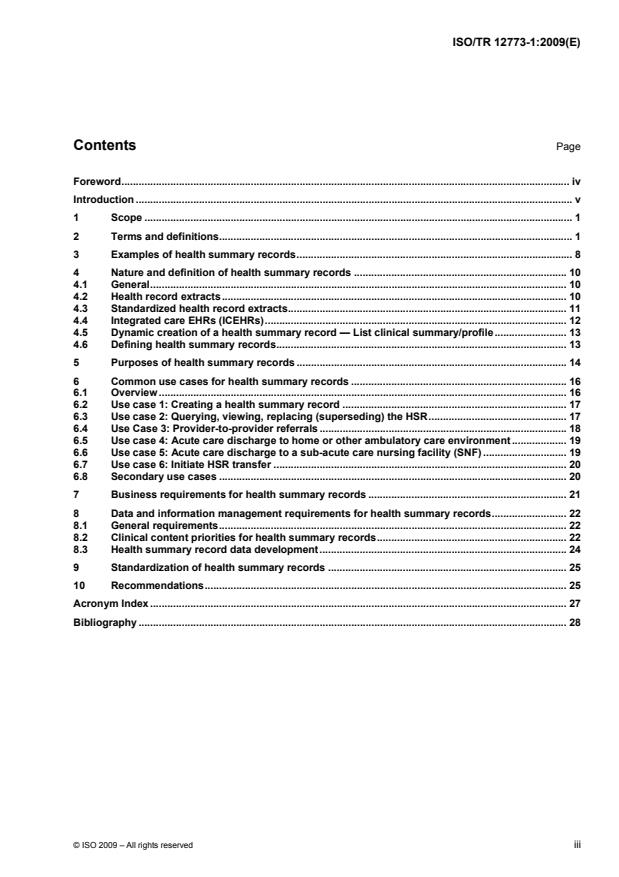
Contents Page
Foreword. iv
Introduction . v
1 Scope . 1
2 Terms and definitions. 1
3 Examples of health summary records. 8
4 Nature and definition of health summary records . 10
4.1 General. 10
4.2 Health record extracts. 10
4.3 Standardized health record extracts. 11
4.4 Integrated care EHRs (ICEHRs). 12
4.5 Dynamic creation of a health summary record — List clinical summary/profile. 13
4.6 Defining health summary records. 13
5 Purposes of health summary records .14
6 Common use cases for health summary records . 16
6.1 Overview . 16
6.2 Use case 1: Creating a health summary record . 17
6.3 Use case 2: Querying, viewing, replacing (superseding) the HSR. 17
6.4 Use Case 3: Provider-to-provider referrals .18
6.5 Use case 4: Acute care discharge to home or other ambulatory care environment . 19
6.6 Use case 5: Acute care discharge to a sub-acute care nursing facility (SNF) . 19
6.7 Use case 6: Initiate HSR transfer . 20
6.8 Secondary use cases . 20
7 Business requirements for health summary records . 21
8 Data and information management requirements for health summary records. 22
8.1 General requirements. 22
8.2 Clinical content priorities for health summary records. 22
8.3 Health summary record data development. 24
9 Standardization of health summary records . 25
10 Recommendations. 25
Acronym Index . 27
Bibliography . 28
Foreword
ISO (the International Organization for Standardization) is a worldwide federation of national standards bodies
(ISO member bodies). The work of preparing International Standards is normally carried out through ISO
technical committees. Each member body interested in a subject for which a technical committee has been
established has the right to be represented on that committee. International organizations, governmental and
non-governmental, in liaison with ISO, also take part in the work. ISO collaborates closely with the
International Electrotechnical Commission (IEC) on all matters of electrotechnical standardization.
International Standards are drafted in accordance with the rules given in the ISO/IEC Directives, Part 2.
The main task of technical committees is to prepare International Standards. Draft International Standards
adopted by the technical committees are circulated to the member bodies for voting. Publication as an
International Standard requires approval by at least 75 % of the member bodies casting a vote.
In exceptional circumstances, when a technical committee has collected data of a different kind from that
which is normally published as an International Standard (“state of the art”, for example), it may decide by a
simple majority vote of its participating members to publish a Technical Report. A Technical Report is entirely
informative in nature and does not have to be reviewed until the data it provides are considered to be no
longer valid or useful.
Attention is drawn to the possibility that some of the elements of this document may be the subject of patent
rights. ISO shall not be held responsible for identifying any or all such patent rights.
ISO/TR 12773-1 was prepared by Technical Committee ISO/TC 215, Health informatics.
ISO/TR 12773 consists of the following parts, under the general title Business requirements for health
summary records:
⎯ Part 1: Requirements
⎯ Part 2: Environmental Scan
iv © ISO 2009 – All rights reserved
Introduction
Consumer, clinician, industry and government demands for improved safety, quality, effectiveness and
efficiency in healthcare are driving the need for more “connected” care, which in turn requires improved
communication of clinical information between multiple providers and subjects of care. Internationally, various
“summary” or “snapshot” health records have been developed to meet these communication needs. Many
similarities are evident in these initiatives, but their conceptual foundations have not always been articulated
with a set of business requirements as their starting point.
The purpose of ISO/TR 12773 is to identify the common business requirements these initiatives are seeking to
address as well as the requirements for standards for health summary records (HSRs) that can guide future
HSR development efforts.
Any future ISO initiative to create standards for a generic HSR specification or specifications for one or more
types of HSR will leverage existing initiatives and adopt/adapt relevant standards utilized therein. Such HSR
specifications are unlikely to require new standards, given that much of their content is deemed “common”,
“core”, “essential” or “emergency” in nature and is therefore part of most EHR initiatives world-wide as
evidenced in ISO/TR 12773-2.
TECHNICAL REPORT ISO/TR 12773-1:2009(E)
Business requirements for health summary records —
Part 1:
Requirements
1 Scope
This part of ISO/TR 12773 is based on a comprehensive review of a series of initiatives and implementations
worldwide that for the purposes of this Technical Report are collectively called health summary records
(HSRs). Project sponsors and/or authorities were contacted as needed to gather additional information and
clarify questions or issues arising out of the review.
This part of ISO/TR 12773 defines and describes HSRs in general as well as specific instances of HSRs and
their most common use cases. It summarises the business requirements driving HSR development and the
content that is common across HSRs, as well as issues associated with them. Finally, it recommends some
future ISO/TC 215 activities to support international standardization of HSRs.
It is important to note that this part of ISO/TR 12773 focuses primarily on requirements that are specific
(unique) to HSRs. It does not attempt to articulate, other than at a high level, requirements that are generally
applicable to all health records or all electronic health records.
2 Terms and definitions
For the purposes of this document, the following terms and definitions apply.
2.1
agent
see healthcare agent (2.19)
2.2
client
patient
individual who is a subject of care
[ISO/TR 20514:2005, definition 2.30]
NOTE The terms “client” and “patient” are synonymous but the usage of one or the other of these terms tends to
differ between different groups of health professionals. Clinicians working in a hospital setting and medical practitioners in
most clinical settings will use the term “patient” whereas allied health professionals may use the term “client”.
2.3
clinical data repository
CDR
data store that holds and manages clinical data collected from service encounters at point of service locations
(e.g. hospitals, clinics)
[ISO/TR 20514:2005, definition 2.5]
NOTE Data from a CDR can be sent to the EHR for that subject of care; in that sense the CDR is recognised as a
source system for a shared EHR or an integrated care EHR.
2.4
clinical data warehouse
CDW
grouping of data accessible by a single data management system, possibly of diverse sources, pertaining to a
health system or sub-system and enabling secondary data analysis for questions relevant to understanding
the functioning of that health system, and hence supporting proper maintenance and improvement of that
health system
[ISO/TR 22221:2006, definition 2.2]
NOTE A CDW tends not to be used in real time; however, depending on the rapidity of transfer of data to the data
warehouse, and data integrity, near real time applications are not excluded.
2.5
clinical information
information about a person, relevant to his or her health or healthcare
[ISO 13606-1:2008, definition 3.13]
2.6
clinician
health professional who delivers health services directly to a patient/client
[ISO/TR 20514:2005, definition 2.6]
2.7
consumer
individual who may become a subject of care
[ISO/TR 20514:2005, definition 2.9]
2.8
data object
collection of data which has a natural grouping and may be identified as a complete entity
2.9
electronic health record
EHR
〈basic generic form〉 repository of information regarding the health status of a subject of care, in computer
processable form
[ISO/TR 20514:2005, definition 2.11]
2.10
electronic health record composition
EHR composition
the set of information committed to one EHR by one agent, as a result of a single clinical encounter or record
documentation
EXAMPLES Progress note, radiology report, referral letter, clinic visit record, discharge summary, functional health
assessment, diabetes review.
2.11
electronic health record extract
EHR extract
a) unit of communication of the EHR which is itself attestable and which consists of one or more EHR
compositions
[ISO/TR 20514:2005, definition 2.13]
2 © ISO 2009 – All rights reserved
b) part or all of the electronic health record of a subject of care communicated between an EHR provider
system and an EHR recipient
NOTE Adapted from ISO 13606-1:2008.
2.12
electronic health record (EHR) — integrated care (ICEHR)
repository of information regarding the health status of a subject of care, in computer processable form, stored
and transmitted securely, and accessible by multiple authorized users and having a standardized or
commonly agreed logical information model that is independent of EHR systems and whose primary purpose
is the support of continuing, efficient and quality integrated healthcare and which contains information that is
retrospective, concurrent, and prospective
NOTE 1 Adapted from ISO/TR 20514:2005.
NOTE 2 The definition of the EHR for integrated care should be considered the primary definition of an electronic
health record. The definition of a basic-generic EHR is given only for completeness.
2.13
electronic health record repository
database in which electronic health record information is persisted
2.14
electronic health record — shareable
EHR — shareable
electronic health record with a standardized information model, which is independent of electronic health
record systems and accessible by multiple authorized users
NOTE 1 The shareable EHR per se is an artefact between a basic-generic EHR and the integrated care EHR (ICEHR)
which is a specialization of the shareable EHR. The shareable EHR is probably of little use without the additional clinical
characteristics that are necessary for its effective use in an integrated care setting.
NOTE 2 Whilst the ICEHR is the target for interoperability of patient health information and optimal patient care, it
should be noted that the large majority of EHRs in use at present are not even shareable let alone have the additional
characteristics required to comply with the definition of an Integrated care EHR. A definition of a basic-generic EHR has
therefore been included to acknowledge this current reality.
2.15
electronic health record system
EHR system
system for recording, retrieving, and manipulating information in electronic health records
[ISO 13606-1:2008, definition 3.26]
2.16
health
state of complete physical, mental and social well-being and not merely the absence of disease or infirmity
[WHO:1948]
2.17
healthcare
activities, services, or supplies related to the health of an individual
[ISO 18308:—, definition 3.28]
2.18
healthcare activity
undertakings (assessments, interventions) that comprise a healthcare service
2.19
healthcare agent
person, device or software that performs a role in a healthcare activity
[ISO 13606-1:2008, definition 3.31]
2.20
healthcare organization
organization involved in the direct or indirect provision of healthcare services to an individual or to a population
[ISO 13606-1:2008, definition 3.33]
2.21
healthcare service
service provided with the intention of directly or indirectly improving the health of the person or populations to
whom it is provided
[ISO 13606-1:2008, definition 3.35]
2.22
health condition
a) aspect of a person or group’s health that requires some form of intervention
[Canada Health Infoway EHRS Blueprint v1.0: 2003]
NOTE These interventions could be anticipatory or prospective, such as enhancing wellness, wellness promotion or
illness prevention (e.g. immunization).
b) symptoms, health problems (not yet diagnosed), diagnoses (known or provisional), e.g. diabetes, or
physiological changes that affect the body as a whole or one or more of its parts, e.g. benign positional
vertigo, and/or affect the person’s well-being, e.g. psychosis, and/or affect the person’s usual
physiological state, e.g. pregnancy, lactation
[Canada Health Infoway, iEHR Clinical Standards Glossary 2007]
2.23
health information
see clinical information (2.5)
2.24
health problem
see health condition (2.22); see problem (2.39)
2.25
health professional
person who is authorized by a recognised body to directly provide certain healthcare services
NOTE Adapted from ISO/TR 20514:2005 and EN 13940-1:2007.
2.26
health record
repository of information regarding the health of a subject of care
[ISO/TR 20514:2005, definition 2.25]
2.27
health record extract
attestable unit of communication of all or part of a health record.
4 © ISO 2009 – All rights reserved
2.28
health summary record
health record extract comprising a standardized collection of clinical and contextual information (retrospective,
concurrent, prospective) that provides a snapshot in time of a subject of care’s health information and
healthcare
2.29
HL7 Clinical Document Architecture
CDA
documentation that defines structure and semantics of medical documents for the purpose of exchange
NOTE CDA documents are encoded in Extensible Mark-up Language (XML). They derive their meaning from the
HL7 Reference Information Model (RIM) and use the HL7 Version 3 Data Types, which are part of the HL7 RIM.
[HL7 International- HL7 CDA Release 2.0]
2.30
integrated care electronic health record (EHR) (ICEHR)
see electronic health record (EHR) — integrated care (ICEHR) (2.12)
2.31
metadata
a) information stored in a data dictionary that describes the content of a document
[ISO/TR 22221:2006, definition 2.10]
NOTE Metadata can include data structure, constraints, types, formats, authorizations, privileges, relationships,
distinct values, value frequencies, keywords and users of the database sources loaded in the EHR repository and the EHR
repository itself. Metadata facilitates information management for users, developers and administrators.
b) data that define object class and property for the information collected
[ISO 13606-1:2008, definition 3.37]
2.32
organization
unique framework of authority within which a person or persons act, or are designated to act towards some
purpose
[ISO/IEC 6523-1:1998, definition 3.1]
2.33
persistent data
a) data which are stored on a permanent basis
[ISO 13606-1:2008, definition 3.40]
b) data in a final form intended as a permanent record, such that any subsequent modification is recorded
together with the original data
[ISO/TR 22221:2006, definition 2.14]
2.34
personal health record
PHR
electronic, universally available, lifelong resource of health information needed by individuals to make health
decisions
NOTE Individuals own and manage the information in the PHR, which comes from healthcare providers and the
individual. The PHR is maintained in a secure and private environment, with the individual determining rights of access.
The PHR is separate from and does not replace the legal record of any provider.
[AHIMA E-HIM PHR Work Group 2005]
2.35
personal health record system
system for recording, retrieving, and manipulating information in personal health records
2.36
physician
health professional who has successfully completed the prescribed course of studies in medicine in a
recognised medical school and who has met the qualifications for licensure in the practice of medicine set by
the state or country in which they are practicing
2.37
practice electronic health record (EHR) system
EHR system that a clinician or group of clinicians uses to document the care provided to a subject of care in
their healthcare organization
NOTE In primary and ambulatory care settings, the practice EHR is usually referred to as an electronic medical
record (EMR). In acute care settings such as hospitals, it is commonly referred to as an electronic patient record (EPR). In
community care settings including home care settings, it may be referred to as an electronic client record (ECR) or an
EPR.
2.38
primary care
overall management of a subject of care’s health problems, including direct delivery of care as well as
coordinating care to specialists and other providers in a gatekeeper system, i.e. a system where the primary
care provider acts on behalf of their patients to manage and prioritize access to required healthcare services
NOTE Adapted from Canada Health Infoway iEHR Clinical Standards Glossary 2007.
2.39
problem
entity for which an assessment is made and a plan or intervention is initiated
[NZ EMR:1998]
NOTE The term “issue” is often used rather than “problem” by many allied health professions, especially in the more
social/psychological disciplines. The term “condition” is also sometimes used to describe pregnancy and other non-
disease health states which nevertheless usually involve interaction with a health system.
2.40
provider
person or organization involved in or associated with the delivery of healthcare to a subject of care, or caring
for the wellbeing of a subject of care
2.41
records
information created, received and maintained as evidence and information by an organization or person, in
pursuance of legal obligations or in the transaction of business
[ISO 15489-1:2001, definition 3.15]
6 © ISO 2009 – All rights reserved
2.42
referral
practice of a provider sending a subject of care to receive healthcare services or a clinical opinion from
another provider when the sending provider is not qualified or prepared to offer such services or opinion
NOTE 1 Adapted from Canada Health Infoway iEHR Standards Glossary 2007.
NOTE 2 A referral letter is a clinical document that accompanies the referral request. It contains the reason for the
referral and includes details of the subject’s health condition(s) and other additional health information relevant to the
referral, as well as a date and the authentication of the referring provider.
2.43
secondary data use
use of data for additional purposes than the primary reason for their collection, adding value to this data
[ISO/TR 22221:2006, definition 2.16]
2.44
secondary use
〈of a healthcare record〉 any legitimate use of a healthcare record other than for the purpose of supporting the
direct delivery of healthcare services to the subject of care
EXAMPLES medico-legal, quality management, clinical research, epidemiology, population health, health
administration, financial, educational or health service planning purposes.
2.45
security
combination of confidentiality, integrity and availability
2.46
service
number of processes involving an organization in the provision of specific objectives
[ISO 12967-1:—, definition 3.4.7]
2.47
shareable EHR
see electronic health record — shareable (2.14)
2.48
shared EHR
see electronic health record — shareable (2.14)
2.49
specialist
〈physician〉 whose practice is limited to a particular area of medicine in which the physician is usually certified
by a recognized board or college of physicians
2.50
standard
document, established by consensus and approved by a recognised body that provides, for common and
repeated use, rules, guidelines or characteristics for activities or their results, aimed at achievement of the
optimum degree of order in a given context
[ISO/IEC Guide 2:2004, definition 3.2]
2.51
subject of care
one or more persons scheduled to receive, receiving, or having received healthcare
NOTE 1 Adapted from ISO 13606-1:2008.
NOTE 2 The terms “patient” and “client” are synonymous with subject of care in a health record context and are
commonly used instead of the more formal term “subject of care”.
NOTE 3 The term “consumer” is also often used as a synonym in this context. However, it should be noted that a
consumer may not necessarily be a subject of care since it can be argued that it is possible for a consumer to have a
health record without ever having received a healthcare service.
3 Examples of health summary records
There are many initiatives in which “summary” or “snapshot” data are extracted or compiled from source
systems and represented in standardized ways. Various definitions have been developed, often tied to
specific business needs. Terms, definitions and contextual descriptions of initiatives identified through the
environmental scan are briefly described in this clause, listed alphabetically, not by country.
For the purposes of this part of ISO/TR 12773, all such records are referred to as health summary records
(HSRs). ISO/TR 12773-2, Clause 6 gives details of these initiatives.
⎯ Care record summary: a summary of care document that contains a patient’s relevant health history for
some time period. It is intended for communication between healthcare providers and often accompanies
the transfer of care of a patient from one provider/organization to another.
HL7 CDA Care Record Summary, U.S. Realm Implementation Guides Level 1 & Level 2, 3rd Informative
[10]
Ballot, Nov 2005
NOTE Internationally, a care record summary is the most common first area of application for the HL7 clinical
document architecture (CDA).
⎯ Continuity of care document (CCD): describes how to implement the continuity of care record dataset with
the standard architecture for clinical records developed by HL7 — the clinical document architecture
(CDA). The standard can be used to send electronic health information among providers without loss of
meaning. Clinical information that can be exchanged includes patient demographic data, medication and
allergy information.
[5]
ASTM and HL7 International
⎯ Continuity of care record (CCR): a patient health summary standard that provides a snapshot in time of a
core dataset of the most relevant and timely facts about a patient’s health information and healthcare
(current and historical). The CCR is organized and transportable and prepared by a practitioner at the
conclusion of a healthcare encounter to enable the next practitioner to readily access such information
electronically or via a paper copy. Data can be sourced from many clinical documents, including a
patient’s personal health record.
ASTM International E31 Committee on Health Informatics and E31.28 Sub-committee on EHR — CCR
[4]
Workgroup
⎯ Core dataset: a standardized dataset that can be used to enable the export and import of all
administrative and clinical information needed to provide continuity of patient care when primary care
physicians switch from one EMR vendor system to a different EMR vendor system.
[17]
OntarioMD Clinical Management System (EMR system) specification 2007
⎯ Emergency care summary: provides a GP summary dataset for use by other clinicians in unscheduled
care settings.
[15]
NHS UK – Scotland
8 © ISO 2009 – All rights reserved
⎯ Electronic medical summary: a standardized core dataset of key health information that can be
communicated electronically and is available at the point of care to provide a snapshot of relevant patient
information. The intention is to support shareable care in the contexts of patient referrals, on-call care and
emergency care.
[6]
Canada: British Columbia Ministry of Health electronic Medical Summary Project, 2005
⎯ Health profile: a summary of essential demographic and clinical information, e.g. current and relevant
past medical conditions, allergies and medications, which will inform healthcare providers and facilitate
care. It should contain, at a minimum, some key types of data. Jurisdictions should have the ability to add
more data types (extensions) to this basic structure.
[7]
Canada Health Infoway — EHRS Blueprint v1.0
⎯ Individual health record: provides an extract of all coded data from GP systems except sensitive data
such as sex changes or sexually transmitted infections, to support out-of-hours and emergency care.
[16]
NHS UK – Wales
⎯ Limited clinical data object: data intended to aid the delivery of emergency care and include a limited
emergency dataset, a blood grouping and transfusion record dataset and an immunizations received
dataset. The data by themselves are neither intended, nor fit for purpose for the total information needed
for the delivery of emergency care.
[30]
ISO 21549-3
⎯ Medical Summaries: a class of clinical documents that contain the most relevant portions of information
about the patient, intended for a specific provider or a broad range of potential providers in different care
settings.
IHE XDS Medical Summary Integration Profile from the Trial Implementation Version of the Patient Care
[11]
Coordination Technical Framework, Revision 1.0, balloted summer 2005
⎯ Medical summary for transfer of patient data: a dataset that will include the necessary and sufficient
patient information, in the absence of the entire medical record, that can be transferred from one
physician office system to another to support informed medical care. The intention is to provide a medical
summary to support the business needs of physicians in providing informed medical care that is
independent of the technology used to perform the transfer.
Alberta Health Information Standards Committee of Alberta, Physician Office System Program Medical
[3]
Summary for Transfer of Patient Data, Version 0, July 2005
⎯ National discharge summary: encompasses standard specifications for the content and structure of a
typical discharge summary, and can be used in a range of clinical settings (e.g. an emergency
department visit or an admission encounter) where relevant clinical information might be captured, stored,
exchanged or displayed.
National E-Health Transition Authority, Discharge Summary Content Specifications, Release Notes, 21
[13]
December 2006
⎯ Personal health record (PHR) minimum common data elements: patient-supplied minimum common
dataset that must be included in a PHR in order to ensure its interoperability among different care settings
and different providers. Suggested categories include personal demographics, general medical
information, allergies and drug sensitivities, conditions, hospitalizations, surgeries, medications,
immunizations, clinical tests and pregnancy history.
[1]
AHIMA E-HIM PHR Work Group, 2005
⎯ Summary care record: a record which holds essential elements of a person’s electronic record, extracted
from general practice notes and essential elements relating to that person from other organizations where
they receive care.
[14]
NHS UK – England
Noteworthy about these terms and definitions is the focus on relevance and timeliness of the data, and
communication of information between healthcare providers for purposes of shared care in various contexts
(transfers, emergency, etc.). The definitions also speak to one or both business contexts for use — point-to-point
provider communication and the shared EHR in support of continuity of care. Many of the definitions do not
imply that the source or recipient of the data is a user with an EHR system, nor do they imply that the
transmission of the health summary is electronic.
NOTE The terms ‘patient’ and ‘subject of care’ are used as synonyms in this part of ISO/TR 12773.
4 Nature and definition of health summary records
4.1 General
A record is defined under 2.41. See Reference [21].
A health record is defined under 2.26. See Reference [24].
Health summary records (HSRs) as articulated in this part of ISO/TR 12773 form a subset of health records.
They comprise standardized extracts from an EHR system or from an EHR repository or multiple EHR
repositories of information regarding the health of subjects of care. HSRs summarize (constitute a summary of,
or abstract into one place) the most important pieces of health information relevant to the purposes at hand.
HSRs such as those identified in this clause typically contain information regarding a subject of care’s key
health history — current health conditions, ongoing health conditions, significant past medical/surgical history,
medication, allergies and adverse reactions, alerts and special needs, etc. — as well as identifying
demographic and contextual information. They may exist in either paper or electronic formats, and both
free-text and structured data are typically included, although there is increasingly a preference for structured,
computer processable content.
The primary use of HSRs is the communication of targeted clinical information between and amongst
healthcare providers and providers and subjects of care in support of ongoing care or delivering
unscheduled/unplanned care and/or enabling appropriate self-care. The primary beneficiaries are subjects of
care and their providers.
4.2 Health record extracts
[24]
An electronic health record (EHR) extract is defined in ISO/TR 20514 as “the unit of communication of the
[28]
EHR which is itself attestable and which consists of one or more EHR compositions”. ISO 13606-1 defines
an EHR extract as part or all of the EHR of a subject of care communicated between an EHR provider system
and an EHR recipient (the latter might be another EHR system, a clinical data repository, a client application
or a middleware service such as an electronic guideline component (from ISO 13606-1:2008, Table 1).
Therefore health record extracts more generally (i.e. including non-electronic extracts) may be described as
‘units’ of communication between authorized and interested parties to a healthcare transaction or transactions.
Such extracts may be either ad hoc in terms of their content, format and/or representation — e.g. a clinician
selects specific content from a health record either “on the fly” or in an idiosyncratic manner and transmits it to
another clinician or to the subject of care — or the extracts may be standardized in terms of content, format
and representation. In the latter case, the most relevant content for a community of providers and/or subjects
of care for a defined set of purposes is likely to have been pre-determined by, or on behalf of that community,
along with the formatting and representation of the selected content.
10 © ISO 2009 – All rights reserved
HSRs are part of the latter subset, which is depicted in Figure 1.
Figure 1 — A binary classification of health record extracts
It should be noted that:
⎯ an instance of a health record extract may be drawn from either a single or multiple instances of
health records for a specific subject of care;
⎯ health record extracts in this generic sense are agnostic of standardized data structures; e.g., they
may conform to ISO 13606-1 or HL7 V3 RIM semantics, or they may not (e.g. in the case of paper-
based health record extracts).
4.3 Standardized health record extracts
Health record extracts that are standardized in terms of pre-agreed content may range from very generic in
nature — e.g. a record of a general health assessment forming an initial entry in an EHR — to the very
specialized summary records intended to capture detailed or sentinel summary data (disease indicator data)
on specific types of health conditions or for specific purposes, e.g. cancer registries or notifications of
infectious diseases. Figure 2 depicts this continuum.
Figure 2 — A continuum of health summary records
The ISO definition of a standard is a “document, established by consensus and approved by a recognized
body, that provides, for common and repeated use, rules, guidelines or characteristics for activities or their
[32]
results, aimed at achievement of the optimum degree of order in a given context” .
”
Accordingly, discussion of the need for standards must consider both the nature of the “order required and
the given context.
The primary domain of interest for this part of ISO/TR 12773 is towards the left hand side of the continuum
depicted in Figure 2 — i.e. health record extracts that are standardized, the primary purpose of which is for a
healthcare provider to pass on to other providers or to the subject of care, a set of information that has been
agreed to be relevant and important to the subject’s ongoing care. Other forms of health record extracts to
which much of the content of this part of ISO/TR 12773 may apply but which are outside its scope include:
⎯ reports extracted from the health record(s) of a subject of care for purposes of notification of specific (e.g.
infectious) conditions, as input to registries of health conditions (e.g. cancer registries) or primarily for
administrative or billing purposes;
⎯ data collection forms coded from the health record(s) of a subject of care for the purpose of aggregation
of statistical information (e.g. hospital morbidity data collections) for secondary usage of data rather than
support of ongoing care.
4.4 Integrated care EHRs (ICEHRs)
[24]
ISO/TR 20514 defines the ICEHR as a repository of information regarding the health status of a subject of
care in computer processable form, stored and transmitted securely, and accessible by multiple authorized
users. It has a standardized or commonly agreed logical information model which is independent of EHR
systems. Its primary purpose is the support of continuing efficient and quality integrated healthcare and it
contains information which is retrospective, concurrent and prospective.
12 © ISO 2009 – All rights reserved
There is a close relationship between health summary records (HSRs) and ICEHRs, not the least of which is a
commonality of purpose.
Key differences, however, include:
⎯ HSRs may not be electronic;
⎯ ICEHRs may contain all available data pertaining to a subject of care, whereas HSRs contain selective
subsets;
⎯ although ICEHRs may have a logical information model, this may only extend to the method of organizing
data content (e.g. sections, folders, compositions), and the data itself may not be standardized, whereas
HSRs (of the type under discussion in this part of ISO/TR 12773) would have pre-agreed, standardized
content.
It should be noted that considerable dialogue concerning the existing terms and definitions for various kinds of
EHRs and EHR systems (i.e. those already specified in existing ISO documents) occurred during the
compilation of this part of ISO/TR 12773. This dialogue provided the basis for the report’s recommendation
that all such related/similar terms and definitions be systematically reviewed by ISO TC 215.
4.5 Dynamic creation of a health summary record — List clinical summary/profile
Within the context of an ICEHR, Canada Health Infoway developed (2006) an HL7 v3 transaction — List
Clinical Profile — which will return the “summary” versions of all demographics, medications, allergies, health
conditions, lab tests, observations, procedures, encounters, referrals and other clinical data stored in one or
more ICEHRs. The HL7 CDA model was adapted to develop this transaction. Because of its cross-domain
nature and uniqueness to Canada’s EHR architecture, this is a Canadian-specific HL7 v3 transaction,
i.e. international balloting is not planned.
For this type of transaction, the default would be to filter for a “standard” view showing the most commonly
needed summary data, based on consensus achieved via the governing authority for a particular ICEHR or
ICEHRs. The transaction would be executed by invoking “summary” queries for each clinical area. The
response would be composed of response messages defined for each clinical area. A parameter can be
added to allow certain types of data to be retrieved as CDA “blobs” e.g. for local systems that are unable to
handle discrete data. The ICEHR can render the blobs for these systems. Conformance needs to allow for
support of different “pieces” of this transaction, with “blob” support as a minimum.
Templates as defined by a particular ICEHR authority can be used to filter which types of data come back,
e.g. a “diabetic summary”. Additional filtering can occur at the practice EHR system level, e.g. family
physician’s office EHR system.
4.6 Defining health summary records
4.6.1 Health record extract
An attestable unit of communication of all or part of a healthcare record.
4.6.2 Health summary record (HSR)
A health record extract comprising a standardized collection of clinical and contextual information
(retrospective, concurrent, prospective) that provides a snapshot in time of a subject of care’s health
information and healthcare.
Noteworthy elements of these definitions include:
⎯ The definition of a health record extract is a generalization of existing ISO definitions for electronic health
record (EHR) extracts, such as those found in ISO/TR 20514; ISO 13606-1.
⎯ An HSR is a form of health record extract.
⎯ The focus of standardization of HSRs is their data content. Other standards (e.g. security, archiving and
data structures) may or may not be applied to HSRs, but the context for their application is that they are
subsets of records, healthcare records and health record extracts and these other standards apply at
those levels. The only unique need for standardization associated with HSRs is associated with their
informational content. This is discussed further in Clause 10.
⎯ The information comprising a HSR is either clinical or contextual (i.e. providing essential context for the
interpretation of the clinical information, such as data identifying the subject of care and/or healthcare
service provider, clinically significant demographic information, etc.).
⎯ The information comprising an HSR may be retrospective (historical), concurrent (where the extraction of
information occurs at the point of care) or prospective (e.g. providing a protocol for future care).
⎯ An HSR is a snapshot — it provides health information for a subject of care, which is relevant at a point in
time.
⎯ The sources of HSR information may include, but are not limited to, various types of EHRs, demographic
registries for clients, providers and location of care
...