


ISO/IEC 19075-3:2021
(Main)Information technology - Guidance for the use of database language SQL - Part 3: SQL embedded in programs using the JavaTM programming language
Information technology - Guidance for the use of database language SQL - Part 3: SQL embedded in programs using the JavaTM programming language
This document describes the support for the use of SQL within programs written in Java. This document discusses the following features of the SQL language: - The embedding of SQL expressions and statements in programs written in the Java programming language.
Technologies de l'information — Recommandations pour l'utilisation du langage de base de données SQL — Partie 3: SQL intégré dans des programmes utilisant le langage de programmation de JavaTM
General Information
Relations
Overview
ISO/IEC 19075-3:2021 provides guidance for embedding the SQL database language inside programs written in the Java programming language. The standard explains how to integrate SQL expressions and statements into Java source, describes design goals (such as binary portability and compile-time checking), and documents runtime profile customization and utilities that enable database-specific behavior. This is commonly referred to when implementing or using SQL embedded in Java (SQL/OLB / SQLJ) solutions and when deciding between embedded SQL and lower-level APIs like JDBC.
Key topics and technical requirements
- Embedding SQL in Java: Rules and recommendations for placing SQL expressions and statements directly in Java code, including host expressions and host variables.
- Design goals: Support for compile-time SQL syntactic/semantic checking, location-independent SQL semantics, binary portability, and shared SQL connection usage between SQL/OLB and JDBC environments.
- Advantages over JDBC: Smaller, higher-level source programs; potential for translator compile-time type checking; direct embedding of Java host expressions; stronger typing and simplified SQL-invoked routine invocation.
- Profile customization: Mechanisms to add implementation-specific SQL execution control via serializable profile customizers and runtime interfaces (for example, SQLJ.runtime.profile.RTStatement, RTResultSet, ConnectedProfile).
- Profile customization process: Steps for discovering, deserializing, customizing, and reserializing profiles (JAR-based profiles), enabling SQL implementations to register hooks for particular DBMS behavior.
- Runtime and utilities: Recommendations for tools (CLI, GUI/IDE integrations, installers) to automate profile customization and precompile/optimize embedded SQL.
- Examples and features: Iterators, binding strategies (positional and named), connection contexts, batching, result mapping, user-defined types, and techniques to obtain java.sql.ResultSet objects from SQL/OLB iterators.
Applications and users
Who uses ISO/IEC 19075-3:
- Java application developers who want to embed SQL directly in their code for stronger typing and simpler source.
- Database vendors and middleware vendors implementing SQL/OLB translators or runtime customizations.
- Tool and IDE developers building precompilers, profile customization utilities, and migration tools.
- System integrators targeting binary-portable Java database applications across multiple SQL implementations.
Practical benefits:
- Cleaner Java source with less boilerplate than JDBC.
- Compile-time SQL checks and safer runtime behavior.
- Easier portability and DB-specific optimization through profile customization.
Related standards
- ISO/IEC 9075 series (SQL/Framework and Object Language Bindings): parts 1, 2, 3, 4, 9–16 as listed in the standard
- Java Language Specification (Java SE editions)
- JDBC Specification (e.g., JDBC 4.3)
Keywords: SQL embedded in Java, SQL/OLB, SQLJ, embedded SQL, JDBC alternative, profile customization, binary portability, Java database integration.
Standards Content (Sample)
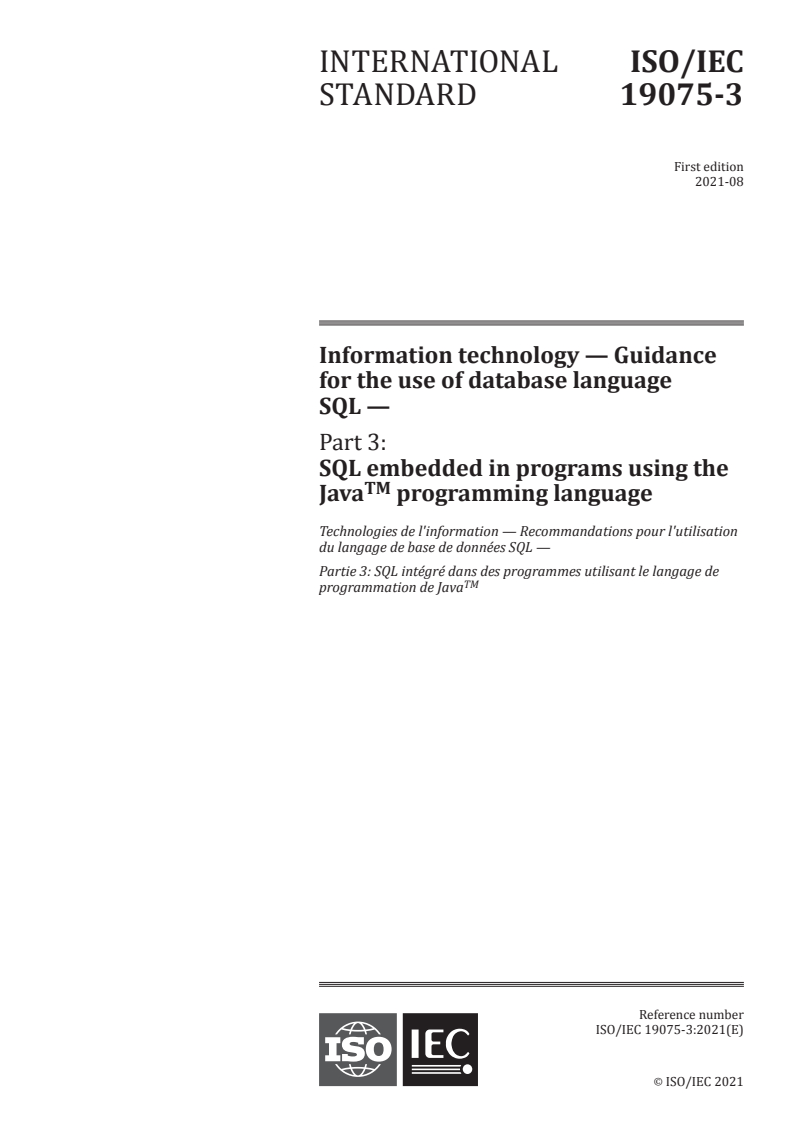
INTERNATIONAL ISO/IEC
STANDARD 19075-3
First edition
2021-08
Information technology — Guidance
for the use of database language
SQL —
Part 3:
SQL embedded in programs using the
TM
Java programming language
Technologies de l'information — Recommandations pour l'utilisation
du langage de base de données SQL —
Partie 3: SQL intégré dans des programmes utilisant le langage de
TM
programmation de Java
Reference number
©
ISO/IEC 2021
© ISO/IEC 2021
All rights reserved. Unless otherwise specified, or required in the context of its implementation, no part of this publication may
be reproduced or utilized otherwise in any form or by any means, electronic or mechanical, including photocopying, or posting
on the internet or an intranet, without prior written permission. Permission can be requested from either ISO at the address
below or ISO’s member body in the country of the requester.
ISO copyright office
CP 401 • Ch. de Blandonnet 8
CH-1214 Vernier, Geneva
Phone: +41 22 749 01 11
Email: copyright@iso.org
Website: www.iso.org
Published in Switzerland
ii © ISO/IEC 2021 – All rights reserved
ISO/IEC19075-3:2021(E)
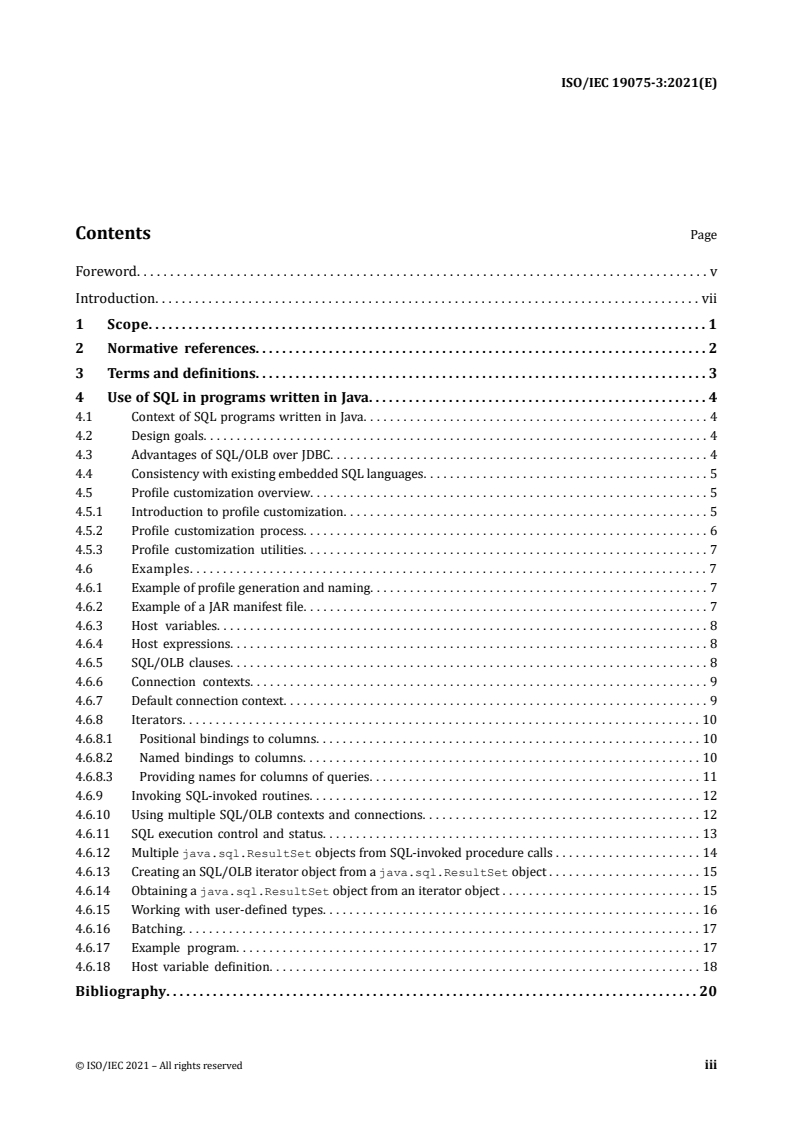
Contents Page
Foreword.v
Introduction.vii
1 Scope.1
2 Normativereferences.2
3 Termsanddefinitions.3
4 UseofSQLinprogramswritteninJava.4
4.1 ContextofSQLprogramswritteninJava.4
4.2 Designgoals.4
4.3 AdvantagesofSQL/OLBoverJDBC.4
4.4 ConsistencywithexistingembeddedSQLlanguages.5
4.5 Profilecustomizationoverview.5
4.5.1 Introductiontoprofilecustomization.5
4.5.2 Profilecustomizationprocess.6
4.5.3 Profilecustomizationutilities.7
4.6 Examples.7
4.6.1 Exampleofprofilegenerationandnaming.7
4.6.2 ExampleofaJARmanifestfile.7
4.6.3 Host variables.8
4.6.4 Hostexpressions.8
4.6.5 SQL/OLBclauses.8
4.6.6 Connection contexts.9
4.6.7 Defaultconnectioncontext.9
4.6.8 Iterators.10
4.6.8.1 Positionalbindingstocolumns.10
4.6.8.2 Namedbindingstocolumns.10
4.6.8.3 Providingnamesforcolumnsofqueries.11
4.6.9 InvokingSQL-invokedroutines.12
4.6.10 UsingmultipleSQL/OLBcontextsandconnections.12
4.6.11 SQLexecutioncontrolandstatus.13
4.6.12 Multiplejava.sql.ResultSetobjectsfromSQL-invokedprocedurecalls.14
4.6.13 CreatinganSQL/OLBiteratorobjectfromajava.sql.ResultSetobject.15
4.6.14 Obtainingajava.sql.ResultSetobjectfromaniteratorobject.15
4.6.15 Workingwithuser-definedtypes.16
4.6.16 Batching.17
4.6.17 Example program.17
4.6.18 Hostvariabledefinition.18
Bibliography.20
©ISO/IEC2021–Allrightsreserved iii
ISO/IEC19075-3:2021(E)
Index.21
iv ©ISO/IEC2021–Allrightsreserved
ISO/IEC19075-3:2021(E)
Foreword
ISO(theInternationalOrganizationforStandardization)andIEC(theInternationalElectrotechnical
Commission)formthespecializedsystemforworldwidestandardization.Nationalbodiesthatare
membersofISOorIECparticipateinthedevelopmentofInternationalStandardsthroughtechnical
committeesestablishedbytherespectiveorganizationtodealwithparticularfieldsoftechnicalactivity.
ISOandIECtechnicalcommitteescollaborateinfieldsofmutualinterest.Otherinternationalorganizations,
governmentalandnon-governmental,inliaisonwithISOandIEC,alsotakepartinthework.
Theproceduresusedtodevelopthisdocumentandthoseintendedforitsfurthermaintenanceare
describedintheISO/IECDirectives,Part1.Inparticular,thedifferentapprovalcriterianeededforthe
differenttypesofdocumentshouldbenoted.Thisdocumentwasdraftedinaccordancewiththeeditorial
rulesoftheISO/IECDirectives,Part2(seewww.iso.org/directivesorwww.iec.ch/mem-
bers_experts/refdocs).
Attentionisdrawntothepossibilitythatsomeoftheelementsofthisdocumentmaybethesubjectof
patentrights.ISOandIECshallnotbeheldresponsibleforidentifyinganyorallsuchpatentrights.Details
ofanypatentrightsidentifiedduringthedevelopmentofthedocumentwillbeintheIntroductionand/or
ontheISOlistofpatentdeclarationsreceived(seewww.iso.org/patents),ortheIEClistofpatent
declarationsreceived(seepatents.iec.ch).
Anytradenameusedinthisdocumentisinformationgivenfortheconvenienceofusersanddoesnot
constituteanendorsement.
Foranexplanationofthevoluntarynatureofstandards,themeaningofISOspecifictermsandexpressions
relatedtoconformityassessment,aswellasinformationaboutISO’sadherencetotheWorldTrade
Organization(WTO)principlesintheTechnicalBarrierstoTrade(TBT)seewww.iso.org/iso/fore-
word.html.IntheIEC,seewww.iec.ch/understanding-standards.
ThisdocumentwaspreparedbyTechnicalCommitteeISO/IECJTC1,Informationtechnology,Subcom-
mitteeSC32,Datamanagementandinterchange.
ThisfirsteditionofISO/IEC19075-3cancelsandreplacesISO/IECTR19075-3:2015.
ThisdocumentisintendedtobeusedinconjunctionwiththefollowingeditionsofthepartsoftheISO/IEC
9075series:
— ISO/IEC9075-1,sixtheditionorlater;
— ISO/IEC9075-2,sixtheditionorlater;
— ISO/IEC9075-3,sixtheditionorlater;
— ISO/IEC9075-4,seventheditionorlater;
— ISO/IEC9075-9,fiftheditionorlater;
— ISO/IEC9075-10,fiftheditionorlater;
— ISO/IEC9075-11,fiftheditionorlater;
— ISO/IEC9075-13,fiftheditionorlater;
— ISO/IEC9075-14,sixtheditionorlater;
— ISO/IEC9075-15,secondeditionorlater;
— ISO/IEC9075-16,firsteditionorlater.
©ISO/IEC2021–Allrightsreserved v
ISO/IEC19075-3:2021(E)
AlistofallpartsintheISO/IEC19075seriescanbefoundontheISOandIECwebsites.
Anyfeedbackorquestionsonthisdocumentshouldbedirectedtotheuser’snationalstandardsbody.A
completelistingofthesebodiescanbefoundatwww.iso.org/members.htmlandwww.iec.ch/-
national-committees.
vi ©ISO/IEC2021–Allrightsreserved
ISO/IEC19075-3:2021(E)
Introduction
Theorganizationofthisdocumentisasfollows:
1) Clause1,“Scope”,specifiesthescopeofthisdocument.
2) Clause2,“Normativereferences”,identifiesadditionalstandardsthat,throughreferenceinthis
document,constituteprovisionsofthisdocument.
3) Clause3,“Termsanddefinitions”,definesthetermsanddefinitionsusedinthisdocument.
4) Clause4,“UseofSQLinprogramswritteninJava”,providesatutorialontheembeddingofSQL
expressionsandstatementsinprogramswrittenintheJava™ programminglanguage.
1Java™isthetrademarkofaproductsuppliedbyOracle.Thisinformationisgivenfortheconvenienceofusersofthisdocument
anddoesnotconstituteanendorsementbyISOorIECoftheproductnamed.
©ISO/IEC2021–Allrightsreserved vii
INTERNATIONAL STANDARD ISO/IEC 19075-3:2021(E)
Informationtechnology—GuidancefortheuseofdatabaselanguageSQL—
Part3:
SQLembeddedinprogramsusingtheJava™programminglanguage
1 Scope
ThisdocumentdescribesthesupportfortheuseofSQLwithinprogramswritteninJava.
ThisdocumentdiscussesthefollowingfeaturesoftheSQLlanguage:
— TheembeddingofSQLexpressionsandstatementsinprogramswrittenintheJavaprogramming
language.
©ISO/IEC2021–Allrightsreserved 1
ISO/IEC19075-3:2021(E)
2 Normativereferences
Thefollowingdocumentsarereferredtointhetextinsuchawaythatsomeoralloftheircontentconsti-
tutesrequirementsofthisdocument.Fordatedreferences,onlytheeditioncitedapplies.Forundated
references,thelatesteditionofthereferenceddocument(includinganyamendments)applies.
ISO/IEC9075-1,Informationtechnology—Databaselanguages—SQL—Part1:Framework
(SQL/Framework)
ISO/IEC9075-10,Informationtechnology—Databaselanguages—SQL—Part10:ObjectLanguage
Bindings(SQL/OLB)
JavaCommunityProcess.TheJava™LanguageSpecification[online].JavaSE13Edition.Redwood
Shores,California,USA:Oracle,Availableathttps://docs.oracle.com/javase/specs/jls/-
se13/jls13.pdf
JavaCommunityProcess.JDBC™4.3Specification[online].Edition4.3.RedwoodShores,California,
USA:Oracle,Availableathttps://download.oracle.com/otn-pub/jcp/-
jdbc-4_3-mrel3-eval-spec/jdbc4.3-fr-spec.pdf
2 ©ISO/IEC2021–Allrightsreserved
ISO/IEC19075-3:2021(E)
3 Termsanddefinitions
Forthepurposesofthisdocument,thetermsanddefinitionsgiveninISO/IEC9075-1apply.
ISOandIECmaintainterminologicaldatabasesforuseinstandardizationatthefollowingaddresses:
— IECElectropedia:availableathttp://www.electropedia.org/
— ISOOnlinebrowsingplatform:availableathttp://www.iso.org/obp
©ISO/IEC2021–Allrightsreserved 3
ISO/IEC19075-3:2021(E)
4 UseofSQLinprogramswritteninJava
4.1 ContextofSQLprogramswritteninJava
TherequirementsforthematerialdiscussedinthisdocumentshallbeasspecifiedinISO/IEC9075-1
andISO/IEC9075-10.
4.2 Designgoals
ThefollowingitemsrepresentthemajordesignfeaturesofISO/IEC9075-1.ISO/IEC9075-10,Java,and
JDBCallspecifyrequirementsforthematerialdiscussedinthisdocument.
— Provideaconcise,legiblemechanismforembeddingSQL-statementsinaprogramthatotherwise
conformstoJava.
— SyntacticandsemanticcheckofSQL-statementspriortoprogramexecution.
SQL/OLBcanuseanimplementation-definedmechanismattranslatetimetocheckembeddedSQL-
statementstomakesurethattheyaresyntacticallyandsemanticallycorrect.
— AllowthesyntaxandsemanticsofSQL-statementstobelocation-independent.
ThesyntaxandsemanticsofSQL-statementsinanSQL/OLBprogramdonotdependontheconfigu-
rationunderwhichSQL/OLBisrunning.ThismakesitpossibletoimplementSQL/OLBprograms
thatrunontheclient,intheSQL-server,orinamiddletier.
— ProvidefacilitiesthatenabletheprogrammertomovebetweentheSQL/OLBandJDBCenvironments
bysharingasingleSQL-connectioninbothenvironments.
— ProvideforbinaryportabilityoftranslatedandcompiledJavaSQL-clientapplicationssuchthatthey
canbeusedtransparentlywithmultipleSQL-servers.Inaddition,binaryportabilityprofilesallow
forcustomizationandoptimizationofSQL-statementswithinanSQL/OLBapplication.
4.3 AdvantagesofSQL/OLBoverJDBC
JDBCprovidesacomplete,low-levelSQLinterfacefromJavatoSQL-implementations.SQL/OLBisdesigned
tofillacomplementaryrolebyprovidingahigher-levelprogramminginterfacetoSQL-implementations
insuchamannerastofreetheprogrammerfromthetediousandcomplexprogramminginterfacesfound
inlower-levelAPIs.
Thefollowingaresomemajordifferencesbetweenthetwo:
— SQL/OLBsourceprogramsaresmallerthanequivalentJDBCprogramssincethetranslatorcan
implicitlyhandlemanyofthetediousprogrammingchoresthatdynamicinterfacesrequire.
— SQL/OLBprogramscantype-checkSQLcodeattranslatetimeusinganimplementation-dependent
mechanism.JDBC,beingacompletelydynamicAPI,cannot.
4 ©ISO/IEC2021–Allrightsreserved
ISO/IEC19075-3:2021(E)
4.3 AdvantagesofSQL/OLBoverJDBC
— SQL/OLBprogramsallowdirectembeddingofJavahostexpressionswithinSQL-statements.JDBC
requiresaseparatecallstatementforeachbindvariableandspecifiesthebindingbypositionnumber.
— SQL/OLBenforcesstrongtypingofqueryoutputsandvaluesreturnedandallowstypecheckingon
calls.JDBCpassesvaluestoandfromSQLwithoutcompiletimetypechecking.
— SQL/OLBprovidessimplifiedrulesforinvokingSQL-invokedroutines.JDBCrequiresagenericcall
toanSQL-invokedroutine,fun,tohavethefollowingsyntax:
prepStmt.prepareCall("{call fun(.)}"); // For SQL-invoked procedures
prepStmt.prepareCall("{? = call fun(.)}"); // For SQL-invoked functions
SQL/OLBprovidessimplifiednotations:
#sql { CALL fun(.) }; // SQL-invoked procedure
// Declare x
...
#sql x = { VALUES(fun(.)) }; // SQL-invoked function
// VALUES is an SQL construct
4.4 ConsistencywithexistingembeddedSQLlanguages
ProgramminglanguagescontainingembeddedSQLarecalledhostlanguages.Javadiffersfromthetradi-
tionalhostlanguages(Ada,C,COBOL,Fortran,MUMPS(M),Pascal,PL/I)inwaysthatsignificantlyaffect
itsembeddingofSQL.
— Javahasautomaticstoragemanagement(alsoknownas“garbagecollection”)thatsimplifiesthe
managementofstoragefordataretrievedfromSQL-implementations.
— AllJavatypesrepresentingcompositedata,anddataofvaryingsizes,haveadistinguishedvalue
null,whichcanbeusedtorepresenttheSQLNULLvalue.ThisgivesJavaprogramsanalternative
totheindicatorvariablesthatarepartoftheinterfacestootherhostlanguages.
— Javaisdesignedtosupportprogramsthatareautomaticallyheterogeneouslyportable(alsocalled
“superportable”orsimply“downloadable”).That,alongwithJava’stypesystemofclassesand
interfaces,enablescomponentsoftware.Inparticular,anSQL/OLBtranslator,writteninJava,can
callcomponentsthatarespecializedbySQL-implementations,inordertoleveragetheexisting
authorization,schemachecking,typechecking,transactional,andrecoverycapabilitiesthataretra-
ditionalofSQL-implementations,andtogeneratecodeoptimizedforparticularSQL-implementations.
— Javaisdesignedforbinaryportabilityinheterogeneousnetworks,whichpromisestoenablebinary
portabilityforapplicationsthatuseSQL.
— SQL/OLBextendsthetraditionalconceptofembeddedhostvariablesbyallowinggeneralizedhost
expressions.
4.5 Profilecustomizationoverview
4.5.1 Introductiontoprofilecustomization
Thissubclausedescribeshowimplementation-specific“customized”SQLexecutioncontrolcanbeadded
toSQL/OLBapplications.TheSQL/OLBruntimeframeworkusesthefollowinginterfaces:
©ISO/IEC2021–Allrightsreserved 5
ISO/IEC19075-3:2021(E)
4.5 Profilecustomizationoverview
— SQLJ.runtime.profile.RTStatementtoexecuteSQL-statements.
— SQLJ.runtime.profile.RTResultSettodescribequeryresults.
— SQLJ.runtime.profile.ConnectedProfiletocreateRTStatementobjectscorrespondingtoparticular
SQL-statements.
AnSQL-implementationisabletocontrolSQLexecutionbyprovidinganimplementationofthe
RTStatement,RTResultSet,andConnectedProfileinterfaces.AnSQL-implementationisabletoredirect
controltoitsowncodebyregisteringcustomizationhookswiththeapplicationprofiles.
Forexample,iftheclientconnectstoSQL-serverA,thenacustomizationthatunderstandsSQL-server
A’ssystemwillbeused.IftheclientconnectstoSQL-serverB,thenSQL-serverB’scustomizationwillbe
used.Intheabsenceofaconnectionspecificcustomization,thedefaultJDBCbasedcustomizationwill
beused.Liketheprofileobject,customizationobjectsareserializable.Thisallowsthecustomization
statetobestoredandrestoredwiththeprofile.Inthismanner,animplementation-dependentdeployment
toolisabletoloadtheprofile,inspectandprecompiletheSQL-statementsitcontains,registeran
appropriatecustomization,andstoretheprofileinpersistentstorage.Thenatapplicationruntime,the
profileandtheregisteredimplementation-dependentcustomizationwillbothberestored,andthecus-
tomizationwillbeusedtoexecutetheSQL-statements.
4.5.2 Profilecustomizationprocess
Theprofilecustomizationprocessistheactofregisteringprofilecustomizationobjectswiththeprofile(s)
associatedwithanapplication.Theprofilecustomizationprocesscanbegeneralizedtothefollowing
steps:
1) DiscovertheprofileobjectswithinaJARfile.
2) Foreachprofile,deserializetheprofileobjectfromtheappropriateJARentry.
3) CreateanSQL-connectionwithwhichtheprofilewillbecustomized.
4) Createandregisteraprofilecustomizationwiththeprofile.
5) Serializethecustomizedprofilebacktopersistentstorage.
6) RecreatetheJARcontentsusingthecustomizedserializedprofiles.
Oftheabovesteps,onlyStep4)islikelytochangefromSQL-implementationtoSQL-implementation.
WhileStep3)isimplementation-dependent,itcanbedoneusingaparameterizedtoolandJDBC.The
restofthestepsinvolveactionsthatcanbeperformedbyanygenericutilitywithoutspecificknowledge
ofthecustomizationbeingperformed.
Theactofcreatingandregisteringacustomizationobjectwithaprofile(step4above)isabstractly
definedbytheJavainterfaceSQLJ.runtime.profile.util.ProfileCustomizer.Theintentofdefiningthis
interfaceistoallowSQL-implementationstoconcentrateonwritingprofilecustomizersandcustomization
objects(step4above),whiletoolsandapplicationimplementationsconcentrateonwritinggenerictools
thatapplycustomizerstoapplicationprofiles(steps1–3and5–6above).
Theprofilecustomizerinterfaceisabletosupportmostcustomizationregistrationrequirements.However,
itisnotrequiredthatallutilitiesthatregistercustomizationobjectswithaprofileimplementthisinterface.
SQL/OLBapplicationswillbeabletorunandleverageallimplementation-specificcustomizationobjects
registeredwithaprofile,regardlessofwhetherornottheywereregisteredbyaprofilecustomizer.The
primarybenefitofconformingtotheprofilecustomizerinterfaceistobeabletotakeadvantageof
existingandfutureautomatedprofilecustomizationutilitiesthatareabletoload,callandmanipulate
profilecustomizers.
6 ©ISO/IEC2021–Allrightsreserved
ISO/IEC19075-3:2021(E)
4.5 Profilecustomizationoverview
4.5.3 Profilecustomizationutilities
Profilecustomizerscanbeinstantiatedandusedbyautomatedgeneral-purposeprofilecustomization
utilities.AnSQL-implementationmightincludeacommand-linebasedtoolthatservesasacustomization
utilityprototype.Inadditiontoacommandline-basedutility,otherusefulcustomizationutilitiesmight
include:
— GUI-basedIDEsusedtodrag-and-dropcustomizationsintoprofiles.
— TightintegrationofcustomizationutilitieswithSQL-implementationstoautomaticallycustomize
theprofilesloadedintotheSQL-server.
— Background“SQL/OLBinstaller”processusedasadministrativetooltodiscoverandcustomize
SQL/OLBapplicationsforavailableSQL-schemas.
NOTE1—Implementorsareencouragedtoimplementutilitiesusingtheseandotherideas.Makingsuchtoolspublicly
availablewillgreatlybenefitandfacilitatetheSQL/OLBbinary-portabilityeffort.
4.6 Examples
4.6.1 Exampleofprofilegenerationandnaming
Supposethereexiststhefollowingfile,Bar.SQLJ,whichdefinespackageCOM.foo,andcontainsthree
sassociatedwithtwos.
package COM.foo;
#sql context MyContext;
public class Bar
{
public static void doSQL(MyContext ctx) throws SQLException
{
// 1: explicit context
#sql [ctx] { UPDATE TAB1 SET COL1 = COL1 + 2 };
// 2: implicit context
#sql { INSERT INTO TAB2 VALUES(3, 'Hello there') };
// 3: explicit context again
#sql [ctx] { DELETE FROM TAB1 WHERE COL1 > 500 };
}
}
Twoprofilesarecreatedforthisfile;theyarenamedCOM.foo.Bar_SJProfile0andCOM.foo.Bar_SJPro-
file1.COM.foo.Bar_SJProfile0containsinformationdescribings1and3,andis
storedinafilecalledBar_SJProfile0.ser.Com.foo.Bar_SJProfile1describesclause2,andisstoredin
fileBar_SJProfile1.ser.
4.6.2 ExampleofaJARmanifestfile
WorkingagainwiththefileBar.SQLJfromthelastexample,iftheBarapplicationwerepackagedfor
deploymentasaJARfile,theJAR’smanifestcanbeusedbySQL/OLBcustomizationutilitiestolocatethe
application’sprofilefiles.Toallowthatuse,theprofilesectionofthemanifestfilewouldhavethefollowing
entries:
— Name:COM/foo/Bar_SJProfile0.serSQLJProfile:TRUE
©ISO/IEC2021–Allrightsreserved 7
ISO/IEC19075-3:2021(E)
4.6 Examples
— Name:COM/foo/Bar_SJProfile1.serSQLJProfile:TRUE
4.6.3 Hostvariables
Thefollowingquerycontainshostvariable:x(whichistheJavavariable,Javafield,orparameterxvisible
inthescopecontainingthequery):
SELECT COL1, COL2 FROM TABLE1 WHERE :x > COL3
4.6.4 Hostexpressions
Hostexpressionsareevaluatedfromlefttorightandcancausesideeffects.Forexample:
SELECT COL1, COL2 FROM TABLE1 WHERE :(x++) > COL3
HostexpressionsarealwayspassedtoandretrievedfromtheSQL-serverusingpurevaluesemantics.
Forinstance,intheaboveexample,thevalueofx++isdeterminedpriortostatementexecutionandits
determinedvalueisthevaluethatispassedtotheSQL-serverforstatementexecution.
SELECT COL1, COL2 FROM TABLE1 WHERE :(x[--i]) > COL3
Intheaboveexample,priortostatementexecution,thevalueofiisdecrementedby1(one)andthen
thevalueofthei-thelementofxisdeterminedandpassedtotheSQL-serverforstatementexecution.
ConsiderthefollowingexampleofanSQL/PSM:
SET :(z[i++]) = :(x[i++]) + :(y[i++])
Assumethatihasaninitialvalueof1(one).Hostexpressionsareevaluatedinlexicalorder.
Therefore,thearrayindexusedtodeterminethelocationinthearrayzis1(one),afterwhichthevalue
ofiisincrementedby1(one).Consequently,thearrayindexusedtodeterminethelocationinthearray
xis2,afterwhichthevalueofiisincrementedby1(one).Asaresult,thearrayindexusedtodetermine
thelocationinthearrayyis3,afterwhichthevalueofiisincrementedby1(one).Thevalueofiinthe
Javaspaceisnow4.Thestatementisthenexecuted.Afterstatementexecution,theoutputvalueisassigned
toz[1].
Assignmentstooutputhostexpressionsarealsoperformedinlexicalorder.Forexample,considerthe
followingcalltoanSQL-invokedprocedurefoothatreturnsthevalues2and3.
CALL foo( :OUT x, :OUT x )
Afterexecution,xhasthevalue3.
4.6.5 SQL/OLBclauses
ThefollowingSQL/OLBclauseispermittedtoappearwhereveraJavastatementcanlegallyappearand
itspurposeistodeletealloftherowsinthetablenamedTAB:
#sql { DELETE FROM TAB };
ThefollowingJavamethod,wheninvoked,insertsitsargumentsintoanSQLtable.Themethodbody
consistsofanSQL/OLBexecutableclausecontainingthehostexpressionsx,y,andz.
8 ©ISO/IEC2021–Allrightsreserved
ISO/IEC19075-3:2021(E)
4.6 Examples
void m (int x, String y, float z) throws SQLException
{
#sql { INSERT INTO TAB1 VALUES (:x, :y, :z ) };
}
Thefollowingmethodselectstheaddressofthepersonwhosenameisspecifiedbytheinputhost
expressionnameandthenretrievesanassociatedaddressfromtheassumedtablePEOPLE,withcolumns
NAMEandADDRESS,intotheoutputhostexpressionsaddr,whereitisthenpermittedtobeused,for
example,inacalltoSystem.out.println:
void print_address (String name) throws SQLException
{
String addr;
#sql { SELECT ADDRESS INTO :addr
FROM PEOPLE
WHERE :name = NAME };
}
4.6.6 Connectioncontexts
InthefollowingSQL/OLBclause,theconnectioncontextisthevalueoftheJavavariablemyconn.
#sql [myconn] { SELECT ADDRESS INTO :addr
FROM PEOPLE
WHERE :name = NAME } ;
ThefollowingillustratesanSQL/OLBconnectionclausethatdefinesaconnectioncontextclassnamed
“Inventory”:
#sql context Inventory;
4.6.7 Defaultconnectioncontext
IfaninvocationofanSQL/OLBtranslatorindicatesthatthedefaultconnectioncontextclassisclassGreen,
thenallSQL/OLBclausesthatusethedefaultconnectionwillbetranslatedasiftheyusedtheexplicit
connectioncontextobjectGreen.getDefaultContext( ).Forexample,thefollowingtwoSQL/OLBclauses
areequivalentifthedefaultconnectioncontextclassisclassGreen:
#sql { UPDATE TAB SET COL = :x };
#sql
...
Frequently Asked Questions
ISO/IEC 19075-3:2021 is a standard published by the International Organization for Standardization (ISO). Its full title is "Information technology - Guidance for the use of database language SQL - Part 3: SQL embedded in programs using the JavaTM programming language". This standard covers: This document describes the support for the use of SQL within programs written in Java. This document discusses the following features of the SQL language: - The embedding of SQL expressions and statements in programs written in the Java programming language.
This document describes the support for the use of SQL within programs written in Java. This document discusses the following features of the SQL language: - The embedding of SQL expressions and statements in programs written in the Java programming language.
ISO/IEC 19075-3:2021 is classified under the following ICS (International Classification for Standards) categories: 35.060 - Languages used in information technology. The ICS classification helps identify the subject area and facilitates finding related standards.
ISO/IEC 19075-3:2021 has the following relationships with other standards: It is inter standard links to ISO/IEC TR 19075-3:2015. Understanding these relationships helps ensure you are using the most current and applicable version of the standard.
You can purchase ISO/IEC 19075-3:2021 directly from iTeh Standards. The document is available in PDF format and is delivered instantly after payment. Add the standard to your cart and complete the secure checkout process. iTeh Standards is an authorized distributor of ISO standards.
Questions, Comments and Discussion
Ask us and Technical Secretary will try to provide an answer. You can facilitate discussion about the standard in here.
Loading comments...