

ISO 24681:2023
(Main)Ships and marine technology — Fibre-reinforced plastic gratings
General Information
- Abstract
This document specifies the structure, technical requirements and test methods of gratings for fibre-reinforced plastics (FRP) in the marine industry. It also defines terms related to FRP gratings. This document is applicable to the design, manufacture and inspection of self-support FRP gratings used for pedestrian pathways and platforms on ships or offshore platforms.
- Status
- Published
- Publication Date
- 14-May-2023
- Technical Committee
- ISO/TC 8/SC 8 - Ship design
- Drafting Committee
- ISO/TC 8/SC 8 - Ship design
- Current Stage
- 6060 - International Standard published
- Start Date
- 15-May-2023
- Due Date
- 23-Sep-2023
- Completion Date
- 15-May-2023


Overview
ISO 24681:2023 - Ships and marine technology - Fibre-reinforced plastic gratings - specifies the structure, technical requirements and test methods for fibre-reinforced plastic (FRP) gratings used on ships and offshore platforms. The standard covers terminology, classification (moulded and pultruded gratings), manufacture, inspection and performance testing for self-supporting FRP gratings intended for pedestrian pathways, platforms and stair treads in maritime environments.
Key topics and technical requirements
The standard addresses design, manufacturing and verification aspects with emphasis on safety and durability. Key points include:
- Types and construction: distinguishes moulded and pultruded FRP gratings, with typical mesh sizes and bearing-bar profiles described for selection and specification.
- Appearance and quality: requirements for surface finish (no obvious stratification, fibre exposure or cracks), pore limits (no pores > 3 mm; ≤10 pores between 1–3 mm per 300×300 mm) and warpage limits (≤2.5 mm/m along bearing bars; ≤5 mm/m other directions).
- Load-bearing capacity: minimum flexural strength of 345 MPa; design load criteria for pedestrian pathways and platforms (uniform load specified in the standard) and deflection limits (mid-span deflection ≤ span/120 and maximum deflection ≤ 9 mm). Stair treads are assessed for a 2 kN concentrated load with tighter deflection limits (≤ span/200; max 6 mm).
- Corrosion and environmental resistance: requirements for seawater and salt-fog resistance; post-salt-spray load-bearing verification.
- Skid resistance: average coefficient of friction for the upper surface ≥ 0.75 (dry conditions).
- Fire performance: surface flame-spread testing per IMO FTP Code (Part 5) or equivalent (e.g., ASTM E84 - FSI ≤ 25); smoke and toxicity testing per IMO FTP Code with equivalence to ASTM E84 SDI ≤ 450.
- Anti-electrostatic properties: conductive surface and grounding requirements for hazardous areas (see IEC 61892-7 and numeric limits in the standard).
- Testing and inspection: prescriptive test methods for flexural loading (three-point bending), flame integrity, UV exposure, salt spray and other acceptance tests. Annexes include normative test procedures and an informative application guideline.
Practical applications and who uses this standard
ISO 24681:2023 is essential for:
- Naval architects and ship designers specifying deck, walkway and platform materials.
- FRP grating manufacturers and fabricators ensuring product compliance.
- Classification societies, shipbuilders and offshore operators for procurement, inspection and acceptance.
- Safety and maintenance engineers assessing skid, fire and corrosion performance in maritime environments.
Using this standard reduces ambiguity in specifications, improves safety on ships and offshore platforms, and ensures consistent quality and testing of FRP gratings.
Related standards and references
Normative references cited include: ISO 4892-3 (UV exposure), ISO 9227 (salt spray), ISO 14125 (flexural properties of FRP), IMO FTP Code, SOLAS, ASTM D2047, ASTM E84, and IEC 61892-7. Consult the full ISO 24681:2023 document for complete numeric limits, test methods and annexed procedures.
Get Certified
Connect with accredited certification bodies for this standard

DNV
DNV is an independent assurance and risk management provider.

Lloyd's Register
Lloyd's Register is a global professional services organisation specialising in engineering and technology.

FSC International
Forest Stewardship Council certification.
Sponsored listings
Frequently Asked Questions
ISO 24681:2023 is a standard published by the International Organization for Standardization (ISO). Its full title is "Ships and marine technology — Fibre-reinforced plastic gratings". This standard covers: This document specifies the structure, technical requirements and test methods of gratings for fibre-reinforced plastics (FRP) in the marine industry. It also defines terms related to FRP gratings. This document is applicable to the design, manufacture and inspection of self-support FRP gratings used for pedestrian pathways and platforms on ships or offshore platforms.
This document specifies the structure, technical requirements and test methods of gratings for fibre-reinforced plastics (FRP) in the marine industry. It also defines terms related to FRP gratings. This document is applicable to the design, manufacture and inspection of self-support FRP gratings used for pedestrian pathways and platforms on ships or offshore platforms.
ISO 24681:2023 is classified under the following ICS (International Classification for Standards) categories: 47.020.50 - Deck equipment and installations. The ICS classification helps identify the subject area and facilitates finding related standards.
ISO 24681:2023 is available in PDF format for immediate download after purchase. The document can be added to your cart and obtained through the secure checkout process. Digital delivery ensures instant access to the complete standard document.
Standards Content (Sample)
INTERNATIONAL ISO
STANDARD 24681
First edition
2023-05
Ships and marine technology — Fibre-
reinforced plastic gratings
Reference number
© ISO 2023
All rights reserved. Unless otherwise specified, or required in the context of its implementation, no part of this publication may
be reproduced or utilized otherwise in any form or by any means, electronic or mechanical, including photocopying, or posting on
the internet or an intranet, without prior written permission. Permission can be requested from either ISO at the address below
or ISO’s member body in the country of the requester.
ISO copyright office
CP 401 • Ch. de Blandonnet 8
CH-1214 Vernier, Geneva
Phone: +41 22 749 01 11
Email: copyright@iso.org
Website: www.iso.org
Published in Switzerland
ii
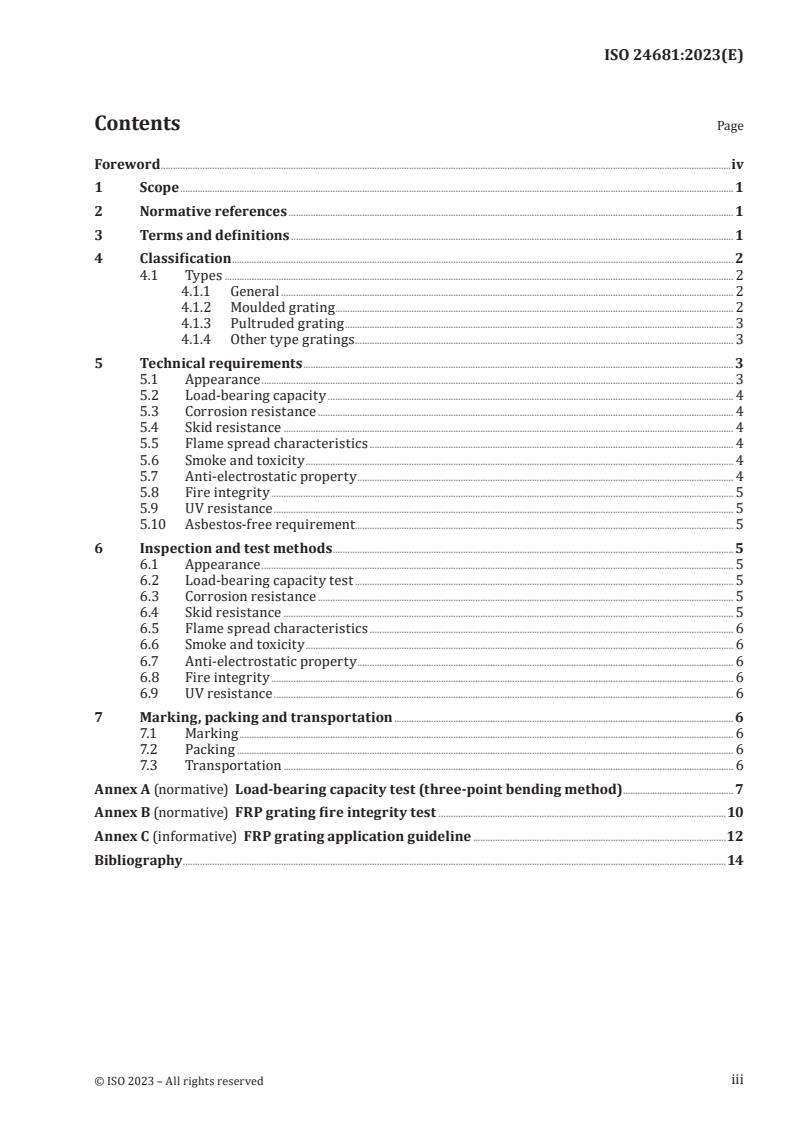
Contents Page
Foreword .iv
1 Scope . 1
2 Normative references . 1
3 Terms and definitions . 1
4 Classification . 2
4.1 Types . 2
4.1.1 General . 2
4.1.2 Moulded grating . 2
4.1.3 Pultruded grating . 3
4.1.4 Other type gratings . 3
5 Technical requirements . 3
5.1 Appearance . 3
5.2 Load-bearing capacity . 4
5.3 Corrosion resistance . 4
5.4 Skid resistance . 4
5.5 Flame spread characteristics . 4
5.6 Smoke and toxicity . 4
5.7 Anti-electrostatic property . 4
5.8 Fire integrity . 5
5.9 UV resistance . 5
5.10 Asbestos-free requirement . . 5
6 Inspection and test methods .5
6.1 Appearance . 5
6.2 Load-bearing capacity test . 5
6.3 Corrosion resistance . 5
6.4 Skid resistance . 5
6.5 Flame spread characteristics . 6
6.6 Smoke and toxicity . 6
6.7 Anti-electrostatic property . 6
6.8 Fire integrity . 6
6.9 UV resistance . 6
7 Marking, packing and transportation . 6
7.1 Marking . 6
7.2 Packing . 6
7.3 Transportation . 6
Annex A (normative) Load-bearing capacity test (three-point bending method) .7
Annex B (normative) FRP grating fire integrity test .10
Annex C (informative) FRP grating application guideline .12
Bibliography .14
iii
Foreword
ISO (the International Organization for Standardization) is a worldwide federation of national standards
bodies (ISO member bodies). The work of preparing International Standards is normally carried out
through ISO technical committees. Each member body interested in a subject for which a technical
committee has been established has the right to be represented on that committee. International
organizations, governmental and non-governmental, in liaison with ISO, also take part in the work.
ISO collaborates closely with the International Electrotechnical Commission (IEC) on all matters of
electrotechnical standardization.
The procedures used to develop this document and those intended for its further maintenance are
described in the ISO/IEC Directives, Part 1. In particular, the different approval criteria needed for the
different types of ISO document should be noted. This document was drafted in accordance with the
editorial rules of the ISO/IEC Directives, Part 2 (see www.iso.org/directives).
ISO draws attention to the possibility that the implementation of this document may involve the use
of (a) patent(s). ISO takes no position concerning the evidence, validity or applicability of any claimed
patent rights in respect thereof. As of the date of publication of this document, ISO had not received
notice of (a) patent(s) which may be required to implement this document. However, implementers are
cautioned that this may not represent the latest information, which may be obtained from the patent
database available at www.iso.org/patents. ISO shall not be held responsible for identifying any or all
such patent rights.
Any trade name used in this document is information given for the convenience of users and does not
constitute an endorsement.
For an explanation of the voluntary nature of standards, the meaning of ISO specific terms and
expressions related to conformity assessment, as well as information about ISO's adherence to
the World Trade Organization (WTO) principles in the Technical Barriers to Trade (TBT), see
www.iso.org/iso/foreword.html.
This document was prepared by Technical Committee ISO/TC 8, Ships and marine technology,
Subcommittee SC 8, Ship design.
Any feedback or questions on this document should be directed to the user’s national standards body. A
complete listing of these bodies can be found at www.iso.org/members.html.
iv
INTERNATIONAL STANDARD ISO 24681:2023(E)
Ships and marine technology — Fibre-reinforced plastic
gratings
1 Scope
This document specifies the structure, technical requirements and test methods of gratings for fibre-
reinforced plastics (FRP) in the marine industry. It also defines terms related to FRP gratings.
This document is applicable to the design, manufacture and inspection of self-support FRP gratings
used for pedestrian pathways and platforms on ships or offshore platforms.
2 Normative references
The following documents are referred to in the text in such a way that some or all of their content
constitutes requirements of this document. For dated references, only the edition cited applies. For
undated references, the latest edition of the referenced document (including any amendments) applies.
ISO 4892-3:2016, Plastics — Methods of exposure to laboratory light sources — Part 3: Fluorescent UV
lamps
ISO 9227, Corrosion tests in artificial atmospheres — Salt spray tests
ISO 14125, Fibre-reinforced plastic composites — Determination of flexural properties
IMO, International Code for Application of Fire Test Procedures (FTP Code), 2010
IMO, International Convention for the Safety of Life at Sea (SOLAS), 1974 and amendment
ASTM D2047, Test method for static coefficient of friction of polish-coated flooring surfaces as measured by
the James machine
ASTM E84, Standard test method for surface burning characteristics of building materials
3 Terms and definitions
For the purposes of this document, the following terms and definitions apply.
ISO and IEC maintain terminology databases for use in standardization at the following addresses:
— ISO Online browsing platform: available at https:// www .iso .org/ obp
— IEC Electropedia: available at https:// www .electropedia .org/
3.1
fibre reinforced plastic
FRP
composite material made of resin reinforced with fibre
Note 1 to entry: Glass fibres are widely used as reinforced fibre.
3.2
skid resistance
property of the trafficked surface which limits the relative movement between the contact patch of
pedestrian footwear or a vehicle tyre and the surface
4 Classification
4.1 Types
4.1.1 General
Fibre reinforced plastic (FRP) grating is a kind of composite panel material with a certain aperture
ratio, which is based on thermosetting resin and reinforced with fibreglass roving, and processed by
special technology. The raw materials shall meet recognized standards and be specified in the technical
specification, so as to ensure its continuous and stable performance.
FRP gratings are generally divided into two types, moulded or pultruded FRP gratings. For typical
examples, see Figure 1 and Figure 2.
Figure 1 — Moulded grating
Figure 2 — Pultruded grating
4.1.2 Moulded grating
Moulded FRP gratings are produced by the open mould process in which thermosetting resin and
dry glass fibre are placed in the mould in cross directions. After filling the mould with the designated
amount of material, the resin is allowed to cure in the open mould. Moulded grating is usually
manufactured in square mesh or rectangular mesh configurations. Square mesh moulded grating has
nearly equal strength in longitudinal and transverse directions. Rectangular mesh has better strength
along longitudinal direction. For the common mesh configuration, see Table 1.
Table 1 — Common moulded FRP grating configuration
Dimensions in millimetres
Mesh size Height Web thickness
Bottom thickness / top thickness
25,4 × 25,4 50 6/8
38,1 × 38,1 25 5/6,35
38,1 × 38,1 30 5/6,6
38,1 × 38,1 38 5/7
38,1 × 38,1 50 5,8/8,5
38,1 × 38,1 50 9/11,5
38,1 × 38,1 63 5,8/9
38,1 × 38,1 63 9/12
50,7 × 50,7 50 5/8,3
25,4 × 50,8 50 9/11,5
25,4 × 152,4 38 5/7
38,1 × 101,6 38 5/7
38,1 × 152,4 50 7/9
NOTE Moulded FRP gratings are in general with inverted trapezoidal web section. The bottom thickness is smallest
depending on the mould. The top thickness is greater depending on the height.
4.1.3 Pultruded grating
Pultruded grating consists of longitudinal bearing bars secured in position by transverse bars. The
reinforced fibre is impregnated by thermosetting resin and pultruded to make shaped bearing bar
under compression and heat. The bearing bar profile is generally “I” or “T” shaped. The product has
high strength along bearing bars direction and is suitable for large span use. Common specifications
are shown in Table 2.
Table 2 — Common pultruded FRP grating configuration
Dimensions in millimetres
Bearing bar Width Space Height
I 15 10/15/23 25/30/38
T 25,4 12,7/25,4 50,8
NOTE The common transverse securing bar is arranged in 152,4 mm interval.
4.1.4 Other type gratings
Authorities are responsible for confirming other types of gratings of occupied areas for workers or
machinery.
5 Technical requirements
5.1 Appearance
5.1.1 FRP grating shall be smooth and flat, with no obvious stratification, burr, crack, fibre exposure
and impurities.
5.1.2 No pores larger than 3 mm in diameter are allowed. The number of pores between 1 mm and
3 mm in any 300 mm × 300 mm area shall not exceed 10.
5.1.3 The warpage shall be not more than 2,5 mm/m along bearing bar direction and not more than
5 mm/m in other directions.
5.2 Load-bearing capacity
5.2.1 The flexural strength of the FRP grating panel shall be not less than 345 MPa.
5.2.2 No crack, stratification or other destructive damage shall be observed when the FRP grating is
subject to 1,5 times design load.
5.2.3 The design load of the FRP grating used in pedestrian pathways and platform of ship shall be
4 kN/m uniform load or equivalent. The design load may be other than specified if it is dedicated for
a certain load condition. The grating deflection in the middle point of span shall not be greater than
1/120 of the span under design load, and the maximum deflection shall not exceed 9 mm.
5.2.4 For FRP grating used as steps of stair ladders, 2 kN concentrated load applied at the middle of
step shall also be considered. The deflection of the middle point of the tread shall not be greater than
1/200 of its span, and the maximum deflection shall not exceed 6 mm.
5.3 Corrosion resistance
FRP grating should have good corrosion resistance. Gratings used for exposed area or ballast tanks
shall be designed with good resistance to sea water and high salt fog conditions. After the salt spray
test, the load-bearing capacity shall meet the requirements of 5.2.1.
5.4 Skid resistance
FRP gratings should have good skid resistance. The average coefficient of friction of upper surface shall
be not less than 0,75 for dry weather conditions.
5.5 Flame spread characteristics
When FRP grating is required to have low flame spread characteristics, the product shall be tested in
accordance with the test for surface flammability specified in IMO FTP Code 2010, Annex 1, Part 5. The
result shall meet the requirements for ceiling, bulkhead, or shall be in accordance with other equivalent
standards such as ASTM E84, which specifies a flame spread index (FSI) of ≤25.
5.6 Smoke and toxicity
When the FRP grating is required to not produce excessive quantities of smoke and toxic products or
...