


ISO/IEC 9594-8:2001
(Main)Information technology — Open Systems Interconnection — The Directory: Public-key and attribute certificate frameworks — Part 8:
Information technology — Open Systems Interconnection — The Directory: Public-key and attribute certificate frameworks — Part 8:
Technologies de l'information — Interconnexion de systèmes ouverts (OSI) — L'annuaire: Cadre général des certificats de clé publique et d'attribut — Partie 8:
General Information
- Status
- Withdrawn
- Publication Date
- 15-Aug-2001
- Withdrawal Date
- 15-Aug-2001
- Current Stage
- 9599 - Withdrawal of International Standard
- Start Date
- 02-Nov-2009
- Completion Date
- 12-Feb-2026
Relations
- Effective Date
- 16-Oct-2025
- Effective Date
- 16-Oct-2025
- Effective Date
- 16-Oct-2025
- Effective Date
- 16-Oct-2025
- Effective Date
- 16-Oct-2025
- Effective Date
- 06-Jun-2022
- Effective Date
- 06-Jun-2022
- Effective Date
- 15-Apr-2008
ISO/IEC 9594-8:2001 - Information technology -- Open Systems Interconnection -- The Directory: Public-key and attribute certificate frameworks
ISO/IEC 9594-8:2001 - Technologies de l'information -- Interconnexion de systemes ouverts (OSI) -- L'annuaire: Cadre général des certificats de clé publique et d'attribut
Get Certified
Connect with accredited certification bodies for this standard

BSI Group
BSI (British Standards Institution) is the business standards company that helps organizations make excellence a habit.

NYCE
Mexican standards and certification body.
Sponsored listings
Frequently Asked Questions
ISO/IEC 9594-8:2001 is a standard published by the International Organization for Standardization (ISO). Its full title is "Information technology — Open Systems Interconnection — The Directory: Public-key and attribute certificate frameworks — Part 8:". This standard covers: Information technology — Open Systems Interconnection — The Directory: Public-key and attribute certificate frameworks — Part 8:
Information technology — Open Systems Interconnection — The Directory: Public-key and attribute certificate frameworks — Part 8:
ISO/IEC 9594-8:2001 is classified under the following ICS (International Classification for Standards) categories: 35.100.70 - Application layer. The ICS classification helps identify the subject area and facilitates finding related standards.
ISO/IEC 9594-8:2001 has the following relationships with other standards: It is inter standard links to ISO/IEC 9594-8:1998/Cor 5:2004, ISO/IEC 9594-8:1998/Cor 6:2005, ISO/IEC 9594-8:1998/Cor 3:2002, ISO/IEC 9594-8:1998/Cor 4:2002, ISO/IEC 9594-8:1998/Cor 2:2002, ISO/IEC 9594-8:1998/Cor 1:2000, ISO/IEC 9594-8:1998, ISO/IEC 9594-8:2005. Understanding these relationships helps ensure you are using the most current and applicable version of the standard.
ISO/IEC 9594-8:2001 is available in PDF format for immediate download after purchase. The document can be added to your cart and obtained through the secure checkout process. Digital delivery ensures instant access to the complete standard document.
Standards Content (Sample)
INTERNATIONAL ISO/IEC
STANDARD 9594-8
Fourth edition
2001-08-01
Information technology — Open Systems
Interconnection — The Directory:
Public-key and attribute certificate
frameworks
Technologies de l'information — Interconnexion de systèmes ouverts
(OSI) — L'annuaire: Cadres de clé publique et de certificat d'attribut
Reference number
©
ISO/IEC 2001
PDF disclaimer
This PDF file may contain embedded typefaces. In accordance with Adobe's licensing policy, this file may be printed or viewed but shall not
be edited unless the typefaces which are embedded are licensed to and installed on the computer performing the editing. In downloading this
file, parties accept therein the responsibility of not infringing Adobe's licensing policy. The ISO Central Secretariat accepts no liability in this
area.
Adobe is a trademark of Adobe Systems Incorporated.
Details of the software products used to create this PDF file can be found in the General Info relative to the file; the PDF-creation parameters
were optimized for printing. Every care has been taken to ensure that the file is suitable for use by ISO member bodies. In the unlikely event
that a problem relating to it is found, please inform the Central Secretariat at the address given below.
© ISO/IEC 2001
All rights reserved. Unless otherwise specified, no part of this publication may be reproduced or utilized in any form or by any means, electronic
or mechanical, including photocopying and microfilm, without permission in writing from either ISO at the address below or ISO's member body
in the country of the requester.
ISO copyright office
Case postale 56 • CH-1211 Geneva 20
Tel. + 41 22 749 01 11
Fax + 41 22 749 09 47
E-mail copyright@iso.ch
Web www.iso.ch
Printed in Switzerland
ii © ISO/IEC 2001 – All rights reserved
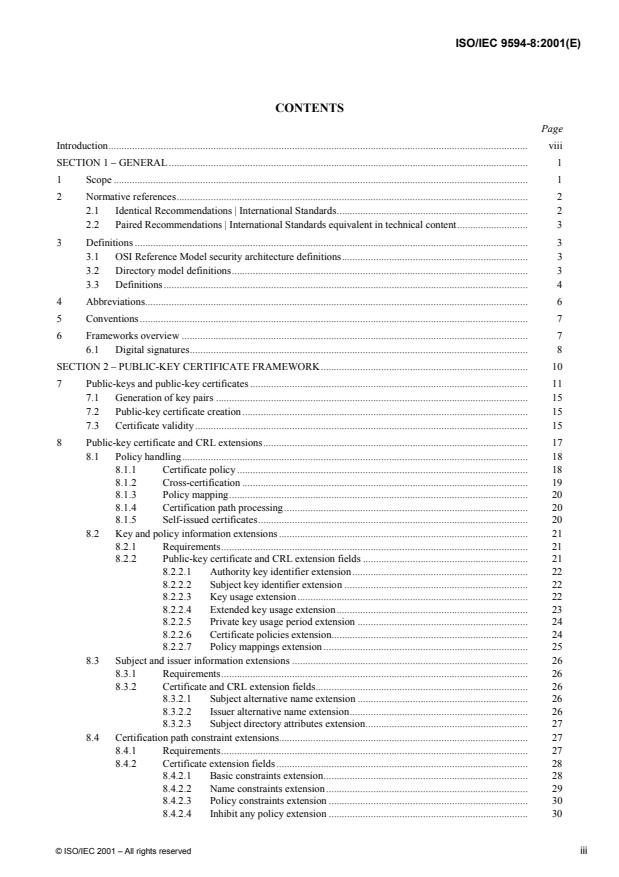
CONTENTS
Page
Introduction. viii
SECTION 1 – GENERAL . 1
1 Scope . 1
2 Normative references. 2
2.1 Identical Recommendations | International Standards. 2
2.2 Paired Recommendations | International Standards equivalent in technical content. 3
3 Definitions . 3
3.1 OSI Reference Model security architecture definitions. 3
3.2 Directory model definitions. 3
3.3 Definitions. 4
4 Abbreviations. 6
5 Conventions . 7
6 Frameworks overview . 7
6.1 Digital signatures. 8
SECTION 2 – PUBLIC-KEY CERTIFICATE FRAMEWORK. 10
7 Public-keys and public-key certificates . 11
7.1 Generation of key pairs . 15
7.2 Public-key certificate creation. 15
7.3 Certificate validity. 15
8 Public-key certificate and CRL extensions. 17
8.1 Policy handling. 18
8.1.1 Certificate policy . 18
8.1.2 Cross-certification . 19
8.1.3 Policy mapping. 20
8.1.4 Certification path processing. 20
8.1.5 Self-issued certificates. 20
8.2 Key and policy information extensions . 21
8.2.1 Requirements. 21
8.2.2 Public-key certificate and CRL extension fields . 21
8.2.2.1 Authority key identifier extension. 22
8.2.2.2 Subject key identifier extension . 22
8.2.2.3 Key usage extension. 22
8.2.2.4 Extended key usage extension. 23
8.2.2.5 Private key usage period extension . 24
8.2.2.6 Certificate policies extension. 24
8.2.2.7 Policy mappings extension . 25
8.3 Subject and issuer information extensions . 26
8.3.1 Requirements. 26
8.3.2 Certificate and CRL extension fields. 26
8.3.2.1 Subject alternative name extension . 26
8.3.2.2 Issuer alternative name extension. 26
8.3.2.3 Subject directory attributes extension. 27
8.4 Certification path constraint extensions. 27
8.4.1 Requirements. 27
8.4.2 Certificate extension fields . 28
8.4.2.1 Basic constraints extension. 28
8.4.2.2 Name constraints extension. 29
8.4.2.3 Policy constraints extension . 30
8.4.2.4 Inhibit any policy extension . 30
© ISO/IEC 2001 – All rights reserved iii
Page
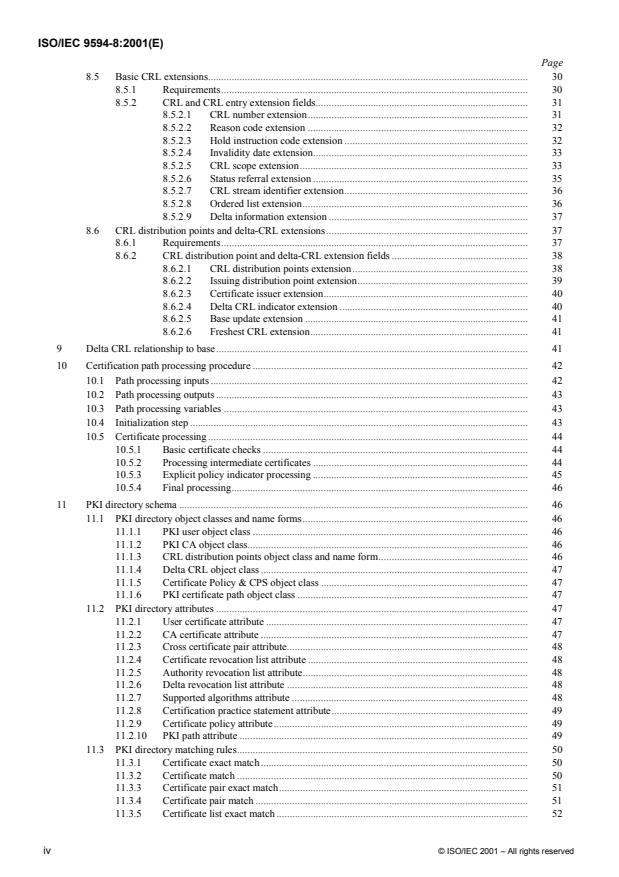
8.5 Basic CRL extensions. 30
8.5.1 Requirements. 30
8.5.2 CRL and CRL entry extension fields. 31
8.5.2.1 CRL number extension. 31
8.5.2.2 Reason code extension . 32
8.5.2.3 Hold instruction code extension . 32
8.5.2.4 Invalidity date extension. 33
8.5.2.5 CRL scope extension. 33
8.5.2.6 Status referral extension . 35
8.5.2.7 CRL stream identifier extension. 36
8.5.2.8 Ordered list extension. 36
8.5.2.9 Delta information extension . 37
8.6 CRL distribution points and delta-CRL extensions. 37
8.6.1 Requirements. 37
8.6.2 CRL distribution point and delta-CRL extension fields . 38
8.6.2.1 CRL distribution points extension. 38
8.6.2.2 Issuing distribution point extension. 39
8.6.2.3 Certificate issuer extension. 40
8.6.2.4 Delta CRL indicator extension . 40
8.6.2.5 Base update extension . 41
8.6.2.6 Freshest CRL extension. 41
9 Delta CRL relationship to base. 41
10 Certification path processing procedure . 42
10.1 Path processing inputs . 42
10.2 Path processing outputs . 43
10.3 Path processing variables . 43
10.4 Initialization step . 43
10.5 Certificate processing . 44
10.5.1 Basic certificate checks . 44
10.5.2 Processing intermediate certificates . 44
10.5.3 Explicit policy indicator processing . 45
10.5.4 Final processing. 46
11 PKI directory schema . 46
11.1 PKI directory object classes and name forms. 46
11.1.1 PKI user object class . 46
11.1.2 PKI CA object class. 46
11.1.3 CRL distribution points object class and name form. 46
11.1.4 Delta CRL object class . 47
11.1.5 Certificate Policy & CPS object class . 47
11.1.6 PKI certificate path object class . 47
11.2 PKI directory attributes . 47
11.2.1 User certificate attribute . 47
11.2.2 CA certificate attribute . 47
11.2.3 Cross certificate pair attribute. 48
11.2.4 Certificate revocation list attribute . 48
11.2.5 Authority revocation list attribute. 48
11.2.6 Delta revocation list attribute . 48
11.2.7 Supported algorithms attribute . 48
11.2.8 Certification practice statement attribute. 49
11.2.9 Certificate policy attribute. 49
11.2.10 PKI path attribute . 49
11.3 PKI directory matching rules. 50
11.3.1 Certificate exact match. 50
11.3.2 Certificate match . 50
11.3.3 Certificate pair exact match. 51
11.3.4 Certificate pair match . 51
11.3.5 Certificate list exact match . 52
iv © ISO/IEC 2001 – All rights reserved
Page
11.3.6 Certificate list match. 52
11.3.7 Algorithm identifier match . 53
11.3.8 Policy match. 53
11.3.9 PKI path match. 53
SECTION 3 – ATTRIBUTE CERTIFICATE FRAMEWORK . 53
12 Attribute certificates . 54
12.1 Attribute certificate structure. 54
12.2 Attribute certificate paths . 56
13 Attribute Authority, SOA and Certification Authority relationship . 56
13.1 Privilege in attribute certificates. 57
13.2 Privilege in public-key certificates . 57
14 PMI models. 58
14.1 General model . 58
14.1.1 PMI in access control context. 59
14.1.2 PMI in a non-repudiation context. 59
14.2 Control model. 59
14.3 Delegation model . 60
14.4 Roles model. 61
14.4.1 Role attribute . 61
15 Privilege management certificate extensions. 62
15.1 Basic privilege management extensions. 62
15.1.1 Requirements. 62
15.1.2 Basic privilege management extension fields. 63
15.1.2.1 Time specification extension. 63
15.1.2.2 Targeting information extension . 63
15.1.2.3 User notice extension . 64
15.1.2.4 Acceptable privilege policies extension . 64
15.2 Privilege revocation extensions. 65
15.2.1 Requirements. 65
15.2.2 Privilege revocation extension fields. 65
15.2.2.1 CRL distribution points extension. 65
15.2.2.2 No revocation information extension . 66
15.3 Source of Authority extensions . 65
15.3.1 Requirements. 65
15.3.2 SOA extension fields. 65
15.3.2.1 SOA identifier extension . 65
15.3.2.2 Attribute descriptor extension . 66
15.4 Role extensions. 67
15.4.1 Requirements. 67
15.4.2 Role extension fields . 67
15.4.2.1 Role specification certificate identifier extension . 67
15.5 Delegation extensions. 68
15.5.1 Requirements. 68
15.5.2 Delegation extension fields . 68
15.5.2.1 Basic attribute constraints extension . 68
15.5.2.2 Delegated name constraints extension. 70
15.5.2.3 Acceptable certificate policies extension. 70
15.5.2.4 Authority attribute identifier extension . 71
16 Privilege path processing procedure . 71
16.1 Basic processing procedure . 72
16.2 Role processing procedure . 72
16.3 Delegation processing procedure. 72
16.3.1 Verify integrity of domination rule. 73
16.3.2 Establish valid delegation path. 73
16.3.3 Verify privilege delegation. 73
16.3.4 Pass/fail determination . 74
© ISO/IEC 2001 – All rights reserved v
Page
17 PMI directory schema. 74
17.1 PMI directory object classes. 74
17.1.1 PMI user object class. 74
17.1.2 PMI AA object class. 74
17.1.3 PMI SOA object class . 74
17.1.4 Attribute certificate CRL distribution point object class . 74
17.1.5 PMI delegation path object class . 75
17.1.6 Privilege policy object class . 75
17.2 PMI Directory attributes. 75
17.2.1 Attribute certificate attribute . 75
17.2.2 AA certificate attribute . 75
17.2.3 Attribute descriptor certificate attribute. 75
17.2.4 Attribute certificate revocation list attribute. 75
17.2.5 AA certificate revocation list attribute . 76
17.2.6 Delegation path attribute . 76
17.2.7 Privilege policy attribute . 76
17.3 PMI general directory matching rules . 76
17.3.1 Attribute certificate exact match. 76
17.3.2 Attribute certificate match. 76
17.3.3 Holder issuer match. 77
17.3.4 Delegation path match. 77
SECTION 4 – DIRECTORY USE OF PUBLIC-KEY & ATTRIBUTE CERTIFICATE FRAMEWORKS . 77
18 Directory authentication . 78
18.1 Simple authentication procedure . 78
18.1.1 Generation of protected identifying information. 79
18.1.2 Procedure for protected simple authentication . 79
18.1.3 User password attribute type . 80
18.2 Strong Authentication. 80
18.2.1 Obtaining public-key certificates from the directory. 81
18.2.1.1 Example. 81
18.2.2 Strong authentication procedures . 83
18.2.2.1 One-way authentication. 84
18.2.2.2 Two-way authentication . 84
18.2.2.3 Three-way authentication . 85
19 Access control. 86
20 Protection of Directory operations. 86
Annex A – Public-Key and Attribute Certificate Frameworks . 87
Annex B – CRL Generation and Processing Rules. 107
B.1 Introduction . 107
B.1.1 CRL types. 107
B.1.2 CRL processing . 108
B.2 Determine parameters for CRLs. 108
B.3 Determine CRLs required. 109
B.3.1 End-entity with critical CRL DP . 109
B.3.2 End-entity with no critical CRL DP . 109
B.3.3 CA with critical CRL DP . 110
B.3.4 CA with no critical CRL DP. 110
B.4 Obtain CRLs. 110
B.5 Process CRLs . 110
B.5.1 Validate base CRL scope. 110
B.5.1.1 Complete CRL. 111
B.5.1.2 Complete EPRL. 111
B.5.1.3 Complete CARL. 111
B.5.1.4 Distribution point based CRL/EPRL/CARL . 112
B.5.2 Validate delta CRL scope. 112
B.5.3 Validity and currency checks on the base CRL. 113
B.5.4 Validity and checks on the delta CRL . 113
vi © ISO/IEC 2001 – All rights reserved
Page
Annex C – Examples of Delta CRL Issuance . 114
C.1 Introduction . 114
Annex D – Privilege Policy and Privilege Attribute Definition Examples . 116
D.1 Introduction . 116
D.2 Sample syntaxes . 116
D.2.1 First example . 116
D.2.2 Second example. 118
D.3 Privilege attribute example. 120
Annex E – An introduction to public key cryptography . 121
Annex F – Reference definition of algorithm object identifiers. 123
Annex G – Examples of use of certification path constraints . 124
G.1 Example 1: Use of basic constraints. 124
G.2 Example 2: Use of name constraints . 124
G.3 Example 3: Use of policy mapping and policy constraints. 124
Annex H – Alphabetical list of information item definitions. 126
Annex I – Amendments and corrigenda. 129
© ISO/IEC 2001 – All rights reserved vii
Foreword
ISO (the International Organization for Standardization) and IEC (the International Electrotechnical Commission)
form the specialized system for worldwide standardization. National bodies that are members of ISO or IEC
participate in the development of International Standards through technical committees established by the
respective organization to deal with particular fields of technical activity. ISO and IEC technical committees
collaborate in fields of mutual interest. Other international organizations, governmental and non-governmental, in
liaison with ISO and IEC, also take part in the work.
International Standards are drafted in accordance with the rules given in the ISO/IEC Directives, Part 3.
In the field of information technology, ISO and IEC have established a joint technical committee, ISO/IEC JTC 1.
Draft International Standards adopted by the joint technical committee are circulated to national bodies for voting.
Publication as an International Standard requires approval by at least 75 % of the national bodies casting a vote.
Users and implementors should note the existence of a "defect resolution" procedure in ISO/IEC JTC 1 to identify
and correct errors in International Standards through the publication of Technical Corrigenda. Identical corrections
are made to the corresponding ITU-T Recommendations through Corrigenda and may also be made in the form of
Implementors' Guides. Details of Technical Corrigenda to International Standards are available on the ISO website;
published Technical Corrigenda can be obtained via the ISO webstore or from the ISO and IEC national bodies.
Corrigenda and Implementors' Guides to ITU-T Recommendations can be obtained from the ITU-T website.
International Standard ISO/IEC 9594-8 was prepared by Joint Technical Committee ISO/IEC JTC 1, Information
technology, Subcommittee SC 6, Telecommunications and information exchange between systems, in
collaboration with ITU-T. The identical text is published as ITU-T Recommendation X.509.
This fourth edition of ISO/IEC 9594-8 constitutes a technical revision of the third edition (ISO/IEC 9594-8:1998),
which is provisionally retained in order to support implementations based on the third edition. This edition also
incorporates Corrigendum 1:2000.
ISO/IEC 9594 consists of the following parts, under the general title Information technology — Open Systems
Interconnection — The Directory:
— Part 1: Overview of concepts, models and services
— Part 2: Models
— Part 3: Abstract service definition
— Part 4: Procedures for distributed operation
— Part 5: Protocol specifications
— Part 6: Selected attribute types
— Part 7: Selected object classes
— Part 8: Public-key and attribute certificate frameworks
— Part 9: Replication
— Part 10: Use of systems management for administration of the Directory
Annexes A, B and F form a normative part of this part of ISO/IEC 9594. Annexes C, D, E, G, H and I are for
information only.
viii © ISO/IEC 2001 – All rights reserved
Introduction
This Recommendation | International Standard, together with other Recommendations | International Standards, has been
produced to facilitate the interconnection of information processing systems to provide directory services. A set of such
systems, together with the directory information which they hold, can be viewed as an integrated whole, called the
Directory. The information held by the Directory, collectively known as the Directory Information Base (DIB), is
typically used to facilitate communication between, with or about objects such as application-entities, people, terminals
and distribution lists.
The Directory plays a significant role in Open Systems Interconnection, whose aim is to allow, with a minimum of
technical agreement outside of the interconnection standards themselves, the interconnection of information processing
systems:
– from different manufacturers;
– under different managements;
– of different levels of complexity; and
– of different ages.
Many applications have requirements for security to protect against threats to the communication of information.
Virtually all security services are dependent upon the identities of the communicating parties being reliably known, i.e.
authentication.
This Recommendation | International Standard defines a framework for public-key certificates. That framework includes
specification of data objects used to represent the certificates themselves as well as revocation notices for issued
certificates that should no longer be trusted. The public-key certificate framework defined in this Specification, while it
defines some critical components of a Public-key Infrastructure (PKI), it does not define a PKI in its entirety. However,
this Specification provides the foundation upon which full PKIs and their specifications would be built.
Similarly, this Recommendation | International Standard defines a framework for attribute certificates. That framework
includes specification of data objects used to represent the certificates themselves as well as revocation notices for issued
certificates that should no longer be trusted. The attribute certificate framework defined in this Specification, while it
defines some critical components of a Privilege Management Infrastructure (PMI), it does not define a PMI it its entirety.
However, this Specification provides the foundation upon which full PMIs and their specifications would be built.
Information objects for holding PKI and PMI objects in the Directory and for comparing presented values with stored
values are also defined.
This Recommendation | International Standard also defines a framework for the provision of authentication services by
the Directory to its users.
This Recommendation | International Standard provides the foundation frameworks upon which industry profiles can be
defined by other standards groups and industry forums. Many of the features defined as optional in these frameworks,
may be mandated for use in certain environments through profiles. This fourth edition technically revises and enhances,
but does not replace, the third edition of this Recommendation | International Standard. Implementations may still claim
conformance to the third edition. However, at some point, the third edition will not be supported (i.e. reported defects
will no longer be resolved). It is recommended that implementations conform to this fourth edition as soon as possible.
This fourth edition specifies version 1 and 2 of the Directory protocols.
The first and second editions specified only version 1. Most of the services and protocols specified in this edition are
designed to function under version 1. However some enhanced services and protocols, e.g. signed errors, will not
function unless all Directory entities involved in the operation have negotiated version 2. Whichever version has been
negotiated, differences between the services and between the protocols defined in the four editions, except for those
specifically assigned to version 2, are accommodated using the rules of extensibility defined in this edition of ITU-T
Rec. X.519 | ISO/IEC 9594-5.
Annex A, which is an integral part of this Recommendation | International Standard, provides the ASN.1 module which
contains all of the definitions associated with the frameworks.
Annex B, which is an integral part of this Recommendation | International Standard, provides rules for generating and
processing Certificate Revocation Lists.
Annex C, which is not an integral part of this Recommendation | International Standard, provides examples of delta-CRL
issuance.
© ISO/IEC 2001 – All rights reserved ix
Annex D, which is not an integral part of this Recommendation | International Standard, provides examples of privilege
policy syntaxes and privilege attributes.
Annex E, which is not an integral part of this Recommendation | International Standard, is an introduction to public-key
cryptography.
Annex F, which is an integral part of this Recommendation | International Standard, defines object identifiers assigned to
authentication and encryption algorithms, in the absence of a formal register.
Annex G, which is not an integral part of this Recommendation | International Standard, contains examples of the use of
certification path constraints.
Annex H, which is not an integral part of this Recommendation | International Standard, contains an alphabetical list of
information item definitions in this Specification.
Annex I, which is not an integral part of this Recommendation | International Standard, lists the amendments and defect
reports that have been incorporated to form this edition of this Recommendation | International Standard.
The International Organization for Standardization (ISO) and the International Electrotechnical Commission (IEC)] draw
attention to the fact that it is claimed that compliance with this part of ISO/IEC 9594 may involve the use of a patent
concerning the CRL distribution point facility.
ISO and IEC take no position concerning the evidence, validity and scope of this patent right.
The holder of this patent right has assured ISO and IEC that he is willing to negotiate licences under reasonable and non-
discriminatory terms and conditions with applicants throughout the world. In this respect, the statement of the holder of
this patent right is registered with ISO and IEC. Information may be obtained from:
Entrust Technologies
Mr. Mike Morgan, Senior Legal Counsel
750 Heron Road, Suite E08
Ottawa, Ontario K1V 1A7
Canada
Attention is drawn to the possibility that some of the elements of this part of ISO/IEC 9594 may be the subject of patent
rights other than those identified above. ISO and IEC shall not be held responsible for identif
...
NORME ISO/CEI
INTERNATIONALE 9594-8
Quatrième édition
2001-08-01
Technologies de l'information —
Interconnexion de systèmes ouverts
(OSI) — L'annuaire: Cadre général
des certificats de clé publique et d'attribut
Information technology — Open Systems Interconnection — The Directory:
Public-key and attribute certificate frameworks
Numéro de référence
ISO/CEI 9594-8:2001(F)
©
ISO/CEI 2001
ISO/CEI 9594-8:2001(F)
PDF – Exonération de responsabilité
Le présent fichier PDF peut contenir des polices de caractères intégrées. Conformément aux conditions de licence d'Adobe, ce fichier peut
être imprimé ou visualisé, mais ne doit pas être modifié à moins que l'ordinateur employé à cet effet ne bénéficie d'une licence autorisant
l'utilisation de ces polices et que celles-ci y soient installées. Lors du téléchargement de ce fichier, les parties concernées acceptent de fait la
responsabilité de ne pas enfreindre les conditions de licence d'Adobe. Le Secrétariat central de l'ISO décline toute responsabilité en la
matière.
Adobe est une marque déposée d'Adobe Systems Incorporated.
Les détails relatifs aux produits logiciels utilisés pour la création du présent fichier PDF sont disponibles dans la rubrique General Info du
fichier; les paramètres de création PDF ont été optimisés pour l'impression. Toutes les mesures ont été prises pour garantir l'exploitation de
ce fichier par les comités membres de l'ISO. Dans le cas peu probable où surviendrait un problème d'utilisation, veuillez en informer le
Secrétariat central à l'adresse donnée ci-dessous.
© ISO/CEI 2001
Droits de reproduction réservés. Sauf prescription différente, aucune partie de cette publication ne peut être reproduite ni utilisée sous quelque
forme que ce soit et par aucun procédé, électronique ou mécanique, y compris la photocopie et les microfilms, sans l'accord écrit de l’ISO à
l’adresse ci-après ou du comité membre de l’ISO dans le pays du demandeur.
ISO copyright office
Case postale 56 • CH-1211 Geneva 20
Tel. + 41 22 749 01 11
Fax. + 41 22 749 09 47
E-mail copyright@iso.ch
Web www.iso.ch
Version française parue en 2002
Imprimé en Suisse
ii © ISO/CEI 2001 – Tous droits réservés
ISO/CEI 9594-8:2001(F)
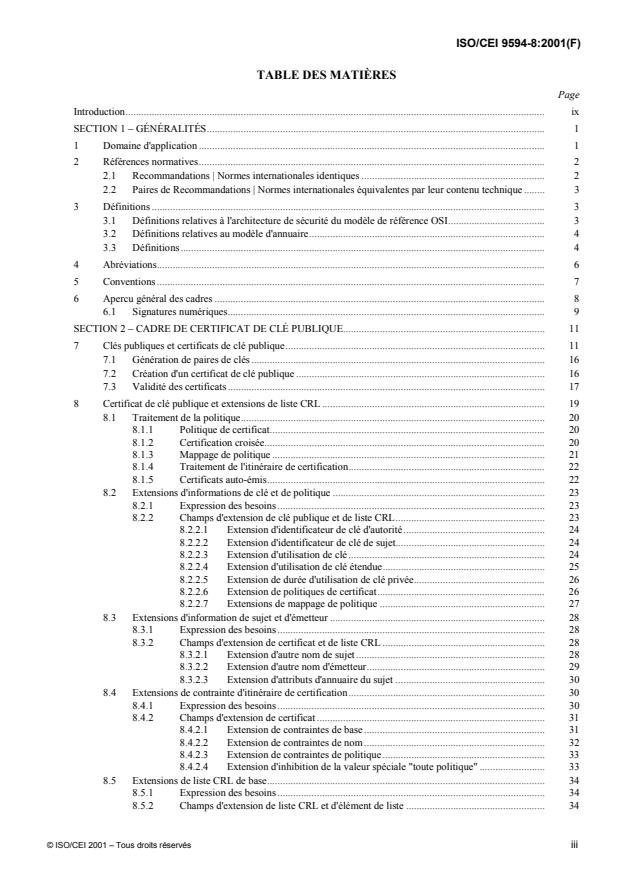
TABLE DES MATIÈRES
Page
Introduction. i x
SECTION 1 – GÉNÉRALITÉS. 1
1 Domaine d'application . 1
2 Références normatives. 2
2.1 Recommandations | Normes internationales identiques . 2
2.2 Paires de Recommandations | Normes internationales équivalentes par leur contenu technique . 3
3 Définitions . 3
3.1 Définitions relatives à l'architecture de sécurité du modèle de référence OSI. 3
3.2 Définitions relatives au modèle d'annuaire. 4
3.3 Définitions. 4
4 Abréviations. 6
5 Conventions . 7
6 Apercu général des cadres . 8
6.1 Signatures numériques. 9
SECTION 2 – CADRE DE CERTIFICAT DE CLÉ PUBLIQUE. 11
7 Clés publiques et certificats de clé publique. 11
7.1 Génération de paires de clés . 16
7.2 Création d'un certificat de clé publique . 16
7.3 Validité des certificats . 17
8 Certificat de clé publique et extensions de liste CRL . 19
8.1 Traitement de la politique. 20
8.1.1 Politique de certificat. 20
8.1.2 Certification croisée. 20
8.1.3 Mappage de politique . 21
8.1.4 Traitement de l'itinéraire de certification. 22
8.1.5 Certificats auto-émis. 22
8.2 Extensions d'informations de clé et de politique . 23
8.2.1 Expression des besoins . 23
8.2.2 Champs d'extension de clé publique et de liste CRL. 23
8.2.2.1 Extension d'identificateur de clé d'autorité. 24
8.2.2.2 Extension d'identificateur de clé de sujet. 24
8.2.2.3 Extension d'utilisation de clé . 24
8.2.2.4 Extension d'utilisation de clé étendue. 25
8.2.2.5 Extension de durée d'utilisation de clé privée. 26
8.2.2.6 Extension de politiques de certificat. 26
8.2.2.7 Extensions de mappage de politique . 27
8.3 Extensions d'information de sujet et d'émetteur . 28
8.3.1 Expression des besoins . 28
8.3.2 Champs d'extension de certificat et de liste CRL . 28
8.3.2.1 Extension d'autre nom de sujet . 28
8.3.2.2 Extension d'autre nom d'émetteur. 29
8.3.2.3 Extension d'attributs d'annuaire du sujet . 30
8.4 Extensions de contrainte d'itinéraire de certification. 30
8.4.1 Expression des besoins . 30
8.4.2 Champs d'extension de certificat . 31
8.4.2.1 Extension de contraintes de base . 31
8.4.2.2 Extension de contraintes de nom. 32
8.4.2.3 Extension de contraintes de politique. 33
8.4.2.4 Extension d'inhibition de la valeur spéciale "toute politique" . 33
8.5 Extensions de liste CRL de base. 34
8.5.1 Expression des besoins . 34
8.5.2 Champs d'extension de liste CRL et d'élément de liste . 34
© ISO/CEI 2001 – Tous droits réservés iii
ISO/CEI 9594-8:2001(F)
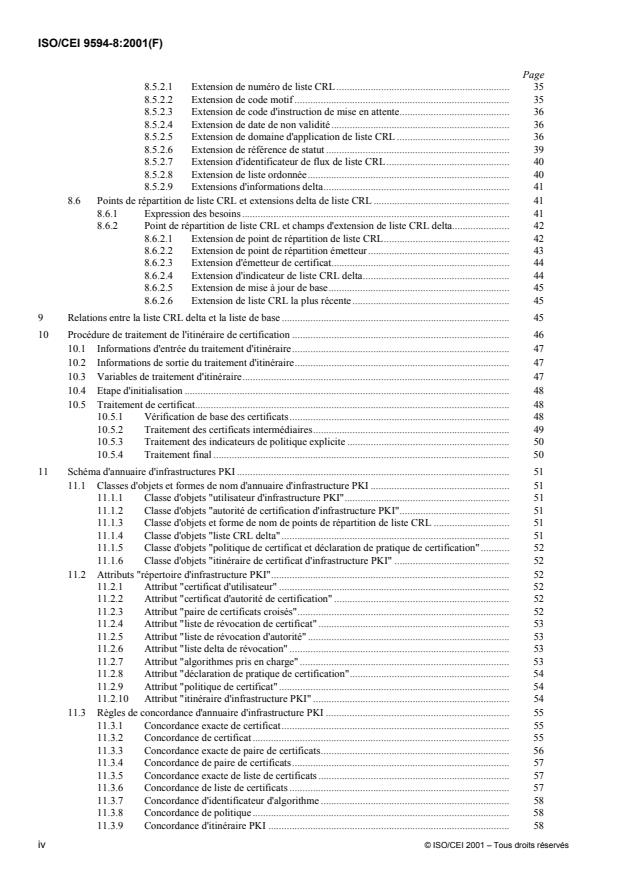
Page
8.5.2.1 Extension de numéro de liste CRL . 35
8.5.2.2 Extension de code motif . 35
8.5.2.3 Extension de code d'instruction de mise en attente. 36
8.5.2.4 Extension de date de non validité. 36
8.5.2.5 Extension de domaine d'application de liste CRL . 36
8.5.2.6 Extension de référence de statut . 39
8.5.2.7 Extension d'identificateur de flux de liste CRL. 40
8.5.2.8 Extension de liste ordonnée. 40
8.5.2.9 Extensions d'informations delta. 41
8.6 Points de répartition de liste CRL et extensions delta de liste CRL . 41
8.6.1 Expression des besoins . 41
8.6.2 Point de répartition de liste CRL et champs d'extension de liste CRL delta. 42
8.6.2.1 Extension de point de répartition de liste CRL. 42
8.6.2.2 Extension de point de répartition émetteur. 43
8.6.2.3 Extension d'émetteur de certificat. 44
8.6.2.4 Extension d'indicateur de liste CRL delta. 44
8.6.2.5 Extension de mise à jour de base. 45
8.6.2.6 Extension de liste CRL la plus récente. 45
9 Relations entre la liste CRL delta et la liste de base . 45
10 Procédure de traitement de l'itinéraire de certification . 46
10.1 Informations d'entrée du traitement d'itinéraire. 47
10.2 Informations de sortie du traitement d'itinéraire. 47
10.3 Variables de traitement d'itinéraire. 47
10.4 Etape d'initialisation . 48
10.5 Traitement de certificat. 48
10.5.1 Vérification de base des certificats. 48
10.5.2 Traitement des certificats intermédiaires. 49
10.5.3 Traitement des indicateurs de politique explicite . 50
10.5.4 Traitement final . 50
11 Schéma d'annuaire d'infrastructures PKI . 51
11.1 Classes d'objets et formes de nom d'annuaire d'infrastructure PKI . 51
11.1.1 Classe d'objets "utilisateur d'infrastructure PKI". 51
11.1.2 Classe d'objets "autorité de certification d'infrastructure PKI". 51
11.1.3 Classe d'objets et forme de nom de points de répartition de liste CRL . 51
11.1.4 Classe d'objets "liste CRL delta". 51
11.1.5 Classe d'objets "politique de certificat et déclaration de pratique de certification" . 52
11.1.6 Classe d'objets "itinéraire de certificat d'infrastructure PKI" . 52
11.2 Attributs "répertoire d'infrastructure PKI". 52
11.2.1 Attribut "certificat d'utilisateur" . 52
11.2.2 Attribut "certificat d'autorité de certification" . 52
11.2.3 Attribut "paire de certificats croisés". 52
11.2.4 Attribut "liste de révocation de certificat" . 53
11.2.5 Attribut "liste de révocation d'autorité" . 53
11.2.6 Attribut "liste delta de révocation" . 53
11.2.7 Attribut "algorithmes pris en charge" . 53
11.2.8 Attribut "déclaration de pratique de certification". 54
11.2.9 Attribut "politique de certificat" . 54
11.2.10 Attribut "itinéraire d'infrastructure PKI" . 54
11.3 Règles de concordance d'annuaire d'infrastructure PKI . 55
11.3.1 Concordance exacte de certificat. 55
11.3.2 Concordance de certificat . 55
11.3.3 Concordance exacte de paire de certificats. 56
11.3.4 Concordance de paire de certificats. 57
11.3.5 Concordance exacte de liste de certificats . 57
11.3.6 Concordance de liste de certificats . 57
11.3.7 Concordance d'identificateur d'algorithme . 58
11.3.8 Concordance de politique . 58
11.3.9 Concordance d'itinéraire PKI . 58
iv © ISO/CEI 2001 – Tous droits réservés
ISO/CEI 9594-8:2001(F)
Page
SECTION 3 – CADRE DE CERTIFICAT D'ATTRIBUT. 59
12 Certificats d'attribut . 59
12.1 Structure du certificat d'attribut . 60
12.2 Itinéraires de certificat d'attribut. 62
13 Relations entre l'autorité d'attribut, la source d'autorité et l'autorité de certification . 62
13.1 Privilège dans les certificats d'attribut . 63
13.2 Privilège dans des certificats de clé publique . 63
14 Modèles d'infrastructure PMI . 64
14.1 Modèle général . 64
14.1.1 Infrastructure PMI dans le contexte de contrôle d'accès. 65
14.1.2 Infrastructure PMI dans un contexte de non-répudiation . 65
14.2 Modèle de contrôle d'accès. 66
14.3 Modèle de délégation . 66
14.4 Modèle de rôles . 67
14.4.1 Attribut "rôle". 68
15 Extensions de certificat de gestion de privilège. 68
15.1 Extensions de gestion de privilège de base. 69
15.1.1 Définition des besoins . 69
15.1.2 Champs de gestion d'extension de privilège de base . 69
15.1.2.1 Extension de spécification de durée . 69
15.1.2.2 Extension d'informations de cible. 70
15.1.2.3 Extension de notification d'utilisateur . 70
15.1.2.4 Extension de politiques de privilège acceptable. 71
15.2.2.1 Extension de point de répartition de liste CRL. 71
15.2.2.2 Extension d'absence d'informations de révocation . 72
15.3.2.1 Extension d'identificateur de source d'autorité . 72
15.3.2.2 Extension de descripteur d'attribut . 73
15.4.2.1 Extension d'identificateur de certificat de spécification de rôle . 74
15.5.2.1 Extension de contraintes d'attribut de base. 75
15.5.2.2 Extension de contraintes de nom délégué. 77
15.5.2.3 Extension de politiques de certificat acceptable . 77
15.5.2.4 Extension d'identificateur d'autorité d'attribut . 78
15.2 Extensions de révocation de privilège . 71
15.2.1 Définition des besoins . 71
15.2.2 Champs d'extension de révocation de privilège. 71
15.3 Extensions de source d'autorité . 72
15.3.1 Définition des besoins . 72
15.3.2 Champs d'extension de source d'autorité . 72
15.4 Extensions de rôle . 74
15.4.1 Définition des besoins . 74
15.4.2 Champs d'extension de rôle. 74
15.5 Extensions de délégation . 75
15.5.1 Définition des besoins . 75
15.5.2 Champs d'extension de délégation. 75
16 Procédure de traitement d'itinéraire de privilège . 79
16.1 Procédure de traitement de base . 79
16.2 Procédure de traitement d'itinéraire de privilège . 80
16.3 Procédure de traitement de délégation. 80
16.3.1 Vérification de l'intégrité des données de la règle de hiérarchie . 81
16.3.2 Etablir un itinéraire de délégation valide. 81
16.3.3 Vérification de la délégation de privilège. 81
16.3.4 Détermination de la réussite ou de l'échec. 81
© ISO/CEI 2001 – Tous droits réservés v
ISO/CEI 9594-8:2001(F)
Page
17 Schéma d'annuaire PMI . 82
17.1 Classes d'objets "annuaire PMI". 82
17.1.1 Classe d'objets "utilisateur d'infrastructure PMI" . 82
17.1.2 Classe d'objets "autorité d'attribut d'infrastructure PMI". 82
17.1.3 Classe d'objets "source d'autorité d'infrastructure PMI". 82
17.1.4 Classe d'objets "certificat d'attribut de point de répartition de liste CRL". 82
17.1.5 Classe d'objets "itinéraire de délégation d'infrastructure PMI" . 83
17.1.6 Classe d'objets "politique de privilège" . 83
17.2 Attributs d'annuaire d'infrastructure PMI . 83
17.2.1 Attribut "certificat d'attribut". 83
17.2.2 Attribut "certificats d'autorité d'attribut" . 83
17.2.3 Attribut "certificat de descripteur d'attribut" . 83
17.2.4 Attribut "liste de révocation de certificat d'attribut". 83
17.2.5 Attribut "liste de révocation de certificat d'autorité d'attribut" . 84
17.2.6 Attribut "itinéraire de délégation" . 84
17.2.7 Attribut "politique de privilège" . 84
17.3 Règles de concordance de répertoire d'infrastructure PMI. 84
17.3.1 Concordance exacte de certificat d'attribut. 84
17.3.2 Concordance de certificat d'attribut. 85
17.3.3 Concordance détenteur/émetteur . 85
17.3.4 Concordance d'itinéraire de délégation. 85
SECTION 4 – UTILISATION DES CADRES DE CLÉ PUBLIQUE ET DE CERTIFICAT D'ATTRIBUT PAR
L'ANNUAIRE . 86
18 Authentification de l'annuaire. 86
18.1 Procédure d'authentification simple. 86
18.1.1 Générations d'informations d'identification protégées. 87
18.1.2 Procédure d'authentification simple protégée. 87
18.1.3 Type d'attribut "mot de passe utilisateur". 88
18.2 Authentification forte . 88
18.2.1 Obtention de certificats de clé publique à partir de l'annuaire. 89
18.2.2 Procédures d'authentification forte . 91
18.2.1.1 Exemple. 90
18.2.2.1 Authentification en un temps. 92
18.2.2.2 Authentification en deux temps. 93
18.2.2.3 Authentification en trois temps. 94
19 Contrôle d'accès. 94
20 Protection des opérations d'annuaire. 95
Annexe A – Cadres de certificats d'attribut et de clé publique . 96
Annexe B – Règles de génération et de traitement des listes CRL . 114
B.1 Introduction . 114
B.1.1 Types de liste CRL . 114
B.1.2 Traitement de liste CRL . 115
B.2 Détermination des paramètres pour les listes CRL. 115
B.3 Détermination des listes CRL nécessaires. 116
B.3.1 Entité finale avec point de répartition de liste CRL critique . 116
B.3.2 Entité finale sans point de répartition de liste CRL critique. 116
B.3.3 Autorité de certification avec point de répartition de liste CRL critique. 117
B.3.4 Autorité de certification sans point de répartition de liste CRL critique . 117
B.4 Extraction des listes CRL . 117
B.5 Traitement des listes CRL . 117
B.5.1 Validation du domaine d'application de liste CRL . 118
B.5.2 Validation du domaine d'application de liste CRL delta . 119
B.5.3 Vérification de validité et d'actualité de la liste CRL de base . 120
B.5.4 Validité et vérifications de la liste CRL delta. 121
B.5.1.1 Liste CRL complète. 118
B.5.1.2 Liste EPRL complète. 118
B.5.1.3 Liste CARL complète. 119
B.5.1.4 Liste CRL, EPRL ou CARL basée sur un point de répartition. 119
vi © ISO/CEI 2001 – Tous droits réservés
ISO/CEI 9594-8:2001(F)
Page
Annexe C – Exemples d'émission de liste CRL delta . 122
C.1 Introduction . 122
Annexe D – Exemples de définition de politique de privilège et d'attribut de privilège. 124
D.1 Introduction . 124
D.2 Exemples de syntaxes. 124
D.2.1 Premier exemple. 124
D.2.2 Deuxième exemple . 126
D.3 Exemple d'attribut de privilège. 128
Annexe E – Introduction à la cryptographie avec clé publique. 129
Annexe F – Définition de référence des identificateurs d'objet d'algorithme . 131
Annexe G – Exemples d'utilisation de contraintes d'itinéraire de certification. 132
G.1 Exemple 1: utilisation de contraintes de base. 132
G.2 Exemple 2: utilisation de contraintes nominatives . 132
G.3 Exemple 3: utilisation de mappage de politiques et de contraintes de politiques. 132
Annexe H – Liste alphabétique des définitions des éléments d'information. 134
Annexe I – Amendements et corrigenda. 137
© ISO/CEI 2001 – Tous droits réservés vii
ISO/CEI 9594-8:2001(F)
Avant-propos
L'ISO (Organisation internationale de normalisation) et la CEI (Commission électrotechnique internationale)
forment le système spécialisé de la normalisation mondiale. Les organismes nationaux membres de l'ISO ou de la
CEI participent au développement de Normes internationales par l'intermédiaire des comités techniques créés par
l'organisation concernée afin de s'occuper des domaines particuliers de l'activité technique. Les comités
techniques de l'ISO et de la CEI collaborent dans des domaines d'intérêt commun. D'autres organisations
internationales, gouvernementales et non gouvernementales, en liaison avec l'ISO et la CEI participent également
aux travaux.
Les Normes internationales sont rédigées conformément aux règles données dans les Directives ISO/CEI, Partie 3.
Dans le domaine des technologies de l'information, l'ISO et la CEI ont créé un comité technique mixte,
l'ISO/CEI JTC 1. Les projets de Normes internationales adoptés par le comité technique mixte sont soumis aux
organismes nationaux pour vote. Leur publication comme Normes internationales requiert l'approbation de 75 % au
moins des organismes nationaux votants.
Il convient que les utilisateurs de la présente partie de l'ISO/CEI 9594, et ceux la mettant en application, notent
l'existence d'une procédure de «résolution de défaut» dans l'ISO/CEI JTC 1 pour identifier et corriger les erreurs
dans les Normes internationales, par la publication de Rectificatifs techniques. Des corrections identiques sont
faites aux Recommandations UIT-T correspondantes dans des Corrigenda et peuvent aussi être faites sous la
forme de Guides de mise en application. Le détail des Rectificatifs techniques aux Normes internationales est
disponible sur le site Web de l'ISO; les Rectificatifs techniques publiés peuvent être obtenus dans le magasin en
ligne de l'ISO, ou auprès des comités nationaux de l'ISO ou de la CEI. Les Corrigenda et Guides de mise en
application aux Recommandations UIT-T peuvent être obtenus sur le site Web de l'UIT-T.
La Norme internationale ISO/CEI 9594-8 a été élaborée par le comité technique mixte ISO/CEI JTC 1,
Technologies de l'information, sous-comité SC 6, Téléinformatique, en collaboration avec l'UIT-T. Le texte
identique est publié en tant que Recommandation UIT-T X.509.
Cette quatrième édition constitue une révision technique de la troisième édition (ISO/CEI 9594-8:1998), qui est
provisoirement retenue pour pouvoir être utilisée. Elle incorpore aussi le Rectificatif 1:2000.
L'ISO/CEI 9594 comprend les parties suivantes, présentées sous le titre général Technologies de l'information —
Interconnexion de systèmes ouverts (OSI) — L'annuaire:
— Partie 1: Aperçu général des concepts, modèles et services
— Partie 2: Les modèles
— Partie 3: Définition du service abstrait
— Partie 4: Procédures pour le fonctionnement réparti
— Partie 5: Spécification du protocole
— Partie 6: Types d'attributs sélectionnés
— Partie 7: Classes d'objets sélectionnées
— Partie 8: Cadre général des certificats de clé publique et d'attribut
— Partie 9: Duplication
— Partie 10: Utilisation de la gestion-systèmes pour l'administration de l'annuaire
Les annexes A, B et F constituent un élément normatif de la présente partie de l'ISO/CEI 9594. Les annexes C, D,
E, G, H et I sont données uniquement à titre d'information.
viii © ISO/CEI 2001 – Tous droits réservés
ISO/CEI 9594-8:2001(F)
Introduction
La présente Recommandation | Norme internationale, associée à d'autres Recommandations | Normes internationales, a
été produite en vue de faciliter l'interconnexion de systèmes de traitement de l'information pour la fourniture de services
d'annuaire. Un ensemble de tels services, associés aux informations qu'ils détiennent, peut être considéré comme une
entité intégrée, appelée annuaire. Les informations détenues par l'annuaire, appelées collectivement base d'information
d'annuaire (DIB) sont utilisées en général pour faciliter les communications s'effectuant entre, ou concernant, des objets,
tels que des entités d'application, des individus, des terminaux et des listes de répartition.
L'annuaire joue un rôle important dans l'interconnexion des systèmes ouverts; moyennant un minimum d'accords
techniques en dehors des normes d'interconnexion proprement dites, il a pour but de permettre l'interconnexion de
systèmes de traitement de l'information:
– de fournisseurs divers;
– sous des responsabilités de gestion diverses;
– de niveaux de complexité divers;
– d'âges divers.
De nombreuses applications ont des besoins de sécurité pour se protéger contre des menaces portant sur la
communication des informations. Pratiquement tous les services de sécurité font appel à la connaissance fiable des
identités des participants de la communication, c'est-à-dire à leur authentification.
La présente Recommandation | Norme internationale définit un cadre pour des certificats de clé publique. Ce cadre
comprend la spécification des objets de données utilisés pour représenter les certificats proprement dits ainsi que les
notifications de révocation de certificats émis et auxquels il ne doit plus être fait confiance. Le cadre de certificat de clé
publique décrit dans la présente Spécification définit certains composants critiques d'une infrastructure de clé publique
(PKI), mais pas la totalité d'une telle infrastructure. La présente Spécification fournit toutefois une base permettant
d'édifier des infrastructures PKI complètes et leurs spécifications.
La présente Recommandation | Norme internationale définit de même un cadre pour des certificats d'attribut. Ce cadre
contient la spécification des objets de données utilisés pour représenter les certificats proprement dits, ainsi que les
notifications de révocation de certificat émis auxquels il ne doit plus être fait confiance. Le cadre de certificat d'attribut
décrit dans la présente Spécification définit certains composants critiques d'une infrastructure de gestion de privilège
(PMI), mais pas la totalité d'une telle infrastructure. La présente Spécification fournit toutefois une base permettant
d'édifier des infrastructures PMI complètes et leurs spécifications.
Sont définis également les objets d'informations permettant de stocker les objets d'infrastructure PKI et PMI dans
l'annuaire et de comparer des valeurs présentées avec les valeurs stockées.
La présente Recommandation | Norme internationale définit également un cadre pour la fourniture de services
d'authentification par l'annuaire au bénéfice de ses utilisateurs.
La présente Recommandation | Norme internationale fournit les cadres de base permettant la définition de profils
industriels par d'autres organismes de normalisation et par des forums industriels. L'utilisation d'un grand nombre des
fonctionnalités optionnelles figurant dans ces cadres peut être rendue obligatoire dans certains environnements au moyen
de profils. Cette quatrième édition révise et étend sur le plan technique la troisième édition de la présente
Recommandation | Norme internationale mais ne la remplace pas. Des implémentations peuvent continuer à déclarer la
conformité avec la troisième édition. Cette dernière ne sera toutefois plus prise en charge à partir d'une certaine date
(c'est-à-dire que les comptes rendus de faute ne seront plus traités). Il est recommandé que les implémentations se
conforment à la présente quatrième édition, et ce dès que possible.
La présente quatrième édition spécifie la version 1 et la version 2 des protocoles d'annuaire.
Les première et deuxième éditions ne spécifiaient que la version 1. La plupart des services et des protocoles spécifiés
dans la présente édition sont conçus pour fonctionner dans le cadre de la version 1. Toutefois, certains services et
protocoles améliorés – les erreurs signées, par exemple – ne fonctionneront que si toutes les entités de l'annuaire qui
participent à l'opération ont négocié la version 2. Quelle que soit la version qui a été négociée, les différences entre les
services et entre les protocoles définis dans les quatre éditions, à l'exception de celles qui s'appliquent expressément à la
version 2, sont prises en compte selon les règles d'extensibilité définies dans la présente édition de la Recommandation
UIT-T X.519 | ISO/CEI 9594-5.
L'Annexe A, qui fait partie intégrante de la présente Recommandation | Norme internationale, fournit le module ASN.1
contenant toutes les définitions associées au cadre d'authentification.
L'Annexe B, qui fait partie intégrante de la présente Recommandation | Norme internationale, fournit des règles de
génération et de traitement des listes de révocation de certificat.
© ISO/CEI 2001 – Tous droits réservés ix
ISO/CEI 9594-8:2001(F)
L'Annexe C, qui ne fait pas partie intégrante de la présente Recommandation | Norme internationale, fournit des
exemples d'émission de liste CRL delta.
L'Annexe D, qui ne fait pas partie intégrante de la présente Recommandation | Norme internationale, fournit des
exemples de syntaxe de politiques de privilège et des exemples d'attribut de privilèges.
L'Annexe E, qui ne fait pas partie intégrante de la présente Recommandation | Norme internationale, constitue une
introduction au chiffrement avec clé publique.
L'Annexe F, qui fait partie intégrante de la présente Recommandation | Norme internationale, définit les identificateurs
d'objets attribués aux algorithmes d'authentification et de chiffrement, en l'absence d'un enregistrement formel.
L'Annexe G, qui ne fait pas partie intégrante de la présente Recommandation | Norme internationale, contient des
exemples d'utilisation de contraintes de certification d'itinéraire.
L'Annexe H, qui ne fait pas partie intégrante de la présente Recommandation | Norme internationale, contient les
définitions des éléments d'information par ordre alphabétique.
L'Annexe I, qui ne fait pas partie intégrante de la présente Recommandation | Norme internationale, fournit la liste des
amendements et des comptes rendus d'erreur qui ont été incorporés dans cette édition de la présente Recommandation |
Norme internationale.
x © ISO/CEI 2001 – Tous droits réservés
ISO/CEI 9594-8 : 2001 (F)
NORME INTERNATIONALE
ISO/CEI 9594-8 : 2001 (F)
RECOMMANDATION UIT-T
TECHNOLOGIES DE L'INFORMATION – INTERCONNEXION
DES SYSTÈMES OUVERTS – L'ANNUAIRE: CADRE GÉNÉRAL
DES CERTIFICATS DE CLÉ PUBLIQUE ET D'ATTRIBUT
SECTION 1 – GÉNÉRALITÉS
1 Domaine d'application
La présente Recommandation | Norme internationale traite de certai
...
Questions, Comments and Discussion
Ask us and Technical Secretary will try to provide an answer. You can facilitate discussion about the standard in here.
Loading comments...