

ISO/IEC 24713-3:2009
(Main)Information technology — Biometric profiles for interoperability and data interchange — Part 3: Biometrics-based verification and identification of seafarers
General Information
- Abstract
In order to support a globally interoperable system of seafarers' identity documents, ISO/IEC 24713-3:2009 establishes a biometric profile to define how to use biometrics for verification and identification of seafarers at the various stages of document issuance and inspection. It defines a set of base standards and criteria for applying those standards in applications where identity documents are issued to seafarers and biometrics are used to link each document to the seafarer to whom it was issued. It attempts to provide information on the processes surrounding the enrolment and verification or identification of seafarers so that the biometric components of the system can be used in a proper context. It also addresses other system components such as the storage medium for the biometric data and the security of the system, since these will affect the use of the biometric technology.
- Status
- Withdrawn
- Publication Date
- 26-Aug-2009
- Technical Committee
- ISO/IEC JTC 1/SC 37 - Biometrics
- Drafting Committee
- ISO/IEC JTC 1/SC 37/WG 4 - Technical Implementation of Biometric Systems
- Current Stage
- 9599 - Withdrawal of International Standard
- Start Date
- 14-Sep-2026
- Completion Date
- 19-Sep-2026
Buy Documents
ISO/IEC 24713-3:2009 - Information technology -- Biometric profiles for interoperability and data interchange
ISO/IEC 24713-3:2009 - Information technology — Biometric profiles for interoperability and data interchange — Part 3: Biometrics-based verification and identification of seafarers/27/2009
Overview
ISO/IEC 24713-3:2009 - "Information technology - Biometric profiles for interoperability and data interchange - Part 3: Biometrics-based verification and identification of seafarers" defines a biometric profile to support globally interoperable Seafarers’ Identity Documents (SIDs). The standard specifies how biometrics are used during issuance, enrolment, verification and identification of seafarers, and sets requirements for data formats, storage media and system security to ensure reliable linkage between a seafarer and their identity document.
Key topics and technical requirements
- Scope and conformance: Defines conformance rules and the relationship to ILO Convention No.185 (Seafarers’ Identity Documents).
- Biometric modalities: Supports fingerprint-based templates (minutiae), face image data and other suitable modalities while emphasizing backward compatibility with two-fingerprint minutiae profiles.
- Data storage formats & media: Profiles options such as two-dimensional barcodes, contactless integrated circuits (smartcards) and secure electronic databases; includes CBEFF patron format (Annex B) and CBEFF security block (Annex C).
- Enrolment & verification procedures: Describes enrolment workflows, offline and online verification methods, and processes for watchlist checks and duplicate-identity prevention.
- Performance levels: Specifies expected biometric performance characteristics and operational considerations for maritime environments.
- Security, privacy & access control: Addresses protection of biometric data on SIDs, authentication of stored biometric data, secure database safeguards, and data protection/privacy constraints.
- Environmental robustness: Requires systems and credentials to function in harsh maritime conditions (wet weather, salt spray, high humidity and temperatures).
Practical applications and who uses it
ISO/IEC 24713-3:2009 is intended for organizations involved in issuing, inspecting or implementing biometric seafarer IDs:
- Maritime authorities and national issuing agencies (flag states)
- Port authorities and shore-side security/immigration officials
- Ship operators and crewing agencies
- Biometric system integrators, smart card and barcode manufacturers
- Developers of enrolment and verification software and secure databases
- Standards and compliance teams ensuring compatibility with ILO Convention No.185
Practical uses include secure issuance of SIDs, gangway access control, cross-border immigration checks for seafarers, fraud prevention (duplicate identities) and interoperability between national systems and inspection points.
Related standards
- ISO/IEC 19794 family (biometric data interchange formats) - referenced for image and minutiae formats
- ISO/IEC 19785 (CBEFF) - container format used by annexes in this profile
- ILO Convention No.185 - policy context for SIDs
ISO/IEC 24713-3:2009 is a technical profile aimed at ensuring interoperable, secure, and operationally robust biometric seafarer identity systems worldwide.
Buy Documents
ISO/IEC 24713-3:2009 - Information technology -- Biometric profiles for interoperability and data interchange
ISO/IEC 24713-3:2009 - Information technology — Biometric profiles for interoperability and data interchange — Part 3: Biometrics-based verification and identification of seafarers/27/2009
Get Certified
Connect with accredited certification bodies for this standard

BSI Group
BSI (British Standards Institution) is the business standards company that helps organizations make excellence a habit.

NYCE
Mexican standards and certification body.
Sponsored listings
Frequently Asked Questions
ISO/IEC 24713-3:2009 is a standard published by the International Organization for Standardization (ISO). Its full title is "Information technology — Biometric profiles for interoperability and data interchange — Part 3: Biometrics-based verification and identification of seafarers". This standard covers: In order to support a globally interoperable system of seafarers' identity documents, ISO/IEC 24713-3:2009 establishes a biometric profile to define how to use biometrics for verification and identification of seafarers at the various stages of document issuance and inspection. It defines a set of base standards and criteria for applying those standards in applications where identity documents are issued to seafarers and biometrics are used to link each document to the seafarer to whom it was issued. It attempts to provide information on the processes surrounding the enrolment and verification or identification of seafarers so that the biometric components of the system can be used in a proper context. It also addresses other system components such as the storage medium for the biometric data and the security of the system, since these will affect the use of the biometric technology.
In order to support a globally interoperable system of seafarers' identity documents, ISO/IEC 24713-3:2009 establishes a biometric profile to define how to use biometrics for verification and identification of seafarers at the various stages of document issuance and inspection. It defines a set of base standards and criteria for applying those standards in applications where identity documents are issued to seafarers and biometrics are used to link each document to the seafarer to whom it was issued. It attempts to provide information on the processes surrounding the enrolment and verification or identification of seafarers so that the biometric components of the system can be used in a proper context. It also addresses other system components such as the storage medium for the biometric data and the security of the system, since these will affect the use of the biometric technology.
ISO/IEC 24713-3:2009 is classified under the following ICS (International Classification for Standards) categories: 35.040 - Information coding; 35.240.15 - Identification cards. Chip cards. Biometrics. The ICS classification helps identify the subject area and facilitates finding related standards.
ISO/IEC 24713-3:2009 is available in PDF format for immediate download after purchase. The document can be added to your cart and obtained through the secure checkout process. Digital delivery ensures instant access to the complete standard document.
Standards Content (Sample)
INTERNATIONAL ISO/IEC
STANDARD 24713-3
First edition
2009-09-01
Information technology — Biometric
profiles for interoperability and data
interchange —
Part 3:
Biometrics-based verification and
identification of seafarers
Technologies de l'information — Profils biométriques pour
interopérabilité et échange de données —
Partie 3: Vérification basée sur la biométrie et identification des
navigateurs
Reference number
©
ISO/IEC 2009
PDF disclaimer
This PDF file may contain embedded typefaces. In accordance with Adobe's licensing policy, this file may be printed or viewed but
shall not be edited unless the typefaces which are embedded are licensed to and installed on the computer performing the editing. In
downloading this file, parties accept therein the responsibility of not infringing Adobe's licensing policy. The ISO Central Secretariat
accepts no liability in this area.
Adobe is a trademark of Adobe Systems Incorporated.
Details of the software products used to create this PDF file can be found in the General Info relative to the file; the PDF-creation
parameters were optimized for printing. Every care has been taken to ensure that the file is suitable for use by ISO member bodies. In
the unlikely event that a problem relating to it is found, please inform the Central Secretariat at the address given below.
© ISO/IEC 2009
All rights reserved. Unless otherwise specified, no part of this publication may be reproduced or utilized in any form or by any means,
electronic or mechanical, including photocopying and microfilm, without permission in writing from either ISO at the address below or
ISO's member body in the country of the requester.
ISO copyright office
Case postale 56 • CH-1211 Geneva 20
Tel. + 41 22 749 01 11
Fax + 41 22 749 09 47
E-mail copyright@iso.org
Web www.iso.org
Published in Switzerland
ii © ISO/IEC 2009 – All rights reserved
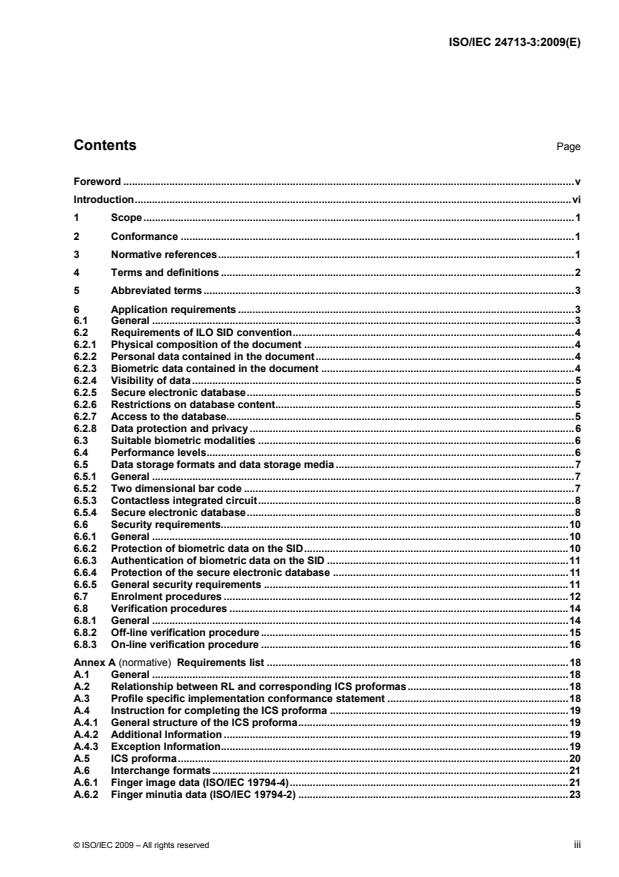
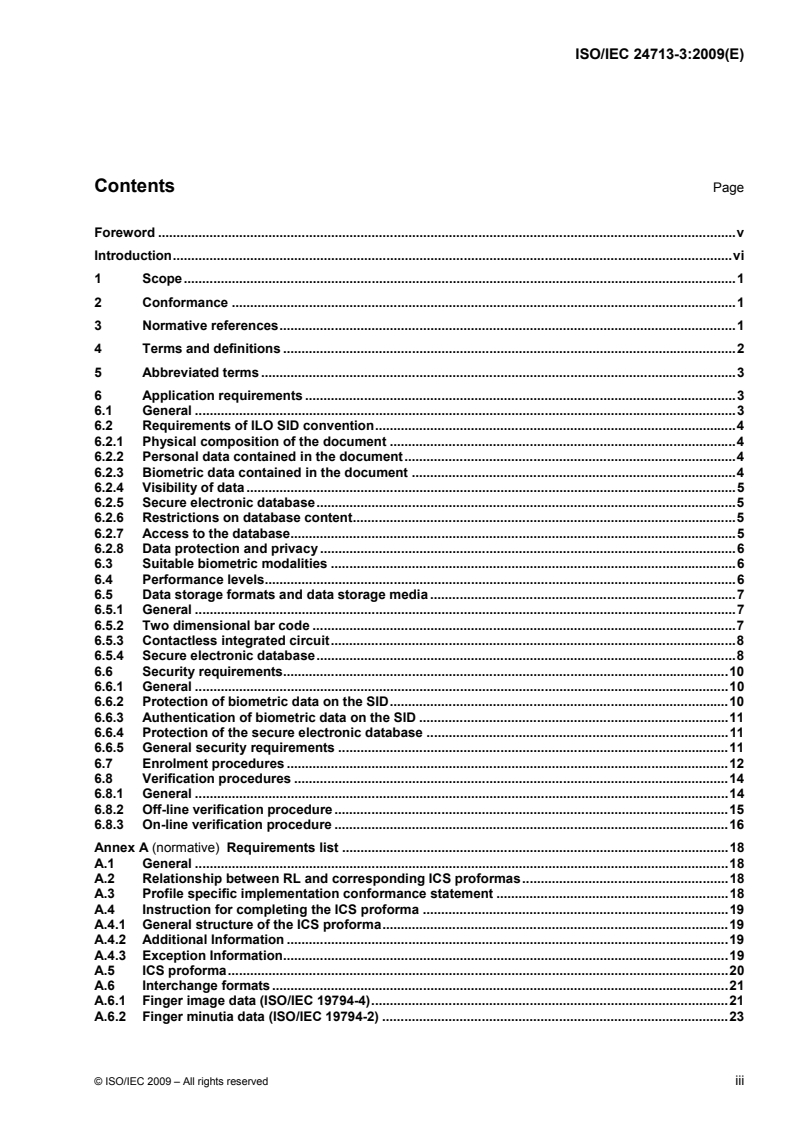
Contents Page
Foreword .v
Introduction.vi
1 Scope.1
2 Conformance .1
3 Normative references.1
4 Terms and definitions .2
5 Abbreviated terms.3
6 Application requirements .3
6.1 General .3
6.2 Requirements of ILO SID convention.4
6.2.1 Physical composition of the document .4
6.2.2 Personal data contained in the document.4
6.2.3 Biometric data contained in the document .4
6.2.4 Visibility of data .5
6.2.5 Secure electronic database.5
6.2.6 Restrictions on database content.5
6.2.7 Access to the database.5
6.2.8 Data protection and privacy .6
6.3 Suitable biometric modalities .6
6.4 Performance levels.6
6.5 Data storage formats and data storage media .7
6.5.1 General .7
6.5.2 Two dimensional bar code .7
6.5.3 Contactless integrated circuit.8
6.5.4 Secure electronic database.8
6.6 Security requirements.10
6.6.1 General .10
6.6.2 Protection of biometric data on the SID.10
6.6.3 Authentication of biometric data on the SID .11
6.6.4 Protection of the secure electronic database .11
6.6.5 General security requirements .11
6.7 Enrolment procedures .12
6.8 Verification procedures .14
6.8.1 General .14
6.8.2 Off-line verification procedure .15
6.8.3 On-line verification procedure .16
Annex A (normative) Requirements list .18
A.1 General .18
A.2 Relationship between RL and corresponding ICS proformas.18
A.3 Profile specific implementation conformance statement .18
A.4 Instruction for completing the ICS proforma .19
A.4.1 General structure of the ICS proforma.19
A.4.2 Additional Information .19
A.4.3 Exception Information.19
A.5 ICS proforma.20
A.6 Interchange formats.21
A.6.1 Finger image data (ISO/IEC 19794-4).21
A.6.2 Finger minutia data (ISO/IEC 19794-2) .23
© ISO/IEC 2009 – All rights reserved iii
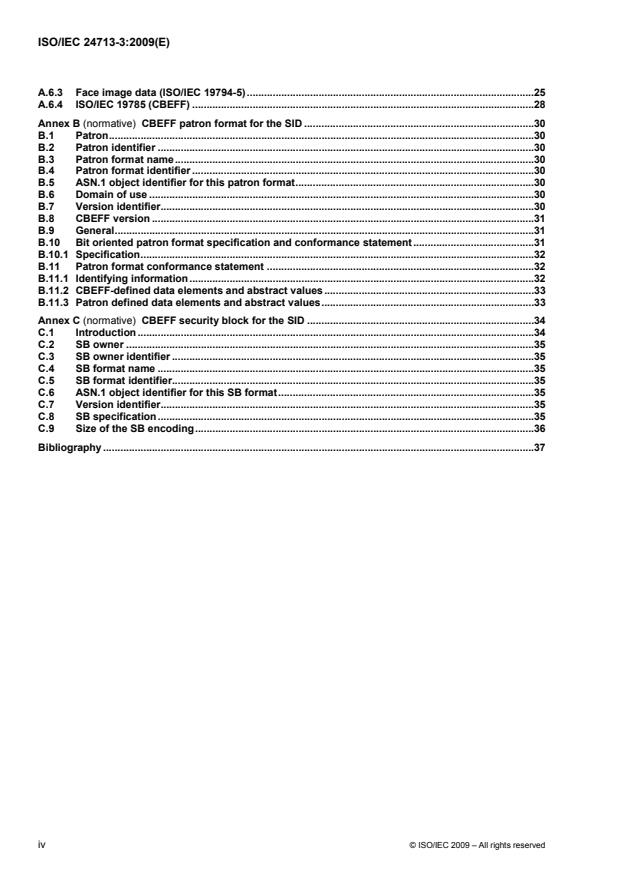
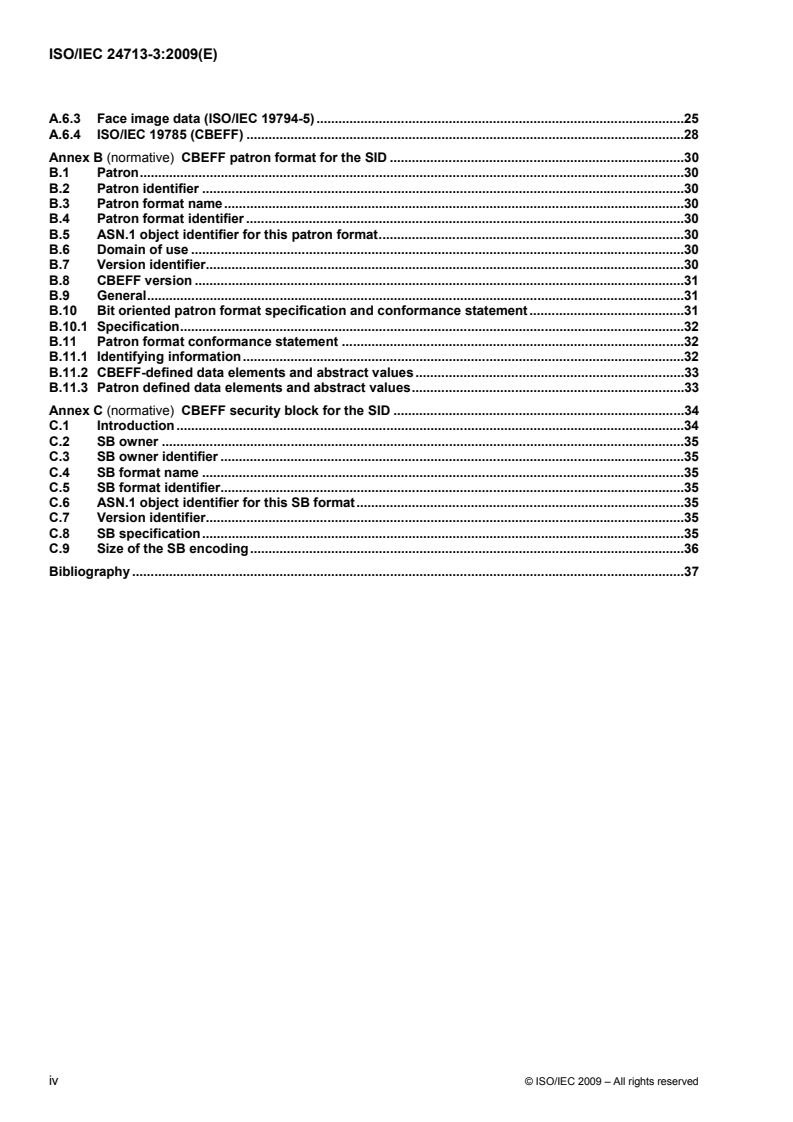
A.6.3 Face image data (ISO/IEC 19794-5).25
A.6.4 ISO/IEC 19785 (CBEFF) .28
Annex B (normative) CBEFF patron format for the SID .30
B.1 Patron.30
B.2 Patron identifier .30
B.3 Patron format name.30
B.4 Patron format identifier .30
B.5 ASN.1 object identifier for this patron format.30
B.6 Domain of use .30
B.7 Version identifier.30
B.8 CBEFF version .31
B.9 General.31
B.10 Bit oriented patron format specification and conformance statement.31
B.10.1 Specification.32
B.11 Patron format conformance statement .32
B.11.1 Identifying information.32
B.11.2 CBEFF-defined data elements and abstract values.33
B.11.3 Patron defined data elements and abstract values.33
Annex C (normative) CBEFF security block for the SID .34
C.1 Introduction.34
C.2 SB owner .35
C.3 SB owner identifier .35
C.4 SB format name .35
C.5 SB format identifier.35
C.6 ASN.1 object identifier for this SB format.35
C.7 Version identifier.35
C.8 SB specification.35
C.9 Size of the SB encoding.36
Bibliography .37
iv © ISO/IEC 2009 – All rights reserved
Foreword
ISO (the International Organization for Standardization) and IEC (the International Electrotechnical
Commission) form the specialized system for worldwide standardization. National bodies that are members of
ISO or IEC participate in the development of International Standards through technical committees
established by the respective organization to deal with particular fields of technical activity. ISO and IEC
technical committees collaborate in fields of mutual interest. Other international organizations, governmental
and non-governmental, in liaison with ISO and IEC, also take part in the work. In the field of information
technology, ISO and IEC have established a joint technical committee, ISO/IEC JTC 1.
International Standards are drafted in accordance with the rules given in the ISO/IEC Directives, Part 2.
The main task of the joint technical committee is to prepare International Standards. Draft International
Standards adopted by the joint technical committee are circulated to national bodies for voting. Publication as
an International Standard requires approval by at least 75 % of the national bodies casting a vote.
Attention is drawn to the possibility that some of the elements of this document may be the subject of patent
rights. ISO and IEC shall not be held responsible for identifying any or all such patent rights.
ISO/IEC 24713-3 was prepared by Joint Technical Committee ISO/IEC JTC 1, Information technology,
Subcommittee SC 37, Biometrics.
ISO/IEC 24713 consists of the following parts, under the general title Information technology — Biometric
profiles for interoperability and data interchange:
⎯ Part 1: Overview of biometric systems and biometric profiles
⎯ Part 2: Physical access control for employees at airports
⎯ Part 3: Biometrics-based verification and identification of seafarers
© ISO/IEC 2009 – All rights reserved v
Introduction
The International Labour Organization, in response to a request from the International Maritime Organization,
has adopted the Seafarers' Identity Documents Convention (Revised), 2003 (No.185). This convention
requires all seafarers from ratifying nations to be issued with an identity document that follows a uniform
format, has specific physical security features, and uses biometrics to link the seafarer to their identity
document. Currently Convention No. 185 specifies the use of two fingerprints stored in a two-dimensional bar
code, but the choice of biometric modality and storage medium could be changed provided backwards
compatibility is maintained.
In order to support a globally interoperable system of Seafarers' Identity Documents (SIDs), this part of
ISO/IEC 24713 establishes a biometric profile to define how to use biometrics for verification and identification
of seafarers at the various stages of document issuance and inspection. It defines a set of base standards and
criteria for applying those standards in applications where identity documents are issued to seafarers and
biometrics are used to link each document to the seafarer to whom it was issued. It attempts to provide
information on the processes surrounding the enrolment and verification or identification of seafarers so that
the biometric components of the system can be used in a proper context. It also addresses other system
components such as the storage medium for the biometric data and the security of the system, since these
will affect the use of the biometric technology. This part of ISO/IEC 24713 is intended for use in the maritime
industry, but can be applicable to other situations where identification and verification of document holders are
necessary during document issuance or inspection.
The use of biometric data includes identification checks during the issuance of the document, when watchlists
can be checked and the entire database of existing seafarers can be searched to prevent a single seafarer
from establishing multiple identities.
It also includes the use of biometric data for verification when a card is presented at a control point by a
person claiming to be the seafarer to whom the card was issued. Such control points can include port
entrances, ship gangplanks, border crossing points where a seafarer must verify themselves to immigration
authorities and any other situation where the seafarer needs to verify their identity as a seafarer. This
verification is expected to be performed not only indoors under controlled conditions, but also outdoors in
difficult conditions, including harsh wet weather, salt spray, high humidity and high temperatures. Biometric
equipment and credentials have to be capable of functioning in all such environments.
This part of ISO/IEC 24713 is not intended in any way to conflict with the existing international Convention
No. 185 established by the International Labour Organization and ratified by various member states of the
ILO. Instead, the approaches profiled in this part of ISO/IEC 24713 can be used to satisfy the requirements of
the current version of Convention No. 185 while also allowing alternative approaches outlined in this part of
ISO/IEC 24713 to be used in the future by the ILO if the technical documents associated with or annexes of
Convention No. 185 are modified. To this end, the concept of backwards compatibility is stressed. The
fundamental choices already made by the ILO of the use of a minutiae-based, two-finger template for seafarer
verification, of the inclusion of a photograph and signature in the visible area of the SID, and of the use of a
two-dimensional barcode as a storage medium are respected in this profile. Where alternative technology
choices are promoted, they are defined in such a way that there will still be backwards compatibility with
existing SIDs.
This part of ISO/IEC 24713 defines a CBEFF patron format in Annex B and a CBEFF Security Block in
Annex C that are suitable for the limited storage available in a two dimensional barcode and which may be
relevant for other storage constrained environments.
vi © ISO/IEC 2009 – All rights reserved
INTERNATIONAL STANDARD ISO/IEC 24713-3:2009(E)
Information technology — Biometric profiles for interoperability
and data interchange —
Part 3:
Biometrics-based verification and identification of seafarers
1 Scope
This part of ISO/IEC 24713 specifies a biometric profile including data interchange formats, system
requirements, and the operation of biometric procedures on a Seafarers’ Identity Document (SID).
The domain of applicability can extend to other situations where an interoperable biometrics-based identity
document is required, but the main focus is on the use of biometrics on a Seafarers' Identity Document (SID).
This part of ISO/IEC 24713 notes that ILO Convention No. 185 already provides the overarching policy
guidance on biometric verification and identification of seafarers and it relies on that guidance. Determining
any matters of policy beyond those or in contradiction to those included in ILO Convention No. 185 is explicitly
out of scope of this part of ISO/IEC 24713.
2 Conformance
All seafarers' identity documents, systems used for issuing seafarers' identity documents, and systems used
for verification or identification of seafarers that claim conformance to this part of ISO/IEC 24713 shall conform
to the mandatory requirements of Clause 6 of this part of ISO/IEC 24713 and of the normative Annexes
referenced therein.
3 Normative references
The following referenced documents are indispensable for the application of this document. For dated
references, only the edition cited applies. For undated references, the latest edition of the referenced
document (including any amendments) applies.
ISO/IEC 7501-1, Identification cards — Machine readable travel documents — Part 1: Machine readable
passport
ISO/IEC 7501-3, Identification cards — Machine readable travel documents — Part 3: Machine readable
official travel documents
ISO/IEC 8824-1:2002, Information technology — Abstract Syntax Notation One (ASN.1): Specification of basic
notation
ISO/IEC 8825-1:2002, Information technology — ASN.1 encoding rules: Specification of Basic Encoding
Rules (BER), Canonical Encoding Rules (CER) and Distinguished Encoding Rules (DER)
ISO/IEC 8825-2:2002, Information technology — ASN.1 encoding rules: Specification of Packed Encoding
Rules (PER)
© ISO/IEC 2009 – All rights reserved 1
ISO/IEC 15438:2006, Information technology — Automatic identification and data capture techniques —
PDF417 bar code symbology specification
ISO/IEC 19785-1:2006, Information technology — Common Biometric Exchange Formats Framework —
Part 1: Data element specification
ISO/IEC 19785-3:2007, Information technology — Common Biometric Exchange Formats Framework —
Part 3: Patron format specifications
ISO/IEC 19794-2:2005, Information technology — Biometric data interchange formats — Part 2: Finger
minutiae data
ISO/IEC 19794-4:2005, Information technology — Biometric data interchange formats — Part 4: Finger image
data
ISO/IEC 19794-5:2005, Information technology — Biometric data interchange formats — Part 5: Face image
data
ISO/IEC 19795-4:2008, Information technology — Biometric performance testing and reporting — Part 4:
Interoperability performance testing
ISO/IEC 24713-1:2008, Information technology — Biometric profiles for interoperability and data
interchange — Part 1: Overview of biometric systems and biometric profiles
ISO/IEC 29109-1, Information technology — Conformance testing methodology for biometric data interchange
formats defined in ISO/IEC 19794 — Part 1: Generalized conformance testing methodology
4 Terms and definitions
For the purposes of this document, the terms and definitions given in ISO/IEC 24713-1 and the following
apply.
NOTE There are some terms which are commonly used in this part of ISO/IEC 24713 but are not explicitly defined.
Specifically, verification authority, issuing authority, competent authority and focal point are terms which address legal
entities that are the responsibility of the ILO and which vary from country to country. These terms are used frequently in
ILO Convention No. 185 but their precise definition is best left to the interpretation of ILO legal experts. Further
explanations can be found by reading Convention No. 185 as provided in the bibiliography or by consulting with the ILO.
4.1
biometric characteristic
measurable, physical characteristic or personal behavioural trait used to recognize the identity, or verify the
claimed identity, of an enrolee
4.2
biometric enrolment
process of creating and storing, for an individual, a data record associated with an individual and including
biometric reference(s) and, typically, non-biometric data
4.3
biometric feature
concise representation of information extracted from an acquired or intermediate biometric sample by applying
a mathematical transformation
4.4
biometric model
stored function (dependent on the biometric data subject) generated from a biometric feature(s)
2 © ISO/IEC 2009 – All rights reserved
4.5
biometric reference
one or more stored biometric samples, biometric templates or biometric models attributed to a biometric data
subject and used for comparison
4.6
enrolee
person who has a biometric reference template recorded for the purpose of issuing a SID
4.7
IC chip
processor and storage embedded in a SID that contains information suitable for verification of the seafarers’
identity when read by a SID verification station that is equipped to communicate with an IC chip
NOTE This is also called a contactless integrated circuit.
4.8
seafarer
person who is employed or is engaged or works in any capacity on board a vessel (other than a ship of war)
ordinarily engaged in maritime navigation
4.9
Seafarers' Identity Document
SID
document containing identifying information about a seafarer including demographic information, a photo of
that seafarer and biometric data contained within a PDF 417 bar code or optionally an IC chip
NOTE It is expected that in initial deployments of SIDs the inclusion of an IC chip will be optional but that more
deployments will migrate to that technology as IC chips and the technology to perform biometric verification using IC chips
become ubiquitous.
4.10
SID verification station
system of hardware and software that supports the biometric verification of a seafarer's identity using
information recorded on the SID, optionally including the capability to perform on-line verification of the SID
with a secure electronic database provided by the issuing authority that issued the SID
NOTE A single verification authority will often support multiple SID verification stations, some of which may be
required to function on board ships or in other difficult environments where no on-line access is available.
5 Abbreviated terms
CBEFF Common Biometric Exchange Formats Framework
ILO International Labour Organization
SID Seafarers' Identity Document
6 Application requirements
6.1 General
The requirements of a globally interoperable system of seafarers' identity documents to be used for the
biometric verification and identification of seafarers are outlined in this clause. The requirements focus on the
biometric aspects of this application, but where other aspects affect the use of biometrics, they are also
discussed. These requirements are intended to be in accordance with the regulatory requirements of the
Seafarers' Identity Documents Convention (Revised), 2003 (No.185) [3] and to ensure backwards
© ISO/IEC 2009 – All rights reserved 3
compatibility with the existing practices of the ILO and with SIDs already issued. There are currently several
requirements of the existing Convention that would be difficult to change and which this standard normatively
requires for all verification and identification of seafarers. Permission has been given for certain portions of
Convention No. 185 to be quoted directly in this document, and these are used to help define the
requirements. The relevant sections of Convention No. 185 (renumbered to make sense when quoted without
the full text of the Convention) follow in Clause 6.2.
6.2 Requirements of ILO SID convention
6.2.1 Physical composition of the document
The seafarers' identity document shall be designed in a simple manner, be made of durable material, with
special regard to conditions at sea and be machine-readable. The materials used shall:
a) prevent tampering with the document or falsification, as far as possible, and enable easy detection of
alterations; and
b) be generally accessible to governments at the lowest cost consistent with reliably achieving the purpose
set out in (a) above.
NOTE 1 This requirement comes from Article 3, paragraph 2 of Convention No. 185 [3].
NOTE 2 The specific details associated with this requirement are found by reference to the physical layout and
document specifications for either a TD-3 booklet size document as defined in ISO/IEC 7501-1 or preferably a TD-1 card
size document as defined in ISO/IEC 7501-3.
6.2.2 Personal data contained in the document
Particulars about the holder included in the seafarer's identity document shall be restricted to the following:
a) full name (first and last names where applicable);
b) sex;
c) date and place of birth;
d) nationality;
e) any special physical characteristics that may assist identification;
f) digital or original photograph; and
g) signature
NOTE This requirement comes from Article 3, paragraph 7 of Convention No. 185 [3].
6.2.3 Biometric data contained in the document
Notwithstanding 6.2.2 above, a template or other representation of a biometric of the holder shall also be
required for inclusion in the seafarers' identity document, provided that the following preconditions are
satisfied:
a) the biometric can be captured without any invasion of privacy of the persons concerned, discomfort to
them, risk to their health or offence against their dignity;
b) the biometric shall itself be visible on the document and it shall not be possible to reconstitute it from the
template or other representation;
4 © ISO/IEC 2009 – All rights reserved
NOTE This requirement is interpreted to mean that the fingerprint template which is a representation of the biometric
used in the document shall be made visible by being encoded in a two dimensional barcode. Since the
ISO 19794-2 fingerprint template profiled in this standard is a representation only of bifurcations and endpoints,
this is interpreted to be only a subset of the information in the original biometric characteristic of the fingerprint
and thus satisfies the requirement that the biometric can not be reconstituted from the template.
c) the equipment needed for the provision and verification of the biometric is user-friendly and is generally
accessible to governments at low cost;
d) the equipment for the verification of the biometric can be conveniently and reliably operated in ports and
in other places, including on board ship, where verification of identity is normally carried out by the
competent authorities; and
e) the system in which the biometric is to be used (including the equipment, technologies and procedures for
use) provides results that are uniform and reliable for the authentication of identity.
NOTE This requirement comes from Article 3, paragraph 8 of Convention No. 185 [3].
6.2.4 Visibility of data
All data concerning the seafarer that are recorded on the document shall be visible. Seafarers shall have
convenient access to machines enabling them to inspect any data concerning them that is not eye-readable.
Such access shall be provided by or on behalf of the issuing authority.
NOTE This requirement comes from Article 3, paragraph 9 of Convention No. 185 [3].
6.2.5 Secure electronic database
Each Member shall ensure that a record of each seafarers' identity document issued, suspended or withdrawn
by it is stored in an electronic database. The necessary measures shall be taken to secure the database from
interference or unauthorized access.
NOTE 1 This requirement comes from Article 4, paragraph 1 of Convention No. 185 [3].
NOTE 2 The detailed contents of this database are described elsewhere in Convention No. 185 [3], but for purposes of
this standard they are defined in Clause 6.5.4 of this document.
NOTE 3 There will usually be a separate issuance database created by the document issuance system that is used to
record personal information and issue the SID, but this is not specified either in Convention No. 185 [3] or in this part of
ISO/IEC 24713.
6.2.6 Restrictions on database content
The information contained in the record shall be restricted to details which are essential for the purposes of
verifying a seafarers' identity document or the status of a seafarer and which are consistent with the seafarer's
right to privacy and which meet all applicable data protection requirements.
NOTE This requirement comes from Article 4, paragraph 2 of Convention No. 185 [3].
6.2.7 Access to the database
Each Member shall designate a permanent focal point for responding to inquiries, from the immigration or
other competent authorities of all Members of the Organization, concerning the authenticity and validity of the
seafarers' identity document issued by its authority. Details of the permanent focal point shall be
communicated to the International Labour Office, and the Office shall maintain a list which shall be
communicated to all Members of the Organization.
© ISO/IEC 2009 – All rights reserved 5
The details referred to in paragraph 6.2.5 above shall at all times be immediately accessible to the immigration
or other competent authorities in member States of the Organization, either electronically or through the focal
point referred to above.
NOTE This requirement comes from Article 4, paragraphs 4 and 5 of Convention No. 185 [3].
6.2.8 Data protection and privacy
For the purposes of this Convention, appropriate restrictions shall be established to ensure that no data - in
particular, photographs - are exchanged, unless a mechanism is in place to ensure that applicable data
protection and privacy standards are adhered to.
Members shall ensure that the personal data on the electronic database shall not be used for any purpose
other than verification of the seafarers' identity document.
NOTE This requirement comes from Article 4, paragraphs 6 and 7 of Convention No. 185 [3].
6.3 Suitable biometric modalities
Although many biometric modalities are suitable for use with seafarers, current practice uses two fingerprints,
preferably one from each hand. These fingerprints are stored in a single template with two finger views,
formatted in accordance with the card normal format (including a record header) defined by an early draft of
ISO/IEC 19794-2 and profiled in detail in ILO SID-0002 [4]. Any other modalities selected should therefore be
used in addition to a minutiae based fingerprint template in order to maintain backwards compatibility.
Since existing practice for seafarers' identity documents is to show a photograph of the seafarer’s face on the
printed document, it is current practice to collect both fingerprints and facial images for most seafarers. All
applications for biometric verification and identification that are conformant to this standard shall use
fingerprint as a mandatory biometric and face as an optional additional biometric.
6.4 Performance levels
The International Labour Organization has already specified a performance level that it deems to be
acceptable for verification of seafarers at ports and on board ships. It has not, however, specified a
performance level for identification of seafarers which may be relevant during background checks or duplicate
issuance checks when the seafarer is being enrolled into one of the electronic databases described in 6.2.5
and having their identity document issued. Given the dependence of the identification performance on the
quality of the input biometric data and the lack of detailed performance testing methodology standards for
identification operations, the simplest solution is to adopt the current ILO specified performance levels as the
minimum performance levels.
Biometric systems that perform enrolment or verification functions for use with seafarers, as defined by this
profile, shall be able to achieve specified metrics of interoperable performance (as defined by
ISO/IEC 19795-4) that are measured using generalized transactional false accept rate (GFAR) and
generalized transactional false reject rate (GFRR). Specifically the mean interoperable GFRR at a GFAR of
1 % shall be less than 1 % for all systems in an interoperable group and the maximum GFRR at a GFAR of
1 % for any combination of enrolment system and verification system shall be less than 2 %. Interoperable
groups may be defined such that systems may be either enrolment only or verification only or both.
Any tests to determine which biometric systems meet the interoperable performance thresholds mandated by
this standard shall be conformant to ISO/IEC 19795-4.
6 © ISO/IEC 2009 – All rights reserved
6.5 Data storage formats and data storage media
6.5.1 General
There are privacy concerns about storing images of fingerprints that may hinder adoption of a system based
on fingerprint images. Individual documents will also be more expensive if fingerprint images are used
because of the additional data storage requirements.
For these reasons, the format for storing fingerprints in a seafarers' identity document shall be one of those
defined in ISO/IEC 19794-2.
Since existing practice is to display photographs on seafarers' identity documents, there should not be any
privacy issues with using face images. Therefore the storage format for face images shall be
ISO/IEC 19794-5.
Although all SIDs created prior to publication of this part of ISO/IEC 24713 were based on earlier ILO
documents and use a data format for fingerprint minutiae records based on an older draft of ISO/IEC 19794-2
as profiled in detail in ILO SID-0002, it should be possible in the future for parsers to identify whether the
record is an old record or a new record based on the header bytes and to interpret the remainder of the record
appropriately. Therefore the requirement for backwards compatibility does not restrict this standard from using
the final published versions of the data formats and all systems and documents claiming conformance to this
standard for issuance of SID cards shall use only those versions of the data formats profiled in Clause A.6 of
this standard. The only constraints should be the memory capacity of the media being used to store the data
and the ability to achieve the interoperable performance outlined in Clause 6.4. It is, however, recommended
but not required that systems conforming to this standard for verification should also support biometric
matching using the older fingerprint minutiae format profiled in ILO SID-0002.
Biometric data used for the verification and identification of seafarers in the context of this standard will be
stored both in a secure electronic database (as described in Clause 6.2.5) and on an identity document. All
SIDs that are compliant to ILO Convention No. 185 use a PDF 417 bar code to store an ISO/IEC 19794-2
record containing minutiae data from two fingers and therefore all SIDs that are conformant to this standard
shall include such a barcode, as defined in ISO/IEC 15438.
6.5.2 Two dimensional bar code
In order to make the bar code legible, it should be printed as large as is practical within the allotted space on
the document. The available space is defined by the ID-1 size card layout in ISO/IEC 7501-3 (for SIDs that are
cards) and by the passport data page layout in ISO/IEC 7501-1 (for SIDs that are in ID-3 size booklet form).
This determines the space that remains for additional print features once all of the mandatory features, such
as the seafarer’s printed photograph and the document's machine readable zone, have been printed. The
specific positioning of the two dimensional barcode depends on the document size.
For ID-3 size booklets, the bar code shall be placed immediately to the right of the printed photograph of the
seafarer (Zone V in ISO/IEC 7501-1) and immediately above the machine readable zone (Zone VII in
ISO/IEC 7501-1). In order to leave space for other necessary data elements the area allotted for the two
dimensional bar code including all necessary quiet zones shall not be more than 21,35 mm in height and it
shall not extend below 23,2 mm above the bottom of the document since the first 23,2 mm are allotted to the
machine readable zone. The bar code shall also be limited in width by the end of the printed photograph in
Zone V on the left side and the 2 mm no-print zone at the edge of the document on the right side. Since the
width of the photograph is somewhat flexible in ISO/IEC 7501-1, it is not possible to specify an exact width for
the bar code.
For ID-1 size cards, the bar code shall be printed on the reverse side of the card from the printed photograph
and shall be printed at the top of this side of the card, with the machine readable zone printed at the bottom.
The two dimensional bar code shall be printed entirely within Zone VI as defined in ISO/IEC 7501-3 and
therefore the maximum size of the two dimensional barcode shall be 85,6 mm in width and 27,8 mm in height
including all necessary quiet zones.
© ISO/IEC 2009 – All rights reserved 7
In order to permit the finger minutiae data to be stored in the limited space available on a two dimensional bar
code, the only data contained in the bar code shall be a template containing two finger minutiae data records
of CBEFF format type 3 or CBEFF format type 4, as defined in ISO/IEC 19794-2 and profiled in Clause A.6.2
of this standard. This template shall be wrapped in a CBEFF Patron Format Header specified in Annex B and
a CBEFF Security Block specified in Annex C. This use of the CBEFF Patron Format and Security Block is
profiled in clause A.6.4.
The data contained within the two dimensional barcode shall be encoded and printed using the PDF 417 bar
code symbology specification defined in ISO/IEC 15438. The precise size of the bar code data symbols as
well as the number of rows and columns should be decided by the authority that prints the document based on
the size of the document and the print technology used to create it. The only mandatory requirement is that an
error correction level of 5 shall be used and the barcode shall be readable with commercial hand held barcode
readers. One recommended option is to use an x-dimension for the bar code data symbols of 0,170 mm and a
y-dimension of 0,511 mm.
6.5.3 Contactless integrated circuit
If the SID also contains a contactless integrated circuit, then it shall respect the provisions of Clause 6.2.
Specifically, it shall not contain any information pertaining to the seafarer other than that listed in Clauses
6.2.2 and 6.2.3 and this information shall be visible somewhere else on the document (such as the photo or
demographic data printed on the document or the fingerprints stored in the bar code on the document). The
contactless integrated circuit is not constrained by the storage capacity limits of the bar code, however, and
there is more flexibility in the specific CBEFF format types that may be used.
The integrated circuit shall contain fingerprint data consisting of a two finger minutiae record that is
conformant to either CBEFF format type 3 or 4 as defined in ISO/IEC 19794-2 and profiled in Clause A.6.2 of
this standard. The integrated circuit shall also contain face image data comprising a digital representation of
the photograph printed on the document, stored in a data record that is conformant to ISO/IEC 19794-5 as
profiled in Clause A.6.3 of this standard. The finger minutiae data record shall be encapsulated in a CBEFF
data record specified in Annex B and profiled in Clause A.6.4 of this standard. As in the case of the two
dimensional bar code, a security block shall be mandatory an
...
INTERNATIONAL ISO/IEC
STANDARD 24713-3
First edition
2009-09-01
Information technology — Biometric
profiles for interoperability and data
interchange —
Part 3:
Biometrics-based verification and
identification of seafarers
Technologies de l'information — Profils biométriques pour
interopérabilité et échange de données —
Partie 3: Vérification basée sur la biométrie et identification des
navigateurs
Reference number
©
ISO/IEC 2009
PDF disclaimer
This PDF file may contain embedded typefaces. In accordance with Adobe's licensing policy, this file may be printed or viewed but
shall not be edited unless the typefaces which are embedded are licensed to and installed on the computer performing the editing. In
downloading this file, parties accept therein the responsibility of not infringing Adobe's licensing policy. The ISO Central Secretariat
accepts no liability in this area.
Adobe is a trademark of Adobe Systems Incorporated.
Details of the software products used to create this PDF file can be found in the General Info relative to the file; the PDF-creation
parameters were optimized for printing. Every care has been taken to ensure that the file is suitable for use by ISO member bodies. In
the unlikely event that a problem relating to it is found, please inform the Central Secretariat at the address given below.
© ISO/IEC 2009
All rights reserved. Unless otherwise specified, no part of this publication may be reproduced or utilized in any form or by any means,
electronic or mechanical, including photocopying and microfilm, without permission in writing from either ISO at the address below or
ISO's member body in the country of the requester.
ISO copyright office
Case postale 56 • CH-1211 Geneva 20
Tel. + 41 22 749 01 11
Fax + 41 22 749 09 47
E-mail copyright@iso.org
Web www.iso.org
Published in Switzerland
ii © ISO/IEC 2009 – All rights reserved
Contents Page
Foreword .v
Introduction.vi
1 Scope.1
2 Conformance .1
3 Normative references.1
4 Terms and definitions .2
5 Abbreviated terms.3
6 Application requirements .3
6.1 General .3
6.2 Requirements of ILO SID convention.4
6.2.1 Physical composition of the document .4
6.2.2 Personal data contained in the document.4
6.2.3 Biometric data contained in the document .4
6.2.4 Visibility of data .5
6.2.5 Secure electronic database.5
6.2.6 Restrictions on database content.5
6.2.7 Access to the database.5
6.2.8 Data protection and privacy .6
6.3 Suitable biometric modalities .6
6.4 Performance levels.6
6.5 Data storage formats and data storage media .7
6.5.1 General .7
6.5.2 Two dimensional bar code .7
6.5.3 Contactless integrated circuit.8
6.5.4 Secure electronic database.8
6.6 Security requirements.10
6.6.1 General .10
6.6.2 Protection of biometric data on the SID.10
6.6.3 Authentication of biometric data on the SID .11
6.6.4 Protection of the secure electronic database .11
6.6.5 General security requirements .11
6.7 Enrolment procedures .12
6.8 Verification procedures .14
6.8.1 General .14
6.8.2 Off-line verification procedure .15
6.8.3 On-line verification procedure .16
Annex A (normative) Requirements list .18
A.1 General .18
A.2 Relationship between RL and corresponding ICS proformas.18
A.3 Profile specific implementation conformance statement .18
A.4 Instruction for completing the ICS proforma .19
A.4.1 General structure of the ICS proforma.19
A.4.2 Additional Information .19
A.4.3 Exception Information.19
A.5 ICS proforma.20
A.6 Interchange formats.21
A.6.1 Finger image data (ISO/IEC 19794-4).21
A.6.2 Finger minutia data (ISO/IEC 19794-2) .23
© ISO/IEC 2009 – All rights reserved iii
A.6.3 Face image data (ISO/IEC 19794-5).25
A.6.4 ISO/IEC 19785 (CBEFF) .28
Annex B (normative) CBEFF patron format for the SID .30
B.1 Patron.30
B.2 Patron identifier .30
B.3 Patron format name.30
B.4 Patron format identifier .30
B.5 ASN.1 object identifier for this patron format.30
B.6 Domain of use .30
B.7 Version identifier.30
B.8 CBEFF version .31
B.9 General.31
B.10 Bit oriented patron format specification and conformance statement.31
B.10.1 Specification.32
B.11 Patron format conformance statement .32
B.11.1 Identifying information.32
B.11.2 CBEFF-defined data elements and abstract values.33
B.11.3 Patron defined data elements and abstract values.33
Annex C (normative) CBEFF security block for the SID .34
C.1 Introduction.34
C.2 SB owner .35
C.3 SB owner identifier .35
C.4 SB format name .35
C.5 SB format identifier.35
C.6 ASN.1 object identifier for this SB format.35
C.7 Version identifier.35
C.8 SB specification.35
C.9 Size of the SB encoding.36
Bibliography .37
iv © ISO/IEC 2009 – All rights reserved
Foreword
ISO (the International Organization for Standardization) and IEC (the International Electrotechnical
Commission) form the specialized system for worldwide standardization. National bodies that are members of
ISO or IEC participate in the development of International Standards through technical committees
established by the respective organization to deal with particular fields of technical activity. ISO and IEC
technical committees collaborate in fields of mutual interest. Other international organizations, governmental
and non-governmental, in liaison with ISO and IEC, also take part in the work. In the field of information
technology, ISO and IEC have established a joint technical committee, ISO/IEC JTC 1.
International Standards are drafted in accordance with the rules given in the ISO/IEC Directives, Part 2.
The main task of the joint technical committee is to prepare International Standards. Draft International
Standards adopted by the joint technical committee are circulated to national bodies for voting. Publication as
an International Standard requires approval by at least 75 % of the national bodies casting a vote.
Attention is drawn to the possibility that some of the elements of this document may be the subject of patent
rights. ISO and IEC shall not be held responsible for identifying any or all such patent rights.
ISO/IEC 24713-3 was prepared by Joint Technical Committee ISO/IEC JTC 1, Information technology,
Subcommittee SC 37, Biometrics.
ISO/IEC 24713 consists of the following parts, under the general title Information technology — Biometric
profiles for interoperability and data interchange:
⎯ Part 1: Overview of biometric systems and biometric profiles
⎯ Part 2: Physical access control for employees at airports
⎯ Part 3: Biometrics-based verification and identification of seafarers
© ISO/IEC 2009 – All rights reserved v
Introduction
The International Labour Organization, in response to a request from the International Maritime Organization,
has adopted the Seafarers' Identity Documents Convention (Revised), 2003 (No.185). This convention
requires all seafarers from ratifying nations to be issued with an identity document that follows a uniform
format, has specific physical security features, and uses biometrics to link the seafarer to their identity
document. Currently Convention No. 185 specifies the use of two fingerprints stored in a two-dimensional bar
code, but the choice of biometric modality and storage medium could be changed provided backwards
compatibility is maintained.
In order to support a globally interoperable system of Seafarers' Identity Documents (SIDs), this part of
ISO/IEC 24713 establishes a biometric profile to define how to use biometrics for verification and identification
of seafarers at the various stages of document issuance and inspection. It defines a set of base standards and
criteria for applying those standards in applications where identity documents are issued to seafarers and
biometrics are used to link each document to the seafarer to whom it was issued. It attempts to provide
information on the processes surrounding the enrolment and verification or identification of seafarers so that
the biometric components of the system can be used in a proper context. It also addresses other system
components such as the storage medium for the biometric data and the security of the system, since these
will affect the use of the biometric technology. This part of ISO/IEC 24713 is intended for use in the maritime
industry, but can be applicable to other situations where identification and verification of document holders are
necessary during document issuance or inspection.
The use of biometric data includes identification checks during the issuance of the document, when watchlists
can be checked and the entire database of existing seafarers can be searched to prevent a single seafarer
from establishing multiple identities.
It also includes the use of biometric data for verification when a card is presented at a control point by a
person claiming to be the seafarer to whom the card was issued. Such control points can include port
entrances, ship gangplanks, border crossing points where a seafarer must verify themselves to immigration
authorities and any other situation where the seafarer needs to verify their identity as a seafarer. This
verification is expected to be performed not only indoors under controlled conditions, but also outdoors in
difficult conditions, including harsh wet weather, salt spray, high humidity and high temperatures. Biometric
equipment and credentials have to be capable of functioning in all such environments.
This part of ISO/IEC 24713 is not intended in any way to conflict with the existing international Convention
No. 185 established by the International Labour Organization and ratified by various member states of the
ILO. Instead, the approaches profiled in this part of ISO/IEC 24713 can be used to satisfy the requirements of
the current version of Convention No. 185 while also allowing alternative approaches outlined in this part of
ISO/IEC 24713 to be used in the future by the ILO if the technical documents associated with or annexes of
Convention No. 185 are modified. To this end, the concept of backwards compatibility is stressed. The
fundamental choices already made by the ILO of the use of a minutiae-based, two-finger template for seafarer
verification, of the inclusion of a photograph and signature in the visible area of the SID, and of the use of a
two-dimensional barcode as a storage medium are respected in this profile. Where alternative technology
choices are promoted, they are defined in such a way that there will still be backwards compatibility with
existing SIDs.
This part of ISO/IEC 24713 defines a CBEFF patron format in Annex B and a CBEFF Security Block in
Annex C that are suitable for the limited storage available in a two dimensional barcode and which may be
relevant for other storage constrained environments.
vi © ISO/IEC 2009 – All rights reserved
INTERNATIONAL STANDARD ISO/IEC 24713-3:2009(E)
Information technology — Biometric profiles for interoperability
and data interchange —
Part 3:
Biometrics-based verification and identification of seafarers
1 Scope
This part of ISO/IEC 24713 specifies a biometric profile including data interchange formats, system
requirements, and the operation of biometric procedures on a Seafarers’ Identity Document (SID).
The domain of applicability can extend to other situations where an interoperable biometrics-based identity
document is required, but the main focus is on the use of biometrics on a Seafarers' Identity Document (SID).
This part of ISO/IEC 24713 notes that ILO Convention No. 185 already provides the overarching policy
guidance on biometric verification and identification of seafarers and it relies on that guidance. Determining
any matters of policy beyond those or in contradiction to those included in ILO Convention No. 185 is explicitly
out of scope of this part of ISO/IEC 24713.
2 Conformance
All seafarers' identity documents, systems used for issuing seafarers' identity documents, and systems used
for verification or identification of seafarers that claim conformance to this part of ISO/IEC 24713 shall conform
to the mandatory requirements of Clause 6 of this part of ISO/IEC 24713 and of the normative Annexes
referenced therein.
3 Normative references
The following referenced documents are indispensable for the application of this document. For dated
references, only the edition cited applies. For undated references, the latest edition of the referenced
document (including any amendments) applies.
ISO/IEC 7501-1, Identification cards — Machine readable travel documents — Part 1: Machine readable
passport
ISO/IEC 7501-3, Identification cards — Machine readable travel documents — Part 3: Machine readable
official travel documents
ISO/IEC 8824-1:2002, Information technology — Abstract Syntax Notation One (ASN.1): Specification of basic
notation
ISO/IEC 8825-1:2002, Information technology — ASN.1 encoding rules: Specification of Basic Encoding
Rules (BER), Canonical Encoding Rules (CER) and Distinguished Encoding Rules (DER)
ISO/IEC 8825-2:2002, Information technology — ASN.1 encoding rules: Specification of Packed Encoding
Rules (PER)
© ISO/IEC 2009 – All rights reserved 1
ISO/IEC 15438:2006, Information technology — Automatic identification and data capture techniques —
PDF417 bar code symbology specification
ISO/IEC 19785-1:2006, Information technology — Common Biometric Exchange Formats Framework —
Part 1: Data element specification
ISO/IEC 19785-3:2007, Information technology — Common Biometric Exchange Formats Framework —
Part 3: Patron format specifications
ISO/IEC 19794-2:2005, Information technology — Biometric data interchange formats — Part 2: Finger
minutiae data
ISO/IEC 19794-4:2005, Information technology — Biometric data interchange formats — Part 4: Finger image
data
ISO/IEC 19794-5:2005, Information technology — Biometric data interchange formats — Part 5: Face image
data
ISO/IEC 19795-4:2008, Information technology — Biometric performance testing and reporting — Part 4:
Interoperability performance testing
ISO/IEC 24713-1:2008, Information technology — Biometric profiles for interoperability and data
interchange — Part 1: Overview of biometric systems and biometric profiles
ISO/IEC 29109-1, Information technology — Conformance testing methodology for biometric data interchange
formats defined in ISO/IEC 19794 — Part 1: Generalized conformance testing methodology
4 Terms and definitions
For the purposes of this document, the terms and definitions given in ISO/IEC 24713-1 and the following
apply.
NOTE There are some terms which are commonly used in this part of ISO/IEC 24713 but are not explicitly defined.
Specifically, verification authority, issuing authority, competent authority and focal point are terms which address legal
entities that are the responsibility of the ILO and which vary from country to country. These terms are used frequently in
ILO Convention No. 185 but their precise definition is best left to the interpretation of ILO legal experts. Further
explanations can be found by reading Convention No. 185 as provided in the bibiliography or by consulting with the ILO.
4.1
biometric characteristic
measurable, physical characteristic or personal behavioural trait used to recognize the identity, or verify the
claimed identity, of an enrolee
4.2
biometric enrolment
process of creating and storing, for an individual, a data record associated with an individual and including
biometric reference(s) and, typically, non-biometric data
4.3
biometric feature
concise representation of information extracted from an acquired or intermediate biometric sample by applying
a mathematical transformation
4.4
biometric model
stored function (dependent on the biometric data subject) generated from a biometric feature(s)
2 © ISO/IEC 2009 – All rights reserved
4.5
biometric reference
one or more stored biometric samples, biometric templates or biometric models attributed to a biometric data
subject and used for comparison
4.6
enrolee
person who has a biometric reference template recorded for the purpose of issuing a SID
4.7
IC chip
processor and storage embedded in a SID that contains information suitable for verification of the seafarers’
identity when read by a SID verification station that is equipped to communicate with an IC chip
NOTE This is also called a contactless integrated circuit.
4.8
seafarer
person who is employed or is engaged or works in any capacity on board a vessel (other than a ship of war)
ordinarily engaged in maritime navigation
4.9
Seafarers' Identity Document
SID
document containing identifying information about a seafarer including demographic information, a photo of
that seafarer and biometric data contained within a PDF 417 bar code or optionally an IC chip
NOTE It is expected that in initial deployments of SIDs the inclusion of an IC chip will be optional but that more
deployments will migrate to that technology as IC chips and the technology to perform biometric verification using IC chips
become ubiquitous.
4.10
SID verification station
system of hardware and software that supports the biometric verification of a seafarer's identity using
information recorded on the SID, optionally including the capability to perform on-line verification of the SID
with a secure electronic database provided by the issuing authority that issued the SID
NOTE A single verification authority will often support multiple SID verification stations, some of which may be
required to function on board ships or in other difficult environments where no on-line access is available.
5 Abbreviated terms
CBEFF Common Biometric Exchange Formats Framework
ILO International Labour Organization
SID Seafarers' Identity Document
6 Application requirements
6.1 General
The requirements of a globally interoperable system of seafarers' identity documents to be used for the
biometric verification and identification of seafarers are outlined in this clause. The requirements focus on the
biometric aspects of this application, but where other aspects affect the use of biometrics, they are also
discussed. These requirements are intended to be in accordance with the regulatory requirements of the
Seafarers' Identity Documents Convention (Revised), 2003 (No.185) [3] and to ensure backwards
© ISO/IEC 2009 – All rights reserved 3
compatibility with the existing practices of the ILO and with SIDs already issued. There are currently several
requirements of the existing Convention that would be difficult to change and which this standard normatively
requires for all verification and identification of seafarers. Permission has been given for certain portions of
Convention No. 185 to be quoted directly in this document, and these are used to help define the
requirements. The relevant sections of Convention No. 185 (renumbered to make sense when quoted without
the full text of the Convention) follow in Clause 6.2.
6.2 Requirements of ILO SID convention
6.2.1 Physical composition of the document
The seafarers' identity document shall be designed in a simple manner, be made of durable material, with
special regard to conditions at sea and be machine-readable. The materials used shall:
a) prevent tampering with the document or falsification, as far as possible, and enable easy detection of
alterations; and
b) be generally accessible to governments at the lowest cost consistent with reliably achieving the purpose
set out in (a) above.
NOTE 1 This requirement comes from Article 3, paragraph 2 of Convention No. 185 [3].
NOTE 2 The specific details associated with this requirement are found by reference to the physical layout and
document specifications for either a TD-3 booklet size document as defined in ISO/IEC 7501-1 or preferably a TD-1 card
size document as defined in ISO/IEC 7501-3.
6.2.2 Personal data contained in the document
Particulars about the holder included in the seafarer's identity document shall be restricted to the following:
a) full name (first and last names where applicable);
b) sex;
c) date and place of birth;
d) nationality;
e) any special physical characteristics that may assist identification;
f) digital or original photograph; and
g) signature
NOTE This requirement comes from Article 3, paragraph 7 of Convention No. 185 [3].
6.2.3 Biometric data contained in the document
Notwithstanding 6.2.2 above, a template or other representation of a biometric of the holder shall also be
required for inclusion in the seafarers' identity document, provided that the following preconditions are
satisfied:
a) the biometric can be captured without any invasion of privacy of the persons concerned, discomfort to
them, risk to their health or offence against their dignity;
b) the biometric shall itself be visible on the document and it shall not be possible to reconstitute it from the
template or other representation;
4 © ISO/IEC 2009 – All rights reserved
NOTE This requirement is interpreted to mean that the fingerprint template which is a representation of the biometric
used in the document shall be made visible by being encoded in a two dimensional barcode. Since the
ISO 19794-2 fingerprint template profiled in this standard is a representation only of bifurcations and endpoints,
this is interpreted to be only a subset of the information in the original biometric characteristic of the fingerprint
and thus satisfies the requirement that the biometric can not be reconstituted from the template.
c) the equipment needed for the provision and verification of the biometric is user-friendly and is generally
accessible to governments at low cost;
d) the equipment for the verification of the biometric can be conveniently and reliably operated in ports and
in other places, including on board ship, where verification of identity is normally carried out by the
competent authorities; and
e) the system in which the biometric is to be used (including the equipment, technologies and procedures for
use) provides results that are uniform and reliable for the authentication of identity.
NOTE This requirement comes from Article 3, paragraph 8 of Convention No. 185 [3].
6.2.4 Visibility of data
All data concerning the seafarer that are recorded on the document shall be visible. Seafarers shall have
convenient access to machines enabling them to inspect any data concerning them that is not eye-readable.
Such access shall be provided by or on behalf of the issuing authority.
NOTE This requirement comes from Article 3, paragraph 9 of Convention No. 185 [3].
6.2.5 Secure electronic database
Each Member shall ensure that a record of each seafarers' identity document issued, suspended or withdrawn
by it is stored in an electronic database. The necessary measures shall be taken to secure the database from
interference or unauthorized access.
NOTE 1 This requirement comes from Article 4, paragraph 1 of Convention No. 185 [3].
NOTE 2 The detailed contents of this database are described elsewhere in Convention No. 185 [3], but for purposes of
this standard they are defined in Clause 6.5.4 of this document.
NOTE 3 There will usually be a separate issuance database created by the document issuance system that is used to
record personal information and issue the SID, but this is not specified either in Convention No. 185 [3] or in this part of
ISO/IEC 24713.
6.2.6 Restrictions on database content
The information contained in the record shall be restricted to details which are essential for the purposes of
verifying a seafarers' identity document or the status of a seafarer and which are consistent with the seafarer's
right to privacy and which meet all applicable data protection requirements.
NOTE This requirement comes from Article 4, paragraph 2 of Convention No. 185 [3].
6.2.7 Access to the database
Each Member shall designate a permanent focal point for responding to inquiries, from the immigration or
other competent authorities of all Members of the Organization, concerning the authenticity and validity of the
seafarers' identity document issued by its authority. Details of the permanent focal point shall be
communicated to the International Labour Office, and the Office shall maintain a list which shall be
communicated to all Members of the Organization.
© ISO/IEC 2009 – All rights reserved 5
The details referred to in paragraph 6.2.5 above shall at all times be immediately accessible to the immigration
or other competent authorities in member States of the Organization, either electronically or through the focal
point referred to above.
NOTE This requirement comes from Article 4, paragraphs 4 and 5 of Convention No. 185 [3].
6.2.8 Data protection and privacy
For the purposes of this Convention, appropriate restrictions shall be established to ensure that no data - in
particular, photographs - are exchanged, unless a mechanism is in place to ensure that applicable data
protection and privacy standards are adhered to.
Members shall ensure that the personal data on the electronic database shall not be used for any purpose
other than verification of the seafarers' identity document.
NOTE This requirement comes from Article 4, paragraphs 6 and 7 of Convention No. 185 [3].
6.3 Suitable biometric modalities
Although many biometric modalities are suitable for use with seafarers, current practice uses two fingerprints,
preferably one from each hand. These fingerprints are stored in a single template with two finger views,
formatted in accordance with the card normal format (including a record header) defined by an early draft of
ISO/IEC 19794-2 and profiled in detail in ILO SID-0002 [4]. Any other modalities selected should therefore be
used in addition to a minutiae based fingerprint template in order to maintain backwards compatibility.
Since existing practice for seafarers' identity documents is to show a photograph of the seafarer’s face on the
printed document, it is current practice to collect both fingerprints and facial images for most seafarers. All
applications for biometric verification and identification that are conformant to this standard shall use
fingerprint as a mandatory biometric and face as an optional additional biometric.
6.4 Performance levels
The International Labour Organization has already specified a performance level that it deems to be
acceptable for verification of seafarers at ports and on board ships. It has not, however, specified a
performance level for identification of seafarers which may be relevant during background checks or duplicate
issuance checks when the seafarer is being enrolled into one of the electronic databases described in 6.2.5
and having their identity document issued. Given the dependence of the identification performance on the
quality of the input biometric data and the lack of detailed performance testing methodology standards for
identification operations, the simplest solution is to adopt the current ILO specified performance levels as the
minimum performance levels.
Biometric systems that perform enrolment or verification functions for use with seafarers, as defined by this
profile, shall be able to achieve specified metrics of interoperable performance (as defined by
ISO/IEC 19795-4) that are measured using generalized transactional false accept rate (GFAR) and
generalized transactional false reject rate (GFRR). Specifically the mean interoperable GFRR at a GFAR of
1 % shall be less than 1 % for all systems in an interoperable group and the maximum GFRR at a GFAR of
1 % for any combination of enrolment system and verification system shall be less than 2 %. Interoperable
groups may be defined such that systems may be either enrolment only or verification only or both.
Any tests to determine which biometric systems meet the interoperable performance thresholds mandated by
this standard shall be conformant to ISO/IEC 19795-4.
6 © ISO/IEC 2009 – All rights reserved
6.5 Data storage formats and data storage media
6.5.1 General
There are privacy concerns about storing images of fingerprints that may hinder adoption of a system based
on fingerprint images. Individual documents will also be more expensive if fingerprint images are used
because of the additional data storage requirements.
For these reasons, the format for storing fingerprints in a seafarers' identity document shall be one of those
defined in ISO/IEC 19794-2.
Since existing practice is to display photographs on seafarers' identity documents, there should not be any
privacy issues with using face images. Therefore the storage format for face images shall be
ISO/IEC 19794-5.
Although all SIDs created prior to publication of this part of ISO/IEC 24713 were based on earlier ILO
documents and use a data format for fingerprint minutiae records based on an older draft of ISO/IEC 19794-2
as profiled in detail in ILO SID-0002, it should be possible in the future for parsers to identify whether the
record is an old record or a new record based on the header bytes and to interpret the remainder of the record
appropriately. Therefore the requirement for backwards compatibility does not restrict this standard from using
the final published versions of the data formats and all systems and documents claiming conformance to this
standard for issuance of SID cards shall use only those versions of the data formats profiled in Clause A.6 of
this standard. The only constraints should be the memory capacity of the media being used to store the data
and the ability to achieve the interoperable performance outlined in Clause 6.4. It is, however, recommended
but not required that systems conforming to this standard for verification should also support biometric
matching using the older fingerprint minutiae format profiled in ILO SID-0002.
Biometric data used for the verification and identification of seafarers in the context of this standard will be
stored both in a secure electronic database (as described in Clause 6.2.5) and on an identity document. All
SIDs that are compliant to ILO Convention No. 185 use a PDF 417 bar code to store an ISO/IEC 19794-2
record containing minutiae data from two fingers and therefore all SIDs that are conformant to this standard
shall include such a barcode, as defined in ISO/IEC 15438.
6.5.2 Two dimensional bar code
In order to make the bar code legible, it should be printed as large as is practical within the allotted space on
the document. The available space is defined by the ID-1 size card layout in ISO/IEC 7501-3 (for SIDs that are
cards) and by the passport data page layout in ISO/IEC 7501-1 (for SIDs that are in ID-3 size booklet form).
This determines the space that remains for additional print features once all of the mandatory features, such
as the seafarer’s printed photograph and the document's machine readable zone, have been printed. The
specific positioning of the two dimensional barcode depends on the document size.
For ID-3 size booklets, the bar code shall be placed immediately to the right of the printed photograph of the
seafarer (Zone V in ISO/IEC 7501-1) and immediately above the machine readable zone (Zone VII in
ISO/IEC 7501-1). In order to leave space for other necessary data elements the area allotted for the two
dimensional bar code including all necessary quiet zones shall not be more than 21,35 mm in height and it
shall not extend below 23,2 mm above the bottom of the document since the first 23,2 mm are allotted to the
machine readable zone. The bar code shall also be limited in width by the end of the printed photograph in
Zone V on the left side and the 2 mm no-print zone at the edge of the document on the right side. Since the
width of the photograph is somewhat flexible in ISO/IEC 7501-1, it is not possible to specify an exact width for
the bar code.
For ID-1 size cards, the bar code shall be printed on the reverse side of the card from the printed photograph
and shall be printed at the top of this side of the card, with the machine readable zone printed at the bottom.
The two dimensional bar code shall be printed entirely within Zone VI as defined in ISO/IEC 7501-3 and
therefore the maximum size of the two dimensional barcode shall be 85,6 mm in width and 27,8 mm in height
including all necessary quiet zones.
© ISO/IEC 2009 – All rights reserved 7
In order to permit the finger minutiae data to be stored in the limited space available on a two dimensional bar
code, the only data contained in the bar code shall be a template containing two finger minutiae data records
of CBEFF format type 3 or CBEFF format type 4, as defined in ISO/IEC 19794-2 and profiled in Clause A.6.2
of this standard. This template shall be wrapped in a CBEFF Patron Format Header specified in Annex B and
a CBEFF Security Block specified in Annex C. This use of the CBEFF Patron Format and Security Block is
profiled in clause A.6.4.
The data contained within the two dimensional barcode shall be encoded and printed using the PDF 417 bar
code symbology specification defined in ISO/IEC 15438. The precise size of the bar code data symbols as
well as the number of rows and columns should be decided by the authority that prints the document based on
the size of the document and the print technology used to create it. The only mandatory requirement is that an
error correction level of 5 shall be used and the barcode shall be readable with commercial hand held barcode
readers. One recommended option is to use an x-dimension for the bar code data symbols of 0,170 mm and a
y-dimension of 0,511 mm.
6.5.3 Contactless integrated circuit
If the SID also contains a contactless integrated circuit, then it shall respect the provisions of Clause 6.2.
Specifically, it shall not contain any information pertaining to the seafarer other than that listed in Clauses
6.2.2 and 6.2.3 and this information shall be visible somewhere else on the document (such as the photo or
demographic data printed on the document or the fingerprints stored in the bar code on the document). The
contactless integrated circuit is not constrained by the storage capacity limits of the bar code, however, and
there is more flexibility in the specific CBEFF format types that may be used.
The integrated circuit shall contain fingerprint data consisting of a two finger minutiae record that is
conformant to either CBEFF format type 3 or 4 as defined in ISO/IEC 19794-2 and profiled in Clause A.6.2 of
this standard. The integrated circuit shall also contain face image data comprising a digital representation of
the photograph printed on the document, stored in a data record that is conformant to ISO/IEC 19794-5 as
profiled in Clause A.6.3 of this standard. The finger minutiae data record shall be encapsulated in a CBEFF
data record specified in Annex B and profiled in Clause A.6.4 of this standard. As in the case of the two
dimensional bar code, a security block shall be mandatory an
...