

ISO 18324:2016
(Main)Timber structures — Test methods — Floor vibration performance
General Information
- Abstract
ISO 18324:2016 specifies test procedures to measure natural frequencies, modal damping ratios and static deflection under a concentrated load of laboratory or field timber floors. These parameters have been found to correlate well with human perception to timber floor vibration response caused by human-induced excitation under normal use. It is intended that the test procedures can be applied in lieu of calculation to quantify some or all of the above parameters that are used to evaluate the vibrational serviceability of the test floor. The subsequent use of the measured parameters to evaluate vibrational serviceability is, however, outside the scope of this International Standard. ISO published a series of International Standards on the application of modal testing and analysis to determine natural frequencies, modal damping ratios, and other dynamic properties of a structure. For the measurement of dynamic parameters such as natural frequencies and modal damping ratios, modal testing is proposed in this International Standard. It is assumed that the test operators possess the required equipment and fundamental knowledge to perform such a test. The theory of modal testing and analysis has been well documented in Reference [4].
- Status
- Published
- Publication Date
- 31-Mar-2016
- Technical Committee
- ISO/TC 165 - Timber structures
- Drafting Committee
- ISO/TC 165/WG 7 - Connections and assemblies
- Current Stage
- 9093 - International Standard confirmed
- Start Date
- 25-Feb-2022
- Completion Date
- 29-Aug-2026
Buy Documents

ISO 18324:2016 - Timber structures -- Test methods -- Floor vibration performance

ISO 18324:2016 - Timber structures — Test methods — Floor vibration performance/1/2016
Overview
ISO 18324:2016 - Timber structures - Test methods - Floor vibration performance - defines standardized laboratory and field test procedures to measure floor vibration parameters for timber floors. The standard specifies how to determine natural frequencies, modal damping ratios, and static deflection under a concentrated load, parameters that correlate with human perception of floor vibration caused by normal use. ISO 18324 provides practical guidance on modal testing (shaker and impact techniques), instrumentation, data acquisition (FFT-based signal analysis) and reporting - enabling measurement in lieu of purely calculated estimates of vibrational behaviour.
Key topics and technical requirements
- Measured parameters: Natural frequencies, modal damping ratios and static deflection under a concentrated load (used to assess vibrational serviceability).
- Modal testing methods:
- Shaker test (attached exciter) and impact test (unattached instrumented hammer).
- Selection of excitation and response locations to capture modes of interest.
- Instrumentation:
- Exciters (electro‑dynamic, electro‑hydraulic, piezoelectric shakers or instrumented hammers).
- Accelerometers for response measurement and force transducers for input measurement.
- Signal analyser using FFT to produce Frequency Response Functions (FRF) and coherence function.
- Data acquisition rules: Sampling frequency must exceed twice the highest frequency of interest (Nyquist principle); ensure adequate signal‑to‑noise and avoid nonlinear excitation.
- Modal analysis: Extraction of natural frequencies, modal damping ratios and mode shapes from FRFs.
- Supplementary requirements: Guidelines on transducer mounting (including carpets/floating floors), environmental conditions at the test site, validation of measurements and contents of the test report.
- Assumptions: Test operators are expected to have appropriate equipment and fundamental knowledge of modal testing theory.
Applications and who uses it
ISO 18324 is used by:
- Structural and timber engineers validating vibration performance of timber floor systems.
- Test laboratories performing field or laboratory modal tests.
- Manufacturers and product developers verifying dynamic behaviour of flooring systems.
- Researchers studying human perception of floor vibrations and dynamic floor performance.
- Building authorities and consultants needing standardized measurement methods where calculation is insufficient or to confirm design assumptions.
Practical uses include pre‑occupancy verification, retrofit assessment, research experiments, and support for vibration serviceability evaluations (note: ISO 18324 specifies measurement methods; acceptance criteria for serviceability are outside its scope).
Related standards
- ISO 7626 (modal testing and measurement of vibration) - referenced for modal testing methodology.
- Other ISO standards and literature on modal analysis and vibration measurement (as cited in ISO 18324) for theoretical background.
Keywords: ISO 18324, timber floor vibration, modal testing, natural frequencies, damping ratios, static deflection, shaker test, impact test, frequency response function.
Buy Documents
ISO 18324:2016 - Timber structures -- Test methods -- Floor vibration performance
ISO 18324:2016 - Timber structures — Test methods — Floor vibration performance/1/2016
Get Certified
Connect with accredited certification bodies for this standard

DIBt (Deutsches Institut für Bautechnik)
German Institute for Building Technology.
DIN CERTCO
DIN Group product certification.

Aboma Certification B.V.
Specialized in construction, metal, and transport sectors.
Sponsored listings
Frequently Asked Questions
ISO 18324:2016 is a standard published by the International Organization for Standardization (ISO). Its full title is "Timber structures — Test methods — Floor vibration performance". This standard covers: ISO 18324:2016 specifies test procedures to measure natural frequencies, modal damping ratios and static deflection under a concentrated load of laboratory or field timber floors. These parameters have been found to correlate well with human perception to timber floor vibration response caused by human-induced excitation under normal use. It is intended that the test procedures can be applied in lieu of calculation to quantify some or all of the above parameters that are used to evaluate the vibrational serviceability of the test floor. The subsequent use of the measured parameters to evaluate vibrational serviceability is, however, outside the scope of this International Standard. ISO published a series of International Standards on the application of modal testing and analysis to determine natural frequencies, modal damping ratios, and other dynamic properties of a structure. For the measurement of dynamic parameters such as natural frequencies and modal damping ratios, modal testing is proposed in this International Standard. It is assumed that the test operators possess the required equipment and fundamental knowledge to perform such a test. The theory of modal testing and analysis has been well documented in Reference [4].
ISO 18324:2016 specifies test procedures to measure natural frequencies, modal damping ratios and static deflection under a concentrated load of laboratory or field timber floors. These parameters have been found to correlate well with human perception to timber floor vibration response caused by human-induced excitation under normal use. It is intended that the test procedures can be applied in lieu of calculation to quantify some or all of the above parameters that are used to evaluate the vibrational serviceability of the test floor. The subsequent use of the measured parameters to evaluate vibrational serviceability is, however, outside the scope of this International Standard. ISO published a series of International Standards on the application of modal testing and analysis to determine natural frequencies, modal damping ratios, and other dynamic properties of a structure. For the measurement of dynamic parameters such as natural frequencies and modal damping ratios, modal testing is proposed in this International Standard. It is assumed that the test operators possess the required equipment and fundamental knowledge to perform such a test. The theory of modal testing and analysis has been well documented in Reference [4].
ISO 18324:2016 is classified under the following ICS (International Classification for Standards) categories: 91.080.20 - Timber structures. The ICS classification helps identify the subject area and facilitates finding related standards.
ISO 18324:2016 is available in PDF format for immediate download after purchase. The document can be added to your cart and obtained through the secure checkout process. Digital delivery ensures instant access to the complete standard document.
Standards Content (Sample)
INTERNATIONAL ISO
STANDARD 18324
First edition
2016-04-01
Timber structures — Test methods —
Floor vibration performance
Structures en bois — Méthodes d’essai — Comportement vibratoire
des planchers
Reference number
©
ISO 2016
© ISO 2016, Published in Switzerland
All rights reserved. Unless otherwise specified, no part of this publication may be reproduced or utilized otherwise in any form
or by any means, electronic or mechanical, including photocopying, or posting on the internet or an intranet, without prior
written permission. Permission can be requested from either ISO at the address below or ISO’s member body in the country of
the requester.
ISO copyright office
Ch. de Blandonnet 8 • CP 401
CH-1214 Vernier, Geneva, Switzerland
Tel. +41 22 749 01 11
Fax +41 22 749 09 47
copyright@iso.org
www.iso.org
ii © ISO 2016 – All rights reserved
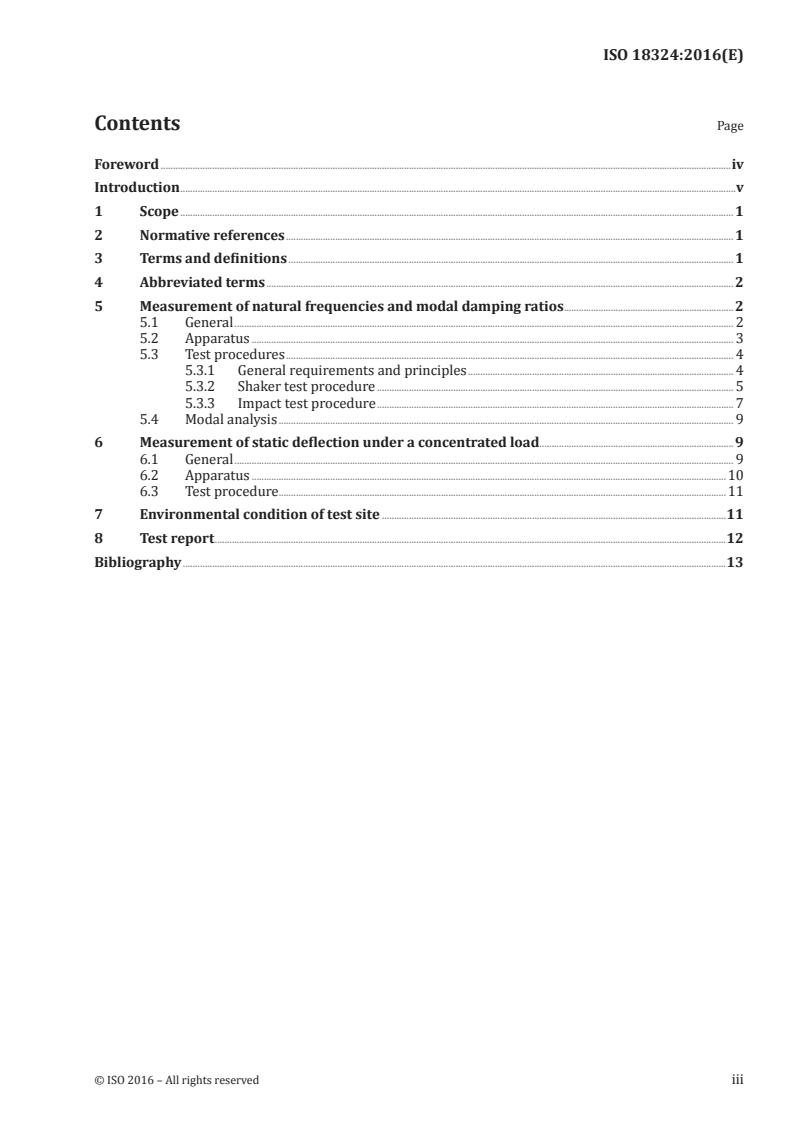
Contents Page
Foreword .iv
Introduction .v
1 Scope . 1
2 Normative references . 1
3 Terms and definitions . 1
4 Abbreviated terms . 2
5 Measurement of natural frequencies and modal damping ratios .2
5.1 General . 2
5.2 Apparatus . 3
5.3 Test procedures . 4
5.3.1 General requirements and principles . 4
5.3.2 Shaker test procedure . 5
5.3.3 Impact test procedure . 7
5.4 Modal analysis . 9
6 Measurement of static deflection under a concentrated load. 9
6.1 General . 9
6.2 Apparatus .10
6.3 Test procedure .11
7 Environmental condition of test site .11
8 Test report .12
Bibliography .13
Foreword
ISO (the International Organization for Standardization) is a worldwide federation of national standards
bodies (ISO member bodies). The work of preparing International Standards is normally carried out
through ISO technical committees. Each member body interested in a subject for which a technical
committee has been established has the right to be represented on that committee. International
organizations, governmental and non-governmental, in liaison with ISO, also take part in the work.
ISO collaborates closely with the International Electrotechnical Commission (IEC) on all matters of
electrotechnical standardization.
The procedures used to develop this document and those intended for its further maintenance are
described in the ISO/IEC Directives, Part 1. In particular the different approval criteria needed for the
different types of ISO documents should be noted. This document was drafted in accordance with the
editorial rules of the ISO/IEC Directives, Part 2 (see www.iso.org/directives).
Attention is drawn to the possibility that some of the elements of this document may be the subject of
patent rights. ISO shall not be held responsible for identifying any or all such patent rights. Details of
any patent rights identified during the development of the document will be in the Introduction and/or
on the ISO list of patent declarations received (see www.iso.org/patents).
Any trade name used in this document is information given for the convenience of users and does not
constitute an endorsement.
For an explanation on the meaning of ISO specific terms and expressions related to conformity
assessment, as well as information about ISO’s adherence to the WTO principles in the Technical
Barriers to Trade (TBT) see the following URL: Foreword - Supplementary information
The committee responsible for this document is ISO/TC 165, Timber structures.
iv © ISO 2016 – All rights reserved
Introduction
Dynamic properties of timber structures are of critical importance to designers since they govern
how these structures respond to seismic, wind and in-service human-induced dynamic excitation.
Seismic and wind can cause structural failure, while in-service human-induced motion generally causes
serviceability problems related to human discomfort; this is also true to wind-induced building motion.
Since occupants are constantly in contact with the floor system, vibration serviceability of floor systems
is often of concern to designers of timber structures. Vibrational performance of a timber floor can
be assessed using parameters such as natural frequencies, damping ratios, dynamic responses to an
impulse (dynamic displacement, velocity, and acceleration), and static deflection under a concentrated
load. These parameters have been found to correlate well with human perceptions. Among these
parameters, natural frequencies, damping ratios, and static deflection under concentrated load
are commonly used to evaluate timber floor vibrational performance. Design procedures have been
developed, and in some cases implemented in design standards, for assessing vibration serviceability
of timber floors. These design procedures usually include criteria for floor response parameters, such
as those listed above, and mathematical procedures to calculate these parameters. As an alternative
to calculation, it is also necessary to provide standardized procedures to measure these parameters
experimentally. This is the prime motive for the development of this ISO test standard.
Natural frequencies and damping ratios of a test system can be measured using modal testing. ISO
published a series of International Standards on the application of modal testing and analysis to
determine natural frequencies, modal damping ratios, and other dynamic properties of an object. The
[4]
theory of modal testing and analysis has been well documented in Reference. This International
Standard provides practical procedures that can be applied either in the laboratory or in the field to
measure natural frequencies, modal damping ratios and static deflection under a concentrated load of
a timber floor. It is assumed that users of the International Standard have the necessary equipment and
fundamental knowledge to perform modal testing.
This International Standard does not address acceptance criteria for vibrational serviceability.
INTERNATIONAL STANDARD ISO 18324:2016(E)
Timber structures — Test methods — Floor vibration
performance
1 Scope
This International Standard specifies test procedures to measure natural frequencies, modal damping
ratios and static deflection under a concentrated load of laboratory or field timber floors. These
parameters have been found to correlate well with human perception to timber floor vibration
response caused by human-induced excitation under normal use. It is intended that the test procedures
can be applied in lieu of calculation to quantify some or all of the above parameters that are used to
evaluate the vibrational serviceability of the test floor. The subsequent use of the measured parameters
to evaluate vibrational serviceability is, however, outside the scope of this International Standard.
ISO published a series of International Standards on the application of modal testing and analysis to
determine natural frequencies, modal damping ratios, and other dynamic properties of a structure. For
the measurement of dynamic parameters such as natural frequencies and modal damping ratios, modal
testing is proposed in this International Standard. It is assumed that the test operators possess the
required equipment and fundamental knowledge to perform such a test. The theory of modal testing
and analysis has been well documented in Reference [4].
2 Normative references
There are no normative references in this document.
3 Terms and definitions
For the purposes of this document, the following terms and definitions apply.
3.1
coherence function
indicator of the degree of linearity at each frequency component between the input and output signals,
i.e., the noise level at each frequency component in the frequency response function (FRF) spectrum
Note 1 to entry: The value of coherence function is one when there is no noise in the signal, and zero for pure
noise in the measured signals.
3.2
damping
parameter relating to the dissipation of energy, or more precisely, to the conversion of the mechanical
energy associated with a vibration to a form that is unavailable to the vibration
3.3
natural frequency
frequency, associated with a vibration mode (3.12), at which a system naturally vibrates once it has
been set into motion with a transient excitation
3.4
frequency response function
response function expressed in frequency domain and normalized to the input force
Note 1 to entry: It is the summation of each mode in the modal space. It shows the response of a system to be a
series of peaks. Each peak with identifiable centre-frequency is the natural frequency of the system vibrating as
if it was a single degree-of-freedom system.
3.5
leakage
effect on measured frequency due to truncating the infinite time response signal during Discrete
Fourier Transform
3.6
modal damping ratio
damping ratio associated with a vibration mode (3.12)
3.7
modal testing
measurement of the frequency response function (3.4)
3.8
modal analysis
process of determining the natural frequencies (3.3), modal damping ratios (3.6), and mode shapes (3.9)
of a structure (floor) for the vibration modes (3.12) in the frequency range of interest from the frequency
response function (3.4)
3.9
mode shape
pattern of movement (i.e., dynamic displacement, velocity, acceleration) of a structure (floor) for a
vibration mode (3.12)
3.10
nodal point
point of zero displacement on a vibrating system of a mode shape (3.9) associated with a vibration
mode (3.12)
3.11
vibration
oscillation of a system about its equilibrium position
3.12
vibration mode
vibration behaviour of a system or object that is characterized by its natural frequency (3.3), modal
damping ratio (3.6) and mode shape (3.9)
Note 1 to entry: The free vibration of a continuous structure such as floor system contains a summation of an
infinite number of vibration modes.
4 Abbreviated terms
FFT Fast Fourier Transform
FRF Frequency Response Function
5 Measurement of natural frequencies and modal damping ratios
5.1 General
This clause specifies the general procedure of applying modal testing and analysis described in
ISO 7626 to timber floors to determine their natural frequencies and damping ratios associated with
the vibration modes. Specifically, this clause focuses on two techniques of exciting the out-of-plane
2 © ISO 2016 – All rights reserved
vibration of a floor. One technique uses a shaker that is attached to the test floor, and the other uses an
impact device that is not attached to the floor.
NOTE A general understanding of the theoretical basis of modal testing is expected in order to apply
the procedures described in this clause. This understanding can be acquired by consulting relevant text, e.g.
Reference [4].
5.2 Apparatus
The equipment required for modal testing shall consist of three major items: 1) an exciter for inducing
vibration; 2) transducers for measuring the time history signal of excitation force and the vibration
response; 3) a signal analyser for recording and analysing the time signals and extracting the desired
information from the analysis results. Figure 1 illustrates the layout of a modal test system using a
shaker as the exciter.
NOTE 1 This figure was a modification of the original figure in Reference [4].
Figure 1 — Layout of a modal test system using a shaker as the exciter
5.2.1 Exciter, shall be provided to initiate vibration in a structure. Generally, a satisfactory exciter for
floor testing shall have the following capabilities:
a) Sufficient energy to induce floor vibration so that the modal testing measurements made over
the entire frequency range of interest has an adequate signal-to-noise ratio without exciting a
nonlinear response;
b) A suitable excitation waveform with frequency content that covers the frequency range of interest.
The exciter shall be either a shaker or an unattached impact device.
5.2.1.1 Attached exciter – shaker, shall be an electro-dynamic, electro-hydraulic, or piezoelectric
vibration exciter attached to the test floor. The shaker shall be attached to a selected location on the floor
during testing to continuously apply the excitation to the floor.
5.2.1.2 Unattached exciter – impact device, an instrumented hammer with a built-in force transducer
or an impact device with a separate force transducer placed on a floor shall be used as the unattached
exciter. The impact system shall have sufficient energy and appropriate surface contact characteristics
to excite all the frequencies that are of interest. Specific requirements on the impact characteristics are
given in 5.3.3.
5.2.2 Transducer and mounting
5.2.2.1 Transducer, for modal testing, both excitation and response signals are required. The
transducer shall have sufficient sensitivity and capacity to cover the frequency range of interest and
low noise-to-signal ratio, and be insensitive to extraneous environmental effects, such as temperature,
humidity, shock, rough field working conditions, etc. It shall also be sufficiently light that its presence on
the test floor does not change the dynamic characteristics of the floor. The vibration response shall be
measured using accelerometers. A procedure to evaluate any possible influence of mass of transducer is
given in 5.3.1.3.
5.2.2.2 Transducer mounting, for an instrumented hammer, the force transducer is built into the
hammer. The technique of mounting a force transducer onto a shaker is specified in 5.3.2.1, along with
the shaker mounting technique. The accelerometer shall be rigidly attached to the floor structure.
For floors with carpet overlaid on wood-based subfloor, a special mounting base that penetrates the
carpet to the subfloor shall be used. The accelerometer shall be attached to the upper face of the base
plate of the tripod. A tripod with a heavy metal base plate and pinned legs that can penetrate through
[5]
the carpet to the subfloor has been found to work well.
For timber floors with floating flooring as finishing or a floating heavy topping, the accelerometer shall
be attached to the underside of the floor.
5.2.3 Signal analyser, shall be used to process the time signals and shall use the fast fourier transform
(FFT) method to convert the time domain signals into frequency domain. For signal analysers that also
acquire the data, the equipment shall have at least two input channels for acquiring the excitation force
signal and the floor response signal simultaneously. The sampling frequency shall be at least twice the
highest frequency of interest to capture all the target natural frequencies of the test floor. As a minimum,
the outputs of the signal analyser shall include the FRF and coherence function.
5.3 Test procedures
5.3.1 General requirements and principles
The following principles shall be followed when performing the test procedure:
— The locations for exciter and response measurement shall be selected in such a way that all the
modal parameters of the modes of interest, such as natural frequencies, modal damping ratios, and
mode shapes, can be obtained.
— The modal parameters shall be extracted from a set of frequency response measurements between
a fixed reference point on the floor and a number of roving points over the floor. The number of
frequency response measurements shall be larger than or equal to the number of modes of interest.
The general procedure of modal testing shall consist of the following five steps:
a) Selection of excitation location (see 5.3.1.1);
b) Selection of response measurement location (see 5.3.1.2);
c) Mounting of transducers;
d) Excitation of the test system;
e) Validation of the measurements (see 5.3.1.3)
5.3.1.1 Selection of excitation location
The exciter shall not be placed at the nodal points of the modes of interest and be located as close to the
floor centre as possible to ensure that the first natural frequency is excited.
4 © ISO 2016 – All rights reserved
5.3.1.2 Selection of response locations
The response measurements shall be recorded at a s
...
INTERNATIONAL ISO
STANDARD 18324
First edition
2016-04-01
Timber structures — Test methods —
Floor vibration performance
Structures en bois — Méthodes d’essai — Comportement vibratoire
des planchers
Reference number
©
ISO 2016
© ISO 2016, Published in Switzerland
All rights reserved. Unless otherwise specified, no part of this publication may be reproduced or utilized otherwise in any form
or by any means, electronic or mechanical, including photocopying, or posting on the internet or an intranet, without prior
written permission. Permission can be requested from either ISO at the address below or ISO’s member body in the country of
the requester.
ISO copyright office
Ch. de Blandonnet 8 • CP 401
CH-1214 Vernier, Geneva, Switzerland
Tel. +41 22 749 01 11
Fax +41 22 749 09 47
copyright@iso.org
www.iso.org
ii © ISO 2016 – All rights reserved
Contents Page
Foreword .iv
Introduction .v
1 Scope . 1
2 Normative references . 1
3 Terms and definitions . 1
4 Abbreviated terms . 2
5 Measurement of natural frequencies and modal damping ratios .2
5.1 General . 2
5.2 Apparatus . 3
5.3 Test procedures . 4
5.3.1 General requirements and principles . 4
5.3.2 Shaker test procedure . 5
5.3.3 Impact test procedure . 7
5.4 Modal analysis . 9
6 Measurement of static deflection under a concentrated load. 9
6.1 General . 9
6.2 Apparatus .10
6.3 Test procedure .11
7 Environmental condition of test site .11
8 Test report .12
Bibliography .13
Foreword
ISO (the International Organization for Standardization) is a worldwide federation of national standards
bodies (ISO member bodies). The work of preparing International Standards is normally carried out
through ISO technical committees. Each member body interested in a subject for which a technical
committee has been established has the right to be represented on that committee. International
organizations, governmental and non-governmental, in liaison with ISO, also take part in the work.
ISO collaborates closely with the International Electrotechnical Commission (IEC) on all matters of
electrotechnical standardization.
The procedures used to develop this document and those intended for its further maintenance are
described in the ISO/IEC Directives, Part 1. In particular the different approval criteria needed for the
different types of ISO documents should be noted. This document was drafted in accordance with the
editorial rules of the ISO/IEC Directives, Part 2 (see www.iso.org/directives).
Attention is drawn to the possibility that some of the elements of this document may be the subject of
patent rights. ISO shall not be held responsible for identifying any or all such patent rights. Details of
any patent rights identified during the development of the document will be in the Introduction and/or
on the ISO list of patent declarations received (see www.iso.org/patents).
Any trade name used in this document is information given for the convenience of users and does not
constitute an endorsement.
For an explanation on the meaning of ISO specific terms and expressions related to conformity
assessment, as well as information about ISO’s adherence to the WTO principles in the Technical
Barriers to Trade (TBT) see the following URL: Foreword - Supplementary information
The committee responsible for this document is ISO/TC 165, Timber structures.
iv © ISO 2016 – All rights reserved
Introduction
Dynamic properties of timber structures are of critical importance to designers since they govern
how these structures respond to seismic, wind and in-service human-induced dynamic excitation.
Seismic and wind can cause structural failure, while in-service human-induced motion generally causes
serviceability problems related to human discomfort; this is also true to wind-induced building motion.
Since occupants are constantly in contact with the floor system, vibration serviceability of floor systems
is often of concern to designers of timber structures. Vibrational performance of a timber floor can
be assessed using parameters such as natural frequencies, damping ratios, dynamic responses to an
impulse (dynamic displacement, velocity, and acceleration), and static deflection under a concentrated
load. These parameters have been found to correlate well with human perceptions. Among these
parameters, natural frequencies, damping ratios, and static deflection under concentrated load
are commonly used to evaluate timber floor vibrational performance. Design procedures have been
developed, and in some cases implemented in design standards, for assessing vibration serviceability
of timber floors. These design procedures usually include criteria for floor response parameters, such
as those listed above, and mathematical procedures to calculate these parameters. As an alternative
to calculation, it is also necessary to provide standardized procedures to measure these parameters
experimentally. This is the prime motive for the development of this ISO test standard.
Natural frequencies and damping ratios of a test system can be measured using modal testing. ISO
published a series of International Standards on the application of modal testing and analysis to
determine natural frequencies, modal damping ratios, and other dynamic properties of an object. The
[4]
theory of modal testing and analysis has been well documented in Reference. This International
Standard provides practical procedures that can be applied either in the laboratory or in the field to
measure natural frequencies, modal damping ratios and static deflection under a concentrated load of
a timber floor. It is assumed that users of the International Standard have the necessary equipment and
fundamental knowledge to perform modal testing.
This International Standard does not address acceptance criteria for vibrational serviceability.
INTERNATIONAL STANDARD ISO 18324:2016(E)
Timber structures — Test methods — Floor vibration
performance
1 Scope
This International Standard specifies test procedures to measure natural frequencies, modal damping
ratios and static deflection under a concentrated load of laboratory or field timber floors. These
parameters have been found to correlate well with human perception to timber floor vibration
response caused by human-induced excitation under normal use. It is intended that the test procedures
can be applied in lieu of calculation to quantify some or all of the above parameters that are used to
evaluate the vibrational serviceability of the test floor. The subsequent use of the measured parameters
to evaluate vibrational serviceability is, however, outside the scope of this International Standard.
ISO published a series of International Standards on the application of modal testing and analysis to
determine natural frequencies, modal damping ratios, and other dynamic properties of a structure. For
the measurement of dynamic parameters such as natural frequencies and modal damping ratios, modal
testing is proposed in this International Standard. It is assumed that the test operators possess the
required equipment and fundamental knowledge to perform such a test. The theory of modal testing
and analysis has been well documented in Reference [4].
2 Normative references
There are no normative references in this document.
3 Terms and definitions
For the purposes of this document, the following terms and definitions apply.
3.1
coherence function
indicator of the degree of linearity at each frequency component between the input and output signals,
i.e., the noise level at each frequency component in the frequency response function (FRF) spectrum
Note 1 to entry: The value of coherence function is one when there is no noise in the signal, and zero for pure
noise in the measured signals.
3.2
damping
parameter relating to the dissipation of energy, or more precisely, to the conversion of the mechanical
energy associated with a vibration to a form that is unavailable to the vibration
3.3
natural frequency
frequency, associated with a vibration mode (3.12), at which a system naturally vibrates once it has
been set into motion with a transient excitation
3.4
frequency response function
response function expressed in frequency domain and normalized to the input force
Note 1 to entry: It is the summation of each mode in the modal space. It shows the response of a system to be a
series of peaks. Each peak with identifiable centre-frequency is the natural frequency of the system vibrating as
if it was a single degree-of-freedom system.
3.5
leakage
effect on measured frequency due to truncating the infinite time response signal during Discrete
Fourier Transform
3.6
modal damping ratio
damping ratio associated with a vibration mode (3.12)
3.7
modal testing
measurement of the frequency response function (3.4)
3.8
modal analysis
process of determining the natural frequencies (3.3), modal damping ratios (3.6), and mode shapes (3.9)
of a structure (floor) for the vibration modes (3.12) in the frequency range of interest from the frequency
response function (3.4)
3.9
mode shape
pattern of movement (i.e., dynamic displacement, velocity, acceleration) of a structure (floor) for a
vibration mode (3.12)
3.10
nodal point
point of zero displacement on a vibrating system of a mode shape (3.9) associated with a vibration
mode (3.12)
3.11
vibration
oscillation of a system about its equilibrium position
3.12
vibration mode
vibration behaviour of a system or object that is characterized by its natural frequency (3.3), modal
damping ratio (3.6) and mode shape (3.9)
Note 1 to entry: The free vibration of a continuous structure such as floor system contains a summation of an
infinite number of vibration modes.
4 Abbreviated terms
FFT Fast Fourier Transform
FRF Frequency Response Function
5 Measurement of natural frequencies and modal damping ratios
5.1 General
This clause specifies the general procedure of applying modal testing and analysis described in
ISO 7626 to timber floors to determine their natural frequencies and damping ratios associated with
the vibration modes. Specifically, this clause focuses on two techniques of exciting the out-of-plane
2 © ISO 2016 – All rights reserved
vibration of a floor. One technique uses a shaker that is attached to the test floor, and the other uses an
impact device that is not attached to the floor.
NOTE A general understanding of the theoretical basis of modal testing is expected in order to apply
the procedures described in this clause. This understanding can be acquired by consulting relevant text, e.g.
Reference [4].
5.2 Apparatus
The equipment required for modal testing shall consist of three major items: 1) an exciter for inducing
vibration; 2) transducers for measuring the time history signal of excitation force and the vibration
response; 3) a signal analyser for recording and analysing the time signals and extracting the desired
information from the analysis results. Figure 1 illustrates the layout of a modal test system using a
shaker as the exciter.
NOTE 1 This figure was a modification of the original figure in Reference [4].
Figure 1 — Layout of a modal test system using a shaker as the exciter
5.2.1 Exciter, shall be provided to initiate vibration in a structure. Generally, a satisfactory exciter for
floor testing shall have the following capabilities:
a) Sufficient energy to induce floor vibration so that the modal testing measurements made over
the entire frequency range of interest has an adequate signal-to-noise ratio without exciting a
nonlinear response;
b) A suitable excitation waveform with frequency content that covers the frequency range of interest.
The exciter shall be either a shaker or an unattached impact device.
5.2.1.1 Attached exciter – shaker, shall be an electro-dynamic, electro-hydraulic, or piezoelectric
vibration exciter attached to the test floor. The shaker shall be attached to a selected location on the floor
during testing to continuously apply the excitation to the floor.
5.2.1.2 Unattached exciter – impact device, an instrumented hammer with a built-in force transducer
or an impact device with a separate force transducer placed on a floor shall be used as the unattached
exciter. The impact system shall have sufficient energy and appropriate surface contact characteristics
to excite all the frequencies that are of interest. Specific requirements on the impact characteristics are
given in 5.3.3.
5.2.2 Transducer and mounting
5.2.2.1 Transducer, for modal testing, both excitation and response signals are required. The
transducer shall have sufficient sensitivity and capacity to cover the frequency range of interest and
low noise-to-signal ratio, and be insensitive to extraneous environmental effects, such as temperature,
humidity, shock, rough field working conditions, etc. It shall also be sufficiently light that its presence on
the test floor does not change the dynamic characteristics of the floor. The vibration response shall be
measured using accelerometers. A procedure to evaluate any possible influence of mass of transducer is
given in 5.3.1.3.
5.2.2.2 Transducer mounting, for an instrumented hammer, the force transducer is built into the
hammer. The technique of mounting a force transducer onto a shaker is specified in 5.3.2.1, along with
the shaker mounting technique. The accelerometer shall be rigidly attached to the floor structure.
For floors with carpet overlaid on wood-based subfloor, a special mounting base that penetrates the
carpet to the subfloor shall be used. The accelerometer shall be attached to the upper face of the base
plate of the tripod. A tripod with a heavy metal base plate and pinned legs that can penetrate through
[5]
the carpet to the subfloor has been found to work well.
For timber floors with floating flooring as finishing or a floating heavy topping, the accelerometer shall
be attached to the underside of the floor.
5.2.3 Signal analyser, shall be used to process the time signals and shall use the fast fourier transform
(FFT) method to convert the time domain signals into frequency domain. For signal analysers that also
acquire the data, the equipment shall have at least two input channels for acquiring the excitation force
signal and the floor response signal simultaneously. The sampling frequency shall be at least twice the
highest frequency of interest to capture all the target natural frequencies of the test floor. As a minimum,
the outputs of the signal analyser shall include the FRF and coherence function.
5.3 Test procedures
5.3.1 General requirements and principles
The following principles shall be followed when performing the test procedure:
— The locations for exciter and response measurement shall be selected in such a way that all the
modal parameters of the modes of interest, such as natural frequencies, modal damping ratios, and
mode shapes, can be obtained.
— The modal parameters shall be extracted from a set of frequency response measurements between
a fixed reference point on the floor and a number of roving points over the floor. The number of
frequency response measurements shall be larger than or equal to the number of modes of interest.
The general procedure of modal testing shall consist of the following five steps:
a) Selection of excitation location (see 5.3.1.1);
b) Selection of response measurement location (see 5.3.1.2);
c) Mounting of transducers;
d) Excitation of the test system;
e) Validation of the measurements (see 5.3.1.3)
5.3.1.1 Selection of excitation location
The exciter shall not be placed at the nodal points of the modes of interest and be located as close to the
floor centre as possible to ensure that the first natural frequency is excited.
4 © ISO 2016 – All rights reserved
5.3.1.2 Selection of response locations
The response measurements shall be recorded at a s
...