


ISO/FDIS 10642
(Main)Fasteners - Hexagon socket countersunk head screws with reduced loadability
Fasteners - Hexagon socket countersunk head screws with reduced loadability
This document specifies the characteristics of hexagon socket countersunk head screws with reduced loadability due to head design, in steel and stainless steel, with metric coarse pitch threads M2 to M20, and with product grade A. NOTE 1 Other dimensional options are given in ISO 888, ISO 965-1 and ISO 4753. NOTE 2 The reduced loadability (related to the countersunk head dimensions in combination with penetration of the hexagon socket specified in this document) implies a limitation of ultimate tensile load; see Table 5. NOTE 3 Particular attention is needed to ensure alignment of the countersunk head with the bearing surface of the countersink in the assembly.
Fixations — Vis à tête fraisée à six pans creux à capacité de charge réduite
Le présent document spécifie les caractéristiques des vis à tête fraisée à six pans creux à capacité de charge réduite du fait de la conception de la tête, en acier et en acier inoxydable, à filetage métrique à pas gros de M2 à M20, et de grade A. NOTE 1 D'autres options de dimensions sont données dans l'ISO 888, l'ISO 965-1 et l'ISO 4753. NOTE 2 La capacité de charge réduite (du fait des dimensions de la tête fraisée combinées avec la pénétration de l'empreinte six pans creux spécifiée dans le présent document) implique une limitation de la charge minimale de rupture à la traction; voir Tableau 5. NOTE 3 Une attention toute particulière est nécessaire pour assurer l'alignement de la tête fraisée avec la fraisure de la surface d'appui au niveau de l'assemblage.
General Information
- Status
- Not Published
- Technical Committee
- ISO/TC 2/SC 11 - Fasteners with metric external thread
- Drafting Committee
- ISO/TC 2/SC 11 - Fasteners with metric external thread
- Current Stage
- 5020 - FDIS ballot initiated: 2 months. Proof sent to secretariat
- Start Date
- 12-Dec-2025
- Completion Date
- 12-Dec-2025
Relations
- Effective Date
- 07-Jan-2025
- Effective Date
- 07-Jan-2025
Overview - ISO/FDIS 10642:2025 (Hexagon socket countersunk head screws)
ISO/FDIS 10642 defines the characteristics of hexagon socket countersunk head screws with reduced loadability. It applies to screws in steel and stainless steel, metric coarse-pitch threads M2 to M20, and product grade A. The reduced loadability results from the head design and the specified socket penetration, and the document includes dimensional, gauging, marking and labelling requirements for manufacturing, inspection and procurement.
Key topics and technical requirements
- Scope and applicability: Covers hexagon-socket countersunk head screws M2–M20, steel and stainless steel, product grade A.
- Reduced loadability: The standard specifies a limitation of ultimate tensile load for these heads. The head loadability is assumed to be 80% of the thread loadability for all sizes and property classes; specific load limits are shown in the standard (see Table 5).
- Dimensions and gauging: Detailed head, socket and shank dimensions, alternative socket forms (e.g., broached), and gauging provisions are provided for controlled manufacture and inspection.
- Thread and length options: Metric coarse pitch threads and standardized length ranges are defined; references to other dimensional options are given (ISO 888, ISO 965‑1, ISO 4753).
- Marking and designation: Product marking and package labelling rules are included. Reduced loadability is indicated by a property class preceded by a zero.
- Assembly note: The document highlights the need for correct alignment of the countersunk head with the bearing surface of the mating countersink to avoid localized overload or misfit.
- Normative references: Integrates related ISO standards (e.g., ISO 225, ISO 898‑1, ISO 3506‑1, ISO 4759‑1) for threads, mechanical properties, coatings and tolerances.
Applications and users
Who uses ISO/FDIS 10642:
- Fastener manufacturers for design, production tolerances and quality control.
- Mechanical designers and OEM engineers specifying fasteners where a flush countersunk head is required but head geometry reduces load capacity.
- Procurement and quality inspectors for acceptance criteria, marking and labelling verification.
- Assembly and maintenance engineers who must ensure proper countersink alignment and avoid overstressing the head.
Practical uses:
- Applications requiring flush mounting (e.g., aerospace interiors, precision machinery, consumer electronics) where head dimensions or socket depth limit tensile capacity.
- Situations where specifying reduced-load countersunk screws avoids over‑specifying heavier or more costly fasteners.
Related standards
Relevant cross‑references in the standard include:
- ISO 225 (dimensions symbols), ISO 898‑1 (mechanical properties), ISO 3506‑1 (stainless steel properties),
- ISO 965‑1, ISO 4753 (thread/ends), ISO 4759‑1 (tolerances), ISO 3269 (acceptance inspection).
Keywords: ISO 10642, hexagon socket countersunk head screws, reduced loadability, metric screws M2–M20, product grade A, fastener standards, countersunk screw dimensions.
ISO/FDIS 10642 - Fasteners — Hexagon socket countersunk head screws with reduced loadability Released:11/28/2025
REDLINE ISO/FDIS 10642 - Fasteners — Hexagon socket countersunk head screws with reduced loadability Released:11/28/2025
ISO/FDIS 10642 - Fixations — Vis à tête fraisée à six pans creux à capacité de charge réduite Released:17. 12. 2025
Frequently Asked Questions
ISO/FDIS 10642 is a draft published by the International Organization for Standardization (ISO). Its full title is "Fasteners - Hexagon socket countersunk head screws with reduced loadability". This standard covers: This document specifies the characteristics of hexagon socket countersunk head screws with reduced loadability due to head design, in steel and stainless steel, with metric coarse pitch threads M2 to M20, and with product grade A. NOTE 1 Other dimensional options are given in ISO 888, ISO 965-1 and ISO 4753. NOTE 2 The reduced loadability (related to the countersunk head dimensions in combination with penetration of the hexagon socket specified in this document) implies a limitation of ultimate tensile load; see Table 5. NOTE 3 Particular attention is needed to ensure alignment of the countersunk head with the bearing surface of the countersink in the assembly.
This document specifies the characteristics of hexagon socket countersunk head screws with reduced loadability due to head design, in steel and stainless steel, with metric coarse pitch threads M2 to M20, and with product grade A. NOTE 1 Other dimensional options are given in ISO 888, ISO 965-1 and ISO 4753. NOTE 2 The reduced loadability (related to the countersunk head dimensions in combination with penetration of the hexagon socket specified in this document) implies a limitation of ultimate tensile load; see Table 5. NOTE 3 Particular attention is needed to ensure alignment of the countersunk head with the bearing surface of the countersink in the assembly.
ISO/FDIS 10642 is classified under the following ICS (International Classification for Standards) categories: 21.060.10 - Bolts, screws, studs. The ICS classification helps identify the subject area and facilitates finding related standards.
ISO/FDIS 10642 has the following relationships with other standards: It is inter standard links to ISO/IEC 21794-2:2021/Amd 1:2021, ISO 10642:2019. Understanding these relationships helps ensure you are using the most current and applicable version of the standard.
ISO/FDIS 10642 is available in PDF format for immediate download after purchase. The document can be added to your cart and obtained through the secure checkout process. Digital delivery ensures instant access to the complete standard document.
Standards Content (Sample)
FINAL DRAFT
International
Standard
ISO/TC 2/SC 11
Fasteners — Hexagon socket
Secretariat: DIN
countersunk head screws with
Voting begins on:
reduced loadability
2025-12-12
Fixations — Vis à tête fraisée à six pans creux à capacité de
Voting terminates on:
charge réduite
2026-02-06
RECIPIENTS OF THIS DRAFT ARE INVITED TO SUBMIT,
WITH THEIR COMMENTS, NOTIFICATION OF ANY
RELEVANT PATENT RIGHTS OF WHICH THEY ARE AWARE
AND TO PROVIDE SUPPOR TING DOCUMENTATION.
IN ADDITION TO THEIR EVALUATION AS
BEING ACCEPTABLE FOR INDUSTRIAL, TECHNO
ISO/CEN PARALLEL PROCESSING LOGICAL, COMMERCIAL AND USER PURPOSES, DRAFT
INTERNATIONAL STANDARDS MAY ON OCCASION HAVE
TO BE CONSIDERED IN THE LIGHT OF THEIR POTENTIAL
TO BECOME STAN DARDS TO WHICH REFERENCE MAY BE
MADE IN NATIONAL REGULATIONS.
Reference number
FINAL DRAFT
International
Standard
ISO/TC 2/SC 11
Fasteners — Hexagon socket
Secretariat: DIN
countersunk head screws with
Voting begins on:
reduced loadability
Fixations — Vis à tête fraisée à six pans creux à capacité de
Voting terminates on:
charge réduite
RECIPIENTS OF THIS DRAFT ARE INVITED TO SUBMIT,
WITH THEIR COMMENTS, NOTIFICATION OF ANY
RELEVANT PATENT RIGHTS OF WHICH THEY ARE AWARE
AND TO PROVIDE SUPPOR TING DOCUMENTATION.
© ISO 2025
IN ADDITION TO THEIR EVALUATION AS
All rights reserved. Unless otherwise specified, or required in the context of its implementation, no part of this publication may
BEING ACCEPTABLE FOR INDUSTRIAL, TECHNO
ISO/CEN PARALLEL PROCESSING
LOGICAL, COMMERCIAL AND USER PURPOSES, DRAFT
be reproduced or utilized otherwise in any form or by any means, electronic or mechanical, including photocopying, or posting on
INTERNATIONAL STANDARDS MAY ON OCCASION HAVE
the internet or an intranet, without prior written permission. Permission can be requested from either ISO at the address below
TO BE CONSIDERED IN THE LIGHT OF THEIR POTENTIAL
or ISO’s member body in the country of the requester.
TO BECOME STAN DARDS TO WHICH REFERENCE MAY BE
MADE IN NATIONAL REGULATIONS.
ISO copyright office
CP 401 • Ch. de Blandonnet 8
CH-1214 Vernier, Geneva
Phone: +41 22 749 01 11
Email: copyright@iso.org
Website: www.iso.org
Published in Switzerland Reference number
ii
Contents Page
Foreword .iv
1 Scope . 1
2 Normative references . 1
3 Terms and definitions . 2
4 Dimensions and gauging of head . 2
4.1 Dimensions .2
4.1.1 Gauging of head .6
5 Requirements and reference International Standards . 6
6 Marking and labelling . 8
6.1 Marking on product . .8
6.2 Labelling on package .8
7 Designation . 9
Annex A (informative) Minimum ultimate tensile loads for bolts and screws with full loadability,
coarse pitch threads M2 and M2,5 . 10
Bibliography .11
iii
Foreword
ISO (the International Organization for Standardization) is a worldwide federation of national standards
bodies (ISO member bodies). The work of preparing International Standards is normally carried out through
ISO technical committees. Each member body interested in a subject for which a technical committee
has been established has the right to be represented on that committee. International organizations,
governmental and non-governmental, in liaison with ISO, also take part in the work. ISO collaborates closely
with the International Electrotechnical Commission (IEC) on all matters of electrotechnical standardization.
The procedures used to develop this document and those intended for its further maintenance are described
in the ISO/IEC Directives, Part 1. In particular, the different approval criteria needed for the different types
of ISO document should be noted. This document was drafted in accordance with the editorial rules of the
ISO/IEC Directives, Part 2 (see www.iso.org/directives).
ISO draws attention to the possibility that the implementation of this document may involve the use of (a)
patent(s). ISO takes no position concerning the evidence, validity or applicability of any claimed patent
rights in respect thereof. As of the date of publication of this document, ISO had not received notice of (a)
patent(s) which may be required to implement this document. However, implementers are cautioned that
this may not represent the latest information, which may be obtained from the patent database available at
www.iso.org/patents. ISO shall not be held responsible for identifying any or all such patent rights.
Any trade name used in this document is information given for the convenience of users and does not
constitute an endorsement.
For an explanation of the voluntary nature of standards, the meaning of ISO specific terms and expressions
related to conformity assessment, as well as information about ISO's adherence to the World Trade
Organization (WTO) principles in the Technical Barriers to Trade (TBT), see www.iso.org/iso/foreword.html.
This document was prepared by Technical Committee ISO/TC 2, Fasteners, Subcommittee SC 11, Fasteners
with metric external thread, in collaboration with the European Committee for Standardization (CEN)
Technical Committee CEN/TC 185, Fasteners, in accordance with the Agreement on technical cooperation
between ISO and CEN (Vienna Agreement).
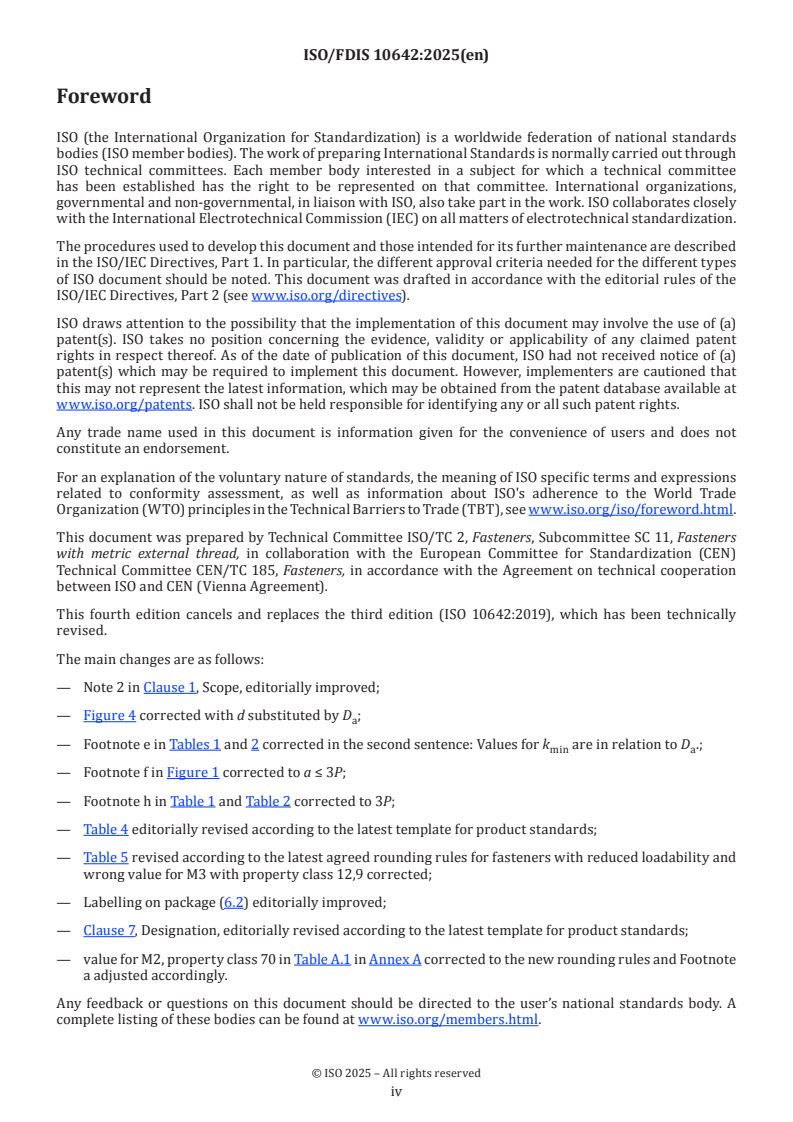
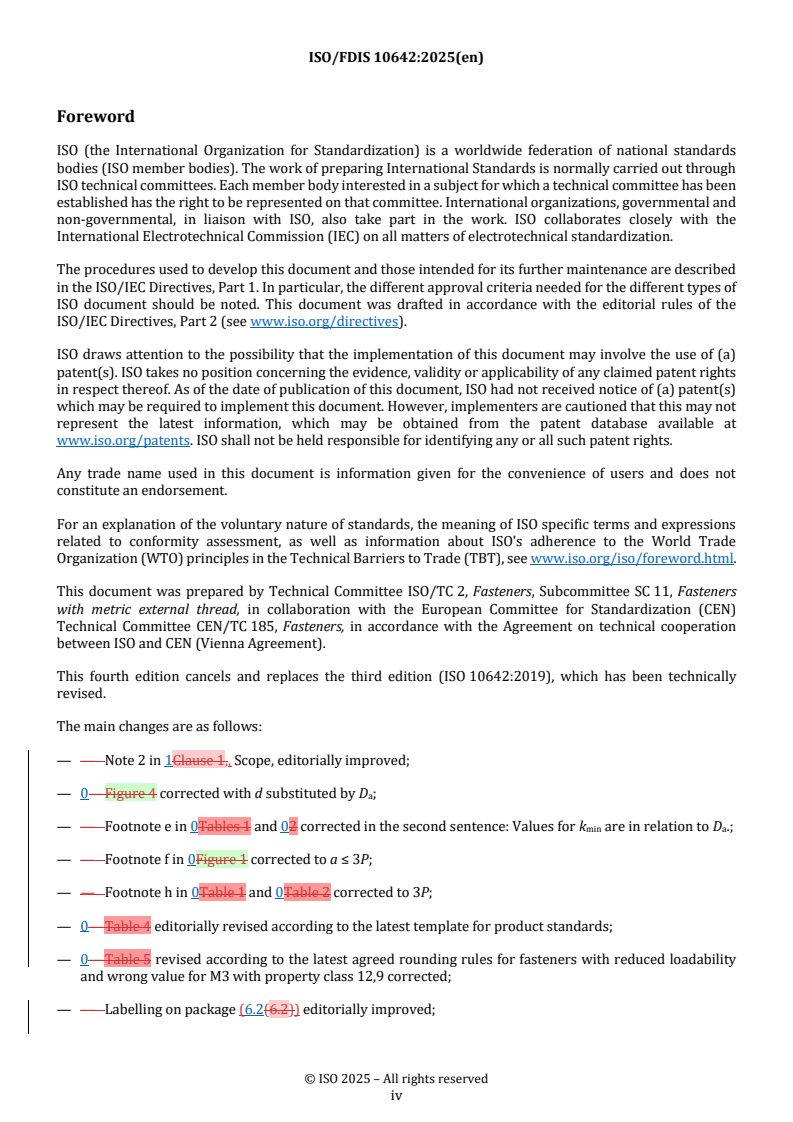
This fourth edition cancels and replaces the third edition (ISO 10642:2019), which has been technically
revised.
The main changes are as follows:
— Note 2 in Clause 1, Scope, editorially improved;
— Figure 4 corrected with d substituted by D ;
a
— Footnote e in Tables 1 and 2 corrected in the second sentence: Values for k are in relation to D .;
min a
— Footnote f in Figure 1 corrected to a ≤ 3P;
— Footnote h in Table 1 and Table 2 corrected to 3P;
— Table 4 editorially revised according to the latest template for product standards;
— Table 5 revised according to the latest agreed rounding rules for fasteners with reduced loadability and
wrong value for M3 with property class 12,9 corrected;
— Labelling on package (6.2) editorially improved;
— Clause 7, Designation, editorially revised according to the latest template for product standards;
— value for M2, property class 70 in Table A.1 in Annex A corrected to the new rounding rules and Footnote
a adjusted accordingly.
Any feedback or questions on this document should be directed to the user’s national standards body. A
complete listing of these bodies can be found at www.iso.org/members.html.
iv
FINAL DRAFT International Standard ISO/FDIS 10642:2025(en)
Fasteners — Hexagon socket countersunk head screws with
reduced loadability
1 Scope
This document specifies the characteristics of hexagon socket countersunk head screws with reduced
loadability due to head design, in steel and stainless steel, with metric coarse pitch threads M2 to M20, and
with product grade A.
NOTE 1 Other dimensional options are given in ISO 888, ISO 965-1 and ISO 4753.
NOTE 2 The reduced loadability (related to the countersunk head dimensions in combination with penetration
of the hexagon socket specified in this document) implies a limitation of ultimate tensile load shown by a specific
marking (property class preceded by a zero). The loadability in the head is assumed to be 80 % of that in the thread for
all sizes and all property classes; see Table 5.
NOTE 3 Particular attention is needed to ensure alignment of the countersunk head with the bearing surface of the
countersink in the assembly.
2 Normative references
The following documents are referred to in the text in such a way that some or all of their content constitutes
requirements of this document. For dated references, only the edition cited applies. For undated references,
the latest edition of the referenced document (including any amendments) applies.
ISO 225, Fasteners — Bolts, screws, studs and nuts — Symbols and descriptions of dimensions
ISO 898-1, Mechanical properties of fasteners made of carbon steel and alloy steel — Part 1: Bolts, screws and
studs with specified property classes — Coarse thread and fine pitch thread
ISO 965-1, ISO general purpose metric screw threads — Tolerances — Part 1: Principles and basic data
ISO 1891-4, Fasteners — Vocabulary — Part 4: Control, inspection, delivery, acceptance and quality
ISO 3269, Fasteners — Acceptance inspection
ISO 3506-1, Fasteners — Mechanical properties of corrosion-resistant stainless steel fasteners — Part 1: Bolts,
screws and studs with specified grades and property classes
ISO 4042, Fasteners — Electroplated coating systems
ISO 4753, Fasteners — Ends of parts with external ISO metric thread
ISO 4759-1, Tolerances for fasteners — Part 1: Bolts, screws, studs and nuts — Product grades A, B and C
ISO 6157-1, Fasteners — Surface discontinuities — Part 1: Bolts, screws and studs for general requirements
ISO 6157-3, Fasteners — Surface discontinuities — Part 3: Bolts, screws and studs for special requirements
ISO 8991, Designation system for fasteners
ISO 8992, Fasteners — General requirements for bolts, screws, studs and nuts
ISO 10683, Fasteners — Non-electrolytically applied zinc flake coating systems
3 Terms and definitions
No terms and definitions are listed in this document.
ISO and IEC maintain terminology databases for use in standardization at the following addresses:
— ISO Online browsing platform: available at https:// www .iso .org/ obp
— IEC Electropedia: available at https:// www .electropedia .org/
4 Dimensions and gauging of head
4.1 Dimensions
Dimensions shall be in accordance with Figures 1 to 4 and Tables 1 and 2.
Symbols and descriptions of dimensions shall be as specified in ISO 225.
a) Partially threaded screw
b) Screw threaded to the head
a
A slight rounding or countersink at the mouth of the socket is permissible.
b
In accordance with ISO 4753: chamfered end (CH), but for sizes ≤ M4 as rolled end (RL) is also allowed.
c
Edge of the head flat or rounded.
d
Incomplete thread u ≤ 2P.
e
d applies when values for l are specified in Tables 1 and 2.
s s,min
f
In accordance with ISO 3508: a ≤ 3P.
Figure 1 — Hexagon socket countersunk head screws
ISO/FD
...
ISO /TC 2/SC 11
Secretariat: DIN
Date: 2025-11-10xx
Fasteners — Hexagon socket countersunk head screws with reduced
loadability
Fixations — Vis à tête fraisée à six pans creux à capacité de charge réduite
FDIS stage
TThhiiss d drraft iaft iss su subbmmiitted tted to to a pa parallearallel vl vote ote iinn IS ISOO, CE, CENN.
All rights reserved. Unless otherwise specified, or required in the context of its implementation, no part of this publication
may be reproduced or utilized otherwise in any form or by any means, electronic or mechanical, including photocopying,
or posting on the internet or an intranet, without prior written permission. Permission can be requested from either ISO
at the address below or ISO’s member body in the country of the requester.
ISO copyright office
CP 401 • Ch. de Blandonnet 8
CH-1214 Vernier, Geneva
Phone: + 41 22 749 01 11
EmailE-mail: copyright@iso.org
Website: www.iso.org
Published in Switzerland
ii
Contents
Foreword . iv
1 Scope . 1
2 Normative references . 1
3 Terms and definitions . 2
4 Dimensions and gauging of head . 2
4.1 Dimensions. 2
5 Requirements and reference International Standards . 8
6 Marking and labelling . 10
6.1 Marking on product . 10
6.2 Labelling on package . 10
7 Designation . 11
Annex A (informative) Minimum ultimate tensile loads for bolts and screws with full
loadability, coarse pitch threads M2 and M2,5 . 12
Bibliography . 13
Foreword . iii
1 Scope . 1
2 Normative references . 1
3 Terms and definitions . 2
4 Dimensions and gauging of head . 2
4.1 Dimensions. 2
4.2 Gauging of head . 7
5 Requirements and reference International Standards . 9
6 Marking and labelling . 10
6.1 Marking on product . 10
6.2 Labelling on package . 10
7 Designation . 11
Annex A (informative) Minimum ultimate tensile loads for bolts and screws with full loadability,
coarse pitch threads M2 and M2,5 . 12
Bibliography . 13
iii
Foreword
ISO (the International Organization for Standardization) is a worldwide federation of national standards
bodies (ISO member bodies). The work of preparing International Standards is normally carried out through
ISO technical committees. Each member body interested in a subject for which a technical committee has been
established has the right to be represented on that committee. International organizations, governmental and
non-governmental, in liaison with ISO, also take part in the work. ISO collaborates closely with the
International Electrotechnical Commission (IEC) on all matters of electrotechnical standardization.
The procedures used to develop this document and those intended for its further maintenance are described
in the ISO/IEC Directives, Part 1. In particular, the different approval criteria needed for the different types of
ISO document should be noted. This document was drafted in accordance with the editorial rules of the
ISO/IEC Directives, Part 2 (see www.iso.org/directives).
ISO draws attention to the possibility that the implementation of this document may involve the use of (a)
patent(s). ISO takes no position concerning the evidence, validity or applicability of any claimed patent rights
in respect thereof. As of the date of publication of this document, ISO had not received notice of (a) patent(s)
which may be required to implement this document. However, implementers are cautioned that this may not
represent the latest information, which may be obtained from the patent database available at
www.iso.org/patents. ISO shall not be held responsible for identifying any or all such patent rights.
Any trade name used in this document is information given for the convenience of users and does not
constitute an endorsement.
For an explanation of the voluntary nature of standards, the meaning of ISO specific terms and expressions
related to conformity assessment, as well as information about ISO's adherence to the World Trade
Organization (WTO) principles in the Technical Barriers to Trade (TBT), see www.iso.org/iso/foreword.html.
This document was prepared by Technical Committee ISO/TC 2, Fasteners, Subcommittee SC 11, Fasteners
with metric external thread, in collaboration with the European Committee for Standardization (CEN)
Technical Committee CEN/TC 185, Fasteners, in accordance with the Agreement on technical cooperation
between ISO and CEN (Vienna Agreement).
This fourth edition cancels and replaces the third edition (ISO 10642:2019), which has been technically
revised.
The main changes are as follows:
— — Note 2 in 1Clause 1,, Scope, editorially improved;
— 0— Figure 4 corrected with d substituted by D ;
a
— — Footnote e in 0Tables 1 and 02 corrected in the second sentence: Values for k are in relation to D .;
min a
— — Footnote f in 0Figure 1 corrected to a ≤ 3P;
— — Footnote h in 0Table 1 and 0Table 2 corrected to 3P;
— 0— Table 4 editorially revised according to the latest template for product standards;
— 0— Table 5 revised according to the latest agreed rounding rules for fasteners with reduced loadability
and wrong value for M3 with property class 12,9 corrected;
— — Labelling on package (6.2(6.2)) editorially improved;
iv
— 7— Clause 7,, Designation, editorially revised according to the latest template for product standards;
— — value for M2, property class 70 in 0Table A.1 in Annex AAnnex A corrected to the new rounding rules
and Footnote a adjusted accordingly.
Any feedback or questions on this document should be directed to the user’s national standards body. A
complete listing of these bodies can be found at www.iso.org/members.html.
v
Fasteners — Hexagon socket countersunk head screws with reduced
loadability
1 Scope
This document specifies the characteristics of hexagon socket countersunk head screws with reduced
loadability due to head design, in steel and stainless steel, with metric coarse pitch threads M2 to M20, and
with product grade A.
NOTE 1 Other dimensional options are given in ISO 888, ISO 965-1 and ISO 4753.
NOTE 2 The reduced loadability (related to the countersunk head dimensions in combination with penetration of the
hexagon socket specified in this document) implies a limitation of ultimate tensile load shown by a specific marking
(property class preceded by a zero). The loadability in the head is assumed to be 80 % of that in the thread for all sizes
and all property classes; see 0Table 5.
NOTE 3 Particular attention is needed to ensure alignment of the countersunk head with the bearing surface of the
countersink in the assembly.
2 Normative references
The following documents are referred to in the text in such a way that some or all of their content constitutes
requirements of this document. For dated references, only the edition cited applies. For undated references,
the latest edition of the referenced document (including any amendments) applies.
ISO 225, Fasteners — Bolts, screws, studs and nuts — Symbols and descriptions of dimensions
ISO 898--1, Mechanical properties of fasteners made of carbon steel and alloy steel — Part 1: Bolts, screws and
studs with specified property classes — Coarse thread and fine pitch thread
ISO 965--1, ISO general purpose metric screw threads — Tolerances — Part 1: Principles and basic data
ISO 1891--4, Fasteners — Vocabulary — Part 4: Control, inspection, delivery, acceptance and quality
ISO 3269, Fasteners — Acceptance inspection
ISO 3506--1, Fasteners — Mechanical properties of corrosion-resistant stainless steel fasteners — Part 1: Bolts,
screws and studs with specified grades and property classes
ISO 4042, Fasteners — Electroplated coating systems
ISO 4753, Fasteners — Ends of parts with external ISO metric thread
ISO 4759--1, Tolerances for fasteners — Part 1: Bolts, screws, studs and nuts — Product grades A, B and C
ISO 6157--1, Fasteners — Surface discontinuities — Part 1: Bolts, screws and studs for general requirements
ISO 6157--3, Fasteners — Surface discontinuities — Part 3: Bolts, screws and studs for special requirements
ISO 8991, Designation system for fasteners
ISO 8992, Fasteners — General requirements for bolts, screws, studs and nuts
ISO 10683, Fasteners — Non-electrolytically applied zinc flake coating systems
3 Terms and definitions
No terms and definitions are listed in this document.
ISO and IEC maintain terminologicalterminology databases for use in standardization at the following
addresses:
— — ISO Online browsing platform: available at https://www.iso.org/obp
— — IEC Electropedia: available at https://www.electropedia.org/
4 Dimensions and gauging of head
4.1 Dimensions
Dimensions shall be in accordance with 0Figures 1 to 04 and 0Tables 1 and 02.
Symbols and descriptions of dimensions areshall be as specified in ISO 225.
10642_ed4fig1a.EPS
a) Partially threaded screw
10642_ed4fig1b.EPS
b) Screw threaded to the head
a
A slight rounding or countersink at the mouth of the socket is permissible.
b
In accordance with ISO 4753: chamfered end (CH), but for sizes ≤ M4 as rolled end (RL) is also allowed.
c
Edge of the head flat or rounded.
d
Incomplete thread u ≤ 2P.
e
ds applies when values for ls,min are specified in 0Tables 1 and 02.
f
In accordance with ISO 3508: a ≤ 3P.
Figure 1 — Hexagon socket countersunk head screws
10642_ed4fig2.EPS
Figure 2 — Permissible alternative form of socket (broached socket)
For broached sockets which are at the maximum limit of size, the overcut resulting from drilling shall not
exceed 1/3 of the length of any flat of the socket which is e/2 (see 0Figure 3).).
10642_ed4fig3.EPS
Figure 3 — Deta
...
PROJET FINAL
Norme
internationale
ISO/TC 2/SC 11
Fixations — Vis à tête fraisée à six
Secrétariat: DIN
pans creux à capacité de charge
Début de vote:
réduite
2025-12-12
Fasteners — Hexagon socket countersunk head screws with
Vote clos le:
reduced loadability
2026-02-06
LES DESTINATAIRES DU PRÉSENT PROJET SONT
INVITÉS À PRÉSENTER, AVEC LEURS OBSERVATIONS,
NOTIFICATION DES DROITS DE PROPRIÉTÉ DONT ILS
AURAIENT ÉVENTUELLEMENT CONNAISSANCE ET À
FOURNIR UNE DOCUMENTATION EXPLICATIVE.
OUTRE LE FAIT D’ÊTRE EXAMINÉS POUR
ÉTABLIR S’ILS SONT ACCEPTABLES À DES FINS
INDUSTRIELLES, TECHNOLOGIQUES ET COM-MERCIALES,
AINSI QUE DU POINT DE VUE DES UTILISATEURS, LES
PROJETS DE NORMES
TRAITEMENT PARALLÈLE ISO/CEN
INTERNATIONALES DOIVENT PARFOIS ÊTRE CONSIDÉRÉS
DU POINT DE VUE DE LEUR POSSI BILITÉ DE DEVENIR DES
NORMES POUVANT
SERVIR DE RÉFÉRENCE DANS LA RÉGLEMENTATION
NATIONALE.
Numéro de référence
PROJET FINAL
Norme
internationale
ISO/TC 2/SC 11
Fixations — Vis à tête fraisée à six
Secrétariat: DIN
pans creux à capacité de charge
Début de vote:
réduite
2025-12-12
Fasteners — Hexagon socket countersunk head screws with
Vote clos le:
reduced loadability
2026-02-06
LES DESTINATAIRES DU PRÉSENT PROJET SONT
INVITÉS À PRÉSENTER, AVEC LEURS OBSERVATIONS,
NOTIFICATION DES DROITS DE PROPRIÉTÉ DONT ILS
AURAIENT ÉVENTUELLEMENT CONNAISSANCE ET À
FOURNIR UNE DOCUMENTATION EXPLICATIVE.
DOCUMENT PROTÉGÉ PAR COPYRIGHT
OUTRE LE FAIT D’ÊTRE EXAMINÉS POUR
ÉTABLIR S’ILS SONT ACCEPTABLES À DES FINS
© ISO 2025 INDUSTRIELLES, TECHNOLOGIQUES ET COM-MERCIALES,
AINSI QUE DU POINT DE VUE DES UTILISATEURS, LES
Tous droits réservés. Sauf prescription différente ou nécessité dans le contexte de sa mise en œuvre, aucune partie de cette
PROJETS DE NORMES
TRAITEMENT PARALLÈLE ISO/CEN
INTERNATIONALES DOIVENT PARFOIS ÊTRE CONSIDÉRÉS
publication ne peut être reproduite ni utilisée sous quelque forme que ce soit et par aucun procédé, électronique ou mécanique,
DU POINT DE VUE DE LEUR POSSI BILITÉ DE DEVENIR DES
y compris la photocopie, ou la diffusion sur l’internet ou sur un intranet, sans autorisation écrite préalable. Une autorisation peut
NORMES POUVANT
être demandée à l’ISO à l’adresse ci-après ou au comité membre de l’ISO dans le pays du demandeur.
SERVIR DE RÉFÉRENCE DANS LA RÉGLEMENTATION
NATIONALE.
ISO copyright office
Case postale 401 • Ch. de Blandonnet 8
CH-1214 Vernier, Genève
Tél.: +41 22 749 01 11
E-mail: copyright@iso.org
Web: www.iso.org
Publié en Suisse Numéro de référence
ii
Sommaire Page
Avant-propos .iv
1 Domaine d’application . 1
2 Références normatives . 1
3 Termes et définitions . 2
4 Dimensions et contrôle par calibre de la tête . 2
4.1 Dimensions .2
4.2 Contrôle par calibre de la tête .7
5 Exigences et Normes internationales de référence . 8
6 Marquage et étiquetage . 9
6.1 Marquage sur le produit .9
6.2 Étiquetage sur l’emballage .10
7 Désignation .10
Annexe A (informative) Charges minimales de rupture à la traction des vis à capacité de charge
intégrale, à filetage à pas gros M2 et M2,5 .11
Bibliographie .12
iii
Avant-propos
L'ISO (Organisation internationale de normalisation) est une fédération mondiale d'organismes nationaux
de normalisation (comités membres de l'ISO). L'élaboration des Normes internationales est en général
confiée aux comités techniques de l'ISO. Chaque comité membre intéressé par une étude a le droit de faire
partie du comité technique créé à cet effet. Les organisations internationales, gouvernementales et non
gouvernementales, en liaison avec l'ISO participent également aux travaux. L'ISO collabore étroitement avec
la Commission électrotechnique internationale (IEC) en ce qui concerne la normalisation électrotechnique.
Les procédures utilisées pour élaborer le présent document et celles destinées à sa mise à jour sont
décrites dans les Directives ISO/IEC, Partie 1. Il convient, en particulier, de prendre note des différents
critères d'approbation requis pour les différents types de documents ISO. Le présent document a
été rédigé conformément aux règles de rédaction données dans les Directives ISO/IEC, Partie 2 (voir
www.iso.org/directives).
L’ISO attire l’attention sur le fait que la mise en application du présent document peut entraîner l’utilisation
d’un ou de plusieurs brevets. L’ISO ne prend pas position quant à la preuve, à la validité et à l’applicabilité de
tout droit de propriété revendiqué à cet égard. À la date de publication du présent document, l’ISO n'avait pas
reçu notification qu’un ou plusieurs brevets pouvaient être nécessaires à sa mise en application. Toutefois,
il y a lieu d’avertir les responsables de la mise en application du présent document que des informations
plus récentes sont susceptibles de figurer dans la base de données de brevets, disponible à l'adresse
www.iso.org/brevets. L’ISO ne saurait être tenue pour responsable de ne pas avoir identifié tout ou partie de
tels droits de propriété.
Les appellations commerciales éventuellement mentionnées dans le présent document sont données pour
information, par souci de commodité, à l’intention des utilisateurs et ne sauraient constituer un engagement.
Pour une explication de la nature volontaire des normes, la signification des termes et expressions
spécifiques de l'ISO liés à l'évaluation de la conformité, ou pour toute information au sujet de l'adhésion de
l'ISO aux principes de l’Organisation mondiale du commerce (OMC) concernant les obstacles techniques au
commerce (OTC), voir www.iso.org/avant-propos.
Le présent document a été élaboré par le comité technique ISO/TC 2, Fixations, sous-comité SC 11, Fixations
à filetage métrique extérieur, en collaboration avec le comité technique CEN/TC 185, Fixations, du Comité
européen de normalisation (CEN) conformément à l’Accord de coopération technique entre l’ISO et le CEN
(Accord de Vienne).
Cette quatrième édition annule et remplace la troisième édition (ISO 10642:2019), qui a fait l’objet d’une
révision technique. Les principales modifications par rapport à l’édition précédente sont les suivantes:
— la Note 2 de l’Article 1, Domaine d’application, a été améliorée rédactionnellement;
— la Figure 4 a été corrigée avec d remplacé par D ;
a
— la seconde phrase de la note e des Tableaux 1 et 2 a été corrigée: Les valeurs de k sont données par
min
rapport à D ;
a
— la note f de la Figure 1 a été corrigée avec a ≤ 3P;
— la note h du Tableau 1 et du Tableau 2 a été corrigée avec 3P;
— la rédaction du Tableau 4 a été modifiée selon le dernier modèle des normes de produits;
— le Tableau 5 a été révisé selon les dernières règles d'arrondi convenues pour les fixations à capacité de
charge réduite et la valeur erronée pour M3 avec la classe de qualité 12.9 a été corrigée;
— Étiquetage sur l’emballage (6.2) a été a été amélioré rédactionnellement;
— la rédaction de l’Article 7, Désignation, a été modifiée selon le dernier modèle des normes de produits;
— la valeur pour M2, classe de qualité 70 dans le Tableau A.1 de l’Annexe A, a été corrigée en fonction des
a
nouvelles règles d'arrondi et la note a été adaptée en conséquence.
iv
Il convient que l’utilisateur adresse tout retour d’information ou toute question concernant le présent
document à l’organisme national de normalisation de son pays. Une liste exhaustive desdits organismes se
trouve à l’adresse www.iso.org/fr/members.html.
v
PROJET FINAL Norme internationale ISO/FDIS 10642:2025(fr)
Fixations — Vis à tête fraisée à six pans creux à capacité de
charge réduite
1 Domaine d’application
Le présent document spécifie les caractéristiques des vis à tête fraisée à six pans creux à capacité de charge
réduite du fait de la conception de la tête, en acier et en acier inoxydable, à filetage métrique à pas gros de M2
à M20, et de grade A.
NOTE 1 D'autres options dimensionnelles sont indiquées dans l’ISO 888, l’ISO 965-1 et l’ISO 4753.
NOTE 2 La capacité de charge réduite (du fait des dimensions de la tête fraisée combinées avec la pénétration de
l’empreinte six pans creux spécifiée dans le présent document) implique une limitation de la charge minimale de
rupture indiquée par un marquage spécifique (classe de qualité précédée d'un zéro). La capacité de charge dans la
tête est supposée être de 80 % de celle dans le filetage pour toutes les dimensions et toutes les classes de qualité; voir
Tableau 5.
NOTE 3 Une attention particulière est nécessaire pour assurer l’alignement de la tête fraisée avec la fraisure de la
surface d’appui au niveau de l’assemblage.
2 Références normatives
Les documents suivants sont cités dans le texte de sorte qu’ils constituent, pour tout ou partie de leur
contenu, des exigences du présent document. Pour les références datées, seule l'édition citée s'applique. Pour
les références non datées, la dernière édition du document de référence s'applique (y compris les éventuels
amendements).
ISO 225, Éléments de fixation — Vis, goujons et écrous — Symboles et description des dimensions
ISO 898-1, Caractéristiques mécaniques des éléments de fixation en acier au carbone et en acier allié — Partie 1:
Vis, goujons et tiges filetées de classes de qualité spécifiées — Filetages à pas gros et filetages à pas fin
ISO 965-1, Filetages métriques ISO pour usages généraux — Tolérances — Partie 1: Principes et données
fondamentales
ISO 1891-4, Fixations — Vocabulaire — Partie 4: Contrôle, livraison, réception et qualité
ISO 3269, Fixations — Contrôle réception
ISO 3506-1, Fixations — Caractéristiques mécaniques des fixations en acier inoxydable résistant à la corrosion
— Partie 1: Vis, goujons et tiges filetées de grades et classes de qualité spécifiés
ISO 4042, Fixations — Systèmes de revêtements électrolytiques
ISO 4753, Éléments de fixation — Extrémités des éléments à filetage extérieur métrique ISO
ISO 4759-1, Tolérances des éléments de fixation — Partie 1: Vis, goujons et écrous — Grades A, B et C
ISO 6157-1, Éléments de fixation — Défauts de surface — Partie 1: Vis et goujons d'usage général
ISO 6157-3, Éléments de fixation — Défauts de surface — Partie 3: Vis et goujons pour applications particulières
ISO 8991, Système de désignation des éléments de fixation
ISO 8992, Éléments de fixation — Exigences générales pour vis, goujons et écrous
ISO 10683, Fixations — Systèmes de revêtements non électrolytiques de zinc lamellaire
3 Termes et définitions
Aucun terme n'est défini dans le présent document.
L'ISO et l'IEC tiennent à jour des bases de données terminologiques destinées à être utilisées en normalisation,
consultables aux adresses suivantes:
— ISO Online browsing platform: disponible à l'adresse https:// www .iso .org/ obp
— IEC Electropedia: disponible à l'adresse https:// www .electropedia .org/
4 Dimensions et contrôle par calibre de la tête
4.1 Dimensions
Les dimensions doivent être conformes aux Figures 1 à 4 et aux Tableaux 1 et 2.
Les symboles et descriptions des dimensions doivent être tels que spécifiés dans l’ISO 225.
a) Vis partiellement filetée
b) Vis entièrement filetée
a
Un arrondi de faible rayon ou un léger chanfrein à l’entrée du six pans creux est autorisé.
b
Conformément à l’ISO 4753: bout chanfreiné (CH), mais pour les dimensions ≤ M4 bout brut de roulage (RL)
est également permis.
c
Contour de la tête aplati ou arrondi.
d
Filetage incomplet u ≤ 2P.
e
d s’applique lorsque des valeurs de l sont spécifiées dans les Tableaux 1 et 2.
s s,min
f
Conformément à l’ISO 3508: a ≤ 3P.
Figure 1 — Vis à tête fraisée à six pans creux
Figure 2 — Autre forme d’empreinte admise (empreinte obtenue par brochage)
Pour les empreintes obtenues par brochage qui sont à leur dimension maximale, la largeur de la surcoupe de
l’avant-trou résultant du perçage ne doit pas excéder 1/3 de la longueur des plats de l’empreinte, égale à e/2
(voir Figure 3).
Figure 3 — Détail: Empreinte obtenue par brochage
Figure 4 — Configuration de la tête fraisée
Tableau 1 — Dimensions (M2 à M6)
Dimensions en millimètres
Filetage, d M2 M2,5 M3 M4 M5 M6
a
P 0,4 0,45 0,5 0,7 0,8 1
b
b (réf.) — — 18 20 22 24
théor. max. 4,70 5,88 6,72 8,96 11,20 13,44
d max. 4,09 5,08 5,81 7,96 10,07 12,16
k
réel
min. 3,70 4,80 5,54 7,53 9,43 11,34
max. 2,00 2,50 3,00 4,00 5,00 6,00
d
s
min. 1,86 2,36 2,86 3,82 4,82 5,82
c,d
e min. 1,454 1,733 2,303 2,873 3,443 4,583
max. 1,350 1,690 1,860 2,48 3,100 3,720
e
k (réf.)
min. 1,130 1,408 1,522 2,121 2,669 3,218
r min. 0,1 0,1 0,1 0,2 0,2 0,25
nom. 1,3 1,5 2 2,5 3 4
d
s max. 1,360 1,560 2,080 2,580 3,080 4,095
min. 1,320 1,520 2,020 2,520 3,020 4,020
max. 0,85 1,15 1,25 1,65 2,00 2,50
t
min. 0,75
...
Questions, Comments and Discussion
Ask us and Technical Secretary will try to provide an answer. You can facilitate discussion about the standard in here.
Loading comments...