

ISO 15375:2010
(Main)Medical infusion bottles — Suspension devices for multiple use — Requirements and test methods
General Information
- Abstract
ISO 15375:2010 specifies requirements for permanent suspension devices, fixed to infusion racks or set-up devices, for infusion bottles that confirm to the requirements of ISO 8536‑1. The suspension devices are intended for multiple use. The purpose of ISO 15375:2010 is to establish a safe suspension device for infusion bottles during administering of their contents.
- Status
- Published
- Publication Date
- 03-Jun-2010
- Current Stage
- 9060 - Close of review
- Completion Date
- 02-Dec-2031
Overview
ISO 15375:2010 - "Medical infusion bottles - Suspension devices for multiple use - Requirements and test methods" specifies safety, design and test requirements for permanent suspension devices fixed to infusion racks or set-up devices used with infusion bottles that conform to ISO 8536‑1. The standard targets suspension devices intended for multiple use and defines how manufacturers must design, label and test these devices so infusion bottles remain secure during administration.
Key topics and requirements
- Scope and designation
- Applies to permanent suspension devices for infusion bottles (multiple use). Devices are identified by a designation block referencing ISO 15375 and the nominal bottle capacity (example: Suspension device ISO 15375 - M 50 - 250).
- Design requirements
- Must permit installation of bottles with perforated transfer sets.
- Prevent unintentional removal from infusion racks or set-up devices.
- Hold bottles approximately perpendicular (maximum deviation 15°).
- Prevent bottle drop-off at tilts up to 45°.
- Be corrosion-resistant and free from burrs.
- Materials
- Materials chosen must meet performance requirements and resist chemical/physical damage from disinfectants; manufacturers should select materials inert to common disinfectants and resistant to stress cracking and thermal stress.
- Sterilization and cleaning
- Manufacturer’s instructions must specify cleaning, sterilization and disinfection methods compatible with the device materials.
- Load and life-cycle
- Devices must withstand specified gravitational and permanent load tests without detaching or being damaged.
- If a device has a limited life (≤ 5 years), the manufacturer must state storage conditions and usable life; assessment criteria must be provided to determine end-of-life.
- Test methods
- Assembly test (orientation/perpendicularity)
- Sloping test (45° tilt)
- Gravitational test (drop arrest test)
- Permanent load test (continuous loading for 24 h with test weight defined by nominal capacity)
Applications and users
- Who uses ISO 15375: manufacturers and designers of infusion equipment, medical device test laboratories, hospital procurement and biomedical engineering teams, regulatory bodies and conformity assessors.
- Practical use: ensures safe, standardized suspension devices that reduce risk of bottle drop during blood transfusion and infusion of pharmaceutical solutions; helps procurement specify compliant devices and supports manufacturers in product development and labeling.
Related standards
- ISO 8536‑1 - Infusion glass bottles (normative reference)
- ISO 2768‑1 - General tolerances for linear and angular dimensions (referenced for tolerances)
- Prepared under ISO/TC 76 (Transfusion, infusion and injection equipment)
Keywords: ISO 15375:2010, medical infusion bottles, suspension devices, multiple use, infusion racks, test methods, ISO 8536-1, permanent suspension devices, sterilization, load tests.
Relations
- Effective Date
- 11-Oct-2008
Get Certified
Connect with accredited certification bodies for this standard

BSI Group
BSI (British Standards Institution) is the business standards company that helps organizations make excellence a habit.

TÜV Rheinland
TÜV Rheinland is a leading international provider of technical services.

TÜV SÜD
TÜV SÜD is a trusted partner of choice for safety, security and sustainability solutions.
Sponsored listings
Frequently Asked Questions
ISO 15375:2010 is a standard published by the International Organization for Standardization (ISO). Its full title is "Medical infusion bottles — Suspension devices for multiple use — Requirements and test methods". This standard covers: ISO 15375:2010 specifies requirements for permanent suspension devices, fixed to infusion racks or set-up devices, for infusion bottles that confirm to the requirements of ISO 8536‑1. The suspension devices are intended for multiple use. The purpose of ISO 15375:2010 is to establish a safe suspension device for infusion bottles during administering of their contents.
ISO 15375:2010 specifies requirements for permanent suspension devices, fixed to infusion racks or set-up devices, for infusion bottles that confirm to the requirements of ISO 8536‑1. The suspension devices are intended for multiple use. The purpose of ISO 15375:2010 is to establish a safe suspension device for infusion bottles during administering of their contents.
ISO 15375:2010 is classified under the following ICS (International Classification for Standards) categories: 11.040.20 - Transfusion, infusion and injection equipment. The ICS classification helps identify the subject area and facilitates finding related standards.
ISO 15375:2010 has the following relationships with other standards: It is inter standard links to ISO 15375:2004. Understanding these relationships helps ensure you are using the most current and applicable version of the standard.
ISO 15375:2010 is available in PDF format for immediate download after purchase. The document can be added to your cart and obtained through the secure checkout process. Digital delivery ensures instant access to the complete standard document.
Standards Content (Sample)
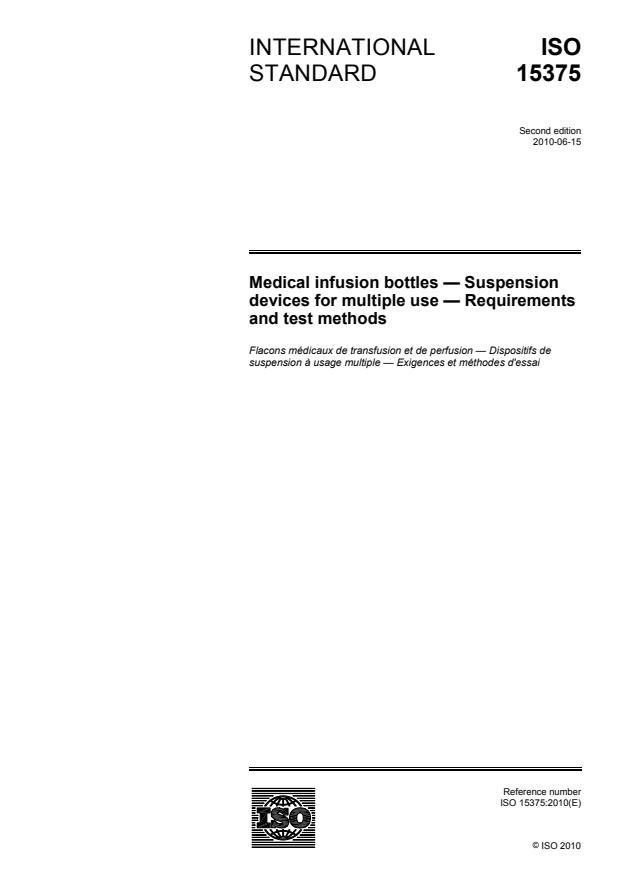
INTERNATIONAL ISO
STANDARD 15375
Second edition
2010-06-15
Medical infusion bottles — Suspension
devices for multiple use — Requirements
and test methods
Flacons médicaux de transfusion et de perfusion — Dispositifs de
suspension à usage multiple — Exigences et méthodes d'essai
Reference number
©
ISO 2010
PDF disclaimer
This PDF file may contain embedded typefaces. In accordance with Adobe's licensing policy, this file may be printed or viewed but
shall not be edited unless the typefaces which are embedded are licensed to and installed on the computer performing the editing. In
downloading this file, parties accept therein the responsibility of not infringing Adobe's licensing policy. The ISO Central Secretariat
accepts no liability in this area.
Adobe is a trademark of Adobe Systems Incorporated.
Details of the software products used to create this PDF file can be found in the General Info relative to the file; the PDF-creation
parameters were optimized for printing. Every care has been taken to ensure that the file is suitable for use by ISO member bodies. In
the unlikely event that a problem relating to it is found, please inform the Central Secretariat at the address given below.
© ISO 2010
All rights reserved. Unless otherwise specified, no part of this publication may be reproduced or utilized in any form or by any means,
electronic or mechanical, including photocopying and microfilm, without permission in writing from either ISO at the address below or
ISO's member body in the country of the requester.
ISO copyright office
Case postale 56 • CH-1211 Geneva 20
Tel. + 41 22 749 01 11
Fax + 41 22 749 09 47
E-mail copyright@iso.org
Web www.iso.org
Published in Switzerland
ii © ISO 2010 – All rights reserved
Foreword
ISO (the International Organization for Standardization) is a worldwide federation of national standards bodies
(ISO member bodies). The work of preparing International Standards is normally carried out through ISO
technical committees. Each member body interested in a subject for which a technical committee has been
established has the right to be represented on that committee. International organizations, governmental and
non-governmental, in liaison with ISO, also take part in the work. ISO collaborates closely with the
International Electrotechnical Commission (IEC) on all matters of electrotechnical standardization.
International Standards are drafted in accordance with the rules given in the ISO/IEC Directives, Part 2.
The main task of technical committees is to prepare International Standards. Draft International Standards
adopted by the technical committees are circulated to the member bodies for voting. Publication as an
International Standard requires approval by at least 75 % of the member bodies casting a vote.
Attention is drawn to the possibility that some of the elements of this document may be the subject of patent
rights. ISO shall not be held responsible for identifying any or all such patent rights.
ISO 15375 was prepared by Technical Committee ISO/TC 76, Transfusion, infusion and injection equipment
for medical and pharmaceutical use.
This second edition cancels and replaces the first edition (ISO 15375:2004), Clause 2 of which has been
technically revised.
Introduction
This International Standard deals with permanent suspension devices for multiple use for infusion bottles in
accordance with ISO 8536-1. The intended purpose of suspension devices is to avoid dropdowns of infusion
bottles during administering of blood or pharmaceutical solutions.
iv © ISO 2010 – All rights reserved
INTERNATIONAL STANDARD ISO 15375:2010(E)
Medical infusion bottles — Suspension devices for multiple
use — Requirements and test methods
1 Scope
This International Standard specifies requirements for permanent suspension devices, fixed to infusion racks
or set-up devices, for infusion bottles that confirm to the requirements of ISO 8536-1. The suspension devices
are intended for multiple use.
The purpose of this International Standard is to establish a safe suspension device for infusion bottles during
administering of their contents.
2 Normative references
The following referenced documents are indispensable for the application of this document. For dated
references, only the edition cited applies. For undated references, the latest edition of the referenced
document (including any amendments) applies.
ISO 2768-1, General tolerances — Part 1: Tolerances for linear and angular dimensions without individual
tolerance indications
ISO 8536-1, Infusion equipment for medical use — Part 1: Infusion glass bottles
3 Designation code and test weights
Permanent suspension
...