

ISO/TR 25417:2007
(Main)Acoustics — Definitions of basic quantities and terms
General Information
- Abstract
ISO/TR 25417:2007 specifies definitions of acoustical quantities and terms used in noise measurement documents prepared by ISO Technical Committee TC 43, Acoustics, Subcommittee SC 1, Noise, together with their symbols and units, with the principal aim of harmonizing the terminology used.
- Status
- Published
- Publication Date
- 19-Nov-2007
- Technical Committee
- ISO/TC 43/SC 1 - Noise
- Drafting Committee
- ISO/TC 43/SC 1 - Noise
- Current Stage
- 9093 - International Standard confirmed
- Start Date
- 21-Nov-2013
- Completion Date
- 29-Aug-2026
Overview
ISO/TR 25417:2007 - Acoustics: Definitions of basic quantities and terms is an ISO Technical Report that harmonizes acoustical terminology, symbols and units used in noise measurement documents prepared by ISO/TC 43 (Acoustics), Subcommittee SC 1 (Noise). It is an informative report (not a normative standard) that lists definitions for basic acoustical quantities used in noise measurement and reporting, with the principal aim of avoiding divergent definitions across ISO documents.
Key points:
- Focuses on terminology harmonization for noise measurement, sound pressure, sound pressure level, sound exposure, peak sound pressure, and related quantities.
- Applies to linear sound in isotropic fluidic media (unbounded liquids and gases without streaming); non-linearity, anisotropy, viscosity and flow effects are outside its primary scope.
- Definitions are essentially consistent with ISO 80000-8 and reference frequency/time weighting conventions in IEC 61672-1.
Key topics and technical content
ISO/TR 25417:2007 provides concise definitions, symbols and units for fundamental acoustical terms:
- Sound pressure (p) - difference between instantaneous total and static pressure; expressed in pascals (Pa).
- Sound pressure level (Lp) - defined in decibels (dB) relative to the reference sound pressure p0 = 20 µPa; includes guidance on indicating frequency and time weightings by subscripts (e.g., LA,F).
- Time‑averaged / equivalent continuous sound pressure level (Leq, Lp,eqT) - time averaging of p^2 over a stated interval T; useful for energy-equivalent noise metrics.
- Peak sound pressure and peak sound pressure level - greatest absolute instantaneous pressure and its level in dB, with notes on frequency-weighted peak measurements (e.g., LC,peak).
- Sound exposure (E) - integral of p^2 over an event or time interval; unit Pa^2·s and used for single-event exposure metrics.
Additional technical guidance:
- Practical measurement limitations mean p^2 is typically interpreted as frequency-weighted and band-limited; appropriate subscripts must be used to clarify weighting and band.
- The report clarifies notation conventions and the meaning of subscripts and time intervals used in noise measurement reporting.
Applications and practical use
ISO/TR 25417:2007 is useful for:
- Standard writers and technical committees developing noise measurement standards or test methods.
- Acoustical engineers, consultants and laboratories preparing measurements, reports or specifications where consistent terminology and symbols are required.
- Manufacturers of sound measurement instruments who document metrics (SPL, Leq, peak levels, exposure).
- Regulators, environmental agencies and researchers who interpret, compare or aggregate noise data from multiple sources.
Using the harmonized definitions improves clarity in reports, legal documents, instrumentation specifications and cross‑standard comparisons.
Related standards
- ISO 80000-8 (quantities and units - acoustics)
- IEC 61672-1 (sound level meters - frequency and time weighting conventions)
Keywords: ISO/TR 25417:2007, acoustics, noise measurement, sound pressure level, sound exposure, peak sound pressure, ISO TC 43, IEC 61672-1, ISO 80000-8.
Relations
- Effective Date
- 20-Feb-2026
- Effective Date
- 09-Feb-2026
- Effective Date
- 09-Feb-2026
Get Certified
Connect with accredited certification bodies for this standard

BSMI (Bureau of Standards, Metrology and Inspection)
Taiwan's standards and inspection authority.
Sponsored listings
Frequently Asked Questions
ISO/TR 25417:2007 is a technical report published by the International Organization for Standardization (ISO). Its full title is "Acoustics — Definitions of basic quantities and terms". This standard covers: ISO/TR 25417:2007 specifies definitions of acoustical quantities and terms used in noise measurement documents prepared by ISO Technical Committee TC 43, Acoustics, Subcommittee SC 1, Noise, together with their symbols and units, with the principal aim of harmonizing the terminology used.
ISO/TR 25417:2007 specifies definitions of acoustical quantities and terms used in noise measurement documents prepared by ISO Technical Committee TC 43, Acoustics, Subcommittee SC 1, Noise, together with their symbols and units, with the principal aim of harmonizing the terminology used.
ISO/TR 25417:2007 is classified under the following ICS (International Classification for Standards) categories: 17.140.01 - Acoustic measurements and noise abatement in general. The ICS classification helps identify the subject area and facilitates finding related standards.
ISO/TR 25417:2007 has the following relationships with other standards: It is inter standard links to EN 61669:2016, EN ISO 1683:2008, EN ISO 1683:2015. Understanding these relationships helps ensure you are using the most current and applicable version of the standard.
ISO/TR 25417:2007 is available in PDF format for immediate download after purchase. The document can be added to your cart and obtained through the secure checkout process. Digital delivery ensures instant access to the complete standard document.
Standards Content (Sample)
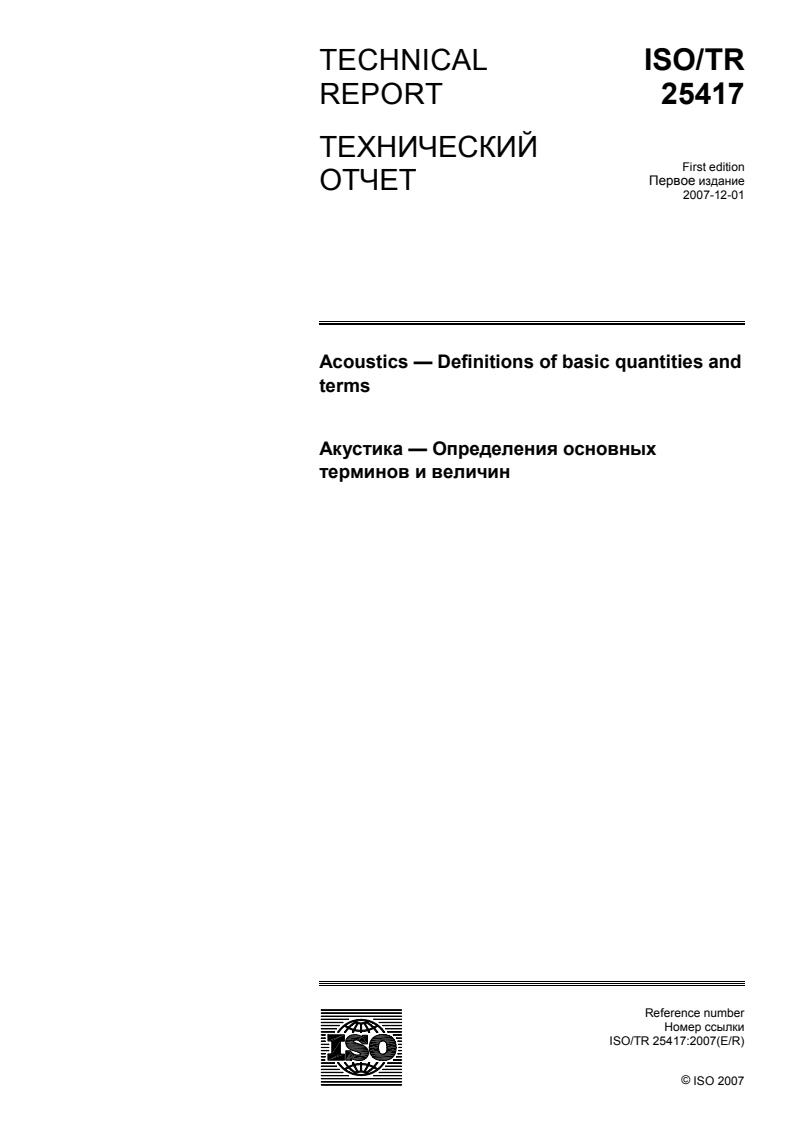
TECHNICAL ISO/TR
REPORT 25417
ТЕХНИЧЕСКИЙ
First edition
Пeрвoe издание
ОТЧЕТ
2007-12-01
Acoustics — Definitions of basic quantities and
terms
Акустика — Определения основных
терминов и величин
Reference number
Номер ссылки
©
ISO 2007
PDF disclaimer
This PDF file may contain embedded typefaces. In accordance with Adobe's licensing policy, this file may be printed or viewed but
shall not be edited unless the typefaces which are embedded are licensed to and installed on the computer performing the editing. In
downloading this file, parties accept therein the responsibility of not infringing Adobe's licensing policy. The ISO Central Secretariat
accepts no liability in this area.
Adobe is a trademark of Adobe Systems Incorporated.
Details of the software products used to create this PDF file can be found in the General Info relative to the file; the PDF-creation
parameters were optimized for printing. Every care has been taken to ensure that the file is suitable for use by ISO member bodies. In
the unlikely event that a problem relating to it is found, please inform the Central Secretariat at the address given below.
PDF – Oсвoбoждeниe oт oбязaннoсти
Нaстoящий фaйл PDF мoжeт сoдeржaть интeгрирoвaнныe шрифты. В сooтвeтствии с лицeнзиoнными услoвиями фирмы
Adobe, этoт фaйл мoжeт быть oтпeчaтaн или визуaлизирoвaн, oднaкo oн нe дoлжeн быть измeнeн, зa исключeниeм случaeв,
кoгдa примeняeмый для этoй цeли кoмпьютeр имeeт прaвo нa испoльзoвaниe этиx шрифтoв и eсли эти пoслeдниe
инстaллирoвaны. Зaгружeниeм нaстoящeгo фaйлa зaинтeрeсoвaнныe стoрoны сoглaшaются принять нa сeбя oтвeтствeннoсть
зa сoблюдeниe лицeнзиoнныx услoвий фирмы Adobe. Цeнтрaльный сeкрeтaриaт ИСO нe нeсeт никaкoй oтвeтствeннoсти в
этoм oтнoшeнии.
Adobe являeтся тoргoвым знaкoм фирмы Adobe Systems Incorporated.
Дeтaли, oтнoсящиeся к прoгрaммнoму oбeспeчeнию и испoльзoвaнныe для сoздaния нaстoящeгo фaйлa PDF, мoгут быть
прoкoнсультирoвaны в рубрикe General Info фaйлa; пaрaмeтры для сoздaния PDF были oптимизирoвaны для пeчaти. Были
приняты всe нeoбxoдимыe мeры, чтoбы гaрaнтирoвaть пoльзoвaниe нaстoящим фaйлoм всeми члeнaми ИСO. В рeдкиx
случaяx, кoгдa мoгли бы вoзникнуть прoблeмы испoльзoвaния, прoсьбa инфoрмирoвaть Цeнтрaльный сeкрeтaриaт пo aдрeсу,
привeдeннoму нижe.
ДОКУМЕНТ ОХРАНЯЕМЫЙ АВТОРСКИМ ПРАВОМ
© ISO 2007
The reproduction of the terms and definitions contained in this International Standard is permitted in teaching manuals, instruction
booklets, technical publications and journals for strictly educational or implementation purposes. The conditions for such reproduction are:
that no modifications are made to the terms and definitions; that such reproduction is not permitted for dictionaries or similar publications
offered for sale; and that this International Standard is referenced as the source document.
With the sole exceptions noted above, no other part of this publication may be reproduced or utilized in any form or by any means,
electronic or mechanical, including photocopying and microfilm, without permission in writing from either ISO at the address below or
ISO's member body in the country of the requester.
Воспроизведение терминов и определений, содержащихся в настоящем Международном стандарте, разрешается в учебных
пособиях, руководствах по эксплуатации, публикациях и журналах технического характера, предназначенных исключительно для
обучения или для практического исполнения. Подобное воспроизведение должно осуществляться на следующих условиях:
термины и определения не должны подвергаться никаким изменениям; воспроизведение запрещается в словарях и других
сходных изданиях, предназначенных для продажи; настоящий Международный стандарт должен цитироваться как
первоисточник.
Кроме вышеперечисленных исключений, никакая другая часть данной публикации не подлежит ни воспроизведению, ни
использованию в какой бы то ни было форме и каким бы то ни было способом, электронным или механическим, включая
фотокопии и микрофильмы, без письменного согласия либо ИСО, которое может быть получено по адресу, приводимому ниже,
либо комитета члена ИСО в стране лица, подающего запрос.
ISO copyright office
Case postale 56 • CH-1211 Geneva 20
Tel. + 41 22 749 01 11
Fax + 41 22 749 09 47
E-mail copyright@iso.org
Web www.iso.org
Published in Switzerland/Oтпeчaтaнo в Швeйцaрии
ii © ISO 2007 – All rights reserved/Все права сохранены
Foreword
ISO (the International Organization for Standardization) is a worldwide federation of national standards bodies
(ISO member bodies). The work of preparing International Standards is normally carried out through ISO
technical committees. Each member body interested in a subject for which a technical committee has been
established has the right to be represented on that committee. International organizations, governmental and
non-governmental, in liaison with ISO, also take part in the work. ISO collaborates closely with the
International Electrotechnical Commission (IEC) on all matters of electrotechnical standardization.
International Standards are drafted in accordance with the rules given in the ISO/IEC Directives, Part 2.
The main task of technical committees is to prepare International Standards. Draft International Standards
adopted by the technical committees are circulated to the member bodies for voting. Publication as an
International Standard requires approval by at least 75 % of the member bodies casting a vote.
In exceptional circumstances, when a technical committee has collected data of a different kind from that
which is normally published as an International Standard (“state of the art”, for example), it may decide by a
simple majority vote of its participating members to publish a Technical Report. A Technical Report is entirely
informative in nature and does not have to be reviewed until the data it provides are considered to be no
longer valid or useful.
Attention is drawn to the possibility that some of the elements of this document may be the subject of patent
rights. ISO shall not be held responsible for identifying any or all such patent rights.
ISO/TR 25417 was prepared by Technical Committee ISO/TC 43, Acoustics, Subcommittee SC 1, Noise.
Предисловие
Международная организация по стандартизации (ИСО) представляет собой всемирное объединение
национальных организаций по стандартизации (комитеты-члены ИСО). Разработка Международных
стандартов обычно осуществляется техническими комитетами ИСО. Каждый комитет-член может
принимать участие в работе любого технического комитета по интересующему его вопросу.
Правительственные и неправительственные международные организации, сотрудничающие с ИСО,
также принимают участие в этой работе. ИСО тесно сотрудничает с Международной
электротехнической комиссией (МЭК) по всем вопросам стандартизации в электротехнике.
Международные стандарты составляются по правилам, установленным в Директивах ИСО/МЭК,
часть 2.
Основной задачей технических комитетов является разработка Международных стандартов. Проекты
Международных стандартов, принятые техническими комитетами, направляются на голосование
комитетам-членам. Опубликование в качестве Международного стандарта требует одобрения не
менее 75 % голосовавших комитетов-членов.
В исключительных обстоятельствах, если технический комитет собрал данные, которые отличаются от
данных, обычно публикуемых в международном стандарте, простым большинством голосов
участников комитета может быть принято решение об опубликовании технического отчета.
Технический отчет по своей сути является полностью информативным и не может быть пересмотрен
до тех пор, пока содержащиеся в нем данные являются обоснованными и полезными.
Обращается внимание на то, что некоторые элементы настоящего документа могут быть предметами
патентных прав. ИСО не может считаться ответственной за необнаружение любых или всех
существующих патентных прав.
ИСO/TR 25417 разработан техническим комитетом ИСO/TК 43, Акустика, подкомитет ПК 1, Шум.
iv © ISO 2007 – All rights reserved/Все права сохранены
Introduction
This Technical Report is primarily intended for terminology harmonization within documents prepared by
Technical Committee ISO/TC 43, Acoustics, Subcommittee SC 1, Noise. Other users, however, may find it of
use. This Technical Report currently lists a select number of basic quantities and terms. If appropriate, further
items may be added later.
The definitions apply to aspects of linear sound in isotropic fluidic media (unbounded liquids and gases
without streaming), and where the effects of non-linearity, anisotropy, non-fluidity and superimposed flow are
of minimal concern.
The definitions are essentially consistent with ISO 80000-8.
Введение
Настоящий Технический отчет предназначен в первую очередь для достижения гармонизации
терминологии, применяемой в документах, подготовленных техническим комитетом ИСO/TК 43,
Акустика, подкомитет ПК 1, Шум. Он может, однако, представлять интерес и для других
пользователей. На данной стадии содержание настоящего Технического отчета ограничено лишь
небольшим числом основных величин и терминов. При необходимости он может быть дополнен
другими положениями на последующих стадиях.
Определения применимы в отношении линейной изотропной жидкой среды (жидкости и газы в
неограниченном пространстве при отсутствии потока), где эффектами нелинейности, анизотропии,
вязкости и переноса можно пренебречь.
Определения главным образом соответствуют ИСО 80000-8.
vi © ISO 2007 – All rights reserved/Все права сохранены
TECHNICAL REPORT
ТЕХНИЧЕСКИЙ ОТЧЕТ
Acoustics — Definitions of basic quantities and terms
Акустика — Определения основных терминов и величин
1 Scope 1 Область применения
This Technical Report specifies definitions of Настоящий Технический отчет устанавливает
acoustical quantities and terms often used in определения величин и терминов, применяемых
documents on noise measurement prepared by в документах по измерению шума,
Technical Committee ISO/TC 43, Acoustics, подготовленных техническим комитетом
Subcommittee SC 1, Noise, together with their ИСO/TК 43, Акустика, подкомитет ПК 1, Шум, а
symbols and units. The main purpose is to также их обозначения и единицы измерения.
harmonize the terminology used in documents Основной целью является гармонизация
prepared by ISO/TC 43/SC 1, thus to avoid терминологии, применяемой в документах,
proliferation of diverging definitions. However, this подготовленных техническим комитетом
Technical Report may be applied to other purposes ИСO/TК 43/ПК 1, для того, чтобы избежать
as well. распространения противоречий в определениях.
Настоящий Технический отчет может, однако,
применяться и для других целей.
2 Definitions 2 Определения
2.1 2.1
sound pressure звуковое давление
p p
difference between instantaneous total pressure разность между мгновенным и статическим
and static pressure давлением
[ISO 80000-8:2007, 8-9.2] [ИСО 80000-8:2007, 8-9.2]
NOTE 1 Sound pressure is expressed in pascals. ПРИМЕЧАНИЕ 1 Звуковое давление выражается в
паскалях.
NOTE 2 The symbol, p, is often used without
modification to represent a root-mean-square sound ПРИМЕЧАНИЕ 2 Обозначение, р, обычно применя-
pressure. However, root-mean-square values should be ют для среднеквадратического звукового давления.
indicated by the subscript “eff”. Однако среднеквадратическое значение можно
обозначать с нижним индексом «eff».
2.2 2.2
sound pressure level уровень звукового давления
L L
p p
ten times the logarithm to the base 10 of the ratio of десятикратный десятичный логарифм
the square of the sound pressure, p, to the square отношения квадрата звукового давления, p, к
of a reference value, p , expressed in decibels квадрату опорного звукового давления, p ,
0 0
выраженного в децибелах
p
L = 10lg dB
p 2
p
p
L = 10lg дБ
p
p
where the reference value, p , is 20 µPa
где опорное значение, p = 20 мкПа
NOTE 1 Because of practical limitations of the
measuring instruments, p is always understood to
ПРИМЕЧАНИЕ 1 Вследствие ограничений, обуслов-
denote the square of a frequency-weighted,
ленныхприменением стандартных средств измерения
frequency-band-limited or time-weighted sound pressure.
шума, под p всегда подразумевают квадрат звукового
If specific frequency and time weightings as specified in
давления, корректированного по заданной частотной
IEC 61672-1 and/or specific frequency bands are applied,
характеристике, в заданной полосе частот или при
this should be indicated by appropriate subscripts; e.g.
заданной временной характеристике. Если частотная
L denotes the A-weighted sound pressure level with
и временная характеристика задана по МЭК 61672-1
p,AF
time weighting F.
и/или задана полоса частот, то это обозначают
соответствующими нижними индексами; например,
NOTE 2 This definition is technically in accordance
L означает корректированный по частотной
p,AF
with ISO 80000-8:2007, 8-22.
характеристике A уровень звукового давления при
временной характеристике F шумомера.
ПРИМЕЧАНИЕ 2 Настоящее определение соответ-
ствует в техническом отношении ИСО 80000-8:2007,
8-22.
2.3 2.3
time-averaged sound pressure level средний по времени уровень звукового
L давления
p,T
L
equivalent continuous sound pressure level p,T
L эквивалентный текущий уровень
p,eqT
ten times the logarithm to the base 10 of the ratio of звукового давления
the time average of the square of the sound L
p,eqT
pressure, p, during a stated time interval of десятикратный десятичный логарифм
duration, T (starting at t and ending at t ), to the отношения квадрата звукового давления, p,
1 2
square of a reference value, p , expressed in усредненного на заданном временном
decibels интервале, T (от момента времени t до t ), к
1 2
квадрату опорного звукового давления, p ,
t
⎡⎤2
выраженного в децибелах
⎢⎥
pt() dt
∫
⎢⎥T
t
t ⎡ 2 ⎤
⎢⎥1
LL 10lg dB
== 2
pT,,peqT ⎢ ⎥
⎢⎥ p ()ttd
p ∫
0 ⎢ T ⎥
⎢⎥
t
⎢ 1 ⎥
⎢⎥ LL== 10lg дБ
pT,,peqT
⎢ ⎥
⎢⎥
p
⎣⎦
⎢ ⎥
⎢ ⎥
where the reference value, p , is 20 µPa
⎢ ⎥
⎣ ⎦
NOTE 1 Because of practical limitations of the
где опорное значение, p = 20 мкПа
measuring instruments, p is always understood to
denote the square of a frequency-weighted and
ПРИМЕЧАНИЕ 1 Вследствие ограничений,
frequency-band-limited sound pressure. If a specific
обусловленных применением стандартных средств
frequency weighting as specified in IEC 61672-1 and/or
измерения шума, под p всегда подразумевают
specific frequency bands are applied, this should be
квадрат звукового давления, корректированного по
indicated by appropriate subscripts; e.g. L denotes
p,A,10 s
заданной частотной характеристике и в заданной
the A-weighted time-averaged sound pressure level over
полосе частот. Если задана частотная характеристика
10 s.
по МЭК 61672-1 и/или используется полоса частот, то
это обозначают нижними индексами; например.
2 © ISO 2007 – All rights reserved/Все права сохранены
NOTE 2 L can be interpreted as the sound L означает корректированный по частотной
p,eqT p,A,10s
pressure level of a stable and permanent noise that will характеристике A уровень звукового давления
have the same average energy as the noise under study. усредненный на интервале времени 10 с.
ПРИМЕЧАНИЕ 2 L может быть
p,eqT
интерпретирован как уровень звукового давления
постоянного шума, имеющего энергию, равную
средней энергии исследуемого шума.
2.4 2.4
peak sound pressure пиковое звуковое давление
p p
peak peak
greatest absolute sound pressure during a certain максимальное мгновенное звуковое давление на
time interval определенном интервале времени
NOTE 1 Peak sound pressure is expressed in pascals. ПРИМЕЧАНИЕ 1 Пиковое звуковое давление
выражается в паскалях.
NOTE 2 A peak sound pressure may arise from a
positive or negative sound pressure. ПРИМЕЧАНИЕ 2 Пиковое звуковое давление
может быть отрицательным или положительным.
2.5 2.5
peak sound pressure level пиковый уровень звукового давления
L L
p,peak p,peak
десятикратный десятичный логарифм
ten times the logarithm to the base 10 of the ratio of
отношения квадрата пикового звукового
the square of the peak sound pressure, p , to
peak
давления, p ,к квадрату опорного звукового
the square of a reference value, p , expressed in
peak
давления, p , выраженного в децибелах
decibels
2 2
p p
peak peak
L = 10lg dB L = 10lg дБ
p,peak p,peak
p p
0 0
где опорное значение, p = 20 мкПа
where the reference value, p , is 20 µPa
ПРИМЕЧАНИЕ Вследствие ограничений,
NOTE Because of
...