


ISO/PRF 4106
(Main)Motorcycles — Engine test code — Net power
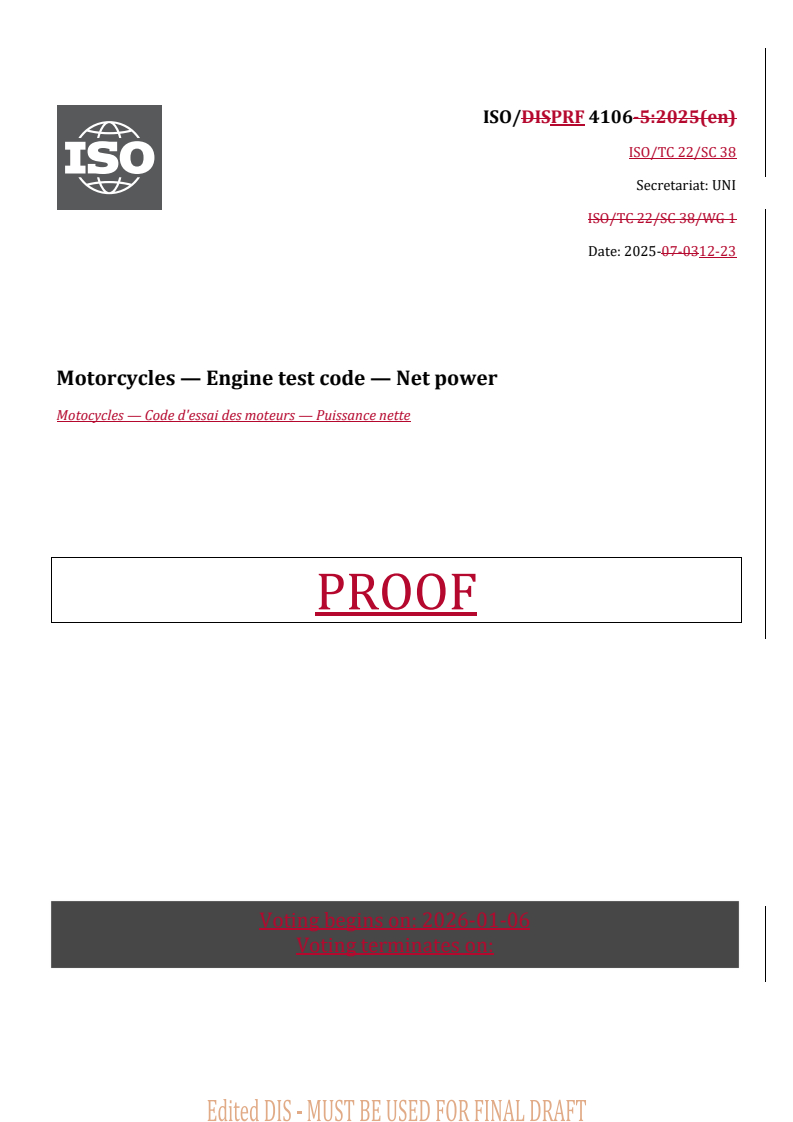
Motorcycles — Engine test code — Net power
This International Standard specifies methods for evaluating the performance of engines designed for motorcycles as defined in ISO 3833, in particular with a view to the presentation of power curves and specific fuel consumption at full load as a function of engine speed, for net power assessment. It is applicable to reciprocating internal combustion engines (spark-ignition or compression-ignition) — excluding free-piston engines — and rotary piston engines, either naturally aspirated or pressure-charged and equipped with either mechanical pressure-charger or turbocharger. Particular specifications for the test of compression-ignition engines are specified in Annex A.
Motocycles — Code d'essai des moteurs — Puissance nette
General Information
- Status
- Not Published
- Technical Committee
- ISO/TC 22/SC 38 - Motorcycles and mopeds
- Drafting Committee
- ISO/TC 22/SC 38 - Motorcycles and mopeds
- Current Stage
- 5020 - FDIS ballot initiated: 2 months. Proof sent to secretariat
- Start Date
- 05-Jan-2026
- Completion Date
- 07-Jan-2026
Relations
- Effective Date
- 29-Jun-2024
Overview
ISO/PRF 4106:2025 is an International Standard published by ISO that defines the engine test code for measuring the net power of motorcycle engines. This standard provides a comprehensive methodology for evaluating the performance of reciprocating internal combustion engines and rotary piston engines designed for motorcycles, addressing both spark-ignition and compression-ignition engines. It outlines testing procedures to produce power curves and specific fuel consumption data at full load based on engine speed, ensuring consistent, reliable, and comparable results across different engine types and manufacturers.
The 2025 revision enhances harmonization with other measurement methods, expands testing ranges for fuel and air temperatures, and updates equipment efficiency parameters, making it a technically robust guideline for accurate net power assessment.
Key Topics
Scope and Applicability
Applicable to motorcycle engines as defined in ISO 3833, this standard covers:- Reciprocating internal combustion engines (both spark-ignition and compression-ignition)
- Rotary piston engines
- Both naturally aspirated and pressure-charged variants (mechanical pressure-charger or turbocharger)
- Excludes free-piston engines
Testing Methods and Equipment
The document sets detailed requirements for:- Measurement accuracy for torque, engine speed, fuel flow, temperature, pressure, and humidity
- Installation and condition of equipment and auxiliaries replicating real-world operating conditions
- Calibration procedures to account for friction and instrument variances
Performance Measurement Parameters
- Net power and net torque measurement at the crankshaft output
- Calculation and correction of measured values to standard reference conditions (100 kPa barometric pressure, 298.2 K air temperature, 30% relative humidity)
- Specific fuel consumption evaluation, critical for assessing engine efficiency
Correction Factors and Standard Reference Conditions
Corrected net power and torque are derived using established correction factors to normalize results, making comparisons meaningful regardless of ambient test conditions.Test Reporting Requirements
Specifies the format and essential data for comprehensive test reports including corrected power curves, torque, and specific fuel consumption figures.Annexes and Additional Specifications
- Annex A details specific testing methods for compression-ignition engines
- Annex B offers example forms for recording test fuel specifications, ensuring fuel consistency
Applications
ISO/PRF 4106:2025 is essential for:
- Motorcycle manufacturers conducting engine performance validation and certification
- Test laboratories performing engine power and fuel consumption testing to meet regulatory and consumer standards
- Engineering teams optimizing motorcycle engines for power output and fuel efficiency
- Regulatory bodies and technical inspectors verifying compliance with performance claims
- Research and development sectors aiming to benchmark engine performance under standardized conditions
By following this standard, stakeholders achieve consistent and reliable assessment of motorcycle engine net power, facilitating market transparency and advancing engine technology with validated data.
Related Standards
- ISO 3833 - Defines vehicle categories and types including motorcycles, essential for the scope definition of engines tested under ISO 4106.
- ISO 2710-1 - Provides terminology related to reciprocating internal combustion engines, ensuring clarity in communication and documentation.
- ISO 15550 - Covers general requirements for measuring engine power, serving as a foundational reference for the test methods used in ISO 4106.
- ISO/IEC Directives, Part 1 and 2 - Guidelines followed in the preparation and maintenance of this International Standard.
Conclusion
ISO/PRF 4106:2025 offers a standardized, precise, and practical framework for measuring the net power of motorcycle engines, addressing key factors such as fuel consumption, torque, and correction for environmental variables. This standard ensures that manufacturers, test houses, and regulators can produce comparable and credible engine performance data, improving product development, certification processes, and consumer information in the motorcycle industry.
Keywords: ISO 4106, motorcycle engine test code, engine net power measurement, specific fuel consumption, motorcycle engine performance, internal combustion engines, spark-ignition engines, compression-ignition engines, engine testing standards, engine torque, corrected net power, engine performance evaluation.
Frequently Asked Questions
ISO/PRF 4106 is a draft published by the International Organization for Standardization (ISO). Its full title is "Motorcycles — Engine test code — Net power". This standard covers: This International Standard specifies methods for evaluating the performance of engines designed for motorcycles as defined in ISO 3833, in particular with a view to the presentation of power curves and specific fuel consumption at full load as a function of engine speed, for net power assessment. It is applicable to reciprocating internal combustion engines (spark-ignition or compression-ignition) — excluding free-piston engines — and rotary piston engines, either naturally aspirated or pressure-charged and equipped with either mechanical pressure-charger or turbocharger. Particular specifications for the test of compression-ignition engines are specified in Annex A.
This International Standard specifies methods for evaluating the performance of engines designed for motorcycles as defined in ISO 3833, in particular with a view to the presentation of power curves and specific fuel consumption at full load as a function of engine speed, for net power assessment. It is applicable to reciprocating internal combustion engines (spark-ignition or compression-ignition) — excluding free-piston engines — and rotary piston engines, either naturally aspirated or pressure-charged and equipped with either mechanical pressure-charger or turbocharger. Particular specifications for the test of compression-ignition engines are specified in Annex A.
ISO/PRF 4106 is classified under the following ICS (International Classification for Standards) categories: 43.140 - Motorcycles and mopeds. The ICS classification helps identify the subject area and facilitates finding related standards.
ISO/PRF 4106 has the following relationships with other standards: It is inter standard links to ISO 4106:2012. Understanding these relationships helps ensure you are using the most current and applicable version of the standard.
ISO/PRF 4106 is available in PDF format for immediate download after purchase. The document can be added to your cart and obtained through the secure checkout process. Digital delivery ensures instant access to the complete standard document.
Standards Content (Sample)
International
Standard
ISO 4106
Fifth edition
Motorcycles — Engine test code —
Net power
Motocycles — Code d'essai des moteurs — Puissance nette
PROOF/ÉPREUVE
Reference number
ISO 4106:2026(en) © ISO 2026
ISO 4106:2026(en)
© ISO 2026
All rights reserved. Unless otherwise specified, or required in the context of its implementation, no part of this publication may
be reproduced or utilized otherwise in any form or by any means, electronic or mechanical, including photocopying, or posting on
the internet or an intranet, without prior written permission. Permission can be requested from either ISO at the address below
or ISO’s member body in the country of the requester.
ISO copyright office
CP 401 • Ch. de Blandonnet 8
CH-1214 Vernier, Geneva
Phone: +41 22 749 01 11
Email: copyright@iso.org
Website: www.iso.org
Published in Switzerland
PROOF/ÉPREUVE
ii
ISO 4106:2026(en)
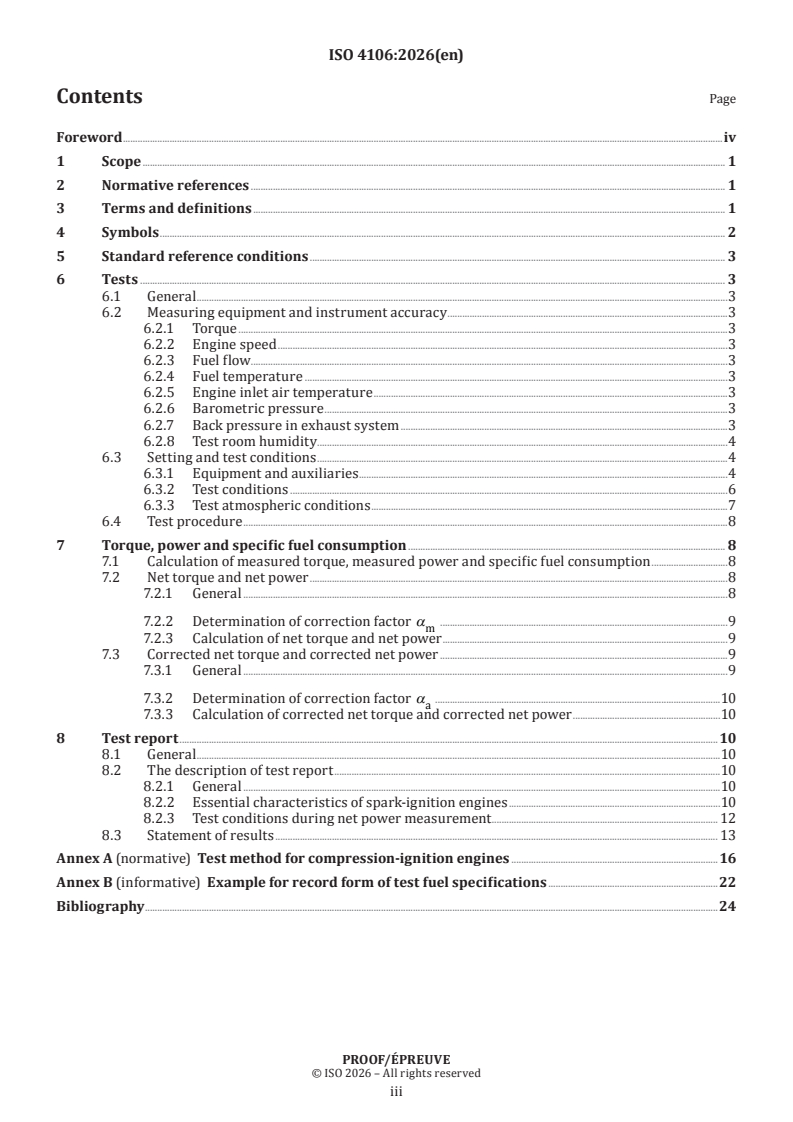
Contents Page
Foreword .iv
1 Scope . 1
2 Normative references . 1
3 Terms and definitions . 1
4 Symbols . 2
5 Standard reference conditions . 3
6 Tests . 3
6.1 General .3
6.2 Measuring equipment and instrument accuracy .3
6.2.1 Torque .3
6.2.2 Engine speed .3
6.2.3 Fuel flow.3
6.2.4 Fuel temperature .3
6.2.5 Engine inlet air temperature .3
6.2.6 Barometric pressure .3
6.2.7 Back pressure in exhaust system .3
6.2.8 Test room humidity . . .4
6.3 Setting and test conditions .4
6.3.1 Equipment and auxiliaries .4
6.3.2 Test conditions .6
6.3.3 Test atmospheric conditions .7
6.4 Test procedure .8
7 Torque, power and specific fuel consumption . 8
7.1 Calculation of measured torque, measured power and specific fuel consumption .8
7.2 Net torque and net power .8
7.2.1 General .8
7.2.2 Determination of correction factor α .9
m
7.2.3 Calculation of net torque and net power .9
7.3 Corrected net torque and corrected net power .9
7.3.1 General .9
7.3.2 Determination of correction factor α .10
a
7.3.3 Calculation of corrected net torque and corrected net power .10
8 Test report .10
8.1 General .10
8.2 The description of test report .10
8.2.1 General .10
8.2.2 Essential characteristics of spark-ignition engines .10
8.2.3 Test conditions during net power measurement . 12
8.3 Statement of results . 13
Annex A (normative) Test method for compression-ignition engines .16
Annex B (informative) Example for record form of test fuel specifications .22
Bibliography .24
PROOF/ÉPREUVE
iii
ISO 4106:2026(en)
Foreword
ISO (the International Organization for Standardization) is a worldwide federation of national standards
bodies (ISO member bodies). The work of preparing International Standards is normally carried out through
ISO technical committees. Each member body interested in a subject for which a technical committee
has been established has the right to be represented on that committee. International organizations,
governmental and non-governmental, in liaison with ISO, also take part in the work. ISO collaborates closely
with the International Electrotechnical Commission (IEC) on all matters of electrotechnical standardization.
The procedures used to develop this document and those intended for its further maintenance are described
in the ISO/IEC Directives, Part 1. In particular, the different approval criteria needed for the different types
of ISO documents should be noted. This document was drafted in accordance with the editorial rules of the
ISO/IEC Directives, Part 2 (see www.iso.org/directives).
ISO draws attention to the possibility that the implementation of this document may involve the use of (a)
patent(s). ISO takes no position concerning the evidence, validity or applicability of any claimed patent
rights in respect thereof. As of the date of publication of this document, ISO had not received notice of (a)
patent(s) which may be required to implement this document. However, implementers are cautioned that
this may not represent the latest information, which may be obtained from the patent database available at
www.iso.org/patents. ISO shall not be held responsible for identifying any or all such patent rights.
Any trade name used in this document is information given for the convenience of users and does not
constitute an endorsement.
For an explanation of the voluntary nature of standards, the meaning of ISO specific terms and expressions
related to conformity assessment, as well as information about ISO’s adherence to the World Trade
Organization (WTO) principles in the Technical Barriers to Trade (TBT), see www.iso.org/iso/foreword.html.
This document was prepared by Technical Committee ISO/TC 22, Road vehicles, Subcommittee SC 38,
Motorcycles and mopeds.
This fifth edition cancels and replaces the fourth edition (ISO 4106:2012), which has been technically
revised.
The main changes are as follows:
— the ranges of fuel temperature, engine inlet air temperature, and the applicable range of the correction
factor have been expanded;
— engine inlet depression and dry atmospheric pressure have been removed from required measurement
items;
— an example of the record form for test fuel specifications has been added;
— transmission component efficiencies of helical and bevel gears have been changed.
Any feedback or questions on this document should be directed to the user’s national standards body. A
complete listing of these bodies can be found at www.iso.org/members.html.
PROOF/ÉPREUVE
iv
International Standard ISO 4106:2026(en)
Motorcycles — Engine test code — Net power
1 Scope
This document specifies methods for evaluating the performance of engines designed for motorcycles
as defined in ISO 3833, in particular with a view to the presentation of power curves and specific
fuel consumption at full load as a function of engine speed, for net power assessment. It is applicable to
reciprocating internal combustion engines (spark-ignition or compression-ignition) ‒ excluding free-piston
engines ‒ and rotary piston engines, either naturally aspirated or pressure-charged and equipped with
either mechanical pressure-charger or turbocharger. Particular specifications for the test of compression-
ignition engines are specified in Annex A.
2 Normative references
The following documents are referred to in the text in such a way that some or all of their content constitutes
requirements of this document. For dated references, only the edition cited applies. For undated references,
the latest edition of the referenced document (including any amendments) applies.
ISO 2710-1, Reciprocating internal combustion engines — Vocabulary — Part 1: Terms for engine design and
operation
ISO 15550, Internal combustion engines — Determination and method for the measurement of engine power —
General requirements
3 Terms and definitions
For the purposes of this document, the terms and definitions given in ISO 2710-1, ISO 15550 and the following
apply.
ISO and IEC maintain terminology databases for use in standardization at the following addresses:
— ISO Online browsing platform: available at https:// www .iso .org/ obp
— IEC Electropedia: available at https:// www .electropedia .org/
3.1
net power
power obtained on a test bed at the end of the crankshaft or its equivalent at the corresponding engine
speed with the equipment and auxiliaries listed in 6.3.1
3.2
corrected net power
net power (3.1) corrected under the standard reference conditions
3.3
net torque
torque transmitted on a test bed at the end of the crankshaft or its equivalent at the corresponding engine
speed with the equipment and auxiliaries listed in 6.3.1
3.4
corrected net torque
net torque (3.3) corrected under the standard reference conditions
PROOF/ÉPREUVE
ISO 4106:2026(en)
3.5
specific fuel consumption
amount of fuel consumed by an engine per unit of power and time
Note 1 to entry: The amount of the lubricants for two-stroke cycle engines is excluded.
3.6
auxiliaries
equipment and devices necessary to make the engine acceptable for service in the intended application
4 Symbols
For the purposes of this document, the symbols given in Table 1 apply.
Table 1 — Symbols
Symbol Designation Unit
b specific fuel consumption g/(kW·h)
e
B amount of fuel consumed by an engine per unit of time g/h
c coefficient of the dynamometer m
L arm length of the dynamometer m
-1
n crankshaft rotation speed min
c
-1
n power take-off shaft rotation speed min
p
-1
N dynamometer rotation speed min
d
p ambient dry air barometric pressure during the test kPa
d
p standard reference total barometric pressure kPa
r
p standard reference saturated water vapour pressure kPa
sr
p ambient saturated water vapour pressure during the test kPa
sy
p ambient total barometric pressure during the test kPa
y
P measured power kW
P corrected net power kW
o
P net power kW
y
r reduction gear ratio ‒
g
t measured torque N·m
t corrected net torque N·m
o
t net torque N·m
y
T standard reference ambient air temperature K
r
T engine inlet air temperature during the test K
y
W dynamometer braking load N
α correction factor for ambient test conditions ‒
a
correction factor for efficiency of the transmission ‒
α
m
η efficiency of each element constituting the transmission ‒
i
efficiency of the transmission which is located between the crankshaft and the measurement
η ‒
t
point
standard reference relative humidity %
φ
r
φ
ambient relative humidity during the test %
y
PROOF/ÉPREUVE
ISO 4106:2026(en)
5 Standard reference conditions
For the purpose of determining the power and fuel consumption of an engine, the following standard
reference conditions shall be used:
— standard reference total barometric pressure: p = 100 kPa;
r
— standard reference air temperature: T = 298,2 K;
r
— standard reference relative humidity: φ = 30 %.
r
NOTE A relative humidity of 30 % at a temperature of 298,2 K corresponds to a water pressure of 1 kPa. The
corresponding dry barometric pressure is 99 kPa.
6 Tests
6.1 General
This test method is used for verifying the net power of an engine type with the declared values. It presents
engine performance at full power/torque as a function of engine speed by generating curves of corrected net
torque, corrected net power and specific fuel consumption.
6.2 Measuring equipment and instrument accuracy
6.2.1 Torque
The dynamometer torque-measuring system shall have an accuracy of ±1 % in the range of scale values
required for the test. The torque-measuring system shall be calibrated to take into account friction losses.
The accuracy may be ±2 % for measurements carried out at a power less than 50 % of maximum power.
6.2.2 Engine speed
The engine-speed measuring system shall have an accuracy of ±0,5 % of reading.
6.2.3 Fuel flow
The fuel-flow measuring system shall have an accuracy of ±1 % of reading.
6.2.4 Fuel temperature
The fuel-temperature measuring system shall have an accuracy of ±1 K.
6.2.5 Engine inlet air temperature
The air-temperature measuring system shall have an accuracy of ±1 K.
6.2.6 Barometric pressure
The barometric-pressure measuring system shall have an accuracy of ±70 Pa.
6.2.7 Back pressure in exhaust system
The system used to measure the back pressure (differential pressure) in the exhaust system shall have an
accuracy of ±25 Pa.
PROOF/ÉPREUVE
ISO 4106:2026(en)
6.2.8 Test room humidity
The test-room-humidity measuring system shall have an accuracy of ±5 % in relative humidity.
6.3 Setting and test conditions
6.3.1 Equipment and auxiliaries
During the test, if the equipment and auxiliaries specified in Table 2 are the standard productions, they
shall be installed on the test bench as far as possible in the same position and in the same condition as in the
intended application. The equipment and auxiliaries for the test of compression-ignition engines are listed
in Annex A.
Table 2 — Equipment and auxiliaries to be installed for the test to determine engine power
No. Equipment and auxiliaries
Inlet manifold
Crankcase emission control system
Control devices for dual induction
Electronic control system
1 Inlet system Air flow meter
a
Air inlet ductwork
a
Air filter
a
Inlet silencer
a
Speed-limiting device
2 Induction-heating device of inlet manifold
Exhaust purifier
Exhaust manifold
Pressure-charging device
b
3 Exhaust system Connecting pipes
b
Silencer
b
Tail pipe
Electronic control system
c
Fuel supply pump
Carburettor
Electronic control system
4 Fuel supply system
Gaseous fuel pressure reducer
Gaseous fuel evaporator
Gaseous fuel mixer
Prefilter
Filter
Fuel injection pump
5 Fuel injection equipment High-pressure pipes
Injector
Air inlet valve
Electronic control system
PROOF/ÉPREUVE
ISO 4106:2026(en)
TTabablele 2 2 ((ccoonnttiinnueuedd))
No. Equipment and auxiliaries
d
Radiator
de
Fan
d
6 Liquid-cooling equipment Fan cowl
d
Water pump
df
Thermostat
d
Cowl
de
7 Air-cooling equipment Fan or blower
Temperature-regulating device
g
Generator
g
Battery
Spark distribution system
8 Electrical equipment Coil or coils
Wiring
Spark-plugs
h
Electronic control system
Compressor driven directly by the engine and/or by the exhaust gases
i
Boost control
9 Pressure-charging equipment
dej
Charge air cooler
Coolant pump or fan (engine-driven)
k
10 Anti-pollution device
11 Lubricating oil pump
12 Oil cooler
a
Except in the case where there is a risk of the system having a noticeable influence upon engine power, where the
equivalents may be used. In this case, a check shall be made to ascertain that inlet depression does not differ by more
than 100 Pa from the limit specified by the manufacturer for a clean air filter.
b
If it is impracticable to fit the standard exhaust system, a system permitting the normal engine running characteris-
tics in accordance with the manufacturer’s specification shall be fitted for the test. In particular, in the test laboratory,
the exhaust extraction system at the point where the test bench exhaust system is connected shall not create a pres-
sure differing from the atmospheric pressure by more than ±740 Pa at the exhaust extraction duct, with the engine in
operation, unless the manufacturer has specifically prescribed the back pressure prior to the test, in which case the
lower of the two pressures shall be used.
c
If necessary, the fuel feed pressure may be adjusted to reproduce the fuel pressures existing in the particular engine
application (particularly when a “fuel return” system, for example to tank or filter, is used).
d
The radiator, fan, fan cowl, water pump, thermostat and cowl shall be located on the test bed in the same relative
positions that they are to occupy on the vehicle or machine. The cooling liquid circulation shall only be operated by
the engine water pump. Cooling of the liquid may be provided either by the engine radiator or by an external circuit,
provided that the pressure loss of this circuit and the pressure at the pump inlet remain substantially the same as those
of the engine cooling system. The radiator shutter, if incorporated, shall be set in the open position.
Where the fan, radiator and cowl system cannot conveniently be fitted to the engine, the power absorbed by the fan
when separately mounted in its correct position in relation to the radiator and cowl (if used) shall be determined at
the speeds corresponding to the engine speeds used for measurement of the engine power either by calculation from
standard characteristics or by practical tests. This power, corrected to the standard atmospheric conditions defined
in Clause 5, shall be deducted from the corrected power.
PROOF/ÉPREUVE
ISO 4106:2026(en)
TTabablele 2 2 ((ccoonnttiinnueuedd))
No. Equipment and auxiliaries
e
Where a disconnectable or progressive fan or blower is incorporated, the test shall be performed with the fan or
blower disconnected or with the progressive fan running at maximum slip.
f
The thermostat may be fixed in the fully open position.
g
The electrical power of the generator shall be the minimum. It shall be limited to that necessary for operation of
accessories which are indispensable for engine operation. If the connection of a battery is necessary, a fully charged
battery in good condition shall be used.
h
The spark advance shall be representative of in-use conditions established with the minimum octane fuel recom-
mended by the manufacturer.
i
For engines equipped with variable boost as a function of charge or inlet air temperature, octane rating and/or engine
speed, the boost pressure shall be representative of in-vehicle conditions established with the minimum octane fuel
as recommended by the manufacturer.
j
Charge air-cooled engines shall be tested with the charge air-cooling system operating, whether this system is
liquid-cooled or air-cooled. If the engine manufacturer prefers, a test bed system may replace an air-cooled cooler.
In either case the measurement of power at each speed shall be made with the pressure drop and temperature drop
of the engine air across the charge air cooler in the test bed the same as those specified by the manufacturer for the
system on the complete vehicle.
k
These may include, for example, exhaust gas recirculation (EGR) system, catalytic converter, secondary air-supply,
fuel evaporation protection systems and crankcase emission control system.
6.3.2 Test conditions
The test conditions shall be as follows. The particular test conditions for test of compression-ignition engines
shall be as specified in Annex A.
a) The power test shall consist of a run at full throttle, the engine being equipped with equipment and
auxiliaries as specified in 6.3.1.
b) The engine speed during a test run shall not deviate from the selected speed by more than ±1 %.
c) Performance data shall be obtained under stabilized operating conditions in accordance with the
manufacturer’s specifications, with an adequate fresh-air supply to the engine.
Before the test, the engine shall have been run-in in accordance with the manufacturer’s
recommendations. Test conditions such as inlet air temperature shall be selected to be as near to the
standard reference conditions (see Clause 5) as possible in order to minimize the magnitude of the
correction factor.
d) No data shall be taken until torque, engine speed and temperatures have been maintained substantially
constant as specified by the manufacturer.
If the constant operating conditions (torque, engine speed and temperatures) are not specified by the
manufacturer, no data shall be taken until the engine speed has been maintained within the limits
specified in 6.3.2 b). Each measurement period shall be equal for every measurement.
e) Observed brake load, fuel consumption and engine inlet air temperature data shall be taken
simultaneously and shall be the average of two stabilised consecutive values. In the case of the brake
load and fuel consumption, these values shall not vary by more than 2 %.
No adjustment shall be made to the engine between these readings.
f) A measurement time of not less than 10 s shall be used when measuring engine speed and fuel
consumption with an automatically synchronized counter-timer combination.
PROOF/ÉPREUVE
ISO 4106:2026(en)
g) For liquid-cooled engines, the temperature of the coolant at the outlet from the engine shall be kept
within ±5 K from the upper thermostatically controlled temperature specified by the manufacturer. If
no temperature is specified by the manufacturer, the temperature shall be 353,2 K ± 5 K.
For air-cooled engines, the temperature at a point indicated by the manufacturer shall be kept within
K of the maximum value specified by the manufacturer for the reference conditions.
−20
If no temperature is specified by the manufacturer, the temperature of the ignition spark-plug washer
shall be 523,2 K or less. For multi-cylinder engines, it is permissible to measure the ignition spark-plug
washer temperature at only one representative cylinder.
h) The fuel temperature shall be measured as near as possible to the inlet of the carburettor or fuel injector
manifold assembly. Fuel temperature shall be maintained within the limits set by the manufacturer.
However, the minimum test fuel temperature allowed shall be the ambient air temperature. If the test
fuel temperature is not specified by the manufacturer, it shall be 298,2 K ± 20 K.
i) The lubricating oil temperature measured in the oil sump or at the oil cooler outlet, if fitted, shall be
maintained within the limits established by the engine manufacturer.
j) Engine inlet air temperature shall be measured within 0,15 m of the point of entry to the air cleaner, or,
if no air cleaner is used, within 0,15 m of the air inlet horn.
The thermometer or thermocouple shall be shi
...
ISO/DISPRF 4106-5:2025(en)
ISO/TC 22/SC 38
Secretariat: UNI
ISO/TC 22/SC 38/WG 1
Date: 2025-07-0312-23
Motorcycles — Engine test code — Net power
Motocycles — Code d'essai des moteurs — Puissance nette
PROOF
VVoottiing bng beegiginsns o on:n: 202 20266--0101--0606
VoVotinting tg teerrminminatateses o onn::
ISO #####-#:####(X/PRF 4106:2025(en)
All rights reserved. Unless otherwise specified, or required in the context of its implementation, no part of this publication
may be reproduced or utilized otherwise in any form or by any means, electronic or mechanical, including photocopying,
or posting on the internet or an intranet, without prior written permission. Permission can be requested from either ISO
at the address below or ISO’s member body in the country of the requester.
ISO copyright office
CP 401 • Ch. de Blandonnet 8
CH-1214 Vernier, Geneva
Phone: + 41 22 749 01 11
EmailE-mail: copyright@iso.org
Website: www.iso.org
Published in Switzerland
© ISO #### 2025 – All rights reserved
ii
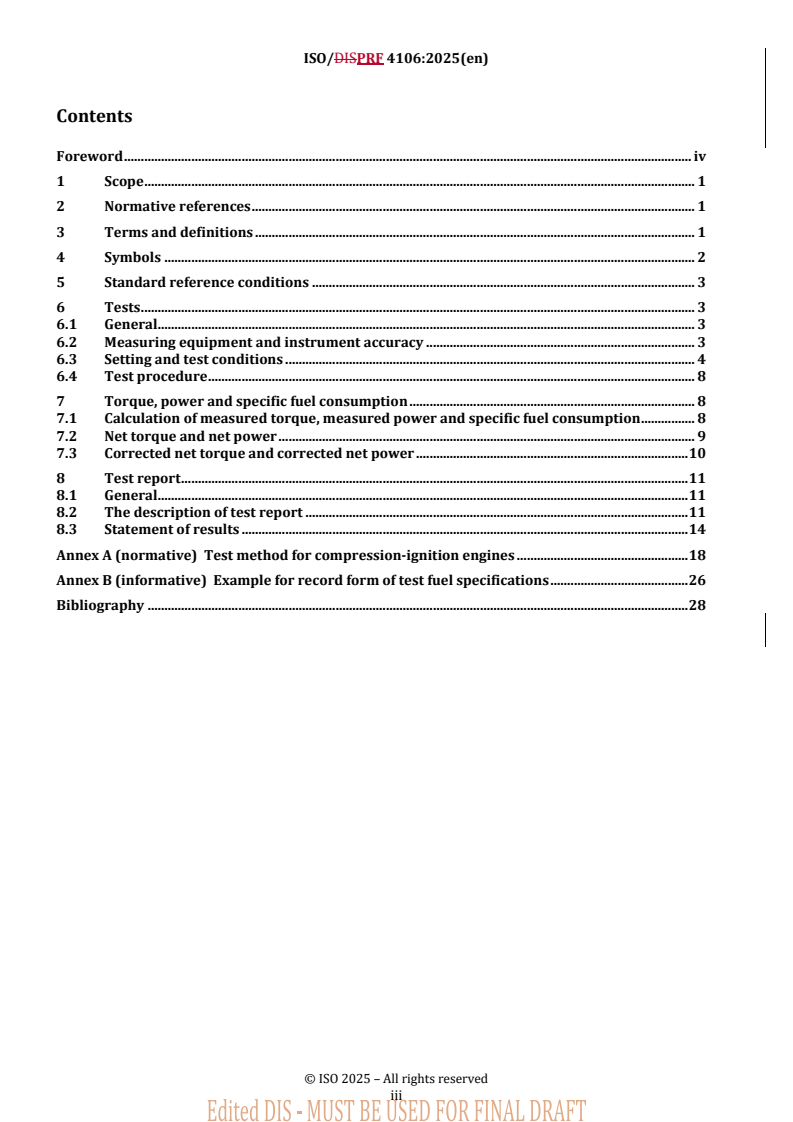
ISO/DISPRF 4106:2025(en)
Contents
Foreword . iv
1 Scope . 1
2 Normative references . 1
3 Terms and definitions . 1
4 Symbols . 2
5 Standard reference conditions . 3
6 Tests . 3
6.1 General . 3
6.2 Measuring equipment and instrument accuracy . 3
6.3 Setting and test conditions . 4
6.4 Test procedure . 8
7 Torque, power and specific fuel consumption . 8
7.1 Calculation of measured torque, measured power and specific fuel consumption . 8
7.2 Net torque and net power . 9
7.3 Corrected net torque and corrected net power . 10
8 Test report . 11
8.1 General . 11
8.2 The description of test report . 11
8.3 Statement of results . 14
Annex A (normative) Test method for compression-ignition engines . 18
Annex B (informative) Example for record form of test fuel specifications . 26
Bibliography . 28
iii
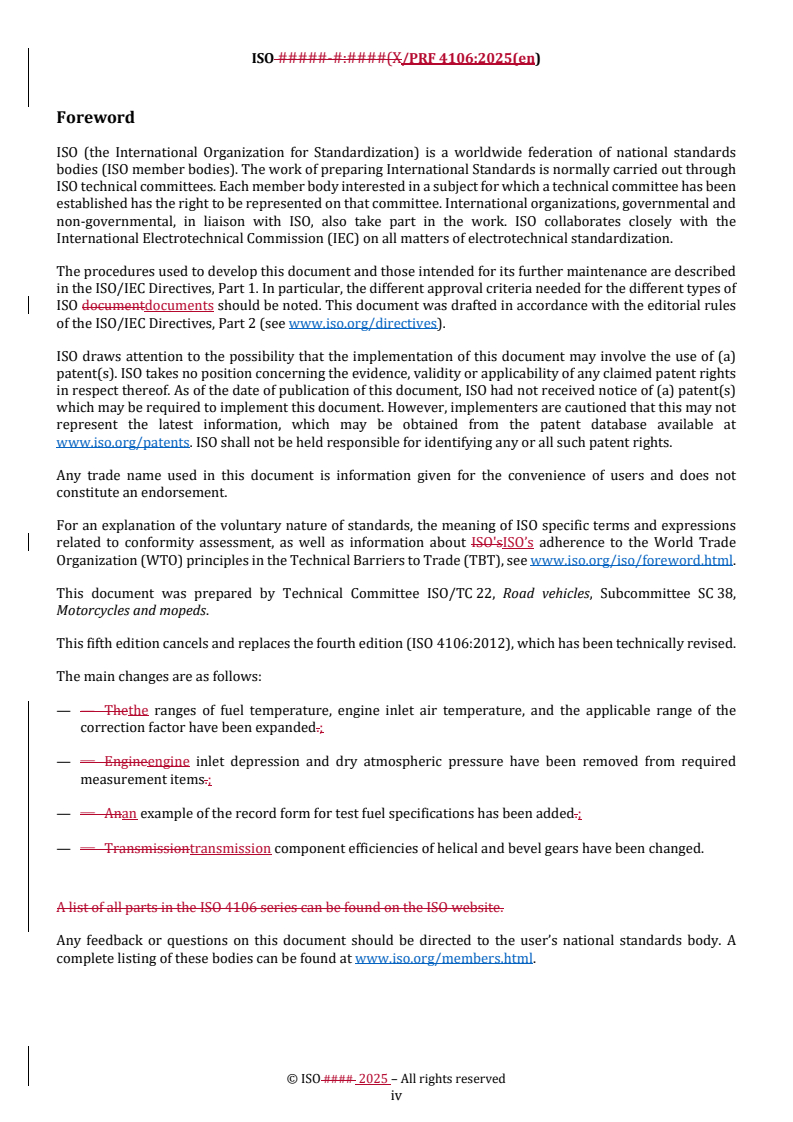
ISO #####-#:####(X/PRF 4106:2025(en)
Foreword
ISO (the International Organization for Standardization) is a worldwide federation of national standards
bodies (ISO member bodies). The work of preparing International Standards is normally carried out through
ISO technical committees. Each member body interested in a subject for which a technical committee has been
established has the right to be represented on that committee. International organizations, governmental and
non-governmental, in liaison with ISO, also take part in the work. ISO collaborates closely with the
International Electrotechnical Commission (IEC) on all matters of electrotechnical standardization.
The procedures used to develop this document and those intended for its further maintenance are described
in the ISO/IEC Directives, Part 1. In particular, the different approval criteria needed for the different types of
ISO documentdocuments should be noted. This document was drafted in accordance with the editorial rules
of the ISO/IEC Directives, Part 2 (see www.iso.org/directives).
ISO draws attention to the possibility that the implementation of this document may involve the use of (a)
patent(s). ISO takes no position concerning the evidence, validity or applicability of any claimed patent rights
in respect thereof. As of the date of publication of this document, ISO had not received notice of (a) patent(s)
which may be required to implement this document. However, implementers are cautioned that this may not
represent the latest information, which may be obtained from the patent database available at
www.iso.org/patents. ISO shall not be held responsible for identifying any or all such patent rights.
Any trade name used in this document is information given for the convenience of users and does not
constitute an endorsement.
For an explanation of the voluntary nature of standards, the meaning of ISO specific terms and expressions
related to conformity assessment, as well as information about ISO'sISO’s adherence to the World Trade
Organization (WTO) principles in the Technical Barriers to Trade (TBT), see www.iso.org/iso/foreword.html.
This document was prepared by Technical Committee ISO/TC 22, Road vehicles, Subcommittee SC 38,
Motorcycles and mopeds.
This fifth edition cancels and replaces the fourth edition (ISO 4106:2012), which has been technically revised.
The main changes are as follows:
— — Thethe ranges of fuel temperature, engine inlet air temperature, and the applicable range of the
correction factor have been expanded.;
— ― Engineengine inlet depression and dry atmospheric pressure have been removed from required
measurement items.;
— ― Anan example of the record form for test fuel specifications has been added.;
— ― Transmissiontransmission component efficiencies of helical and bevel gears have been changed.
A list of all parts in the ISO 4106 series can be found on the ISO website.
Any feedback or questions on this document should be directed to the user’s national standards body. A
complete listing of these bodies can be found at www.iso.org/members.html.
© ISO #### 2025 – All rights reserved
iv
ISO/DISPRF 4106:2025(en)
Introduction
The fourth edition of ISO 4106 (ISO 4106:2012) has some minor differences compared to the other
measurement methods, making it unreasonable for those who need to use both. This fifth edition harmonizes
these differences as much as possible. Additionally, some editorial modifications have also been made for
refinement.
ISO4106 has become a more reasonable International Standard for engine net power measurement of
motorcycles while ensuring technical correctness.
v
DRAFT International Standard ISO/DIS 4106:2025(en)
Motorcycles — Engine test code — Net power
1 Scope
This document specifies methods for evaluating the performance of engines designed for motorcycles as
defined in ISO 3833, in particular with a view to the presentation of power curves and specific fuel
consumption at full load as a function of engine speed, for net power assessment. It is applicable to
reciprocating internal combustion engines (spark-ignition or compression-ignition) — ‒ excluding free-
piston engines — ‒ and rotary piston engines, either naturally aspirated or pressure-charged and equipped
with either mechanical pressure-charger or turbocharger. Particular specifications for the test of
compression-ignition engines are specified in Annex AAnnex A.
2 Normative references
The following documents are referred to in the text in such a way that some or all of their content constitutes
requirements of this document. For dated references, only the edition cited applies. For undated references,
the latest edition of the referenced document (including any amendments) applies.
ISO 2710--1, Reciprocating internal combustion engines — Vocabulary — Part 1: Terms for engine design and
operation
ISO 15550, Internal combustion engines — Determination and method for the measurement of engine power —
General requirements
3 Terms and definitions
For the purposes of this document, the terms and definitions given in ISO 2710-1, ISO 15550 and the following
apply.
ISO and IEC maintain terminology databases for use in standardization at the following addresses:
— — ISO Online browsing platform: available at https://www.iso.org/obp
— — IEC Electropedia: available at https://www.electropedia.org/
3.1 3.1
net power
power obtained on a test bed at the end of the crankshaft or its equivalent at the corresponding engine speed
with the equipment and auxiliaries listed in 6.3.16.3.1
3.2 3.2
corrected net power
net power (3.1) corrected under the standard reference conditions
3.3 3.3
net torque
torque transmitted on a test bed at the end of the crankshaft or its equivalent at the corresponding engine
speed with the equipment and auxiliaries listed in 6.3.16.3.1
3.4 3.4
corrected net torque
net torque (3.3) corrected under the standard reference conditions
3.5 3.5
specific fuel consumption
amount of fuel consumed by an engine per unit of power and time
Note 1 to entry: The amount of the lubricants for two-stroke cycle engines is excluded.
3.6 3.6
auxiliaries
equipment and devices necessary to make the engine acceptable for service in the intended application
4 Symbols
For the purposes of this document, the symbols given in Table 1Table 1 apply.
Table 1 — Symbols
Symbol Designation Unit
be Specificspecific fuel consumption g/(kW·h)
B Amountamount of fuel consumed by an engine per unit of time g/h
c Coefficientcoefficient of the dynamometer m
L Armarm length of the dynamometer m
-1
n Crankshaftcrankshaft rotation speed min
c
-1
np Powerpower take-off shaft rotation speed min
-1
Nd Dynamometerdynamometer rotation speed min
p Ambientambient dry air barometric pressure during the test kPa
d
p Standardstandard reference total barometric pressure kPa
r
psr Standardstandard reference saturated water vapour pressure kPa
psy Ambientambient saturated water vapour pressure during the test kPa
p Ambientambient total barometric pressure during the test kPa
y
P Measuredmeasured power kW
P Correctedcorrected net power kW
o
Py Netnet power kW
rg Reductionreduction gear ratio —‒
t Measuredmeasured torque N·m
t Correctedcorrected net torque N·m
o
ty Netnet torque N·m
Tr Standardstandard reference ambient air temperature K
Ty Engineengine inlet air temperature during the test K
W Dynamometerdynamometer braking load N
𝛼𝛼 Correctioncorrection factor for ambient test conditions —‒
𝑎𝑎
𝛼𝛼 𝛼𝛼 Correctioncorrection factor for efficiency of the transmission —‒
m m
© ISO #### 2025 – All rights reserved
ISO/DISPRF 4106:2025(en)
Symbol Designation Unit
𝜂𝜂𝜂𝜂 Efficiencyefficiency of each element constituting the transmission —‒
i i
Efficiencyefficiency of the transmission which is located between the crankshaft and the
𝜂𝜂𝜂𝜂 —‒
t t
measurement point
𝜙𝜙𝜙𝜙 Standardstandard reference relative humidity %
r r
𝜙𝜙𝜙𝜙
Ambientambient relative humidity during the test %
y y
5 Standard reference conditions
For the purpose of determining the power and fuel consumption of an engine, the following standard reference
conditions shall be used:
— — standard reference total barometric pressure: 𝑝𝑝𝑝𝑝 = 100 kPa;
r r
— — standard reference air temperature: 𝑇𝑇𝑇𝑇 = 298,2 K;
r r
— — standard reference relative humidity: 𝜙𝜙𝜙𝜙 = 30 %.
r r
NOTE A relative humidity of 30 % at a temperature of 298,2 K corresponds to a water pressure of 1 kPa. The
corresponding dry barometric pressure is 99 kPa.
6 Tests
6.1 General
This test method is used for verifying the net power of an engine type with the declared values. It presents
engine performance at full power/torque as a function of engine speed by generating curves of corrected net
torque, corrected net power and specific fuel consumption.
6.2 Measuring equipment and instrument accuracy
6.2.1 Torque
The dynamometer torque-measuring system shall have an accuracy of ±1 % in the range of scale values
required for the test. The torque-measuring system shall be calibrated to take into account friction losses. The
accuracy may be ±2 % for measurements carried out at a power less than 50 % of maximum power.
6.2.2 Engine speed
The engine-speed measuring system shall have an accuracy of ±0,5 % of reading.
6.2.3 Fuel flow
The fuel-flow measuring system shall have an accuracy of ±1 % of reading.
6.2.4 Fuel temperature
The fuel-temperature measuring system shall have an accuracy of ±1 K.
6.2.5 Engine inlet air temperature
The air-temperature measuring system shall have an accuracy of ±1 K.
6.2.6 Barometric pressure
The barometric-pressure measuring system shall have an accuracy of ±70 Pa.
6.2.7 Back pressure in exhaust system
The system used to measure the back pressure (differential pressure) in the exhaust system shall have an
accuracy of ±25 Pa.
6.2.8 Test room humidity
The test-room-humidity measuring system shall have an accuracy of ±5 % in relative humidity.
6.3 Setting and test conditions
6.3.1 Equipment and auxiliaries
During the test, if the equipment and auxiliaries specified in Table 2Table 2 are the standard productions, they
shall be installed on the test bench as far as possible in the same position and in the same condition as in the
intended application. The equipment and auxiliaries for the test of compression-ignition engines are listed in
Annex AAnnex A.
Table 2 — Equipment and auxiliaries to be installed for the test to determine engine power
No. Equipment and auxiliaries
Inlet manifold
Crankcase emission control system
Control devices for dual induction
Electronic control system
1 Inlet system Air flow meter
a
Air inlet ductwork
a
Air filter
a
Inlet silencer
a
Speed-limiting device
2 Induction-heating device of inlet manifold
Exhaust purifier
Exhaust manifold
Pressure-charging device
b
3 Exhaust system Connecting pipes
b
Silencer
b
Tail pipe
Electronic control system
c
Fuel supply pump
Carburettor
4 Fuel supply system
Electronic control system
Gaseous fuel pressure reducer
© ISO #### 2025 – All rights reserved
ISO/DISPRF 4106:2025(en)
No. Equipment and auxiliaries
Gaseous fuel evaporator
Gaseous fuel mixer
Prefilter
Filter
Fuel injection pump
5 Fuel injection equipment High-pressure pipes
Injector
Air inlet valve
Electronic control system
d
Radiator
de
Fan
d
6 Liquid-cooling equipment Fan cowl
d
Water pump
df
Thermostat
d
Cowl
de
7 Air-cooling equipment Fan or blower
Temperature-regulating device
g
Generator
g
Battery
Spark distribution system
8 Electrical equipment Coil or coils
Wiring
Spark-plugs
h
Electronic control system
Compressor driven directly by the engine and/or by the exhaust gases
i
Boost control
Pressure-charging
equipment dej
Charge air cooler
Coolant pump or fan (engine-driven)
k
10 Anti-pollution device
11 Lubricating oil pump
12 Oil cooler
a
Except in the case where there is a risk of the system having a noticeable influence upon engine power, where the
equivalents may be used. In this case, a check shall be made to ascertain that inlet depression does not differ by more
than 100 Pa from the limit specified by the manufacturer for a clean air filter.
b
If it is impracticable to fit the standard exhaust system, a system permitting the normal engine running
characteristics in accordance with the manufacturer’s specification shall be fitted for the test. In particular, in the
test laboratory, the exhaust extraction system at the point where the test bench exhaust system is connected shall
not create a pressure differing from the atmospheric pressure by more than ±740 Pa at the exhaust extraction duct,
with the engine in operation, unless the manufacturer has specifically prescribed the back pressure prior to the test,
in which case the lower of the two pressures shall be used.
No. Equipment and auxiliaries
c
If necessary, the fuel feed pressure may be adjusted to reproduce the fuel pressures existing in the particular
engine application (particularly when a “fuel return” system, for example to tank or filter, is used).
d
The radiator, fan, fan cowl, water pump, thermostat and cowl shall be located on the test bed in the same relative
positions that they are to occupy on the vehicle or machine. The cooling liquid circulation shall only be operated by
the engine water pump. Cooling of the liquid may be provided either by the engine radiator or by an external circuit,
provided that the pressure loss of this circuit and the pressure at the pump inlet remain substantially the same as
those of the engine cooling system. The radiator shutter, if incorporated, shall be set in the open position.
Where the fan, radiator and cowl system cannot conveniently be fitted to the engine, the power absorbed by the fan
when separately mounted in its correct position in relation to the radiator and cowl (if used) shall be determined at
the speeds corresponding to the engine speeds used for measurement of the engine power either by calculation from
standard characteristics or by practical tests. This power, corrected to the standard atmospheric conditions defined
in Clause 5, shall be deducted from the corrected power.
a
Except in the case where there is a risk of the system having a noticeable influence upon engine power, where the equivalents may
be used. In this case, a check shall be made to ascertain that inlet depression does not differ by more than 100 Pa from the limit
specified by the manufacturer for a clean air filter.
b
If it is impracticable to fit the standard exhaust system, a system permitting the normal engine running characteristics in
accordance with the manufacturer’s specification shall be fitted for the test. In particular, in the test laboratory, the exhaust
extraction system at the point where the test bench exhaust system is connected shall not create a pressure differing from the
atmospheric pressure by more than ±740 Pa at the exhaust extraction duct, with the engine in operation, unless the manufacturer
has specifically prescribed the back pressure prior to the test, in which case the lower of the two pressures shall be used.
c
If necessary, the fuel feed pressure may be adjusted to reproduce the fuel pressures existing in the particular engine application
(particularly when a “fuel return” system, for example to tank or filter, is used).
d
The radiator, fan, fan cowl, water pump, thermostat and cowl shall be located on the test bed in the same relative positions that
they are to occupy on the vehicle or machine. The cooling liquid circulation shall only be operated by the engine water pump.
Cooling of the liquid may be provided either by the engine radiator or by an external circuit, provided that the pressure loss of this
circuit and the pressure at the pump inlet remain substantially the same as those of the engine cooling system. The radiator shutter,
if incorporated, shall be set in the open position.
Where the fan, radiator and cowl system cannot conveniently be fitted to the engine, the power absorbed by the fan when separately
mounted in its correct position in relation to the radiator and cowl (if used) shall be determined at the speeds corresponding to the
engine speeds used for measurement of the engine power either by calculation from standard characteristics or by practical tests.
This power, corrected to the standard atmospheric conditions defined in Clause 5, shall be deducted from the corrected power.
e
Where a disconnectable or progressive fan or blower is incorporated, the test shall be performed with the fan or
blower disconnected or with the progressive fan running at maximum slip.
f
The thermostat may be fixed in the fully open position.
g
The electrical power of the generator shall be the minimum. It shall be limited to that necessary for operation of
accessories which are indispensable for engine operation. If the connection of a battery is necessary, a fully charged
battery in good condition shall be used.
h
The spark advance shall be representative of in-use conditions established with the minimum octane fuel
recommended by the manufacturer.
i
For engines equipped with variable boost as a function of charge or inlet air temperature, octane rating and/or
engine speed, the boost pressure shall be representative of in-vehicle conditions established with the minimum
octane fuel as recommended by the manufacturer.
j
Charge air-cooled engines shall be tested with the charge air-cooling system operating, whether this system is
liquid-cooled or air--cooled. If the engine manufacturer prefers, a test bed system may replace an air-cooled cooler.
In either case the measurement of power at each speed shall be made with the pressure drop and temperature drop
of the engine air across the charge air cooler in the test bed the same as those specified by the manufacturer for the
system on the complete vehicle.
k
These may include, for example, Exhaust Gas Recirculationexhaust gas recirculation (EGR) system, catalytic
converter, secondary air-supply, fuel evaporation protection systems and crankcase emission control system.
6.3.2 Test conditions
The test conditions shall be as follows. The particular test conditions for test of compression-ignition engines
shall be as specified in Annex AAnnex A.
© ISO #### 2025 – All rights reserved
ISO/DISPRF 4106:2025(en)
a) a) The power test shall consist of a run at full throttle, the engine being equipped with equipment
and auxiliaries as specified in 6.3.16.3.1.
b) b) The engine speed during a test run shall not deviate from the selected speed by more than
±1 %.
c) c) Performance data shall be obtained under stabilized operating conditions in accordance with
the manufacturer’s specifications, with an adequate fresh-air supply to the engine.
Before the test, the engine shall have been run-in in accordance with the manufacturer’s
recommendations. Test conditions such as inlet air temperature shall be selected to be as near to the
standard reference conditions (see Clause 5Clause 5)) as possible in order to minimize the magnitude of
the correction factor.
d) d) No data shall be taken until torque, engine speed and temperatures have been maintained
substantially constant as specified by the manufacturer.
If the constant operating conditions (torque, engine speed and temperatures) are not specified by the
manufacturer, no data shall be taken until the engine speed has been maintained within the limits
specified in 6.3.26.3.2 b). Each measurement period shall be equal for every measurement.
e) e) Observed brake load, fuel consumption and engine inlet air temperature data shall be taken
simultaneously and shall be the average of two stabilised consecutive values. In the case of the brake load
and fuel consumption, these values shall not vary by more than 2 %.
No adjustment shall be made to the engine between these readings.
f) f) A measurement time of not less than 10 s shall be used when measuring engine speed and fuel
consumption with an automatically synchronized counter-timer combination.
g) g) For liquid-cooled engines, the temperature of the coolant at the outlet from the engine shall be
kept within ±5 K from the upper thermostatically controlled temperature specified by the manufacturer.
If no temperature is specified by the manufacturer, the temperature shall be 353,2 K ± 5 K.
For air-cooled engines, the temperature at a point indicated by the manufacturer shall be kept within
K of the maximum value specified by the manufacturer for the reference conditions.
−20
If no temperature is specified by the manufacturer, the temperature of the ignition spark-plug washer
shall be 523,2 K or less. For multi-cylinder engines, it is permissible to measure the ignition spark-plug
washer temperature at only one representative cylinder.
h) h) The fuel temperature shall be measured as near as possible to the inlet of the carburettor or
fuel injector manifold assembly. Fuel temperature shall be maintained within the limits set by the
manufacturer. However, the minimum test fuel temperature allowed shall be the ambient air
temperature. If the test fuel temperature is not specified by the manufacturer, it shall be 298,2 K ± 20 K.
i) i) The lubricating oil temperature measured in the oil sump or at the oil cooler outlet, if fitted,
shall be maintained within the limits established by the engine manufacturer.
j) j) Engine inlet air temperature shall be measured within 0,15 m of the point of entry to the air
cleaner, or, if no air cleaner is used, within 0,15 m of the air inlet horn.
The thermometer or thermocouple shall be shielded from fuel spray-back and radiant heat and located
directly in the air stream. A sufficient number of locations shall be used to give a representative average
of the inlet temperature.
k) k) The exhaust temperature shall be measured at a point in the exhaust pipe(s) adjacent to the
outlet flange(s) of the exhaust manifold(s) or ports.
l) l) The specification of test fuel shall be reported. An example of the record form is given in
Annex BAnnex B.
At least the following fuel information shall be reported:
1) 1) make and name;
2) 2) octane number RON or MON;
3) 3) relative density at 288 K, in g/cm ;
4) 4) lower calorific value, in kJ/kg;
5) 5) applicable fuel standard(s).
In case of using commercial fuels, it is permitted to only report the following information:
— — make and name;
— — grade;
— — applicable fuel standard(s).
Unleaded gasoline shall be used for the engine equipped with the catalyst.
m) m) Data to be recorded shall be those indicated in 8.38.3.
6.3.3 Test atmospheric conditions
During the test, the atmospheric conditions shall lie within the following range:
Engine inlet air temperature, in kelvin, 283,2≤𝑇𝑇𝑇𝑇 ≤ 318,2.
y y
6.4 Test procedure
Measurements shall be taken at a sufficient number of engine speeds to completely define the torque and
power curve between the lowest and the highest engine speeds recommended by the manufacturer. The speed
range shall include the point at which the engine produces its maximum torque and power. Data shall be taken
incrementally from the lowest to the highest engine speeds recommended by the manufacturer. When the
temperature exceeds the value specified in 6.3.26.3.2 g), the measurements shall be made intermittently.
7 Torque, power and specific fuel consumption
7.1 Calculation of measured torque, measured power and specific fuel consumption
The measured torque and measured power shall be calculated by Formulae (1)Formulae (1) and (2)(2),,
respectively:
𝑡𝑡 =𝑊𝑊𝑊𝑊 (1)
2𝜋𝜋𝜋𝜋𝜋𝜋𝑁𝑁 2π𝜋𝜋𝜋𝜋𝑁𝑁
d d
𝑃𝑃 = =𝑐𝑐𝑊𝑊𝑁𝑁𝑁𝑁 (2)
d d
60×1 00060×1 000
where
© ISO #### 2025 – All rights reserved
ISO/DISPRF 4106:2025(en)
2𝜋𝜋𝜋𝜋
c
is the coefficient of the dynamometer�𝑐𝑐 = �;
60×1 000
L is the arm length of the dynamometer, in metres;
-1
𝑁𝑁 is the dynamometer rotation speed, in min ;
d
W
is the dynamometer braking load, in newtons.
2π𝜋𝜋
𝑐𝑐
...
Questions, Comments and Discussion
Ask us and Technical Secretary will try to provide an answer. You can facilitate discussion about the standard in here.
Loading comments...