

ISO 8925:1989
(Main)Earth-moving machinery — Diagnostic ports
General Information
- Abstract
Defines the sizes, types and accessibility of diagnostic ports for use in measuring fluid temperature, pressure and flow, and to obtain fluid samples. Sets out also the requirements for accessibility to the port. Applies to earth-moving machinery as defined in ISO 6165, and gives general guidelines for diagnostic port use.
- Status
- Published
- Publication Date
- 25-Oct-1989
- Current Stage
- 9093 - International Standard confirmed
- Start Date
- 08-Dec-2021
- Completion Date
- 29-Aug-2026
Buy Documents

ISO 8925:1989 - Earth-moving machinery — Diagnostic ports Released:10/26/1989

ISO 8925:1989 - Engins de terrassement — Orifices de contrôle Released:10/26/1989
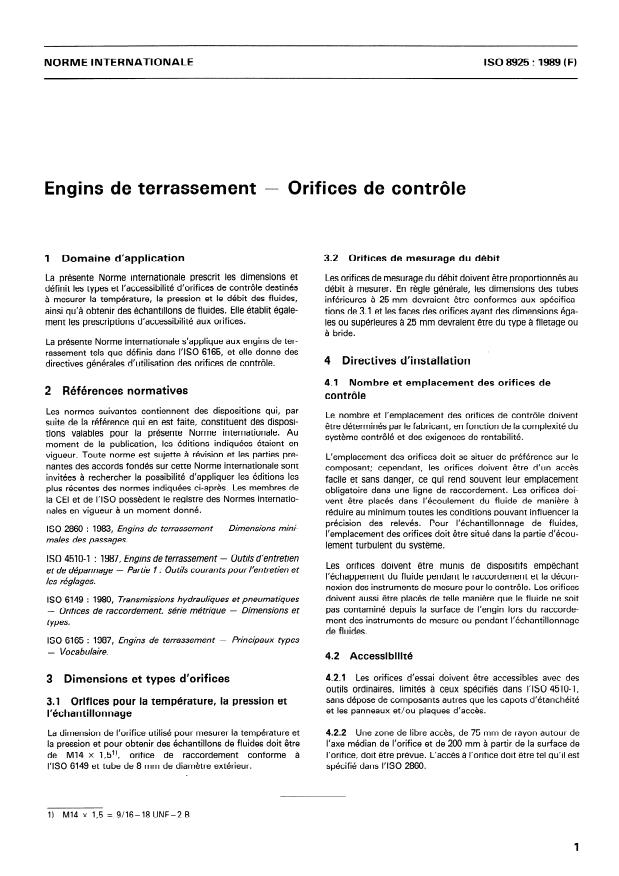

ISO 8925:1989 - Engins de terrassement — Orifices de contrôle Released:10/26/1989
Overview
ISO 8925:1989 specifies the sizes, types and accessibility requirements for diagnostic ports used on earth‑moving machinery to measure fluid temperature, pressure and flow, and to obtain fluid samples. The standard applies to earth‑moving machinery as defined in ISO 6165 and gives general guidelines to ensure reliable measurements, safe servicing and compatibility with common service tools.
Key topics and technical requirements
- Port types and sizes
- Temperature, pressure and sampling ports: M14 x 1.5 (compatible with ISO 6149) attached to an 8 mm outside diameter tube.
- Flow measurement ports: must be adequate for accurate flow measurement. For tube sizes below 25 mm, follow the temperature/pressure port specification; for sizes equal to or above 25 mm provide threaded or flanged port faces.
- Location and installation
- Preferred location is in the component itself, but ports may be placed in connecting lines if accessibility or measurement accuracy requires it.
- Ports should be located in the fluid stream to minimize conditions that could cause measurement inaccuracies; sampling ports should be in a turbulent flow section.
- Accessibility and serviceability
- Test ports must be accessible with common maintenance tools (as limited by ISO 4510‑1) without removing components other than sealing caps, access panels or plates.
- A clear working envelope: 75 mm radius around the centreline of the port and 200 mm clear from the port surface are required; overall access must meet ISO 2860 minimum access dimensions.
- Safety and contamination control
- Ports shall include devices to prevent loss of fluid during connection/disconnection and be arranged to avoid contamination of fluid or machine surfaces during sampling.
Applications and who uses it
ISO 8925 is practical for:
- Earth‑moving machinery manufacturers - to design hydraulic, lubrication and cooling systems with standardized diagnostic access.
- Service and maintenance technicians - for safe, repeatable measurement of pressure, temperature and flow during troubleshooting.
- Fleet managers and equipment owners - to reduce downtime via faster diagnostics and consistent sampling procedures.
- Test equipment and probe manufacturers - to ensure connectors and adapters match standardized port sizes.
Benefits include improved diagnostic interoperability, safer servicing, reduced measurement errors and lower maintenance costs for hydraulic and fluid systems on excavators, loaders, dozers and related machinery.
Related standards
- ISO 6165 - Earth‑moving machinery - Basic types (vocabulary, applicability)
- ISO 6149 - Fluid power systems - Metric ports (dimensions and design)
- ISO 2860 - Earth‑moving machinery - Minimum access dimensions
- ISO 4510‑1 - Service tools - Common maintenance and adjustment tools
Keywords: ISO 8925, diagnostic ports, earth‑moving machinery, fluid sampling, pressure measurement, temperature measurement, flow measurement, hydraulic diagnostics.
Relations
- Effective Date
- 06-Jun-2022
- Effective Date
- 15-Apr-2008
Buy Documents
ISO 8925:1989 - Earth-moving machinery — Diagnostic ports Released:10/26/1989
ISO 8925:1989 - Engins de terrassement — Orifices de contrôle Released:10/26/1989
ISO 8925:1989 - Engins de terrassement — Orifices de contrôle Released:10/26/1989
Frequently Asked Questions
ISO 8925:1989 is a standard published by the International Organization for Standardization (ISO). Its full title is "Earth-moving machinery — Diagnostic ports". This standard covers: Defines the sizes, types and accessibility of diagnostic ports for use in measuring fluid temperature, pressure and flow, and to obtain fluid samples. Sets out also the requirements for accessibility to the port. Applies to earth-moving machinery as defined in ISO 6165, and gives general guidelines for diagnostic port use.
Defines the sizes, types and accessibility of diagnostic ports for use in measuring fluid temperature, pressure and flow, and to obtain fluid samples. Sets out also the requirements for accessibility to the port. Applies to earth-moving machinery as defined in ISO 6165, and gives general guidelines for diagnostic port use.
ISO 8925:1989 is classified under the following ICS (International Classification for Standards) categories: 53.100 - Earth-moving machinery. The ICS classification helps identify the subject area and facilitates finding related standards.
ISO 8925:1989 has the following relationships with other standards: It is inter standard links to ISO 8925:1989/Amd 1:1997; is excused to ISO 8925:1989/Amd 1:1997. Understanding these relationships helps ensure you are using the most current and applicable version of the standard.
ISO 8925:1989 is available in PDF format for immediate download after purchase. The document can be added to your cart and obtained through the secure checkout process. Digital delivery ensures instant access to the complete standard document.
Standards Content (Sample)
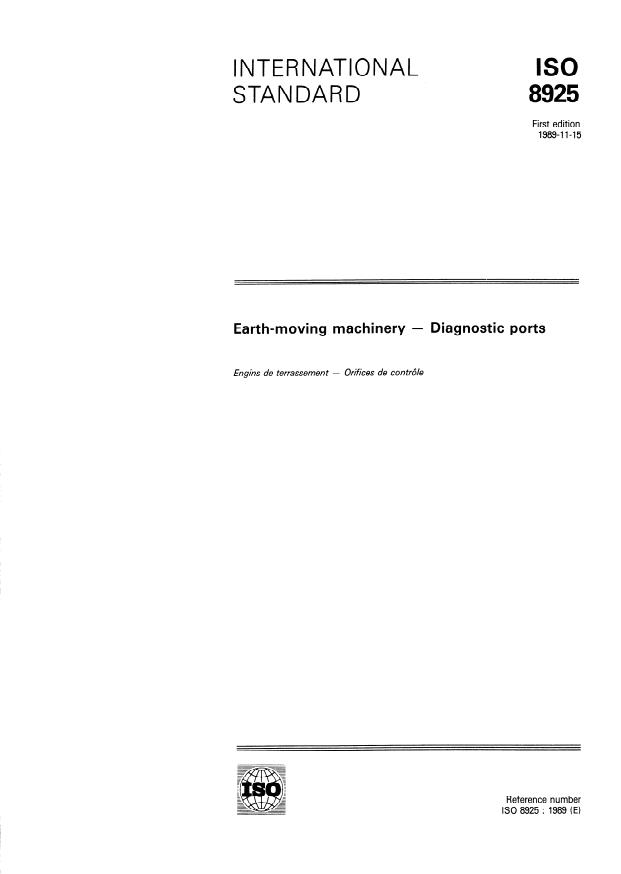
INTERNATIONAL IS0
STANDARD
First edition
1989-11-15
Earth-moving machinery - Diagnostic ports
Engins de terrassement - Orifices de contr6le
Reference number
IS0 8925 : 1989 (El
IS0 8925 : 1989 (E)
Foreword
IS0 (the International Organization for Standardization) is a worldwide federation of
national standards bodies (IS0 member bodies). The work of preparing International
Standards is normally carried out through IS0 technical committees. Each member
body interested in a subject for which a technical committee has been established has
the right to be represented on that committee. International organizations, govern-
mental and non-governmental, in liaison with ISO, also take part in the work. IS0
collaborates closely with the International Electrotechnical Commission (IEC) on all
matters of electrotechnical standardization.
Draft International Standards adopted by the technical committees are circulated to
the member bodies for approval before their acceptance as International Standards by
the IS0 Council. They are approved in accordance with IS0 procedures requiring at
least 75 % approval by the member bodies voting.
International Standard IS0 8925 was prepared by Technical Committee lSO/TC 127,
Earth-moving machinery.
@ IS0 1989
All rights reserved. No part of this publication may be reproduced or utilized in any form or by any
means, electronic or mechanical, including photocopying and microfilm, without permission in
writing from the publisher.
International Organization for Standardization
Case postale 56 l CH-1211 Geneve 20 l Switzerland
Printed in Switzerland
INTERNATIONAL STANDARD
IS0 8925 : 1989 (E)
Earth-moving machinery - Diagnostic ports
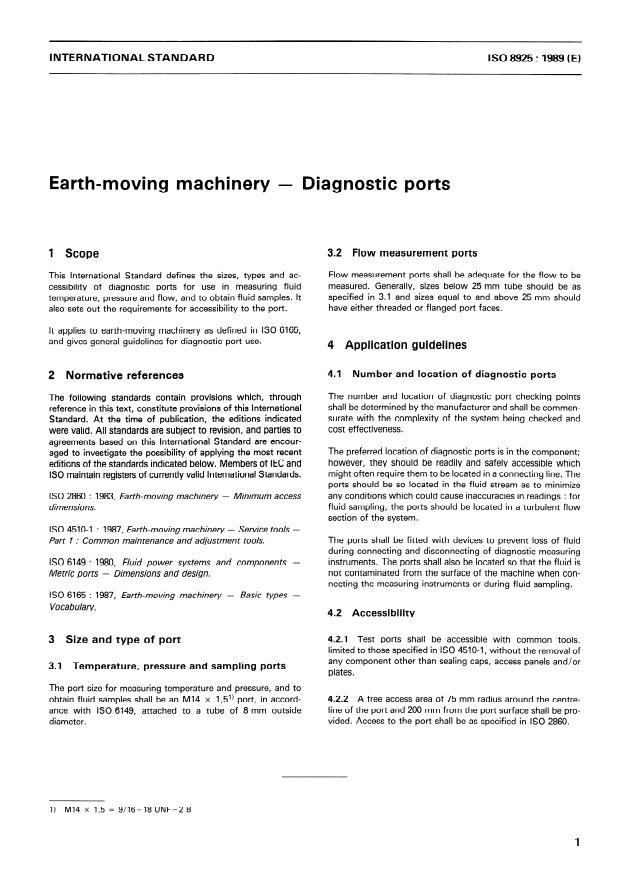
3.2 Flow measurement ports
1 Scope
Flow measurement ports shall be adequate for the flow to be
This International Standard defines the sizes, types and ac-
measured. Generally, sizes below 25 mm tube should be as
cessibility of diagnostic ports for use in measuring fluid
specified in 3.1 and sizes equal to and above 25 mm should
temperature, pressure and flow, and to obtain fluid samples. It
have either threaded or flanged port faces.
also sets out the requirements for accessibility to the port.
It applies to earth-moving machinery as defined in IS0 6165,
and gives general guidelines for diagnostic port use.
4 Application guidelines
4.1 Number and location of diagnostic ports
2 Normative references
The number and location of diagnostic port checking points
The following standards contain pr
...
ISO
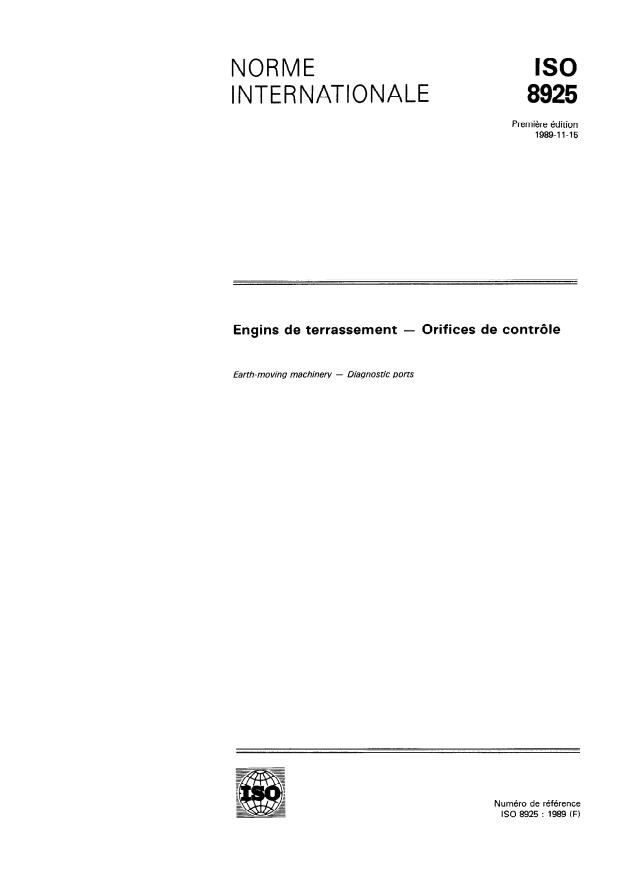
NORME
INTERNATIONALE
Première édition
1989-l 1-15
Engins de terrassement - Orifices de contrôle
Earth-moving machinery - Diagnostic ports
Numéro de référence
ISO 8925 : 1989 (FI
ISO 8925 : 1989 (FI
Avant-propos
L’ISO (Organisation internationale de normalisation) est une fédération mondiale
d’organismes nationaux de normalisation (comités membres de I’ISO). L’élaboration
des Normes internationales est en général confiée aux comités techniques de I’ISO.
Chaque comité membre intéressé par une étude a le droit de faire partie du comité
technique créé à cet effet. Les organisations internationales, gouvernementales et non
gouvernementales, en liaison avec I’ISO participent également aux travaux. L’ISO col-
labore étroitement avec la Commission électrotechnique internationale (CEI) en ce qui
concerne la normalisation électrotechnique.
Les projets de Normes internationales adoptés par les comités techniques sont soumis
aux comités membres pour approbation, avant leur acceptation comme Normes inter-
nationales par le Conseil de I’ISO. Les Normes internationales sont approuvées confor-
mément aux procédures de I’ISO qui requièrent l’approbation de 75 % au moins des
comités membres votants.
La Norme internationale ISO 8925 a été élaborée par le comité technique ISO/TC 127,
Engins de terrassement.
0 ISO 1989
Droits de reproduction réservés. Aucune partie de cette publication ne peut être reproduite ni
utilisée sous quelque forme que ce soit et par aucun procédé, électronique ou mécanique,
y compris la photocopie et les microfilms, sans l’accord écrit de l’éditeur.
Organisation internationale de normalisation
Case postale 56 l CH-1211 Genève 20 l Suisse
Imprimé en Suisse
ISO 8925 : 1989 (FI
NORME INTERNATIONALE
Engins de terrassement - Orifices de contrôle
3.2 Orifices de mesurage du débit
1 Domaine d’application
La présente Norme internationale prescrit les dimensions et
Les orifices de mesurage du débit doivent être proportionnés au
définit les types et l’accessibilité d’orifices de contrôle destinés débit à mesurer. En règle générale, les dimensions des tubes
à mesurer la température, la pression et le débit des fluides,
inférieures à 25 mm devraient être conformes aux spécifica-
ainsi qu’à obtenir des échantillons de fluides. Elle établit égale- tions de 3.1 et les faces des orifices ayant des dimensions éga-
ment les prescriptions d’accessibilité aux orifices.
les ou supérieures à 25 mm devraient être du type à filetage ou
à bride.
La présente Norme internationale s’applique aux engins de ter-
rassement tels que définis dans I’ISO 6165, et elle donne des
4 Directives d’installation
directives générales d’utilisation des orifices de contrôle.
4.1 Nombre et emplacement des orifices de
2 Références normatives
contrôle
Les normes suivantes contiennent des dispositions qui, par
Le nombre et l’emplacement des orifices de contrôle doivent
suite de la référence q
...
ISO
NORME
INTERNATIONALE
Première édition
1989-l 1-15
Engins de terrassement - Orifices de contrôle
Earth-moving machinery - Diagnostic ports
Numéro de référence
ISO 8925 : 1989 (FI
ISO 8925 : 1989 (FI
Avant-propos
L’ISO (Organisation internationale de normalisation) est une fédération mondiale
d’organismes nationaux de normalisation (comités membres de I’ISO). L’élaboration
des Normes internationales est en général confiée aux comités techniques de I’ISO.
Chaque comité membre intéressé par une étude a le droit de faire partie du comité
technique créé à cet effet. Les organisations internationales, gouvernementales et non
gouvernementales, en liaison avec I’ISO participent également aux travaux. L’ISO col-
labore étroitement avec la Commission électrotechnique internationale (CEI) en ce qui
concerne la normalisation électrotechnique.
Les projets de Normes internationales adoptés par les comités techniques sont soumis
aux comités membres pour approbation, avant leur acceptation comme Normes inter-
nationales par le Conseil de I’ISO. Les Normes internationales sont approuvées confor-
mément aux procédures de I’ISO qui requièrent l’approbation de 75 % au moins des
comités membres votants.
La Norme internationale ISO 8925 a été élaborée par le comité technique ISO/TC 127,
Engins de terrassement.
0 ISO 1989
Droits de reproduction réservés. Aucune partie de cette publication ne peut être reproduite ni
utilisée sous quelque forme que ce soit et par aucun procédé, électronique ou mécanique,
y compris la photocopie et les microfilms, sans l’accord écrit de l’éditeur.
Organisation internationale de normalisation
Case postale 56 l CH-1211 Genève 20 l Suisse
Imprimé en Suisse
ISO 8925 : 1989 (FI
NORME INTERNATIONALE
Engins de terrassement - Orifices de contrôle
3.2 Orifices de mesurage du débit
1 Domaine d’application
La présente Norme internationale prescrit les dimensions et
Les orifices de mesurage du débit doivent être proportionnés au
définit les types et l’accessibilité d’orifices de contrôle destinés débit à mesurer. En règle générale, les dimensions des tubes
à mesurer la température, la pression et le débit des fluides,
inférieures à 25 mm devraient être conformes aux spécifica-
ainsi qu’à obtenir des échantillons de fluides. Elle établit égale- tions de 3.1 et les faces des orifices ayant des dimensions éga-
ment les prescriptions d’accessibilité aux orifices.
les ou supérieures à 25 mm devraient être du type à filetage ou
à bride.
La présente Norme internationale s’applique aux engins de ter-
rassement tels que définis dans I’ISO 6165, et elle donne des
4 Directives d’installation
directives générales d’utilisation des orifices de contrôle.
4.1 Nombre et emplacement des orifices de
2 Références normatives
contrôle
Les normes suivantes contiennent des dispositions qui, par
Le nombre et l’emplacement des orifices de contrôle doivent
suite de la référence q
...