


ISO/IEC 9995-9
(Main)Information technology - Keyboard layouts for text and office systems - Part 9: Groups and mechanisms for multilingual and multiscript input
Information technology - Keyboard layouts for text and office systems - Part 9: Groups and mechanisms for multilingual and multiscript input
Within the general scope described in ISO/IEC 9995-1, ISO 9995-9:2016 defines the allocation on a keyboard of a set of graphic characters which, when used in combination with an existing national version keyboard layout, allows the input of a minimum character repertoire as defined herein. This repertoire is intended to address all characters needed to write all contemporary languages using the Latin script, together with standardized Latin transliterations of some major languages using other scripts. It also contains all symbols and punctuation marks contained in ISO 8859-1, together with some selected other ones commonly used in typography and office use. It also addresses characters of some other scripts (Greek, Cyrillic, Armenian, Georgian, Hebrew) to the same extent (in the case of Cyrillic, leaving out some minority languages of the Russian Federation which have only a few hundred speakers left). It provides means to include other scripts (e.g. Arabic, Devanagari) in future versions of ISO 9995-9:2016 (e.g. by amendments). Furthermore, it addresses the International Phonetic Alphabet (IPA). ISO 9995-9:2016 is primarily intended for word-processing and text-processing applications, to be used with full-sized keyboards as well as with miniature keyboards found on mobile devices ("smartphones" or handheld computers), especially ones which have only keys for the 26 basic Latin letters but no dedicated keys for digits.
Technologies de l'information — Disposition des claviers conçus pour la bureautique — Partie 9: Groupes et mécanismes pour la saisie multilingue et multi-écritures
Dans le domaine d'application général de la partie 1 de l'ISO/IEC 9995, ISO 9995-9:2016 décrit l'affectation sur le clavier d'un ensemble de caractères graphiques qui, lorsqu'ils sont utilisés de pair avec une disposition nationale de clavier existante, permettent la saisie d'un répertoire de caractères minimal tel que défini ci-dessous. Ce répertoire est destiné à référencer tous les caractères nécessaires pour écrire la totalité des langues contemporaines utilisant l'écriture latine, ainsi que des translittérations latines normalisées de certaines langues majeures utilisant d'autres écritures. De plus, il contient tous les symboles et les signes de ponctuation contenus dans l'ISO 8859-1, ainsi que certains autres symboles communément utilisés en typographie et bureautique. Il référence également les caractères de certaines autres écritures (grecque, cyrillique, arménienne, géorgienne, hébraïque) dans la même mesure (à l'exception pour le cyrillique de certaines langues minoritaires de la Fédération de Russie pour lesquelles il ne reste qu'une centaine de locuteurs). Il donne les moyens d'inclure d'autres écritures (par exemple arabe, dévanâgarî) dans des versions futures de la présente norme (par exemple par des amendements). Enfin, il inclut l'Alphabet Phonétique International (API). ISO 9995-9:2016 est principalement destinée aux applications de traitement de texte, pour être utilisée à la fois avec les claviers complets et avec les claviers miniatures des appareils mobiles (tels que les « téléphones intelligents » ou les ordinateurs de poche), en particulier ceux qui ne disposent que de touches dédiées aux 26 lettres latines de base, sans touches dédiées aux chiffres.
General Information
- Status
- Not Published
- Technical Committee
- ISO/IEC JTC 1/SC 35 - User interfaces
- Current Stage
- 6000 - International Standard under publication
- Start Date
- 29-Nov-2025
- Completion Date
- 07-Jan-2026
Relations
- Effective Date
- 03-Feb-2024
- Effective Date
- 03-Feb-2024
Overview
ISO/IEC 9995-9 (Part 9) is an international standard that specifies groups and mechanisms for multilingual and multiscript input on keyboards used for text and office systems. The 2025 edition revises and extends the 2016 version. It defines how sets of graphic characters are mapped onto the 26 basic Latin keys (A–Z) and digit keys (0–9), creating named “groups” that enable entry of a minimum character repertoire for:
- all contemporary languages using the Latin script (and standardized Latin transliterations of major non‑Latin languages),
- common typographic symbols and punctuation (including ISO 8859-1 symbols),
- selected characters from other scripts (Greek, Cyrillic, Armenian, Georgian, Hebrew),
- the International Phonetic Alphabet (IPA).
The standard is intended for word‑processing/text‑processing on full‑size keyboards and miniature keyboards (e.g., smartphones) that may only expose the 26 basic Latin keys.
Key topics and requirements
- Group definitions: Mappings of character sets onto Latin keys (upper/lower levels) and digit keys; tables for groups are provided in normative annexes.
- Mechanisms and modes: Defines group and mode selection, single‑select vs. switch‑to behaviour, reference groups, and special modes (e.g., Unicode decimal/hexadecimal entry, IPA mode).
- Special functions: Introduces the Superselect function to single‑select groups via a key or key combination; defines special character select functions.
- Keyboard types: Formal definitions for alphanumeric keyboards, Latin keyboards, and Latin conformant keyboards (requirements include at least 26 letter keys and 10 digit keys).
- Conformance levels: Specifies multiple conformance levels-full conformance, single‑selection conformance, per‑group conformance, and IPA conformance-and guidance for font conformance claims.
- Normative references and machine‑readable annexes: References ISO/IEC 9995‑1 (general principles) and ISO/IEC 10646 (Unicode/Universal Coded Character Set); includes machine‑readable character lists (Annexes E/F).
Applications and who uses it
ISO/IEC 9995-9 is practical for:
- Operating system and input method developers (multilingual keyboard layouts and IMEs)
- Hardware manufacturers (keyboard firmware and on‑screen keyboards for mobile devices)
- Localization and internationalization engineers (ensuring complete character repertoires)
- Font designers (providing glyph coverage for conformance statements)
- Document and office software vendors (text/word processing with multilingual/multiscript input)
- Accessibility and linguistic tool developers (IPA input support)
Implementing this standard helps ensure consistent, interoperable input methods across platforms and devices for multilingual text entry.
Related standards
- ISO/IEC 9995-1 - General principles governing keyboard layouts
- ISO/IEC 10646 - Universal Coded Character Set (Unicode)
Keywords: ISO/IEC 9995-9, keyboard layouts, multilingual input, multiscript, Superselect, IPA input, Unicode, ISO/IEC 10646, alphanumeric keyboard, conformance.
ISO/IEC FDIS 9995-9 - Information technology — Keyboard layouts for text and office systems — Part 9: Groups and mechanisms for multilingual and multiscript input Released:19. 09. 2025
REDLINE ISO/IEC FDIS 9995-9 - Information technology — Keyboard layouts for text and office systems — Part 9: Groups and mechanisms for multilingual and multiscript input Released:19. 09. 2025
Frequently Asked Questions
ISO/IEC 9995-9 is a draft published by the International Organization for Standardization (ISO). Its full title is "Information technology - Keyboard layouts for text and office systems - Part 9: Groups and mechanisms for multilingual and multiscript input". This standard covers: Within the general scope described in ISO/IEC 9995-1, ISO 9995-9:2016 defines the allocation on a keyboard of a set of graphic characters which, when used in combination with an existing national version keyboard layout, allows the input of a minimum character repertoire as defined herein. This repertoire is intended to address all characters needed to write all contemporary languages using the Latin script, together with standardized Latin transliterations of some major languages using other scripts. It also contains all symbols and punctuation marks contained in ISO 8859-1, together with some selected other ones commonly used in typography and office use. It also addresses characters of some other scripts (Greek, Cyrillic, Armenian, Georgian, Hebrew) to the same extent (in the case of Cyrillic, leaving out some minority languages of the Russian Federation which have only a few hundred speakers left). It provides means to include other scripts (e.g. Arabic, Devanagari) in future versions of ISO 9995-9:2016 (e.g. by amendments). Furthermore, it addresses the International Phonetic Alphabet (IPA). ISO 9995-9:2016 is primarily intended for word-processing and text-processing applications, to be used with full-sized keyboards as well as with miniature keyboards found on mobile devices ("smartphones" or handheld computers), especially ones which have only keys for the 26 basic Latin letters but no dedicated keys for digits.
Within the general scope described in ISO/IEC 9995-1, ISO 9995-9:2016 defines the allocation on a keyboard of a set of graphic characters which, when used in combination with an existing national version keyboard layout, allows the input of a minimum character repertoire as defined herein. This repertoire is intended to address all characters needed to write all contemporary languages using the Latin script, together with standardized Latin transliterations of some major languages using other scripts. It also contains all symbols and punctuation marks contained in ISO 8859-1, together with some selected other ones commonly used in typography and office use. It also addresses characters of some other scripts (Greek, Cyrillic, Armenian, Georgian, Hebrew) to the same extent (in the case of Cyrillic, leaving out some minority languages of the Russian Federation which have only a few hundred speakers left). It provides means to include other scripts (e.g. Arabic, Devanagari) in future versions of ISO 9995-9:2016 (e.g. by amendments). Furthermore, it addresses the International Phonetic Alphabet (IPA). ISO 9995-9:2016 is primarily intended for word-processing and text-processing applications, to be used with full-sized keyboards as well as with miniature keyboards found on mobile devices ("smartphones" or handheld computers), especially ones which have only keys for the 26 basic Latin letters but no dedicated keys for digits.
ISO/IEC 9995-9 is classified under the following ICS (International Classification for Standards) categories: 35.180 - IT Terminal and other peripheral equipment. The ICS classification helps identify the subject area and facilitates finding related standards.
ISO/IEC 9995-9 has the following relationships with other standards: It is inter standard links to ISO/IEC 9995-9:2016, ISO/IEC 9995-9:2016/Amd 1:2019. Understanding these relationships helps ensure you are using the most current and applicable version of the standard.
ISO/IEC 9995-9 is available in PDF format for immediate download after purchase. The document can be added to your cart and obtained through the secure checkout process. Digital delivery ensures instant access to the complete standard document.
Standards Content (Sample)
FINAL DRAFT
International
Standard
ISO/IEC FDIS
9995-9
ISO/IEC JTC 1/SC 35
Information technology —
Secretariat: AFNOR
Keyboard layouts for text and office
Voting begins on:
systems —
2025-10-03
Part 9:
Voting terminates on:
2025-11-28
Groups and mechanisms for
multilingual and multiscript input
Technologies de l'information — Disposition des claviers conçus
pour la bureautique —
Partie 9: Groupes et mécanismes pour la saisie multilingue et
multi-écritures
RECIPIENTS OF THIS DRAFT ARE INVITED TO SUBMIT,
WITH THEIR COMMENTS, NOTIFICATION OF ANY
RELEVANT PATENT RIGHTS OF WHICH THEY ARE AWARE
AND TO PROVIDE SUPPOR TING DOCUMENTATION.
IN ADDITION TO THEIR EVALUATION AS
BEING ACCEPTABLE FOR INDUSTRIAL, TECHNO
LOGICAL, COMMERCIAL AND USER PURPOSES, DRAFT
INTERNATIONAL STANDARDS MAY ON OCCASION HAVE
TO BE CONSIDERED IN THE LIGHT OF THEIR POTENTIAL
TO BECOME STAN DARDS TO WHICH REFERENCE MAY BE
MADE IN NATIONAL REGULATIONS.
Reference number
ISO/IEC FDIS 99959:2025(en) © ISO/IEC 2025
FINAL DRAFT
ISO/IEC FDIS 9995-9:2025(en)
International
Standard
ISO/IEC FDIS
9995-9
ISO/IEC JTC 1/SC 35
Information technology —
Secretariat: AFNOR
Keyboard layouts for text and office
Voting begins on:
systems —
Part 9:
Voting terminates on:
Groups and mechanisms for
multilingual and multiscript input
Technologies de l'information — Disposition des claviers conçus
pour la bureautique —
Partie 9: Groupes et mécanismes pour la saisie multilingue et
multi-écritures
RECIPIENTS OF THIS DRAFT ARE INVITED TO SUBMIT,
WITH THEIR COMMENTS, NOTIFICATION OF ANY
RELEVANT PATENT RIGHTS OF WHICH THEY ARE AWARE
AND TO PROVIDE SUPPOR TING DOCUMENTATION.
© ISO/IEC 2025
IN ADDITION TO THEIR EVALUATION AS
All rights reserved. Unless otherwise specified, or required in the context of its implementation, no part of this publication may
BEING ACCEPTABLE FOR INDUSTRIAL, TECHNO
LOGICAL, COMMERCIAL AND USER PURPOSES, DRAFT
be reproduced or utilized otherwise in any form or by any means, electronic or mechanical, including photocopying, or posting on
INTERNATIONAL STANDARDS MAY ON OCCASION HAVE
the internet or an intranet, without prior written permission. Permission can be requested from either ISO at the address below
TO BE CONSIDERED IN THE LIGHT OF THEIR POTENTIAL
or ISO’s member body in the country of the requester.
TO BECOME STAN DARDS TO WHICH REFERENCE MAY BE
MADE IN NATIONAL REGULATIONS.
ISO copyright office
CP 401 • Ch. de Blandonnet 8
CH-1214 Vernier, Geneva
Phone: +41 22 749 01 11
Email: copyright@iso.org
Website: www.iso.org
Published in Switzerland Reference number
ISO/IEC FDIS 99959:2025(en) © ISO/IEC 2025
© ISO/IEC 2025 – All rights reserved
ii
ISO/IEC FDIS 9995-9:2025(en)
Contents Page
Foreword . iv
Scope. 1
Normative references . 1
Terms and definitions . 1
Conformance . 3
Groups defined in this document . 5
Group and mode selection . 9
Special keys . 11
Special modes "Unicode decimal" and "Unicode hexadecimal" . 12
Entering IPA characters . 13
Annex A (normative) Group definition tables . 17
Annex B (normative) Table for IPA input . 31
Annex C (informative) General information . 33
Annex D (informative) Character tables in machine-readable form . 43
Annex E (informative) Summary of ISO/IEC 10646 characters . 47
Annex F (informative) List of ISO/IEC 10646 characters contained in any group or in the “Table for IPA
input” . 50
Bibliography . 78
© ISO/IEC 2025 – All rights reserved
iii
ISO/IEC FDIS 9995-9:2025(en)
Foreword
ISO (the International Organization for Standardization) and IEC (the International Electrotechnical
Commission) form the specialized system for worldwide standardization. National bodies that are members
of ISO or IEC participate in the development of International Standards through technical committees
established by the respective organization to deal with particular fields of technical activity. ISO and IEC
technical committees collaborate in fields of mutual interest. Other international organizations,
governmental and non-governmental, in liaison with ISO and IEC, also take part in the work.
The procedures used to develop this document and those intended for its further maintenance are described
in the ISO/IEC Directives, Part 1. In particular, the different approval criteria needed for the different types
of document should be noted. This document was drafted in accordance with the editorial rules of the
ISO/IEC Directives, Part 2 (see www.iso.org/directives or www.iec.ch/members_experts/refdocs).
ISO and IEC draw attention to the possibility that the implementation of this document may involve the use
of (a) patent(s). ISO and IEC take no position concerning the evidence, validity or applicability of any claimed
patent rights in respect thereof. As of the date of publication of this document, ISO and IEC had not received
notice of (a) patent(s) which may be required to implement this document. However, implementers are
cautioned that this may not represent the latest information, which may be obtained from the patent
database available at www.iso.org/patents and https://patents.iec.ch. ISO and IEC shall not be held
responsible for identifying any or all such patent rights.
Any trade name used in this document is information given for the convenience of users and does not
constitute an endorsement.
For an explanation of the voluntary nature of standards, the meaning of ISO specific terms and expressions
related to conformity assessment, as well as information about ISO's adherence to the World Trade
Organization (WTO) principles in the Technical Barriers to Trade (TBT) see
www.iso.org/iso/foreword.html. In the IEC, see www.iec.ch/understanding-standards.
This document was prepared by Joint Technical Committee ISO/IEC JTC 1, Information technology,
Subcommittee SC 35, User interfaces.
This second edition cancels and replaces the first edition (ISO/IEC 9995-9:2016), which has been technically
revised. It also incorporates the Amendment ISO/IEC 9995-9:2016/Amd. 1:2019.
The main changes are as follows:
— conformant keyboards now are required to have separate keys for digits, as it is common for hardware
keyboards used for text processing, and can be displayed easily as on-screen keyboards on
contemporary mobile devices. Thus, miniature hardware keyboards which were common in the early
st
21 century on mobile phones but now are fallen out of use are no longer supported;
— the descriptions of the groups defined in this document and of specific mechanisms to access these are
separated, thus other standards can reference specific groups defined in this document without having
to reference the mechanisms;
© ISO/IEC 2025 – All rights reserved
iv
ISO/IEC FDIS 9995-9:2025(en)
— the groups containing Latin letters and symbols are reorganized, to make them clearer and more
systematic, and thus more usable. Some minor changes also are made to other groups. Also, some
characters ant three new groups for variants of the Georgian script are added;
— all references to characters which are not included in ISO/IEC 10646 (Unicode), and therefore have to be
encoded in the PUA (Private Use Area) in specific fonts, are deleted;
— the optional special key which was named “Secondary Superselect” is now named “Special Character
Select”;
— the formal recommendations for the positioning of the “Superselect” key and of a “Special Character
Select” keys are dropped. The previously recommended positions now are mentioned in informative
notes.
A list of all parts in the ISO/IEC 9995 series can be found on the ISO and IEC websites.
Any feedback or questions on this document should be directed to the user’s national standards body. A
complete listing of these bodies can be found at www.iso.org/members.html and www.iec.ch/national-
committees.
© ISO/IEC 2025 – All rights reserved
v
FINAL DRAFT International Standard ISO/IEC FDIS 9995-9:2025(en)
Information technology — Keyboard layouts for office
systems —
Part 9:
Groups and mechanisms for multilingual and multiscript
input
1 Scope
Within the general scope described in ISO/IEC 9995-1, this document defines mappings of different sets of
graphic characters onto the uppercase and lowercase forms of the 26 basic Latin characters (A–Z and a–z)
and the digits 0–9, each of these mappings constituting a “group” as defined in ISO/IEC 9995-2.
A detailed synopsis is contained in the informative Annex C.
This document is primarily intended for word-processing and text-processing applications, to be used with
keyboards which have at least 26 dedicated keys to enter letters and 10 additional keys to enter decimal
digits.
2 Normative references
The following documents, in whole or in part, are normatively referenced in this document and are
indispensable for its application. For dated references, only the edition cited applies. For undated references,
the latest edition of the referenced document (including any amendments) applies.
ISO/IEC 9995-1, Information technology — Keyboard layouts for text and office systems — Part 1: General
principles governing keyboard layouts
ISO/IEC 10646, Information technology — Universal Coded Character Set (UCS)
3 Terms and definitions
For the purposes of this document, the terms and definitions given in ISO/IEC 9995-1 and the following
apply.
ISO and IEC maintain terminology databases for use in standardization at the following addresses:
— ISO Online browsing platform: available at https://www.iso.org/obp
— IEC Electropedia: available at https://www.electropedia.org/
© ISO/IEC 2025 – All rights reserved
ISO/IEC FDIS 9995-9:2025(en)
3.1
alphanumeric keyboard
keyboard having at least the following 39 different keys: 26 keys usable for the Latin letters A–Z (even if this
is not their primary use), 10 keys for the digits 0–9, a Space key, an Enter key; and a level 2 selector key
Note 1 to entry: The digit keys typically enter the digits in level 1 or 2 of group 1.
Note 2 to entry: The level 2 selector key is usually called "shift key".
3.2
associated with
key or key combination used to enter a specific character
Note 1 to entry: Any group and/or level selection prerequisite for this action must be done for the actuation of a key to
enter the intended character or call the intended function.
3.3
base mode
mode in which keys have their usual function such as selecting characters according to the active group and
level
3.4
digit key
key associated with any digit 0–9
3.5
enter key
key associated with an enter or return function
3.6
Latin keyboard
keyboard with a layout which has all Latin lowercase letters a–z (U+0061–U+007A) in group 1 level 1, and
all Latin uppercase letters A–Z (U+0041–U+005A) in group 1 level 2, each uppercase letter being associated
with the same key as its lowercase counterpart, and which has a level 2 selector key which is either to be
pressed simultaneously with the letter key or separately immediately before pressing the letter key, to select
level 2
3.7
Latin conformant keyboard
keyboard with a layout which has all Latin letters a–z and A–Z in a single group other than Group 1, where
that group can be selected permanently, and which otherwise behaves as a Latin keyboard as long as that
group is selected
3.8
mode
state which determines the effects of all the keys of a keyboard
© ISO/IEC 2025 – All rights reserved
ISO/IEC FDIS 9995-9:2025(en)
3.9
reference group
group that is switched to, or reverted to after the actuation of a key has disengaged a group previously
single-selected to
3.10
reference group switching mode
special mode where the next actuation of a key either switches to a new group or has the sole effect of
generating an error signal to the user, when there is no group to be switched to when pressing that key
3.11
single-select
select a group or level in such a manner that only the next actuation of a key is affected, with the group
reverting to the previously selected group (reference group) afterwards
3.12
space key
key associated with character U+0020 SPACE
3.13
special mode
mode which is not the base mode, and where the functions of the keys are defined by the description of the
mode
3.14
superselect
function which, upon simultaneous or consecutive actuation of any key associated with a Latin letter A–Z
(without the Shift key, thus effectively actuating the lowercase variant of the letter), single-selects or
switches to a specific group
EXAMPLE Superselect can be a key, a combination of keys, or another function.
3.15
switch to
select a group or a mode which then stays in effect until another group or mode is selected, be it by
switching to another group or selecting another reference group
3.16
symbol
graphical symbol which is neither a letter nor a digit
Note 1 to entry: This definition does not apply to the term "symbol" as part of the phrase "graphical symbol" as defined
in ISO/IEC 9995-1.
4 Conformance
4.1 General
© ISO/IEC 2025 – All rights reserved
ISO/IEC FDIS 9995-9:2025(en)
The layout of a keyboard can fully or partially conform to this document in a level defined in the following
subclauses if it meets all of the following conditions:
It is either a Latin keyboard, or a Latin conformant keyboard, as defined in Clause 3.
It is an alphanumeric keyboard, as defined in Clause 3.
The keyboard is intended to output valid ISO/IEC 10646 characters and valid sequences thereof.
There is a special function called "Superselect", which, when (according to the layout) either operated
(i.e. pressed if it is a key) together with any a–z key, or followed by the actuation of any a–z key,
performs the function according to Tables 2 and 3 in Clause 6.
NOTE 1 The "Superselect" can be a single dedicated key, or a special sequence of other keys to be input.
EXAMPLES:
The "Superselect" can be a "symbol key" to be pressed together with a "shift key".
The "Superselect" can be the “Tab” key or a specific letter key pressed together with the Level 3 Select key (which
is commonly named “Alt Gr”).
NOTE 2 Keyboard symbols for the “Superselect” function are defined in ISO/IEC 9995-7 as symbols #100 and #111.
There are several levels of conformance described in subclause 4.2.
Lists of Unicode values of the characters accessible by such levels of conformance are provided in the informative
Annex E.
A cross reference list of the Unicode values enterable by methods defined in this document, referencing these methods,
is given in the informative Annex F.
NOTE 3 The annexes E and F are intended as an aid for font designers to enable conformance statements for their
fonts as described in subclause 4.2.5.
4.2 Levels of Conformance
4.2.1 Full conformance
A keyboard layout (in conjunction with the software which implements it) is fully conformant to this
document if it meets the following conditions (additionally to the ones listed in the previous subclause
“General”):
All groups listed in Table 2 and specified in the subsequent text are contained in the layout, except
Group L for a Latin keyboard. The groups may contain additional characters associated with other keys
than in the tables.
All modes and select functions listed in Table 3 and specified in the subsequent text work as described in
this document.
NOTE 1 It is not specified in this document which characters or symbols are in fact to be engraved on the keyboard.
As full conformance includes the implementation of the IPA mode, there is no need to implement the
“Entering IPA characters with a special function key” according to subclause 9.3.
© ISO/IEC 2025 – All rights reserved
ISO/IEC FDIS 9995-9:2025(en)
Any statement of conformance to this document shall be taken to imply that the complete character
repertoire of the “Table for IPA input” in Annex B and of all groups listed in Clause 6 has been implemented.
4.2.2 Single-Selection conformance
A keyboard layout (in conjunction with the software which implements it) is “single-selection conformant”
to this document if it meets the following conditions (additionally to the ones listed in the previous
subclause 4.1):
All groups listed in Table 1 and marked there with an “X” in the column “C.” are contained in the layout,
except Group L for a Latin keyboard, and except Group YU for keyboards where all characters contained
in that group are associated with other keys.
The groups may contain additional characters associated with other keys than in the tables.
Characters of these groups can be single-selected by using the Superselect key (or key combination)
together with (i.e. either simultaneously pressed or followed by) the group selection character listed in
Table 3 of Clause 6, followed by the associated key listed in the group definition.
It is not required to implement the “Entering IPA characters with a special function key” according to
subclause 9.3 to get single-selection conformance. If this is done, the “IPA conformance” as specified in 4.2.4
is gained in parallel.
4.2.3 Conformance for single groups
A keyboard layout is conformant to a single group defined in this document, if this group is included, and if it
specifies a single-selection key or key combination for this group, and if the characters of this group are
selected by using the associated key listed in the group definition.
4.2.4 IPA conformance
A keyboard layout is “IPA conformant” if it either implements the IPA mode defined in this document as
described in subclause 9.2, or if it implements a function key (or key combination) as described in subclause
9.3.
4.2.5 Conformance statements for fonts
Statements of conformance may be made for fonts which contain all characters contained in groups (as
defined in this document) which are listed in the conformance statement, or all characters needed for full
conformance, single-selection conformance of IPA conformance (if the conformance statement expresses
such).
5 Groups defined in this document
5.1 General
The groups defined in this document are denoted:
— either by a single Latin letter (if such a group is to be primarily used as a reference group which can be
switched to, which does not exclude that such a group can also be single-selected),
© ISO/IEC 2025 – All rights reserved
ISO/IEC FDIS 9995-9:2025(en)
— or by a combination of two Latin letters (if such a group is primarily designed to be single-selected). For
the latter ones, the first letter either denotes the single-letter-named group to which its content is
related, or "D" for diacritics, or "Y" for symbols (including digits).
The single letter "N" and all two letter combinations containing a "N" are reserved for groups defined in
national standards conformant with this document and thus will not be used in future versions of this
document.
The group number according to ISO/IEC 9995-1 is computed for the former groups as "letter number × 100",
for the latter groups as "first letter number × 100 + second letter number", where "letter number" is 1 for A,
2 for B, and so on until 26 for Z (e.g. "Group G" is "Group 700", "Group GE" is "Group 705").
This document thus defines groups within the number range from "Group 100" to "Group 2626" (not filling
this number range contiguously).
The groups are defined in the normative Annex A.
The informative Annex C contains general information of the design considerations leading to this document
and the layout of the groups, especially notes on single groups.
5.2 Types of groups defined in this document
There are four types of groups defined in this document:
— simple: such a group contains up to 52 characters, which are associated with the basic Latin letters A–Z
and a–z.
— special: such a group contains up to 52 characters or character pairs, which are associated with the basic
Latin letters A–Z and a–z. The selection of a character pair requires special handling (either causing the
input of the sequence of both characters, or causing the selection of one of the two characters depending
on the input context), as described in the normative Annex A.
— alphanumeric: such a group contains up to 62 characters, which are associated with the basic Latin
letters A–Z and a–z and the decimal digits 0–9.
— modifying: such a group contains consistently modified (i.e. encircled, lowered/subscript or
raised/superscript) character variants of the basic Latin letters A–Z and a–z and the decimal digits 0–9,
associated with these characters. In addition, any keyboard layout definition may add such modified
character variants for other characters (e.g., an encircled or raised plus sign associated with “+”) to such
a group.
5.3 List of groups defined in this document
In this document, there are 37 groups listed in Table 1 and defined in the normative Annex A “Group
definition tables”.
The informative Annex D contains a consolidated list of these groups and the characters they contain in a
machine readable form.
NOTE The informative Annex D is intended as an aid for software developers implementing the methods described
in this document.
© ISO/IEC 2025 – All rights reserved
ISO/IEC FDIS 9995-9:2025(en)
Table 1 — List of the groups defined in this document
a b c
Name Description Type S. C.
A Group A (Arabic) S
AE Group AE (“Arabic Extra Letters”) S (e)
C Group C ("Cyrillic") -
CE Group CE (“Cyrillic Extra Letters”) - (e)
CX Group CX (“Cyrillic Additional Extra Letters”) - (x)
CS Group CS (“Cyrillic Church Slavonic Letters”) - (z)
DD Group DD (“Diacritics”) - a X
DS Group DS (“Spacing Diacritics and Similar Characters”) - v X
DI Group DI (“Diacritics for IPA”) - j
DJ Group DJ (“Spacing Diacritics and Symbols for IPA”) - w
G Group G ("Greek") - g X
GE Group GE (“Greek Extra Letters”) - y/(e) X
H Group H ("Hebrew") -
HE Group HE (“Hebrew Extra Letters”) - (e)
K Group K ("Korean Hangul") S
L Group L ("Latin") A l X
LE Group LE (“Latin Extra Letters”) A e X
LF Group LF (“Latin additional extra letters e. g. for Africa”) A f X
LA Group LA (“Latin Letters with Hook Above and similar”) - h X
LB Group LB (“Latin Letters with Hook Below and similar”) - b X
LD Group LD (“Latin Letters with Diagonal Stroke”) - x X
LH Group LH (“Latin Letters with Horizontal Stroke”) - z X
MC Group MC (“Encircled Latin Letters and Digits”) M o X
ML Group ML (“Lowered Latin Letters and Digits”) M q X
MR Group MR (“Raised Latin Letters and Digits”) M r X
Q Group Q (“Georgian Mkhedruli”: common or lowercase -
of the modern secular alphabet)
QM Group QM (“Georgian Mtravruli”: special (all caps) - (e)
uppercase of the modern secular alphabet)
QX Group QX (“Georgian Khutsuri lowercase”: lowercase of -
the old ecclesiastical alphabet)
QY Group QY (“Georgian Khutsuri uppercase”: uppercase of - (e)
© ISO/IEC 2025 – All rights reserved
ISO/IEC FDIS 9995-9:2025(en)
a b c
Name Description Type S. C.
the old ecclesiastical alphabet)
W Group W (Armenian) -
WE Group WE (“Armenian Extra letters”) - (e)
YC Group YC (“Currency symbols”) A c X
YL Group YL (“Letterlike and Other Symbols”) A t X
YM Group YM (“Mathematical symbols”) A m X
YP Group YP (“Punctuation”) A p X
YS Group YS (“Shapes and Related Symbols”) A s X
YU Group YU (“Universal Symbols”) A n X
a
“-“ denotes “simple”, “S” denotes “special”, “A” denotes “alphanumeric”, “M” denotes
“modifying”.
b
This column is informative. For groups which can be single-selected by the functions
described in Clause 6, the corresponding letter in the first column of Table 3 is shown here.
This is shown in parentheses if that letter is valid only when Group L (Latin) is not the
reference group (as described in Clause 6).
c
Groups marked with an X in this column must be implemented to be single-selectable in a
keyboard layout which claims to be Single-Selection conformant to this document (except
Group L for Latin keyboard layouts, and except Group YU for keyboards where all characters
contained in that group are associated with other keys).
5.4 Definition form and conformant use of a group defined in this document
In Annex A “Group definition tables”, the definition for each of the 37 groups defined there is shown using a
table like the one depicted in Figure 1.
00BC ¼ 00BD ½ 00BE ¾ 215B ⅛ 215C ⅜ 215D ⅝ 215E ⅞ 2153 ⅓ 2154 ⅔ 2205 ∅
1 2 3 4 5 6 7 8 9 0
211A ℚ 226B ≫ 2204 ∄ 211D ℝ 2207 ∇ 2265 ≥ 2229 ∩ 221D ∝ 2209 ∉ 220F ∏
2260 ≠ 226A ≪ 2203 ∃ 221A √ 27C2 ⊥ 2264 ≤ 222A ∪ 221E ∞ 2208 ∈ 21CC ⇌
Q W E R T Y U I O P
2135 ℵ 2211 ∑ 2206 ∆ 2234 ∴ 2287 ⊇ 210F ℏ 2284 ⊄ 2285 ⊅ 220C ∌
2200 ∀ 222B ∫ 2202 ∂ 2235 ∵ 2286 ⊆ 210E ℎ 2282 ⊂ 2283 ⊃ 220B ∋
A S D F G H J K L
2124 ℤ 2310 ⌐ 2102 ℂ 2227 ∧ 21CE ⇎ 2115 ℕ 21CF ⇏
2194 ↔ 00AC ¬ 221B ∛ 2228 ∨ 21D4 ⇔ 21D0 ⇐ 21D2 ⇒
Z X C V B N M
Figure 1 — Example of a group definition in Annex A
NOTE 1 Figure 1 does not define a group by itself. It is only an example depicted here for explanatory purposes.
However, the (identical) group definition for Group YM (Mathematical symbols) shown in Annex A is valid there.
Tables as the one depicted here contain the ISO/IEC 10646 (Unicode) code values (as 4-digit hexadecimal
numbers) for all characters which are contained in the group to be defined by such a table. In most cases, the
code number is followed by a depiction of the character.
© ISO/IEC 2025 – All rights reserved
ISO/IEC FDIS 9995-9:2025(en)
Such tables are arranged in 3 or 4 rows and 10 columns.
NOTE 2 The tables are arranged like the keys on a typical Latin layout, namely 1234567890 / qwertyuiop / asdfghjkl /
zxcvbnm. This is done only to be illustrative for users of such a keyboard. It does not mean that any layout conformant
to this document or any Latin group as part of such a layout has to be arranged in that way.
For alphanumeric and modifying groups, the first row shows the characters associated with the keys used to
input the decimal digits 1-9 and 0. The decimal digit is shown in light grey in the lower left corner of the
table cell. If the keyboard layout has the decimal digits in group 1 on Level 2 (“shifted”) positions, the
specification of that layout may include a rule that the decimal digit keys may be actuated without using the
Level 2 key (“Shift key”) to generate the selected character of the group.
For all groups, the last 3 rows (which are the only 3 rows for most groups) show the characters associated
with the keys used to input the basic Latin letters A–Z/a–z. The uppercase form of the letter is shown in light
grey in the lower left corner of the table cell. Above that, each cell contains two lines. If a character code is
shown in the upper line, it is associated with the uppercase form of the letter. If a character code is shown in
the lower line, it is associated with the lowercase form of the letter.
EXAMPLE 1 To input the fraction ⅞, you single-select the group YM (according to Table 3 in Clause 6 by
Superselect+”m”) and actuate the key used for typing “7”. On a French AZERTY keyboard, which needs the Shift key for
entering digits, it is implementation dependent whether you need the Shift key also together with the “7” key to enter
⅞ this way.
EXAMPLE 2 To input the rational number set symbol ℚ, you single-select the group YM and actuate the key
combination used for typing “Q” (usually pressing the Level 2 key, commonly named “Shift key”, together with the key
used for typing “q”). This is independent of the position of this key, which is B01 on many keyboards (e. g. US ANSI, but
also in the Latin group selectable on many non-Latin keyboards), but e.g. C01 on a French AZERTY keyboard, B07 on a
French BÉPO keyboard, or B02 on a Dvorak keyboard.
6 Group and mode selection
6.1 Reference groups
Groups which are named by a single Latin letter can act as reference groups.
Such are selected by actuating the Superselect function, followed by the letter “k” (or, on a non-Latin
keyboard, the key associated with the letter “k”), followed with a letter selecting the group according to the
following Table 2. When the Group A (Arabic) is selected by the letter “p” or “x”, also a special mode is
selected according to the table entry.
Table 2 — Reference groups and their selection
a
Letter Reference group selected by the letter key in the reference group switching mode Symbol
(i. e. by entering “Superselect” and “k” (for “Keyboard Selection”) followed by this letter)
b
a Group A (Arabic) U+0628 ب
c Group C ("Cyrillic") U+042F Я
ⴃ
e Group QX (Georgian, Khutsuri: lowercase of the old ecclesiastical alphabet)
U+2D03
g Group G ("Greek") U+0389 Ω
h Group H ("Hebrew") U+05D0 א
k Group K ("Korean Hangul") U+AC00
가가
Implementations that replace the input of Jamo sequences by the appropriate Hangul
characters when this mode is active, are conformant to this document.
© ISO/IEC 2025 – All rights reserved
ISO/IEC FDIS 9995-9:2025(en)
a
Letter Reference group selected by the letter key in the reference group switching mode Symbol
(i. e. by entering “Superselect” and “k” (for “Keyboard Selection”) followed by this letter)
l Group L ("Latin") U+004C L
m Group QM (Georgian, Mtravruli: special (all caps) uppercase of the modern secular alphabet) U+1C93
c
p Group A (Arabic) U+06F5 ۵
Switching to this group by this key also selects a mode "Eastern Arabic-Indian digits". This
mode causes that digit keys which otherwise enter the standard decimal digits U+0030–
U+0039 enter the according Eastern Arabic-Indic digits 06F0–06F9 instead. This mode stays
in effect until another "reference group" selection is done.
d
q
Group Q (Georgian, Mkhedruli: common or lowercase of the modern secular alphabet) U+10D3 დ
e
w U+053D Խ
Group W (Armenian)
x Group A (Arabic). U+0664 ٤
Switching to this group by this key also selects a mode "Arabic-Indian digits". This mode
causes that digit keys which otherwise enter the standard decimal digits U+0030–U+0039
enter the according Arabic-Indic digits 0660–0669 instead. This mode stays in effect until
another "reference group" selection is done.
a
The symbol listed in this column is to be shown inside of the ISO/IEC 9995-7 symbol 105 (“Switch to specific group”,
square with rounded corners) when this selection function is associated to a single key (in addition to the "Superselect"
mechanism described here), or it is to be displayed on an on-screen keyboard after the actuation of "Superselect".
b
This selection deselects any mode selected as listed for keys "p" or "x", i.e. digit keys subsequently enter the standard
decimal digits U+0030–U+0039
c
"p" stands for Persian/Pashto
d
"g" selects Greek
e
"a" is reserved to select Arabic
6.2 Selection of other groups and of modes
Table 3 lists the other groups and the modes specified in this document, according to the letter key which is
to be pressed after or together with the "Superselect" function, as described in Clause 3.
Table 3 — Group and mode selection functions
a
Key Function performed by this key when used with the "Superselect" function Symbol
b
a 106 ̌
Single-selects Group DD ("Diacritics").
b Single-selects Group LB ("Hook below") when Group L (Latin) is the reference group. 90
c Single-selects Group YC ("Currency symbols") 106 ¤
d Switches to Mode "Unicode decimal". 103
e Single-selects Group LE ("Latin Extra Letters") when Group L is the reference group. 106 X
Single-selects Group AE ("Arabic Extra Letters") when Group A is the reference group.
Single-selects Group CE ("Cyrillic Extra Letters") when Group C is the reference group.
Single-selects Group GE ("Greek Extra Letters") when Group G is the reference group.
Single-selects Group HE ("Hebrew Extra Letters") when Group H is the reference group.
Single-selects Group QM ("Georgian Mtravruli") when Group Q is the reference group.
Single-selects Group QY ("Georgian Khutsuri lowercase") when Group QX is the ref. group.
Single-selects Group WE ("Armenian Extra letters") when Group W is the ref. group.
f Single-selects Group LF ("Latin additional extra letters for Africa") when Group L (Latin) is the 106 Ɔ
reference group.
c
g Single-selects Group G ("Greek") 106 Ω
h Single-selects Group LA ("Hook above") when Group L (Latin) is the reference group. 91
i Switches to Mode "IPA" (International Phonetic Alphabet) 107 ə
j Single-selects Group DI ("Diacritics for IPA")
k Switches to Mode "reference group switching mode" to switch to a group according to Table 2 107 ∗
© ISO/IEC 2025 – All rights reserved
ISO/IEC FDIS 9995-9:2025(en)
a
Key Function performed by this key when used with the "Superselect" function Symbol
d
by the subsequent actuation of a key.
In keyboard layouts which have single-selection conformance (according to 4.2.2) but not full 106 +any
appropriate
conformance (according to 4.2.1), instead, it may single-select a Group NA ("National
symbol
e
additions") if such a group is defined in the applicable keyboard layout standard.
f
l 106 L
Single-selects Group L ("Latin")
On a Latin keyboard (as defined in Clause 3), instead, it may single-select a Group NL ("Latin
e
additions") if such a group is defined in the applicable keyboard layout standard.
m Single-selects Group YM ("Mathematical symbols") 106 ∞
n Single-selects Group YU (“Universal Symbols”), which contains all symbols contained in the 106 &
Unicode character range U+0021–U+007E (commonly known as ASCII).
In keyboard layouts where all characters contained in that group are associated with other keys,
instead, it may single-select a Group NN ("National") if such a group is defined in the applicable
e
keyboard layout standard.
o Single-selects Group MC (“Encircled Latin Letters and Digits”)
106 Ⓐ
p Single-selects Group YP ("Punctuation") 106 #
q Single-selects Group ML ("Lowered Latin Letters and Digits") 94
r Single-selects Group MR ("Raised Latin Letters and Digits") 93
s Single-selects Group YS ("Shapes and other Symbols")
106 ��
t Single-selects Group YL ("Letterlike and other symbols") 106 ℓ
u Switches to Mode "Unicode hexadecimal" 104
v Single-selects Group DS ("Spacing Diacritics and Similar Characters") 106 ʿ
w Single-selects Group DJ ("Spacing Diacritics and Symbols for IPA") 106 ˦
x Single-selects Group LD ("Diagonal Stroke") when Group L (Latin) is the reference group. 88
Single-selects Group CX ("Cyrillic Additional Extra Letters") when Group C (Cyrillic) is the 106 Ҕ
reference group.
g
y Single-selects Group GE ("Greek Extra Letters") 106 ϖ
Single-selects Group LH ("Horizontal Stroke") when Group L (Latin) is the reference group.
z 87
Single-selects Group CS ("Cyrillic Church Slavonic Letters") when Group C (Cyrillic) is the 106 Ѧ
reference group.
[Space] Switches to base mode and to Group 1 (whichever this is, depending on the national or 107 ←
manufacturer standard used)
a
The column "Symbol" denotes the number of the symbol in ISO/IEC 9995-7 for the group or mode selection when this selection function is
associated to a single key (in addition to the "Superselect" mechanism described here), or it is to be displayed on an on-screen keyboard
after the actuation of "Superselect". If the symbol number is 105 "Switch to specific group", 106 "Single-select a specific group", or 107
"Switch to specific mode", the number is followed by the character to be enclosed by the symbol.
b
"A" is a mnemonic for "Accents".
c
This is useful to enter single Greek letters used as symbols.
d
"k" is a mnemonic for "Keyboard selection".
e
e.g. containing precomposed letters frequent in the concerned language[s].
f
This is useful to enter single Latin letters used as symbols or abbreviations on non-Latin keyboards .
g
This is useful to enter single Greek special letters used as symbols.
7 Special keys
7.1 Special Character Select function
Keyboards may allocate a Special Character Select function, which is defined ain Table 4:
© ISO/IEC 2025 – All rights reserved
ISO/IEC FDIS 9995-9:2025(en)
Table 4 — Special Character Select function definition
Condition Effect of the Special Character Select key
If actuated once If actuated twice If actuated three times
consecutively consecutively
Single-selects group LF
Reference group is Single-selects group LE
(Latin additional extra
Group L (Latin) (Latin extra letters)
letters for Africa)
Reference group is Single-selects group AE
Group A (Arabic) (Arabic extra letters)
Single-selects Group CS
Reference group is Single-selects group CE Single-selects CX (Cyrillic
(Cyrillic church Slavonic
Group C (Cyrillic) (Cyrillic extra letters) additional extra letters)
letters)
Reference group is Single-selects group GE
Group G (Greek) (Greek extra letters)
Reference group is group Single-selects group HE
H (Hebrew) (Hebrew extra letters)
Reference group is group Single-selects group QM
Q (Georgian Mkhredruli) (Georgian Mtravruli)
Reference group is group Single-selects group QY
QX (Georgian Khutsuri (Georgian Khutsuri
lowercase) uppercase)
Reference group is group Single-selects group WE
W (Armenian) (Armenian extra letters)
The Special Character Select function may be allocated on the Backspace key pressed together with the
Level 3 Select key (commonly named “Alt Gr key”).
7.2 Use of the Backspace key
When a Backspace key is pressed immediately after a group selector, mode-switching key, or level selector
that does not require simultaneous pressing with another key, it shall simply cancel the group selection,
mode switching, or level selection.
7.3 Combining characters
As long as the Superselect mechanism is used, all combining characters (accents, diacritical marks, etc.)
contained in the groups defined in this document are to be entered after their corresponding base character,
according to the order in which they are to be stored according to ISO/IEC 10646.
8 Special modes "Unicode decimal" and "Unicode hexadecimal"
These modes are to enter any valid ISO/IEC 10646 character, by entering their code point values as decimal
resp. hexadecimal number.
NOTE 1 The names of these special modes reflect the fact that the character set defined by ISO/IEC 10646 is usually
synchronized with the one defined by the industry standard "Unicode", the name of which is more popular and
memorable, and is reflected in the "U"-like shapes of the ISO/IEC 9995-7 symbols which are associated with these
special modes.
The mode "Unicode Decimal" works as follows:
© ISO/IEC 2025 – All rights reserved
ISO/IEC FDIS 9995-9:2025(en)
All actuations of keys associated with decimal digits are temporarily stored into a sequence representing a
decimal number. When any other key except a Backspace key is pressed, then, if the decimal number
contains at least one digit and represents a valid ISO/IEC 10646 value, then the according character shall be
output. If not, then a U+FFFD OBJECT REPLACEMENT CHARACTER shall be output, followed by the entered
sequence of decimal digits. In any case, the temporary sequence shall be cleared.
Then, if the other key pressed is not an Enter key, a Decimal Separator key or a Space key, the keyboard shall
be switched to base mode.
If the other key pressed is an Enter key, the keyboard shall be switched to base mode, and the Enter key
itself shall not be processed further.
If the other key pressed is a Decimal Separator or a Space key, the mode "Unicode Decimal" shall persist, and
the Decimal Separator key or Space key itself shall not be processed further.
If a Backspace key is pressed, while the temporarily stored sequence is not empty, the last digit appended to
that sequence shall be dropped from that sequence.
NOTE 2 If a Backspace key is pressed, while the temporarily stored sequence is empty, the effect is not defined by
this document.
NOTE 3 The underlying software is allowed to erase the last entered ISO/IEC 10646 character from the input
sequence but is not required to do so, as it is beyond the scope of this document what happens to characters on
completion of entering.
Thus, the user can enter any sequence of valid ISO/IEC 10646 characters by entering their decimal code
values, separated by Space or decimal separator (which is especially convenient if any numeric keypad is
used), and terminated by Enter.
The mode "Unicode Hexadecimal" works accordingly. Hexadecimal digits are all decimal digits and A–F and
a–f, not differentiating between upper and lower case.
Valid ISO/IEC 10646 characters must have hexadecimal values between 0 and 10FFFD. Also, their value
must not be in the intervals D800–DFFF (ISO/IEC 10646 surrogate points) and FDD0–FDEF (ISO/ IEC 10646
noncharacters), and their value modulo hexadecimal 10000 must not be FFFE or FFFF (values guaranteed
not to be an ISO/IEC 10646 character at all by ISO/IEC 10646). — The operating system may provide more
restrictions, e.g. usage of a code position in a specific version of ISO/IEC 10646.
9 Entering IPA characters
9.1 General
Two methods are described here to enter IPA characters. These are characters contained in the International
Phonetic Alphabet, as specified in Reference [1], where also numbers are given for these characters in the
Appendix 2.
These methods are:
— the special mode “IPA” (subclause 9.2),
— entering IPA characters with a special function key (subclause 9.3).
© ISO/IEC 2025 – All rights reserved
ISO/IEC FDIS 9995-9:2
...
INTERNATIONAL STANDARD FDIS DRAFT
ISO/IEC JTC 1/SC 35/WG 1 N xxx
Draft Date: 2025-08-29
ISO/IEC FDIS 9995-9:2025(en)
ISO/IEC TC JTC 1/SC 35/WG 1
Secretariat: AFNOR
Information technology — Keyboard layouts for office systems — Part 9: Groups and mechanisms for
multilingual and multiscript input
Technologies de l'information — Disposition de claviers pour systèmes bureautiques — Partie 9: Groupes et
mécanismes pour la saisie multilingue et multi-écriture
ISO/IEC FDIS 9995-9:2025(en)
© ISO/IEC 2025
All rights reserved. Unless otherwise specified, or required in the context of its implementation, no part of this
publication may be reproduced or utilized otherwise in any form or by any means, electronic or mechanical,
including photocopying, or posting on the internet or an intranet, without prior written permission. Permission can
be requested from either ISO at the address below or ISO’s member body in the country of the requester.
ISO copyright office
CP 401 • Ch. de Blandonnet 8
CH-1214 Vernier, Geneva
Phone: +41 22 749 01 11
Email: copyright@iso.org
Website: www.iso.org
Published in Switzerland
© ISO/IEC 2025 – All rights reserved
ii
ISO/IEC FDIS 9995-9:2025(en)
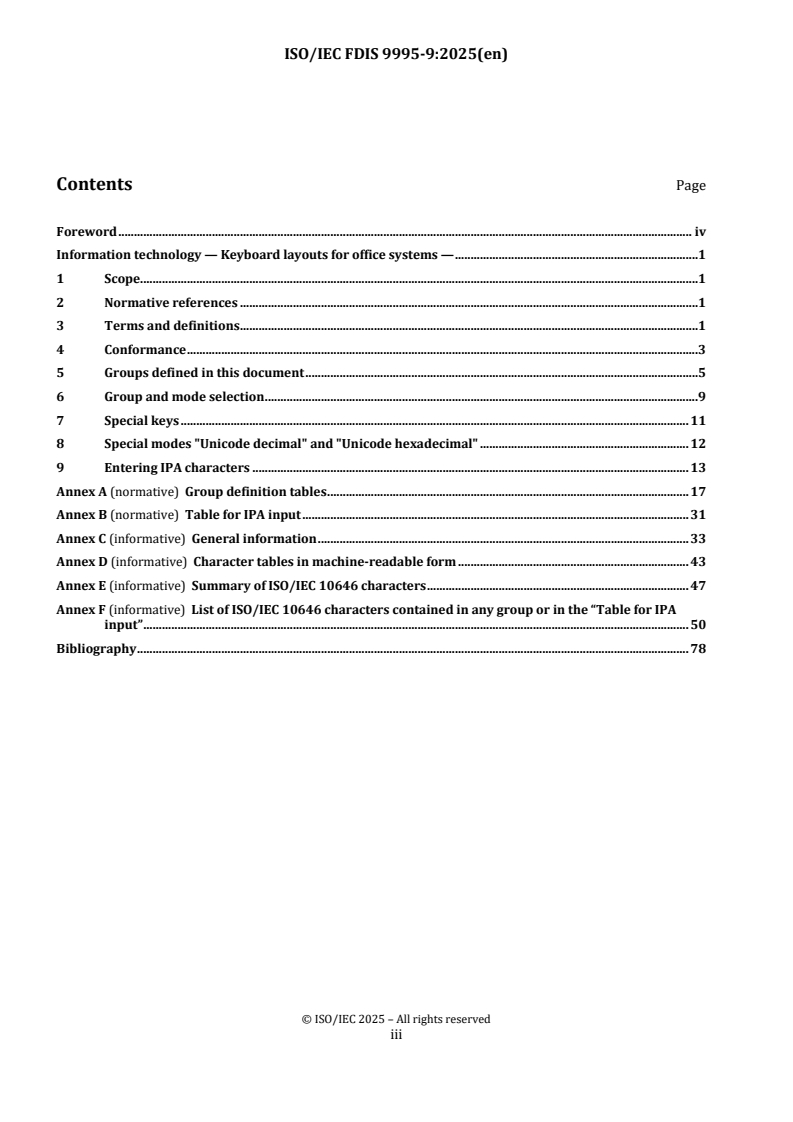
Contents Page
Foreword . iv
Information technology — Keyboard layouts for office systems — . 1
1 Scope. 1
2 Normative references . 1
3 Terms and definitions . 1
4 Conformance . 3
5 Groups defined in this document . 5
6 Group and mode selection . 9
7 Special keys . 11
8 Special modes "Unicode decimal" and "Unicode hexadecimal" . 12
9 Entering IPA characters . 13
Annex A (normative) Group definition tables . 17
Annex B (normative) Table for IPA input . 31
Annex C (informative) General information . 33
Annex D (informative) Character tables in machine-readable form . 43
Annex E (informative) Summary of ISO/IEC 10646 characters . 47
Annex F (informative) List of ISO/IEC 10646 characters contained in any group or in the “Table for IPA
input” . 50
Bibliography . 78
© ISO/IEC 2025 – All rights reserved
iii
ISO/IEC FDIS 9995-9:2025(en)
Foreword
ISO (the International Organization for Standardization) and IEC (the International Electrotechnical
Commission) form the specialized system for worldwide standardization. National bodies that are members
of ISO or IEC participate in the development of International Standards through technical committees
established by the respective organization to deal with particular fields of technical activity. ISO and IEC
technical committees collaborate in fields of mutual interest. Other international organizations,
governmental and non-governmental, in liaison with ISO and IEC, also take part in the work.
The procedures used to develop this document and those intended for its further maintenance are described
in the ISO/IEC Directives, Part 1. In particular, the different approval criteria needed for the different types
of document should be noted. This document was drafted in accordance with the editorial rules of the
ISO/IEC Directives, Part 2 (see www.iso.org/directives or www.iec.ch/members_experts/refdocs).
ISO and IEC draw attention to the possibility that the implementation of this document may involve the use
of (a) patent(s). ISO and IEC take no position concerning the evidence, validity or applicability of any claimed
patent rights in respect thereof. As of the date of publication of this document, ISO and IEC had not received
notice of (a) patent(s) which may be required to implement this document. However, implementers are
cautioned that this may not represent the latest information, which may be obtained from the patent
database available at www.iso.org/patents and https://patents.iec.ch. ISO and IEC shall not be held
responsible for identifying any or all such patent rights.
Any trade name used in this document is information given for the convenience of users and does not
constitute an endorsement.
For an explanation of the voluntary nature of standards, the meaning of ISO specific terms and expressions
related to conformity assessment, as well as information about ISO's adherence to the World Trade
Organization (WTO) principles in the Technical Barriers to Trade (TBT) see
www.iso.org/iso/foreword.html. In the IEC, see www.iec.ch/understanding-standards.
This document was prepared by Joint Technical Committee ISO/IEC JTC 1, Information technology,
Subcommittee SC 35, User interfaces.
This second edition cancels and replaces the first edition (ISO/IEC 9995-9:2016), which has been technically
revised. It also incorporates the Amendment ISO/IEC 9995-9:2016/Amd. 1:2019.
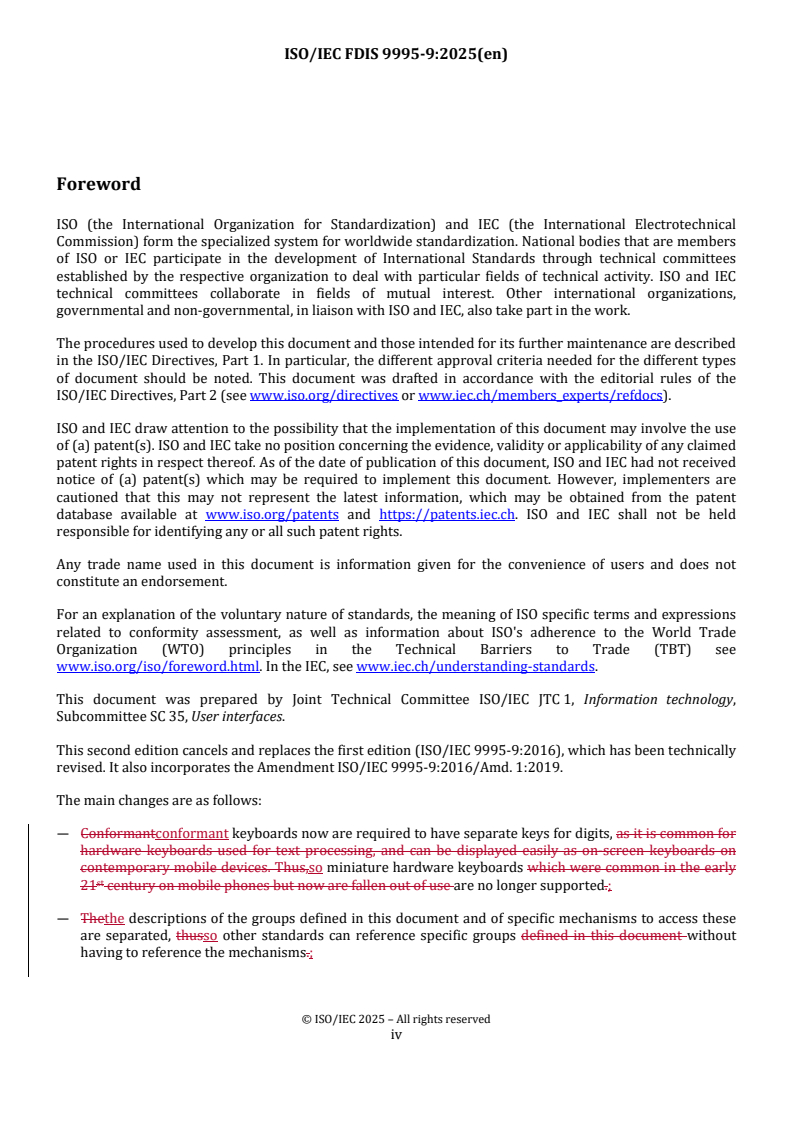
The main changes are as follows:
— Conformantconformant keyboards now are required to have separate keys for digits, as it is common for
hardware keyboards used for text processing, and can be displayed easily as on-screen keyboards on
contemporary mobile devices. Thus,so miniature hardware keyboards which were common in the early
st
21 century on mobile phones but now are fallen out of use are no longer supported.;
— Thethe descriptions of the groups defined in this document and of specific mechanisms to access these
are separated, thusso other standards can reference specific groups defined in this document without
having to reference the mechanisms.;
© ISO/IEC 2025 – All rights reserved
iv
ISO/IEC FDIS 9995-9:2025(en)
— Thethe groups containing Latin letters and symbols are reorganized, to make them clearer and more
systematic, and thus more usable. Some minor changes also are made to other groups. Also,, and some
characters antand three new groups for variants of the Georgian script arewere added.;
— Allall references to characters which are not included in ISO/IEC 10646 (Unicode), and therefore have to
be encoded in the PUA (Private Use Area) in specific fonts, arewere deleted.;
— Thethe optional special key which was named “Secondary Superselect” is now named “Special Character
Select”.”;
— Thethe formal recommendations for the positioning of the “Superselect” key and of a “Special Character
Select” keys are dropped. The previously recommended positions now are and only mentioned in
informative notes.
A list of all parts in the ISO/IEC 9995 series can be found on the ISO and IEC websites.
Any feedback or questions on this document should be directed to the user’s national standards body. A
complete listing of these bodies can be found at www.iso.org/members.html and www.iec.ch/national-
committees.
© ISO/IEC 2025 – All rights reserved
v
FINAL DRAFT International Standard ISO/IEC FDIS 9995-9:2025(en)
Information technology — Keyboard layouts for office
systems —
Part 9:
Groups and mechanisms for multilingual and multiscript
input
1 Scope
Within the general scope described in ISO/IEC 9995-1, this document defines mappings of different sets of
graphic characters onto the uppercase and lowercase forms of the 26 basic Latin characters (A–Z and a–z)
and the digits 0–9, each of these mappings constituting a “group” as defined in ISO/IEC 9995-2.
A detailed synopsis is contained in the informative Annex C.
This document is primarily intended for word-processing and text-processing applications, to be used with
keyboards which have at least 26 dedicated keys to enter letters and 10 additional keys to enter decimal
digits.
2 Normative references
The following documents, in whole or in part, are normatively referenced in this document and are
indispensable for its application. For dated references, only the edition cited applies. For undated references,
the latest edition of the referenced document (including any amendments) applies.
ISO/IEC 9995-1, Information technology — Keyboard layouts for text and office systems — Part 1: General
principles governing keyboard layouts
ISO/IEC 10646, Information technology — Universal Coded Character Set (UCS)
3 Terms and definitions
For the purposes of this document, the terms and definitions given in ISO/IEC 9995-1 and the following
apply.
ISO and IEC maintain terminology databases for use in standardization at the following addresses:
— ISO Online browsing platform: available at https://www.iso.org/obp
— IEC Electropedia: available at https://www.electropedia.org/
© ISO/IEC 2025 – All rights reserved
ISO/IEC FDIS 9995-9:2025(en)
3.1
alphanumeric keyboard
keyboard having at least the following 39 different keys: 26 keys usable for the Latin letters A–Z (even if this
is not their primary use), 10 keys for the digits 0–9, a Space key, an Enter key; and a level 2 selector key
Note 1 to entry: The digit keys typically enter the digits in level 1 or 2 of group 1.
Note 2 to entry: The level 2 selector key is usually called "shift key".
3.2
associated with
key or key combination used to enter a specific character
Note 1 to entry: Any group and/or level selection prerequisite for this action must be done for the actuation of a key to
enter the intended character or call the intended function.
3.3
base mode
mode in which keys have their usual function such as selecting characters according to the active group and
level
3.4
digit key
key associated with any digit 0–9
3.5
enter key
key associated with an enter or return function
3.6
Latin keyboard
keyboard with a layout which has all Latin lowercase letters a–z (U+0061–U+007A) in group 1 level 1, and
all Latin uppercase letters A–Z (U+0041–U+005A) in group 1 level 2, each uppercase letter being associated
with the same key as its lowercase counterpart, and which has a level 2 selector key which is either to be
pressed simultaneously with the letter key or separately immediately before pressing the letter key, to select
level 2
3.7
Latin conformant keyboard
keyboard with a layout which has all Latin letters a–z and A–Z in a single group other than Group 1, where
that group can be selected permanently, and which otherwise behaves as a Latin keyboard as long as that
group is selected
3.8
mode
state which determines the effects of all the keys of a keyboard
© ISO/IEC 2025 – All rights reserved
ISO/IEC FDIS 9995-9:2025(en)
3.9
reference group
group that is switched to, or reverted to after the actuation of a key has disengaged a group previously
single-selected to
3.10
reference group switching mode
special mode where the next actuation of a key either switches to a new group or has the sole effect of
generating an error signal to the user, when there is no group to be switched to when pressing that key
3.11
single-select
select a group or level in such a manner that only the next actuation of a key is affected, with the group
reverting to the previously selected group (reference group) afterwards
3.12
space key
key associated with character U+0020 SPACE
3.13
special mode
mode which is not the base mode, and where the functions of the keys are defined by the description of the
mode
3.14
superselect
function which, upon simultaneous or consecutive actuation of any key associated with a Latin letter A–Z
(without the Shift key, thus effectively actuating the lowercase variant of the letter), single-selects or
switches to a specific group
EXAMPLE Superselect can be a key, a combination of keys, or another function.
3.15
switch to
select a group or a mode which then stays in effect until another group or mode is selected, be it by
switching to another group or selecting another reference group
3.16
symbol
graphical symbol which is neither a letter nor a digit
Note 1 to entry: This definition does not apply to the term "symbol" as part of the phrase "graphical symbol" as defined
in ISO/IEC 9995-1.
4 Conformance
4.1 General
© ISO/IEC 2025 – All rights reserved
ISO/IEC FDIS 9995-9:2025(en)
The layout of a keyboard can fully or partially conform to this document in a level defined in the following
subclauses if it meets all of the following conditions:
It is either a Latin keyboard, or a Latin conformant keyboard, as defined in Clause 3.
It is an alphanumeric keyboard, as defined in Clause 3.
The keyboard is intended to output valid ISO/IEC 10646 characters and valid sequences thereof.
There is a special function called "Superselect", which, when (according to the layout) either operated
(i.e. pressed if it is a key) together with any a–z key, or followed by the actuation of any a–z key,
performs the function according to Tables 2 and 3 in Clause 6.
NOTE 1 The "Superselect" can be a single dedicated key, or a special sequence of other keys to be input.
EXAMPLES:
The "Superselect" can be a "symbol key" to be pressed together with a "shift key".
The "Superselect" can be the “Tab” key or a specific letter key pressed together with the Level 3 Select key (which
is commonly named “Alt Gr”).
NOTE 2 Keyboard symbols for the “Superselect” function are defined in ISO/IEC 9995-7 as symbols #100 and #111.
There are several levels of conformance described in subclause 4.2.
Lists of Unicode values of the characters accessible by such levels of conformance are provided in the
informative Annex E.
A cross reference list of the Unicode values enterable by methods defined in this document, referencing
these methods, is given in the informative Annex F.
NOTE 3 The annexes E and F are intended as an aid for font designers to enable conformance statements for their
fonts as described in subclause 4.2.5.
4.2 Levels of Conformance
4.2.1 Full conformance
A keyboard layout (in conjunction with the software which implements it) is fully conformant to this
document if it meets the following conditions (additionally to the ones listed in the previous subclause
“General”):
All groups listed in Table 2 and specified in the subsequent text are contained in the layout, except
Group L for a Latin keyboard. The groups may contain additional characters associated with other keys
than in the tables.
All modes and select functions listed in Table 3 and specified in the subsequent text work as described in
this document.
NOTE 1 It is not specified in this document which characters or symbols are in fact to be engraved on the keyboard.
As full conformance includes the implementation of the IPA mode, there is no need to implement the
“Entering IPA characters with a special function key” according to subclause 9.3.
© ISO/IEC 2025 – All rights reserved
ISO/IEC FDIS 9995-9:2025(en)
Any statement of conformance to this document shall be taken to imply that the complete character
repertoire of the “Table for IPA input” in Annex B and of all groups listed in Clause 6 has been implemented.
4.2.2 Single-Selection conformance
A keyboard layout (in conjunction with the software which implements it) is “single-selection conformant”
to this document if it meets the following conditions (additionally to the ones listed in the previous
subclause 4.1):
All groups listed in Table 1 and marked there with an “X” in the column “C.” are contained in the layout,
except Group L for a Latin keyboard, and except Group YU for keyboards where all characters contained
in that group are associated with other keys.
The groups may contain additional characters associated with other keys than in the tables.
Characters of these groups can be single-selected by using the Superselect key (or key combination)
together with (i.e. either simultaneously pressed or followed by) the group selection character listed in
Table 3 of Clause 6, followed by the associated key listed in the group definition.
It is not required to implement the “Entering IPA characters with a special function key” according to
subclause 9.3 to get single-selection conformance. If this is done, the “IPA conformance” as specified in 4.2.4
is gained in parallel.
4.2.3 Conformance for single groups
A keyboard layout is conformant to a single group defined in this document, if this group is included, and if it
specifies a single-selection key or key combination for this group, and if the characters of this group are
selected by using the associated key listed in the group definition.
4.2.4 IPA conformance
A keyboard layout is “IPA conformant” if it either implements the IPA mode defined in this document as
described in subclause 9.2, or if it implements a function key (or key combination) as described in subclause
9.3.
4.2.5 Conformance statements for fonts
Statements of conformance may be made for fonts which contain all characters contained in groups (as
defined in this document) which are listed in the conformance statement, or all characters needed for full
conformance, single-selection conformance of IPA conformance (if the conformance statement expresses
such).
5 Groups defined in this document
5.1 General
The groups defined in this document are denoted:
— either by a single Latin letter (if such a group is to be primarily used as a reference group which can be
switched to, which does not exclude that such a group can also be single-selected),
© ISO/IEC 2025 – All rights reserved
ISO/IEC FDIS 9995-9:2025(en)
— or by a combination of two Latin letters (if such a group is primarily designed to be single-selected). For
the latter ones, the first letter either denotes the single-letter-named group to which its content is
related, or "D" for diacritics, or "Y" for symbols (including digits).
The single letter "N" and all two letter combinations containing a "N" are reserved for groups defined in
national standards conformant with this document and thus will not be used in future versions of this
document.
The group number according to ISO/IEC 9995-1 is computed for the former groups as "letter number × 100",
for the latter groups as "first letter number × 100 + second letter number", where "letter number" is 1 for A,
2 for B, and so on until 26 for Z (e.g. "Group G" is "Group 700", "Group GE" is "Group 705").
This document thus defines groups within the number range from "Group 100" to "Group 2626" (not filling
this number range contiguously).
The groups are defined in the normative Annex A.
The informative Annex C contains general information of the design considerations leading to this document
and the layout of the groups, especially notes on single groups.
5.2 Types of groups defined in this document
There are four types of groups defined in this document:
— simple: such a group contains up to 52 characters, which are associated with the basic Latin letters A–Z
and a–z.
— special: such a group contains up to 52 characters or character pairs, which are associated with the basic
Latin letters A–Z and a–z. The selection of a character pair requires special handling (either causing the
input of the sequence of both characters, or causing the selection of one of the two characters depending
on the input context), as described in the normative Annex A.
— alphanumeric: such a group contains up to 62 characters, which are associated with the basic Latin
letters A–Z and a–z and the decimal digits 0–9.
— modifying: such a group contains consistently modified (i.e. encircled, lowered/subscript or
raised/superscript) character variants of the basic Latin letters A–Z and a–z and the decimal digits 0–9,
associated with these characters. In addition, any keyboard layout definition may add such modified
character variants for other characters (e.g., an encircled or raised plus sign associated with “+”) to such
a group.
5.3 List of groups defined in this document
In this document, there are 37 groups listed in Table 1 and defined in the normative Annex A “Group
definition tables”.
The informative Annex D contains a consolidated list of these groups and the characters they contain in a
machine readable form.
NOTE The informative Annex D is intended as an aid for software developers implementing the methods described
in this document.
© ISO/IEC 2025 – All rights reserved
ISO/IEC FDIS 9995-9:2025(en)
Table 1 — List of the groups defined in this document
a b c
Name Description Type S. C.
A Group A (Arabic) S
AE Group AE (“Arabic Extra Letters”) S (e)
C Group C ("Cyrillic") -
CE Group CE (“Cyrillic Extra Letters”) - (e)
CX Group CX (“Cyrillic Additional Extra Letters”) - (x)
CS Group CS (“Cyrillic Church Slavonic Letters”) - (z)
DD Group DD (“Diacritics”) - a X
DS Group DS (“Spacing Diacritics and Similar Characters”) - v X
DI Group DI (“Diacritics for IPA”) - j
DJ Group DJ (“Spacing Diacritics and Symbols for IPA”) - w
G Group G ("Greek") - g X
GE Group GE (“Greek Extra Letters”) - y/(e) X
H Group H ("Hebrew") -
HE Group HE (“Hebrew Extra Letters”) - (e)
K Group K ("Korean Hangul") S
L Group L ("Latin") A l X
LE Group LE (“Latin Extra Letters”) A e X
LF Group LF (“Latin additional extra letters e. g. for Africa”) A f X
LA Group LA (“Latin Letters with Hook Above and similar”) - h X
LB Group LB (“Latin Letters with Hook Below and similar”) - b X
LD Group LD (“Latin Letters with Diagonal Stroke”) - x X
LH Group LH (“Latin Letters with Horizontal Stroke”) - z X
MC Group MC (“Encircled Latin Letters and Digits”) M o X
ML Group ML (“Lowered Latin Letters and Digits”) M q X
MR Group MR (“Raised Latin Letters and Digits”) M r X
Q Group Q (“Georgian Mkhedruli”: common or lowercase -
of the modern secular alphabet)
QM Group QM (“Georgian Mtravruli”: special (all caps) - (e)
uppercase of the modern secular alphabet)
QX Group QX (“Georgian Khutsuri lowercase”: lowercase of -
the old ecclesiastical alphabet)
QY Group QY (“Georgian Khutsuri uppercase”: uppercase of - (e)
© ISO/IEC 2025 – All rights reserved
ISO/IEC FDIS 9995-9:2025(en)
a b c
Name Description Type S. C.
the old ecclesiastical alphabet)
W Group W (Armenian) -
WE Group WE (“Armenian Extra letters”) - (e)
YC Group YC (“Currency symbols”) A c X
YL Group YL (“Letterlike and Other Symbols”) A t X
YM Group YM (“Mathematical symbols”) A m X
YP Group YP (“Punctuation”) A p X
YS Group YS (“Shapes and Related Symbols”) A s X
YU Group YU (“Universal Symbols”) A n X
a
“-“ denotes “simple”, “S” denotes “special”, “A” denotes “alphanumeric”, “M” denotes
“modifying”.
b
This column is informative. For groups which can be single-selected by the functions
described in Clause 6, the corresponding letter in the first column of Table 3 is shown here.
This is shown in parentheses if that letter is valid only when Group L (Latin) is not the
reference group (as described in Clause 6).
c
Groups marked with an X in this column must be implemented to be single-selectable in a
keyboard layout which claims to be Single-Selection conformant to this document (except
Group L for Latin keyboard layouts, and except Group YU for keyboards where all characters
contained in that group are associated with other keys).
5.4 Definition form and conformant use of a group defined in this document
In Annex A “Group definition tables”, the definition for each of the 37 groups defined there is shown using a
table like the one depicted in Figure 1.
00BC ¼ 00BD ½ 00BE ¾ 215B ⅛ 215C ⅜ 215D ⅝ 215E ⅞ 2153 ⅓ 2154 ⅔ 2205 ∅
1 2 3 4 5 6 7 8 9 0
211A ℚ 226B ≫ 2204 ∄ 211D ℝ 2207 ∇ 2265 ≥ 2229 ∩ 221D ∝ 2209 ∉ 220F ∏
2260 ≠ 226A ≪ 2203 ∃ 221A √ 27C2 ⊥ 2264 ≤ 222A ∪ 221E ∞ 2208 ∈ 21CC ⇌
Q W E R T Y U I O P
2135 ℵ 2211 ∑ 2206 ∆ 2234 ∴ 2287 ⊇ 210F ℏ 2284 ⊄ 2285 ⊅ 220C ∌
2200 ∀ 222B ∫ 2202 ∂ 2235 ∵ 2286 ⊆ 210E ℎ 2282 ⊂ 2283 ⊃ 220B ∋
A S D F G H J K L
2124 ℤ 2310 ⌐ 2102 ℂ 2227 ∧ 21CE ⇎ 2115 ℕ 21CF ⇏
2194 ↔ 00AC ¬ 221B ∛ 2228 ∨ 21D4 ⇔ 21D0 ⇐ 21D2 ⇒
Z X C V B N M
Figure 1 — Example of a group definition in Annex A
NOTE 1 Figure 1 does not define a group by itself. It is only an example depicted here for explanatory purposes.
However, the (identical) group definition for Group YM (Mathematical symbols) shown in Annex A is valid there.
Tables as the one depicted here contain the ISO/IEC 10646 (Unicode) code values (as 4-digit hexadecimal
numbers) for all characters which are contained in the group to be defined by such a table. In most cases, the
code number is followed by a depiction of the character.
© ISO/IEC 2025 – All rights reserved
ISO/IEC FDIS 9995-9:2025(en)
Such tables are arranged in 3 or 4 rows and 10 columns.
NOTE 2 The tables are arranged like the keys on a typical Latin layout, namely 1234567890 / qwertyuiop / asdfghjkl /
zxcvbnm. This is done only to be illustrative for users of such a keyboard. It does not mean that any layout conformant
to this document or any Latin group as part of such a layout has to be arranged in that way.
For alphanumeric and modifying groups, the first row shows the characters associated with the keys used to
input the decimal digits 1-9 and 0. The decimal digit is shown in light grey in the lower left corner of the
table cell. If the keyboard layout has the decimal digits in group 1 on Level 2 (“shifted”) positions, the
specification of that layout may include a rule that the decimal digit keys may be actuated without using the
Level 2 key (“Shift key”) to generate the selected character of the group.
For all groups, the last 3 rows (which are the only 3 rows for most groups) show the characters associated
with the keys used to input the basic Latin letters A–Z/a–z. The uppercase form of the letter is shown in light
grey in the lower left corner of the table cell. Above that, each cell contains two lines. If a character code is
shown in the upper line, it is associated with the uppercase form of the letter. If a character code is shown in
the lower line, it is associated with the lowercase form of the letter.
ExampleEXAMPLE 1 — To input the fraction ⅞, you single-select the group YM (according to Table 3 in Clause 6 by
Superselect+”m”) and actuate the key used for typing “7”. On a French AZERTY keyboard, which needs the Shift key for
entering digits, it is implementation dependent whether you need the Shift key also together with the “7” key to enter
⅞ this way.
ExampleEXAMPLE 2 — To input the rational number set symbol ℚ, you single-select the group YM and actuate the
key combination used for typing “Q” (usually pressing the Level 2 key, commonly named “Shift key”, together with the
key used for typing “q”). This is independent of the position of this key, which is B01 on many keyboards (e. g. US ANSI,
but also in the Latin group selectable on many non-Latin keyboards), but e.g. C01 on a French AZERTY keyboard, B07
on a French BÉPO keyboard, or B02 on a Dvorak keyboard.
6 Group and mode selection
6.1 Reference groups
Groups which are named by a single Latin letter can act as reference groups.
Such are selected by actuating the Superselect function, followed by the letter “k” (or, on a non-Latin
keyboard, the key associated with the letter “k”), followed with a letter selecting the group according to the
following Table 2. When the Group A (Arabic) is selected by the letter “p” or “x”, also a special mode is
selected according to the table entry.
Table 2 — Reference groups and their selection
a
Letter Reference group selected by the letter key in the reference group switching mode Symbol
(i. e. by entering “Superselect” and “k” (for “Keyboard Selection”) followed by this letter)
b
a Group A (Arabic) U+0628 ب
c Group C ("Cyrillic") U+042F Я
ⴃ
e Group QX (Georgian, Khutsuri: lowercase of the old ecclesiastical alphabet)
U+2D03
g Group G ("Greek") U+0389 Ω
h Group H ("Hebrew") U+05D0 א
k Group K ("Korean Hangul") U+AC00
가가
Implementations that replace the input of Jamo sequences by the appropriate Hangul
characters when this mode is active, are conformant to this document.
© ISO/IEC 2025 – All rights reserved
ISO/IEC FDIS 9995-9:2025(en)
a
Letter Reference group selected by the letter key in the reference group switching mode Symbol
(i. e. by entering “Superselect” and “k” (for “Keyboard Selection”) followed by this letter)
l Group L ("Latin") U+004C L
m Group QM (Georgian, Mtravruli: special (all caps) uppercase of the modern secular alphabet) U+1C93
c
p Group A (Arabic) U+06F5 ۵
Switching to this group by this key also selects a mode "Eastern Arabic-Indian digits". This
mode causes that digit keys which otherwise enter the standard decimal digits U+0030–
U+0039 enter the according Eastern Arabic-Indic digits 06F0–06F9 instead. This mode stays
in effect until another "reference group" selection is done.
d
q
Group Q (Georgian, Mkhedruli: common or lowercase of the modern secular alphabet) U+10D3 დ
e
w U+053D Խ
Group W (Armenian)
x Group A (Arabic). U+0664 ٤
Switching to this group by this key also selects a mode "Arabic-Indian digits". This mode
causes that digit keys which otherwise enter the standard decimal digits U+0030–U+0039
enter the according Arabic-Indic digits 0660–0669 instead. This mode stays in effect until
another "reference group" selection is done.
a
The symbol listed in this column is to be shown inside of the ISO/IEC 9995-7 symbol 105 (“Switch to specific group”,
square with rounded corners) when this selection function is associated to a single key (in addition to the "Superselect"
mechanism described here), or it is to be displayed on an on-screen keyboard after the actuation of "Superselect".
b
This selection deselects any mode selected as listed for keys "p" or "x", i.e. digit keys subsequently enter the standard
decimal digits U+0030–U+0039
c
"p" stands for Persian/Pashto
d
"g" selects Greek
e
"a" is reserved to select Arabic
6.2 Selection of other groups and of modes
Table 3 lists the other groups and the modes specified in this document, according to the letter key which is
to be pressed after or together with the "Superselect" function, as described in Clause 3.
Table 3 — Group and mode selection functions
a
Key Function performed by this key when used with the "Superselect" function Symbol
b
a 106 ̌
Single-selects Group DD ("Diacritics").
b Single-selects Group LB ("Hook below") when Group L (Latin) is the reference group. 90
c Single-selects Group YC ("Currency symbols") 106 ¤
d Switches to Mode "Unicode decimal". 103
e Single-selects Group LE ("Latin Extra Letters") when Group L is the reference group. 106 X
Single-selects Group AE ("Arabic Extra Letters") when Group A is the reference group.
Single-selects Group CE ("Cyrillic Extra Letters") when Group C is the reference group.
Single-selects Group GE ("Greek Extra Letters") when Group G is the reference group.
Single-selects Group HE ("Hebrew Extra Letters") when Group H is the reference group.
Single-selects Group QM ("Georgian Mtravruli") when Group Q is the reference group.
Single-selects Group QY ("Georgian Khutsuri lowercase") when Group QX is the ref. group.
Single-selects Group WE ("Armenian Extra letters") when Group W is the ref. group.
f Single-selects Group LF ("Latin additional extra letters for Africa") when Group L (Latin) is the 106 Ɔ
reference group.
c
g Single-selects Group G ("Greek") 106 Ω
h Single-selects Group LA ("Hook above") when Group L (Latin) is the reference group. 91
i Switches to Mode "IPA" (International Phonetic Alphabet) 107 ə
j Single-selects Group DI ("Diacritics for IPA")
k Switches to Mode "reference group switching mode" to switch to a group according to Table 2 107 ∗
© ISO/IEC 2025 – All rights reserved
ISO/IEC FDIS 9995-9:2025(en)
a
Key Function performed by this key when used with the "Superselect" function Symbol
d
by the subsequent actuation of a key.
In keyboard layouts which have single-selection conformance (according to 4.2.2) but not full 106 +any
appropriate
conformance (according to 4.2.1), instead, it may single-select a Group NA ("National
symbol
e
additions") if such a group is defined in the applicable keyboard layout standard.
f
l 106 L
Single-selects Group L ("Latin")
On a Latin keyboard (as defined in Clause 3), instead, it may single-select a Group NL ("Latin
e
additions") if such a group is defined in the applicable keyboard layout standard.
m Single-selects Group YM ("Mathematical symbols") 106 ∞
n Single-selects Group YU (“Universal Symbols”), which contains all symbols contained in the 106 &
Unicode character range U+0021–U+007E (commonly known as ASCII).
In keyboard layouts where all characters contained in that group are associated with other keys,
instead, it may single-select a Group NN ("National") if such a group is defined in the applicable
e
keyboard layout standard.
o Single-selects Group MC (“Encircled Latin Letters and Digits”)
106 Ⓐ
p Single-selects Group YP ("Punctuation") 106 #
q Single-selects Group ML ("Lowered Latin Letters and Digits") 94
r Single-selects Group MR ("Raised Latin Letters and Digits") 93
s Single-selects Group YS ("Shapes and other Symbols")
106 ◾
t Single-selects Group YL ("Letterlike and other symbols") 106 ℓ
u Switches to Mode "Unicode hexadecimal" 104
v Single-selects Group DS ("Spacing Diacritics and Similar Characters") 106 ʿ
w Single-selects Group DJ ("Spacing Diacritics and Symbols for IPA") 106 ˦
x Single-selects Group LD ("Diagonal Stroke") when Group L (Latin) is the reference group. 88
Single-selects Group CX ("Cyrillic Additional Extra Letters") when Group C (Cyrillic) is the 106 Ҕ
reference group.
g
y Single-selects Group GE ("Greek Extra Letters") 106 ϖ
Single-selects Group LH ("Horizontal Stroke") when Group L (Latin) is the reference group.
z 87
Single-selects Group CS ("Cyrillic Church Slavonic Letters") when Group C (Cyrillic) is the 106 Ѧ
reference group.
[Space] Switches to base mode and to Group 1 (whichever this is, depending on the national or 107 ←
manufacturer standard used)
a
The column "Symbol" denotes the number of the symbol in ISO/IEC 9995-7 for the group or mode selection when this selection function is
associated to a single key (in addition to the "Superselect" mechanism described here), or it is to be displayed on an on-screen keyboard
after the actuation of "Superselect". If the symbol number is 105 "Switch to specific group", 106 "Single-select a specific group", or 107
"Switch to specific mode", the number is followed by the character to be enclosed by the symbol.
b
"A" is a mnemonic for "Accents".
c
This is useful to enter single Greek letters used as symbols.
d
"k" is a mnemonic for "Keyboard selection".
e
e.g. containing precomposed letters frequent in the concerned language[s].
f
This is useful to enter single Latin letters used as symbols or abbreviations on non-Latin keyboards .
g
This is useful to enter single Greek special letters used as symbols.
7 Special keys
7.1 Special Character Select function
Keyboards may allocate a Special Character Select function, which is defined ainin Table 4:
© ISO/IEC 2025 – All rights reserved
ISO/IEC FDIS 9995-9:2025(en)
Table 4 — Special Character Select function definition
Condition Effect of the Special Character Select key
If actuated once If actuated twice If actuated three times
consecutively consecutively
Single-selects group LF
Reference group is Single-selects group LE
(Latin additional extra
Group L (Latin) (Latin extra letters)
letters for Africa)
Reference group is Single-selects group AE
Group A (Arabic) (Arabic extra letters)
Single-selects Group CS
Reference group is Single-selects group CE Single-selects CX (Cyrillic
(Cyrillic church Slavonic
Group C (Cyrillic) (Cyrillic extra letters) additional extra letters)
letters)
Reference group is Single-selects group GE
Group G (Greek) (Greek extra letters)
Reference group is group Single-selects group HE
H (Hebrew) (Hebrew extra letters)
Reference group is group Single-selects group QM
Q (Georgian Mkhredruli) (Georgian Mtravruli)
Reference group is group Single-selects group QY
QX (Georgian Khutsuri (Georgian Khutsuri
lowercase) uppercase)
Reference group is group Single-selects group WE
W (Armenian) (Armenian extra letters)
The Special Character Select function may be allocated on the Backspace key pressed together with the Level
3 Select key (commonly named “Alt Gr key”).
7.2 Use of the Backspace key
When a Backspace key is pressed immediately after a group selector, mode-switching key, or level selector
that does not require simultaneous pressing with another key, it shall simply cancel the group selection,
mode switching, or level selection.
7.3 Combining characters
As long as the Superselect mechanism is used, all combining characters (accents, diacritical marks, etc.)
contained in the groups defined in this document are to be entered after their corresponding base character,
according to the order in which they are to be stored according to ISO/IEC 10646.
8 Special modes "Unicode decimal" and "Unicode hexadecimal"
These modes are to enter any valid ISO/IEC 10646 character, by entering their code point values as decimal
resp. hexadecimal number.
NOTE 1 The names of these special modes reflect the fact that the character set defined by ISO/IEC 10646 is usually
synchronized with the one defined by the industry standard "Unicode", the name of which is more popular and
memorable, and is reflected in the "U"-like shapes of the ISO/IEC 9995-7 symbols which are associated with these
special modes.
The mode "Unicode Decimal" works as follows:
© ISO/IEC 2025 – All rights reserved
ISO/IEC FDIS 9995-9:2025(en)
All actuations of keys associated with decimal digits are temporarily stored into a sequence representing a
decimal number. When any other key except a Backspace key is pressed, then, if the decimal number
contains at least one digit and represents a valid ISO/IEC 10646 value, then the according character shall be
output. If not, then a U+FFFD OBJECT REPLACEMENT CHARACTER shall be output, followed by the entered
sequence of decimal digits. In any case, the temporary sequence shall be cleared.
Then, if the other key pressed is not an Enter key, a Decimal Separator key or a Space key, the keyboard shall
be switched to base mode.
If the other key pressed is an Enter key, the keyboard shall be switched to base mode, and the Enter key
itself shall not be processed further.
If the other key pressed is a Decimal Separator or a Space key, the mode "Unicode Decimal" shall persist, and
the Decimal Separator key or Space key itself shall not be processed further.
If a Backspace key is pressed, while the temporarily stored sequence is not empty, the last digit appended to
that sequence shall be dropped from that sequence.
NOTE 2 If a Backspace key is pressed, while the temporarily stored sequence is empty, the effect is not defined by
this document.
NOTE 3 The underlying software is allowed to erase the last entered ISO/IEC 10646 character from the input
sequence but is not required to do so, as it is beyond the scope of this document what happens to characters on
completion of entering.
Thus, the user can enter any sequence of valid ISO/IEC 10646 characters by entering their decimal code
values, separated by Space or decimal separator (which is especially convenient if any numeric keypad is
used), and terminated by Enter.
The mode "Unicode Hexadecimal" works accordingly. Hexadecimal digits are all decimal digits and A–F and
a–f, not differentiating between upper and lower case.
Valid ISO/IEC 10646 characters must have hexadecimal values between 0 and 10FFFD. Also, their value
must not be in the intervals D800–DFFF (ISO/IEC 10646 surrogate points) and FDD0–FDEF (ISO/ IEC 10646
noncharacters), and their value modulo hexadecimal 10000 must not be FFFE or FFFF (values guaranteed
not to be an ISO/IEC 10646 character at all by ISO/IEC 10646). — The operating system may provide more
restrictions, e.g. usage of a code position in a specific version of ISO/IEC 10646.
9 Entering IPA characters
9.1 General
Two methods are described here to enter IPA characters. These are characters contained in the International
Phonetic Alphabet, as specified the “IPA: Handbook of the International Phonetic Association”.( Cambridge
1999),in Reference [1], where also numbers are given for these characters in the Appendix 2 (pp. 161–185).
These methods are:
— the special mode “IPA” (subclause 9.2),
— entering IPA characters with a special function key (subclause 9.3).
© ISO/IEC 2025 – All rights reserved
ISO/IEC FDIS 9995-9:2025(en)
The IPA characters which can entered by any of these methods are the ones with the numbers 100–599 and
901–911.
Regarding the IPA characters 217-219, 517-518, 908-909, and the later added IPA character 184, new
mappings to ISO/IEC 10646 code points due to the development of ISO/IEC 10646 since the release date of
the Handbook are taken into account.
NOTE 1 The "Extensions of the IPA: The ExtIPA chart" for the transcription of disordered speech (IPA numbers 601 to
799), as defined in Appendix 3 of the aforementioned “IPA: Handbook of the International Phonetic Association”, , are
not covered by this document.
A few characters used by sinologists, which are not formally part of the International Phonetic Alphabet, are
added to the set of IPA characters covered by the aforementioned methods.
NOTE 2 As the IPA characters 529 to 533 are not mapped onto single ISO/IEC 10646 characters, they will have to be
entered as sequences of IPA characters 519 to 523:
for IPA 529 (rising contour), enter IPA 523 then IPA 519,
for IPA 530 (falling contour), enter IPA 519 then IPA 523
for IPA 531 (high rising contour), enter IPA 521 then IPA 519
for
...
Questions, Comments and Discussion
Ask us and Technical Secretary will try to provide an answer. You can facilitate discussion about the standard in here.
Loading comments...