

ISO/IEC 20889:2018
(Main)Privacy enhancing data de-identification terminology and classification of techniques
General Information
- Abstract
This document provides a description of privacy-enhancing data de-identification techniques, to be used to describe and design de-identification measures in accordance with the privacy principles in ISO/IEC 29100. In particular, this document specifies terminology, a classification of de-identification techniques according to their characteristics, and their applicability for reducing the risk of re-identification. This document is applicable to all types and sizes of organizations, including public and private companies, government entities, and not-for-profit organizations, that are PII controllers or PII processors acting on a controller's behalf, implementing data de-identification processes for privacy enhancing purposes.
- Status
- Published
- Publication Date
- 05-Nov-2018
- Drafting Committee
- ISO/IEC JTC 1/SC 27/WG 5 - Identity management and privacy technologies
- Current Stage
- 9093 - International Standard confirmed
- Start Date
- 03-May-2024
- Completion Date
- 29-Aug-2026
Buy Documents

ISO/IEC 20889:2018 - Privacy enhancing data de-identification terminology and classification of techniques

ISO/IEC 20889:2018 - Privacy enhancing data de-identification terminology and classification of techniques/6/2018
Overview
ISO/IEC 20889:2018 - "Privacy enhancing data de-identification terminology and classification of techniques" provides a standardized vocabulary and classification framework for data de-identification. The standard helps organizations describe, select and design de-identification measures consistent with the privacy principles in ISO/IEC 29100. It focuses on reducing the risk of re-identification for datasets containing personally identifiable information (PII) and is applicable to PII controllers and processors across public, private and not‑for‑profit sectors.
Key Topics and Requirements
ISO/IEC 20889:2018 organizes de-identification knowledge into clear technical building blocks and practical guidance:
- Terminology and technical model - standard definitions for terms used in de-identification and a model to describe de-identification processes.
- Re-identification - discussion of re-identification risks and common attack types to inform threat-aware design.
- Classification of de-identification techniques - grouped by characteristics and applicability:
- Statistical tools (sampling, aggregation)
- Cryptographic tools (deterministic, format-preserving, homomorphic techniques)
- Suppression and masking (local and record suppression)
- Pseudonymization (attribute selection and pseudonym creation)
- Anatomization and generalization (rounding, top/bottom coding)
- Randomization (noise addition, permutation, microaggregation)
- Synthetic data generation
- Formal privacy measurement models - overview of models used to quantify privacy guarantees, including k-anonymity (with l-diversity, t-closeness) and differential privacy (server and local models), and other sensitivity-based models.
- Principles for application - guidance on attribute classification, handling direct identifiers, sampling vs. microdata, and integrating privacy guarantee models.
- Organizational and technical controls - access controls, controlled re-identification, and data flow considerations.
Applications and Who Uses This Standard
ISO/IEC 20889 is intended for practitioners and decision-makers who design or oversee data sharing and analytics where privacy is a concern:
- Data protection officers, privacy engineers and data scientists selecting de-identification techniques for research, analytics or publication.
- IT/security teams and architects integrating privacy-enhancing measures into data pipelines and cloud services.
- Healthcare, finance and government organizations publishing or sharing datasets while minimizing re-identification risk.
- Vendors developing de-identification tools, synthetic data platforms and privacy-preserving analytics.
Use cases include secure data sharing, compliance-oriented anonymization, privacy-preserving machine learning, and preparing datasets for research or public release.
Related Standards (if applicable)
- ISO/IEC 29100 - Privacy framework referenced by ISO/IEC 20889 for privacy principles.
- National and regional data-protection laws (e.g., GDPR) provide legal context for de-identification practice.
Keywords: ISO/IEC 20889:2018, privacy enhancing, data de-identification, de-identification techniques, pseudonymization, k-anonymity, differential privacy, re-identification, PII, data anonymization.
Buy Documents
ISO/IEC 20889:2018 - Privacy enhancing data de-identification terminology and classification of techniques
ISO/IEC 20889:2018 - Privacy enhancing data de-identification terminology and classification of techniques/6/2018
Get Certified
Connect with accredited certification bodies for this standard

BSI Group
BSI (British Standards Institution) is the business standards company that helps organizations make excellence a habit.

Bureau Veritas
Bureau Veritas is a world leader in laboratory testing, inspection and certification services.

DNV
DNV is an independent assurance and risk management provider.
Sponsored listings
Frequently Asked Questions
ISO/IEC 20889:2018 is a standard published by the International Organization for Standardization (ISO). Its full title is "Privacy enhancing data de-identification terminology and classification of techniques". This standard covers: This document provides a description of privacy-enhancing data de-identification techniques, to be used to describe and design de-identification measures in accordance with the privacy principles in ISO/IEC 29100. In particular, this document specifies terminology, a classification of de-identification techniques according to their characteristics, and their applicability for reducing the risk of re-identification. This document is applicable to all types and sizes of organizations, including public and private companies, government entities, and not-for-profit organizations, that are PII controllers or PII processors acting on a controller's behalf, implementing data de-identification processes for privacy enhancing purposes.
This document provides a description of privacy-enhancing data de-identification techniques, to be used to describe and design de-identification measures in accordance with the privacy principles in ISO/IEC 29100. In particular, this document specifies terminology, a classification of de-identification techniques according to their characteristics, and their applicability for reducing the risk of re-identification. This document is applicable to all types and sizes of organizations, including public and private companies, government entities, and not-for-profit organizations, that are PII controllers or PII processors acting on a controller's behalf, implementing data de-identification processes for privacy enhancing purposes.
ISO/IEC 20889:2018 is classified under the following ICS (International Classification for Standards) categories: 35.030 - IT Security. The ICS classification helps identify the subject area and facilitates finding related standards.
ISO/IEC 20889:2018 is available in PDF format for immediate download after purchase. The document can be added to your cart and obtained through the secure checkout process. Digital delivery ensures instant access to the complete standard document.
Standards Content (Sample)
INTERNATIONAL ISO/IEC
STANDARD 20889
First edition
2018-11
Privacy enhancing data de-
identification terminology and
classification of techniques
Terminologie et classification des techniques de dé-identification de
données pour la protection de la vie privée
Reference number
©
ISO/IEC 2018
© ISO/IEC 2018
All rights reserved. Unless otherwise specified, or required in the context of its implementation, no part of this publication may
be reproduced or utilized otherwise in any form or by any means, electronic or mechanical, including photocopying, or posting
on the internet or an intranet, without prior written permission. Permission can be requested from either ISO at the address
below or ISO’s member body in the country of the requester.
ISO copyright office
CP 401 • Ch. de Blandonnet 8
CH-1214 Vernier, Geneva
Phone: +41 22 749 01 11
Fax: +41 22 749 09 47
Email: copyright@iso.org
Website: www.iso.org
Published in Switzerland
ii © ISO/IEC 2018 – All rights reserved
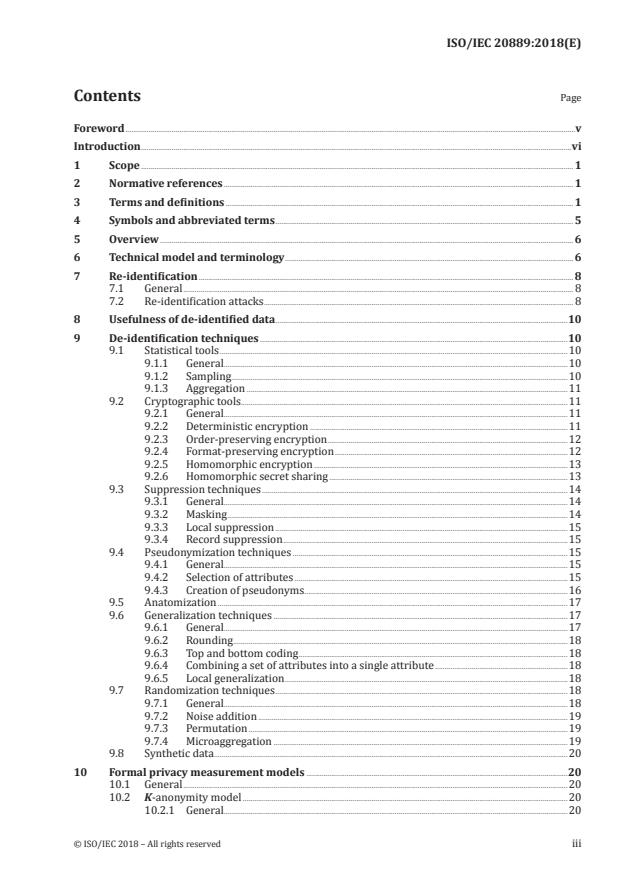
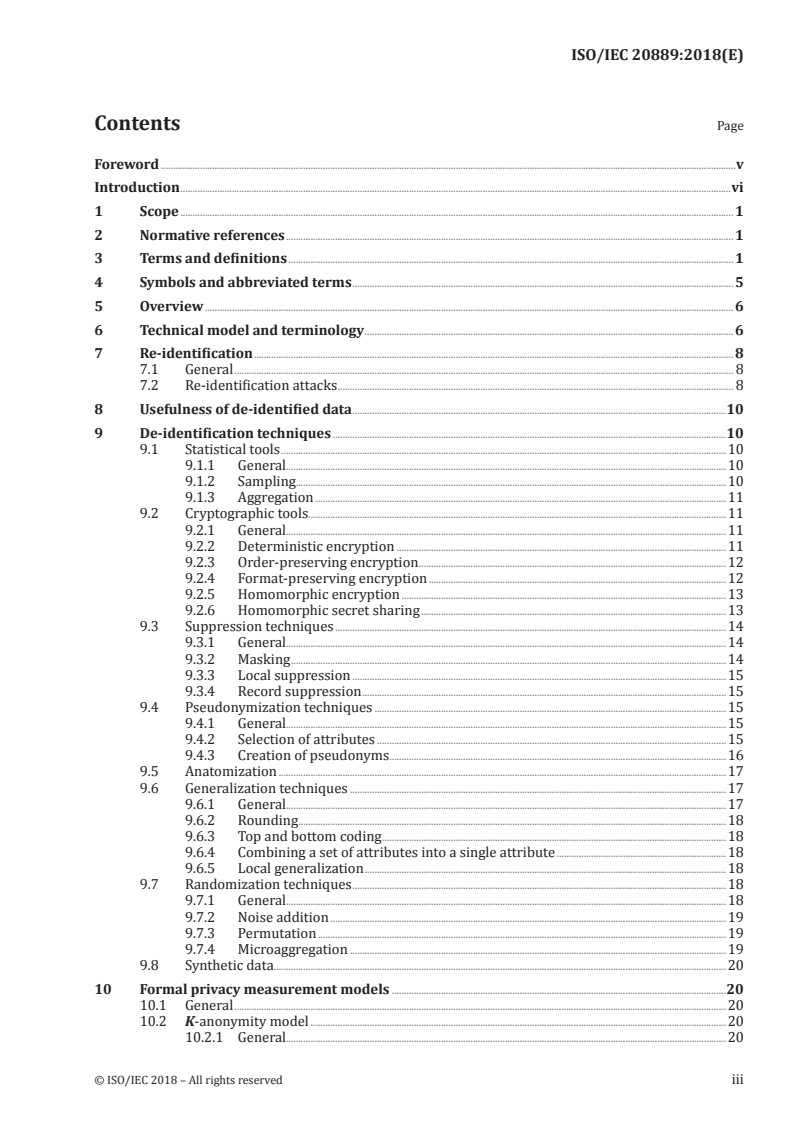
Contents Page
Foreword .v
Introduction .vi
1 Scope . 1
2 Normative references . 1
3 Terms and definitions . 1
4 Symbols and abbreviated terms . 5
5 Overview . 6
6 Technical model and terminology . 6
7 Re-identification . 8
7.1 General . 8
7.2 Re-identification attacks . 8
8 Usefulness of de-identified data .10
9 De-identification techniques .10
9.1 Statistical tools .10
9.1.1 General.10
9.1.2 Sampling.10
9.1.3 Aggregation .11
9.2 Cryptographic tools.11
9.2.1 General.11
9.2.2 Deterministic encryption .11
9.2.3 Order-preserving encryption .12
9.2.4 Format-preserving encryption .12
9.2.5 Homomorphic encryption .13
9.2.6 Homomorphic secret sharing .13
9.3 Suppression techniques .14
9.3.1 General.14
9.3.2 Masking .14
9.3.3 Local suppression .15
9.3.4 Record suppression .15
9.4 Pseudonymization techniques .15
9.4.1 General.15
9.4.2 Selection of attributes .15
9.4.3 Creation of pseudonyms .16
9.5 Anatomization .17
9.6 Generalization techniques .17
9.6.1 General.17
9.6.2 Rounding . .18
9.6.3 Top and bottom coding . .18
9.6.4 Combining a set of attributes into a single attribute .18
9.6.5 Local generalization .18
9.7 Randomization techniques .18
9.7.1 General.18
9.7.2 Noise addition .19
9.7.3 Permutation .19
9.7.4 Microaggregation .19
9.8 Synthetic data . .20
10 Formal privacy measurement models .20
10.1 General .20
10.2 K-anonymity model .20
10.2.1 General.20
© ISO/IEC 2018 – All rights reserved iii
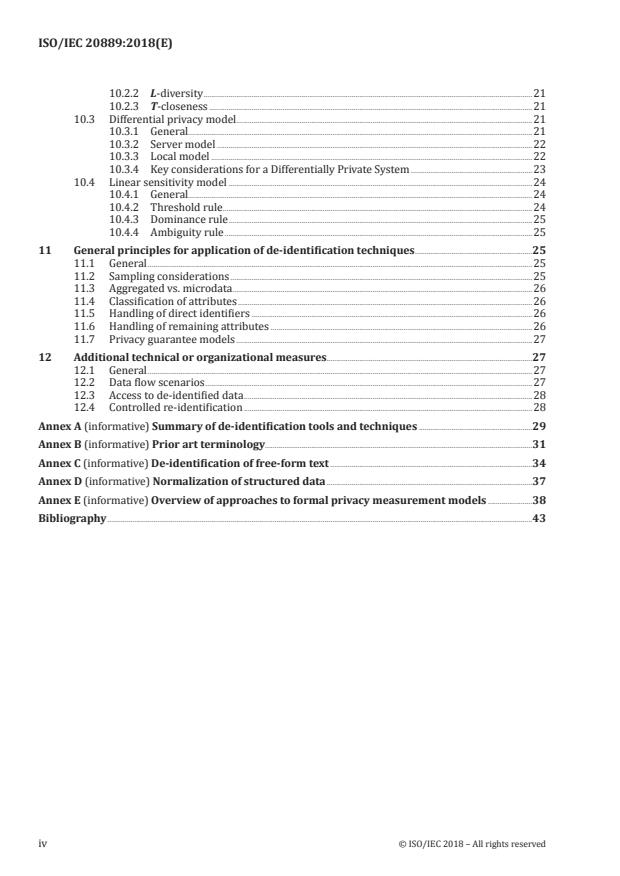
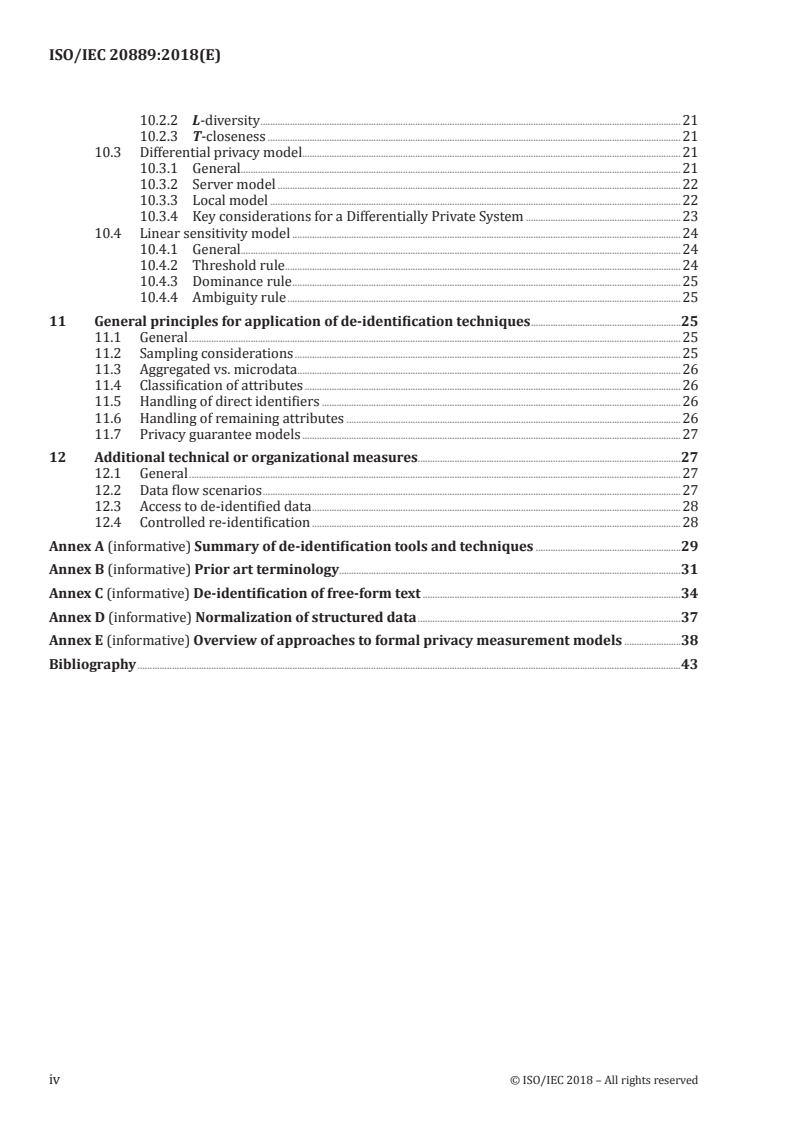
10.2.2 L-diversity .21
10.2.3 T-closeness .21
10.3 Differential privacy model.21
10.3.1 General.21
10.3.2 Server model .22
10.3.3 Local model .22
10.3.4 Key considerations for a Differentially Private System .23
10.4 Linear sensitivity model .24
10.4.1 General.24
10.4.2 Threshold rule . . .24
10.4.3 Dominance rule .25
10.4.4 Ambiguity rule .25
11 General principles for application of de-identification techniques .25
11.1 General .25
11.2 Sampling considerations .25
11.3 Aggregated vs. microdata.26
11.4 Classification of attributes .26
11.5 Handling of direct identifiers .26
11.6 Handling of remaining attributes .26
11.7 Privacy guarantee models .27
12 Additional technical or organizational measures.27
12.1 General .27
12.2 Data flow scenarios .27
12.3 Access to de-identified data .28
12.4 Controlled re-identification .28
Annex A (informative) Summary of de-identification tools and techniques .29
Annex B (informative) Prior art terminology.31
Annex C (informative) De-identification of free-form text .34
Annex D (informative) Normalization of structured data .37
Annex E (informative) Overview of approaches to formal privacy measurement models .38
Bibliography .43
iv © ISO/IEC 2018 – All rights reserved
Foreword
ISO (the International Organization for Standardization) and IEC (the International Electrotechnical
Commission) form the specialized system for worldwide standardization. National bodies that
are members of ISO or IEC participate in the development of International Standards through
technical committees established by the respective organization to deal with particular fields of
technical activity. ISO and IEC technical committees collaborate in fields of mutual interest. Other
international organizations, governmental and non-governmental, in liaison with ISO and IEC, also
take part in the work.
The procedures used to develop this document and those intended for its further maintenance are
described in the ISO/IEC Directives, Part 1. In particular, the different approval criteria needed for
the different types of document should be noted. This document was drafted in accordance with the
editorial rules of the ISO/IEC Directives, Part 2 (see www .iso .org/directives).
Attention is drawn to the possibility that some of the elements of this document may be the subject
of patent rights. ISO and IEC shall not be held responsible for identifying any or all such patent
rights. Details of any patent rights identified during the development of the document will be in the
Introduction and/or on the ISO list of patent declarations received (see www .iso .org/patents) or the IEC
list of patent declarations received (see http: //patents .iec .ch).
Any trade name used in this document is information given for the convenience of users and does not
constitute an endorsement.
For an explanation of the voluntary nature of standards, the meaning of ISO specific terms and
expressions related to conformity assessment, as well as information about ISO's adherence to the
World Trade Organization (WTO) principles in the Technical Barriers to Trade (TBT) see www .iso
.org/iso/foreword .html.
This document was prepared by Joint Technical Committee ISO/IEC JTC 1, Information technology,
Subcommittee SC 27, IT Security techniques.
Any feedback or questions on this document should be directed to the user’s national standards body. A
complete listing of these bodies can be found at www .iso .org/members .html.
© ISO/IEC 2018 – All rights reserved v
Introduction
It is well-established that major benefits can be derived from processing electronically stored data,
including so-called “big data”. However, where this data includes personally identifiable information
(PII), as is often the case, processing this data needs to comply with applicable personal data protection
principles. The appropriate use of de-identification techniques is an important component of measures
to enable the exploitation of the benefits of data processing while maintaining compliance with the
relevant ISO/IEC 29100 privacy principles.
The immediate relevance of this document is to personal data protection of natural persons (i.e. PII
principals), but the term “data principal”, defined and used in this document, is broader than “PII
principal” and, for example, includes organizations and computers.
This document focuses on commonly used techniques for de-identification of structured datasets as well
as on datasets containing information about data principals that can be represented logically in the form
of a table. In particular, the techniques are applicable to datasets that can be converted to having the
form of a table (e.g. data held in key-value databases). It is possible that the techniques described in this
document do not apply to more complex datasets, e.g. containing free-form text, images, audio, or video.
The use of de-identification techniques is good practice to mitigate re-identification risk, but does
not always guarantee the desired result. This document establishes the notion of a formal privacy
measurement model as an approach to the application of data de-identification techniques.
NOTE 1 Annex C clarifies how selected de-identification techniques described in this document are applicable
for de-identification of free-form text.
NOTE 2 The application of de-identification techniques can be a privacy risk treatment option arising from a
[32]
privacy impact assessment, as described in ISO/IEC 29134 .
The selection of de-identification techniques needs to effectively address the risks of re-identification
in a given operational context. There is therefore a need to classify known de-identification techniques
using standardized terminology, and to describe their characteristics, including the underlying
technologies and the applicability of each technique to the reduction of the risk of re-identification. This
is the main goal of this document. The relationship between the terminology used in this document
and related terminology used elsewhere (e.g. the notion of anonymization) is described in Annex B.
However, the specification of detailed processes for the selection and configuration of de-identification
techniques, including assessments of data usefulness and the overall risk from a re-identification
attack, is outside the scope of this document.
NOTE 3 Authentication, credential provisioning, and identity proofing are also outside the scope of this
document.
De-identification techniques are typically accompanied by technical and other organizational measures
to enhance their effectiveness. The use of these measures is also described wherever applicable.
This document provides an overview of core concepts relating to the de-identification of data, and
establishes a standard terminology for, and description of, the operation and properties of a range of
de-identification techniques. However, it does not specify how these techniques should be managed in
a particular use case. It is anticipated that sector-specific framework standards will be developed to
provide such guidance.
vi © ISO/IEC 2018 – All rights reserved
INTERNATIONAL STANDARD ISO/IEC 20889:2018(E)
Privacy enhancing data de-identification terminology and
classification of techniques
1 Scope
This document provides a description of privacy-enhancing data de-identification techniques, to be
used to describe and design de-identification measures in accordance with the privacy principles in
ISO/IEC 29100.
In particular, this document specifies terminology, a classification of de-identification techniques
according to their characteristics, and their applicability for reducing the risk of re-identification.
This document is applicable to all types and sizes of organizations, including public and private
companies, government entities, and not-for-profit organizations, that are PII controllers or PII
processors acting on a controller's behalf, implementing data de-identification processes for privacy
enhancing purposes.
2 Normative references
The following documents are referred to in the text in such a way that some or all of their content
constitutes requirements of this document. For dated references, only the edition cited applies. For
undated references, the latest edition of the referenced document (including any amendments) applies.
ISO/IEC 27000, Information technology — Security techniques — Information security management
systems — Overview and vocabulary
ISO/IEC 29100, Information technology — Security techniques — Privacy framework
3 Terms and definitions
For the purposes of this document, the terms and definitions given in ISO/IEC 27000, ISO/IEC 29100
and the following apply.
ISO and IEC maintain terminological databases for use in standardization at the following addresses:
— ISO Online browsing platform: available at https: //www .iso .org/obp
— IEC Electropedia: available at http: //www .electropedia .org/
3.1
aggregated data
data representing a group of data principals (3.4), such as a collection of statistical properties of that group
3.2
attribute
inherent characteristic
[SOURCE: ISO 9241-302:2008, 3.4.2]
3.3
formal privacy measurement model
approach to the application of data de-identification techniques (3.7) that enables the calculation of re-
identification risk (3.33)
© ISO/IEC 2018 – All rights reserved 1
3.4
data principal
entity to which data relates
Note 1 to entry: The term “data principal” is broader than “PII principal” (or “data subject” as used elsewhere),
and is able to denote any entity such as a person, an organization, a device, or a software application.
3.5
dataset
collection of data
[SOURCE: ISO 19115-1:2014, 4.3, modified — The word “identifiable” has been deleted in the definition.]
3.6
de-identification process
process of removing the association between a set of identifying attributes (3.14) and the data
principal (3.4)
3.7
de-identification technique
method for transforming a dataset (3.5) with the objective of reducing the extent to which information
is able to be associated with individual data principals (3.4)
3.8
de-identified dataset
dataset (3.5) resulting from the application of a de-identification process (3.6)
3.9
differential privacy
formal privacy measurement model (3.3) that ensures that the probability distribution of the output from
a statistical analysis differs by at most a specified value, whether or not any particular data principal
(3.4) is represented in the input dataset
Note 1 to entry: More specifically, differential privacy provides:
a) a mathematical definition of privacy which posits that, for the outcome of any statistical analysis to be
considered privacy-preserving, the analysis results from the original dataset are indistinguishable from those
obtained if any data principal is added to or removed from the dataset; and
b) a measure of privacy that enables monitoring of cumulative privacy loss and setting of an upper bound (or
“budget”) for loss limit. A formal definition is as follows. Let ε be a positive real number, and M be a randomized
algorithm that takes a dataset as input. The algorithm M is said to be ε-differentially private if for all datasets D
and D that differ in a single element (i.e. the data for one data principal), and all subsets S of the range of M,
ε
Pr MD ∈≤Se Pr MD ∈S , where the probability is taken over the randomness used by the algorithm.
() ()
12
3.10
direct identifier
attribute (3.2) that alone enables unique identification of a data principal (3.4) within a specific
operational context
Note 1 to entry: Here and throughout, the operational context includes the information that the entity processing
(e.g. de-identifying) the data possesses, together with information that third parties and potential attackers can
possess or that is in the public domain.
3.11
equivalence class
set of records (3.30) in a dataset (3.5) that have the same values for a specified subset of attributes (3.2)
3.12
generalization
category of de-identification techniques (3.7) that reduce the granularity of information contained in a
selected attribute (3.2) or in a set of related attributes (3.2) in a dataset (3.5)
2 © ISO/IEC 2018 – All rights reserved
3.13
identifier
set of attributes (3.2) in a dataset (3.5) that enables unique identification of a data principal (3.4) within
a specific operational context
Note 1 to entry: See Annex B for a discussion of how this definition relates to those given in other standards.
3.14
identifying attribute
attribute (3.2) in a dataset (3.5) that is able to contribute to uniquely identifying a data principal (3.4)
within a specific operational context
3.15
identity disclosure
re-identification (3.31) event in which an entity correctly assigns an identity to a data principal (3.4)
3.16
indirect identifier
attribute (3.2) that, together with other attributes (3.2) that can be in the dataset (3.5) or external to it,
enables unique identification of a data principal (3.4) within a specific operational context
3.17
inference
act of deducing otherwise unknown information with non-negligible probability, using the values of
one or more attributes (3.2) or by correlating external data sources
Note 1 to entry: The deduced information can be the value of one or more attributes of a data principal, the
presence or absence of a data principal in a dataset, or the value of one or more statistics for a population or
segment of a population.
3.18
K-anonymity
formal privacy measurement model (3.3) that ensures that for each identifier (3.13) in a dataset (3.5)
there is a corresponding equivalence class (3.11) containing at least K records (3.30)
3.19
L-diversity
formal privacy measurement model (3.3) that ensures that for a selected attribute (3.2) each equivalence
class (3.11) has at least L well-represented values
Note 1 to entry: L-diversity is a property of a dataset that gives a guaranteed lower bound, L, on the diversity of
values shared by an equivalence class for a selected attribute.
3.20
linkability
property for a dataset (3.5) that it is possible to associate (by linking) a record (3.30) concerning a data
principal (3.4) with a record (3.30) concerning the same data principal in a separate dataset
3.21
linking
act of associating a record (3.30) concerning a data principal (3.4) with a record (3.30) concerning the
same data principal in a separate dataset (3.5)
3.22
macrodata
dataset (3.5) comprised of aggregated data (3.1)
3.23
microdata
dataset (3.5) comprised of records (3.30) related to individual data principals (3.4)
© ISO/IEC 2018 – All rights reserved 3
3.24
noise addition
de-identification technique (3.7) that modifies a dataset (3.5) by adding random values to the values of a
selected attribute (3.2)
3.25
permutation
de-identification technique (3.7) for reordering the values of a selected attribute (3.2) across the records
(3.30) in a dataset (3.5) without modifying these values
3.26
pseudonym
unique identifier created for a data principal (3.4) to replace the commonly used identifier (3.13) [or
identifiers (3.13)] for that data principal (3.4)
Note 1 to entry: A pseudonym is sometimes also known as an alias.
3.27
pseudonymization
de-identification technique (3.7) that replaces an identifier (or identifiers) for a data principal (3.4) with
a pseudonym (3.26) in order to hide the identity of that data principal
3.28
quasi-identifier
attribute (3.2) in a dataset (3.5) that, when considered in conjunction with other attributes in the
dataset, singles out (3.35) a data principal (3.4)
3.29
randomization technique
de-identification technique (3.7) in which the values of attributes (3.2) are modified so that their new
values differ from their true values in a random way
3.30
record
set of attributes (3.2) concerning a single data principal (3.4)
3.31
re-identification
process of associating data in a de-identified dataset (3.5) with the original data principal (3.4)
Note 1 to entry: A process that establishes the presence of a particular data principal in a dataset is included in
this definition.
3.32
re-identification attack
action performed on de-identified data by an attacker with the purpose of re-identification (3.31)
3.33
re-identification risk
risk of a successful re-identification attack (3.32)
3.34
sensitive attribute
attribute (3.2) in a dataset (3.5) that, depending on the application context, merits specific, high-
level protection against potential re-identification attacks (3.32) enabling disclosure of its values, its
existence, or association with any of the data principals (3.4)
Note 1 to entry: Designating an attribute as sensitive depends on the application context, and such a designation
is an input to the design of the de-identification process (3.6) in a specific use case.
4 © ISO/IEC 2018 – All rights reserved
3.35
single out
isolate records (3.30) belonging to a data principal (3.4) in the dataset (3.5) by observing a set of
characteristics known to uniquely identify this data principal
3.36
T-closeness
formal privacy measurement model (3.3) that ensures that the distance between the distribution of a
selected attribute (3.2) in an equivalence class (3.11) and the distribution of this attribute (3.2) in the
entire table is no more than a threshold T
Note 1 to entry: A table is said to have T-closeness with respect to a selected attribute if all equivalence classes
containing this attribute have T-closeness.
3.37
truthful data
factual data that has not been accidentally or deliberately distorted
Note 1 to entry: Reducing granularity maintains data truthfulness.
3.38
unique identifier
attribute (3.2) in a dataset (3.5) that alone singles out a data principal (3.4) in the dataset
3.39
usefulness
degree of suitability of the type and format of information in a dataset (3.5) for application to a
specific purpose
Note 1 to entry: The term utility is sometimes used with a similar meaning.
4 Symbols and abbreviated terms
ICO Information Commissioner's Office (UK)
PII Personally Identifiable Information
PPDM Privacy-Preserving Data Mining
PPDP Privacy-Preserving Data Publishing
SDC Statistical Disclosure Control
SDL Statistical Disclosure Limitation
ε privacy budget
C privacy cost
D , D datasets
1 2
k number of records or a parameter (percentage) used in the threshold rule
K parameter used in the K-anonymity model
L parameter used in the L-diversity model
M randomized algorithm
N number of queries posed
© ISO/IEC 2018 – All rights reserved 5
n threshold value or number of queries/values (depending on context)
p parameter (percentage) used in the ambiguity rule
Pr probability function
q parameter (percentage) used in the ambiguity rule
S sensitivity of a query
T parameter used in the T-closenesss model
∈ is an element of (a set)
5 Overview
The goal of this document is to provide organizations that are implementing privacy and security
measures with information to support the selection and design of appropriate de-identification
techniques in the context of their organization. After introducing the terminology used in this document
in Clause 6, the threat of re-identification is described in Clause 7; the risk of re-identification attacks
must be assessed as part of the process of selecting appropriate de-identification techniques. The
degree to which usefulness of data after de-identification is retained is the subject of Clause 8.
De-identification techniques are classified in Clause 9 according to their underlying technologies.
Each technique is further assessed in terms of its effectiveness against re-identification as well as its
usefulness in a variety of use cases. The organization's objectives provide an essential context for the
choice of de-identification techniques and other supporting measures. While definition of security
technologies is outside the scope of this document, their use as part of de-identification techniques is
described wherever applicable. The use of technical and other organizational measures to enhance the
effectiveness of de-identification techniques is also described wherever applicable.
NOTE A de-identification process can be deemed to be successful if the output is de-identified to the
required level. This level can differ between two processes depending on the use case (e.g. the dataset dimension,
the type and nature of the data, the type and nature of the data principal, the motivation of the attacker, and the
availability of other sources of information).
Formal privacy measurement models provide a means of assessing the effectiveness of de-identification
and are described in Clause 10. This is followed in Clause 11 by a discussion of principles for the use of
de-identification techniques. The main body of the document concludes in Clause 12 with a review of
additional technical or organizational measures that can be applied for de-identification.
6 Technical model and terminology
De-identification refers to a process that removes the association between a set of data attributes and
the data principal which they concern. A de-identification technique is a method for transforming a
dataset with the objective of reducing the extent to which data can be associated with specific data
principals.
Unless otherwise stated, the focus of this document is on de-identification of datasets that are
represented as a collection of records, where each record is comprised of a set of attributes. Each record
carries information about a data principal and each attribute carries a known meaning.
Regardless of its physical or logical arrangement, any dataset that fits these characteristics is capable
of being viewed as a table. That is, it can be represented as a table with rows and columns, where each
data principal is represented by a single row and each column represents an attribute with a known
meaning. This includes key-value databases, i.e. repositories for data consisting of pairs made up of a
key and a value. The assumption that each data principal is only associated with a single row is made
for the purposes of this document in giving a conceptual description of de-identification techniques and
formal privacy measurement models. However, in practice, data principals are sometimes represented
6 © ISO/IEC 2018 – All rights reserved
by multiple rows (e.g. because of the formal privacy measurement model considered), or in aggregated
form with attributes represented by both rows and columns.
NOTE 1 If, in practice, multiple rows exist corresponding to a single data principal, then, if possible, for the
purposes of applying the concepts described in this document they need to be merged.
Some datasets are not organized as a collection of records each carrying information about a single
data principal. Examples of such datasets are free-form text files, log files of events recorded in order
of their occurrence, and logical graphs that indirectly contain information about data principals. Such
datasets can still contain fields carrying personal or sensitive characteristics relating to potential data
principals.
Annex C describes a number of existing approaches to the de-identification of free-form text, and
clarifies how some of the de-identification techniques described in this document are able to be used
for the de-identification of free-form text. Transactional/longitudinal data can be reorganized into a
binary view with each data principal represented by a single row (see Annex D).
The classification of attributes used in this document, as summarized below, reflects the difference
between singling out a data principal in a dataset and identifying a data principal within a specific
operational context, where the operational context includes information possessed by the entity
processing (e.g. de-identifying) the data, together with information that third parties and potential
attackers can possess:
NOTE 2 Singling out a data principal in the dataset is a necessary precursor to singling out the data principal
in the population; re-identification occurs if the data principal can be singled out in the population, but not
necessarily if the data principal is only singled out in the dataset (which can be a sample).
— Identifier (see 3.12): a set of attributes in a dataset that enables unique identification of a data
principal within a specific operational context;
— Local identifier: a set of attributes in a dataset that together single out a data principal in the dataset;
— Direct identifier (see 3.9): an attribute in a dataset that alone enables unique identification of a data
principal within a specific operational context;
— Unique identifier (see 3.37): an attribute in a dataset that alone singles out a data principal in the
dataset;
NOTE 3 Pseudonyms are examples of unique identifiers.
— Indirect identifier (see 3.15): an attribute in a dataset that, when considered in conjunction with
other attributes that can be in the dataset or external to it, enables unique identification of a data
principal within a specific operational context;
NOTE 4 A related term sometimes used to describe “indirect identifier” is “key attribute”.
NOTE 5 In the context of PII, examples of indirect identifiers include: birth date, postal area code (ZIP
code), and sex.
NOTE 6 There is the potential for a large proportion of the attributes in some datasets to qualify as
indirect identifiers. This can be considered during the selection of de-identification techniques.
— Quasi-identifier (see 3.27): an attribute in a dataset that, when considered in conjunction with other
attributes in the dataset, singles out a data principal;
Sensitive attributes (see 3.33) require specific, high-level protection against potential re-identification
attacks enabling disclosure of their values, existence, or association with any of the data principals.
Designating an attribute as sensitive depends on the application context.
NOTE 7 In some contexts (such as in specific jurisdictions), attributes are deemed sensitive depending on the
nature of the PII, and can, for example, include racial or ethnic origin, political opinions, religious or other beliefs,
personal data on health, sex life or criminal convictions.
© ISO/IEC 2018 – All rights reserved 7
Figure 1 depicts the relationships between the various types of identifier described above. Any attribute
that is equal to or part of one of the types of identifier defined above is deemed to be an identifying
attribute. In Figure 1, “Dataset” refers to the dataset to which de-identification techniques are to be
applied, and “context” refers to information derived from the operational context of the dataset.
Figure 1 — Types of identifier
7 Re-identification
7.1 General
A de-identification technique is designed to reduce the risk of re-identification by generating data that is
less vulnerable to known re-identification attacks. Typically, a de-identification technique alone cannot
provide quantifiable guarantees against re-identification attacks. To achieve this, a range of formal
privacy measurement models have been devised, enabling the calculation of the risk of re-identification
– core models are described in Clause 10. General considerations regarding the effectiveness of de-
identification techniques are described as known at the time of publication. The vulnerability of a
specific data processing system to re-identification attacks can only be assessed in the context of the
organization, and is outside the scope of this document.
Re-identification events in which an entity correctly assigns an identity to a data principal, are known
as “identity disclosures”. Re-identification events in which an entity correctly assigns data from a de-
identified set to a data principal are known as “attribute disclosures”. The two disclosure types can
help enable each other. For example, using additional datasets, identity disclosure can help enable
attribute disclosures, while attribute disclosure for an unknown data principal can contribute to its
identity disclosure.
7.2 Re-identification attacks
A re-identification attack is an action performed on de-identified data by an attacker with the purpose
of re-identification.
Typically, a re-identification attack involves the creation of an “observation” dataset representing
some or all of the data principals from the original dataset. Note that it is possible that the resulting
information about the data principals is not identical to or consistent with the original data as a result
8 © ISO/IEC 2018 – All rights reserved
of modifications to the original values of data attributes in the course of
...
INTERNATIONAL ISO/IEC
STANDARD 20889
First edition
2018-11
Privacy enhancing data de-
identification terminology and
classification of techniques
Terminologie et classification des techniques de dé-identification de
données pour la protection de la vie privée
Reference number
©
ISO/IEC 2018
© ISO/IEC 2018
All rights reserved. Unless otherwise specified, or required in the context of its implementation, no part of this publication may
be reproduced or utilized otherwise in any form or by any means, electronic or mechanical, including photocopying, or posting
on the internet or an intranet, without prior written permission. Permission can be requested from either ISO at the address
below or ISO’s member body in the country of the requester.
ISO copyright office
CP 401 • Ch. de Blandonnet 8
CH-1214 Vernier, Geneva
Phone: +41 22 749 01 11
Fax: +41 22 749 09 47
Email: copyright@iso.org
Website: www.iso.org
Published in Switzerland
ii © ISO/IEC 2018 – All rights reserved
Contents Page
Foreword .v
Introduction .vi
1 Scope . 1
2 Normative references . 1
3 Terms and definitions . 1
4 Symbols and abbreviated terms . 5
5 Overview . 6
6 Technical model and terminology . 6
7 Re-identification . 8
7.1 General . 8
7.2 Re-identification attacks . 8
8 Usefulness of de-identified data .10
9 De-identification techniques .10
9.1 Statistical tools .10
9.1.1 General.10
9.1.2 Sampling.10
9.1.3 Aggregation .11
9.2 Cryptographic tools.11
9.2.1 General.11
9.2.2 Deterministic encryption .11
9.2.3 Order-preserving encryption .12
9.2.4 Format-preserving encryption .12
9.2.5 Homomorphic encryption .13
9.2.6 Homomorphic secret sharing .13
9.3 Suppression techniques .14
9.3.1 General.14
9.3.2 Masking .14
9.3.3 Local suppression .15
9.3.4 Record suppression .15
9.4 Pseudonymization techniques .15
9.4.1 General.15
9.4.2 Selection of attributes .15
9.4.3 Creation of pseudonyms .16
9.5 Anatomization .17
9.6 Generalization techniques .17
9.6.1 General.17
9.6.2 Rounding . .18
9.6.3 Top and bottom coding . .18
9.6.4 Combining a set of attributes into a single attribute .18
9.6.5 Local generalization .18
9.7 Randomization techniques .18
9.7.1 General.18
9.7.2 Noise addition .19
9.7.3 Permutation .19
9.7.4 Microaggregation .19
9.8 Synthetic data . .20
10 Formal privacy measurement models .20
10.1 General .20
10.2 K-anonymity model .20
10.2.1 General.20
© ISO/IEC 2018 – All rights reserved iii
10.2.2 L-diversity .21
10.2.3 T-closeness .21
10.3 Differential privacy model.21
10.3.1 General.21
10.3.2 Server model .22
10.3.3 Local model .22
10.3.4 Key considerations for a Differentially Private System .23
10.4 Linear sensitivity model .24
10.4.1 General.24
10.4.2 Threshold rule . . .24
10.4.3 Dominance rule .25
10.4.4 Ambiguity rule .25
11 General principles for application of de-identification techniques .25
11.1 General .25
11.2 Sampling considerations .25
11.3 Aggregated vs. microdata.26
11.4 Classification of attributes .26
11.5 Handling of direct identifiers .26
11.6 Handling of remaining attributes .26
11.7 Privacy guarantee models .27
12 Additional technical or organizational measures.27
12.1 General .27
12.2 Data flow scenarios .27
12.3 Access to de-identified data .28
12.4 Controlled re-identification .28
Annex A (informative) Summary of de-identification tools and techniques .29
Annex B (informative) Prior art terminology.31
Annex C (informative) De-identification of free-form text .34
Annex D (informative) Normalization of structured data .37
Annex E (informative) Overview of approaches to formal privacy measurement models .38
Bibliography .43
iv © ISO/IEC 2018 – All rights reserved
Foreword
ISO (the International Organization for Standardization) and IEC (the International Electrotechnical
Commission) form the specialized system for worldwide standardization. National bodies that
are members of ISO or IEC participate in the development of International Standards through
technical committees established by the respective organization to deal with particular fields of
technical activity. ISO and IEC technical committees collaborate in fields of mutual interest. Other
international organizations, governmental and non-governmental, in liaison with ISO and IEC, also
take part in the work.
The procedures used to develop this document and those intended for its further maintenance are
described in the ISO/IEC Directives, Part 1. In particular, the different approval criteria needed for
the different types of document should be noted. This document was drafted in accordance with the
editorial rules of the ISO/IEC Directives, Part 2 (see www .iso .org/directives).
Attention is drawn to the possibility that some of the elements of this document may be the subject
of patent rights. ISO and IEC shall not be held responsible for identifying any or all such patent
rights. Details of any patent rights identified during the development of the document will be in the
Introduction and/or on the ISO list of patent declarations received (see www .iso .org/patents) or the IEC
list of patent declarations received (see http: //patents .iec .ch).
Any trade name used in this document is information given for the convenience of users and does not
constitute an endorsement.
For an explanation of the voluntary nature of standards, the meaning of ISO specific terms and
expressions related to conformity assessment, as well as information about ISO's adherence to the
World Trade Organization (WTO) principles in the Technical Barriers to Trade (TBT) see www .iso
.org/iso/foreword .html.
This document was prepared by Joint Technical Committee ISO/IEC JTC 1, Information technology,
Subcommittee SC 27, IT Security techniques.
Any feedback or questions on this document should be directed to the user’s national standards body. A
complete listing of these bodies can be found at www .iso .org/members .html.
© ISO/IEC 2018 – All rights reserved v
Introduction
It is well-established that major benefits can be derived from processing electronically stored data,
including so-called “big data”. However, where this data includes personally identifiable information
(PII), as is often the case, processing this data needs to comply with applicable personal data protection
principles. The appropriate use of de-identification techniques is an important component of measures
to enable the exploitation of the benefits of data processing while maintaining compliance with the
relevant ISO/IEC 29100 privacy principles.
The immediate relevance of this document is to personal data protection of natural persons (i.e. PII
principals), but the term “data principal”, defined and used in this document, is broader than “PII
principal” and, for example, includes organizations and computers.
This document focuses on commonly used techniques for de-identification of structured datasets as well
as on datasets containing information about data principals that can be represented logically in the form
of a table. In particular, the techniques are applicable to datasets that can be converted to having the
form of a table (e.g. data held in key-value databases). It is possible that the techniques described in this
document do not apply to more complex datasets, e.g. containing free-form text, images, audio, or video.
The use of de-identification techniques is good practice to mitigate re-identification risk, but does
not always guarantee the desired result. This document establishes the notion of a formal privacy
measurement model as an approach to the application of data de-identification techniques.
NOTE 1 Annex C clarifies how selected de-identification techniques described in this document are applicable
for de-identification of free-form text.
NOTE 2 The application of de-identification techniques can be a privacy risk treatment option arising from a
[32]
privacy impact assessment, as described in ISO/IEC 29134 .
The selection of de-identification techniques needs to effectively address the risks of re-identification
in a given operational context. There is therefore a need to classify known de-identification techniques
using standardized terminology, and to describe their characteristics, including the underlying
technologies and the applicability of each technique to the reduction of the risk of re-identification. This
is the main goal of this document. The relationship between the terminology used in this document
and related terminology used elsewhere (e.g. the notion of anonymization) is described in Annex B.
However, the specification of detailed processes for the selection and configuration of de-identification
techniques, including assessments of data usefulness and the overall risk from a re-identification
attack, is outside the scope of this document.
NOTE 3 Authentication, credential provisioning, and identity proofing are also outside the scope of this
document.
De-identification techniques are typically accompanied by technical and other organizational measures
to enhance their effectiveness. The use of these measures is also described wherever applicable.
This document provides an overview of core concepts relating to the de-identification of data, and
establishes a standard terminology for, and description of, the operation and properties of a range of
de-identification techniques. However, it does not specify how these techniques should be managed in
a particular use case. It is anticipated that sector-specific framework standards will be developed to
provide such guidance.
vi © ISO/IEC 2018 – All rights reserved
INTERNATIONAL STANDARD ISO/IEC 20889:2018(E)
Privacy enhancing data de-identification terminology and
classification of techniques
1 Scope
This document provides a description of privacy-enhancing data de-identification techniques, to be
used to describe and design de-identification measures in accordance with the privacy principles in
ISO/IEC 29100.
In particular, this document specifies terminology, a classification of de-identification techniques
according to their characteristics, and their applicability for reducing the risk of re-identification.
This document is applicable to all types and sizes of organizations, including public and private
companies, government entities, and not-for-profit organizations, that are PII controllers or PII
processors acting on a controller's behalf, implementing data de-identification processes for privacy
enhancing purposes.
2 Normative references
The following documents are referred to in the text in such a way that some or all of their content
constitutes requirements of this document. For dated references, only the edition cited applies. For
undated references, the latest edition of the referenced document (including any amendments) applies.
ISO/IEC 27000, Information technology — Security techniques — Information security management
systems — Overview and vocabulary
ISO/IEC 29100, Information technology — Security techniques — Privacy framework
3 Terms and definitions
For the purposes of this document, the terms and definitions given in ISO/IEC 27000, ISO/IEC 29100
and the following apply.
ISO and IEC maintain terminological databases for use in standardization at the following addresses:
— ISO Online browsing platform: available at https: //www .iso .org/obp
— IEC Electropedia: available at http: //www .electropedia .org/
3.1
aggregated data
data representing a group of data principals (3.4), such as a collection of statistical properties of that group
3.2
attribute
inherent characteristic
[SOURCE: ISO 9241-302:2008, 3.4.2]
3.3
formal privacy measurement model
approach to the application of data de-identification techniques (3.7) that enables the calculation of re-
identification risk (3.33)
© ISO/IEC 2018 – All rights reserved 1
3.4
data principal
entity to which data relates
Note 1 to entry: The term “data principal” is broader than “PII principal” (or “data subject” as used elsewhere),
and is able to denote any entity such as a person, an organization, a device, or a software application.
3.5
dataset
collection of data
[SOURCE: ISO 19115-1:2014, 4.3, modified — The word “identifiable” has been deleted in the definition.]
3.6
de-identification process
process of removing the association between a set of identifying attributes (3.14) and the data
principal (3.4)
3.7
de-identification technique
method for transforming a dataset (3.5) with the objective of reducing the extent to which information
is able to be associated with individual data principals (3.4)
3.8
de-identified dataset
dataset (3.5) resulting from the application of a de-identification process (3.6)
3.9
differential privacy
formal privacy measurement model (3.3) that ensures that the probability distribution of the output from
a statistical analysis differs by at most a specified value, whether or not any particular data principal
(3.4) is represented in the input dataset
Note 1 to entry: More specifically, differential privacy provides:
a) a mathematical definition of privacy which posits that, for the outcome of any statistical analysis to be
considered privacy-preserving, the analysis results from the original dataset are indistinguishable from those
obtained if any data principal is added to or removed from the dataset; and
b) a measure of privacy that enables monitoring of cumulative privacy loss and setting of an upper bound (or
“budget”) for loss limit. A formal definition is as follows. Let ε be a positive real number, and M be a randomized
algorithm that takes a dataset as input. The algorithm M is said to be ε-differentially private if for all datasets D
and D that differ in a single element (i.e. the data for one data principal), and all subsets S of the range of M,
ε
Pr MD ∈≤Se Pr MD ∈S , where the probability is taken over the randomness used by the algorithm.
() ()
12
3.10
direct identifier
attribute (3.2) that alone enables unique identification of a data principal (3.4) within a specific
operational context
Note 1 to entry: Here and throughout, the operational context includes the information that the entity processing
(e.g. de-identifying) the data possesses, together with information that third parties and potential attackers can
possess or that is in the public domain.
3.11
equivalence class
set of records (3.30) in a dataset (3.5) that have the same values for a specified subset of attributes (3.2)
3.12
generalization
category of de-identification techniques (3.7) that reduce the granularity of information contained in a
selected attribute (3.2) or in a set of related attributes (3.2) in a dataset (3.5)
2 © ISO/IEC 2018 – All rights reserved
3.13
identifier
set of attributes (3.2) in a dataset (3.5) that enables unique identification of a data principal (3.4) within
a specific operational context
Note 1 to entry: See Annex B for a discussion of how this definition relates to those given in other standards.
3.14
identifying attribute
attribute (3.2) in a dataset (3.5) that is able to contribute to uniquely identifying a data principal (3.4)
within a specific operational context
3.15
identity disclosure
re-identification (3.31) event in which an entity correctly assigns an identity to a data principal (3.4)
3.16
indirect identifier
attribute (3.2) that, together with other attributes (3.2) that can be in the dataset (3.5) or external to it,
enables unique identification of a data principal (3.4) within a specific operational context
3.17
inference
act of deducing otherwise unknown information with non-negligible probability, using the values of
one or more attributes (3.2) or by correlating external data sources
Note 1 to entry: The deduced information can be the value of one or more attributes of a data principal, the
presence or absence of a data principal in a dataset, or the value of one or more statistics for a population or
segment of a population.
3.18
K-anonymity
formal privacy measurement model (3.3) that ensures that for each identifier (3.13) in a dataset (3.5)
there is a corresponding equivalence class (3.11) containing at least K records (3.30)
3.19
L-diversity
formal privacy measurement model (3.3) that ensures that for a selected attribute (3.2) each equivalence
class (3.11) has at least L well-represented values
Note 1 to entry: L-diversity is a property of a dataset that gives a guaranteed lower bound, L, on the diversity of
values shared by an equivalence class for a selected attribute.
3.20
linkability
property for a dataset (3.5) that it is possible to associate (by linking) a record (3.30) concerning a data
principal (3.4) with a record (3.30) concerning the same data principal in a separate dataset
3.21
linking
act of associating a record (3.30) concerning a data principal (3.4) with a record (3.30) concerning the
same data principal in a separate dataset (3.5)
3.22
macrodata
dataset (3.5) comprised of aggregated data (3.1)
3.23
microdata
dataset (3.5) comprised of records (3.30) related to individual data principals (3.4)
© ISO/IEC 2018 – All rights reserved 3
3.24
noise addition
de-identification technique (3.7) that modifies a dataset (3.5) by adding random values to the values of a
selected attribute (3.2)
3.25
permutation
de-identification technique (3.7) for reordering the values of a selected attribute (3.2) across the records
(3.30) in a dataset (3.5) without modifying these values
3.26
pseudonym
unique identifier created for a data principal (3.4) to replace the commonly used identifier (3.13) [or
identifiers (3.13)] for that data principal (3.4)
Note 1 to entry: A pseudonym is sometimes also known as an alias.
3.27
pseudonymization
de-identification technique (3.7) that replaces an identifier (or identifiers) for a data principal (3.4) with
a pseudonym (3.26) in order to hide the identity of that data principal
3.28
quasi-identifier
attribute (3.2) in a dataset (3.5) that, when considered in conjunction with other attributes in the
dataset, singles out (3.35) a data principal (3.4)
3.29
randomization technique
de-identification technique (3.7) in which the values of attributes (3.2) are modified so that their new
values differ from their true values in a random way
3.30
record
set of attributes (3.2) concerning a single data principal (3.4)
3.31
re-identification
process of associating data in a de-identified dataset (3.5) with the original data principal (3.4)
Note 1 to entry: A process that establishes the presence of a particular data principal in a dataset is included in
this definition.
3.32
re-identification attack
action performed on de-identified data by an attacker with the purpose of re-identification (3.31)
3.33
re-identification risk
risk of a successful re-identification attack (3.32)
3.34
sensitive attribute
attribute (3.2) in a dataset (3.5) that, depending on the application context, merits specific, high-
level protection against potential re-identification attacks (3.32) enabling disclosure of its values, its
existence, or association with any of the data principals (3.4)
Note 1 to entry: Designating an attribute as sensitive depends on the application context, and such a designation
is an input to the design of the de-identification process (3.6) in a specific use case.
4 © ISO/IEC 2018 – All rights reserved
3.35
single out
isolate records (3.30) belonging to a data principal (3.4) in the dataset (3.5) by observing a set of
characteristics known to uniquely identify this data principal
3.36
T-closeness
formal privacy measurement model (3.3) that ensures that the distance between the distribution of a
selected attribute (3.2) in an equivalence class (3.11) and the distribution of this attribute (3.2) in the
entire table is no more than a threshold T
Note 1 to entry: A table is said to have T-closeness with respect to a selected attribute if all equivalence classes
containing this attribute have T-closeness.
3.37
truthful data
factual data that has not been accidentally or deliberately distorted
Note 1 to entry: Reducing granularity maintains data truthfulness.
3.38
unique identifier
attribute (3.2) in a dataset (3.5) that alone singles out a data principal (3.4) in the dataset
3.39
usefulness
degree of suitability of the type and format of information in a dataset (3.5) for application to a
specific purpose
Note 1 to entry: The term utility is sometimes used with a similar meaning.
4 Symbols and abbreviated terms
ICO Information Commissioner's Office (UK)
PII Personally Identifiable Information
PPDM Privacy-Preserving Data Mining
PPDP Privacy-Preserving Data Publishing
SDC Statistical Disclosure Control
SDL Statistical Disclosure Limitation
ε privacy budget
C privacy cost
D , D datasets
1 2
k number of records or a parameter (percentage) used in the threshold rule
K parameter used in the K-anonymity model
L parameter used in the L-diversity model
M randomized algorithm
N number of queries posed
© ISO/IEC 2018 – All rights reserved 5
n threshold value or number of queries/values (depending on context)
p parameter (percentage) used in the ambiguity rule
Pr probability function
q parameter (percentage) used in the ambiguity rule
S sensitivity of a query
T parameter used in the T-closenesss model
∈ is an element of (a set)
5 Overview
The goal of this document is to provide organizations that are implementing privacy and security
measures with information to support the selection and design of appropriate de-identification
techniques in the context of their organization. After introducing the terminology used in this document
in Clause 6, the threat of re-identification is described in Clause 7; the risk of re-identification attacks
must be assessed as part of the process of selecting appropriate de-identification techniques. The
degree to which usefulness of data after de-identification is retained is the subject of Clause 8.
De-identification techniques are classified in Clause 9 according to their underlying technologies.
Each technique is further assessed in terms of its effectiveness against re-identification as well as its
usefulness in a variety of use cases. The organization's objectives provide an essential context for the
choice of de-identification techniques and other supporting measures. While definition of security
technologies is outside the scope of this document, their use as part of de-identification techniques is
described wherever applicable. The use of technical and other organizational measures to enhance the
effectiveness of de-identification techniques is also described wherever applicable.
NOTE A de-identification process can be deemed to be successful if the output is de-identified to the
required level. This level can differ between two processes depending on the use case (e.g. the dataset dimension,
the type and nature of the data, the type and nature of the data principal, the motivation of the attacker, and the
availability of other sources of information).
Formal privacy measurement models provide a means of assessing the effectiveness of de-identification
and are described in Clause 10. This is followed in Clause 11 by a discussion of principles for the use of
de-identification techniques. The main body of the document concludes in Clause 12 with a review of
additional technical or organizational measures that can be applied for de-identification.
6 Technical model and terminology
De-identification refers to a process that removes the association between a set of data attributes and
the data principal which they concern. A de-identification technique is a method for transforming a
dataset with the objective of reducing the extent to which data can be associated with specific data
principals.
Unless otherwise stated, the focus of this document is on de-identification of datasets that are
represented as a collection of records, where each record is comprised of a set of attributes. Each record
carries information about a data principal and each attribute carries a known meaning.
Regardless of its physical or logical arrangement, any dataset that fits these characteristics is capable
of being viewed as a table. That is, it can be represented as a table with rows and columns, where each
data principal is represented by a single row and each column represents an attribute with a known
meaning. This includes key-value databases, i.e. repositories for data consisting of pairs made up of a
key and a value. The assumption that each data principal is only associated with a single row is made
for the purposes of this document in giving a conceptual description of de-identification techniques and
formal privacy measurement models. However, in practice, data principals are sometimes represented
6 © ISO/IEC 2018 – All rights reserved
by multiple rows (e.g. because of the formal privacy measurement model considered), or in aggregated
form with attributes represented by both rows and columns.
NOTE 1 If, in practice, multiple rows exist corresponding to a single data principal, then, if possible, for the
purposes of applying the concepts described in this document they need to be merged.
Some datasets are not organized as a collection of records each carrying information about a single
data principal. Examples of such datasets are free-form text files, log files of events recorded in order
of their occurrence, and logical graphs that indirectly contain information about data principals. Such
datasets can still contain fields carrying personal or sensitive characteristics relating to potential data
principals.
Annex C describes a number of existing approaches to the de-identification of free-form text, and
clarifies how some of the de-identification techniques described in this document are able to be used
for the de-identification of free-form text. Transactional/longitudinal data can be reorganized into a
binary view with each data principal represented by a single row (see Annex D).
The classification of attributes used in this document, as summarized below, reflects the difference
between singling out a data principal in a dataset and identifying a data principal within a specific
operational context, where the operational context includes information possessed by the entity
processing (e.g. de-identifying) the data, together with information that third parties and potential
attackers can possess:
NOTE 2 Singling out a data principal in the dataset is a necessary precursor to singling out the data principal
in the population; re-identification occurs if the data principal can be singled out in the population, but not
necessarily if the data principal is only singled out in the dataset (which can be a sample).
— Identifier (see 3.12): a set of attributes in a dataset that enables unique identification of a data
principal within a specific operational context;
— Local identifier: a set of attributes in a dataset that together single out a data principal in the dataset;
— Direct identifier (see 3.9): an attribute in a dataset that alone enables unique identification of a data
principal within a specific operational context;
— Unique identifier (see 3.37): an attribute in a dataset that alone singles out a data principal in the
dataset;
NOTE 3 Pseudonyms are examples of unique identifiers.
— Indirect identifier (see 3.15): an attribute in a dataset that, when considered in conjunction with
other attributes that can be in the dataset or external to it, enables unique identification of a data
principal within a specific operational context;
NOTE 4 A related term sometimes used to describe “indirect identifier” is “key attribute”.
NOTE 5 In the context of PII, examples of indirect identifiers include: birth date, postal area code (ZIP
code), and sex.
NOTE 6 There is the potential for a large proportion of the attributes in some datasets to qualify as
indirect identifiers. This can be considered during the selection of de-identification techniques.
— Quasi-identifier (see 3.27): an attribute in a dataset that, when considered in conjunction with other
attributes in the dataset, singles out a data principal;
Sensitive attributes (see 3.33) require specific, high-level protection against potential re-identification
attacks enabling disclosure of their values, existence, or association with any of the data principals.
Designating an attribute as sensitive depends on the application context.
NOTE 7 In some contexts (such as in specific jurisdictions), attributes are deemed sensitive depending on the
nature of the PII, and can, for example, include racial or ethnic origin, political opinions, religious or other beliefs,
personal data on health, sex life or criminal convictions.
© ISO/IEC 2018 – All rights reserved 7
Figure 1 depicts the relationships between the various types of identifier described above. Any attribute
that is equal to or part of one of the types of identifier defined above is deemed to be an identifying
attribute. In Figure 1, “Dataset” refers to the dataset to which de-identification techniques are to be
applied, and “context” refers to information derived from the operational context of the dataset.
Figure 1 — Types of identifier
7 Re-identification
7.1 General
A de-identification technique is designed to reduce the risk of re-identification by generating data that is
less vulnerable to known re-identification attacks. Typically, a de-identification technique alone cannot
provide quantifiable guarantees against re-identification attacks. To achieve this, a range of formal
privacy measurement models have been devised, enabling the calculation of the risk of re-identification
– core models are described in Clause 10. General considerations regarding the effectiveness of de-
identification techniques are described as known at the time of publication. The vulnerability of a
specific data processing system to re-identification attacks can only be assessed in the context of the
organization, and is outside the scope of this document.
Re-identification events in which an entity correctly assigns an identity to a data principal, are known
as “identity disclosures”. Re-identification events in which an entity correctly assigns data from a de-
identified set to a data principal are known as “attribute disclosures”. The two disclosure types can
help enable each other. For example, using additional datasets, identity disclosure can help enable
attribute disclosures, while attribute disclosure for an unknown data principal can contribute to its
identity disclosure.
7.2 Re-identification attacks
A re-identification attack is an action performed on de-identified data by an attacker with the purpose
of re-identification.
Typically, a re-identification attack involves the creation of an “observation” dataset representing
some or all of the data principals from the original dataset. Note that it is possible that the resulting
information about the data principals is not identical to or consistent with the original data as a result
8 © ISO/IEC 2018 – All rights reserved
of modifications to the original values of data attributes in the course of
...