

ISO/IEC 30107-4:2024
(Main)Information technology — Biometric presentation attack detection — Part 4: Profile for testing of mobile devices
General Information
- Abstract
This document is a profile that specifies requirements for testing biometric presentation attack detection (PAD) mechanisms on mobile devices with local biometric recognition and on biometric modules integrated into mobile devices. The profile lists requirements from ISO/IEC 30107-3 that are specific to mobile devices. It also establishes requirements that are not present in ISO/IEC 30107-3. For each requirement, the profile defines an “Approach in PAD Tests for Mobile Devices”. For some requirements, numerical values or ranges are provided in the form of best practices. This profile is applicable to mobile devices that operate as closed systems with no access to internal results, including mobile devices with local biometric recognition as well as biometric modules for mobile devices. This document is not applicable to mobile devices with solely remote biometric recognition. The attacks considered in this document take place at the capture device during the presentation and collection of biometric characteristics. Any other attacks are outside the scope of this document.
- Status
- Published
- Publication Date
- 06-Feb-2024
- Technical Committee
- ISO/IEC JTC 1/SC 37 - Biometrics
- Drafting Committee
- ISO/IEC JTC 1/SC 37 - Biometrics
- Current Stage
- 6060 - International Standard published
- Start Date
- 07-Feb-2024
- Due Date
- 11-Feb-2024
- Completion Date
- 07-Feb-2024

Overview
ISO/IEC 30107-4:2024 - "Information technology - Biometric presentation attack detection - Part 4: Profile for testing of mobile devices" is an ISO profile that tailors PAD (presentation attack detection) testing requirements specifically for mobile devices. It specifies how to evaluate PAD mechanisms on mobile devices with local biometric recognition and on biometric modules integrated into mobile devices. The profile lists mobile-specific requirements drawn from ISO/IEC 30107-3 and adds mobile-focused requirements and test approaches. It applies to closed systems (no access to internal PAD results) and excludes devices that rely solely on remote biometric recognition. Only attacks at the capture device during presentation are considered.
Key topics and technical requirements
- Scope and applicability: Targets mobile devices (smartphones, tablets, wearables, laptops) and embedded biometric modules operating as closed systems. Not applicable to remote-only biometric systems.
- PAD evaluation profile: Defines a mobile-specific profile that maps ISO/IEC 30107-3 requirements to an “Approach in PAD Tests for Mobile Devices,” including numerical best-practices where appropriate.
- Attack types and attacker models: Requires specification of the presentation attacker type (e.g., biometric impostor or concealer) and the set or range of attack types under test.
- Item under test (IUT) description: Test reports must fully describe mobile device model, OS and version, sensor position (front/back), biometric module positioning, and user interaction method (touch, swipe, gaze, passphrase).
- Evaluation level: Emphasizes full-system evaluations for mobile devices; clarifies when subsystem or capture-level tests apply.
- PAI and bona fide samples: Requires a representative set of presentation attack instruments (PAIs) and bona fide test subjects; best-practice PAI species minimum has been updated (document notes change from minimum 3 to minimum 6).
- Artefact creation and usage: Test reports must document artefact creation, preparation difficulty, durability, presenter training level, and any oversight during usage.
- FIDO-specific profile: Clause dedicated to FIDO biometric PAD evaluation requirements for Fast IDentity Online implementations on mobile platforms.
Applications and who uses this standard
- Mobile device manufacturers and biometric module vendors - for implementing, testing and documenting PAD capability.
- Security evaluation laboratories and certification bodies - to plan and execute PAD tests and to produce compliant evaluation reports.
- Mobile OS and app developers integrating local biometric authentication - to understand testing expectations and ensure compatibility with PAD profiles.
- Procurement, compliance, and risk teams - to specify PAD testing requirements in contracts and regulatory submissions.
- FIDO implementers - to align mobile biometric PAD tests with FIDO-specific requirements.
Related standards
- ISO/IEC 30107-1 (PAD framework)
- ISO/IEC 30107-3 (PAD testing and reporting)
- ISO/IEC 19795-1 (biometric performance testing)
- ISO/IEC 2382-37 (biometrics vocabulary)
Keywords: ISO/IEC 30107-4:2024, biometric presentation attack detection, PAD testing, mobile devices, FIDO biometric, biometric module, presentation attack instruments, mobile biometrics.
Relations
- Effective Date
- 02-Sep-2026
- Effective Date
- 01-Jul-2026
- Effective Date
- 06-Jun-2022
Get Certified
Connect with accredited certification bodies for this standard

BSI Group
BSI (British Standards Institution) is the business standards company that helps organizations make excellence a habit.

NYCE
Mexican standards and certification body.
Sponsored listings
Frequently Asked Questions
ISO/IEC 30107-4:2024 is a standard published by the International Organization for Standardization (ISO). Its full title is "Information technology — Biometric presentation attack detection — Part 4: Profile for testing of mobile devices". This standard covers: This document is a profile that specifies requirements for testing biometric presentation attack detection (PAD) mechanisms on mobile devices with local biometric recognition and on biometric modules integrated into mobile devices. The profile lists requirements from ISO/IEC 30107-3 that are specific to mobile devices. It also establishes requirements that are not present in ISO/IEC 30107-3. For each requirement, the profile defines an “Approach in PAD Tests for Mobile Devices”. For some requirements, numerical values or ranges are provided in the form of best practices. This profile is applicable to mobile devices that operate as closed systems with no access to internal results, including mobile devices with local biometric recognition as well as biometric modules for mobile devices. This document is not applicable to mobile devices with solely remote biometric recognition. The attacks considered in this document take place at the capture device during the presentation and collection of biometric characteristics. Any other attacks are outside the scope of this document.
This document is a profile that specifies requirements for testing biometric presentation attack detection (PAD) mechanisms on mobile devices with local biometric recognition and on biometric modules integrated into mobile devices. The profile lists requirements from ISO/IEC 30107-3 that are specific to mobile devices. It also establishes requirements that are not present in ISO/IEC 30107-3. For each requirement, the profile defines an “Approach in PAD Tests for Mobile Devices”. For some requirements, numerical values or ranges are provided in the form of best practices. This profile is applicable to mobile devices that operate as closed systems with no access to internal results, including mobile devices with local biometric recognition as well as biometric modules for mobile devices. This document is not applicable to mobile devices with solely remote biometric recognition. The attacks considered in this document take place at the capture device during the presentation and collection of biometric characteristics. Any other attacks are outside the scope of this document.
ISO/IEC 30107-4:2024 is classified under the following ICS (International Classification for Standards) categories: 35.240.15 - Identification cards. Chip cards. Biometrics. The ICS classification helps identify the subject area and facilitates finding related standards.
ISO/IEC 30107-4:2024 has the following relationships with other standards: It is inter standard links to CEN/TS 18212-3:2026, CEN/TS 18212-5:2026, ISO/IEC 30107-4:2020. Understanding these relationships helps ensure you are using the most current and applicable version of the standard.
ISO/IEC 30107-4:2024 is available in PDF format for immediate download after purchase. The document can be added to your cart and obtained through the secure checkout process. Digital delivery ensures instant access to the complete standard document.
Standards Content (Sample)
International
Standard
ISO/IEC 30107-4
Second edition
Information technology —
2024-02
Biometric presentation attack
detection —
Part 4:
Profile for testing of mobile devices
Technologies de l'information — Détection d'attaque de
présentation en biométrie —
Partie 4: Profil pour les essais des dispositifs mobiles
Reference number
© ISO/IEC 2024
All rights reserved. Unless otherwise specified, or required in the context of its implementation, no part of this publication may
be reproduced or utilized otherwise in any form or by any means, electronic or mechanical, including photocopying, or posting on
the internet or an intranet, without prior written permission. Permission can be requested from either ISO at the address below
or ISO’s member body in the country of the requester.
ISO copyright office
CP 401 • Ch. de Blandonnet 8
CH-1214 Vernier, Geneva
Phone: +41 22 749 01 11
Email: copyright@iso.org
Website: www.iso.org
Published in Switzerland
© ISO/IEC 2024 – All rights reserved
ii
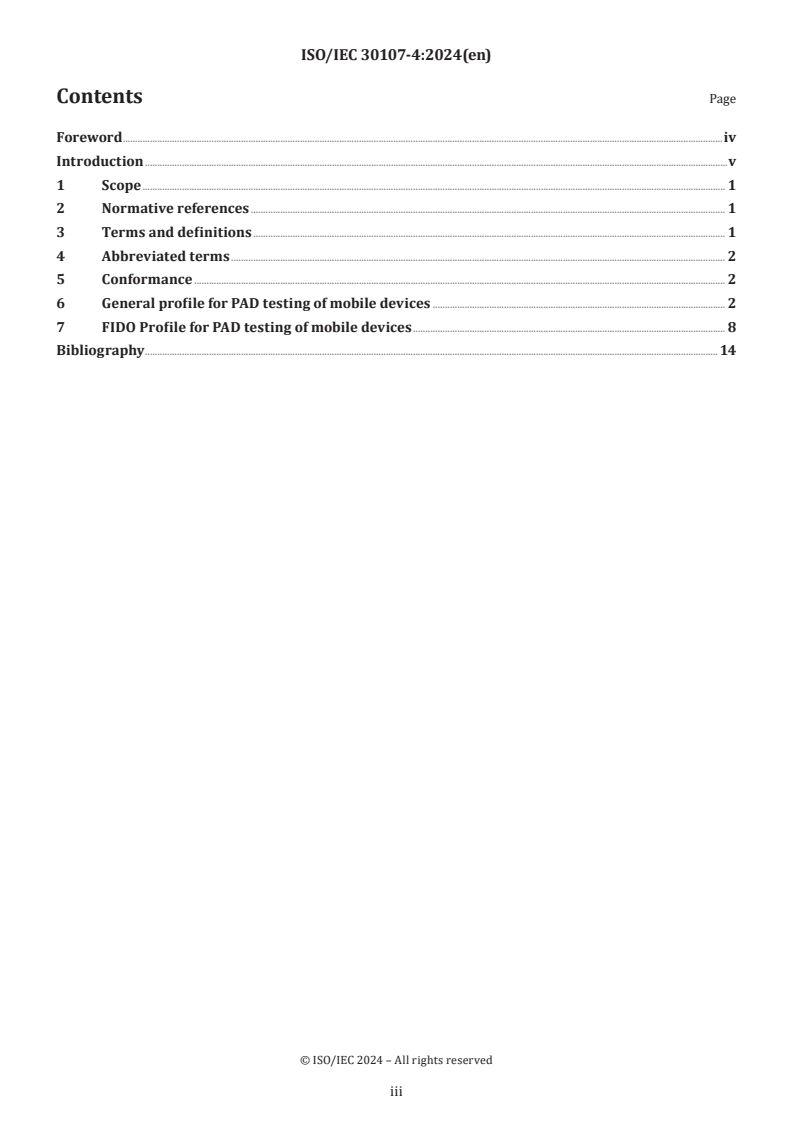
Contents Page
Foreword .iv
Introduction .v
1 Scope . 1
2 Normative references . 1
3 Terms and definitions . 1
4 Abbreviated terms . 2
5 Conformance . 2
6 General profile for PAD testing of mobile devices . 2
7 FIDO Profile for PAD testing of mobile devices . 8
Bibliography . 14
© ISO/IEC 2024 – All rights reserved
iii
Foreword
ISO (the International Organization for Standardization) and IEC (the International Electrotechnical
Commission) form the specialized system for worldwide standardization. National bodies that are
members of ISO or IEC participate in the development of International Standards through technical
committees established by the respective organization to deal with particular fields of technical activity.
ISO and IEC technical committees collaborate in fields of mutual interest. Other international organizations,
governmental and non-governmental, in liaison with ISO and IEC, also take part in the work.
The procedures used to develop this document and those intended for its further maintenance are described
in the ISO/IEC Directives, Part 1. In particular, the different approval criteria needed for the different types
of document should be noted. This document was drafted in accordance with the editorial rules of the ISO/
IEC Directives, Part 2 (see www.iso.org/directives or www.iec.ch/members_experts/refdocs).
ISO and IEC draw attention to the possibility that the implementation of this document may involve the
use of (a) patent(s). ISO and IEC take no position concerning the evidence, validity or applicability of any
claimed patent rights in respect thereof. As of the date of publication of this document, ISO and IEC had not
received notice of (a) patent(s) which may be required to implement this document. However, implementers
are cautioned that this may not represent the latest information, which may be obtained from the patent
database available at www.iso.org/patents and https://patents.iec.ch. ISO and IEC shall not be held
responsible for identifying any or all such patent rights.
Any trade name used in this document is information given for the convenience of users and does not
constitute an endorsement.
For an explanation of the voluntary nature of standards, the meaning of ISO specific terms and expressions
related to conformity assessment, as well as information about ISO's adherence to the World Trade
Organization (WTO) principles in the Technical Barriers to Trade (TBT) see www.iso.org/iso/foreword.html.
In the IEC, see www.iec.ch/understanding-standards.
This document was prepared by Joint Technical Committee ISO/IEC JTC 1, Information technology,
Subcommittee SC 37, Biometrics.
This second edition cancels and replaces the first edition (ISO/IEC 30107-4:2020), which has been technically
revised.
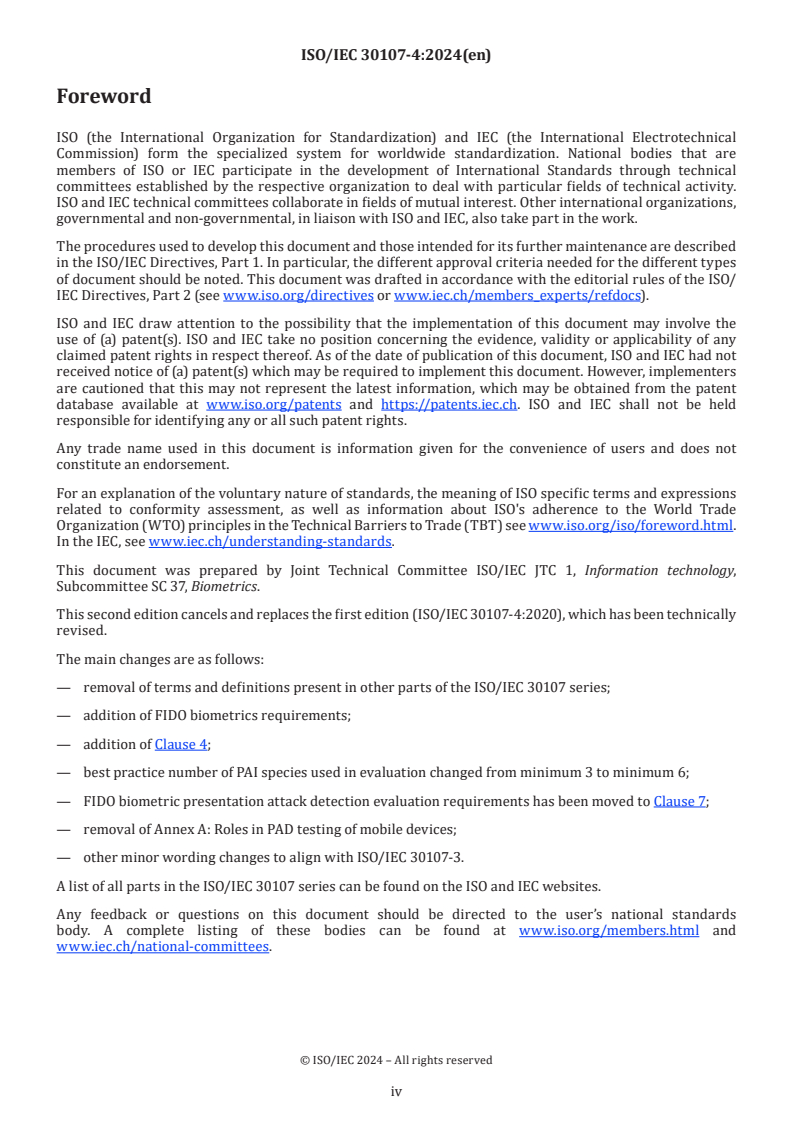
The main changes are as follows:
— removal of terms and definitions present in other parts of the ISO/IEC 30107 series;
— addition of FIDO biometrics requirements;
— addition of Clause 4;
— best practice number of PAI species used in evaluation changed from minimum 3 to minimum 6;
— FIDO biometric presentation attack detection evaluation requirements has been moved to Clause 7;
— removal of Annex A: Roles in PAD testing of mobile devices;
— other minor wording changes to align with ISO/IEC 30107-3.
A list of all parts in the ISO/IEC 30107 series can be found on the ISO and IEC websites.
Any feedback or questions on this document should be directed to the user’s national standards
body. A complete listing of these bodies can be found at www.iso.org/members.html and
www.iec.ch/national-committees.
© ISO/IEC 2024 – All rights reserved
iv
Introduction
The presentation of an artefact or of human characteristics to a biometric capture subsystem in a fashion
intended to interfere with system policy is referred to as presentation attack. The ISO/IEC 30107 series
deals with techniques for the automated detection of presentation attacks. These techniques are called
presentation attack detection (PAD) mechanisms. ISO/IEC 30107-3 establishes principles and methods for
performance assessment of PAD mechanisms and for reporting the results thereof.
[1][2]
PAD mechanisms are commonly integrated into mobile devices that use biometrics. The following
characteristics of mobile devices necessitate the development of an ISO/IEC 30107-3 profile specific to
mobile devices:
— Mobile devices often have accelerated product development timelines, therefore time and resources for
PAD testing can potentially be limited.
— A single type of biometric subsystem is often integrated into a wide range of mobile devices, such that
results from a single test can be applicable to multiple types of mobile devices with the same operating
system (OS) or using the same development language.
— Biometric subsystems integrated into mobile devices are typically closed systems, such that performance
testing takes place through a full-system evaluation.
This document provides requirements for assessing the performance of PAD mechanisms on mobile devices
with local biometric recognition. A general profile is provided in Clause 5 as well as a profile specific to Fast
[3]
IDentity Online (FIDO) biometric presentation attack detection evaluation requirements in Clause 6.
© ISO/IEC 2024 – All rights reserved
v
International Standard ISO/IEC 30107-4:2024(en)
Information technology — Biometric presentation attack
detection —
Part 4:
Profile for testing of mobile devices
1 Scope
This document is a profile that specifies requirements for testing biometric presentation attack detection
(PAD) mechanisms on mobile devices with local biometric recognition and on biometric modules integrated
into mobile devices.
The profile lists requirements from ISO/IEC 30107-3 that are specific to mobile devices. It also establishes
requirements that are not present in ISO/IEC 30107-3. For each requirement, the profile defines an “Approach
in PAD Tests for Mobile Devices”. For some requirements, numerical values or ranges are provided in the
form of best practices.
This profile is applicable to mobile devices that operate as closed systems with no access to internal results,
including mobile devices with local biometric recognition as well as biometric modules for mobile devices.
This document is not applicable to mobile devices with solely remote biometric recognition.
The attacks considered in this document take place at the capture device during the presentation and
collection of biometric characteristics. Any other attacks are outside the scope of this document.
2 Normative references
The following documents are referred to in the text in such a way that some or all of their content constitutes
requirements of this document. For dated references, only the edition cited applies. For undated references,
the latest edition of the referenced document (including any amendments) applies.
ISO/IEC 2382-37, Information technology — Vocabulary — Part 37: Biometrics
ISO/IEC 19795-1, Information technology — Biometric performance testing and reporting — Part 1: Principles
and framework
ISO/IEC 30107-1, Information technology — Biometric presentation attack detection — Part 1: Framework
ISO/IEC 30107-3, Information technology — Biometric presentation attack detection — Part 3: Testing and
reporting
3 Terms and definitions
For the purposes of this document, the terms and definitions given in ISO/IEC 2382-37, ISO/IEC 19795-1,
ISO/IEC 30107-1, ISO/IEC 30107-3 and the following apply.
ISO and IEC maintain terminology databases for use in standardization at the following addresses:
— ISO Online browsing platform: available at https:// www .iso .org/ obp
— IEC Electropedia: available at https:// www .electropedia .org/
© ISO/IEC 2024 – All rights reserved
3.1
mobile device
small, compact, handheld, lightweight, standalone computing device, typically having a display screen with
digitizer input and/or a miniature keyboard
Note 1 to entry: Examples include laptops, tablet PCs, wearable information and communication technology (ICT)
devices, and smartphones
3.2
biometric module
small, compact and lightweight unit that is integrated into or interfaces with a mobile device and that
captures biometric samples, compares biometric references or stores biometric templates
4 Abbreviated terms
The abbreviated terms below are used in this document.
FAR false accept rate
FIDO Fast IDentity Online
FRR false reject rate
FS-PD full system processing duration
IAPAR impostor attack presentation accept rate
IAPAR impostor attack presentation accept rate at the given attack potential
AP
IUT item under test
OS operating system
PAD presentation attack detection
PAI presentation attack instrument
TOE target of evaluation
5 Conformance
Evaluations not based on FIDO biometric requirements shall be planned, executed and reported in
accordance with all requirements set forth in Clause 6.
Evaluations based on FIDO biometrics requirements shall be planned, executed and reported in accordance
with all requirements set forth in Clause 7.
6 General profile for PAD testing of mobile devices
Table 1 provides a profile for PAD testing of mobile devices. Requirements are numbered within Table 1 for
ease of reference.
© ISO/IEC 2024 – All rights reserved
Table 1 — Profile for PAD testing of mobile devices
ISO/IEC 30107- Requirement Approach in presentation attack
3:2023, clause detection (PAD) testing of mobile
or subclause no. devices
6 1) Evaluations of PAD mechanisms and resulting reports Presentation attacks for PAD testing of
shall specify the type of presentation attacker (biome- mobile devices are executed by biomet-
tric impostor or biometric concealer) considered in an ric impostors.
evaluation.
6 2) Evaluations of PAD mechanisms and resulting reports The evaluator shall specify one of the
shall describe the type of evaluation conducted as well following:
as the attack types to be tested.
— Evaluations of PAD mechanisms
in which the set or range of attack
types is selected to be appropriate
to the application, such as those
discussed in ISO/IEC 30107-3:2023,
Clause 11.
— Product-specific evaluations of
PAD mechanisms, used to test a
supplier’s claim of performance
against a specific category of attack
types.
7.1 3) PAD evaluations and resulting reports shall fully de- The evaluator shall provide narrative,
scribe the IUT, including all configurations and settings to include the following:
as well as the amount of information available to the
— Mobile device model, OS, and OS
evaluator about PAD mechanisms in place.
version.
— Position of sensor (e.g. front, back,
side), to include position relative to
device’s screen(s).
— If applicable, manner of test subject
interaction with the biometric
sensor (e.g. touch left index finger,
swipe right or left thumb, look
at front-facing camera, speak a
passphrase).
— If applicable, the positioning of the
biometric module with respect to
the mobile device.
7.1 4) Evaluations of PAD mechanisms and resulting reports PAD testing of mobile devices is applied
shall specify the applicable evaluation level, whether at the full system level.
PAD subsystem, data capture subsystem, or full system.
7.2 5) Evaluations of PAD mechanisms shall cover a defined The evaluator shall determine the
variety of attack types by utilizing a representative set suitable range of PAIs and bona fide test
of presentation attack instruments and a representative crew composition.
set of bona fide test subjects.
7.2 6) The evaluator shall define the parameters of the The evaluator shall provide basis and
attack presentation to fully characterize the range of narrative.
PAI presenter interactions with the IUT, to include the
temporal boundaries of the presentation.
7.2 7) In an evaluation of PAD mechanisms, the evaluator The evaluator shall provide basis and
shall 1) define bona fide presentations and representa- narrative.
tive test subjects for the target application and popula-
tion and 2) provide a rationale for these definitions.
10.2 8) Evaluations of PAD mechanisms and resulting reports The evaluator shall provide basis and
shall describe how artefacts were created and prepared, narrative for each bullet.
addressing the following:
© ISO/IEC 2024 – All rights reserved
TTaabblle 1 e 1 ((ccoonnttiinnueuedd))
ISO/IEC 30107- Requirement Approach in presentation attack
3:2023, clause detection (PAD) testing of mobile
or subclause no. devices
— creation and preparation processes;
— effort required to create and prepare artefacts (e.g.
technical know-how, creation time, difficulty of
collecting artefact materials, creation instruments,
and preparation instruments);
— ability to consistently create and prepare artefacts
with intended properties;
— customization of artefacts for specific PAI
presenters;
— customization of artefacts for specific systems;
— sourcing of biometric characteristics;
— availability of public information on creation and
preparation process;
— changes in artefact creation or preparation
processes over the course of the evaluation.
10.3 9) Evaluations of PAD mechanisms and resulting reports The evaluator shall provide basis and
shall describe how artefacts were used in the evaluation, narrative for each bullet. It is assumed
addressing the following: that no scrutiny or oversight is applied
during artefact usage.
— level of PAI presenter training and habituation;
— artefact durability, including the number of
presentations associated with each artefact; and
— level of scrutiny or oversight applied during artefact
usage.
11.1 10) Evaluations of PAD mechanisms and resulting The evaluator shall document which
reports shall describe whether evaluation design con- processes were considered in evalua-
sidered enrolment, identification, and/or verification tion design: enrolment, verification, or
processes identification.
© ISO/IEC 2024 – All rights reserved
TTaabblle 1 e 1 ((ccoonnttiinnueuedd))
ISO/IEC 30107- Requirement Approach in presentation attack
3:2023, clause detection (PAD) testing of mobile
or subclause no. devices
11.2 11) Evaluations of PAD mechanisms and resulting re- The evaluator shall provide basis and
ports that apply to enrolment processes shall describe narrative for each bullet. Assumptions
the following: for enrolment processes include the
following:
— use of enrolment-specific quality thresholds or — enrolment parameters are native to
presentation policy; the device and are not changeable
or exposed to the evaluator;
— parameters of the enrolment transaction, including
number and duration of presentations; — no operator oversight is present;
and
— level of operator oversight present in the process;
— no operator functions are applied
— manner in which operator functions were applied or
or emulated in the evaluation.
emulated in the evaluation; and
— whether the IUT checks sample quality and provides
feedback to the test subject (e.g. “finger too wet”,
“move to a quieter room”).
11.3 12) Evaluations of PAD mechanisms and resulting re- The evaluator shall provide basis and
ports that apply to verification processes shall describe narrative for each bullet. Assumptions
the following: for verification processes include the
following:
— use of quality thresholds and presentation policy; — verification parameters are native
to the device and not changeable or
— parameters of the verification transaction, including
exposed to the evaluator;
the number and duration of presentations;
— no operator oversight is present in
— level of operator oversight present in the process;
the process; and
— no operator functions are applied
or emulated in the evaluation.
© ISO/IEC 2024 – All rights reserved
TTaabblle 1 e 1 ((ccoonnttiinnueuedd))
ISO/IEC 30107- Requirement Approach in presentation attack
3:2023, clause detection (PAD) testing of mobile
or subclause no. devices
— manner in which operator functions were applied or Transaction policies, attempt limits,
emulated in the evaluation; and user feedback are particularly im-
portant when considering mobile devic-
— whether the IUT
...