


ISO/TR 18486:2016
(Main)Plastics — Parameters comparing the spectral irradiance of a laboratory light source for weathering applications to a reference solar spectral irradiance
Plastics — Parameters comparing the spectral irradiance of a laboratory light source for weathering applications to a reference solar spectral irradiance
ISO/TR 18486:2016 specifies a calculation method which allows calculating a parameter which compares the spectral irradiance of a laboratory radiation source for weathering application to a reference solar spectral irradiance.
Plastiques — Paramètres de comparaison de la distribution spectrale d'une source de lumière de laboratoire pour les applications de vieillissement et d'une distribution spectrale solaire de référence
General Information
- Status
- Withdrawn
- Publication Date
- 01-Feb-2016
- Withdrawal Date
- 01-Feb-2016
- Technical Committee
- ISO/TC 61/SC 6 - Ageing, chemical and environmental resistance
- Drafting Committee
- ISO/TC 61/SC 6/WG 2 - Exposure to light
- Current Stage
- 9599 - Withdrawal of International Standard
- Start Date
- 26-Nov-2018
- Completion Date
- 12-Feb-2026
Relations
- Effective Date
- 07-Oct-2017
Get Certified
Connect with accredited certification bodies for this standard

Smithers Quality Assessments
US management systems and product certification.

DIN CERTCO
DIN Group product certification.
Sponsored listings
Frequently Asked Questions
ISO/TR 18486:2016 is a technical report published by the International Organization for Standardization (ISO). Its full title is "Plastics — Parameters comparing the spectral irradiance of a laboratory light source for weathering applications to a reference solar spectral irradiance". This standard covers: ISO/TR 18486:2016 specifies a calculation method which allows calculating a parameter which compares the spectral irradiance of a laboratory radiation source for weathering application to a reference solar spectral irradiance.
ISO/TR 18486:2016 specifies a calculation method which allows calculating a parameter which compares the spectral irradiance of a laboratory radiation source for weathering application to a reference solar spectral irradiance.
ISO/TR 18486:2016 is classified under the following ICS (International Classification for Standards) categories: 83.080.01 - Plastics in general. The ICS classification helps identify the subject area and facilitates finding related standards.
ISO/TR 18486:2016 has the following relationships with other standards: It is inter standard links to ISO/TR 18486:2018. Understanding these relationships helps ensure you are using the most current and applicable version of the standard.
ISO/TR 18486:2016 is available in PDF format for immediate download after purchase. The document can be added to your cart and obtained through the secure checkout process. Digital delivery ensures instant access to the complete standard document.
Standards Content (Sample)
TECHNICAL ISO/TR
REPORT 18486
First edition
2016-02-01
Plastics — Parameters comparing the
spectral irradiance of a laboratory
light source for weathering
applications to a reference solar
spectral irradiance
Plastiques — Paramètres de comparaison de la distribution spectrale
d’une source de lumière de laboratoire pour les applications de
vieillissement et d’une distribution spectrale solaire de référence
Reference number
©
ISO 2016
© ISO 2016, Published in Switzerland
All rights reserved. Unless otherwise specified, no part of this publication may be reproduced or utilized otherwise in any form
or by any means, electronic or mechanical, including photocopying, or posting on the internet or an intranet, without prior
written permission. Permission can be requested from either ISO at the address below or ISO’s member body in the country of
the requester.
ISO copyright office
Ch. de Blandonnet 8 • CP 401
CH-1214 Vernier, Geneva, Switzerland
Tel. +41 22 749 01 11
Fax +41 22 749 09 47
copyright@iso.org
www.iso.org
ii © ISO 2016 – All rights reserved
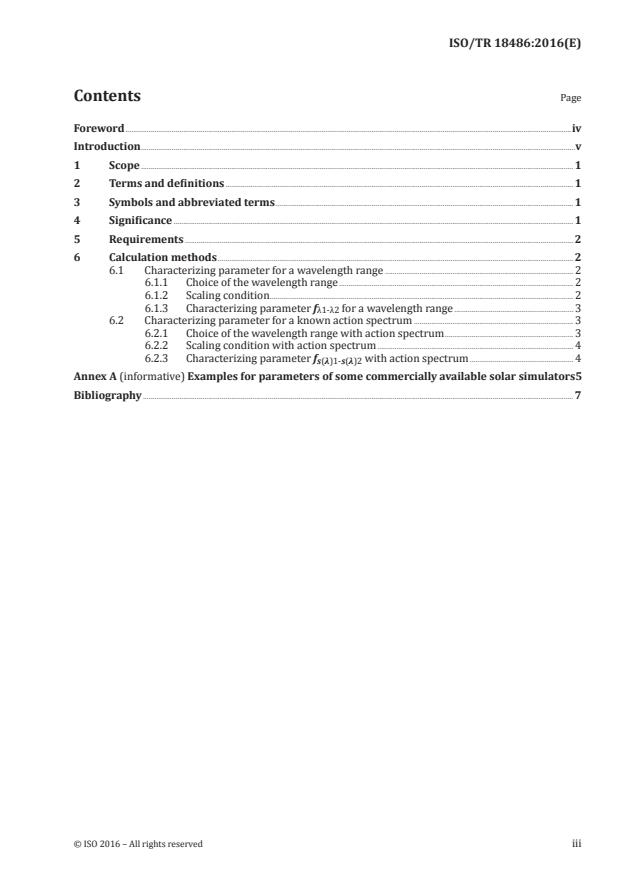
Contents Page
Foreword .iv
Introduction .v
1 Scope . 1
2 Terms and definitions . 1
3 Symbols and abbreviated terms . 1
4 Significance . 1
5 Requirements . 2
6 Calculation methods . 2
6.1 Characterizing parameter for a wavelength range . 2
6.1.1 Choice of the wavelength range . 2
6.1.2 Scaling condition . 2
6.1.3 Characterizing parameter f for a wavelength range . 3
λ1-λ2
6.2 Characterizing parameter for a known action spectrum . 3
6.2.1 Choice of the wavelength range with action spectrum . 3
6.2.2 Scaling condition with action spectrum . 4
6.2.3 Characterizing parameter f with action spectrum . 4
s(λ)1-s(λ)2
Annex A (informative) Examples for parameters of some commercially available solar simulators 5
Bibliography . 7
Foreword
ISO (the International Organization for Standardization) is a worldwide federation of national standards
bodies (ISO member bodies). The work of preparing International Standards is normally carried out
through ISO technical committees. Each member body interested in a subject for which a technical
committee has been established has the right to be represented on that committee. International
organizations, governmental and non-governmental, in liaison with ISO, also take part in the work.
ISO collaborates closely with the International Electrotechnical Commission (IEC) on all matters of
electrotechnical standardization.
The procedures used to develop this document and those intended for its further maintenance are
described in the ISO/IEC Directives, Part 1. In particular the different approval criteria needed for the
different types of ISO documents should be noted. This document was drafted in accordance with the
editorial rules of the ISO/IEC Directives, Part 2 (see www.iso.org/directives).
Attention is drawn to the possibility that some of the elements of this document may be the subject of
patent rights. ISO shall not be held responsible for identifying any or all such patent rights. Details of
any patent rights identified during the development of the document will be in the Introduction and/or
on the ISO list of patent declarations received (see www.iso.org/patents).
Any trade name used in this document is information given for the convenience of users and does not
constitute an endorsement.
For an explanation on the meaning of ISO specific terms and expressions related to conformity
assessment, as well as information about ISO’s adherence to the WTO principles in the Technical
Barriers to Trade (TBT) see the following URL: Foreword - Supplementary information.
The committee responsible for this document is ISO/TC 61, Plastics, Subcommittee SC 6, Ageing, chemical
and environmental resistance.
iv © ISO 2016 – All rights reserved
Introduction
Laboratory radiation sources generate radiation which is intended to simulate a defined „reference
sun“ as perfect as possible, where the fitting to the spectral irradiance in the materials sensitive range
is most important. So far, the fitting is described verbally only, e.g. standards concerning artificial
weathering, and the user has to decide for himself if the spectral irradiance E(λ) indicated by the
producer of the laboratory radiation source agrees suitable enough with the „reference sun“ for his
specific application or, occasionally, the classification describes the fitting to a wanted „reference sun“
only insufficiently (e.g. for standard weathering tests).
This Technical Report deals with a procedure for the determination of objective factors characterizing
the grade of fitting in quantity.
One procedure describes the grade of fitting of a laboratory radiation source to the defined reference
sun for specific spectral ranges. A second procedure results in characterizing parameters for the
respective wavelength ranges, incorporating known action spectra.
TECHNICAL REPORT ISO/TR 18486:2016(E)
Plastics — Parameters comparing the spectral irradiance
of a laboratory light source for weathering applications to
a reference solar spectral irradiance
1 Scope
This Technical Report specifies a calculation method which allows calculating a parameter which
compares the spectral irradiance of a laboratory radiation source for weathering application to a
reference solar spectral irradiance.
2 Terms and definitions
For the purposes of this document, the following terms and definitions apply.
2.1
spectral irradiance
E
λ
radiant flux per unit area per wavelength interval
–2 –1
Note 1 to entry: It is measured in watts per square metre per nanometre (W ⋅ m ⋅ nm ).
2.2
action spectrum
description of the spectral efficiency of radiation to produce a particular polymer response (specific
property change of a specific polymer) plotted as a function of the wavelength of the radiation
Note 1 to entry: Data of an action spectrum are specific to the polymer but independent from the radiation
source, also named spectral sensitivity.
3 Symbols and abbreviated terms
–2 –1
E(λ) spectral irradiance of reference sun (W ⋅ m ⋅ nm )
ref.
–2 –1
E(λ) spectral irradiance of laboratory radiation source (W ⋅ m ⋅ nm )
source
–2 –1
E(λ) scaled spectral irradiance of laboratory radiation source (W ⋅ m ⋅ nm )
scaled
s(λ) action spectrum
4 Significance
Not for all applications of simulated solar radiation (laboratory radiation source) the total sun spectrum
is needed. For economic reasons, therefore, it is advisable to simulate only that spectral range being of
importance for the respective process or in cases of application where the object’s heating has to be
observed in close limits, e.g. with biological objects. In this case, both VIS and IR radiation have to be
eliminated to a great extent (see Table 1).
...
Questions, Comments and Discussion
Ask us and Technical Secretary will try to provide an answer. You can facilitate discussion about the standard in here.
Loading comments...