


ISO 4548-2:1997
(Main)Methods of test for full-flow lubricating oil filters for internal combustion engines — Part 2: Element by-pass valve characteristics
Methods of test for full-flow lubricating oil filters for internal combustion engines — Part 2: Element by-pass valve characteristics
Méthodes d'essai des filtres à huile de lubrification à passage intégral pour moteurs à combustion interne — Partie 2: Caractéristiques de l'organe de dérivation du filtre
General Information
- Status
- Published
- Publication Date
- 17-Sep-1997
- Technical Committee
- ISO/TC 70/SC 7 - Tests for lubricating oil filters
- Drafting Committee
- ISO/TC 70/SC 7 - Tests for lubricating oil filters
- Current Stage
- 9093 - International Standard confirmed
- Start Date
- 22-Feb-2024
- Completion Date
- 12-Feb-2026
Relations
- Effective Date
- 06-Jun-2022
- Effective Date
- 16-Oct-2025
- Effective Date
- 15-Apr-2008
Overview
ISO 4548-2:1997 specifies standardized test methods for the element by‑pass valve characteristics of full‑flow lubricating oil filters used on internal combustion engines. It defines how to set up a test rig, prepare the filter (including use of a non‑permeable dummy element or separate housing for spin‑on types), select test liquids, and measure differential pressure, leakage and valve opening/closing behaviour across a range of flow rates. The purpose is to ensure the by‑pass valve maintains oil supply under choke or cold‑start conditions while minimising unfiltered oil flow during normal operation.
Key Topics and Technical Requirements
- Scope: Tests target the element by‑pass valve of full‑flow engine oil filters; complementary parts of ISO 4548 cover other filter characteristics.
- Test liquids & viscosities: Two kinematic viscosities are used to simulate conditions:
- ~24 mm²/s for typical operating temperature (examples given: ISO VG 100 / SAE 30 at ≈74 °C or ISO VG 150 / SAE 40 at ≈83 °C).
- ~500 mm²/s for cold conditions (example: ISO VG 460 / SAE 140 at ≈38 °C).
- Test rig components: Sump with temperature control, motor pump, throttle/regulating valves, flow meter, pressure gauges, inlet/outlet pipes with specified tap positions, and sampling/discharge arrangements.
- Filter preparation: Element replaced by a non‑permeable dummy of identical dimensions or valve tested in a separate housing where element removal is impractical.
- Measurements & procedure:
- Measure differential pressure across the by‑pass valve at at least eight approximately equal flow increments up to 110% of rated flow.
- Record valve opening and closing pressures (approaching flow points from lower and higher values respectively).
- Measure leakage at 10% below specified minimum opening pressure and ensure leakage flow has stabilized before sampling.
- Note any valve noise (oscillation), as it may correlate with wear.
- Accuracy & reporting: Measurement accuracy requirements and reporting formats are defined; differential pressure is expressed in kilopascals (kPa).
Practical Applications and Users
- Who uses it: filter manufacturers, OEM engine designers, independent test laboratories, quality assurance and procurement teams, and regulatory authorities specifying component safety/performance.
- Why it matters: Ensures by‑pass valves provide reliable engine lubrication during cold starts or element blockage while limiting unfiltered oil delivery during normal operation-critical for engine durability and warranty compliance.
- Benefits: Provides repeatable, comparable test results for design validation, supplier acceptance testing, and product specifications.
Related Standards
- ISO 4548 (other parts): Part 1 (differential pressure/flow), Part 3 (high differential/temperature resistance), Parts 4–12 (efficiency, durability, burst, vibration, etc.)
- ISO 1219‑1: Graphic symbols for fluid power
- ISO 11841‑1 / ISO 11841‑2: Filter vocabulary and definitions
Keywords: ISO 4548-2:1997, by‑pass valve characteristics, lubricating oil filter test methods, full‑flow filters, kinematic viscosity, differential pressure, engine oil filter testing.
ISO 4548-2:1997 - Methods of test for full-flow lubricating oil filters for internal combustion engines

ISO 4548-2:1997 - Méthodes d'essai des filtres a huile de lubrification a passage intégral pour moteurs a combustion interne
ISO 4548-2:1997 - Méthodes d'essai des filtres a huile de lubrification a passage intégral pour moteurs a combustion interne
Get Certified
Connect with accredited certification bodies for this standard

DNV
DNV is an independent assurance and risk management provider.

Lloyd's Register
Lloyd's Register is a global professional services organisation specialising in engineering and technology.
DNV Energy Systems
Energy and renewable energy certification.
Sponsored listings
Frequently Asked Questions
ISO 4548-2:1997 is a standard published by the International Organization for Standardization (ISO). Its full title is "Methods of test for full-flow lubricating oil filters for internal combustion engines — Part 2: Element by-pass valve characteristics". This standard covers: Methods of test for full-flow lubricating oil filters for internal combustion engines — Part 2: Element by-pass valve characteristics
Methods of test for full-flow lubricating oil filters for internal combustion engines — Part 2: Element by-pass valve characteristics
ISO 4548-2:1997 is classified under the following ICS (International Classification for Standards) categories: 27.020 - Internal combustion engines. The ICS classification helps identify the subject area and facilitates finding related standards.
ISO 4548-2:1997 has the following relationships with other standards: It is inter standard links to ISO 23631:2006, ISO 4548-2:1982/Cor 1:1990, ISO 4548-2:1982. Understanding these relationships helps ensure you are using the most current and applicable version of the standard.
ISO 4548-2:1997 is available in PDF format for immediate download after purchase. The document can be added to your cart and obtained through the secure checkout process. Digital delivery ensures instant access to the complete standard document.
Standards Content (Sample)
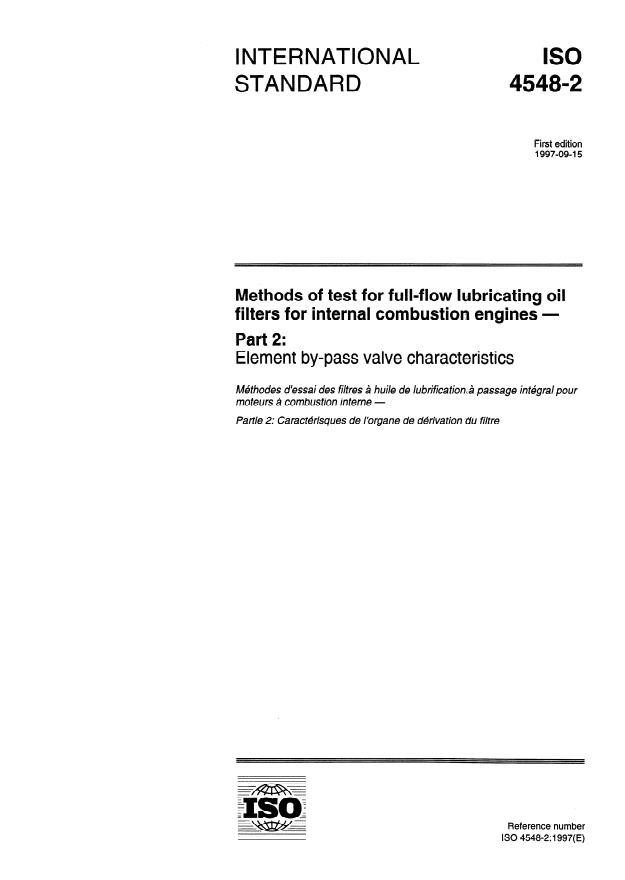
IS0
INTERNATIONAL
4548-2
STANDARD
First edition
1997-09-I 5
Methods of test for full-flow lubricating oil
filters for internal combustion engines -
Part 2:
Element by-pass valve characteristics
Mbthodes d’essai des filtres A huile de IubrificationA passage int6gral pour
moteurs & combustion interne -
Partie 2: Caractkisques de I’organe de dbrivation du filfre
Reference number
IS0 4548-2: 1997(E)
IS0 4548=2:1997(E)
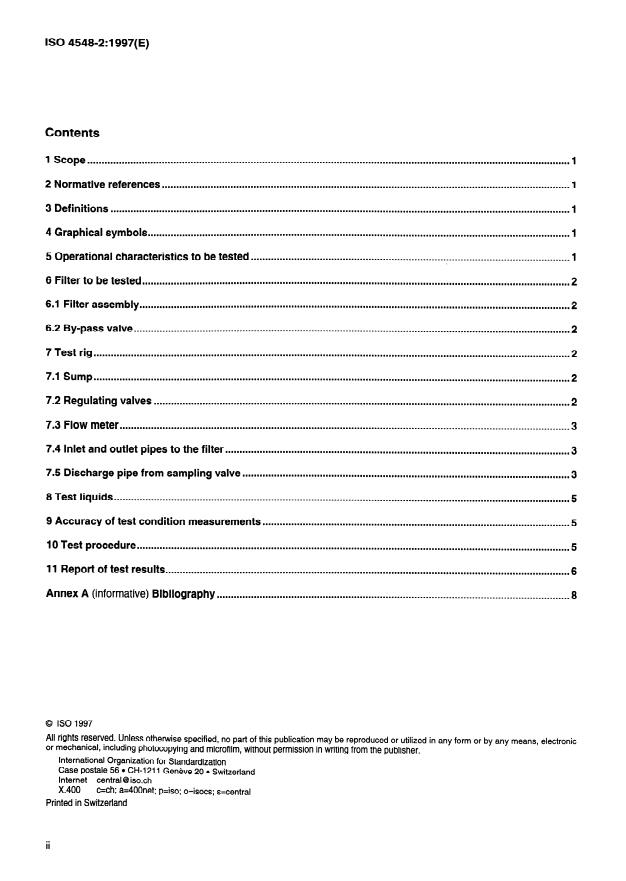
Contents
~~~~~~~~~~~~~~,~~~*,**~~.~a~~~~~~~~~~~.~~.~.~.~~~~.~.~.~~.~.~.,.~.*~*
1 Scope
mmmmmmmmmmmmmmmmmmmmmmmmmmmmmmmmmmmmmmmmmmmmmmmmmmmmmmmmmmmmmmmmmmmmmmmmmmmmmmmmmmmmmmmmmmmmmmmmmmmmmmmmmmmmmmmmmmmmmmmmmmmmmmmmmmmmmmmmmmmmmm
2 Normative references
. . . . . . . . . . . . . . . . . . . . . . . . . . . . . . . . . . . . . . . . . . . . . . . .*.=.**.**.
3 Definitions
...................................................................................................................................................
4 Graphical symbols
...............................................................................................................
5 Operational characteristics to be tested
<
mmmmmmmmmmmmmmmmmmmmmmmmmmmmmmmmmmmmmmmmmmmmmmmmmmmmmmmmmmmmmmmmmmmmm*mmmmmmmmmmmmmmmmmmmmmmmmmmmmmmmmmmmmmmmmmmmmmmmmmmmmmmmmmmmmmmmmmmmmmmmmmmmmmmm
6 Filter to be tested
......................................................................................................................................................
6.1 Filter assembly
........................................................................................................................................................
6.2 By-pass valve
......................................................................................................................................................................
7 Test rig
......................................................................................................................................................................
7.1 Sump
.................................................................................................................................................
7.2 Regulating valves
7.3 Flow meter .
7.4 Inlet and outlet pipes to the filter mmmmmmmmmmmmmmmmmmmmmmmmmmmmmmmmmmmmmmmmmmmmmmmmmmmmmmmmmmmmmmmmmmmmmmmmmmmmmmmmmmmmmmmmmmmmmmmmmmmmmmmmmmmmmmmmmmmmmmmm
..................................................................................................................
7.5 Discharge pipe from sampling valve
...............................................................................................................................................................
8 Test liquids
...........................................................................................................
9 Accuracy of test condition measurements
10 Test procedure .
11 Report of test results mmmmmmmmmmmmmmmmmmmmmmmmmmmmmmmmmmmmmmmmmmmmmmmm*mmmmmmmmmmmmmmmmmmmmmmmmmmmmmmmmmmmmmmmmmmmmmmmmmmmmmmmmmmmmmmmmmmmmmmmmmmmmmmmmmmmmmmmmmmmm
Annex A (informative) Bibliography .
0 IS0 1997
All rights reserved. Unless otherwise specified, no paa of this publication may be reproduced or utilized in any form or by any means, electronic
or mechanical, including photocopying and microfilm, without permission in writing from the publisher.
International Organization for Standardization
Case postale 56 l CH-1211 Geneve 20 l Switzerland
Internet central @ iso.ch
x.400 c=ch; a=400net; p=iso; o=isocs; s=central
Printed in Switzerland
0 IS0 IS0 4548-2: 1997(E)
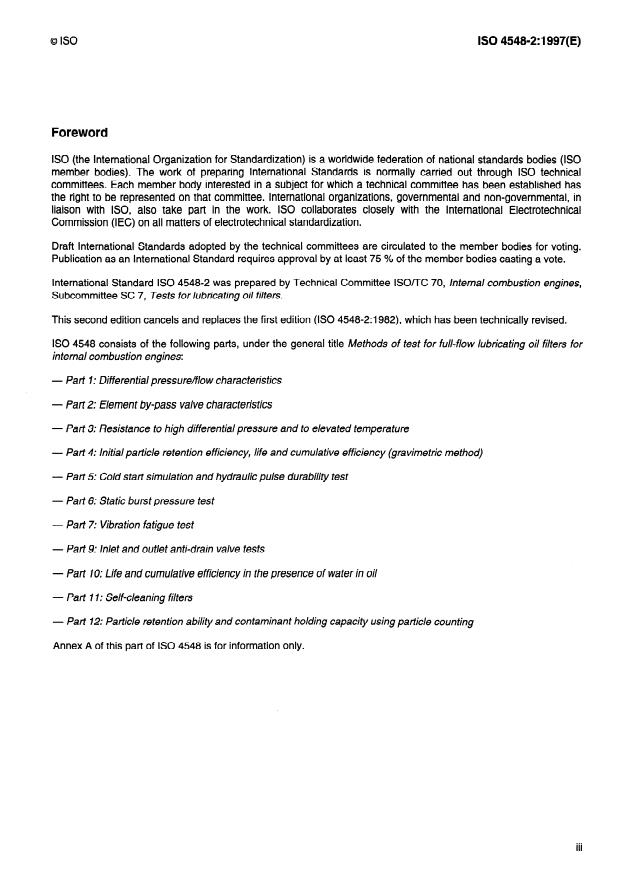
Foreword
IS0 (the International Organization for Standardization) is a worldwide federation of national standards bodies (IS0
member bodies). The work of preparing International Standards is normally carried out through IS0 technical
committees. Each member body interested in a subject for which a technical committee has been established has
the right to be represented on that committee. International organizations, governmental and non-governmental, in
liaison with ISO, also take part in the work. IS0 collaborates closely with the International Electrotechnical
Commission (IEC) on all matters of electrotechnical standardization.
Draft International Standards adopted by the technical committees are circulated to the member bodies for voting.
casting
Publication as an International Standard requires approval by at least 75 % of the member bodies a vote.
International Standard IS0 4548-2 was prepared by Technical Committee ISO/lC 70, Internal combustion engines,
Subcommittee SC 7, Tests for lubricating oil filters.
This second edition cancels and replaces the first edition (IS0 4548-2:1982), which has :been technically revised.
IS0 4548 consists of the following parts, under the general title Methods of test for fukflow lubricating oil fi/ters for
internal combustion engines:
- Part 1: Differential pressure/flow characteristics
- Part 2: Element by-pass valve characteristics
- Part 3: Resistance to high differential pressure and to elevated temperature
- Part 4: Initial particle retention efficiency, life and cumulative efficiency (gravimetric method)
- Part 5: Co/d start simulation and hydraulic pulse durability test
- Part 6: Static burst pressure test
- Part 7: Vibration fatigue test
- Part 9: Inlet and outlet anti-drain valve tests
- Part 10: Life and cumulative efficiency in the presence of water in oil
- Part 11: Self-cleaning filters
- Part 12: Particle retention ability and contaminant holding capacity using particle counting
Annex A of this part of IS0 4548 is for information only.
0 IS0
IS0 4548-2: 1997(E)
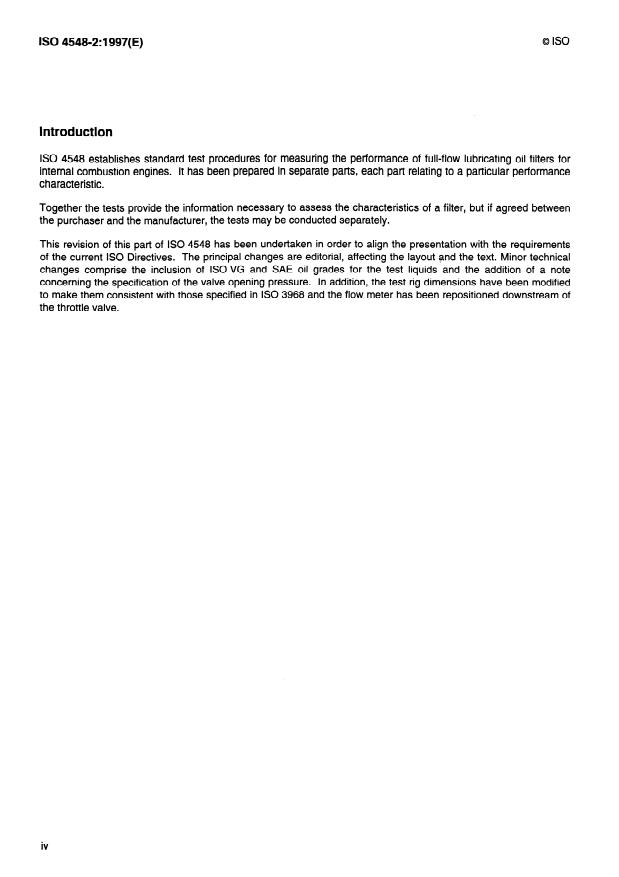
Introduction
IS0 4548 establishes standard test procedures for measuring the performance of full-flow lubricating oil filters for
internal combustion engines. It has been prepared in separate parts, each part relating to a particular performance
characteristic.
Together the tests provide the information necessary to assess the characteristics of a filter, but if agreed between
the purchaser and the manufacturer, the tests may be conducted separately.
This revision of this part of IS0 4548 has been undertaken in order to align the presentation with the requirements
of the current IS0 Directives. The principal changes are editorial, affecting the layout and the text. Minor technical
.
changes comprise the inclusion of IS0 VG and SAE oil grades for the test liquids and the addition of a note
In addition, the test rig dimensions have been modified
concerning the specification of the valve opening pressure.
to make them consistent with those specified in IS0 3968 and the flow meter has been repositioned downstream of
the throttle valve.
iv
IS0 4548-2: 1997(E)
INTERNATIONAL STANDARD o IS0
Methods of test for full-flow lubricating oil filters for internal
combustion engines -
Part 2:
Element by-pass valve characteristics
1 Scope
This part of IS0 4548 specifies tests for determining the element by-pass valve characteristics of full-flow lubricating
oil filters for internal combustion engines.
Tests are specified with oils at two viscosities, one to assess the performance of an element by-pass valve with a
cold oil and the other to assess its performance with an oil at a typical operating temperature.
2 Normative references
The following standards contain provisions which, through reference in this text, constitute provisions of this part of
IS0 4548. At the time of publication, the editions indicated were valid. All standards are subject to revision and
parties to agreement based on this part of IS0 4548 are encouraged to investigate the possibility of applying the
most recent editions of the standards indicated below. Members of IEC and IS0 maintain registers of currently valid
International Standards.
IS0 1219-l :1991, Fluid power systems and components - Graphic symbols and circuit diagrams - Part 1:
Graphic symbols.
IS0 11841-1: -I), Road vehicles and internal combustion engines - Filter vocabulary -) Part 1: Definitions of filters
and filter components.
IS0 11841-2:-l), Road vehicles and internal combustion engines - Filter vocabulary - Part 2: Definitions of
characteristics of filters and their components.
3 Definitions
For the purposes of this part of IS0 4548, the definitions given in IS0 11841-l and IS0 11841-2 apply.
4 Graphical symbols
The graphical symbols used in this part of IS0 4548 are in accordance with IS0 1219-l.
5 Operational characteristics to be tested
The purpose of the element by-pass valve of a lubricating oil filter is to maintain an adequate supply of oil to the
engine when the differential pressure across the filter element is high, even if the oil is not then filtered. Such
conditions may occur, for example, when the engine is started from cold or in the event of the element becoming
choked.
1) To be published.
0 IS0
IS0 4548-2: 1997(E)
To limit the quantity of unfiltered oil passed to the engine when there is no excessive differential pressure across the
filter, it is customary for the by-pass valve to be designed not to open below a specified differential pressure and to
allow leakage at no more than a specified rate when the differential pressure is not above the value.
To maintain an adequate oil supply to the engine when the filter element is completely choked, it is customary for
the by-pass valve to be designed to pass the full oil flow with no more than a specified differential pressure. The
tests specified in this part of IS0 4548 measure the differential pressure across the by-pass valve over the whole
range of oil flow rates.
These tests include the requirement that a note shall be made of any noise emitted by the by-pass valve for
example, due to valve oscillation. This is because there has been found to be a correlation between noise in these
components and wear.
The differential pressure is measured across the complete filter assembly as described in 6.1.
6 Filter to be tested
6.1 Filter assembly
The filter element shall be removed from the filter and in its place there shall be installed a non-permeable dummy
element of identical dimensions.
In the case of a filter whose element cannot readily be replaced by a non-permeable dummy element, for example a
spin-on cartridge filter, the unit shall be opened and the by-pass valve shall be removed for testing in a separate
housing, the design of which shall be agreed between the manufacturer and the purchaser of the filter.
6.2 By-pass valve
The filter by-pass valve for test, the test liquid and the test rig shall be clean. For the purpose of this part of
IS0 4548, the term “clean” means that there is no detectable increase in differential pressure across a filter of the
type under test (not modified in accordance with 6.1) when the test liquid at the test temperature is circulated
through the test rig and the filter at the rated flow of the filter for 5 min.
7 Test rig
The test rig is shown diagrammatically in figure 1. It shall include the components described in 7.1 to 7.5, together
with the necessary tubing, connectors and supports.
7.1 Sump
The sump shall be capable of holding sufficient oil and shall be equipped with a thermostatically controlled heater
and cooler capable of maintaining
...
ISO
NORME
4548-2
INTERNATIONALE
Premiére édition
1997-09-I 5
Méthodes d’essai des filtres àihuile de
lubrification à passage intégrd pour
moteurs à combustion interne e
Partie 2:
Caractéristiques de l’organe de dérivation du
filtre
Methods of test for full-flow lubricating oil filfers for interna/ combustion
engines -
Part 2: Element by-pass valve characteristics
Numéro de référence
ISO 4548-2: 1997(F)
ISO 4548-2: 1997(F)
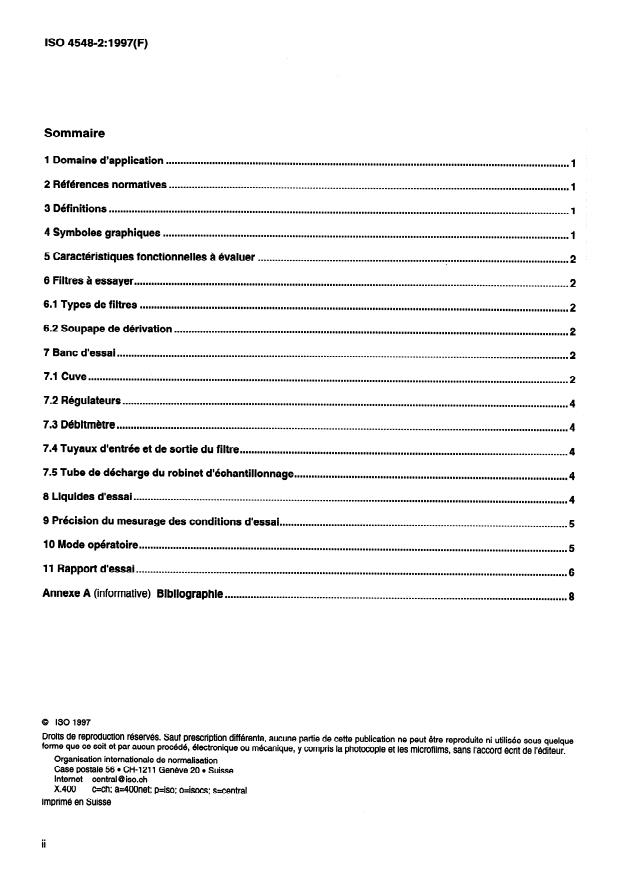
Sommaire
1 Domaine d’application . . . . . . . . . . . . . .DDDDmDmmmDDoommDDommDDDmmDmDDD.DmDDDDDDmmmmDDDDDDDDDDDmmmDDDmDmDDDmDmmDDDDDDDDDDm
2 Références normatives mmmmmmmmmmmmmmmmmmmmmmmmm8mmmmmmmmmmmmmmmmmmmmmwmmmmmmmmmmmmmmmmmmmmmmommmmmmmmmmmmmmmemmmmmmmmmmmmommmmmmmmmmmmmmm8mmmmmmmmmmmmmommmmmmmmm
mmmmmmmmmwmoammmmmmmmmmmm8wmmmmmmmmmmmmmmmmmmmmmmmmmmmmmmmmmmmmwmmmmmmmmmmmmmmmmmmm*mmmmmmmmmmmmmmmmmmmmmmmmmmmmmmmmmmmmmmmmmmmmmmmmmmmmmmmmmmmmmmmm*mmmmmmmmmmm
3 Définitions
mmmmmmmmmmmmem8mmmmmmmmmmmmmmmmmmmmmmmmmmmmmmmmmmmmmmmmmmmmmmmmmmmmmmmmmmmmmmmmmammmmmmmmmmmmm*ammmmmmmmmmmmmmmmmmmmmmmmmmmmmmmmmmmmmmmmmmmmm
4 Symboles graphiques
mmmmm*mmm*mmmmmmmmmmmmmmmmmmmmmmmmmmmmmmmmmmmmmmmmmmmmmmmmmmmammmm88*mmmmmmmmmmmm*mmmmmmmmmmmmmmmmmmmmmmmmmm
5 Caractéristiques fonctionnelles à évaluer
.
mmmmmmmmmmmmmmmmmmmmmmmmmmmmmmmmmmmmmmmammmmmmmmmmmmmmmommmmmmmmmmmmommmmmmmmmmmmmmmmmmmmmmmmmmmmmmmmmmommmmmmmm*mmmmmm*mmmmmmmmmmmmmmmmmmmmmmmmmmmmmmm 2
6 Filtres à essayer
mmmmmmmmmmmmmmmmmmmm8mmmmmmmmmmmmmmmmmmmmmmmmmmmmmmmmmmmmmmmmmmmmmmmmmmmmmmmmm8mmmmmmmmmmmmmmmm8mmmmmmmmmmmmmmmmmmmmmmmmmmmmmmmmmmmmmmmmmmmmmmmmmmmmm 2
6.1 Types de filtres
mmmmmmmmmmmmmmmmmmmmmmwmmmmmmmmmmmmmmmmmmmmmmmmmmmmmmmmmmmmmmmmmmmmmmmm*mmmmmmmmmmmmmmmmmmmmmmmmmmmmmmmmmmmmmmmmmmmmmmmmmmmmmmmmmmmmmmmmm 2
6.2 Soupape de dérivation
7 Banc d’essai mmmmmmmmmmmmmmmmmmmmmmmmmmmmmmmmmmmmmmmmmmmmmmmmmmmmmmmmmmmmmmmmmmmmmmmmmmmmmmmmmmmmmmmmmmmmmmmmmmmmmmmmmmmmmmmmmmmmmmmmmmmmmmmmmmmmmmmmmmmmmmmmmmmmmmmmmmmmm
7.1 Cuve mmmmmmmmmmmmmmmmmm8mmmmmmmmmmmmmmmmmmmmmmm8mmmmmmmmmmmmmmmmmmmmmmmmmmmmmmmmmmmmmmmmmwmmmmmmmmmmmmmmmmmmmmmmmmmmm8mmmmmommmmmemmmmmmmmmmmmmmmmmmmmmmmmmmmmmm8mmmmmmmmmmm
7.2 Régulateurs mmmmmmmmmmmmmmmmmmmmmmommmmmmmmmmmmmmmmmmmmmmm*mmmmmmmmmmmmmmmmmmmmmmmmmmmmmmmmmmmmmmmmmmmmmmmmmmmmmmmmmmmmmmmmmmmmmmmmmmmmmmmmmmmmmmmmammmmmmmmmmmmmmmmmmm
7.3 Débitmètre mmmmmmmmmmmmmmmmmmmmmmmmmmmmmmmmmmmmemmmmmmmmmmmmmmmmmmmmmmmmmmmmmmmmmmmmmmmmmmmmmmmmommmmmmmmmmmmmmmmmommmmmmmmmmmmmmmmmmmmmmmmmmmmmmmmmmmmmmmmmmmmmmmmmmmmm
7.4 Tuyaux d’entrée et de sortie du filtre mmmmmmmmmmmmmmmmmmmmmmmmmmmmmmmmmmmmmmmmmmmmmmmmmmmmmmmmmmmmmmmmmmmmmmmmmmmmmmmmmmmmmmmmmmmmommmmmmmmmmmmmmmmmommm
7.5 Tube de décharge du robinet d’échantillonnage mmmmmmmmmmmmmmmmmmmmmmmmmmmmmmmmmmmmmmmmmammmmmmmmmmmmmmmmmmmmmmmmmmmmmmmmmmmmmmmmmmammmmmmmmmm 4
8 Liquides d’essai mmmmmmmmmmmmmmmmmmmmmmmmmmmmmmmmmmmmmmommmmmmmmmmmmmmmmmmammmmmmmmmmmmmmmmmmmmmmmmmmmmmmmommmommmmmmmmmmmmmmmmmmmmmmmmmmommmmmmmmmmmmmmmommmmmmmmmmmmmm 4
9 Précision du mesurage des conditions d’essai mmmmmmmmommmmmoommmmmmmmmmmmmmmmmmmmmmmmommmmmmmmmmmmmmmmmmmmmmmmmmm*mmmmmmmmmmmmmmmmmmmmmmmmmmmmmmm 5
10 Mode opératoire mammmmm*mmmmmm8ommmmmmmmmm8mmmmmmmwmmmmmmmmmmmmmmmmmmmmmmmmmmmmmmmmm*mmmmmmmmmmmm8mmmmmmmwommmmmmwmmmmsmmmmmmm8mmmmmmmammmmmmmmmmmmmmommmmmmmmmmmamm* 5
11 Rapport d’essai mmmmmmmmmmmoommmmmmmmmmmmmmmmmmmmmmommmmmmmmmmmmmmmmmmmmmommmmmmmmmommmmmmmmmmmmmmmmmmmmommmmmmommmmmmmmemmmmmmmmmmmmmmmammmmmmmmmmmmmmmmmmmmmmmmmmomm 6
Annexe A (informative) Bibliographie mmmmmmmmmommm*mmmmmmommmmmommmmmmmmmmammmmmmmmmmmmmmmmmmmmmommmmmmmmmmmmmmmmmmmommmmmmmmmmmmommmmmmmmmmmmmmmmmmmmmmmmmm 8
@ ISO 1997
Droits de reproduction réserves. Sauf prescription differente, aucune partie de cette publication ne peut être reproduite ni utilisée sous quelque
forme que ce soit et par aucun procede, electronique ou mecanique, y compris la photocopie et les microfilms, sans l’accord Wit de Mditeur.
Organisation internationale de normalisation
Case postale 56 l CH-121 1 Geneve 20 l Suisse
Internet central @ iso.ch
x.400 c=ch; a=4OOnet; p=iso; o=isocs; s=central
Imprime en Suisse
ii
ISO 4548-2: 1997(F)
0 ISO
.
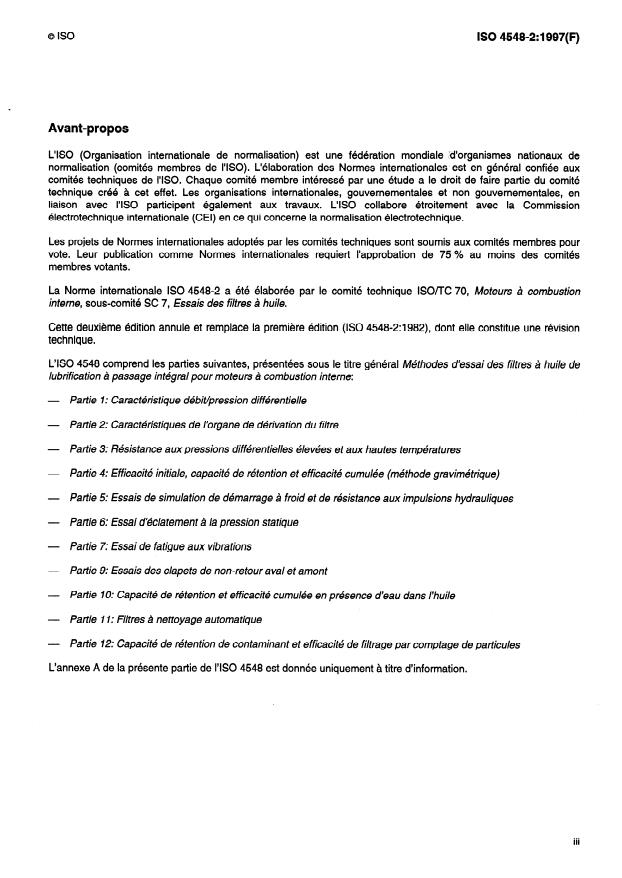
Avant-propos
L’ISO (Organisation internationale de normalisation) est une fédération mondiale :d’organismes nationaux de
normalisation (comités membres de I’ISO). L’élaboration des Normes internationales. est en général confiée aux
comités techniques de I’ISO. Chaque comité membre intéressé par u,ne étude a le droit de faire partie du comité
technique créé à cet effet. Les organisations internationales, gouvernementales et non gouvernementales, en
L’ISO collabore étroitement avec la Commission
liaison avec I’ISO participent également aux travaux.
électrotechnique internationale (CEI) en ce qui concerne la normalisation électrotechnique.
Les projets de Normes internationales adoptés par les comités techniques sont soumis aux comités membres pour
vote. Leur publication comme Normes internationales requiert l’approbation de 75 % au moins des comités
membres votants.
La Norme internationale ISO 4548-2 a été élaborée par le comité technique ISO/TC 70, Moteurs a combustion
interne, sous-comité SC 7, Essais des filtres à huile.
Cette deuxième édition annule et remplace la première édition (ISO 454802:1982), dont elle constitue une révision
technique.
L’ISO 4548 comprend les parties suivantes, présentées sous le titre général Méthodes d’essai des filtres a huile de
lubrification a passage intégral pour moteurs a combustion interne:
- Partie 1: Caractéristique débitipression différentielle
- Partie 2: Caractéristiques de l’organe de dérivation du filtre
- Partie 3; Résistance aux pressions différentielles élevées et aux hautes températures
- Partie 4: Efficacité initiale, capacité de rétention et efficacité cumulée (méthode gravimétrique)
- Partie 5: Essais de simulation de démarrage à froid et de résistance aux impulsions hydrauliques
- Partie 6: Essai d’éclatement à la pression statique
- Partie 7: Essai de fatigue aux vibrations
- Partie 9: Essais des clapets de non-retour aval et amont
- Partie 10: Capacité de rétention et efficacité cumulée en présence d’eau dans /‘huile
Partie 11: Filtres à nettoyage automatique
-
- Partie 12: Capacité de rétention de contaminant et efficacité de filtrage par comptage de particules
L’annexe A de la présente partie de I’ISO 4548 est donnée uniquement à titre d’information.
. . .
III
0 ISO
ISO 4548=2:1997(F)
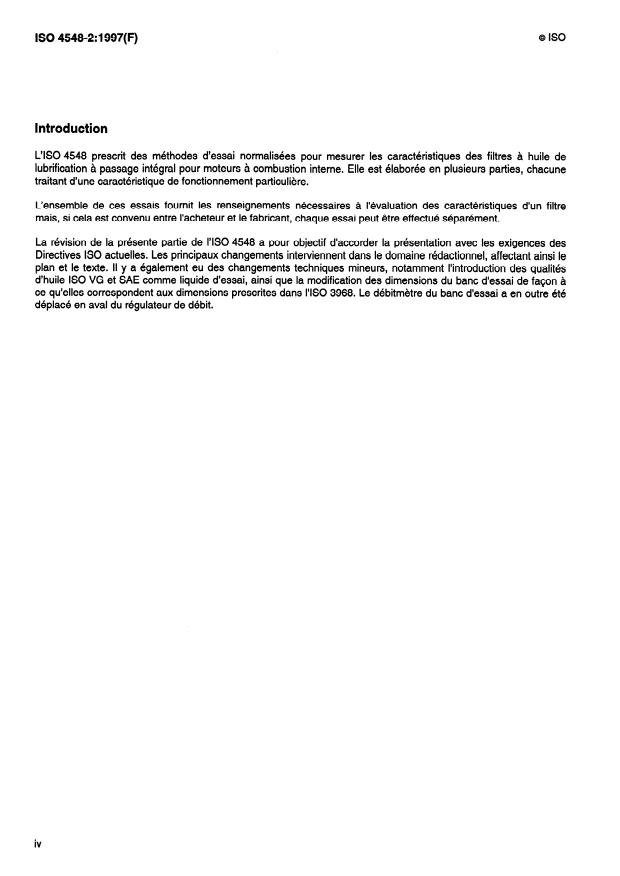
Introduction
L’ISO 4548 prescrit des méthodes d’essai normalisées pour mesurer les caractéristiques des filtres à huile de
lubrification à passage intégral pour moteurs à combustion interne. Elle est élaborée en plusieurs parties, chacune
traitant d’une caractéristique de fonctionnement particulière.
L’ensemble de ces essais fournit les renseignements nécessaires à l’évaluation des caractéristiques d’un filtre
mais, si cela est convenu entre l’acheteur et le fabricant, chaque essai peut être effectué séparément.
La révision de la présente partie de I’ISO 4548 a pour objectif d’accorder la présentation avec les exigences des
Directives ISO actuelles. Les principaux changements interviennent dans le domaine rédactionnel, affectant ainsi le
plan et le texte. II y a également eu des changements techniques mineurs, notamment l’introduction des qualités
d’huile ISO VG et SAE comme liquide d’essai, ainsi que la modification des dimensions du banc d’essai de façon à
ce qu’elles correspondent aux dimensions prescrites dans I’ISO 3968. Le débitmètre du banc d’essai a en outre été
déplace en aval du régulateur de débit.
ISO 4548-2: 1997(F)
NORME INTERNATIONALE o ISO
Méthodes d’essai des filtres à huile de lubrificationlà passage
intégral pour moteurs à combustion interne -
Partie 2:
Caractéristiques de l’organe de dérivation du filtre
1 Domaine d’application
La présente partie de I’ISO 4548 prescrit des essais permettant de déterminer les caractéristiques de l’organe de
dérivation des filtres à huile de lubrification à passage intégral pour moteurs à combustion interne.
Les essais prescrits utilisent deux huiles de viscosités différentes: l’une pour évaluer la performance d’un filtre avec
une huile à basse température, l’autre pour évaluer la performance du filtre avec une huile à une température de
fonctionnement typique.
2 Références normatives
Les normes suivantes contiennent des dispositions qui, par suite de la référence qui en est faite, constituent des
dispositions valables pour la présente partie de I’ISO 4548. Au moment de la publication, les éditions indiquées
étaient en vigueur. Toute norme est sujette à révision et les parties prenantes des accords fondés sur la présente
partie de I’ISO 4548 sont invitées à rechercher la possibilité d’appliquer les éditions lesplus récentes des normes
indiquées ci-après. Les membres de la CEI et de I’ISO possèdent le registre des Normes internationales en vigueur
à un moment donné.
ISO 1219-I :1991, Transmissions hydrauliques et pneumatiques - Symboles graphiques et schémas de circuit -
Partie 1: Symboles graphiques.
ISO 11841-I :- I), Véhicules routiers et moteurs à combustion interne - Vocabulaire relatif aux filfres - Partie 1:
Définitions des filtres et de leurs composants.
ISO 11841-2:- l), Véhicules routiers et moteurs à combustion interne - Vocabulaire relatif aux filtres - Partie 2:
Définitions des caractéristiques des filtres et de leurs composants.
3 Définitions
Pour les besoins de la présente partie de I’ISO 4548, les définitions données dans I’ISO 11841-I et dans
I’ISO 11841-2 s’appliquent.
4 Symboles graphiques
Les symboles graphiques utilisés dans la présente partie de I’ISO 4548 sont conformes à I’ISO 1219-I.
1) À publier.
0 ISO
ISO 4548-2: 1997(F)
5 Caractéristiques fonctionnelles à évaluer
Le but de l’organe de dérivation d’un filtre à huile de lubrification est d’assurer une alimentation en huile suffisante
du moteur lorsque l’élément filtrant provoque une pression différentielle élevée, et cela même si I’huile n’est pas
filtrée. De telles conditions peuvent notamment se produire lors d’un démarrage à froid du moteur ou si l’élément
filtrant est colmaté.
Pour limiter la quantité d’huile non filtrée dans le moteur lorsque la pression différentielle à travers le filtre n’est pas
trop importante, la soupape de dérivation est généralement conçue pour ne pas s’ouvrir lorsque la pression
différentielle est inférieure à une valeur spécifiée et pour permettre une fuite à un débit ne dépassant pas une valeur
spécifiée lorsque la pression différentielle est inférieure à cette valeur.
Pour assurer au moteur une alimentation en huile suffisante lorsque l’élément filtrant est complètement colmaté, la
soupape de dérivation est généralement conçue de façon à laisser passer le débit d’huile intégral avec une
pression différentielle ne dépassant pas une valeur spécifiée. Les essais prescrits .dans la présente partie de
NS0 4548 permettent de mesurer la pression différentielle à travers la soupape de dérivation, sur toute la gamme
des débits d’huile.
Ces essais impliquent également l’enregistrement de tous les bruits émis par la soupape de dérivation, par exemple
ceux dus à la vibration du clapet. On a en effet trouvé une corrélation entre le bruit et l’usure de ces éléments.
La pression différentielle est mesurée à travers l’ensemble filtrant complet, comme indiqué en 6.1.
6 Filtres à essayer
6.1 Types de filtres
L’élément filtrant doit être retiré du filtre et remplacé par un élément factice non perméable de dimensions
identiques. ,
Dans le cas de filtres dont l’élément filtrant ne peut pas être facilement remplacé par un élément factice non
perméable, lorsqu’il s’agit d’un filtre à cartouche à visser par exemple, l’ensemble doit être ouvert et la soupape de
dérivation retirée pour être essayée dans un corps de filtre séparé dont la conception doit faire l’objet d’un accord
entre le fabricant et l’acheteur du filtre.
6.2 Soupape de dérivation
La soupape de dérivation soumise à l’essai, le liquide d’essai ainsi que le banc d’essai doivent être propres. Pour
les besoins de la présente partie de I’ISO 4548, le terme (> signifie que la circulation du liquide a la
température d’essai dans le banc d’essai et le filtre (non modifié conformément à 6.1), au débit nominal du filtre et
pendant 5 min, ne provoque pas de hausse détectable de la pression différentielle dans le filtre du type essayé.
7 Banc d’essai
Le banc d’essai est représenté sous forme de schéma à la figure 1. II doit comprendre les éléments décrits de 7.1 à
7.5, ainsi que les tuyaux, les raccords et les supports nécessaires.
7.1 Cuve
La cuve doit avoir une capacité suffisante et doit êt
...
ISO
NORME
4548-2
INTERNATIONALE
Premiére édition
1997-09-I 5
Méthodes d’essai des filtres àihuile de
lubrification à passage intégrd pour
moteurs à combustion interne e
Partie 2:
Caractéristiques de l’organe de dérivation du
filtre
Methods of test for full-flow lubricating oil filfers for interna/ combustion
engines -
Part 2: Element by-pass valve characteristics
Numéro de référence
ISO 4548-2: 1997(F)
ISO 4548-2: 1997(F)
Sommaire
1 Domaine d’application . . . . . . . . . . . . . .DDDDmDmmmDDoommDDommDDDmmDmDDD.DmDDDDDDmmmmDDDDDDDDDDDmmmDDDmDmDDDmDmmDDDDDDDDDDm
2 Références normatives mmmmmmmmmmmmmmmmmmmmmmmmm8mmmmmmmmmmmmmmmmmmmmmwmmmmmmmmmmmmmmmmmmmmmmommmmmmmmmmmmmmmemmmmmmmmmmmmommmmmmmmmmmmmmm8mmmmmmmmmmmmmommmmmmmmm
mmmmmmmmmwmoammmmmmmmmmmm8wmmmmmmmmmmmmmmmmmmmmmmmmmmmmmmmmmmmmwmmmmmmmmmmmmmmmmmmm*mmmmmmmmmmmmmmmmmmmmmmmmmmmmmmmmmmmmmmmmmmmmmmmmmmmmmmmmmmmmmmmm*mmmmmmmmmmm
3 Définitions
mmmmmmmmmmmmem8mmmmmmmmmmmmmmmmmmmmmmmmmmmmmmmmmmmmmmmmmmmmmmmmmmmmmmmmmmmmmmmmmammmmmmmmmmmmm*ammmmmmmmmmmmmmmmmmmmmmmmmmmmmmmmmmmmmmmmmmmmm
4 Symboles graphiques
mmmmm*mmm*mmmmmmmmmmmmmmmmmmmmmmmmmmmmmmmmmmmmmmmmmmmmmmmmmmmammmm88*mmmmmmmmmmmm*mmmmmmmmmmmmmmmmmmmmmmmmmm
5 Caractéristiques fonctionnelles à évaluer
.
mmmmmmmmmmmmmmmmmmmmmmmmmmmmmmmmmmmmmmmammmmmmmmmmmmmmmommmmmmmmmmmmommmmmmmmmmmmmmmmmmmmmmmmmmmmmmmmmmommmmmmmm*mmmmmm*mmmmmmmmmmmmmmmmmmmmmmmmmmmmmmm 2
6 Filtres à essayer
mmmmmmmmmmmmmmmmmmmm8mmmmmmmmmmmmmmmmmmmmmmmmmmmmmmmmmmmmmmmmmmmmmmmmmmmmmmmmm8mmmmmmmmmmmmmmmm8mmmmmmmmmmmmmmmmmmmmmmmmmmmmmmmmmmmmmmmmmmmmmmmmmmmmm 2
6.1 Types de filtres
mmmmmmmmmmmmmmmmmmmmmmwmmmmmmmmmmmmmmmmmmmmmmmmmmmmmmmmmmmmmmmmmmmmmmmm*mmmmmmmmmmmmmmmmmmmmmmmmmmmmmmmmmmmmmmmmmmmmmmmmmmmmmmmmmmmmmmmmm 2
6.2 Soupape de dérivation
7 Banc d’essai mmmmmmmmmmmmmmmmmmmmmmmmmmmmmmmmmmmmmmmmmmmmmmmmmmmmmmmmmmmmmmmmmmmmmmmmmmmmmmmmmmmmmmmmmmmmmmmmmmmmmmmmmmmmmmmmmmmmmmmmmmmmmmmmmmmmmmmmmmmmmmmmmmmmmmmmmmmmm
7.1 Cuve mmmmmmmmmmmmmmmmmm8mmmmmmmmmmmmmmmmmmmmmmm8mmmmmmmmmmmmmmmmmmmmmmmmmmmmmmmmmmmmmmmmmwmmmmmmmmmmmmmmmmmmmmmmmmmmm8mmmmmommmmmemmmmmmmmmmmmmmmmmmmmmmmmmmmmmm8mmmmmmmmmmm
7.2 Régulateurs mmmmmmmmmmmmmmmmmmmmmmommmmmmmmmmmmmmmmmmmmmmm*mmmmmmmmmmmmmmmmmmmmmmmmmmmmmmmmmmmmmmmmmmmmmmmmmmmmmmmmmmmmmmmmmmmmmmmmmmmmmmmmmmmmmmmmammmmmmmmmmmmmmmmmmm
7.3 Débitmètre mmmmmmmmmmmmmmmmmmmmmmmmmmmmmmmmmmmmemmmmmmmmmmmmmmmmmmmmmmmmmmmmmmmmmmmmmmmmmmmmmmmmommmmmmmmmmmmmmmmmommmmmmmmmmmmmmmmmmmmmmmmmmmmmmmmmmmmmmmmmmmmmmmmmmmmm
7.4 Tuyaux d’entrée et de sortie du filtre mmmmmmmmmmmmmmmmmmmmmmmmmmmmmmmmmmmmmmmmmmmmmmmmmmmmmmmmmmmmmmmmmmmmmmmmmmmmmmmmmmmmmmmmmmmmommmmmmmmmmmmmmmmmommm
7.5 Tube de décharge du robinet d’échantillonnage mmmmmmmmmmmmmmmmmmmmmmmmmmmmmmmmmmmmmmmmmammmmmmmmmmmmmmmmmmmmmmmmmmmmmmmmmmmmmmmmmmammmmmmmmmm 4
8 Liquides d’essai mmmmmmmmmmmmmmmmmmmmmmmmmmmmmmmmmmmmmmommmmmmmmmmmmmmmmmmammmmmmmmmmmmmmmmmmmmmmmmmmmmmmmommmommmmmmmmmmmmmmmmmmmmmmmmmmommmmmmmmmmmmmmmommmmmmmmmmmmmm 4
9 Précision du mesurage des conditions d’essai mmmmmmmmommmmmoommmmmmmmmmmmmmmmmmmmmmmmommmmmmmmmmmmmmmmmmmmmmmmmmm*mmmmmmmmmmmmmmmmmmmmmmmmmmmmmmm 5
10 Mode opératoire mammmmm*mmmmmm8ommmmmmmmmm8mmmmmmmwmmmmmmmmmmmmmmmmmmmmmmmmmmmmmmmmm*mmmmmmmmmmmm8mmmmmmmwommmmmmwmmmmsmmmmmmm8mmmmmmmammmmmmmmmmmmmmommmmmmmmmmmamm* 5
11 Rapport d’essai mmmmmmmmmmmoommmmmmmmmmmmmmmmmmmmmmommmmmmmmmmmmmmmmmmmmmommmmmmmmmommmmmmmmmmmmmmmmmmmmommmmmmommmmmmmmemmmmmmmmmmmmmmmammmmmmmmmmmmmmmmmmmmmmmmmmomm 6
Annexe A (informative) Bibliographie mmmmmmmmmommm*mmmmmmommmmmommmmmmmmmmammmmmmmmmmmmmmmmmmmmmommmmmmmmmmmmmmmmmmmommmmmmmmmmmmommmmmmmmmmmmmmmmmmmmmmmmmm 8
@ ISO 1997
Droits de reproduction réserves. Sauf prescription differente, aucune partie de cette publication ne peut être reproduite ni utilisée sous quelque
forme que ce soit et par aucun procede, electronique ou mecanique, y compris la photocopie et les microfilms, sans l’accord Wit de Mditeur.
Organisation internationale de normalisation
Case postale 56 l CH-121 1 Geneve 20 l Suisse
Internet central @ iso.ch
x.400 c=ch; a=4OOnet; p=iso; o=isocs; s=central
Imprime en Suisse
ii
ISO 4548-2: 1997(F)
0 ISO
.
Avant-propos
L’ISO (Organisation internationale de normalisation) est une fédération mondiale :d’organismes nationaux de
normalisation (comités membres de I’ISO). L’élaboration des Normes internationales. est en général confiée aux
comités techniques de I’ISO. Chaque comité membre intéressé par u,ne étude a le droit de faire partie du comité
technique créé à cet effet. Les organisations internationales, gouvernementales et non gouvernementales, en
L’ISO collabore étroitement avec la Commission
liaison avec I’ISO participent également aux travaux.
électrotechnique internationale (CEI) en ce qui concerne la normalisation électrotechnique.
Les projets de Normes internationales adoptés par les comités techniques sont soumis aux comités membres pour
vote. Leur publication comme Normes internationales requiert l’approbation de 75 % au moins des comités
membres votants.
La Norme internationale ISO 4548-2 a été élaborée par le comité technique ISO/TC 70, Moteurs a combustion
interne, sous-comité SC 7, Essais des filtres à huile.
Cette deuxième édition annule et remplace la première édition (ISO 454802:1982), dont elle constitue une révision
technique.
L’ISO 4548 comprend les parties suivantes, présentées sous le titre général Méthodes d’essai des filtres a huile de
lubrification a passage intégral pour moteurs a combustion interne:
- Partie 1: Caractéristique débitipression différentielle
- Partie 2: Caractéristiques de l’organe de dérivation du filtre
- Partie 3; Résistance aux pressions différentielles élevées et aux hautes températures
- Partie 4: Efficacité initiale, capacité de rétention et efficacité cumulée (méthode gravimétrique)
- Partie 5: Essais de simulation de démarrage à froid et de résistance aux impulsions hydrauliques
- Partie 6: Essai d’éclatement à la pression statique
- Partie 7: Essai de fatigue aux vibrations
- Partie 9: Essais des clapets de non-retour aval et amont
- Partie 10: Capacité de rétention et efficacité cumulée en présence d’eau dans /‘huile
Partie 11: Filtres à nettoyage automatique
-
- Partie 12: Capacité de rétention de contaminant et efficacité de filtrage par comptage de particules
L’annexe A de la présente partie de I’ISO 4548 est donnée uniquement à titre d’information.
. . .
III
0 ISO
ISO 4548=2:1997(F)
Introduction
L’ISO 4548 prescrit des méthodes d’essai normalisées pour mesurer les caractéristiques des filtres à huile de
lubrification à passage intégral pour moteurs à combustion interne. Elle est élaborée en plusieurs parties, chacune
traitant d’une caractéristique de fonctionnement particulière.
L’ensemble de ces essais fournit les renseignements nécessaires à l’évaluation des caractéristiques d’un filtre
mais, si cela est convenu entre l’acheteur et le fabricant, chaque essai peut être effectué séparément.
La révision de la présente partie de I’ISO 4548 a pour objectif d’accorder la présentation avec les exigences des
Directives ISO actuelles. Les principaux changements interviennent dans le domaine rédactionnel, affectant ainsi le
plan et le texte. II y a également eu des changements techniques mineurs, notamment l’introduction des qualités
d’huile ISO VG et SAE comme liquide d’essai, ainsi que la modification des dimensions du banc d’essai de façon à
ce qu’elles correspondent aux dimensions prescrites dans I’ISO 3968. Le débitmètre du banc d’essai a en outre été
déplace en aval du régulateur de débit.
ISO 4548-2: 1997(F)
NORME INTERNATIONALE o ISO
Méthodes d’essai des filtres à huile de lubrificationlà passage
intégral pour moteurs à combustion interne -
Partie 2:
Caractéristiques de l’organe de dérivation du filtre
1 Domaine d’application
La présente partie de I’ISO 4548 prescrit des essais permettant de déterminer les caractéristiques de l’organe de
dérivation des filtres à huile de lubrification à passage intégral pour moteurs à combustion interne.
Les essais prescrits utilisent deux huiles de viscosités différentes: l’une pour évaluer la performance d’un filtre avec
une huile à basse température, l’autre pour évaluer la performance du filtre avec une huile à une température de
fonctionnement typique.
2 Références normatives
Les normes suivantes contiennent des dispositions qui, par suite de la référence qui en est faite, constituent des
dispositions valables pour la présente partie de I’ISO 4548. Au moment de la publication, les éditions indiquées
étaient en vigueur. Toute norme est sujette à révision et les parties prenantes des accords fondés sur la présente
partie de I’ISO 4548 sont invitées à rechercher la possibilité d’appliquer les éditions lesplus récentes des normes
indiquées ci-après. Les membres de la CEI et de I’ISO possèdent le registre des Normes internationales en vigueur
à un moment donné.
ISO 1219-I :1991, Transmissions hydrauliques et pneumatiques - Symboles graphiques et schémas de circuit -
Partie 1: Symboles graphiques.
ISO 11841-I :- I), Véhicules routiers et moteurs à combustion interne - Vocabulaire relatif aux filfres - Partie 1:
Définitions des filtres et de leurs composants.
ISO 11841-2:- l), Véhicules routiers et moteurs à combustion interne - Vocabulaire relatif aux filtres - Partie 2:
Définitions des caractéristiques des filtres et de leurs composants.
3 Définitions
Pour les besoins de la présente partie de I’ISO 4548, les définitions données dans I’ISO 11841-I et dans
I’ISO 11841-2 s’appliquent.
4 Symboles graphiques
Les symboles graphiques utilisés dans la présente partie de I’ISO 4548 sont conformes à I’ISO 1219-I.
1) À publier.
0 ISO
ISO 4548-2: 1997(F)
5 Caractéristiques fonctionnelles à évaluer
Le but de l’organe de dérivation d’un filtre à huile de lubrification est d’assurer une alimentation en huile suffisante
du moteur lorsque l’élément filtrant provoque une pression différentielle élevée, et cela même si I’huile n’est pas
filtrée. De telles conditions peuvent notamment se produire lors d’un démarrage à froid du moteur ou si l’élément
filtrant est colmaté.
Pour limiter la quantité d’huile non filtrée dans le moteur lorsque la pression différentielle à travers le filtre n’est pas
trop importante, la soupape de dérivation est généralement conçue pour ne pas s’ouvrir lorsque la pression
différentielle est inférieure à une valeur spécifiée et pour permettre une fuite à un débit ne dépassant pas une valeur
spécifiée lorsque la pression différentielle est inférieure à cette valeur.
Pour assurer au moteur une alimentation en huile suffisante lorsque l’élément filtrant est complètement colmaté, la
soupape de dérivation est généralement conçue de façon à laisser passer le débit d’huile intégral avec une
pression différentielle ne dépassant pas une valeur spécifiée. Les essais prescrits .dans la présente partie de
NS0 4548 permettent de mesurer la pression différentielle à travers la soupape de dérivation, sur toute la gamme
des débits d’huile.
Ces essais impliquent également l’enregistrement de tous les bruits émis par la soupape de dérivation, par exemple
ceux dus à la vibration du clapet. On a en effet trouvé une corrélation entre le bruit et l’usure de ces éléments.
La pression différentielle est mesurée à travers l’ensemble filtrant complet, comme indiqué en 6.1.
6 Filtres à essayer
6.1 Types de filtres
L’élément filtrant doit être retiré du filtre et remplacé par un élément factice non perméable de dimensions
identiques. ,
Dans le cas de filtres dont l’élément filtrant ne peut pas être facilement remplacé par un élément factice non
perméable, lorsqu’il s’agit d’un filtre à cartouche à visser par exemple, l’ensemble doit être ouvert et la soupape de
dérivation retirée pour être essayée dans un corps de filtre séparé dont la conception doit faire l’objet d’un accord
entre le fabricant et l’acheteur du filtre.
6.2 Soupape de dérivation
La soupape de dérivation soumise à l’essai, le liquide d’essai ainsi que le banc d’essai doivent être propres. Pour
les besoins de la présente partie de I’ISO 4548, le terme (> signifie que la circulation du liquide a la
température d’essai dans le banc d’essai et le filtre (non modifié conformément à 6.1), au débit nominal du filtre et
pendant 5 min, ne provoque pas de hausse détectable de la pression différentielle dans le filtre du type essayé.
7 Banc d’essai
Le banc d’essai est représenté sous forme de schéma à la figure 1. II doit comprendre les éléments décrits de 7.1 à
7.5, ainsi que les tuyaux, les raccords et les supports nécessaires.
7.1 Cuve
La cuve doit avoir une capacité suffisante et doit êt
...
Questions, Comments and Discussion
Ask us and Technical Secretary will try to provide an answer. You can facilitate discussion about the standard in here.
Loading comments...