

ISO 20957-8:2017
(Main)Stationary training equipment — Part 8: Steppers, stairclimbers and climbers — Additional specific safety requirements and test methods
General Information
- Abstract
ISO 20957-8.2017 specifies safety requirements for stepper, stairclimber and climber machines (hereafter called training equipment) performed from either a standing or sitting position. The requirements are in addition to the general safety requirements of ISO 20957‑1, with which ISO 20957-8.2017 is intended to be read in conjunction. ISO 20957-8.2017 is applicable to stationary training equipment type stepper, stairclimber and climber training equipment, within classes S and H. Additional requirements are provided for accuracy class A.
- Status
- Published
- Publication Date
- 16-Oct-2017
- Technical Committee
- ISO/TC 83 - Sports and other recreational facilities and equipment
- Drafting Committee
- ISO/TC 83 - Sports and other recreational facilities and equipment
- Current Stage
- 9093 - International Standard confirmed
- Start Date
- 02-Nov-2023
- Completion Date
- 29-Aug-2026
Buy Documents

ISO 20957-8:2017 - Stationary training equipment
ISO 20957-8:2017 - Stationary training equipment — Part 8: Steppers, stairclimbers and climbers — Additional specific safety requirements and test methods/17/2017
ISO 20957-8:2017 - Équipement d'entraînement fixe
ISO 20957-8:2017 - Équipement d'entraînement fixe — Partie 8: Monte-escaliers, escalators et simulateurs d'escalade — Exigences spécifiques de sécurité et méthodes d'essai supplémentaires/17/2017
Overview
ISO 20957-8:2017 - Stationary training equipment: Steppers, stairclimbers and climbers - specifies additional safety requirements and test methods for stepper, stairclimber and climber machines used from a standing or seated position. It is intended to be read in conjunction with ISO 20957‑1 (general safety requirements and test methods) and applies to equipment in classes S and H, with extra provisions for accuracy class A. The standard covers product construction, user interaction points, and standardized tests to verify safety and durability.
Key Topics and Technical Requirements
- Read together with ISO 20957‑1: ISO 20957-8 adds machine-specific requirements beyond the general rules.
- Definitions and classification: terms such as stepper, ministepper (hinge point < 200 mm), stairclimber, climber and seated stepper are defined for consistent scope and testing.
- External construction:
- Protection against squeeze and shear points (EN 71-1 finger probe referenced for ministeppers of class H).
- Temperature limits for accessible surfaces and methods to test them.
- Intrinsic loading: structural loading and forces that components must withstand under use.
- Handrails/handlebars: requirements for design, accessibility and testing.
- Footplatforms and stairs: geometry, footplatform guards and slip protection for safe mounting/dismounting.
- Endurance and freewheel: durability tests and behavior during power loss or manual motion.
- Stopping and entrapment prevention: manual and automatic stopping systems (stairclimbers) to reduce the risk of entrapment and ensure safe stepping on/off.
- Seated stepper specifics: requirements for movable/non-movable handlebars, seat backrest and seat-mounted handles.
- Test methods: dimensional, visual, tactile, performance tests and specific procedures for temperature, intrinsic loading, friction, endurance, stepping tests and stopping systems. (See clause summaries in standard for details.)
Applications
- Product design and development of steppers, stairclimbers and climbers for gyms, rehabilitation centers and home use.
- Type testing and conformity assessment by test laboratories to demonstrate compliance.
- Procurement and specification drafting for equipment buyers (fitness clubs, healthcare providers) requiring ISO-compliant safety.
- Risk assessment, safety labeling and instructions for use.
Who uses this standard
- Equipment manufacturers and designers
- Conformity and certification bodies
- Test laboratories and accredited safety engineers
- Procurement officers, facility managers and product compliance teams
Related standards
- ISO 20957-1 - General safety requirements and test methods (must be read together)
- Other parts of the ISO 20957 series
- ISO 4649 (abrasion testing) and EN 71‑1 (toy safety finger probe referenced)
Complying with ISO 20957-8:2017 helps ensure steppers, stairclimbers and climbers meet recognized international safety and testing expectations, improving user safety and supporting market access.
Relations
- Effective Date
- 12-Feb-2026
- Effective Date
- 06-Jun-2022
- Effective Date
- 06-Jun-2022
- Effective Date
- 12-Mar-2016
Buy Documents
ISO 20957-8:2017 - Stationary training equipment
ISO 20957-8:2017 - Stationary training equipment — Part 8: Steppers, stairclimbers and climbers — Additional specific safety requirements and test methods/17/2017
ISO 20957-8:2017 - Équipement d'entraînement fixe
ISO 20957-8:2017 - Équipement d'entraînement fixe — Partie 8: Monte-escaliers, escalators et simulateurs d'escalade — Exigences spécifiques de sécurité et méthodes d'essai supplémentaires/17/2017
Frequently Asked Questions
ISO 20957-8:2017 is a standard published by the International Organization for Standardization (ISO). Its full title is "Stationary training equipment — Part 8: Steppers, stairclimbers and climbers — Additional specific safety requirements and test methods". This standard covers: ISO 20957-8.2017 specifies safety requirements for stepper, stairclimber and climber machines (hereafter called training equipment) performed from either a standing or sitting position. The requirements are in addition to the general safety requirements of ISO 20957‑1, with which ISO 20957-8.2017 is intended to be read in conjunction. ISO 20957-8.2017 is applicable to stationary training equipment type stepper, stairclimber and climber training equipment, within classes S and H. Additional requirements are provided for accuracy class A.
ISO 20957-8.2017 specifies safety requirements for stepper, stairclimber and climber machines (hereafter called training equipment) performed from either a standing or sitting position. The requirements are in addition to the general safety requirements of ISO 20957‑1, with which ISO 20957-8.2017 is intended to be read in conjunction. ISO 20957-8.2017 is applicable to stationary training equipment type stepper, stairclimber and climber training equipment, within classes S and H. Additional requirements are provided for accuracy class A.
ISO 20957-8:2017 is classified under the following ICS (International Classification for Standards) categories: 97.220.30 - Indoor sports equipment. The ICS classification helps identify the subject area and facilitates finding related standards.
ISO 20957-8:2017 has the following relationships with other standards: It is inter standard links to EN ISO 20957-8:2017, ISO/TR 13014:2012/Cor 1:2012, ISO/TR 21186-2:2021, ISO 20957-8:2005. Understanding these relationships helps ensure you are using the most current and applicable version of the standard.
ISO 20957-8:2017 is available in PDF format for immediate download after purchase. The document can be added to your cart and obtained through the secure checkout process. Digital delivery ensures instant access to the complete standard document.
Standards Content (Sample)
INTERNATIONAL ISO
STANDARD 20957-8
Second edition
2017-10
Stationary training equipment —
Part 8:
Steppers, stairclimbers and climbers
— Additional specific safety
requirements and test methods
Équipement d'entraînement fixe —
Partie 8: Monte-escaliers, escalators et simulateurs d'escalade —
Exigences spécifiques de sécurité et méthodes d'essai supplémentaires
Reference number
©
ISO 2017
© ISO 2017, Published in Switzerland
All rights reserved. Unless otherwise specified, no part of this publication may be reproduced or utilized otherwise in any form
or by any means, electronic or mechanical, including photocopying, or posting on the internet or an intranet, without prior
written permission. Permission can be requested from either ISO at the address below or ISO’s member body in the country of
the requester.
ISO copyright office
Ch. de Blandonnet 8 • CP 401
CH-1214 Vernier, Geneva, Switzerland
Tel. +41 22 749 01 11
Fax +41 22 749 09 47
copyright@iso.org
www.iso.org
ii © ISO 2017 – All rights reserved
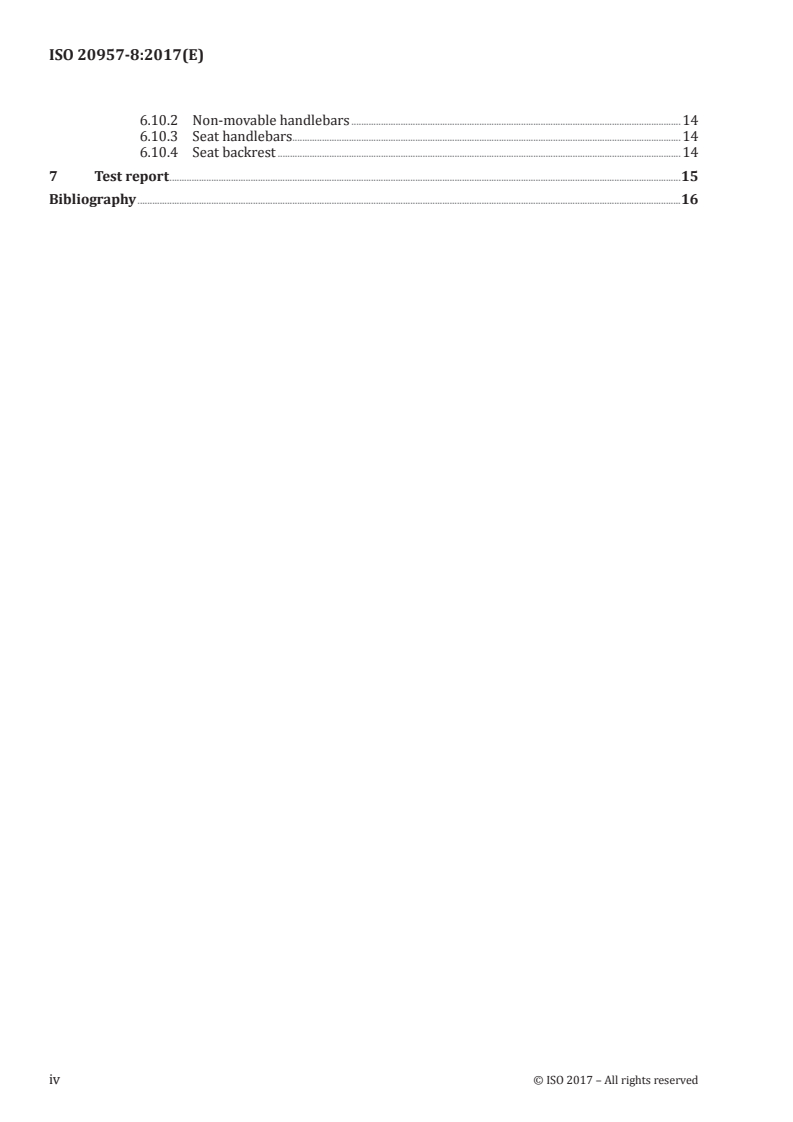
Contents Page
Foreword .v
1 Scope . 1
2 Normative references . 1
3 Terms and definitions . 1
4 Classification . 6
5 Safety requirements . 6
5.1 General . 6
5.2 External construction . 6
5.2.1 Additional requirements for squeeze and shear points within the
accessible area . 6
5.2.2 Temperature of accessible surfaces . 6
5.3 Intrinsic loading . 6
5.4 Handrails/handlebars . 6
5.5 Footplatforms and stairs . 7
5.5.1 Footplatforms . 7
5.5.2 Stairs . 7
5.6 Endurance . 7
5.7 Freewheel . 7
5.8 Additional requirement for class A . 7
5.9 Additional requirements for stairclimbers . 8
5.9.1 Stepping on and stepping off . 8
5.9.2 Manual stopping system . . . 8
5.9.3 Automatic stopping system to reduce the risk of entrapment . 8
5.10 Additional requirements for seated steppers . 8
5.10.1 Movable handlebars . 8
5.10.2 Non-movable handlebars . 8
5.10.3 Seat handlebars. 9
5.10.4 Seat backrest . 9
5.11 Additional instructions for use . 9
6 Test methods . 9
6.1 General . 9
6.1.1 Dimensional check . 9
6.1.2 Visual examination . 9
6.1.3 Tactile examination. 9
6.1.4 Performance test . 9
6.2 Testing of temperature of accessible surfaces . 9
6.3 Testing of intrinsic loading .10
6.3.1 General.10
6.3.2 Stepper or climber with independent action .10
6.3.3 Stepper or climber with dependent action .10
6.3.4 Stairclimber .10
6.4 Testing of handrails/handlebars .11
6.5 Testing of friction .11
6.6 Endurance testing.12
6.6.1 General.12
6.6.2 Endurance testing for stairclimbers .12
6.6.3 Endurance testing for steppers .12
6.7 Testing of the additional requirements for class A .12
6.8 Testing of stepping on and stepping off .13
6.9 Testing of stopping system and clearance between moving stairs and floor or structure .13
6.10 Testing for additional requirements for seated steppers .14
6.10.1 Movable handlebars .14
6.10.2 Non-movable handlebars .14
6.10.3 Seat handlebars.14
6.10.4 Seat backrest .14
7 Test report .15
Bibliography .16
iv © ISO 2017 – All rights reserved
Foreword
ISO (the International Organization for Standardization) is a worldwide federation of national standards
bodies (ISO member bodies). The work of preparing International Standards is normally carried out
through ISO technical committees. Each member body interested in a subject for which a technical
committee has been established has the right to be represented on that committee. International
organizations, governmental and non-governmental, in liaison with ISO, also take part in the work.
ISO collaborates closely with the International Electrotechnical Commission (IEC) on all matters of
electrotechnical standardization.
The procedures used to develop this document and those intended for its further maintenance are
described in the ISO/IEC Directives, Part 1. In particular the different approval criteria needed for the
different types of ISO documents should be noted. This document was drafted in accordance with the
editorial rules of the ISO/IEC Directives, Part 2 (see www.iso.org/directives).
Attention is drawn to the possibility that some of the elements of this document may be the subject of
patent rights. ISO shall not be held responsible for identifying any or all such patent rights. Details of
any patent rights identified during the development of the document will be in the Introduction and/or
on the ISO list of patent declarations received (see www.iso.org/patents).
Any trade name used in this document is information given for the convenience of users and does not
constitute an endorsement.
For an explanation on the voluntary nature of standards, the meaning of ISO specific terms and
expressions related to conformity assessment, as well as information about ISO's adherence to the
World Trade Organization (WTO) principles in the Technical Barriers to Trade (TBT) see the following
URL: www.iso.org/iso/foreword.html.
ISO 20957-8 was prepared by the European Committee for Standardization (CEN) Technical Committee
CEN/TC 136, Sports, playground and other recreational facilities and equipment, in collaboration with ISO
Technical Committee TC 83, Sports and other recreational facilities and equipment, in accordance with
the Agreement on technical cooperation between ISO and CEN (Vienna Agreement).
This second edition cancels and replaces the first edition (ISO 20957-8:2005), which has been
technically revised.
The main changes compared to the previous edition are as follows:
— the Scope has been simplified;
— the formulation has been aligned to ISO 20957-1;
— Clause 5 has been specified and restructured;
— Clause 6 has been specified and restructured.
A list of all parts in the ISO 20957 series can be found on the ISO website.
INTERNATIONAL STANDARD ISO 20957-8:2017(E)
Stationary training equipment —
Part 8:
Steppers, stairclimbers and climbers — Additional specific
safety requirements and test methods
1 Scope
This document specifies safety requirements for stepper, stairclimber and climber machines (hereafter
called training equipment) performed from either a standing or sitting position. The requirements are
in addition to the general safety requirements of ISO 20957-1, with which this document is intended to
be read in conjunction.
This document is applicable to stationary training equipment type stepper, stairclimber and climber
training equipment, within classes S and H. Additional requirements are provided for accuracy class A.
2 Normative references
The following documents are referred to in the text in such a way that some or all of their content
constitutes requirements of this document. For dated references, only the edition cited applies. For
undated references, the latest edition of the referenced document (including any amendments) applies.
ISO 4649:2010, Rubber, vulcanized or thermoplastic — Determination of abrasion resistance using a
rotating cylindrical drum device
ISO 20957-1, Stationary training equipment — Part 1: General safety requirements and test methods
EN 71-1, Safety of toys — Part 1: Mechanical and physical properties
3 Terms and definitions
For the purposes of this document, the terms and definitions given in ISO 20957-1 and the following apply.
ISO and IEC maintain terminological databases for use in standardization at the following addresses:
— IEC Electropedia: available at http://www.electropedia.org/
— ISO Online browsing platform: available at http://www.iso.org/obp
3.1
stepper
stationary training equipment where the feet move in a reciprocating motion where the foot is not
required to leave the foot pedal
Note 1 to entry: See Figure 1 a).
3.2
ministepper
stepper (3.1) with a hinge point height to the floor <200 mm
Note 1 to entry: See Figure 1 b).
a) Stepper b) Ministepper
Key
1 display
2 hand grip
3 base frame
4 footplatform
5 handrail/handlebar
6 housing
7 footplatform guard
Figure 1 — Examples of steppers
2 © ISO 2017 – All rights reserved
3.3
stairclimber
stationary training equipment similar to a moving mechanical staircase or escalator where the user's
foot must leave the staircase in order to perform the action of climbing
Note 1 to entry: See Figure 2.
Key
1 display
2 handrail
3 stair
4 base frame
5 housing
Figure 2 — Example of a stairclimber
3.4
climber
stationary training equipment that is equipped with feet and hand positions both of which can be
moved in a reciprocating simulated climbing motion
Note 1 to entry: See Figure 3.
Key
1 display
2 movable handgrip
3 track rail
4 foot pedal
5 base frame
6 resistance adjustment
Figure 3 — Example of a climber
4 © ISO 2017 – All rights reserved
3.5
seated stepper
stationary training equipment where the feet move in a reciprocating motion where the foot is not
required to leave the foot pedal performed in a seated or semi-recumbent position
Note 1 to entry: See Figure 4.
Key
1 display
2 base frame
3 footplatform
4 handrail/handlebar
5 housing
6 footplatform guard
7 seat
Figure 4 — Example of a seated stepper
3.6
dependent action
action in which the movement of one foot pedal is linked to the m
...
INTERNATIONAL ISO
STANDARD 20957-8
Second edition
2017-10
Stationary training equipment —
Part 8:
Steppers, stairclimbers and climbers
— Additional specific safety
requirements and test methods
Équipement d'entraînement fixe —
Partie 8: Monte-escaliers, escalators et simulateurs d'escalade —
Exigences spécifiques de sécurité et méthodes d'essai supplémentaires
Reference number
©
ISO 2017
© ISO 2017, Published in Switzerland
All rights reserved. Unless otherwise specified, no part of this publication may be reproduced or utilized otherwise in any form
or by any means, electronic or mechanical, including photocopying, or posting on the internet or an intranet, without prior
written permission. Permission can be requested from either ISO at the address below or ISO’s member body in the country of
the requester.
ISO copyright office
Ch. de Blandonnet 8 • CP 401
CH-1214 Vernier, Geneva, Switzerland
Tel. +41 22 749 01 11
Fax +41 22 749 09 47
copyright@iso.org
www.iso.org
ii © ISO 2017 – All rights reserved
Contents Page
Foreword .v
1 Scope . 1
2 Normative references . 1
3 Terms and definitions . 1
4 Classification . 6
5 Safety requirements . 6
5.1 General . 6
5.2 External construction . 6
5.2.1 Additional requirements for squeeze and shear points within the
accessible area . 6
5.2.2 Temperature of accessible surfaces . 6
5.3 Intrinsic loading . 6
5.4 Handrails/handlebars . 6
5.5 Footplatforms and stairs . 7
5.5.1 Footplatforms . 7
5.5.2 Stairs . 7
5.6 Endurance . 7
5.7 Freewheel . 7
5.8 Additional requirement for class A . 7
5.9 Additional requirements for stairclimbers . 8
5.9.1 Stepping on and stepping off . 8
5.9.2 Manual stopping system . . . 8
5.9.3 Automatic stopping system to reduce the risk of entrapment . 8
5.10 Additional requirements for seated steppers . 8
5.10.1 Movable handlebars . 8
5.10.2 Non-movable handlebars . 8
5.10.3 Seat handlebars. 9
5.10.4 Seat backrest . 9
5.11 Additional instructions for use . 9
6 Test methods . 9
6.1 General . 9
6.1.1 Dimensional check . 9
6.1.2 Visual examination . 9
6.1.3 Tactile examination. 9
6.1.4 Performance test . 9
6.2 Testing of temperature of accessible surfaces . 9
6.3 Testing of intrinsic loading .10
6.3.1 General.10
6.3.2 Stepper or climber with independent action .10
6.3.3 Stepper or climber with dependent action .10
6.3.4 Stairclimber .10
6.4 Testing of handrails/handlebars .11
6.5 Testing of friction .11
6.6 Endurance testing.12
6.6.1 General.12
6.6.2 Endurance testing for stairclimbers .12
6.6.3 Endurance testing for steppers .12
6.7 Testing of the additional requirements for class A .12
6.8 Testing of stepping on and stepping off .13
6.9 Testing of stopping system and clearance between moving stairs and floor or structure .13
6.10 Testing for additional requirements for seated steppers .14
6.10.1 Movable handlebars .14
6.10.2 Non-movable handlebars .14
6.10.3 Seat handlebars.14
6.10.4 Seat backrest .14
7 Test report .15
Bibliography .16
iv © ISO 2017 – All rights reserved
Foreword
ISO (the International Organization for Standardization) is a worldwide federation of national standards
bodies (ISO member bodies). The work of preparing International Standards is normally carried out
through ISO technical committees. Each member body interested in a subject for which a technical
committee has been established has the right to be represented on that committee. International
organizations, governmental and non-governmental, in liaison with ISO, also take part in the work.
ISO collaborates closely with the International Electrotechnical Commission (IEC) on all matters of
electrotechnical standardization.
The procedures used to develop this document and those intended for its further maintenance are
described in the ISO/IEC Directives, Part 1. In particular the different approval criteria needed for the
different types of ISO documents should be noted. This document was drafted in accordance with the
editorial rules of the ISO/IEC Directives, Part 2 (see www.iso.org/directives).
Attention is drawn to the possibility that some of the elements of this document may be the subject of
patent rights. ISO shall not be held responsible for identifying any or all such patent rights. Details of
any patent rights identified during the development of the document will be in the Introduction and/or
on the ISO list of patent declarations received (see www.iso.org/patents).
Any trade name used in this document is information given for the convenience of users and does not
constitute an endorsement.
For an explanation on the voluntary nature of standards, the meaning of ISO specific terms and
expressions related to conformity assessment, as well as information about ISO's adherence to the
World Trade Organization (WTO) principles in the Technical Barriers to Trade (TBT) see the following
URL: www.iso.org/iso/foreword.html.
ISO 20957-8 was prepared by the European Committee for Standardization (CEN) Technical Committee
CEN/TC 136, Sports, playground and other recreational facilities and equipment, in collaboration with ISO
Technical Committee TC 83, Sports and other recreational facilities and equipment, in accordance with
the Agreement on technical cooperation between ISO and CEN (Vienna Agreement).
This second edition cancels and replaces the first edition (ISO 20957-8:2005), which has been
technically revised.
The main changes compared to the previous edition are as follows:
— the Scope has been simplified;
— the formulation has been aligned to ISO 20957-1;
— Clause 5 has been specified and restructured;
— Clause 6 has been specified and restructured.
A list of all parts in the ISO 20957 series can be found on the ISO website.
INTERNATIONAL STANDARD ISO 20957-8:2017(E)
Stationary training equipment —
Part 8:
Steppers, stairclimbers and climbers — Additional specific
safety requirements and test methods
1 Scope
This document specifies safety requirements for stepper, stairclimber and climber machines (hereafter
called training equipment) performed from either a standing or sitting position. The requirements are
in addition to the general safety requirements of ISO 20957-1, with which this document is intended to
be read in conjunction.
This document is applicable to stationary training equipment type stepper, stairclimber and climber
training equipment, within classes S and H. Additional requirements are provided for accuracy class A.
2 Normative references
The following documents are referred to in the text in such a way that some or all of their content
constitutes requirements of this document. For dated references, only the edition cited applies. For
undated references, the latest edition of the referenced document (including any amendments) applies.
ISO 4649:2010, Rubber, vulcanized or thermoplastic — Determination of abrasion resistance using a
rotating cylindrical drum device
ISO 20957-1, Stationary training equipment — Part 1: General safety requirements and test methods
EN 71-1, Safety of toys — Part 1: Mechanical and physical properties
3 Terms and definitions
For the purposes of this document, the terms and definitions given in ISO 20957-1 and the following apply.
ISO and IEC maintain terminological databases for use in standardization at the following addresses:
— IEC Electropedia: available at http://www.electropedia.org/
— ISO Online browsing platform: available at http://www.iso.org/obp
3.1
stepper
stationary training equipment where the feet move in a reciprocating motion where the foot is not
required to leave the foot pedal
Note 1 to entry: See Figure 1 a).
3.2
ministepper
stepper (3.1) with a hinge point height to the floor <200 mm
Note 1 to entry: See Figure 1 b).
a) Stepper b) Ministepper
Key
1 display
2 hand grip
3 base frame
4 footplatform
5 handrail/handlebar
6 housing
7 footplatform guard
Figure 1 — Examples of steppers
2 © ISO 2017 – All rights reserved
3.3
stairclimber
stationary training equipment similar to a moving mechanical staircase or escalator where the user's
foot must leave the staircase in order to perform the action of climbing
Note 1 to entry: See Figure 2.
Key
1 display
2 handrail
3 stair
4 base frame
5 housing
Figure 2 — Example of a stairclimber
3.4
climber
stationary training equipment that is equipped with feet and hand positions both of which can be
moved in a reciprocating simulated climbing motion
Note 1 to entry: See Figure 3.
Key
1 display
2 movable handgrip
3 track rail
4 foot pedal
5 base frame
6 resistance adjustment
Figure 3 — Example of a climber
4 © ISO 2017 – All rights reserved
3.5
seated stepper
stationary training equipment where the feet move in a reciprocating motion where the foot is not
required to leave the foot pedal performed in a seated or semi-recumbent position
Note 1 to entry: See Figure 4.
Key
1 display
2 base frame
3 footplatform
4 handrail/handlebar
5 housing
6 footplatform guard
7 seat
Figure 4 — Example of a seated stepper
3.6
dependent action
action in which the movement of one foot pedal is linked to the m
...
NORME ISO
INTERNATIONALE 20957-8
Deuxième édition
2017-10
Équipement d'entraînement fixe —
Partie 8:
Monte-escaliers, escalators et
simulateurs d'escalade — Exigences
spécifiques de sécurité et méthodes
d'essai supplémentaires
Stationary training equipment —
Part 8: Steppers, stairclimbers and climbers — Additional specific
safety requirements and test methods
Numéro de référence
©
ISO 2017
DOCUMENT PROTÉGÉ PAR COPYRIGHT
© ISO 2017, Publié en Suisse
Droits de reproduction réservés. Sauf indication contraire, aucune partie de cette publication ne peut être reproduite ni utilisée
sous quelque forme que ce soit et par aucun procédé, électronique ou mécanique, y compris la photocopie, l’affichage sur
l’internet ou sur un Intranet, sans autorisation écrite préalable. Les demandes d’autorisation peuvent être adressées à l’ISO à
l’adresse ci-après ou au comité membre de l’ISO dans le pays du demandeur.
ISO copyright office
Ch. de Blandonnet 8 • CP 401
CH-1214 Vernier, Geneva, Switzerland
Tel. +41 22 749 01 11
Fax +41 22 749 09 47
copyright@iso.org
www.iso.org
ii © ISO 2017 – Tous droits réservés
Sommaire Page
Avant-propos .v
1 Domaine d’application . 1
2 Références normatives . 1
3 Termes et définitions . 1
4 Classification . 6
5 Exigences de sécurité . 6
5.1 Généralités . 6
5.2 Construction externe . 6
5.2.1 Exigences supplémentaires relatives aux points d’écrasement et de
cisaillement dans la zone accessible . 6
5.2.2 Température des surfaces accessibles . 6
5.3 Charge intrinsèque . 6
5.4 Mains courantes/guidons . 6
5.5 Repose-pieds et marches d’escalier . 7
5.5.1 Repose-pieds . 7
5.5.2 Marches d’escalier . 7
5.6 Endurance . 7
5.7 Roue libre . 7
5.8 Exigence supplémentaire pour la classe A . 7
5.9 Exigences supplémentaires pour les escalators . 8
5.9.1 Montée et descente de l’appareil . 8
5.9.2 Système d’arrêt manuel . 8
5.9.3 Système d’arrêt automatique pour réduire le risque de coincement. 8
5.10 Exigences supplémentaires pour les monte-escaliers utilisés en position assise . 8
5.10.1 Poignées mobiles . 8
5.10.2 Poignées fixes . 9
5.10.3 Poignées de siège . 9
5.10.4 Dossier du siège . 9
5.11 Instructions d’utilisation supplémentaires . 9
6 Méthodes d’essai . 9
6.1 Généralités . 9
6.1.1 Contrôle dimensionnel . 9
6.1.2 Examen visuel. 9
6.1.3 Examen tactile .10
6.1.4 Essai de performance .10
6.2 Essai portant sur la température des surfaces accessibles .10
6.3 Essai de charge intrinsèque .10
6.3.1 Généralités .10
6.3.2 Monte-escaliers ou simulateur d’escalade avec déplacement indépendant .10
6.3.3 Monte-escaliers ou simulateur d’escalade avec déplacement dépendant .10
6.3.4 Escalator.11
6.4 Essais des mains courantes/guidons .11
6.5 Essai de frottement .11
6.6 Essais d’endurance .12
6.6.1 Généralités .12
6.6.2 Essais d’endurance pour les escalators .12
6.6.3 Essais d’endurance pour les monte-escaliers .12
6.7 Essai pour les exigences supplémentaires applicables à la classe A .13
6.8 Essai de montée et descente de l’appareil .13
6.9 Essai du système d’arrêt et espace entre les marches d’escalier en mouvement et
le sol ou la structure .14
6.10 Essai pour les exigences supplémentaires applicables aux monte-escaliers utilisés
en position assise .14
6.10.1 Poignées mobiles .14
6.10.2 Poignées fixes .14
6.10.3 Poignées de siège .14
6.10.4 Dossier du siège .15
7 Rapport d’essai .15
Bibliographie .16
iv © ISO 2017 – Tous droits réservés
Avant-propos
L’ISO (Organisation internationale de normalisation) est une fédération mondiale d’organismes
nationaux de normalisation (comités membres de l’ISO). L’élaboration des Normes internationales est
en général confiée aux comités techniques de l’ISO. Chaque comité membre intéressé par une étude
a le droit de faire partie du comité technique créé à cet effet. Les organisations internationales,
gouvernementales et non gouvernementales, en liaison avec l’ISO participent également aux travaux.
L’ISO collabore étroitement avec la Commission électrotechnique internationale (IEC) en ce qui
concerne la normalisation électrotechnique.
Les procédures utilisées pour élaborer le présent document et celles destinées à sa mise à jour sont
décrites dans les Directives ISO/IEC, Partie 1. Il convient, en particulier de prendre note des différents
critères d’approbation requis pour les différents types de documents ISO. Le présent document a été
rédigé conformément aux règles de rédaction données dans les Directives ISO/IEC, Partie 2 (voir www.
iso.org/directives).
L’attention est attirée sur le fait que certains des éléments du présent document peuvent faire l’objet de
droits de propriété intellectuelle ou de droits analogues. L’ISO ne saurait être tenue pour responsable
de ne pas avoir identifié de tels droits de propriété et averti de leur existence. Les détails concernant
les références aux droits de propriété intellectuelle ou autres droits analogues identifiés lors de
l’élaboration du document sont indiqués dans l’Introduction et/ou dans la liste des déclarations de
brevets reçues par l’ISO (voir www.iso.org/brevets).
Les appellations commerciales éventuellement mentionnées dans le présent document sont données
pour information, par souci de commodité, à l’intention des utilisateurs et ne sauraient constituer un
engagement.
Pour une explication de la nature volontaire des normes, la signification des termes et expressions
spécifiques de l’ISO liés à l’évaluation de la conformité, ou pour toute information au sujet de l’adhésion
de l’ISO aux principes de l’Organisation mondiale du commerce (OMC) concernant les obstacles
techniques au commerce (OTC), voir le lien suivant: www.iso.org/iso/fr/avant-propos.html.
L’ISO 20957-8 a été élaborée par le comité technique CEN/TC 136, Équipements et installations
pour le sport, les aires de jeux, et autres équipements et installations de loisir, du Comité européen de
normalisation (CEN), en collaboration avec le comité technique ISO/TC 83, Matériel et équipements de
sports et autres activités de loisirs, conformément à l’accord de coopération technique entre l’ISO et le
CEN (Accord de Vienne).
Cette deuxième édition annule et remplace la première édition (ISO 20957-8:2005), qui a fait l’objet
d’une révision technique.
Les principales modifications par rapport à l’édition précédente sont les suivantes :
— le Domaine d’application a été simplifié ;
— la formulation a été alignée sur l’ISO 20957-1 ;
— l’Article 5 a été spécifié et restructuré ;
— l’Article 6 a été spécifié et restructuré.
Une liste de toutes les parties de la série ISO 20957 se trouve sur le site Web de l’ISO.
NORME INTERNATIONALE ISO 20957-8:2017(F)
Équipement d'entraînement fixe —
Partie 8:
Monte-escaliers, escalators et simulateurs d'escalade —
Exigences spécifiques de sécurité et méthodes d'essai
supplémentaires
1 Domaine d’application
Le présent document spécifie les exigences de sécurité relatives aux monte-escaliers, escalators et
simulateurs d’escalade (appelés ci-après « appareils d’entraînement ») utilisés en position debout ou
assise. Ces exigences viennent compléter les exigences générales de sécurité de l’ISO 20957-1, avec
laquelle le présent document est destiné à être lu conjointement.
Le présent document s’applique aux appareils d’entraînement fixes de type monte-escaliers, escalator
et simulateur d’escalade des classes S et H. Des exigences supplémentaires sont fournies pour la classe
de précision A.
2 Références normatives
Les documents suivants cités dans le texte constituent, pour tout ou partie de leur contenu, des
exigences du présent document. Pour les références datées, seule l’édition citée s’applique. Pour les
références non datées, la dernière édition du document de référence s’applique (y compris les éventuels
amendements).
ISO 4649:2010, Caoutchouc vulcanisé ou thermoplastique — Détermination de la résistance à l’abrasion à
l’aide d’un dispositif à tambour tournant
ISO 20957-1, Équipement d’entraînement fixe — Partie 1 : Exigences générales de sécurité et méthodes d’essai
EN 71-1, Sécurité des jouets — Partie 1 : Propriétés mécaniques et physiques
3 Termes et définitions
Pour les besoins du présent document, les termes et définitions de l’ISO 20957-1 ainsi que les suivants,
s’appliquent.
L’ISO et l’IEC tiennent à jour des bases de données terminologiques destinées à être utilisées en
normalisation, consultables aux adresses suivantes :
— IEC Electropedia : disponible à l’adresse http://www.electropedia.org/
— ISO Online browsing platform : disponible à l’adresse http://www.iso.org/obp
3.1
monte-escaliers
appareil d’entraînement fixe sur lequel les pieds du sujet effectuent un mouvement alternatif de montée-
descente sans avoir à quitter les pédales
Note 1 à l'article: Voir la Figure 1 a).
3.2
mini monte-escaliers
monte-escaliers (3.1) sur lequel le point d’articulation est situé à < 200 mm du sol
Note 1 à l'article: Voir la Figure 1 b).
a) Monte-escaliers b) Mini monte-escaliers
Légende
1 affichage
2 poignée
3 support de base
4 repose-pied
5 main courante/guidon
6 châssis
7 épaulement de repose-pied
Figure 1 — Exemples de monte-escaliers
2 © ISO 2017 – Tous droits réservés
3.3
escalator
appareil d’entraînement fixe simulant un escalier mécanique roulant ou un escalator, sur lequel le sujet
doit lever les pieds pour réaliser l’action de monter
Note 1 à l'article: Voir la Figure 2.
Légende
1 affichage
2 main courante
3 marche d’escalier
4 support de base
5 châssis
Figure 2 — Exemple d’escalator
3.4
simulateur d’escalade
appareil d’entraînement fixe comportant des poignées et des pédales, les deux pouvant effectuer un
mouvement alternatif simulant l’escalade
Note 1 à l'article: Voir la Figure 3.
Légende
1 affichage
2 poignée mobile
3 rail de guidage
4 pédale
5 support de base
6 réglage de la résistance
Figure 3 — Exemple de simulateur d’escalade
4 © ISO 2017 – Tous droits réservés
3.5
monte-escaliers utilisé en position assise
appareil d’entraînement fixe sur lequel les pieds du sujet effectuent un mouvement alternatif de montée-
descente sans avoir à quitter les pédales, le sujet étant en position assise ou semi-allongée
Note 1 à l'article: Voir la Figure 4.
Légende
1 affichage
2 support de base
3 repose-pied
4 main courante/guidon
5 châssis
6 épaulement de repose-pied
7 siège
Figure 4 — Exemple de monte-escaliers utilisé en position assise
3.6
déplacement dépendant
action dans laquelle le mouvement d’une pédale est lié au mouvement de l’autre pédale
3.7
déplacement indépendant
action dans laquelle le mouvement d’une pédale n’est pas lié au mouvement de l’autre pédale
3.8
cycle
action au cours de laquelle un pied revient à sa
position initiale
Note 1 à l'article: Un cycle comprend deux pas.
3.9
repose-pied
surface qui maintient le pied pendant la réalisation de l’exercice spécifié par le fabricant ou qui permet
à l’utilisateur de monter sur l’appareil ou d’en descendre
[SOURCE: ISO 20957-9:2016, 3.2]
3.10
épaulement de repose-pied
partie rigide de la structure qui contribue à empêcher le pied de glisser à l’extérieur du repose-pied (3.9)
Note 1 à l'article: Voir la Figure 1 et la Figure 5.
[SOURCE: ISO 20957-9:2016, 3.3, modifiée — « Rigide » a été ajouté, le sens de blocage du déplacement
du pied a été supprimé et la note a été ajoutée.]
...
NORME ISO
INTERNATIONALE 20957-8
Deuxième édition
2017-10
Équipement d'entraînement fixe —
Partie 8:
Monte-escaliers, escalators et
simulateurs d'escalade — Exigences
spécifiques de sécurité et méthodes
d'essai supplémentaires
Stationary training equipment —
Part 8: Steppers, stairclimbers and climbers — Additional specific
safety requirements and test methods
Numéro de référence
©
ISO 2017
DOCUMENT PROTÉGÉ PAR COPYRIGHT
© ISO 2017, Publié en Suisse
Droits de reproduction réservés. Sauf indication contraire, aucune partie de cette publication ne peut être reproduite ni utilisée
sous quelque forme que ce soit et par aucun procédé, électronique ou mécanique, y compris la photocopie, l’affichage sur
l’internet ou sur un Intranet, sans autorisation écrite préalable. Les demandes d’autorisation peuvent être adressées à l’ISO à
l’adresse ci-après ou au comité membre de l’ISO dans le pays du demandeur.
ISO copyright office
Ch. de Blandonnet 8 • CP 401
CH-1214 Vernier, Geneva, Switzerland
Tel. +41 22 749 01 11
Fax +41 22 749 09 47
copyright@iso.org
www.iso.org
ii © ISO 2017 – Tous droits réservés
Sommaire Page
Avant-propos .v
1 Domaine d’application . 1
2 Références normatives . 1
3 Termes et définitions . 1
4 Classification . 6
5 Exigences de sécurité . 6
5.1 Généralités . 6
5.2 Construction externe . 6
5.2.1 Exigences supplémentaires relatives aux points d’écrasement et de
cisaillement dans la zone accessible . 6
5.2.2 Température des surfaces accessibles . 6
5.3 Charge intrinsèque . 6
5.4 Mains courantes/guidons . 6
5.5 Repose-pieds et marches d’escalier . 7
5.5.1 Repose-pieds . 7
5.5.2 Marches d’escalier . 7
5.6 Endurance . 7
5.7 Roue libre . 7
5.8 Exigence supplémentaire pour la classe A . 7
5.9 Exigences supplémentaires pour les escalators . 8
5.9.1 Montée et descente de l’appareil . 8
5.9.2 Système d’arrêt manuel . 8
5.9.3 Système d’arrêt automatique pour réduire le risque de coincement. 8
5.10 Exigences supplémentaires pour les monte-escaliers utilisés en position assise . 8
5.10.1 Poignées mobiles . 8
5.10.2 Poignées fixes . 9
5.10.3 Poignées de siège . 9
5.10.4 Dossier du siège . 9
5.11 Instructions d’utilisation supplémentaires . 9
6 Méthodes d’essai . 9
6.1 Généralités . 9
6.1.1 Contrôle dimensionnel . 9
6.1.2 Examen visuel. 9
6.1.3 Examen tactile .10
6.1.4 Essai de performance .10
6.2 Essai portant sur la température des surfaces accessibles .10
6.3 Essai de charge intrinsèque .10
6.3.1 Généralités .10
6.3.2 Monte-escaliers ou simulateur d’escalade avec déplacement indépendant .10
6.3.3 Monte-escaliers ou simulateur d’escalade avec déplacement dépendant .10
6.3.4 Escalator.11
6.4 Essais des mains courantes/guidons .11
6.5 Essai de frottement .11
6.6 Essais d’endurance .12
6.6.1 Généralités .12
6.6.2 Essais d’endurance pour les escalators .12
6.6.3 Essais d’endurance pour les monte-escaliers .12
6.7 Essai pour les exigences supplémentaires applicables à la classe A .13
6.8 Essai de montée et descente de l’appareil .13
6.9 Essai du système d’arrêt et espace entre les marches d’escalier en mouvement et
le sol ou la structure .14
6.10 Essai pour les exigences supplémentaires applicables aux monte-escaliers utilisés
en position assise .14
6.10.1 Poignées mobiles .14
6.10.2 Poignées fixes .14
6.10.3 Poignées de siège .14
6.10.4 Dossier du siège .15
7 Rapport d’essai .15
Bibliographie .16
iv © ISO 2017 – Tous droits réservés
Avant-propos
L’ISO (Organisation internationale de normalisation) est une fédération mondiale d’organismes
nationaux de normalisation (comités membres de l’ISO). L’élaboration des Normes internationales est
en général confiée aux comités techniques de l’ISO. Chaque comité membre intéressé par une étude
a le droit de faire partie du comité technique créé à cet effet. Les organisations internationales,
gouvernementales et non gouvernementales, en liaison avec l’ISO participent également aux travaux.
L’ISO collabore étroitement avec la Commission électrotechnique internationale (IEC) en ce qui
concerne la normalisation électrotechnique.
Les procédures utilisées pour élaborer le présent document et celles destinées à sa mise à jour sont
décrites dans les Directives ISO/IEC, Partie 1. Il convient, en particulier de prendre note des différents
critères d’approbation requis pour les différents types de documents ISO. Le présent document a été
rédigé conformément aux règles de rédaction données dans les Directives ISO/IEC, Partie 2 (voir www.
iso.org/directives).
L’attention est attirée sur le fait que certains des éléments du présent document peuvent faire l’objet de
droits de propriété intellectuelle ou de droits analogues. L’ISO ne saurait être tenue pour responsable
de ne pas avoir identifié de tels droits de propriété et averti de leur existence. Les détails concernant
les références aux droits de propriété intellectuelle ou autres droits analogues identifiés lors de
l’élaboration du document sont indiqués dans l’Introduction et/ou dans la liste des déclarations de
brevets reçues par l’ISO (voir www.iso.org/brevets).
Les appellations commerciales éventuellement mentionnées dans le présent document sont données
pour information, par souci de commodité, à l’intention des utilisateurs et ne sauraient constituer un
engagement.
Pour une explication de la nature volontaire des normes, la signification des termes et expressions
spécifiques de l’ISO liés à l’évaluation de la conformité, ou pour toute information au sujet de l’adhésion
de l’ISO aux principes de l’Organisation mondiale du commerce (OMC) concernant les obstacles
techniques au commerce (OTC), voir le lien suivant: www.iso.org/iso/fr/avant-propos.html.
L’ISO 20957-8 a été élaborée par le comité technique CEN/TC 136, Équipements et installations
pour le sport, les aires de jeux, et autres équipements et installations de loisir, du Comité européen de
normalisation (CEN), en collaboration avec le comité technique ISO/TC 83, Matériel et équipements de
sports et autres activités de loisirs, conformément à l’accord de coopération technique entre l’ISO et le
CEN (Accord de Vienne).
Cette deuxième édition annule et remplace la première édition (ISO 20957-8:2005), qui a fait l’objet
d’une révision technique.
Les principales modifications par rapport à l’édition précédente sont les suivantes :
— le Domaine d’application a été simplifié ;
— la formulation a été alignée sur l’ISO 20957-1 ;
— l’Article 5 a été spécifié et restructuré ;
— l’Article 6 a été spécifié et restructuré.
Une liste de toutes les parties de la série ISO 20957 se trouve sur le site Web de l’ISO.
NORME INTERNATIONALE ISO 20957-8:2017(F)
Équipement d'entraînement fixe —
Partie 8:
Monte-escaliers, escalators et simulateurs d'escalade —
Exigences spécifiques de sécurité et méthodes d'essai
supplémentaires
1 Domaine d’application
Le présent document spécifie les exigences de sécurité relatives aux monte-escaliers, escalators et
simulateurs d’escalade (appelés ci-après « appareils d’entraînement ») utilisés en position debout ou
assise. Ces exigences viennent compléter les exigences générales de sécurité de l’ISO 20957-1, avec
laquelle le présent document est destiné à être lu conjointement.
Le présent document s’applique aux appareils d’entraînement fixes de type monte-escaliers, escalator
et simulateur d’escalade des classes S et H. Des exigences supplémentaires sont fournies pour la classe
de précision A.
2 Références normatives
Les documents suivants cités dans le texte constituent, pour tout ou partie de leur contenu, des
exigences du présent document. Pour les références datées, seule l’édition citée s’applique. Pour les
références non datées, la dernière édition du document de référence s’applique (y compris les éventuels
amendements).
ISO 4649:2010, Caoutchouc vulcanisé ou thermoplastique — Détermination de la résistance à l’abrasion à
l’aide d’un dispositif à tambour tournant
ISO 20957-1, Équipement d’entraînement fixe — Partie 1 : Exigences générales de sécurité et méthodes d’essai
EN 71-1, Sécurité des jouets — Partie 1 : Propriétés mécaniques et physiques
3 Termes et définitions
Pour les besoins du présent document, les termes et définitions de l’ISO 20957-1 ainsi que les suivants,
s’appliquent.
L’ISO et l’IEC tiennent à jour des bases de données terminologiques destinées à être utilisées en
normalisation, consultables aux adresses suivantes :
— IEC Electropedia : disponible à l’adresse http://www.electropedia.org/
— ISO Online browsing platform : disponible à l’adresse http://www.iso.org/obp
3.1
monte-escaliers
appareil d’entraînement fixe sur lequel les pieds du sujet effectuent un mouvement alternatif de montée-
descente sans avoir à quitter les pédales
Note 1 à l'article: Voir la Figure 1 a).
3.2
mini monte-escaliers
monte-escaliers (3.1) sur lequel le point d’articulation est situé à < 200 mm du sol
Note 1 à l'article: Voir la Figure 1 b).
a) Monte-escaliers b) Mini monte-escaliers
Légende
1 affichage
2 poignée
3 support de base
4 repose-pied
5 main courante/guidon
6 châssis
7 épaulement de repose-pied
Figure 1 — Exemples de monte-escaliers
2 © ISO 2017 – Tous droits réservés
3.3
escalator
appareil d’entraînement fixe simulant un escalier mécanique roulant ou un escalator, sur lequel le sujet
doit lever les pieds pour réaliser l’action de monter
Note 1 à l'article: Voir la Figure 2.
Légende
1 affichage
2 main courante
3 marche d’escalier
4 support de base
5 châssis
Figure 2 — Exemple d’escalator
3.4
simulateur d’escalade
appareil d’entraînement fixe comportant des poignées et des pédales, les deux pouvant effectuer un
mouvement alternatif simulant l’escalade
Note 1 à l'article: Voir la Figure 3.
Légende
1 affichage
2 poignée mobile
3 rail de guidage
4 pédale
5 support de base
6 réglage de la résistance
Figure 3 — Exemple de simulateur d’escalade
4 © ISO 2017 – Tous droits réservés
3.5
monte-escaliers utilisé en position assise
appareil d’entraînement fixe sur lequel les pieds du sujet effectuent un mouvement alternatif de montée-
descente sans avoir à quitter les pédales, le sujet étant en position assise ou semi-allongée
Note 1 à l'article: Voir la Figure 4.
Légende
1 affichage
2 support de base
3 repose-pied
4 main courante/guidon
5 châssis
6 épaulement de repose-pied
7 siège
Figure 4 — Exemple de monte-escaliers utilisé en position assise
3.6
déplacement dépendant
action dans laquelle le mouvement d’une pédale est lié au mouvement de l’autre pédale
3.7
déplacement indépendant
action dans laquelle le mouvement d’une pédale n’est pas lié au mouvement de l’autre pédale
3.8
cycle
action au cours de laquelle un pied revient à sa
position initiale
Note 1 à l'article: Un cycle comprend deux pas.
3.9
repose-pied
surface qui maintient le pied pendant la réalisation de l’exercice spécifié par le fabricant ou qui permet
à l’utilisateur de monter sur l’appareil ou d’en descendre
[SOURCE: ISO 20957-9:2016, 3.2]
3.10
épaulement de repose-pied
partie rigide de la structure qui contribue à empêcher le pied de glisser à l’extérieur du repose-pied (3.9)
Note 1 à l'article: Voir la Figure 1 et la Figure 5.
[SOURCE: ISO 20957-9:2016, 3.3, modifiée — « Rigide » a été ajouté, le sens de blocage du déplacement
du pied a été supprimé et la note a été ajoutée.]
...