

ISO 25247:2026
(Main)Treatment of aquaculture effluent in closed and semi-closed aquaculture systems — Principles, methods and guidance
- Abstract
This document specifies a system for aquaculture effluent reduction and discharge management. It includes principles, methods and guidance. This document is applicable to closed and semi-closed aquaculture systems in seawater and freshwater, aiming at reducing effluents and managing discharge and their impacts on receiving environments. This document does not apply to open aquaculture.
- Status
- Published
- Publication Date
- 04-Jun-2026
- Technical Committee
- ISO/TC 234 - Fisheries and aquaculture
- Drafting Committee
- ISO/TC 234 - Fisheries and aquaculture
- Current Stage
- 6060 - International Standard published
- Start Date
- 05-Jun-2026
- Due Date
- 06-Aug-2026
- Completion Date
- 05-Jun-2026
Buy Documents
ISO 25247:2026 - Treatment of aquaculture effluent in closed and semi-closed aquaculture systems — Principles, methods and guidance
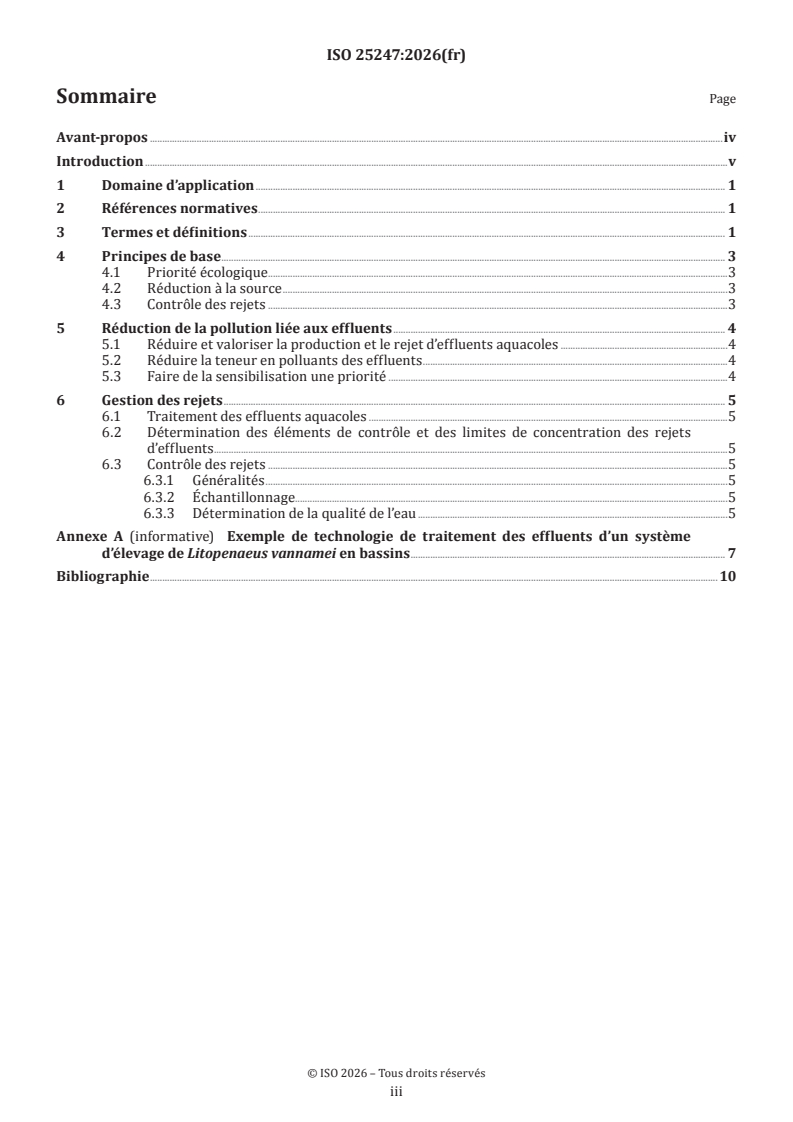
ISO 25247:2026 - Traitement des effluents aquacoles dans les systèmes d'aquaculture fermés et semi-fermés — Principes, méthodes et recommandations
ISO 25247:2026 is an ISO International Standard on treatment of aquaculture effluent in closed and semi-closed aquaculture systems. It specifies principles, methods and guidance for reducing effluent, managing discharge and limiting impacts on receiving water bodies in seawater and freshwater systems. It is intended for aquaculture operations that use closed or semi-closed systems, not open aquaculture.
What does ISO 25247:2026 specify?
ISO 25247:2026 sets out a system for aquaculture effluent reduction and discharge management. The document is organized into scope, terms and definitions, basic principles, effluent pollution minimization, discharge management, and one informative annex with an example for pond culture.
| Annex | What it covers |
|---|---|
| Annex A | Example treatment technology for effluent from a Litopenaeus vannamei pond culture system |
For a reader, the structure matters because the main clauses give the general approach, while Annex A shows how those ideas can be applied in a pond-based case.
What are the key requirements of ISO 25247:2026?
ISO 25247:2026 focuses on preventing pollution at the source, treating effluent before discharge or reuse, and checking that discharge meets the relevant limits. In practice, the standard asks aquaculture operators to manage the whole path from farming process to outlet monitoring.
- Clause 4.1, ecological priority - The document says to start with the receiving water body and identify local pollutant control items from the discharge characteristics of the aquaculture sector. This means the farm should first understand what it is releasing and what environmental effects matter most.
- Clause 4.2, source reduction - The standard points to better farming practices, feed quality, AI-supported feeding control, reduced medicine use and, where suitable, recirculating aquaculture system (RAS) methods. In practice, this is about reducing waste before it enters the water.
- Clause 4.3, discharge control - Effluent discharge should be planned according to the environment, best available techniques, culture cycle, species, scale and farm layout. This helps the operator choose treatment and release practices that fit the actual farm.
- Clause 5.1, reduce and valorize effluent - The document promotes recirculating and ecological aquaculture, plus collection and treatment of pond effluent for reuse or discharge after treatment. That means effluent is treated as a managed stream, not simply wastewater to release.
- Clause 5.2, reduce pollutant content - The standard highlights stocking density, feeding rate, feed formulation, precise use of feed, medicines and nutrients, physical/chemical/biological purification, solid recovery, and IMTA. For a buyer or manager, this is the core toolbox for reducing nitrogen, phosphorus and solids.
- Clause 5.3, awareness raising - Farmers and other interested parties should be informed through training, lectures, handouts and technical cooperation. This matters because effluent control depends on day-to-day farm behavior, not only equipment.
- Clause 6.1 to 6.3, discharge management - Effluent should be collected, treated, monitored and only discharged after meeting the applicable limit value. The document also calls for visible outlet identification, self-monitoring, retained records, sampling at the discharge outlet, and laboratory competence aligned with ISO/IEC 17025. In practice, this creates a traceable control loop from outlet to test result.
What terms does ISO 25247:2026 define?
- Aquaculture - Farming of aquatic organisms such as fish, molluscs, crustaceans and aquatic plants, with active intervention in rearing and production.
- Aquaculture system - The combination of culture unit type, intensity, species and scale of exploitation.
- Closed aquaculture system - A system with highly isolated farming water, artificial control of environmental parameters and fully controlled water outflow.
- Semi-closed aquaculture system - A system between closed and open aquaculture, with partial natural water exchange and partially controlled outflow.
- Aquaculture effluent - Water leaving the system that contains organic matter, nitrogen compounds, phosphorus and other nutrients or pollutants.
- Receiving water body - The waterbody or canal that receives the aquaculture effluent.
- IMTA - Integrated multi-trophic aquaculture, where species from different trophic levels interact in the same freshwater or seawater system.
- Stakeholder - A person or organization that can affect, be affected by, or perceive itself to be affected by the activity or decision.
Who uses ISO 25247:2026?
ISO 25247:2026 is used by aquaculture farm operators, pond culture managers, RAS operators, environmental managers, quality managers, and water-quality testing laboratories. It is also useful for designers of treatment facilities and for organizations that need to document effluent control, monitoring and discharge decisions in closed or semi-closed aquaculture in seawater or freshwater.
Which standards are used with ISO 25247:2026?
- ISO 5667-10 - Supports sampling of wastewater at the discharge outlet.
- ISO 5667-3 - Supports preservation and handling of collected water samples.
- ISO/IEC 17025 - Supports the competence of laboratories that test treated effluent.
- ISO 17273:2024 - Provides the source definition used for the aquaculture term.
- ISO 5020:2022 - Provides the source definition used for the stakeholder term.
What does the ISO 25247:2026 document contain?
ISO 25247:2026 contains the general framework for effluent reduction, treatment and discharge management, plus practical monitoring guidance. It describes three treatment families - physical, chemical and biological - and explains the kinds of contaminants each is intended to remove or reduce.
Annex A is an informative example for Litopenaeus vannamei pond culture. It covers treatment facility components, layout, area allocation, construction requirements for the pond treatment chain, and an example collection-and-treatment arrangement shown in figures. The annex is useful for design and implementation because it turns the general guidance into a pond-based facility concept.
The main text also covers outlet marking, self-monitoring, sampling location, sample handling, laboratory competence, and the condition for discharge after testing.
Buy Documents
ISO 25247:2026 - Treatment of aquaculture effluent in closed and semi-closed aquaculture systems — Principles, methods and guidance
ISO 25247:2026 - Traitement des effluents aquacoles dans les systèmes d'aquaculture fermés et semi-fermés — Principes, méthodes et recommandations
Get Certified
Connect with accredited certification bodies for this standard

Control Union Certifications
Global certification for agriculture and sustainability.

ECOCERT
Organic and sustainability certification.

FSC International
Forest Stewardship Council certification.
Sponsored listings
Frequently Asked Questions
ISO 25247:2026 is a standard published by the International Organization for Standardization (ISO). Its full title is "Treatment of aquaculture effluent in closed and semi-closed aquaculture systems — Principles, methods and guidance". This standard covers: This document specifies a system for aquaculture effluent reduction and discharge management. It includes principles, methods and guidance. This document is applicable to closed and semi-closed aquaculture systems in seawater and freshwater, aiming at reducing effluents and managing discharge and their impacts on receiving environments. This document does not apply to open aquaculture.
This document specifies a system for aquaculture effluent reduction and discharge management. It includes principles, methods and guidance. This document is applicable to closed and semi-closed aquaculture systems in seawater and freshwater, aiming at reducing effluents and managing discharge and their impacts on receiving environments. This document does not apply to open aquaculture.
ISO 25247:2026 is classified under the following ICS (International Classification for Standards) categories: 65.150 - Fishing and fish breeding. The ICS classification helps identify the subject area and facilitates finding related standards.
ISO 25247:2026 is available in PDF format for immediate download after purchase. The document can be added to your cart and obtained through the secure checkout process. Digital delivery ensures instant access to the complete standard document.
Standards Content (Sample)
International
Standard
ISO 25247
First edition
Treatment of aquaculture
2026-06
effluent in closed and semi-closed
aquaculture systems — Principles,
methods and guidance
Traitement des effluents aquacoles dans les systèmes
d'aquaculture fermés et semi-fermés — Principes, méthodes et
recommandations
Reference number
© ISO 2026
All rights reserved. Unless otherwise specified, or required in the context of its implementation, no part of this publication may
be reproduced or utilized otherwise in any form or by any means, electronic or mechanical, including photocopying, or posting on
the internet or an intranet, without prior written permission. Permission can be requested from either ISO at the address below
or ISO’s member body in the country of the requester.
ISO copyright office
CP 401 • Ch. de Blandonnet 8
CH-1214 Vernier, Geneva
Phone: +41 22 749 01 11
Email: copyright@iso.org
Website: www.iso.org
Published in Switzerland
ii
Contents Page
Foreword .iv
Introduction .v
1 Scope . 1
2 Normative references . 1
3 Terms and definitions . 1
4 Basic principles . 3
4.1 Ecological priority .3
4.2 Source reduction .3
4.3 Discharge control .3
5 Effluent pollution minimization. 3
5.1 Reduce and valorize the generation and discharge of aquaculture effluents .3
5.2 Reduce the content of pollutants in effluent .3
5.3 Make awareness raising a priority .4
6 Discharge management . 4
6.1 Aquaculture effluent treatment .4
6.2 Determination of control items and concentration limitations of effluent discharge .4
6.3 Discharge monitoring .5
6.3.1 General .5
6.3.2 Sampling .5
6.3.3 Determination of water quality .5
Annex A (informative) Example of treatment technology for effluent from Litopenaeus
vannamei pond culture system . 6
Bibliography . 8
iii
Foreword
ISO (the International Organization for Standardization) is a worldwide federation of national standards
bodies (ISO member bodies). The work of preparing International Standards is normally carried out through
ISO technical committees. Each member body interested in a subject for which a technical committee
has been established has the right to be represented on that committee. International organizations,
governmental and non-governmental, in liaison with ISO, also take part in the work. ISO collaborates closely
with the International Electrotechnical Commission (IEC) on all matters of electrotechnical standardization.
The procedures used to develop this document and those intended for its further maintenance are described
in the ISO/IEC Directives, Part 1. In particular, the different approval criteria needed for the different types
of ISO document should be noted. This document was drafted in accordance with the editorial rules of the
ISO/IEC Directives, Part 2 (see www.iso.org/directives).
ISO draws attention to the possibility that the implementation of this document may involve the use of (a)
patent(s). ISO takes no position concerning the evidence, validity or applicability of any claimed patent
rights in respect thereof. As of the date of publication of this document, ISO had not received notice of (a)
patent(s) which may be required to implement this document. However, implementers are cautioned that
this may not represent the latest information, which may be obtained from the patent database available at
www.iso.org/patents. ISO shall not be held responsible for identifying any or all such patent rights.
Any trade name used in this document is information given for the convenience of users and does not
constitute an endorsement.
For an explanation of the voluntary nature of standards, the meaning of ISO specific terms and expressions
related to conformity assessment, as well as information about ISO’s adherence to the World Trade
Organization (WTO) principles in the Technical Barriers to Trade (TBT), see www.iso.org/iso/foreword.html.
This document was prepared by Technical Committee ISO/TC 234, Fisheries and aquaculture.
Any feedback or questions on this document should be directed to the user’s national standards body. A
complete listing of these bodies can be found at www.iso.org/members.html.
iv
Introduction
Aquaculture activities influence the environment in different ways, and the scale, performance and location
of the activity determines the degree of influence. However, with the rapid development of aquaculture,
the discharge of aquaculture effluent has increased, which can affect environmental carrying capacity and
environmental self-purification capacity. Nitrogen and phosphorus, in various solid and dissolved forms,
among other food residues, as well as excrement of aquatic animals, in effluent can pollute the surrounding
waters, which can lead to eutrophication and algal bloom.
Aquacultural effluent discharges can have a potential impact on different trophic compartments of the
receiving aquatic environment, with the consequence of limiting green and sustainable development of
aquaculture. It is important that problems due to effluent are therefore solved at an international as well as
at a national level. Reduced discharge of aquaculture effluent into marine and freshwater bodies will also
make a significant contribution to improved resource management, increased sustainable food production
and improved circular economy.
This document for effluent reduction and discharge management in aquaculture can contribute to:
— reduced discharge of aquaculture effluent;
— reduced risks to biodiversity and the environment from aquaculture effluent;
— increased contribution to green, healthy and sustainable development of aquaculture.
v
International Standard ISO 25247:2026(en)
Treatment of aquaculture effluent in closed and semi-closed
aquaculture systems — Principles, methods and guidance
1 Scope
This document specifies a system for aquaculture effluent reduction and discharge management. It includes
principles, methods and guidance.
This document is applicable to closed and semi-closed aquaculture systems in seawater and freshwater,
aiming at reducing effluents and managing discharge and their impacts on receiving environments.
This document does not apply to open aquaculture.
2 Normative references
There are no normative references in this document.
3 Terms and definitions
For the purposes of this document, the following terms and definitions apply.
ISO and IEC maintain terminology databases for use in standardization at the following addresses:
— ISO Online browsing platform: available at https:// www .iso .org/ obp
— IEC Electropedia: available at https:// www .electropedia .org/
3.1
aquaculture
farming of aquatic organisms, including but not limited to fish, molluscs, crustaceans and aquatic plants
Note 1 to entry: Farming implies some sort of intervention in the rearing process to enhance production, such as
regular stocking, feeding, protection from predators, etc. Farming also implies individual or corporate ownership of
the stock being cultivated, the planning, development and operation of aquaculture systems (3.2), sites, facilities and
practices, and production and transport.
[SOURCE: ISO 17273:2024, 3.2.1, modified — Second sentence extended and third sentence deleted in Note
1 to entry.]
3.2
aquaculture system
combination of type of culture units, levels of intensity, cultures species and scales or sizes of exploitation
3.3
closed aquaculture system
aquaculture system (3.2) in which the farming water body is highly isolated from the external natural
environment and relies on artificial regulation to maintain environmental parameters, and the outflow of
water from the culture unit can be fully controlled
Note 1 to entry: The farming water body in closed aquaculture is recycled and reused, without or in limited volume of
external water input or exchange, without or in limited volume of effluent discharge.
Note 2 to entry: The environmental parameters in closed aquaculture (e.g. water temperature, dissolved oxygen, pH,
ammonia nitrogen) are artificially regulated or maintained by using aerators, heaters, monitoring equipment, etc.
Note 3 to entry: A closed aquaculture system is minimally affected by fluctuations in external climate and water
quality, and is suitable for high-density aquaculture.
Note 4 to entry: Closed aquaculture can be implemented on land, in marine and freshwater bodies.
Note 5 to entry: Closed aquaculture can be, but is not limited to, recirculating aquaculture systems (RAS) (3.6).
3.4
semi-closed aquaculture system
aquaculture system (3.2) that lies in between the closed aquaculture system (3.3) and open aquaculture
system (3.5), partially relying on the exchange of natural water bodies and maintaining the environment
parameters through both artificial interventions and natural factors, and the outflow of water from the
culture unit can be partially controlled
Note 1 to entry: A semi-closed aquaculture system requires regular replenishment of external water or partial
discharge of effluent, but the exchange capacity is much lower than that of open aquaculture system.
Note 2 to entry: A semi-closed aquaculture system may use aerators, simple biofilters, etc. to maintain environmental
parameters, but the precision can be inferior to that of closed aquaculture system.
Note 3 to entry: A semi-closed aquaculture sys
...
Norme
internationale
ISO 25247
Première édition
Traitement des effluents aquacoles
2026-06
dans les systèmes d'aquaculture
fermés et semi-fermés — Principes,
méthodes et recommandations
Treatment of aquaculture effluent in closed and semi-closed
aquaculture systems — Principles, methods and guidance
Numéro de référence
DOCUMENT PROTÉGÉ PAR COPYRIGHT
© ISO 2026
Tous droits réservés. Sauf prescription différente ou nécessité dans le contexte de sa mise en œuvre, aucune partie de cette
publication ne peut être reproduite ni utilisée sous quelque forme que ce soit et par aucun procédé, électronique ou mécanique,
y compris la photocopie, ou la diffusion sur l’internet ou sur un intranet, sans autorisation écrite préalable. Une autorisation peut
être demandée à l’ISO à l’adresse ci-après ou au comité membre de l’ISO dans le pays du demandeur.
ISO copyright office
Case postale 401 • Ch. de Blandonnet 8
CH-1214 Vernier, Genève
Tél.: +41 22 749 01 11
E-mail: copyright@iso.org
Web: www.iso.org
Publié en Suisse
ii
Sommaire Page
Avant-propos .iv
Introduction .v
1 Domaine d’application . 1
2 Références normatives . 1
3 Termes et définitions . 1
4 Principes de base . 3
4.1 Priorité écologique .3
4.2 Réduction à la source .3
4.3 Contrôle des rejets .3
5 Réduction de la pollution liée aux effluents . 4
5.1 Réduire et valoriser la production et le rejet d’effluents aquacoles .4
5.2 Réduire la teneur en polluants des effluents .4
5.3 Faire de la sensibilisation une priorité .4
6 Gestion des rejets . 5
6.1 Traitement des effluents aquacoles .5
6.2 Détermination des éléments de contrôle et des limites de concentration des rejets
d’effluents .5
6.3 Contrôle des rejets .5
6.3.1 Généralités .5
6.3.2 Échantillonnage.5
6.3.3 Détermination de la qualité de l’eau .5
Annexe A (informative) Exemple de technologie de traitement des effluents d’un système
d’élevage de Litopenaeus vannamei en bassins . 7
Bibliographie . 10
iii
Avant-propos
L’ISO (Organisation internationale de normalisation) est une fédération mondiale d’organismes nationaux
de normalisation (comités membres de l’ISO). L’élaboration des Normes internationales est en général
confiée aux comités techniques de l’ISO. Chaque comité membre intéressé par une étude a le droit de faire
partie du comité technique créé à cet effet. Les organisations internationales, gouvernementales et non
gouvernementales, en liaison avec l’ISO participent également aux travaux. L’ISO collabore étroitement avec
la Commission électrotechnique internationale (IEC) en ce qui concerne la normalisation électrotechnique.
Les procédures utilisées pour élaborer le présent document et celles destinées à sa mise à jour sont
décrites dans les Directives ISO/IEC, Partie 1. Il convient, en particulier, de prendre note des différents
critères d’approbation requis pour les différents types de documents ISO. Le présent document a
été rédigé conformément aux règles de rédaction données dans les Directives ISO/IEC, Partie 2 (voir
www.iso.org/directives).
L’ISO attire l’attention sur le fait que la mise en application du présent document peut entraîner l’utilisation
d’un ou de plusieurs brevets. L’ISO ne prend pas position quant à la preuve, à la validité et à l’applicabilité de
tout droit de brevet revendiqué à cet égard. À la date de publication du présent document, l’ISO n’avait pas
reçu notification qu’un ou plusieurs brevets pouvaient être nécessaires à sa mise en application. Toutefois,
il y a lieu d’avertir les responsables de la mise en application du présent document que des informations
plus récentes sont susceptibles de figurer dans la base de données de brevets, disponible à l’adresse
www.iso.org/brevets. L’ISO ne saurait être tenue pour responsable de ne pas avoir identifié tout ou partie de
tels droits de propriété.
Les appellations commerciales éventuellement mentionnées dans le présent document sont données pour
information, par souci de commodité, à l’intention des utilisateurs et ne sauraient constituer un engagement.
Pour une explication de la nature volontaire des normes, la signification des termes et expressions
spécifiques de l’ISO liés à l’évaluation de la conformité, ou pour toute information au sujet de l’adhésion de
l’ISO aux principes de l’Organisation mondiale du commerce (OMC) concernant les obstacles techniques au
commerce (OTC), voir www.iso.org/avant-propos.
Le présent document a été élaboré par le comité technique ISO/TC 234, Pêches et aquaculture.
Il convient que l’utilisateur adresse tout retour d’information ou toute question concernant le présent
document à l’organisme national de normalisation de son pays. Une liste exhaustive desdits organismes se
trouve à l’adresse www.iso.org/fr/members.html.
iv
Introduction
Les activités aquacoles ont une incidence sur l’environnement de différentes manières, et l’ampleur, les
performances et la localisation de l’activité déterminent le degré d’influence. Toutefois, en raison du
développement rapide de l’aquaculture, les rejets d’effluents aquacoles ont augmenté, ce qui peut affecter la
capacité d’accueil et la capacité d’auto-épuration des milieux. L’azote et le phosphore, sous diverses formes
solides et dissoutes, entre autres résidus alimentaires, ainsi que les excréments d’animaux aquatiques,
présents dans les effluents, peuvent polluer les eaux environnantes, ce qui peut entraîner une eutrophisation
et une prolifération d’algues.
Les rejets d’effluents aquacoles peuvent avoir une incidence potentielle sur différents compartiments
trophiques du milieu aquatique récepteur, avec pour conséquence de limiter le développement écologique et
durable de l’aquaculture. Il est donc important que les problèmes liés aux effluents soient résolus au niveau
international comme au niveau national. La réduction des rejets d’effluents aquacoles en milieux aquatiques
marins et d’eau douce contribuera en outre et de manière significative à l’amélioration de la gestion des
ressources, à l’augmentation de la production alimentaire durable et à l’amélioration de l’économie circulaire.
Le présent document sur la réduction des effluents et la gestion des rejets dans l’aquaculture peut être utile
en vue de:
— diminuer les rejets d’effluents aquacoles;
— réduire les risques pour la biodiversité et l’environnement liés aux effluents aquacoles;
— contribuer davantage au développement écologique, sain et durable de l’aquaculture.
v
Norme internationale ISO 25247:2026(fr)
Traitement des effluents aquacoles dans les systèmes
d'aquaculture fermés et semi-fermés — Principes, méthodes
et recommandations
1 Domaine d’application
Le présent document spécifie un système de réduction des effluents aquacoles et de gestion des rejets. Il
comprend des principes, des méthodes et des recommandations.
Le présent document est applicable aux systèmes d’aquaculture fermés et semi-fermés en eau de mer et en
eau douce, visant à réduire les effluents et à gérer les rejets et leurs impacts sur les milieux récepteurs.
Le présent document ne s’applique pas à l’aquaculture ouverte.
2 Références normatives
Le présent document ne contient aucune référence normative.
3 Termes et définitions
Pour les besoins du présent document, les termes et définitions suivants s’appliquent.
L’ISO et l’IEC tiennent à jour des bases de données terminologiques destinées à être utilisées en normalisation,
consultables aux adresses suivantes:
— ISO Online browsing platform: disponible à l’adresse https:// www .iso .org/ obp
— IEC Electropedia: disponible à l’adresse https:// www .electropedia .org/
3.1
aquaculture
élevage et culture d’organismes aquatiques, y compris de poissons, de mollusques, de crustacés et de plantes
aquatiques
Note 1 à l'article: L’élevage implique une certaine forme d’intervention dans le processus afin d’améliorer la production,
telle que le rechargement régulier des stocks, le nourrissage, la protection contre les prédateurs, etc. L’élevage
implique aussi la propriété d’un individu ou d’une entreprise sur le stock cultivé, la planification, le développement et
l’exploitation des systèmes (3.2), sites, installations et pratiques d’aquaculture, ainsi que la production et le transport.
[SOURCE: ISO 17273:2024, 3.2.1, modifié — Deuxième phrase étoffée et troisième phrase supprimée dans
la Note 1 à l’article.]
3.2
système d’aquaculture
combinaison du type d’unités de culture, des niveaux d’intensité, des espèces cultivées et de l’échelle ou de la
taille de l’exploitation
3.3
système d’aquaculture fermé
système d’aquaculture (3.2) dans lequel le milieu aquatique de culture est fortement isolé de l’environnement
naturel extérieur et dépend d’une régulation artificielle pour maintenir les paramètres environnementaux,
et où l’écoulement d’eau de l’unité de culture peut être entièrement contrôlé
Note 1 à l'article: L’eau utilisée pour la culture en aquaculture fermée est recyclée et réemployée, avec un volume nul
ou limité d’apport ou d’échange d’eau externe et avec un volume nul ou limité de rejet d’effluents.
Note 2 à l'article: Les paramètres environnementaux de l’aquaculture fermée, tels que la température de l’eau, l’oxygène
dissous, le pH, l’azote ammoniacal, sont régulés ou maintenus artificiellement à l’aide d’aérateurs, de dispositifs de
chauffage, d’équipements de surveillance, etc.
Note 3 à l'article: Les systèmes d’aquaculture fermés sont peu affectés par les variations de qualité extérieures
relatives au climat et à l’eau et ils sont adaptés à l’aquaculture à haute densité.
Note 4 à l'article: L’aquaculture fermée peut être mise en œuvre à terre, dans les milieux aquatiques marins et d’eau
douce.
Note 5 à l'article: L’aquaculture fermée peut notamment prendre la forme de systèmes d’aquaculture en
recirculation (RAS) (3.6).
3.4
système d’aquaculture semi-fermé
système d’aquaculture (3.2) situé entre le système d’aquaculture fermé (3.3) et le système d’aquaculture
ouvert (3.5), qui s’appuie partiellement sur l’échange entre milieux aquatiques naturels et qui maintient les
paramètres environnementaux par des interventions artificielles et des facteurs naturels, et où l’écoulement
d’eau depuis l’unité de culture peut être partiellement contrôlé
Note 1 à l'article: Les systèmes d’aquaculture semi-fermés nécessitent un apport régulier d’eau extérieure ou un rejet
partiel des effluents, mais leur capacité d’échange est bien plus faible que celle des systèmes d’aquaculture ouverts.
Note 2 à l'article: Les systèmes d’aquaculture semi-fermés peuvent utiliser des aérateurs, des biofiltres simples,
etc., pour maintenir les paramètres environnementaux, mais la précision peut être inférieure à celle des systèmes
d’aquaculture fermés.
Note 3 à l'article: Certains facteurs naturels, tels que la saison, la température et les précipitations ont une incidence
sur les systèmes d’aquaculture semi-fermés.
Note 4 à l'article: L’aquaculture semi-fermée peut être mise en œuvre à terre, dans les milieux aquatiques marins et
d’eau douce.
Note 5 à l'article: L’aquaculture semi-fermée peut notamment prendre la forme de la culture en bassin (3.7).
3.5
système d’aquaculture ouvert
production aquacole réalisée en mer, dans les lacs, les réservoirs et les rivières à l’aide de radeaux, de
cages flottantes, de cages suspendues et d’ensemencement des fonds, d’ensemencement artificiel ou
d’enrichissement naturel, etc.
3.6
système d’aquaculture en recirculation
RAS
technologie d’éle
...