

ISO/FDIS 24831
(Main)Fine ceramics (advanced ceramics, advanced technical ceramics) — Mechanical properties of ceramic matrix composite at ambient temperature in air atmospheric pressure — Determination of leak strength of tubes
General Information
- Abstract
- Status
- Not Published
- Technical Committee
- ISO/TC 206 - Fine ceramics
- Drafting Committee
- ISO/TC 206/WG 4 - Composites
- Current Stage
- 5020 - FDIS ballot initiated: 2 months. Proof sent to secretariat
- Start Date
- 21-Sep-2026
- Completion Date
- 21-Sep-2026
Buy Documents


ISO/FDIS 24831 - Fine ceramics (advanced ceramics, advanced technical ceramics) — Mechanical properties of ceramic matrix composite at ambient temperature in air atmospheric pressure — Determination of leak strength of tubes
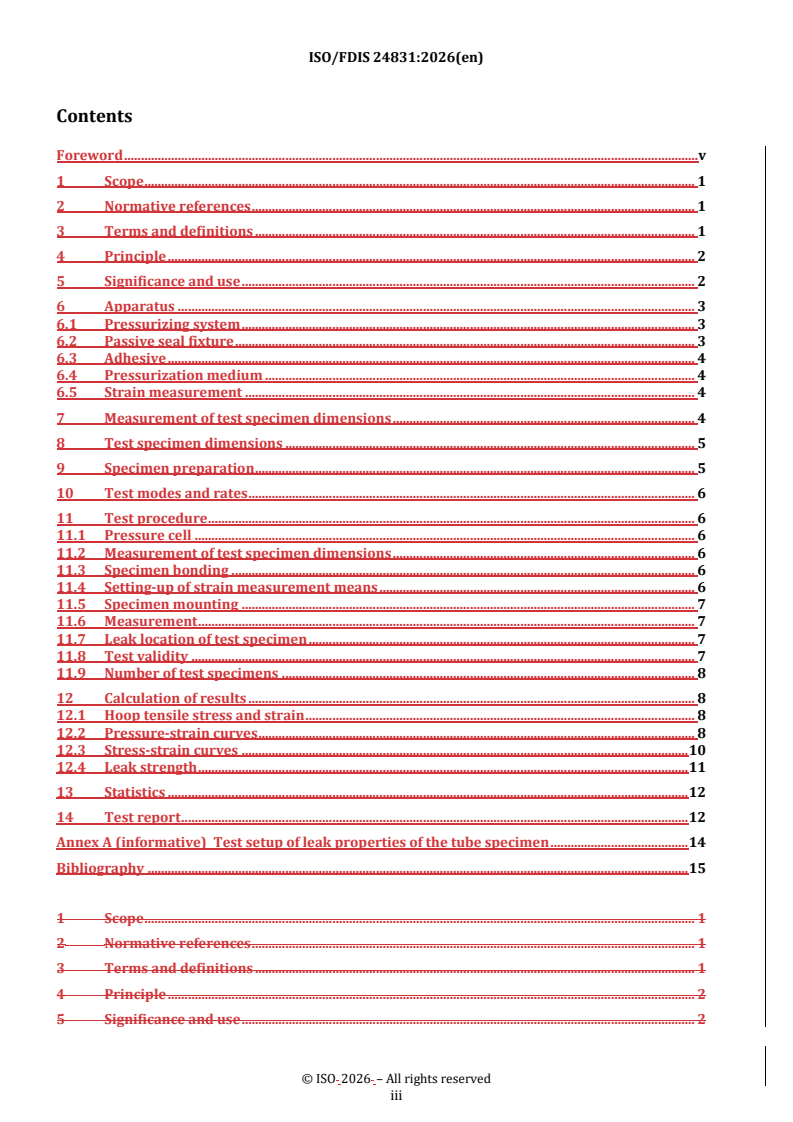
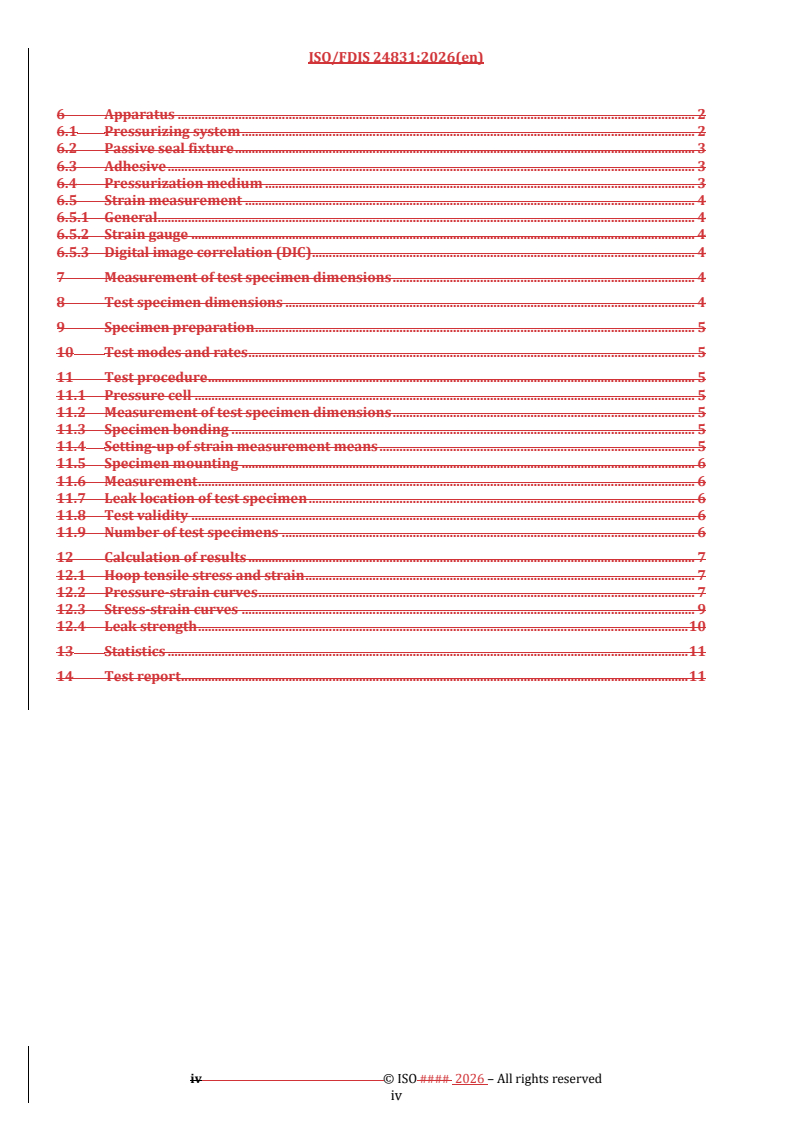
REDLINE ISO/FDIS 24831 - Fine ceramics (advanced ceramics, advanced technical ceramics) — Mechanical properties of ceramic matrix composite at ambient temperature in air atmospheric pressure — Determination of leak strength of tubes
Overview
ISO/FDIS 24831: Fine ceramics (advanced ceramics, advanced technical ceramics) - Mechanical properties of ceramic matrix composite at ambient temperature in air atmospheric pressure - Determination of leak strength of tubes is an International Standard developed by ISO/TC 206. This standard specifies the method for determining the leak strength of ceramic matrix composite (CMC) tubes with fiber reinforcement under ambient temperature and air atmospheric pressure. It supports the assessment of mechanical performance, assisting industries and laboratories in material development, quality assurance, and comparative evaluation of fine ceramics components.
Key Topics
Leak Strength Determination:
Outlines procedures to measure the hoop stress at which a CMC tube begins to leak without catastrophic fracture, providing insight into the mechanical reliability of tubes under internal pressure.Test Specimens:
Applicability to CMC tubes with continuous fiber reinforcement (unidirectional, bidirectional, and tridirectional). Includes dimensional requirements such as wall thickness, length, diameter, and surface preparation to ensure test repeatability.Test Apparatus and Equipment:
Requirements for pressurizing systems, seal fixtures, adhesives, and pressurization media (e.g., silicone oil) are detailed to maintain test validity and safety. Recommendations emphasize accurate, calibrated measurement devices and safe pressure application control.Measurement and Recording:
Usage of strain gauges (ASTM E251-92) or digital image correlation (DIC, ASTM E2208-02) for precise determination of hoop strain. Emphasis is placed on proper placement, calibration, and data acquisition to ensure accurate pressure-strain and stress-strain curves.Data Analysis:
The standard prescribes methods for calculating hoop tensile stress, leak pressure, and leak strength based on pressure-strain behaviors. Test results support statistical analysis including mean, standard deviation, and coefficient of variation.
Applications
Quality Assurance in Manufacturing:
Enables manufacturers to validate the leak resistance and mechanical integrity of CMC tubes in fine ceramics production, ensuring that only reliable components enter critical applications.Material Research and Development:
Assists research institutions in characterizing new ceramic matrix composites, optimizing their design for higher performance and durability under internal pressure conditions.Component Design and Selection:
Provides engineers with critical data for comparing leakage strength across different CMC tube geometries, reinforcement architectures, and manufacturing batches, supporting informed decisions in design and material selection.Testing and Calibration Laboratories:
Accredited laboratories can use ISO/FDIS 24831 to perform standardized leak strength measurements, ensuring consistency and comparability of data for certification processes and supply chain quality controls.
Related Standards
ISO 20507:
Vocabulary for fine ceramics (advanced ceramics, advanced technical ceramics); provides essential terminology used throughout ISO/FDIS 24831.ISO 3611:
Geometrical product specifications for dimensional measuring equipment, ensuring accurate measurement practices during specimen preparation and testing.ISO/IEC 17025:
General requirements for the competence of testing and calibration laboratories; supports reliable, repeatable results in accredited environments.ASTM E251-92:
Test methods for resistance strain gauges, relevant to strain measurement during leak tests.ASTM E2208-02:
Standard guide for evaluating non-contacting optical strain measurement systems, such as DIC.
Practical Value
Conformance to ISO/FDIS 24831 guarantees that leakage strength testing of ceramic matrix composite tubes is performed in a technically sound, reproducible manner. This provides manufacturers, suppliers, and end-users with trustworthy data on product performance, supporting compliance, innovation, and product reliability in fields such as aerospace, energy, and advanced engineering applications.
Keywords: fine ceramics, advanced ceramics, ceramic matrix composite, CMC tubes, leak strength, ISO/FDIS 24831, mechanical properties, hoop stress, strain measurement, standardized testing, material quality, industrial ceramics.
Buy Documents
ISO/FDIS 24831 - Fine ceramics (advanced ceramics, advanced technical ceramics) — Mechanical properties of ceramic matrix composite at ambient temperature in air atmospheric pressure — Determination of leak strength of tubes
REDLINE ISO/FDIS 24831 - Fine ceramics (advanced ceramics, advanced technical ceramics) — Mechanical properties of ceramic matrix composite at ambient temperature in air atmospheric pressure — Determination of leak strength of tubes
Frequently Asked Questions
ISO/FDIS 24831 is a draft published by the International Organization for Standardization (ISO). Its full title is "Fine ceramics (advanced ceramics, advanced technical ceramics) — Mechanical properties of ceramic matrix composite at ambient temperature in air atmospheric pressure — Determination of leak strength of tubes". This standard covers: Fine ceramics (advanced ceramics, advanced technical ceramics) — Mechanical properties of ceramic matrix composite at ambient temperature in air atmospheric pressure — Determination of leak strength of tubes
Fine ceramics (advanced ceramics, advanced technical ceramics) — Mechanical properties of ceramic matrix composite at ambient temperature in air atmospheric pressure — Determination of leak strength of tubes
ISO/FDIS 24831 is classified under the following ICS (International Classification for Standards) categories: 81.060.30 - Advanced ceramics. The ICS classification helps identify the subject area and facilitates finding related standards.
ISO/FDIS 24831 is available in PDF format for immediate download after purchase. The document can be added to your cart and obtained through the secure checkout process. Digital delivery ensures instant access to the complete standard document.
Standards Content (Sample)
FINAL DRAFT
International
Standard
ISO/TC 206
Fine ceramics (advanced ceramics,
Secretariat: JISC
advanced technical ceramics) —
Voting begins on:
Mechanical properties of ceramic
2026-09-21
matrix composite at ambient
Voting terminates on:
temperature in air atmospheric
2026-11-16
pressure — Determination of leak
strength of tubes
RECIPIENTS OF THIS DRAFT ARE INVITED TO SUBMIT,
WITH THEIR COMMENTS, NOTIFICATION OF ANY
RELEVANT PATENT RIGHTS OF WHICH THEY ARE AWARE
AND TO PROVIDE SUPPOR TING DOCUMENTATION.
IN ADDITION TO THEIR EVALUATION AS
BEING ACCEPTABLE FOR INDUSTRIAL, TECHNO
LOGICAL, COMMERCIAL AND USER PURPOSES, DRAFT
INTERNATIONAL STANDARDS MAY ON OCCASION HAVE
TO BE CONSIDERED IN THE LIGHT OF THEIR POTENTIAL
TO BECOME STAN DARDS TO WHICH REFERENCE MAY BE
MADE IN NATIONAL REGULATIONS.
Reference number
FINAL DRAFT
International
Standard
ISO/TC 206
Fine ceramics (advanced ceramics,
Secretariat: JISC
advanced technical ceramics) —
Voting begins on:
Mechanical properties of ceramic
matrix composite at ambient
Voting terminates on:
temperature in air atmospheric
pressure — Determination of leak
strength of tubes
RECIPIENTS OF THIS DRAFT ARE INVITED TO SUBMIT,
WITH THEIR COMMENTS, NOTIFICATION OF ANY
RELEVANT PATENT RIGHTS OF WHICH THEY ARE AWARE
AND TO PROVIDE SUPPOR TING DOCUMENTATION.
© ISO 2026
IN ADDITION TO THEIR EVALUATION AS
All rights reserved. Unless otherwise specified, or required in the context of its implementation, no part of this publication may
BEING ACCEPTABLE FOR INDUSTRIAL, TECHNO
LOGICAL, COMMERCIAL AND USER PURPOSES, DRAFT
be reproduced or utilized otherwise in any form or by any means, electronic or mechanical, including photocopying, or posting on
INTERNATIONAL STANDARDS MAY ON OCCASION HAVE
the internet or an intranet, without prior written permission. Permission can be requested from either ISO at the address below
TO BE CONSIDERED IN THE LIGHT OF THEIR POTENTIAL
or ISO’s member body in the country of the requester.
TO BECOME STAN DARDS TO WHICH REFERENCE MAY BE
MADE IN NATIONAL REGULATIONS.
ISO copyright office
CP 401 • Ch. de Blandonnet 8
CH-1214 Vernier, Geneva
Phone: +41 22 749 01 11
Email: copyright@iso.org
Website: www.iso.org
Published in Switzerland Reference number
ii
Contents Page
Foreword .iv
1 Scope . 1
2 Normative references . 1
3 Terms and definitions . 1
4 Principle . 2
5 Significance and use . 2
6 Apparatus . 2
6.1 Pressurizing system .2
6.2 Passive seal fixture .3
6.3 Adhesive .3
6.4 Pressurization medium .3
6.5 Strain measurement .4
6.5.1 General .4
6.5.2 Strain gauge .4
6.5.3 Digital image correlation (DIC) .4
7 Measurement of test specimen dimensions. 4
8 Test specimen dimensions . 4
9 Specimen preparation . . 5
10 Test modes and rates . 5
11 Test procedure . 5
11.1 Pressure cell .5
11.2 Measurement of test specimen dimensions .6
11.3 Specimen bonding .6
11.4 Setting-up of strain measurement means .6
11.5 Specimen mounting . .7
11.6 Measurement .7
11.7 Leak location of test specimen .7
11.8 Test validity .7
11.9 Number of test specimens .7
12 Calculation of results . 8
12.1 Hoop tensile stress and strain .8
12.2 Pressure-strain curves .8
12.3 Stress-strain curves .10
12.4 Leak strength .11
13 Statistics . .11
14 Test report .12
Annex A (informative) Test setup of leak properties of the tube specimen .13
Bibliography . 14
iii
Foreword
ISO (the International Organization for Standardization) is a worldwide federation of national standards
bodies (ISO member bodies). The work of preparing International Standards is normally carried out through
ISO technical committees. Each member body interested in a subject for which a technical committee
has been established has the right to be represented on that committee. International organizations,
governmental and non-governmental, in liaison with ISO, also take part in the work. ISO collaborates closely
with the International Electrotechnical Commission (IEC) on all matters of electrotechnical standardization.
The procedures used to develop this document and those intended for its further maintenance are described
in the ISO/IEC Directives, Part 1. In particular, the different approval criteria needed for the different types
of ISO document should be noted. This document was drafted in accordance with the editorial rules of the
ISO/IEC Directives, Part 2 (see www.iso.org/directives).
ISO draws attention to the possibility that the implementation of this document may involve the use of (a)
patent(s). ISO takes no position concerning the evidence, validity or applicability of any claimed patent
rights in respect thereof. As of the date of publication of this document, ISO had not received notice of (a)
patent(s) which may be required to implement this document. However, implementers are cautioned that
this may not represent the latest information, which may be obtained from the patent database available at
www.iso.org/patents. ISO shall not be held responsible for identifying any or all such patent rights.
Any trade name used in this document is information given for the convenience of users and does not
constitute an endorsement.
For an explanation of the voluntary nature of standards, the meaning of ISO specific terms and expressions
related to conformity assessment, as well as information about ISO's adherence to the World Trade
Organization (WTO) principles in the Technical Barriers to Trade (TBT), see www.iso.org/iso/foreword.html.
This document was prepared by Technical Committee ISO/TC 206, Fine Ceramics.
Any feedback or questions on this document should be directed to the user’s national standards body. A
complete listing of these bodies can be found at www.iso.org/members.html.
iv
FINAL DRAFT International Standard ISO/FDIS 24831:2026(en)
Fine ceramics (advanced ceramics, advanced technical
ceramics) — Mechanical properties of ceramic matrix
composite at ambient temperature in air atmospheric
pressure — Determination of leak strength of tubes
1 Scope
This document specifies a method for determining the leak strength of ceramic matrix composite (CMC)
tubes with fibre-reinforcement at room temperature in air atmospheric pressure. This document provides
information on the stress-strain response, such as leak strength, and corresponding hoop tensile strain.
This document applies primarily to ceramic matrix composite tubes with continuous fibre reinforcement:
uni-directional (1-D), bi-directional (2-D), tri-directional (xD, 2< x <3).
2 Normative references
The following documents are referred to in the text in such a way that some or all of their content constitutes
requirements of this document. For dated references, only the edition cited applies. For undated references,
the latest edition of the referenced document (including any amendments) applies.
ISO 3611, Geometrical product specifications (GPS) — Dimensional measuring equipment — Design and
metrological characteristics of micrometers for external measurements
ISO 20507, Fine ceramics (advanced ceramics, advanced technical ceramics) —Vocabulary
ASTM E251-92, Test Methods for performance characteristics of metallic bonded resistance strain gauges
ASTM E2208-02, Standard Guide for Evaluating Non-Contacting Optical Strain Measurement Systems
3 Terms and definitions
For the purposes of this document, the terms and definitions given in ISO 20507 and the following apply.
ISO and IEC maintain terminology databases for use in standardization at the following addresses:
— ISO Online browsing platform: available at https:// www .iso .org/ obp
— IEC Electropedia: available at https:// www .electropedia .org/
3.1
total length
L
t
length including ends of the tube specimen
3.2
calibrated length
L
c
part of the test specimen that has uniform and minimum external diameter
[SOURCE: ISO 21971:2019,3.1]
3.3
gauge length
L
g
initial distance between reference points on the test specimen in the calibrated length
[SOURCE: ISO 21971:2019,3.2]
3.4
leak pressure
P
l
internal pressure corresponding to the tube specimen when leakage occurs during the test
3.5
leak strength
σ
l
hoop stress corresponding to leak pressure (3.4)
Note 1 to entry: The leak pressure is not enough to cause fibre breakage, therefore, the tube specimen still has a
complete integrity geometry.
4 Principle
Closed-end seal fittings incorporating a high-strength adhesive seal against the test specimen tube of
specified dimensions are used at room temperature. Both axial and hoop stress act on the tube specimen
at the same time during leak properties test of CMC tube specimen. Pressure medium is pumped into the
test specimen at a constant volume flow rate. The tube specimen is loaded to leakage and the corresponding
test time, internal pressure, and strain data are recorded. The leak strength of the specimen are calculated
based on the test data and curves.
The end fitting incorporating a high-strength adhesive shall ensure that there is no leakage of pressurized
medium from the seal area during loading.
5 Significance and use
Unlike hoop strength tests, which lead to severe fracture of CMC tubes, this standard specifies a method for
determining the liquid pressure leak strength under low internal pressure. Leakage arises from microscopic
matrix damage, with no extensive fibre breakage. The CMC tube remains intact in its original shape once the
leak strength is reached.
This standard is intended to assess the influences of pore characteristics (quantity, size and connectivity),
reinforcement weaving architecture and tube geometry (wall thickness and diameter) on the leakage
resistance of CMC tubes. Test data can support material development, production quality control, material
comparison and performance characterization of CMC tubular components
6 Apparatus
6.1 Pressurizing system
Pressurizing system should be designed with sufficient safety protection device, in case of overpressure,
leakage and other dangers, to ensure the safety of staff and equipment (see Figure A.1).
Special consideration shall be given to the following items.
a) Pump, shall be able to apply a continuously increasing and uniform internal pressure to the tube
specimen. The pump should not produce a pressure surge with each stroke.
b) Valves, shall include the following functions: control, regulation, and safety.
c) Pressure sensor, of adequate capacity, shall be used to monitor system pressure and to record the fluid
pressure attained. The accuracy of pressure sensor shall be better than 1 % of the test value.
6.2 Passive seal fixture
Passive seal fixture transmits the pressure medium applied by the pressurizing system to the tube specimen.
Seal fixture mainly consists of left end fitting, right end fitting and seal bolt. Left end fitting provides bonding
area on both the OD and the ID zones of the tube specimen, and there is a channel to induce pressurized
medium into the tube specimen. Right end fitting has a vent hole to ensure that all free gases shall be vented
prior to test. The seal bolt is used to seal vent hole. An example of the tube specimen closed-end seal fixture
is shown in Figure 1. The tube specimen is recommended to fit into the bonding cavity with a thin (~0,1 to
[2]
0,2 mm) space for adhesive, providing uniform gluing zone between the tube specimen and the end fitting .
Insufficient b
...
ISO/TC 206/WG 4
Secretariat: JISC
Date: 2026-7-0609-07
Fine ceramics (advanced ceramics, advanced technical ceramics)
— — Mechanical properties of ceramic matrix composite at ambient
temperature in air atmospheric pressure — Determination of leak
strength of tubes
Céramiques techniques – Propriétés mécaniques des composites à matrice céramique à température
ambiante sous pression atmosphérique — Détermination de la résistance à la fuite des tubes
FDIS stage
All rights reserved. Unless otherwise specified, or required in the context of its implementation, no part of this publication
may be reproduced or utilized otherwise in any form or by any means, electronic or mechanical, including photocopying,
or posting on the internet or an intranet, without prior written permission. Permission can be requested from either ISO
at the address below or ISO’s member body in the country of the requester.
ISO copyright office
CP 401 • Ch. de Blandonnet 8
CH-1214 Vernier, Geneva
Phone: + 41 22 749 01 11
EmailE-mail: copyright@iso.org
Website: www.iso.orgwww.iso.org
Published in Switzerland
ii © ISO #### 2026 – All rights reserved
ii
Contents
Foreword . v
1 Scope . 1
2 Normative references . 1
3 Terms and definitions . 1
4 Principle . 2
5 Significance and use . 2
6 Apparatus . 3
6.1 Pressurizing system . 3
6.2 Passive seal fixture . 3
6.3 Adhesive . 4
6.4 Pressurization medium . 4
6.5 Strain measurement . 4
7 Measurement of test specimen dimensions . 4
8 Test specimen dimensions . 5
9 Specimen preparation . 5
10 Test modes and rates . 6
11 Test procedure . 6
11.1 Pressure cell . 6
11.2 Measurement of test specimen dimensions . 6
11.3 Specimen bonding . 6
11.4 Setting-up of strain measurement means . 6
11.5 Specimen mounting . 7
11.6 Measurement . 7
11.7 Leak location of test specimen . 7
11.8 Test validity . 7
11.9 Number of test specimens . 8
12 Calculation of results . 8
12.1 Hoop tensile stress and strain . 8
12.2 Pressure-strain curves . 8
12.3 Stress-strain curves . 10
12.4 Leak strength . 11
13 Statistics . 12
14 Test report . 12
Annex A (informative) Test setup of leak properties of the tube specimen . 14
Bibliography . 15
1 Scope . 1
2 Normative references . 1
3 Terms and definitions . 1
4 Principle . 2
5 Significance and use . 2
© ISO 2026 – All rights reserved
iii
6 Apparatus . 2
6.1 Pressurizing system . 2
6.2 Passive seal fixture . 3
6.3 Adhesive . 3
6.4 Pressurization medium . 3
6.5 Strain measurement . 4
6.5.1 General . 4
6.5.2 Strain gauge . 4
6.5.3 Digital image correlation (DIC) . 4
7 Measurement of test specimen dimensions . 4
8 Test specimen dimensions . 4
9 Specimen preparation . 5
10 Test modes and rates . 5
11 Test procedure . 5
11.1 Pressure cell . 5
11.2 Measurement of test specimen dimensions . 5
11.3 Specimen bonding . 5
11.4 Setting-up of strain measurement means . 5
11.5 Specimen mounting . 6
11.6 Measurement . 6
11.7 Leak location of test specimen . 6
11.8 Test validity . 6
11.9 Number of test specimens . 6
12 Calculation of results . 7
12.1 Hoop tensile stress and strain . 7
12.2 Pressure-strain curves . 7
12.3 Stress-strain curves . 9
12.4 Leak strength . 10
13 Statistics . 11
14 Test report . 11
iv © ISO #### 2026 – All rights reserved
iv
Foreword
ISO (the International Organization for Standardization) is a worldwide federation of national standards
bodies (ISO member bodies). The work of preparing International Standards is normally carried out through
ISO technical committees. Each member body interested in a subject for which a technical committee has been
established has the right to be represented on that committee. International organizations, governmental and
non-governmental, in liaison with ISO, also take part in the work. ISO collaborates closely with the
International Electrotechnical Commission (IEC) on all matters of electrotechnical standardization.
The procedures used to develop this document and those intended for its further maintenance are described
in the ISO/IEC Directives, Part 1. In particular, the different approval criteria needed for the different types of
ISO document should be noted. This document was drafted in accordance with the editorial rules of the
ISO/IEC Directives, Part 2 (see www.iso.org/directives).
ISO draws attention to the possibility that the implementation of this document may involve the use of (a)
patent(s). ISO takes no position concerning the evidence, validity or applicability of any claimed patent rights
in respect thereof. As of the date of publication of this document, ISO had not received notice of (a) patent(s)
which may be required to implement this document. However, implementers are cautioned that this may not
represent the latest information, which may be obtained from the patent database available at
www.iso.org/patents.www.iso.org/patents. ISO shall not be held responsible for identifying any or all such
patent rights.
Any trade name used in this document is information given for the convenience of users and does not
constitute an endorsement.
For an explanation of the voluntary nature of standards, the meaning of ISO specific terms and expressions
related to conformity assessment, as well as information about ISO's adherence to the World Trade
Organization (WTO) principles in the Technical Barriers to Trade (TBT), see
www.iso.org/iso/foreword.htmlwww.iso.org/iso/foreword.html.
This document was prepared by Technical Committee ISO/TC 206, Fine Ceramics.
Any feedback or questions on this document should be directed to the user’s national standards body. A
complete listing of these bodies can be found at www.iso.org/members.htmlwww.iso.org/members.html.
© ISO 2026 – All rights reserved
v
FINAL DRAFT International Standard ISO/FDIS 24831:2026(en)
Fine ceramics (advanced ceramics, advanced technical ceramics) — —
Mechanical properties of ceramic matrix composite at ambient
temperature in air atmospheric pressure — Determination of leak
strength of tubes
1 Scope
This document specifies a method for determining the leak strength of ceramic matrix composite (CMC) tubes
with fibre-reinforcement at room temperature in air atmospheric pressure. TheThis document provides
information on the stress-strain response, such as leak strength, and corresponding hoop tensile strain.
This document applies primarily to ceramic matrix composite tubes with continuous fiberfibre reinforcement:
uni-directional (1-D), bi-directional (2-D), tri-directional (xD, 2< x <3).
2 Normative references
The following documents are referred to in the text in such a way that some or all of their content constitutes
requirements of this document. For dated references, only the edition cited applies. For undated references,
the latest edition of the referenced document (including any amendments) applies.
ISO 3611, Geometrical product specifications (GPS) — Dimensional measuring equipment — Design and
metrological characteristics of micrometers for external measurements
ISO/IEC 17025, General requirements for the competence of testing and calibration laboratories
ISO 20507, Fine ceramics (advanced ceramics, advanced technical ceramics) —Vocabulary
ASTM E251-92: Test Methods for performance characteristics of metallic bonded resistance strain
gauges
ASTM E2208-02: Standard Guide for Evaluating Non-Contacting Optical Strain Measurement
Systems
ISO 20507, Fine ceramics (advanced ceramics, advanced technical ceramics) —Vocabulary
ASTM E251-92, Test Methods for performance characteristics of metallic bonded resistance strain gauges
ASTM E2208-02, Standard Guide for Evaluating Non-Contacting Optical Strain Measurement Systems
3 Terms and definitions
For the purposes of this document, the terms and definitions given in ISO 20507 and the following apply.
ISO and IEC maintain terminology databases for use in standardization at the following addresses:
— — ISO Online browsing platform: available at https://www.iso.org/obphttps://www.iso.org/obp
— — IEC Electropedia: available at https://www.electropedia.org/https://www.electropedia.org/
3.1 3.1
total length
L
t
length including ends of the tube specimen
3.2 3.2
calibrated length
L
c
part of the test specimen that has uniform and minimum external diameter
[SOURCE: ISO 21971:2019,3.1]
3.3 3.3
gauge length
L
g
initial distance between reference points on the test specimen in the calibrated length
[SOURCE: ISO 21971:2019,3.2]
3.4 3.4
leak pressure
P
l
internal pressure corresponding to the tube specimen when leakage occurs during the test
3.5 3.5
leak strength
σ
l
hoop stress corresponding to leak pressure (3.4)(3.4)
Note 1 to entry: The leak pressure is not enough to cause fibre breakage, therefore, the tube specimen still has a
complete integrity geometry.
4 Principle
Closed-end seal fittings incorporating a high-strength adhesive seal against the test specimen tube of specified
dimensions are used at room temperature. Both axial and hoop stress act on the tube specimen at the same
time during leak properties test of CMC tube specimen. Pressure medium is pumped into the test specimen at
a constant volume flow rate. The tube specimen is loaded to leakage and the corresponding test time, internal
pressure, and strain data are recorded. The leak strength of the specimen are calculated based on the test data
and curves.
The end fitting incorporating a high-strength adhesive shall ensure that there is no leakage of pressurized
medium from the seal area during loading.
5 Significance and use
DifferentUnlike hoop strength tests, which lead to severe fracture of CMC tubes, this standard specifies a
method for determining the liquid pressure leak strength under low internal pressure. Leakage arises from
microscopic matrix damage, with no extensive fibre breakage. The CMC tube remains intact in its original
shape once the leak strength is reached.
This standard is intended to assess the influences of pore characteristics (quantity, size and connectivity),
reinforcement weaving architecture and tube geometry (wall thickness and diameter) on the leakage
resistance of CMC tubes. Test data can support material development, production quality control, material
comparison and performance characterization of CMC tubular components
2 © ISO #### 2026 – All rights reserved
6 Apparatus
6.1 Pressurizing system
Pressurizing system should be designed with sufficient safety protection device, in case of overpressure,
leakage and other dangers, to ensure the safety of staff and equipment (see Figure A.1).Figure A.1 ).
Special consideration shall be given to the following items:.
a) a) Pump, shall be able to apply a continuously increasing and uniform internal pressure to the
tube specimen. The pump should not produce a pressure surge with each stroke.
b) b) Valves, shall include the following functions: control, regulation, and safety.
c) c) Pressure sensor, of adequate capacity, shall be used to monitor system pressure and to record
the fluid pressure attained. The accuracy of pressure sensor shall be better than 1 % of the test value.
6.2 Passive seal fixture
Passive seal fixture transmits the pressure medium applied by the pressurizing system to the tube specimen.
Seal fixture
...