

ISO 16373-1:2015
(Main)Textiles — Dyestuffs — Part 1: General principles of testing coloured textiles for dyestuff identification
General Information
- Abstract
ISO 16373-1:2015 gives the definition of the colourant classes and the relationship to textile fibres. It describes some procedures to identify qualitatively the colourant class used in textile material.
- Status
- Published
- Publication Date
- 03-Dec-2015
- Technical Committee
- ISO/TC 38 - Textiles
- Drafting Committee
- ISO/TC 38/WG 22 - Composition and chemical testing
- Current Stage
- 9093 - International Standard confirmed
- Start Date
- 25-Sep-2026
- Completion Date
- 26-Sep-2026
Buy Documents

ISO 16373-1:2015 - Textiles — Dyestuffs — Part 1: General principles of testing coloured textiles for dyestuff identification Released:12/4/2015

ISO 16373-1:2015 - Textiles — Colorants — Partie 1: Principes généraux d'essais des textiles colorés pour l'identification des colorants Released:12/4/2015
Overview
ISO 16373-1:2015 - Textiles - Dyestuffs - Part 1 provides general principles for qualitative testing of coloured textiles to identify dyestuff (colourant) classes. The standard defines colourant classes (dyes vs pigments), describes the relationship between dye types and textile fibres, lists required reagents and apparatus, and gives example procedures for class identification. ISO 16373-1 is the introductory part of the ISO 16373 series and guides laboratories and industry on practical, safety-aware approaches to dyestuff identification and preliminary screening.
Key Topics
- Colourant definitions: distinction between dyes (water-soluble or water-insoluble molecules with fibre affinity) and pigments (water‑insoluble, no fibre affinity).
- Dye classes: descriptions of major dye families and their application methods, including acid dyes, basic (cationic) dyes, direct dyes, disperse dyes, reactive dyes, sulphur dyes, vat dyes, azoic dyes, and mordant dyes.
- Chemist classification: complementary classes such as azo dyes (R–N=N–R') and the note that dye-class terms may overlap between dyers’ and chemists’ classifications.
- Sample preparation and conditioning: reference to ISO 5089 for specimen preparation and ISO/TR 11827 for fibre identification prior to dyestuff testing.
- Reagents and apparatus: list of analytical-grade reagents (e.g., ammonia, acetic acid, sodium hydroxide, sodium formaldehyde sulfoxylate, sodium dithionite, pyridine-water) and basic lab apparatus.
- Example procedures: qualitative workflows including pigment identification, finishing removal, and routine treatments (boiling acid/alkali, reductive/oxidative steps, staining transfers) to distinguish dye classes.
- Safety note: procedures may involve hazardous chemicals; users must follow health, safety and environmental regulations.
Applications / Who Uses It
- Textile testing laboratories performing qualitative dyestuff screening and fibre-dye compatibility checks.
- Manufacturers and quality control teams verifying dye classes and evaluating dyeing processes.
- Regulatory and compliance bodies screening for potential allergenic or restricted dyestuffs prior to quantitative analysis.
- Forensic analysts and conservation specialists identifying colourant types in historical or disputed textiles.
- Practical use cases include initial screening before quantitative extraction (ISO 16373-2 / -3), troubleshooting dyeing problems, and verifying supplier declarations.
Related Standards
- ISO 16373-2 - Determination of extractable dyestuffs (pyridine-water extraction).
- ISO 16373-3 - Determination of certain carcinogenic extractable dyestuffs (triethylamine-methanol extraction).
- ISO 3696 - Water for analytical laboratory use.
- ISO 5089 - Preparation of laboratory test samples for chemical testing.
- ISO/TR 11827 - Fibre identification methods.
Keywords: ISO 16373-1, dyestuff identification, textiles, dye testing, colourant classes, reactive dyes, azo dyes, extractable dyestuffs.
Relations
- Effective Date
- 12-Feb-2026
- Effective Date
- 06-Jun-2022
Buy Documents
ISO 16373-1:2015 - Textiles — Dyestuffs — Part 1: General principles of testing coloured textiles for dyestuff identification Released:12/4/2015
ISO 16373-1:2015 - Textiles — Colorants — Partie 1: Principes généraux d'essais des textiles colorés pour l'identification des colorants Released:12/4/2015
Get Certified
Connect with accredited certification bodies for this standard

Control Union Certifications
Global certification for agriculture and sustainability.

Hohenstein Institut
Textile testing and certification.

Bureau Veritas Bangladesh
Bureau Veritas certification services in Bangladesh.
Sponsored listings
Frequently Asked Questions
ISO 16373-1:2015 is a standard published by the International Organization for Standardization (ISO). Its full title is "Textiles — Dyestuffs — Part 1: General principles of testing coloured textiles for dyestuff identification". This standard covers: ISO 16373-1:2015 gives the definition of the colourant classes and the relationship to textile fibres. It describes some procedures to identify qualitatively the colourant class used in textile material.
ISO 16373-1:2015 gives the definition of the colourant classes and the relationship to textile fibres. It describes some procedures to identify qualitatively the colourant class used in textile material.
ISO 16373-1:2015 is classified under the following ICS (International Classification for Standards) categories: 59.080.01 - Textiles in general. The ICS classification helps identify the subject area and facilitates finding related standards.
ISO 16373-1:2015 has the following relationships with other standards: It is inter standard links to EN ISO 16373-1:2015, ISO 13982-2:2004. Understanding these relationships helps ensure you are using the most current and applicable version of the standard.
ISO 16373-1:2015 is available in PDF format for immediate download after purchase. The document can be added to your cart and obtained through the secure checkout process. Digital delivery ensures instant access to the complete standard document.
Standards Content (Sample)
INTERNATIONAL ISO
STANDARD 16373-1
First edition
2015-12-15
Textiles — Dyestuffs —
Part 1:
General principles of testing coloured
textiles for dyestuff identification
Textiles — Colorants —
Partie 1: Principes généraux d’essais des textiles colorés pour
l’identification des colorants
Reference number
©
ISO 2015
© ISO 2015, Published in Switzerland
All rights reserved. Unless otherwise specified, no part of this publication may be reproduced or utilized otherwise in any form
or by any means, electronic or mechanical, including photocopying, or posting on the internet or an intranet, without prior
written permission. Permission can be requested from either ISO at the address below or ISO’s member body in the country of
the requester.
ISO copyright office
Ch. de Blandonnet 8 • CP 401
CH-1214 Vernier, Geneva, Switzerland
Tel. +41 22 749 01 11
Fax +41 22 749 09 47
copyright@iso.org
www.iso.org
ii © ISO 2015 – All rights reserved
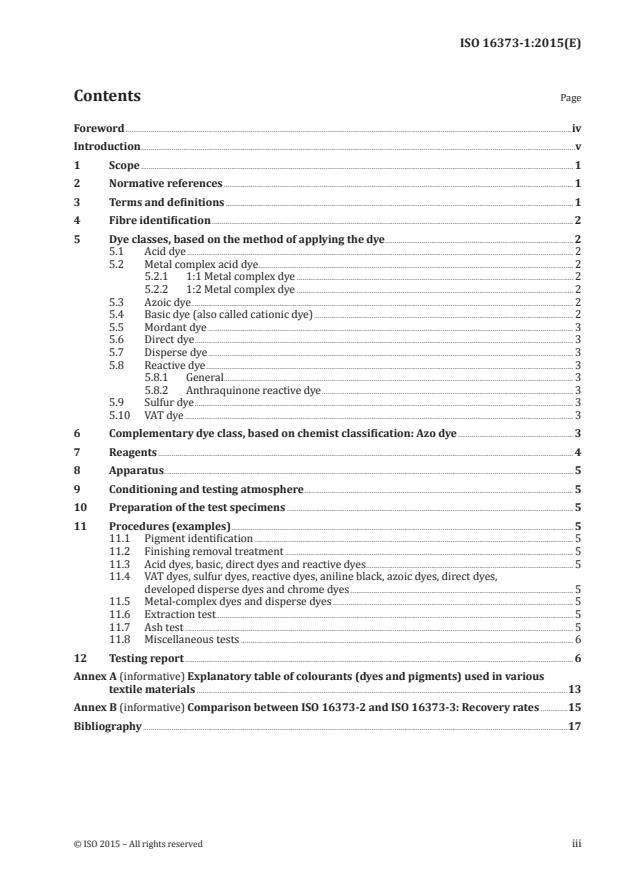
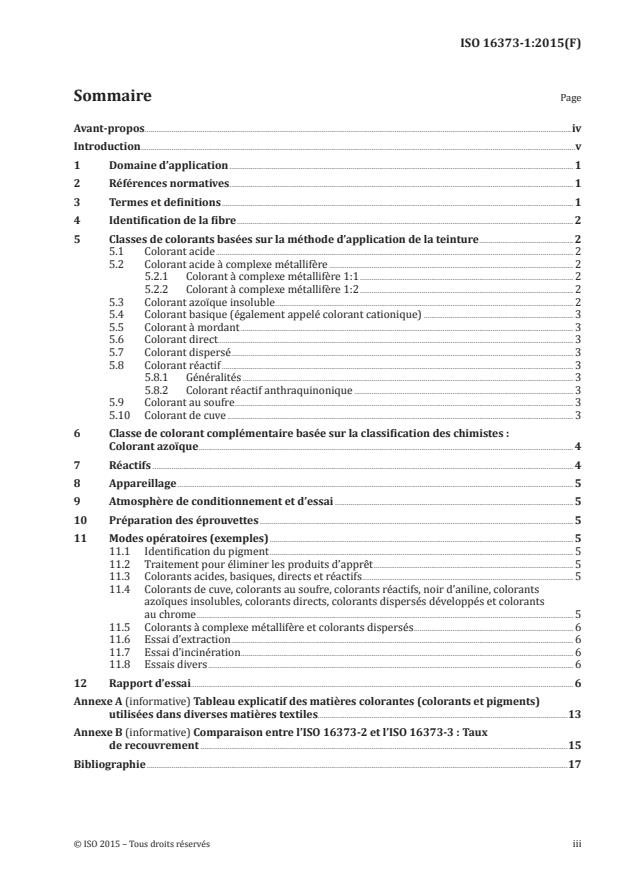
Contents Page
Foreword .iv
Introduction .v
1 Scope . 1
2 Normative references . 1
3 Terms and definitions . 1
4 Fibre identification . 2
5 Dye classes, based on the method of applying the dye . 2
5.1 Acid dye . 2
5.2 Metal complex acid dye . 2
5.2.1 1:1 Metal complex dye . 2
5.2.2 1:2 Metal complex dye . 2
5.3 Azoic dye. 2
5.4 Basic dye (also called cationic dye) . 2
5.5 Mordant dye . 3
5.6 Direct dye . 3
5.7 Disperse dye . 3
5.8 Reactive dye . 3
5.8.1 General. 3
5.8.2 Anthraquinone reactive dye . 3
5.9 Sulfur dye . 3
5.10 VAT dye . 3
6 Complementary dye class, based on chemist classification: Azo dye .3
7 Reagents . 4
8 Apparatus . 5
9 Conditioning and testing atmosphere . 5
10 Preparation of the test specimens . 5
11 Procedures (examples) . 5
11.1 Pigment identification . 5
11.2 Finishing removal treatment . 5
11.3 Acid dyes, basic, direct dyes and reactive dyes . 5
11.4 VAT dyes, sulfur dyes, reactive dyes, aniline black, azoic dyes, direct dyes,
developed disperse dyes and chrome dyes . 5
11.5 Metal-complex dyes and disperse dyes . 5
11.6 Extraction test. 5
11.7 Ash test . 5
11.8 Miscellaneous tests . 6
12 Testing report . 6
Annex A (informative) Explanatory table of colourants (dyes and pigments) used in various
textile materials .13
Annex B (informative) Comparison between ISO 16373-2 and ISO 16373-3: Recovery rates .15
Bibliography .17
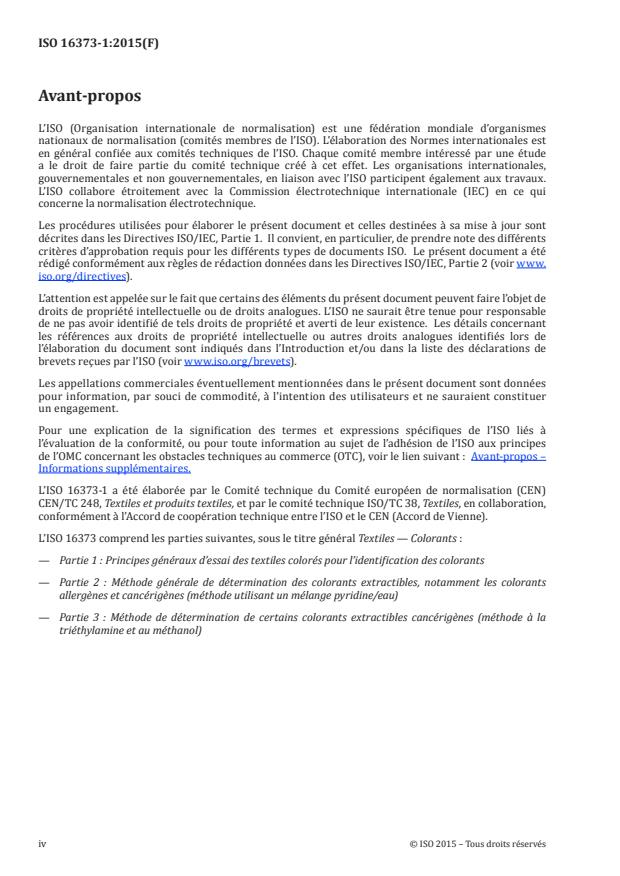
Foreword
ISO (the International Organization for Standardization) is a worldwide federation of national standards
bodies (ISO member bodies). The work of preparing International Standards is normally carried out
through ISO technical committees. Each member body interested in a subject for which a technical
committee has been established has the right to be represented on that committee. International
organizations, governmental and non-governmental, in liaison with ISO, also take part in the work.
ISO collaborates closely with the International Electrotechnical Commission (IEC) on all matters of
electrotechnical standardization.
The procedures used to develop this document and those intended for its further maintenance are
described in the ISO/IEC Directives, Part 1. In particular the different approval criteria needed for the
different types of ISO documents should be noted. This document was drafted in accordance with the
editorial rules of the ISO/IEC Directives, Part 2 (see www.iso.org/directives).
Attention is drawn to the possibility that some of the elements of this document may be the subject of
patent rights. ISO shall not be held responsible for identifying any or all such patent rights. Details of
any patent rights identified during the development of the document will be in the Introduction and/or
on the ISO list of patent declarations received (see www.iso.org/patents).
Any trade name used in this document is information given for the convenience of users and does not
constitute an endorsement.
For an explanation on the meaning of ISO specific terms and expressions related to conformity
assessment, as well as information about ISO’s adherence to the WTO principles in the Technical
Barriers to Trade (TBT) see the following URL: Foreword - Supplementary information
ISO 16373-1 was prepared by the European Committee for Standardization (CEN) Technical Committee
CEN/TC 248, Textiles and textile products, in collaboration with ISO Technical Committee TC 38, Textiles,
in accordance with the Agreement on technical cooperation between ISO and CEN (Vienna Agreement).
ISO 16373 consists of the following parts, under the general title Textiles — Dyestuffs:
— Part 1: General principles of testing coloured textiles for dyestuff identification
— Part 2: General method for the determination of extractable dyestuffs including allergenic and
carcinogenic dyestuffs (method using pyridine-water)
— Part 3: Method for determination of certain carcinogenic dyestuffs (method using triethylamine/methanol)
iv © ISO 2015 – All rights reserved
Introduction
The ISO 16373- series deals with dyes used in textiles for qualification and quantification.
This part of ISO 16373 includes the definition of the classes of dyes, the description of some procedures
to identify qualitatively the class of dyes used in textile material.
The other parts of ISO 16373 are related to the quantification of some dyes.
— The principle of the test method in ISO 16373-2 is based on the extraction using pyridine-water
solution, which has been found to be the most efficient solution to extract a large range of dyes,
including allergenic and carcinogenic dyes.
— The principle of the test method in ISO 16373-3 is based on the extraction using triethylamine-
methanol solution. This solution has been found efficient to extract some dyes in some cases.
Additional information related to the recovery rates (to characterize the extraction efficiency) obtained
from the application of ISO 16373-2 and ISO 16373-3 are summarized in Annex B.
It is important to note that there are other test methods related to azo dyes, for which a reduction of the
extracted azo dyes leads to the release of some aromatic amines to be detected and determined using
chromatography (See Bibliography/Aromatic amines determination).
INTERNATIONAL STANDARD ISO 16373-1:2015(E)
Textiles — Dyestuffs —
Part 1:
General principles of testing coloured textiles for dyestuff
identification
WARNING — This document calls for the use of substances/procedures that may be injurious
to the health/environment if appropriate conditions are not observed. It refers only to
technical suitability and does not absolve the user from legal obligations relating to health and
safety/environment at any stage.
1 Scope
This part of ISO 16373 gives the definition of the colourant classes and the relationship to textile fibres.
It describes some procedures to identify qualitatively the colourant class used in textile material.
2 Normative references
The following documents, in whole or in part, are normatively referenced in this document and are
indispensable for its application. For dated references, only the edition cited applies. For undated
references, the latest edition of the referenced document (including any amendments) applies.
ISO 3696, Water for analytical laboratory use — Specification and test methods
ISO 5089, Textiles — Preparation of laboratory test samples and test specimens for chemical testing
3 Terms and definitions
For the purposes of this document, the following terms and definitions apply.
3.1
colourant
dye or pigment
3.2
dye
dyestuff
water-insoluble or water-soluble molecule which has dyeing affinity with fibre
Note 1 to entry: The defining difference between a dye and a pigment is its solubility in an aqueous medium. In
this part of ISO 16373, the term “affinity” is used as a qualitative expression, although affinity is the quantitative
expression of substantivity and usually expressed in Joules per mole, where substantivity is the attraction
between a substrate and a dye or other substance under precise conditions where the latter is selectively
extracted from the application medium by the substrate.
3.3
pigment
water-insoluble molecule which has no dyeing affinity with fibre
Note 1 to entry: The defining difference between a dye and a pigment is its solubility in an aqueous medium. In
this part of ISO 16373, the term “affinity” is used as a qualitative expression, although affinity is the quantitative
expression of substantivity and usually expressed in Joules per mole, where substantivity is the attraction
between a substrate and a dye or other substance under precise conditions where the latter is selectively
extracted from the application medium by the substrate.
4 Fibre identification
Prior to any colourant identification (including dye class), the fibre nature of the textile product shall be
known. The fibre nature may be based on information given by manufacturer, etc. or can be identified,
using one or more techniques as described in ISO/TR 11827, for example.
An explanatory table of colourants used in various textile materials is given in Annex A.
5 Dye classes, based on the method of applying the dye
5.1 Acid dye
Acid dye is water-soluble anionic dye using neutral to acid dye baths. Attachment to the fibre (e.g.
protein fibres and polyamide fibres) is attributed, at least partly, to salt formation between anionic
groups in the dye and cationic groups in the fibre.
5.2 Metal complex acid dye
A metal complex dye is an acid dye that has a coordinate metal atom in its molecule.
5.2.1 1:1 Metal complex dye
1 molecule of dye is combined with 1 metal ion.
5.2.2 1:2 Metal complex dye
2 molecules of dye are combined with 1 metal ion. 1:2 metal complex dyes are the most frequent.
5.3 Azoic dye
Azoic dye is water-insoluble dye which is formed on the fibre by coupling a water-soluble diazo
compound with a water soluble coupling compound having affinity for cellulose.
NOTE 1 The definition of the class “azoic dye” (‘dyers’ classification) is distinct from the definition of the class
“azo dye” (see Clause 6, chemist classification).
NOTE 2 For the French version, the term “azoic dye” should be translated by “colorant azoïque insoluble”
(known as well as “colorant naphtol”) in order to make a clear distinction with the translation of “azo dye” by
“colorant azoïque”.
5.4 Basic dye (also called cationic dye)
Basic dye is water-soluble cationic dye using neutral to acid dye baths. Attachment to the fibre (e.g.
acrylic) is attributed, at least partly, to salt formation between cationic groups in the dye and anionic
groups in the fibre.
2 © ISO 2015 – All rights reserved
5.5 Mordant dye
Dye capable of forming a chelate complex with a metal ion (e.g. chromium) thus forming a metal complex
dye in situ within the fibre.
NOTE Due to the toxicity of residual chromium ions in waste water, this kind of treatment is usually
strictly controlled.
5.6 Direct dye
An anionic dye that interacts with the fibre (e.g. cellulosic fibre, polyamide fibres) by mechanical
adsorption, normally applied from an aqueous bath c
...
NORME ISO
INTERNATIONALE 16373-1
Première édition
2015-12-15
Textiles — Colorants —
Partie 1:
Principes généraux d’essais des
textiles colorés pour l’identification
des colorants
Textiles — Dyestuffs —
Part 1: General principles of testing coloured textiles for dyestuff
identification
Numéro de référence
©
ISO 2015
DOCUMENT PROTÉGÉ PAR COPYRIGHT
© ISO 2015, Publié en Suisse
Droits de reproduction réservés. Sauf indication contraire, aucune partie de cette publication ne peut être reproduite ni utilisée
sous quelque forme que ce soit et par aucun procédé, électronique ou mécanique, y compris la photocopie, l’affichage sur
l’internet ou sur un Intranet, sans autorisation écrite préalable. Les demandes d’autorisation peuvent être adressées à l’ISO à
l’adresse ci-après ou au comité membre de l’ISO dans le pays du demandeur.
ISO copyright office
Ch. de Blandonnet 8 • CP 401
CH-1214 Vernier, Geneva, Switzerland
Tel. +41 22 749 01 11
Fax +41 22 749 09 47
copyright@iso.org
www.iso.org
ii © ISO 2015 – Tous droits réservés
Sommaire Page
Avant-propos .iv
Introduction .v
1 Domaine d’application . 1
2 Références normatives . 1
3 Termes et definitions . 1
4 Identification de la fibre . 2
5 Classes de colorants basées sur la méthode d’application de la teinture .2
5.1 Colorant acide . 2
5.2 Colorant acide à complexe métallifère . 2
5.2.1 Colorant à complexe métallifère 1:1 . 2
5.2.2 Colorant à complexe métallifère 1:2 . 2
5.3 Colorant azoïque insoluble . 2
5.4 Colorant basique (également appelé colorant cationique) . 3
5.5 Colorant à mordant . 3
5.6 Colorant direct . 3
5.7 Colorant dispersé . 3
5.8 Colorant réactif . 3
5.8.1 Généralités . 3
5.8.2 Colorant réactif anthraquinonique . 3
5.9 Colorant au soufre . 3
5.10 Colorant de cuve . 3
6 Classe de colorant complémentaire basée sur la classification des chimistes :
Colorant azoïque . 4
7 Réactifs . 4
8 Appareillage . 5
9 Atmosphère de conditionnement et d’essai . 5
10 Préparation des éprouvettes . 5
11 Modes opératoires (exemples) . 5
11.1 Identification du pigment . 5
11.2 Traitement pour éliminer les produits d’apprêt . 5
11.3 Colorants acides, basiques, directs et réactifs . 5
11.4 Colorants de cuve, colorants au soufre, colorants réactifs, noir d’aniline, colorants
azoïques insolubles, colorants directs, colorants dispersés développés et colorants
au chrome . 5
11.5 Colorants à complexe métallifère et colorants dispersés . 6
11.6 Essai d’extraction . 6
11.7 Essai d’incinération . 6
11.8 Essais divers . 6
12 Rapport d’essai . 6
Annexe A (informative) Tableau explicatif des matières colorantes (colorants et pigments)
utilisées dans diverses matières textiles.13
Annexe B (informative) Comparaison entre l’ISO 16373-2 et l’ISO 16373-3 : Taux
de recouvrement .15
Bibliographie .17
Avant-propos
L’ISO (Organisation internationale de normalisation) est une fédération mondiale d’organismes
nationaux de normalisation (comités membres de l’ISO). L’élaboration des Normes internationales est
en général confiée aux comités techniques de l’ISO. Chaque comité membre intéressé par une étude
a le droit de faire partie du comité technique créé à cet effet. Les organisations internationales,
gouvernementales et non gouvernementales, en liaison avec l’ISO participent également aux travaux.
L’ISO collabore étroitement avec la Commission électrotechnique internationale (IEC) en ce qui
concerne la normalisation électrotechnique.
Les procédures utilisées pour élaborer le présent document et celles destinées à sa mise à jour sont
décrites dans les Directives ISO/IEC, Partie 1. Il convient, en particulier, de prendre note des différents
critères d’approbation requis pour les différents types de documents ISO. Le présent document a été
rédigé conformément aux règles de rédaction données dans les Directives ISO/IEC, Partie 2 (voir www.
iso.org/directives).
L’attention est appelée sur le fait que certains des éléments du présent document peuvent faire l’objet de
droits de propriété intellectuelle ou de droits analogues. L’ISO ne saurait être tenue pour responsable
de ne pas avoir identifié de tels droits de propriété et averti de leur existence. Les détails concernant
les références aux droits de propriété intellectuelle ou autres droits analogues identifiés lors de
l’élaboration du document sont indiqués dans l’Introduction et/ou dans la liste des déclarations de
brevets reçues par l’ISO (voir www.iso.org/brevets).
Les appellations commerciales éventuellement mentionnées dans le présent document sont données
pour information, par souci de commodité, à l’intention des utilisateurs et ne sauraient constituer
un engagement.
Pour une explication de la signification des termes et expressions spécifiques de l’ISO liés à
l’évaluation de la conformité, ou pour toute information au sujet de l’adhésion de l’ISO aux principes
de l’OMC concernant les obstacles techniques au commerce (OTC), voir le lien suivant : Avant-propos –
Informations supplémentaires.
L’ISO 16373-1 a été élaborée par le Comité technique du Comité européen de normalisation (CEN)
CEN/TC 248, Textiles et produits textiles, et par le comité technique ISO/TC 38, Textiles, en collaboration,
conformément à l’Accord de coopération technique entre l’ISO et le CEN (Accord de Vienne).
L’ISO 16373 comprend les parties suivantes, sous le titre général Textiles — Colorants :
— Partie 1 : Principes généraux d’essai des textiles colorés pour l’identification des colorants
— Partie 2 : Méthode générale de détermination des colorants extractibles, notamment les colorants
allergènes et cancérigènes (méthode utilisant un mélange pyridine/eau)
— Partie 3 : Méthode de détermination de certains colorants extractibles cancérigènes (méthode à la
triéthylamine et au méthanol)
iv © ISO 2015 – Tous droits réservés
Introduction
La série ISO 16373 traite des colorants utilisés dans les textiles pour la qualification et la quantification.
La présente partie de l’ISO 16373 définit les classes de colorants et décrit certains modes opératoires
permettant d’identifier qualitativement la classe du colorant utilisé dans la matière textile.
Les autres parties de l’ISO 16373 portent sur la quantification de certains colorants.
— Le principe de la méthode d’essai spécifiée dans l’ISO 16373‑2 repose sur l’extraction avec un
mélange pyridine/eau, qui s’est révélé la solution la plus efficace pour extraire une large gamme de
colorants, y compris des colorants allergènes et cancérigènes.
— Le principe de la méthode d’essai spécifiée dans l’ISO 16373‑3 repose sur l’extraction avec une
solution de triéthylamine et de méthanol. Cette solution a été jugée efficace pour extraire certains
colorants, dans certains cas.
L’Annexe B fournit des informations complémentaires sur le taux de recouvrement (pour caractériser le
rendement d’extraction) obtenu en appliquant l’ISO 16373-2 et l’ISO 16373-3.
Il est important de noter qu’il existe d’autres méthodes d’essai en rapport avec les colorants azoïques,
pour lesquelles une réduction des colorants azoïques extraits conduit à la libération de certaines amines
aromatiques qui sont détectées et déterminées par chromatographie (voir la Bibliographie/Dosage des
amines aromatiques).
NORME INTERNATIONALE ISO 16373-1:2015(F)
Textiles — Colorants —
Partie 1:
Principes généraux d’essais des textiles colorés pour
l’identification des colorants
AVERTISSEMENT — Le présent document implique l’usage de substances ou la mise en œuvre
de modes opératoires qui peuvent être nocifs pour la santé/l’environnement si les conditions
appropriées ne sont pas observées. Il fait uniquement référence à l’aptitude technique et ne
dispense aucunement l’utilisateur de satisfaire, à tout moment, aux obligations légales en
matière de santé, de sécurité et d’environnement.
1 Domaine d’application
La présente partie de l’ISO 16373 donne la définition des classes de matières colorantes et la relation
avec les fibres textiles (Annexe A).
Elle décrit certains modes opératoires permettant d’identifier qualitativement la classe de la matière
colorante utilisée dans la matière textile.
2 Références normatives
Les documents ci‑après, dans leur intégralité ou non, sont des références normatives indispensables à
l’application du présent document. Pour les références datées, seule l’édition citée s’applique. Pour les
références non datées, la dernière édition du document de référence s’applique (y compris les éventuels
amendements).
ISO 3696, Eau pour laboratoire à usage analytique — Spécification et méthodes d’essai.
ISO 5089, Textiles — Préparation des échantillons réduits de laboratoire et des éprouvettes en vue des
essais chimiques.
3 Termes et definitions
Pour les besoins du présent document, les termes et définitions suivants s’appliquent.
3.1
matière colorante
colorant ou pigment
3.2
colorant
molécule, soluble ou insoluble dans l’eau, qui présente une affinité tinctoriale pour la fibre
Note 1 à l’article: La différence fondamentale entre un colorant et un pigment est sa solubilité en milieu aqueux.
Dans la présente partie de l’ISO 16373, le terme « affinité » est utilisé comme une expression qualitative,
bien que l’affinité soit une expression quantitative de la substantivité et qu’elle soit généralement exprimée
en Joules par mole, la substantivité étant l’attraction entre un substrat et un colorant ou une autre substance
dans des conditions précises dans lesquelles ce colorant/cette substance est extrait(e) sélectivement du milieu
d’application par le substrat.
3.3
pigment
molécule insoluble dans l’eau qui ne présente aucune affinité tinctoriale pour la fibre
Note 1 à l’article: La différence fondamentale entre un colorant et un pigment est sa solubilité en milieu aqueux.
Dans la présente partie de l’ISO 16373, le terme « affinité » est utilisé comme une expression qualitative,
bien que l’affinité soit une expression quantitative de la substantivité et qu’elle soit généralement exprimée
en Joules par mole, la substantivité étant l’attraction entre un substrat et un colorant ou une autre substance
dans des conditions précises dans lesquelles ce colorant/cette substance est extrait(e) sélectivement du milieu
d’application par le substrat.
4 Identification de la fibre
Avant toute identification de la matière colorante (notamment de la classe du colorant), la nature de
la fibre du produit textile doit être connue. La nature de la fibre peut être basée sur les informations
fournies par le fabricant, etc. ou elle peut être identifiée au moyen d’une ou de plusieurs des techniques
décrites dans l’ISO/TR 11827, par exemple.
L’Annexe A fournit un tableau explicatif des matières colorantes utilisées dans diverses matières textiles.
5 Classes de colorants basées sur la méthode d’application de la teinture
5.1 Colorant acide
Un colorant acide est un colorant anionique soluble dans l’eau qui utilise des bains de teinture de neutres
à acides. La fixation à la fibre (par exemple fibres protéiniques et fibres polyamide) est attribuée, au
moins en partie, à la formation de sel entre les groupes anioniques dans les colorants et les groupes
cationiques dans la fibre.
5.2 Colorant acide à complexe métallifère
Un colorant acide à complexe métallifère est un colorant acide qui possède un atome métallique
complexant dans sa molécule.
5.2.1 Colorant à complexe métallifère 1:1
1 molécule de colorant est combinée à 1 ion métallique.
5.2.2 Colorant à complexe métallifère 1:2
2 molécules de colorant sont combinées à 1 ion métallique. Les colorants à complexe métallifère 1:2
sont les plus fréquents.
5.3 Colorant azoïque insoluble
Un colorant azoïque insoluble est un colorant insoluble dans l’eau qui est formé sur la fibre par couplage
d’un composé diazoïque soluble dans l’eau avec un agent de couplage soluble dans l’eau qui a une affinité
pour la cellulose.
NOTE 1 La définition de la classe des « colorants azoïques insolubles » (classification des teinturiers) est
différente de la définition de la classe des « colorants azoïques » (Clause 6, classification des chimistes).
NOTE 2 Dans la version française, il convient de traduire le terme « azoic dye » par « colorant azoïque
insoluble » (également connu sous le nom de « colorant au naphtol ») pour faire une distinction claire avec la
traduction de « azo dye » par « colorant azoïque ».
2 © ISO 2015 – Tous droits réservés
5.4 Colorant basique (également appelé colorant cationique)
Un colorant basique est un colorant cationique soluble dans l’eau qui utilise des bains de teinture de
neutres à acides. La fixation à la fibre (par exemple acrylique) est attribuée, au moins en partie, à la
formation de sel entre les groupes cationiques dans les colorants et les groupes anioniques dans la fibre.
5.5 Colorant à mordant
Colorant capable de former un complexe chélaté avec un ion métallique (par exemple du chrome) pour
former un colorant à complexe métallifère in situ dans la fibre.
NOTE En raison de la toxicité des ions chrome résiduels dans les eaux usées, ce type de traitement est
généralement strictement contrôlé.
5.6 Colorant direct
Colorant anionique qui interagit avec la fibre (par exemple fibre cellulosique, fibres polyamide) par
adsorption mécanique et qui est normalement appliqué à partir d’un bain aqueux contenant un électrolyte.
5.7 Colorant dispersé
Colorant insoluble dans l’eau ayant une affinité pour les fibres hydrophobes (par exemple fibres
polyester et fibres d’acétate).
NOTE Les colorants sont finement broyés en présence d’un agent dispersant et sont vendus sous forme de
pâte, ou ils sont séchés par pulvérisation et vendus sous forme de poudre. La grande superficie obtenue grâce à la
granulométrie très fine facilite la dissolution et permet l’absorption par la fibre.
5.8 Colorant réactif
5.8.1 Généralités
Colorant con
...