

ISO 3471:2008
(Main)Earth-moving machinery — Roll-over protective structures — Laboratory tests and performance requirements
General Information
- Abstract
ISO 3471:2008 specifies performance requirements for metallic roll-over protective structures (ROPS) for earth-moving machinery, as well as a consistent and reproducible means of evaluating the compliance with these requirements by laboratory testing using static loading on a representative specimen. ISO 3471:2008 is applicable to ROPS intended for the following mobile machines with seated operator as defined in ISO 6165 and with a mass greater than or equal to 700 kg: dozer; loader; backhoe loader; dumper; pipelayer; tractor section (prime mover) of a combination machine (e.g. tractor scraper, articulated frame dumper); grader; landfill compactor; roller; trencher. ISO 3471:2008 is not applicable to training seats or additional seats for operation of an attachment.
- Status
- Published
- Publication Date
- 05-Aug-2008
- Technical Committee
- ISO/TC 127/SC 2 - Safety, ergonomics and general requirements
- Drafting Committee
- ISO/TC 127/SC 2 - Safety, ergonomics and general requirements
- Current Stage
- 9093 - International Standard confirmed
- Start Date
- 03-Oct-2023
- Completion Date
- 29-Aug-2026
Buy Documents
ISO 3471:2008 - Earth-moving machinery — Roll-over protective structures — Laboratory tests and performance requirements Released:8/6/2008

ISO 3471:2008 - Engins de terrassement — Structures de protection au retournement — Essais de laboratoire et exigences de performance Released:8/6/2008
Overview
ISO 3471:2008 - Earth-moving machinery - Roll-over protective structures (ROPS) - Laboratory tests and performance requirements defines performance criteria and a reproducible laboratory test method for metallic ROPS fitted to earth-moving machines. The standard specifies static loading tests on a representative specimen (ROPS, mounting system and machine frame or frame section) to verify that the structure will provide reasonable crush protection for a seat‑belted operator. It applies to machines with a seated operator and a mass ≥ 700 kg (dozer, loader, backhoe loader, dumper, pipelayer, grader, landfill compactor, roller, trencher and similar prime‑mover sections). ISO 3471:2008 does not apply to training seats or additional attachment seats.
Key Topics and Requirements
- Scope and applicability: Metallic ROPS for specified earth‑moving machinery (machines ≥ 700 kg). Can also provide FOPS protection.
- Laboratory test method: Static loading on a representative specimen using defined load application points (LAP) and load distribution devices (LDD).
- Load directions: Lateral, vertical and longitudinal loading criteria are included; longitudinal criterion is established at 80% of the lateral force requirement.
- Deflection control: Measurement of ROPS deflection (∆) at the LAP relative to the deflection‑limiting volume (DLV) - a standardized operator envelope used to determine acceptable deformation and crush space.
- Mounting and frame considerations: Tests account for the ROPS, mounting system and machine frame behavior; representative specimen must reflect production variances.
- Material and test environment: Temperature and material criteria (e.g., impact/ductility considerations) are specified for valid test results.
- Acceptance, labelling and reporting: Clear acceptance criteria, required labelling of compliant ROPS and structured test reporting (Annex A normative ROPS test report, Annex B guidance on design changes).
Practical Applications and Users
Who uses ISO 3471:2008:
- ROPS and vehicle manufacturers for design verification and production compliance.
- Independent test laboratories performing static ROPS certification testing.
- OEMs and fleet purchasers selecting certified protective structures.
- Regulators and safety engineers establishing and enforcing machine safety requirements.
- Design and R&D teams using the standard for development and validation of new ROPS designs.
Practical uses:
- Verifying structural integrity under prescribed static loads.
- Documenting compliance for safety certification and procurement.
- Guiding material selection, mounting designs and labeling of ROPS products.
Related Standards
Normative and related references (helpful for implementation and cross‑checking):
- ISO 3164 (DLV specifications)
- ISO 6165 (machine types and definitions)
- ISO 5353 (seat index point)
- ISO 148-1, ISO 898-1/2 (material and fastener properties)
- ISO 9248 (units and measurement accuracies)
Keywords: ISO 3471:2008, ROPS, roll-over protective structures, earth‑moving machinery, laboratory tests, performance requirements, static loading, deflection-limiting volume, load application point, machine safety.
Relations
- Referred By
EN ISO 19296:2018 - Mining - Mobile machines working underground - Machine safety (ISO 19296:2018) - Effective Date
- 25-Aug-2026
- Effective Date
- 12-Feb-2026
- Effective Date
- 06-Jun-2022
- Effective Date
- 15-Apr-2008
- Effective Date
- 15-Apr-2008
Buy Documents
ISO 3471:2008 - Earth-moving machinery — Roll-over protective structures — Laboratory tests and performance requirements Released:8/6/2008
ISO 3471:2008 - Engins de terrassement — Structures de protection au retournement — Essais de laboratoire et exigences de performance Released:8/6/2008
Frequently Asked Questions
ISO 3471:2008 is a standard published by the International Organization for Standardization (ISO). Its full title is "Earth-moving machinery — Roll-over protective structures — Laboratory tests and performance requirements". This standard covers: ISO 3471:2008 specifies performance requirements for metallic roll-over protective structures (ROPS) for earth-moving machinery, as well as a consistent and reproducible means of evaluating the compliance with these requirements by laboratory testing using static loading on a representative specimen. ISO 3471:2008 is applicable to ROPS intended for the following mobile machines with seated operator as defined in ISO 6165 and with a mass greater than or equal to 700 kg: dozer; loader; backhoe loader; dumper; pipelayer; tractor section (prime mover) of a combination machine (e.g. tractor scraper, articulated frame dumper); grader; landfill compactor; roller; trencher. ISO 3471:2008 is not applicable to training seats or additional seats for operation of an attachment.
ISO 3471:2008 specifies performance requirements for metallic roll-over protective structures (ROPS) for earth-moving machinery, as well as a consistent and reproducible means of evaluating the compliance with these requirements by laboratory testing using static loading on a representative specimen. ISO 3471:2008 is applicable to ROPS intended for the following mobile machines with seated operator as defined in ISO 6165 and with a mass greater than or equal to 700 kg: dozer; loader; backhoe loader; dumper; pipelayer; tractor section (prime mover) of a combination machine (e.g. tractor scraper, articulated frame dumper); grader; landfill compactor; roller; trencher. ISO 3471:2008 is not applicable to training seats or additional seats for operation of an attachment.
ISO 3471:2008 is classified under the following ICS (International Classification for Standards) categories: 53.100 - Earth-moving machinery. The ICS classification helps identify the subject area and facilitates finding related standards.
ISO 3471:2008 has the following relationships with other standards: It is inter standard links to EN ISO 19296:2018, EN ISO 3471:2008, ISO/IEC 9541-1:1991/Amd 2:1998, ISO 3471:1994, ISO 3471:1994/Amd 1:1997. Understanding these relationships helps ensure you are using the most current and applicable version of the standard.
ISO 3471:2008 is available in PDF format for immediate download after purchase. The document can be added to your cart and obtained through the secure checkout process. Digital delivery ensures instant access to the complete standard document.
Standards Content (Sample)
INTERNATIONAL ISO
STANDARD 3471
Fourth edition
2008-08-15
Earth-moving machinery — Roll-over
protective structures — Laboratory tests
and performance requirements
Engins de terrassement — Structures de protection au retournement —
Essais de laboratoire et exigences de performance
Reference number
©
ISO 2008
PDF disclaimer
This PDF file may contain embedded typefaces. In accordance with Adobe's licensing policy, this file may be printed or viewed but
shall not be edited unless the typefaces which are embedded are licensed to and installed on the computer performing the editing. In
downloading this file, parties accept therein the responsibility of not infringing Adobe's licensing policy. The ISO Central Secretariat
accepts no liability in this area.
Adobe is a trademark of Adobe Systems Incorporated.
Details of the software products used to create this PDF file can be found in the General Info relative to the file; the PDF-creation
parameters were optimized for printing. Every care has been taken to ensure that the file is suitable for use by ISO member bodies. In
the unlikely event that a problem relating to it is found, please inform the Central Secretariat at the address given below.
© ISO 2008
All rights reserved. Unless otherwise specified, no part of this publication may be reproduced or utilized in any form or by any means,
electronic or mechanical, including photocopying and microfilm, without permission in writing from either ISO at the address below or
ISO's member body in the country of the requester.
ISO copyright office
Case postale 56 • CH-1211 Geneva 20
Tel. + 41 22 749 01 11
Fax + 41 22 749 09 47
E-mail copyright@iso.org
Web www.iso.org
Published in Switzerland
ii © ISO 2008 – All rights reserved
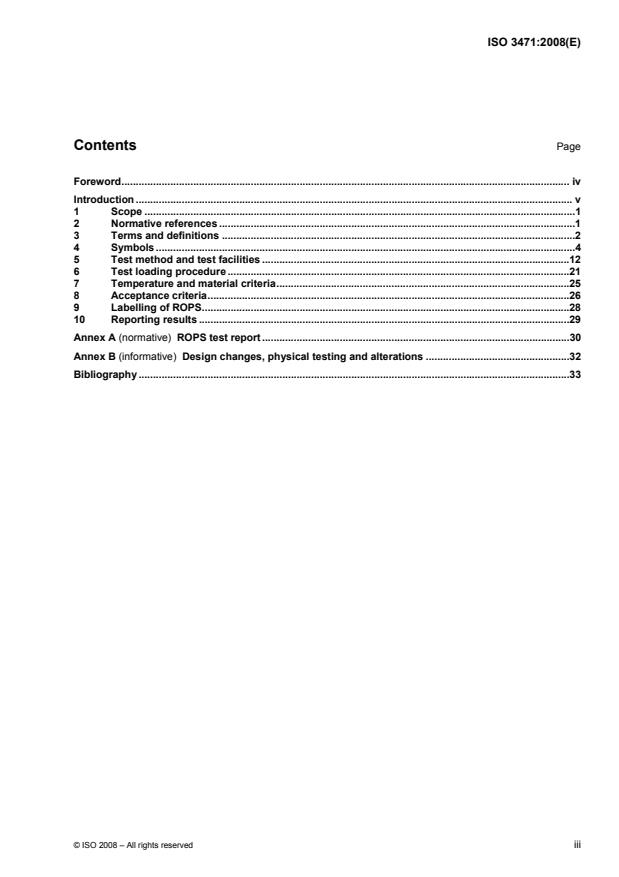
Contents Page
Foreword. iv
Introduction . v
1 Scope .1
2 Normative references .1
3 Terms and definitions .2
4 Symbols .4
5 Test method and test facilities .12
6 Test loading procedure .21
7 Temperature and material criteria.25
8 Acceptance criteria.26
9 Labelling of ROPS.28
10 Reporting results .29
Annex A (normative) ROPS test report.30
Annex B (informative) Design changes, physical testing and alterations .32
Bibliography .33
Foreword
ISO (the International Organization for Standardization) is a worldwide federation of national standards bodies
(ISO member bodies). The work of preparing International Standards is normally carried out through ISO
technical committees. Each member body interested in a subject for which a technical committee has been
established has the right to be represented on that committee. International organizations, governmental and
non-governmental, in liaison with ISO, also take part in the work. ISO collaborates closely with the
International Electrotechnical Commission (IEC) on all matters of electrotechnical standardization.
International Standards are drafted in accordance with the rules given in the ISO/IEC Directives, Part 2.
The main task of technical committees is to prepare International Standards. Draft International Standards
adopted by the technical committees are circulated to the member bodies for voting. Publication as an
International Standard requires approval by at least 75 % of the member bodies casting a vote.
Attention is drawn to the possibility that some of the elements of this document may be the subject of patent
rights. ISO shall not be held responsible for identifying any or all such patent rights.
ISO 3471 was prepared by Technical Committee ISO/TC 127, Earth-moving machinery, Subcommittee SC 2,
Safety requirements and human factors.
This fourth edition cancels and replaces the third edition (ISO 3471:1994), which has been technically revised.
It also incorporates the Amendment ISO 3471:1994/Amd 1:1997 and the Technical Corrigendum
ISO 3471:1994/Cor 1:2000.
iv © ISO 2008 – All rights reserved
Introduction
A review of the initial work on the criteria for roll-over protective structures (ROPS) indicated that these criteria
were based on requirements for machines now identified as mid-range size machines. Since the ROPS
criteria were established, both smaller and larger machines have become common within the size range of
earth-moving machines.
The criteria are a combination of linear and exponential, with respect to mass. For small machines, the
exponential criterion has been changed to a linear function with respect to machine mass. For larger
machines, the exponential criterion was excessive at very large machine masses, and thus was changed to
become a linear function with respect to machine mass.
The longitudinal force criteria were added as new data became available. Situations could arise where ROPS
designs would meet the lateral and vertical loading requirements, but yet be considered as lacking sufficient
performance capability in the longitudinal load direction. For this reason, this International Standard
incorporates a ROPS longitudinal force criterion. The longitudinal force criterion has been established at 80 %
of the lateral force requirement.
The evaluation procedure will not necessarily duplicate structural deformations due to a given actual roll.
However, specific requirements are derived from investigations on ROPS that have performed the intended
function in a variety of actual roll-overs, as well as analytical considerations based upon the compatibility of
ROPS and the machine frame to which it is attached.
INTERNATIONAL STANDARD ISO 3471:2008(E)
Earth-moving machinery — Roll-over protective structures —
Laboratory tests and performance requirements
1 Scope
This International Standard specifies performance requirements for metallic roll-over protective structures
(ROPS) for earth-moving machinery, as well as a consistent and reproducible means of evaluating the
compliance with these requirements by laboratory testing using static loading on a representative specimen.
NOTE 1 The structure can also provide FOPS (falling-object protective structure) protection.
This International Standard is applicable to ROPS intended for the following mobile machines with seated
operator as defined in ISO 6165 and with a mass greater than or equal to 700 kg:
⎯ dozer;
⎯ loader;
⎯ backhoe loader;
⎯ dumper;
⎯ pipelayer;
⎯ tractor section (prime mover) of a combination machine (e.g. tractor scraper, articulated frame dumper);
⎯ grader;
⎯ landfill compactor;
⎯ roller;
⎯ trencher.
This International Standard is not applicable to training seats or additional seats for operation of an
attachment.
NOTE 2 It is expected that reasonable crush protection for a seat-belted operator will be provided under at least the
conditions of an initial forward velocity of 0 km/h to 16 km/h on a hard clay surface of 30° maximum slope in the direction
of roll, and 360° of roll about the longitudinal axis of the machine without loss of contact with the slope.
NOTE 3 This International Standard can be used to provide guidance to the manufacturers of roll-over protective
structures should it be decided to provide such protection for these or other machines for a particular application.
2 Normative references
The following referenced documents are indispensable for the application of this document. For dated
references, only the edition cited applies. For undated references, the latest edition of the referenced
document (including any amendments) applies.
ISO 148-1:2006, Metallic materials — Charpy pendulum impact test (V-notch) — Part 1: Test method
ISO 898-1:1999, Mechanical properties of fasteners made of carbon steel and alloy steel — Part 1: Bolts,
screws and studs
ISO 898-2:1992, Mechanical properties of fasteners — Part 2: Nuts with specified proof load values — Coarse
thread
ISO 3164:1995, Earth-moving machinery — Laboratory evaluations of protective structures — Specifications
for deflection-limiting volume
ISO 5353:1995, Earth-moving machinery, and tractors and machinery for agriculture and forestry — Seat
index point
ISO 6165:2006, Earth-moving machinery — Basic types — Identification and terms and definitions
ISO 9248:1992, Earth-moving machinery — Units for dimensions, performance and capacities, and their
measurement accuracies
3 Terms and definitions
For the purposes of this document, the following terms and definitions apply.
3.1
bedplate
substantially rigid part of the test fixture to which the machine frame is attached to conduct the test
3.2
boundary plane
BP
plane defined as the vertical projected plane of the back, side, or knee area of the DLV
NOTE The boundary planes are used to determine the load application point.
3.3
deflection-limiting volume
DLV
orthogonal approximation of a large, seated, male operator wearing normal clothing and a protective helmet
NOTE Adapted from ISO 3164:1995.
3.4
deflection of ROPS
movement of the ROPS, mounting system and frame section as measured at the load application point (LAP),
excluding the effect of any movement of the test fixture(s)
3.5
falling-object protective structure
FOPS
system of structural members arranged in such a way as to provide operators with reasonable protection from
falling objects (e.g. trees, rocks, small concrete blocks, tools)
3.6
head portion of DLV
upper 270 mm by 330 mm rectangular section of the DLV, whose dimensions are in accordance with
ISO 3164
3.7
lateral simulated ground plane
LSGP
plane defined as where the machine comes to rest on its side, where the plane is 15° away from the DLV.
NOTE It is created by rotating a vertical plane parallel to the machine's longitudinal centreline about a horizontal line
through the outermost point of the upper ROPS member, to which the lateral load is applied (see Figure 6). The LSGP is
established on an unloaded ROPS and moves with the member to which the load is applied while maintaining its 15°
angle with respect to the vertical.
2 © ISO 2008 – All rights reserved
3.8
load distribution device
LDD
device used to prevent localized penetration of the ROPS members at the load application point (LAP)
3.9
load application point
LAP
point (or a point within a defined range) on the ROPS structure at which the test load force (F) is applied
3.10
machine frame
metallic main chassis or main metallic load-bearing member(s) of the machine that extend(s) over a major
section of the machine and upon which the ROPS is directly mounted
3.11
mounting system
all brackets, weldments, fasteners or other devices whose function is to attach the ROPS to the machine
frame
3.12
representative specimen
ROPS, mounting system and machine frame (complete or partial) used for test purposes that is within the
range of material and manufacturing variances designated by the manufacturer’s production specifications
NOTE The intent is that all ROPS manufactured to these specifications be capable of meeting or exceeding the
stated levels of performance.
3.13
roll-over protective structure
ROPS
system of structural members whose primary purpose is to reduce the possibility of a seat-belted operator
being crushed in the event of a machine roll-over
NOTE 1 See Figures 1 to 5 and ISO 6683.
NOTE 2 It can include components such as sub-frame, bracket, mount, bolt, pin, suspension or flexible shock
absorber.
NOTE 3 Non-load-carrying members (posts) are not considered.
3.13.1
rollbar ROPS
ROPS having one or two posts, formed or fabricated, and having no cantilevered structural member(s)
3.13.2
one-post [two-post] ROPS
ROPS having one or two posts, formed or fabricated, and having one or more cantilevered load-carrying
structural members
3.13.3
multiple-post ROPS
ROPS having more than two posts, formed or fabricated, and joining load-carrying structural members
NOTE It can have cantilevered load-carrying structural members.
3.14
ROPS structural member
metallic member designed to withstand an applied force or absorb energy
3.15
simulated ground plane
SGP
plane simulating the flat ground surface on which a machine is assumed to come to rest after rolling over
3.16
Socket
S
test component that allows unrestricted point loading of the load distribution device (LDD)
3.17
vertical projection of DLV
cross-sectional area of the column formed by vertically projecting the outside corners of the deflection limiting
volume (DLV), with dimensions according to ISO 3164, excluding the foot section
3.18
vertical simulated ground plane
VSGP
plane defined by contact with a top cross-member of the ROPS and that front or rear part of the machine
capable of supporting an overturned machine
See Figure 16
NOTE The VSGP applies to the rollbar ROPS, as well as to the one-post and two-post ROPS. The VSGP can
change with the deformation of the ROPS.
4 Symbols
For the purposes of this document, the following symbols apply.
U energy absorbed by the structure, related to the manufacturer’s maximum recommended mass, m,
and expressed in joules
F load force, expressed in newtons
m manufacturer’s maximum recommended mass, expressed in kilograms
⎯ The manufacturer’s maximum recommended mass includes attachments in operating condition,
with all reservoirs full to capacity, tools and ROPS. It excludes towed equipment such as rollers
and drawn scrapers.
⎯ For the tractor scraper and articulated frame dumper, it is the maximum recommended mass of
the tractor section (prime mover) only. In most cases, it is the tractor section, but shall be the
ROPS-bearing section or ROPS-carrying section of the machine. Kingpins, hitches and
articulated-steering components that attach to hitches or towed units are excluded from the
mass of these machines.
⎯ For rigid frame dumpers, m excludes the mass of the dump body and the payload when the
“excluding dump body” criteria are selected. When the “including dump body” criteria are
selected, m includes the mass of the dump body but excludes the mass of the payload.
NOTE See Table 1 for examples.
⎯ For rollers and landfill compactors, loosely contained ballast that would separate from the
machine in the event of a roll-over is also excluded from m.
NOTE Soil, mud, rocks, branches, debris, etc. that commonly adhere to, or lie on, machines in use are
not considered part of the mass of any machine. Material dug, carried, or handled in any manner is not
considered part of the machine mass in determining test requirements.
4 © ISO 2008 – All rights reserved
L length of the ROPS, in millimetres
⎯ L is not applicable to rollbar ROPS.
⎯ For one- or two-post ROPS with cantilevered load-carrying structural members, L is the
longitudinal distance from the outer surface of the ROPS post(s) to the outer surface of the
furthest cantilevered load-carrying members at the top of the ROPS (see Figures 1, 4 and 5). It
is not necessary for the ROPS structural members to cover the complete vertical projection of
the DLV.
⎯ For multiple-post ROPS, L is the greatest longitudinal distance from the outer surface of the front
to the outer surface of the rear posts. See Figure 2.
⎯ For ROPS with shaped structural members, L, is the vertical projection of H with the outer
surface of the structural members. See Figure 3.
⎯ For ROPS with curved structural members, L is defined by the intersection of plane A with the
outer surface of the vertical member. Plane A is defined as the bisector of the angle formed by
the intersection of planes B and C. B is the tangent line at the outer surface parallel to plane D.
Plane D is the plane intersecting the intersections of the curved ROPS members with the
adjacent members. Plane C is the projection of the top surface of the upper ROPS structural
member. See Figure 3.
W width of the ROPS, in millimetres
⎯ For a rollbar ROPS, W is the width to the outermost points of the structural member(s).
⎯ For a one- or two-post ROPS with cantilevered load-carrying structural members, the width, W is
that portion of the cantilevered load-carrying members (See Figures 1, 4 and 5) that covers at
least the vertical projection of the width of the DLV as measured at the top of the ROPS, from
the outside faces of the cantilevered load-carrying members.
⎯ For all other ROPS, the width, W, is the greatest total width between the outsides of the left and
right ROPS posts as measured at the top of the ROPS, from the outside faces of the load-
carrying members. See Figure 3.
⎯ For ROPS with shaped structural members, W is the vertical projection of H with the outer
surface of the structural members. See Figure 3.
⎯ For ROPS with curved structural members, W is defined by the intersection of plane A with the
outer surface of the vertical member. Plane A is defined as the bisector of the angle formed by
the intersection of planes B and C. B is the tangent line at the outer surface parallel to plane D.
Plane D is the plane intersecting the intersections of the curved ROPS members with the
adjacent members. Plane C is the projection of the top surface of the upper ROPS structural
member. See Figure 3.
∆ deflection of the ROPS, expressed in millimetres
H Height of the load application zone, expressed in millimetres
⎯ For a straight member, H is the distance from the top to the bottom of the member, as shown in
Figure 1.
⎯ For a curved member, H is the vertical distance from the top of the member to the vertical plane
at the end of L where it intersects the inner surface of the curved member at Y, as shown in
Figure 3.
⎯ For a shaped member, H is three times the vertical width of the top member, as shown in
Figure 3.
Key
BP boundary planes of DLV
E horizontal mid-point of upper ROPS structural member
F load force
H height of upper ROPS structural member
L length of ROPS
LAP load application point
LDD load distribution device
S socket
W width of ROPS
NOTE The LDD can extend beyond the dimension H.
Figure 1 — Example of lateral load application point (LAP) of two-post ROPS
6 © ISO 2008 – All rights reserved
Key
BP boundary planes of DLV
E horizontal mid-point of upper ROPS structural member
F load force
L [W] length [width] of ROPS
LDD load distribution device
S socket
NOTE See Figure 1 for an example of LAP and LDD details. Two sockets are shown in this example to illustrate that
more than one may be used simultaneously to apply the required force.
Figure 2 — Example of load application point (LAP) of four-post ROPS
8 © ISO 2008 – All rights reserved
Key
A angle bisector of two tangent lines (B and C)
B tangent line parallel to D on outer surface of curved ROPS structural member
C projection of top surface of upper ROPS structural member
D straight line intersecting ends of curved ROPS structural member with mating members
F load force
H height of load application zone
I intersection of curved surface with flat surface
LDD load distribution device
L [W] length [width] of ROPS for LAP determination
LAP load application point
S socket
Y intersection of vertical line from LAP to inner surface of vertical member
NOTE 1 The angle between A and B is equal to the angle between A and C.
NOTE 2 See Figure 1 for an example of LAP and LDD details.
NOTE 3 See Clause 4, H for a curved member and 6.4.3.
Figure 3 — Examples of curved and shaped ROPS structural members
Key
BP boundary planes of DLV
E horizontal mid-point of upper ROPS structural member
F load force
L length of ROPS
LDD load distribution device
S socket
W width of ROPS
NOTE See Figure 1 for an example of LAP and LDD details.
Figure 4 — Example of single-post ROPS
10 © ISO 2008 – All rights reserved
Key
BP boundary planes of DLV
E horizontal mid-point of upper ROPS structural member
F load force
LDD load distribution device
PLC parallel to longitudinal centreline of machine
S socket
W width of ROPS
NOTE 1 The load distribution device (LDD) prevents local penetration of the ROPS members at the load application
point (LAP). The socket (S) provides unrestricted point loading at the designated location. See Figure 1 for an example of
LAP and LDD details.
NOTE 2 Typical, but not mandatory, layout applicable to any ROPS.
Figure 5 — Longitudinal force
Key
a upper ROPS frame member to which lateral load is applied
b outermost point from end view of frame member a
c vertical line through point b
d vertical plane parallel to the machine longitudinal centreline through line c
LSGP lateral simulated ground plane
Figure 6 — Determination of lateral simulated ground plane (LSGP)
5 Test method and test facilities
5.1 General requirements
The requirements are force resistance in the lateral, vertical and longitudinal directions, and energy absorption
in the lateral direction. There are limitations on deflections under the lateral, vertical and longitudinal loading.
5.2 Instrumentation
Systems used to measure mass, force and deflection shall be in accordance with ISO 9248, except that the
force and deflection measurement capability shall be within ± 5% of the maximum values.
5.3 Test facilities
Fixtures shall be adequate to secure the representative specimen to a bedplate and to apply the required
lateral, vertical and longitudinal loads as determined by the formulae given in Table 1.
12 © ISO 2008 – All rights reserved
Table 1 — Force and energy equations
Machine mass Lateral load force Lateral load energy Vertical load force Longitudinal load force
m F U F F
kg N J N N
1) Crawler earth-moving machine: dozer, loader, pipelayer and trencher type
1,25
700 < m u 4 630 6m 13 000 (m/10 000) 4,8m
1,2 1,25 1,2
19,61m
4 630 < m u 59 500 70 000 (m/10 000) 13 000 (m/10 000) 56 000 (m/10 000)
m > 59 500 10m 2,03m 8m
2) Grader
1,25
700 < m u 2 140 6m 15 000 (m/10 000) 4,8m
1,1 1,25 1,1
19,61m
2 140 < m u 38 010 70 000 (m/10 000) 15 000 (m/10 000) 56 000 (m/10 000)
m > 38 010 8m 2,09m 6,4m
3) Wheeled earth-moving machine: loader, tractor-dozer, pipelayer, landfill compactor, skid-steer loader,
backhoe loader and trencher type
1,25
700 < m u 10 000 6m 12 500 (m/10 000) 4,8m
1,2 1,25 1,2
19,61m
10 0000 < m u 128 600 60 000 (m/10 000) 12 500 (m/10 000) 48 000 (m/10 000)
m > 128 600 10m 2,37m 8m
4) Tractor section of combined earth-moving machine: tractor scraper, articulated frame dumper
1,25
700 < m u 1 010 6m 20 000 (m/10 000) 4,8m
1,2 1,25 1,2
19,61m
1 010 < m u 32 160 95 000 (m/10 000) 20 000 (m/10 000) 76 000 (m/10 000)
m > 32 160 12m 2,68m 9,6m
a
5) Roller
1,25
700 < m u 10 000 5m 9 500 (m/10 000) 4m
1,2 1,25 1,2
19,61m
10 000 < m u 53 780 50 000 (m/10 000) 9 500 (m/10 000) 40 000 (m/10 000)
m > 53 780 7m 1,45m 5,6m
b
6) Rigid frame dumper — Excluding dump body
1,25
700 < m u 1 750 6m 15 000 (m/10 000) 4,8m
1,2 1,25 1,2
1 750 < m u 22 540 85 000 (m/10 000) 15 000 (m/10 000) 68 000 (m/10 000)
22 540 < m u 58 960 10m 1,84m 8m
19,61m
413 500
0,32 0,2
58 960 < m u 111 660 61 450 (m/10 000) 330 800 (m/10 000)
0,2
(m/10 000)
m > 111 660 6m 1,19m 4,8m
c
7) Rigid frame dumper — Including dump body
1,25
700 < m u 10 000 6m 6 000 (m/10 000) 4,8m
1,2 1,25 1,2
10 000 < m u 21 610 60 000 (m/10 000) 6 000 (m/10 000) 48 000 (m/10 000)
21 610 < m u 93 900 7m 0,73m 5,6m
19,61m
420 000
0,63 0,2
93 900 < m u 113 860 16 720 (m/10 000) 336 000 (m/10 000)
0,2
(m/10 000)
m > 113 860 6m 0,68m 4,8m
Table 1 (continued)
Machine mass Lateral load force Lateral load energy Vertical load force Longitudinal load force
m F U F F
kg N J N N
d
8) Rigid frame dumper — Combination of ROPS and dump body
1,25
700 < m u 10 000 3,6m 3 600 (m/10 000) 2,9m
1,2 1,25 1,2
10 000 < m u 21 610 36 000 (m/10 000) 3 600 (m/10 000) 28 800 (m/10 000)
21 610 < m u 93 900 4,2m 0,44m 3,4m
11,77m
252 000
0,63 0,2
93 900 < m u 113 860 10 000 (m/10 000) 202 000 (m/10 000)
0,2
(m/10 000)
m > 113 860 3,6m 0,41m 2,9m
a
Mass m excludes mass of loosely contained ballast, which can separate from machine in the event of a roll-over.
b
Mass m includes machine mass but not dump body or payload mass.
c
Mass m includes machine and dump body mass but not payload mass. The body sections on which the loads are applied shall
totally cover the vertical projection of the DLV. Lateral and vertical LAP shall be on the body overhang portion in the same relative
locations outlined for separate ROPS. Longitudinal load shall be applied at that face producing the greatest change of deformation
toward the operator.
d
Mass m includes machine and dump body mass but not payload mass. Lateral, longitudinal or vertical loading of the ROPS and/or
body need not be applied simultaneously to both members of a combination. The only limitation on the order of the six loadings is that
the vertical loading of members shall be applied after the lateral loading and the longitudinal loading of members shall be applied after
the vertical loading. See Figures 12 and 13.
...
NORME ISO
INTERNATIONALE 3471
Quatrième édition
2008-08-15
Engins de terrassement — Structures de
protection au retournement — Essais de
laboratoire et exigences de performance
Earth-moving machinery — Roll-over protective structures —
Laboratory tests and performance requirements
Numéro de référence
©
ISO 2008
PDF – Exonération de responsabilité
Le présent fichier PDF peut contenir des polices de caractères intégrées. Conformément aux conditions de licence d'Adobe, ce fichier
peut être imprimé ou visualisé, mais ne doit pas être modifié à moins que l'ordinateur employé à cet effet ne bénéficie d'une licence
autorisant l'utilisation de ces polices et que celles-ci y soient installées. Lors du téléchargement de ce fichier, les parties concernées
acceptent de fait la responsabilité de ne pas enfreindre les conditions de licence d'Adobe. Le Secrétariat central de l'ISO décline toute
responsabilité en la matière.
Adobe est une marque déposée d'Adobe Systems Incorporated.
Les détails relatifs aux produits logiciels utilisés pour la création du présent fichier PDF sont disponibles dans la rubrique General Info
du fichier; les paramètres de création PDF ont été optimisés pour l'impression. Toutes les mesures ont été prises pour garantir
l'exploitation de ce fichier par les comités membres de l'ISO. Dans le cas peu probable où surviendrait un problème d'utilisation,
veuillez en informer le Secrétariat central à l'adresse donnée ci-dessous.
DOCUMENT PROTÉGÉ PAR COPYRIGHT
© ISO 2008
Droits de reproduction réservés. Sauf prescription différente, aucune partie de cette publication ne peut être reproduite ni utilisée sous
quelque forme que ce soit et par aucun procédé, électronique ou mécanique, y compris la photocopie et les microfilms, sans l'accord écrit
de l'ISO à l'adresse ci-après ou du comité membre de l'ISO dans le pays du demandeur.
ISO copyright office
Case postale 56 • CH-1211 Geneva 20
Tel. + 41 22 749 01 11
Fax. + 41 22 749 09 47
E-mail copyright@iso.org
Web www.iso.org
Publié en Suisse
ii © ISO 2008 – Tous droits réservés
Sommaire Page
Avant-propos. iv
Introduction . v
1 Domaine d'application. 1
2 Références normatives . 2
3 Termes et définitions. 2
4 Symboles . 4
5 Méthode et installations d'essai. 12
6 Mode opératoire d'application de la charge d'essai . 21
7 Critères relatifs à la température et aux matériaux . 25
8 Critères de réception. 27
9 Étiquetage de la ROPS . 29
10 Rapport d'essai . 29
Annexe A (normative) Rapport d'essai d'une ROPS . 30
Annexe B (informative) Changements de conception et ajustements . 32
Bibliographie . 33
Avant-propos
L'ISO (Organisation internationale de normalisation) est une fédération mondiale d'organismes nationaux de
normalisation (comités membres de l'ISO). L'élaboration des Normes internationales est en général confiée
aux comités techniques de l'ISO. Chaque comité membre intéressé par une étude a le droit de faire partie du
comité technique créé à cet effet. Les organisations internationales, gouvernementales et non
gouvernementales, en liaison avec l'ISO participent également aux travaux. L'ISO collabore étroitement avec
la Commission électrotechnique internationale (CEI) en ce qui concerne la normalisation électrotechnique.
Les Normes internationales sont rédigées conformément aux règles données dans les Directives ISO/CEI,
Partie 2.
La tâche principale des comités techniques est d'élaborer les Normes internationales. Les projets de Normes
internationales adoptés par les comités techniques sont soumis aux comités membres pour vote. Leur
publication comme Normes internationales requiert l'approbation de 75 % au moins des comités membres
votants.
L'attention est appelée sur le fait que certains des éléments du présent document peuvent faire l'objet de
droits de propriété intellectuelle ou de droits analogues. L'ISO ne saurait être tenue pour responsable de ne
pas avoir identifié de tels droits de propriété et averti de leur existence.
L'ISO 3471 a été élaborée par le comité technique ISO/TC 127, Engins de terrassement, sous-comité SC 2,
Impératifs de sécurité et facteurs humains.
Cette quatrième édition annule et remplace la troisième édition (ISO 3471:1994), qui a fait l'objet d'une
révision technique. Elle incorpore également l'Amendement ISO 3471:1994/Amd 1:1997 et le Rectificatif
technique ISO 3471:1999/Cor 1:2000.
iv © ISO 2008 – Tous droits réservés
Introduction
Un examen du travail initial sur les critères des structures de protection au retournement (ROPS) a montré
que ceux-ci avaient été basés sur des exigences concernant des engins maintenant identifiés comme des
engins de taille moyenne. Depuis que les critères concernant les ROPS ont été établis, des engins de plus
petite et de plus grande taille sont devenus courants dans la plage de tailles des engins de terrassement.
Les critères sont établis à partir d'une combinaison d'une fonction linéaire et d'une fonction exponentielle, en
fonction de la masse. Pour les petits engins, le critère exponentiel a été modifié en une fonction linéaire de la
masse de l'engin. Pour les plus grands engins, le critère exponentiel étant démesuré pour les engins de
grandes masses, il a été par conséquent remplacé pour devenir une fonction linéaire de la masse de l'engin.
Le critère de la force longitudinale a été ajouté lorsque de nouvelles données sont devenues disponibles. Des
situations pourraient apparaître où les conceptions des ROPS seraient conformes aux exigences de
chargement latéral et vertical, mais seraient considérées comme de capacité de performance insuffisante
dans la direction de charge longitudinale. Pour cette raison, la présente Norme internationale a incorporé un
critère de force longitudinale pour les ROPS. Le critère de force longitudinale a été établi à 80 % de l'exigence
de force latérale.
La procédure d'évaluation ne reproduit pas nécessairement les déformations structurelles dues à un
retournement véritable. Toutefois, des exigences spécifiques sont issues de recherches menées sur les
ROPS qui ont rempli leur fonction attendue dans divers retournements réels, et sont issues d'une prise en
compte analytique basée sur la compatibilité des ROPS et du châssis de l'engin sur lequel cette structure est
montée.
NORME INTERNATIONALE ISO 3471:2008(F)
Engins de terrassement — Structures de protection au
retournement — Essais de laboratoire et exigences de
performance
1 Domaine d'application
La présente Norme internationale spécifie les exigences de performance des structures de protection au
retournement (ROPS) des engins de terrassement, et établit un moyen uniforme et reproductible pour évaluer
la conformité aux exigences par des essais en laboratoire en utilisant la charge statique d'un échantillon
représentatif.
NOTE 1 Cette structure peut également fournir une protection FOPS.
La présente Norme internationale s'applique aux ROPS destinées aux engins suivants commandés par un
conducteur assis à bord, tels qu'ils sont définis dans l'ISO 6165, avec une masse supérieure ou égale à
700 kg:
⎯ bouteur;
⎯ chargeuse;
⎯ chargeuse-pelleteuse;
⎯ tombereau et motobasculeur;
⎯ poseur de canalisations;
⎯ partie «tracteur» (machine motrice) des machines combinées (décapeuse automotrice et tombereau à
direction par châssis articulé);
⎯ niveleuse;
⎯ compacteur de remblais et de déchets;
⎯ compacteur;
⎯ trancheuse.
La présente Norme internationale ne s'applique pas aux sièges supplémentaires de l'instructeur ou pour une
opération avec un accessoire.
NOTE 2 Il est attendu que soit fournie une protection raisonnable contre l'écrasement pour un opérateur ayant bouclé
sa ceinture de sécurité dans des conditions de vitesse d'avancement comprises entre 0 km/h et 16 km/h sur une surface
en argile dure de pente maximale de 30° dans la direction du retournement, pour 360° de retournement dans l'axe
longitudinal de la machine, sans perte de contact avec la pente.
NOTE 3 La présente Norme internationale peut être utilisée pour fournir des lignes directrices aux fabricants de
structures de protection au retournement s'il est décidé de fournir une telle protection à ces machines ou à d'autres
machines pour une application particulière.
2 Références normatives
Les documents de référence suivants sont indispensables pour l'application du présent document. Pour les
références datées, seule l'édition citée s'applique. Pour les références non datées, la dernière édition du
document de référence s'applique (y compris les éventuels amendements).
ISO 148-1:2006, Matériaux métalliques — Essai de flexion par choc sur éprouvette Charpy — Partie 1:
Méthode d'essai
ISO 898-1:1999, Caractéristiques mécaniques des éléments de fixation en acier au carbone et en acier
allié — Partie 1: Vis et goujons
ISO 898-2:1992, Caractéristiques mécaniques des éléments de fixation — Partie 2: Écrous avec charges
d'épreuve spécifiées — Filetages à pas gros
ISO 3164:1995, Engins de terrassement — Étude en laboratoire des structures de protection — Spécifications
pour le volume limite de déformation
ISO 5353:1995, Engins de terrassement, et tracteurs et matériels agricoles et forestiers — Point repère du
siège
ISO 6165:2006, Engins de terrassement — Principaux types — Identification et termes et définitions
ISO 9248:1992, Engins de terrassement — Unités pour exprimer les dimensions, les performances et les
capacités, et exactitude de leur mesurage
3 Termes et définitions
Pour les besoins du présent document, les termes et définitions suivants s'appliquent.
3.1
banc d'essai
partie hautement rigide de la structure d'essai à laquelle le châssis de l'engin est fixé aux fins de l'essai
3.2
plan limite
BP
plan défini comme la projection verticale du plan de la zone arrière, latérale ou des genoux du DLV
NOTE Les plans limites sont utilisés pour déterminer le point d'application de la charge.
3.3
volume limite de déformation
DLV
approximation orthogonale d'un grand opérateur assis, de sexe masculin, portant des vêtements normaux et
un casque de protection
NOTE Adapté de l'ISO 3164:1995.
3.4
déformation de la ROPS
mouvement de la ROPS, du système de montage et de la partie du châssis, mesuré au point d'application de
la charge (LAP), en excluant les effets des mouvements du (des) dispositif(s) d'essai
3.5
structure de protection contre les chutes d'objets
FOPS
assemblage de membrures disposé de façon à fournir à l'opérateur une protection suffisante contre les chutes
d'objets (par exemple arbres, rochers, petits blocs de béton et outils)
2 © ISO 2008 – Tous droits réservés
3.6
tête du DLV
section rectangulaire supérieure du DLV, mesurant 270 mm par 330 mm, dont les dimensions sont conformes
à l’ISO 3164
3.7
plan fictif latéral du sol
LSGP
〈engin qui s'immobilise sur le flanc〉 plan écarté du DLV d'un angle de 15°
NOTE Le LSGP est créé en faisant tourner un plan vertical parallèle à l'axe longitudinal de l'engin autour d'une ligne
horizontale passant par le point le plus à l'extérieur de l'élément supérieur de la ROPS auquel la charge latérale est
appliquée (voir Figure 6). Il est déterminé sur une ROPS non soumise à une charge, et se déplace avec l'élément sur
lequel la charge est appliquée tout en maintenant l'angle de 15° qu'il forme avec la verticale.
3.8
dispositif de répartition de la charge
LDD
dispositif utilisé pour empêcher la pénétration localisée des montants de la ROPS au point d'application de la
charge (LAP)
3.9
point d'application de la charge
LAP
point (ou un point dans une étendue définie) de la structure de la ROPS où est appliquée la charge d'essai (F)
3.10
châssis de l'engin
châssis métallique principal, ou principal(aux) élément(s) porteur(s) de l'engin, formant la partie principale de
l'engin et sur lequel (lesquels) la ROPS est montée directement
3.11
système de montage
tous supports, soudures, éléments de fixation et autres dispositifs dont la fonction est de fixer la ROPS au
châssis de l'engin
3.12
échantillon représentatif
ROPS, matériel de montage et châssis de l'engin (complet ou partiel) aux fins d'essai, se conformant aux
spécifications du fabricant relatives à la conception pour des gammes de matériaux et les différentes
fabrications
NOTE L'objectif est qu'à terme toutes les ROPS fabriquées suivant ces spécifications satisfassent ou dépassent les
niveaux de performances établis.
3.13
structure de protection au retournement
ROPS
assemblage de membrures ayant pour rôle principal de réduire la possibilité, pour un opérateur assis et ayant
bouclé sa ceinture, d'être écrasé en cas de retournement de l'engin
NOTE 1 Voir Figures 1 à 5 et voir l'ISO 6683.
NOTE 2 Cela peut inclure des composants tels que cadres secondaires, entretoises, éléments de montage, boulons,
goupilles, suspensions ou amortisseurs souples.
NOTE 3 Les membrures non porteuses ne sont pas prises en considération.
3.13.1
ROPS à arceau de sécurité
ROPS à un montant ou à deux montants formée ou assemblée sans membrure(s) porteuse(s) en porte-à-faux
3.13.2
ROPS à un montant [à deux montants]
ROPS ayant un ou deux montants formées ou assemblées de manière qu'une (des) membrure(s) porteuse(s)
est (sont) en porte-à-faux
3.13.3
ROPS à montants multiples
ROPS ayant plus de deux montants formées ou assemblées à partir de membrures porteuses jointes
NOTE Cela peut inclure des membrures porteuses en porte-à-faux.
3.14
membrure d'une ROPS
membrure métallique conçue pour résister à une force appliquée ou pour absorber de l'énergie
3.15
plan fictif du sol
SGP
surface plane sur laquelle un engin est censé s'immobiliser après s'être retourné
3.16
chape
S
composant d'essai qui permet l'application de la charge sans restriction au point de charge du dispositif de
répartition de la charge (LD)
3.17
projection verticale du DLV
surface du plan de coupe de la colonne formée par la projection verticale des coins opposés du volume limite
de déformation (DLV), avec des dimensions conformes à l’ISO 3164, à l'exclusion de la base de la section
3.18
plan fictif vertical du sol
VSGP
plan défini par le contact avec l'élément de traverse supérieure de la ROPS et la partie avant ou arrière de
l'engin capable de soutenir un engin renversé
Voir Figure 16.
NOTE Le VSGP s'applique aux ROPS à arceau de sécurité et aux ROPS à un montant ou à deux montants. Le
VSGP peut changer en fonction de la déformation de la ROPS.
4 Symboles
Pour les besoins du présent document, les symboles suivants s'appliquent.
U énergie absorbée par la structure, fonction de la masse maximale de l'engin recommandée par le
fabricant, et exprimée en joules
F force, exprimée en newtons
m masse maximale de l'engin recommandée par le fabricant, exprimée en kilogrammes
⎯ La masse maximale recommandée de l'engin inclut tous les accessoires en condition de
fonctionnement, tous les réservoirs pleins, les outils et la ROPS. Elle exclut les équipements
traînés tels que compacteurs ou décapeuses tractées.
⎯ Pour les décapeuses et les tombereaux à direction par châssis articulé, il s'agit de la masse
maximale recommandée de la partie «tracteur» (machine motrice) uniquement. Dans la plupart
4 © ISO 2008 – Tous droits réservés
des cas, il s'agit de la partie «tracteur», mais il doit s'agir de l'élément porteur de la ROPS ou de
la partie portante de la ROPS. Les pivots de fusée, les attelages et les éléments à direction
articulée qui se montent sur les attelages ou les unités traînées ne sont pas compris dans la
masse de ces engins.
⎯ Pour les tombereaux à châssis rigides, m ne comprend pas la masse de la benne basculante, ni
la charge utile, lorsque l'on sélectionne le critère «Sans benne basculante». Lorsque l'on
sélectionne le critère «Avec benne basculante», m comprend la masse de la benne basculante,
mais ne comprend pas la charge utile.
NOTE Voir exemples dans le Tableau 1.
⎯ Pour les compacteurs et compacteurs de remblais et de déchets, le ballast lâche contenu, qui
pourrait se désolidariser de l'engin lors d'un retournement, n'est pas compris, lui non plus,
dans m.
NOTE La terre, la boue, les branches, les débris et autres éléments qui adhèrent ou reposent
normalement sur les engins en cours d'utilisation ne sont pas compris non plus dans la masse de l'engin.
Les matériaux creusés, portés ou manipulés d'une quelconque façon ne sont pas considérés comme
faisant partie de la masse de l'engin pour la détermination des exigences d'essai.
L Longueur de la ROPS, exprimée en millimètres
⎯ Pour les ROPS à arceau de sécurité, L ne s'applique pas.
⎯ Pour les ROPS à un montant ou à deux montants avec des membrures porteuses en porte-
à-faux, L est la distance longitudinale entre la surface externe de la membrure de la ROPS et la
surface externe des membrures porteuses en porte-à-faux les plus distantes en haut de la
ROPS (voir Figures 1, 4 et 5). Il n'est pas nécessaire que les membrures de la ROPS couvrent
totalement la projection verticale du DLV.
⎯ Pour les ROPS à montants multiples, L est la distance longitudinale la plus grande entre les
surfaces externes des montants avant et arrière. Voir Figure 2.
⎯ Pour les ROPS à montants profilés, L est la projection verticale de H avec la surface externe
des membrures. Voir Figure 3.
⎯ Pour les ROPS avec montants courbés, L est définie par l'intersection du plan A avec la surface
externe du montant vertical. Le plan A est défini par la bissectrice de l'angle formé par
l'intersection des plans B et C. B est la ligne tangentielle à la surface externe parallèle au plan D.
Le plan D est le plan coupant les intersections des montants courbés de la ROPS avec les
montants adjacents. Le plan C est la projection de la surface supérieure des membrures
supérieures de la ROPS. Voir Figure 3.
W Largeur de la ROPS, exprimée en millimètres
⎯ Pour les ROPS à arceau de sécurité, W est mesurée aux points les plus éloignés de la (des)
membrure(s).
⎯ Pour les ROPS à un ou à deux montants avec membrures porteuses en porte-à-faux, W est la
portion des membrures porteuses en porte-à-faux (voir Figures 1, 4 et 5) qui couvre au moins la
projection verticale de la largeur du DLV tel que mesuré dans le haut de la ROPS, à partir des
faces externes les plus éloignées des membrures porteuses en porte-à-faux.
⎯ Pour toutes les autres ROPS, W est la largeur totale la plus grande entre les extérieurs des
montants gauche et droit de la ROPS (voir Figure 3), mesurée dans le haut de la ROPS, à partir
des faces externes les plus éloignées des membrures porteuses en porte-à-faux.
⎯ Pour les ROPS à montants profilés, W est la projection verticale de H avec la surface externe
des membrures. Voir Figure 3.
⎯ Pour les ROPS avec montants courbés, W est définie par l'intersection du plan A avec la surface
externe du montant vertical. Le plan A est défini par la bissectrice de l'angle formé par
l'intersection des plans B et C. B est la ligne tangentielle à la surface externe parallèle au plan D.
Le plan D est le plan coupant les intersections des montants courbés de la ROPS avec les
montants adjacents. Le plan C est la projection de la surface supérieure des membrures
supérieures de la ROPS. Voir Figure 3.
∆ Déformation de la ROPS, exprimée en millimètres.
H Hauteur de la zone d'application de la charge, exprimée en millimètres
⎯ Pour les montants droits, H est la distance entre le haut et le bas du montant, comme présenté
sur la Figure 1.
⎯ Pour les montants courbés, H est la distance verticale entre le haut du montant et le plan vertical
à l'extrémité de L lorsque celui-ci coupe la surface intérieure du montant courbé en Y, comme
présenté sur la Figure 3.
⎯ Pour les montants profilés, H est trois fois la largeur de la membrure supérieure mesurée par
rapport à la verticale, comme présenté sur la Figure 3.
Légende
BP plans limites du DLV
E point intermédiaire horizontal de la
membrure supérieure de la ROPS
F force
H hauteur de la membrure supérieure
de la ROPS
L longueur de la ROPS
LAP point d'application de la charge
LDD dispositif de répartition de la charge
S chape
W largeur de la ROPS
NOTE Le LDD peut s'étendre au-delà de la dimension H.
Figure 1 — Exemple de point d'application de la charge latérale sur une ROPS à deux montants
6 © ISO 2008 – Tous droits réservés
Légende
BP plan limites du DLV
E point intermédiaire horizontal de la membrure supérieure de la ROPS
F force
L [W] longueur [largeur] de la ROPS
LDD dispositif de répartition de la charge
S chape
NOTE Voir la Figure 1 pour un exemple de détails de LAP et de LDD. Deux chapes sont présentées dans cet
exemple pour illustrer que plus d'une chape peuvent être utilisées simultanément pour appliquer la force.
Figure 2 — Exemple de point d'application de la charge sur une ROPS à quatre montants
8 © ISO 2008 – Tous droits réservés
Légende
A angle bissecteur de deux lignes tangentes (B et C).
B ligne tangentielle parallèle à D sur la surface externe de la membrure courbée de la ROPS
C projection de la surface supérieure de la membrure de la ROPS
D ligne droite d'intersection des extrémités des montants courbés de la ROPS avec les membrures qui les relient
F force
H hauteur de la zone d'application de la charge
I intersection de la surface incurvée avec la surface plane
LDD dispositif de répartition de la charge
L [W] longueur [ou largeur] de la ROPS pour la détermination du LAP
LAP point d'application de la charge
S chape
Y intersection d'une ligne verticale entre LAP et la surface interne du montant vertical
NOTE 1 L'angle entre A et B est égal à l'angle entre A et C.
NOTE 2 Voir la Figure 1 pour un exemple de détails de LAP et de LDD.
NOTE 3 Voir l'Article 4, H, pour les montants courbés, et 6.4.3.
Figure 3 — Exemple de ROPS à quatre montants courbés et profilés
Légende
BP plans limites du DLV
E point intermédiaire horizontal de la membrure supérieure de la ROPS
F force
L longueur de la ROPS
LDD dispositif de répartition de la charge
S chape
W largeur de la ROPS
NOTE Voir la Figure 1 pour un exemple de détails de LAP et de LDD.
Figure 4 — Exemple de ROPS à un seul montant
10 © ISO 2008 – Tous droits réservés
Légende
BP plans limites du DLV
E point intermédiaire horizontal de la membrure supérieure de la ROPS
F force
LDD dispositif de répartition de la charge
PLC parallèle à l'axe longitudinal de l'engin
S chape
W largeur de la ROPS
NOTE 1 Le dispositif de répartition de la charge (LDD) sert à empêcher toute pénétration localisée des montants de la
ROPS au niveau du point d'application de la charge (LAP). La chape (S) permet l'application de la charge sans restriction
au point indiqué. Voir la Figure 1 pour un exemple de détails de LAP et de LDD.
NOTE 2 Configuration applicable à toutes les ROPS, typique mais pas obligatoire.
Figure 5 — Charge longitudinale
Légende
a membrure supérieure de la ROPS à laquelle la charge latérale est appliquée
b point le plus à l'extérieur de la membrure a, vue de face
c ligne verticale passant par le point b
d plan vertical parallèle à l'axe longitudinal de l'engin et passant par la ligne c
LSGP plan fictif latéral du sol
Figure 6 — Détermination du plan fictif latéral du sol (LSGP)
5 Méthode et installations d'essai
5.1 Exigences générales
Les exigences sont la résistance à la force dans les directions latérale, verticale et longitudinale et l'absorption
d'énergie dans la direction latérale. Il existe des limites de déformation sous charge latérale, verticale et
longitudinale. Il existe des limites de déflexion sous charge latérale, verticale et longitudinale.
5.2 Instrumentation
Les systèmes mesurant la masse, la force et la déformation doivent satisfaire aux exigences de l'ISO 9248,
sauf qu'il doit être possible de mesurer la force et la déformation dans une plage de ± 5 % des valeurs
maximales.
5.3 Installations d'essai
Les montages doivent être adéquats pour assurer la fixation de l'échantillon représentatif à un banc d'essai et
pour appliquer les charges latérale, verticale et longitudinale requises, déterminées par les formules données
dans le Tableau 1.
12 © ISO 2008 – Tous droits réservés
Tableau 1 — Équations de force et d'énergie
Force de la charge Énergie de la charge Force de la charge Force de la charge
Masse de l'engin
latérale latérale verticale longitudinale
m
F U F F
kg N J N
N
1) Engin de terrassement à chenilles: bouteur, chargeuse, poseur de canalisations et trancheuse
1,25
700 < m u 4 630
6m 13 000 (m/10 000) 4,8m
1,2 1,25 1,2
19,61m
4 630 < m u 59 500
70 000 (m/10 000) 13 000 (m/10 000) 56 000 (m/10 000)
10m 2,03m 8m
m > 59 500
2) Niveleuse
1,25
700 < m u 2 140
6m 15 000 (m/10 000) 4,8m
1,1 1,25 19,61m 1,1
2 140 < m u 38 010
70 000 (m/10 000) 15 000 (m/10 000) 56 000 (m/10 000)
m > 38 010 8m 2,09m 6,4m
3) Engin de terrassement à roues: chargeuse, bouteur, poseur de canalisations, compacteur de remblais et de
déchets, chargeuse à direction par glissement, chargeuse-pelleteuse et trancheuse
1,25
700 < m u 10 000
6m 12 500 (m/10 000) 4,8m
1,2 1,25 1,2
19,61m
10 0000 < m u 128 600
60 000 (m/10 000) 12 500 (m/10 000) 48 000 (m/10 000)
10m 2,37m 8m
m > 128 600
4) Partie «tracteur» (machine motrice) d'engins de terrassement combinés: décapeuse, tombereau à châssis
articulé
1,25
700 < m u 1 010 6m 4,8m
20 000 (m/10 000)
1,2 1,25 1,2
19,61m
1 010 < m u 32 160
95 000 (m/10 000) 20 000 (m/10 000) 76 000 (m/10 000)
m > 32 160 12m 2,68m 9,6m
a
5) Compacteur
1,25
700 < m u 10 000
5m 9 500 (m/10 000) 4m
1,2 1,25 1,2
19,61m
10 000 < m u 53 780
50 000 (m/10 000) 9 500 (m/10 000) 40 000 (m/10 000)
7m 1,45m 5,6m
m > 53 780
Tableau 1 (suite)
Force de la charge Énergie de la charge Force de la charge Force de la charge
Masse de l'engin
latérale latérale verticale longitudinale
m
F U F F
kg N J N
N
b
6) Tombereau à châssis rigide — Sans la benne basculante
1,25
700 < m u 1 750
6m 4,8m
15 000 (m/10 000)
1,2 1,25 1,2
1 750 < m u 22 540
85 000 (m/10 000) 15 000 (m/10 000) 68 000 (m/10 000)
22 540 < m u 58 960
10m 1,84m 8m
19,61m
413 500
0,32 0,2
58 960 < m u 111 660
61 450 (m/10 000) 330 800 (m/10 000)
0,2
(m/10 000)
m > 111 660 6m 1,19m 4,8m
c
7) Tombereau à châssis rigide — Avec benne basculante
1,25
700 < m u 10 000
6m 6 000 (m/10 000) 4,8m
1,2 1,25 1,2
10 000 < m u 21 610
60 000 (m/10 000) 6 000 (m/10 000) 48 000 (m/10 000)
21 610 < m u 93 900
7m 0,73m 5,6m
19,61m
420 000
0,63 0,2
93 900 < m u 113 860
16 720 (m/10 000) 336 000 (m/10 000)
0,2
(m/10 000)
6m 0,68m 4,8m
m > 113 860
d
8) Tombereau à châssis rigide — Association d'une ROPS et d'une benne
1,25
700 < m u 10 000
3,6m 2,9m
3 600 (m/10 000)
1,2 1,25 1,2
10 000 < m u 21 610
36 000 (m/10 000) 3 600 (m/10 000) 28 800 (m/10 000)
21 610 < m u 93 900
4,2m 0,44m 3,4m
11,77m
252 000
0,63 0,2
93 900 < m u 113 860
10 000 (m/10 000) 202 000 (m/10 000)
0,2
(m/10 000)
m > 113 860 3,6m 0,41m 2,9m
a
La masse, m, ne comprend pas le ballast lâche contenu susceptible de se détacher de l'engin lors d'un retournement.
b
La masse, m, ne comprend pas la masse de la benne basculante du tombereau, ni la charge utile.
c
La masse, m, comprend la masse de l'engin et de la benne basculante, mais pas la charge utile.
d
Les parties de corps sur lesquelles les charges sont appliquées doivent couvrir totalement la projection verticale du DLV (à
l'exception de la section de pied qui est permise). Les points de charge latérale et verticale doivent être situés sur la partie en surplomb
de l'engin dans les mêmes endroits relatifs décrits pour les ROPS séparées. La charge longitudinale doit être appliquée sur la face
produisant la déformation la plus grande en direction de l'opérateur. Voir Figures 12 et 13.
5.4 Fixation sur le banc d'essai de l'échantillon représentatif
5.4.1 La ROPS doit être fixée au châssis de l'engin comme elle le serait sur un engin en fonctionnement. Il
n'est pas nécessaire de disposer d'un engin complet pour procéder à l'évaluation. Le châssis de l'engin et
l'échantillon d'essai de la ROPS montée doivent avoir la même configuration structurale qu'une installatio
...