

ISO 1151-13:2026
(Main)Flight dynamics — Vocabulary — Part 13: Training devices
- Abstract
This document defines terms used in the field of pilot training with the use of technical equipment, called flight simulators, enhancing safety by allowing pilots to practice various scenarios in a controlled environments, without the need of an actual aircraft. This document establishes the terms and definitions of the basic concepts applied in science, engineering and manufacturing in the field of flight simulation training devices (airplane and helicopter).
- Status
- Published
- Publication Date
- 04-Aug-2026
- Technical Committee
- ISO/TC 20/SC 8 - Aerospace terminology
- Drafting Committee
- ISO/TC 20/SC 8/WG 2 - Flight dynamics concepts, quantities and symbols
- Current Stage
- 6060 - International Standard published
- Start Date
- 05-Aug-2026
- Due Date
- 25-Mar-2027
- Completion Date
- 05-Aug-2026
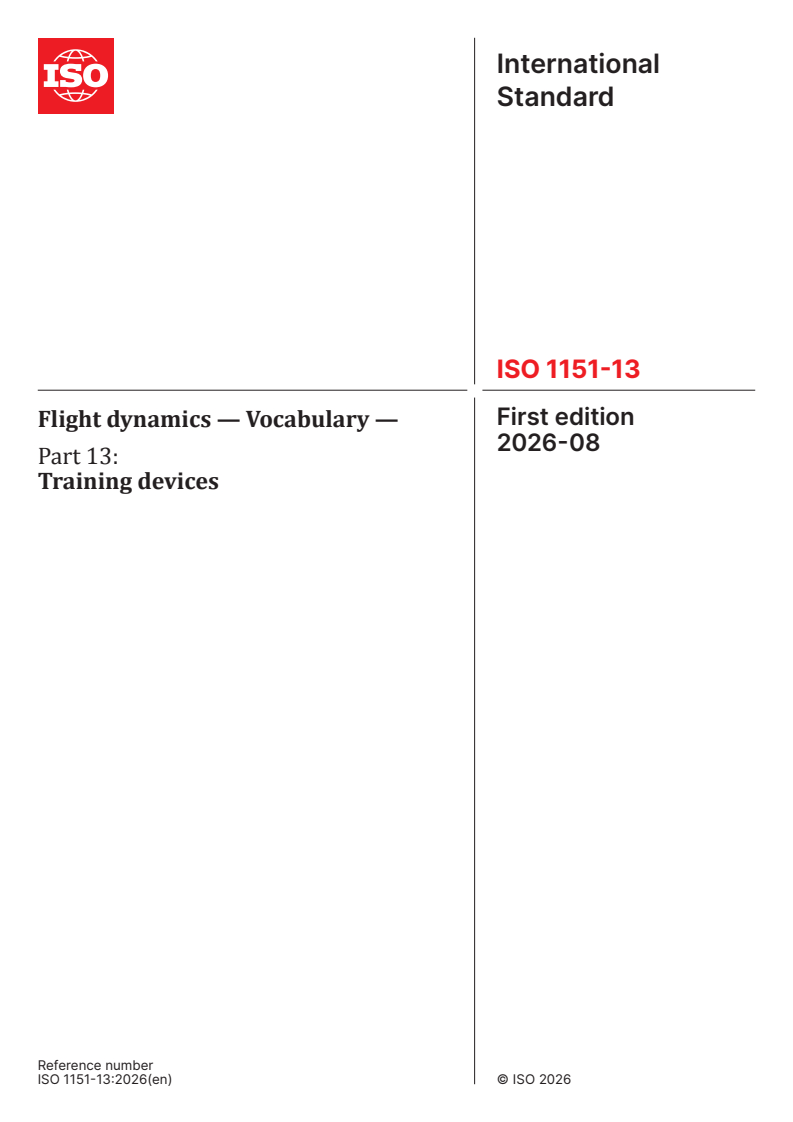
ISO 1151-13:2026 is an ISO International Standard in the Flight dynamics - Vocabulary series. It defines the terms used for pilot training with technical equipment called flight simulators, and it covers the basic concepts used in science, engineering and manufacturing for flight simulation training devices for airplane and helicopter training. For readers, it is the common vocabulary for specifying, testing and discussing these devices consistently.
What does ISO 1151-13:2026 specify?
ISO 1151-13:2026 specifies the terms and definitions used for flight simulation training devices, with a focus on pilot training in a controlled environment. It gives the shared language for describing simulator categories, simulator features, validation data, and qualification-related testing.
The document is organized into Clause 1 Scope, Clause 2 Normative references, and Clause 3 Terms and definitions. Clause 3 is split into three parts:
- 3.1 Categories
- 3.2 FSTD’s simulation features
- 3.3 Basic definitions
An index at the end helps users find individual terms quickly.
What are the key requirements of ISO 1151-13:2026?
Because ISO 1151-13:2026 is a vocabulary standard, its main substance is the set of defined terms. In practice, those definitions shape how an FSTD is described, procured, evaluated and maintained.
Main device categories in Clause 3.1
| Term | Practical meaning |
|---|---|
| FSTD | The umbrella term for a flight simulation training device. |
| FFS | A full-size replica of a specific aircraft flight deck, with systems and cues needed for full ground and flight operations. |
| NWS | A device focused on navigation and weapon systems, with no motion cueing required. |
| FTD | A full-size replica of an aircraft cockpit or flight deck, without a required visual system, force cueing or motion cueing. |
| CPT | A procedure trainer with mission systems, without a required motion or visual system. |
| FNPT | A flight deck or cockpit environment used to represent aircraft flight operations to the extent that systems appear to function as in an aircraft. |
| BITD | A ground-based device representing the student pilot station of a class of aeroplanes. |
| CBT | Training software on a personal computer or workstation for self-training, without a cockpit replica. |
These distinctions matter because buyers, trainers and evaluators need to specify how much of the aircraft experience the device must reproduce.
Clause 3.2 defines the simulation features that can be described and assessed: cockpit layout and structure, flight model, ground handling, aircraft systems, flight controls and forces, sound cue, visual display cue, vibration cue, motion cue, navigation environment, weather environment, landing areas and terrain environment, and air traffic control environment. In practice, these are the elements that determine fidelity level and what must be modeled or reviewed for a given training task.
Clause 3.3 defines the evidence and test vocabulary used around qualification. Terms such as validation data, approved data, flight test data, validation flight test data, engineering simulation validation data, and validation data roadmap (VDR) describe where comparison data comes from and how it is organized.
The same clause also defines the main evaluation tools: qualification test guide (QTG), master qualification test guide (MQTG), statement of conformance (SOC), objective test, subjective test, validation test, functions test, integrated testing, footprint test, hands-off test, hands-on test, closed loop testing, driven test and manual testing. These terms matter because they describe how an FSTD is checked against aircraft data and how test results are documented.
Clause 3.3 also includes lifecycle terms such as FSTD operator, FSTD update, upgrade, convertible FSTD, correct trend and magnitude (CT&M), deadband, and transport delay. These help teams describe changes to a device and the performance effects that are observed during testing.
What terms does ISO 1151-13:2026 define?
- FSTD - Flight simulation training devices, the general category for the training equipment covered by the standard.
- FFS - A full flight simulator with a full-size replica of a specific aircraft flight deck and the systems needed for full operation.
- Validation data - Data used to prove that the FSTD performance corresponds to that of the aircraft.
- Approved data - Aircraft data collected using good engineering practice and accepted by the National Aviation Authority (NAA).
- QTG - The qualification test guide used as the primary reference for evaluating an FSTD.
- VDR - A validation data roadmap that identifies the best sources of data for the required qualification tests.
- SOC - A statement of conformance declaring that specific requirements have been met.
Who uses ISO 1151-13:2026?
ISO 1151-13:2026 is used by simulator manufacturers, aircraft manufacturers, flight training organizations, FSTD operators, evaluators, and National Aviation Authorities (NAA). They use it to specify simulator features, prepare validation data, write test guides, assess conformance, and maintain qualification for airplane and helicopter training devices.
What does the ISO 1151-13:2026 document contain?
ISO 1151-13:2026 contains a structured vocabulary for flight simulation training devices. It groups terms into device categories, simulation features, and basic definitions, and then provides an index for navigation.
The document covers the terms used in design discussions, validation work, qualification testing, and operational management of FSTD. It is especially useful when teams need to align on what a device can simulate, how it is tested, and what evidence supports its qualification.
The entries include terms for training device types, cueing and environment features, test methods, data sources, and documentation used in FSTD qualification and maintenance.
Get Certified
Connect with accredited certification bodies for this standard

BSI Group
BSI (British Standards Institution) is the business standards company that helps organizations make excellence a habit.

Bureau Veritas
Bureau Veritas is a world leader in laboratory testing, inspection and certification services.

DNV
DNV is an independent assurance and risk management provider.
Sponsored listings
Frequently Asked Questions
ISO 1151-13:2026 is a standard published by the International Organization for Standardization (ISO). Its full title is "Flight dynamics — Vocabulary — Part 13: Training devices". This standard covers: This document defines terms used in the field of pilot training with the use of technical equipment, called flight simulators, enhancing safety by allowing pilots to practice various scenarios in a controlled environments, without the need of an actual aircraft. This document establishes the terms and definitions of the basic concepts applied in science, engineering and manufacturing in the field of flight simulation training devices (airplane and helicopter).
This document defines terms used in the field of pilot training with the use of technical equipment, called flight simulators, enhancing safety by allowing pilots to practice various scenarios in a controlled environments, without the need of an actual aircraft. This document establishes the terms and definitions of the basic concepts applied in science, engineering and manufacturing in the field of flight simulation training devices (airplane and helicopter).
ISO 1151-13:2026 is classified under the following ICS (International Classification for Standards) categories: 01.040.49 - Aircraft and space vehicle engineering (Vocabularies); 49.020 - Aircraft and space vehicles in general. The ICS classification helps identify the subject area and facilitates finding related standards.
ISO 1151-13:2026 is available in PDF format for immediate download after purchase. The document can be added to your cart and obtained through the secure checkout process. Digital delivery ensures instant access to the complete standard document.
Standards Content (Sample)
International
Standard
ISO 1151-13
First edition
Flight dynamics — Vocabulary —
2026-08
Part 13:
Training devices
Reference number
© ISO 2026
All rights reserved. Unless otherwise specified, or required in the context of its implementation, no part of this publication may
be reproduced or utilized otherwise in any form or by any means, electronic or mechanical, including photocopying, or posting on
the internet or an intranet, without prior written permission. Permission can be requested from either ISO at the address below
or ISO’s member body in the country of the requester.
ISO copyright office
CP 401 • Ch. de Blandonnet 8
CH-1214 Vernier, Geneva
Phone: +41 22 749 01 11
Email: copyright@iso.org
Website: www.iso.org
Published in Switzerland
ii
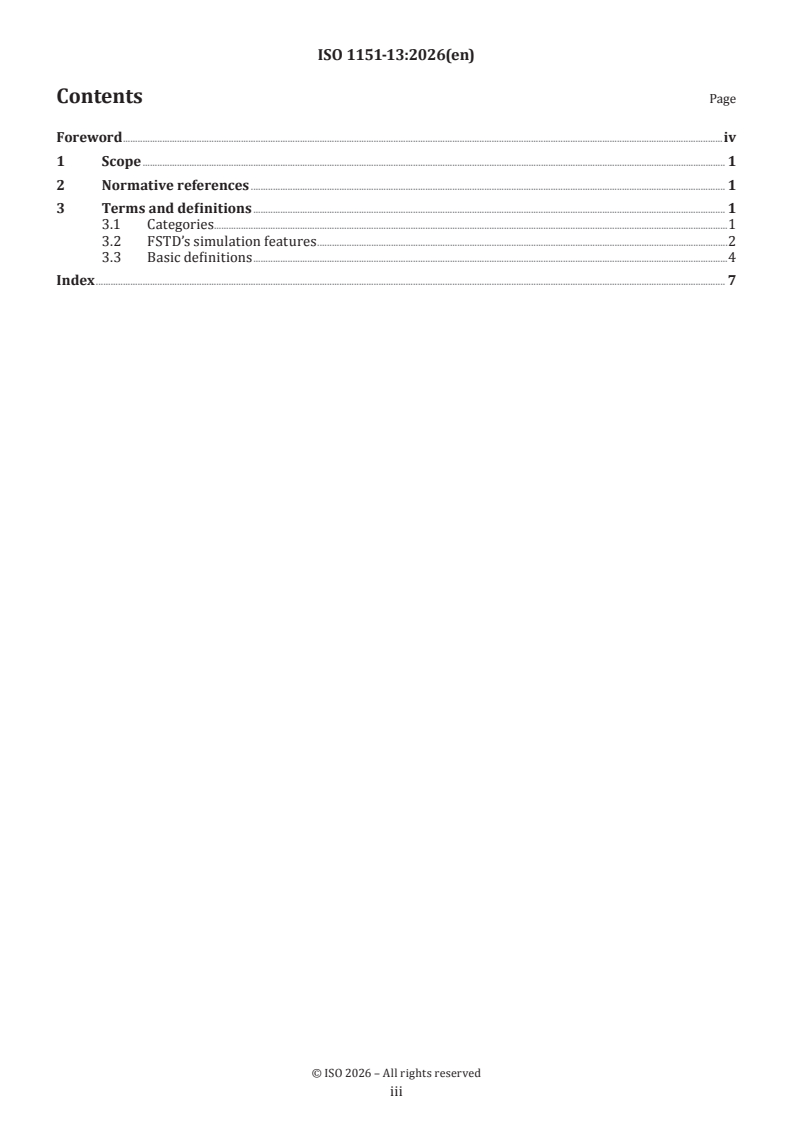
Contents Page
Foreword .iv
1 Scope . 1
2 Normative references . 1
3 Terms and definitions . 1
3.1 Categories.1
3.2 FSTD’s simulation features .2
3.3 Basic definitions .4
Index . 7
iii
Foreword
ISO (the International Organization for Standardization) is a worldwide federation of national standards
bodies (ISO member bodies). The work of preparing International Standards is normally carried out through
ISO technical committees. Each member body interested in a subject for which a technical committee
has been established has the right to be represented on that committee. International organizations,
governmental and non-governmental, in liaison with ISO, also take part in the work. ISO collaborates closely
with the International Electrotechnical Commission (IEC) on all matters of electrotechnical standardization.
The procedures used to develop this document and those intended for its further maintenance are described
in the ISO/IEC Directives, Part 1. In particular, the different approval criteria needed for the different types
of ISO documents should be noted. This document was drafted in accordance with the editorial rules of the
ISO/IEC Directives, Part 2 (see www.iso.org/directives).
Attention is drawn to the possibility that some of the elements of this document may be the subject of patent
rights. ISO shall not be held responsible for identifying any or all such patent rights. Details of any patent
rights identified during the development of the document will be in the Introduction and/or on the ISO list of
patent declarations received (see www.iso.org/patents).
Any trade name used in this document is information given for the convenience of users and does not
constitute an endorsement.
For an explanation of the voluntary nature of standards, the meaning of ISO specific terms and expressions
related to conformity assessment, as well as information about ISO's adherence to the World Trade
Organization (WTO) principles in the Technical Barriers to Trade (TBT), see www.iso.org/iso/foreword.html.
This document was prepared by Technical Committee ISO/TC 20, Aircraft and space vehicles, Subcommittee
SC 8, Aerospace terminology.
A list of all parts in the ISO 1151 series can be found on the ISO website.
Any feedback or questions on this document should be directed to the user’s national standards body. A
complete listing of these bodies can be found at www.iso.org/members.html.
iv
International Standard ISO 1151-13:2026(en)
Flight dynamics — Vocabulary —
Part 13:
Training devices
1 Scope
This document defines terms used in the field of pilot training with the use of technical equipment,
called flight simulators, enhancing safety by allowing pilots to practice various scenarios in a controlled
environments, without the need of an actual aircraft.
This document establishes the terms and definitions of the basic concepts applied in science, engineering
and manufacturing in the field of flight simulation training devices (airplane and helicopter).
2 Normative references
There are no normative references in this document.
3 Terms and definitions
ISO and IEC maintain terminological databases for use in standardization at the following addresses:
— ISO Online browsing platform: available at https:// www .iso .org/ obp
— IEC Electropedia: available at https:// www .electropedia .org/
3.1 Categories
3.1.1
flight simulation training devices
FSTD
technical system designed to replicate the experience on flying an aircraft in various scenarios in a
controllable environment without the need for an actual aircraft
3.1.2
full flight simulator
FFS
FSTD (3.1.1), equipped with a full size replica of a specific type, model and series aircraft flight deck, including
the assemblage of all equipment and computer programs necessary to represent the aircraft in ground and
flight operations, normal, abnormal and emergency procedures throughout the full flight envelope
Note 1 to entry: FFS (3.1.2) includes all flight and basic aircraft systems, a visual system providing an out of the flight
deck view, acoustic system providing sound cues and a force cueing motion system.
3.1.3
navigation and weapon systems trainer
NWS
FSTD (3.1.1), equipped with a full size replica of aircraft instruments, panels, equipment and controls, in
an open cockpit area, including all equipment and computer programs necessary to represent the aircraft
in ground and flight conditions to the extent of the navigation and weapon systems (NWS) installed in the
device
Note 1 to entry: For NWS (3.1.3), no motion cueing system is required.
3.1.4
flight training device
FTD
FSTD (3.1.1), equipped with a full size replica of a specific aircraft type’s instruments, equipment, panels and
controls in an open flight deck area or an enclosed aircraft flight deck, including the assemblage of equipment
and computer software programs necessary to represent the aircraft in ground and flight conditions to the
extent of the systems installed in the device
Note 1 to entry: For FTD (3.1.4), no force cueing, motion cueing or visual system is required.
3.1.5
cockpit procedure trainer
CPT
FSTD (3.1.1), equipped with a full size replica of aircraft instruments, panels, equipment and controls, in an
open cockpit area, including all equipment and computer programs necessary to represent the aircraft in
ground and flight conditions to the extent of the systems installed in the device, including mission systems
Note 1 to entry: For CPT (3.1.5), no motion cueing or visual system is required.
3.1.6
flight and navigation procedures trainer
FNPT
FSTD (3.1.1), equipped with flight deck or cockpit environment including the assemblage of equipment and
computer programs necessary to represent an aircraft in flight operations to the extent that the systems
appear to function as in an aircraft
3.1.7
basic instrument training device
BITD
ground based FSTD (3.1.1), which represents the student pilot‘s station of a class of aeroplanes
Note 1 to entry: BITD (3.1.7) may be equipped with screen based instrument panels and spring-loaded flight controls,
providing a training platform for at least the procedural aspects of instrument flight.
3.1.8
computer based training
CBT
training software implemented on personal computer or workstation allowing self-training of aircraft
system knowledge, operation and use
Note 1 to entry: For CBT (3.1.8), no cockpit replica required, the interactive trainee-machine being via the screen, close
to real-time.
3.2 FSTD’s simulation features
3.2.1
cockpit layout and structure
physical structure and layout of the cockpit environment, instrument layout and presentation, controls and
seating for pilot, instructor, observer(s) and rear crew member
Note 1 to entry: Rear crew member may be winch operator, winch man, medical staff, etc.
3.2.2
flight model
mathematical models (aerodynamics and engine) and associated data to be used to describe the aerodynamic
and flight dynamic characteristics required to be modelled in the FSTD (3.1.1)
3.2.3
ground handling
mathematical models and associated data to be used to describe aircraft behaviour and runway conditions
required to be modeled in the FSTD whenever the aircraft, either wheeled or skidded, is in contact with the
surface
3.2.4
aircraft systems
types of aircraft systems required to be modeled in the FSTD (3.
...