

ISO 22934:2021
(Main)Graphic technology — Communication of offset ink properties
General Information
- Abstract
This document specifies offset ink related properties which are intended to be communicated between ink supplier and the printer, and which are essential for the optimized print production planning and the intended use of the final product. NOTE The final product is not necessarily the finished print product. Aspects related to food safety and other safety requirements like children's toys safety are not part of the scope of this document.
- Status
- Published
- Publication Date
- 30-May-2021
- Technical Committee
- ISO/TC 130 - Graphic technology
- Drafting Committee
- ISO/TC 130/WG 4 - Media and materials
- Current Stage
- 9060 - Close of review
- Completion Date
- 02-Dec-2031
Buy Documents


ISO 22934:2021 - Graphic technology -- Communication of offset ink properties

ISO 22934:2021 - Graphic technology — Communication of offset ink properties/31/2021
Overview
ISO 22934:2021 - Graphic technology - Communication of offset ink properties defines a standard set of offset ink properties that ink suppliers must communicate to printers. Its purpose is to enable optimized print production planning and ensure inks are suitable for the intended use of the final product (the final product is not necessarily the finished print). The standard excludes specific aspects of food safety and children’s toy safety.
Key topics and technical requirements
- Scope of communication
- Information must be provided in an official language of the local market and delivered on container labels and technical data sheets.
- Safety data sheets (SDS) must be available and supplied for hazardous formulations.
- Mandatory identification
- Product name, use, colour, and supplier contact data on the container.
- Properties to be communicated
- Intended usage: printable substrates (e.g., paper, PE, PET), preprint requirements (e.g., corona treatment), and explicitly where the ink is not intended to be used.
- Light fastness: expressed in levels 1–8 (or intermediate "x-y") and determined per ISO 12040.
- Transparency: categorized as "opaque", "semi opaque", or "transparent" (method referenced in ISO 2846‑1).
- Drying mechanism: categories include "oxidative", "setting", "radiation curing" (subtypes: mercury lamps, iron-doped mercury lamps, UV‑LED, electron beam), or "other".
- Resistance to solvents and alkali:
- Ethanol resistance: "fast", "unstable", or "conditional" (test per ISO 2836).
- Specific solvent mixture (60% denatured ethanol, 30% ethyl acetate, 10% 1‑methoxy‑2‑propanol): categorical resistance (ISO 2836).
- Alkali resistance: "fast" or "unstable" (ISO 2836); for harsher conditions, ISO 12632 testing is recommended.
- Fresh conditioning: indicate skin-avoiding properties for oxidative drying sheet‑fed inks.
- Additional information
- Parties may mutually agree to report other film properties (gloss, slip, special resistances).
Applications and who uses it
ISO 22934 is practical for:
- Ink suppliers - to standardize technical data sheets and labels for offset inks.
- Printers and production planners - for selecting inks compatible with substrates, varnishes, drying systems, and production workflows.
- Quality managers and procurement teams - to verify ink suitability, resistance, and performance claims.
- Packaging printers - to coordinate ink selection with finishing processes (note: food‑contact safety requires other guidance).
Benefits include improved production planning, reduced rework from incompatibilities (e.g., solvent bleeding or poor drying), and clearer supplier–printer communication.
Related standards
- ISO 2836 - Assessment of resistance of prints to various agents
- ISO 12040 - Assessment of light fastness (filtered xenon arc)
- ISO 2846‑1 - Colour and transparency of printing ink sets
- ISO 12632 - Hot alkali penetration and resistance
Keywords: ISO 22934, offset ink properties, graphic technology, communication of ink properties, light fastness, transparency, drying mechanism, solvent resistance, safety data sheet, offset printing.
Relations
- Effective Date
- 06-Jun-2022
Buy Documents
ISO 22934:2021 - Graphic technology -- Communication of offset ink properties
ISO 22934:2021 - Graphic technology — Communication of offset ink properties/31/2021
Frequently Asked Questions
ISO 22934:2021 is a standard published by the International Organization for Standardization (ISO). Its full title is "Graphic technology — Communication of offset ink properties". This standard covers: This document specifies offset ink related properties which are intended to be communicated between ink supplier and the printer, and which are essential for the optimized print production planning and the intended use of the final product. NOTE The final product is not necessarily the finished print product. Aspects related to food safety and other safety requirements like children's toys safety are not part of the scope of this document.
This document specifies offset ink related properties which are intended to be communicated between ink supplier and the printer, and which are essential for the optimized print production planning and the intended use of the final product. NOTE The final product is not necessarily the finished print product. Aspects related to food safety and other safety requirements like children's toys safety are not part of the scope of this document.
ISO 22934:2021 is classified under the following ICS (International Classification for Standards) categories: 87.080 - Inks. Printing inks. The ICS classification helps identify the subject area and facilitates finding related standards.
ISO 22934:2021 has the following relationships with other standards: It is inter standard links to ISO 16701:2025. Understanding these relationships helps ensure you are using the most current and applicable version of the standard.
ISO 22934:2021 is available in PDF format for immediate download after purchase. The document can be added to your cart and obtained through the secure checkout process. Digital delivery ensures instant access to the complete standard document.
Standards Content (Sample)
INTERNATIONAL ISO
STANDARD 22934
First edition
2021-05
Graphic technology — Communication
of offset ink properties
Technologie graphique — Communication des propriétés de l'encre
offset
Reference number
©
ISO 2021
© ISO 2021
All rights reserved. Unless otherwise specified, or required in the context of its implementation, no part of this publication may
be reproduced or utilized otherwise in any form or by any means, electronic or mechanical, including photocopying, or posting
on the internet or an intranet, without prior written permission. Permission can be requested from either ISO at the address
below or ISO’s member body in the country of the requester.
ISO copyright office
CP 401 • Ch. de Blandonnet 8
CH-1214 Vernier, Geneva
Phone: +41 22 749 01 11
Email: copyright@iso.org
Website: www.iso.org
Published in Switzerland
ii © ISO 2021 – All rights reserved
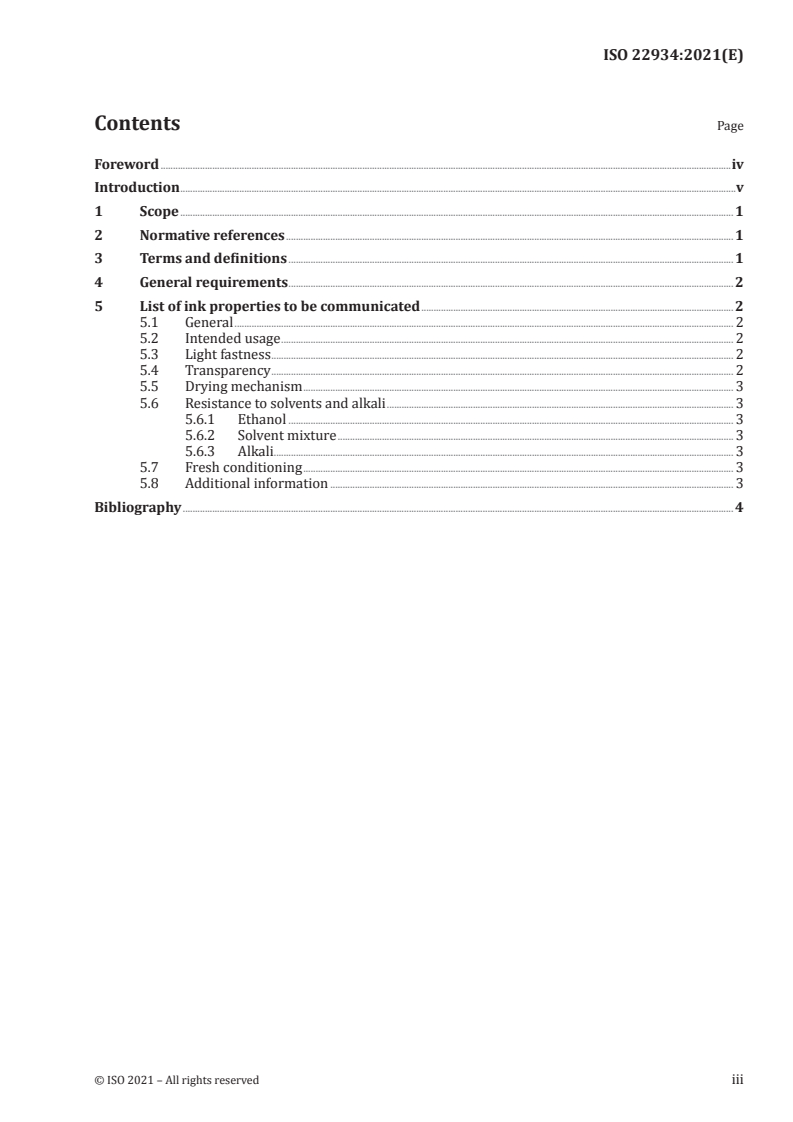
Contents Page
Foreword .iv
Introduction .v
1 Scope . 1
2 Normative references . 1
3 Terms and definitions . 1
4 General requirements . 2
5 List of ink properties to be communicated . 2
5.1 General . 2
5.2 Intended usage . 2
5.3 Light fastness . 2
5.4 Transparency . 2
5.5 Drying mechanism . 3
5.6 Resistance to solvents and alkali . 3
5.6.1 Ethanol . 3
5.6.2 Solvent mixture . 3
5.6.3 Alkali . 3
5.7 Fresh conditioning . 3
5.8 Additional information . 3
Bibliography . 4
Foreword
ISO (the International Organization for Standardization) is a worldwide federation of national standards
bodies (ISO member bodies). The work of preparing International Standards is normally carried out
through ISO technical committees. Each member body interested in a subject for which a technical
committee has been established has the right to be represented on that committee. International
organizations, governmental and non-governmental, in liaison with ISO, also take part in the work.
ISO collaborates closely with the International Electrotechnical Commission (IEC) on all matters of
electrotechnical standardization.
The procedures used to develop this document and those intended for its further maintenance are
described in the ISO/IEC Directives, Part 1. In particular, the different approval criteria needed for the
different types of ISO documents should be noted. This document was drafted in accordance with the
editorial rules of the ISO/IEC Directives, Part 2 (see www .iso .org/ directives).
Attention is drawn to the possibility that some of the elements of this document may be the subject of
patent rights. ISO shall not be held responsible for identifying any or all such patent rights. Details of
any patent rights identified during the development of the document will be in the Introduction and/or
on the ISO list of patent declarations received (see www .iso .org/ patents).
Any trade name used in this document is information given for the convenience of users and does not
constitute an endorsement.
For an explanation of the voluntary nature of standards, the meaning of ISO specific terms and
expressions related to conformity assessment, as well as information about ISO's adherence to the
World Trade Organization (WTO) principles in the Technical Barriers to Trade (TBT), see www .iso .org/
iso/ foreword .html.
This document was prepared by Technical Committee ISO/TC 130, Graphic technology.
Any feedback or questions on this document should be directed to the user’s national standards body. A
complete listing of these bodies can be found at www .iso .org/ members .html.
iv © ISO 2021 – All rights reserved
Introduction
Offset printing inks are special purpose, complex mixtures of chemicals intended to be applied on a
substrate by offset printing. They have customized properties and defined drying mechanisms resulting
in ink films with standard or customized properties. This document establishes requirements on the
communication of offset ink properties, aiming to the optimized planning of printing and to ensure the
inks have the appropriate properties for the intended use of the printed products. Examples are the
use of alkali resistant inks for combined use with dispersion varnishes to avoid colour changes after
printing or the use of higher light fast inks for outdoor applications.
For the printing of food packaging, additional requirements are in continuing development. Often,
these are related to the usability of particular substances within the inks. Printers of food packaging
are recommended to stay in close contact to their ink suppliers and industry federations and to follow
actual developments in this are
...
INTERNATIONAL ISO
STANDARD 22934
First edition
2021-05
Graphic technology — Communication
of offset ink properties
Technologie graphique — Communication des propriétés de l'encre
offset
Reference number
©
ISO 2021
© ISO 2021
All rights reserved. Unless otherwise specified, or required in the context of its implementation, no part of this publication may
be reproduced or utilized otherwise in any form or by any means, electronic or mechanical, including photocopying, or posting
on the internet or an intranet, without prior written permission. Permission can be requested from either ISO at the address
below or ISO’s member body in the country of the requester.
ISO copyright office
CP 401 • Ch. de Blandonnet 8
CH-1214 Vernier, Geneva
Phone: +41 22 749 01 11
Email: copyright@iso.org
Website: www.iso.org
Published in Switzerland
ii © ISO 2021 – All rights reserved
Contents Page
Foreword .iv
Introduction .v
1 Scope . 1
2 Normative references . 1
3 Terms and definitions . 1
4 General requirements . 2
5 List of ink properties to be communicated . 2
5.1 General . 2
5.2 Intended usage . 2
5.3 Light fastness . 2
5.4 Transparency . 2
5.5 Drying mechanism . 3
5.6 Resistance to solvents and alkali . 3
5.6.1 Ethanol . 3
5.6.2 Solvent mixture . 3
5.6.3 Alkali . 3
5.7 Fresh conditioning . 3
5.8 Additional information . 3
Bibliography . 4
Foreword
ISO (the International Organization for Standardization) is a worldwide federation of national standards
bodies (ISO member bodies). The work of preparing International Standards is normally carried out
through ISO technical committees. Each member body interested in a subject for which a technical
committee has been established has the right to be represented on that committee. International
organizations, governmental and non-governmental, in liaison with ISO, also take part in the work.
ISO collaborates closely with the International Electrotechnical Commission (IEC) on all matters of
electrotechnical standardization.
The procedures used to develop this document and those intended for its further maintenance are
described in the ISO/IEC Directives, Part 1. In particular, the different approval criteria needed for the
different types of ISO documents should be noted. This document was drafted in accordance with the
editorial rules of the ISO/IEC Directives, Part 2 (see www .iso .org/ directives).
Attention is drawn to the possibility that some of the elements of this document may be the subject of
patent rights. ISO shall not be held responsible for identifying any or all such patent rights. Details of
any patent rights identified during the development of the document will be in the Introduction and/or
on the ISO list of patent declarations received (see www .iso .org/ patents).
Any trade name used in this document is information given for the convenience of users and does not
constitute an endorsement.
For an explanation of the voluntary nature of standards, the meaning of ISO specific terms and
expressions related to conformity assessment, as well as information about ISO's adherence to the
World Trade Organization (WTO) principles in the Technical Barriers to Trade (TBT), see www .iso .org/
iso/ foreword .html.
This document was prepared by Technical Committee ISO/TC 130, Graphic technology.
Any feedback or questions on this document should be directed to the user’s national standards body. A
complete listing of these bodies can be found at www .iso .org/ members .html.
iv © ISO 2021 – All rights reserved
Introduction
Offset printing inks are special purpose, complex mixtures of chemicals intended to be applied on a
substrate by offset printing. They have customized properties and defined drying mechanisms resulting
in ink films with standard or customized properties. This document establishes requirements on the
communication of offset ink properties, aiming to the optimized planning of printing and to ensure the
inks have the appropriate properties for the intended use of the printed products. Examples are the
use of alkali resistant inks for combined use with dispersion varnishes to avoid colour changes after
printing or the use of higher light fast inks for outdoor applications.
For the printing of food packaging, additional requirements are in continuing development. Often,
these are related to the usability of particular substances within the inks. Printers of food packaging
are recommended to stay in close contact to their ink suppliers and industry federations and to follow
actual developments in this are
...