

ISO 12632:2015
(Main)Graphic technology — Ink, paper and labels — Requirements on hot alkali penetration and resistance
General Information
- Abstract
ISO 12632:2015 specifies test methods for - penetrability and removal times of labels that have been wet glued on bottles intended to be refilled and reused, and - resistance of printed labels against hot alkaline solution. Test results always deal with systems comprising of substrates, ink films and varnish films if present. This International Standard is valid for label substrates and printed labels. Label substrates include metalized papers. The test procedures are also valid for the evaluation of inks and papers to be used in printing labels. ISO 12632:2015 does not purport to address all of the safety concerns, if any, associated with its use. It is the responsibility of the user of this International Standard to establish appropriate safety and health practices and determine the applicability of regulatory limitations prior to use.
- Status
- Published
- Publication Date
- 30-Nov-2015
- Technical Committee
- ISO/TC 130 - Graphic technology
- Drafting Committee
- ISO/TC 130/WG 4 - Media and materials
- Current Stage
- 9060 - Close of review
- Completion Date
- 02-Sep-2031
Buy Documents
ISO 12632:2015 - Graphic technology -- Ink, paper and labels -- Requirements on hot alkali penetration and resistance
ISO 12632:2015 - Graphic technology — Ink, paper and labels — Requirements on hot alkali penetration and resistance/1/2015
Overview
ISO 12632:2015 specifies standardized test methods for the behaviour of printed labels and label substrates when exposed to hot alkaline cleaning solutions. The standard addresses three interrelated test objectives: the penetrability of hot alkaline solution through labels, the removal time of wet-glued labels from refillable bottles, and the resistance of printed labels against hot alkaline solutions. Test results apply to the complete system of substrate, ink film and varnish (if present), and label substrates include metalized papers.
The standard is aimed primarily at the beverage industry and operations that refill and reuse bottles or containers where hot alkaline cleaning is used. It also supports ink and paper evaluation during label development and quality control.
Key Topics
- Test principles: penetration time (indicator colour change), removal time (separation from glass substrate) and resistance (visual inspection and solution colouration).
- Indicator and reagents: a thymolphthalein-containing glue is used to reveal penetration (blue colour) and sodium hydroxide solutions are specified (1 % NaOH for penetrability/removal tests; 2.5 % NaOH for resistance tests).
- Representative test conditions: when testing labels for glass bottles the NaOH solution temperature is (75 ± 2) °C for penetrability; resistance testing uses 2.5 % NaOH at 85 °C for 20 minutes with magnetic stirring at (250 ± 50) rpm (as specified in the standard).
- Specimens and preparation: ink films must be fully dried/cured prior to testing; multiple specimens are used and labels are glued onto petri dishes with the thymolphthalein glue.
- Evaluation criteria:
- Penetration endpoint: three-quarters of specimen area turns blue.
- Removal endpoint: label separates from petri dish.
- Resistance: integrity of substrate, integrity of printed image and no colouration of the alkaline solution after filtration.
- Safety: hot alkaline solutions can cause severe chemical burns and eye damage; use protective gloves and safety glasses.
Applications
- Quality control for printed labels and label substrates intended for refillable bottles.
- Screening and selection of inks and varnishes for alkali resistance and minimal contamination of cleaning solutions.
- Process stability in industrial bottle-cleaning systems and reduction of waste-treatment costs by avoiding dyeing of cleaning solutions.
- Supplier and contract testing to document compliance and support product development.
Related Standards
ISO 12632:2015 was prepared by ISO/TC 130 (Graphic technology) and the test methods are established in the European beverage industry and harmonized with corresponding DIN practices. For broader conformity assessment consult complementary ISO guidance from graphic-technology and packaging committees and local regulatory requirements.
Practical value: applying ISO 12632:2015 helps manufacturers, printers and beverage packagers ensure labels detach reliably during hot-alkali cleaning, preserve substrate integrity, and avoid contamination of recycling streams and cleaning effluents.
Buy Documents
ISO 12632:2015 - Graphic technology -- Ink, paper and labels -- Requirements on hot alkali penetration and resistance
ISO 12632:2015 - Graphic technology — Ink, paper and labels — Requirements on hot alkali penetration and resistance/1/2015
Frequently Asked Questions
ISO 12632:2015 is a standard published by the International Organization for Standardization (ISO). Its full title is "Graphic technology — Ink, paper and labels — Requirements on hot alkali penetration and resistance". This standard covers: ISO 12632:2015 specifies test methods for - penetrability and removal times of labels that have been wet glued on bottles intended to be refilled and reused, and - resistance of printed labels against hot alkaline solution. Test results always deal with systems comprising of substrates, ink films and varnish films if present. This International Standard is valid for label substrates and printed labels. Label substrates include metalized papers. The test procedures are also valid for the evaluation of inks and papers to be used in printing labels. ISO 12632:2015 does not purport to address all of the safety concerns, if any, associated with its use. It is the responsibility of the user of this International Standard to establish appropriate safety and health practices and determine the applicability of regulatory limitations prior to use.
ISO 12632:2015 specifies test methods for - penetrability and removal times of labels that have been wet glued on bottles intended to be refilled and reused, and - resistance of printed labels against hot alkaline solution. Test results always deal with systems comprising of substrates, ink films and varnish films if present. This International Standard is valid for label substrates and printed labels. Label substrates include metalized papers. The test procedures are also valid for the evaluation of inks and papers to be used in printing labels. ISO 12632:2015 does not purport to address all of the safety concerns, if any, associated with its use. It is the responsibility of the user of this International Standard to establish appropriate safety and health practices and determine the applicability of regulatory limitations prior to use.
ISO 12632:2015 is classified under the following ICS (International Classification for Standards) categories: 87.080 - Inks. Printing inks. The ICS classification helps identify the subject area and facilitates finding related standards.
ISO 12632:2015 is available in PDF format for immediate download after purchase. The document can be added to your cart and obtained through the secure checkout process. Digital delivery ensures instant access to the complete standard document.
Standards Content (Sample)
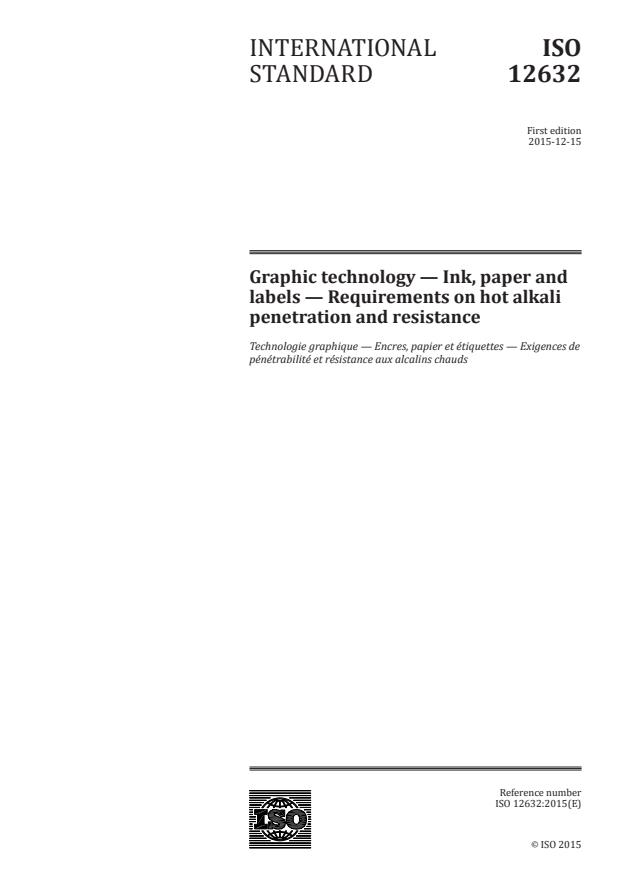
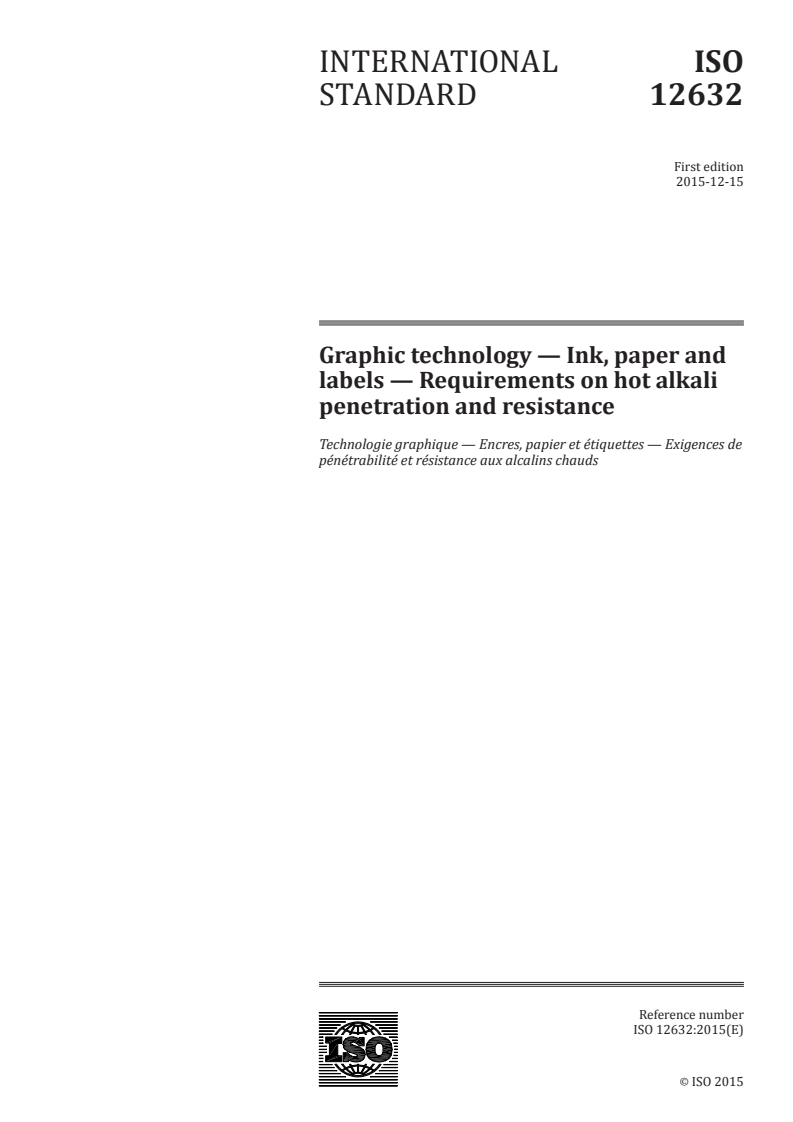
INTERNATIONAL ISO
STANDARD 12632
First edition
2015-12-15
Graphic technology — Ink, paper and
labels — Requirements on hot alkali
penetration and resistance
Technologie graphique — Encres, papier et étiquettes — Exigences de
pénétrabilité et résistance aux alcalins chauds
Reference number
©
ISO 2015
© ISO 2015, Published in Switzerland
All rights reserved. Unless otherwise specified, no part of this publication may be reproduced or utilized otherwise in any form
or by any means, electronic or mechanical, including photocopying, or posting on the internet or an intranet, without prior
written permission. Permission can be requested from either ISO at the address below or ISO’s member body in the country of
the requester.
ISO copyright office
Ch. de Blandonnet 8 • CP 401
CH-1214 Vernier, Geneva, Switzerland
Tel. +41 22 749 01 11
Fax +41 22 749 09 47
copyright@iso.org
www.iso.org
ii © ISO 2015 – All rights reserved
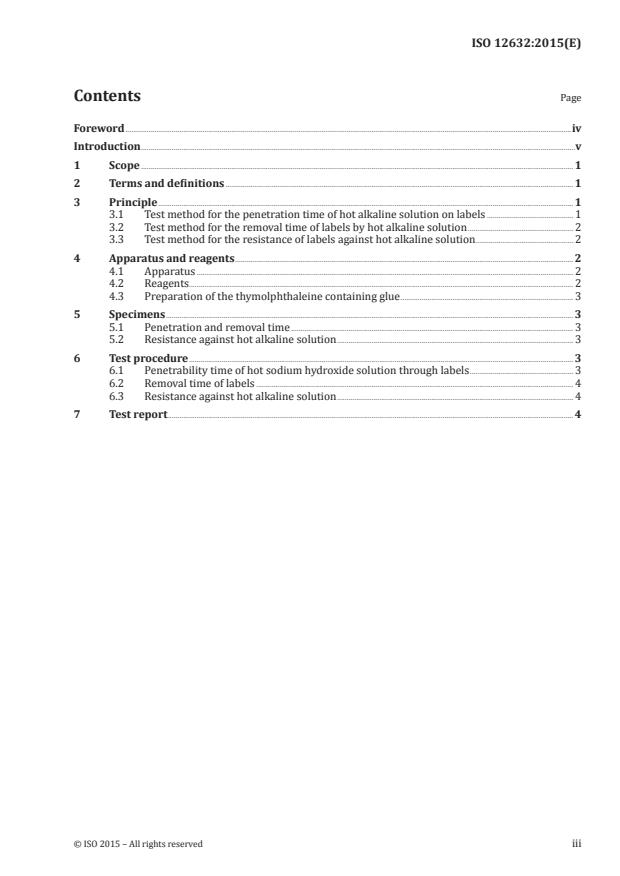
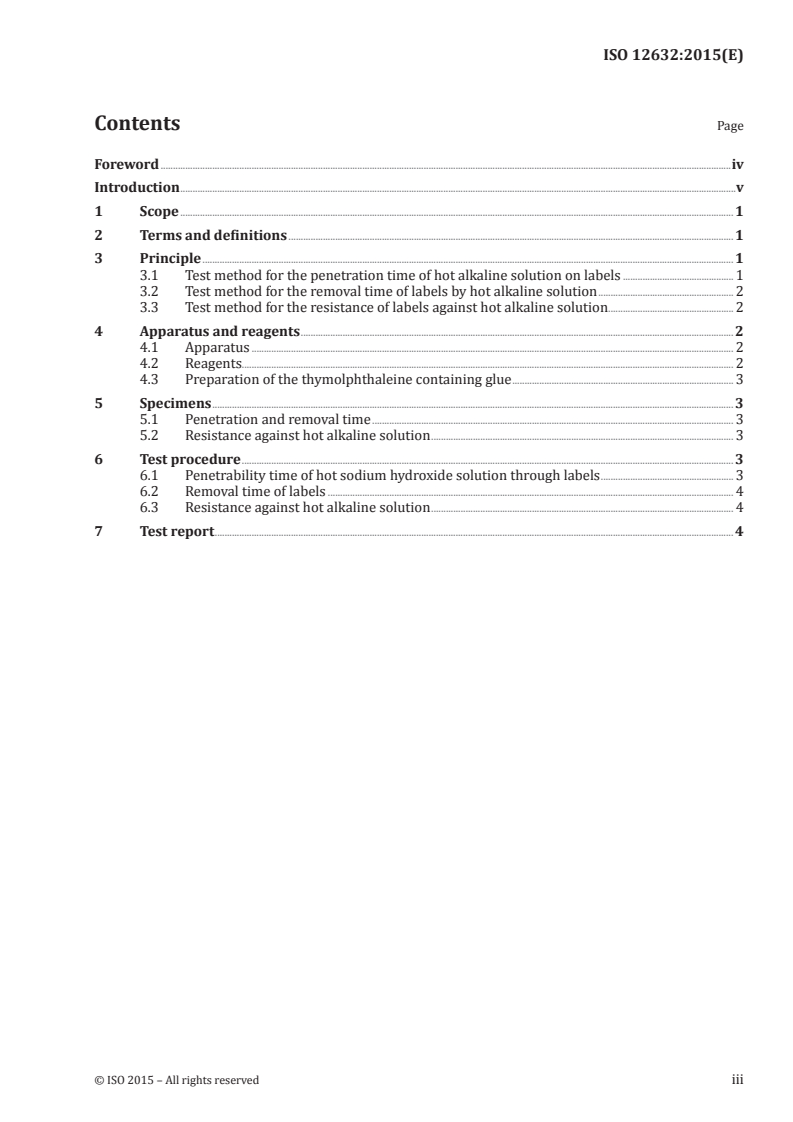
Contents Page
Foreword .iv
Introduction .v
1 Scope . 1
2 Terms and definitions . 1
3 Principle . 1
3.1 Test method for the penetration time of hot alkaline solution on labels . 1
3.2 Test method for the removal time of labels by hot alkaline solution . 2
3.3 Test method for the resistance of labels against hot alkaline solution . 2
4 Apparatus and reagents . 2
4.1 Apparatus . 2
4.2 Reagents. 2
4.3 Preparation of the thymolphthaleine containing glue . 3
5 Specimens . 3
5.1 Penetration and removal time . 3
5.2 Resistance against hot alkaline solution . 3
6 Test procedure . 3
6.1 Penetrability time of hot sodium hydroxide solution through labels . 3
6.2 Removal time of labels . 4
6.3 Resistance against hot alkaline solution . 4
7 Test report . 4
Foreword
ISO (the International Organization for Standardization) is a worldwide federation of national standards
bodies (ISO member bodies). The work of preparing International Standards is normally carried out
through ISO technical committees. Each member body interested in a subject for which a technical
committee has been established has the right to be represented on that committee. International
organizations, governmental and non-governmental, in liaison with ISO, also take part in the work.
ISO collaborates closely with the International Electrotechnical Commission (IEC) on all matters of
electrotechnical standardization.
The procedures used to develop this document and those intended for its further maintenance are
described in the ISO/IEC Directives, Part 1. In particular the different approval criteria needed for the
different types of ISO documents should be noted. This document was drafted in accordance with the
editorial rules of the ISO/IEC Directives, Part 2 (see www.iso.org/directives).
Attention is drawn to the possibility that some of the elements of this document may be the subject of
patent rights. ISO shall not be held responsible for identifying any or all such patent rights. Details of
any patent rights identified during the development of the document will be in the Introduction and/or
on the ISO list of patent declarations received (see www.iso.org/patents).
Any trade name used in this document is information given for the convenience of users and does not
constitute an endorsement.
For an explanation on the meaning of ISO specific terms and expressions related to conformity
assessment, as well as information about ISO’s adherence to the WTO principles in the Technical
Barriers to Trade (TBT) see the following URL: Foreword - Supplementary information
The committee responsible for this document is ISO/TC 130, Graphic technology.
iv © ISO 2015 – All rights reserved
Introduction
Bottles or other containers for beverages and soft drinks may be labeled with wet glued printed labels
of various substrates. If the bottles and containers are reused, they need to be cleaned thoroughly.
Often, bottles and containers are used for different types of drinks. This requires the removal of the
labels from the bottles and containers during the cleaning process. Usually, hot alkaline solution is
used within the cleaning facilities. To ensure the stability of the process, the penetration of the cleaning
solution through the label needs to occur rapidly. In addition, the labels need to stay intact to ease the
process of removing them from the cleaning agent. Also, no dying of the solution must occur so as to
minimize costs for the waste treatment of the cleaning solutions after neutralization. The test methods
given in this International Standard have been successfully applied in the European beverage industry
for decades and are also standardized as DIN Standards.
INTERNATIONAL STANDARD ISO 12632:2015(E)
Graphic technology — Ink, paper and labels —
Requirements on hot alkali penetration and resistance
1 Scope
This International Standard specifies test methods for
— penetrability and removal times of labels that have been wet glued on bottles intended to be refilled
and reused, and
— resistance of printed labels against hot alkaline solution.
Test results always deal with systems comprising of substrates, ink films and varnish films if present.
This International Standard is valid for label substrates and printed labels. Label substrates include
metalized papers. The test procedures are also valid for the evaluation of inks and papers to be used in
printing labels.
This International Standard does not purport to address all of the safety concerns, if any, associated
with its
...
INTERNATIONAL ISO
STANDARD 12632
First edition
2015-12-15
Graphic technology — Ink, paper and
labels — Requirements on hot alkali
penetration and resistance
Technologie graphique — Encres, papier et étiquettes — Exigences de
pénétrabilité et résistance aux alcalins chauds
Reference number
©
ISO 2015
© ISO 2015, Published in Switzerland
All rights reserved. Unless otherwise specified, no part of this publication may be reproduced or utilized otherwise in any form
or by any means, electronic or mechanical, including photocopying, or posting on the internet or an intranet, without prior
written permission. Permission can be requested from either ISO at the address below or ISO’s member body in the country of
the requester.
ISO copyright office
Ch. de Blandonnet 8 • CP 401
CH-1214 Vernier, Geneva, Switzerland
Tel. +41 22 749 01 11
Fax +41 22 749 09 47
copyright@iso.org
www.iso.org
ii © ISO 2015 – All rights reserved
Contents Page
Foreword .iv
Introduction .v
1 Scope . 1
2 Terms and definitions . 1
3 Principle . 1
3.1 Test method for the penetration time of hot alkaline solution on labels . 1
3.2 Test method for the removal time of labels by hot alkaline solution . 2
3.3 Test method for the resistance of labels against hot alkaline solution . 2
4 Apparatus and reagents . 2
4.1 Apparatus . 2
4.2 Reagents. 2
4.3 Preparation of the thymolphthaleine containing glue . 3
5 Specimens . 3
5.1 Penetration and removal time . 3
5.2 Resistance against hot alkaline solution . 3
6 Test procedure . 3
6.1 Penetrability time of hot sodium hydroxide solution through labels . 3
6.2 Removal time of labels . 4
6.3 Resistance against hot alkaline solution . 4
7 Test report . 4
Foreword
ISO (the International Organization for Standardization) is a worldwide federation of national standards
bodies (ISO member bodies). The work of preparing International Standards is normally carried out
through ISO technical committees. Each member body interested in a subject for which a technical
committee has been established has the right to be represented on that committee. International
organizations, governmental and non-governmental, in liaison with ISO, also take part in the work.
ISO collaborates closely with the International Electrotechnical Commission (IEC) on all matters of
electrotechnical standardization.
The procedures used to develop this document and those intended for its further maintenance are
described in the ISO/IEC Directives, Part 1. In particular the different approval criteria needed for the
different types of ISO documents should be noted. This document was drafted in accordance with the
editorial rules of the ISO/IEC Directives, Part 2 (see www.iso.org/directives).
Attention is drawn to the possibility that some of the elements of this document may be the subject of
patent rights. ISO shall not be held responsible for identifying any or all such patent rights. Details of
any patent rights identified during the development of the document will be in the Introduction and/or
on the ISO list of patent declarations received (see www.iso.org/patents).
Any trade name used in this document is information given for the convenience of users and does not
constitute an endorsement.
For an explanation on the meaning of ISO specific terms and expressions related to conformity
assessment, as well as information about ISO’s adherence to the WTO principles in the Technical
Barriers to Trade (TBT) see the following URL: Foreword - Supplementary information
The committee responsible for this document is ISO/TC 130, Graphic technology.
iv © ISO 2015 – All rights reserved
Introduction
Bottles or other containers for beverages and soft drinks may be labeled with wet glued printed labels
of various substrates. If the bottles and containers are reused, they need to be cleaned thoroughly.
Often, bottles and containers are used for different types of drinks. This requires the removal of the
labels from the bottles and containers during the cleaning process. Usually, hot alkaline solution is
used within the cleaning facilities. To ensure the stability of the process, the penetration of the cleaning
solution through the label needs to occur rapidly. In addition, the labels need to stay intact to ease the
process of removing them from the cleaning agent. Also, no dying of the solution must occur so as to
minimize costs for the waste treatment of the cleaning solutions after neutralization. The test methods
given in this International Standard have been successfully applied in the European beverage industry
for decades and are also standardized as DIN Standards.
INTERNATIONAL STANDARD ISO 12632:2015(E)
Graphic technology — Ink, paper and labels —
Requirements on hot alkali penetration and resistance
1 Scope
This International Standard specifies test methods for
— penetrability and removal times of labels that have been wet glued on bottles intended to be refilled
and reused, and
— resistance of printed labels against hot alkaline solution.
Test results always deal with systems comprising of substrates, ink films and varnish films if present.
This International Standard is valid for label substrates and printed labels. Label substrates include
metalized papers. The test procedures are also valid for the evaluation of inks and papers to be used in
printing labels.
This International Standard does not purport to address all of the safety concerns, if any, associated
with its
...