

ISO 18263-2:2015
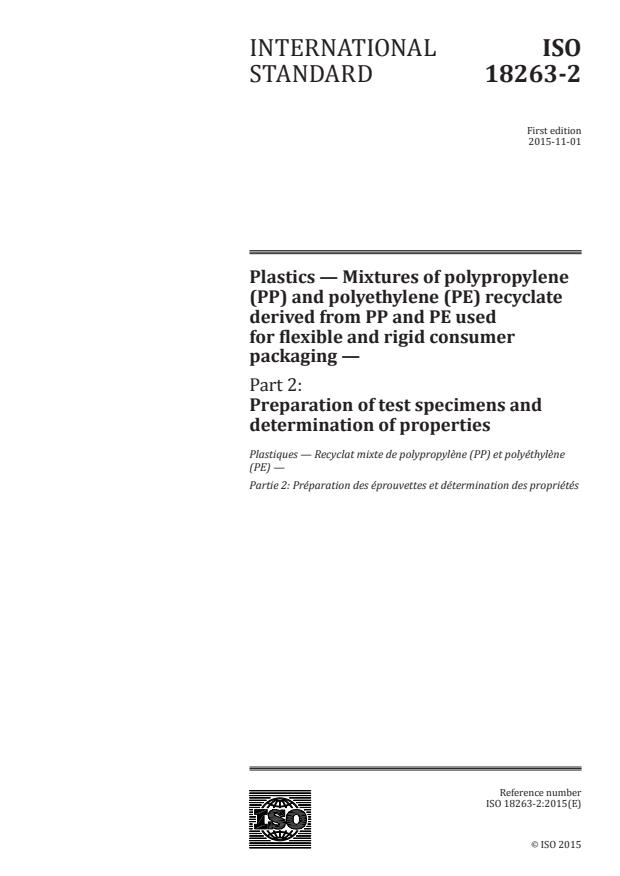
(Main)Plastics — Mixtures of polypropylene (PP) and polyethylene (PE) recyclate derived from PP and PE used for flexible and rigid consumer packaging — Part 2: Preparation of test specimens and determination of properties
General Information
- Abstract
ISO 18263-2:2015 specifies methods of preparation of test specimens and the standard test methods to be used in determining the properties of mixtures of polypropylene (PP) and polyethylene (PE) recyclate derived from PP and PE used for flexible and rigid consumer packaging for moulding and extrusion. Recyclate from packaging used for the transport, handling, or storage of hazardous goods is not to be used. Since it is impossible to get the information about stabilizer levels of recyclate, it is necessary to add stabilizer as needed. Requirements for handling test material and for conditioning both the test material before moulding and the specimens before testing are given in this part of ISO 18263.
- Status
- Published
- Publication Date
- 04-Nov-2015
- Technical Committee
- ISO/TC 61/SC 9 - Thermoplastic materials
- Drafting Committee
- ISO/TC 61/SC 9 - Thermoplastic materials
- Current Stage
- 9060 - Close of review
- Completion Date
- 02-Dec-2030
Buy Documents
ISO 18263-2:2015 - Plastics -- Mixtures of polypropylene (PP) and polyethylene (PE) recyclate derived from PP and PE used for flexible and rigid consumer packaging
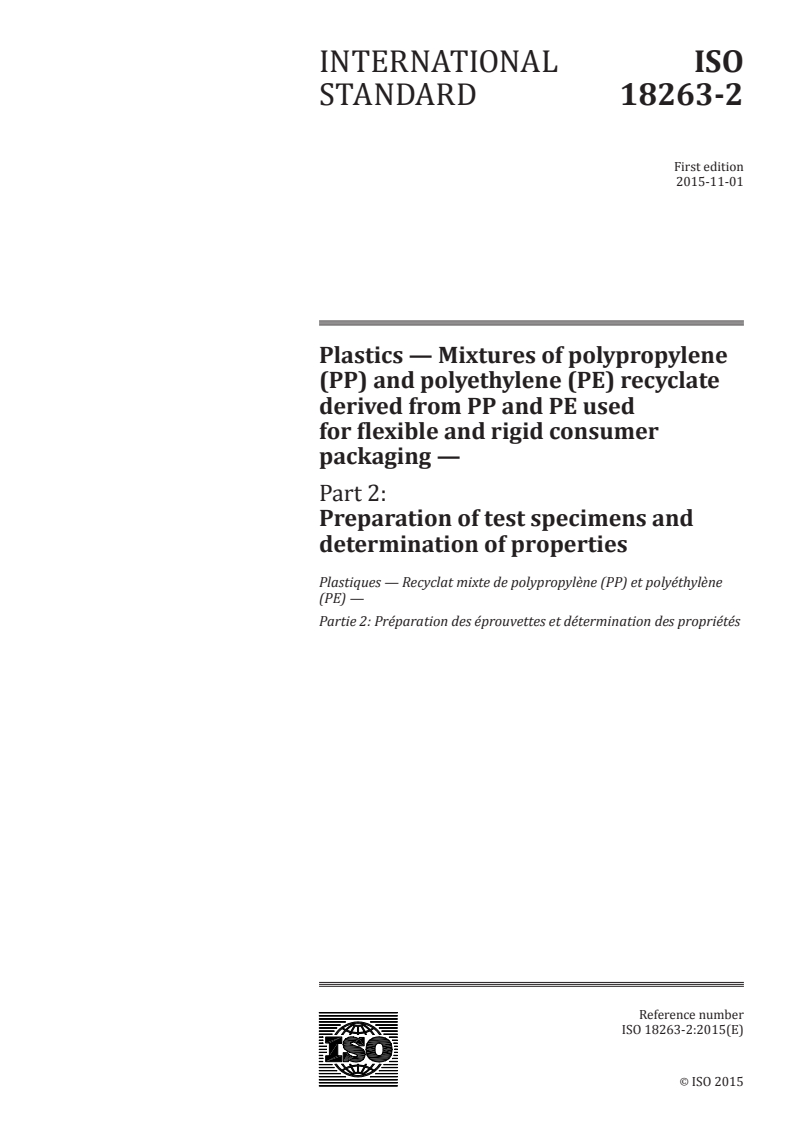
ISO 18263-2:2015 - Plastics — Mixtures of polypropylene (PP) and polyethylene (PE) recyclate derived from PP and PE used for flexible and rigid consumer packaging — Part 2: Preparation of test specimens and determination of properties/5/2015
Overview
ISO 18263-2:2015 specifies how to prepare test specimens and which standard test methods to use for mixtures of polypropylene (PP) and polyethylene (PE) recyclate derived from PP and PE intended for flexible and rigid consumer packaging (moulding and extrusion). The part covers handling, conditioning, and property determination of recyclate blends, with explicit exclusions (recyclate from packaging used for hazardous goods transport is not allowed). Because recyclate stabilizer levels are typically unknown, the standard requires adding stabilizer as needed.
Key topics and requirements
- Specimen preparation: Follow ISO 1873-2 procedures; specimens must be made consistently using the same processing conditions for repeatable results.
- Conditioning: Mechanical-property and density specimens conditioned in standard atmosphere per ISO 291 for 40–96 hours at 23 °C ± 2 °C.
- Property testing: Uses established ISO test methods (see Table 1/2). Key properties include:
- Melt mass‑flow rate (MFR) - ISO 1133‑1 (typical condition: 230 °C, 2.16 kg)
- Tensile properties - ISO 527‑1 / ISO 527‑2 (moulding/extrusion specimens)
- Flexural modulus and strength - ISO 178
- Charpy impact (notched / unnotched) - ISO 179‑1 / ISO 179‑2 and ISO 20753 specimen definitions
- Density - ISO 1183 series (immersion, density gradient, gas pyknometer)
- Visual checks - colour and form (per ISO 18263‑1)
- Composition (PP/PE ratio): Determination should be traceable using supplier documentation (EN 15343, ISO/IEC 17050 recommended). Annex A describes an FTIR ATR method (A(1370 cm‑1)/A(1464 cm‑1) correlation) as an informative technique - useful for estimation but not definitive due to recyclate complexity.
- Data presentation: Apply ISO 10350‑1 rules for acquiring and presenting comparable single‑point data.
Practical applications and users
Who benefits:
- Recyclers and compounders - quality control and formulation of PP/PE recyclate blends for moulding and extrusion.
- Test laboratories - validated procedures for specimen prep, conditioning, and mechanical/physical testing.
- Material suppliers & specifiers - establishing material specifications and supplier declarations of recyclate content.
- Product designers and brand owners - assessing suitability of recycled PP/PE for rigid and flexible consumer packaging.
- Regulators and compliance teams - verifying recyclate properties and traceability (excluding hazardous‑goods recyclate).
Typical uses:
- Acceptance testing of incoming recyclate batches
- Material comparison and selection for packaging applications
- Development of compound specifications and stability protocols (addition of stabilizer)
- Generating comparable property datasets for technical datasheets
Related standards
- ISO 18263‑1 (designation system and basis for specifications)
- ISO 1873‑2, ISO 1133‑1, ISO 527 series, ISO 178, ISO 179 series, ISO 1183 series, ISO 10350‑1, ISO 291
- EN 15343 and ISO/IEC 17050 for recycling traceability and supplier declarations
Keywords: ISO 18263-2:2015, polypropylene, polyethylene, PP/PE recyclate, test specimens, MFR, FTIR, conditioning, tensile, flexural, Charpy, density, packaging recyclate.
Relations
- Consolidated By
ISO 16664:2017 - Gas analysis — Handling of calibration gases and gas mixtures — Guidelines - Effective Date
- 06-Jun-2022
Buy Documents
ISO 18263-2:2015 - Plastics -- Mixtures of polypropylene (PP) and polyethylene (PE) recyclate derived from PP and PE used for flexible and rigid consumer packaging
ISO 18263-2:2015 - Plastics — Mixtures of polypropylene (PP) and polyethylene (PE) recyclate derived from PP and PE used for flexible and rigid consumer packaging — Part 2: Preparation of test specimens and determination of properties/5/2015
Get Certified
Connect with accredited certification bodies for this standard

DIN CERTCO
DIN Group product certification.

Smithers Quality Assessments
US management systems and product certification.
Sponsored listings
Frequently Asked Questions
ISO 18263-2:2015 is a standard published by the International Organization for Standardization (ISO). Its full title is "Plastics — Mixtures of polypropylene (PP) and polyethylene (PE) recyclate derived from PP and PE used for flexible and rigid consumer packaging — Part 2: Preparation of test specimens and determination of properties". This standard covers: ISO 18263-2:2015 specifies methods of preparation of test specimens and the standard test methods to be used in determining the properties of mixtures of polypropylene (PP) and polyethylene (PE) recyclate derived from PP and PE used for flexible and rigid consumer packaging for moulding and extrusion. Recyclate from packaging used for the transport, handling, or storage of hazardous goods is not to be used. Since it is impossible to get the information about stabilizer levels of recyclate, it is necessary to add stabilizer as needed. Requirements for handling test material and for conditioning both the test material before moulding and the specimens before testing are given in this part of ISO 18263.
ISO 18263-2:2015 specifies methods of preparation of test specimens and the standard test methods to be used in determining the properties of mixtures of polypropylene (PP) and polyethylene (PE) recyclate derived from PP and PE used for flexible and rigid consumer packaging for moulding and extrusion. Recyclate from packaging used for the transport, handling, or storage of hazardous goods is not to be used. Since it is impossible to get the information about stabilizer levels of recyclate, it is necessary to add stabilizer as needed. Requirements for handling test material and for conditioning both the test material before moulding and the specimens before testing are given in this part of ISO 18263.
ISO 18263-2:2015 is classified under the following ICS (International Classification for Standards) categories: 83.080.20 - Thermoplastic materials. The ICS classification helps identify the subject area and facilitates finding related standards.
ISO 18263-2:2015 has the following relationships with other standards: It is inter standard links to ISO 16664:2017. Understanding these relationships helps ensure you are using the most current and applicable version of the standard.
ISO 18263-2:2015 is available in PDF format for immediate download after purchase. The document can be added to your cart and obtained through the secure checkout process. Digital delivery ensures instant access to the complete standard document.
Standards Content (Sample)
INTERNATIONAL ISO
STANDARD 18263-2
First edition
2015-11-01
Plastics — Mixtures of polypropylene
(PP) and polyethylene (PE) recyclate
derived from PP and PE used
for flexible and rigid consumer
packaging —
Part 2:
Preparation of test specimens and
determination of properties
Plastiques — Recyclat mixte de polypropylène (PP) et polyéthylène
(PE) —
Partie 2: Préparation des éprouvettes et détermination des propriétés
Reference number
©
ISO 2015
© ISO 2015, Published in Switzerland
All rights reserved. Unless otherwise specified, no part of this publication may be reproduced or utilized otherwise in any form
or by any means, electronic or mechanical, including photocopying, or posting on the internet or an intranet, without prior
written permission. Permission can be requested from either ISO at the address below or ISO’s member body in the country of
the requester.
ISO copyright office
Ch. de Blandonnet 8 • CP 401
CH-1214 Vernier, Geneva, Switzerland
Tel. +41 22 749 01 11
Fax +41 22 749 09 47
copyright@iso.org
www.iso.org
ii © ISO 2015 – All rights reserved
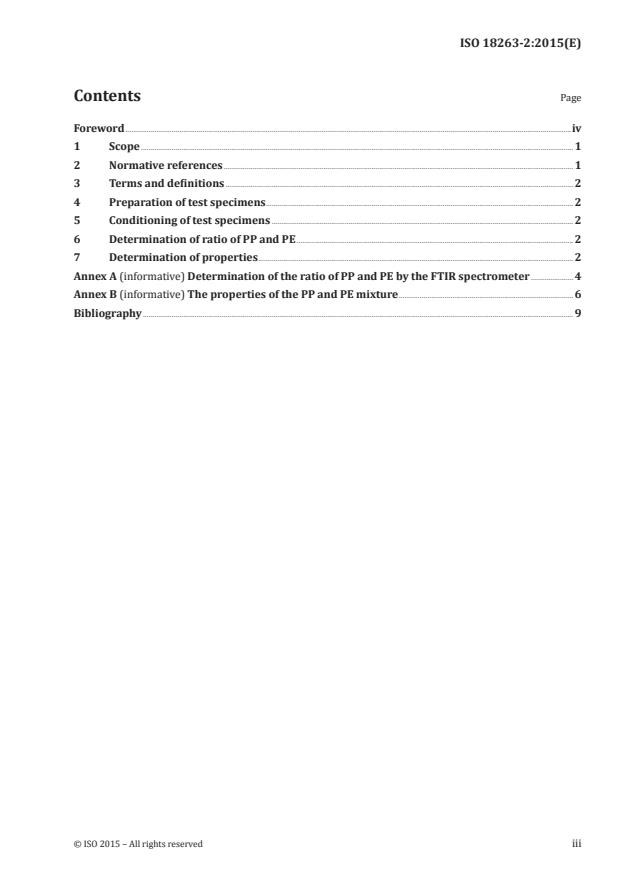
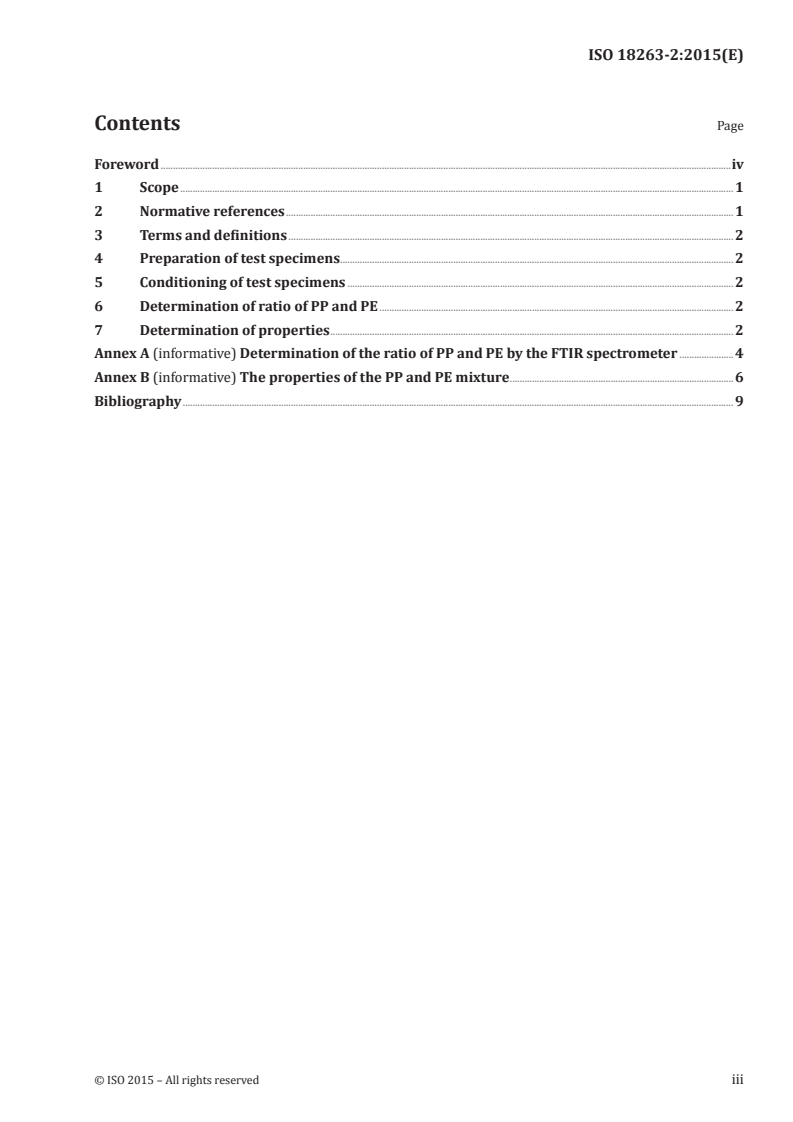
Contents Page
Foreword .iv
1 Scope . 1
2 Normative references . 1
3 Terms and definitions . 2
4 Preparation of test specimens . 2
5 Conditioning of test specimens . 2
6 Determination of ratio of PP and PE . 2
7 Determination of properties . 2
Annex A (informative) Determination of the ratio of PP and PE by the FTIR spectrometer .4
Annex B (informative) The properties of the PP and PE mixture . 6
Bibliography . 9
Foreword
ISO (the International Organization for Standardization) is a worldwide federation of national standards
bodies (ISO member bodies). The work of preparing International Standards is normally carried out
through ISO technical committees. Each member body interested in a subject for which a technical
committee has been established has the right to be represented on that committee. International
organizations, governmental and non-governmental, in liaison with ISO, also take part in the work.
ISO collaborates closely with the International Electrotechnical Commission (IEC) on all matters of
electrotechnical standardization.
The procedures used to develop this document and those intended for its further maintenance are
described in the ISO/IEC Directives, Part 1. In particular the different approval criteria needed for the
different types of ISO documents should be noted. This document was drafted in accordance with the
editorial rules of the ISO/IEC Directives, Part 2 (see www.iso.org/directives).
Attention is drawn to the possibility that some of the elements of this document may be the subject of
patent rights. ISO shall not be held responsible for identifying any or all such patent rights. Details of
any patent rights identified during the development of the document will be in the Introduction and/or
on the ISO list of patent declarations received (see www.iso.org/patents).
Any trade name used in this document is information given for the convenience of users and does not
constitute an endorsement.
For an explanation on the meaning of ISO specific terms and expressions related to conformity
assessment, as well as information about ISO’s adherence to the WTO principles in the Technical
Barriers to Trade (TBT) see the following URL: Foreword - Supplementary information
The committee responsible for this document is ISO/TC 61, Plastics, Subcommittee SC 9,
Thermoplastic materials.
ISO 18263 consists of the following parts, under the general title Plastics — Mixtures of polypropylene
(PP) and polyethylene (PE) recyclate derived from PP and PE used for flexible and rigid consumer packaging:
— Part 1: Designation system and basis for specification
— Part 2: Preparation of test specimens and determination of properties
iv © ISO 2015 – All rights reserved
INTERNATIONAL STANDARD ISO 18263-2:2015(E)
Plastics — Mixtures of polypropylene (PP) and
polyethylene (PE) recyclate derived from PP and PE used
for flexible and rigid consumer packaging —
Part 2:
Preparation of test specimens and determination of
properties
1 Scope
This part of ISO 18263 specifies methods of preparation of test specimens and the standard test
methods to be used in determining the properties of mixtures of polypropylene (PP) and polyethylene
(PE) recyclate derived from PP and PE used for flexible and rigid consumer packaging for moulding and
extrusion. Recyclate from packaging used for the transport, handling, or storage of hazardous goods
is not to be used. Since it is impossible to get the information about stabilizer levels of recyclate, it is
necessary to add stabilizer as needed. Requirements for handling test material and for conditioning both
the test material before moulding and the specimens before testing are given in this part of ISO 18263.
2 Normative references
The following documents, in whole or in part, are normatively referenced in this document and are
indispensable for its application. For dated references, only the edition cited applies. For undated
references, the latest edition of the referenced document (including any amendments) applies.
ISO 178, Plastics — Determination of flexural properties
ISO 179-1, Plastics — Determination of Charpy impact properties — Part 1: Non-instrumented impact test
ISO 179-2, Plastics — Determination of Charpy impact properties — Part 2: Instrumented impact test
ISO 291, Plastics — Standard atmospheres for conditioning and testing
ISO 472, Plastics — Vocabulary
ISO 527-1, Plastics — Determination of tensile properties — Part 1: General principles
ISO 527-2, Plastics — Determination of tensile properties — Part 2: Test conditions for moulding and
extrusion plastics
ISO 1133-1, Plastics — Determination of the melt mass-flow rate (MFR) and melt volume-flow rate (MVR)
of thermoplastics — Part 1: Standard method
ISO 1183-1, Plastics — Methods for determining the density of non-cellular plastics — Part 1: Immersion
method, liquid pyknometer method and titration method
ISO 1183-2, Plastics — Methods for determining the density of non-cellular plastics — Part 2: Density
gradient column method
ISO 1183-3, Plastics — Methods for determining the density of non-cellular plastics — Part 3: Gas
pyknometer method
ISO 1873-2, Plastics — Polypropylene (PP) moulding and extrusion materials — Part 2: Preparation of test
specimens and determination of properties
ISO 10350-1, Plastics — Acquisition and presentation of comparable single-point data — Part 1:
Moulding materials
ISO 15270, Plastics — Guidelines for the recovery and recycling of plastics waste
ISO 18263-1, Plastics — Mixtures of polypropylene (PP) and Polyethylene (PE) recyclate derived from
PP and PE used for flexible and rigid consumer packaging — Part 1: Designation system and basis for
specifications
ISO 20753, Plastics — Test specimens
3 Terms and definitions
For the purposes of this document, the terms and definitions given in ISO 472 and ISO 15270 apply.
4 Preparation of test specimens
The test specimens shall be prepared in accordance with ISO 1873-2 and shall be tested
...
INTERNATIONAL ISO
STANDARD 18263-2
First edition
2015-11-01
Plastics — Mixtures of polypropylene
(PP) and polyethylene (PE) recyclate
derived from PP and PE used
for flexible and rigid consumer
packaging —
Part 2:
Preparation of test specimens and
determination of properties
Plastiques — Recyclat mixte de polypropylène (PP) et polyéthylène
(PE) —
Partie 2: Préparation des éprouvettes et détermination des propriétés
Reference number
©
ISO 2015
© ISO 2015, Published in Switzerland
All rights reserved. Unless otherwise specified, no part of this publication may be reproduced or utilized otherwise in any form
or by any means, electronic or mechanical, including photocopying, or posting on the internet or an intranet, without prior
written permission. Permission can be requested from either ISO at the address below or ISO’s member body in the country of
the requester.
ISO copyright office
Ch. de Blandonnet 8 • CP 401
CH-1214 Vernier, Geneva, Switzerland
Tel. +41 22 749 01 11
Fax +41 22 749 09 47
copyright@iso.org
www.iso.org
ii © ISO 2015 – All rights reserved
Contents Page
Foreword .iv
1 Scope . 1
2 Normative references . 1
3 Terms and definitions . 2
4 Preparation of test specimens . 2
5 Conditioning of test specimens . 2
6 Determination of ratio of PP and PE . 2
7 Determination of properties . 2
Annex A (informative) Determination of the ratio of PP and PE by the FTIR spectrometer .4
Annex B (informative) The properties of the PP and PE mixture . 6
Bibliography . 9
Foreword
ISO (the International Organization for Standardization) is a worldwide federation of national standards
bodies (ISO member bodies). The work of preparing International Standards is normally carried out
through ISO technical committees. Each member body interested in a subject for which a technical
committee has been established has the right to be represented on that committee. International
organizations, governmental and non-governmental, in liaison with ISO, also take part in the work.
ISO collaborates closely with the International Electrotechnical Commission (IEC) on all matters of
electrotechnical standardization.
The procedures used to develop this document and those intended for its further maintenance are
described in the ISO/IEC Directives, Part 1. In particular the different approval criteria needed for the
different types of ISO documents should be noted. This document was drafted in accordance with the
editorial rules of the ISO/IEC Directives, Part 2 (see www.iso.org/directives).
Attention is drawn to the possibility that some of the elements of this document may be the subject of
patent rights. ISO shall not be held responsible for identifying any or all such patent rights. Details of
any patent rights identified during the development of the document will be in the Introduction and/or
on the ISO list of patent declarations received (see www.iso.org/patents).
Any trade name used in this document is information given for the convenience of users and does not
constitute an endorsement.
For an explanation on the meaning of ISO specific terms and expressions related to conformity
assessment, as well as information about ISO’s adherence to the WTO principles in the Technical
Barriers to Trade (TBT) see the following URL: Foreword - Supplementary information
The committee responsible for this document is ISO/TC 61, Plastics, Subcommittee SC 9,
Thermoplastic materials.
ISO 18263 consists of the following parts, under the general title Plastics — Mixtures of polypropylene
(PP) and polyethylene (PE) recyclate derived from PP and PE used for flexible and rigid consumer packaging:
— Part 1: Designation system and basis for specification
— Part 2: Preparation of test specimens and determination of properties
iv © ISO 2015 – All rights reserved
INTERNATIONAL STANDARD ISO 18263-2:2015(E)
Plastics — Mixtures of polypropylene (PP) and
polyethylene (PE) recyclate derived from PP and PE used
for flexible and rigid consumer packaging —
Part 2:
Preparation of test specimens and determination of
properties
1 Scope
This part of ISO 18263 specifies methods of preparation of test specimens and the standard test
methods to be used in determining the properties of mixtures of polypropylene (PP) and polyethylene
(PE) recyclate derived from PP and PE used for flexible and rigid consumer packaging for moulding and
extrusion. Recyclate from packaging used for the transport, handling, or storage of hazardous goods
is not to be used. Since it is impossible to get the information about stabilizer levels of recyclate, it is
necessary to add stabilizer as needed. Requirements for handling test material and for conditioning both
the test material before moulding and the specimens before testing are given in this part of ISO 18263.
2 Normative references
The following documents, in whole or in part, are normatively referenced in this document and are
indispensable for its application. For dated references, only the edition cited applies. For undated
references, the latest edition of the referenced document (including any amendments) applies.
ISO 178, Plastics — Determination of flexural properties
ISO 179-1, Plastics — Determination of Charpy impact properties — Part 1: Non-instrumented impact test
ISO 179-2, Plastics — Determination of Charpy impact properties — Part 2: Instrumented impact test
ISO 291, Plastics — Standard atmospheres for conditioning and testing
ISO 472, Plastics — Vocabulary
ISO 527-1, Plastics — Determination of tensile properties — Part 1: General principles
ISO 527-2, Plastics — Determination of tensile properties — Part 2: Test conditions for moulding and
extrusion plastics
ISO 1133-1, Plastics — Determination of the melt mass-flow rate (MFR) and melt volume-flow rate (MVR)
of thermoplastics — Part 1: Standard method
ISO 1183-1, Plastics — Methods for determining the density of non-cellular plastics — Part 1: Immersion
method, liquid pyknometer method and titration method
ISO 1183-2, Plastics — Methods for determining the density of non-cellular plastics — Part 2: Density
gradient column method
ISO 1183-3, Plastics — Methods for determining the density of non-cellular plastics — Part 3: Gas
pyknometer method
ISO 1873-2, Plastics — Polypropylene (PP) moulding and extrusion materials — Part 2: Preparation of test
specimens and determination of properties
ISO 10350-1, Plastics — Acquisition and presentation of comparable single-point data — Part 1:
Moulding materials
ISO 15270, Plastics — Guidelines for the recovery and recycling of plastics waste
ISO 18263-1, Plastics — Mixtures of polypropylene (PP) and Polyethylene (PE) recyclate derived from
PP and PE used for flexible and rigid consumer packaging — Part 1: Designation system and basis for
specifications
ISO 20753, Plastics — Test specimens
3 Terms and definitions
For the purposes of this document, the terms and definitions given in ISO 472 and ISO 15270 apply.
4 Preparation of test specimens
The test specimens shall be prepared in accordance with ISO 1873-2 and shall be tested
...