

ISO/FDIS 14419
(Main)Textiles — Oil repellency — Hydrocarbon resistance test
- Abstract
This document specifies a method for the evaluation of a substrate's resistance to absorption of a selected series of liquid hydrocarbons of different surface tensions. This document provides guidance to oil stain resistance. It can provide a rough index of oil stain resistance as, generally, the higher the oil repellency grade, the better resistance to staining by oily materials, especially liquid oil substances. This is particularly true when comparing various finishes for a given substrate. This document can also be used to determine if washing and/or drycleaning treatments have any adverse effect on the oil repellency characteristics of a substrate. NOTE 1 Washing and drycleaning treatment procedures are described in ISO 6330 and ISO 3175 (all parts), respectively. This document is not intended to give an absolute measure of the resistance of the substrate to staining by all oily materials. Other factors, such as composition and viscosity of the oily substances, substrate construction, fibre type, dyes and other finishing agents, also influence stain resistance. This document is not intended to estimate the resistance to penetration of the substrate by oil-based chemicals. NOTE 2 For the evaluation of the resistance to penetration of the substrate by oil-based chemicals, see ISO 6530.
- Status
- Not Published
- Technical Committee
- ISO/TC 38/SC 2 - Cleansing, finishing and water resistance tests
- Drafting Committee
- ISO/TC 38/SC 2/WG 8 - Water resistance tests
- Current Stage
- 5020 - Proof sent to secretariat or FDIS ballot initiated: 8 weeks - 50 Approval
- Start Date
- 12-Oct-2026
- Due Date
- 12-Oct-2026
- Completion Date
- 12-Oct-2026
Buy Documents
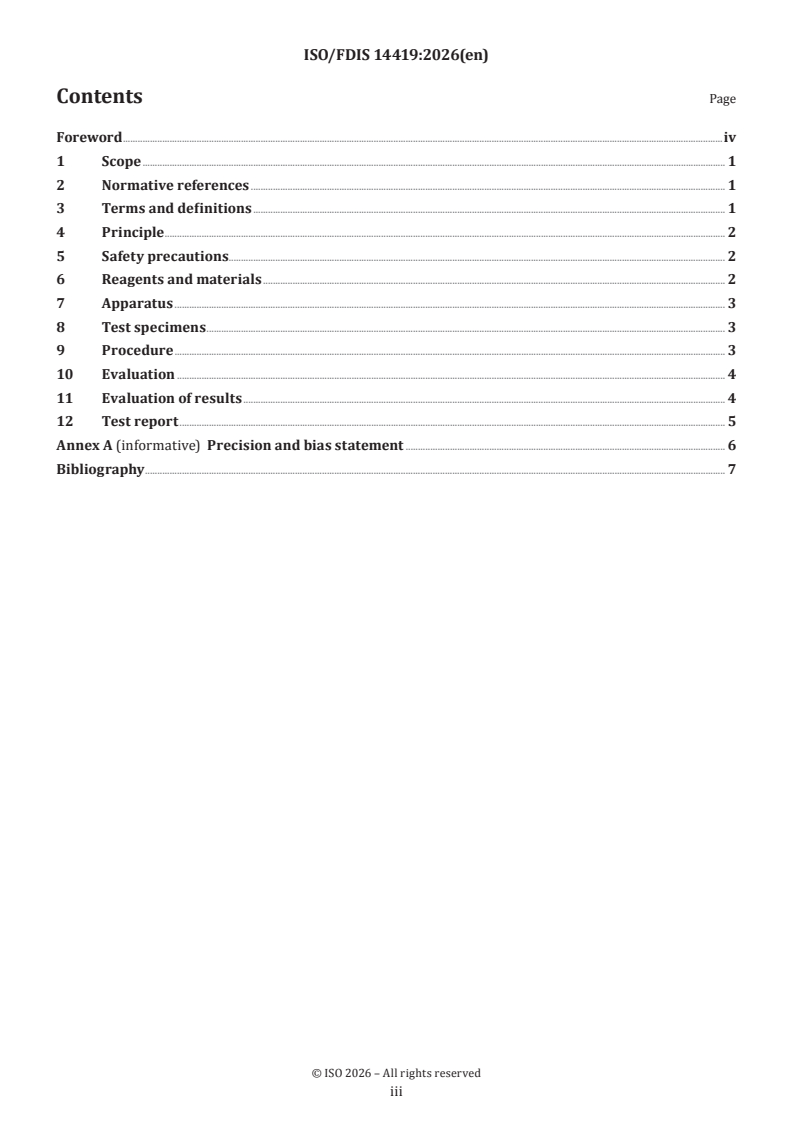

ISO/FDIS 14419 - Textiles — Oil repellency — Hydrocarbon resistance test
REDLINE ISO/FDIS 14419 - Textiles — Oil repellency — Hydrocarbon resistance test
ISO/FDIS 14419 - Textiles — Oléofugation — Essai de résistance aux hydrocarbures
ISO/FDIS 14419 from ISO specifies a laboratory method for judging how a textile substrate resists absorption of a selected series of liquid hydrocarbons. It gives an oil repellency grade that serves as a practical index of staining resistance to oily liquids, especially when comparing finishes on the same substrate. The method is also used to check whether washing or drycleaning changes that repellency.
What does ISO/FDIS 14419 specify?
ISO/FDIS 14419 specifies a hydrocarbon resistance test for textiles, with the result reported as an oil repellency grade. The method is intended for comparing substrates and finishes, and for checking the effect of washing or drycleaning on repellency.
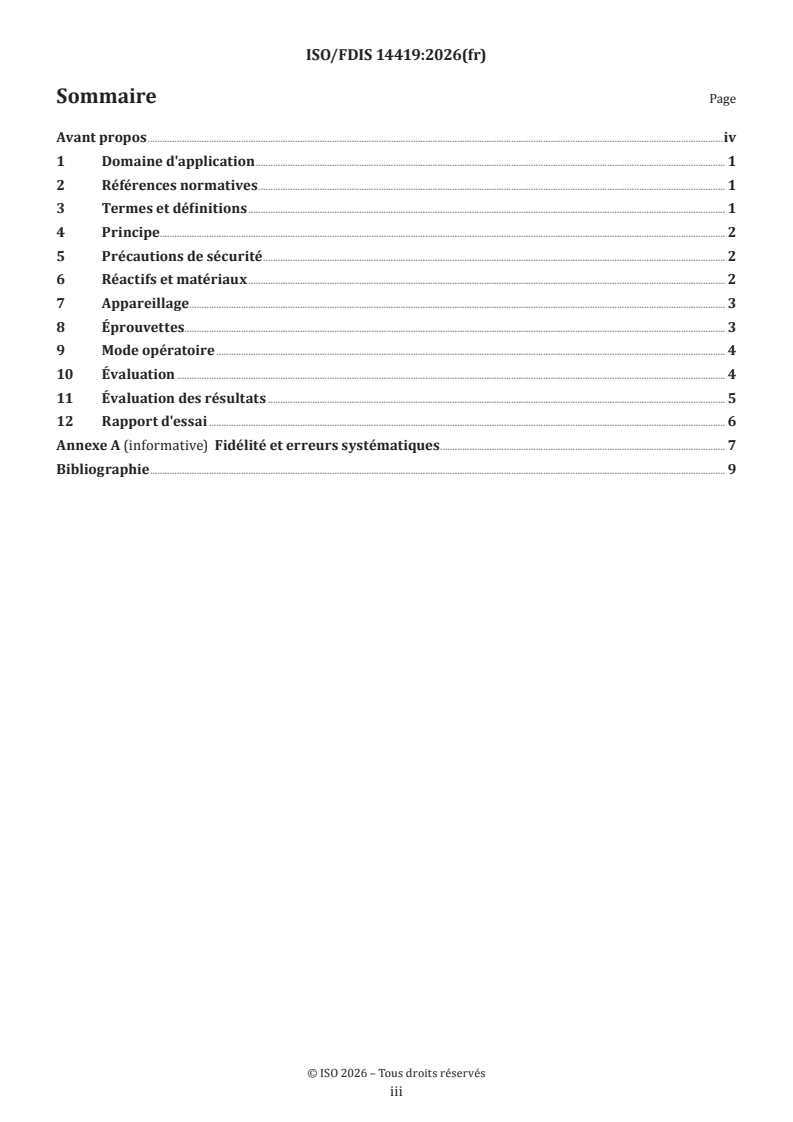
The document is organized into clauses for scope, references, terms, principle, safety, reagents and materials, apparatus, test specimens, procedure, evaluation, evaluation of results, and test report. Annex A gives the precision and bias statement.
| Annex | What it covers |
|---|---|
| A | Precision and bias statement |
What are the key requirements of ISO/FDIS 14419?
ISO/FDIS 14419 bases the result on which numbered hydrocarbon liquid first wets the substrate, so the test is a graded comparison rather than a pass/fail check. In practice, the tester must control the liquids, the atmosphere, the specimen preparation, and the reading time carefully, because small handling differences can change the grade.
Test principle and grading
Clause 4 places drops of standard test liquids on the surface and watches for absorption, wicking, and contact angle. The oil repellency grade is the highest numbered liquid that does not absorb into the substrate within the set observation time.
That means the test shows relative repellency to a defined liquid series, not resistance to every oily material. The scope also notes that substrate construction, fibre type, dyes, and finishing agents can all affect the result.
Safety and handling
Clause 5 treats the hydrocarbons as flammable laboratory materials. The document calls for good laboratory practice, safety glasses, impervious gloves, ventilation, and keeping the liquids away from heat, sparks, and open flame.
Reagents, materials, and apparatus
Clause 6 requires analytical-grade reagents and standard test liquids stored at the specified temperature. The liquid series is numbered, and the table defines the liquids used for grading, including white mineral oil and n-heptane in the series.
Clause 7 requires marked dropping bottles and warns against silicone contamination. In practice, this matters because silicone can alter wetting and give misleadingly high grades.
Test specimens and procedure
Clause 8 uses three specimens of about 35 cm by 35 cm, conditioned before testing in the ISO 139 atmosphere. Clause 9 places drops at five locations, observes each drop for 30 seconds, and continues through the liquid series until wetting or wicking appears.
For napped or pile fabrics, the surface is brushed first in the direction of greatest lay. For open-weave or thin substrates, extra layers are placed underneath so the backing does not create a false result.
Evaluation and reporting
Clause 10 defines pass, borderline pass, and fail by the appearance of the five drops. A grade of zero is used when the specimen fails with white mineral oil, and borderline cases are reported in half-grade steps.
Clause 11 requires two determinations, with a third if the first two disagree. The reported value is the matching result, or the median when three results differ. Clause 12 requires the report to identify the sample, number of specimens, atmosphere, deviations, results, grade, and date.
What terms does ISO/FDIS 14419 define?
- Grade - a step on the standard reference scale; here it is the reported oil repellency rating.
- Oil repellency - the characteristic of a fabric that resists absorption of oily liquids.
- Standard test liquids - the numbered hydrocarbon liquids used to challenge the substrate in sequence.
- White textile blotting paper - the absorbent backing used under the specimen to make wetting easier to see.
- Borderline pass - a result where the drop remains rounded but shows partial darkening at the interface.
- CAS RN - Chemical Abstracts Service Registry Number, the identifier used for white mineral oil.
- Analytical grade - the reagent quality required for the test liquids and other reagents.
- Test specimen - the conditioned piece of substrate that is actually tested.
Who uses ISO/FDIS 14419?
ISO/FDIS 14419 is used by textile testing laboratories, textile manufacturers, finish suppliers, quality teams, and buyers who compare oil-repellent finishes. It is also used when checking whether domestic washing, professional cleaning, or finishing treatments have changed repellency.
In practice, these users apply the method to compare finishes on the same fabric, verify product claims, and investigate variation between specimens. It is most useful where oily staining is a concern and a simple, repeatable laboratory index is needed.
What changed in ISO/FDIS 14419 from the previous edition?
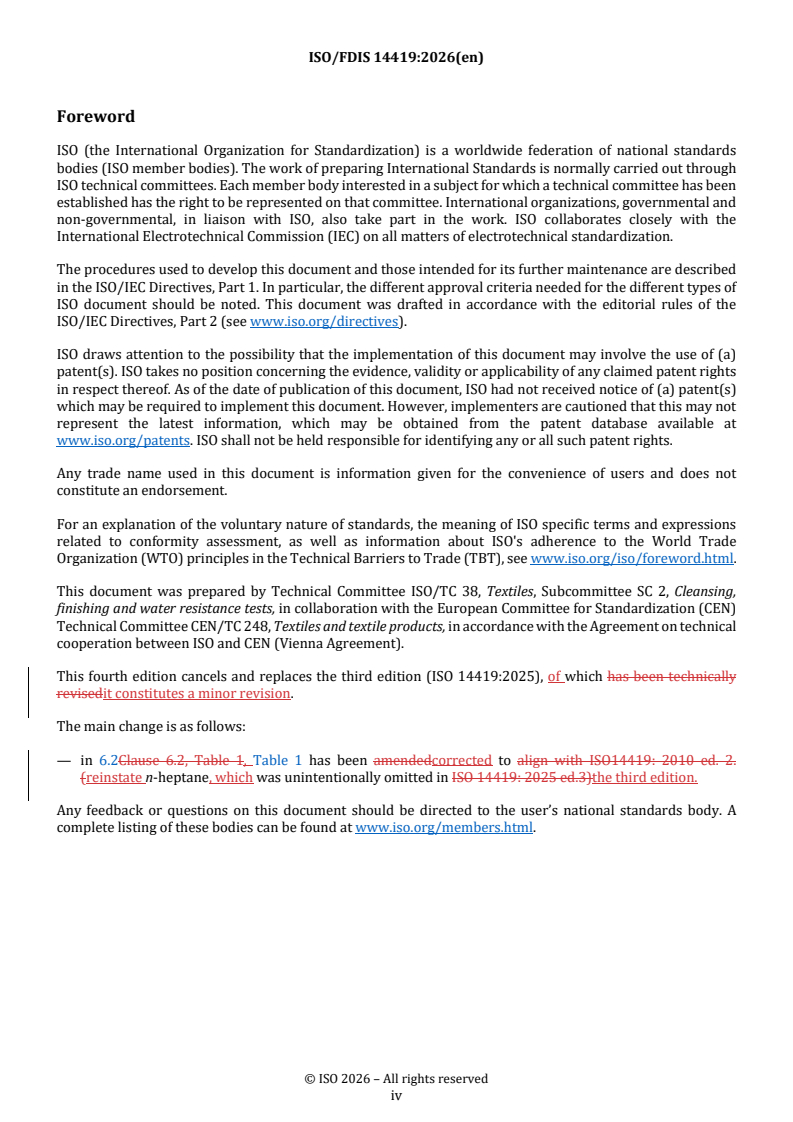
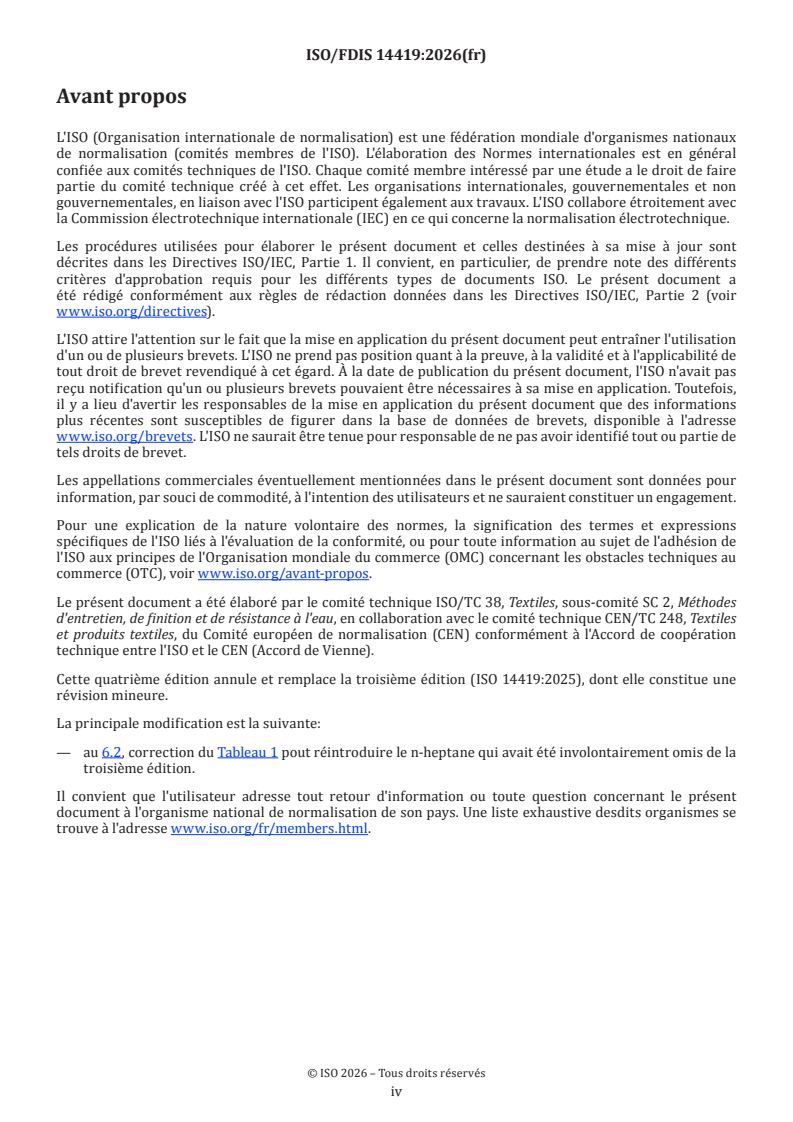
ISO/FDIS 14419 states that this fourth edition cancels and replaces ISO 14419:2025, with technical revision only. The main change is in Clause 6.2, Table 1, where the liquid list was corrected to align with ISO 14419:2010 edition 2 and n-heptane was reinstated.
Which standards are used with ISO/FDIS 14419?
ISO/FDIS 14419 names ISO 139 as the conditioning and testing atmosphere reference. That standard contributes the controlled temperature and relative humidity used before and during testing.
The bibliography also names ISO 6330, ISO 3175-1 to ISO 3175-6, and ISO 6530. ISO 6330 and the ISO 3175 series are used when checking the effect of washing or drycleaning treatments, while ISO 6530 is the reference for resistance to penetration by oil-based chemicals, which is a different property from repellency.
What does the ISO/FDIS 14419 document contain?
ISO/FDIS 14419 contains a full laboratory method, including the principle, safety precautions, reagent list, apparatus, specimen preparation, procedure, evaluation rules, result handling, and reporting items. It also includes Table 1 for the standard test liquids and Figure 1, which illustrates pass, borderline pass, and fail appearances.
Annex A provides the precision and bias statement, based on interlaboratory studies. That section is useful when comparing results between operators or laboratories and when judging whether two grades are meaningfully different.
Relations
- Consolidates
prEN ISO 14419 - Textiles - Oil repellency - Hydrocarbon resistance test (ISO/FDIS 14419:2026) - Effective Date
- 30-May-2026
- Effective Date
- 23-May-2026
Buy Documents
ISO/FDIS 14419 - Textiles — Oil repellency — Hydrocarbon resistance test
REDLINE ISO/FDIS 14419 - Textiles — Oil repellency — Hydrocarbon resistance test
ISO/FDIS 14419 - Textiles — Oléofugation — Essai de résistance aux hydrocarbures
Get Certified
Connect with accredited certification bodies for this standard

Control Union Certifications
Global certification for agriculture and sustainability.

Hohenstein Institut
Textile testing and certification.

Bureau Veritas Bangladesh
Bureau Veritas certification services in Bangladesh.
Sponsored listings
Frequently Asked Questions
ISO/FDIS 14419 is a draft published by the International Organization for Standardization (ISO). Its full title is "Textiles — Oil repellency — Hydrocarbon resistance test". This standard covers: This document specifies a method for the evaluation of a substrate's resistance to absorption of a selected series of liquid hydrocarbons of different surface tensions. This document provides guidance to oil stain resistance. It can provide a rough index of oil stain resistance as, generally, the higher the oil repellency grade, the better resistance to staining by oily materials, especially liquid oil substances. This is particularly true when comparing various finishes for a given substrate. This document can also be used to determine if washing and/or drycleaning treatments have any adverse effect on the oil repellency characteristics of a substrate. NOTE 1 Washing and drycleaning treatment procedures are described in ISO 6330 and ISO 3175 (all parts), respectively. This document is not intended to give an absolute measure of the resistance of the substrate to staining by all oily materials. Other factors, such as composition and viscosity of the oily substances, substrate construction, fibre type, dyes and other finishing agents, also influence stain resistance. This document is not intended to estimate the resistance to penetration of the substrate by oil-based chemicals. NOTE 2 For the evaluation of the resistance to penetration of the substrate by oil-based chemicals, see ISO 6530.
This document specifies a method for the evaluation of a substrate's resistance to absorption of a selected series of liquid hydrocarbons of different surface tensions. This document provides guidance to oil stain resistance. It can provide a rough index of oil stain resistance as, generally, the higher the oil repellency grade, the better resistance to staining by oily materials, especially liquid oil substances. This is particularly true when comparing various finishes for a given substrate. This document can also be used to determine if washing and/or drycleaning treatments have any adverse effect on the oil repellency characteristics of a substrate. NOTE 1 Washing and drycleaning treatment procedures are described in ISO 6330 and ISO 3175 (all parts), respectively. This document is not intended to give an absolute measure of the resistance of the substrate to staining by all oily materials. Other factors, such as composition and viscosity of the oily substances, substrate construction, fibre type, dyes and other finishing agents, also influence stain resistance. This document is not intended to estimate the resistance to penetration of the substrate by oil-based chemicals. NOTE 2 For the evaluation of the resistance to penetration of the substrate by oil-based chemicals, see ISO 6530.
ISO/FDIS 14419 is classified under the following ICS (International Classification for Standards) categories: 59.080.01 - Textiles in general. The ICS classification helps identify the subject area and facilitates finding related standards.
ISO/FDIS 14419 has the following relationships with other standards: It is inter standard links to prEN ISO 14419, ISO 14419:2025. Understanding these relationships helps ensure you are using the most current and applicable version of the standard.
ISO/FDIS 14419 is available in PDF format for immediate download after purchase. The document can be added to your cart and obtained through the secure checkout process. Digital delivery ensures instant access to the complete standard document.
Standards Content (Sample)
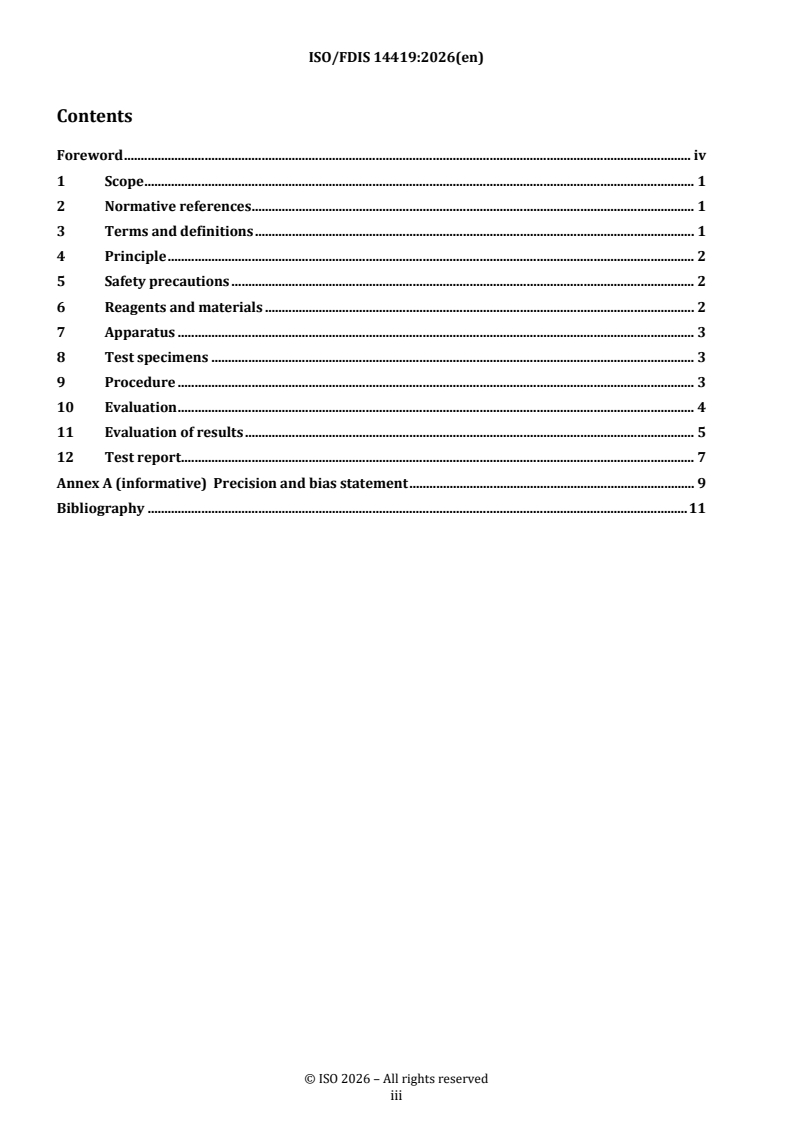
Contents
- 1 Scope
- 2 Normative references
- 3 Terms and definitions
- 3.1 grade, noun
- 3.2 oil repellency, noun
- 4 Principle
- 5 Safety precautions
- 6 Reagents and materials
- 7 Apparatus
- 8 Test specimens
- 9 Procedure
- 10 Evaluation
- 11 Evaluation of results
- 12 Test report
- Annex A
- Bibliography
1 Scope
This document specifies a method for the evaluation of a substrate's resistance to absorption of a selected series of liquid hydrocarbons of different surface tensions.
This document provides guidance to oil stain resistance. It can provide a rough index of oil stain resistance as, generally, the higher the oil repellency grade, the better resistance to staining by oily materials, especially liquid oil substances. This is particularly true when comparing various finishes for a given substrate. This document can also be used to determine if washing and/or drycleaning treatments have any adverse effect on the oil repellency characteristics of a substrate.
[1] [2] [3] NOTE 1 Washing and drycleaning treatment procedures are described in ISO 6330 , ISO 3175-1 , ISO 3175-2 , [4] [5] [6] [7] ISO 3175-3 , ISO 3175-4 , ISO 3175-5 and ISO 3175-6 .
This document is not intended to give an absolute measure of the resistance of the substrate to staining by all oily materials. Other factors, such as composition and viscosity of the oily substances, substrate construction, fibre type, dyes and other finishing agents, also influence stain resistance. This document is not intended to estimate the resistance to penetration of the substrate by oil-based chemicals. [1] NOTE 2 For the evaluation of the resistance to penetration of the substrate by oil-based chemicals, see ISO 6330 .
2 Normative references
The following documents are referred to in the text in such a way that some or all of their content constitutes requirements of this document. For dated references, only the edition cited applies. For undated references, the latest edition of the referenced document (including any amendments) applies. ISO 139, Textiles — Standard atmospheres for conditioning and testing
3 Terms and definitions
For the purposes of this document, the following terms and definitions apply. ISO and IEC maintain terminology databases for use in standardization at the following addresses:
- ISO Online browsing platform: available at https:// www .iso .org/ obp
- IEC Electropedia: available at https:// www .electropedia .org/
3.1 grade, noun
symbol for any step of a multistep standard reference scale for a quality characteristic Note 1 to entry: The grade is assigned to test specimens exhibiting a degree of the quality comparable to that step of the standard reference scale.
3.2 oil repellency, noun
characteristic of a fabric whereby it resists absorption of oily liquids
ISO/FDIS 14419:2026(en)
4 Principle
Drops of standard test liquids, consisting of a selected series of hydrocarbons with different surface tensions, are placed on the substrate surface and then observed for absorption, wicking and contact angle. The oil repellency grade is the highest numbered test liquid which is not absorbed by the substrate surface.
5 Safety precautions
WARNING — These safety precautions are for information purposes only. The precautions are ancillary to the testing procedures and are not intended to be all inclusive. It is the user's responsibility to use safe and proper techniques in handling materials in this document. The manufacturers should be consulted for specific detail such as material safety data sheets and other manufacturer's recommendations.
5.1 Good laboratory practices should be followed. Wear safety glasses and impervious gloves when handling test liquids in all laboratory areas.
5.2 Some of the hydrocarbons specified in this document are flammable. Keep away from heat, sparks and open flame. Use with adequate ventilation. Avoid prolonged breathing of vapour or contact with skin. Do not take internally.
6 Reagents and materials
6.1 All reagents shall be of a suitable analytical grade. Ensure the standard test liquids are used and stored at a temperature of (20 ± 2) °C. All reagents and standard test liquids have a maximum shelf life of three years.
6.2 Test liquids, prepared and numbered according to Table 1. The purity of test liquids affects surface tension of the liquid. Use only analytical grades of test liquids. 1) 6.3 White mineral oil, CAS Registry Number® (CAS RN®) 8042-47-5. Table 1 — Standard test liquids Density Surface tension Oil test liquid num- Composition ber kg/l N/m at 25 °C None (fails with white mineral oil) 0 — — White mineral oil 1 0,84 to 0,87 0,031 5 65:35 white mineral oil:
2 0,82 0,029 6 n-hexadecane by volume n-hexadecane 3 0,77 0,027 3 n-tetradecane 4 0,76 0,026 4 n-dodecane 5 0,75 0,024 7 n-decane 6 0,73 0,023 5 n-octane 7 0,70 0,021 4 n-heptane 8 0,69 0,019 8 1) CAS Registry Number® (CAS RN®) is a trademark of the American Chemical Society (ACS). This information is given for the convenience of users of this document and does not constitute an endorsement by ISO of the product named. Equivalent products may be used if they can be shown to lead to the same results.
ISO/FDIS 14419:2026(en) 2) 6.4 White textile blotting paper , of approximately (0,71 ± 0,10) mm in thickness, weight of (370 ± 5 ) g/
m and an absorbent capacity of (220 ± 30) %.
7 Apparatus
7.1 Dropping bottles, each marked with the appropriate oil test liquid number, to which, for convenience, it is desirable to transfer the test liquids from stock solutions. A typical system found useful consists of 60 ml dropping bottles with ground-in pipettes and neoprene bulbs. Prior to use, the bulbs should be soaked in heptane for several hours and then rinsed in fresh heptane to remove soluble substances. It has been found helpful to place the test liquids in sequential order on a wooden platform on the grading table. 7.2 Laboratory gloves, of general purpose are sufficient.
...
Contents
- 1 Scope
- 2 Normative references
- 3 Terms and definitions
- 3.1 grade, noun
- 3.2 oil repellency, noun
- 4 Principle
- 5 Safety precautions
- 6 Reagents and materials
- 6.4 2) 2
- 7 Apparatus
- 8 Test specimens
- 9 Procedure
- 10 Evaluation
- 11 Evaluation of results
- 12 Test report
- Annex A
- Bibliography
1 Scope
This document specifies a method for the evaluation of a substrate's resistance to absorption of a selected series of liquid hydrocarbons of different surface tensions.
This document provides guidance to oil stain resistance. It can provide a rough index of oil stain resistance as, generally, the higher the oil repellency grade, the better resistance to staining by oily materials, especially liquid oil substances. This is particularly true when comparing various finishes for a given substrate. This document can also be used to determine if washing and/or drycleaning treatments have any adverse effect on the oil repellency characteristics of a substrate.
[1] [2] [3] NOTE 1 Washing and drycleaning treatment procedures are described in ISO 6330 , ISO 3175-1 , ISO 3175-2 , [4] [5] [6] [7] ISO 3175-3 , ISO 3175-4 , ISO 3175-5 and ISO 3175-6 ISO 6330 and ISO 3175 (all parts), respectively.. This document is not intended to give an absolute measure of the resistance of the substrate to staining by all oily materials. Other factors, such as composition and viscosity of the oily substances, substrate construction, fibre type, dyes and other finishing agents, also influence stain resistance. This document is not intended to estimate the resistance to penetration of the substrate by oil-based chemicals. NOTE 2 For the evaluation of the resistance to penetration of the substrate by oil-based chemicals, see ISO [1] 6330 ISO 6530..
2 Normative references
There are no normative references in this document.
The following documents are referred to in the text in such a way that some or all of their content constitutes requirements of this document. For dated references, only the edition cited applies. For undated references, the latest edition of the referenced document (including any amendments) applies. ISO 139, Textiles — Standard atmospheres for conditioning and testing
3 Terms and definitions
For the purposes of this document, the following terms and definitions apply. ISO and IEC maintain terminology databases for use in standardization at the following addresses:
- ISO Online browsing platform: available at https://www.iso.org/obp
- IEC Electropedia: available at https://www.electropedia.org/
3.1 grade, noun
symbol for any step of a multistep standard reference scale for a quality characteristic Note 1 to entry: The grade is assigned to test specimens exhibiting a degree of the quality comparable to that step of the standard reference scale.
3.2 oil repellency, noun
characteristic of a fabric whereby it resists absorption of oily liquids
ISO/FDIS 14419:2026(en)
4 Principle
Drops of standard test liquids, consisting of a selected series of hydrocarbons with different surface tensions, are placed on the substrate surface and then observed for absorption, wicking and contact angle. The oil repellency grade is the highest numbered test liquid which is not absorbed by the substrate surface.
5 Safety precautions
WARNING — These safety precautions are for information purposes only. The precautions are ancillary to the testing procedures and are not intended to be all inclusive. It is the user's responsibility to use safe and proper techniques in handling materials in this document. The manufacturers should be consulted for specific detail such as material safety data sheets and other manufacturer's recommendations.
5.1 Good laboratory practices should be followed. Wear safety glasses and impervious gloves when handling test liquids in all laboratory areas.
5.2 Some of the hydrocarbons specified in this document are flammable. Keep away from heat, sparks and open flame. Use with adequate ventilation. Avoid prolonged breathing of vapour or contact with skin. Do not take internally.
6 Reagents and materials
6.1 All reagents shall be of a suitable analytical grade. Ensure the standard test liquids are used and stored at a temperature of (20 ± 2) °C. All reagents and standard test liquids have a maximum shelf life of three years. 6.2 Test liquids, prepared and numbered according to Table 1. The purity of test liquids affects surface tension of the liquid. Use only analytical grades of test liquids.
6.3 1) White mineral oil, CAS Registry Number® (CAS RN®) 8042-47-5.
Table 1 — Standard test liquids Density Surface tension Oil test liquid Composition number kg/l N/m at 25 °C None (fails with white mineral oil) 0 — — White mineral oil 1 0,84 to 0,87 0,031 5 65:35 white mineral oil:
2 0,82 0,029 6 n-hexadecane by volume
1) CAS Registry Number® (CAS RN®) is a trademark of the American Chemical Society (ACS). This information is given for the convenience of users of this document and does not constitute an endorsement by ISO of the product named. Equivalent products may be used if they can be shown to lead to the same results.
ISO/FDIS 14419:2026(en) Density Surface tension Oil test liquid Composition number kg/l N/m at 25 °C n-hexadecane 3 0,77 0,027 3 n-tetradecane 4 0,76 0,026 4 n-dodecane 5 0,75 0,024 7 n-decane 6 0,73 0,023 5 n-octane 7 0,70 0,021 4 n-heptane 8 0,69 0,019 8
6.4 2) 2
White textile blotting paper , of approximately (0,71 ± 0,10) mm in thickness, weight of (370 ± 5 ) g/m and an absorbent capacity of (220 ± 30) %.
7 Apparatus
7.1 Dropping bottles, each marked with the appropriate oil test liquid number, to which, for convenience, it is desirable to transfer the test liquids from stock solutions. A typical system found useful consists of 60 ml dropping bottles with ground-in pipettes and neoprene bulbs. Prior to use, the bulbs should be soaked in heptane for several hours and then rinsed in fresh heptane to remove soluble substances. It has been found helpful to place the test liquids in sequential order on a wooden platform on the grading table. 7.2 Laboratory gloves, of general purpose are sufficient.
...
Contents
- 1 Domaine d'application
- 2 Références normatives
- 3 Termes et définitions
- 3.1 classe, nom
- 3.2 oléofugation, nom
- 4 Principe
- 5 Précautions de sécurité
- 6 Réactifs et matériaux
- 6.4 Buvard en textile blanc , ayant une épaisseur d'environ (0,71 ± 0,10) mm, un grammage de
- 7 Appareillage
- 8 Éprouvettes
- 9 Mode opératoire
- 10 Évaluation
- 11 Évaluation des résultats
- 12 Rapport d'essai
- Annexe A
- Bibliographie
1 Domaine d'application
Le présent document spécifie une méthode d'évaluation de la résistance d'un substrat à la pénétration par une série d'hydrocarbures liquides sélectionnés présentant des tensions de surface différentes. Le présent document fournit des recommandations relatives à la détermination de la résistance aux taches d'huile. Il peut servir d'indice approximatif de la résistance aux taches d'huile dans la mesure où, de manière générale, la résistance au tachage par des matériaux huileux, en particulier des substances huileuses liquides, est d'autant plus grande que la classe d'oléofugation est élevée. Cela se vérifie en particulier lors de la comparaison des divers apprêts ou finissages d'un substrat donné. Le présent document peut également être utilisé pour déterminer si les traitements de lavage et/ou de nettoyage à sec ont des effets défavorables sur les caractéristiques d'oléofugation d'un substrat.
NOTE 1 Des traitements appropriés de lavage et de nettoyage à sec sont décrits dans [1] [2] [3] [4] [5] [6] [7] l'ISO 6330, l'ISO 3175-1, l'ISO 3175-2, l'ISO 3175-3, l'ISO 3175-4, l'ISO 3175-5 et l'ISO 3175-6 . Le présent document n'a pas pour objet de fournir une mesure absolue de la résistance des substrats au tachage par tous les matériaux huileux. D'autres facteurs, tels que la composition et la viscosité des substances huileuses, la conception des substrats, le type de fibre, les colorants et autres agents d'apprêt ou de finissage, influent également sur la résistance aux taches. Le présent document n'est pas destiné à l'évaluation de la résistance du substrat à la pénétration par des produits chimiques à base d'huile. NOTE 2 Pour l'évaluation de la résistance d'un substrat à la pénétration par des produits chimiques à base d'huile, [1] voir l'ISO 6330 .
2 Références normatives
Les documents suivants sont cités dans le texte de sorte qu'ils constituent, pour tout ou partie de leur contenu, des exigences du présent document. Pour les références datées, seule l'édition citée s'applique. Pour les références non datées, la dernière édition du document de référence s'applique (y compris les éventuels amendements).
ISO 139, Textiles — Atmosphères normales de conditionnement et d'essai
3 Termes et définitions
Pour les besoins du présent document, les termes et définitions suivants s'appliquent. L'ISO et l'IEC tiennent à jour des bases de données terminologiques destinées à être utilisées en normalisation, consultables aux adresses suivantes:
- ISO Online browsing platform: disponible à l'adresse https:// www .iso .org/ obp
- IEC Electropedia: disponible à l'adresse https:// www .electropedia .org/
ISO/FDIS 14419:2026(fr)
3.1 classe, nom
valeur que peut prendre n'importe quel échelon d'une échelle de référence normalisée pour les caractéristiques liées à la qualité Note 1 à l'article: Cette valeur est attribuée aux éprouvettes présentant un degré de qualité comparable à l'échelon de l'échelle de référence normalisée.
3.2 oléofugation, nom
aptitude d'une étoffe à résister à la pénétration par des liquides à base d'huile
4 Principe
Des gouttes de liquides d'essai normalisés, issus d'une série d'hydrocarbures sélectionnés présentant des tensions de surface différentes, sont déposées à la surface du substrat. La pénétration des gouttes, l'effet de mèche et l'angle de contact sont ensuite observés. La classe d'oléofugation du substrat correspond au numéro de liquide d'essai le plus élevé parmi les liquides d'essai n'ayant pas été absorbés par le substrat.
5 Précautions de sécurité
AVERTISSEMENT — Ces précautions de sécurité sont données à titre d'information uniquement. Elles s'ajoutent aux modes opératoires d'essai et ne sont pas censées couvrir tous les risques. Il incombe à l'utilisateur d'appliquer des techniques sûres et appropriées lors de la manipulation des produits indiqués dans le présent document. Il convient de s'adresser aux fabricants afin de se procurer les informations spécifiques, telles que les fiches de données de sécurité et autres recommandations. 5.1 Il convient de respecter les bonnes pratiques de laboratoire. Porter des lunettes de sécurité et des gants imperméables lors de la manipulation des liquides d'essai partout dans le laboratoire. 5.2 Certains des hydrocarbures spécifiés dans le présent document sont inflammables. Les conserver à l'abri de la chaleur, des étincelles et des flammes nues. Les utiliser dans un environnement suffisamment ventilé. Éviter l'inhalation prolongée d'émanations d'hydrocarbures ou tout contact avec la peau. Ne pas ingérer.
6 Réactifs et matériaux
6.1 Tous les réactifs doivent être de qualité analytique appropriée. S'assurer que les liquides d'essai normalisés sont utilisés et conservés à une température de (20 ± 2) °C. Tous les réactifs et tous les liquides d'essai normalisés ont une durée maximale de conservation de trois ans. 6.2 Liquides d'essai, préparés et numérotés conformément au Tableau 1. La pureté des liquides d'essai a une influence sur la tension de surface du liquide. Utiliser uniquement des liquides d'essai de qualité analytique.
ISO/FDIS 14419:2026(fr) 1) 6.3 Huile minérale blanche, numéro de registre CAS® (CAS RN®) 8042-47-5. Tableau 1 — Liquides d'essai normalisés Numéro du liquide Masse volumique Tension de surface Composition d'essai à base kg/l N/m à 25 °C d'huile Aucune (correspond à la pénétration totale par
l'huile blanche) Huile minérale blanche 1 0,84 à 0,87 0,031 5 Huile minérale blanche/n-hexadécane (65:35 en 2 0,82 0,029 6 volume) n-hexadécane 3 0,77 0,027 3 n-tétradécane 4 0,76 0,026 4 n-dodécane 5 0,75 0,024 7 n-décane 6 0,73 0,023 5 n-octane 7 0,70 0,021 4 n-heptane 8 0,69 0,019 8 2)
6.4 Buvard en textile blanc , ayant une épaisseur d'environ (0,71 ± 0,10) mm, un grammage de
(370 ± 5) g/m et une capacité d'absorption de (220 ± 30) %.
7 Appareillage
7.1 Compte-gouttes, portant chacun l'indication du numéro du liquide d'essai approprié, dans lesquels il est souhaitable, pour des raisons pratiques, de transférer les liquides d'essai issus des solutions-mères. Un système type qui s'est avéré utile est constitué de compte-gouttes de 60 ml munis de pipettes rodées et de poires en polychloroprène. Il convient de mettre les poires à tremper dans de l'heptane plusieurs heures avant l'utilisation, et de les rincer ensuite dans une nouvelle solution d'heptane pour éliminer les substances solubles. Un procédé commode consiste à disposer les liquides d'essai en ordre consécutif sur un plateau en bois sur la table d'évaluation.
7.2 Gants de laboratoire, d'usage général.
...