


ISO/IEC 14496-12:2020
(Main)Information technology — Coding of audio-visual objects — Part 12: ISO base media file format
Information technology — Coding of audio-visual objects — Part 12: ISO base media file format
This document specifies the ISO base media file format, which is a general format forming the basis for a number of other more specific file formats. This format contains the timing, structure, and media information for timed sequences of media data, such as audio-visual presentations.
Technologies de l'information — Codage des objets audiovisuels — Partie 12: Format ISO de base pour les fichiers médias
General Information
- Status
- Withdrawn
- Publication Date
- 15-Dec-2020
- Technical Committee
- ISO/IEC JTC 1/SC 29 - Coding of audio, picture, multimedia and hypermedia information
- Drafting Committee
- ISO/IEC JTC 1/SC 29/WG 3 - MPEG Systems
- Current Stage
- 9599 - Withdrawal of International Standard
- Start Date
- 25-Jan-2022
- Completion Date
- 12-Feb-2026
Relations
- Consolidated By
ISO/TS 14265:2024 - Health informatics — Classification of purposes for processing personal health information - Effective Date
- 06-Jun-2022
- Effective Date
- 04-Sep-2021
- Effective Date
- 23-Apr-2020
- Effective Date
- 23-Apr-2020
- Effective Date
- 02-Sep-2017



Get Certified
Connect with accredited certification bodies for this standard

BSI Group
BSI (British Standards Institution) is the business standards company that helps organizations make excellence a habit.

NYCE
Mexican standards and certification body.
Sponsored listings
Frequently Asked Questions
ISO/IEC 14496-12:2020 is a standard published by the International Organization for Standardization (ISO). Its full title is "Information technology — Coding of audio-visual objects — Part 12: ISO base media file format". This standard covers: This document specifies the ISO base media file format, which is a general format forming the basis for a number of other more specific file formats. This format contains the timing, structure, and media information for timed sequences of media data, such as audio-visual presentations.
This document specifies the ISO base media file format, which is a general format forming the basis for a number of other more specific file formats. This format contains the timing, structure, and media information for timed sequences of media data, such as audio-visual presentations.
ISO/IEC 14496-12:2020 is classified under the following ICS (International Classification for Standards) categories: 35.040.40 - Coding of audio, video, multimedia and hypermedia information. The ICS classification helps identify the subject area and facilitates finding related standards.
ISO/IEC 14496-12:2020 has the following relationships with other standards: It is inter standard links to ISO/TS 14265:2024, ISO/IEC 14496-12:2022, ISO/IEC 14496-12:2015/Amd 1:2017, ISO/IEC 14496-12:2015/Amd 2:2018, ISO/IEC 14496-12:2015. Understanding these relationships helps ensure you are using the most current and applicable version of the standard.
ISO/IEC 14496-12:2020 is available in PDF format for immediate download after purchase. The document can be added to your cart and obtained through the secure checkout process. Digital delivery ensures instant access to the complete standard document.
Standards Content (Sample)
INTERNATIONAL ISO/IEC
STANDARD 14496-12
Sixth edition
2020-12
Information technology — Coding of
audio-visual objects —
Part 12:
ISO base media file format
Technologies de l'information — Codage des objets audiovisuels —
Partie 12: Format ISO de base pour les fichiers médias
Reference number
©
ISO/IEC 2020
© ISO/IEC 2020
All rights reserved. Unless otherwise specified, or required in the context of its implementation, no part of this publication may
be reproduced or utilized otherwise in any form or by any means, electronic or mechanical, including photocopying, or posting
on the internet or an intranet, without prior written permission. Permission can be requested from either ISO at the address
below or ISO’s member body in the country of the requester.
ISO copyright office
CP 401 • Ch. de Blandonnet 8
CH-1214 Vernier, Geneva
Phone: +41 22 749 01 11
Email: copyright@iso.org
Website: www.iso.org
Published in Switzerland
ii © ISO/IEC 2020 – All rights reserved
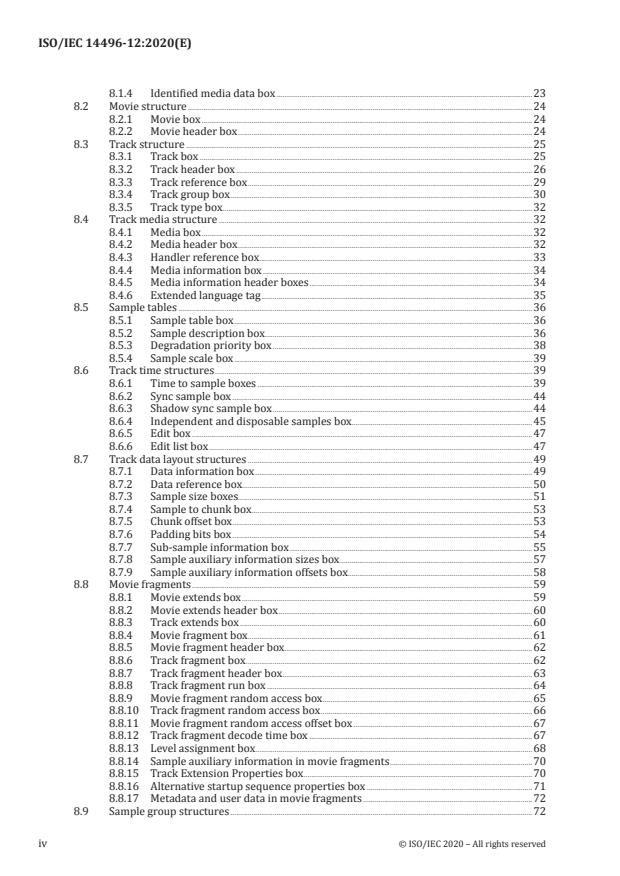
Contents Page
Foreword .ix
Introduction .x
1 Scope . 1
2 Normative references . 1
3 Terms, definitions and abbreviated terms . 2
3.1 Terms and definitions . 2
3.2 Abbreviated terms . 6
4 Object-structured file organization . 6
4.1 File structure . 6
4.2 Object structure. 6
4.2.1 Object syntax conventions . 6
4.2.2 Object definitions . 7
4.3 File-type box . 9
4.3.1 Definition . 9
4.3.2 Syntax . 9
4.3.3 Semantics . 9
4.4 Extended type box .10
4.4.1 Definition .10
4.4.2 Syntax .10
4.4.3 Semantics .10
5 Design considerations .10
5.1 Usage.10
5.1.1 Multi-purpose .10
5.1.2 Interchange .11
5.1.3 Content creation .11
5.1.4 Preparation for streaming .11
5.1.5 Local presentation .12
5.1.6 Streamed presentation .12
5.2 Design principles .12
6 ISO base media file organization .13
6.1 Presentation structure .13
6.1.1 Referencing external data .13
6.1.2 Object structure .13
6.1.3 Meta data and media data .13
6.1.4 Track identifiers .13
6.2 Metadata structure (objects) .14
6.2.1 Box . .14
6.2.2 Data types and fields .14
6.2.3 Box order .15
6.2.4 URIs as type indicators .18
6.3 Brand identification .19
6.4 Time structure overview .19
7 Streaming support .19
7.1 Handling of streaming protocols .19
7.2 Protocol ‘hint’ tracks .20
7.3 Hint track format .20
8 Box structures .22
8.1 File structure and general boxes .22
8.1.1 Media data box . .22
8.1.2 Free space box .22
8.1.3 Progressive download information box .23
© ISO/IEC 2020 – All rights reserved iii
8.1.4 Identified media data box .23
8.2 Movie structure .24
8.2.1 Movie box .24
8.2.2 Movie header box .24
8.3 Track structure .25
8.3.1 Track box .25
8.3.2 Track header box .26
8.3.3 Track reference box .29
8.3.4 Track group box .30
8.3.5 Track type box .32
8.4 Track media structure .32
8.4.1 Media box .32
8.4.2 Media header box .32
8.4.3 Handler reference box .33
8.4.4 Media information box .34
8.4.5 Media information header boxes .34
8.4.6 Extended language tag .35
8.5 Sample tables .36
8.5.1 Sample table box .36
8.5.2 Sample description box .36
8.5.3 Degradation priority box .38
8.5.4 Sample scale box .39
8.6 Track time structures .39
8.6.1 Time to sample boxes .39
8.6.2 Sync sample box .44
8.6.3 Shadow sync sample box .44
8.6.4 Independent and disposable samples box.45
8.6.5 Edit box .47
8.6.6 Edit list box .47
8.7 Track data layout structures .49
8.7.1 Data information box .49
8.7.2 Data reference box.50
8.7.3 Sample size boxes.51
8.7.4 Sample to chunk box . .53
8.7.5 Chunk offset box .53
8.7.6 Padding bits box .54
8.7.7 Sub-sample information box .55
8.7.8 Sample auxiliary information sizes box .57
8.7.9 Sample auxiliary information offsets box.58
8.8 Movie fragments .59
8.8.1 Movie extends box .59
8.8.2 Movie extends header box .60
8.8.3 Track extends box .60
8.8.4 Movie fragment box . .61
8.8.5 Movie fragment header box.62
8.8.6 Track fragment box .62
8.8.7 Track fragment header box .63
8.8.8 Track fragment run box .64
8.8.9 Movie fragment random access box .65
8.8.10 Track fragment random access box .66
8.8.11 Movie fragment random access offset box .67
8.8.12 Track fragment decode time box .67
8.8.13 Level assignment box .68
8.8.14 Sample auxiliary information in movie fragments .70
8.8.15 Track Extension Properties box .70
8.8.16 Alternative startup sequence properties box .71
8.8.17 Metadata and user data in movie fragments .72
8.9 Sample group structures .72
iv © ISO/IEC 2020 – All rights reserved
8.9.1 Overview .72
8.9.2 Sample to group box .73
8.9.3 Sample group description box .74
8.9.4 Representation of group structures in movie fragments .76
8.9.5 Compact sample to group box .77
8.10 User data .79
8.10.1 User data box .79
8.10.2 Copyright box . .79
8.10.3 Track selection box .80
8.10.4 Track kind .81
8.11 Metadata support .82
8.11.1 MetaBox .82
8.11.2 XML boxes .83
8.11.3 Item location box .84
8.11.4 Primary item box .86
8.11.5 Item protection box .87
8.11.6 Item information box .87
8.11.7 Additional metadata container box .90
8.11.8 Metabox Relation box .90
8.11.9 URL forms for MetaBoxes .90
8.11.10 Static metadata .90
8.11.11 Item data box .91
8.11.12 Item reference box.92
8.11.13 Auxiliary video metadata .93
8.11.14 Item properties box .93
8.11.15 Brand item property .94
8.12 Support for protected streams .95
8.12.1 Overview .95
8.12.2 Protection scheme information box .96
8.12.3 Original format box . .97
8.12.4 IPMPInfoBox .97
8.12.5 IPMP control box .97
8.12.6 Scheme type box .97
8.12.7 Scheme information box .98
8.12.8 Scramble Scheme Information Box .98
8.13 File delivery format support .99
8.13.1 Overview .99
8.13.2 FD item information box .99
8.13.3 File partition box .100
8.13.4 FEC reservoir box .101
8.13.5 FD session group box .102
8.13.6 Group ID to name box .103
8.13.7 File reservoir box . .103
8.14 Sub tracks .104
8.14.1 Overview .104
8.14.2 Backward compatibility .104
8.14.3 Sub track box .105
8.14.4 Sub track information box .105
8.14.5 Sub track definition box .106
8.14.6 Sub track sample group box .106
8.15 Post-decoder requirements on media .107
8.15.1 General.107
8.15.2 Restricted sample entry transformation .107
8.15.3 Restricted scheme information box .108
8.15.4 Scheme for stereoscopic video arrangements .108
8.15.5 Compatible scheme type box .110
8.16 Segments .111
8.16.1 Overview .111
© ISO/IEC 2020 – All rights reserved v
8.16.2 Segment type box .111
8.16.3 Segment index box .111
8.16.4 Subsegment index box .115
8.16.5 Producer reference time box .116
8.17 Support for incomplete tracks .118
8.17.1 General.118
8.17.2 Transformation .119
8.17.3 Complete track information box .119
8.18 Entity grouping .119
8.18.1 General.119
8.18.2 Groups list box .120
8.18.3 Entity to group box .120
8.19 Compressed boxes .121
8.19.1 Overview and processing .121
8.19.2 Processing model .121
8.19.3 General syntax . . .123
8.19.4 General semantics .123
8.19.5 Original file-type box .123
8.19.6 Compressed movie box .123
8.19.7 Compressed movie fragment box .124
8.19.8 Compressed segment index box .124
8.19.9 Compressed subsegment index box .125
9 Hint track formats .125
9.1 RTP and SRTP hint track format .125
9.1.1 Overview .125
9.1.2 Sample description format .126
9.1.3 Sample format .127
9.1.4 SDP information .129
9.1.5 Statistical information . .130
9.2 ALC/LCT and FLUTE hint track format .131
9.2.1 Overview .131
9.2.2 Design principles .131
9.2.3 Sample description format .133
9.2.4 Sample format .133
9.3 MPEG-2 transport hint track format .136
9.3.1 Overview .136
9.3.2 Design principles .137
9.3.3 Sample description format .138
9.3.4 Sample format .140
9.3.5 Protected MPEG 2 transport stream hint track .142
9.4 RTP, RTCP, SRTP and SRTCP reception hint tracks .143
9.4.1 RTP reception hint track .143
9.4.2 RTCP reception hint track .146
9.4.3 SRTP reception hint track .147
9.4.4 SRTCP reception hint tracks .149
9.4.5 Protected RTP reception hint track .150
9.4.6 Recording procedure .150
9.4.7 Parsing procedure .150
10 Sample groups .150
10.1 Random access recovery points .150
10.1.1 Definition .150
10.1.2 Syntax .151
10.1.3 Semantics .151
10.2 Rate share groups .151
10.2.1 Overview .151
10.2.2 Rate share sample group entry .152
10.2.3 Relationship between tracks .153
vi © ISO/IEC 2020 – All rights reserved
10.2.4 Bitrate allocation .154
10.3 Alternative startup sequences .154
10.3.1 Definition .154
10.3.2 Syntax .155
10.3.3 Semantics .155
10.3.4 Examples .155
10.4 Random access point (RAP) sample group .157
10.4.1 Definition .157
10.4.2 Syntax .157
10.4.3 Semantics .157
10.5 Temporal level sample group .157
10.5.1 Definition .157
10.5.2 Syntax .158
10.5.3 Semantics .158
10.6 Stream access point sample group .158
10.6.1 Definition .158
10.6.2 Syntax .
...
Questions, Comments and Discussion
Ask us and Technical Secretary will try to provide an answer. You can facilitate discussion about the standard in here.
Loading comments...