

ISO 1520:2006
(Main)Paints and varnishes — Cupping test
General Information
- Abstract
ISO 1520:2006 specifies an empirical test procedure for assessing the resistance of a coating of paint, varnish or related product to cracking and/or detachment from a metal substrate when subjected to gradual deformation by indentation under standard conditions. For a multi-coat system, each coat may be tested separately or the complete system may be tested. The method may be carried out as follows: either as a 'pass/fail' test, by testing to a specified depth of indentation to assess compliance with a particular requirement; or by gradually increasing the depth of indentation to determine the minimum depth at which the coating cracks and/or becomes detached from the substrate.
- Status
- Published
- Publication Date
- 14-Nov-2006
- Technical Committee
- ISO/TC 35/SC 9 - General test methods for paints and varnishes
- Drafting Committee
- ISO/TC 35/SC 9 - General test methods for paints and varnishes
- Current Stage
- 9093 - International Standard confirmed
- Start Date
- 11-Jun-2026
- Completion Date
- 29-Aug-2026
Buy Documents
ISO 1520:2006 - Paints and varnishes -- Cupping test
ISO 1520:2006 - Paints and varnishes — Cupping test/15/2006
ISO 1520:2006 - Peintures et vernis -- Essai d'emboutissage
ISO 1520:2006 - Peintures et vernis — Essai d'emboutissage/15/2006
ISO 1520:2006 - Paints and varnishes — Cupping test/14/2008
Overview
ISO 1520:2006 - Paints and varnishes - Cupping test specifies an empirical test method to assess a coating’s resistance to cracking and/or detachment from a metal substrate when the coated panel is gradually deformed by indentation. The method can be applied to single or multi-coat systems either as a pass/fail test at a specified indentation depth or to determine the minimum indentation depth that causes coating failure.
Key topics and technical requirements
- Principle: A hemispherical indenter pushes a coated flat metal panel into a drawing die to form a dome; coating is inspected for cracking or detachment.
- Apparatus: Drawing die and retaining ring (plane-polished), and a hardened polished hemispherical indenter 20 mm diameter. Indenter travel must stay within 0.1 mm of die axis; rotational movement is prevented.
- Test speed and measurement: Indenter rate 0.1–0.3 mm/s. Depth measured to 0.1 mm; panel thickness to 0.01 mm.
- Test panels: Rectangular metal panels, thickness 0.3–1.25 mm. Indentation centers ≥ 35 mm from edges and ≥ 70 mm apart. Coating thickness measured per ISO 2808.
- Conditioning: Unless agreed otherwise, condition coated panels at (23 ± 2) °C and (50 ± 5) % RH for at least 16 h before testing. Tests are carried out in duplicate.
- Result reporting: Report pass/fail at specified depth or the mean maximum depth (mean of two valid results) to 0.1 mm. Specify whether visual inspection used normal corrected vision or magnification (×10).
- Precision: Repeatability r = ±1 mm; reproducibility R = ±2 mm (95 % probability).
- Test report: Must identify product, reference ISO 1520:2006, supplementary conditions (substrate, application, drying, thickness), apparatus type, deviations and anomalies, and date.
Applications and users
ISO 1520 is used for:
- Quality control and acceptance testing of paints, varnishes and related coatings on metal substrates.
- Comparative performance testing during formulation development.
- Verification of coating resistance for manufacturers, coatings laboratories, OEMs, specifiers, and corrosion-protection engineers.
- Contractual or regulatory compliance where a cupping deformation resistance requirement is specified.
Keywords: ISO 1520, cupping test, paint testing, coating adhesion, resistance to cracking, metal substrate, indentation test, coating performance.
Related standards
- ISO 1513, ISO 1514, ISO 15528, ISO 2808 (normative references for sampling, panels and film thickness).
- Other deformation/impact tests in the same family: ISO 1519 (bend test), ISO 6272‑1/‑2 (impact / falling-weight tests), ISO 6860 (conical mandrel), ISO 17132 (T-bend).
Relations
- Referred By
EN ISO 3248:2016 - Paints and varnishes - Determination of the effect of heat (ISO 3248:2016) - Effective Date
- 25-Aug-2026
- Effective Date
- 25-Aug-2026
- Effective Date
- 25-Aug-2026
- Effective Date
- 12-Feb-2026
- Effective Date
- 06-Jun-2022
- Consolidated By
ISO 22007-4:2017 - Plastics — Determination of thermal conductivity and thermal diffusivity — Part 4: Laser flash method - Effective Date
- 06-Jun-2022
- Effective Date
- 15-Apr-2008
Buy Documents
ISO 1520:2006 - Paints and varnishes -- Cupping test
ISO 1520:2006 - Paints and varnishes — Cupping test/15/2006
ISO 1520:2006 - Peintures et vernis -- Essai d'emboutissage
ISO 1520:2006 - Peintures et vernis — Essai d'emboutissage/15/2006
ISO 1520:2006 - Paints and varnishes — Cupping test/14/2008
Frequently Asked Questions
ISO 1520:2006 is a standard published by the International Organization for Standardization (ISO). Its full title is "Paints and varnishes — Cupping test". This standard covers: ISO 1520:2006 specifies an empirical test procedure for assessing the resistance of a coating of paint, varnish or related product to cracking and/or detachment from a metal substrate when subjected to gradual deformation by indentation under standard conditions. For a multi-coat system, each coat may be tested separately or the complete system may be tested. The method may be carried out as follows: either as a 'pass/fail' test, by testing to a specified depth of indentation to assess compliance with a particular requirement; or by gradually increasing the depth of indentation to determine the minimum depth at which the coating cracks and/or becomes detached from the substrate.
ISO 1520:2006 specifies an empirical test procedure for assessing the resistance of a coating of paint, varnish or related product to cracking and/or detachment from a metal substrate when subjected to gradual deformation by indentation under standard conditions. For a multi-coat system, each coat may be tested separately or the complete system may be tested. The method may be carried out as follows: either as a 'pass/fail' test, by testing to a specified depth of indentation to assess compliance with a particular requirement; or by gradually increasing the depth of indentation to determine the minimum depth at which the coating cracks and/or becomes detached from the substrate.
ISO 1520:2006 is classified under the following ICS (International Classification for Standards) categories: 87.040 - Paints and varnishes. The ICS classification helps identify the subject area and facilitates finding related standards.
ISO 1520:2006 has the following relationships with other standards: It is inter standard links to EN ISO 3248:2016, EN ISO 22553-15:2023, EN ISO 16927:2014, EN ISO 1520:2006, ISO 7823-2:1996, ISO 22007-4:2017, ISO 1520:1999. Understanding these relationships helps ensure you are using the most current and applicable version of the standard.
ISO 1520:2006 is available in PDF format for immediate download after purchase. The document can be added to your cart and obtained through the secure checkout process. Digital delivery ensures instant access to the complete standard document.
Standards Content (Sample)
INTERNATIONAL ISO
STANDARD 1520
Third edition
2006-11-15
Paints and varnishes — Cupping test
Peintures et vernis — Essai d'emboutissage
Reference number
©
ISO 2006
PDF disclaimer
This PDF file may contain embedded typefaces. In accordance with Adobe's licensing policy, this file may be printed or viewed but shall
not be edited unless the typefaces which are embedded are licensed to and installed on the computer performing the editing. In
downloading this file, parties accept therein the responsibility of not infringing Adobe's licensing policy. The ISO Central Secretariat
accepts no liability in this area.
Adobe is a trademark of Adobe Systems Incorporated.
Details of the software products used to create this PDF file can be found in the General Info relative to the file; the PDF-creation
parameters were optimized for printing. Every care has been taken to ensure that the file is suitable for use by ISO member bodies. In the
unlikely event that a problem relating to it is found, please inform the Central Secretariat at the address given below.
All rights reserved. Unless otherwise specified, no part of this publication may be reproduced or utilized in any form or by any means,
electronic or mechanical, including photocopying and microfilm, without permission in writing from either ISO at the address below or
ISO's member body in the country of the requester.
ISO copyright office
Case postale 56 CH-1211 Geneva 20
Tel. + 41 22 749 01 11
Fax + 41 22 749 09 47
E-mail copyright@iso.org
Web www.iso.org
Published in Switzerland
©
ii ISO 2006 – All rights reserved
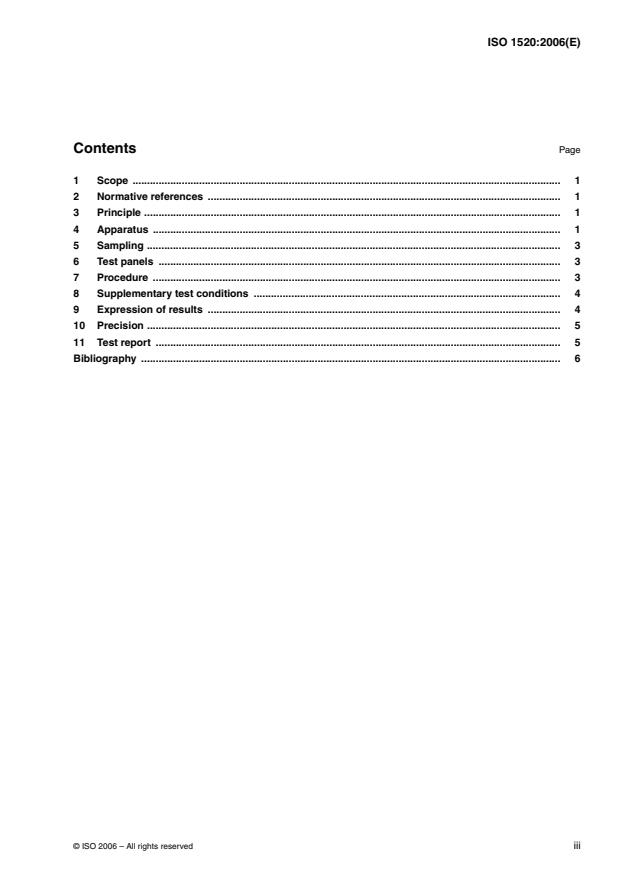
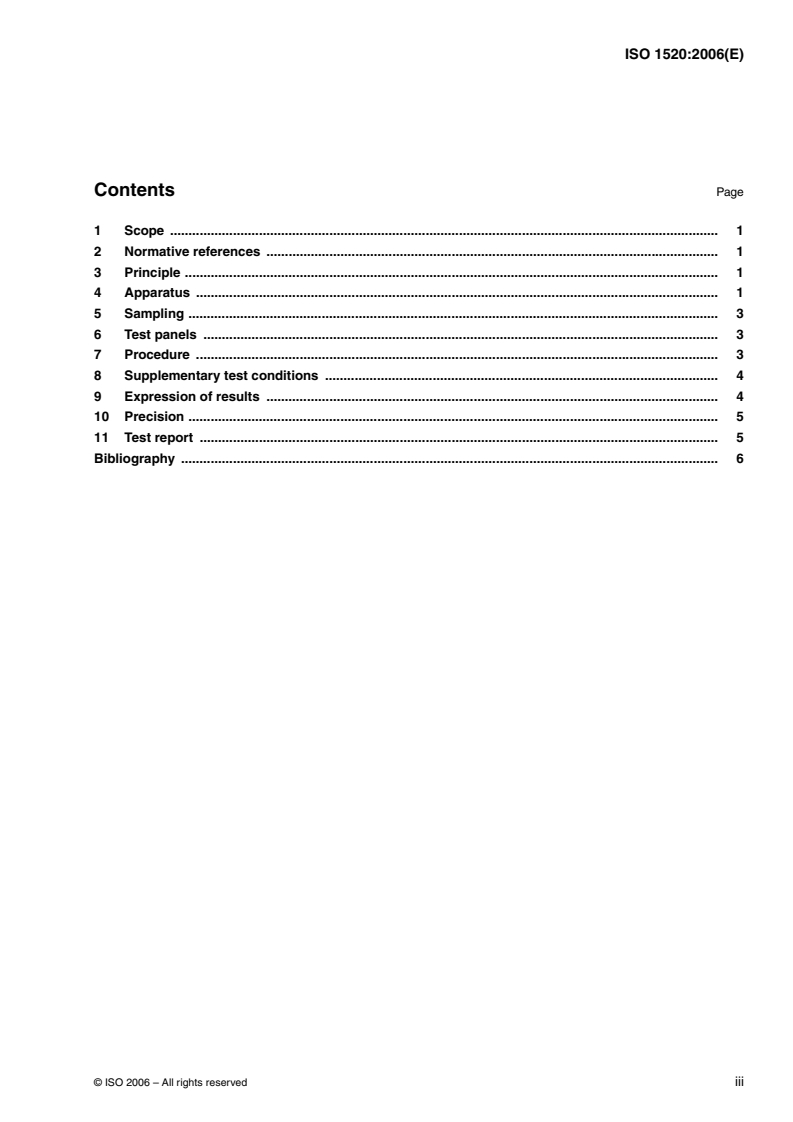
Contents Page
1 Scope . 1
2 Normative references . 1
3 Principle . 1
4 Apparatus . 1
5 Sampling . 3
6 Test panels . 3
7 Procedure . 3
8 Supplementary test conditions . 4
9 Expression of results . 4
10 Precision . 5
11 Test report . 5
Bibliography . 6
©
ISO 2006 – All rights reserved iii
Foreword
ISO (the International Organization for Standardization) is a worldwide federation of national standards bodies
(ISO member bodies). The work of preparing International Standards is normally carried out through ISO
technical committees. Each member body interested in a subject for which a technical committee has been
established has the right to be represented on that committee. International organizations, governmental and
non-governmental, in liaison with ISO, also take part in the work. ISO collaborates closely with the International
Electrotechnical Commission (IEC) on all matters of electrotechnical standardization.
International Standards are drafted in accordance with the rules given in the ISO/IEC Directives, Part 2.
The main task of technical committees is to prepare International Standards. Draft International Standards
adopted by the technical committees are circulated to the member bodies for voting. Publication as an
International Standard requires approval by at least 75 % of the member bodies casting a vote.
Attention is drawn to the possibility that some of the elements of this document may be the subject of patent
rights. ISO shall not be held responsible for identifying any or all such patent rights.
ISO 1520 was prepared by Technical Committee ISO/TC 35, Paints and varnishes, Subcommittee SC 9,
General test methods for paints and varnishes.
This third edition cancels and replaces the second edition (ISO 1520:1999), which has been technically revised.
The main changes are:
— the determination is carried out in duplicate instead of triplicate;
— precision data have been added;
— the text has been editorially revised and the normative references have been reviewed.
©
iv ISO 2006 – All rights reserved
Introduction
This International Standard is one of six standards which specify empirical test procedures for assessing the
resistance of coatings of paints, varnishes and related products to cracking and/or detachment from the
substrate under different conditions of deformation.
The other standards are:
ISO 1519, Paints and varnishes — Bend test (cylindrical mandrel)
ISO 6272-1, Paints and varnishes — Rapid-deformation (impact resistance) tests — Part 1: Falling-weight
test, large-area indenter
ISO 6272-2, Paints and varnishes — Rapid-deformation (impact resistance) tests — Part 2: Falling-weight
test, small-area indenter
ISO 6860, Paints and varnishes — Bend test (conical mandrel)
ISO 17132, Paints and varnishes — T-bend test
The method to be chosen depends on the property which has to be measured. In principle, all these tests differ
technically from each other and differ in accuracy.
©
ISO 2006 – All rights reserved v
.
vi
INTERNATIONAL STANDARD ISO 1520:2006(E)
Paints and varnishes — Cupping test
1Scope
This International Standard specifies an empirical method for assessing the resistance of a coating of paint,
varnish or related product to cracking and/or detachment from a metal substrate when subjected to gradual
deformation by indentation under standard conditions (see 7.1).
For a multi-coat system, each coat may be tested separately or the complete system may be tested.
The method may be carried out as follows:
— either as a “pass/fail” test, by testing to a specified depth of indentation to assess compliance with a
particular requirement;
— or by gradually increasing the depth of indentation to determine the minimum depth at which the coating
cracks and/or becomes detached from the substrate.
2 Normative references
The following referenced documents are indispensable for the application of this document. For dated
references, only the edition cited applies. For undated references, the latest edition of the referenced document
(including any amendments) applies.
ISO 1513, Paints and varnishes — Examination and preparation of samples for testing
ISO 1514, Paints and varnishes — Standard panels for testing
ISO 2808, Paints and varnishes — Determination of film thickness
ISO 15528, Paints, varnishes and raw materials for paints and varnishes — Sampling
3 Principle
The product or system under test is applied at uniform thickness to flat panels of uniform surface texture.
After drying/curing, the elastic properties of the paint film are determined by first placing the coated panel
between two rings, namely the retaining ring and the drawing die. The panel is then pushed by a hemispherical
indenter at a steady rate into the die so as to form a dome shape with the coating on the outside.
The deformation is increased either to a depth agreed between the interested parties or until the coating cracks
and/or detaches from the substrate, and the result is then assessed.
4 Apparatus
4.1 Cupping test apparatus, which conforms to the design and dimensions shown in Figure 1 and consists
essentially of the following components:
4.1.1 Drawing die, made of surface-hardened steel and of which the surface in contact with the test panel is
plane-polished.
©
ISO 2006 – All rights reserved 1
...
INTERNATIONAL ISO
STANDARD 1520
Third edition
2006-11-15
Paints and varnishes — Cupping test
Peintures et vernis — Essai d'emboutissage
Reference number
©
ISO 2006
PDF disclaimer
This PDF file may contain embedded typefaces. In accordance with Adobe's licensing policy, this file may be printed or viewed but shall
not be edited unless the typefaces which are embedded are licensed to and installed on the computer performing the editing. In
downloading this file, parties accept therein the responsibility of not infringing Adobe's licensing policy. The ISO Central Secretariat
accepts no liability in this area.
Adobe is a trademark of Adobe Systems Incorporated.
Details of the software products used to create this PDF file can be found in the General Info relative to the file; the PDF-creation
parameters were optimized for printing. Every care has been taken to ensure that the file is suitable for use by ISO member bodies. In the
unlikely event that a problem relating to it is found, please inform the Central Secretariat at the address given below.
All rights reserved. Unless otherwise specified, no part of this publication may be reproduced or utilized in any form or by any means,
electronic or mechanical, including photocopying and microfilm, without permission in writing from either ISO at the address below or
ISO's member body in the country of the requester.
ISO copyright office
Case postale 56 CH-1211 Geneva 20
Tel. + 41 22 749 01 11
Fax + 41 22 749 09 47
E-mail copyright@iso.org
Web www.iso.org
Published in Switzerland
©
ii ISO 2006 – All rights reserved
Contents Page
1 Scope . 1
2 Normative references . 1
3 Principle . 1
4 Apparatus . 1
5 Sampling . 3
6 Test panels . 3
7 Procedure . 3
8 Supplementary test conditions . 4
9 Expression of results . 4
10 Precision . 5
11 Test report . 5
Bibliography . 6
©
ISO 2006 – All rights reserved iii
Foreword
ISO (the International Organization for Standardization) is a worldwide federation of national standards bodies
(ISO member bodies). The work of preparing International Standards is normally carried out through ISO
technical committees. Each member body interested in a subject for which a technical committee has been
established has the right to be represented on that committee. International organizations, governmental and
non-governmental, in liaison with ISO, also take part in the work. ISO collaborates closely with the International
Electrotechnical Commission (IEC) on all matters of electrotechnical standardization.
International Standards are drafted in accordance with the rules given in the ISO/IEC Directives, Part 2.
The main task of technical committees is to prepare International Standards. Draft International Standards
adopted by the technical committees are circulated to the member bodies for voting. Publication as an
International Standard requires approval by at least 75 % of the member bodies casting a vote.
Attention is drawn to the possibility that some of the elements of this document may be the subject of patent
rights. ISO shall not be held responsible for identifying any or all such patent rights.
ISO 1520 was prepared by Technical Committee ISO/TC 35, Paints and varnishes, Subcommittee SC 9,
General test methods for paints and varnishes.
This third edition cancels and replaces the second edition (ISO 1520:1999), which has been technically revised.
The main changes are:
— the determination is carried out in duplicate instead of triplicate;
— precision data have been added;
— the text has been editorially revised and the normative references have been reviewed.
©
iv ISO 2006 – All rights reserved
Introduction
This International Standard is one of six standards which specify empirical test procedures for assessing the
resistance of coatings of paints, varnishes and related products to cracking and/or detachment from the
substrate under different conditions of deformation.
The other standards are:
ISO 1519, Paints and varnishes — Bend test (cylindrical mandrel)
ISO 6272-1, Paints and varnishes — Rapid-deformation (impact resistance) tests — Part 1: Falling-weight
test, large-area indenter
ISO 6272-2, Paints and varnishes — Rapid-deformation (impact resistance) tests — Part 2: Falling-weight
test, small-area indenter
ISO 6860, Paints and varnishes — Bend test (conical mandrel)
ISO 17132, Paints and varnishes — T-bend test
The method to be chosen depends on the property which has to be measured. In principle, all these tests differ
technically from each other and differ in accuracy.
©
ISO 2006 – All rights reserved v
.
vi
INTERNATIONAL STANDARD ISO 1520:2006(E)
Paints and varnishes — Cupping test
1Scope
This International Standard specifies an empirical method for assessing the resistance of a coating of paint,
varnish or related product to cracking and/or detachment from a metal substrate when subjected to gradual
deformation by indentation under standard conditions (see 7.1).
For a multi-coat system, each coat may be tested separately or the complete system may be tested.
The method may be carried out as follows:
— either as a “pass/fail” test, by testing to a specified depth of indentation to assess compliance with a
particular requirement;
— or by gradually increasing the depth of indentation to determine the minimum depth at which the coating
cracks and/or becomes detached from the substrate.
2 Normative references
The following referenced documents are indispensable for the application of this document. For dated
references, only the edition cited applies. For undated references, the latest edition of the referenced document
(including any amendments) applies.
ISO 1513, Paints and varnishes — Examination and preparation of samples for testing
ISO 1514, Paints and varnishes — Standard panels for testing
ISO 2808, Paints and varnishes — Determination of film thickness
ISO 15528, Paints, varnishes and raw materials for paints and varnishes — Sampling
3 Principle
The product or system under test is applied at uniform thickness to flat panels of uniform surface texture.
After drying/curing, the elastic properties of the paint film are determined by first placing the coated panel
between two rings, namely the retaining ring and the drawing die. The panel is then pushed by a hemispherical
indenter at a steady rate into the die so as to form a dome shape with the coating on the outside.
The deformation is increased either to a depth agreed between the interested parties or until the coating cracks
and/or detaches from the substrate, and the result is then assessed.
4 Apparatus
4.1 Cupping test apparatus, which conforms to the design and dimensions shown in Figure 1 and consists
essentially of the following components:
4.1.1 Drawing die, made of surface-hardened steel and of which the surface in contact with the test panel is
plane-polished.
©
ISO 2006 – All rights reserved 1
...
NORME ISO
INTERNATIONALE 1520
Troisième édition
2006-11-15
Peintures et vernis — Essai
d'emboutissage
Paints and varnishes — Cupping test
Numéro de référence
©
ISO 2006
PDF — Exonération de responsabilité
Le présent fichier PDF peut contenir des polices de caractères intégrées. Conformément aux conditions de licence d'Adobe, ce fichier
peut être imprimé ou visualisé, mais ne doit pas être modifié à moins que l'ordinateur employé à cet effet ne bénéficie d'une licence
autorisant l'utilisation de ces polices et que celles-ci y soient installées. Lors du téléchargement de ce fichier, les parties concernées
acceptent de fait la responsabilité de ne pas enfreindre les conditions de licence d'Adobe. Le Secrétariat central de l'ISO décline toute
responsabilité en la matière.
Adobe est une marque déposée d'Adobe Systems Incorporated.
Les détails relatifs aux produits logiciels utilisés pour la création du présent fichier PDF sont disponibles dans la rubrique General Info du
fichier; les paramètres de création PDF ont été optimisés pour l'impression. Toutes les mesures ont été prises pour garantir l'exploitation
de ce fichier par les comités membres de l'ISO. Dans le cas peu probable où surviendrait un problème d'utilisation, veuillez en informer
le Secrétariat central à l'adresse donnée ci-dessous.
Droits de reproduction réservés. Sauf prescription différente, aucune partie de cette publication ne peut être reproduite ni utilisée sous
quelque forme que ce soit et par aucun procédé, électronique ou mécanique, y compris la photocopie et les microfilms, sans l'accord écrit
de l'ISO à l'adresse ci-après ou du comité membre de l'ISO dans le pays du demandeur.
ISO copyright office
Case postale 56 CH-1211 Geneva 20
Tel. + 41 22 749 01 11
Fax + 41 22 749 09 47
E-mail copyright@iso.org
Web www.iso.org
Publié en Suisse
©
ii ISO 2006 – Tous droits réservés
Sommaire Page
1 Domaine d'application . 1
2 Références normatives . 1
3 Principe . 1
4 Appareillage . 1
5 Échantillonnage . 3
6 Panneaux d'essai . 3
7 Mode opératoire . 4
8 Conditions d'essais supplémentaires . 4
9 Expression des résultats . 5
10 Fidélité . 5
11 Rapport d'essai . 5
Bibliographie . 6
©
ISO 2006 – Tous droits réservés iii
Avant-propos
L'ISO (Organisation internationale de normalisation) est une fédération mondiale d'organismes nationaux de
normalisation (comités membres de l'ISO). L'élaboration des Normes internationales est en général confiée
aux comités techniques de l'ISO. Chaque comité membre intéressé par une étude a le droit de faire partie du
comité technique créé à cet effet. Les organisations internationales, gouvernementales et non
gouvernementales, en liaison avec l'ISO participent également aux travaux. L'ISO collabore étroitement avec la
Commission électrotechnique internationale (CEI) en ce qui concerne la normalisation électrotechnique.
Les Normes internationales sont rédigées conformément aux règles données dans les Directives ISO/CEI,
Partie 2.
La tâche principale des comités techniques est d'élaborer les Normes internationales. Les projets de Normes
internationales adoptés par les comités techniques sont soumis aux comités membres pour vote. Leur
publication comme Normes internationales requiert l'approbation de 75 % au moins des comités membres
votants.
L'attention est appelée sur le fait que certains des éléments du présent document peuvent faire l'objet de droits
de propriété intellectuelle ou de droits analogues. L'ISO ne saurait être tenue pour responsable de ne pas avoir
identifié de tels droits de propriété et averti de leur existence.
L'ISO1520 a été élaborée par le comité technique ISO/TC35, Peintures et vernis, sous-comité SC9,
Méthodes générales d'essais des peintures et vernis.
Cette troisième édition annule et remplace la deuxième édition (ISO 1520:1999), dont elle constitue une
révision technique. Les principales modifications sont:
— la détermination est effectuée en double au lieu de triple;
— des précisions relatives aux données ont été ajoutées;
— le texte a fait l’objet de modifications rédactionnelles et les références normatives ont été revues.
©
iv ISO 2006 – Tous droits réservés
Introduction
La présente Norme internationale est l'une des six normes qui spécifient des méthodes d'essai empiriques
d'évaluation de la résistance des couches de peinture, de vernis et de produits assimilés aux craquelures et/ou
au décollement du subjectile dans différentes conditions de déformation.
Les autres normes sont:
ISO 1519, Peintures et vernis — Essai de pliage sur mandrin cylindrique
ISO 6272-1, Peintures et vernis — Essais de déformation rapide (résistance au choc) — Partie 1: Essai de
chute d'une masse avec pénétrateur de surface importante
ISO 6272-2, Peintures et vernis — Essais de déformation rapide (résistance au choc) — Partie 2: Essai de
chute d'une masse avec pénétrateur de surface réduite
ISO 6860, Peintures et vernis — Essai de pliage (mandrin conique)
ISO 17132, Peintures et vernis — Essai de pliage en T
La méthode à choisir dépend de la propriété à mesurer. En principe, tous ces essais diffèrent les uns des autres
sur le plan technique et du point de vue de l'exactitude.
©
ISO 2006 – Tous droits réservés v
.
vi
NORME INTERNATIONALE ISO 1520:2006(F)
Peintures et vernis — Essai d'emboutissage
1 Domaine d'application
La présente Norme internationale spécifie une méthode d'essai empirique d'évaluation de la résistance d'un
revêtement de peinture, de vernis ou d'un produit assimilé, aux craquelures et/ou au décollement d'un subjectile
métallique lorsque celui-ci est soumis à une déformation progressive par emboutissage dans des conditions
normalisées (voir 7.1).
En cas d'utilisation d'un système multicouche, l'essai peut être fait sur chaque couche séparément ou sur
l'ensemble du système.
La méthode peut être exécutée de la façon suivante:
— soit comme un essai «tout ou rien», l'essai étant effectué à une profondeur d'emboutissage spécifiée, pour
évaluer la conformité à une exigence particulière;
— soit en augmentant graduellement la profondeur d'emboutissage pour déterminer la profondeur minimale à
laquelle la couche se craquelle et/ou se décolle du subjectile.
2 Références normatives
Les documents de référence suivants sont indispensables pour l'application du présent document. Pour les
références datées, seule l'édition citée s'applique. Pour les références non datées, la dernière édition du
document de référence s'applique (y compris les éventuels amendements).
ISO 1513, Peintures et vernis — Examen et préparation des échantillons pour essais
ISO 1514, Peintures et vernis — Panneaux normalisés pour essais
ISO 2808, Peintures et vernis — Détermination de l'épaisseur du feuil
ISO 15528, Peintures, vernis et matières premières pour peintures et vernis — Échantillonnage
3Principe
Le produit ou le système soumis à essai est appliqué à une épaisseur uniforme sur des panneaux plans ayant
un état de surface uniforme.
Après séchage/réticulation, les propriétés élastiques du feuil de peinture sont déterminées en plaçant d'abord
le panneau revêtu entre deux bagues, à savoir la bague de retenue et la matrice, puis il est enfoncé dans la
matrice par un poinçon hémisphérique à une vitesse constante de manière à former un dôme, le revêtement se
trouvant sur la face extérieure.
La déformation est augmentée, soit jusqu'à une profondeur en accord entre les parties intéressées, soit jusqu'à
ce que le revêtement se craquelle et/ou se détache du subjectile, puis le résultat est évalué.
4 Appareillage
4.1 Appareil d'emboutissage, conforme à la conception et aux dimensions indiquées à la Figure 1 et se
composant essentiellement des éléments suivants:
©
ISO 2006 – Tous droits réservés 1
4.1.1 Matrice, en acier trempé en surface et dont la surface en contact avec le panneau d'essai est plane et
polie.
4.1.2 Bague de retenue, dont la surface en contact avec le panneau d'essai est plane, polie et parallèle à la
...
NORME ISO
INTERNATIONALE 1520
Troisième édition
2006-11-15
Peintures et vernis — Essai
d'emboutissage
Paints and varnishes — Cupping test
Numéro de référence
©
ISO 2006
PDF — Exonération de responsabilité
Le présent fichier PDF peut contenir des polices de caractères intégrées. Conformément aux conditions de licence d'Adobe, ce fichier
peut être imprimé ou visualisé, mais ne doit pas être modifié à moins que l'ordinateur employé à cet effet ne bénéficie d'une licence
autorisant l'utilisation de ces polices et que celles-ci y soient installées. Lors du téléchargement de ce fichier, les parties concernées
acceptent de fait la responsabilité de ne pas enfreindre les conditions de licence d'Adobe. Le Secrétariat central de l'ISO décline toute
responsabilité en la matière.
Adobe est une marque déposée d'Adobe Systems Incorporated.
Les détails relatifs aux produits logiciels utilisés pour la création du présent fichier PDF sont disponibles dans la rubrique General Info du
fichier; les paramètres de création PDF ont été optimisés pour l'impression. Toutes les mesures ont été prises pour garantir l'exploitation
de ce fichier par les comités membres de l'ISO. Dans le cas peu probable où surviendrait un problème d'utilisation, veuillez en informer
le Secrétariat central à l'adresse donnée ci-dessous.
Droits de reproduction réservés. Sauf prescription différente, aucune partie de cette publication ne peut être reproduite ni utilisée sous
quelque forme que ce soit et par aucun procédé, électronique ou mécanique, y compris la photocopie et les microfilms, sans l'accord écrit
de l'ISO à l'adresse ci-après ou du comité membre de l'ISO dans le pays du demandeur.
ISO copyright office
Case postale 56 CH-1211 Geneva 20
Tel. + 41 22 749 01 11
Fax + 41 22 749 09 47
E-mail copyright@iso.org
Web www.iso.org
Publié en Suisse
©
ii ISO 2006 – Tous droits réservés
Sommaire Page
1 Domaine d'application . 1
2 Références normatives . 1
3 Principe . 1
4 Appareillage . 1
5 Échantillonnage . 3
6 Panneaux d'essai . 3
7 Mode opératoire . 4
8 Conditions d'essais supplémentaires . 4
9 Expression des résultats . 5
10 Fidélité . 5
11 Rapport d'essai . 5
Bibliographie . 6
©
ISO 2006 – Tous droits réservés iii
Avant-propos
L'ISO (Organisation internationale de normalisation) est une fédération mondiale d'organismes nationaux de
normalisation (comités membres de l'ISO). L'élaboration des Normes internationales est en général confiée
aux comités techniques de l'ISO. Chaque comité membre intéressé par une étude a le droit de faire partie du
comité technique créé à cet effet. Les organisations internationales, gouvernementales et non
gouvernementales, en liaison avec l'ISO participent également aux travaux. L'ISO collabore étroitement avec la
Commission électrotechnique internationale (CEI) en ce qui concerne la normalisation électrotechnique.
Les Normes internationales sont rédigées conformément aux règles données dans les Directives ISO/CEI,
Partie 2.
La tâche principale des comités techniques est d'élaborer les Normes internationales. Les projets de Normes
internationales adoptés par les comités techniques sont soumis aux comités membres pour vote. Leur
publication comme Normes internationales requiert l'approbation de 75 % au moins des comités membres
votants.
L'attention est appelée sur le fait que certains des éléments du présent document peuvent faire l'objet de droits
de propriété intellectuelle ou de droits analogues. L'ISO ne saurait être tenue pour responsable de ne pas avoir
identifié de tels droits de propriété et averti de leur existence.
L'ISO1520 a été élaborée par le comité technique ISO/TC35, Peintures et vernis, sous-comité SC9,
Méthodes générales d'essais des peintures et vernis.
Cette troisième édition annule et remplace la deuxième édition (ISO 1520:1999), dont elle constitue une
révision technique. Les principales modifications sont:
— la détermination est effectuée en double au lieu de triple;
— des précisions relatives aux données ont été ajoutées;
— le texte a fait l’objet de modifications rédactionnelles et les références normatives ont été revues.
©
iv ISO 2006 – Tous droits réservés
Introduction
La présente Norme internationale est l'une des six normes qui spécifient des méthodes d'essai empiriques
d'évaluation de la résistance des couches de peinture, de vernis et de produits assimilés aux craquelures et/ou
au décollement du subjectile dans différentes conditions de déformation.
Les autres normes sont:
ISO 1519, Peintures et vernis — Essai de pliage sur mandrin cylindrique
ISO 6272-1, Peintures et vernis — Essais de déformation rapide (résistance au choc) — Partie 1: Essai de
chute d'une masse avec pénétrateur de surface importante
ISO 6272-2, Peintures et vernis — Essais de déformation rapide (résistance au choc) — Partie 2: Essai de
chute d'une masse avec pénétrateur de surface réduite
ISO 6860, Peintures et vernis — Essai de pliage (mandrin conique)
ISO 17132, Peintures et vernis — Essai de pliage en T
La méthode à choisir dépend de la propriété à mesurer. En principe, tous ces essais diffèrent les uns des autres
sur le plan technique et du point de vue de l'exactitude.
©
ISO 2006 – Tous droits réservés v
.
vi
NORME INTERNATIONALE ISO 1520:2006(F)
Peintures et vernis — Essai d'emboutissage
1 Domaine d'application
La présente Norme internationale spécifie une méthode d'essai empirique d'évaluation de la résistance d'un
revêtement de peinture, de vernis ou d'un produit assimilé, aux craquelures et/ou au décollement d'un subjectile
métallique lorsque celui-ci est soumis à une déformation progressive par emboutissage dans des conditions
normalisées (voir 7.1).
En cas d'utilisation d'un système multicouche, l'essai peut être fait sur chaque couche séparément ou sur
l'ensemble du système.
La méthode peut être exécutée de la façon suivante:
— soit comme un essai «tout ou rien», l'essai étant effectué à une profondeur d'emboutissage spécifiée, pour
évaluer la conformité à une exigence particulière;
— soit en augmentant graduellement la profondeur d'emboutissage pour déterminer la profondeur minimale à
laquelle la couche se craquelle et/ou se décolle du subjectile.
2 Références normatives
Les documents de référence suivants sont indispensables pour l'application du présent document. Pour les
références datées, seule l'édition citée s'applique. Pour les références non datées, la dernière édition du
document de référence s'applique (y compris les éventuels amendements).
ISO 1513, Peintures et vernis — Examen et préparation des échantillons pour essais
ISO 1514, Peintures et vernis — Panneaux normalisés pour essais
ISO 2808, Peintures et vernis — Détermination de l'épaisseur du feuil
ISO 15528, Peintures, vernis et matières premières pour peintures et vernis — Échantillonnage
3Principe
Le produit ou le système soumis à essai est appliqué à une épaisseur uniforme sur des panneaux plans ayant
un état de surface uniforme.
Après séchage/réticulation, les propriétés élastiques du feuil de peinture sont déterminées en plaçant d'abord
le panneau revêtu entre deux bagues, à savoir la bague de retenue et la matrice, puis il est enfoncé dans la
matrice par un poinçon hémisphérique à une vitesse constante de manière à former un dôme, le revêtement se
trouvant sur la face extérieure.
La déformation est augmentée, soit jusqu'à une profondeur en accord entre les parties intéressées, soit jusqu'à
ce que le revêtement se craquelle et/ou se détache du subjectile, puis le résultat est évalué.
4 Appareillage
4.1 Appareil d'emboutissage, conforme à la conception et aux dimensions indiquées à la Figure 1 et se
composant essentiellement des éléments suivants:
©
ISO 2006 – Tous droits réservés 1
4.1.1 Matrice, en acier trempé en surface et dont la surface en contact avec le panneau d'essai est plane et
polie.
4.1.2 Bague de retenue, dont la surface en contact avec le panneau d'essai est plane, polie et parallèle à la
...
МЕЖДУНАРОДНЫЙ ISO
СТАНДАРТ 1520
Третье издание
2006-11-15
Краски и лаки. Испытание на глубокую
вытяжку
Paints and varnishes — Cupping test
Ответственность за подготовку русской версии несёт GOST R
(Российская Федерация) в соответствии со статьёй 18.1 Устава ISO
Ссылочный номер
©
ISO 2006
Отказ от ответственности при работе в PDF
Настоящий файл PDF может содержать интегрированные шрифты. В соответствии с условиями лицензирования, принятыми
фирмой Adobe, этот файл можно распечатать или смотреть на экране, но его нельзя изменить, пока не будет получена
лицензия на интегрированные шрифты и они не будут установлены на компьютере, на котором ведется редактирование. В
случае загрузки настоящего файла заинтересованные стороны принимают на себя ответственность за соблюдение
лицензионных условий фирмы Adobe. Центральный секретариат ISO не несет никакой ответственности в этом отношении.
Adobe - торговый знак фирмы Adobe Systems Incorporated.
Подробности, относящиеся к программным продуктам, использованные для создания настоящего файла PDF, можно найти в
рубрике General Info файла; параметры создания PDF были оптимизированы для печати. Были приняты во внимание все
меры предосторожности с тем, чтобы обеспечить пригодность настоящего файла для использования комитетами-членами
ISO. В редких случаях возникновения проблемы, связанной со сказанным выше, просьба проинформировать Центральный
секретариат по адресу, приведенному ниже.
ДОКУМЕНТ ЗАЩИЩЕН АВТОРСКИМ ПРАВОМ
Все права сохраняются. Если не указано иное, никакую часть настоящей публикации нельзя копировать или использовать в
какой-либо форме или каким-либо электронным или механическим способом, включая фотокопии и микрофильмы, без
предварительного письменного согласия ISO, которое должно быть получено после запроса о разрешении, направленного по
адресу, приведенному ниже, или в комитет-член ISO в стране запрашивающей стороны.
ISO copyright office
Case postale 56 • CH-1211 Geneva 20
Tel. + 41 22 749 01 11
Fax + 41 22 734 09 47
E-mail copyright @ iso.org
Web www.iso.org
Опубликовано в Швейцарии
ii © ISO 2006 – Все права сохраняются
Содержание Страница
1 Область применения .1
2 Нормативные ссылки .1
3 Принцип.1
4 Аппаратура.1
5 Взятие образцов .3
6 Испытуемые пластины .3
7 Методика .3
8 Дополнительные условия испытания .4
9 Выражение результатов .5
10 Прецизионность.5
11 Протокол испытания.5
Библиография.6
Предисловие
Международная организация по стандартизации (ISO) является всемирной федерацией национальных
организаций по стандартизации (комитетов-членов ISO). Разработка международных стандартов
обычно осуществляется техническими комитетами ISO. Каждый национальный комитет,
заинтересованный в деятельности, для которой был создан технический комитет, имеет право быть
представленным в этом комитете. Международные правительственные и неправительственные
организации, имеющие связи с ISO, также принимают участие в работах. Что касается стандартизации
в области электротехники, то ISO работает в тесном сотрудничестве с Международной
электротехнической комиссией (IEC).
Проекты международных стандартов разрабатываются в соответствии с правилами, установленными в
Директивах ISO/IEC, Часть 2.
Основная задача технических комитетов заключается в подготовке международных стандартов.
Проекты международных стандартов, принятые техническими комитетами, рассылаются комитетам-
членам ISO на голосование. Их опубликование в качестве международных стандартов требует
одобрения не менее 75 % комитетов-членов, принимающих участие в голосовании.
Следует иметь в виду, что некоторые элементы настоящего международного стандарта могут быть
объектом патентных прав. ISO не может нести ответственность за идентификацию какого-либо одного
или всех патентных прав.
Международный стандарт ISO 1520 подготовлен Техническим комитетом ISO/TC 35, Лаки и краски,
Подкомитетом SC 9, Общие методы испытаний для красок и лаков.
Настоящее третье издание отменяет и заменяет второе издание (ISO 1520:1999), которое было
пересмотрено в техническом отношении. Основные изменения коснулись следующего:
определение проводится на двух образцах вместо трех;
были добавлены данные прецизионности;
текст был пересмотрен в редакционном отношении и были уточнены нормативные ссылки.
iv © ISO 2006 – Все права сохраняются
Введение
Настоящий международный стандарт является одним из шести стандартов, которые устанавливают
методику эмпирических испытаний оценки стойкости красок, лаков и родственных продуктов
растрескиванию и/или отделению от подложки при различных условиях деформации.
Другими пятью стандартами являются следующие:
ISO 1519, Краски и лаки. Испытание на изгиб (цилиндрический стержень)
ISO 6272-1, Краски и лаки. Испытание на быструю деформацию (сопротивление удару). Часть 1.
Испытание падающим весом, индентер большой площади
ISO 6272-2 Краски и лаки. Испытание на быструю деформацию (сопротивление удару). Часть 1.
Испытание падающим весом, индентер площади
ISO 6860, Краски и лаки. Испытание на изгиб (коническая стержень)
ISO 17132, Краски и лаки. Испытание на Т-образный изгиб
Выбираемый метод зависит от свойства, которое подлежит измерению. В принципе, все эти испытания
отличаются технически друг от друга и различаются по точности.
МЕЖДУНАРОДНЫЙ СТАНДАРТ ISO 1520:2006(R)
Краски и лаки. Испытание на глубокую вытяжку
1 Область применения
Настоящий международный стандарт устанавливает эмпирический метод оценки стойкости краски,
лака и родственного продукта растрескиванию и/или отделению от металлической подложки под
воздействием постепенной деформации путем вдавливания при стандартных условиях (см. 7.1).
В отношении многослойных систем покрытия каждый слой может испытываться отдельно, или же вся
система может быть испытана целиком.
Данный метод может быть осуществлен следующим образом:
либо как испытание до отказа на заданную глубину вдавливания с целью оценки специального
требования;
либо путем постепенного увеличения глубины проникновения с целью определения минимальной
глубины, при которой покрытие становится отделяемым от подложки.
2 Нормативные ссылки
Следующие ссылочные документы являются обязательными при применении данного документа. Для
датированных ссылок применяют только пересмотренное издание документа. Для недатированных
ссылок используют последнее издание нормативного ссылочного документа с учетом всех изменений.
ISO 1513, Краски и лаки. Исследование и приготовление образцов для испытания
ISO 1514, Краски и лаки. Стандартные плитки для испытания
ISO 2808, Краски и лаки. Определение толщины пленки
ISO 15528, Краски, лаки и сырье для них. Взятие образцов
3 Принцип
Испытуемый продукт или система наносят равномерной толщиной на плоские пластины с однородной
структурой поверхности.
После сушки/отверждения свойства упругости лакокрасочной пленки определяют сначала путем
помещения покрытой пластины между двумя кольцами, а именно, между удерживающим кольцом и
вытяжной формой. Пластину затем вдавливает полусферический индентер с постоянной скорости в
форму для получения куполообразной формы с покрытием на внешней стороне.
Деформацию увеличивают либо до глубины, согласованной между заинтересованными сторонами,
либо до тех пор, пока покрытие не треснет и/или не отделится от подложки, после чего оценивается
полученный результат.
4 Аппаратура
4.1 Устройство для испытания на глубокую вытяжку, конструкция и размеры которого
соответствуют приведенным на Рисунке 1, состоит в основном из следующих компонентов:
4.1.1 Вытяжная форма, изготовленная из закаленной стали, поверхность контакта которой с
пластиной для испытания плоскополирована.
-------------------
...
МЕЖДУНАРОДНЫЙ ISO
СТАНДАРТ 1520
Третье издание
2006-11-15
Краски и лаки. Испытание на глубокую
вытяжку
Paints and varnishes — Cupping test
Ответственность за подготовку русской версии несёт GOST R
(Российская Федерация) в соответствии со статьёй 18.1 Устава ISO
Ссылочный номер
©
ISO 2006
Отказ от ответственности при работе в PDF
Настоящий файл PDF может содержать интегрированные шрифты. В соответствии с условиями лицензирования, принятыми
фирмой Adobe, этот файл можно распечатать или смотреть на экране, но его нельзя изменить, пока не будет получена
лицензия на интегрированные шрифты и они не будут установлены на компьютере, на котором ведется редактирование. В
случае загрузки настоящего файла заинтересованные стороны принимают на себя ответственность за соблюдение
лицензионных условий фирмы Adobe. Центральный секретариат ISO не несет никакой ответственности в этом отношении.
Adobe - торговый знак фирмы Adobe Systems Incorporated.
Подробности, относящиеся к программным продуктам, использованные для создания настоящего файла PDF, можно найти в
рубрике General Info файла; параметры создания PDF были оптимизированы для печати. Были приняты во внимание все
меры предосторожности с тем, чтобы обеспечить пригодность настоящего файла для использования комитетами-членами
ISO. В редких случаях возникновения проблемы, связанной со сказанным выше, просьба проинформировать Центральный
секретариат по адресу, приведенному ниже.
ДОКУМЕНТ ЗАЩИЩЕН АВТОРСКИМ ПРАВОМ
Все права сохраняются. Если не указано иное, никакую часть настоящей публикации нельзя копировать или использовать в
какой-либо форме или каким-либо электронным или механическим способом, включая фотокопии и микрофильмы, без
предварительного письменного согласия ISO, которое должно быть получено после запроса о разрешении, направленного по
адресу, приведенному ниже, или в комитет-член ISO в стране запрашивающей стороны.
ISO copyright office
Case postale 56 • CH-1211 Geneva 20
Tel. + 41 22 749 01 11
Fax + 41 22 734 09 47
E-mail copyright @ iso.org
Web www.iso.org
Опубликовано в Швейцарии
ii © ISO 2006 – Все права сохраняются
Содержание Страница
1 Область применения .1
2 Нормативные ссылки .1
3 Принцип.1
4 Аппаратура.1
5 Взятие образцов .3
6 Испытуемые пластины .3
7 Методика .3
8 Дополнительные условия испытания .4
9 Выражение результатов .5
10 Прецизионность.5
11 Протокол испытания.5
Библиография.6
Предисловие
Международная организация по стандартизации (ISO) является всемирной федерацией национальных
организаций по стандартизации (комитетов-членов ISO). Разработка международных стандартов
обычно осуществляется техническими комитетами ISO. Каждый национальный комитет,
заинтересованный в деятельности, для которой был создан технический комитет, имеет право быть
представленным в этом комитете. Международные правительственные и неправительственные
организации, имеющие связи с ISO, также принимают участие в работах. Что касается стандартизации
в области электротехники, то ISO работает в тесном сотрудничестве с Международной
электротехнической комиссией (IEC).
Проекты международных стандартов разрабатываются в соответствии с правилами, установленными в
Директивах ISO/IEC, Часть 2.
Основная задача технических комитетов заключается в подготовке международных стандартов.
Проекты международных стандартов, принятые техническими комитетами, рассылаются комитетам-
членам ISO на голосование. Их опубликование в качестве международных стандартов требует
одобрения не менее 75 % комитетов-членов, принимающих участие в голосовании.
Следует иметь в виду, что некоторые элементы настоящего международного стандарта могут быть
объектом патентных прав. ISO не может нести ответственность за идентификацию какого-либо одного
или всех патентных прав.
Международный стандарт ISO 1520 подготовлен Техническим комитетом ISO/TC 35, Лаки и краски,
Подкомитетом SC 9, Общие методы испытаний для красок и лаков.
Настоящее третье издание отменяет и заменяет второе издание (ISO 1520:1999), которое было
пересмотрено в техническом отношении. Основные изменения коснулись следующего:
определение проводится на двух образцах вместо трех;
были добавлены данные прецизионности;
текст был пересмотрен в редакционном отношении и были уточнены нормативные ссылки.
iv © ISO 2006 – Все права сохраняются
Введение
Настоящий международный стандарт является одним из шести стандартов, которые устанавливают
методику эмпирических испытаний оценки стойкости красок, лаков и родственных продуктов
растрескиванию и/или отделению от подложки при различных условиях деформации.
Другими пятью стандартами являются следующие:
ISO 1519, Краски и лаки. Испытание на изгиб (цилиндрический стержень)
ISO 6272-1, Краски и лаки. Испытание на быструю деформацию (сопротивление удару). Часть 1.
Испытание падающим весом, индентер большой площади
ISO 6272-2 Краски и лаки. Испытание на быструю деформацию (сопротивление удару). Часть 1.
Испытание падающим весом, индентер площади
ISO 6860, Краски и лаки. Испытание на изгиб (коническая стержень)
ISO 17132, Краски и лаки. Испытание на Т-образный изгиб
Выбираемый метод зависит от свойства, которое подлежит измерению. В принципе, все эти испытания
отличаются технически друг от друга и различаются по точности.
МЕЖДУНАРОДНЫЙ СТАНДАРТ ISO 1520:2006(R)
Краски и лаки. Испытание на глубокую вытяжку
1 Область применения
Настоящий международный стандарт устанавливает эмпирический метод оценки стойкости краски,
лака и родственного продукта растрескиванию и/или отделению от металлической подложки под
воздействием постепенной деформации путем вдавливания при стандартных условиях (см. 7.1).
В отношении многослойных систем покрытия каждый слой может испытываться отдельно, или же вся
система может быть испытана целиком.
Данный метод может быть осуществлен следующим образом:
либо как испытание до отказа на заданную глубину вдавливания с целью оценки специального
требования;
либо путем постепенного увеличения глубины проникновения с целью определения минимальной
глубины, при которой покрытие становится отделяемым от подложки.
2 Нормативные ссылки
Следующие ссылочные документы являются обязательными при применении данного документа. Для
датированных ссылок применяют только пересмотренное издание документа. Для недатированных
ссылок используют последнее издание нормативного ссылочного документа с учетом всех изменений.
ISO 1513, Краски и лаки. Исследование и приготовление образцов для испытания
ISO 1514, Краски и лаки. Стандартные плитки для испытания
ISO 2808, Краски и лаки. Определение толщины пленки
ISO 15528, Краски, лаки и сырье для них. Взятие образцов
3 Принцип
Испытуемый продукт или система наносят равномерной толщиной на плоские пластины с однородной
структурой поверхности.
После сушки/отверждения свойства упругости лакокрасочной пленки определяют сначала путем
помещения покрытой пластины между двумя кольцами, а именно, между удерживающим кольцом и
вытяжной формой. Пластину затем вдавливает полусферический индентер с постоянной скорости в
форму для получения куполообразной формы с покрытием на внешней стороне.
Деформацию увеличивают либо до глубины, согласованной между заинтересованными сторонами,
либо до тех пор, пока покрытие не треснет и/или не отделится от подложки, после чего оценивается
полученный результат.
4 Аппаратура
4.1 Устройство для испытания на глубокую вытяжку, конструкция и размеры которого
соответствуют приведенным на Рисунке 1, состоит в основном из следующих компонентов:
4.1.1 Вытяжная форма, изготовленная из закаленной стали, поверхность контакта которой с
пластиной для испытания плоскополирована.
-------------------
...