

ISO/IEC 39794-5:2019
(Main)Information technology — Extensible biometric data interchange formats — Part 5: Face image data
General Information
- Abstract
This document specifies: — generic extensible data interchange formats for the representation of face image data: A tagged binary data format based on an extensible specification in ASN.1 and a textual data format based on an XML schema definition that are both capable of holding the same information; — examples of data record contents; — application specific requirements, recommendations, and best practices in data acquisition; and — conformance test assertions and conformance test procedures applicable to this document.
- Status
- Published
- Publication Date
- 19-Dec-2019
- Technical Committee
- ISO/IEC JTC 1/SC 37 - Biometrics
- Drafting Committee
- ISO/IEC JTC 1/SC 37/WG 3 - Biometric data interchange formats
- Current Stage
- 9060 - Close of review
- Completion Date
- 04-Jun-2030
Buy Documents

ISO/IEC 39794-5:2019 - Information technology -- Extensible biometric data interchange formats

ISO/IEC 39794-5:2019 - Information technology — Extensible biometric data interchange formats — Part 5: Face image data/20/2019
Overview
ISO/IEC 39794-5:2019 defines extensible biometric data interchange formats specifically for face image data. The standard specifies two interoperable representations: a tagged binary format based on an extensible ASN.1 specification and a textual XML schema that can carry the same information. It also provides examples of data record contents, recommended and application‑specific acquisition practices, and conformance test assertions and procedures to validate implementations.
Keywords: ISO/IEC 39794-5:2019, face image data, extensible biometric data interchange formats, ASN.1, XML schema, biometric interoperability, conformance testing
Key Topics and Technical Requirements
- Dual representation formats: a binary tagged format (ASN.1) and an equivalent XML schema for textual interchange.
- Modality‑specific data blocks: structured elements for face images such as image representation, capture device, version, session and derived‑from metadata.
- Image characteristics and measurements: image size, face/head measurements (inter‑eye distance, head width, head length), colour space and reference colour mapping.
- 2D and 3D support: separate blocks for 2D and 3D representations, including 3D vertices, texture maps, coordinate systems and resolution parameters.
- Landmarks and pose: detailed landmark definitions (MPEG4 points, anthropometric landmarks), pose angle and angle uncertainty blocks for accurate geometric description.
- Quality and processing metadata: quality blocks, post‑acquisition processing, lossy transformation attempts, and PAD (presentation attack detection) metadata.
- Identity and biometric attributes: identity metadata and attributes such as gender, eye colour, hair colour, subject height.
- Acquisition best practices and application requirements: recommendations for capture, device specifics and certification identifiers.
- Conformance framework: test assertions and procedures to ensure interoperability and compliance across implementations.
Practical Applications and Who Uses This Standard
ISO/IEC 39794-5:2019 is used where robust, interoperable exchange of face image data is required:
- Biometric device manufacturers (cameras, 3D scanners) implementing standard output formats.
- Software developers and system integrators building face recognition, enrolment, and verification systems.
- Government agencies and border control for standardized face image records in identity documents and immigration workflows.
- Law enforcement and forensics requiring consistent metadata (landmarks, pose, quality) for matching and analysis.
- Test labs and certification bodies conducting conformance testing and interoperability evaluations.
Adopting this standard improves biometric interoperability, preserves rich metadata for analytics, and supports reliable conformance testing.
Related Standards
- Other parts of the ISO/IEC 39794 series and complementary ISO/IEC biometric interchange standards address additional modalities, global interoperability and related conformance frameworks.
Relations
- Effective Date
- 25-Aug-2026
- Effective Date
- 01-Jul-2026
Buy Documents
ISO/IEC 39794-5:2019 - Information technology -- Extensible biometric data interchange formats
ISO/IEC 39794-5:2019 - Information technology — Extensible biometric data interchange formats — Part 5: Face image data/20/2019
Get Certified
Connect with accredited certification bodies for this standard

BSI Group
BSI (British Standards Institution) is the business standards company that helps organizations make excellence a habit.

NYCE
Mexican standards and certification body.
Sponsored listings
Frequently Asked Questions
ISO/IEC 39794-5:2019 is a standard published by the International Organization for Standardization (ISO). Its full title is "Information technology — Extensible biometric data interchange formats — Part 5: Face image data". This standard covers: This document specifies: — generic extensible data interchange formats for the representation of face image data: A tagged binary data format based on an extensible specification in ASN.1 and a textual data format based on an XML schema definition that are both capable of holding the same information; — examples of data record contents; — application specific requirements, recommendations, and best practices in data acquisition; and — conformance test assertions and conformance test procedures applicable to this document.
This document specifies: — generic extensible data interchange formats for the representation of face image data: A tagged binary data format based on an extensible specification in ASN.1 and a textual data format based on an XML schema definition that are both capable of holding the same information; — examples of data record contents; — application specific requirements, recommendations, and best practices in data acquisition; and — conformance test assertions and conformance test procedures applicable to this document.
ISO/IEC 39794-5:2019 is classified under the following ICS (International Classification for Standards) categories: 35.240.15 - Identification cards. Chip cards. Biometrics. The ICS classification helps identify the subject area and facilitates finding related standards.
ISO/IEC 39794-5:2019 has the following relationships with other standards: It is inter standard links to CEN/TS 18139:2025, CEN/TS 18212-5:2026. Understanding these relationships helps ensure you are using the most current and applicable version of the standard.
ISO/IEC 39794-5:2019 is available in PDF format for immediate download after purchase. The document can be added to your cart and obtained through the secure checkout process. Digital delivery ensures instant access to the complete standard document.
Standards Content (Sample)
INTERNATIONAL ISO/IEC
STANDARD 39794-5
First edition
2019-12
Information technology — Extensible
biometric data interchange formats —
Part 5:
Face image data
Reference number
©
ISO/IEC 2019
© ISO/IEC 2019
All rights reserved. Unless otherwise specified, or required in the context of its implementation, no part of this publication may
be reproduced or utilized otherwise in any form or by any means, electronic or mechanical, including photocopying, or posting
on the internet or an intranet, without prior written permission. Permission can be requested from either ISO at the address
below or ISO’s member body in the country of the requester.
ISO copyright office
CP 401 • Ch. de Blandonnet 8
CH-1214 Vernier, Geneva
Phone: +41 22 749 01 11
Fax: +41 22 749 09 47
Email: copyright@iso.org
Website: www.iso.org
Published in Switzerland
ii © ISO/IEC 2019 – All rights reserved
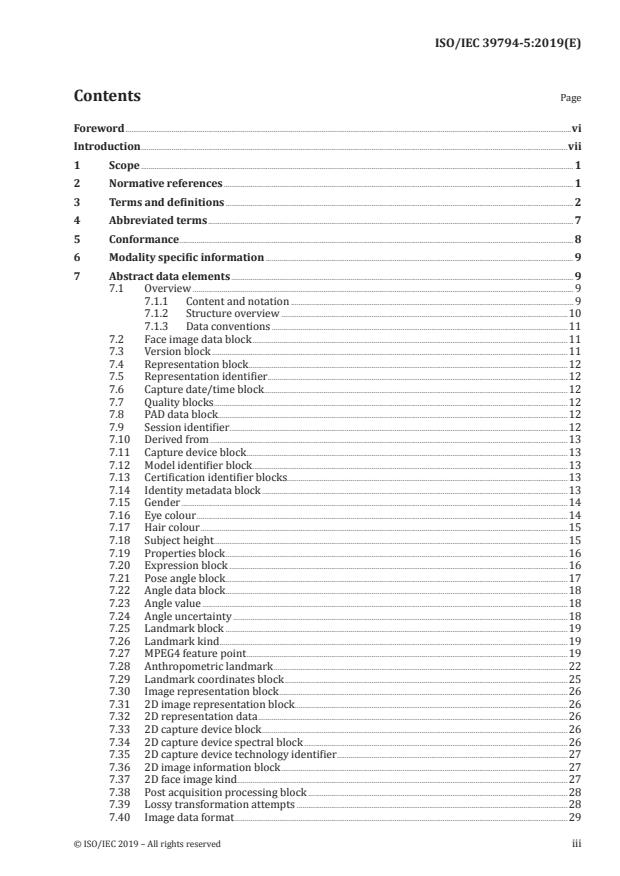
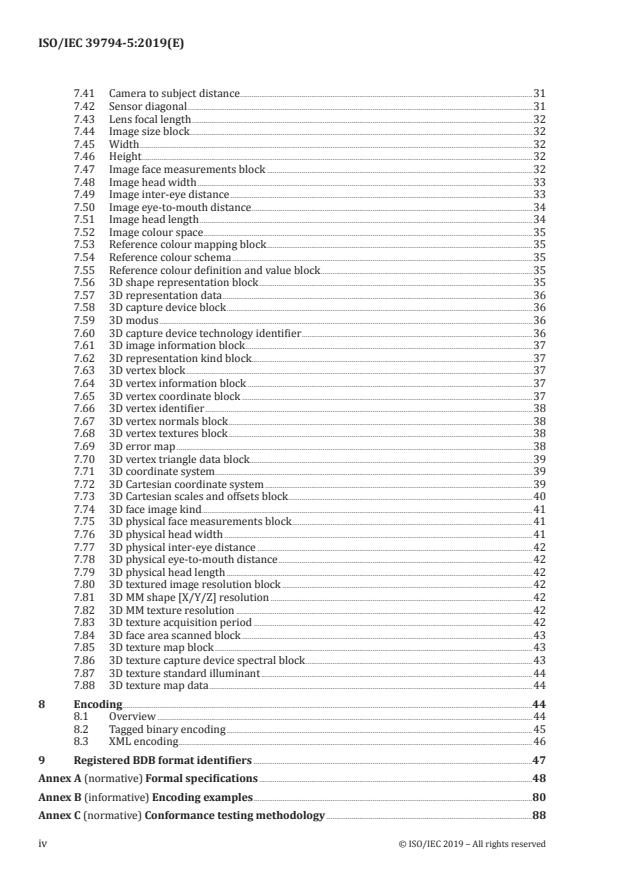
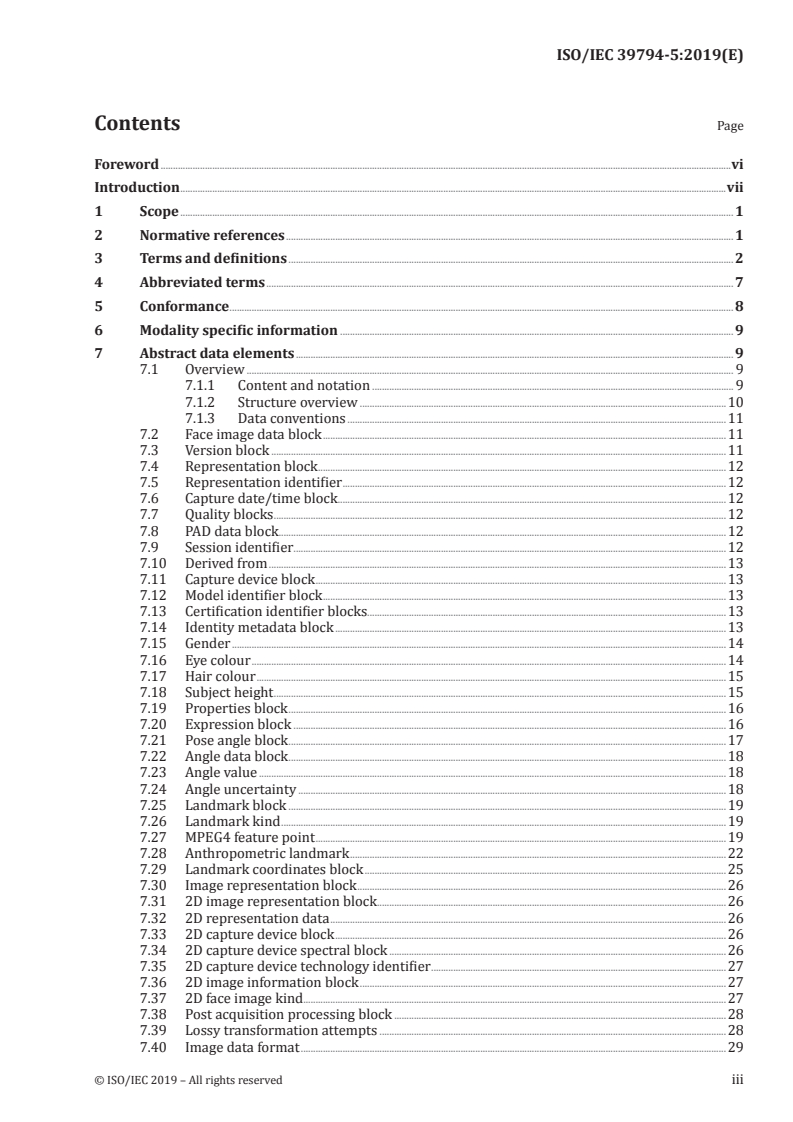
Contents Page
Foreword .vi
Introduction .vii
1 Scope . 1
2 Normative references . 1
3 Terms and definitions . 2
4 Abbreviated terms . 7
5 Conformance . 8
6 Modality specific information . 9
7 Abstract data elements . 9
7.1 Overview . 9
7.1.1 Content and notation . 9
7.1.2 Structure overview .10
7.1.3 Data conventions .11
7.2 Face image data block .11
7.3 Version block .11
7.4 Representation block .12
7.5 Representation identifier .12
7.6 Capture date/time block . .12
7.7 Quality blocks .12
7.8 PAD data block.12
7.9 Session identifier.12
7.10 Derived from .13
7.11 Capture device block .13
7.12 Model identifier block .13
7.13 Certification identifier blocks.13
7.14 Identity metadata block .13
7.15 Gender .14
7.16 Eye colour .14
7.17 Hair colour .15
7.18 Subject height .15
7.19 Properties block .16
7.20 Expression block .16
7.21 Pose angle block .17
7.22 Angle data block .18
7.23 Angle value .18
7.24 Angle uncertainty .18
7.25 Landmark block .19
7.26 Landmark kind .19
7.27 MPEG4 feature point .19
7.28 Anthropometric landmark .22
7.29 Landmark coordinates block .25
7.30 Image representation block .26
7.31 2D image representation block .26
7.32 2D representation data .26
7.33 2D capture device block .26
7.34 2D capture device spectral block .26
7.35 2D capture device technology identifier .27
7.36 2D image information block .27
7.37 2D face image kind.27
7.38 Post acquisition processing block .28
7.39 Lossy transformation attempts .28
7.40 Image data format .29
© ISO/IEC 2019 – All rights reserved iii
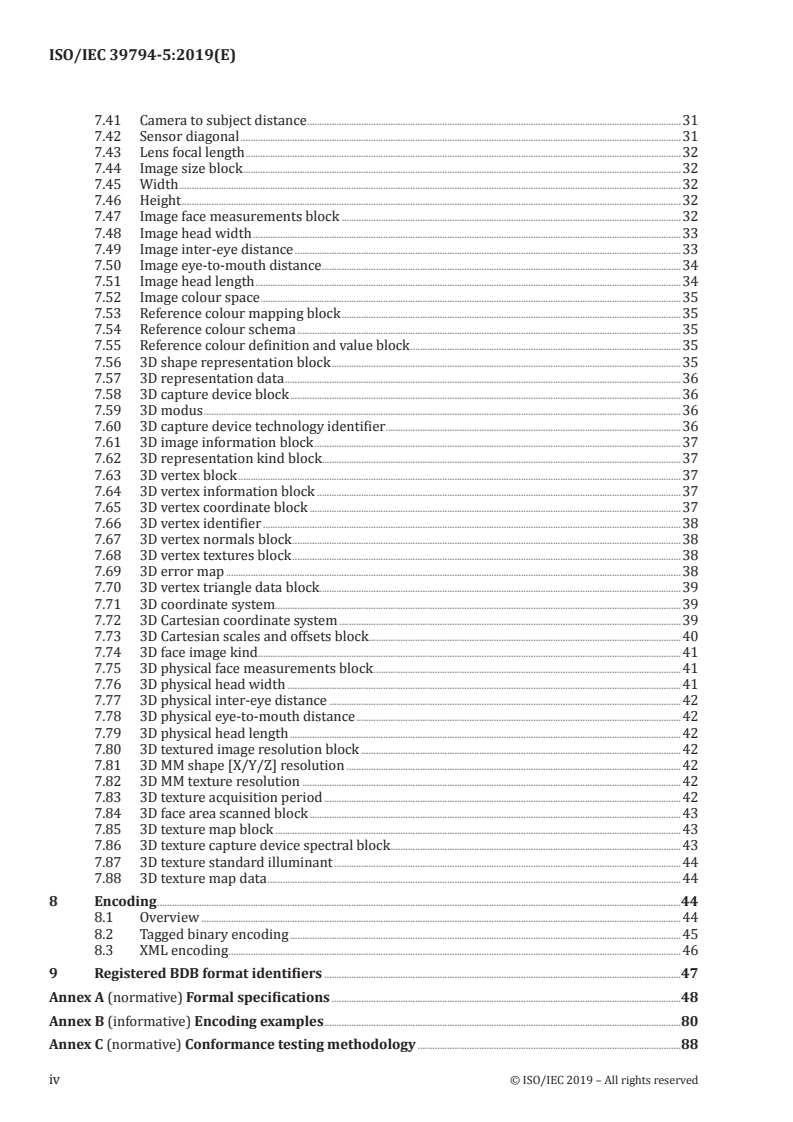
7.41 Camera to subject distance .31
7.42 Sensor diagonal .31
7.43 Lens focal length .32
7.44 Image size block .32
7.45 Width .32
7.46 Height .32
7.47 Image face measurements block .32
7.48 Image head width .33
7.49 Image inter-eye distance .33
7.50 Image eye-to-mouth distance .34
7.51 Image head length .34
7.52 Image colour space .35
7.53 Reference colour mapping block .35
7.54 Reference colour schema .35
7.55 Reference colour definition and value block .35
7.56 3D shape representation block .35
7.57 3D representation data .36
7.58 3D capture device block .36
7.59 3D modus .36
7.60 3D capture device technology identifier .36
7.61 3D image information block .37
7.62 3D representation kind block.37
7.63 3D vertex block .37
7.64 3D vertex information block .37
7.65 3D vertex coordinate block .37
7.66 3D vertex identifier .38
7.67 3D vertex normals block .38
7.68 3D vertex textures block .38
7.69 3D error map .38
7.70 3D vertex triangle data block.39
7.71 3D coordinate system .39
7.72 3D Cartesian coordinate system .39
7.73 3D Cartesian scales and offsets block.40
7.74 3D face image kind.41
7.75 3D physical face measurements block .41
7.76 3D physical head width .41
7.77 3D physical inter-eye distance .42
7.78 3D physical eye-to-mouth distance .42
7.79 3D physical head length .42
7.80 3D textured image resolution block .42
7.81 3D MM shape [X/Y/Z] resolution .42
7.82 3D MM texture resolution .42
7.83 3D texture acquisition period .42
7.84 3D face area scanned block .43
7.85 3D texture map block .43
7.86 3D texture capture device spectral block .43
7.87 3D texture standard illuminant .44
7.88 3D texture map data .44
8 Encoding .44
8.1 Overview .44
8.2 Tagged binary encoding .45
8.3 XML encoding .46
9 Registered BDB format identifiers .47
Annex A (normative) Formal specifications .48
Annex B (informative) Encoding examples .80
Annex C (normative) Conformance testing methodology .88
iv © ISO/IEC 2019 – All rights reserved
Annex D (normative) Application profiles .101
Annex E (informative) Additional technical considerations .154
Bibliography .184
© ISO/IEC 2019 – All rights reserved v
Foreword
ISO (the International Organization for Standardization) and IEC (the International Electrotechnical
Commission) form the specialized system for worldwide standardization. National bodies that
are members of ISO or IEC participate in the development of International Standards through
technical committees established by the respective organization to deal with particular fields of
technical activity. ISO and IEC technical committees collaborate in fields of mutual interest. Other
international organizations, governmental and non-governmental, in liaison with ISO and IEC, also
take part in the work.
The procedures used to develop this document and those intended for its further maintenance are
described in the ISO/IEC Directives, Part 1. In particular, the different approval criteria needed for
the different types of document should be noted. This document was drafted in accordance with the
editorial rules of the ISO/IEC Directives, Part 2 (see www .iso .org/ directives).
Attention is drawn to the possibility that some of the elements of this document may be the subject
of patent rights. ISO and IEC shall not be held responsible for identifying any or all such patent
rights. Details of any patent rights identified during the development of the document will be in the
Introduction and/or on the ISO list of patent declarations received (see www .iso .org/ patents) or the IEC
list of patent declarations received (see http:// patents .iec .ch).
Any trade name used in this document is information given for the convenience of users and does not
constitute an endorsement.
For an explanation of the voluntary nature of standards, the meaning of ISO specific terms and
expressions related to conformity assessment, as well as information about ISO's adherence to the
World Trade Organization (WTO) principles in the Technical Barriers to Trade (TBT) see www .iso .org/
iso/ foreword .html.
This document was prepared by Joint Technical Committee ISO/IEC JTC 1, Information technology,
Subcommittee SC 37, Biometrics.
A list of all parts in the ISO/IEC 39794 series can be found on the ISO website.
Any feedback or questions on this document should be directed to the user’s national standards body. A
complete listing of these bodies can be found at www .iso .org/ members .html.
The purchase of this ISO/IEC document carries a copyright licence for the purchaser to use ISO/IEC
copyright in the schemas in the annexes to this document for the purpose of developing, implementing,
installing and using software based on those schemas, subject to ISO/IEC licensing conditions set out in
the schemas.
vi © ISO/IEC 2019 – All rights reserved
Introduction
Face images have been used for many decades to verify the identity of individuals. In recent years,
digital face images have been used in many applications including human examination as well as
computer-automated face recognition. Photographic formats are standardized, e.g., for passports
and driver licences. There is also a need for a standard data format for digital face images to enable
interoperability. A prominent case where such interoperability is essential is the electronic passport
system, where face images are stored for several purposes including Automated Border Control.
Biometric data interchange formats enable the interoperability of different biometric systems. The
first generation of biometric data interchange formats was published between 2005 and 2007 in the
first edition of the ISO/IEC 19794 series. From 2011 onwards, the second generation of biometric data
interchange formats was published in the second edition of the established parts and the first edition
of some new parts of the ISO/IEC 19794 series. In the second generation of biometric data interchange
formats, new useful data elements such as data elements related to biometric sample quality were
added, the header data structures were harmonized across all parts of the ISO/IEC 19794 series, and
XML encoding was been added in addition to the binary encoding.
In anticipation of the need for additional data elements, and in order to avoid future compatibility
issues, the ISO/IEC 39794 series provides standard biometric data interchange formats capable of
being extended in a defined way. Extensible specifications in ASN.1 (Abstract Syntax Notation One) and
the distinguished encoding rules (DER) of ASN.1 form the basis for encoding biometric data in binary
tag-length-value formats. XSDs (XML schema definitions) form the basis for encoding biometric data in
XML (eXtensible Markup Language).
This third generation of face image data interchange formats complements ISO/IEC 19794-5:2005 and
ISO/IEC 19794-5:2011. The first generation of biometric data interchange formats, which has been
adopted, e.g., by ICAO for the biometric data stored in Machine Readable Travel Documents, is expected
to be retained in the standards catalogue as long as needed.
This document is intended to provide a generic face image data format for face recognition applications
requiring exchange of face image data. Typical applications are:
— automated face biometric verification (one-to-one comparison) and identification (one-to-many
comparison), and
— human verification of a biometric claim by comparison of data subjects against face images, including
examination of face images with sufficient detail.
In addition to the data format, this document specifies application specific profiles including scene
constraints, photographic properties and digital image attributes like image spatial sampling rate,
image size, etc. These application profiles are contained in Annex D.
The structure of the data format in this document is not compatible with the previous generations.
However, this new revision addresses, for the first time, a mechanism to maintain future extensions in a
backwards- and forwards-compatible manner. This will mean that a parser is able to read data records
and understand data items that are formatted according to versions of the standard that are older, the
same or newer than the parser is developed to. All newer data items will not disrupt the parsing process
and can be ignored. Newer versions of this document will at least include the mandatory data items of
the previous standards.
The 3D encoding types 3D point map and range image are not supported by this edition of this
document.
© ISO/IEC 2019 – All rights reserved vii
INTERNATIONAL STANDARD ISO/IEC 39794-5:2019(E)
Information technology — Extensible biometric data
interchange formats —
Part 5:
Face image data
1 Scope
This document specifies:
— generic extensible data interchange formats for the representation of face image data: A tagged
binary data format based on an extensible specification in ASN.1 and a textual data format based on
an XML schema definition that are both capable of holding the same information;
— examples of data record contents;
— application specific requirements, recommendations, and best practices in data acquisition; and
— conformance test assertions and conformance test procedures applicable to this document.
2 Normative references
The following documents are referred to in the text in such a way that some or all of their content
constitutes requirements of this document. For dated references, only the edition cited applies. For
undated references, the latest edition of the referenced document (including any amendments) applies.
ISO/IEC 2382-37, Information technology — Vocabulary — Part 37: Biometrics
ISO/IEC 8824-1, Information technology — Abstract Syntax Notation One (ASN.1): Specification of basic
notation — Part 1
ISO/IEC 8825-1, Information technology — ASN.1 encoding rules: Specification of Basic Encoding Rules
(BER), Canonical Encoding Rules (CER) and Distinguished Encoding Rules (DER) — Part 1
ITU-T Rec. T.81 | ISO/IEC 10918-1, Information technology — Digital compression and coding of
continuous-tone still images — Part 1: Requirements and guidelines
ISO 11664-2:2007, Colorimetry — Part 2: CIE standard illuminants
ISO/IEC 14496-2:2004, Information technology — Coding of audio-visual objects — Part 2: Visual
ITU-T Rec. T.800 | ISO/IEC 15444-1, Information technology — JPEG 2000 image coding system— Part 1:
Core coding system
ISO/IEC 15948, Information technology — Computer graphics and image processing — Portable Network
Graphics (PNG): Functional specification
ISO/IEC 39794-1, Information technology — Extensible biometric data interchange formats — Part 1:
Framework
Doc ICAO 9303: Machine Readable Travel Documents
W3C Recommendation, XML Schema Part 1: Structures (Second Edition), 28 October 2004, http:// www
.w3 .org/ TR/ xmlschema -1/
© ISO/IEC 2019 – All rights reserved 1
W3C Recommendation, XML Schema Part 2: Datatypes (Second Edition), 28 October 2004, http:// www
.w3 .org/ TR/ xmlschema -2/
3 Terms and definitions
For the purposes of this document, the terms and definitions given in ISO/IEC 39794-1, ISO/IEC 2382-37
and the following apply.
ISO and IEC maintain terminological databases for use in standardization at the following addresses:
— IEC Electropedia: available at http:// www .electropedia .org/
— ISO Online browsing platform: available at https:// www .iso .org/ obp
3.1
1:1 application case
biometric verification
Note 1 to entry: Biometric verification is defined in ISO/IEC 2382-37 as a process of confirming a biometric claim
through biometric comparison.
3.2
1:N application case
biometric identification
Note 1 to entry: Biometric identification is defined in ISO/IEC 2382-37 as a process of searching against a
biometric enrolment database to find and return the biometric reference identifier(s) attributable to a single
individual.
3.3
2D face image
two-dimensional face representation that encodes the luminance and/or colour texture of the face of a
capture subject in a given lighting environment
3.4
3D face image
three-dimensional face representation that encodes a surface in a 3D space
3.5
3D vertex
representation using 3D vertices and triangles between these points for coding of a 3D surface
3.6
RGB
colour space designed to encompass most of the colours achievable on CMYK colour printers, but by
using red, green and blue primary colours on a device such as a computer display
3.7
anthropometric landmark
landmark on the face used for identification and classification of humans
3.8
landmark code
two-part code that uniquely defines an anthropometric landmark
3.9
camera to subject distance
CSD
distance between the eyes plane of a capture subject and the and the sensor/image plane of the camera
2 © ISO/IEC 2019 – All rights reserved
3.10
Cartesian coordinate system
3D orthogonal coordinate system
3.11
chin
central forward portion of the lower jaw
3.12
CIE standard illuminant D65
commonly used standard illuminant defined by the International Commission on Illumination (CIE) that is
intended to represent average daylight and has a correlated colour temperature of approximately 6500 K
Note 1 to entry: CIE standard illuminant D65 is specified in ISO 11664-2.
3.13
colour image
continuous tone image (3.16) that has more than one channel, each of which is coded with one or
multiple bits
3.14
colour space
way of representing colours of pixels in an image
EXAMPLE RGB and YUV colour spaces are typically used in this document.
3.15
common biometric exchange formats framework
CBEFF
data format specifically for exchanging biometric data that provides for the encompassing of any
biometric type into a standard format
3.16
continuous tone image
image whose channels have more than one bit per pixel
3.17
crop factor
ratio of the diagonal of the full frame camera (43,3 mm) to that of a selected camera’s image sensor
Note 1 to entry: The determination of an appropriate focal length lens for a field of view equivalent to a full frame
camera can be made by considering the crop factor.
3.18
crown
top of the head ignoring any hair
3.19
dots per inch
DPI
individual printed dots in a line or column within a span of 25,4 mm (1 inch)
3.20
exposure value
EV
number that represents a combination of a camera's shutter speed and f-number, such that all
combinations that yield the same exposure have the same description value
© ISO/IEC 2019 – All rights reserved 3
3.21
eye centre
centre of the line connecting the inner and the outer corner of the eye
Note 1 to entry: The eye centres are the feature points 12.1 and 12.2 as defined in ISO/IEC 14496-2:2004, Annex C.
Note 2 to entry: The inner and the outer corner of the eye are defined by ISO/IEC 14496-2-2:2004: feature points
3.12 and 3.8 for the right eye, and 3.11 and 3.7 for the left eye.
3.22
eye-to-mouth distance
EMD
distance between the face centre and the mouth midpoint
Note 1 to entry: The mouth midpoint is the feature point 2.3 as defined in ISO/IEC 14496-2:2004, Annex C.
3.23
eye visibility zone
EVZ
zone covering a rectangle having a margin to any part of the visible eyeball
Note 1 to entry: The margin is defined in D.1.4.3.3.
3.24
face centre
M
midpoint of the line connecting the two eye centres
3.25
face image kind
category of face images (3.27) that satisfy specific requirements
Note 1 to entry: Application specific requirements are specified in one of the application profiles in Annex D.
3.26
facial animation parameter
FAP
standard for the virtual representation, which includes visual speech intelligibility, mood and gesture
by using feature points
Note 1 to entry: Visual representation as specified in ISO/IEC 14496-1 and ISO/IEC 14496-2.
3.27
face image
electronic image-based representation of the face of a capture subject
3.28
face portrait
visual representation of the capture subject, which includes the full-frontal part of the head, including
hair in most cases, as well as neck and possibly top of shoulders
3.29
face texture
2D sampling face representation that encodes one or a combination of several spectral spatial
modulations received by 3D imaging systems of a face in a given lighting system having a 2D coordinate
link to the face shape
3.30
feature point
reference point in a face image as used by face recognition algorithms
Note 1 to entry: Commonly referred to as a landmark, an example being the position of the eyes.
4 © ISO/IEC 2019 – All rights reserved
3.31
fish eye
type of distortion where central objects of the image erroneously appear closer than those at the edge
3.32
Frankfurt Horizon
standard plane for orientation of the head defined by a line passing through the right tragion (the front
of the ear) and the lowest point of the right eye socket
Note 1 to entry: The Frankfurt Horizon may be hard to define, as it is related to the ear position that may be
covered by hair.
Note 2 to entry: The Frankfurt Horizon has been defined in the Frankfurt-am-Main (anthropological) Agreement
of 1882.
3.33
greyscale image
continuous tone image (3.16) encoded with one luminance channel
Note 1 to entry: If the luminance channel is coded with 8 bits, the greyscale image is also referred to as a
monochrome or black and white image.
3.34
horizontal deviation angle
HD
maximal allowed deviation from the horizontal of the imaginary line between the nose of a capture
subject and the lens of the camera
3.35
human examination
process of human comparison of a face image with an individual or another face image through
detailed examination of face characteristics and structures for the purposes of biometric verification
or identification
3.36
human identification
process of human searching through a list of face images to match against an input image(s)
Note 1 to entry: Also known as one-to-many (1:N) searching.
Note 2 to entry: Identification can be performed by human (experts) as well, and human identification may
consider more than biometric data.
3.37
human verification
process of confirming a specific biometric claim by human comparison of a face image with an individual
or another face image
Note 1 to entry: Also known as one-to-one (1:1) comparison.
Note 2 to entry: Verification can be performed by human (experts) as well, and human verification may consider
more than biometric data.
3.38
implementation under test
IUT
Implementation of a technical system currently tested
3.39
inner region
pixels of a face image carrying data of the central region of a face
© ISO/IEC 2019 – All rights reserved 5
3.40
inter-eye distance
IED
length of the line connecting the eye centres of the left and right eye
3.41
issuer
organization that issues Machine Readable Travel Documents (MRTDs)
3.42
lower camel-case notation
naming convention in which compound words are joined together without spaces, where the first letter
of the entire word is lowercase, but the first letter of subsequent words is uppercase
3.43
magnification distortion
image imperfection where the degree of magnification varies with the distance from the camera and
the depth of the face
3.44
modus
manner in which a particular property is acquired
3.45
near infrared
section of infrared band with wavelength from 780 nm to 3000 nm
3.46
outer region
pixels of a face image outside of the inner region
3.47
photo booth
automated system for digitally capturing 2D images in either public or office environments
Note 1 to entry: A photo booth encloses the subject in a highly-controlled lighting environment and consists of
a camera, lighting and peripheral devices such as printers. It has entrances on one or both sides with reflective
curtains protecting against ambient light.
3.48
photo kiosk
semi-automated system for digitally capturing 2D images in an office-environment
Note 1 to entry: A photo kiosk consists of camera and lighting and usually has a separate panel placed behind the
subject to provide the required background but is otherwise open.
3.49
pixel
picture element on a two-dimensional array that comprises an image
3.50
pixel per inch
PPI
individual pixels in a line or column of a digital image within a span of 25,4 mm (1 inch)
3.51
presentation attack
presentation of an artefact or human characteristic to the biometric capture subsystem in a fashion
that could interfere with the intended policy of the biometric system
6 © ISO/IEC 2019 – All rights reserved
3.52
presentation attack detection
PAD
automated determination of a presentation attack
3.53
radial distortion
image imperfection where the degree of magnification varies with the distance from the optical axis
3.54
red eye effect
red glow from a subject’s eye caused by light from flash reflecting from blood vessels behind the retina
3.55
subject
individual who is to be displayed on the face portrait
Note 1 to entry: If the face portrait is part of a Machine Readable Travel Document (MRTD), this individual is
intended to be the holder of the MRTD.
3.56
upper camel-case notation
naming convention in which compound words are joined together without spaces and the first letter of
every word is uppercase
3.57
wavelength
distance between repeating units of a wave pattern
Note 1 to entry: Commonly designated by the Greek letter lambda (λ).
3.58
white light
apparently colourless light on human perception
EXAMPLE Ordinary daylight, standard lights as D50, D65, etc.
Note 1 to entry: For many purposes it is assumed that white light contains all wavelengths of the visible spectrum
at equal intensity based on human perception. Strong deviations from equal intensity usually lead to deviations
in the perception of colours.
4 Abbreviated terms
For the purposes of this document, the abbreviated terms given in ISO/IEC 39794-1 and the
following apply.
ABC Automated Border Control
CCD charge-coupled device
CMOS complementary metal-oxide-semiconductor
CSD camera to subject distance
DOVID diffractive optically variable image device
DPI dots per inch
EMD eye-to-mouth distance
© ISO/IEC 2019 – All rights reserved 7
EV exposure value
EVZ eye visibility zone
FAP facial animation parameter
FH Frankfurt Horizon
HD horizontal deviation angle
ICAO International Civil Aviation Organization
IED Inter-eye distance
JPEG image compression standard specified as ISO/IEC 10918; the JPEG baseline standard
was published as ITU-T Rec. T.81 | ISO/IEC 10918-1
JPEG2000 image compression standard specified as ISO/IEC 15444; the JPEG2000 baseline stand-
ard was published as ITU-T Rec. T.800 | ISO/IEC 15444-1
LDS logical data structure as defined in ICAO Doc 9303
M face centre
MP intensity measurement pattern side length
MRTD machine readable travel document, the term also includes electronic MRTD’s, electronic
machine readable travel document using a contactless integrated circuit
MTF modulation transfer function
MTF20 highest spatial frequency where the MTF is 20 % or above
NIR near infrared
PPCM pixel per centimetre
PPI pixel per inch
PNG portable network graphics format specified as ISO/IEC 15948
RFID radio-frequency identification
RGB red green blue colour representation
SFR spatial frequency response
SNR signal to noise ratio
sRGB standard RGB colour space created for use on monitors, printers and the Internet using
the ITU-R BT.709 primaries
5 Conformance
A BDB conforms to this document if it satisfies all the relevant requirements r
...
INTERNATIONAL ISO/IEC
STANDARD 39794-5
First edition
2019-12
Information technology — Extensible
biometric data interchange formats —
Part 5:
Face image data
Reference number
©
ISO/IEC 2019
© ISO/IEC 2019
All rights reserved. Unless otherwise specified, or required in the context of its implementation, no part of this publication may
be reproduced or utilized otherwise in any form or by any means, electronic or mechanical, including photocopying, or posting
on the internet or an intranet, without prior written permission. Permission can be requested from either ISO at the address
below or ISO’s member body in the country of the requester.
ISO copyright office
CP 401 • Ch. de Blandonnet 8
CH-1214 Vernier, Geneva
Phone: +41 22 749 01 11
Fax: +41 22 749 09 47
Email: copyright@iso.org
Website: www.iso.org
Published in Switzerland
ii © ISO/IEC 2019 – All rights reserved
Contents Page
Foreword .vi
Introduction .vii
1 Scope . 1
2 Normative references . 1
3 Terms and definitions . 2
4 Abbreviated terms . 7
5 Conformance . 8
6 Modality specific information . 9
7 Abstract data elements . 9
7.1 Overview . 9
7.1.1 Content and notation . 9
7.1.2 Structure overview .10
7.1.3 Data conventions .11
7.2 Face image data block .11
7.3 Version block .11
7.4 Representation block .12
7.5 Representation identifier .12
7.6 Capture date/time block . .12
7.7 Quality blocks .12
7.8 PAD data block.12
7.9 Session identifier.12
7.10 Derived from .13
7.11 Capture device block .13
7.12 Model identifier block .13
7.13 Certification identifier blocks.13
7.14 Identity metadata block .13
7.15 Gender .14
7.16 Eye colour .14
7.17 Hair colour .15
7.18 Subject height .15
7.19 Properties block .16
7.20 Expression block .16
7.21 Pose angle block .17
7.22 Angle data block .18
7.23 Angle value .18
7.24 Angle uncertainty .18
7.25 Landmark block .19
7.26 Landmark kind .19
7.27 MPEG4 feature point .19
7.28 Anthropometric landmark .22
7.29 Landmark coordinates block .25
7.30 Image representation block .26
7.31 2D image representation block .26
7.32 2D representation data .26
7.33 2D capture device block .26
7.34 2D capture device spectral block .26
7.35 2D capture device technology identifier .27
7.36 2D image information block .27
7.37 2D face image kind.27
7.38 Post acquisition processing block .28
7.39 Lossy transformation attempts .28
7.40 Image data format .29
© ISO/IEC 2019 – All rights reserved iii
7.41 Camera to subject distance .31
7.42 Sensor diagonal .31
7.43 Lens focal length .32
7.44 Image size block .32
7.45 Width .32
7.46 Height .32
7.47 Image face measurements block .32
7.48 Image head width .33
7.49 Image inter-eye distance .33
7.50 Image eye-to-mouth distance .34
7.51 Image head length .34
7.52 Image colour space .35
7.53 Reference colour mapping block .35
7.54 Reference colour schema .35
7.55 Reference colour definition and value block .35
7.56 3D shape representation block .35
7.57 3D representation data .36
7.58 3D capture device block .36
7.59 3D modus .36
7.60 3D capture device technology identifier .36
7.61 3D image information block .37
7.62 3D representation kind block.37
7.63 3D vertex block .37
7.64 3D vertex information block .37
7.65 3D vertex coordinate block .37
7.66 3D vertex identifier .38
7.67 3D vertex normals block .38
7.68 3D vertex textures block .38
7.69 3D error map .38
7.70 3D vertex triangle data block.39
7.71 3D coordinate system .39
7.72 3D Cartesian coordinate system .39
7.73 3D Cartesian scales and offsets block.40
7.74 3D face image kind.41
7.75 3D physical face measurements block .41
7.76 3D physical head width .41
7.77 3D physical inter-eye distance .42
7.78 3D physical eye-to-mouth distance .42
7.79 3D physical head length .42
7.80 3D textured image resolution block .42
7.81 3D MM shape [X/Y/Z] resolution .42
7.82 3D MM texture resolution .42
7.83 3D texture acquisition period .42
7.84 3D face area scanned block .43
7.85 3D texture map block .43
7.86 3D texture capture device spectral block .43
7.87 3D texture standard illuminant .44
7.88 3D texture map data .44
8 Encoding .44
8.1 Overview .44
8.2 Tagged binary encoding .45
8.3 XML encoding .46
9 Registered BDB format identifiers .47
Annex A (normative) Formal specifications .48
Annex B (informative) Encoding examples .80
Annex C (normative) Conformance testing methodology .88
iv © ISO/IEC 2019 – All rights reserved
Annex D (normative) Application profiles .101
Annex E (informative) Additional technical considerations .154
Bibliography .184
© ISO/IEC 2019 – All rights reserved v
Foreword
ISO (the International Organization for Standardization) and IEC (the International Electrotechnical
Commission) form the specialized system for worldwide standardization. National bodies that
are members of ISO or IEC participate in the development of International Standards through
technical committees established by the respective organization to deal with particular fields of
technical activity. ISO and IEC technical committees collaborate in fields of mutual interest. Other
international organizations, governmental and non-governmental, in liaison with ISO and IEC, also
take part in the work.
The procedures used to develop this document and those intended for its further maintenance are
described in the ISO/IEC Directives, Part 1. In particular, the different approval criteria needed for
the different types of document should be noted. This document was drafted in accordance with the
editorial rules of the ISO/IEC Directives, Part 2 (see www .iso .org/ directives).
Attention is drawn to the possibility that some of the elements of this document may be the subject
of patent rights. ISO and IEC shall not be held responsible for identifying any or all such patent
rights. Details of any patent rights identified during the development of the document will be in the
Introduction and/or on the ISO list of patent declarations received (see www .iso .org/ patents) or the IEC
list of patent declarations received (see http:// patents .iec .ch).
Any trade name used in this document is information given for the convenience of users and does not
constitute an endorsement.
For an explanation of the voluntary nature of standards, the meaning of ISO specific terms and
expressions related to conformity assessment, as well as information about ISO's adherence to the
World Trade Organization (WTO) principles in the Technical Barriers to Trade (TBT) see www .iso .org/
iso/ foreword .html.
This document was prepared by Joint Technical Committee ISO/IEC JTC 1, Information technology,
Subcommittee SC 37, Biometrics.
A list of all parts in the ISO/IEC 39794 series can be found on the ISO website.
Any feedback or questions on this document should be directed to the user’s national standards body. A
complete listing of these bodies can be found at www .iso .org/ members .html.
The purchase of this ISO/IEC document carries a copyright licence for the purchaser to use ISO/IEC
copyright in the schemas in the annexes to this document for the purpose of developing, implementing,
installing and using software based on those schemas, subject to ISO/IEC licensing conditions set out in
the schemas.
vi © ISO/IEC 2019 – All rights reserved
Introduction
Face images have been used for many decades to verify the identity of individuals. In recent years,
digital face images have been used in many applications including human examination as well as
computer-automated face recognition. Photographic formats are standardized, e.g., for passports
and driver licences. There is also a need for a standard data format for digital face images to enable
interoperability. A prominent case where such interoperability is essential is the electronic passport
system, where face images are stored for several purposes including Automated Border Control.
Biometric data interchange formats enable the interoperability of different biometric systems. The
first generation of biometric data interchange formats was published between 2005 and 2007 in the
first edition of the ISO/IEC 19794 series. From 2011 onwards, the second generation of biometric data
interchange formats was published in the second edition of the established parts and the first edition
of some new parts of the ISO/IEC 19794 series. In the second generation of biometric data interchange
formats, new useful data elements such as data elements related to biometric sample quality were
added, the header data structures were harmonized across all parts of the ISO/IEC 19794 series, and
XML encoding was been added in addition to the binary encoding.
In anticipation of the need for additional data elements, and in order to avoid future compatibility
issues, the ISO/IEC 39794 series provides standard biometric data interchange formats capable of
being extended in a defined way. Extensible specifications in ASN.1 (Abstract Syntax Notation One) and
the distinguished encoding rules (DER) of ASN.1 form the basis for encoding biometric data in binary
tag-length-value formats. XSDs (XML schema definitions) form the basis for encoding biometric data in
XML (eXtensible Markup Language).
This third generation of face image data interchange formats complements ISO/IEC 19794-5:2005 and
ISO/IEC 19794-5:2011. The first generation of biometric data interchange formats, which has been
adopted, e.g., by ICAO for the biometric data stored in Machine Readable Travel Documents, is expected
to be retained in the standards catalogue as long as needed.
This document is intended to provide a generic face image data format for face recognition applications
requiring exchange of face image data. Typical applications are:
— automated face biometric verification (one-to-one comparison) and identification (one-to-many
comparison), and
— human verification of a biometric claim by comparison of data subjects against face images, including
examination of face images with sufficient detail.
In addition to the data format, this document specifies application specific profiles including scene
constraints, photographic properties and digital image attributes like image spatial sampling rate,
image size, etc. These application profiles are contained in Annex D.
The structure of the data format in this document is not compatible with the previous generations.
However, this new revision addresses, for the first time, a mechanism to maintain future extensions in a
backwards- and forwards-compatible manner. This will mean that a parser is able to read data records
and understand data items that are formatted according to versions of the standard that are older, the
same or newer than the parser is developed to. All newer data items will not disrupt the parsing process
and can be ignored. Newer versions of this document will at least include the mandatory data items of
the previous standards.
The 3D encoding types 3D point map and range image are not supported by this edition of this
document.
© ISO/IEC 2019 – All rights reserved vii
INTERNATIONAL STANDARD ISO/IEC 39794-5:2019(E)
Information technology — Extensible biometric data
interchange formats —
Part 5:
Face image data
1 Scope
This document specifies:
— generic extensible data interchange formats for the representation of face image data: A tagged
binary data format based on an extensible specification in ASN.1 and a textual data format based on
an XML schema definition that are both capable of holding the same information;
— examples of data record contents;
— application specific requirements, recommendations, and best practices in data acquisition; and
— conformance test assertions and conformance test procedures applicable to this document.
2 Normative references
The following documents are referred to in the text in such a way that some or all of their content
constitutes requirements of this document. For dated references, only the edition cited applies. For
undated references, the latest edition of the referenced document (including any amendments) applies.
ISO/IEC 2382-37, Information technology — Vocabulary — Part 37: Biometrics
ISO/IEC 8824-1, Information technology — Abstract Syntax Notation One (ASN.1): Specification of basic
notation — Part 1
ISO/IEC 8825-1, Information technology — ASN.1 encoding rules: Specification of Basic Encoding Rules
(BER), Canonical Encoding Rules (CER) and Distinguished Encoding Rules (DER) — Part 1
ITU-T Rec. T.81 | ISO/IEC 10918-1, Information technology — Digital compression and coding of
continuous-tone still images — Part 1: Requirements and guidelines
ISO 11664-2:2007, Colorimetry — Part 2: CIE standard illuminants
ISO/IEC 14496-2:2004, Information technology — Coding of audio-visual objects — Part 2: Visual
ITU-T Rec. T.800 | ISO/IEC 15444-1, Information technology — JPEG 2000 image coding system— Part 1:
Core coding system
ISO/IEC 15948, Information technology — Computer graphics and image processing — Portable Network
Graphics (PNG): Functional specification
ISO/IEC 39794-1, Information technology — Extensible biometric data interchange formats — Part 1:
Framework
Doc ICAO 9303: Machine Readable Travel Documents
W3C Recommendation, XML Schema Part 1: Structures (Second Edition), 28 October 2004, http:// www
.w3 .org/ TR/ xmlschema -1/
© ISO/IEC 2019 – All rights reserved 1
W3C Recommendation, XML Schema Part 2: Datatypes (Second Edition), 28 October 2004, http:// www
.w3 .org/ TR/ xmlschema -2/
3 Terms and definitions
For the purposes of this document, the terms and definitions given in ISO/IEC 39794-1, ISO/IEC 2382-37
and the following apply.
ISO and IEC maintain terminological databases for use in standardization at the following addresses:
— IEC Electropedia: available at http:// www .electropedia .org/
— ISO Online browsing platform: available at https:// www .iso .org/ obp
3.1
1:1 application case
biometric verification
Note 1 to entry: Biometric verification is defined in ISO/IEC 2382-37 as a process of confirming a biometric claim
through biometric comparison.
3.2
1:N application case
biometric identification
Note 1 to entry: Biometric identification is defined in ISO/IEC 2382-37 as a process of searching against a
biometric enrolment database to find and return the biometric reference identifier(s) attributable to a single
individual.
3.3
2D face image
two-dimensional face representation that encodes the luminance and/or colour texture of the face of a
capture subject in a given lighting environment
3.4
3D face image
three-dimensional face representation that encodes a surface in a 3D space
3.5
3D vertex
representation using 3D vertices and triangles between these points for coding of a 3D surface
3.6
RGB
colour space designed to encompass most of the colours achievable on CMYK colour printers, but by
using red, green and blue primary colours on a device such as a computer display
3.7
anthropometric landmark
landmark on the face used for identification and classification of humans
3.8
landmark code
two-part code that uniquely defines an anthropometric landmark
3.9
camera to subject distance
CSD
distance between the eyes plane of a capture subject and the and the sensor/image plane of the camera
2 © ISO/IEC 2019 – All rights reserved
3.10
Cartesian coordinate system
3D orthogonal coordinate system
3.11
chin
central forward portion of the lower jaw
3.12
CIE standard illuminant D65
commonly used standard illuminant defined by the International Commission on Illumination (CIE) that is
intended to represent average daylight and has a correlated colour temperature of approximately 6500 K
Note 1 to entry: CIE standard illuminant D65 is specified in ISO 11664-2.
3.13
colour image
continuous tone image (3.16) that has more than one channel, each of which is coded with one or
multiple bits
3.14
colour space
way of representing colours of pixels in an image
EXAMPLE RGB and YUV colour spaces are typically used in this document.
3.15
common biometric exchange formats framework
CBEFF
data format specifically for exchanging biometric data that provides for the encompassing of any
biometric type into a standard format
3.16
continuous tone image
image whose channels have more than one bit per pixel
3.17
crop factor
ratio of the diagonal of the full frame camera (43,3 mm) to that of a selected camera’s image sensor
Note 1 to entry: The determination of an appropriate focal length lens for a field of view equivalent to a full frame
camera can be made by considering the crop factor.
3.18
crown
top of the head ignoring any hair
3.19
dots per inch
DPI
individual printed dots in a line or column within a span of 25,4 mm (1 inch)
3.20
exposure value
EV
number that represents a combination of a camera's shutter speed and f-number, such that all
combinations that yield the same exposure have the same description value
© ISO/IEC 2019 – All rights reserved 3
3.21
eye centre
centre of the line connecting the inner and the outer corner of the eye
Note 1 to entry: The eye centres are the feature points 12.1 and 12.2 as defined in ISO/IEC 14496-2:2004, Annex C.
Note 2 to entry: The inner and the outer corner of the eye are defined by ISO/IEC 14496-2-2:2004: feature points
3.12 and 3.8 for the right eye, and 3.11 and 3.7 for the left eye.
3.22
eye-to-mouth distance
EMD
distance between the face centre and the mouth midpoint
Note 1 to entry: The mouth midpoint is the feature point 2.3 as defined in ISO/IEC 14496-2:2004, Annex C.
3.23
eye visibility zone
EVZ
zone covering a rectangle having a margin to any part of the visible eyeball
Note 1 to entry: The margin is defined in D.1.4.3.3.
3.24
face centre
M
midpoint of the line connecting the two eye centres
3.25
face image kind
category of face images (3.27) that satisfy specific requirements
Note 1 to entry: Application specific requirements are specified in one of the application profiles in Annex D.
3.26
facial animation parameter
FAP
standard for the virtual representation, which includes visual speech intelligibility, mood and gesture
by using feature points
Note 1 to entry: Visual representation as specified in ISO/IEC 14496-1 and ISO/IEC 14496-2.
3.27
face image
electronic image-based representation of the face of a capture subject
3.28
face portrait
visual representation of the capture subject, which includes the full-frontal part of the head, including
hair in most cases, as well as neck and possibly top of shoulders
3.29
face texture
2D sampling face representation that encodes one or a combination of several spectral spatial
modulations received by 3D imaging systems of a face in a given lighting system having a 2D coordinate
link to the face shape
3.30
feature point
reference point in a face image as used by face recognition algorithms
Note 1 to entry: Commonly referred to as a landmark, an example being the position of the eyes.
4 © ISO/IEC 2019 – All rights reserved
3.31
fish eye
type of distortion where central objects of the image erroneously appear closer than those at the edge
3.32
Frankfurt Horizon
standard plane for orientation of the head defined by a line passing through the right tragion (the front
of the ear) and the lowest point of the right eye socket
Note 1 to entry: The Frankfurt Horizon may be hard to define, as it is related to the ear position that may be
covered by hair.
Note 2 to entry: The Frankfurt Horizon has been defined in the Frankfurt-am-Main (anthropological) Agreement
of 1882.
3.33
greyscale image
continuous tone image (3.16) encoded with one luminance channel
Note 1 to entry: If the luminance channel is coded with 8 bits, the greyscale image is also referred to as a
monochrome or black and white image.
3.34
horizontal deviation angle
HD
maximal allowed deviation from the horizontal of the imaginary line between the nose of a capture
subject and the lens of the camera
3.35
human examination
process of human comparison of a face image with an individual or another face image through
detailed examination of face characteristics and structures for the purposes of biometric verification
or identification
3.36
human identification
process of human searching through a list of face images to match against an input image(s)
Note 1 to entry: Also known as one-to-many (1:N) searching.
Note 2 to entry: Identification can be performed by human (experts) as well, and human identification may
consider more than biometric data.
3.37
human verification
process of confirming a specific biometric claim by human comparison of a face image with an individual
or another face image
Note 1 to entry: Also known as one-to-one (1:1) comparison.
Note 2 to entry: Verification can be performed by human (experts) as well, and human verification may consider
more than biometric data.
3.38
implementation under test
IUT
Implementation of a technical system currently tested
3.39
inner region
pixels of a face image carrying data of the central region of a face
© ISO/IEC 2019 – All rights reserved 5
3.40
inter-eye distance
IED
length of the line connecting the eye centres of the left and right eye
3.41
issuer
organization that issues Machine Readable Travel Documents (MRTDs)
3.42
lower camel-case notation
naming convention in which compound words are joined together without spaces, where the first letter
of the entire word is lowercase, but the first letter of subsequent words is uppercase
3.43
magnification distortion
image imperfection where the degree of magnification varies with the distance from the camera and
the depth of the face
3.44
modus
manner in which a particular property is acquired
3.45
near infrared
section of infrared band with wavelength from 780 nm to 3000 nm
3.46
outer region
pixels of a face image outside of the inner region
3.47
photo booth
automated system for digitally capturing 2D images in either public or office environments
Note 1 to entry: A photo booth encloses the subject in a highly-controlled lighting environment and consists of
a camera, lighting and peripheral devices such as printers. It has entrances on one or both sides with reflective
curtains protecting against ambient light.
3.48
photo kiosk
semi-automated system for digitally capturing 2D images in an office-environment
Note 1 to entry: A photo kiosk consists of camera and lighting and usually has a separate panel placed behind the
subject to provide the required background but is otherwise open.
3.49
pixel
picture element on a two-dimensional array that comprises an image
3.50
pixel per inch
PPI
individual pixels in a line or column of a digital image within a span of 25,4 mm (1 inch)
3.51
presentation attack
presentation of an artefact or human characteristic to the biometric capture subsystem in a fashion
that could interfere with the intended policy of the biometric system
6 © ISO/IEC 2019 – All rights reserved
3.52
presentation attack detection
PAD
automated determination of a presentation attack
3.53
radial distortion
image imperfection where the degree of magnification varies with the distance from the optical axis
3.54
red eye effect
red glow from a subject’s eye caused by light from flash reflecting from blood vessels behind the retina
3.55
subject
individual who is to be displayed on the face portrait
Note 1 to entry: If the face portrait is part of a Machine Readable Travel Document (MRTD), this individual is
intended to be the holder of the MRTD.
3.56
upper camel-case notation
naming convention in which compound words are joined together without spaces and the first letter of
every word is uppercase
3.57
wavelength
distance between repeating units of a wave pattern
Note 1 to entry: Commonly designated by the Greek letter lambda (λ).
3.58
white light
apparently colourless light on human perception
EXAMPLE Ordinary daylight, standard lights as D50, D65, etc.
Note 1 to entry: For many purposes it is assumed that white light contains all wavelengths of the visible spectrum
at equal intensity based on human perception. Strong deviations from equal intensity usually lead to deviations
in the perception of colours.
4 Abbreviated terms
For the purposes of this document, the abbreviated terms given in ISO/IEC 39794-1 and the
following apply.
ABC Automated Border Control
CCD charge-coupled device
CMOS complementary metal-oxide-semiconductor
CSD camera to subject distance
DOVID diffractive optically variable image device
DPI dots per inch
EMD eye-to-mouth distance
© ISO/IEC 2019 – All rights reserved 7
EV exposure value
EVZ eye visibility zone
FAP facial animation parameter
FH Frankfurt Horizon
HD horizontal deviation angle
ICAO International Civil Aviation Organization
IED Inter-eye distance
JPEG image compression standard specified as ISO/IEC 10918; the JPEG baseline standard
was published as ITU-T Rec. T.81 | ISO/IEC 10918-1
JPEG2000 image compression standard specified as ISO/IEC 15444; the JPEG2000 baseline stand-
ard was published as ITU-T Rec. T.800 | ISO/IEC 15444-1
LDS logical data structure as defined in ICAO Doc 9303
M face centre
MP intensity measurement pattern side length
MRTD machine readable travel document, the term also includes electronic MRTD’s, electronic
machine readable travel document using a contactless integrated circuit
MTF modulation transfer function
MTF20 highest spatial frequency where the MTF is 20 % or above
NIR near infrared
PPCM pixel per centimetre
PPI pixel per inch
PNG portable network graphics format specified as ISO/IEC 15948
RFID radio-frequency identification
RGB red green blue colour representation
SFR spatial frequency response
SNR signal to noise ratio
sRGB standard RGB colour space created for use on monitors, printers and the Internet using
the ITU-R BT.709 primaries
5 Conformance
A BDB conforms to this document if it satisfies all the relevant requirements r
...