

ISO 20569:2018
(Main)Dentistry — Trephine burs
General Information
- Abstract
This document specifies requirements and their test methods for trephine burs used in dentistry especially for oral implantology procedures such as collecting bone and/or removing an implant. It also specifies requirements for their marking and labelling.
- Status
- Published
- Publication Date
- 17-Sep-2018
- Technical Committee
- ISO/TC 106/SC 4 - Dental instruments
- Drafting Committee
- ISO/TC 106/SC 4/WG 13 - Implant instruments
- Current Stage
- 9093 - International Standard confirmed
- Start Date
- 04-Dec-2023
- Completion Date
- 29-Aug-2026
Buy Documents


ISO 20569:2018 - Dentistry — Trephine burs/18/2018
ISO 20569:2018 - Médecine bucco-dentaire -- Fraises-trépans
ISO 20569:2018 - Médecine bucco-dentaire — Fraises-trépans/18/2018
Overview
ISO 20569:2018 specifies requirements and test methods for trephine burs used in dentistry, particularly in oral implantology procedures such as collecting bone cores and removing implants. The standard covers design classification, materials, dimensional tolerances, mechanical performance (hardness, run-out, torque), reprocessing resilience, and requirements for marking and labelling so clinicians can use devices safely and reliably.
Key topics and technical requirements
- Classification:
- Type 1 - for bone collection (outer-diameter specified).
- Type 2 - for implant removal (inner-diameter specified).
- Materials and surface:
- Metals to conform with ISO 7153‑1 and ISO 13504.
- Surfaces must be free of visible defects on visual inspection.
- Dimensions and tolerances:
- Type 1 outer working diameter: 2 mm to 16 mm.
- Type 2 inner working diameter: 2 mm to 15 mm.
- Diameter tolerance: ±0.05 mm (measured per ISO 8325).
- Operative part length tolerance: ±0.5 mm.
- Shank dimensions per ISO 1797.
- Marking and labelling:
- Depth marking lines from tip; legible without magnification and within ±0.1 mm of stated dimensions.
- Diameter value must be marked (Type 1 outer, Type 2 inner) on operative part or shank.
- Manufacturer must provide reprocessing/sterilization instructions (ISO 17664).
- Mechanical performance:
- Vickers hardness ≥ 500 HV2 (ISO 6507‑1).
- Run-out ≤ 0.1 mm (measured near the tip).
- Resistance to torque: 80 Ncm without fracture or deformation - tested after reprocessing.
- Reprocessing:
- Validation for at least 10 reprocessing cycles (or manufacturer's declared maximum), including cleaning, disinfection and sterilization per ISO 17664; no deterioration allowed.
Applications and users
- Practical uses: design, manufacture and quality control of dental trephine burs for bone harvesting and implant removal; acceptance testing; clinical procurement decisions.
- Primary users: medical device manufacturers, R&D and design engineers, quality assurance and test laboratories, dental clinics and oral surgeons, regulatory and purchasing specialists who require compliance evidence for implantology instruments.
Related standards
- ISO 7153‑1 (surgical instrument metals)
- ISO 1797 (shanks for rotary instruments)
- ISO 8325 (test methods for rotary instruments)
- ISO 6507‑1 (Vickers hardness)
- ISO 17664 (processing information for medical devices)
- ISO 13504, ISO 16443, ISO 1942
Keywords: ISO 20569, trephine burs, dental trephine, oral implantology, Vickers hardness, run-out, torque resistance, reprocessing, dental instruments, marking and labelling.
Relations
- Effective Date
- 12-Feb-2026
Buy Documents
ISO 20569:2018 - Dentistry — Trephine burs/18/2018
ISO 20569:2018 - Médecine bucco-dentaire -- Fraises-trépans
ISO 20569:2018 - Médecine bucco-dentaire — Fraises-trépans/18/2018
Get Certified
Connect with accredited certification bodies for this standard

BSI Group
BSI (British Standards Institution) is the business standards company that helps organizations make excellence a habit.

TÜV Rheinland
TÜV Rheinland is a leading international provider of technical services.

TÜV SÜD
TÜV SÜD is a trusted partner of choice for safety, security and sustainability solutions.
Sponsored listings
Frequently Asked Questions
ISO 20569:2018 is a standard published by the International Organization for Standardization (ISO). Its full title is "Dentistry — Trephine burs". This standard covers: This document specifies requirements and their test methods for trephine burs used in dentistry especially for oral implantology procedures such as collecting bone and/or removing an implant. It also specifies requirements for their marking and labelling.
This document specifies requirements and their test methods for trephine burs used in dentistry especially for oral implantology procedures such as collecting bone and/or removing an implant. It also specifies requirements for their marking and labelling.
ISO 20569:2018 is classified under the following ICS (International Classification for Standards) categories: 11.060.20 - Dental equipment. The ICS classification helps identify the subject area and facilitates finding related standards.
ISO 20569:2018 has the following relationships with other standards: It is inter standard links to EN ISO 20569:2018. Understanding these relationships helps ensure you are using the most current and applicable version of the standard.
ISO 20569:2018 is available in PDF format for immediate download after purchase. The document can be added to your cart and obtained through the secure checkout process. Digital delivery ensures instant access to the complete standard document.
Standards Content (Sample)
INTERNATIONAL ISO
STANDARD 20569
First edition
2018-09
Dentistry — Trephine burs
Médecine bucco-dentaire — Fraises-trépans
Reference number
©
ISO 2018
© ISO 2018
All rights reserved. Unless otherwise specified, or required in the context of its implementation, no part of this publication may
be reproduced or utilized otherwise in any form or by any means, electronic or mechanical, including photocopying, or posting
on the internet or an intranet, without prior written permission. Permission can be requested from either ISO at the address
below or ISO’s member body in the country of the requester.
ISO copyright office
CP 401 • Ch. de Blandonnet 8
CH-1214 Vernier, Geneva
Phone: +41 22 749 01 11
Fax: +41 22 749 09 47
Email: copyright@iso.org
Website: www.iso.org
Published in Switzerland
ii © ISO 2018 – All rights reserved
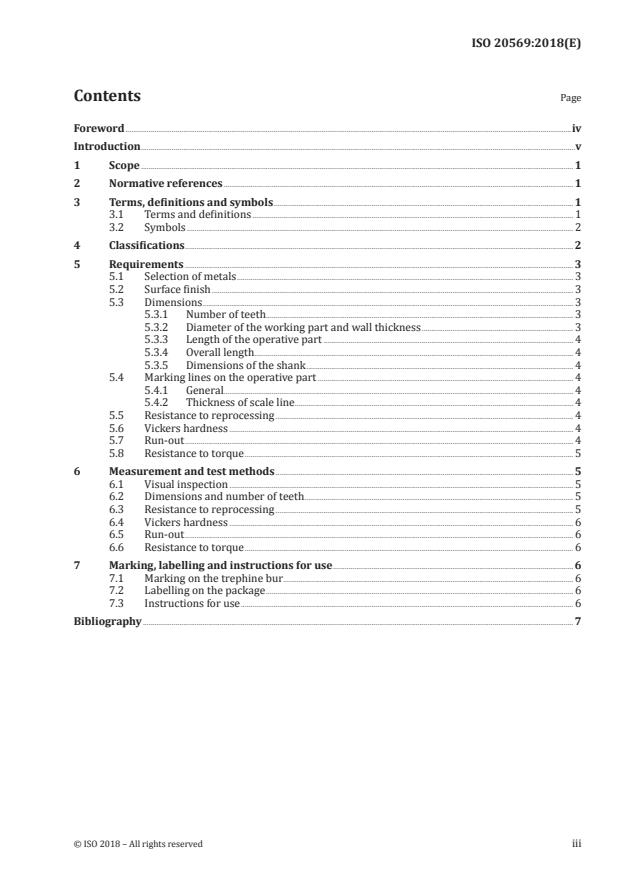
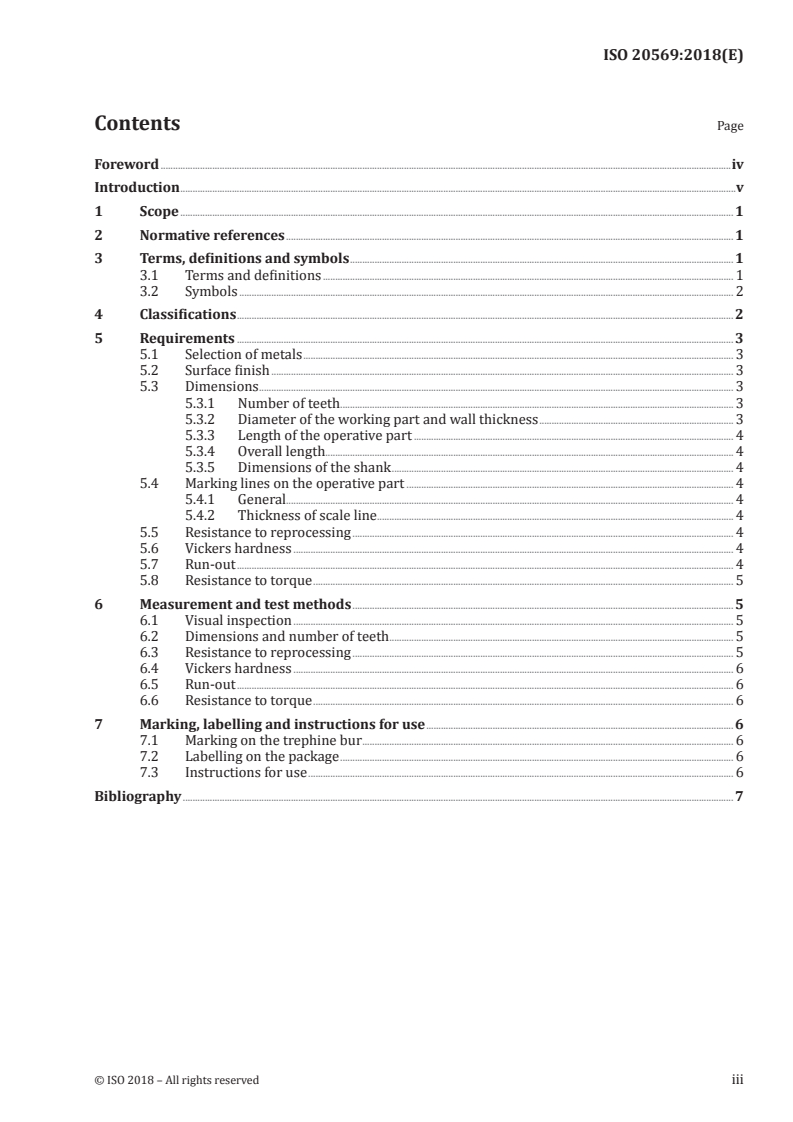
Contents Page
Foreword .iv
Introduction .v
1 Scope . 1
2 Normative references . 1
3 Terms, definitions and symbols . 1
3.1 Terms and definitions . 1
3.2 Symbols . 2
4 Classifications . 2
5 Requirements . 3
5.1 Selection of metals . 3
5.2 Surface finish . 3
5.3 Dimensions . 3
5.3.1 Number of teeth . . 3
5.3.2 Diameter of the working part and wall thickness . 3
5.3.3 Length of the operative part . 4
5.3.4 Overall length . . 4
5.3.5 Dimensions of the shank . 4
5.4 Marking lines on the operative part . 4
5.4.1 General. 4
5.4.2 Thickness of scale line . . 4
5.5 Resistance to reprocessing . 4
5.6 Vickers hardness . 4
5.7 Run-out . 4
5.8 Resistance to torque . 5
6 Measurement and test methods . 5
6.1 Visual inspection . 5
6.2 Dimensions and number of teeth . 5
6.3 Resistance to reprocessing . 5
6.4 Vickers hardness . 6
6.5 Run-out . 6
6.6 Resistance to torque . 6
7 Marking, labelling and instructions for use . 6
7.1 Marking on the trephine bur . 6
7.2 Labelling on the package . 6
7.3 Instructions for use . 6
Bibliography . 7
Foreword
ISO (the International Organization for Standardization) is a worldwide federation of national standards
bodies (ISO member bodies). The work of preparing International Standards is normally carried out
through ISO technical committees. Each member body interested in a subject for which a technical
committee has been established has the right to be represented on that committee. International
organizations, governmental and non-governmental, in liaison with ISO, also take part in the work.
ISO collaborates closely with the International Electrotechnical Commission (IEC) on all matters of
electrotechnical standardization.
The procedures used to develop this document and those intended for its further maintenance are
described in the ISO/IEC Directives, Part 1. In particular, the different approval criteria needed for the
different types of ISO documents should be noted. This document was drafted in accordance with the
editorial rules of the ISO/IEC Directives, Part 2 (see www .iso .org/directives).
Attention is drawn to the possibility that some of the elements of this document may be the subject of
patent rights. ISO shall not be held responsible for identifying any or all such patent rights. Details of
any patent rights identified during the development of the document will be in the Introduction and/or
on the ISO list of patent declarations received (see www .iso .org/patents).
Any trade name used in this document is information given for the convenience of users and does not
constitute an endorsement.
For an explanation of the voluntary nature of standards, the meaning of ISO specific terms and
expressions related to conformity assessment, as well as information about ISO's adherence to the
World Trade Organization (WTO) principles in the Technical Barriers to Trade (TBT) see www .iso
.org/iso/foreword .html.
This document was prepared by Technical Committee ISO/TC 106, Dentistry, Subcommittee SC 4, Dental
instruments.
Any feedback or questions on this document should be directed to the user’s national standards body. A
complete listing of these bodies can be found at www .iso .org/members .html.
iv © ISO 2018 – All rights reserved
Introduction
Dental trephine burs are dental instruments used in dental implantology.
...
INTERNATIONAL ISO
STANDARD 20569
First edition
2018-09
Dentistry — Trephine burs
Médecine bucco-dentaire — Fraises-trépans
Reference number
©
ISO 2018
© ISO 2018
All rights reserved. Unless otherwise specified, or required in the context of its implementation, no part of this publication may
be reproduced or utilized otherwise in any form or by any means, electronic or mechanical, including photocopying, or posting
on the internet or an intranet, without prior written permission. Permission can be requested from either ISO at the address
below or ISO’s member body in the country of the requester.
ISO copyright office
CP 401 • Ch. de Blandonnet 8
CH-1214 Vernier, Geneva
Phone: +41 22 749 01 11
Fax: +41 22 749 09 47
Email: copyright@iso.org
Website: www.iso.org
Published in Switzerland
ii © ISO 2018 – All rights reserved
Contents Page
Foreword .iv
Introduction .v
1 Scope . 1
2 Normative references . 1
3 Terms, definitions and symbols . 1
3.1 Terms and definitions . 1
3.2 Symbols . 2
4 Classifications . 2
5 Requirements . 3
5.1 Selection of metals . 3
5.2 Surface finish . 3
5.3 Dimensions . 3
5.3.1 Number of teeth . . 3
5.3.2 Diameter of the working part and wall thickness . 3
5.3.3 Length of the operative part . 4
5.3.4 Overall length . . 4
5.3.5 Dimensions of the shank . 4
5.4 Marking lines on the operative part . 4
5.4.1 General. 4
5.4.2 Thickness of scale line . . 4
5.5 Resistance to reprocessing . 4
5.6 Vickers hardness . 4
5.7 Run-out . 4
5.8 Resistance to torque . 5
6 Measurement and test methods . 5
6.1 Visual inspection . 5
6.2 Dimensions and number of teeth . 5
6.3 Resistance to reprocessing . 5
6.4 Vickers hardness . 6
6.5 Run-out . 6
6.6 Resistance to torque . 6
7 Marking, labelling and instructions for use . 6
7.1 Marking on the trephine bur . 6
7.2 Labelling on the package . 6
7.3 Instructions for use . 6
Bibliography . 7
Foreword
ISO (the International Organization for Standardization) is a worldwide federation of national standards
bodies (ISO member bodies). The work of preparing International Standards is normally carried out
through ISO technical committees. Each member body interested in a subject for which a technical
committee has been established has the right to be represented on that committee. International
organizations, governmental and non-governmental, in liaison with ISO, also take part in the work.
ISO collaborates closely with the International Electrotechnical Commission (IEC) on all matters of
electrotechnical standardization.
The procedures used to develop this document and those intended for its further maintenance are
described in the ISO/IEC Directives, Part 1. In particular, the different approval criteria needed for the
different types of ISO documents should be noted. This document was drafted in accordance with the
editorial rules of the ISO/IEC Directives, Part 2 (see www .iso .org/directives).
Attention is drawn to the possibility that some of the elements of this document may be the subject of
patent rights. ISO shall not be held responsible for identifying any or all such patent rights. Details of
any patent rights identified during the development of the document will be in the Introduction and/or
on the ISO list of patent declarations received (see www .iso .org/patents).
Any trade name used in this document is information given for the convenience of users and does not
constitute an endorsement.
For an explanation of the voluntary nature of standards, the meaning of ISO specific terms and
expressions related to conformity assessment, as well as information about ISO's adherence to the
World Trade Organization (WTO) principles in the Technical Barriers to Trade (TBT) see www .iso
.org/iso/foreword .html.
This document was prepared by Technical Committee ISO/TC 106, Dentistry, Subcommittee SC 4, Dental
instruments.
Any feedback or questions on this document should be directed to the user’s national standards body. A
complete listing of these bodies can be found at www .iso .org/members .html.
iv © ISO 2018 – All rights reserved
Introduction
Dental trephine burs are dental instruments used in dental implantology.
...
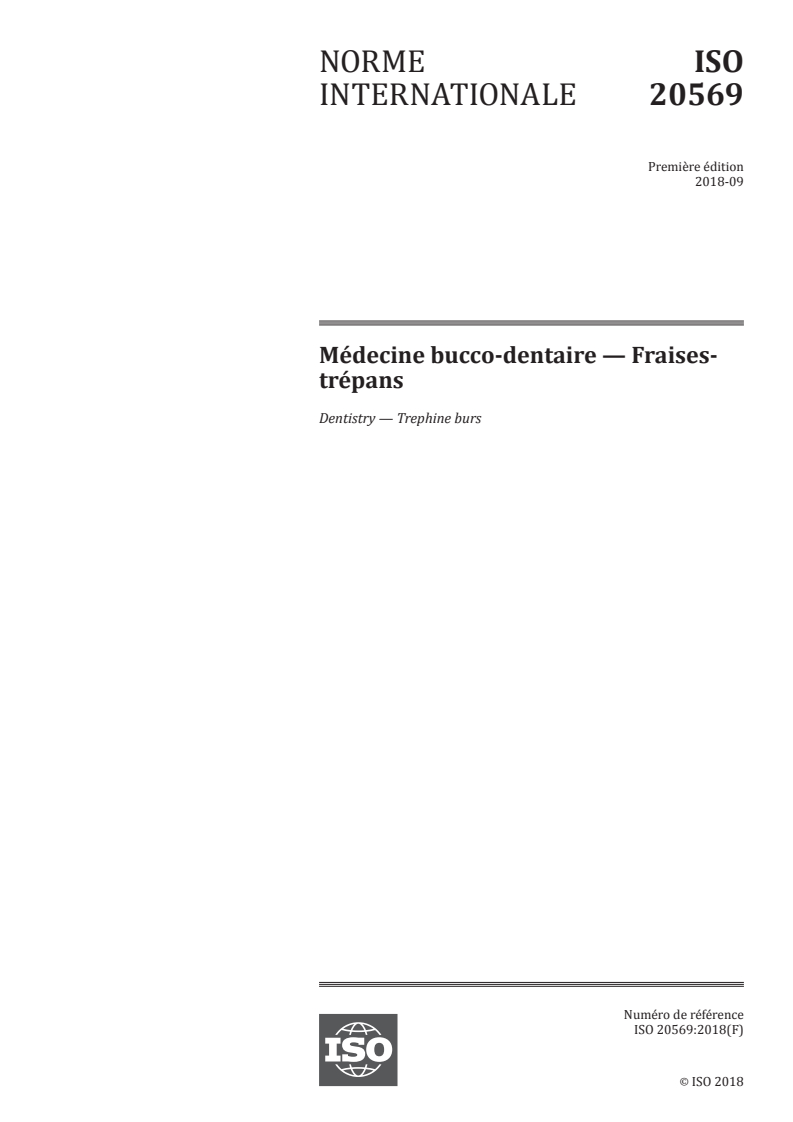
NORME ISO
INTERNATIONALE 20569
Première édition
2018-09
Médecine bucco-dentaire — Fraises-
trépans
Dentistry — Trephine burs
Numéro de référence
©
ISO 2018
DOCUMENT PROTÉGÉ PAR COPYRIGHT
© ISO 2018
Tous droits réservés. Sauf prescription différente ou nécessité dans le contexte de sa mise en œuvre, aucune partie de cette
publication ne peut être reproduite ni utilisée sous quelque forme que ce soit et par aucun procédé, électronique ou mécanique,
y compris la photocopie, ou la diffusion sur l’internet ou sur un intranet, sans autorisation écrite préalable. Une autorisation peut
être demandée à l’ISO à l’adresse ci-après ou au comité membre de l’ISO dans le pays du demandeur.
ISO copyright office
Case postale 401 • Ch. de Blandonnet 8
CH-1214 Vernier, Genève
Tél.: +41 22 749 01 11
Fax: +41 22 749 09 47
E-mail: copyright@iso.org
Web: www.iso.org
Publié en Suisse
ii © ISO 2018 – Tous droits réservés
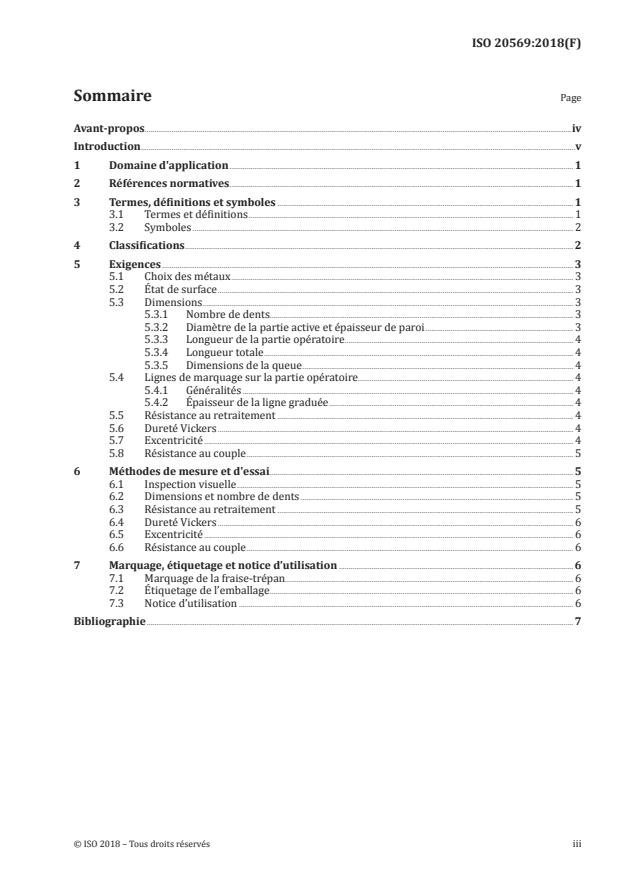
Sommaire Page
Avant-propos .iv
Introduction .v
1 Domaine d'application . 1
2 Références normatives . 1
3 Termes, définitions et symboles . 1
3.1 Termes et définitions . 1
3.2 Symboles . 2
4 Classifications . 2
5 Exigences . 3
5.1 Choix des métaux . 3
5.2 État de surface . 3
5.3 Dimensions . 3
5.3.1 Nombre de dents. 3
5.3.2 Diamètre de la partie active et épaisseur de paroi . 3
5.3.3 Longueur de la partie opératoire . 4
5.3.4 Longueur totale . 4
5.3.5 Dimensions de la queue . 4
5.4 Lignes de marquage sur la partie opératoire . 4
5.4.1 Généralités . 4
5.4.2 Épaisseur de la ligne graduée . 4
5.5 Résistance au retraitement . 4
5.6 Dureté Vickers . 4
5.7 Excentricité . 4
5.8 Résistance au couple . 5
6 Méthodes de mesure et d'essai . 5
6.1 Inspection visuelle . 5
6.2 Dimensions et nombre de dents . 5
6.3 Résistance au retraitement . 5
6.4 Dureté Vickers . 6
6.5 Excentricité . 6
6.6 Résistance au couple . 6
7 Marquage, étiquetage et notice d’utilisation . 6
7.1 Marquage de la fraise-trépan. 6
7.2 Étiquetage de l’emballage . 6
7.3 Notice d’utilisation . 6
Bibliographie . 7
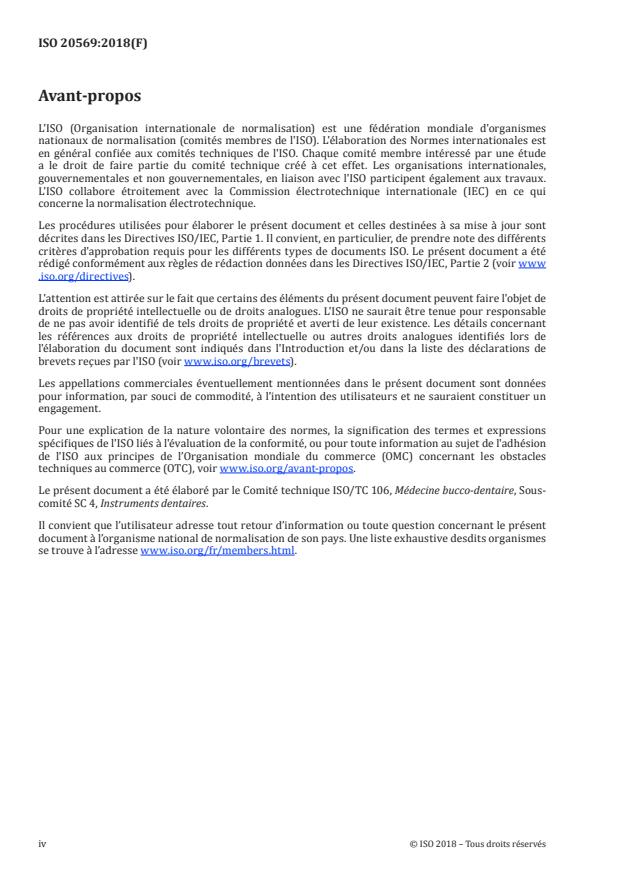
Avant-propos
L'ISO (Organisation internationale de normalisation) est une fédération mondiale d'organismes
nationaux de normalisation (comités membres de l'ISO). L'élaboration des Normes internationales est
en général confiée aux comités techniques de l'ISO. Chaque comité membre intéressé par une étude
a le droit de faire partie du comité technique créé à cet effet. Les organisations internationales,
gouvernementales et non gouvernementales, en liaison avec l'ISO participent également aux travaux.
L'ISO collabore étroitement avec la Commission électrotechnique internationale (IEC) en ce qui
concerne la normalisation électrotechnique.
Les procédures utilisées pour élaborer le présent document et celles destinées à sa mise à jour sont
décrites dans les Directives ISO/IEC, Partie 1. Il convient, en particulier, de prendre note des différents
critères d'approbation requis pour les différents types de documents ISO. Le présent document a été
rédigé conformément aux règles de rédaction données dans les Directives ISO/IEC, Partie 2 (voir www
.iso .org/directives).
L'attention est attirée sur le fait que certains des éléments du présent document peuvent faire l'objet de
droits de propriété intellectuelle ou de droits analogues. L'ISO ne saurait être tenue pour responsable
de ne pas avoir identifié de tels droits de propriété et averti de leur existence. Les détails concernant
les références aux droits de propriété intellectuelle ou autres droits analogues identifiés lors de
l'élaboration du document sont indiqués dans l'Introduction et/ou dans la liste des déclarations de
brevets reçues par l'ISO (voir www .iso .org/brevets).
Les appellations commerciales éventuellement mentionnées dans le présent document sont données
pour information, par souci de commodité, à l’intention des utilisateurs et ne sauraient constituer un
engagement.
Pour une explication de la nature volontaire des normes, la signification des termes et expressions
spécifiques de l'ISO liés à l'évaluation de la conformité, ou pour toute information au sujet de l'adhésion
de l'ISO aux principes de l’Organisation mondiale du commerce (OMC) concernant les obstacles
techniques au commerce (OTC), voir www .iso .org/avant -propos.
Le présent document a été élaboré par le Comité technique ISO/TC 106, Médecine bucco-dentaire, Sous-
comité SC 4, Instruments dentaires.
Il convient que l’utilisateur adresse tout retour d’information ou toute question concernant le présent
document à l’organisme national de normalisation de son pays. Une liste exhaustive desdits organismes
se trouve à l’adresse www .iso .org/fr/members .html.
iv © ISO 2018 – Tous droits réservés
Introduction
Les fraises-trépans sont des instruments dentaires utilisés en implantologie dentaire.
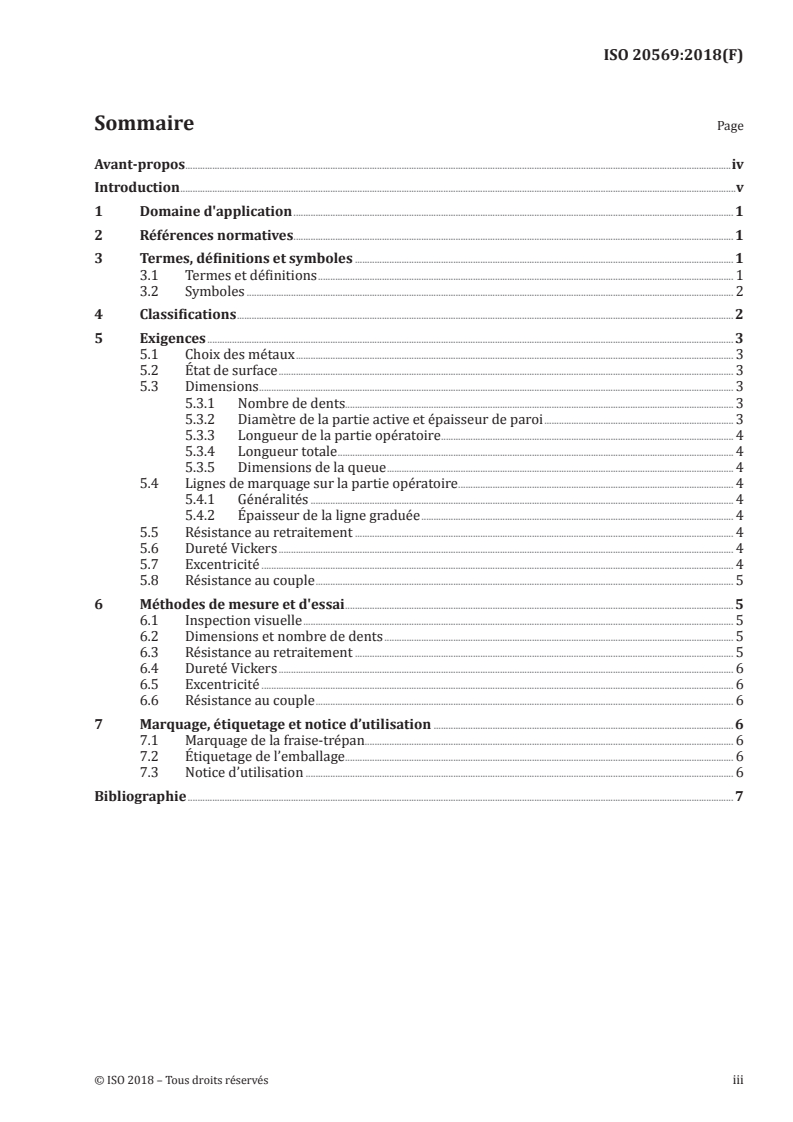
NORME INTERNATIONALE ISO 20569:2018(F)
Médecine bucco-dentaire — Fraises-trépans
1 Domaine d'application
Le présent document spécifie les exigences et méthodes d’essai des fraises‐trépans employées dans la
médecine bucco-dentaire, en particulier dans le cadre de procédures d’implantologie buccale telles que
les prélèvements osseux et/ou le retrait d’un implant. Il
...
NORME ISO
INTERNATIONALE 20569
Première édition
2018-09
Médecine bucco-dentaire — Fraises-
trépans
Dentistry — Trephine burs
Numéro de référence
©
ISO 2018
DOCUMENT PROTÉGÉ PAR COPYRIGHT
© ISO 2018
Tous droits réservés. Sauf prescription différente ou nécessité dans le contexte de sa mise en œuvre, aucune partie de cette
publication ne peut être reproduite ni utilisée sous quelque forme que ce soit et par aucun procédé, électronique ou mécanique,
y compris la photocopie, ou la diffusion sur l’internet ou sur un intranet, sans autorisation écrite préalable. Une autorisation peut
être demandée à l’ISO à l’adresse ci-après ou au comité membre de l’ISO dans le pays du demandeur.
ISO copyright office
Case postale 401 • Ch. de Blandonnet 8
CH-1214 Vernier, Genève
Tél.: +41 22 749 01 11
Fax: +41 22 749 09 47
E-mail: copyright@iso.org
Web: www.iso.org
Publié en Suisse
ii © ISO 2018 – Tous droits réservés
Sommaire Page
Avant-propos .iv
Introduction .v
1 Domaine d'application . 1
2 Références normatives . 1
3 Termes, définitions et symboles . 1
3.1 Termes et définitions . 1
3.2 Symboles . 2
4 Classifications . 2
5 Exigences . 3
5.1 Choix des métaux . 3
5.2 État de surface . 3
5.3 Dimensions . 3
5.3.1 Nombre de dents. 3
5.3.2 Diamètre de la partie active et épaisseur de paroi . 3
5.3.3 Longueur de la partie opératoire . 4
5.3.4 Longueur totale . 4
5.3.5 Dimensions de la queue . 4
5.4 Lignes de marquage sur la partie opératoire . 4
5.4.1 Généralités . 4
5.4.2 Épaisseur de la ligne graduée . 4
5.5 Résistance au retraitement . 4
5.6 Dureté Vickers . 4
5.7 Excentricité . 4
5.8 Résistance au couple . 5
6 Méthodes de mesure et d'essai . 5
6.1 Inspection visuelle . 5
6.2 Dimensions et nombre de dents . 5
6.3 Résistance au retraitement . 5
6.4 Dureté Vickers . 6
6.5 Excentricité . 6
6.6 Résistance au couple . 6
7 Marquage, étiquetage et notice d’utilisation . 6
7.1 Marquage de la fraise-trépan. 6
7.2 Étiquetage de l’emballage . 6
7.3 Notice d’utilisation . 6
Bibliographie . 7
Avant-propos
L'ISO (Organisation internationale de normalisation) est une fédération mondiale d'organismes
nationaux de normalisation (comités membres de l'ISO). L'élaboration des Normes internationales est
en général confiée aux comités techniques de l'ISO. Chaque comité membre intéressé par une étude
a le droit de faire partie du comité technique créé à cet effet. Les organisations internationales,
gouvernementales et non gouvernementales, en liaison avec l'ISO participent également aux travaux.
L'ISO collabore étroitement avec la Commission électrotechnique internationale (IEC) en ce qui
concerne la normalisation électrotechnique.
Les procédures utilisées pour élaborer le présent document et celles destinées à sa mise à jour sont
décrites dans les Directives ISO/IEC, Partie 1. Il convient, en particulier, de prendre note des différents
critères d'approbation requis pour les différents types de documents ISO. Le présent document a été
rédigé conformément aux règles de rédaction données dans les Directives ISO/IEC, Partie 2 (voir www
.iso .org/directives).
L'attention est attirée sur le fait que certains des éléments du présent document peuvent faire l'objet de
droits de propriété intellectuelle ou de droits analogues. L'ISO ne saurait être tenue pour responsable
de ne pas avoir identifié de tels droits de propriété et averti de leur existence. Les détails concernant
les références aux droits de propriété intellectuelle ou autres droits analogues identifiés lors de
l'élaboration du document sont indiqués dans l'Introduction et/ou dans la liste des déclarations de
brevets reçues par l'ISO (voir www .iso .org/brevets).
Les appellations commerciales éventuellement mentionnées dans le présent document sont données
pour information, par souci de commodité, à l’intention des utilisateurs et ne sauraient constituer un
engagement.
Pour une explication de la nature volontaire des normes, la signification des termes et expressions
spécifiques de l'ISO liés à l'évaluation de la conformité, ou pour toute information au sujet de l'adhésion
de l'ISO aux principes de l’Organisation mondiale du commerce (OMC) concernant les obstacles
techniques au commerce (OTC), voir www .iso .org/avant -propos.
Le présent document a été élaboré par le Comité technique ISO/TC 106, Médecine bucco-dentaire, Sous-
comité SC 4, Instruments dentaires.
Il convient que l’utilisateur adresse tout retour d’information ou toute question concernant le présent
document à l’organisme national de normalisation de son pays. Une liste exhaustive desdits organismes
se trouve à l’adresse www .iso .org/fr/members .html.
iv © ISO 2018 – Tous droits réservés
Introduction
Les fraises-trépans sont des instruments dentaires utilisés en implantologie dentaire.
NORME INTERNATIONALE ISO 20569:2018(F)
Médecine bucco-dentaire — Fraises-trépans
1 Domaine d'application
Le présent document spécifie les exigences et méthodes d’essai des fraises‐trépans employées dans la
médecine bucco-dentaire, en particulier dans le cadre de procédures d’implantologie buccale telles que
les prélèvements osseux et/ou le retrait d’un implant. Il
...