

ISO/IEC 29794-1:2024
(Main)Information technology — Biometric sample quality — Part 1: Framework
General Information
- Abstract
This document establishes the following items for any or all biometric sample types as necessary: — terms and definitions that are useful in the specification and use of quality measures; — purpose and interpretation of biometric quality scores; — motivation for developing biometric sample datasets for the purpose of quality score normalization; — format for exchange of quality assessment algorithm results; — methods for aggregation of quality scores; — methods for evaluating the efficiency of quality assessment algorithms. The following are outside the scope of this document: — specification of minimum requirements for sample, module, or system quality scores; — standardization of quality assessment algorithms; — assessment of utility of biometric samples or references for human examiners.
- Status
- Published
- Publication Date
- 29-May-2024
- Technical Committee
- ISO/IEC JTC 1/SC 37 - Biometrics
- Drafting Committee
- ISO/IEC JTC 1/SC 37/WG 3 - Biometric data interchange formats
- Current Stage
- 9092 - International Standard to be revised
- Start Date
- 20-Jan-2025
- Completion Date
- 29-Aug-2026


Overview
ISO/IEC 29794-1:2024 - "Information technology - Biometric sample quality - Part 1: Framework" defines a common framework for expressing, interpreting and exchanging biometric sample quality information. The third edition standardizes terms and concepts (aligned with ISO/IEC 2382-37:2022), describes the purpose of quality scores, motivates dataset development for quality score normalization, and specifies formats and methods to enable interoperable quality assessment algorithms across biometric systems.
Key topics and technical requirements
- Scope and terminology: Standardized terms such as biometric utility, acquisition fidelity, and biometric character to ensure consistent interpretation of quality measures.
- Purpose of quality scores: Guidance on how to interpret scores for sample selection, processing, and performance diagnosis.
- Data interchange formats: Abstract field definitions and concrete encodings (XML, tagged binary). The 2024 edition adds support for ASN.1 (per ISO/IEC 39794-1).
- Quality assessment algorithm metadata: Identifier blocks and standardized fields to record algorithm results and errors for exchange between systems.
- Aggregation methods: Procedures for combining component scores into aggregate quality measures.
- Normalization: Guidance on creating and using biometric sample datasets to normalize quality scores across devices and algorithms.
- Evaluation metrics: Methods to evaluate algorithm efficacy - including false non‑match error versus discard (FNM‑EDC), false match error versus discard (FM‑EDC), DET vs. discard, and sample acceptance/discard rate.
- Out-of-scope items: The standard explicitly does not set minimum quality thresholds, standardize algorithms themselves, or define human examiner utility assessments.
Practical applications
ISO/IEC 29794-1:2024 supports real-world biometric operations by enabling:
- Real-time capture feedback to improve enrollment and acquisition quality.
- Interoperable quality exchange between capture devices, matching modules, and fusion engines (including CBEFF-compatible use).
- Quality-driven workflows such as conditional processing, workload reduction (discarding low-quality samples), and selection of the best sample from multiple captures.
- Performance analysis and diagnostics by correlating quality measures with system metrics to identify failure modes.
- Research and benchmarking through normalized quality datasets for algorithm comparison.
Who should use this standard
- Biometric system architects and integrators
- Device manufacturers and quality-assessment algorithm developers
- Test labs, certification bodies, and researchers
- Organizations deploying large-scale biometric enrollment or multimodal fusion
Related standards
- ISO/IEC 39794-1 (Extensible biometric data interchange formats)
- ISO/IEC 2382-37 (Biometrics vocabulary)
- ISO/IEC 19785-2 (CBEFF biometric registration authority)
- Other parts of the ISO/IEC 29794 series (mode-specific quality guidance)
Keywords: ISO/IEC 29794-1:2024, biometric sample quality, quality scores, quality assessment algorithms, quality score normalization, biometric systems, CBEFF, ASN.1, XML encoding.
Relations
- Effective Date
- 23-Apr-2020
Get Certified
Connect with accredited certification bodies for this standard

BSI Group
BSI (British Standards Institution) is the business standards company that helps organizations make excellence a habit.

NYCE
Mexican standards and certification body.
Sponsored listings
Frequently Asked Questions
ISO/IEC 29794-1:2024 is a standard published by the International Organization for Standardization (ISO). Its full title is "Information technology — Biometric sample quality — Part 1: Framework". This standard covers: This document establishes the following items for any or all biometric sample types as necessary: — terms and definitions that are useful in the specification and use of quality measures; — purpose and interpretation of biometric quality scores; — motivation for developing biometric sample datasets for the purpose of quality score normalization; — format for exchange of quality assessment algorithm results; — methods for aggregation of quality scores; — methods for evaluating the efficiency of quality assessment algorithms. The following are outside the scope of this document: — specification of minimum requirements for sample, module, or system quality scores; — standardization of quality assessment algorithms; — assessment of utility of biometric samples or references for human examiners.
This document establishes the following items for any or all biometric sample types as necessary: — terms and definitions that are useful in the specification and use of quality measures; — purpose and interpretation of biometric quality scores; — motivation for developing biometric sample datasets for the purpose of quality score normalization; — format for exchange of quality assessment algorithm results; — methods for aggregation of quality scores; — methods for evaluating the efficiency of quality assessment algorithms. The following are outside the scope of this document: — specification of minimum requirements for sample, module, or system quality scores; — standardization of quality assessment algorithms; — assessment of utility of biometric samples or references for human examiners.
ISO/IEC 29794-1:2024 is classified under the following ICS (International Classification for Standards) categories: 35.240.15 - Identification cards. Chip cards. Biometrics. The ICS classification helps identify the subject area and facilitates finding related standards.
ISO/IEC 29794-1:2024 has the following relationships with other standards: It is inter standard links to ISO/IEC 29794-1:2016. Understanding these relationships helps ensure you are using the most current and applicable version of the standard.
ISO/IEC 29794-1:2024 is available in PDF format for immediate download after purchase. The document can be added to your cart and obtained through the secure checkout process. Digital delivery ensures instant access to the complete standard document.
Standards Content (Sample)
International
Standard
ISO/IEC 29794-1
Third edition
Information technology —
2024-05
Biometric sample quality —
Part 1:
Framework
Technologies de l'information — Qualité d'échantillon
biométrique —
Partie 1: Cadre
Reference number
© ISO/IEC 2024
All rights reserved. Unless otherwise specified, or required in the context of its implementation, no part of this publication may
be reproduced or utilized otherwise in any form or by any means, electronic or mechanical, including photocopying, or posting on
the internet or an intranet, without prior written permission. Permission can be requested from either ISO at the address below
or ISO’s member body in the country of the requester.
ISO copyright office
CP 401 • Ch. de Blandonnet 8
CH-1214 Vernier, Geneva
Phone: +41 22 749 01 11
Email: copyright@iso.org
Website: www.iso.org
Published in Switzerland
© ISO/IEC 2024 – All rights reserved
ii
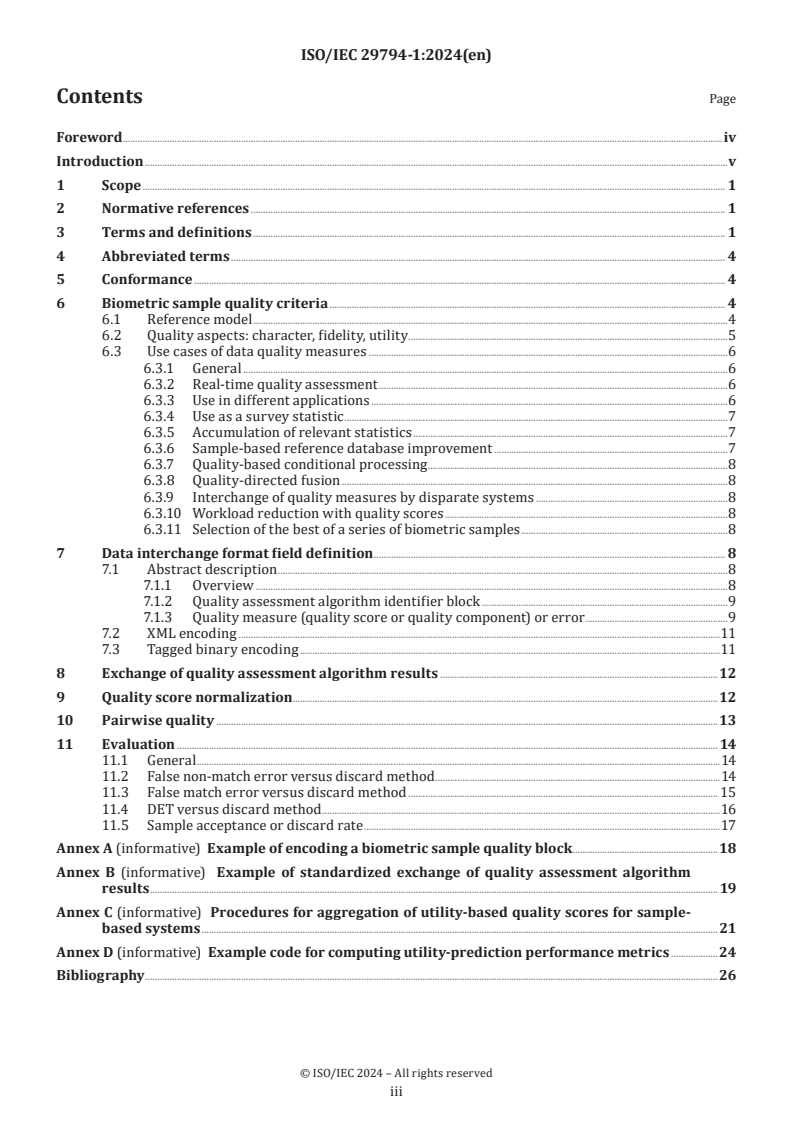
Contents Page
Foreword .iv
Introduction .v
1 Scope . 1
2 Normative references . 1
3 Terms and definitions . 1
4 Abbreviated terms . 4
5 Conformance . 4
6 Biometric sample quality criteria . 4
6.1 Reference model .4
6.2 Quality aspects: character, fidelity, utility .5
6.3 Use cases of data quality measures .6
6.3.1 General .6
6.3.2 Real-time quality assessment .6
6.3.3 Use in different applications .6
6.3.4 Use as a survey statistic .7
6.3.5 Accumulation of relevant statistics .7
6.3.6 Sample-based reference database improvement .7
6.3.7 Quality-based conditional processing .8
6.3.8 Quality-directed fusion .8
6.3.9 Interchange of quality measures by disparate systems .8
6.3.10 Workload reduction with quality scores .8
6.3.11 Selection of the best of a series of biometric samples .8
7 Data interchange format field definition . 8
7.1 Abstract description .8
7.1.1 Overview .8
7.1.2 Quality assessment algorithm identifier block .9
7.1.3 Quality measure (quality score or quality component) or error .9
7.2 XML encoding .11
7.3 Tagged binary encoding .11
8 Exchange of quality assessment algorithm results .12
9 Quality score normalization . .12
10 Pairwise quality .13
11 Evaluation . 14
11.1 General .14
11.2 False non-match error versus discard method .14
11.3 False match error versus discard method . 15
11.4 DET versus discard method .16
11.5 Sample acceptance or discard rate .17
Annex A (informative) Example of encoding a biometric sample quality block .18
Annex B (informative) Example of standardized exchange of quality assessment algorithm
results . 19
Annex C (informative) Procedures for aggregation of utility-based quality scores for sample-
based systems .21
Annex D (informative) Example code for computing utility-prediction performance metrics .24
Bibliography .26
© ISO/IEC 2024 – All rights reserved
iii
Foreword
ISO (the International Organization for Standardization) and IEC (the International Electrotechnical
Commission) form the specialized system for worldwide standardization. National bodies that are
members of ISO or IEC participate in the development of International Standards through technical
committees established by the respective organization to deal with particular fields of technical activity.
ISO and IEC technical committees collaborate in fields of mutual interest. Other international organizations,
governmental and non-governmental, in liaison with ISO and IEC, also take part in the work.
The procedures used to develop this document and those intended for its further maintenance are described
in the ISO/IEC Directives, Part 1. In particular, the different approval criteria needed for the different types
of document should be noted. This document was drafted in accordance with the editorial rules of the ISO/
IEC Directives, Part 2 (see www.iso.org/directives or www.iec.ch/members_experts/refdocs).
ISO and IEC draw attention to the possibility that the implementation of this document may involve the
use of (a) patent(s). ISO and IEC take no position concerning the evidence, validity or applicability of any
claimed patent rights in respect thereof. As of the date of publication of this document, ISO and IEC had not
received notice of (a) patent(s) which may be required to implement this document. However, implementers
are cautioned that this may not represent the latest information, which may be obtained from the patent
database available at www.iso.org/patents and https://patents.iec.ch. ISO and IEC shall not be held
responsible for identifying any or all such patent rights.
Any trade name used in this document is information given for the convenience of users and does not
constitute an endorsement.
For an explanation of the voluntary nature of standards, the meaning of ISO specific terms and expressions
related to conformity assessment, as well as information about ISO's adherence to the World Trade
Organization (WTO) principles in the Technical Barriers to Trade (TBT) see www.iso.org/iso/foreword.html.
In the IEC, see www.iec.ch/understanding-standards.
This document was prepared by Joint Technical Committee ISO/IEC JTC 1, Information technology,
Subcommittee SC 37, Biometrics.
This third edition cancels and replaces the second edition (ISO/IEC 29794-1:2016), which has been
technically revised.
The main changes are as follows:
— the definitions of “quality”, “quality score”, and “utility” have been aligned with those in
ISO/IEC 2382-37:2022;
— methods for evaluating the efficacy of quality assessment algorithms have been added;
— ASN.1 encoding as defined in ISO/IEC 39794-1 is supported.
A list of all parts in the ISO/IEC 29794 series can be found on the ISO and IEC websites.
Any feedback or questions on this document should be directed to the user’s national standards
body. A complete listing of these bodies can be found at www.iso.org/members.html and
www.iec.ch/national-committees.
© ISO/IEC 2024 – All rights reserved
iv
Introduction
Quality measures are useful for several applications in the field of biometrics. While ISO/IEC 19784-1
specifies a structure and gives guidelines for quality score categorization, this document defines and specifies
methodologies for objective and quantitative quality score expression, interpretation and interchange.
This document establishes a framework that facilitates the use of biometric sample quality assessment
and scoring tools. The tools are intended to encourage innovation and performance improvements in,
and interoperability of, biometric systems generally. The ISO/IEC 29794 series presents several biometric
sample quality assessment and scoring tools, the use of which is generally optional but can be determined
as mandatory by particular application profiles or specific implementations. The ISO/IEC 29794 series is
prepared to accommodate additional parts that address the biometric modes specified by the ISO/IEC 19794
series and the ISO/IEC 39794 series, with part numbers and titles aligning appropriately. However, as this
document is intended for use by all biometric modes, a mode does not necessarily need a mode-specific part
to make use of quality scores.
Several applications can benefit from the use of biometric sample quality measures. An example is the use
of real-time quality feedback as part of the biometric capture process to improve the operational efficiency
and performance of a biometric system. Other examples include data fusion for which multiple samples or
references are available in the comparison process, either from a single or multiple biometric mode, and
hardening systems against presentation attacks using or targeting low quality biometric samples. The
association of quality measures with biometric samples is an important component of quality measure
standardization. Quality fields as specified in Clause 7 are included in biometric data interchange formats.
If a CBEFF (Common Biometric Exchange Formats Framework) header is present, then CBEFF_BDB_quality
may additionally be used to express quality measures. Useful analyses can be performed using quality
measures along with other data to improve the performance of a biometric system. For example, correlating
quality measures to other system metrics can be used to diagnose problems and highlight potential areas of
performance improvement.
© ISO/IEC 2024 – All rights reserved
v
International Standard ISO/IEC 29794-1:2024(en)
Information technology — Biometric sample quality —
Part 1:
Framework
1 Scope
This document establishes the following items for any or all biometric sample types as necessary:
— terms and definitions that are useful in the specification and use of quality measures;
— purpose and interpretation of biometric quality scores;
— motivation for developing biometric sample datasets for the purpose of quality score normalization;
— format for exchange of quality assessment algorithm results;
— methods for aggregation of quality scores;
— methods for evaluating the efficiency of quality assessment algorithms.
The following are outside the scope of this document:
— specification of minimum requirements for sample, module, or system quality scores;
— standardization of quality assessment algorithms;
— assessment of utility of biometric samples or references for human examiners.
2 Normative references
The following documents are referred to in the text in such a way that some or all of their content constitutes
requirements of this document. For dated references, only the edition cited applies. For undated references,
the latest edition of the referenced document (including any amendments) applies.
ISO/IEC 39794-1, Information technology — Extensible biometric data interchange formats — Part 1:
Framework
ISO/IEC 2382-37, Information technology — Vocabulary — Part 37: Biometrics
ISO/IEC 19785-2, Information technology — Common Biometric Exchange Formats Framework — Part 2:
Biometric registration authority
3 Terms and definitions
For the purposes of this document, the terms and definitions given in ISO/IEC 2382-37, ISO/IEC 39794-1 and
the following apply.
ISO and IEC maintain terminology databases for use in standardization at the following addresses:
— ISO Online browsing platform: available at https:// www .iso .org/ obp
— IEC Electropedia: available at https:// www .electropedia .org/
© ISO/IEC 2024 – All rights reserved
3.1
acquisition fidelity
fidelity (3.8) of a biometric sample attributed to the acquisition process
3.2
biometric character
set of attributes associated with a biometric characteristic that cannot be controlled during the biometric
acquisition process
EXAMPLE Scars, number of minutiae, blepharoptosis (droopy eyelid)
[SOURCE: ISO/IEC 2382-37:2022, 37.09.15, modified — Note 1 to entry has been removed.]
3.3
biometric utility
degree to which a biometric sample supports biometric recognition performance (3.11)
Note 1 to entry: The biometric character (3.2) of the sample source, the fidelity (3.8) of the processed biometric samples
and the conformance of the biometric sample presentation contribute to, or similarly detract from, the utility of the
biometric sample.
Note 2 to entry: Performance measures such as false match rate, false non-match rate, failure-to-enrol rate, and
failure-to-acquire rate are an indication of biometric utility.
[SOURCE: ISO/IEC 2382-37:2022, 37.09.16, modified — “character” has been changed to “biometric
character” in Note 1 to entry.]
3.4
environment
physical surroundings and conditions in which the biometric capture takes place
Note 1 to entry: The conditions include the factors such as lighting and temperature, level of enrolee cooperation, and
the skill of the operator, if one is involved in the capture process.
3.5
false non-match error versus discard characteristic
FNM-EDC
method to evaluate the efficacy of quality assessment algorithms (3.13) by quantifying how efficiently
discarding samples with low quality scores (3.16) results in an improved (i.e. reduced) false non-match rate
Note 1 to entry: The false non-match error versus discard characteristic is a graphical presentation of the performance
(3.11) of quality assessment algorithms, plotting the dependence of the false non-match rate at a fixed comparison
decision threshold on the percentage of low-quality reference and probe samples discarded.
3.6
false match error versus discard characteristic
FM-EDC
method to evaluate the efficacy of quality assessment algorithms (3.13) by quantifying how efficiently
discarding samples with low quality scores (3.16) results in an improved (i.e. reduced) false match rate
Note 1 to entry: The false match error versus discard characteristic is a graphical presentation of the performance
(3.11) of quality assessment algorithms, plotting the dependence of the false match rate at a fixed comparison decision
threshold on the percentage of low-quality reference and probe samples discarded.
3.7
extraction fidelity
component of the fidelity (3.8) of a sample attributed to the biometric feature extraction process
© ISO/IEC 2024 – All rights reserved
3.8
fidelity
degree to which a biometric sample is representative of its source biometric characteristic
Note 1 to entry: The fidelity of a sample comprises components attributable to one or more of the processing steps:
acquisition, extraction, signal processing.
3.9
interpretation
process of analysing a quality score (3.16) along with other data in order to give that score contextual,
relative meaning
3.10
native quality measure
output of a quality assessment algorithm (3.13) without constraints on data format and/or value range
3.11
performance
assessment of false match rate, false non-match rate, failure-to-enrol rate, failure-to-acquire rate, processing
time or throughput rates of a biometric system
3.12
quality
degree to which a biometric sample meets the specified requirements for its targeted application
[SOURCE: ISO/IEC 2382-37:2022, 37.09.14]
3.13
quality assessment algorithm
quality algorithm
algorithm to calculate a quality measure (3.15)
Note 1 to entry: The ISO/IEC 19785 series uses the term "quality algorithm".
3.14
quality component
measurement on the biometric sample that may contribute to the computation of a unified quality score (3.16)
Note 1 to entry: Features expressing quality components are defined in the modality-specific parts of the
ISO/IEC 29794 series.
3.15
quality measure
quality score (3.16) or quality component (3.14)
3.16
quality score
quantitative value of the fitness of a biometric sample to accomplish or fulfil the comparison decision
[SOURCE: ISO/IEC 2382-37:2022, 37.09.13]
3.17
quality score normalization
rescaling of quality scores (3.16) to improve consistency in scale and interpretation (3.9)
3.18
quality score normalization dataset
QSND
dataset of biometric samples annotated with quality scores (3.16) for use in quality score normalization (3.17)
Note 1 to entry: Target quality scores may be assigned based on performance (3.11) outcomes using the sample in
question or may be based on quality factors recorded in the acquisition of the dataset.
© ISO/IEC 2024 – All rights reserved
3.19
quality score percentile rank
QSPR
percentile rank of quality scores (3.16) of biometric samples in an identified control dataset that are less than
the specified quality score
Note 1 to entry: See QSND (3.18).
3.20
raw quality score
quality score (3.16) that has not been interpreted (3.9), either by the creator or recipient of the score, and
alone potentially does not intrinsically provide contextual information
4 Abbreviated terms
BDB biometric data block
CBEFF common biometric exchange formats framework (ISO/IEC 19785)
CDF cumulative distribution function
DET detection error trade-off
FERET facial image database developed by the U.S. government in the 1990s
FMR false match rate
FNMR false non-match rate
QAID quality assessment algorithm identifier
QSND quality score normalization dataset
QSPR quality score percentile rank
QVID quality assessment algorithm vendor identifier
5 Conformance
A biometric sample quality block shall be considered conformant to this document if its structure and data
values conform to the formatting requirements of Clause 7.
The semantic conformance testing will be handled in the modality-specific parts of the ISO/IEC 29794 series,
where, for example, conformance test sets (a set of biometric samples representing the entire variety of
quality from poor to good) and associated quality scores to be obtained with the reference implementation
are given.
6 Biometric sample quality criteria
6.1 Reference model
In biometrics, the term “quality” is used to describe several different aspects of a biometric sample that
contribute to the overall performance of a biometric system. For the purposes of standardization, this
document defines terms, definitions, and a reference model for distinguishing among the different aspects of
quality, illustrated in Figure 1. The quality of a biometric sample depends on character and fidelity. Figure 2
illustrates the relationship between quality (character, fidelity and utility) and system performance. The
utility of a biometric sample reflects the impact of this sample on biometric recognition performance.
© ISO/IEC 2024 – All rights reserved
Figure 1 — Quality reference model illustration
Figure 2 — Relationship between quality and system performance
6.2 Quality aspects: character, fidelity, utility
The term “quality” as it is currently used in the field of biometrics has several connotations, depending on
context. Three prevalent uses subjectively reflect the following.
a) Character of a sample — An expression of quality based on the inherent properties of the biometric
characteristic from which the biometric sample is derived. For example, worn friction ridges have poor
character and blepharoptosis (droopy eyelid) causes poor iris character.
b) Fidelity of a sample to the biometric characteristic from which it is derived — An expression of quality
based on fidelity reflects how accurately the sample represents its biometric characteristic. Sample
fidelity is comprised of fidelity components contributed by different processes.
c) Utility of a sample within a biometric system — An expression of quality based on utility reflects the
predicted positive or negative contribution of an individual sample to the overall performance of a
biometric system. Utility-based quality is dependent on both the character and fidelity of a sample or
reference as well as the details of the specific biometric system of which performance is being evaluated.
This implies that utility is not necessarily a universal attribute of a sample consistent across all systems.
© ISO/IEC 2024 – All rights reserved
Utility-based quality is intended to be more predictive of system performance (e.g. in terms of false
match rate, false non-match rate, failure to enrol rate, and failure to acquire rate) than measures of
quality based on character or fidelity alone. See Table 1 for more information.
The term “quality” is not solely attributable to the characteristics of the capture device, such as sampling
rate, transfer function, directionality, sensitivity, dynamic range and bit depth, image resolution, pixel
density, dimensions in pixels, or grey scale/colour bit depth, although such factors can affect sample utility
and can contribute to the overall quality score.
The character and utility of an acquired sample depend on the features generated by a feature extraction
subsystem. For instance, the same finger image can be of low character and utility with respect to minutiae
recognition (because of too few minutiae), but of high character and utility with respect to spectral pattern
recognition.
As avoidance of demographic differentials in performance across populations is vitally important to all
applications of biometrics, quality measures should not be based on performance measures that correlate
with age, ethnicity, gender, sex, religion or recognized disabilities. For this reason, quality measures
should be described to the extent possible so that metrics with a potential demographic differential can be
recognized.
Table 1 — Illustration of relationship between fidelity, utility and character
Fidelity
Low High
Low fidelity and low character results in low High fidelity and low character results in
utility. Recapture can improve utility. Howev- low utility. Recapture will not improve util-
Low
er, if possible, use of other biometric charac- ity. Use of other biometric characteristics is
Character
teristics is recommended. recommended.
Samples with high character and low fidelity Samples with high character and high fidel-
typically will not demonstrate high utility. ity indicate capture of a useful sample. High
High
Recapture or signal enhancement techniques utility is expected.
can improve utility.
6.3 Use cases of data quality measures
6.3.1 General
This document restricts the definition of "utility" to the performance of automated systems for the
recognition of individuals based on their biological and behavioural characteristics. Assessment of utility of
biometric samples and references for human examination or forensic applications is beyond the scope of this
document.
6.3.2 Real-time quality assessment
Real-time quality assessment of a biometric sample and the resulting quality measures can be used by
an operator, by an automated system, or by a biometric data subject to help improve the average quality
of captured biometric samples. This feedback can be used in manual or automated decision-making to
determine whether another capture attempt is needed, or whether a sample should be accepted or discarded
and not be used for enrolment or comparison. This provides the opportunity for overall system performance
to be improved by assisting an operator or augmenting an automated quality control system in the context
of decisions as to whether to accept or retain the sample, discard the sample, reattempt a capture, or declare
a failure to acquire or failure to enrol. Quality measures can be retained for later use, for example, for
determining whether an enrolment sample should be replaced when the next sample is captured.
6.3.3 Use in different applications
An acquired biometric sample can be used in multiple applications involving several different feature
extraction and comparison algorithms. These applications and algorithms can be unknown at the time the
© ISO/IEC 2024 – All rights reserved
sample is acquired and its quality is assessed. As far as possible, the assessed quality of the sample should be
broadly predictive of utility across uses and biometric system algorithms.
One challenge in establishing a universal quality standard is in defining a measure that is sufficiently
adaptable for use with different comparison algorithms across applications with varying utility metrics.
Thus, a quality assessment algorithm will be likely to produce measures of predicted utility for only
a limited number of biometric systems. It can be useful to compute and apply multiple quality scores to
improve predictability of various failure modes.
A second challenge is that comparison algorithms produce scores from the comparison of a probe to a
reference and are influenced by the quality of each. If the reference exists in the form of an aggregated or
averaged sample, or is a model, it will not necessarily be possible to assign a quality score to the reference.
A third challenge is that reference databases are generally curated or created under various policy-driven
constraints, either implicit or explicit. For example, blank fingerprint images or empty minutiae files are
generally removed from a fingerprint database. Facial images used as references can be limited to those
meeting the requirements of ISO/IEC 39794-5:2019, Clause D.1. Speaker recognition models can have been
developed using a particular audio acquisition channel. Similarity scores resulting from comparisons of
probes with a reference will be affected by the extent to which the probe collection mimics the reference
collection and curation policies.
Therefore, in developing a quality assessment algorithm, it is necessary to state the assumptions of the
reference creation and curation process as completely and clearly as possible. For example, one face image
quality assessment algorithm can be developed for full-frontal reference face images that conform to
ISO/IEC 39794-5:2019, Clause D.1, whereas another one can be developed for in-the-wild face images.
It is useful for algorithm-specific quality scores to be interpretable within the context of the capture device
producing the original biometric sample and the application to which they are being applied. The ability to
interpret quality scores within the context of both their generation and application is particularly important
in the setting of comparison decision thresholds (or recognition threshold).
6.3.4 Use as a survey statistic
Quality scores can be used to monitor operational conditions and processes.
EXAMPLE 1 Aggregated quality scores can be compared with pre-set limits or monitored against an operational
requirement. See Annex C for procedures for aggregation.
EXAMPLE 2 If quality scores are generated from biometric samples collected at many sites, or over different time
periods, then they can be used to identify anomalous operation.
EXAMPLE 3 If face image quality is computed at the licence issuance desks at a Department of Motor Vehicles, then
a ranked list of aggregated quality scores can be used to identify desks that exhibit a lower-than-average quality, or to
monitor trends over weeks or months.
6.3.5 Accumulation of relevant statistics
Reliable quality scores can be used to survey users and transactions to accumulate statistics giving
conditional probabilities of the kind “given a quality X sample on finger A, what is the likelihood of a quality
Y sample from finger A (or finger B)". This will inform the system and/or operators of whether a higher
quality sample is likely if another capture is attempted.
6.3.6 Sample-based reference database improvement
The association of quality measures with a sample that is to be entered into a reference database is important
for the maintenance and improvement of reference database utility. The tracking of sample quality measures
can lead to detection of deterioration of operator performance, environmental conditions, or biometric
sample capture device performance. Tracking of the sample quality measures should be an important part
of a biometric system’s operating procedures. Improvement of the sample reference database can be made
by replacement or augmentation to make use of the highest quality biometric sample. Typically, replacement
decisions are linked to the comparator performance of the system processing the data.
© ISO/IEC 2024 – All rights reserved
6.3.7 Quality-based conditional processing
Biometric samples can be processed differently based on quality measures. In particular, poor-quality
biometric samples can be processed using different algorithms or thresholds from those used for high-
quality biometric samples.
Quality scores should not be used for the detection of presentation attacks. Manipulation of signals (e.g. by
adding noise) can affect quality while generating a threat vector.
6.3.8 Quality-directed fusion
When applying multimodal or multi-sample biometric fusion, the relative qualities of samples can be used to
direct or augment a fusion process.
In a multi-instance system, the weights for each contributing channel can be determined based on the
quality of the biometric sample. For instance, in a ten-print fingerprint recognition system, less weight can
be expected for the little finger.
6.3.9 Interchange of quality measures by disparate systems
Standardized exchange of quality measures between disparate systems is useful in retaining the modular
interchangeability of local or remote system hardware and software components, and the integrity of
quality measures in the event of such an interchange.
For example, by using standardized exchange of quality measures, consumers of quality measures from a
component require minimal modification if that component is replaced.
6.3.10 Workload reduction with quality scores
In a large-scale biometric system, a nearest quality score-based intelligent search for reduction of the
[9]
computational workload in biometric identification can reduce the transaction time. More precisely, the
variability of quality scores exhibited on different biometric characteristic types (face, iris and fingerprint)
can be turned into an advantage for rapid indexing. Depending on the size and properties of the database,
the search space can be reduced significantly for each biometric characteristic, depending on the variation
[9]
in terms of sample quality.
Quality-based processing would improve the efficiency but can adversely affect the overall recognition
accuracy due to possible failures of the quality assessment algorithm used.
6.3.11 Selection of the best of a series of biometric samples
Given a series of biometric samples of a data subject, quality scores can be used in the selection of the best
sample. This operation is useful when a receiving system expects exactly one sample and the sending system
is required to determine which of several collected samples to transmit.
7 Data interchange format field definition
7.1 Abstract description
7.1.1 Overview
Figure 3 illustrates the structure of a quality block. The data structure is designed for the interchange of
values of quality measures. The other parts of the ISO/IEC 29794 series may use the data structure for
encoding mode-specific quality components (e.g. number of minutiae in a fingerprint image, pose-angle of a
captured face).
If no quality scoring is attempted, then there shall be no quality block present. If there is more than one
quality measure for a biometric sample, then a sequence of quality blocks shall be used.
© ISO/IEC 2024 – All rights reserved
Figure 3 — Structure of a quality block
7.1.2 Quality assessment algorithm identifier block
Abstract values: Sequence of two integers 1 to 65 535
Contents: This data element shall identify the quality assessment algorithm used. It shall consist
of two elements:
— the quality assessment algorithm vendor identifier (QVID); and
— the quality assessment algorithm identifier (QAID).
The QVID shall be one of the biometric organization identifiers registered in accordance
with ISO/IEC 19785-2. The QAID shall be one of the quality assessment algorithm identifiers
associated with the given QVID. Different versions of a quality assessment algorithm that
yield different results shall be assigned different QAIDs to allow for unique identification.
NOTE 1 ISO/IEC 19785-1:2020, 7.1.6 states that registration of biometric product identifiers
is optional.
NOTE 2 It is indispensable to enable the recipient of biometric data to differentiate between
quality measures generated by different quality assessment algorithms and to adjust for
any differences in processing or analysis as necessary. The combination of QVID and QAID
is a solution that can be implemented quickly but only partially achieves the goals of quality
score standardization. This method does not preclude, but rather complements, further work
to standardize a universal quality scoring method (i.e. a score that intrinsically includes some
degree of normalization).
NOTE 3 The other parts of the ISO/IEC 29794 series specify standardized computation
methods for the quality measures defined in that part of the ISO/IEC 29794 series.
7.1.3 Quality measure (quality score or quality component) or error
Abstract values: Integer between 0 and 100 or failureToAssess
Contents: Quality measures shall be embedded in the quality block as an integer between 0 to 100.
If the output of a quality assessment algorithm is a floating-point number or outside
the range from 0 to 100, it shall be scaled to the range from 0 to 100 and rounded to the
nearest integer for embedding in the quality block. The abstract value failureToAssess
shall indicate that the quality assessment algorithm has failed.
© ISO/IEC 2024 – All rights reserved
Quality scores enable discrimination between distinct levels of performance. A quality
score shall predict performance metrics such as false match and false non-match rates
when comparisons are made to references developed under stated collection policies.
EXAMPLE 1 A particular face image quality assessment algorithm can produce quality
scores predicting performance against full-frontal reference face images conformant to
ISO/IEC 39794-5:2019, Clause D.1.
A quality score represents the entire biometric sample quality in a holistic manner.
A quality score may be a composite of several quality components.
EXAMPLE 2 The quality score of a fingerprint image reflects the print’s clarity, uniformity of
ridges and valleys, and the number of correctly identified minutia, among other components.
Higher quality score values imply higher biometric utility. Unlike higher values of quality
scores, higher values of quality components do not necessarily imply higher biometric
utility.
To be predictive of performance, a quality score may model known failure modes/ sensi-
tivities of a biometric comparator and image or signal processing algorithm. To achieve
some measure of generality, the quality score should be based on the set of sensitivities
that are common to a class of system (e.g. fingerprint comparison algorithms based on
minutia data). If the biometric system utilizes subsystems from multiple vendors, the
quality score should reflect the aspects of performance important for each subsystem used.
NOTE 1 As it is challenging to find a single quality measure that is universal, not vendor-
specific and yet adequately indicates performance, it can be useful to apply more than one
quality assessment algorithm.
Any time a biometric sample undergoes a transformation (e.g. downsampling or further
compression), the quality of the transformed sample should be reassessed and associated
with the transformed sample.
EXAMPLE 3 Throughout an identity management system, a biometric sample can be stored
in multiple formats (e.g. high-resolution finger image stored centrally and a minutiae-based
representation stored on a smart card).
The native quality measure may be scaled using Formula (1):
Q − min(Q )
n,i n
Q = minmax 0,100 ,100
s,i
max(QQ)m− in()
nn
(1)
where
Q is the scaled quality measure for biometric sample i;
s,i
Q is the native quality measure for biometric sample i;
n,i
min(Q ) is the minimum value of the native quality measure; and
n
max(Q ) is the maximum value for the native quality measure.
n
min(Q ) and max(Q ) may be computed empirically.
n n
NOTE 2 The linear nature of min-max function [see Formula (1)] allows for accurately
estimating the minimum and maximum observable values.
Another option for scaling a native quality measure into [0, 100] is a sigmoid function,
as shown in Formula (2):
© ISO/IEC 2024 – All rights reserved
Q =
s,i
QQ−
n,0n,i
w
1+e
(2)
where
Q is the scaled quality measure for biometric sample i;
s,i
Q is the native quality measure for biometric sample i;
n,i
Q indicates the inflection point; and
n,0
w is the slope of the sigmoid function.
Parameters Q and w shall be selected by the developer of the quality assessment algo-
n,0
rithm or biometric system operators. The sigmoid function output values (Q ) plotted
s,i
versus the native quality measure Q is shown in Figure 4.
n,i
NOTE 3 The sigmoid function is used for non-linear normalization of continuous features.
Instead of using a linear normalization a non-linear normalization allows to focus on those
quality values that have higher utility than the values outside the focus area.
Key
X Q (native quality measure for biometric sample i)
n,i
Y Q (scaled quality measure for biometric sample i)
s,i
Figure 4 — Sigmoid function
7.2 XML encoding
ISO/IEC 39794-1 defines an XML encoding of quality blocks. See Annex A for an example.
7.3 Tagged binary encoding
ISO/IEC 39794-1 defines the abstract syntax of quality blocks in ASN.1. The tagged binary encoding of a
biometric data block is obtained by application of the ASN.1 Distinguished Encoding Rules (ISO/IEC 8825-1)
to the ASN.1 module describing the data block. See Annex A for an example.
© ISO/IEC 2024 – All rights reserved
8 Exchange of quality assessment algorithm results
Quality assessment algorithm vendors should be able to offer results of their quality assessment algorithms
in a st
...