

ISO 22889:2013
(Main)Metallic materials — Method of test for the determination of resistance to stable crack extension using specimens of low constraint
General Information
- Abstract
ISO 22889:2013 specifies methods for determining the resistance to stable crack extension in terms of crack opening displacement, δ5, and critical crack tip opening angle, ψc, for homogeneous metallic materials by the quasistatic loading of cracked specimens that exhibit low constraint to plastic deformation. Compact and middle-cracked tension specimens are notched, precracked by fatigue, and tested under slowly increasing displacement. ISO 22889:2013 describes methods covering tests on specimens not satisfying requirements for size-insensitive fracture properties; namely, compact specimens and middle-cracked tension specimens in relatively thin gauges. Methods are given for determining the crack extension resistance curve (R-curve). Point values of fracture toughness for compact specimens are determined according to ISO 12135. Methods for determining point values of fracture toughness for the middle-cracked tension specimen are given. Crack extension resistance is determined using either the multiple-specimen or single-specimen method. The multiple-specimen method requires that each of several nominally identical specimens be loaded to a specified level of displacement. The extent of ductile crack extension is marked and the specimens are then broken open to allow measurement of crack extension. Single-specimen methods based on either unloading compliance or potential drop techniques can be used to measure crack extension, provided they meet specified accuracy requirements. Recommendations for single-specimen techniques are described in ISO 12135. Using either technique, the objective is to determine a sufficient number of data points to adequately describe the crack extension resistance behaviour of a material. The measurement of δ5 is relatively simple and well established. The δ5 results are expressed in terms of a resistance curve, which has been shown to be unique within specified limits of crack extension. Beyond those limits, δ5 R-curves for compact specimens show a strong specimen dependency on specimen width, whereas the δ5 R-curves for middle-cracked tension specimens show a weak dependency. CTOA is more difficult to determine experimentally. The critical CTOA is expressed in terms of a constant value achieved after a certain amount of crack extension. The CTOA concept has been shown to apply to very large amounts of crack extension and can be applied beyond the current limits of δ5 applications. Both measures of crack extension resistance are suitable for structural assessment. The δ5 concept is well established and can be applied to structural integrity problems by means of simple crack driving force formulae from existing assessment procedures. The CTOA concept is generally more accurate. Its structural application requires numerical methods, i.e. finite element analysis. Investigations have shown a very close relation between the concept of constant CTOA and a unique R-curve for both compact and middle-cracked tension specimens up to maximum load. Further study is required to establish analytical or numerical relationships between the δ5 R-curve and the critical CTOA values.
- Status
- Published
- Publication Date
- 18-Sep-2013
- Technical Committee
- ISO/TC 164/SC 4 - Fatigue, fracture and toughness testing
- Drafting Committee
- ISO/TC 164/SC 4 - Fatigue, fracture and toughness testing
- Current Stage
- 9093 - International Standard confirmed
- Start Date
- 11-Oct-2021
- Completion Date
- 29-Aug-2026

Overview - What ISO 22889:2013 covers
ISO 22889:2013 defines laboratory methods for measuring the resistance of homogeneous metallic materials to stable crack extension using low-constraint specimen geometries. The standard specifies quasistatic, displacement-controlled tests on fatigue-precracked, notched compact and middle-cracked tension specimens to produce crack extension resistance data in two complementary forms:
- Crack opening displacement (δ5) - COD measured over a 5 mm gauge length at the fatigue precrack tip.
- Crack tip opening angle (CTOA, ψ) - angle measured (or calculated) at 1 mm from the current crack tip; a critical CTOA (ψc) is defined as the steady-state value after sufficient crack extension.
ISO 22889 describes both multiple‑specimen and single‑specimen test techniques (single‑specimen methods may use unloading‑compliance or potential‑drop measurements) and procedures for constructing an R‑curve (δ vs. Δa) and determining fracture toughness point values where applicable.
Key technical topics and requirements
- Specimen types: compact specimens and middle‑cracked tension specimens in relatively thin gauges (low constraint to plastic deformation).
- Precracking: fatigue precrack following machining of a starter notch.
- Test control: quasistatic, slowly increasing displacement; measurement of force, δ5 and ψ during testing.
- Measurement methods:
- Multiple‑specimen: each specimen loaded to different displacements, crack extension measured post‑test.
- Single‑specimen: unloading‑compliance or potential‑drop techniques (must meet specified accuracy).
- Data outputs: δ5 R‑curve, critical CTOA (ψc), and point fracture toughness values (compact specimens per ISO 12135; methods for M(T) specimens in Annex D).
- Behavioral notes: δ5 R‑curves are unique only within specified crack extension limits-beyond that, compact specimen δ5 R‑curves can depend strongly on specimen width while M(T) curves are less width‑sensitive. CTOA is more experimentally demanding but can apply over larger crack extensions.
- Structural application: δ5 enables simpler assessments using established crack‑driving formulae; CTOA generally requires numerical methods (finite element analysis) for structural predictions.
Practical applications and who uses ISO 22889
ISO 22889 is used for:
- Characterizing material resistance to ductile crack growth in thin components or tension‑dominated loading.
- Producing R‑curves and fracture parameters for structural integrity assessments, material qualification, research and development, and fracture mechanics validation.
Typical users include materials/test laboratories, fracture‑mechanics engineers, R&D groups, and structural integrity assessors who require accurate crack growth resistance data for numerical modelling or design assessments.
Related standards
- ISO 12135 - unified method for quasistatic fracture toughness (point values).
- ISO 3785, ISO 7500‑1, ISO 9513 - referenced for specimen axis designation, testing machine verification, and extensometer calibration.
Keywords: ISO 22889, crack opening displacement δ5, CTOA, crack tip opening angle, R‑curve, fracture toughness, low constraint specimens, compact specimen, middle‑cracked tension, single‑specimen, multiple‑specimen, unloading compliance, potential drop, finite element analysis.
Relations
- Effective Date
- 10-Feb-2026
- Effective Date
- 12-Nov-2011
Get Certified
Connect with accredited certification bodies for this standard

Element Materials Technology
Materials testing and product certification.

Inštitut za kovinske materiale in tehnologije
Institute of Metals and Technology. Materials testing, metallurgical analysis, NDT.
Sponsored listings
Frequently Asked Questions
ISO 22889:2013 is a standard published by the International Organization for Standardization (ISO). Its full title is "Metallic materials — Method of test for the determination of resistance to stable crack extension using specimens of low constraint". This standard covers: ISO 22889:2013 specifies methods for determining the resistance to stable crack extension in terms of crack opening displacement, δ5, and critical crack tip opening angle, ψc, for homogeneous metallic materials by the quasistatic loading of cracked specimens that exhibit low constraint to plastic deformation. Compact and middle-cracked tension specimens are notched, precracked by fatigue, and tested under slowly increasing displacement. ISO 22889:2013 describes methods covering tests on specimens not satisfying requirements for size-insensitive fracture properties; namely, compact specimens and middle-cracked tension specimens in relatively thin gauges. Methods are given for determining the crack extension resistance curve (R-curve). Point values of fracture toughness for compact specimens are determined according to ISO 12135. Methods for determining point values of fracture toughness for the middle-cracked tension specimen are given. Crack extension resistance is determined using either the multiple-specimen or single-specimen method. The multiple-specimen method requires that each of several nominally identical specimens be loaded to a specified level of displacement. The extent of ductile crack extension is marked and the specimens are then broken open to allow measurement of crack extension. Single-specimen methods based on either unloading compliance or potential drop techniques can be used to measure crack extension, provided they meet specified accuracy requirements. Recommendations for single-specimen techniques are described in ISO 12135. Using either technique, the objective is to determine a sufficient number of data points to adequately describe the crack extension resistance behaviour of a material. The measurement of δ5 is relatively simple and well established. The δ5 results are expressed in terms of a resistance curve, which has been shown to be unique within specified limits of crack extension. Beyond those limits, δ5 R-curves for compact specimens show a strong specimen dependency on specimen width, whereas the δ5 R-curves for middle-cracked tension specimens show a weak dependency. CTOA is more difficult to determine experimentally. The critical CTOA is expressed in terms of a constant value achieved after a certain amount of crack extension. The CTOA concept has been shown to apply to very large amounts of crack extension and can be applied beyond the current limits of δ5 applications. Both measures of crack extension resistance are suitable for structural assessment. The δ5 concept is well established and can be applied to structural integrity problems by means of simple crack driving force formulae from existing assessment procedures. The CTOA concept is generally more accurate. Its structural application requires numerical methods, i.e. finite element analysis. Investigations have shown a very close relation between the concept of constant CTOA and a unique R-curve for both compact and middle-cracked tension specimens up to maximum load. Further study is required to establish analytical or numerical relationships between the δ5 R-curve and the critical CTOA values.
ISO 22889:2013 specifies methods for determining the resistance to stable crack extension in terms of crack opening displacement, δ5, and critical crack tip opening angle, ψc, for homogeneous metallic materials by the quasistatic loading of cracked specimens that exhibit low constraint to plastic deformation. Compact and middle-cracked tension specimens are notched, precracked by fatigue, and tested under slowly increasing displacement. ISO 22889:2013 describes methods covering tests on specimens not satisfying requirements for size-insensitive fracture properties; namely, compact specimens and middle-cracked tension specimens in relatively thin gauges. Methods are given for determining the crack extension resistance curve (R-curve). Point values of fracture toughness for compact specimens are determined according to ISO 12135. Methods for determining point values of fracture toughness for the middle-cracked tension specimen are given. Crack extension resistance is determined using either the multiple-specimen or single-specimen method. The multiple-specimen method requires that each of several nominally identical specimens be loaded to a specified level of displacement. The extent of ductile crack extension is marked and the specimens are then broken open to allow measurement of crack extension. Single-specimen methods based on either unloading compliance or potential drop techniques can be used to measure crack extension, provided they meet specified accuracy requirements. Recommendations for single-specimen techniques are described in ISO 12135. Using either technique, the objective is to determine a sufficient number of data points to adequately describe the crack extension resistance behaviour of a material. The measurement of δ5 is relatively simple and well established. The δ5 results are expressed in terms of a resistance curve, which has been shown to be unique within specified limits of crack extension. Beyond those limits, δ5 R-curves for compact specimens show a strong specimen dependency on specimen width, whereas the δ5 R-curves for middle-cracked tension specimens show a weak dependency. CTOA is more difficult to determine experimentally. The critical CTOA is expressed in terms of a constant value achieved after a certain amount of crack extension. The CTOA concept has been shown to apply to very large amounts of crack extension and can be applied beyond the current limits of δ5 applications. Both measures of crack extension resistance are suitable for structural assessment. The δ5 concept is well established and can be applied to structural integrity problems by means of simple crack driving force formulae from existing assessment procedures. The CTOA concept is generally more accurate. Its structural application requires numerical methods, i.e. finite element analysis. Investigations have shown a very close relation between the concept of constant CTOA and a unique R-curve for both compact and middle-cracked tension specimens up to maximum load. Further study is required to establish analytical or numerical relationships between the δ5 R-curve and the critical CTOA values.
ISO 22889:2013 is classified under the following ICS (International Classification for Standards) categories: 77.040.10 - Mechanical testing of metals. The ICS classification helps identify the subject area and facilitates finding related standards.
ISO 22889:2013 has the following relationships with other standards: It is inter standard links to EN IEC 61587-1:2022, ISO 22889:2007. Understanding these relationships helps ensure you are using the most current and applicable version of the standard.
ISO 22889:2013 is available in PDF format for immediate download after purchase. The document can be added to your cart and obtained through the secure checkout process. Digital delivery ensures instant access to the complete standard document.
Standards Content (Sample)
INTERNATIONAL ISO
STANDARD 22889
Second edition
2013-10-01
Metallic materials — Method of test
for the determination of resistance
to stable crack extension using
specimens of low constraint
Matériaux métalliques — Méthode d’essai pour la détermination de la
résistance à la propagation stable de fissures au moyen d’éprouvettes
à faible taux de triaxialité des contraintes
Reference number
©
ISO 2013
© ISO 2013
All rights reserved. Unless otherwise specified, no part of this publication may be reproduced or utilized otherwise in any form
or by any means, electronic or mechanical, including photocopying, or posting on the internet or an intranet, without prior
written permission. Permission can be requested from either ISO at the address below or ISO’s member body in the country of
the requester.
ISO copyright office
Case postale 56 • CH-1211 Geneva 20
Tel. + 41 22 749 01 11
Fax + 41 22 749 09 47
E-mail copyright@iso.org
Web www.iso.org
Published in Switzerland
ii © ISO 2013 – All rights reserved
Contents Page
Foreword .iv
Introduction .v
1 Scope . 1
2 Normative references . 1
3 Terms and definitions . 2
4 Symbols . 3
5 General requirements . 3
5.1 Introduction . 3
5.2 Test specimens . 4
5.3 Pre-test requirements . 6
5.4 Test apparatus . 6
5.5 Test requirements . 7
5.6 Post-test crack measurements . 9
6 Determination of δ − Δa resistance curve and CTOA .11
6.1 General .11
6.2 Test procedure .11
6.3 R-curve plot . .11
6.4 Critical CTOA determination .12
7 Test report .13
7.1 General .13
7.2 Specimen, material and test environment .13
7.3 Test data qualification .14
7.4 Qualification of the δ R-Curve .16
7.5 Qualification of ψ .16
c
Annex A (informative) Examples of test reports .27
Annex B (informative) Apparatus for measurement of crack opening displacement, δ .32
Annex C (informative) Determination of the crack tip opening angle, ψ .34
Annex D (informative) Determination of point values of fracture toughness .44
Bibliography .47
Foreword
ISO (the International Organization for Standardization) is a worldwide federation of national standards
bodies (ISO member bodies). The work of preparing International Standards is normally carried out
through ISO technical committees. Each member body interested in a subject for which a technical
committee has been established has the right to be represented on that committee. International
organizations, governmental and non-governmental, in liaison with ISO, also take part in the work.
ISO collaborates closely with the International Electrotechnical Commission (IEC) on all matters of
electrotechnical standardization.
The procedures used to develop this document and those intended for its further maintenance are
described in the ISO/IEC Directives, Part 1. In particular the different approval criteria needed for the
different types of ISO documents should be noted. This document was drafted in accordance with the
editorial rules of the ISO/IEC Directives, Part 2. www.iso.org/directives
Attention is drawn to the possibility that some of the elements of this document may be the subject of
patent rights. ISO shall not be held responsible for identifying any or all such patent rights. Details of
any patent rights identified during the development of the document will be in the Introduction and/or
on the ISO list of patent declarations received. www.iso.org/patents
Any trade name used in this document is information given for the convenience of users and does not
constitute an endorsement.
The committee responsible for this document is ISO/TC 164, Mechanical testing of metals, Subcommittee
SC 4, Toughness testing — Fracture (F), Pendulum (P), Tear (T).
This second edition cancels and replaces the first edition (ISO 22889:2007), of which it constitutes a
minor revision.
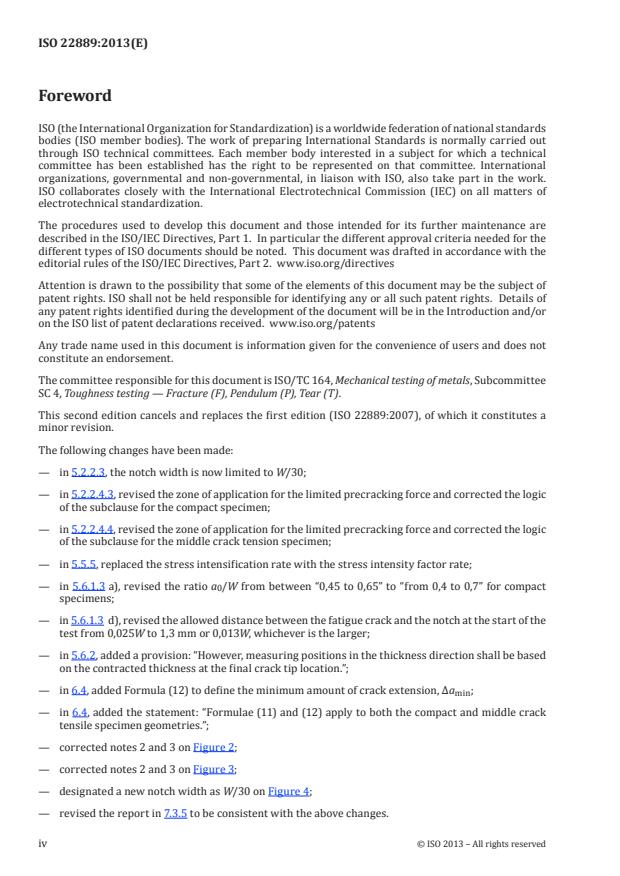
The following changes have been made:
— in 5.2.2.3, the notch width is now limited to W/30;
— in 5.2.2.4.3, revised the zone of application for the limited precracking force and corrected the logic
of the subclause for the compact specimen;
— in 5.2.2.4.4, revised the zone of application for the limited precracking force and corrected the logic
of the subclause for the middle crack tension specimen;
— in 5.5.5, replaced the stress intensification rate with the stress intensity factor rate;
— in 5.6.1.3 a), revised the ratio a /W from between “0,45 to 0,65” to “from 0,4 to 0,7” for compact
specimens;
— in 5.6.1.3 d), revised the allowed distance between the fatigue crack and the notch at the start of the
test from 0,025W to 1,3 mm or 0,013W, whichever is the larger;
— in 5.6.2, added a provision: “However, measuring positions in the thickness direction shall be based
on the contracted thickness at the final crack tip location.”;
— in 6.4, added Formula (12) to define the minimum amount of crack extension, Δa ;
min
— in 6.4, added the statement: “Formulae (11) and (12) apply to both the compact and middle crack
tensile specimen geometries.”;
— corrected notes 2 and 3 on Figure 2;
— corrected notes 2 and 3 on Figure 3;
— designated a new notch width as W/30 on Figure 4;
— revised the report in 7.3.5 to be consistent with the above changes.
iv © ISO 2013 – All rights reserved
Introduction
ISO 12135 uses compact and bend specimens to determine specific (point) values of fracture toughness
at the onset of either stable or unstable crack extension, and to quantify resistance to stable crack
extension. These specimen types have near-square remaining ligaments to provide conditions of high
constraint. If certain size requirements are met, then the values of the quantities K , δ and J
Ic 0,2BL 0,2BL
determined from these specimens are considered size insensitive, and regarded as lower-bound fracture
toughness values. Although not explicitly stated, size insensitivity holds also for the crack extension
resistance curve (R-curve).
In engineering practice, however, there are cases which are not covered by the method of test in
ISO 12135, for example where
— the component thickness is much less than that required for size-insensitive properties as
determined using ISO 12135,
— the thickness of the available material does not enable fabrication of specimens meeting the criteria
for size insensitivity, and
— the loading conditions in the structural component are characterized by tension rather than bending.
In these cases, constraint in the structural component may be lower than that of the specimens specified
by ISO 12135, thus leading to higher resistance to crack extension and higher load-carrying capability in
the structural component than would have been forecast based on the test in ISO 12135.
INTERNATIONAL STANDARD ISO 22889:2013(E)
Metallic materials — Method of test for the determination
of resistance to stable crack extension using specimens of
low constraint
1 Scope
This International Standard specifies methods for determining the resistance to stable crack extension
in terms of crack opening displacement, δ , and critical crack tip opening angle, ψ , for homogeneous
5 c
metallic materials by the quasistatic loading of cracked specimens that exhibit low constraint to plastic
deformation. Compact and middle-cracked tension specimens are notched, precracked by fatigue, and
tested under slowly increasing displacement.
This International Standard describes methods covering tests on specimens not satisfying requirements
for size-insensitive fracture properties; namely, compact specimens and middle-cracked tension
specimens in relatively thin gauges.
Methods are given for determining the crack extension resistance curve (R-curve). Point values of fracture
toughness for compact specimens are determined according to ISO 12135. Methods for determining
point values of fracture toughness for the middle-cracked tension specimen are given in Annex D.
Crack extension resistance is determined using either the multiple-specimen or single-specimen method.
The multiple-specimen method requires that each of several nominally identical specimens be loaded to
a specified level of displacement. The extent of ductile crack extension is marked and the specimens are
then broken open to allow measurement of crack extension. Single-specimen methods based on either
unloading compliance or potential drop techniques can be used to measure crack extension, provided
they meet specified accuracy requirements. Recommendations for single-specimen techniques are
described in ISO 12135. Using either technique, the objective is to determine a sufficient number of data
points to adequately describe the crack extension resistance behaviour of a material.
The measurement of δ is relatively simple and well established. The δ results are expressed in terms of
5 5
a resistance curve, which has been shown to be unique within specified limits of crack extension. Beyond
those limits, δ R-curves for compact specimens show a strong specimen dependency on specimen width,
whereas the δ R-curves for middle-cracked tension specimens show a weak dependency.
CTOA is more difficult to determine experimentally. The critical CTOA is expressed in terms of a constant
value achieved after a certain amount of crack extension. The CTOA concept has been shown to apply to
very large amounts of crack extension and can be applied beyond the current limits of δ applications.
Both measures of crack extension resistance are suitable for structural assessment. The δ concept is
well established and can be applied to structural integrity problems by means of simple crack driving
force formulae from existing assessment procedures.
The CTOA concept is generally more accurate. Its structural application requires numerical methods, i.e.
finite element analysis.
Investigations have shown a very close relation between the concept of constant CTOA and a unique R-curve
for both compact and middle-cracked tension specimens up to maximum load. Further study is required to
establish analytical or numerical relationships between the δ R-curve and the critical CTOA values.
2 Normative references
The following documents, in whole or in part, are normatively referenced in this document and are
indispensable for its application. For dated references, only the edition cited applies. For undated
references, the latest edition of the referenced document (including any amendments) applies.
ISO 3785, Metallic materials — Designation of test specimen axes in relation to product texture
ISO 7500-1, Metallic materials — Verification of static uniaxial testing machines — Part 1: Tension/
compression testing machines — Verification and calibration of the force-measuring system
ISO 9513, Metallic materials — Calibration of extensometer systems used in uniaxial testing
ISO 12135:2002, Metallic materials — Unified method of test for the determination of quasistatic
fracture toughness
3 Terms and definitions
For the purposes of this document, the following terms and definitions apply.
3.1
crack opening displacement
COD
δ
relative displacement of the crack surfaces normal to the original (undeformed) crack plane at the tip
of the fatigue precrack, as measured on the specimen’s side surface over an initial gauge length of 5 mm
3.2
crack tip opening angle
CTOA
ψ
relative angle of the crack surfaces measured (or calculated) at 1 mm from the current crack tip
3.3
stable crack extension
Δa
crack extension that, in displacement control, occurs only when the applied displacement is increased
3.4
crack extension resistance curve
R-curve
variation in δ with stable crack extension Δa
3.5
critical crack tip opening angle
ψ
c
steady-state value of crack tip opening angle ψ at 1 mm from the current crack tip
Note 1 to entry: This value is insensitive to the in-plane dimensions specified in this method; however, it may be
thickness dependent.
2 © ISO 2013 – All rights reserved
4 Symbols
For the purposes of this International Standard, the following symbols and units apply. For all parameters,
the temperature is assumed to be the test temperature unless otherwise noted.
Symbol Unit Designation
a mm crack length
a mm final crack length (a + Δa )
f 0 f
a mm length of machined crack starter notch
m
a mm initial crack length
Δa mm stable crack extension
Δa mm crack extension beyond which ψ is nearly constant
min c
Δa mm crack extension limit for δ or ψ controlled crack extension
max 5 c
Δa mm final stable crack extension
f
B mm specimen thickness
E MPa Young’s modulus of elasticity
F kN applied force
F kN maximum fatigue precracking force
f
MPa 0,2 % offset yield strength perpendicular to crack plane at the test tempera-
R
p0,2
ture
R MPa tensile strength perpendicular to crack plane at the test temperature
m
α degrees crack path deviation
W mm width of compact specimen, half width of middle-cracked tension specimen
W − a mm uncracked ligament length
W − a mm initial uncracked ligament length
W − a mm final uncracked ligament length
f
ψ degrees crack tip opening angle (CTOA)
ψ degrees critical crack tip opening angle (critical CTOA)
c
ν Poisson’s ratio
mm crack opening displacement over a 5 mm gauge length at tip of fatigue pre-
δ
crack
NOTE This is not a complete list of parameters. Only the main parameters are given here; other parameters are referred
to and defined in the text.
5 General requirements
5.1 Introduction
The resistance to stable crack extension of metallic materials can be characterized in terms of either
specific (single point) values (see Annex D) or a continuous curve relating fracture resistance to crack
extension over a limited range of crack extension (see Clause 6). Any one of the fatigue-cracked test
specimen configurations specified in this method may be used to measure or calculate any of these
fracture resistance parameters. Tests are performed by applying slowly increasing displacement to the
test specimen and measuring the resulting force and corresponding crack opening displacement and
angle. The measured forces, displacements and angles are then used in conjunction with certain pre-test
and post-test specimen measurements to determine the material’s resistance to crack extension. Details
of test specimens and general information relevant to the determination of all fracture parameters
are given in this method. A flow-chart illustrating the way this International Standard can be used is
presented in Figure 1.
Fracture resistance symbols identified for use in this International Standard method of test are given
in Table 1:
Table 1 — Fracture resistance symbols
Size-sensitive
quantities
Size-insensitive
Parameter Qualifying limits
quantities
(specific to thickness B
tested)
See Annex D Not applicable
δ , point value of fracture
toughness
Not applicable a , (W − a ) ≥ 4B Δa < Δa = 0,25(W − a
0 0 max
δ R-curve
) for compact speci-
mens;
Δa < Δa = W − a − 4
max 0
B for middle-cracked
tensile specimens
ψ Not applicable a , (W − a ) ≥ 4B Δa > Δa = 50/(5 + B)
0 0 min
c
Δa < Δa = W − a − 4B
max 0
(see Figure 11)
NOTE The qualifying limit for ψ , Δa > Δa = 50/(5 + B) was established using surface measurements of crack extension
c min
for aluminium alloys and steels in sheet thicknesses ranging from 1 mm to 25 mm.
5.2 Test specimens
5.2.1 Specimen configuration and size
Specimen dimensions and tolerances shall conform to those shown in Figures 2 and 3.
The choice of specimen design shall take into consideration the likely outcome of the test (see Figure 1),
which fracture resistance value (δ or ψ) is to be determined, the crack plane orientation of interest, and
the amount and condition of test material available.
NOTE Both specimen configurations (Figures 2 and 3) are suitable for determination of δ and ψ values.
5 c
For both specimen configurations, the conditions [a , (W − a )] ≥ 4B shall be satisfied.
0 0
5.2.2 Specimen preparation
5.2.2.1 Material condition
Specimens shall be machined from stock in the final heat-treated and mechanically worked conditions.
In exceptional circumstances where material cannot be machined in the final condition, final heat
treatment may be carried out after machining, provided that the required dimensions and tolerances
for the specimen, its shape, and its surface finish are met. Where dimensions of the machined specimen
are substantially different from the pre-machined stock, a size effect on the heat-treated microstructure
and mechanical properties shall be taken into account in the service application.
4 © ISO 2013 – All rights reserved
5.2.2.2 Crack plane orientation
The orientation of the crack plane shall be decided before machining, identified in accordance with
ISO 3785, and recorded. An example test report, including this information, is shown in Table A.1.
NOTE Crack extension resistance depends on the orientation and direction of crack extension in relation to
the principal directions of mechanical working, grain flow and other forms of anisotropy.
5.2.2.3 Machining
The specimen notch profile shall not exceed the envelope shown in Figure 4. The root radius of a
machined notch shall be not greater than 0,10 mm and the maximum allowed notch width is W/30.
Sawn, disk ground, or spark-eroded notches shall not have a width greater than 0,15 mm; see Key item
“c” in Figure 4.
5.2.2.4 Fatigue precracking
5.2.2.4.1 General
Fatigue precracking shall be performed with the material in the final heat-treated, mechanically worked
or environmentally conditioned state. Intermediate treatments between fatigue precracking and
testing are acceptable only when such treatments are necessary to simulate the conditions of a specific
structural application; such departure from recommended practice shall be (explicitly) reported.
Maximum fatigue precracking force during any stage of the fatigue precracking process shall be
accurate to ±2,5 %.
Measured values of specimen thickness, B, and width, W, determined in accordance with 5.3.1, shall be
recorded and used to determine the maximum fatigue precracking force F in accordance with 5.2.2.4.3
f
and 5.2.2.4.4.
The ratio of minimum-to-maximum force in the fatigue cycle shall be in the range 0 to 0,1 except that, in
order to expedite crack initiation, one or more cycles of −1,0 may be applied first.
5.2.2.4.2 Equipment and fixtures
Fixtures for fatigue precracking shall be carefully aligned and arranged so that loading is uniform
through the specimen thickness B and symmetrical about the plane of the prospective crack.
5.2.2.4.3 Compact specimens
For compact specimens, the maximum fatigue precracking force during the final 1,3 mm or 0,4N of
precrack extension, whichever is larger, shall be equal to or less than
BW
F =ξΕ (1)
f
ga(/W)
−40,5
where ξ =×16, 10 m , and
−15, 2 3 4
a a a a a a
0 00 0 0 0
ga(/W),=−12+ 0 886+−46,,41332 +14,,72 −56 (2)
W W W W W W
5.2.2.4.4 Middle-cracked tension specimens
For middle-cracked tension specimens, the maximum fatigue precracking force during the final 1,3 mm
or 0,4N of precrack extension, whichever is larger, shall be equal to or less than
−05,
πa
FE=ξ BW2 πa sec (3)
f 0
2W
−40,5
where ξ =×16, 10 m
5.3 Pre-test requirements
5.3.1 Pre-test measurements
The dimensions of specimens shall conform to those shown in Figures 2 and 3. Measurement of the
thickness B and width W shall be within 0,02 mm or to ±0,2 %, whichever is the larger.
Specimen thickness B shall be measured, before testing, at a minimum of three equally spaced
positions along the intended crack extension path. The average of these measurements shall be taken
as the thickness B.
Specimen width W of the middle-cracked tension specimen shall be measured at a minimum of three
equally spaced positions within ±0,1 W of the crack plane. The average of these measurements shall be
taken as the width W.
The compact specimen width W shall be measured with reference to the loading-hole centreline.
Customarily, the loading-hole centreline is established first, and then the dimension W is measured to
the specimen edge ahead of the crack tip in the plane of the crack. This measurement shall be made at
a minimum of three equally spaced positions across the specimen thickness. The dimension 1,25 W
(between the specimen edges ahead and behind the crack tip) shall be measured in addition, at the same
equally spaced positions across the thickness in a plane as close as possible to the plane of the crack.
5.3.2 Crack front shape and length requirements
A fatigue crack shall be developed from the root of the machined notch of the specimen as follows:
— for compact specimens (see Figure 2), the ratio a /W shall be in the range 0,4 to 0,7;
— for middle-cracked tension specimens, the ratio a /W shall be in the range 0,25 to 0,50.
The minimum fatigue crack extension shall be the larger of 1,3 mm or 2,5 % of the specimen width W.
The notch plus fatigue crack shall be within the limiting envelope shown in Figure 4.
5.4 Test apparatus
5.4.1 Calibration
Calibration of all measuring apparatus shall be traceable either directly or indirectly via a hierarchical
chain to an accredited calibration laboratory.
5.4.2 Force application
The combined force sensing and recording device shall conform to ISO 7500-1.
The test machine shall operate at a constant displacement rate.
A force measuring system of nominal capacity exceeding 1,2 F shall be used, where
L
— for compact specimens
6 © ISO 2013 – All rights reserved
BW()−a
F = R (4)
Lm
()2Wa+
— or for middle-cracked tension specimens
FB=−2 ()Wa R (5)
Lm0
5.4.3 Displacement measurement
The displacement gauge used for the determination of δ shall have an electrical output that accurately
represents the displacement between two precisely located gauge positions 5 mm apart, spanning the
crack at the fatigue crack tip. The design of the displacement gauge (or transducer where appropriate)
and specimen shall allow free rotation of the points of contact between the gauge and specimen.
NOTE 1 Guidance for determining δ is given in Annex B.
NOTE 2 The crack mouth opening displacement is not needed for the δ and ψ determinations, but a force crack
5 c
mouth opening displacement record may be suitable for evaluating the methods from finite element analyses and
other fracture analysis methods. Examples of proven displacement gauge designs are given in References [1] and
[2] (see Bibliography), and similar gauges are commercially available.
Gauges for crack mouth opening displacement measurement shall be calibrated in accordance with
ISO 9513, as interpreted in relation with this International Standard, and shall be at least of Class 1.
Calibration shall be performed at least each week when the gauges are in use.
NOTE 3 Calibration may be carried out more frequently depending on use and agreement between
contractual parties.
Verification of the displacement gauge shall be performed at the test temperature ±5 °C. The response of the
gauge shall be true to ±0,003 mm for displacements up to 0,3 mm and to ±1 % of the actual reading thereafter.
5.4.4 Test fixtures
Compact specimens shall be loaded using a clevis and pin arrangement designed to minimize friction.
The arrangement shall ensure load train alignment as the specimen is loaded under tension. Clevises
for R-curve measurements shall have flat-bottomed holes (see Figure 5) so that the loading pins are
free to roll throughout the test. Round-bottomed holes (see Figure 6) shall not be allowed for single-
specimen (unloading compliance) tests. Fixture-bearing surfaces shall have a hardness greater than
40 HRC (400 HV) or a yield strength of at least 1 000 MPa. Middle-cracked tension specimens shall be
loaded using hydraulically clamped or bolted grips designed to carry the applied load by friction. Bolt
bearing should be avoided in order to minimize non-uniform loading. The arrangement shall ensure
alignment of the specimen with minimal in-plane and out-of-plane bending. All specimens shall be tested
with anti-buckling guide plates, as shown in Figure 7. The anti-buckling guide plates shall cover a large
portion of the specimen. Support only along the crack plane has been shown to be insufficient to prevent
buckling between the grip lines and the crack plane for thin-sheet materials. Flat plates are sufficient
for small middle-cracked tension specimens (W < 600 mm); but flat plates and I-beams, as illustrated in
Figure 7a), are required for middle-cracked tension specimens with widths larger than about 600 mm.
A suitable design for compact specimens is shown in Figure 7b).
5.5 Test requirements
It is recommended that anti-buckling plates be attached to both sides of the tension specimen covering
the expected path of the crack for a distance four times the initial total crack length perpendicular to the
crack. Frictional forces between the specimen and anti-buckling plates shall be minimized by the use of
an inert lubricant such as polytetrafluoroethylene (PTFE) applied to the mating surfaces. An access hole
is required in one of the plates for mounting the δ gauge on the specimen or, if the potential method is
used, for the attachment of cables.
5.5.1 Compact specimen testing
5.5.1.1 Specimen and fixture alignment
The loading clevises shall be aligned to within 0,25 mm, and the specimen shall be centred on the loading
pins within 0,75 mm with respect to the clevis opening.
5.5.1.2 Crack opening displacement δ
A method of measuring the crack opening displacement δ is described in Annex B.
5.5.1.3 Crack tip opening angle ψ
The crack tip opening angle ψ may be measured or calculated as described in Annex C.
5.5.2 Middle-cracked tension specimen testing
5.5.2.1 Specimen and fixture alignment
The fixture shall be designed to distribute the load uniformly over the cross-section of the specimen.
The fixture may be rigidly connected to the machine if uniform loading of the specimen in the machine
can be ensured at all loads. Otherwise, pinloading via detachable grips is recommended.
5.5.2.2 Crack opening displacement δ
A method of measuring the crack opening displacement δ is given in Annex B.
5.5.2.3 Crack tip opening angle ψ
The crack tip opening angle ψ may be measured or calculated as described in Annex C. An example of a
test report is shown in Table A.4.
5.5.3 Specimen test temperature
Specimen test temperature shall be controlled and recorded to an accuracy of ±2 °C. For this purpose,
a thermocouple or platinum resistance thermometer shall be placed in contact with the surface of the
specimen in a region not further than 5 mm from the fatigue crack tip. When substantial amounts of
crack extension are anticipated, additional sensors (thermocouples or thermometers) shall be placed in
proximity to the anticipated crack path so that the specified specimen temperature can be ensured for
the material being tested. Tests shall be made in situ in suitable low- or high- temperature media. Before
testing in a liquid medium, the specimen shall be retained in the liquid for at least 30 s/mm of thickness
B after the specimen surface has reached the test temperature. When using a gaseous medium, a soaking
time of at least 60 s/mm of thickness shall be employed. Minimum soaking time at the test temperature
shall be 15 min. The temperature of the test specimen shall remain within ±2 °C of the nominal test
temperature throughout the test and shall be recorded as required in Clause 7.
5.5.4 Recording
The force and corresponding displacement outputs shall be recorded.
NOTE Corresponding displacements are either crack opening displacement δ (for determining the δ
5 5
R-curve) or the crack mouth opening displacement CMOD (not required here, but useful for supplementary
evaluations).
5.5.5 Testing rates
Tests shall be conducted under crack mouth opening, load-line, or crosshead-displacement control. The
load-line displacement rate shall be such that, within the linear elastic region, the stress intensity factor
8 © ISO 2013 – All rights reserved
0,5 −1 0,5 −1
rate is within the range 0,2 MPa∙m ∙s to 3 MPa∙m ∙s . For each series of tests, all specimens shall
be loaded at the same nominal rate.
5.5.6 Test analyses
Analyses for point determinations of fracture toughness for compact specimens are given in Annex D,
and for δ resistance-curve determinations in Clause 6 (see Figure 1).
5.6 Post-test crack measurements
The specimen shall be broken open after testing and its fracture surface examined to determine the
original crack length a , and the final stable crack extension Δa .
0 f
For some tests, it may be necessary to mark the extent of stable crack extension before breaking open
the specimen. Marking of stable crack extension may be done by either heat tinting or post-test fatiguing.
Care shall be taken to minimize post-test deformation of the specimen. Cooling ferritic steels to ensure
brittle behaviour may be helpful.
5.6.1 Initial crack length a
5.6.1.1 Compact specimens
The initial crack length a shall be measured from the centreline of the pinhole to the tip of the fatigue
crack with an instrument accurate to ±0,1 % or ±0,025 mm, whichever is the greater. Measurements shall
be made at five positions through the specimen thickness. The value of a is obtained by first averaging
the two surface measurements made at positions 0,01B inward from the surface (see Figure 8) and then
averaging these values with those at the three equispaced inner measurement points:
j=4
1 aa+
01 05
a = + a (6)
0 ∑ 0j
j=2
5.6.1.2 Middle-cracked tension specimens
The initial crack length a shall be measured as one-half of the total crack length to the tips of both fatigue
cracks with an instrument accurate to ±0,1 % or 0,025 mm, whichever is the greater. Measurements are
made using a 5-point average. The value of a is obtained by first averaging the two surface measurements
made at positions 0,01B inward from the surface (see Figure 9), averaging these values with those at the
three equispaced inner measurement points, and then dividing the resulting value by 2:
j=4
22aa+
1
01 05
a = + 2a (7)
0 ∑ 0j
8 2
j=2
NOTE For both compact and middle-cracked tension specimens of thickness B < 5 mm, a 3-point average is
sufficient. The value of a is obtained by first averaging the two surface measurements a and a , and then
0 0,1 0,5
averaging that with the measurement made at mid-plane of the specimen, a :
0,3
aa=+05,/aa2+
()
01,,05 03,
5.6.1.3 Requirements
The initial crack length a shall satisfy the following.
a) The ratio a /W shall be within the range 0,4 to 0,7 for compact specimens, and within the range 0,25
to 0,50 for middle-cracked tension specimens.
b) If a five-point average for determining a has been used, then the difference between any one of the
central three points and the five-point average shall not exceed 0,1 a .
c) If a three-point average for determining a has been used, then the difference between the central
point and the three-point average shall not exceed 0,1 a .
d) No part of the fatigue precrack front shall be closer to the crack starter notch than 1,3 mm or 0,013W,
whichever is the larger.
e) The fatigue precrack shall be within the envelope shown in Figure 4.
If the above requirements are not satisfied, the test result is not qualified according to this method of test.
5.6.2 Stable crack extension, Δa
The total final crack extension (including any crack tip blunting) Δa between the initial and final crack
f
fronts shall be measured with an instrument accurate to ±0,025 mm using the averaging procedure
of 5.6.1. However, measuring positions in the thickness direction shall be based on the contracted
thickness at the final crack tip location. For middle-cracked tension specimens, the crack extension Δa
f
is given by the average of the crack extension values measured at both crack fronts. Any irregularities in
crack extension, such as spikes and isolated ‘islands’ of crack extension, shall be reported in accordance
with Clause 7.
NOTE 1 It may only be practical to estimate the length of irregular cracks by ignoring the spikes or subjectively
averaging the crack extension region. Care should be exercised when the results derived from highly irregular
crack fronts are used in analysis. It is useful to provide an additional sketch or photograph of such irregular
cracks in reporting results. All individual pre-test and post-test measurements are to be recorded and used for
calculations in accordance with Clause 6.
NOTE 2 For specimens with thickness B < 5 mm, a three-point average as in 5.6.1.2 is suggested.
5.6.3 Crack path
The crack plane may deviate during stable crack extension from the original fatigue precrack plane
(which is a flat surface perpendicular to the applied force). Typically, the transition is to shear planes at
the specimen surfaces. When such shear planes are sloped similarly with respect to the original fatigue
precrack plane, then crack extension is said to be in a single-shear mode. When they are sloped differently,
such as to resemble a roof in cross-section (the mating fracture surface then resembles a V-groove), crack
extension occurs in a double-shear mode. Shear fracture surfaces are typically sloped 30° to 45°.
NOTE Depending on the material and specimen thickness, the fracture surface in the central part of the
specimen thickness may still be perpendicular to the applied force. This is a mixed mode of crack extension.
5.6.3.1 Crack extension resistance
For fractures that deviate from planarity, the crack extension resistance of those exhibiting double shear
is customarily higher than for those exhibiting single shear. Test results for such double-shear fractures
are considered to be not qualified to characterize the material.
5.6.3.2 Crack path deviation
When the angle α between the original flat precrack plane and the plane of the deviated crack surface
exceeds 10°, the test result is no longer considered qualified according to this method of test.
10 © ISO 2013 – All rights reserved
6 Determination of δ − Δa resistance curve and CTOA
6.1 General
Fracture behaviour is characterized by this method in terms of the variation of either δ (COD) or ψ
(CTOA) with the crack extension Δa. It is important to note, however, that ψ versus Δa is not treated here
as a crack extension resistance curve.
6.2 Test procedure
Load specimens and evaluate the resulting amount of crack extension in accordance with 5.5 and 5.6.
6.2.1 Multiple-specimen procedure
A series of nominally identical specimens shall be loaded to selected displacement levels and the
corresponding amounts of crack extension determined. Each specimen tested provides one point on the
δ − Δa crack resistance curve (hereafter referred to generically as the R-curve).
NOTE Six or more favourably positioned points are required to generate an R-curve. Loading the first
specimen to a point just past maximum load and measuring the resulting stable crack extension helps to determine
the displacement levels needed to position data points favourably in additional tests.
6.2.2 Single-specimen procedure
The single-specimen procedure makes use of electric potential, elastic compliance or another technique
to obtain multiple points on the resistance curve from the test of a single specimen. Single-specimen
testing procedures are described in ISO 12135.
Using a direct method (e.g. elastic compliance), the estimated final crack extension Δa shall be within
f
15 % of the measured crack extension or 0,15 mm, whichever is the greater, for Δa ⩽ 0,2(W − a ), and
f 0
within 0,03(W − a ) for Δa > 0,2(W − a ). For techniques that require an a priori estimate of the initial
0 f 0
crack length a for subsequent determination of crack extension, such as the unloading-compliance
technique, the estimated a shall be within 2 % of the (post-test) measured a value.
0 0
For indirect techniques (e.g. electrical potential), the first specimen tested shall be used to establish a
correlation between experimental output and measured crack extension to beyond the Δa defined
max
in 6.4. At least one additional test shall be conducted to estimate crack extension using the results from
the first test. Agreement between the estimated and actual crack extension Δa shall be within 15 % or
0,15 mm, whichever is the greater; otherwise the procedure shall not be accepted.
6.2.3 Final crack front straightness
The final crack length shall be determined as the sum of the initial crack length and the final stable
crack extension measured using the averaging methods of 5.6.1 and 5.6.2. If the five-point averaging
method is used, none of the three interior final crack length measurements shall differ from the five-
point average value by more than 0,1a ; if the three-point averaging method is used, the central final
crack length measurement shall not differ from the three-point average by more than 0,1a ; otherwise
the result is not qualified.
6.3 R-curve plot
The points of crack opening displacement, δ , versus stable crack extension, Δa, form the fracture
resistance R-curve (see Figure 10). The data may be used in tabular form or as a plotted graph. An
equation may be fitted to the graph for analysis, or the plot itself may be used for analysis.
6.3.1 Plot construction
Construct a plot of the crack opening displacement, δ , versus the stable crack extension, Δa, from the
data obtained in 5.5.1.2, 5.5.2.2 and 5.6.2 (see Figure 10).
For each compact specimen tested, calculate Δa from
max
ΔaW=−02, 5 a (8)
()
max 0
For each middle-cracked tension specimen tested, calculate Δa from
max
ΔaW=−aB−4 (9)
()
max 0
Plot δ versus Δa as shown in Figure 10.
Tests terminating in unstable fracture shall be reported as such and, if the amount of stable crack
extension to fracture can be measured on the fracture surface, include that datum point in the R-curve
plot. Unstable fracture data points shall be clearly marked on the R-curve plot and appropriately noted
in the test report (see Annex A).
NOTE The point of unstable failure can depend on the specimen size and geometry.
6.3.2 Data spacing and curve fitting
A minimum of six data points shall be used to define the R-curve.
When an equation is to be fitted to the R-curve, at least one data point shall reside within each of the
four equal crack extension regions shown in Figure 10. The curve shall be best-fitted
...