

ISO 7928-1:1991
(Main)Savory — Specification — Part 1: Winter savory (Satureja montana Linnaeus)
General Information
- Abstract
Specifies the requirements of summer savory in the form of sprigs, and whole or broken leaves. Does not apply to winter savory. Annexes A (recommendations to storage and transport conditions) and B are for information only.
- Status
- Withdrawn
- Publication Date
- 20-Nov-1991
- Technical Committee
- ISO/TC 34/SC 7 - Spices, culinary herbs and condiments
- Drafting Committee
- ISO/TC 34/SC 7 - Spices, culinary herbs and condiments
- Current Stage
- 9599 - Withdrawal of International Standard
- Start Date
- 27-Apr-2026
- Completion Date
- 29-Aug-2026
Buy Documents

ISO 7928-1:1991 - Savory — Specification — Part 1: Winter savory (Satureja montana Linnaeus) Released:11/21/1991
ISO 7928-1:1991 - Sarriette — Spécifications — Partie 1: Sarriette des montagnes (Satureja montana Linnaeus) Released:11/21/1991
ISO 7928-1:1991 - Sarriette — Spécifications — Partie 1: Sarriette des montagnes (Satureja montana Linnaeus) Released:11/21/1991
Overview
ISO 7928-1:1991 - "Savory - Specification - Part 1: Winter savory (Satureja montana Linnaeus)" defines quality, compositional and presentation requirements for commercial winter savory. The standard applies to winter savory sold as sprigs, whole leaves or broken leaves and excludes summer savory (covered in Part 2). Annexes provide informative guidance on storage/transport and typical chromatograms.
Key topics and requirements
- Scope and description: Covers perennial herb Satureja montana (family Lamiaceae), the commercial forms (sprigs 15–30 cm; whole/broken leaves) and sensory expectations (typical strong aromatic, carvacrol‑like odour and hot flavour).
- Physical purity limits:
- Extraneous matter: total extraneous vegetable/animal/mineral matter not to exceed 1% (m/m).
- Broken stems: when marketed as leaves, broken stems shall not exceed 5% (m/m).
- Freedom from contaminants: product shall be free from living insects and moulds and practically free from dead insects, fragments and rodent contamination visible to the naked eye (or under magnification up to x10).
- Chemical and compositional controls: the standard specifies limits/requirements for moisture content, total ash, acid‑insoluble ash and minimum volatile oil content. Test methods are referenced (ISO 939, ISO 928, ISO 930, ISO 6571, ISO 2825, ISO 927). For exact numeric limits and analytical procedures consult the full ISO 7928‑1:1991 text.
- Chromatographic profile: volatile oil obtained by dry distillation should contain main constituents such as γ‑terpinene, p‑cymene, linalool, 1‑terpinen‑4‑ol and carvacrol; gas chromatography is used for qualitative profiling (with guidance in informative Annex B).
- Sampling, packing and marking:
- Sampling per ISO sampling provisions.
- Packing in materials that protect volatile oils and moisture (e.g., tins, lined wooden cases, new jute bags with liners).
- Mandatory marking items include product name, producer/packer, batch code, net mass, producing country, destination and reference to this part of ISO 7928.
Applications and users
ISO 7928-1:1991 is used by:
- Spice and herb growers, harvesters and commercial processors for product specification and acceptance criteria.
- Quality control and analytical laboratories verifying moisture, ash and volatile oil content and performing gas chromatography profiles.
- Importers, exporters, packers and food traders to set purchase/specification contracts and ensure compliance.
- Regulatory bodies and standards organisations for trade inspections and consumer protection.
- Food manufacturers and seasoning formulators who require consistent sensory and chemical quality of winter savory.
Related standards
ISO 7928 consists of Part 1 (winter savory) and Part 2 (summer savory). ISO 7928-1:1991 references analytical methods and related standards such as ISO 939, ISO 928, ISO 930, ISO 6571, ISO 2825, ISO 927 for specific test methods; consult these documents for laboratory procedures.
Keywords: ISO 7928-1:1991, winter savory, Satureja montana, savory specification, spices and condiments, volatile oil, moisture content, packaging, chromatography.
Relations
- Effective Date
- 19-Oct-2024
Buy Documents
ISO 7928-1:1991 - Savory — Specification — Part 1: Winter savory (Satureja montana Linnaeus) Released:11/21/1991
ISO 7928-1:1991 - Sarriette — Spécifications — Partie 1: Sarriette des montagnes (Satureja montana Linnaeus) Released:11/21/1991
ISO 7928-1:1991 - Sarriette — Spécifications — Partie 1: Sarriette des montagnes (Satureja montana Linnaeus) Released:11/21/1991
Get Certified
Connect with accredited certification bodies for this standard

BSI Group
BSI (British Standards Institution) is the business standards company that helps organizations make excellence a habit.

Bureau Veritas
Bureau Veritas is a world leader in laboratory testing, inspection and certification services.

DNV
DNV is an independent assurance and risk management provider.
Sponsored listings
Frequently Asked Questions
ISO 7928-1:1991 is a standard published by the International Organization for Standardization (ISO). Its full title is "Savory — Specification — Part 1: Winter savory (Satureja montana Linnaeus)". This standard covers: Specifies the requirements of summer savory in the form of sprigs, and whole or broken leaves. Does not apply to winter savory. Annexes A (recommendations to storage and transport conditions) and B are for information only.
Specifies the requirements of summer savory in the form of sprigs, and whole or broken leaves. Does not apply to winter savory. Annexes A (recommendations to storage and transport conditions) and B are for information only.
ISO 7928-1:1991 is classified under the following ICS (International Classification for Standards) categories: 67.220.10 - Spices and condiments. The ICS classification helps identify the subject area and facilitates finding related standards.
ISO 7928-1:1991 has the following relationships with other standards: It is inter standard links to ISO 7928-1:2026. Understanding these relationships helps ensure you are using the most current and applicable version of the standard.
ISO 7928-1:1991 is available in PDF format for immediate download after purchase. The document can be added to your cart and obtained through the secure checkout process. Digital delivery ensures instant access to the complete standard document.
Standards Content (Sample)
SLOVENSKI STANDARD
01-junij-1997
Šetraj - Specifikacija - 1. del: Kraški šetraj (Satureja montana Linnaeus)
Savory -- Specification -- Part 1: Winter savory (Satureja montana Linnaeus)
Sarriette -- Spécifications -- Partie 1: Sarriette des montagnes (Satureja montana
Linnaeus)
Ta slovenski standard je istoveten z: ISO 7928-1:1991
ICS:
67.220.10 =DþLPEH Spices and condiments
2003-01.Slovenski inštitut za standardizacijo. Razmnoževanje celote ali delov tega standarda ni dovoljeno.
ISO
INTERNATIONAL
STANDARD
First edi tion
1991-12-01
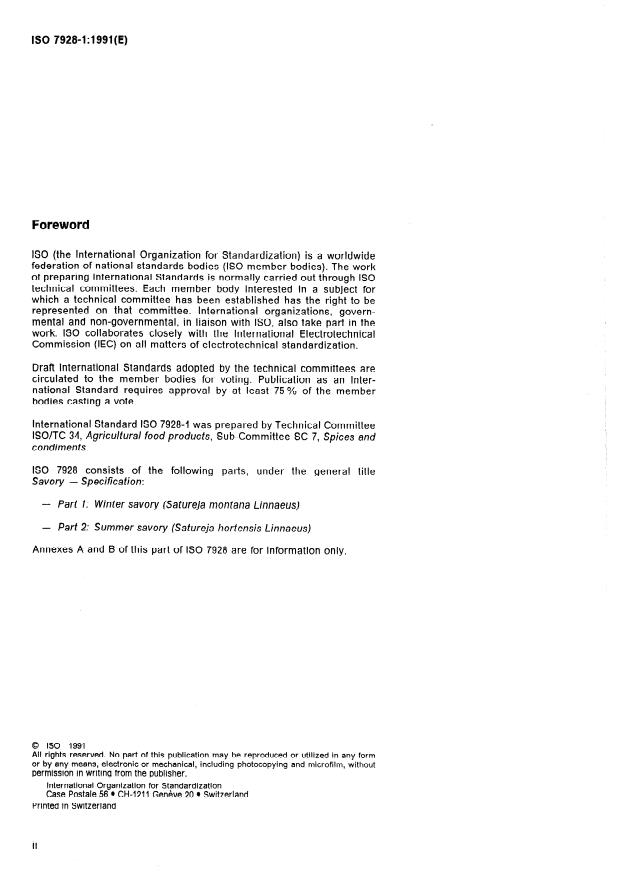
Savoty - Specification -
Part 1:
Winter savory (Satureja montana Linnaeus)
Sarrietfe - Spfkifications -
Partie 1: Sarriette des montagnes (Satureja montana Linnaeus)
--
--
Reference number
--_- ISO 7928-1:1991(E)
.- --.__- _ .-_---. -
ISO 79284:1991(E)
ISO (the International Organization for Standardization) is a worldwide
federation of national Standards bodies (ISO member bodies). The work
of preparing international Standards is normatly carried out through ISO
technical committees. Esch member body interested in a subject for
which a technical committee has been established has the right to be
represented on that committee. International organizations, govern-
mental and non-governmental, in liaison with ISO, also take part in the
work. ISO collaborates closely with the International Electrotechnical
Commission (IEC) on all matters of electrotechnical standardization.
Draft International Standards adopted by the technical committees are
circulated to the member bodies for voting. Publication as an Inter-
national Standard requires approval by at least 75 % of the member
bodies casting a vote.
International Standard ISO 79284 was prepared by Technical Committee
ISO/TC 34, Agricultural food products, Sub-Committee SC 7, Spices and
condiments.
ISO 7928 consists of the following Parts, under the general title
Savory - Specifica tion:
- Part 1: Winter savory (Satureja montana Linnaeus)
- Part 2: Summer savory (Satureja hortensis Linnaeus)
Annexes A and B of this part of ISO 7928 are for information only.
0 ISO 1991
All rights reserved. No part of this publication may be reproduced or utilized in any form
or by any means, electronie or mechanical, including photocopying and microfilm, without
Permission in writing from the publisher.
International Organization for Standardization
Case Postale 56 0 CH-1211 Geneve 20 * Switzerland
Printed in Switzerland
ii
INTERNATIONAL STANDARD ISO 79284:1991(E)
Savory
- Specification -
Part 1:
Winter savory (Satureja montana Linnaeus)
ISO 930:1980, Spices and condiments - Determi-
1 Scope
nation of acid-insoluble ash.
This part of ISO 7928 specifies the requirements of
ISO 939:1980, Spices and condiments - Determi-
Winter savory (Satureja montana Linnaeus) in the
nation of moisture content - Entrainment method.
form of
ISO 2825:1981, Spices and condiments - Preparation
-
sprigs, and
of a ground Sample for analysis.
-
whole or broken leaves.
ISO 6571:1984, Spices, condiments and herbs - Ue-
termination of volati/e oil content.
lt is not applicable to Summer savory (Satureja
horfensis Linnaeus) which forms the subject of
ISO 7928-2.
Recommendations relating to storage and transport
conditions are given in annex A, for information.
3 Description
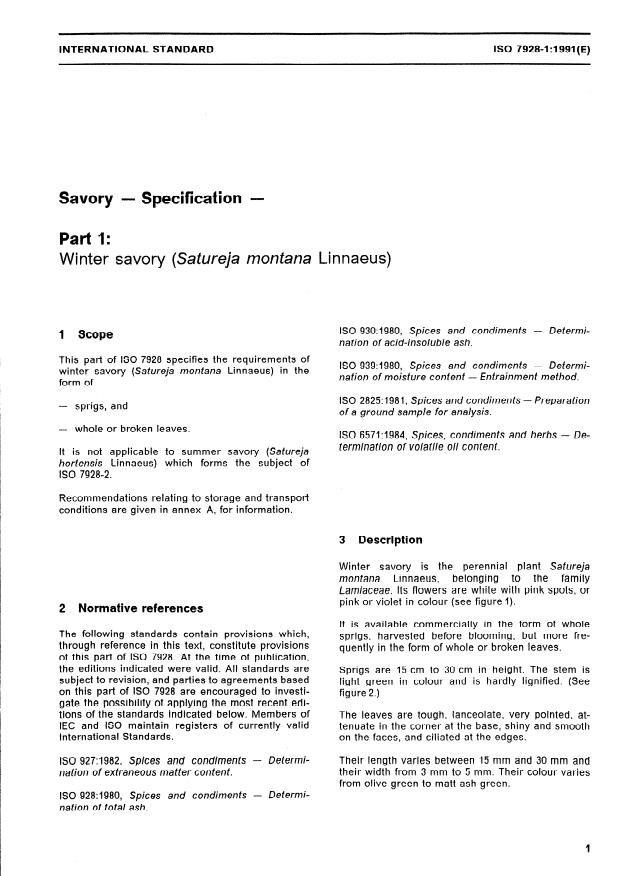
Winter savory is the perennial plant Satureja
montana Linnaeus, belonging to the family
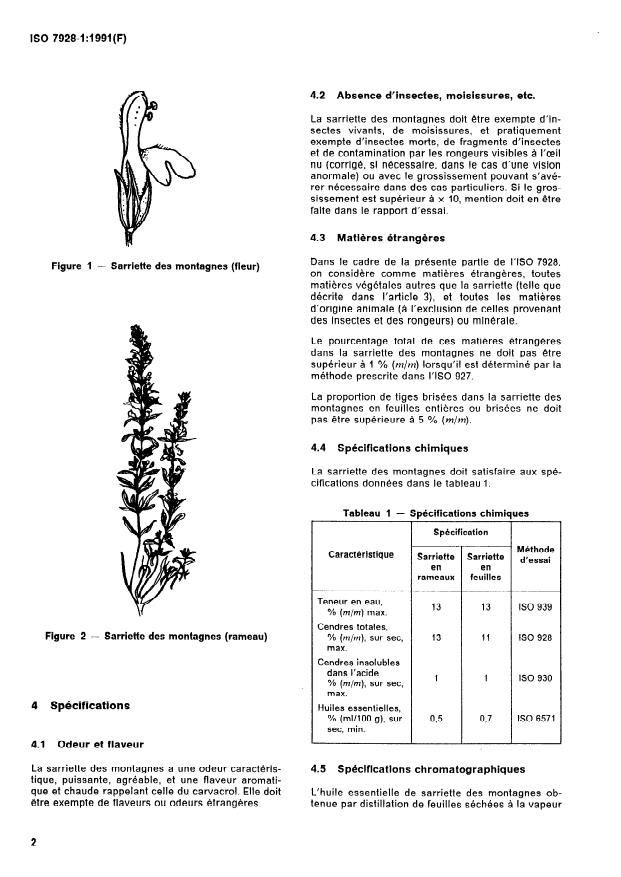
Lamiaceae. Hs flowers are white with pink spots, or
pink or violet in colour (see figure 1).
2 Normative references
lt is available commercially in the form of whole
The following Standards contain provisions which,
sprigs, harvested before blooming, but more fre-
through reference in this text, constitute provisions
quently in the form of whole or broken leaves.
of this part of ISO 7928. At the time of publication,
the editions indicated were valid. All Standards are
Sprigs are 15 cm to 30 cm in height. The stem is
subject to revision, and Parties to agreements based
light green in colour and is hardly lignified. (See
on this part of ISO 7928 are encouraged to investi-
figure 2.)
gate the possibility of applying the most recent edi-
tions of the Standards indicated below. Members of
The leaves are tough, lanceolate, very pointed, at-
IEC and ISO maintain registers of currently valid tenuate in the corner at the base, shiny and smooth
International Standards.
on the faces, and ciliated at the edges.
Their length varies between 15 mm and 30 mm and
ISO 927:1982, Spices and condiments - Defermi-
their width from 3 mm to 5 mm. Their colour varies
nation of extraneous matfer confenf.
from Olive green to matt ash-green.
ISO 928:1980, Spices and condimenfs - Determi-
nation of total ash.
...
ISO
INTERNATIONAL
STANDARD
First edi tion
1991-12-01
Savoty - Specification -
Part 1:
Winter savory (Satureja montana Linnaeus)
Sarrietfe - Spfkifications -
Partie 1: Sarriette des montagnes (Satureja montana Linnaeus)
--
--
Reference number
--_- ISO 7928-1:1991(E)
.- --.__- _ .-_---. -
ISO 79284:1991(E)
ISO (the International Organization for Standardization) is a worldwide
federation of national Standards bodies (ISO member bodies). The work
of preparing international Standards is normatly carried out through ISO
technical committees. Esch member body interested in a subject for
which a technical committee has been established has the right to be
represented on that committee. International organizations, govern-
mental and non-governmental, in liaison with ISO, also take part in the
work. ISO collaborates closely with the International Electrotechnical
Commission (IEC) on all matters of electrotechnical standardization.
Draft International Standards adopted by the technical committees are
circulated to the member bodies for voting. Publication as an Inter-
national Standard requires approval by at least 75 % of the member
bodies casting a vote.
International Standard ISO 79284 was prepared by Technical Committee
ISO/TC 34, Agricultural food products, Sub-Committee SC 7, Spices and
condiments.
ISO 7928 consists of the following Parts, under the general title
Savory - Specifica tion:
- Part 1: Winter savory (Satureja montana Linnaeus)
- Part 2: Summer savory (Satureja hortensis Linnaeus)
Annexes A and B of this part of ISO 7928 are for information only.
0 ISO 1991
All rights reserved. No part of this publication may be reproduced or utilized in any form
or by any means, electronie or mechanical, including photocopying and microfilm, without
Permission in writing from the publisher.
International Organization for Standardization
Case Postale 56 0 CH-1211 Geneve 20 * Switzerland
Printed in Switzerland
ii
INTERNATIONAL STANDARD ISO 79284:1991(E)
Savory
- Specification -
Part 1:
Winter savory (Satureja montana Linnaeus)
ISO 930:1980, Spices and condiments - Determi-
1 Scope
nation of acid-insoluble ash.
This part of ISO 7928 specifies the requirements of
ISO 939:1980, Spices and condiments - Determi-
Winter savory (Satureja montana Linnaeus) in the
nation of moisture content - Entrainment method.
form of
ISO 2825:1981, Spices and condiments - Preparation
-
sprigs, and
of a ground Sample for analysis.
-
whole or broken leaves.
ISO 6571:1984, Spices, condiments and herbs - Ue-
termination of volati/e oil content.
lt is not applicable to Summer savory (Satureja
horfensis Linnaeus) which forms the subject of
ISO 7928-2.
Recommendations relating to storage and transport
conditions are given in annex A, for information.
3 Description
Winter savory is the perennial plant Satureja
montana Linnaeus, belonging to the family
Lamiaceae. Hs flowers are white with pink spots, or
pink or violet in colour (see figure 1).
2 Normative references
lt is available commercially in the form of whole
The following Standards contain provisions which,
sprigs, harvested before blooming, but more fre-
through reference in this text, constitute provisions
quently in the form of whole or broken leaves.
of this part of ISO 7928. At the time of publication,
the editions indicated were valid. All Standards are
Sprigs are 15 cm to 30 cm in height. The stem is
subject to revision, and Parties to agreements based
light green in colour and is hardly lignified. (See
on this part of ISO 7928 are encouraged to investi-
figure 2.)
gate the possibility of applying the most recent edi-
tions of the Standards indicated below. Members of
The leaves are tough, lanceolate, very pointed, at-
IEC and ISO maintain registers of currently valid tenuate in the corner at the base, shiny and smooth
International Standards.
on the faces, and ciliated at the edges.
Their length varies between 15 mm and 30 mm and
ISO 927:1982, Spices and condiments - Defermi-
their width from 3 mm to 5 mm. Their colour varies
nation of extraneous matfer confenf.
from Olive green to matt ash-green.
ISO 928:1980, Spices and condimenfs - Determi-
nation of total ash.
ISO 792891:1991 (E)
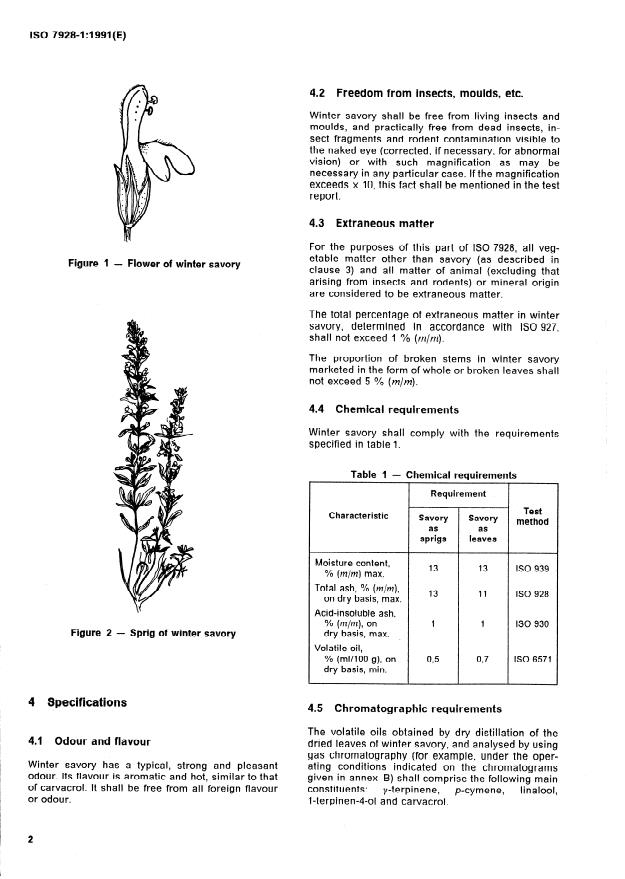
4.2 Freedom from insects, moulds, etc.
Winter savory shall be free from living insects and
moulds, and practically free from dead insects, in-
sect fragments and rodent contamination visible to
the naked eye (corrected, if necessary, for abnormal
Vision) or with such magnification as may be
necessary in any particular case. If the magnification
exceeds x 10, this fact shall be mentioned in the test
report.
4.3 Extraneous matter
For the purposes of this part of ISO 7928, all veg-
etable matter other than sav
...
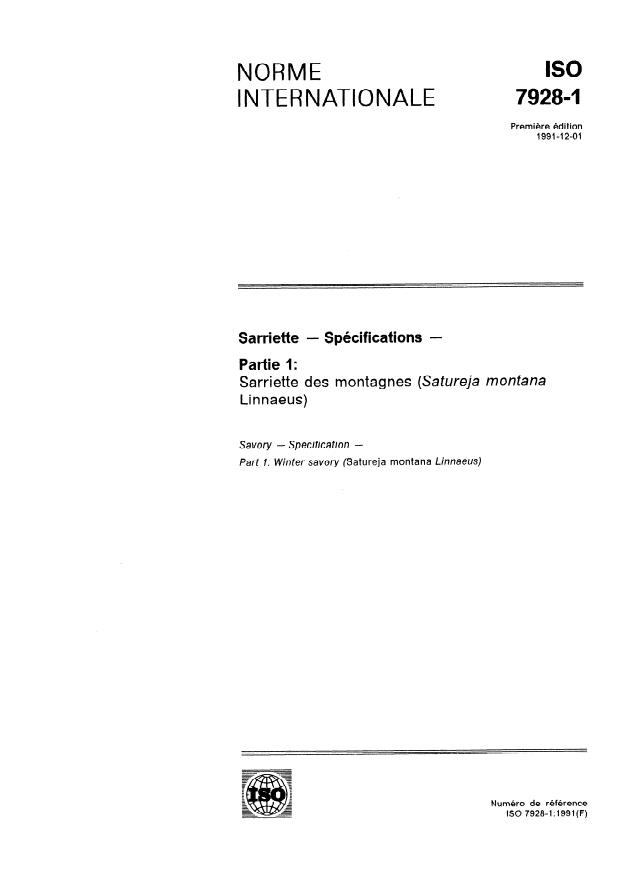
NORME
INTERNATIONALE
Première édition
1991-12-01
Sarriette - Spécifications -
Partie 1:
Sarriette des montagnes (Satureja rnontana
Linnaeus)
- Specification -
Savary
Part 1: Winter savory (Satureja montana Linnaeus)
Numéro de référence
ISO 79284:1991(F)
Avant-propos
L’ISO (Organisation internationale de normalisation) est une fédération
mondiale d’organismes nationaux de normalisation (comités membres
de I’ISO). L’élaboration des Normes internationales est en général
confiée aux comités techniques de I’ISO. Chaque comité membre inté-
ressé par une étude a le droit de faire partie du comité technique créé
à cet effet. Les organisations internationales, gouvernementales et non
gouvernementales, en liaison avec I’ISO participent également aux tra-
vaux. L’ISO collabore étroitement avec la Commission électrotechnique
internationale (CEI) en ce qui concerne la normalisation électrotech-
nique.
Les projets de Normes internationales adoptes par les comités techni-
ques sont soumis aux comités membres pour vote. Leur publication
comme Normes internationales requiert l’approbation de 75 % au moins
des comités membres votants.
La Norme internationale ISO 7928-l a été élaborée par le comité tech-
nique ISO/TC 34, Produits agricoles alimentaires, sous-comité SC 7,
Épices.
L’ISO 7928 comprend les parties suivantes, présentées sous le titre gé-
néral Sarriette - Spécifications:
- Partie 1: Sarriette des montagnes (Satureja montana Linnaeus)
- Partie 2: Sarriette des jardins (Satureja hortensis Linnaeus)
Les annexes A et 6 de la présente partie de I’ISO 7928 sont données
uniquement à titre d’information.
0 ISO 1991
Droits de reproduction réservés. Aucune partie de cette publication ne peut être repro-
duite ni utilisée sous quelque forme que ce soit et par aucun procédé, électronique ou
mécanique, y compris la photocopie et les microfilms, sans l’accord écrit de l’éditeur.
Organisation internationale de normalisation
Case Postale 56 l CH-1211 Genève 20 @ Suisse
Imprimé en Suisse
ii
NORME INTERNATIONALE ISO 79284:1991(F)
Sarriette - Spécifications -
Partie 1:
Sarriette des montagnes (Satureja montana Linnaeus)
ISO 930: 1980, Épices - Détermination des cendres
1 Domaine d’application
insolubles dans l’acide.
La présente partie de I’ISO 7928 prescrit les spéci-
ISO 939: 1980, Épices - Détermination de la teneur
fications de la sarriette des montagnes (Satureja
en eau - Méthode par entraînement.
rnon&w~~ Linnaeus) sous forme
ISO 2825:1981, Épices - Préparation d’un échantillon
- de rameaux feuillés;
moulu en vue de l’analyse.
- de feuilles entières ou brisées:
ISO 6571:1984, Épices, aromates et herbes - Déter-
mination de la teneur en huiles essentielles.
Elle ne s’applique pas à la sarriette des jardins
(Satureja montana Linnaeus) qui fait l’objet de
I’ISO 7928-2.
Des recommandations relatives aux conditions
d’entreposage et de transport sont données en an-
nexe A, à titre indicatif.
3 Description
La sarriette des montagnes est la plante vivace
(Satureja montana Linnaeus) appartenant à la fa-
mille des Lamiaceae. Ses fleurs sont blanches, ta-
2 Références normatives
chetées de rose, roses ou violettes. (Voir figure 1.)
Les normes suivantes contiennent des dispositions
Dans le commerce, on la trouve sous forme de ra-
qui, par suite de la référence qui en est faite,
meaux entiers récoltés avant floraison, mais plus
constituent des dispositions valables pour la pré-
généralement, sous forme de feuilles entières ou
sente partie de I’ISO 7928. Au moment de la publi-
brisées.
cation, les éditions indiquées étaient en vigueur.
Toute norme est sujette à révision et les parties
Les rameaux entiers ont une hauteur de 15 cm à
prenantes des accords fondés sur la présente partie
30 cm. La tige est de couleur vert clair et peu
de I’ISO 7928 sont invitées à rechercher la possi-
lignifiée. (voir figure 2.)
bilité d’appliquer les éditions les plus récentes des
normes indiquées ci-après. Les membres de la CEI
Les feuilles sont coriaces, lancéolées, très aiguës,
et de I’ISO possèdent le registre des Normes inter-
atténuées en coin à la base, luisantes et glabres sur
nationales en vigueur à un moment donné.
les faces, ciliolées aux bords.
ISO 927:1982, Epices - Détermination de la teneur Leur longueur varie entre 15 mm et 30 mm et leur
en matières étrangères. largeur entre 3 mm et 5 mm. Leur couleur varie du
vert olive au vert cendré mat.
ISO 928:1980, Épices - Détermination des cendres
totales.
ISO 7928-l :1991 (F)
4.2 Absence d’insectes, moisissures, etc.
La sarriette des montagnes doit être exempte d’in-
sectes vivants, de moisissures, et pratiquement
exempte d’insectes morts, de fragments d’insectes
et de contamination par les rongeurs visibles à l’oeil
nu (corrigé, si nécessaire, dans le cas d’une vision
anormale) ou avec le grossissement pouvant s’avé-
rer nécessaire dans des cas particuliers. Si le gros-
sissement est supérieur à x 10, mention doit en être
faite dans le rapport d’essai.
4.3 Matières étrangéres
Dans le cadre de la présente partie de I’ISO 7928,
Figure 1 - Sarriette des montagnes (fleur)
on considére comme matières étrangères, toutes
matières végétales autres que la sarriette (telle que
décrite dans l’article 3) et toutes les matières
d’origine animale (à l’exclusion de celles provenant
des insectes et des rongeurs) ou minérale.
Le pourcentage total de ces matières étrangères
dans la sarriette des montagnes ne doit pas être
supérieur à 1 % (m/m) lorsqu’il est déterminé par la
méthode prescrite dans I’ISO 927.
La proportion de tiges brisées dans la sarriette des
montagnes en feuilles entiéres ou brisées ne doit
pas être supérieure à 5 % (m/m).
4.4 Spécifications chimiques
La s
...
NORME
INTERNATIONALE
Première édition
1991-12-01
Sarriette - Spécifications -
Partie 1:
Sarriette des montagnes (Satureja rnontana
Linnaeus)
- Specification -
Savary
Part 1: Winter savory (Satureja montana Linnaeus)
Numéro de référence
ISO 79284:1991(F)
Avant-propos
L’ISO (Organisation internationale de normalisation) est une fédération
mondiale d’organismes nationaux de normalisation (comités membres
de I’ISO). L’élaboration des Normes internationales est en général
confiée aux comités techniques de I’ISO. Chaque comité membre inté-
ressé par une étude a le droit de faire partie du comité technique créé
à cet effet. Les organisations internationales, gouvernementales et non
gouvernementales, en liaison avec I’ISO participent également aux tra-
vaux. L’ISO collabore étroitement avec la Commission électrotechnique
internationale (CEI) en ce qui concerne la normalisation électrotech-
nique.
Les projets de Normes internationales adoptes par les comités techni-
ques sont soumis aux comités membres pour vote. Leur publication
comme Normes internationales requiert l’approbation de 75 % au moins
des comités membres votants.
La Norme internationale ISO 7928-l a été élaborée par le comité tech-
nique ISO/TC 34, Produits agricoles alimentaires, sous-comité SC 7,
Épices.
L’ISO 7928 comprend les parties suivantes, présentées sous le titre gé-
néral Sarriette - Spécifications:
- Partie 1: Sarriette des montagnes (Satureja montana Linnaeus)
- Partie 2: Sarriette des jardins (Satureja hortensis Linnaeus)
Les annexes A et 6 de la présente partie de I’ISO 7928 sont données
uniquement à titre d’information.
0 ISO 1991
Droits de reproduction réservés. Aucune partie de cette publication ne peut être repro-
duite ni utilisée sous quelque forme que ce soit et par aucun procédé, électronique ou
mécanique, y compris la photocopie et les microfilms, sans l’accord écrit de l’éditeur.
Organisation internationale de normalisation
Case Postale 56 l CH-1211 Genève 20 @ Suisse
Imprimé en Suisse
ii
NORME INTERNATIONALE ISO 79284:1991(F)
Sarriette - Spécifications -
Partie 1:
Sarriette des montagnes (Satureja montana Linnaeus)
ISO 930: 1980, Épices - Détermination des cendres
1 Domaine d’application
insolubles dans l’acide.
La présente partie de I’ISO 7928 prescrit les spéci-
ISO 939: 1980, Épices - Détermination de la teneur
fications de la sarriette des montagnes (Satureja
en eau - Méthode par entraînement.
rnon&w~~ Linnaeus) sous forme
ISO 2825:1981, Épices - Préparation d’un échantillon
- de rameaux feuillés;
moulu en vue de l’analyse.
- de feuilles entières ou brisées:
ISO 6571:1984, Épices, aromates et herbes - Déter-
mination de la teneur en huiles essentielles.
Elle ne s’applique pas à la sarriette des jardins
(Satureja montana Linnaeus) qui fait l’objet de
I’ISO 7928-2.
Des recommandations relatives aux conditions
d’entreposage et de transport sont données en an-
nexe A, à titre indicatif.
3 Description
La sarriette des montagnes est la plante vivace
(Satureja montana Linnaeus) appartenant à la fa-
mille des Lamiaceae. Ses fleurs sont blanches, ta-
2 Références normatives
chetées de rose, roses ou violettes. (Voir figure 1.)
Les normes suivantes contiennent des dispositions
Dans le commerce, on la trouve sous forme de ra-
qui, par suite de la référence qui en est faite,
meaux entiers récoltés avant floraison, mais plus
constituent des dispositions valables pour la pré-
généralement, sous forme de feuilles entières ou
sente partie de I’ISO 7928. Au moment de la publi-
brisées.
cation, les éditions indiquées étaient en vigueur.
Toute norme est sujette à révision et les parties
Les rameaux entiers ont une hauteur de 15 cm à
prenantes des accords fondés sur la présente partie
30 cm. La tige est de couleur vert clair et peu
de I’ISO 7928 sont invitées à rechercher la possi-
lignifiée. (voir figure 2.)
bilité d’appliquer les éditions les plus récentes des
normes indiquées ci-après. Les membres de la CEI
Les feuilles sont coriaces, lancéolées, très aiguës,
et de I’ISO possèdent le registre des Normes inter-
atténuées en coin à la base, luisantes et glabres sur
nationales en vigueur à un moment donné.
les faces, ciliolées aux bords.
ISO 927:1982, Epices - Détermination de la teneur Leur longueur varie entre 15 mm et 30 mm et leur
en matières étrangères. largeur entre 3 mm et 5 mm. Leur couleur varie du
vert olive au vert cendré mat.
ISO 928:1980, Épices - Détermination des cendres
totales.
ISO 7928-l :1991 (F)
4.2 Absence d’insectes, moisissures, etc.
La sarriette des montagnes doit être exempte d’in-
sectes vivants, de moisissures, et pratiquement
exempte d’insectes morts, de fragments d’insectes
et de contamination par les rongeurs visibles à l’oeil
nu (corrigé, si nécessaire, dans le cas d’une vision
anormale) ou avec le grossissement pouvant s’avé-
rer nécessaire dans des cas particuliers. Si le gros-
sissement est supérieur à x 10, mention doit en être
faite dans le rapport d’essai.
4.3 Matières étrangéres
Dans le cadre de la présente partie de I’ISO 7928,
Figure 1 - Sarriette des montagnes (fleur)
on considére comme matières étrangères, toutes
matières végétales autres que la sarriette (telle que
décrite dans l’article 3) et toutes les matières
d’origine animale (à l’exclusion de celles provenant
des insectes et des rongeurs) ou minérale.
Le pourcentage total de ces matières étrangères
dans la sarriette des montagnes ne doit pas être
supérieur à 1 % (m/m) lorsqu’il est déterminé par la
méthode prescrite dans I’ISO 927.
La proportion de tiges brisées dans la sarriette des
montagnes en feuilles entiéres ou brisées ne doit
pas être supérieure à 5 % (m/m).
4.4 Spécifications chimiques
La s
...