

ISO/TR 10993-22:2017
(Main)Biological evaluation of medical devices — Part 22: Guidance on nanomaterials
General Information
- Abstract
ISO/TR 10993-22:2017 describes considerations for the biological evaluation of medical devices that are composed of or contain nanomaterials. In addition, this guidance can also be used for the evaluation of nano-objects generated as products of degradation, wear, or from mechanical treatment processes (e.g. in situ grinding, polishing of medical devices) from (components of) medical devices that are manufactured not using nanomaterials. ISO/TR 10993-22:2017 includes considerations on the: - characterization of nanomaterials; - sample preparation for testing of nanomaterials; - release of nano-objects from medical devices; - toxicokinetics of nano-objects; - biological evaluation of nanomaterials; - presentation of results; - risk assessment of nanomaterials in the context of medical device evaluation; - biological evaluation report; - nanostructures on the surface of a medical device, intentionally generated during the engineering, manufacturing or processing of a medical device. The following are excluded from this document: - natural and biological nanomaterials, as long as they have not been engineered, manufactured or processed for use in a medical device; - intrinsic nanostructures in a bulk material; - nanostructures on the surface of a medical device, generated as an unintentional by-product during the engineering, manufacturing or processing of a medical device. NOTE Examples of unintentional nanostructures on the surface of a medical device are extrusion draw lines and machining/tool marks. ISO/TR 10993-22:2017 is intended to provide a general framework and highlights important aspects which need to be considered when assessing the safety of medical devices composed of, containing and/or generating nano-objects. Additionally, the document identifies several common pitfalls and obstacles which have been identified when testing nanomaterials compared to bulk materials or small molecule chemical species. As a technical report (TR), this document represents the current technical knowledge related to nanomaterials. No detailed testing protocols are outlined or provided. This document can serve as a basis for future documents containing detailed protocols with a focus on nanomaterial testing.
- Status
- Published
- Publication Date
- 13-Jul-2017
- Technical Committee
- ISO/TC 194 - Biological and clinical evaluation of medical devices
- Drafting Committee
- ISO/TC 194/WG 17 - Nanomaterials
- Current Stage
- 6060 - International Standard published
- Start Date
- 14-Jul-2017
- Due Date
- 18-Jul-2017
- Completion Date
- 18-Jul-2017
Buy Documents

ISO/TR 10993-22:2017 - Biological evaluation of medical devices

ISO/TR 10993-22:2017 - Biological evaluation of medical devices — Part 22: Guidance on nanomaterials/14/2017

ISO/TR 10993-22:2017 - Évaluation biologique des dispositifs médicaux

ISO/TR 10993-22:2017 - Évaluation biologique des dispositifs médicaux — Partie 22: Lignes directrices sur les nanomatériaux/14/2017
Overview
ISO/TR 10993-22:2017 - "Biological evaluation of medical devices - Part 22: Guidance on nanomaterials" is a Technical Report from ISO that provides a general framework for assessing the biological safety of medical devices that are composed of, contain, or generate nanomaterials or nano-objects. It clarifies considerations for characterization, testing, and risk assessment of nanoscale components (approximately 1–100 nm) and identifies common pitfalls when testing nanomaterials versus bulk materials or small molecules. As a TR, it summarizes current technical knowledge and does not provide detailed testing protocols.
Key technical topics and requirements
The report highlights technical topics that reviewers and test laboratories should consider when evaluating nanomaterials in medical devices:
- Characterization of nanomaterials
- Physicochemical parameters and recommended methods
- Use of reference materials
- Sample preparation
- Preparation and stability of stock dispersions
- Dose metrics and relevant dosing solutions
- Sterilization and endotoxin considerations
- Release of nano-objects
- Degradation, wear, and in situ processing as sources of nano-release
- Toxicokinetics
- Factors influencing absorption, distribution, metabolism and excretion of nano-objects
- Measurement techniques and biomolecular adsorption effects
- Toxicological evaluation
- In vitro and in vivo testing considerations (cytotoxicity, genotoxicity, immunotoxicity, haemocompatibility, systemic toxicity, etc.)
- Potential assay interference by nanomaterials and appropriate controls
- Presentation of results and reporting
- How to document characterization and toxicology data
- Structure of the biological evaluation report
- Risk assessment
- Exposure assessment, hazard identification, risk estimation and evaluation
The TR also explicitly excludes natural/non‑engineered biological nanomaterials, intrinsic bulk nanostructures, and unintentional nanostructures formed as by-products during manufacturing (e.g., tool marks).
Practical applications
ISO/TR 10993-22:2017 is practical for:
- Preclinical safety evaluation and design validation of implants, coatings, and devices containing engineered nanomaterials
- Assessing devices that may generate nano-sized wear or degradation particles during use or processing
- Informing regulatory submissions and risk management documents where nanoscale materials are involved
- Guiding test labs on sample handling, dose metrics, and assay selection to avoid nanomaterial-specific artifacts
Who should use this standard
- Medical device manufacturers and R&D teams designing nano-enabled devices
- Biocompatibility and toxicology specialists
- Test laboratories and contract research organizations (CROs)
- Regulatory affairs professionals preparing device submissions
- Risk assessors and post-market surveillance teams
Related standards
- ISO 10993 series (biological evaluation of medical devices)
- ISO/TS 80004-1:2015 (nanotechnology - vocabulary and definitions)
Keywords: ISO/TR 10993-22:2017, biological evaluation, nanomaterials, medical devices, nano-objects, characterization, toxicokinetics, sample preparation, risk assessment.
Buy Documents
ISO/TR 10993-22:2017 - Biological evaluation of medical devices
ISO/TR 10993-22:2017 - Biological evaluation of medical devices — Part 22: Guidance on nanomaterials/14/2017
ISO/TR 10993-22:2017 - Évaluation biologique des dispositifs médicaux
ISO/TR 10993-22:2017 - Évaluation biologique des dispositifs médicaux — Partie 22: Lignes directrices sur les nanomatériaux/14/2017
Get Certified
Connect with accredited certification bodies for this standard

BSI Group
BSI (British Standards Institution) is the business standards company that helps organizations make excellence a habit.

TÜV Rheinland
TÜV Rheinland is a leading international provider of technical services.

TÜV SÜD
TÜV SÜD is a trusted partner of choice for safety, security and sustainability solutions.
Sponsored listings
Frequently Asked Questions
ISO/TR 10993-22:2017 is a technical report published by the International Organization for Standardization (ISO). Its full title is "Biological evaluation of medical devices — Part 22: Guidance on nanomaterials". This standard covers: ISO/TR 10993-22:2017 describes considerations for the biological evaluation of medical devices that are composed of or contain nanomaterials. In addition, this guidance can also be used for the evaluation of nano-objects generated as products of degradation, wear, or from mechanical treatment processes (e.g. in situ grinding, polishing of medical devices) from (components of) medical devices that are manufactured not using nanomaterials. ISO/TR 10993-22:2017 includes considerations on the: - characterization of nanomaterials; - sample preparation for testing of nanomaterials; - release of nano-objects from medical devices; - toxicokinetics of nano-objects; - biological evaluation of nanomaterials; - presentation of results; - risk assessment of nanomaterials in the context of medical device evaluation; - biological evaluation report; - nanostructures on the surface of a medical device, intentionally generated during the engineering, manufacturing or processing of a medical device. The following are excluded from this document: - natural and biological nanomaterials, as long as they have not been engineered, manufactured or processed for use in a medical device; - intrinsic nanostructures in a bulk material; - nanostructures on the surface of a medical device, generated as an unintentional by-product during the engineering, manufacturing or processing of a medical device. NOTE Examples of unintentional nanostructures on the surface of a medical device are extrusion draw lines and machining/tool marks. ISO/TR 10993-22:2017 is intended to provide a general framework and highlights important aspects which need to be considered when assessing the safety of medical devices composed of, containing and/or generating nano-objects. Additionally, the document identifies several common pitfalls and obstacles which have been identified when testing nanomaterials compared to bulk materials or small molecule chemical species. As a technical report (TR), this document represents the current technical knowledge related to nanomaterials. No detailed testing protocols are outlined or provided. This document can serve as a basis for future documents containing detailed protocols with a focus on nanomaterial testing.
ISO/TR 10993-22:2017 describes considerations for the biological evaluation of medical devices that are composed of or contain nanomaterials. In addition, this guidance can also be used for the evaluation of nano-objects generated as products of degradation, wear, or from mechanical treatment processes (e.g. in situ grinding, polishing of medical devices) from (components of) medical devices that are manufactured not using nanomaterials. ISO/TR 10993-22:2017 includes considerations on the: - characterization of nanomaterials; - sample preparation for testing of nanomaterials; - release of nano-objects from medical devices; - toxicokinetics of nano-objects; - biological evaluation of nanomaterials; - presentation of results; - risk assessment of nanomaterials in the context of medical device evaluation; - biological evaluation report; - nanostructures on the surface of a medical device, intentionally generated during the engineering, manufacturing or processing of a medical device. The following are excluded from this document: - natural and biological nanomaterials, as long as they have not been engineered, manufactured or processed for use in a medical device; - intrinsic nanostructures in a bulk material; - nanostructures on the surface of a medical device, generated as an unintentional by-product during the engineering, manufacturing or processing of a medical device. NOTE Examples of unintentional nanostructures on the surface of a medical device are extrusion draw lines and machining/tool marks. ISO/TR 10993-22:2017 is intended to provide a general framework and highlights important aspects which need to be considered when assessing the safety of medical devices composed of, containing and/or generating nano-objects. Additionally, the document identifies several common pitfalls and obstacles which have been identified when testing nanomaterials compared to bulk materials or small molecule chemical species. As a technical report (TR), this document represents the current technical knowledge related to nanomaterials. No detailed testing protocols are outlined or provided. This document can serve as a basis for future documents containing detailed protocols with a focus on nanomaterial testing.
ISO/TR 10993-22:2017 is classified under the following ICS (International Classification for Standards) categories: 11.100.20 - Biological evaluation of medical devices. The ICS classification helps identify the subject area and facilitates finding related standards.
ISO/TR 10993-22:2017 is available in PDF format for immediate download after purchase. The document can be added to your cart and obtained through the secure checkout process. Digital delivery ensures instant access to the complete standard document.
Standards Content (Sample)
TECHNICAL ISO/TR
REPORT 10993-22
First edition
2017-07
Biological evaluation of medical
devices —
Part 22:
Guidance on nanomaterials
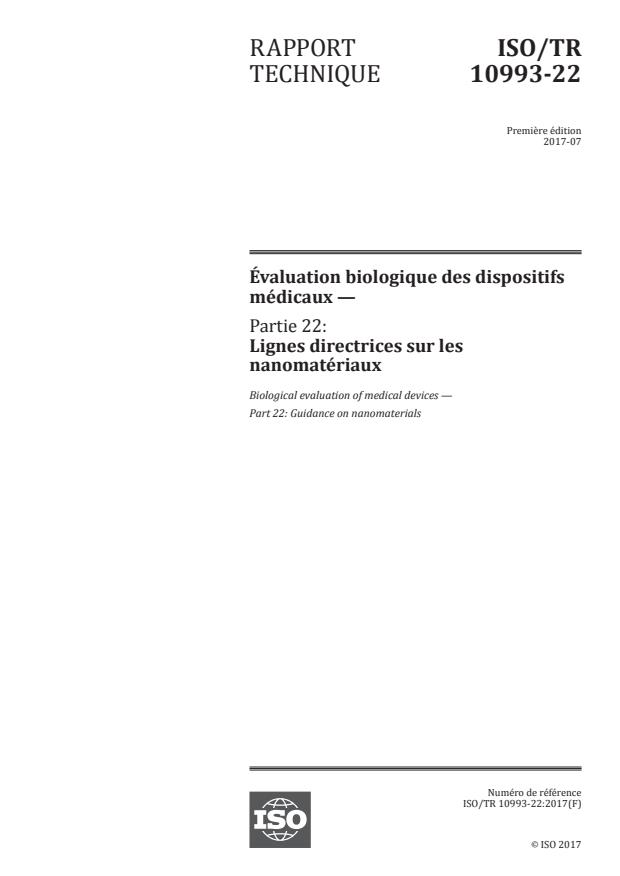
Évaluation biologique des dispositifs médicaux —
Partie 22: Lignes directrices sur les nanomatériaux
Reference number
©
ISO 2017
© ISO 2017, Published in Switzerland
All rights reserved. Unless otherwise specified, no part of this publication may be reproduced or utilized otherwise in any form
or by any means, electronic or mechanical, including photocopying, or posting on the internet or an intranet, without prior
written permission. Permission can be requested from either ISO at the address below or ISO’s member body in the country of
the requester.
ISO copyright office
Ch. de Blandonnet 8 • CP 401
CH-1214 Vernier, Geneva, Switzerland
Tel. +41 22 749 01 11
Fax +41 22 749 09 47
copyright@iso.org
www.iso.org
ii © ISO 2017 – All rights reserved
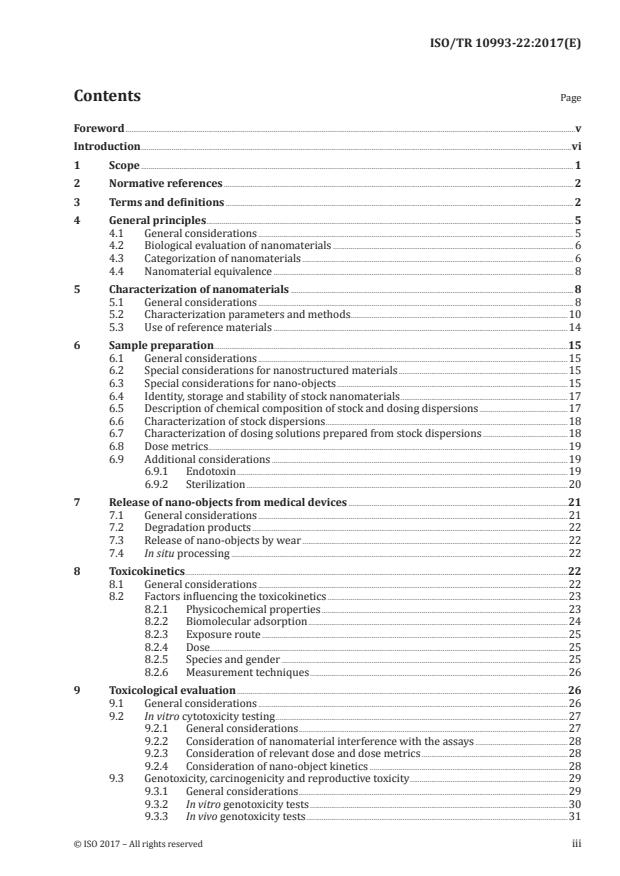
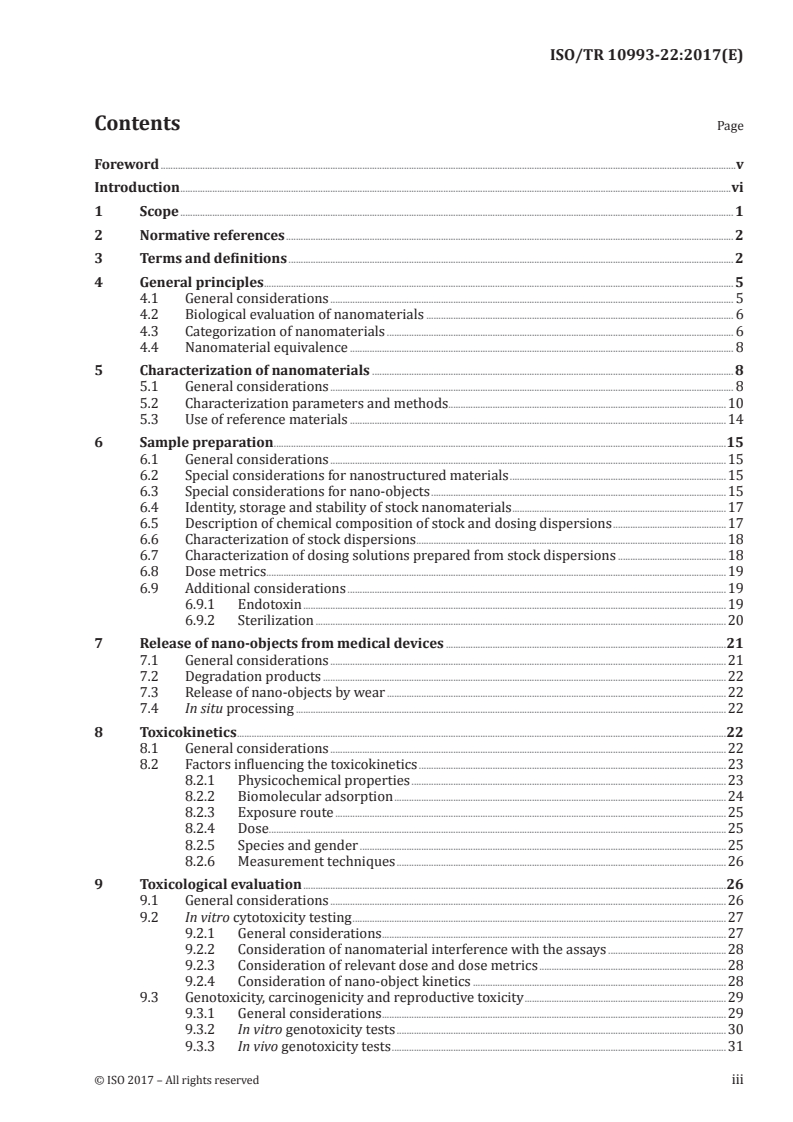
Contents Page
Foreword .v
Introduction .vi
1 Scope . 1
2 Normative references . 2
3 Terms and definitions . 2
4 General principles . 5
4.1 General considerations . 5
4.2 Biological evaluation of nanomaterials . 6
4.3 Categorization of nanomaterials . 6
4.4 Nanomaterial equivalence . 8
5 Characterization of nanomaterials . 8
5.1 General considerations . 8
5.2 Characterization parameters and methods.10
5.3 Use of reference materials .14
6 Sample preparation .15
6.1 General considerations .15
6.2 Special considerations for nanostructured materials .15
6.3 Special considerations for nano-objects .15
6.4 Identity, storage and stability of stock nanomaterials .17
6.5 Description of chemical composition of stock and dosing dispersions .17
6.6 Characterization of stock dispersions .18
6.7 Characterization of dosing solutions prepared from stock dispersions .18
6.8 Dose metrics .19
6.9 Additional considerations .19
6.9.1 Endotoxin .19
6.9.2 Sterilization .20
7 Release of nano-objects from medical devices .21
7.1 General considerations .21
7.2 Degradation products .22
7.3 Release of nano-objects by wear .22
7.4 In situ processing .22
8 Toxicokinetics .22
8.1 General considerations .22
8.2 Factors influencing the toxicokinetics .23
8.2.1 Physicochemical properties .23
8.2.2 Biomolecular adsorption .24
8.2.3 Exposure route .25
8.2.4 Dose . .25
8.2.5 Species and gender .25
8.2.6 Measurement techniques .26
9 Toxicological evaluation .26
9.1 General considerations .26
9.2 In vitro cytotoxicity testing .27
9.2.1 General considerations .27
9.2.2 Consideration of nanomaterial interference with the assays .28
9.2.3 Consideration of relevant dose and dose metrics .28
9.2.4 Consideration of nano-object kinetics .28
9.3 Genotoxicity, carcinogenicity and reproductive toxicity .29
9.3.1 General considerations .29
9.3.2 In vitro genotoxicity tests .30
9.3.3 In vivo genotoxicity tests .31
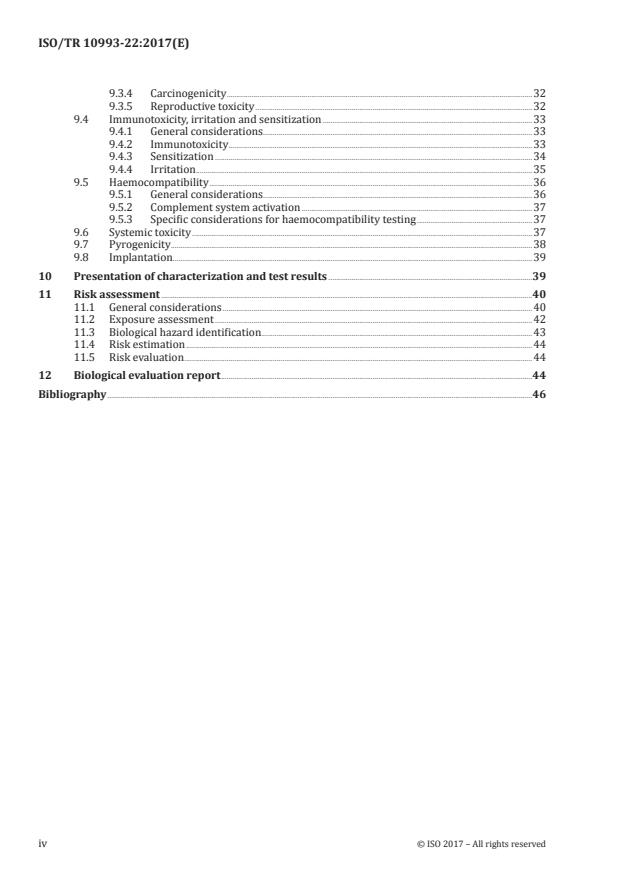
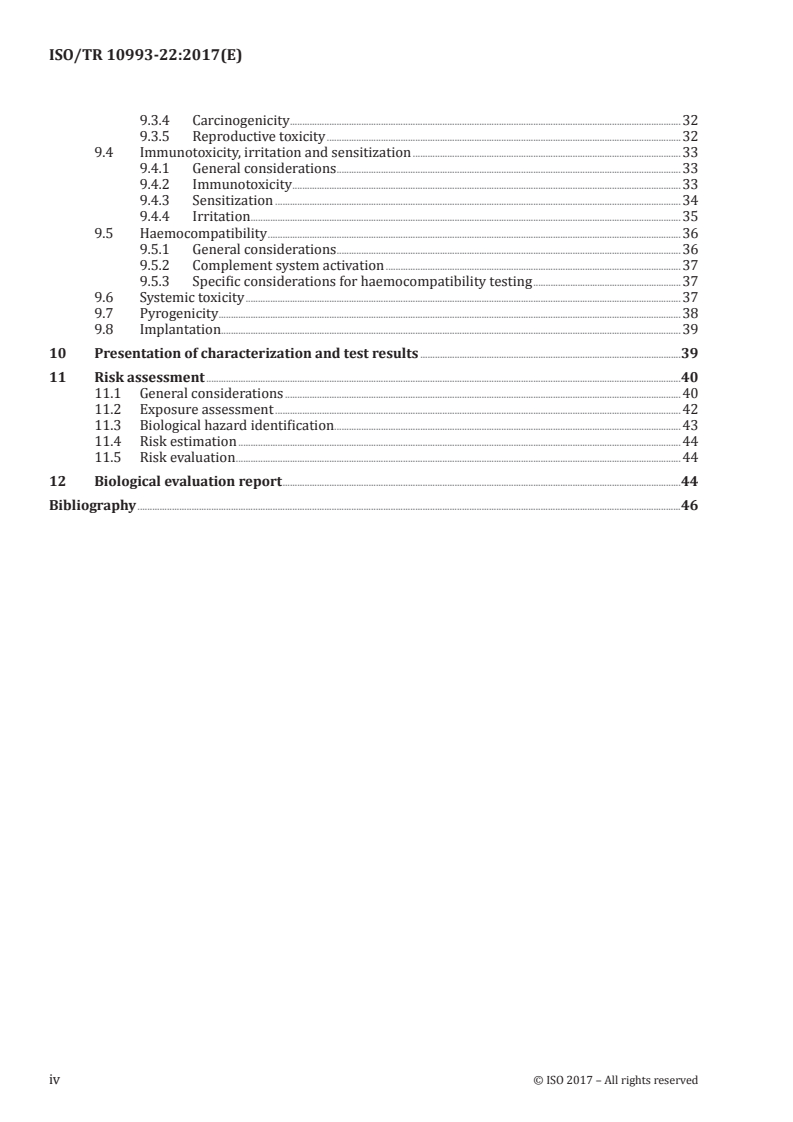
9.3.4 Carcinogenicity .32
9.3.5 Reproductive toxicity .32
9.4 Immunotoxicity, irritation and sensitization .33
9.4.1 General considerations .33
9.4.2 Immunotoxicity .33
9.4.3 Sensitization .34
9.4.4 Irritation . .35
9.5 Haemocompatibility .36
9.5.1 General considerations .36
9.5.2 Complement system activation .37
9.5.3 Specific considerations for haemocompatibility testing .37
9.6 Systemic toxicity .37
9.7 Pyrogenicity .38
9.8 Implantation.39
10 Presentation of characterization and test results .39
11 Risk assessment .40
11.1 General considerations .40
11.2 Exposure assessment .42
11.3 Biological hazard identification.43
11.4 Risk estimation .44
11.5 Risk evaluation .44
12 Biological evaluation report .44
Bibliography .46
iv © ISO 2017 – All rights reserved
Foreword
ISO (the International Organization for Standardization) is a worldwide federation of national standards
bodies (ISO member bodies). The work of preparing International Standards is normally carried out
through ISO technical committees. Each member body interested in a subject for which a technical
committee has been established has the right to be represented on that committee. International
organizations, governmental and non-governmental, in liaison with ISO, also take part in the work.
ISO collaborates closely with the International Electrotechnical Commission (IEC) on all matters of
electrotechnical standardization.
The procedures used to develop this document and those intended for its further maintenance are
described in the ISO/IEC Directives, Part 1. In particular the different approval criteria needed for the
different types of ISO documents should be noted. This document was drafted in accordance with the
editorial rules of the ISO/IEC Directives, Part 2 (see www .iso .org/ directives).
Attention is drawn to the possibility that some of the elements of this document may be the subject of
patent rights. ISO shall not be held responsible for identifying any or all such patent rights. Details of
any patent rights identified during the development of the document will be in the Introduction and/or
on the ISO list of patent declarations received (see www .iso .org/ patents).
Any trade name used in this document is information given for the convenience of users and does not
constitute an endorsement.
For an explanation on the voluntary nature of standards, the meaning of ISO specific terms and
expressions related to conformity assessment, as well as information about ISO’s adherence to the
World Trade Organization (WTO) principles in the Technical Barriers to Trade (TBT) see the following
URL: w w w . i s o .org/ iso/ foreword .html.
This document was prepared by Technical Committee ISO/TC 194, Biological and clinical evaluation of
medical devices.
A list of all parts in the ISO 10993 series can be found on the ISO website.
Introduction
This document is intended as guidance for the biological evaluation of medical devices that contain,
generate or are composed of nanomaterials. Multiple definitions have been developed for the term
nanomaterial. For the purposes of this document, the ISO definition will be used: A material is considered
a nanomaterial when it has a size at the nanoscale including external and internal dimensions, i.e. when
it has a size or is composed of structures with a length of approximately between 1 nm and 100 nm
(ISO/TS 80004-1:2015). For regulatory purposes, it is advisable to check if specific national or regional
regulatory definitions are applicable. It should be realized that other characteristics (e.g. nanospecific
properties) might also be included in such definitions.
Morphological structures created on the surface of a medical device can also have sizes in the nanoscale.
Therefore, possible effects of such structures on the biological response to the device also need to be
considered.
Nano-objects having a length range from 1 nm to 100 nm can be generated during the life cycle of a
medical device, so the evaluation of possible adverse effects due to the generation of nano-objects either
from preparation, use, wear or degradation of medical devices needs to be addressed. This applies to
medical devices manufactured using nanomaterials and medical devices that are manufactured not
using nanomaterials but having the potential to generate nanoscale wear and/or degradation particles.
For the biological evaluation of medical devices, knowledge on the potential generation and/or release
of nano-objects from such materials is essential.
The procedures as described in the ISO 10993 series for the biological evaluation of medical devices
can be used for the biological evaluation of those medical devices that contain nano-objects that are
not released from such a device as they are an integrated part of the device. However, when release
of the nano-objects is possible, a safety evaluation should also be performed on the released nano-
objects. In addition to evaluating a medical device, nanomaterial components or constituents can also
be separately evaluated.
This document provides trained professionals, in the context of medical device evaluation, a general
approach to biological evaluation of nanomaterials and addresses how the other parts of the ISO 10993
series can be used when dealing with the evaluation of nanomaterials. It is likely that the various assays
as described in the ISO 10993 series are not always appropriate as such in the testing of nanomaterials.
Nanomaterials by themselves can be present as powders or colloid dispersions, but also can be present
in medical devices while incorporated in a matrix, as nanostructured material or as surface structures
on materials and/or medical devices. In general, nanomaterials themselves need to be evaluated
instead of extracts as usually used when testing biomaterials or medical devices. Nanomaterials pose
specific challenges when applying test systems commonly used for medical device evaluation and when
interpreting test results.
The field of nanotechnology, development of nanomaterials and the evaluation of potential toxicity
of such materials are emerging fields and this document represents only the knowledge at the time
of writing. Although appropriate tools and methods for evaluation of nanomaterials are still under
development, data on the characteristics and biological effects of nanomaterials should be provided in
order to address safety issues in their application in the medical device field, taking into consideration
a risk/benefit analysis.
This document provides guidance on how to perform a biological evaluation for those medical devices
that contain, generate, or are composed of nanomaterials within a risk management process as
described in ISO 10993.
vi © ISO 2017 – All rights reserved
TECHNICAL REPORT ISO/TR 10993-22:2017(E)
Biological evaluation of medical devices —
Part 22:
Guidance on nanomaterials
1 Scope
This document describes considerations for the biological evaluation of medical devices that are
composed of or contain nanomaterials. In addition, this guidance can also be used for the evaluation
of nano-objects generated as products of degradation, wear, or from mechanical treatment processes
(e.g. in situ grinding, polishing of medical devices) from (components of) medical devices that are
manufactured not using nanomaterials.
This document includes considerations on the:
— characterization of nanomaterials;
— sample preparation for testing of nanomaterials;
— release of nano-objects from medical devices;
— toxicokinetics of nano-objects;
— biological evaluation of nanomaterials;
— presentation of results;
— risk assessment of nanomaterials in the context of medical device evaluation;
— biological evaluation report;
— nanostructures on the surface of a medical device, intentionally generated during the engineering,
manufacturing or processing of a medical device.
The following are excluded from this document:
— natural and biological nanomaterials, as long as they have not been engineered, manufactured or
processed for use in a medical device;
— intrinsic nanostructures in a bulk material;
— nanostructures on the surface of a medical device, generated as an unintentional by-product during
the engineering, manufacturing or processing of a medical device.
NOTE Examples of unintentional nanostructures on the surface of a medical device are extrusion draw lines
and machining/tool marks.
This document is intended to provide a general framework and highlights important aspects which
need to be considered when assessing the safety of medical devices composed of, containing and/or
generating nano-objects. Additionally, the document identifies several common pitfalls and obstacles
which have been identified when testing nanomaterials compared to bulk materials or small molecule
chemical species. As a technical report (TR), this document represents the current technical knowledge
related to nanomaterials. No detailed testing protocols are outlined or provided. This document can
serve as a basis for future documents containing detailed protocols with a focus on nanomaterial
testing.
2 Normative references
The following documents are referred to in the text in such a way that some or all of their content
constitutes requirements of this document. For dated references, only the edition cited applies. For
undated references, the latest edition of the referenced document (including any amendments) applies.
ISO 10993 (all parts), Biological evaluation of medical devices
ISO/TR 13014, Nanotechnologies — Guidance on physico-chemical characterization of engineered
nanoscale materials for toxicologic assessment
ISO 14971, Medical devices — Application of risk management to medical devices
3 Terms and definitions
For the purposes of this document, the terms and definitions given in ISO 10993 (all parts), ISO/TR 13014
and ISO 14971 and the following apply.
ISO and IEC maintain terminological databases for use in standardization at the following addresses:
— ISO Online browsing platform: available at http:// www .iso .org/ obp
— IEC Electropedia: available at http:// www .electropedia .org/
3.1
aggregate
particle comprising strongly bonded or fused particles where the resulting external surface area is
significantly smaller than the sum of calculated surface areas of the individual components
Note 1 to entry: The forces holding an aggregate together are strong forces, for example, covalent bonds, or those
resulting from sintering or complex physical entanglement.
Note 2 to entry: Aggregates are also termed secondary particles and the original source particles are termed
primary particles.
[SOURCE: ISO/TS 80004-2:2015, 3.5, modified — definition and Note 1 to entry changed]
3.2
agglomerate
collection of weakly bound particles or aggregates (3.1) or mixtures of the two where the resulting
external surface area is similar to the sum of the surface areas of the individual components
Note 1 to entry: The forces holding an agglomerate together are weak forces, for example van der Waals forces, or
simple physical entanglement.
Note 2 to entry: Agglomerates are also termed secondary particles and the original source particles are termed
primary particles.
[SOURCE: ISO/TS 80004-2:2015, 3.4]
3.3
engineered nanomaterial
nanomaterial (3.7) designed for a specific purpose or function
[SOURCE: ISO/TS 80004-1:2015, 2.8]
3.4
incidental nanomaterial
nanomaterial (3.7) generated as an unintentional by-product of a process
Note 1 to entry: The process includes manufacturing, bio-technological or other processes.
2 © ISO 2017 – All rights reserved
Note 2 to entry: See “ultrafine particle” in ISO/TR 27628:2007, 2.21.
[SOURCE: ISO/TS 80004-1:2015, 2.10]
3.5
manufactured nanomaterial
nanomaterial (3.7) intentionally produced to have selected properties or composition
[SOURCE: ISO/TS 80004-1:2015, 2.9]
3.6
nanofibre
nano-object (3.8) with two similar external dimensions in the nanoscale (3.12) and the third dimension
significantly larger
Note 1 to entry: A nanofibre can be flexible or rigid.
Note 2 to entry: The two similar external dimensions are considered to differ in size by less than three times and
the significantly larger external dimension is considered to differ from the other two by more than three times.
Note 3 to entry: The largest external dimension is not necessarily in the nanoscale.
[SOURCE: ISO/TS 80004-6:2013, 2.6]
3.7
nanomaterial
material with any external dimension in the nanoscale (3.12) or having internal structure or surface
structure in the nanoscale
Note 1 to entry: This generic term is inclusive of nano-object (3.8) and nanostructured material (3.17).
Note 2 to entry: See also 3.3 to 3.5.
Note 3 to entry: For regulatory purposes, it is advisable to check if specific national or regional regulatory
definitions are applicable. It should be realized that different size ranges or other properties might be included in
such definitions.
[SOURCE: ISO/TS 80004-1:2015, 2.4, modified — Note 2 to entry modified and Note 3 to entry added]
3.8
nano-object
discrete piece of material with one, two or three external dimensions in the nanoscale (3.12)
Note 1 to entry: The second and third external dimensions are orthogonal to the first dimension and to each other.
[SOURCE: ISO/TS 80004-1:2015, 2.5]
3.9
nanoparticle
nano-object (3.8) with all external dimensions at the nanoscale (3.12) where the length of the longest
and the shortest axes of the nano-object do not differ significantly
Note 1 to entry: If the dimensions differ significantly (typically by more than 3 times), terms such as nanofibre or
nanoplate may be preferred to the term nanoparticle.
[SOURCE: ISO/TS 80004-2:2015, 4.4]
3.10
nanoplate
nano-object (3.8) with one external dimension in the nanoscale (3.12) and the two other external
dimensions significantly larger
Note 1 to entry: The smallest external dimension is the thickness of the nanoplate.
Note 2 to entry: The two significantly larger dimensions are considered to differ from the nanoscale dimension
by more than three times.
Note 3 to entry: The larger external dimensions are not necessarily in the nanoscale.
[SOURCE: ISO/TS 80004-6:2013, 2.4]
3.11
nanorod
solid nanofibre (3.6)
[SOURCE: ISO/TS 80004-2:2015, 4.7]
3.12
nanoscale
length range approximately from 1 nm to 100 nm
Note 1 to entry: Properties that are not extrapolations from larger sizes are predominantly exhibited in this
length range.
Note 2 to entry: Properties impacting biocompatibility can also occur at larger sizes, e.g. between 100 nm and 1 um.
[SOURCE: ISO/TS 80004-1:2015, 2.1, modified — Note 2 to entry was added]
3.13
nanoscale phenomenon
effect attributable to the presence of nano-objects (3.8) or nanoscale (3.12) regions
[SOURCE: ISO/TS 80004-1:2015, 2.13]
3.14
nanoscale property
characteristic of a nano-object (3.8) or nanoscale (3.12) region
[SOURCE: ISO/TS 80004-1:2015, 2.14]
3.15
nanoscience
study, discovery and understanding of matter, where size- and structure-dependent properties and
phenomena manifest, predominantly in the nanoscale (3.12), distinct from those associated with
individual atoms or molecules, or extrapolation from larger sizes of the same material
[SOURCE: ISO/TS 80004-1:2015, 2.2]
3.16
nanostructure
composition of inter-related constituent parts in which one or more of those parts is a nanoscale
(3.12) region
Note 1 to entry: A region is defined by a boundary representing a discontinuity in properties.
[SOURCE: ISO/TS 80004-1:2015, 2.6]
3.17
nanostructured material
material having internal nanostructure (3.16) or surface nanostructure
Note 1 to entry: This definition does not exclude the possibility for a nano-object (3.8) to have internal structure
or surface structure. If external dimension(s) are in the nanoscale (3.12), the term nano-object is recommended.
[SOURCE: ISO/TS 80004-1:2015, 2.7]
4 © ISO 2017 – All rights reserved
3.18
nanotechnology
application of scientific knowledge to manipulate and control matter predominantly in the nanoscale
(3.12) to make use of size- and structure-dependent properties and phenomena distinct from those
associated with individual atoms or molecules, or extrapolation from larger sizes of the same material
Note 1 to entry: Manipulation and control includes material synthesis.
[SOURCE: ISO/TS 80004-1:2015, 2.3]
3.19
nanotube
hollow nanofibre (3.6)
[SOURCE: ISO/TS 80004-2:2015, 4.8]
3.20
representative test material
RTM
material, which is sufficiently homogenous and stable with respect to one or more specified properties,
and is implicitly assumed to be fit for its intended use in the development of measurement and test
methods that target properties other than those for which homogeneity and stability have been
demonstrated
[SOURCE: ISO/TS 16195:2013; 3.1, modified — Notes 1 and 2 to entry deleted]
4 General principles
4.1 General considerations
Nanomaterials are manufactured and used because of the specific properties that can be associated
with the decrease in size accompanied by an increase of surface area. Also, materials with dimensions
in the size range >100 nm or <1 micron can elicit properties different from those in the macroscale
(>1 micron). For these types of particulate materials, it might be considered to perform an assessment
similar to nanomaterials in the size range between 1 nm and 100 nm.
The biological evaluation of any material or medical device intended for use in humans should form
part of a structured biological evaluation program within a risk management process in accordance
with ISO 14971 and ISO 10993-1. The risk management process is applicable to devices that contain
or are composed of nanomaterials. The risk management process is also applicable to devices that
generate nano-objects as products of degradation, wear, or from mechanical treatment processes (e.g.
in situ grinding, polishing of medical devices). Similarly, if there is release of nano-objects, there are
specific challenges in the safety evaluation of such products. The safety evaluation and risk assessment
of nanomaterials requires a special focus as various nanomaterials consisting of the same chemical
substance can have a different toxicological risk profile depending on a number of variables, including
size, surface chemistry, physicochemical properties and intended application. For medical devices
that are composed of or that contain nanomaterials, the safety evaluation program should specifically
address issues related to the safety evaluation of nanomaterials. The ISO 10993 series, ISO/TR 13014,
ISO 14971, and References [5],[14],[15],[16],[21],[23],[24],[28],[46],[47] and [49] deal with biological
evaluation of medical devices and various aspects of nanomaterials.
Nanomaterials have sizes similar to structures at subcellular levels including DNA, and thus
(theoretically) can reach and interact with such structures. Also, medical devices utilizing materials
with nanoscale internal structures or with surface nanoscale features associated with coatings,
functionalization, or with other topographical features on the nanoscale, that are intended as part of
the functionality of the device, can have specific and unique properties that might need to be addressed
in the biological evaluation. For example, it has been shown that nanoscale surface topography can
influence cell alignment, cell morphology, cell signalling, gene expression and extracellular matrix
[52] [53] [54]
.
The release of nano-objects and the use of free nanomaterials are considered to pose the highest
potential for risk in view of the potential internal exposure that can occur.
4.2 Biological evaluation of nanomaterials
ISO 10993-1:2009, Annex A, provides a framework for the development of an assessment program of
the biological risks that should be considered depending upon a device’s type and duration of body
contact. This framework is also generally applicable to devices that contain, generate or are composed
of nanomaterials. Such testing should be based on each device’s merits. Special considerations apply to
the ISO 10993 series of tests due to the presence of nanomaterials, as outlined in this document.
ISO 10993-1 provides guidance on the risk management process, which includes hazard identification,
exposure assessment and risk estimation. This process is generally sufficiently robust and flexible
to provide a basis for evaluation of nanomaterials, even though they can have properties that can
be different from conventional ones. This process, including biological evaluation strategy, program
content and acceptance criteria of the risk related to the nanomaterials as required by ISO 10993-1,
should be planned, carried out and documented by knowledgeable and experienced professionals.
The initial step in the biological evaluation of nanomaterials is to gather existing information on that
particular nanomaterial according to the general approach as described in ISO 10993-1. Literature
review of clinical and non-clinical data should be carried out according to ISO 10993-1:2009, Annex C
to provide a rigorous and objective summary of available information about the nanomaterial and
its intended application. Reference [55] has summarized several places where information about
nanomaterials can be found. Following the logic of ISO 14971 and ISO 10993-1, if the biological safety
assessment concludes from existing data that the identified risks are acceptable, no further testing is
needed. Otherwise, additional information should be obtained. In order to use existing data for the
biological evaluation, demonstration of nanomaterial equivalence is necessary (see 4.4).
4.3 Categorization of nanomaterials
The exposure assessment and hazard identification should be based on the characteristics of the
finished medical device and the intended use. Hazard identification should consider the physicochemical
and toxicological properties of the nanomaterial, including additives and processing aids. Exposure
assessment should consider the concentration of nanomaterial used in the medical device, intended use
and exposure route, and the rate and pattern of release and estimated patient exposure. The manner
in which the nanomaterial is incorporated into the finished medical device can significantly alter the
[56]
exposure characteristics . General considerations for different categories of nanomaterials and
medical devices are presented in Table 1. Certain devices might fall into more than one category, in
which case evaluation appropriate to each category should be considered. The evaluation of any device
that does not fall into one of the categories described should follow the general principles contained in
ISO 10993-1, along with any special considerations outlined within this document.
6 © ISO 2017 – All rights reserved
Table 1 — Considerations for biological evaluation of medical devices
that contain, generate, or are composed of nanomaterials
Type of nanomaterial Considerations in addition to the biological
a
Category
in the medical device evaluation according to ISO 10993-1
— Consider potential cellular or tissue effects due to direct
interaction with surface nanostructures (beneficial or
adverse).
— Consider potential of structures to be released (break
off) from the surface.
1 Surface nanostructures
— Consider potential of nano-objects to be generated by
degradation, wear or mechanical treatment processes.
— Consider characterization of nanostructures (see
Clause 5).
— Consider potential cellular or tissue effects due to direct
interaction with surface-bound nano-objects/nano-materi-
als (beneficial or adverse).
— Consider potential of nano-objects to be released from
Nano-objects bound to or incor-
the device.
2 porated within a medical device;
without intention to be released
— Consider potential of nano-objects to be generated by
degradation, wear or mechanical treatment processes.
— Consider characterization of physicochemical properties
of the nano-objects (see Clause 5).
— Consider release kinetics (rate and quantity) of the na-
no-objects and contact duration of the medical device.
— Consider potential cellular or tissue effects due to
direct interaction with nano-objects/nanomaterials (benefi-
cial or adverse).
Nano-objects/nanostructures on the
— Consider characterization of physicochemical properties
surface of or within a medical device;
of the released nano-objects (see Clause 5).
with intentional/expected release
— Consider toxicokinetics and tissue distribution of the
from the device
nano-objects (see Clause 8).
— Consider biological evaluation of the nano-objects (see
Clause 9).
— Consider potential of nano-objects to be generated by
degradation, wear or mechanical treatment processes.
— Consider characterization of physicochemical properties
of the nano-objects (see Clause 5).
— Consider toxicokinetics and tissue distribution of the
4 Nano-object medical device
nano-objects (see Clause 8).
— Consider biological evaluation of the nano-objects (see
Clause 9).
a
A device can contain nanomaterials in more than one category.
b
Nano-objects can be generated from a medical device that does not contain nano-objects.
c
Degradation, wear or treatment of a medical device containing nano-objects can generate new or
unintended nano-objects.
Table 1 (continued)
Type of nanomaterial Considerations in addition to the biological
a
Category
in the medical device evaluation according to ISO 10993-1
— Consider characterization of physicochemical properties
of the nano-objects (see Clause 5).
— Clause 7 describes additional considerations for
nano-objects released by wear or generated by in situ pro-
b
Nano-objects released from a medi-
cessing.
cal device as product of degradation,
c
5 wear, or from mechanical treatment — Consider toxicokinetics and tissue distribution of the
processes (e.g. in situ grinding or nano-objects (see Clause 8).
polishing)
— Consider biological evaluation of the generated nano-ob-
jects (see Clause 9).
— Consider contact duration and release kinetics (rate and
quantity).
a
A device can contain nanomaterials in more than one category.
b
Nano-objects can be generated from a medical device that does not contain nano-objects.
c
Degradation, wear or treatment of a medical device containing nano-objects can generate new or
unintended nano-objects.
4.4 Nanomaterial equivalence
Proper identification and characterization of the nanomaterial is essential. For nanomaterials,
equivalence is dependent on multiple factors. Chemical composition alone is not sufficient to
demonstrate equivalence as nanomaterial-specific properties can also be influenced by a number
of other factors such as size, shape and surface properties of the nanomaterial and/or the source
(manufacturer) of these nanomaterials, manufacturing process and storage conditions. Equivalence
can only be claimed if properly demonstrated and justified by accompanying data.
In general, extrapolation of results by using existing data from other products using/containing similar
nanomaterials, or from the corresponding parent compound of the same substance is not applicable,
although such products can give an indication of possible safety concerns. If testing is considered
necessary, it should be performed on the actual product and/or any nanomaterials which can come into
contact with patients.
5 Characterization of nanomaterials
5.1 General considerations
Knowledge of the physicochemical properties of nanomaterials is essential to understanding their
behaviour in biological systems. The physicochemical characterization is necessary for the identification
of a specific nanomaterial. Characterization of the physicochemical properties of nanomaterials/nano-
objects incorporated in a device and/or created by degradation, wear or mechanical treatment processes
of the device is thus an important step in completing its biological evaluation. Physicochemical
characterization can also be useful in the screening of potential new nanomaterials for suitability
in a medical device for a proposed application. In addition, a proper characterization is necessary to
establish or confirm the specifications of a nanomaterial in a defined medium and conditions.
Physicochemical characterization addresses three fundamental questions about a nanomaterial used
in or released from a medical device.
— Chemical composition: What is it made of?
— Physical description: What does it look like?
— Extrinsic properties: How does it interact with the surrounding environment?
8 © ISO 2017 – All rights reserved
The physicochemical properties associated with these questions encompass a wide range of nano-object
characteristics. In keeping with guidance for evaluation of conventional materials used in medical
devices, the physicochemical characterization of nano-scaled materials is targeted to properties that
are relevant to the biological evaluation and the intended use of the device (clinical application and
duration of use). General principles for chemical, physicochemical, morphological and topographical
characterization of materials used in medical devices are covered in ISO 10993-18 and ISO/TS 10993-
19. The identification and quantification of degradation products in medical devices are addressed
in ISO 10993-9, ISO 10993-13, ISO 10993-14 and ISO 10993-15. Detailed guidance specifically for the
physicochemical characterization of nanomaterials is emerging. Recently published guidance includes
ISO/TR 13014 and ISO/TR 14187 and guidances published by the European Commission for food and
[57] [58] [59]
feed, cosmetic ingredients and medi
...
TECHNICAL ISO/TR
REPORT 10993-22
First edition
2017-07
Biological evaluation of medical
devices —
Part 22:
Guidance on nanomaterials
Évaluation biologique des dispositifs médicaux —
Partie 22: Lignes directrices sur les nanomatériaux
Reference number
©
ISO 2017
© ISO 2017, Published in Switzerland
All rights reserved. Unless otherwise specified, no part of this publication may be reproduced or utilized otherwise in any form
or by any means, electronic or mechanical, including photocopying, or posting on the internet or an intranet, without prior
written permission. Permission can be requested from either ISO at the address below or ISO’s member body in the country of
the requester.
ISO copyright office
Ch. de Blandonnet 8 • CP 401
CH-1214 Vernier, Geneva, Switzerland
Tel. +41 22 749 01 11
Fax +41 22 749 09 47
copyright@iso.org
www.iso.org
ii © ISO 2017 – All rights reserved
Contents Page
Foreword .v
Introduction .vi
1 Scope . 1
2 Normative references . 2
3 Terms and definitions . 2
4 General principles . 5
4.1 General considerations . 5
4.2 Biological evaluation of nanomaterials . 6
4.3 Categorization of nanomaterials . 6
4.4 Nanomaterial equivalence . 8
5 Characterization of nanomaterials . 8
5.1 General considerations . 8
5.2 Characterization parameters and methods.10
5.3 Use of reference materials .14
6 Sample preparation .15
6.1 General considerations .15
6.2 Special considerations for nanostructured materials .15
6.3 Special considerations for nano-objects .15
6.4 Identity, storage and stability of stock nanomaterials .17
6.5 Description of chemical composition of stock and dosing dispersions .17
6.6 Characterization of stock dispersions .18
6.7 Characterization of dosing solutions prepared from stock dispersions .18
6.8 Dose metrics .19
6.9 Additional considerations .19
6.9.1 Endotoxin .19
6.9.2 Sterilization .20
7 Release of nano-objects from medical devices .21
7.1 General considerations .21
7.2 Degradation products .22
7.3 Release of nano-objects by wear .22
7.4 In situ processing .22
8 Toxicokinetics .22
8.1 General considerations .22
8.2 Factors influencing the toxicokinetics .23
8.2.1 Physicochemical properties .23
8.2.2 Biomolecular adsorption .24
8.2.3 Exposure route .25
8.2.4 Dose . .25
8.2.5 Species and gender .25
8.2.6 Measurement techniques .26
9 Toxicological evaluation .26
9.1 General considerations .26
9.2 In vitro cytotoxicity testing .27
9.2.1 General considerations .27
9.2.2 Consideration of nanomaterial interference with the assays .28
9.2.3 Consideration of relevant dose and dose metrics .28
9.2.4 Consideration of nano-object kinetics .28
9.3 Genotoxicity, carcinogenicity and reproductive toxicity .29
9.3.1 General considerations .29
9.3.2 In vitro genotoxicity tests .30
9.3.3 In vivo genotoxicity tests .31
9.3.4 Carcinogenicity .32
9.3.5 Reproductive toxicity .32
9.4 Immunotoxicity, irritation and sensitization .33
9.4.1 General considerations .33
9.4.2 Immunotoxicity .33
9.4.3 Sensitization .34
9.4.4 Irritation . .35
9.5 Haemocompatibility .36
9.5.1 General considerations .36
9.5.2 Complement system activation .37
9.5.3 Specific considerations for haemocompatibility testing .37
9.6 Systemic toxicity .37
9.7 Pyrogenicity .38
9.8 Implantation.39
10 Presentation of characterization and test results .39
11 Risk assessment .40
11.1 General considerations .40
11.2 Exposure assessment .42
11.3 Biological hazard identification.43
11.4 Risk estimation .44
11.5 Risk evaluation .44
12 Biological evaluation report .44
Bibliography .46
iv © ISO 2017 – All rights reserved
Foreword
ISO (the International Organization for Standardization) is a worldwide federation of national standards
bodies (ISO member bodies). The work of preparing International Standards is normally carried out
through ISO technical committees. Each member body interested in a subject for which a technical
committee has been established has the right to be represented on that committee. International
organizations, governmental and non-governmental, in liaison with ISO, also take part in the work.
ISO collaborates closely with the International Electrotechnical Commission (IEC) on all matters of
electrotechnical standardization.
The procedures used to develop this document and those intended for its further maintenance are
described in the ISO/IEC Directives, Part 1. In particular the different approval criteria needed for the
different types of ISO documents should be noted. This document was drafted in accordance with the
editorial rules of the ISO/IEC Directives, Part 2 (see www .iso .org/ directives).
Attention is drawn to the possibility that some of the elements of this document may be the subject of
patent rights. ISO shall not be held responsible for identifying any or all such patent rights. Details of
any patent rights identified during the development of the document will be in the Introduction and/or
on the ISO list of patent declarations received (see www .iso .org/ patents).
Any trade name used in this document is information given for the convenience of users and does not
constitute an endorsement.
For an explanation on the voluntary nature of standards, the meaning of ISO specific terms and
expressions related to conformity assessment, as well as information about ISO’s adherence to the
World Trade Organization (WTO) principles in the Technical Barriers to Trade (TBT) see the following
URL: w w w . i s o .org/ iso/ foreword .html.
This document was prepared by Technical Committee ISO/TC 194, Biological and clinical evaluation of
medical devices.
A list of all parts in the ISO 10993 series can be found on the ISO website.
Introduction
This document is intended as guidance for the biological evaluation of medical devices that contain,
generate or are composed of nanomaterials. Multiple definitions have been developed for the term
nanomaterial. For the purposes of this document, the ISO definition will be used: A material is considered
a nanomaterial when it has a size at the nanoscale including external and internal dimensions, i.e. when
it has a size or is composed of structures with a length of approximately between 1 nm and 100 nm
(ISO/TS 80004-1:2015). For regulatory purposes, it is advisable to check if specific national or regional
regulatory definitions are applicable. It should be realized that other characteristics (e.g. nanospecific
properties) might also be included in such definitions.
Morphological structures created on the surface of a medical device can also have sizes in the nanoscale.
Therefore, possible effects of such structures on the biological response to the device also need to be
considered.
Nano-objects having a length range from 1 nm to 100 nm can be generated during the life cycle of a
medical device, so the evaluation of possible adverse effects due to the generation of nano-objects either
from preparation, use, wear or degradation of medical devices needs to be addressed. This applies to
medical devices manufactured using nanomaterials and medical devices that are manufactured not
using nanomaterials but having the potential to generate nanoscale wear and/or degradation particles.
For the biological evaluation of medical devices, knowledge on the potential generation and/or release
of nano-objects from such materials is essential.
The procedures as described in the ISO 10993 series for the biological evaluation of medical devices
can be used for the biological evaluation of those medical devices that contain nano-objects that are
not released from such a device as they are an integrated part of the device. However, when release
of the nano-objects is possible, a safety evaluation should also be performed on the released nano-
objects. In addition to evaluating a medical device, nanomaterial components or constituents can also
be separately evaluated.
This document provides trained professionals, in the context of medical device evaluation, a general
approach to biological evaluation of nanomaterials and addresses how the other parts of the ISO 10993
series can be used when dealing with the evaluation of nanomaterials. It is likely that the various assays
as described in the ISO 10993 series are not always appropriate as such in the testing of nanomaterials.
Nanomaterials by themselves can be present as powders or colloid dispersions, but also can be present
in medical devices while incorporated in a matrix, as nanostructured material or as surface structures
on materials and/or medical devices. In general, nanomaterials themselves need to be evaluated
instead of extracts as usually used when testing biomaterials or medical devices. Nanomaterials pose
specific challenges when applying test systems commonly used for medical device evaluation and when
interpreting test results.
The field of nanotechnology, development of nanomaterials and the evaluation of potential toxicity
of such materials are emerging fields and this document represents only the knowledge at the time
of writing. Although appropriate tools and methods for evaluation of nanomaterials are still under
development, data on the characteristics and biological effects of nanomaterials should be provided in
order to address safety issues in their application in the medical device field, taking into consideration
a risk/benefit analysis.
This document provides guidance on how to perform a biological evaluation for those medical devices
that contain, generate, or are composed of nanomaterials within a risk management process as
described in ISO 10993.
vi © ISO 2017 – All rights reserved
TECHNICAL REPORT ISO/TR 10993-22:2017(E)
Biological evaluation of medical devices —
Part 22:
Guidance on nanomaterials
1 Scope
This document describes considerations for the biological evaluation of medical devices that are
composed of or contain nanomaterials. In addition, this guidance can also be used for the evaluation
of nano-objects generated as products of degradation, wear, or from mechanical treatment processes
(e.g. in situ grinding, polishing of medical devices) from (components of) medical devices that are
manufactured not using nanomaterials.
This document includes considerations on the:
— characterization of nanomaterials;
— sample preparation for testing of nanomaterials;
— release of nano-objects from medical devices;
— toxicokinetics of nano-objects;
— biological evaluation of nanomaterials;
— presentation of results;
— risk assessment of nanomaterials in the context of medical device evaluation;
— biological evaluation report;
— nanostructures on the surface of a medical device, intentionally generated during the engineering,
manufacturing or processing of a medical device.
The following are excluded from this document:
— natural and biological nanomaterials, as long as they have not been engineered, manufactured or
processed for use in a medical device;
— intrinsic nanostructures in a bulk material;
— nanostructures on the surface of a medical device, generated as an unintentional by-product during
the engineering, manufacturing or processing of a medical device.
NOTE Examples of unintentional nanostructures on the surface of a medical device are extrusion draw lines
and machining/tool marks.
This document is intended to provide a general framework and highlights important aspects which
need to be considered when assessing the safety of medical devices composed of, containing and/or
generating nano-objects. Additionally, the document identifies several common pitfalls and obstacles
which have been identified when testing nanomaterials compared to bulk materials or small molecule
chemical species. As a technical report (TR), this document represents the current technical knowledge
related to nanomaterials. No detailed testing protocols are outlined or provided. This document can
serve as a basis for future documents containing detailed protocols with a focus on nanomaterial
testing.
2 Normative references
The following documents are referred to in the text in such a way that some or all of their content
constitutes requirements of this document. For dated references, only the edition cited applies. For
undated references, the latest edition of the referenced document (including any amendments) applies.
ISO 10993 (all parts), Biological evaluation of medical devices
ISO/TR 13014, Nanotechnologies — Guidance on physico-chemical characterization of engineered
nanoscale materials for toxicologic assessment
ISO 14971, Medical devices — Application of risk management to medical devices
3 Terms and definitions
For the purposes of this document, the terms and definitions given in ISO 10993 (all parts), ISO/TR 13014
and ISO 14971 and the following apply.
ISO and IEC maintain terminological databases for use in standardization at the following addresses:
— ISO Online browsing platform: available at http:// www .iso .org/ obp
— IEC Electropedia: available at http:// www .electropedia .org/
3.1
aggregate
particle comprising strongly bonded or fused particles where the resulting external surface area is
significantly smaller than the sum of calculated surface areas of the individual components
Note 1 to entry: The forces holding an aggregate together are strong forces, for example, covalent bonds, or those
resulting from sintering or complex physical entanglement.
Note 2 to entry: Aggregates are also termed secondary particles and the original source particles are termed
primary particles.
[SOURCE: ISO/TS 80004-2:2015, 3.5, modified — definition and Note 1 to entry changed]
3.2
agglomerate
collection of weakly bound particles or aggregates (3.1) or mixtures of the two where the resulting
external surface area is similar to the sum of the surface areas of the individual components
Note 1 to entry: The forces holding an agglomerate together are weak forces, for example van der Waals forces, or
simple physical entanglement.
Note 2 to entry: Agglomerates are also termed secondary particles and the original source particles are termed
primary particles.
[SOURCE: ISO/TS 80004-2:2015, 3.4]
3.3
engineered nanomaterial
nanomaterial (3.7) designed for a specific purpose or function
[SOURCE: ISO/TS 80004-1:2015, 2.8]
3.4
incidental nanomaterial
nanomaterial (3.7) generated as an unintentional by-product of a process
Note 1 to entry: The process includes manufacturing, bio-technological or other processes.
2 © ISO 2017 – All rights reserved
Note 2 to entry: See “ultrafine particle” in ISO/TR 27628:2007, 2.21.
[SOURCE: ISO/TS 80004-1:2015, 2.10]
3.5
manufactured nanomaterial
nanomaterial (3.7) intentionally produced to have selected properties or composition
[SOURCE: ISO/TS 80004-1:2015, 2.9]
3.6
nanofibre
nano-object (3.8) with two similar external dimensions in the nanoscale (3.12) and the third dimension
significantly larger
Note 1 to entry: A nanofibre can be flexible or rigid.
Note 2 to entry: The two similar external dimensions are considered to differ in size by less than three times and
the significantly larger external dimension is considered to differ from the other two by more than three times.
Note 3 to entry: The largest external dimension is not necessarily in the nanoscale.
[SOURCE: ISO/TS 80004-6:2013, 2.6]
3.7
nanomaterial
material with any external dimension in the nanoscale (3.12) or having internal structure or surface
structure in the nanoscale
Note 1 to entry: This generic term is inclusive of nano-object (3.8) and nanostructured material (3.17).
Note 2 to entry: See also 3.3 to 3.5.
Note 3 to entry: For regulatory purposes, it is advisable to check if specific national or regional regulatory
definitions are applicable. It should be realized that different size ranges or other properties might be included in
such definitions.
[SOURCE: ISO/TS 80004-1:2015, 2.4, modified — Note 2 to entry modified and Note 3 to entry added]
3.8
nano-object
discrete piece of material with one, two or three external dimensions in the nanoscale (3.12)
Note 1 to entry: The second and third external dimensions are orthogonal to the first dimension and to each other.
[SOURCE: ISO/TS 80004-1:2015, 2.5]
3.9
nanoparticle
nano-object (3.8) with all external dimensions at the nanoscale (3.12) where the length of the longest
and the shortest axes of the nano-object do not differ significantly
Note 1 to entry: If the dimensions differ significantly (typically by more than 3 times), terms such as nanofibre or
nanoplate may be preferred to the term nanoparticle.
[SOURCE: ISO/TS 80004-2:2015, 4.4]
3.10
nanoplate
nano-object (3.8) with one external dimension in the nanoscale (3.12) and the two other external
dimensions significantly larger
Note 1 to entry: The smallest external dimension is the thickness of the nanoplate.
Note 2 to entry: The two significantly larger dimensions are considered to differ from the nanoscale dimension
by more than three times.
Note 3 to entry: The larger external dimensions are not necessarily in the nanoscale.
[SOURCE: ISO/TS 80004-6:2013, 2.4]
3.11
nanorod
solid nanofibre (3.6)
[SOURCE: ISO/TS 80004-2:2015, 4.7]
3.12
nanoscale
length range approximately from 1 nm to 100 nm
Note 1 to entry: Properties that are not extrapolations from larger sizes are predominantly exhibited in this
length range.
Note 2 to entry: Properties impacting biocompatibility can also occur at larger sizes, e.g. between 100 nm and 1 um.
[SOURCE: ISO/TS 80004-1:2015, 2.1, modified — Note 2 to entry was added]
3.13
nanoscale phenomenon
effect attributable to the presence of nano-objects (3.8) or nanoscale (3.12) regions
[SOURCE: ISO/TS 80004-1:2015, 2.13]
3.14
nanoscale property
characteristic of a nano-object (3.8) or nanoscale (3.12) region
[SOURCE: ISO/TS 80004-1:2015, 2.14]
3.15
nanoscience
study, discovery and understanding of matter, where size- and structure-dependent properties and
phenomena manifest, predominantly in the nanoscale (3.12), distinct from those associated with
individual atoms or molecules, or extrapolation from larger sizes of the same material
[SOURCE: ISO/TS 80004-1:2015, 2.2]
3.16
nanostructure
composition of inter-related constituent parts in which one or more of those parts is a nanoscale
(3.12) region
Note 1 to entry: A region is defined by a boundary representing a discontinuity in properties.
[SOURCE: ISO/TS 80004-1:2015, 2.6]
3.17
nanostructured material
material having internal nanostructure (3.16) or surface nanostructure
Note 1 to entry: This definition does not exclude the possibility for a nano-object (3.8) to have internal structure
or surface structure. If external dimension(s) are in the nanoscale (3.12), the term nano-object is recommended.
[SOURCE: ISO/TS 80004-1:2015, 2.7]
4 © ISO 2017 – All rights reserved
3.18
nanotechnology
application of scientific knowledge to manipulate and control matter predominantly in the nanoscale
(3.12) to make use of size- and structure-dependent properties and phenomena distinct from those
associated with individual atoms or molecules, or extrapolation from larger sizes of the same material
Note 1 to entry: Manipulation and control includes material synthesis.
[SOURCE: ISO/TS 80004-1:2015, 2.3]
3.19
nanotube
hollow nanofibre (3.6)
[SOURCE: ISO/TS 80004-2:2015, 4.8]
3.20
representative test material
RTM
material, which is sufficiently homogenous and stable with respect to one or more specified properties,
and is implicitly assumed to be fit for its intended use in the development of measurement and test
methods that target properties other than those for which homogeneity and stability have been
demonstrated
[SOURCE: ISO/TS 16195:2013; 3.1, modified — Notes 1 and 2 to entry deleted]
4 General principles
4.1 General considerations
Nanomaterials are manufactured and used because of the specific properties that can be associated
with the decrease in size accompanied by an increase of surface area. Also, materials with dimensions
in the size range >100 nm or <1 micron can elicit properties different from those in the macroscale
(>1 micron). For these types of particulate materials, it might be considered to perform an assessment
similar to nanomaterials in the size range between 1 nm and 100 nm.
The biological evaluation of any material or medical device intended for use in humans should form
part of a structured biological evaluation program within a risk management process in accordance
with ISO 14971 and ISO 10993-1. The risk management process is applicable to devices that contain
or are composed of nanomaterials. The risk management process is also applicable to devices that
generate nano-objects as products of degradation, wear, or from mechanical treatment processes (e.g.
in situ grinding, polishing of medical devices). Similarly, if there is release of nano-objects, there are
specific challenges in the safety evaluation of such products. The safety evaluation and risk assessment
of nanomaterials requires a special focus as various nanomaterials consisting of the same chemical
substance can have a different toxicological risk profile depending on a number of variables, including
size, surface chemistry, physicochemical properties and intended application. For medical devices
that are composed of or that contain nanomaterials, the safety evaluation program should specifically
address issues related to the safety evaluation of nanomaterials. The ISO 10993 series, ISO/TR 13014,
ISO 14971, and References [5],[14],[15],[16],[21],[23],[24],[28],[46],[47] and [49] deal with biological
evaluation of medical devices and various aspects of nanomaterials.
Nanomaterials have sizes similar to structures at subcellular levels including DNA, and thus
(theoretically) can reach and interact with such structures. Also, medical devices utilizing materials
with nanoscale internal structures or with surface nanoscale features associated with coatings,
functionalization, or with other topographical features on the nanoscale, that are intended as part of
the functionality of the device, can have specific and unique properties that might need to be addressed
in the biological evaluation. For example, it has been shown that nanoscale surface topography can
influence cell alignment, cell morphology, cell signalling, gene expression and extracellular matrix
[52] [53] [54]
.
The release of nano-objects and the use of free nanomaterials are considered to pose the highest
potential for risk in view of the potential internal exposure that can occur.
4.2 Biological evaluation of nanomaterials
ISO 10993-1:2009, Annex A, provides a framework for the development of an assessment program of
the biological risks that should be considered depending upon a device’s type and duration of body
contact. This framework is also generally applicable to devices that contain, generate or are composed
of nanomaterials. Such testing should be based on each device’s merits. Special considerations apply to
the ISO 10993 series of tests due to the presence of nanomaterials, as outlined in this document.
ISO 10993-1 provides guidance on the risk management process, which includes hazard identification,
exposure assessment and risk estimation. This process is generally sufficiently robust and flexible
to provide a basis for evaluation of nanomaterials, even though they can have properties that can
be different from conventional ones. This process, including biological evaluation strategy, program
content and acceptance criteria of the risk related to the nanomaterials as required by ISO 10993-1,
should be planned, carried out and documented by knowledgeable and experienced professionals.
The initial step in the biological evaluation of nanomaterials is to gather existing information on that
particular nanomaterial according to the general approach as described in ISO 10993-1. Literature
review of clinical and non-clinical data should be carried out according to ISO 10993-1:2009, Annex C
to provide a rigorous and objective summary of available information about the nanomaterial and
its intended application. Reference [55] has summarized several places where information about
nanomaterials can be found. Following the logic of ISO 14971 and ISO 10993-1, if the biological safety
assessment concludes from existing data that the identified risks are acceptable, no further testing is
needed. Otherwise, additional information should be obtained. In order to use existing data for the
biological evaluation, demonstration of nanomaterial equivalence is necessary (see 4.4).
4.3 Categorization of nanomaterials
The exposure assessment and hazard identification should be based on the characteristics of the
finished medical device and the intended use. Hazard identification should consider the physicochemical
and toxicological properties of the nanomaterial, including additives and processing aids. Exposure
assessment should consider the concentration of nanomaterial used in the medical device, intended use
and exposure route, and the rate and pattern of release and estimated patient exposure. The manner
in which the nanomaterial is incorporated into the finished medical device can significantly alter the
[56]
exposure characteristics . General considerations for different categories of nanomaterials and
medical devices are presented in Table 1. Certain devices might fall into more than one category, in
which case evaluation appropriate to each category should be considered. The evaluation of any device
that does not fall into one of the categories described should follow the general principles contained in
ISO 10993-1, along with any special considerations outlined within this document.
6 © ISO 2017 – All rights reserved
Table 1 — Considerations for biological evaluation of medical devices
that contain, generate, or are composed of nanomaterials
Type of nanomaterial Considerations in addition to the biological
a
Category
in the medical device evaluation according to ISO 10993-1
— Consider potential cellular or tissue effects due to direct
interaction with surface nanostructures (beneficial or
adverse).
— Consider potential of structures to be released (break
off) from the surface.
1 Surface nanostructures
— Consider potential of nano-objects to be generated by
degradation, wear or mechanical treatment processes.
— Consider characterization of nanostructures (see
Clause 5).
— Consider potential cellular or tissue effects due to direct
interaction with surface-bound nano-objects/nano-materi-
als (beneficial or adverse).
— Consider potential of nano-objects to be released from
Nano-objects bound to or incor-
the device.
2 porated within a medical device;
without intention to be released
— Consider potential of nano-objects to be generated by
degradation, wear or mechanical treatment processes.
— Consider characterization of physicochemical properties
of the nano-objects (see Clause 5).
— Consider release kinetics (rate and quantity) of the na-
no-objects and contact duration of the medical device.
— Consider potential cellular or tissue effects due to
direct interaction with nano-objects/nanomaterials (benefi-
cial or adverse).
Nano-objects/nanostructures on the
— Consider characterization of physicochemical properties
surface of or within a medical device;
of the released nano-objects (see Clause 5).
with intentional/expected release
— Consider toxicokinetics and tissue distribution of the
from the device
nano-objects (see Clause 8).
— Consider biological evaluation of the nano-objects (see
Clause 9).
— Consider potential of nano-objects to be generated by
degradation, wear or mechanical treatment processes.
— Consider characterization of physicochemical properties
of the nano-objects (see Clause 5).
— Consider toxicokinetics and tissue distribution of the
4 Nano-object medical device
nano-objects (see Clause 8).
— Consider biological evaluation of the nano-objects (see
Clause 9).
a
A device can contain nanomaterials in more than one category.
b
Nano-objects can be generated from a medical device that does not contain nano-objects.
c
Degradation, wear or treatment of a medical device containing nano-objects can generate new or
unintended nano-objects.
Table 1 (continued)
Type of nanomaterial Considerations in addition to the biological
a
Category
in the medical device evaluation according to ISO 10993-1
— Consider characterization of physicochemical properties
of the nano-objects (see Clause 5).
— Clause 7 describes additional considerations for
nano-objects released by wear or generated by in situ pro-
b
Nano-objects released from a medi-
cessing.
cal device as product of degradation,
c
5 wear, or from mechanical treatment — Consider toxicokinetics and tissue distribution of the
processes (e.g. in situ grinding or nano-objects (see Clause 8).
polishing)
— Consider biological evaluation of the generated nano-ob-
jects (see Clause 9).
— Consider contact duration and release kinetics (rate and
quantity).
a
A device can contain nanomaterials in more than one category.
b
Nano-objects can be generated from a medical device that does not contain nano-objects.
c
Degradation, wear or treatment of a medical device containing nano-objects can generate new or
unintended nano-objects.
4.4 Nanomaterial equivalence
Proper identification and characterization of the nanomaterial is essential. For nanomaterials,
equivalence is dependent on multiple factors. Chemical composition alone is not sufficient to
demonstrate equivalence as nanomaterial-specific properties can also be influenced by a number
of other factors such as size, shape and surface properties of the nanomaterial and/or the source
(manufacturer) of these nanomaterials, manufacturing process and storage conditions. Equivalence
can only be claimed if properly demonstrated and justified by accompanying data.
In general, extrapolation of results by using existing data from other products using/containing similar
nanomaterials, or from the corresponding parent compound of the same substance is not applicable,
although such products can give an indication of possible safety concerns. If testing is considered
necessary, it should be performed on the actual product and/or any nanomaterials which can come into
contact with patients.
5 Characterization of nanomaterials
5.1 General considerations
Knowledge of the physicochemical properties of nanomaterials is essential to understanding their
behaviour in biological systems. The physicochemical characterization is necessary for the identification
of a specific nanomaterial. Characterization of the physicochemical properties of nanomaterials/nano-
objects incorporated in a device and/or created by degradation, wear or mechanical treatment processes
of the device is thus an important step in completing its biological evaluation. Physicochemical
characterization can also be useful in the screening of potential new nanomaterials for suitability
in a medical device for a proposed application. In addition, a proper characterization is necessary to
establish or confirm the specifications of a nanomaterial in a defined medium and conditions.
Physicochemical characterization addresses three fundamental questions about a nanomaterial used
in or released from a medical device.
— Chemical composition: What is it made of?
— Physical description: What does it look like?
— Extrinsic properties: How does it interact with the surrounding environment?
8 © ISO 2017 – All rights reserved
The physicochemical properties associated with these questions encompass a wide range of nano-object
characteristics. In keeping with guidance for evaluation of conventional materials used in medical
devices, the physicochemical characterization of nano-scaled materials is targeted to properties that
are relevant to the biological evaluation and the intended use of the device (clinical application and
duration of use). General principles for chemical, physicochemical, morphological and topographical
characterization of materials used in medical devices are covered in ISO 10993-18 and ISO/TS 10993-
19. The identification and quantification of degradation products in medical devices are addressed
in ISO 10993-9, ISO 10993-13, ISO 10993-14 and ISO 10993-15. Detailed guidance specifically for the
physicochemical characterization of nanomaterials is emerging. Recently published guidance includes
ISO/TR 13014 and ISO/TR 14187 and guidances published by the European Commission for food and
[57] [58] [59]
feed, cosmetic ingredients and medi
...
RAPPORT ISO/TR
TECHNIQUE 10993-22
Première édition
2017-07
Évaluation biologique des dispositifs
médicaux —
Partie 22:
Lignes directrices sur les
nanomatériaux
Biological evaluation of medical devices —
Part 22: Guidance on nanomaterials
Numéro de référence
©
ISO 2017
DOCUMENT PROTÉGÉ PAR COPYRIGHT
© ISO 2017, Publié en Suisse
Droits de reproduction réservés. Sauf indication contraire, aucune partie de cette publication ne peut être reproduite ni utilisée
sous quelque forme que ce soit et par aucun procédé, électronique ou mécanique, y compris la photocopie, l’affichage sur
l’internet ou sur un Intranet, sans autorisation écrite préalable. Les demandes d’autorisation peuvent être adressées à l’ISO à
l’adresse ci-après ou au comité membre de l’ISO dans le pays du demandeur.
ISO copyright office
Ch. de Blandonnet 8 • CP 401
CH-1214 Vernier, Geneva, Switzerland
Tel. +41 22 749 01 11
Fax +41 22 749 09 47
copyright@iso.org
www.iso.org
ii © ISO 2017 – Tous droits réservés
Sommaire Page
Avant-propos .v
Introduction .vi
1 Domaine d’application . 1
2 Références normatives . 2
3 Termes et définitions . 2
4 Principes généraux . 5
4.1 Considérations générales . 5
4.2 Évaluation biologique des nanomatériaux . 6
4.3 Classification des nanomatériaux . 7
4.4 Équivalence de nanomatériaux. 9
5 Caractérisation des nanomatériaux . 9
5.1 Généralités . 9
5.2 Paramètres et méthodes de caractérisation .11
5.3 Utilisation de matériaux de référence .16
6 Préparation d’échantillon .16
6.1 Considérations générales .16
6.2 Considérations particulières applicables aux matériaux nanostructurés .17
6.3 Considérations particulières applicables aux nano-éléments .17
6.4 Identité, stockage et stabilité des préparations de nanomatériaux .19
6.5 Description de la composition chimique des dispersions de nanomatériaux et des
dispersions de dosage .20
6.6 Caractérisation des dispersions de nanomatériaux.20
6.7 Caractérisation des solutions de dosage obtenues à partir de dispersions
de nanomatériaux.21
6.8 Dosimétrie .21
6.9 Considérations supplémentaires .22
6.9.1 Endotoxine .22
6.9.2 Stérilisation .23
7 Libération de nano-éléments par les dispositifs médicaux .24
7.1 Considérations générales .24
7.2 Produits de dégradation .24
7.3 Libération de nano-éléments par l’usure .25
7.4 Traitement in situ .25
8 Toxico-cinétique .25
8.1 Considérations générales .25
8.2 Facteurs influençant la toxico-cinétique .26
8.2.1 Propriétés physicochimiques.26
8.2.2 Adsorption biomoléculaire .27
8.2.3 Voie d’exposition .28
8.2.4 Dose . .28
8.2.5 Espèce et sexe .28
8.2.6 Techniques de mesure .29
9 Évaluation toxicologique .29
9.1 Généralités .29
9.2 Essais de cytotoxicité in vitro .30
9.2.1 Considérations générales .30
9.2.2 Prise en compte des interférences des nanomatériaux avec les essais .31
9.2.3 Prise en compte de la dose et des mesures de dose pertinentes .32
9.2.4 Prise en compte de la cinétique des nano-éléments .32
9.3 Génotoxicité, cancérogénicité et toxicité pour la reproduction .32
9.3.1 Considérations générales .32
9.3.2 Essais de génotoxicité in vitro .34
9.3.3 Essais de génotoxicité in vivo .34
9.3.4 Cancérogénicité.35
9.3.5 Toxicité pour la reproduction .36
9.4 Immuno-toxicité, irritation et sensibilisation .37
9.4.1 Considérations générales .37
9.4.2 Immuno-toxicité .37
9.4.3 Sensibilisation .38
9.4.4 Irritation . .39
9.5 Hémocompatibilité .40
9.5.1 Considérations générales .40
9.5.2 Activation du système du complément .41
9.5.3 Considérations particulières pour les essais de l’hémocompatibilité .41
9.6 Toxicité systémique .42
9.7 Pyrogénicité .43
9.8 Implantation.43
10 Présentation des résultats de caractérisation et d’essai .44
11 Évaluation des risques.45
11.1 Considérations générales .45
11.2 Évaluation de l’exposition .47
11.3 Identification des dangers biologiques .47
11.4 Estimation du risque .48
11.5 Évaluation des risques.49
12 Rapport d’évaluation biologique .49
Bibliographie .50
iv © ISO 2017 – Tous droits réservés
Avant-propos
L’ISO (Organisation internationale de normalisation) est une fédération mondiale d’organismes
nationaux de normalisation (comités membres de l’ISO). L’élaboration des Normes internationales est
en général confiée aux comités techniques de l’ISO. Chaque comité membre intéressé par une étude
a le droit de faire partie du comité technique créé à cet effet. Les organisations internationales,
gouvernementales et non gouvernementales, en liaison avec l’ISO participent également aux travaux.
L’ISO collabore étroitement avec la Commission électrotechnique internationale (IEC) en ce qui
concerne la normalisation électrotechnique.
Les procédures utilisées pour élaborer le présent document et celles destinées à sa mise à jour sont
décrites dans les Directives ISO/IEC, Partie 1. Il convient, en particulier de prendre note des différents
critères d’approbation requis pour les différents types de documents ISO. Le présent document a été
rédigé conformément aux règles de rédaction données dans les Directives ISO/IEC, Partie 2 (voir www
.iso .org/ directives).
L’attention est attirée sur le fait que certains des éléments du présent document peuvent faire l’objet de
droits de propriété intellectuelle ou de droits analogues. L’ISO ne saurait être tenue pour responsable
de ne pas avoir identifié de tels droits de propriété et averti de leur existence. Les détails concernant
les références aux droits de propriété intellectuelle ou autres droits analogues identifiés lors de
l’élaboration du document sont indiqués dans l’Introduction et/ou dans la liste des déclarations de
brevets reçues par l’ISO (voir www .iso .org/ brevets).
Les appellations commerciales éventuellement mentionnées dans le présent document sont données
pour information, par souci de commodité, à l’intention des utilisateurs et ne sauraient constituer un
engagement.
Pour une explication de la nature volontaire des normes, la signification des termes et expressions
spécifiques de l’ISO liés à l’évaluation de la conformité, ou pour toute information au sujet de l’adhésion
de l’ISO aux principes de l’Organisation mondiale du commerce (OMC) concernant les obstacles
techniques au commerce (OTC), voir le lien suivant: w w w . i s o .org/ avant -propos.
Le présent document a été élaboré par le comité technique ISO/TC 194, Évaluation biologique et clinique
des dispositifs médicaux.
Une liste de toutes les parties de la série ISO 10993 se trouve sur le site Web de l’ISO.
Introduction
Le présent document réunit les lignes directrices applicables à l’évaluation biologique des dispositifs
médicaux qui contiennent, génèrent ou sont constitués de nanomatériaux. Plusieurs définitions ont
été développées pour le terme nanomatériau. Pour les besoins du présent document, la définition de
l’ISO s’applique: Un matériau est considéré comme un nanomatériau lorsqu’il présente des dimensions
externes et internes à l’échelle nanométrique, c’est-à-dire lorsque sa taille ou les structures qui le
composent ont une longueur comprise approximativement entre 1 nm et 100 nm (ISO/TS 80004-
1:2015). En matière de réglementation, il est conseillé de vérifier l’applicabilité de définitions
réglementaires nationales ou régionales spécifiques. Il convient de considérer la possibilité d’inclure
d’autres caractéristiques (par exemple, des propriétés nanospécifiques) dans ces définitions.
Les structures morphologiques créées sur la surface d’un dispositif médical peuvent également
présenter des dimensions à l’échelle nanométrique. Les effets possibles de telles structures sur la
réponse biologique du dispositif doivent, par conséquent, être également pris en compte.
Des nano-éléments d’une longueur comprise entre 1 nm et 100 nm peuvent être générés au cours
du cycle de vie d’un dispositif médical; les éventuels effets négatifs liés à la génération de nano-
éléments dans le cadre de la préparation, de l’utilisation, de l’usure ou de la dégradation des dispositifs
médicaux doivent donc être évalués. Ce point s’applique aux dispositifs médicaux fabriqués avec des
nanomatériaux, ainsi qu’aux dispositifs médicaux dont la fabrication ne repose pas sur l’utilisation
de nanomatériaux mais qui sont susceptibles de générer une usure à l’échelle nanométrique et/ou
une libération de particules. Dans le cadre de l’évaluation biologique des dispositifs médicaux, il est
essentiel de connaître le potentiel de génération et/ou de libération de nano-éléments de la part de tels
matériaux.
Les procédures d’évaluation biologique de dispositifs médicaux décrites dans la série ISO 10993 peuvent
être utilisées pour l’évaluation biologique de dispositifs médicaux contenant des nano-éléments qui
sont, non pas libérés, mais intégrés au dispositif lui-même. Cependant, lorsque le risque de libération
de nano-éléments est présent, il convient également de soumettre ces nano-éléments à une évaluation
de sécurité. Parallèlement à l’évaluation d’un dispositif médical, les composants ou constituants d’un
nanomatériau peuvent également faire l’objet d’une évaluation distincte.
Le présent document propose aux professionnels dûment formés, dans le contexte de l’évaluation de
dispositifs médicaux, une approche générale de l’évaluation biologique des nanomatériaux et aborde la
manière dont les autres parties de la série ISO 10993 peuvent être utilisées dans le cadre de l’évaluation
de nanomatériaux. Il est probable que les divers essais décrits dans la série ISO 10993 ne s’appliquent
pas systématiquement en tant que tels à l’évaluation des nanomatériaux. Les nanomatériaux peuvent
être présents sous forme de poudres ou de dispersions colloïdales, mais ils peuvent également être
présents dans les dispositifs médicaux en étant incorporés dans une matrice, sous forme de matériaux
nanostructurés ou de structures de surface sur des matériaux et/ou dispositifs médicaux. En règle
générale, les nanomatériaux eux-mêmes ont besoin d’être évalués, et non leurs extraits comme il est
souvent d’usage pour les biomatériaux ou dispositifs médicaux. Les nanomatériaux présentent certains
défis tant du point de vue de l’application de systèmes d’essai communément employés pour l’évaluation
de dispositifs médicaux que de l’interprétation des résultats d’essai.
Le domaine des nanotechnologies, le développement de nanomatériaux et l’évaluation de leur toxicité
potentielle représentent des disciplines encore récentes; le présent document reflète donc à cet égard
l’état de la connaissance à la date de sa rédaction. Bien que des outils et méthodes d’évaluation des
nanomatériaux soient encore en cours de développement, il convient de fournir des informations sur
les caractéristiques et les effets biologiques des nanomatériaux afin de résoudre les problèmes de
sécurité liés à leur application dans le domaine des dispositifs médicaux, sur la base d’une analyse
risque/bénéfice.
Le présent document fournit des lignes directrices sur la manière de mener une évaluation biologique
sur des dispositifs médicaux qui contiennent, génèrent ou sont composés de nanomatériaux dans le
cadre d’un processus de gestion du risque tel que décrit dans l’ISO 10993.
vi © ISO 2017 – Tous droits réservés
RAPPORT TECHNIQUE ISO/TR 10993-22:2017(F)
Évaluation biologique des dispositifs médicaux —
Partie 22:
Lignes directrices sur les nanomatériaux
1 Domaine d’application
Le présent document décrit les aspects à prendre en compte pour l’évaluation biologique de dispositifs
médicaux qui contiennent ou sont composés de nanomatériaux. Ces lignes directrices peuvent
également être appliquées pour l’évaluation de nano-éléments générés comme produits de dégradation
ou d’usure, ou sous l’effet d’un traitement mécanique (par exemple, broyage ou polissage in situ de
dispositifs médicaux) de dispositifs médicaux ou de leurs composants, fabriqués sans nanomatériaux.
Le présent document couvre notamment:
— la caractérisation des nanomatériaux;
— la préparation d’échantillons pour les essais menés sur des nanomatériaux;
— la libération de nano-éléments par les dispositifs médicaux;
— la toxico-cinétique des nano-éléments;
— l’évaluation biologique des nanomatériaux;
— la présentation des résultats;
— l’évaluation des risques liés aux nanomatériaux dans le contexte de l’évaluation des dispositifs
médicaux;
— le rapport d’évaluation biologique;
— les nanostructures sur la surface d’un dispositif médical, qui ont été délibérément produites au
cours des phases d’ingénierie, de fabrication ou de traitement d’un dispositif médical.
Les aspects suivants sont exclus du domaine d’application du présent document:
— les nanomatériaux naturels et biologiques qui n’ont pas été conçus, fabriqués ou traités en vue d’être
utilisés dans un dispositif médical;
— les nanostructures intrinsèques d’un matériau en vrac;
— les nanostructures, sur la surface d’un dispositif médical, qui ont été générées en tant que sous-
produit non intentionnel au cours des phases d’ingénierie, de fabrication ou de traitement d’un
dispositif médical.
NOTE Les lignes d’extrusion et les marques d’usinage/d’outil sont des exemples de nanostructures
involontaires présentes sur la surface d’un dispositif médical.
Le présent document entend fournir un cadre général et souligner les aspects importants à prendre
en compte lors de l’évaluation de la sécurité de dispositifs médicaux composés de, contenant et/ou
générant des nano-éléments. Il identifie en outre quelques écueils et obstacles courants qui ont été
relevés lors des essais menés sur des nanomatériaux comparativement aux essais réalisés sur des
matériaux en vrac ou sur de petites espèces chimiques moléculaires. Le présent document est un
Rapport technique (TR) qui reflète l’état actuel de la connaissance technique dans le domaine des
nanomatériaux. Il ne décrit ni ne fournit aucun protocole d’essai détaillé. Le présent document peut
servir de base à la rédaction ultérieure de documents contenant des protocoles détaillés axés sur les
essais menés sur des nanomatériaux.
2 Références normatives
Les documents suivants cités dans le texte constituent, pour tout ou partie de leur contenu, des
exigences du présent document. Pour les références datées, seule l’édition citée s’applique. Pour les
références non datées, la dernière édition du document de référence s’applique (y compris les éventuels
amendements).
ISO 10993 (toutes les parties), Évaluation biologique des dispositifs médicaux
ISO/TR 13014, Nanotechnologies — Directives relatives à la caractérisation physico-chimique des nano-
objets manufacturés soumis aux essais toxicologiques
ISO 14971, Dispositifs médicaux — Application de la gestion des risques aux dispositifs médicaux
3 Termes et définitions
Pour les besoins du présent document, les termes et définitions donnés dans l’ISO 10993 (toutes les
parties), l’ISO/TR 13014 et l’ISO 14971 ainsi que les suivants s’appliquent.
L’ISO et l’IEC tiennent à jour des bases de données terminologiques destinées à être utilisées en
normalisation, consultables aux adresses suivantes:
— ISO Online browsing platform: disponible à l’adresse http:// www .iso .org/ obp
— IEC Electropedia: disponible à l’adresse http:// www .electropedia .org/
3.1
agrégat
particule composée de particules fortement liées ou fusionnées, dont l’aire de la surface externe
résultante est significativement plus petite que la somme des aires de surface calculées de chacun des
composants
Note 1 à l’article: Les forces assurant la cohésion d’un agrégat sont puissantes, par exemple, des liaisons
covalentes, ou des forces résultant d’un frittage ou d’un enchevêtrement physique complexe.
Note 2 à l’article: Les agrégats sont également appelés particules secondaires et les particules sources initiales
sont appelées particules primaires.
[SOURCE: ISO/TS 80004-2:2015, 3.5, modifiée — adaptation de la définition et de la Note 1 à l’article]
3.2
agglomérat
ensemble de particules faiblement liées ou d’agrégats (3.1), ou d’une combinaison des deux, dont l’aire
de la surface externe résultante est similaire à la somme des aires de surface de chacun des composants
Note 1 à l’article: Les forces assurant la cohésion d’un agglomérat sont faibles, par exemple des forces de Van der
Waals, ou des forces résultant d’un simple enchevêtrement physique.
Note 2 à l’article: Les agglomérats sont également appelés particules secondaires et les particules sources
initiales sont appelées particules primaires.
[SOURCE: ISO/TS 80004-2:2015, 3.4]
3.3
nanomatériau d’ingénierie
nanomatériau (3.7) conçu pour un but ou une fonction spécifique
[SOURCE: ISO/TS 80004-1:2015, 2.8]
2 © ISO 2017 – Tous droits réservés
3.4
nanomatériau «incidentel»
nanomatériau (3.7) généré en tant que sous-produit non intentionnel d’un processus
Note 1 à l’article: Le processus comprend la fabrication, les processus biotechnologiques ou autres.
Note 2 à l’article: Voir «particule ultrafine» dans l’ISO/TR 27628:2007, 2.21.
[SOURCE: ISO/TS 80004-1:2015, 2.10]
3.5
nanomatériau manufacturé
nanomatériau (3.7) produit intentionnellement pour avoir des propriétés choisies ou une
composition choisie
[SOURCE: ISO/TS 80004-1:2015, 2.9]
3.6
nanofibre
nano-élément (3.8) dont deux dimensions externes similaires sont à l’échelle nanométrique (3.12) et dont
la troisième dimension est significativement plus grande
Note 1 à l’article: Une nanofibre peut être flexible ou rigide.
Note 2 à l’article: On considère que les deux dimensions externes similaires ont une différence de taille plus
petite qu’un facteur trois et on considère que la dimension externe significativement plus grande diffère des
deux autres d’un facteur supérieur à trois.
Note 3 à l’article: La dimension externe la plus grande n’est pas nécessairement à l’échelle nanométrique.
[SOURCE: ISO/TS 80004-6:2013, 2.6]
3.7
nanomatériau
matériau ayant une dimension externe à l’échelle nanométrique (3.12) ou ayant une structure interne ou
une structure de surface à l’échelle nanométrique
Note 1 à l’article: Ce terme générique englobe les nano-éléments (3.8) et les matériaux nanostructurés (3.17).
Note 2 à l’article: Voir également 3.3 à 3.5.
Note 3 à l’article: En matière de réglementation, il est conseillé de vérifier l’applicabilité de définitions
réglementaires nationales ou régionales spécifiques. Il convient de considérer la possibilité d’inclure des gammes
de taille différentes ou d’autres propriétés dans ces définitions.
[SOURCE: ISO/TS 80004-1:2015, 2.4, modifiée — modification de la Note 2 à l’article et ajout de la Note 3
à l’article]
3.8
nano-élément
portion discrète de matériau dont une, deux ou les trois dimensions externes sont à l’échelle
nanométrique (3.12)
Note 1 à l’article: Les deuxième et troisième dimensions externes sont orthogonales à la première dimension et
l’une par rapport à l’autre.
[SOURCE: ISO/TS 80004-1:2015, 2.5]
3.9
nanoparticule
nano-élément (3.8) dont toutes les dimensions externes sont à l’échelle nanométrique (3.12) et dont les
longueurs du plus grand et du plus petit axes ne diffèrent pas de façon significative
Note 1 à l’article: Si les dimensions diffèrent de façon significative (généralement d’un facteur supérieur à 3), des
termes tels que nanofibre ou nanofeuillet peuvent être préférés au terme nanoparticule.
[SOURCE: ISO/TS 80004-2:2015, 4.4]
3.10
nanofeuillet
nano-élément (3.8) dont une dimension externe est à l’échelle nanométrique (3.12) et dont les deux autres
sont significativement plus grandes
Note 1 à l’article: La dimension externe la plus petite est l’épaisseur du nanofeuillet.
Note 2 à l’article: On considère que les deux dimensions significativement les plus grandes diffèrent de la
dimension à l’échelle nanométrique d’un facteur supérieur à trois.
Note 3 à l’article: Les dimensions externes les plus grandes ne sont pas nécessairement à l’échelle nanométrique.
[SOURCE: ISO/TS 80004-6:2013, 2.4]
3.11
nanobâtonnet
nanotige
nanofibre (3.6) solide
[SOURCE: ISO/TS 80004-2:2015, 4.7]
3.12
échelle nanométrique
échelle de longueur s’étendant approximativement de 1 nm à 100 nm
Note 1 à l’article: Les propriétés qui ne constituent pas des extrapolations par rapport à des dimensions plus
grandes sont principalement manifestes dans cette échelle de longueur.
Note 2 à l’article: Des propriétés ayant une incidence sur la biocompatibilité peuvent également se présenter à
des tailles supérieures, par exemple entre 100 nm et 1 µm.
[SOURCE: ISO/TS 80004-1:2015, 2.1, modifiée — ajout de la Note 2 à l’article]
3.13
phénomène à l’échelle nanométrique
effet attribué à la présence de nano-éléments (3.8) ou de régions à l’échelle nanométrique (3.12)
[SOURCE: ISO/TS 80004-1:2015, 2.13]
3.14
propriété à l’échelle nanométrique
caractéristique d’un nano-élément (3.8) ou d’une région à l’échelle nanométrique (3.12)
[SOURCE: ISO/TS 80004-1:2015, 2.14]
3.15
nanoscience
étude, découverte et compréhension de la matière à des échelles où se manifestent des propriétés et
des phénomènes dépendant de la taille et de la structure, principalement à l’échelle nanométrique (3.12),
différents de ceux associés aux atomes ou molécules individuels, ou aux extrapolations par rapport à
des dimensions plus grandes du même matériau
[SOURCE: ISO/TS 80004-1:2015, 2.2]
4 © ISO 2017 – Tous droits réservés
3.16
nanostructure
composition de parties constitutives liées entre elles, dans laquelle une ou plusieurs de ces parties est
une région à l’échelle nanométrique (3.12)
Note 1 à l’article: Une région est définie par une limite représentant une discontinuité des propriétés.
[SOURCE: ISO/TS 80004-1:2015, 2.6]
3.17
matériau nanostructuré
matériau ayant une nanostructure (3.16) interne ou une nanostructure de surface
Note 1 à l’article: Cette définition n’exclut pas la possibilité qu’un nano-élément (3.8) ait une structure interne ou
une structure de surface. Si la ou les dimensions externes sont à l’échelle nanométrique (3.12), il est recommandé
d’utiliser le terme «nano-élément».
[SOURCE: ISO/TS 80004-1:2015, 2.7]
3.18
nanotechnologie
application de connaissances scientifiques à des fins de manipulation et de contrôle de la matière
principalement à l’échelle nanométrique (3.12) afin d’utiliser les propriétés et phénomènes dépendant
de la taille et de la structure, différents de ceux associés aux atomes ou molécules individuels, ou aux
extrapolations par rapport à des dimensions plus grandes du même matériau
Note 1 à l’article: La synthèse des matériaux est comprise dans la manipulation et le contrôle.
[SOURCE: ISO/TS 80004-1:2015, 2.3]
3.19
nanotube
nanofibre (3.6) creuse
[SOURCE: ISO/TS 80004-2:2015, 4.8]
3.20
matériau d’essai représentatif
MER
matériau suffisamment homogène et stable eu égard à une ou plusieurs propriétés spécifiées, et censé
être implicitement adapté à son utilisation prévue dans le cadre du développement de méthodes de
mesure et d’essai, ciblant des propriétés autres que celles pour lesquelles l’homogénéité et la stabilité
ont été démontrées
[SOURCE: ISO/TS 16195:2013; 3.1, modifiée — suppression des Notes 1 et 2 à l’article]
4 Principes généraux
4.1 Considérations générales
Les nanomatériaux sont fabriqués et utilisés en raison de propriétés spécifiques pouvant être associées
à une réduction de taille qui s’accompagne d’une augmentation de la surface spécifique. De même, les
matériaux dont les dimensions se situent dans une gamme > 100 nm ou < 1 micron peuvent présenter
des propriétés différentes de celles observées à l’échelle macrométrique (>1 micron). Pour ces types de
matériaux particulaires, une évaluation similaire à celle réalisée sur des nanomatériaux d’une gamme
comprise entre 1 nm et 100 nm peut être envisagée.
Il convient que l’évaluation biologique de tout matériau ou dispositif médical destiné à servir sur
l’Homme s’inscrive dans un programme structuré d’évaluation biologique au sein d’un processus de
gestion du risque conformément à l’ISO 14971 et à l’ISO 10993-1. Le processus de gestion du risque
s’applique aux dispositifs qui contiennent ou sont composés de nanomatériaux. Le processus de gestion
du risque s’applique également aux dispositifs qui génèrent des nano-éléments comme produits de
dégradation ou d’usure, ou sous l’effet d’un traitement mécanique (par exemple, broyage ou polissage in
situ) des dispositifs médicaux. De la même manière, la libération de nano-éléments soulève des enjeux
particuliers pour l’évaluation de la sécurité de ces produits. L’évaluation de la sécurité et du risque
lié aux nanomatériaux requiert une attention particulière dans la mesure où divers nanomatériaux
constitués de la même substance chimique peuvent présenter un profil de risque toxicologique
différent, qui dépend d’un certain nombre de variables, telles que la taille, la composition chimique de
surface, les propriétés physicochimiques et l’application prévue. Pour les dispositifs médicaux qui sont
composés de ou qui contiennent des nanomatériaux, il convient que le programme d’évaluation de la
sécurité couvre spécifiquement les questions associées à l’évaluation de la sécurité des nanomatériaux.
La série ISO 10993, l’ISO/TR 13014, l’ISO 14971 et les Références [5],[14],[15],[16],[21],[23],[24],[28],
[46],[47] et [49] couvrent l’évaluation biologique de dispositifs médicaux ainsi que différents aspects
des nanomatériaux.
Les nanomatériaux ont des dimensions similaires à celles des structures de niveau subcellulaire,
notamment l’ADN, et peuvent donc (en théorie) atteindre ces structures et interagir avec elles. De
même, les dispositifs médicaux qui utilisent des matériaux présentant des structures internes à
l’échelle nanométrique, des caractéristiques de surface à l’échelle nanométrique associées à des
revêtements ou fonctionnalisations, ou encore qui présentent des caractéristiques topographiques à
l’échelle nanométrique et qui contribuent à la fonctionnalité du dispositif, peuvent avoir des propriétés
spécifiques et uniques qui devront probablement être étudiées dans le cadre de l’évaluation biologique.
Par exemple, il a été démontré que la topographie de surface à l’échelle nanométrique pouvait influencer
l’alignement des cellules, la morphologie des cellules, la signalisation cellulaire, l’expression génique et
[52][53][54]
la matrice extracellulaire .
On considère que la libération de nano-éléments et l’utilisation de nanomatériaux libres présentent
le plus grand risque potentiel du point de vue de l’exposition interne potentielle qu’elles peuvent
occasionner.
4.2 Évaluation biologique des nanomatériaux
L’ISO 10993-1:2009, Annexe A, définit un cadre pour l’élaboration d’un programme d’évaluation
des risques biologiques qu’il convient de considérer en fonction du type de dispositif et de la durée
du contact corporel. Ce cadre s’applique aussi de façon générale aux dispositifs qui contiennent, qui
génèrent ou qui sont composés de nanomatériaux. Il est recommandé que ces essais tiennent compte
des mérites de chaque dispositif. Certaines considérations particulières s’appliquent à la série d’essais
ISO 10993 du fait de la présence de nanomatériaux, comme indiqué dans le présent document.
L’ISO 10993-1 établit des lignes directrices pour le processus de gestion du risque, lequel inclut
l’identification des dangers, l’évaluation de l’exposition et l’estimation du risque. Ce processus est, en
règle générale, suffisamment robuste et souple pour fournir une base d’évaluation des nanomatériaux,
même s’ils peuvent présenter des propriétés différentes de celles observées classiquement. Il convient
que ce processus, y compris la stratégie d’évaluation biologique, le contenu du programme et les
critères d’acceptation du risque en lien avec les nanomatériaux, comme l’exige l’ISO 10993-1, soit
planifié, réalisé et documenté par des professionnels compétents et expérimentés. La première étape de
l’évaluation biologique des nanomatériaux consiste à recueillir les informations existantes concernant
le nanomatériau étudié, en respectant l’approche générale décrite dans l’ISO 10993-1. Il convient que
les données cliniques et non cliniques publiées dans la littérature soient examinées conformément à
l’ISO 10993-1:2009, Annexe C, afin de permettre la rédaction d’un résumé rigoureux et objectif qui
synthétise les informations disponibles relatives au nanomatériau et à l’application à laquelle il est
destiné. La Référence [55] concentre de manière synthétique les sources disponibles pour la recherche
d’informations concernant les nanomatériaux. Suivant la logique de l’ISO 14971 et de l’ISO 10993-1, si
l’évaluation de la sécurité biologique conclut, à partir des données existantes, que les risques identifiés
sont acceptables, aucun essai supplémentaire n’est requis. Sinon, il convient qu’un supplément
d’informations soit obtenu. Il est nécessaire de démontrer l’équivalence de nanomatériaux pour pouvoir
utiliser des données existantes à des fins d’évaluation biologique (voir 4.4).
6 © ISO 2017 – Tous droits réservés
4.3 Classification des nanomatériaux
Il convient de fonder l’évaluation de l’exposition et l’identification des dangers sur les caractéristiques
du dispositif médical fini et de l’utilisation pour laquelle il est prévu. Il est recommandé, dans le cadre
de l’identification des dangers, de tenir compte des propriétés physicochimiques et toxicologiques du
nanomatériau, y compris des additifs et des auxiliaires technologiques. Il convient que l’évaluation de
l’exposition considère la concentration de nanomatériau utilisé dans le dispositif médical, l’utilisation
prévue et la voie d’exposition, de même que la fréquence et le mode de libération ainsi que l’exposition
estimée du patient. La manière dont le nanomatériau est incorporé dans le dispositif médical fini
[56]
peut considérablement altérer les caractéristiques d’exposition . Le Tableau 1 présente les aspects
généraux à prendre en compte pour les différentes catégories de nanomatériaux et de dispositifs
médicaux. Certains dispositifs peuvent appartenir à plus d’une catégorie, auquel cas il convient de
considérer l’évaluation adaptée à chacune de ces catégories. Pour l’évaluation de tout dispositif qui
n’entre dans aucune des catégories ici décrites, il est recommandé de respecter les principes généraux
établis dans l’ISO 10993-1, ainsi que toutes les considérations particulières énoncées dans le présent
document.
Tableau 1 — Considérations applicables à l’évaluation biologique des dispositifs médicaux
qui contiennent, qui génèrent ou qui sont composés de nanomatériaux
Type de nanomatériau Considérations applicables en complément de l’évalua-
a
Catégorie contenu dans le dispositif médi- tion
cal biologique suivant l’ISO 10993-1
— Tenir compte des effets potentiels (bénéfiques ou indé-
sirables) sur les cellules ou les tissus liés à une interaction
directe avec des nanostructures de surface.
— Tenir compte du risque de libération (détachement) des
structures depuis la surface.
1 Nanostructures de surface
— Tenir compte du risque de génération de nano-éléments
sous l’effet de la dégradation, de l’usure ou d’un procédé de
traitement mécanique.
— Tenir compte de la caractérisation des nanostructures
(voir Article 5).
— Tenir compte des effets potentiels (bénéfiques ou indé-
sirables) sur les cellules ou les tissus liés à une interaction
directe avec des nano-éléments/nanomatériaux liés à la
surface.
— Tenir compte du risque de libération de nano-éléments
Nano-éléments liés à ou incorporés
depuis le dispositif.
2 dans un dispositif médical, sans
intention d’être libérés
— Tenir compte du risque de génération de nano-éléments
sous l’effet de la dégradation, de l’usure ou d’un procédé de
traitement mécanique.
— Tenir compte de la caractérisation des propriétés physi-
cochimiques des nano-éléments (voir Article 5).
— Tenir compte de la cinétique de libération (vitesse et
quantité) des nano-éléments et de la durée de contact du
dispositif médical.
— Tenir compte des effets potentiels (bénéfiques ou indési-
rables) sur les cellules ou les tissus
liés à une interaction directe avec des nano-éléments/nano-
matériaux.
Nano-éléments/nanostructures sur la
— Tenir compte de la caractérisation des propriétés physi-
surface ou à l’intérieur d’un dispositif
cochimiques des nano-éléments libérés (voir Article 5).
médical, avec libération intention-
nelle/attendue depuis le dispositif
— Tenir compte de la toxico-cinétique et de la distribution
tissulaire des nano-éléments (voir Article 8).
— Tenir compte de l’évaluation biologique des nano-élé-
ments (voir Article 9).
— Tenir compte du risque de génération de nano-éléments
sous l’effet de la dégradation, de l’usure ou d’un procédé de
traitement mécanique.
— Tenir compte de la caractérisation des propriétés physi-
cochimiques des nano-éléments (voir Article 5).
Dispositif médical sous forme de — Tenir compte de la toxico-cinétique et de la distribution
nano-élément tissulaire des nano-éléments (voir Article 8).
— Tenir compte de l’évaluation biologique des nano-élé-
ments (voir Article 9).
a
Un dispositif peut contenir des nanomatériaux appartena
...
RAPPORT ISO/TR
TECHNIQUE 10993-22
Première édition
2017-07
Évaluation biologique des dispositifs
médicaux —
Partie 22:
Lignes directrices sur les
nanomatériaux
Biological evaluation of medical devices —
Part 22: Guidance on nanomaterials
Numéro de référence
©
ISO 2017
DOCUMENT PROTÉGÉ PAR COPYRIGHT
© ISO 2017, Publié en Suisse
Droits de reproduction réservés. Sauf indication contraire, aucune partie de cette publication ne peut être reproduite ni utilisée
sous quelque forme que ce soit et par aucun procédé, électronique ou mécanique, y compris la photocopie, l’affichage sur
l’internet ou sur un Intranet, sans autorisation écrite préalable. Les demandes d’autorisation peuvent être adressées à l’ISO à
l’adresse ci-après ou au comité membre de l’ISO dans le pays du demandeur.
ISO copyright office
Ch. de Blandonnet 8 • CP 401
CH-1214 Vernier, Geneva, Switzerland
Tel. +41 22 749 01 11
Fax +41 22 749 09 47
copyright@iso.org
www.iso.org
ii © ISO 2017 – Tous droits réservés
Sommaire Page
Avant-propos .v
Introduction .vi
1 Domaine d’application . 1
2 Références normatives . 2
3 Termes et définitions . 2
4 Principes généraux . 5
4.1 Considérations générales . 5
4.2 Évaluation biologique des nanomatériaux . 6
4.3 Classification des nanomatériaux . 7
4.4 Équivalence de nanomatériaux. 9
5 Caractérisation des nanomatériaux . 9
5.1 Généralités . 9
5.2 Paramètres et méthodes de caractérisation .11
5.3 Utilisation de matériaux de référence .16
6 Préparation d’échantillon .16
6.1 Considérations générales .16
6.2 Considérations particulières applicables aux matériaux nanostructurés .17
6.3 Considérations particulières applicables aux nano-éléments .17
6.4 Identité, stockage et stabilité des préparations de nanomatériaux .19
6.5 Description de la composition chimique des dispersions de nanomatériaux et des
dispersions de dosage .20
6.6 Caractérisation des dispersions de nanomatériaux.20
6.7 Caractérisation des solutions de dosage obtenues à partir de dispersions
de nanomatériaux.21
6.8 Dosimétrie .21
6.9 Considérations supplémentaires .22
6.9.1 Endotoxine .22
6.9.2 Stérilisation .23
7 Libération de nano-éléments par les dispositifs médicaux .24
7.1 Considérations générales .24
7.2 Produits de dégradation .24
7.3 Libération de nano-éléments par l’usure .25
7.4 Traitement in situ .25
8 Toxico-cinétique .25
8.1 Considérations générales .25
8.2 Facteurs influençant la toxico-cinétique .26
8.2.1 Propriétés physicochimiques.26
8.2.2 Adsorption biomoléculaire .27
8.2.3 Voie d’exposition .28
8.2.4 Dose . .28
8.2.5 Espèce et sexe .28
8.2.6 Techniques de mesure .29
9 Évaluation toxicologique .29
9.1 Généralités .29
9.2 Essais de cytotoxicité in vitro .30
9.2.1 Considérations générales .30
9.2.2 Prise en compte des interférences des nanomatériaux avec les essais .31
9.2.3 Prise en compte de la dose et des mesures de dose pertinentes .32
9.2.4 Prise en compte de la cinétique des nano-éléments .32
9.3 Génotoxicité, cancérogénicité et toxicité pour la reproduction .32
9.3.1 Considérations générales .32
9.3.2 Essais de génotoxicité in vitro .34
9.3.3 Essais de génotoxicité in vivo .34
9.3.4 Cancérogénicité.35
9.3.5 Toxicité pour la reproduction .36
9.4 Immuno-toxicité, irritation et sensibilisation .37
9.4.1 Considérations générales .37
9.4.2 Immuno-toxicité .37
9.4.3 Sensibilisation .38
9.4.4 Irritation . .39
9.5 Hémocompatibilité .40
9.5.1 Considérations générales .40
9.5.2 Activation du système du complément .41
9.5.3 Considérations particulières pour les essais de l’hémocompatibilité .41
9.6 Toxicité systémique .42
9.7 Pyrogénicité .43
9.8 Implantation.43
10 Présentation des résultats de caractérisation et d’essai .44
11 Évaluation des risques.45
11.1 Considérations générales .45
11.2 Évaluation de l’exposition .47
11.3 Identification des dangers biologiques .47
11.4 Estimation du risque .48
11.5 Évaluation des risques.49
12 Rapport d’évaluation biologique .49
Bibliographie .50
iv © ISO 2017 – Tous droits réservés
Avant-propos
L’ISO (Organisation internationale de normalisation) est une fédération mondiale d’organismes
nationaux de normalisation (comités membres de l’ISO). L’élaboration des Normes internationales est
en général confiée aux comités techniques de l’ISO. Chaque comité membre intéressé par une étude
a le droit de faire partie du comité technique créé à cet effet. Les organisations internationales,
gouvernementales et non gouvernementales, en liaison avec l’ISO participent également aux travaux.
L’ISO collabore étroitement avec la Commission électrotechnique internationale (IEC) en ce qui
concerne la normalisation électrotechnique.
Les procédures utilisées pour élaborer le présent document et celles destinées à sa mise à jour sont
décrites dans les Directives ISO/IEC, Partie 1. Il convient, en particulier de prendre note des différents
critères d’approbation requis pour les différents types de documents ISO. Le présent document a été
rédigé conformément aux règles de rédaction données dans les Directives ISO/IEC, Partie 2 (voir www
.iso .org/ directives).
L’attention est attirée sur le fait que certains des éléments du présent document peuvent faire l’objet de
droits de propriété intellectuelle ou de droits analogues. L’ISO ne saurait être tenue pour responsable
de ne pas avoir identifié de tels droits de propriété et averti de leur existence. Les détails concernant
les références aux droits de propriété intellectuelle ou autres droits analogues identifiés lors de
l’élaboration du document sont indiqués dans l’Introduction et/ou dans la liste des déclarations de
brevets reçues par l’ISO (voir www .iso .org/ brevets).
Les appellations commerciales éventuellement mentionnées dans le présent document sont données
pour information, par souci de commodité, à l’intention des utilisateurs et ne sauraient constituer un
engagement.
Pour une explication de la nature volontaire des normes, la signification des termes et expressions
spécifiques de l’ISO liés à l’évaluation de la conformité, ou pour toute information au sujet de l’adhésion
de l’ISO aux principes de l’Organisation mondiale du commerce (OMC) concernant les obstacles
techniques au commerce (OTC), voir le lien suivant: w w w . i s o .org/ avant -propos.
Le présent document a été élaboré par le comité technique ISO/TC 194, Évaluation biologique et clinique
des dispositifs médicaux.
Une liste de toutes les parties de la série ISO 10993 se trouve sur le site Web de l’ISO.
Introduction
Le présent document réunit les lignes directrices applicables à l’évaluation biologique des dispositifs
médicaux qui contiennent, génèrent ou sont constitués de nanomatériaux. Plusieurs définitions ont
été développées pour le terme nanomatériau. Pour les besoins du présent document, la définition de
l’ISO s’applique: Un matériau est considéré comme un nanomatériau lorsqu’il présente des dimensions
externes et internes à l’échelle nanométrique, c’est-à-dire lorsque sa taille ou les structures qui le
composent ont une longueur comprise approximativement entre 1 nm et 100 nm (ISO/TS 80004-
1:2015). En matière de réglementation, il est conseillé de vérifier l’applicabilité de définitions
réglementaires nationales ou régionales spécifiques. Il convient de considérer la possibilité d’inclure
d’autres caractéristiques (par exemple, des propriétés nanospécifiques) dans ces définitions.
Les structures morphologiques créées sur la surface d’un dispositif médical peuvent également
présenter des dimensions à l’échelle nanométrique. Les effets possibles de telles structures sur la
réponse biologique du dispositif doivent, par conséquent, être également pris en compte.
Des nano-éléments d’une longueur comprise entre 1 nm et 100 nm peuvent être générés au cours
du cycle de vie d’un dispositif médical; les éventuels effets négatifs liés à la génération de nano-
éléments dans le cadre de la préparation, de l’utilisation, de l’usure ou de la dégradation des dispositifs
médicaux doivent donc être évalués. Ce point s’applique aux dispositifs médicaux fabriqués avec des
nanomatériaux, ainsi qu’aux dispositifs médicaux dont la fabrication ne repose pas sur l’utilisation
de nanomatériaux mais qui sont susceptibles de générer une usure à l’échelle nanométrique et/ou
une libération de particules. Dans le cadre de l’évaluation biologique des dispositifs médicaux, il est
essentiel de connaître le potentiel de génération et/ou de libération de nano-éléments de la part de tels
matériaux.
Les procédures d’évaluation biologique de dispositifs médicaux décrites dans la série ISO 10993 peuvent
être utilisées pour l’évaluation biologique de dispositifs médicaux contenant des nano-éléments qui
sont, non pas libérés, mais intégrés au dispositif lui-même. Cependant, lorsque le risque de libération
de nano-éléments est présent, il convient également de soumettre ces nano-éléments à une évaluation
de sécurité. Parallèlement à l’évaluation d’un dispositif médical, les composants ou constituants d’un
nanomatériau peuvent également faire l’objet d’une évaluation distincte.
Le présent document propose aux professionnels dûment formés, dans le contexte de l’évaluation de
dispositifs médicaux, une approche générale de l’évaluation biologique des nanomatériaux et aborde la
manière dont les autres parties de la série ISO 10993 peuvent être utilisées dans le cadre de l’évaluation
de nanomatériaux. Il est probable que les divers essais décrits dans la série ISO 10993 ne s’appliquent
pas systématiquement en tant que tels à l’évaluation des nanomatériaux. Les nanomatériaux peuvent
être présents sous forme de poudres ou de dispersions colloïdales, mais ils peuvent également être
présents dans les dispositifs médicaux en étant incorporés dans une matrice, sous forme de matériaux
nanostructurés ou de structures de surface sur des matériaux et/ou dispositifs médicaux. En règle
générale, les nanomatériaux eux-mêmes ont besoin d’être évalués, et non leurs extraits comme il est
souvent d’usage pour les biomatériaux ou dispositifs médicaux. Les nanomatériaux présentent certains
défis tant du point de vue de l’application de systèmes d’essai communément employés pour l’évaluation
de dispositifs médicaux que de l’interprétation des résultats d’essai.
Le domaine des nanotechnologies, le développement de nanomatériaux et l’évaluation de leur toxicité
potentielle représentent des disciplines encore récentes; le présent document reflète donc à cet égard
l’état de la connaissance à la date de sa rédaction. Bien que des outils et méthodes d’évaluation des
nanomatériaux soient encore en cours de développement, il convient de fournir des informations sur
les caractéristiques et les effets biologiques des nanomatériaux afin de résoudre les problèmes de
sécurité liés à leur application dans le domaine des dispositifs médicaux, sur la base d’une analyse
risque/bénéfice.
Le présent document fournit des lignes directrices sur la manière de mener une évaluation biologique
sur des dispositifs médicaux qui contiennent, génèrent ou sont composés de nanomatériaux dans le
cadre d’un processus de gestion du risque tel que décrit dans l’ISO 10993.
vi © ISO 2017 – Tous droits réservés
RAPPORT TECHNIQUE ISO/TR 10993-22:2017(F)
Évaluation biologique des dispositifs médicaux —
Partie 22:
Lignes directrices sur les nanomatériaux
1 Domaine d’application
Le présent document décrit les aspects à prendre en compte pour l’évaluation biologique de dispositifs
médicaux qui contiennent ou sont composés de nanomatériaux. Ces lignes directrices peuvent
également être appliquées pour l’évaluation de nano-éléments générés comme produits de dégradation
ou d’usure, ou sous l’effet d’un traitement mécanique (par exemple, broyage ou polissage in situ de
dispositifs médicaux) de dispositifs médicaux ou de leurs composants, fabriqués sans nanomatériaux.
Le présent document couvre notamment:
— la caractérisation des nanomatériaux;
— la préparation d’échantillons pour les essais menés sur des nanomatériaux;
— la libération de nano-éléments par les dispositifs médicaux;
— la toxico-cinétique des nano-éléments;
— l’évaluation biologique des nanomatériaux;
— la présentation des résultats;
— l’évaluation des risques liés aux nanomatériaux dans le contexte de l’évaluation des dispositifs
médicaux;
— le rapport d’évaluation biologique;
— les nanostructures sur la surface d’un dispositif médical, qui ont été délibérément produites au
cours des phases d’ingénierie, de fabrication ou de traitement d’un dispositif médical.
Les aspects suivants sont exclus du domaine d’application du présent document:
— les nanomatériaux naturels et biologiques qui n’ont pas été conçus, fabriqués ou traités en vue d’être
utilisés dans un dispositif médical;
— les nanostructures intrinsèques d’un matériau en vrac;
— les nanostructures, sur la surface d’un dispositif médical, qui ont été générées en tant que sous-
produit non intentionnel au cours des phases d’ingénierie, de fabrication ou de traitement d’un
dispositif médical.
NOTE Les lignes d’extrusion et les marques d’usinage/d’outil sont des exemples de nanostructures
involontaires présentes sur la surface d’un dispositif médical.
Le présent document entend fournir un cadre général et souligner les aspects importants à prendre
en compte lors de l’évaluation de la sécurité de dispositifs médicaux composés de, contenant et/ou
générant des nano-éléments. Il identifie en outre quelques écueils et obstacles courants qui ont été
relevés lors des essais menés sur des nanomatériaux comparativement aux essais réalisés sur des
matériaux en vrac ou sur de petites espèces chimiques moléculaires. Le présent document est un
Rapport technique (TR) qui reflète l’état actuel de la connaissance technique dans le domaine des
nanomatériaux. Il ne décrit ni ne fournit aucun protocole d’essai détaillé. Le présent document peut
servir de base à la rédaction ultérieure de documents contenant des protocoles détaillés axés sur les
essais menés sur des nanomatériaux.
2 Références normatives
Les documents suivants cités dans le texte constituent, pour tout ou partie de leur contenu, des
exigences du présent document. Pour les références datées, seule l’édition citée s’applique. Pour les
références non datées, la dernière édition du document de référence s’applique (y compris les éventuels
amendements).
ISO 10993 (toutes les parties), Évaluation biologique des dispositifs médicaux
ISO/TR 13014, Nanotechnologies — Directives relatives à la caractérisation physico-chimique des nano-
objets manufacturés soumis aux essais toxicologiques
ISO 14971, Dispositifs médicaux — Application de la gestion des risques aux dispositifs médicaux
3 Termes et définitions
Pour les besoins du présent document, les termes et définitions donnés dans l’ISO 10993 (toutes les
parties), l’ISO/TR 13014 et l’ISO 14971 ainsi que les suivants s’appliquent.
L’ISO et l’IEC tiennent à jour des bases de données terminologiques destinées à être utilisées en
normalisation, consultables aux adresses suivantes:
— ISO Online browsing platform: disponible à l’adresse http:// www .iso .org/ obp
— IEC Electropedia: disponible à l’adresse http:// www .electropedia .org/
3.1
agrégat
particule composée de particules fortement liées ou fusionnées, dont l’aire de la surface externe
résultante est significativement plus petite que la somme des aires de surface calculées de chacun des
composants
Note 1 à l’article: Les forces assurant la cohésion d’un agrégat sont puissantes, par exemple, des liaisons
covalentes, ou des forces résultant d’un frittage ou d’un enchevêtrement physique complexe.
Note 2 à l’article: Les agrégats sont également appelés particules secondaires et les particules sources initiales
sont appelées particules primaires.
[SOURCE: ISO/TS 80004-2:2015, 3.5, modifiée — adaptation de la définition et de la Note 1 à l’article]
3.2
agglomérat
ensemble de particules faiblement liées ou d’agrégats (3.1), ou d’une combinaison des deux, dont l’aire
de la surface externe résultante est similaire à la somme des aires de surface de chacun des composants
Note 1 à l’article: Les forces assurant la cohésion d’un agglomérat sont faibles, par exemple des forces de Van der
Waals, ou des forces résultant d’un simple enchevêtrement physique.
Note 2 à l’article: Les agglomérats sont également appelés particules secondaires et les particules sources
initiales sont appelées particules primaires.
[SOURCE: ISO/TS 80004-2:2015, 3.4]
3.3
nanomatériau d’ingénierie
nanomatériau (3.7) conçu pour un but ou une fonction spécifique
[SOURCE: ISO/TS 80004-1:2015, 2.8]
2 © ISO 2017 – Tous droits réservés
3.4
nanomatériau «incidentel»
nanomatériau (3.7) généré en tant que sous-produit non intentionnel d’un processus
Note 1 à l’article: Le processus comprend la fabrication, les processus biotechnologiques ou autres.
Note 2 à l’article: Voir «particule ultrafine» dans l’ISO/TR 27628:2007, 2.21.
[SOURCE: ISO/TS 80004-1:2015, 2.10]
3.5
nanomatériau manufacturé
nanomatériau (3.7) produit intentionnellement pour avoir des propriétés choisies ou une
composition choisie
[SOURCE: ISO/TS 80004-1:2015, 2.9]
3.6
nanofibre
nano-élément (3.8) dont deux dimensions externes similaires sont à l’échelle nanométrique (3.12) et dont
la troisième dimension est significativement plus grande
Note 1 à l’article: Une nanofibre peut être flexible ou rigide.
Note 2 à l’article: On considère que les deux dimensions externes similaires ont une différence de taille plus
petite qu’un facteur trois et on considère que la dimension externe significativement plus grande diffère des
deux autres d’un facteur supérieur à trois.
Note 3 à l’article: La dimension externe la plus grande n’est pas nécessairement à l’échelle nanométrique.
[SOURCE: ISO/TS 80004-6:2013, 2.6]
3.7
nanomatériau
matériau ayant une dimension externe à l’échelle nanométrique (3.12) ou ayant une structure interne ou
une structure de surface à l’échelle nanométrique
Note 1 à l’article: Ce terme générique englobe les nano-éléments (3.8) et les matériaux nanostructurés (3.17).
Note 2 à l’article: Voir également 3.3 à 3.5.
Note 3 à l’article: En matière de réglementation, il est conseillé de vérifier l’applicabilité de définitions
réglementaires nationales ou régionales spécifiques. Il convient de considérer la possibilité d’inclure des gammes
de taille différentes ou d’autres propriétés dans ces définitions.
[SOURCE: ISO/TS 80004-1:2015, 2.4, modifiée — modification de la Note 2 à l’article et ajout de la Note 3
à l’article]
3.8
nano-élément
portion discrète de matériau dont une, deux ou les trois dimensions externes sont à l’échelle
nanométrique (3.12)
Note 1 à l’article: Les deuxième et troisième dimensions externes sont orthogonales à la première dimension et
l’une par rapport à l’autre.
[SOURCE: ISO/TS 80004-1:2015, 2.5]
3.9
nanoparticule
nano-élément (3.8) dont toutes les dimensions externes sont à l’échelle nanométrique (3.12) et dont les
longueurs du plus grand et du plus petit axes ne diffèrent pas de façon significative
Note 1 à l’article: Si les dimensions diffèrent de façon significative (généralement d’un facteur supérieur à 3), des
termes tels que nanofibre ou nanofeuillet peuvent être préférés au terme nanoparticule.
[SOURCE: ISO/TS 80004-2:2015, 4.4]
3.10
nanofeuillet
nano-élément (3.8) dont une dimension externe est à l’échelle nanométrique (3.12) et dont les deux autres
sont significativement plus grandes
Note 1 à l’article: La dimension externe la plus petite est l’épaisseur du nanofeuillet.
Note 2 à l’article: On considère que les deux dimensions significativement les plus grandes diffèrent de la
dimension à l’échelle nanométrique d’un facteur supérieur à trois.
Note 3 à l’article: Les dimensions externes les plus grandes ne sont pas nécessairement à l’échelle nanométrique.
[SOURCE: ISO/TS 80004-6:2013, 2.4]
3.11
nanobâtonnet
nanotige
nanofibre (3.6) solide
[SOURCE: ISO/TS 80004-2:2015, 4.7]
3.12
échelle nanométrique
échelle de longueur s’étendant approximativement de 1 nm à 100 nm
Note 1 à l’article: Les propriétés qui ne constituent pas des extrapolations par rapport à des dimensions plus
grandes sont principalement manifestes dans cette échelle de longueur.
Note 2 à l’article: Des propriétés ayant une incidence sur la biocompatibilité peuvent également se présenter à
des tailles supérieures, par exemple entre 100 nm et 1 µm.
[SOURCE: ISO/TS 80004-1:2015, 2.1, modifiée — ajout de la Note 2 à l’article]
3.13
phénomène à l’échelle nanométrique
effet attribué à la présence de nano-éléments (3.8) ou de régions à l’échelle nanométrique (3.12)
[SOURCE: ISO/TS 80004-1:2015, 2.13]
3.14
propriété à l’échelle nanométrique
caractéristique d’un nano-élément (3.8) ou d’une région à l’échelle nanométrique (3.12)
[SOURCE: ISO/TS 80004-1:2015, 2.14]
3.15
nanoscience
étude, découverte et compréhension de la matière à des échelles où se manifestent des propriétés et
des phénomènes dépendant de la taille et de la structure, principalement à l’échelle nanométrique (3.12),
différents de ceux associés aux atomes ou molécules individuels, ou aux extrapolations par rapport à
des dimensions plus grandes du même matériau
[SOURCE: ISO/TS 80004-1:2015, 2.2]
4 © ISO 2017 – Tous droits réservés
3.16
nanostructure
composition de parties constitutives liées entre elles, dans laquelle une ou plusieurs de ces parties est
une région à l’échelle nanométrique (3.12)
Note 1 à l’article: Une région est définie par une limite représentant une discontinuité des propriétés.
[SOURCE: ISO/TS 80004-1:2015, 2.6]
3.17
matériau nanostructuré
matériau ayant une nanostructure (3.16) interne ou une nanostructure de surface
Note 1 à l’article: Cette définition n’exclut pas la possibilité qu’un nano-élément (3.8) ait une structure interne ou
une structure de surface. Si la ou les dimensions externes sont à l’échelle nanométrique (3.12), il est recommandé
d’utiliser le terme «nano-élément».
[SOURCE: ISO/TS 80004-1:2015, 2.7]
3.18
nanotechnologie
application de connaissances scientifiques à des fins de manipulation et de contrôle de la matière
principalement à l’échelle nanométrique (3.12) afin d’utiliser les propriétés et phénomènes dépendant
de la taille et de la structure, différents de ceux associés aux atomes ou molécules individuels, ou aux
extrapolations par rapport à des dimensions plus grandes du même matériau
Note 1 à l’article: La synthèse des matériaux est comprise dans la manipulation et le contrôle.
[SOURCE: ISO/TS 80004-1:2015, 2.3]
3.19
nanotube
nanofibre (3.6) creuse
[SOURCE: ISO/TS 80004-2:2015, 4.8]
3.20
matériau d’essai représentatif
MER
matériau suffisamment homogène et stable eu égard à une ou plusieurs propriétés spécifiées, et censé
être implicitement adapté à son utilisation prévue dans le cadre du développement de méthodes de
mesure et d’essai, ciblant des propriétés autres que celles pour lesquelles l’homogénéité et la stabilité
ont été démontrées
[SOURCE: ISO/TS 16195:2013; 3.1, modifiée — suppression des Notes 1 et 2 à l’article]
4 Principes généraux
4.1 Considérations générales
Les nanomatériaux sont fabriqués et utilisés en raison de propriétés spécifiques pouvant être associées
à une réduction de taille qui s’accompagne d’une augmentation de la surface spécifique. De même, les
matériaux dont les dimensions se situent dans une gamme > 100 nm ou < 1 micron peuvent présenter
des propriétés différentes de celles observées à l’échelle macrométrique (>1 micron). Pour ces types de
matériaux particulaires, une évaluation similaire à celle réalisée sur des nanomatériaux d’une gamme
comprise entre 1 nm et 100 nm peut être envisagée.
Il convient que l’évaluation biologique de tout matériau ou dispositif médical destiné à servir sur
l’Homme s’inscrive dans un programme structuré d’évaluation biologique au sein d’un processus de
gestion du risque conformément à l’ISO 14971 et à l’ISO 10993-1. Le processus de gestion du risque
s’applique aux dispositifs qui contiennent ou sont composés de nanomatériaux. Le processus de gestion
du risque s’applique également aux dispositifs qui génèrent des nano-éléments comme produits de
dégradation ou d’usure, ou sous l’effet d’un traitement mécanique (par exemple, broyage ou polissage in
situ) des dispositifs médicaux. De la même manière, la libération de nano-éléments soulève des enjeux
particuliers pour l’évaluation de la sécurité de ces produits. L’évaluation de la sécurité et du risque
lié aux nanomatériaux requiert une attention particulière dans la mesure où divers nanomatériaux
constitués de la même substance chimique peuvent présenter un profil de risque toxicologique
différent, qui dépend d’un certain nombre de variables, telles que la taille, la composition chimique de
surface, les propriétés physicochimiques et l’application prévue. Pour les dispositifs médicaux qui sont
composés de ou qui contiennent des nanomatériaux, il convient que le programme d’évaluation de la
sécurité couvre spécifiquement les questions associées à l’évaluation de la sécurité des nanomatériaux.
La série ISO 10993, l’ISO/TR 13014, l’ISO 14971 et les Références [5],[14],[15],[16],[21],[23],[24],[28],
[46],[47] et [49] couvrent l’évaluation biologique de dispositifs médicaux ainsi que différents aspects
des nanomatériaux.
Les nanomatériaux ont des dimensions similaires à celles des structures de niveau subcellulaire,
notamment l’ADN, et peuvent donc (en théorie) atteindre ces structures et interagir avec elles. De
même, les dispositifs médicaux qui utilisent des matériaux présentant des structures internes à
l’échelle nanométrique, des caractéristiques de surface à l’échelle nanométrique associées à des
revêtements ou fonctionnalisations, ou encore qui présentent des caractéristiques topographiques à
l’échelle nanométrique et qui contribuent à la fonctionnalité du dispositif, peuvent avoir des propriétés
spécifiques et uniques qui devront probablement être étudiées dans le cadre de l’évaluation biologique.
Par exemple, il a été démontré que la topographie de surface à l’échelle nanométrique pouvait influencer
l’alignement des cellules, la morphologie des cellules, la signalisation cellulaire, l’expression génique et
[52][53][54]
la matrice extracellulaire .
On considère que la libération de nano-éléments et l’utilisation de nanomatériaux libres présentent
le plus grand risque potentiel du point de vue de l’exposition interne potentielle qu’elles peuvent
occasionner.
4.2 Évaluation biologique des nanomatériaux
L’ISO 10993-1:2009, Annexe A, définit un cadre pour l’élaboration d’un programme d’évaluation
des risques biologiques qu’il convient de considérer en fonction du type de dispositif et de la durée
du contact corporel. Ce cadre s’applique aussi de façon générale aux dispositifs qui contiennent, qui
génèrent ou qui sont composés de nanomatériaux. Il est recommandé que ces essais tiennent compte
des mérites de chaque dispositif. Certaines considérations particulières s’appliquent à la série d’essais
ISO 10993 du fait de la présence de nanomatériaux, comme indiqué dans le présent document.
L’ISO 10993-1 établit des lignes directrices pour le processus de gestion du risque, lequel inclut
l’identification des dangers, l’évaluation de l’exposition et l’estimation du risque. Ce processus est, en
règle générale, suffisamment robuste et souple pour fournir une base d’évaluation des nanomatériaux,
même s’ils peuvent présenter des propriétés différentes de celles observées classiquement. Il convient
que ce processus, y compris la stratégie d’évaluation biologique, le contenu du programme et les
critères d’acceptation du risque en lien avec les nanomatériaux, comme l’exige l’ISO 10993-1, soit
planifié, réalisé et documenté par des professionnels compétents et expérimentés. La première étape de
l’évaluation biologique des nanomatériaux consiste à recueillir les informations existantes concernant
le nanomatériau étudié, en respectant l’approche générale décrite dans l’ISO 10993-1. Il convient que
les données cliniques et non cliniques publiées dans la littérature soient examinées conformément à
l’ISO 10993-1:2009, Annexe C, afin de permettre la rédaction d’un résumé rigoureux et objectif qui
synthétise les informations disponibles relatives au nanomatériau et à l’application à laquelle il est
destiné. La Référence [55] concentre de manière synthétique les sources disponibles pour la recherche
d’informations concernant les nanomatériaux. Suivant la logique de l’ISO 14971 et de l’ISO 10993-1, si
l’évaluation de la sécurité biologique conclut, à partir des données existantes, que les risques identifiés
sont acceptables, aucun essai supplémentaire n’est requis. Sinon, il convient qu’un supplément
d’informations soit obtenu. Il est nécessaire de démontrer l’équivalence de nanomatériaux pour pouvoir
utiliser des données existantes à des fins d’évaluation biologique (voir 4.4).
6 © ISO 2017 – Tous droits réservés
4.3 Classification des nanomatériaux
Il convient de fonder l’évaluation de l’exposition et l’identification des dangers sur les caractéristiques
du dispositif médical fini et de l’utilisation pour laquelle il est prévu. Il est recommandé, dans le cadre
de l’identification des dangers, de tenir compte des propriétés physicochimiques et toxicologiques du
nanomatériau, y compris des additifs et des auxiliaires technologiques. Il convient que l’évaluation de
l’exposition considère la concentration de nanomatériau utilisé dans le dispositif médical, l’utilisation
prévue et la voie d’exposition, de même que la fréquence et le mode de libération ainsi que l’exposition
estimée du patient. La manière dont le nanomatériau est incorporé dans le dispositif médical fini
[56]
peut considérablement altérer les caractéristiques d’exposition . Le Tableau 1 présente les aspects
généraux à prendre en compte pour les différentes catégories de nanomatériaux et de dispositifs
médicaux. Certains dispositifs peuvent appartenir à plus d’une catégorie, auquel cas il convient de
considérer l’évaluation adaptée à chacune de ces catégories. Pour l’évaluation de tout dispositif qui
n’entre dans aucune des catégories ici décrites, il est recommandé de respecter les principes généraux
établis dans l’ISO 10993-1, ainsi que toutes les considérations particulières énoncées dans le présent
document.
Tableau 1 — Considérations applicables à l’évaluation biologique des dispositifs médicaux
qui contiennent, qui génèrent ou qui sont composés de nanomatériaux
Type de nanomatériau Considérations applicables en complément de l’évalua-
a
Catégorie contenu dans le dispositif médi- tion
cal biologique suivant l’ISO 10993-1
— Tenir compte des effets potentiels (bénéfiques ou indé-
sirables) sur les cellules ou les tissus liés à une interaction
directe avec des nanostructures de surface.
— Tenir compte du risque de libération (détachement) des
structures depuis la surface.
1 Nanostructures de surface
— Tenir compte du risque de génération de nano-éléments
sous l’effet de la dégradation, de l’usure ou d’un procédé de
traitement mécanique.
— Tenir compte de la caractérisation des nanostructures
(voir Article 5).
— Tenir compte des effets potentiels (bénéfiques ou indé-
sirables) sur les cellules ou les tissus liés à une interaction
directe avec des nano-éléments/nanomatériaux liés à la
surface.
— Tenir compte du risque de libération de nano-éléments
Nano-éléments liés à ou incorporés
depuis le dispositif.
2 dans un dispositif médical, sans
intention d’être libérés
— Tenir compte du risque de génération de nano-éléments
sous l’effet de la dégradation, de l’usure ou d’un procédé de
traitement mécanique.
— Tenir compte de la caractérisation des propriétés physi-
cochimiques des nano-éléments (voir Article 5).
— Tenir compte de la cinétique de libération (vitesse et
quantité) des nano-éléments et de la durée de contact du
dispositif médical.
— Tenir compte des effets potentiels (bénéfiques ou indési-
rables) sur les cellules ou les tissus
liés à une interaction directe avec des nano-éléments/nano-
matériaux.
Nano-éléments/nanostructures sur la
— Tenir compte de la caractérisation des propriétés physi-
surface ou à l’intérieur d’un dispositif
cochimiques des nano-éléments libérés (voir Article 5).
médical, avec libération intention-
nelle/attendue depuis le dispositif
— Tenir compte de la toxico-cinétique et de la distribution
tissulaire des nano-éléments (voir Article 8).
— Tenir compte de l’évaluation biologique des nano-élé-
ments (voir Article 9).
— Tenir compte du risque de génération de nano-éléments
sous l’effet de la dégradation, de l’usure ou d’un procédé de
traitement mécanique.
— Tenir compte de la caractérisation des propriétés physi-
cochimiques des nano-éléments (voir Article 5).
Dispositif médical sous forme de — Tenir compte de la toxico-cinétique et de la distribution
nano-élément tissulaire des nano-éléments (voir Article 8).
— Tenir compte de l’évaluation biologique des nano-élé-
ments (voir Article 9).
a
Un dispositif peut contenir des nanomatériaux appartena
...