


ISO/FDIS 24194
(Main)Solar energy — Collector fields — Check of performance
Solar energy — Collector fields — Check of performance
This document specifies two procedures to check the performance of solar thermal collector fields. This document is applicable to glazed flat plate collectors, evacuated tube collectors and/or tracking, concentrating collectors used as collectors in fields. The check can be done on the thermal power output of the collector field and also be on the daily yield of the collector field. The document specifies for the two procedures how to compare a measured output with a calculated one. The document applies for all sizes of collector fields.
Energie solaire — Champs de capteurs — Vérification de la performance
Le présent document spécifie deux procédures de vérification de la performance des champs de capteurs thermiques solaires. Le présent document est applicable aux capteurs plans vitrés, aux capteurs à tubes sous vide et/ou aux capteurs suiveurs à concentration utilisés comme capteurs dans les champs. La vérification peut porter sur la puissance thermique de sortie du champ de capteurs et peut également porter sur le rendement journalier du champ de capteurs. Le présent document spécifie pour les deux procédures comment comparer une puissance mesurée avec une puissance calculée. Le présent document s'applique aux champs de capteurs de toutes tailles.
General Information
- Status
- Not Published
- Technical Committee
- ISO/TC 180/SC 4 - Systems - Thermal performance, reliability and durability
- Current Stage
- 5060 - Close of voting Proof returned by Secretariat
- Start Date
- 05-May-2026
- Completion Date
- 04-May-2026
Relations
- Consolidates
FprEN ISO 24194 - Solar energy - Collector fields - Check of performance (ISO/FDIS 24194:2026) - Effective Date
- 12-Feb-2026
- Effective Date
- 06-Jul-2024
- Effective Date
- 23-Mar-2024
- Revises
ISO 24194:2022/Amd 1:2024 - Solar energy — Collector fields — Check of performance — Amendment 1 - Effective Date
- 23-Mar-2024
Overview
ISO/FDIS 24194:2026, Solar energy - Collector fields - Check of performance is an international standard developed by ISO Technical Committee 180/SC 4. This standard provides systematic procedures for checking the performance of solar thermal collector fields. Applicable across all sizes of collector fields, it covers glazed flat plate collectors, evacuated tube collectors, and tracking or concentrating collectors operating as part of a field. ISO/FDIS 24194 establishes methods for verifying the thermal power output, daily yield, and annual yield by comparing measured outputs with calculated performance, following models based on ISO 9806.
The importance of accurate performance checks is highlighted by the role solar thermal energy plays in the global transition to renewable heating, with significant implications for energy efficiency and reducing carbon emissions.
Key Topics
Performance Verification Procedures:
ISO/FDIS 24194 details three main procedures:- Power Check – Assesses the thermal power output of the collector field.
- Daily Yield Check – Evaluates the daily thermal energy yield.
- Annual Yield Check – Calculates the total annual energy generated, factoring in operational periods and climate variations.
Applicability and Scope:
The standard covers most collector types referenced in ISO 9806, including:- Glazed liquid heating flat plate collectors
- Evacuated tube collectors
- Tracking and concentrating collectors
Some technologies, such as hybrid (PVT) collectors and solar air heating collectors, have limitations or are excluded due to complexity in real-world measurement.
Performance Factor Calculation:
Multiple influences are considered in a performance factor, including:- Cleanliness and maintenance intervals
- Pipe heat losses
- Measurement and modeling uncertainties
- Non-ideal system behaviors
Operational Validity:
Methods are valid if:- Collector performance has been independently tested (per ISO 9806).
- The tested temperature and operational conditions reflect typical system scenarios.
- Regular cleaning and maintenance are observed.
Environmental and Sustainability Impact:
The standard supports global efforts towards reducing greenhouse gases by ensuring solar thermal systems perform efficiently. It emphasizes alignment with UN Sustainable Development Goals, promoting resource efficiency, local economic development, and access to affordable clean energy.
Applications
District Heating Systems:
Used to provide sustainable heat supply for communities, reducing dependence on fossil fuels.Industrial Process Heat:
Solar thermal collector fields generate heat for industrial applications such as food processing, cleaning, chemical manufacturing, and desalination.Swimming Pool and Water Heating:
Optimized performance checks ensure maximum efficiency in residential and commercial pool heating.Electricity Generation:
Some collector fields support electricity generation through thermal conversion, especially at larger scales.Performance Monitoring and Maintenance:
Provides a robust framework for system operators and installers to monitor, maintain, and verify solar collector field performance throughout their lifecycle, ensuring reliable and cost-effective operation.
Related Standards
For effective implementation and integration, ISO/FDIS 24194 references and complements the following international standards:
- ISO 9806: Solar energy - Solar thermal collectors - Test methods
- ISO 9060: Solar energy - Specification and classification of instruments for measuring hemispherical solar and direct solar radiation
- ISO 9488: Solar energy - Vocabulary
- ISO/TR 9901: Solar energy - Pyranometers - Recommended practice for use
Adopting ISO/FDIS 24194 provides a reliable, industry-accepted approach for performance verification of solar collector fields, supporting quality assurance, regulatory compliance, and continuous improvement in renewable heat supply systems.
Buy Documents

ISO/FDIS 24194 - Solar energy — Collector fields — Check of performance
REDLINE ISO/FDIS 24194 - Solar energy — Collector fields — Check of performance

ISO/FDIS 24194 - Energie solaire — Champs de capteurs — Vérification de la performance
Get Certified
Connect with accredited certification bodies for this standard

DNV
DNV is an independent assurance and risk management provider.

Lloyd's Register
Lloyd's Register is a global professional services organisation specialising in engineering and technology.
DNV Energy Systems
Energy and renewable energy certification.
Sponsored listings
Frequently Asked Questions
ISO/FDIS 24194 is a draft published by the International Organization for Standardization (ISO). Its full title is "Solar energy — Collector fields — Check of performance". This standard covers: This document specifies two procedures to check the performance of solar thermal collector fields. This document is applicable to glazed flat plate collectors, evacuated tube collectors and/or tracking, concentrating collectors used as collectors in fields. The check can be done on the thermal power output of the collector field and also be on the daily yield of the collector field. The document specifies for the two procedures how to compare a measured output with a calculated one. The document applies for all sizes of collector fields.
This document specifies two procedures to check the performance of solar thermal collector fields. This document is applicable to glazed flat plate collectors, evacuated tube collectors and/or tracking, concentrating collectors used as collectors in fields. The check can be done on the thermal power output of the collector field and also be on the daily yield of the collector field. The document specifies for the two procedures how to compare a measured output with a calculated one. The document applies for all sizes of collector fields.
ISO/FDIS 24194 is classified under the following ICS (International Classification for Standards) categories: 27.160 - Solar energy engineering. The ICS classification helps identify the subject area and facilitates finding related standards.
ISO/FDIS 24194 has the following relationships with other standards: It is inter standard links to FprEN ISO 24194, ISO 3353-2:2020, ISO 24194:2022, ISO 24194:2022/Amd 1:2024. Understanding these relationships helps ensure you are using the most current and applicable version of the standard.
ISO/FDIS 24194 is available in PDF format for immediate download after purchase. The document can be added to your cart and obtained through the secure checkout process. Digital delivery ensures instant access to the complete standard document.
Standards Content (Sample)
FINAL DRAFT
International
Standard
ISO/TC 180/SC 4
Solar energy — Collector fields —
Secretariat: SAC
Check of performance
Voting begins on:
Energie solaire — Champs de capteurs — Vérification de la 2026-03-09
performance
Voting terminates on:
2026-05-04
RECIPIENTS OF THIS DRAFT ARE INVITED TO SUBMIT,
WITH THEIR COMMENTS, NOTIFICATION OF ANY
RELEVANT PATENT RIGHTS OF WHICH THEY ARE AWARE
AND TO PROVIDE SUPPOR TING DOCUMENTATION.
IN ADDITION TO THEIR EVALUATION AS
BEING ACCEPTABLE FOR INDUSTRIAL, TECHNO
ISO/CEN PARALLEL PROCESSING LOGICAL, COMMERCIAL AND USER PURPOSES, DRAFT
INTERNATIONAL STANDARDS MAY ON OCCASION HAVE
TO BE CONSIDERED IN THE LIGHT OF THEIR POTENTIAL
TO BECOME STAN DARDS TO WHICH REFERENCE MAY BE
MADE IN NATIONAL REGULATIONS.
Reference number
FINAL DRAFT
International
Standard
ISO/TC 180/SC 4
Solar energy — Collector fields —
Secretariat: SAC
Check of performance
Voting begins on:
Energie solaire — Champs de capteurs — Vérification de la
performance
Voting terminates on:
RECIPIENTS OF THIS DRAFT ARE INVITED TO SUBMIT,
WITH THEIR COMMENTS, NOTIFICATION OF ANY
RELEVANT PATENT RIGHTS OF WHICH THEY ARE AWARE
AND TO PROVIDE SUPPOR TING DOCUMENTATION.
© ISO 2026
IN ADDITION TO THEIR EVALUATION AS
All rights reserved. Unless otherwise specified, or required in the context of its implementation, no part of this publication may
BEING ACCEPTABLE FOR INDUSTRIAL, TECHNO
ISO/CEN PARALLEL PROCESSING
LOGICAL, COMMERCIAL AND USER PURPOSES, DRAFT
be reproduced or utilized otherwise in any form or by any means, electronic or mechanical, including photocopying, or posting on
INTERNATIONAL STANDARDS MAY ON OCCASION HAVE
the internet or an intranet, without prior written permission. Permission can be requested from either ISO at the address below
TO BE CONSIDERED IN THE LIGHT OF THEIR POTENTIAL
or ISO’s member body in the country of the requester.
TO BECOME STAN DARDS TO WHICH REFERENCE MAY BE
MADE IN NATIONAL REGULATIONS.
ISO copyright office
CP 401 • Ch. de Blandonnet 8
CH-1214 Vernier, Geneva
Phone: +41 22 749 01 11
Email: copyright@iso.org
Website: www.iso.org
Published in Switzerland Reference number
ii
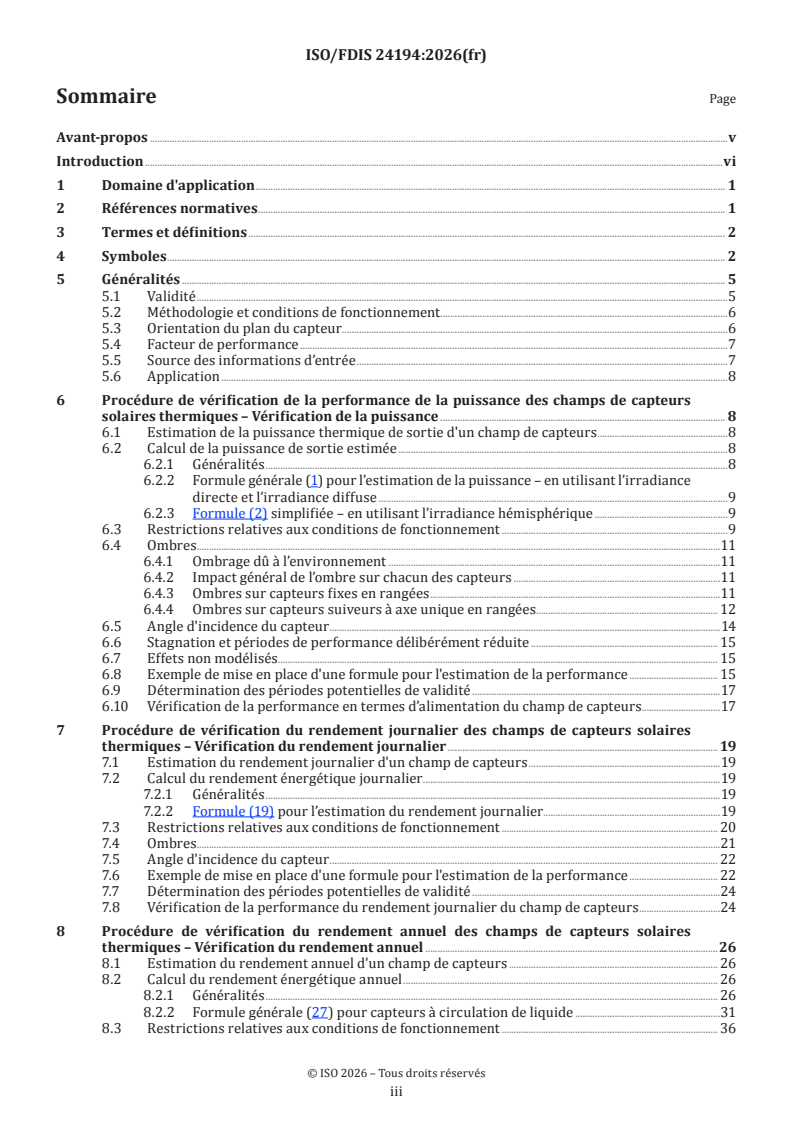
Contents Page
Foreword .v
Introduction .vi
1 Scope . 1
2 Normative references . 1
3 Terms and definitions . 1
4 Symbols . 2
5 General . 5
5.1 Validity .5
5.2 Methodology and operating conditions .6
5.3 Orientation of the collector plane .6
5.4 Performance factor .6
5.5 Source of input information .7
5.6 Application .7
6 Procedure for checking the power performance of solar thermal collector fields –
Power Check . 8
6.1 Stating an estimate for the thermal power output of a collector field .8
6.2 Calculating estimated power output .8
6.2.1 General .8
6.2.2 General Formula (1) for power estimate – using direct and diffuse irradiance .8
6.2.3 Simplified Formula (2) – using hemispherical irradiance.8
6.3 Restrictions on operating conditions .9
6.4 Shadows .10
6.4.1 Shading from the surroundings .10
6.4.2 General shadow impact of collectors on each other .10
6.4.3 Shadows on fixed collectors in rows .11
6.4.4 Shadows on one-axis tracking collectors in row .11
6.5 Collector incidence angle .14
6.6 Stagnation and periods of deliberately reduced performance .14
6.7 Unmodeled Effects .14
6.8 Example of setting up a formula for calculating performance estimate . 15
6.9 Determination of potential valid periods .16
6.10 Checking collector field power performance .16
7 Procedure for checking the daily yield of solar thermal collector fields – Daily Yield
Check .18
7.1 Stating an estimate for the daily yield of a collector field .18
7.2 Calculating daily energy yield . .18
7.2.1 General .18
7.2.2 Formula (19) for daily yield estimate .18
7.3 Restrictions on operating conditions .19
7.4 Shadows . 20
7.5 Collector incidence angle . 20
7.6 Example of setting up a formula for calculating performance estimate .21
7.7 Determination of potential valid periods . 23
7.8 Checking collector field daily yield performance . 23
8 Procedure for checking the annual yield of solar thermal collector fields – Annual Yield
Check .24
8.1 Stating an estimate for the annual yield of a collector field .24
8.2 Calculating annual energy yield .24
8.2.1 General .24
8.2.2 General Formula (27) for liquid heating collectors . 29
8.3 Restrictions on operating conditions . 33
8.4 Shadows . 34
iii
8.4.1 Shading from the surroundings . 34
8.4.2 General shadow impact of collectors on each other . 34
8.5 Switch-off times and power reducing control strategies – planned and unplanned . 34
8.6 Example of setting up a formula for calculating performance estimate . 35
8.7 Determination of potential valid periods . 35
8.8 Checking collector field annual yield performance . 35
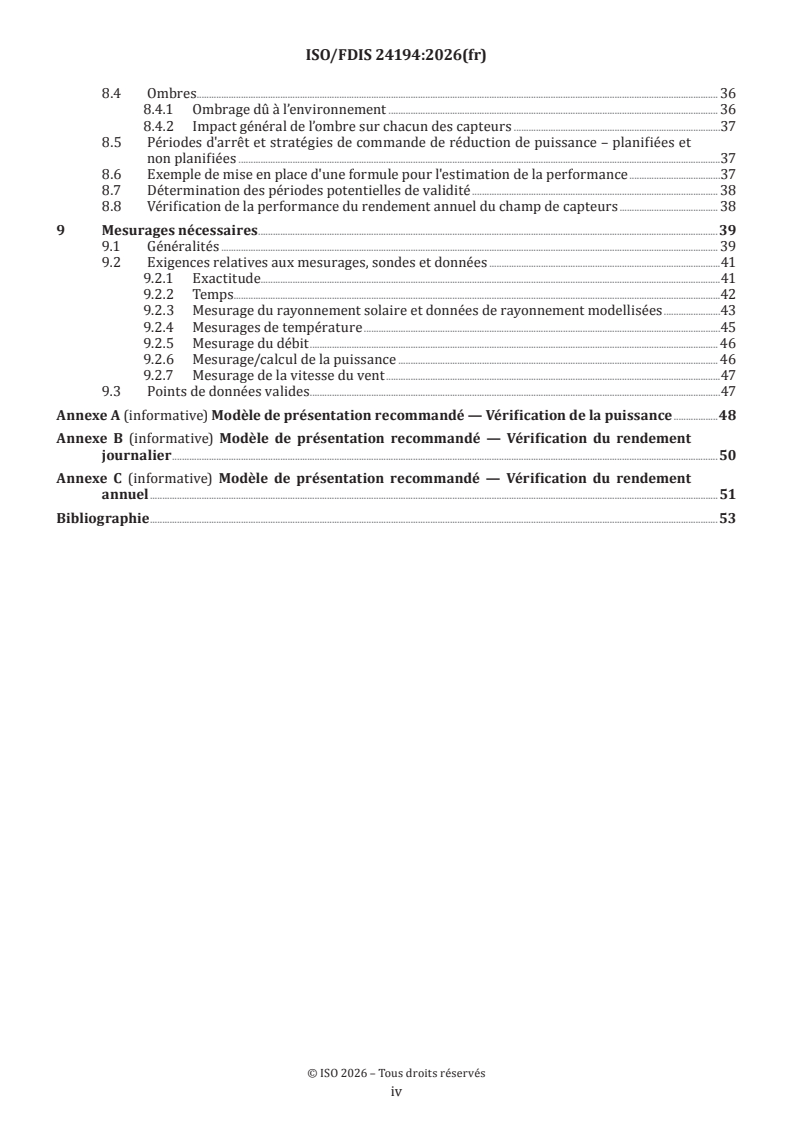
9 Measurements needed.37
9.1 General .37
9.2 Requirements on measurements, sensors and data . 39
9.2.1 Accuracy . 39
9.2.2 Time . 39
9.2.3 Solar radiation measurement and modelled radiation data . 40
9.2.4 Temperature measurements .42
9.2.5 Flow rate measurement .43
9.2.6 Power measurement/calculation .43
9.2.7 Measurement of wind speed . 44
9.3 Valid data points . 44
Annex A (informative) Recommended reporting format — Power Check .45
Annex B (informative) Recommended reporting format — Daily Yield Check . 47
Annex C (informative) Recommended reporting format — Annual Yield Check.48
Bibliography .49
iv
Foreword
ISO (the International Organization for Standardization) is a worldwide federation of national standards
bodies (ISO member bodies). The work of preparing International Standards is normally carried out through
ISO technical committees. Each member body interested in a subject for which a technical committee
has been established has the right to be represented on that committee. International organizations,
governmental and non-governmental, in liaison with ISO, also take part in the work. ISO collaborates closely
with the International Electrotechnical Commission (IEC) on all matters of electrotechnical standardization.
The procedures used to develop this document and those intended for its further maintenance are described
in the ISO/IEC Directives, Part 1. In particular, the different approval criteria needed for the different types
of ISO document should be noted. This document was drafted in accordance with the editorial rules of the
ISO/IEC Directives, Part 2 (see www.iso.org/directives).
ISO draws attention to the possibility that the implementation of this document may involve the use of (a)
patent(s). ISO takes no position concerning the evidence, validity or applicability of any claimed patent
rights in respect thereof. As of the date of publication of this document, ISO had not received notice of (a)
patent(s) which may be required to implement this document. However, implementers are cautioned that
this may not represent the latest information, which may be obtained from the patent database available at
www.iso.org/patents. ISO shall not be held responsible for identifying any or all such patent rights.
Any trade name used in this document is information given for the convenience of users and does not
constitute an endorsement.
For an explanation of the voluntary nature of standards, the meaning of ISO specific terms and expressions
related to conformity assessment, as well as information about ISO's adherence to the World Trade
Organization (WTO) principles in the Technical Barriers to Trade (TBT), see www.iso.org/iso/foreword.html.
This document was prepared by Technical Committee ISO/TC 180, Solar energy, Subcommittee SC 4,
Systems - Thermal performance, reliability and durability, in collaboration with the European Committee
for Standardization (CEN) Technical Committee CEN/TC 312, Thermal solar systems and components, in
accordance with the Agreement on technical cooperation between ISO and CEN (Vienna Agreement).
This second edition cancels and replaces the first edition (ISO 24194:2022), which has been technically
revised. It also incorporates the Amendment ISO 24194:2022/Amd 1:2024.
The main changes are as follows:
— Introduction revised;
— Scope specifies liquid heating collectors;
— Clause 5 added summarizing validity for all 3 procedures, methodology and operating conditions
explained, source of input information described and possible applications mentioned;
— Clause 6: Incorrect formula for direct irradiance deleted and only one general formula according to
ISO 9806 for liquid heating collectors introduced using direct and diffuse irradiance; example with
calculation and result included;
— Clause 7: Daily yield method generalized so that it is applicable for all collectors in the scope; example
with calculation and result included;
— Clause 8: New method for annual yield added that is applicable for all collectors in the scope; example
with calculation and result included;
Any feedback or questions on this document should be directed to the user’s national standards body. A
complete listing of these bodies can be found at www.iso.org/members.html.
v
Introduction
0.1 General
This document specifies procedures for checking the performance of solar thermal collector fields. Measured
performance is compared with calculated performance and conditions for conformity are given.
Three levels for accuracy in the checking can be chosen.
— Level I - giving possibility for giving a very accurate estimate (with low safety retention, e.g. f = 0,95),
U
but with requirements for use of expensive measurement equipment and maintenance.
— Level II/III - allowing for a less accurate estimate (with higher safety retention, e.g. f = 0,90) - but
U
possibility to use less expensive measurement equipment.
0.2 Relevance of solar thermal collector fields in the context of the energy transition and heat supply
Heat accounts for half of the world's total energy consumption - significantly more than electricity (20 %)
and transport (30 %), and heat accounts for more than 40 % of the global energy-related carbon dioxide
emissions. Solar thermal technologies use the sun's energy directly to produce heat that can be used in a
wide range of applications. Solar thermal technologies are therefore key technologies for the reduction of
global carbon dioxide emissions. The core element of any solar thermal system is the solar thermal collector
and is dealt within ISO 9806. This document applies especially to large-scale applications that can generate
large quantities of heat. Solar thermal collector fields have, compared to all other heat generators, the
highest efficiency in converting solar energy into heat and thus they require the least amount of space. Large
solar thermal systems are typically used in the following areas of application.
— District heating with solar fractions from a few percent to 100 % in combination with seasonal storages.
— Industrial processes for food production such as dairies, breweries etc.
— Industrial cleaning processes.
— Chemical processes.
— Desalination.
— Swimming pool heating.
— Solar thermal process heat systems provide heat for industrial processes such as drying, food processing,
pasteurisation, washing, cleaning and all other manufacturing processes at medium temperatures.
— Electricity generation based on heat.
— All other application where heat is needed up to a temperature level of 450 °C.
The achievable temperature level depends on the type of collector used. Today, collectors covered by this
document are available for a temperature range from 25 °C to 450 °C. The heat transfer fluid used in solar
thermal collectors is usually water, water-based antifreeze or silicon oil.
0.3 Application range of this document
This document is currently limited to liquid heating collectors.
This document sets out procedures for checking the thermal power output, daily and annual yield of solar
thermal fields to verify performance expectations.
This document is intended to provide a solid basis for monitoring these fields during the commissioning and
operating phase and over the course of their lifetime, which is typically more than 25 years. It is therefore a
suitable tool to check the influence of soiling and degradation, which can also be linked to increased stresses
caused by climate change, for example.
0.4 Environmental impact of solar thermal systems
vi
As these systems consist mainly of solar collectors, more specific details can be found in ISO 9806. By
checking the performance, this document directly demonstrates energy savings, and by replacing fossil
fuels, also the accompanying greenhouse gas reductions.
The efficiency of converting incoming solar radiation into useful heat can reach > 80 %, depending on
the temperature required and the technology chosen. The annual yield depends significantly on the
geographical location and the use of the collector. The annual energy yield per area is higher with solar
collectors than with any other renewable technology. The yield is considered to be around three times
higher than photovoltaic power generation and 50-100 times higher than for biomass. Given the range of
different products and applications, it is not possible to quantify the greenhouse gas reduction or climate
change mitigation potential of this technology in general terms. The greenhouse gas reduction potential of a
solar thermal collector depends on the application in which it is used and what kind of conventional fuel and
system is replaced.
For the determination of the greenhouse gas reduction of a system in which a solar thermal system is used,
it is recommended to make this quantification using the global warming potential (GWP) for each GHG as
per Table 7.15 of the Intergovernmental Panel on Climate Change (IPCC) Sixth Assessment Report (AR6) by
[1]
aggregating the reduction potential in carbon dioxide equivalents (CO2eq) .
0.5 Supporting the UN Sustainable Development Goals (SDGs)
This document is aligned with the following United Nations Sustainable Development Goals by promoting
and supporting the following.
— Solar thermal collectors and solar thermal technologies to reduce dependence on energy prices to
increase the resilience of humanity to climate-related extreme events and other economic, social and
environmental shocks and disasters (SDG 1.5).
— Solar thermal collectors and solar thermal technologies for water treatment and disinfection to reduce
water-borne diseases (SDG 3.3).
— Solar thermal collectors and solar thermal technologies as a clean and safe energy source to replace other
energy sources, to significantly reduce the number of deaths and illnesses from hazardous chemicals
and polluted air caused by combustion of fossil fuels (SDG 3.9).
— Solar thermal collectors and solar thermal technologies in water purification and desalination facilities
to achieve universal and equitable access to safe and affordable drinking water for all (SDG 6.1).
— Solar thermal collectors and technologies as a key technology in capacity building programmes for water
treatment activities in developing countries (SDG 6.A).
— Solar thermal collectors to ensure access to affordable, reliable and modern energy for all (SDG 7.1).
— Solar thermal collectors to significantly increase the share of renewable energy for all (SDG 7.2).
— Solar thermal collectors in various applications to increase the overall global energy efficiency (SDG 7.3).
— International cooperation in solar thermal technologies to facilitate access to clean energy research
and technology, especially in the fields of renewable energy, energy efficiency and fossil fuel-free
technologies as well as to facilitate investments in solar thermal based energy infrastructure and clean
energy technologies (SDG 7.A).
— Solar thermal collectors to develop infrastructure and technologies for modern and sustainable energy
that is accessible to all in developing countries, in particular least developed countries, small island
developing states and landlocked developing countries, and to provide a sound basis for the development
of appropriate support programmes. (SDG 7.B).
— Solar thermal collectors and technologies as a technology well suited for local production, thereby
achieving higher levels of economic productivity through diversification, technological upgrading and
innovation, including focusing on high value-added and labour-intensive sectors (SDG 8.2).
vii
— Solar thermal collectors and solar thermal technologies as locally manufacturable devices with
low requirements for production technologies and financial investments, to promote and support
productive activities, decent job creation, entrepreneurship, creativity and innovation, and to promote
the formalisation and growth of micro, small and medium-sized enterprises, including through access to
financial services (SDG 8.3).
— Solar thermal collectors and technologies to progressively improve the global resource efficiency of
consumption and production, and to endeavour the decoupling of economic growth from environmental
degradation. (SDG 8.4).
— Solar thermal collectors as part of high quality, reliable, sustainable and resilient infrastructure thereby
supporting the economic development and human well-being, with a focus on affordable and equitable
access for all (SDG 9.1).
— Solar thermal collectors to contribute to the inclusive and sustainable industrialisation and to
significantly increasing the industry's share of employment and gross domestic product, particularly in
least developed countries, in accordance with national circumstances. (SDG 9.2).
— solar thermal collectors as a cost-effective means to increase the availability of energy and the
predictability of energy costs by reducing dependence on fossil energy, and thereby to facilitate the access
of small industrial and other enterprises, particularly in developing countries, to financial services,
including affordable credit, and to integrate these industries into value chains and markets (SDG 9.3).
— Solar thermal collectors to upgrade infrastructure and retrofit industries to make them sustainable,
with increased efficiency in resource use and greater adoption of clean and environmentally sound
technologies and industrial processes (SDG 9.4).
— Scientific research and technological capacity building in the field of solar thermal technologies in
all countries, particularly developing countries, including the promotion of innovation, research and
development activities (SDG 9.5).
— Solar thermal collectors and solar thermal technologies to facilitate sustainable and resilient
infrastructure development in developing countries and to facilitate financial, technological and
technical assistance to African countries, least developed countries, landlocked developing countries
and small island developing states (SDG 9.A).
— Solar thermal collectors as a way to enhance domestic technology development, research and innovation
in developing countries. In addition, the standard supports the development of an enabling policy
environment for solar thermal technologies for industrial diversification and commodity value addition
(SDG 9.B).
— Solar thermal collectors for fossil and biomass free production of heat and hot water to reduce the
adverse per capita environmental impact of cities and in particular by contributing to better air quality.
(SDG 11.6).
— Solar thermal collectors as an element of sustainable and resilient buildings, using local materials and
local production capacity (SDG 11.C).
— Solar thermal collectors for local and affordable thermal food processing to reduce global food waste
and food losses along production and supply chains, including post-harvest losses (SDG 12.3).
— Solar thermal collectors as a product that significantly reduces waste generation through its repairable
designs and through material reduction, the possibility of using recycled materials, and the reuse of
components (SDG 12.5).
— Solar thermal collectors and solar thermal technologies to encourage companies to adopt sustainable
practices and integrate sustainability information into their reporting cycles (SDG 12.6).
— Solar thermal collectors and solar thermal technologies as a locally manufactured technology, using
mainly recycled materials, as part of sustainable public procurement practices. (SDG 12.7)
viii
— Solar thermal collectors and solar thermal technologies to strengthen the technological capacity to move
towards more sustainable patterns of consumption and production, not only in developing countries
(SDG 12.A).
— Subsidy schemes for solar thermal collectors, and thus also the reduction and phasing out of inefficient
fossil fuel subsidies, especially in developing countries, and minimising adverse impacts on their
development in a manner that protects the poor and affected communities (SDG 12.C).
— Solar thermal collectors and solar thermal technologies to reduce the overuse of biomass for heat
generation, thereby also supporting the implementation of sustainable management of all types of
forests, halting deforestation and even enabling afforestation and reforestation worldwide (SDG 15.2).
— The transfer of know-how, dissemination and diffusion of environmentally sound technologies to
developing countries on favourable terms (SDG 17.7).
ix
FINAL DRAFT International Standard ISO/FDIS 24194:2026(en)
Solar energy — Collector fields — Check of performance
1 Scope
This document specifies three procedures to check the performance of solar thermal collector fields. This
document is applicable to most collector types addressed by ISO 9806. This includes glazed liquid heating
flat plate collectors, evacuated tube collectors, and tracking, concentrating collectors. However, certain
limitations apply in comparison to ISO 9806, specifically concerning wind and infrared sensitive collectors
(WISC), hybrid collectors, and air collectors:
— WISC collectors are included only when both wind speed data measured on the collector plane and
longwave radiation data are available.
NOTE Such data is rarely available in practical applications.
— Hybrid collectors (“collectors co-generating thermal and electrical power” in ISO 9806, commonly PVT)
are excluded. The reason is that their thermal performance in real-world operation depends on the
operation of the electrical part: If the electrical part is switched off, limited, or curtailed for any reason,
while the thermal part remains active, this would lead to an overestimation of the thermal power output,
based on performance parameters determined under MPP conditions (maximum electrical power
generation), as specified in ISO 9806.
— Solar air heating collectors (SAHC) are excluded due to the complexity of accurately assessing their
performance: Testing and evaluating SAHC performance is complex, because it requires accounting for
the enthalpy difference in the primary loop. Additionally, their thermal efficiency is highly dependent
on mass flow rate, and their performance is tested at three different air mass flow rates, resulting in
three separate parameter sets. For the ISO 24194 Power Check, this makes it challenging to select the
appropriate parameters for estimating thermal power output.
This document specifies procedures for performance check of the thermal power output of the collector field
as well as on the daily yield and annual yield of the collector field. For the three procedures, this document
specifies how to compare a measured output with the calculated one.
The document is applicable to collector fields of all sizes.
2 Normative references
The following documents are referred to in the text in such a way that some or all of their content constitutes
requirements of this document. For dated references, only the edition cited applies. For undated references,
the latest edition of the referenced document (including any amendments) applies.
ISO 9060, Solar energy — Specification and classification of instruments for measuring hemispherical solar and
direct solar radiation
ISO 9488, Solar energy — Vocabulary
ISO 9806, Solar energy — Solar thermal collectors — Test methods
ISO/TR 9901, Solar energy — Pyranometers — Recommended practice for use
3 Terms and definitions
For the purposes of this document, the terms and definitions given in ISO 9488 apply.
ISO and IEC maintain terminology databases for use in standardization at the following addresses:
— ISO Online browsing platform: available at https:// www .iso .org/ obp
— IEC Electropedia: available at https:// www .electropedia .org/
4 Symbols
A Gross area of collector as defined in ISO 9488 m
G
A Gross area of collector field m
GF
2·
a Heat loss coefficient W/(m K)
2· 2
a Temperature dependence of the heat loss coefficient W/(m K )
3·
a Wind speed dependence of the heat loss coefficient J/(m K)
a Sky temperature dependence of the heat loss coefficient —
2·
a Effective thermal capacity. In some literature and data sheets denoted J/(m K)
C . Note that C unit is kJ/m K.
eff eff
a Wind speed dependence of the zero-loss efficiency s/m
2· 4
a Radiation losses dependence W/(m K )
C Effective thermal capacity of collector J/K
C Geometric concentration ratio —
R
·
c Specific heat capacity of heat transfer fluid J/(kg K)
f
D Gap in between adjacent collectors m
E Longwave irradiance (λ > 3 μm) W/m
L
f Performance factor for cleanliness for the operating time between -
C
two cleanings
f Performance factor taking into account heat losses from pipes etc. in -
P
the collector loop.
f Safety factor taking into account measurement uncertainty. -
U
f Performance factor for other uncertainties e.g. related to non-ideal -
O
conditions such as non-ideal flow distribution and unforeseen heat
losses - and uncertainties in the model/procedure itself.
f Overall performance factor given by the supplier and/or mathemati- -
perf
cal product based on the individual factors f ,f , f , f
C P U O
f Shading factor -
sh
G Hemispherical solar irradiance on a horizontal plane W/m
global
G Hemispherical solar irradiance on the plane of collector W/m
hem
G Direct solar irradiance (beam irradiance) on the plane of collector W/m
b
G Direct normal solar irradiance W/m
bn
G Diffuse solar irradiance on the plane of collector W/m
d
H Annual hemispherical irradiation on a horizontal plane kWh/m
global,a
H Annual hemispherical irradiation on collector plane kWh/m
hem,a
H Daily hemispherical irradiation on collector plane kWh/m
hem,d
H Effective annual irradiation on collector plane during operating hours kWh/m
op,a
H Effective daily irradiation on collector plane during operating hours kWh/m
op,d
H Height of the shaded area m
sh
h Solar altitude angle sin h = cos θ °
Z
h Minimum solar altitude angle °
min
K (θ ,θ ) Incidence angle modifier for hemispherical solar radiation —
hem L T
K (θ ,θ ) Incidence angle modifier for direct solar irradiance —
b L T
K Incidence angle modifier in the longitudinal plane —
θL
K Incidence angle modifier in the transversal plane —
θT
K Incidence angle modifier for diffuse solar radiation —
d
K Daily average incidence angle modifier for hemispherical solar radia- —
hem,av
tion
L Length of a collector (from bottom to top) m
L Overall Length of the pipe system without collectors m
pipe
L Length of the shaded area m
sh
m
Mass flow rate of heat transfer fluid kg/s
N Number of collectors in a row -
c
Coordinate of the point C on the X-axis (C is the point that would reach -
P the shadow formed by the top of the sun facing side of a collector row
X
if it were unobstructed)
P Coordinate of the point C on the y-axis -
Y
Q Annual gross thermal yield kWh/m
GTY
Estimated power output W
Q
estimate
Measured power output W
Q
meas
2 2
q̇Specific measured power output per m collector gross area W/m
meas
Q Daily capacity heat losses of solar thermal system J
cap,d
Q Annual yield estimation of solar thermal system J
estimate,a
Q Daily yield estimation of solar thermal system J
estimate,d
Q̇Daily average gross power output collector field W
estimate-col,d
Q Annual yield measurement of the heat meter J
HM,a
Q Daily yield measurement of the heat meter J
HM,d
Q̇Daily average heat losses of piping W
pipe,d
·
q Empirical specific heat loses per m pipe W/(m K)
l-pipe
S Spacing center to center in between adjacent rows m
T Absolute temperature K
U Fictitious constant heat loss coefficient of the system kWh/K
sys
t Time s
t Time start of measurement s
s
t Time end of measurement s
e
u Surrounding air speed (wind speed) m/s
V Fluid capacity of the collector m
f
V̇ Volumetric flow rate m /s
V Volume of the pipe system without collectors l
pipe
w Width of a collector (from left to right) m
x-axis value of collector operating points as ratio of temperature dif- (m K)/kWh
x
i
ference and irradiation
z Number of days with reduced heat output -
ΔT Temperature difference between fluid outlet and inlet (ϑ - ϑ ) K
e i
β Slope (or tilt), the angle between the plane of the collector and the °
horizontal.
Note: For collectors rotating around a North-South axis, β is positive
in the morning when facing eastwards - and negative in the afternoon
when facing westwards
γ Surface azimuth angle, the deviation of the projection on horizontal °
plane of the normal to the surface from the local meridian, with zero
due south, east negative and west positive
γ Solar azimuth angle, the angular displacement from south of the °
s
projection of direct radiation on the horizontal plan, east negative and
west positive
δ Declination, the angular position of the sun at solar noon with respect °
to the plane of the equator, north positive.
ϕ Latitude, the angular location north or south of the equator, north °
positive
η Annual collector efficiency based on Q and H —
a GTY a
η Collector efficiency based on direct irradiance G —
b b
η Collector efficiency based on hemispherical irradiance G —
hem hem
η Peak collector efficiency (η at ϑ − ϑ = 0 K) based on direct irradi- —
0,b b m a
ance G
b
η Peak collector efficiency (η at ϑ − ϑ = 0 K) based on hemispher- —
0,hem 0,hem m a
ical irradiance G
hem
—
η Collector efficiency, with reference to mass flow m
hem,m i
i
Ω Hour angle, the angular displacement of the sun east or west of the °
local meridian due to rotation of the earth on its axis at 15° per hour;
morning negative, afternoon positive
Θ Angle of incidence °
θ Longitudinal angle of incidence: angle between the normal to the °
L
plane of the collector and incident sunbeam projected into the longi-
tudinal plane
θ Transversal angle of incidence: angle between the normal to the plane °
T
of the collector and incident sunbeam projected into the transversal
plane
θ Zenith angle, the angle between the vertical and the line to the sun, °
Z
that is, the angle of incidence of direct radiation on a horizontal sur-
face. cos θ = sin h
Z
ϑ Ambient air temperature °C
a
ϑ Collector outlet temperature °C
e
ϑ Collector inlet temperature °C
i
ϑ Mean temperature of heat transfer fluid in collector loop °C
m
p Density of heat transfer fluid in primary loop at flow meter position/ kg/m
prim
temperature
ρ Density of heat transfer fluid in secondary loop at flow meter posi- kg/m
sec
tion/temperature
2· 4
σ Stefan-Boltzmann constant W/(m K )
5 General
5.1 Validity
The procedures described in this document can only be applied if the thermal performance of the collector
has been tested in accordance with ISO 9806 and modelled with the corresponding collector parameters.
The typical operating temperature of the system for the check shall be within the valid range. This means
that the operating temperature shall be in a range above measured ambient air temperature –10 K and below
the resulting temperature of measured ambient air temperature and the maximum temperature difference
between the collector and the ambient air during the collector test +30 K.
NOTE The wind related parameters a , a and the infrared related parameter a are included in the procedure
3 6 4
for checking the power performance. It is assumed that the procedure can also be applied to these types of collectors
and the aim is to provide an opportunity to gain experience. However, this requires additional measurements not
described in this document.
The supplier may impose other conditions that shall be met in order to achieve valid results, e.g. regular
cleaning or maintenance procedures.
The procedures can also be applied to fields of combined collector types - e.g. single glazed and double-
glazed:
— if size, inlet and outlet temperatures are available for each field of collectors of same type, estimates can
be given for each of these fields;
— an overall estimate for a combination of fields with two or more similar collector types can be given
choosing a representative set of collector parameters and, if applicable, an area-weighted average
orientation for the whole field. Collector types are similar if they have the same design (flat plate,
evacuated tube, parabolic trough etc.) and the difference between their Q in the reference climate
GT
...
ISO/TC 180/SC 4
Secretariat: SAC
Date: 2025-12-142026-02-20
Solar energy — Collector fields — Check of performance
Energie solaire — Champs de capteurs — Vérification de la performance
FDIS stage
TThhiis s drdraafftt i is s susubbmmiitttteed d ttoo aa ppaarraallellel l vvoottee i inn IISSOO,, CCEEN.N.
All rights reserved. Unless otherwise specified, or required in the context of its implementation, no part of this publication
may be reproduced or utilized otherwise in any form or by any means, electronic or mechanical, including photocopying,
or posting on the internet or an intranet, without prior written permission. Permission can be requested from either ISO
at the address below or ISO’s member body in the country of the requester.
ISO copyright office
CP 401 • Ch. de Blandonnet 8
CH-1214 Vernier, Geneva
Phone: + 41 22 749 01 11
EmailE-mail: copyright@iso.org
Website: www.iso.orgwww.iso.org
Published in Switzerland
ii
Contents
Foreword . iv
Introduction . vi
1 Scope . 1
2 Normative references . 1
3 Terms and definitions . 2
4 Symbols . 2
5 General . 5
6 Procedure for checking the power performance of solar thermal collector fields – Power
Check . 7
7 Procedure for checking the daily yield of solar thermal collector fields – Daily Yield
Check . 20
8 Procedure for checking the annual yield of solar thermal collector fields – Annual Yield
Check . 30
9 Measurements needed . 43
Annex A (informative) Recommended reporting format — Power Check . 54
Annex B (informative) Recommended reporting format — Daily Yield Check . 57
Annex C (informative) Recommended reporting format — Annual Yield Check . 59
Bibliography . 61
iii
Foreword
ISO (the International Organization for Standardization) is a worldwide federation of national standards
bodies (ISO member bodies). The work of preparing International Standards is normally carried out through
ISO technical committees. Each member body interested in a subject for which a technical committee has been
established has the right to be represented on that committee. International organizations, governmental and
non-governmental, in liaison with ISO, also take part in the work. ISO collaborates closely with the
International Electrotechnical Commission (IEC) on all matters of electrotechnical standardization.
The procedures used to develop this document and those intended for its further maintenance are described
in the ISO/IEC Directives, Part 1. In particular, the different approval criteria needed for the different types of
ISO document should be noted. This document was drafted in accordance with the editorial rules of the
ISO/IEC Directives, Part 2 (see www.iso.org/directives).
ISO draws attention to the possibility that the implementation of this document may involve the use of (a)
patent(s). ISO takes no position concerning the evidence, validity or applicability of any claimed patent rights
in respect thereof. As of the date of publication of this document, ISO had not received notice of (a) patent(s)
which may be required to implement this document. However, implementers are cautioned that this may not
represent the latest information, which may be obtained from the patent database available at
www.iso.org/patents.www.iso.org/patents. ISO shall not be held responsible for identifying any or all such
patent rights.
Any trade name used in this document is information given for the convenience of users and does not
constitute an endorsement.
For an explanation of the voluntary nature of standards, the meaning of ISO specific terms and expressions
related to conformity assessment, as well as information about ISO's adherence to the World Trade
Organization (WTO) principles in the Technical Barriers to Trade (TBT), see
www.iso.org/iso/foreword.htmlwww.iso.org/iso/foreword.html.
This document was prepared by Technical Committee ISO/TC 180, Solar energy, Subcommittee SC 4, Systems
- Thermal performance, reliability and durability.,, in collaboration with the European Committee for
Standardization (CEN) Technical Committee CEN/TC 312, Thermal solar systems and components, in
accordance with the Agreement on technical cooperation between ISO and CEN (Vienna Agreement).
This second edition cancels and replaces the first edition (ISO 24194:2022), which has been technically
revised. It also incorporates the Amendment ISO 24194:2022/Amd 1:2024.
The main changes are as follows:
— — Introduction revised;
— — Scope specifies liquid heating collectors;
— — Clause 55 added summarizing validity for all 3 procedures, methodology and operating conditions
explained, source of input information described and possible applications mentioned;
— — Clause 6:6: Incorrect formula for direct irradiance deleted and only one general formula according to
ISO 9806 for liquid heating collectors introduced using direct and diffuse irradiance; example with
calculation and result included;
— — Clause 7:7: Daily yield method generalized so that it is applicable for all collectors in the scope;
example with calculation and result included;
iv
— — Clause 8:8: New method for annual yield added that is applicable for all collectors in the scope;
example with calculation and result included;
Any feedback or questions on this document should be directed to the user’s national standards body. A
complete listing of these bodies can be found at www.iso.org/members.html.
v
Introduction
0.1 0.1 General
This document specifies procedures for checking the performance of solar thermal collector fields. Measured
performance is compared with calculated performance - and conditions for conformity are given.
Three levels for accuracy in the checking can be chosen.
— — Level I - giving possibility for giving a very accurate estimate (with low safety retention, e.g. f = 0,95),
U
but with requirements for use of expensive measurement equipment and maintenance.
— — Level II/III - allowing for a less accurate estimate (with higher safety retention, e.g. fU = 0,90) - but
possibility to use less expensive measurement equipment.
0.2 0.2 Relevance of solar thermal collector fields in the context of the energy transition and
heat supply
Heat accounts for half of the world's total energy consumption - significantly more than electricity (20 %) and
transport (30 %), and heat accounts for more than 40 % of the global energy-related carbon dioxide emissions.
Solar thermal technologies use the sun's energy directly to produce heat that can be used in a wide range of
applications. Solar thermal technologies are therefore key technologies for the reduction of global carbon
dioxide emissions. The core element of any solar thermal system is the solar thermal collector and is dealt
within ISO 9806. This document applies especially to large-scale applications that can generate large
quantities of heat. Solar thermal collector fields have, compared to all other heat generators, the highest
efficiency in converting solar energy into heat and thus they require the least amount of space. Large solar
thermal systems are typically used in the following areas of application.
— — District heating with solar fractions from a few percent to 100 % in combination with seasonal
storages.
— — Industrial processes for food production such as dairies, breweries etc.
— — Industrial cleaning processes.
— — Chemical processes.
— — Desalination.
— — Swimming pool heating.
— — Solar thermal process heat systems provide heat for industrial processes such as drying, food
processing, pasteurisation, washing, cleaning and all other manufacturing processes at medium
temperatures.
— — Electricity generation based on heat.
— — All other application where heat is needed up to a temperature level of 450 °C.
The achievable temperature level depends on the type of collector used. Today, collectors covered by this
document are available for a temperature range from 25 °C to 450 °C. The heat transfer fluid used in solar
thermal collectors is usually water, water-based antifreeze or silicon oil.
vi
0.3 0.3 Application range of this document
This document is currently limited to liquid heating collectors.
This document sets out procedures for checking the thermal power output, daily and annual yield of solar
thermal fields to verify performance expectations.
This document is intended to provide a solid basis for monitoring these fields during the commissioning and
operating phase and over the course of their lifetime, which is typically more than 25 years. It is therefore a
suitable tool to check the influence of soiling and degradation, which can also be linked to increased stresses
caused by climate change, for example.
0.4 0.4 Environmental impact of solar thermal systems
As these systems consist mainly of solar collectors, more specific details can be found in ISO 9806. By checking
the performance, this document directly demonstrates energy savings, and by replacing fossil fuels, also the
accompanying greenhouse gas reductions.
The efficiency of converting incoming solar radiation into useful heat can reach > 80 %, depending on the
temperature required and the technology chosen. The annual yield depends very muchsignificantly on the
geographical location and the use of the collector. Certainly, The annual energy yield per area is higher with
solar collectors than with any other renewable technology. The yield is considered to be around three times
higher than photovoltaic power generation and 50-100 times higher than for biomass. Given the range of
different products and applications, it is not possible to quantify the greenhouse gas reduction or climate
change mitigation potential of this technology in general terms. The greenhouse gas reduction potential of a
solar thermal collector depends on the application in which it is used and what kind of conventional fuel and
system is replaced.
For the determination of the greenhouse gas reduction of a system in which a solar thermal system is used, it
is recommended to make this quantification using the global warming potential (GWP) for each GHG as per
Table 7.15 of the Intergovernmental Panel on Climate Change (IPCC) Sixth Assessment Report (AR6) by
[1]
aggregating the reduction potential in carbon dioxide equivalents (CO2eq) .[1].
0.5 0.5 Supporting the UN Sustainable Development Goals (SDGs)
This document is aligned with the following United Nations Sustainable Development Goals by promoting and
supporting the following.
— — Solar thermal collectors and solar thermal technologies to reduce dependence on energy prices to
increase the resilience of humanity to climate-related extreme events and other economic, social and
environmental shocks and disasters (SDG 1.5).
— — Solar thermal collectors and solar thermal technologies for water treatment and disinfection to reduce
water-borne diseases (SDG 3.3).
— — Solar thermal collectors and solar thermal technologies as a clean and safe energy source to replace
other energy sources, to significantly reduce the number of deaths and illnesses from hazardous chemicals
and polluted air caused by combustion of fossil fuels (SDG 3.9).
— — Solar thermal collectors and solar thermal technologies in water purification and desalination facilities
to achieve universal and equitable access to safe and affordable drinking water for all (SDG 6.1).
— — Solar thermal collectors and technologies as a key technology in capacity building programmes for
water treatment activities in developing countries (SDG 6.A).
vii
— — Solar thermal collectors to ensure access to affordable, reliable and modern energy for all (SDG 7.1).
— — Solar thermal collectors to significantly increase the share of renewable energy for all (SDG 7.2).
— — Solar thermal collectors in various applications to increase the overall global energy efficiency (SDG
7.3).
— — International cooperation in solar thermal technologies to facilitate access to clean energy research
and technology, especially in the fields of renewable energy, energy efficiency and fossil fuel-free
technologies as well as to facilitate investments in solar thermal based energy infrastructure and clean
energy technologies (SDG 7.A).
— — Solar thermal collectors to develop infrastructure and technologies for modern and sustainable energy
that is accessible to all in developing countries, in particular least developed countries, small island
developing states and landlocked developing countries, and to provide a sound basis for the development
of appropriate support programmes. (SDG 7.B).
— — Solar thermal collectors and technologies as a technology well suited for local production, thereby
achieving higher levels of economic productivity through diversification, technological upgrading and
innovation, including focusing on high value-added and labour-intensive sectors (SDG 8.2).
— — Solar thermal collectors and solar thermal technologies as locally manufacturable devices with low
requirements for production technologies and financial investments, to promote and support productive
activities, decent job creation, entrepreneurship, creativity and innovation, and to promote the
formalisation and growth of micro, small and medium-sized enterprises, including through access to
financial services (SDG 8.3).
— — Solar thermal collectors and technologies to progressively improve the global resource efficiency of
consumption and production, and to endeavour the decoupling of economic growth from environmental
degradation. (SDG 8.4).
— — Solar thermal collectors as part of high quality, reliable, sustainable and resilient infrastructure
thereby supporting the economic development and human well-being, with a focus on affordable and
equitable access for all (SDG 9.1).
— — Solar thermal collectors to contribute to the inclusive and sustainable industrialisation and to
significantly increasing the industry's share of employment and gross domestic product, particularly in
least developed countries, in accordance with national circumstances. (SDG 9.2).
— — solar thermal collectors as a cost-effective means to increase the availability of energy and the
predictability of energy costs by reducing dependence on fossil energy, and thereby to facilitate the access
of small industrial and other enterprises, particularly in developing countries, to financial services,
including affordable credit, and to integrate these industries into value chains and markets (SDG 9.3).
— — Solar thermal collectors to upgrade infrastructure and retrofit industries to make them sustainable,
with increased efficiency in resource use and greater adoption of clean and environmentally sound
technologies and industrial processes (SDG 9.4).
— — Scientific research and technological capacity building in the field of solar thermal technologies in all
countries, particularly developing countries, including the promotion of innovation, research and
development activities (SDG 9.5).
— — Solar thermal collectors and solar thermal technologies to facilitate sustainable and resilient
infrastructure development in developing countries and to facilitate financial, technological and technical
viii
assistance to African countries, least developed countries, landlocked developing countries and small
island developing states (SDG 9.A).
— — Solar thermal collectors as a way to enhance domestic technology development, research and
innovation in developing countries. In addition, the standard supports the development of an enabling
policy environment for solar thermal technologies for industrial diversification and commodity value
addition (SDG 9.B).
— — Solar thermal collectors for fossil and biomass free production of heat and hot water to reduce the
adverse per capita environmental impact of cities and in particular by contributing to better air quality.
(SDG 11.6).
— — Solar thermal collectors as an element of sustainable and resilient buildings, using local materials and
local production capacity (SDG 11.C).
— — Solar thermal collectors for local and affordable thermal food processing to reduce global food waste
and food losses along production and supply chains, including post-harvest losses (SDG 12.3).
— — Solar thermal collectors as a product that significantly reduces waste generation through its repairable
designs and through material reduction, the possibility of using recycled materials, and the reuse of
components (SDG 12.5).
— — Solar thermal collectors and solar thermal technologies to encourage companies to adopt sustainable
practices and integrate sustainability information into their reporting cycles (SDG 12.6).
— — Solar thermal collectors and solar thermal technologies as a locally manufactured technology, using
mainly recycled materials, as part of sustainable public procurement practices. (SDG 12.7)
— — Solar thermal collectors and solar thermal technologies to strengthen the technological capacity to
move towards more sustainable patterns of consumption and production, not only in developing countries
(SDG 12.A).
— — Subsidy schemes for solar thermal collectors, and thus also the reduction and phasing out of inefficient
fossil fuel subsidies, especially in developing countries, and minimising adverse impacts on their
development in a manner that protects the poor and affected communities (SDG 12.C).
— — Solar thermal collectors and solar thermal technologies to reduce the overuse of biomass for heat
generation, thereby also supporting the implementation of sustainable management of all types of forests,
halting deforestation and even enabling afforestation and reforestation worldwide (SDG 15.2).
— — The transfer of know-how, dissemination and diffusion of environmentally sound technologies to
developing countries on favourable terms (SDG 17.7).
ix
DRAFT International Standard ISO/DIS 24194:2025(en)
Solar energy — Collector fields — Check of performance
1 Scope
This document specifies three procedures to check the performance of solar thermal collector fields. This
document is applicable to most collector types addressed by ISO 9806. This includes glazed liquid heating flat
plate collectors, evacuated tube collectors, and tracking, concentrating collectors. However, certain limitations
apply in comparison to ISO 9806, specifically concerning wind and infrared sensitive collectors (WISC), hybrid
collectors, and air collectors:
— — WISC collectors are included only when both wind speed data measured on the collector plane and
longwave radiation data are available. Note that such data is rarely available in practical applications.
— NOTE Such data is rarely available in practical applications.
— Hybrid collectors (“collectors co-generating thermal and electrical power” in ISO 9806, commonly PVT)
are excluded. The reason is that their thermal performance in real-world operation depends on the
operation of the electrical part: If the electrical part is switched off, limited, or curtailed for any reason,
while the thermal part remains active, this would lead to an overestimation of the thermal power output,
based on performance parameters determined under MPP conditions (maximum electrical power
generation), as specified in ISO 9806.
— — Solar air heating collectors (SAHC) are excluded due to the complexity of accurately assessing their
performance: Testing and evaluating SAHC performance is complex, because it requires accounting for the
enthalpy difference in the primary loop. Additionally, their thermal efficiency is highly dependent on mass
flow rate, and their performance is tested at three different air mass flow rates, resulting in three separate
parameter sets. For the ISO 24194 Power Check, this makes it challenging to select the appropriate
parameters for estimating thermal power output.
TheThis document specifies procedures for performance check can be done onof the thermal power output of
the collector field as well as on the daily yield and annual yield of the collector field. For the three procedures,
this document specifies how to compare a measured output with the calculated one.
The document is applicable to all sizes of collector fields of all sizes.
2 Normative references
The following documents are referred to in the text in such a way that some or all of their content constitutes
requirements of this document. For dated references, only the edition cited applies. For undated references,
the latest edition of the referenced document (including any amendments) applies.
ISO 9060, Solar energy — Specification and classification of instruments for measuring hemispherical solar and
direct solar radiation
ISO 9488, Solar energy — Vocabulary
ISO 9806, Solar energy — Solar thermal collectors — Test methods
ISO/TR 9901, Solar energy — Pyranometers — Recommended practice for use
3 Terms and definitions
For the purposes of this document, the terms and definitions given in ISO 9488 apply.
ISO and IEC maintain terminology databases for use in standardization at the following addresses:
— — ISO Online browsing platform: available at https://www.iso.org/obphttps://www.iso.org/obp
— — IEC Electropedia: available at https://www.electropedia.org/https://www.electropedia.org/
4 Symbols
A Gross area of collector as defined in ISO 9488 m
G
A Gross area of collector field m
GF
2·
a Heat loss coefficient W/(m K)
2· 2
a2 Temperature dependence of the heat loss coefficient W/(m K )
3·
a Wind speed dependence of the heat loss coefficient J/(m K)
a Sky temperature dependence of the heat loss coefficient —
2·
a Effective thermal capacity. In some literature and data sheets denoted J/(m K)
C . Note that C unit is kJ/m K.
eff eff
a Wind speed dependence of the zero-loss efficiency s/m
2· 4
a8 Radiation losses dependence W/(m K )
C Effective thermal capacity of collector J/K
C Geometric concentration ratio —
R
·
c Specific heat capacity of heat transfer fluid J/(kg K)
f
D Gap in between adjacent collectors m
E Longwave irradiance (λ > 3 μm) W/m
L
f Performance factor for cleanliness for the operating time between two -
C
cleanings
f Performance factor taking into account heat losses from pipes etc. in -
P
the collector loop.
f Safety factor taking into account measurement uncertainty. -
U
f Performance factor for other uncertainties e.g. related to non-ideal -
O
conditions such as non-ideal flow distribution and unforeseen heat
losses - and uncertainties in the model/procedure itself.
f Overall performance factor given by the supplier and/or mathematical -
perf
product based on the individual factors f , f , f , f
C P U O
fsh Shading factor -
G Hemispherical solar irradiance on a horizontal plane W/m
global
G Hemispherical solar irradiance on the plane of collector W/m
hem
G Direct solar irradiance (beam irradiance) on the plane of collector W/m
b
ISO/DISFDIS 24194:20252026(en)
G Direct normal solar irradiance W/m
bn
G Diffuse solar irradiance on the plane of collector W/m
d
Hglobal,a Annual hemispherical irradiation on a horizontal plane kWh/m
H Annual hemispherical irradiation on collector plane kWh/m
hem,a
H Daily hemispherical irradiation on collector plane kWh/m
hem,d
H Effective annual irradiation on collector plane during operating hours kWh/m
op,a
Hop,d Effective daily irradiation on collector plane during operating hours kWh/m
H Height of the shaded area m
sh
h Solar altitude angle sin h = cos θ °
Z
h Minimum solar altitude angle °
min
K (θ ,θ ) Incidence angle modifier for hemispherical solar radiation —
hem L T
K (θ ,θ ) Incidence angle modifier for direct solar irradiance —
b L T
K Incidence angle modifier in the longitudinal plane —
θL
KθT Incidence angle modifier in the transversal plane —
K Incidence angle modifier for diffuse solar radiation —
d
K Daily average incidence angle modifier for hemispherical solar —
hem,av
radiation
L Length of a collector (from bottom to top) m
L Overall Length of the pipe system without collectors m
pipe
Lsh Length of the shaded area m
kg/s
Mass flow rate of heat transfer fluid
m𝑚𝑚˙
Nc Number of collectors in a row -
Coordinate of the point C on the X-axis (C is the point that would reach -
PX the shadow formed by the top of the sun facing side of a collector row
if it were unobstructed)
P Coordinate of the point C on the y-axis -
Y
QGTY Annual gross thermal yield kWh/m
˙
W
Q𝑄𝑄estimate Estimated power output
˙
Q𝑄𝑄 Measured power output W
meas
2 2
q̇ Specific measured power output per m collector gross area W/m
meas
Qcap,d Daily capacity heat losses of solar thermal system J
Q Annual yield estimation of solar thermal system J
estimate,a
Q Daily yield estimation of solar thermal system J
estimate,d
Q� estimate-col,d Daily average gross power output collector field W
Q Annual yield measurement of the heat meter J
HM,a
Q Daily yield measurement of the heat meter J
HM,d
Q� Daily average heat losses of piping W
pipe,d
·
q Empirical specific heat loses per m pipe W/(m K)
l-pipe
S Spacing center to center in between adjacent rows m
T Absolute temperature K
U Fictitious constant heat loss coefficient of the system kWh/K
sys
t Time s
t Time start of measurement s
s
t Time end of measurement s
e
u Surrounding air speed (wind speed) m/s
Vf Fluid capacity of the collector m
V� Volumetric flow rate m /s
V Volume of the pipe system without collectors l
pipe
w Width of a collector (from left to right) m
x-axis value of collector operating points as ratio of temperature (m K)/kWh
x
i
difference and irradiation
z Number of days with reduced heat output -
ΔT Temperature difference between fluid outlet and inlet (ϑ - ϑ ) K
e i
β Slope (or tilt), the angle between the plane of the collector and the °
horizontal.
Note: For collectors rotating around a North-South axis, β is positive in
the morning when facing eastwards - and negative in the afternoon
when facing westwards
Surface azimuth angle, the deviation of the projection on horizontal
γ °
plane of the normal to the surface from the local meridian, with zero
due south, east negative and west positive
γ Solar azimuth angle, the angular displacement from south of the °
s
projection of direct radiation on the horizontal plan, east negative and
west positive
δ Declination, the angular position of the sun at solar noon with respect °
to the plane of the equator, north positive.
ϕ Latitude, the angular location north or south of the equator, north °
positive
ηa Annual collector efficiency based on QGTY and Ha —
η Collector efficiency based on direct irradiance G —
b b
η Collector efficiency based on hemispherical irradiance G —
hem hem
η Peak collector efficiency (η at ϑ − ϑ = 0 K) based on direct irradiance —
0,b b m a
G
b
η Peak collector efficiency (η at ϑ − ϑ = 0 K) based on —
0,hem 0,hem m a
hemispherical irradiance G
hem
𝜂𝜂 —
η ˙ Collector efficiency, with reference to mass flow m𝑚𝑚˙
ℎ𝑒𝑒𝑒𝑒,𝑒𝑒 𝑖𝑖
hem ,m 𝑖𝑖 i
i
ISO/DISFDIS 24194:20252026(en)
Ω Hour angle, the angular displacement of the sun east or west of the °
local meridian due to rotation of the earth on its axis at 15° per hour;
morning negative, afternoon positive
Θ Angle of incidence °
θ Longitudinal angle of incidence: angle between the normal to the plane °
L
of the collector and incident sunbeam projected into the longitudinal
plane
θ Transversal angle of incidence: angle between the normal to the plane °
T
of the collector and incident sunbeam projected into the transversal
plane
θ Zenith angle, the angle between the vertical and the line to the sun, °
Z
that is, the angle of incidence of direct radiation on a horizontal
surface. cos θ = sin h
Z
ϑ Ambient air temperature °C
a
ϑe Collector outlet temperature °C
ϑ Collector inlet temperature °C
i
ϑ Mean temperature of heat transfer fluid in collector loop °C
m
pprim Density of heat transfer fluid in primary loop at flow meter kg/m
position/temperature
ρ Density of heat transfer fluid in secondary loop at flow meter kg/m
sec
position/temperature
2· 4
σ Stefan-Boltzmann constant W/(m K )
5 General
5.1 Validity
The procedures described in this document can only be applied if the thermal performance of the collector
has been tested in accordance with ISO 9806 and modelled with the corresponding collector parameters. The
typical operating temperature of the system for the check shall be within the valid range. This means that the
operating temperature shall be in a range above measured ambient air temperature –10 K and below the
resulting temperature of measured ambient air temperature and the maximum temperature difference
between the collector and the ambient air during the collector test +30 K.
NOTE The wind related parameters a3, a6 and the infrared related parameter a4 are included in the procedure for
checking the power performance. It is assumed that the procedure can also be applied to these types of collectors and
the aim is to provide an opportunity to gain experience. However, this requires additional measurements not described
in this document.
The supplier may impose other conditions that shall be met in order to achieve valid results, e.g. regular
cleaning or maintenance procedures.
The procedures can also be applied to fields of combined collector types - e.g. single glazed and double-glazed:
— — if size, inlet and outlet temperatures are available for each field of collectors of same type, estimates
can be given for each of these fields;
— — an overall estimate for a combination of fields with two or more similar collector types can be given
choosing a representative set of collector parameters and, if applicable, an area-weighted average
orientation for the whole field. Collector types are similar if they have the same design (flat plate,
evacuated tube, parabolic trough etc.) and the difference between their QGTY in the reference climate zone
or at the site under typical operating conditions shall be less than 20 %. For a combination of fields with
similar orientation, the maximum deviation from the average orientation shall be ±10° in azimuth and tilt.
5.2 Methodology and operating conditions
The power and daily yield checks refer to typical blue sky operating conditions using the modelling of the ISO
9806 multiplied by a performance factor and additionally limited by the given restrictions.
The annual yield check is a correlation method based on the QGTY and its derived curve of the annual efficiency
of the collector and the nominal yield, which then results in a nominal efficiency curve. Multiplied by a
performance factor, the estimated annual efficiency curve is created for different weather and operating
conditions. To ensure that the correlation is valid for different conditions, only the effective irradiation in
collector plane that can be used by the collector shall be taken into account. Generally, this means that only
the share of diffuse irradiation multiplied with the incidence angle modifier for diffuse radiation Kd shall be
taken into account. With highly concentrating tracking collectors, for example, the effective irradiation is only
the direct radiation. The annual yield check includes all regular operating conditions including planned
switch-off and stagnation times as well as times of reduced power by control strategies. To take this into
account, the effective irradiation shall be reduced so that this part of the irradiation which is not used has no
influence on the efficiency. However, the effective irradiation shall not be reduced if the reason for reduced
yields or system outages is due to faulty behaviour of the solar system. The range of application is limited by
additional given restrictions.
5.3 Orientation of the collector plane
The orientation of the collectors – azimuth ϒ and tilt β – influences the irradiation in the collector plane and
thus the collector power. While the influence of small deviations is minor in the case of non-concentrating
collectors and fixed orientation, the accuracy of the orientation towards the sun plays a decisive role in the
case of tracking collectors and with increasing concentration. The estimated value for the performance check
shall always be calculated using the actual measured azimuth of the tracking axis to true north and the
corresponding optimal tilt. This applies in particular to the tracking axis of linear concentrating collectors such
as parabolic troughs. It is strongly recommended to compare the measured azimuth of the axis with the
azimuth used to track the collector field. If deviations > ± 0,5° occur, e.g. caused by differences between true
and grid north, incorrect settings in the controller can lead to power reductions, even if the tracker itself is
working accurately. An indication of this error is when the measured power over a day shows a significantly
different behaviour than the estimated curve but meets the curve once or twice a day.
5.4 Performance factor
The performance factor combines multiple sources of uncertainty, including optical losses and additional heat
losses beyond those taken into account, non-ideal conditions, measurement uncertainty etc. The effect of
measurement uncertainty on the estimated power output can, in principle, be modelled in detail, by applying
[2]
GUM [2] uncertainty quantification methods, using documented uncertainty information for each sensor and
the measurement chain. Specific comments on documenting relevant measurement chain information are
given in 9.2.1.9.2.1. The higher the performance factor, the closer the estimate is to the optimal conditions.
The following approach can be helpful in determining the performance factor.
The performance factor f can be divided into factors considering specific influences. As an example, f
perf perf
could be calculated from f = f ·f · f · f , where
perf C P U O
fC is the performance factor for cleanliness for the operating time between two cleanings. If regular
cleaning is mandatory and is only carried out from time to time, a dynamic performance factor
can be used e.g.: f = max (1-r·d, f ) where r is the daily reduction
c C,min
(e.g. 1%/d ≙ r = 0,01/d), d the number of days after cleaning and fC,min is the expected minimum
performance factor for cleanliness without cleaning. If cleaning is a continuous process, a
ISO/DISFDIS 24194:20252026(en)
constant average performance factor can be calculated with the same formula inserting
d = 0,5 x number of days per cleaning cycle period. For the annual yield method a constant
average factor shall be included in f ;
perf
is the performance factor considering heat losses from pipes etc. in the collector loop. To be
fP
estimated based on an evaluation of the pipe losses (e.g. by Formula (23));by 0);
fU is the safety factor considering measurement uncertainty. To be estimated - with the
requirements given in 9.2,9.2, a factor range of 0,93–0,98 (level I), 0,90-0,95 (level II) and 0,85-
0,90 (III) can be used – or detailed documentation for the uncertainty calculation is required
according to ISO/IEC Guide 98-3;
f is the performance factor for other uncertainties e.g. related to non-ideal conditions such as:
O
— non-ideal flow distribution. To be estimated - should be close to 1;
— unforeseen heat losses. To be estimated - should be close to 1;
— uncertainties in the model/procedure itself. To be estimated - should be close to 1.
f is the combined performance factor: f = f · f · f · f .
perf perf C P U O.
5.5 Source of input information
The methods work with results from independent tests, e.g. the collector parameters from ISO 9806, which
are then linked with empirical formulae and supplier information. The procedures may use measurement data
from controls, logging systems, heat meters and preferably qualified radiation data from independent sources,
as radiation measurement has the greatest influence on the error rate. Basically, the aim is to minimize
possible sources of error and to obtain results that are as reliable as possible, e.g. when determining the annual
irradiation sum.
The contribution of suppliers is essential as they know the performance of their system best. Therefore, they
shall specify individual performance factors and provide a nominal annual yield taking into account all
boundary conditions, which may be confidential. If an operating schedule, planned switch-off and stagnation
times as well as control strategies to reduce the heat input into the connected system are part of the design
for the nominal yield, the effective annual reference irradiation shall be reduced. The supplier shall either
provide the information to calculate this reduction or provide the value himself. If the solar thermal system
causes a reduction in yield, e.g. due to a faulty control strategy, although the connected consumer would have
allowed a heat feed-in, this is considered to be faulty operation. Effective irradiation under faulty operation
shall not be deducted.
5.6 Application
The procedures are primarily intended for operators of solar energy systems to check the performance of the
system in practical operation. The performance and daily yield test can be used, for example, to define
acceptance criteria when commissioning a system. The Annual Yield Check can be used to estimate the annual
yield under varying weather conditions and system states. The methods also enable continuous monitoring in
order to detect problems at an early stage and also over the entire service life, such as increasing soiling of the
system or errors in the system supplied with solar heat.
6 Procedure for checking the power performance of solar thermal collector fields –
Power Check
6.1 Stating an estimate for the thermal power output of a collector field
The estimated power output of the collector field is given as a formula depending on collector parameters
according to ISO 9806, operating conditions and a performance factor f . The measured power shall match
perf
or exceed the corresponding calculated power according to this formula. Measured and calculated power are
only compared under some specific conditions to avoid too large uncertainties - see 6.3.6.3.
The performance factor f <1 is chosen by the supplier considering potential influences from soiling, pipe
perf
heat loss, measurement uncertainties, model uncertainties etc. which are reducing the performance and shall
be specified with an accuracy of 2 digits. In Annex A,In Annex A, a template for stating the performance
estimate is given. All the collector parameters and factors applied shall be indicated in the reporting sheet as
well as the level of accuracy (see Introduction and 9.2)9.2)
6.2 Calculating estimated power output
6.2.1 General
The basis for the calculation is the formula for the power output per collector as defined in the ISO 9806:2025,
Formula (A.1). The estimated thermal output is then determined by multiplying the calculated power with a
performance factor.
This formula can be simplified for collectors with an incidence angle modifier for diffuse solar radiation
Kd ≥ 0,8, e.g. collectors with a low concentration ratio CR ≤ 1,25. In these cases, it is not necessary to
differentiate between direct and diffuse irradiance. It is sufficient to measure the hemispherical irradiance.
The estimate is given by stating the formula to be used for calculating the power output, including specific
values for the parameters in the formula. All parameters which have been identified for a certain collector
shall be used. The two possible formulae – general Formula (1)0 and simplified Formula (2)0 - are given in
6.2.26.2.2 and 6.2.3.6.2.3.
When an estimate is given, it shall always be stated which formula shall be used for checking the performance.
Using Formula (2)0 will normally give bigger uncertainty than using Formula (1)0 because there is no
distinction between direct and diffuse radiation.
6.2.2 General Formula (1)0 for power estimate – using direct and diffuse irradiance
The estimated power output for liquid heating collectors is calculated according to Formula (1)0 using
Formula (A.1) of ISO 9806 multiplied by a performance factor:
𝑄𝑄̇=𝐴𝐴 ∙ 𝜂𝜂 𝐾𝐾 𝜃𝜃 ,𝜃𝜃 𝐺𝐺 +𝜂𝜂 𝐾𝐾𝐺𝐺 −𝑎𝑎 𝜗𝜗 −𝜗𝜗 −𝑎𝑎 𝜗𝜗 −𝜗𝜗 − 𝑎𝑎𝑢𝑢𝜗𝜗 −𝜗𝜗 +
� ( ) ( ) ( ) ( )
estimate GF 0,b b T L b 0,b d d 1 m a 2 m a 3 m a
𝑑𝑑𝜗𝜗
m
4 4
˙
𝑎𝑎 𝐸𝐸 −𝜎𝜎𝑇𝑇 −𝑎𝑎 −𝑎𝑎𝑢𝑢(𝐾𝐾 𝜃𝜃 ,𝜃𝜃 𝐺𝐺 +𝐾𝐾𝐺𝐺 )−𝑎𝑎 𝜗𝜗 −𝜗𝜗 ∙𝑓𝑓 𝑄𝑄 =𝐴𝐴 ⋅
( ) � � ( ) ( )�
4 L a 5 6 b T L b d d 8 m a perf estimate GF
𝑑𝑑𝑑𝑑
𝜂𝜂 𝐾𝐾 (𝜃𝜃 ,𝜃𝜃 )𝐺𝐺 +𝜂𝜂 𝐾𝐾𝐺𝐺 −𝑎𝑎 (𝜗𝜗 −𝜗𝜗 )−𝑎𝑎 (𝜗𝜗 −𝜗𝜗 ) − 𝑎𝑎𝑢𝑢(𝜗𝜗 −𝜗𝜗 )
0,b b T L b 0,b d d 1 m a 2 m a 3 m a
[ ]⋅𝑓𝑓 (1)
𝑑𝑑𝜗𝜗 perf
4 m 4
+𝑎𝑎 (𝐸𝐸 −𝜎𝜎𝑇𝑇 )−𝑎𝑎 ( )−𝑎𝑎𝑢𝑢(𝐾𝐾 (𝜃𝜃 ,𝜃𝜃 )𝐺𝐺 +𝐾𝐾𝐺𝐺 )−𝑎𝑎 (𝜗𝜗 −𝜗𝜗 )
4 L a 5 6 b T L b d d 8 m a
𝑑𝑑𝑑𝑑
For large-size one axis tracking concentrating solar collectors, such as the parabolic-through where the
incidence angle modifier have been determined for a single collector, the long
...
PROJET FINAL
Norme
internationale
ISO/TC 180/SC 4
Energie solaire — Champs de
Secrétariat: SAC
capteurs — Vérification de la
Début de vote:
performance
2026-03-09
Solar energy — Collector fields — Check of performance
Vote clos le:
2026-05-04
LES DESTINATAIRES DU PRÉSENT PROJET SONT
INVITÉS À PRÉSENTER, AVEC LEURS OBSERVATIONS,
NOTIFICATION DES DROITS DE PROPRIÉTÉ DONT ILS
AURAIENT ÉVENTUELLEMENT CONNAISSANCE ET À
FOURNIR UNE DOCUMENTATION EXPLICATIVE.
OUTRE LE FAIT D’ÊTRE EXAMINÉS POUR
ÉTABLIR S’ILS SONT ACCEPTABLES À DES FINS
INDUSTRIELLES, TECHNOLOGIQUES ET COM-MERCIALES,
AINSI QUE DU POINT DE VUE DES UTILISATEURS, LES
PROJETS DE NORMES
TRAITEMENT PARALLÈLE ISO/CEN
INTERNATIONALES DOIVENT PARFOIS ÊTRE CONSIDÉRÉS
DU POINT DE VUE DE LEUR POSSI BILITÉ DE DEVENIR DES
NORMES POUVANT
SERVIR DE RÉFÉRENCE DANS LA RÉGLEMENTATION
NATIONALE.
Numéro de référence
PROJET FINAL
Norme
internationale
ISO/TC 180/SC 4
Energie solaire — Champs de
Secrétariat: SAC
capteurs — Vérification de la
Début de vote:
performance
2026-03-09
Solar energy — Collector fields — Check of performance
Vote clos le:
2026-05-04
LES DESTINATAIRES DU PRÉSENT PROJET SONT
INVITÉS À PRÉSENTER, AVEC LEURS OBSERVATIONS,
NOTIFICATION DES DROITS DE PROPRIÉTÉ DONT ILS
AURAIENT ÉVENTUELLEMENT CONNAISSANCE ET À
FOURNIR UNE DOCUMENTATION EXPLICATIVE.
DOCUMENT PROTÉGÉ PAR COPYRIGHT
OUTRE LE FAIT D’ÊTRE EXAMINÉS POUR
ÉTABLIR S’ILS SONT ACCEPTABLES À DES FINS
© ISO 2026 INDUSTRIELLES, TECHNOLOGIQUES ET COM-MERCIALES,
AINSI QUE DU POINT DE VUE DES UTILISATEURS, LES
Tous droits réservés. Sauf prescription différente ou nécessité dans le contexte de sa mise en œuvre, aucune partie de cette
PROJETS DE NORMES
TRAITEMENT PARALLÈLE ISO/CEN
INTERNATIONALES DOIVENT PARFOIS ÊTRE CONSIDÉRÉS
publication ne peut être reproduite ni utilisée sous quelque forme que ce soit et par aucun procédé, électronique ou mécanique,
DU POINT DE VUE DE LEUR POSSI BILITÉ DE DEVENIR DES
y compris la photocopie, ou la diffusion sur l’internet ou sur un intranet, sans autorisation écrite préalable. Une autorisation peut
NORMES POUVANT
être demandée à l’ISO à l’adresse ci-après ou au comité membre de l’ISO dans le pays du demandeur.
SERVIR DE RÉFÉRENCE DANS LA RÉGLEMENTATION
NATIONALE.
ISO copyright office
Case postale 401 • Ch. de Blandonnet 8
CH-1214 Vernier, Genève
Tél.: +41 22 749 01 11
E-mail: copyright@iso.org
Web: www.iso.org
Publié en Suisse Numéro de référence
ii
Sommaire Page
Avant-propos .v
Introduction .vi
1 Domaine d'application . 1
2 Références normatives . 1
3 Termes et définitions . 2
4 Symboles . 2
5 Généralités . 5
5.1 Validité .5
5.2 Méthodologie et conditions de fonctionnement.6
5.3 Orientation du plan du capteur.6
5.4 Facteur de performance .7
5.5 Source des informations d’entrée .7
5.6 Application .8
6 Procédure de vérification de la performance de la puissance des champs de capteurs
solaires thermiques – Vérification de la puissance . 8
6.1 Estimation de la puissance thermique de sortie d'un champ de capteurs .8
6.2 Calcul de la puissance de sortie estimée .8
6.2.1 Généralités .8
6.2.2 Formule générale (1) pour l’estimation de la puissance – en utilisant l’irradiance
directe et l’irradiance diffuse .9
6.2.3 Formule (2) simplifiée – en utilisant l’irradiance hémisphérique .9
6.3 Restrictions relatives aux conditions de fonctionnement .9
6.4 Ombres . .11
6.4.1 Ombrage dû à l’environnement .11
6.4.2 Impact général de l’ombre sur chacun des capteurs .11
6.4.3 Ombres sur capteurs fixes en rangées .11
6.4.4 Ombres sur capteurs suiveurs à axe unique en rangées. 12
6.5 Angle d'incidence du capteur .14
6.6 Stagnation et périodes de performance délibérément réduite . 15
6.7 Effets non modélisés. 15
6.8 Exemple de mise en place d'une formule pour l'estimation de la performance . 15
6.9 Détermination des périodes potentielles de validité .17
6.10 Vérification de la performance en termes d’alimentation du champ de capteurs .17
7 Procédure de vérification du rendement journalier des champs de capteurs solaires
thermiques – Vérification du rendement journalier . 19
7.1 Estimation du rendement journalier d'un champ de capteurs .19
7.2 Calcul du rendement énergétique journalier .19
7.2.1 Généralités .19
7.2.2 Formule (19) pour l’estimation du rendement journalier .19
7.3 Restrictions relatives aux conditions de fonctionnement . 20
7.4 Ombres . .21
7.5 Angle d'incidence du capteur . 22
7.6 Exemple de mise en place d'une formule pour l'estimation de la performance . 22
7.7 Détermination des périodes potentielles de validité .24
7.8 Vérification de la performance du rendement journalier du champ de capteurs .24
8 Procédure de vérification du rendement annuel des champs de capteurs solaires
thermiques – Vérification du rendement annuel .26
8.1 Estimation du rendement annuel d'un champ de capteurs . 26
8.2 Calcul du rendement énergétique annuel . 26
8.2.1 Généralités . 26
8.2.2 Formule générale (27) pour capteurs à circulation de liquide .31
8.3 Restrictions relatives aux conditions de fonctionnement . 36
iii
8.4 Ombres . . 36
8.4.1 Ombrage dû à l’environnement . 36
8.4.2 Impact général de l’ombre sur chacun des capteurs .37
8.5 Périodes d'arrêt et stratégies de commande de réduction de puissance – planifiées et
non planifiées .37
8.6 Exemple de mise en place d'une formule pour l'estimation de la performance .37
8.7 Détermination des périodes potentielles de validité . 38
8.8 Vérification de la performance du rendement annuel du champ de capteurs . 38
9 Mesurages nécessaires .39
9.1 Généralités . 39
9.2 Exigences relatives aux mesurages, sondes et données .41
9.2.1 Exactitude.41
9.2.2 Temps.42
9.2.3 Mesurage du rayonnement solaire et données de rayonnement modellisées .43
9.2.4 Mesurages de température .45
9.2.5 Mesurage du débit . 46
9.2.6 Mesurage/calcul de la puissance . 46
9.2.7 Mesurage de la vitesse du vent .47
9.3 Points de données valides . .47
Annexe A (informative) Modèle de présentation recommandé — Vérification de la puissance .48
Annexe B (informative) Modèle de présentation recommandé — Vérification du rendement
journalier .50
Annexe C (informative) Modèle de présentation recommandé — Vérification du rendement
annuel .51
Bibliographie .53
iv
Avant-propos
L'ISO (Organisation internationale de normalisation) est une fédération mondiale d'organismes nationaux
de normalisation (comités membres de l'ISO). L'élaboration des Normes internationales est en général
confiée aux comités techniques de l'ISO. Chaque comité membre intéressé par une étude a le droit de faire
partie du comité technique créé à cet effet. Les organisations internationales, gouvernementales et non
gouvernementales, en liaison avec l'ISO participent également aux travaux. L'ISO collabore étroitement avec
la Commission électrotechnique internationale (IEC) en ce qui concerne la normalisation électrotechnique.
Les procédures utilisées pour élaborer le présent document et celles destinées à sa mise à jour sont
décrites dans les Directives ISO/IEC, Partie 1. Il convient, en particulier, de prendre note des différents
critères d'approbation requis pour les différents types de documents ISO. Le présent document
a été rédigé conformément aux règles de rédaction données dans les Directives ISO/IEC, Partie 2
(voir www.iso.org/directives).
L’attention est appelée sur le fait que certains des éléments du présent document peuvent faire l’objet
de droits de propriété autres que ceux qui sont mentionnés ci-dessus. L’ISO ne saurait être tenue pour
responsable de ne pas avoir identifié tout ou partie de tels droits de propriété. Les détails concernant les
références aux droits de propriété intellectuelle ou autres droits analogues identifiés lors de l'élaboration du
document sont indiqués dans l'Introduction et/ou dans la liste des déclarations de brevets reçues par l'ISO
(voir www.iso.org/brevets).
Les appellations commerciales éventuellement mentionnées dans le présent document sont données pour
information, par souci de commodité, à l'intention des utilisateurs, et ne sauraient constituer un engagement.
Pour une explication de la nature volontaire des normes, la signification des termes et expressions
spécifiques de l'ISO liés à l'évaluation de la conformité, ou pour toute information au sujet de l'adhésion de
l'ISO aux principes de l'Organisation mondiale du commerce (OMC) concernant les obstacles techniques au
commerce (OTC), voir www.iso.org/avant-propos.
Le présent document a été élaboré par le Comité technique ISO/TC 180, Énergie solaire, Sous-comité SC 4,
Systèmes - Performance thermique, fiabilité et durabilité, en collaboration avec le comité technique CEN/
TC 312 Installations solaires thermiques et leurs composants, du Comité européen de normalisation (CEN)
conformément à l’Accord de coopération technique entre l’ISO et le CEN (Accord de Vienne).
Cette seconde édition annule et remplace la première édition ISO 24194:2022, qui a fait l'objet d'une révision
technique. Il incorpore également l’amendement ISO 24194:2022/AMD 1.
Les principales modifications sont les suivantes:
— Révision de l’introduction;
— Le domaine d'application spécifie les capteurs à circulation de liquide;
— Article 5 ajouté pour résumer la validité pour l'ensemble des 3 procédures, méthodologie et conditions
de fonctionnement, source des informations d’entrée décrite et applications possibles mentionnées.
— Article 6: formule erronée pour l’irradiance directe supprimée et une seule formule générale selon
l’ISO 9806 pour les capteurs à circulation de liquide introduite en utilisant l’irradiance directe et diffuse,
exemple inclus;
— Article 7: méthode du rendement journalier généralisée de sorte qu’elle soit applicable à tous les capteurs
dans le domaine d’application, exemple avec le calcul et le résultat inclus;
— Article 8: nouvelle méthode pour le rendement annuel ajoutée, applicable à tous les capteurs du domaine
d’application; exemple avec le calcul et le résultat inclus.
Il convient que l’utilisateur adresse tout retour d’information ou toute question concernant le présent
document à l’organisme national de normalisation de son pays. Une liste exhaustive desdits organismes se
trouve à l’adresse www.iso.org/fr/members.html.
v
Introduction
0.1 Généralités
Le présent document spécifie les procédures de vérification de la performance des champs de capteurs
thermiques solaires. Il compare la performance mesurée à la performance calculée et donne les conditions
de conformité.
Trois niveaux d'exactitude peuvent être choisis concernant la vérification:
— Niveau I - permet d’obtenir une estimation présentant une exactitude très élevée (avec un faible
coefficient de sécurité, par exemple f = 0,95), mais requiert l'utilisation d'un équipement de mesure et
U
une maintenance coûteuse.
— Niveau II/III - permettent d'obtenir une estimation présentant une exactitude moins élevée (avec un
coefficient de sécurité plus élevé, par exemple f = 0,90), et d'utiliser un équipement de mesure moins
U
coûteux.
0.2 Pertinence des champs de capteurs solaires thermiques dans le contexte de la transition
énergétique et de l’approvisionnement en chaleur
La chaleur représente la moitié de la consommation totale d’énergie dans le monde - nettement plus que
l’électricité (20 %) et les transports (30 %), et représente plus de 40 % des émissions mondiales de dioxyde
de carbone liées à l’énergie. Les technologies solaires thermiques utilisent directement l’énergie du soleil
pour produire de la chaleur qui peut être utilisée dans une gamme étendue d’applications. Les technologies
solaires thermiques sont donc des technologies clés pour la réduction des émissions mondiales de dioxyde
de carbone. L’élément central de toute installation solaire thermique est le capteur solaire thermique,
traité dans l’ISO 9806. Le présent document s’applique particulièrement aux applications à grande échelle
qui peuvent générer d’énormes quantités de chaleur. Les champs de capteurs solaires thermiques ont, par
rapport à tous les autres générateurs de chaleur, la plus grande efficacité dans la conversion de l’énergie
solaire en chaleur et nécessitent donc moins d’espace. Les grandes installations solaires thermiques sont
généralement utilisées dans les domaines d’application suivants:
— Chauffage urbain avec des fractions solaires de quelques pour cent à 100 % en combinaison avec des
stockages saisonniers.
— Procédés industriels pour la production alimentaire tels que laiteries, brasseries, etc.
— Procédés de nettoyage industriel.
— Procédés chimiques.
— Dessalement.
— Chauffage de piscines.
— Installations de chauffage de procédés thermiques solaires fournissant de la chaleur pour des procédés
industriels tels que séchage, traitement des aliments, pasteurisation, lavage, nettoyage et tous autres
procédés de fabrication à des températures moyennes.
— Production d’électricité à partir de la chaleur.
— Toutes les autres applications où la chaleur est nécessaire jusqu’à un niveau de température de 450 °C.
Le niveau de température pouvant être obtenu dépend du type de capteurs utilisé. Aujourd’hui, les capteurs
couverts par le présent document sont disponibles pour une plage de température comprise entre 25 °C
et 450 °C. Le fluide caloporteur utilisé dans les capteurs solaires thermiques est généralement de l’eau, un
antigel à base d’eau ou de l’huile de silicone.
0.3 Gamme d’applications du présent document
Le présent document se limite actuellement aux capteurs à circulation de liquide.
vi
Le présent document présente les procédures de vérification de la puissance thermique, du rendement
journalier et annuel des champs solaires thermiques afin de vérifier les attentes en matière de performance.
La présente norme vise à fournir une base solide pour la surveillance de ces champs pendant la phase de
mise en service et de fonctionnement et au cours de leur durée de vie, qui est généralement supérieure à
25 ans. Il s’agit donc d’un outil approprié pour vérifier l’influence des souillures et de la dégradation, qui
peuvent également être liées à des contraintes accrues causées par le changement climatique, par exemple.
0.4 Impact sur l’environnement des installations solaires thermiques
Comme ces systèmes sont principalement constitués de capteurs solaires, des détails plus spécifiques se
trouvent dans l’ISO 9806. Par la vérification de la performance, le présent document démontre directement
les économies d’énergie et, en remplaçant les combustibles fossiles, également les réductions de gaz à effet
de serre qui l’accompagnent.
L’efficacité de conversion du rayonnement solaire entrant en chaleur utile peut atteindre > 80 %, selon
la température requise et la technologie choisie. Le rendement annuel dépend significativement de la
localisation géographique et de l’utilisation du capteur. Le rendement énergétique annuel par zone est plus
élevé avec des capteurs solaires qu’avec n’importe quelle autre technologie renouvelable. Le rendement
est considéré comme environ trois fois supérieur à la production d’énergie photovoltaïque et 50 à 100 fois
supérieur à celui de la biomasse. Compte tenu de la gamme des différents produits et applications, il n’est
pas possible de quantifier le potentiel de réduction des gaz à effet de serre ou d’atténuation du changement
climatique de cette technologie en termes généraux. Le potentiel de réduction des gaz à effet de serre d’un
capteur solaire thermique dépend de l’application dans laquelle il est utilisé et du type de combustible
conventionnel et de système qui sont remplacés.
Pour la détermination de la réduction des gaz à effet de serre d’un système dans lequel une installation
solaire thermique est utilisée, il est recommandé de faire cette quantification en utilisant le potentiel de
réchauffement global (PRG) pour chaque GES selon le Tableau 7.15 du Groupe intergouvernemental sur
l’évolution du climat (GIEC) Sixième rapport d’évaluation (RE6) par agrégation du potentiel de réduction en
[1]
équivalent dioxyde de carbone (CO2eq) .
0.5 Soutien des Objectifs de Développement Durable des Nations Unies (ODD)
Le présent est aligné sur les Objectifs de Développement Durable des Nations Unies suivants en favorisant et
en soutenant ce qui suit:
— Les capteurs solaires thermiques et les technologies solaires thermiques pour réduire la dépendance
à l’égard des prix de l’énergie afin d’augmenter la résilience de l’humanité aux événements extrêmes
liés au climat et à d’autres chocs économiques, sociaux et environnementaux, ainsi qu’aux catastrophes
(ODD 1.5)
— Les capteurs solaires thermiques et les technologies solaires thermiques pour le traitement de l’eau et la
désinfection afin de réduire les maladies d’origine hydrique (ODD 3.3)
— Les capteurs solaires thermiques et les technologies solaires thermiques en tant que source d’énergie
propre et sûre pour remplacer d’autres sources d’énergie, afin de réduire considérablement le nombre de
décès et de maladies dus aux produits chimiques dangereux et à l’air pollué causés par la combustion des
combustibles fossiles (ODD 3.9)
— Les capteurs solaires thermiques et les technologies solaires thermiques dans les installations de
purification et de dessalement de l’eau afin d’assurer un accès universel et équitable à une eau potable
sûre et abordable pour tous (ODD 6.1)
— Les capteurs et technologies solaires thermiques comme technologie clé dans les programmes de
renforcement des capacités pour les activités de traitement de l’eau dans les pays en développement
(ODD 6.A).
— Les capteurs solaires thermiques pour assurer l’accès à une énergie abordable, fiable et moderne pour
tous (ODD 7.1).
vii
— Les capteurs solaires thermiques pour accroître de manière significative la part des énergies renouvelables
pour tous (ODD 7.2).
— Les capteurs solaires thermiques dans diverses applications pour accroître l’efficacité énergétique
globale (ODD 7.3)
— La coopération internationale dans les technologies solaires thermiques pour faciliter l’accès à une
recherche et une technologie d’énergie propre, en particulier dans les domaines de l’énergie renouvelable,
de l’efficacité énergétique et des technologies sans combustible fossile, ainsi que pour faciliter les
investissements dans les infrastructures à énergie solaire thermique et les technologies relatives à
l’énergie propre (ODD 7.A)
— Les capteurs solaires thermiques pour développer les infrastructures et les technologies pour une
énergie moderne et durable qui soit accessible à tous dans les pays en développement, en particulier les
pays les moins développés, les petits états insulaires en développement et les pays en développement
sans littoral, et pour fournir une base solide pour le développement de programmes d’appui appropriés.
(ODD 7.B)
— Les capteurs et technologies solaires thermiques comme technologie bien adaptée à la production locale,
permettant ainsi d’atteindre des niveaux plus élevés de productivité économique grâce à la diversification,
à la mise à niveau et à l’innovation technologique, en mettant l’accent notamment sur les secteurs à forte
valeur ajoutée et à forte intensité de main-d’œuvre (ODD 8.2).
— Les capteurs solaires thermiques et les technologies solaires thermiques en tant que dispositifs
pouvant être fabriqués localement avec de faibles exigences pour les technologies de production et
les investissements financiers, afin de promouvoir et de soutenir les activités productives, la création
d’emplois décents, l’entrepreneuriat, la créativité et l’innovation, et de promouvoir la formalisation et
la croissance des micro, petites et moyennes entreprises, y compris par l’accès aux services financiers
(ODD 8.3).
— Les capteurs et technologies solaires thermiques pour améliorer progressivement l’efficacité mondiale de
la consommation et de la production en matière de ressources, et pour s’efforcer de dissocier croissance
économique et dégradation de l’environnement. (ODD 8.4)
— Les capteurs solaires thermiques, en tant que partie d’une infrastructure de haute qualité, fiable, durable
et résiliente qui soutient donc le développement économique et le bien-être humain, en mettant l’accent
sur un accès abordable et équitable pour tous (ODD 9.1)
— Les capteurs solaires thermiques pour contribuer à l’industrialisation inclusive et durable et à une
augmentation significative de la part de l’industrie dans l’emploi et le produit intérieur brut, en particulier
dans les pays les moins développés, en fonction des circonstances nationales. (ODD 9.2)
— Les capteurs solaires thermiques comme moyen rentable d’accroître la disponibilité de l’énergie et la
prévisibilité des coûts énergétiques en réduisant la dépendance à l’égard de l’énergie fossile, et faciliter
ainsi l’accès des petites entreprises industrielles et autres, en particulier dans les pays en développement,
aux services financiers, y compris le crédit abordable, et d’intégrer ces industries dans les chaînes de
valeur et les marchés (ODD 9.3).
— Les capteurs solaires thermiques pour améliorer les infrastructures et moderniser les industries afin de
les rendre durables, avec une plus grande efficacité dans l’utilisation des ressources et une plus grande
adoption de technologies et de procédés industriels propres et respectueux de l’environnement (ODD 9.4)
— Le renforcement des capacités scientifiques, de recherche, et technologiques dans le domaine des
technologies solaires thermiques dans tous les pays, en particulier les pays en développement, y compris
la promotion de l’innovation, de la recherche et des activités de développement (ODD 9.5).
— Les capteurs solaires thermiques et les technologies solaires thermiques pour faciliter le développement
d’infrastructures durables et résilientes dans les pays en développement et pour faciliter l’assistance
financière, technologique et technique aux pays africains, aux pays les moins développés, aux pays en
développement sans littoral, et aux petits états insulaires en développement (ODD 9.A).
viii
— Les capteurs solaires thermiques comme moyen d’améliorer le développement, la recherche et l’innovation
technologiques intérieurs dans les pays en développement. En outre, la norme soutient le développement
d’un environnement politique favorable aux technologies solaires thermiques pour la diversification
industrielle et l’ajout de valeur des produits (ODD 9.B).
— Les capteurs solaires thermiques pour la production de chaleur et d’eau chaude sans combustibles fossiles
ni biomasse, afin de réduire l’impact environnemental négatif par habitant des villes et, en particulier, en
contribuant à une meilleure qualité de l’air. (ODD 11.6)
— Les capteurs solaires thermiques comme élément de bâtiments durables et résilients, en utilisant des
matériaux locaux et une capacité de production locale (ODD 11.C)
— Les capteurs solaires thermiques pour le traitement thermique local et abordable des aliments afin de
réduire les déchets alimentaires et les pertes alimentaires à l’échelle mondiale tout au long des chaînes
de production et d’approvisionnement, y compris les pertes après récolte (ODD 12.3).
— Les capteurs solaires thermiques comme produit qui réduit considérablement la production de déchets
grâce à sa conception réparable et à la réduction des matériaux, la possibilité d’utiliser des matériaux
recyclés et la réutilisation des composants (ODD 12.5).
— Les capteurs solaires thermiques et les technologies solaires thermiques pour encourager les entreprises
à adopter des pratiques durables et à intégrer l’information sur le développement durable dans leurs
cycles de déclaration (ODD 12.6).
— Les capteurs solaires thermiques et les technologies solaires thermiques en tant que technologie
fabriquée localement, en utilisant principalement des matériaux recyclés, dans le cadre de pratiques
d’approvisionnement public durables. (ODD 12.7)
— Les capteurs solaires thermiques et les technologies solaires thermiques pour renforcer les capacités
technologiques afin de progresser vers des modèles de consommation et de production plus durables, et
pas seulement dans les pays en développement (ODD 12.A)
— Les programmes de subventions pour les capteurs solaires thermiques, et donc également la réduction et
l’élimination progressive des subventions inefficaces pour les combustibles fossiles, en particulier dans
les pays en développement, et la réduction au minimum des impacts négatifs sur leur développement
d’une manière qui protège les communautés pauvres et affectées (ODD 12.C).
— Les capteurs solaires thermiques et les technologies solaires thermiques pour réduire la surutilisation
de la biomasse pour la production de chaleur, ce qui favorise également la mise en œuvre d’une gestion
durable de tous les types de forêts, l’arrêt du déboisement, voire le boisement et le reboisement dans le
monde entier (ODD 15.2)
— Le transfert de savoir-faire, la diffusion et la diffusion de technologies respectueuses de l’environnement
vers les pays en développement à des conditions favorables (ODD 17.7)
ix
PROJET FINAL Norme internationale ISO/FDIS 24194:2026(fr)
Energie solaire — Champs de capteurs — Vérification de la
performance
1 Domaine d'application
Le présent document spécifie trois procédures de vérification de la performance des champs de capteurs
solaires thermiques. Le présent document s’applique à la plupart des types de capteurs couverts par
l’ISO 9806. Il comprend les capteurs plans vitrés, les capteurs à tubes sous vide, et les capteurs suiveurs à
concentration. Toutefois, certaines limitations s’appliquent par rapport à la norme ISO 9806, notamment en
ce qui concerne les capteurs WISC, wind and infrared sensitive collectors (WISC) hybrides et à air:
— Les capteurs WISC sont inclus uniquement lorsque les données sur la vitesse du vent mesurées sur le
plan du capteur et les données sur le rayonnement à ondes longues sont disponibles.
NOTE Ces données sont rarement disponibles dans des applications pratiques.
— Les capteurs hybrides («capteurs co-générateurs d’énergie thermique et électrique» dans l’ISO 9806,
couramment PVT) sont exclus. La raison en est que leur performance thermique dans le monde réel
dépend du fonctionnement de la partie électrique: si la partie électrique est mise hors tension, limitée
ou réduite pour une raison quelconque, alors que la partie thermique reste active, cela conduira à une
surestimation de la puissance thermique, en fonction des paramètres de performance déterminés dans
les conditions PME (production maximale d’électricité) telles que spécifiées dans l’ISO 9806.
— Les capteurs solaires à air (SAHC) sont exclus en raison de la complexité d’évaluation précise de leur
performance: les essais et l’évaluation de la performance du SAHC sont complexes, car ils nécessitent
de tenir compte de la différence d’enthalpie dans la boucle primaire. De plus, leur efficacité thermique
dépend fortement du débit massique, et leur performance est contrôlée à trois débits massiques d’air
différents, conduisant à trois ensembles de paramètres distincts. Pour la vérification de la puissance
selon l’ISO 24194, il est difficile de sélectionner les paramètres appropriés pour estimer la puissance
thermique de sortie.
Le présent document spécifie des procédures pour la vérification de la puissance thermique de sortie du
champ de capteurs, ainsi que sur le rendement journalier et le rendement annuel du champ de capteurs.
Pour les trois procédures, le présent document spécifie la manière de comparer une puissance mesurée avec
une puissance calculée.
Le présent document est applicable aux champs de capteurs de toutes tailles.
2 Références normatives
Les documents suivants sont cités dans le texte de sorte qu’ils constituent, pour tout ou partie de leur
contenu, des exigences du présent document. Pour les références datées, seule l’édition citée s'applique. Pour
les références non datées, la dernière édition de la publication à laquelle il est fait référence s'applique (y
compris tous les amendements).
ISO 9060, Énergie solaire — Spécification et classification des instruments de mesurage du rayonnement solaire
hémisphérique et direct
ISO 9488, Énergie solaire — Vocabulaire
ISO 9806, Énergie solaire — Capteurs solaires thermiques — Méthodes d'essai
ISO/TR 9901, Énergie solaire — Pyranomètres — Pratique recommandée pour l'emploi
3 Termes et définitions
Pour les besoins du présent document, les termes et définitions donnés dans l'ISO 9488.
L'ISO et l'IEC tiennent à jour des bases de données terminologiques destinées à être utilisées en normalisation,
consultables aux adresses suivantes:
— ISO Online browsing platform: disponible à l’adresse https:// www .iso .org/ obp
— IEC Electropedia: disponible à l'adresse https:// www .electropedia .org/
4 Symboles
A Superficie hors-tout du capteur telle que définie dans l'ISO 9488 m
G
A Superficie hors-tout du champ de capteurs m
GF
2·
a Coefficient de perte thermique W/(m K)
2· 2
a Effet de la température sur le coefficient de perte thermique W/(m K )
3·
a Effet du vent sur le coefficient de perte thermique J/(m K)
a Effet de la température du ciel sur le coefficient de perte thermique —
2·
a Capacité thermique effective. Notée C dans certains documents et J/(m K)
5 eff
fiches techniques. Noter que l'unité de C est kJ/m K.
eff
a Effet du vent sur le rendement optique s/m
2· 4
a Effet des pertes de rayonnement W/(m K )
C Capacité thermique effective du capteur J/K
C Facteur de concentration géométrique —
R
·
c Capacité thermique massique du fluide caloporteur J/(kg K)
f
D Écart entre les capteurs adjacents m
E Irradiance de grandes longueurs d'onde (λ > 3 μm) W/m
L
f Coefficient de performance de propreté pour le temps de fonctionnement -
C
entre deux nettoyages
f Coefficient de performance tenant compte des pertes thermiques liées -
P
aux tuyaux, etc., dans la boucle de captage
f Coefficient de sécurité tenant compte de l'incertitude de mesure -
U
f Coefficient de performance pour les autres incertitudes, par exemple -
O
celles liées à des conditions non idéales telles qu'une répartition non
idéale de l'écoulement ou des pertes thermiques imprévues, et les incer-
titudes liées au modèle/à la procédure.
f Coefficient de performance global donné par le fournisseur et/ou le -
perf
produit mathématique basé sur les coefficients individuels f , f , f , f
C P U O
f Facteur d'ombre -
sh
G Irradiance solaire hémisphérique sur un plan horizontal W/m
global
G Irradiance solaire hémisphérique sur le plan du capteur W/m
hem
G Irradiance solaire directe (irradiance directe) sur le plan du capteur W/m
b
G Irradiance solaire directe normale W/m
bn
G Irradiance solaire diffuse sur le plan du capteur W/m
d
H Irradiation hémisphérique annuelle sur un plan horizontal kWh/m
global,a
H Irradiation hémisphérique annuelle sur le plan du capteur kWh/m
hem,a
H Irradiation hémisphérique journalière sur le plan du capteur kWh/m
hem,d
H Irradiation effective annuelle sur le plan du capteur pendant les heures kWh/m
op,a
de fonctionnement
H Irradiation effective journalière sur le plan du capteur pendant les kWh/m
op,d
heures de fonctionnement
H Hauteur de la zone ombragée m
sh
h Hauteur solaire sin h = cos θ °
Z
h Hauteur solaire minimale °
min
K (θ ,θ ) Facteur d'angle d'incidence pour le rayonnement solaire hémisphérique —
hem L T
K (θ ,θ ) Facteur d'angle d'incidence pour l'irradiance solaire directe —
b L T
K Facteur d'angle d'incidence sur le plan longitudinal —
θL
K Facteur d'angle d'incidence sur le plan transversal —
θT
K Facteur d'angle d'incidence pour le rayonnement solaire diffus —
d
K Modificateur de l’angle d’incidence moyen journalier pour le rayonne- —
hem,av
ment solaire hémisphérique
L Longueur d’un capteur (de bas en haut) m
L Longueur totale du système de tuyauterie sans les capteurs m
pipe
L Longueur de la zone ombragée m
sh
m
Débit massique de fluide caloporteur kg/s
N Nombre de capteurs dans une rangée -
c
Coordonnée du point C sur l'axe X (C étant le point qui atteindrait l'ombre -
P formée par le sommet du côté d'une rangée de capteurs faisant face au
X
soleil s'il n'était pas obstrué)
P Coordonnée du point C sur l'axe Y -
Y
Q Rendement thermique annuel brut kWh/m
GTY
Puissance de sortie estimée W
Q
estimation
W
Q Puissance de sortie mesurée
meas
2 2
q
Puissance de sortie spécifique mesurée par m de superficie hors-tout W/m
du capteur
Q Pertes thermiques journalières de l'installation solaire thermique J
cap,d
Q Estimation du rendement annuel de l'installation solaire thermique J
estimatea
Q Estimation du rendement journalier de l'installation solaire thermique J
estimate, d
Q̇Puissance brute moyenne journalière à la sortie du champ de capteurs W
estimate-col,d
Q Mesure du rendement annuel du calorimètre J
HM,a
Q Mesure de rendement journalier du calorimètre J
HM,d
Q̇Pertes thermiques moyennes journalières de la tuyauterie W
pipe,d
·
q Pertes thermiques spécifiques empiriques par mètre de tuyau W/(m K)
l-pipe
S Entraxe entre les rangées adjacentes m
T Température absolue K
U Coefficient fictif de perte de chaleur constante de l’installation kWh/K
sys
t Temps s
t Heure de début du mesurage s
s
t Heure de fin du mesurage s
e
u Vitesse de l'air environnant (vitesse du vent) m/s
V Contenance en fluide du capteur m
f
3
V Débit volumique m /s
V Volume du système de tuyauterie sans les capteurs l
pipe
w Largeur d’un capteur (de gauche à droite) m
valeur de l’axe x des points de fonctionnement du capteur comme rapport (m K)/kWh
x
i
entre la différence de température et l’irradiation
z Nombre de jours avec une chaleur en sortie réduite -
ΔT Différence de température entre la sortie et l'entrée du fluide (ϑ - ϑ ) K
e i
β Pente (ou inclinaison), angle formé par le plan du capteur et l'horizontale °
Note: Pour les capteurs tournant autour d'un axe nord-sud, β est positif le
matin lorsque les capteurs sont orientés vers l'est, et négatif l'après-midi
...
Questions, Comments and Discussion
Ask us and Technical Secretary will try to provide an answer. You can facilitate discussion about the standard in here.
Loading comments...