


ISO/TS 21091:2005
(Main)Health informatics — Directory services for security, communications and identification of professionals and patients
Health informatics — Directory services for security, communications and identification of professionals and patients
ISO/TS 21091:2005 defines minimal specifications for directory services for health care using the X.500 framework. This Technical Specification provides the common directory information and services needed to support the secure exchange of health care information over public networks. ISO/TS 21091:2005 addresses the health directory from a community perspective in anticipation of supporting inter-enterprise, inter-jurisdiction and international health care communications. ISO/TS 21091:2005 also supports directory services aiming to support identification of health professionals and organizations and the patients/consumers. The latter services include aspects sometimes referred to as master patient indices. The health care directory will only support standard LDAP Client searches. Specific implementation guidance, search criteria and support are out of scope of this document.
Informatique de santé — Services d'annuaires pour la sécurité, les communications et l'identification des patients et des professionnels
General Information
- Status
- Withdrawn
- Publication Date
- 12-Dec-2005
- Withdrawal Date
- 12-Dec-2005
- Technical Committee
- ISO/TC 215 - Health informatics
- Drafting Committee
- ISO/TC 215/WG 4 - Security, Safety and Privacy
- Current Stage
- 9599 - Withdrawal of International Standard
- Start Date
- 19-Feb-2013
- Completion Date
- 12-Feb-2026
Relations
- Effective Date
- 04-Sep-2008
Get Certified
Connect with accredited certification bodies for this standard

BSI Group
BSI (British Standards Institution) is the business standards company that helps organizations make excellence a habit.

NYCE
Mexican standards and certification body.
Sponsored listings
Frequently Asked Questions
ISO/TS 21091:2005 is a technical specification published by the International Organization for Standardization (ISO). Its full title is "Health informatics — Directory services for security, communications and identification of professionals and patients". This standard covers: ISO/TS 21091:2005 defines minimal specifications for directory services for health care using the X.500 framework. This Technical Specification provides the common directory information and services needed to support the secure exchange of health care information over public networks. ISO/TS 21091:2005 addresses the health directory from a community perspective in anticipation of supporting inter-enterprise, inter-jurisdiction and international health care communications. ISO/TS 21091:2005 also supports directory services aiming to support identification of health professionals and organizations and the patients/consumers. The latter services include aspects sometimes referred to as master patient indices. The health care directory will only support standard LDAP Client searches. Specific implementation guidance, search criteria and support are out of scope of this document.
ISO/TS 21091:2005 defines minimal specifications for directory services for health care using the X.500 framework. This Technical Specification provides the common directory information and services needed to support the secure exchange of health care information over public networks. ISO/TS 21091:2005 addresses the health directory from a community perspective in anticipation of supporting inter-enterprise, inter-jurisdiction and international health care communications. ISO/TS 21091:2005 also supports directory services aiming to support identification of health professionals and organizations and the patients/consumers. The latter services include aspects sometimes referred to as master patient indices. The health care directory will only support standard LDAP Client searches. Specific implementation guidance, search criteria and support are out of scope of this document.
ISO/TS 21091:2005 is classified under the following ICS (International Classification for Standards) categories: 35.240.80 - IT applications in health care technology. The ICS classification helps identify the subject area and facilitates finding related standards.
ISO/TS 21091:2005 has the following relationships with other standards: It is inter standard links to ISO 21091:2013. Understanding these relationships helps ensure you are using the most current and applicable version of the standard.
ISO/TS 21091:2005 is available in PDF format for immediate download after purchase. The document can be added to your cart and obtained through the secure checkout process. Digital delivery ensures instant access to the complete standard document.
Standards Content (Sample)
TECHNICAL ISO/TS
SPECIFICATION 21091
First edition
2005-12-15
Health informatics — Directory services
for security, communications and
identification of professionals and
patients
Informatique de santé — Services d'annuaires pour la sécurité, les
communications et l'identification des patients et des professionnels
Reference number
©
ISO 2005
PDF disclaimer
This PDF file may contain embedded typefaces. In accordance with Adobe's licensing policy, this file may be printed or viewed but
shall not be edited unless the typefaces which are embedded are licensed to and installed on the computer performing the editing. In
downloading this file, parties accept therein the responsibility of not infringing Adobe's licensing policy. The ISO Central Secretariat
accepts no liability in this area.
Adobe is a trademark of Adobe Systems Incorporated.
Details of the software products used to create this PDF file can be found in the General Info relative to the file; the PDF-creation
parameters were optimized for printing. Every care has been taken to ensure that the file is suitable for use by ISO member bodies. In
the unlikely event that a problem relating to it is found, please inform the Central Secretariat at the address given below.
© ISO 2005
All rights reserved. Unless otherwise specified, no part of this publication may be reproduced or utilized in any form or by any means,
electronic or mechanical, including photocopying and microfilm, without permission in writing from either ISO at the address below or
ISO's member body in the country of the requester.
ISO copyright office
Case postale 56 • CH-1211 Geneva 20
Tel. + 41 22 749 01 11
Fax + 41 22 749 09 47
E-mail copyright@iso.org
Web www.iso.org
Published in Switzerland
ii © ISO 2005 – All rights reserved
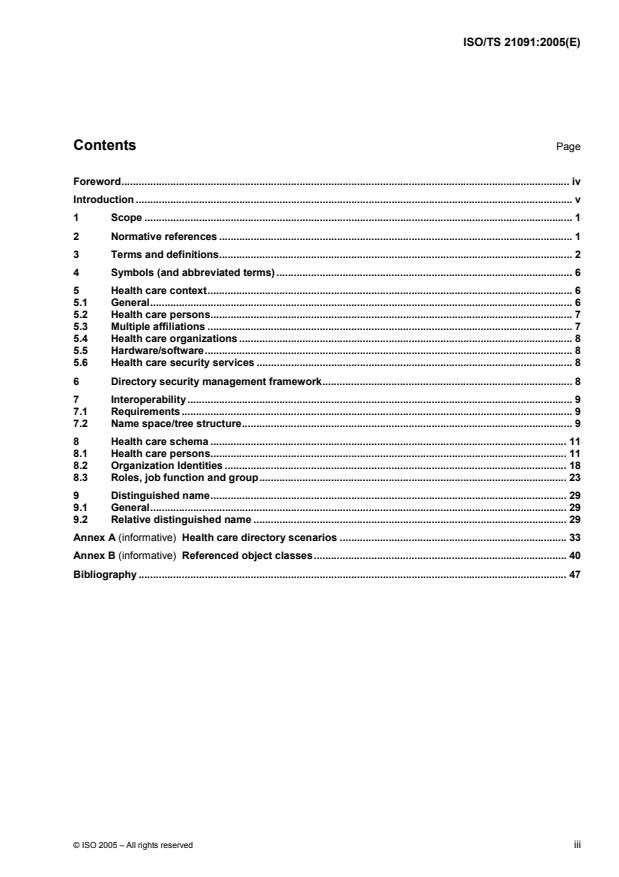
Contents Page
Foreword. iv
Introduction . v
1 Scope . 1
2 Normative references . 1
3 Terms and definitions. 2
4 Symbols (and abbreviated terms) . 6
5 Health care context. 6
5.1 General. 6
5.2 Health care persons. 7
5.3 Multiple affiliations . 7
5.4 Health care organizations . 8
5.5 Hardware/software. 8
5.6 Health care security services . 8
6 Directory security management framework. 8
7 Interoperability. 9
7.1 Requirements . 9
7.2 Name space/tree structure. 9
8 Health care schema . 11
8.1 Health care persons. 11
8.2 Organization Identities . 18
8.3 Roles, job function and group. 23
9 Distinguished name. 29
9.1 General. 29
9.2 Relative distinguished name . 29
Annex A (informative) Health care directory scenarios . 33
Annex B (informative) Referenced object classes. 40
Bibliography . 47
Foreword
ISO (the International Organization for Standardization) is a worldwide federation of national standards bodies
(ISO member bodies). The work of preparing International Standards is normally carried out through ISO
technical committees. Each member body interested in a subject for which a technical committee has been
established has the right to be represented on that committee. International organizations, governmental and
non-governmental, in liaison with ISO, also take part in the work. ISO collaborates closely with the
International Electrotechnical Commission (IEC) on all matters of electrotechnical standardization.
International Standards are drafted in accordance with the rules given in the ISO/IEC Directives, Part 2.
The main task of technical committees is to prepare International Standards. Draft International Standards
adopted by the technical committees are circulated to the member bodies for voting. Publication as an
International Standard requires approval by at least 75 % of the member bodies casting a vote.
In other circumstances, particularly when there is an urgent market requirement for such documents, a
technical committee may decide to publish other types of normative document:
— an ISO Publicly Available Specification (ISO/PAS) represents an agreement between technical experts in
an ISO working group and is accepted for publication if it is approved by more than 50 % of the members
of the parent committee casting a vote;
— an ISO Technical Specification (ISO/TS) represents an agreement between the members of a technical
committee and is accepted for publication if it is approved by 2/3 of the members of the committee casting
a vote.
An ISO/PAS or ISO/TS is reviewed after three years in order to decide whether it will be confirmed for a
further three years, revised to become an International Standard, or withdrawn. If the ISO/PAS or ISO/TS is
confirmed, it is reviewed again after a further three years, at which time it must either be transformed into an
International Standard or be withdrawn.
Attention is drawn to the possibility that some of the elements of this document may be the subject of patent
rights. ISO shall not be held responsible for identifying any or all such patent rights.
ISO/TS 21091 was prepared by Technical Committee ISO/TC 215, Health informatics.
iv © ISO 2005 – All rights reserved
Introduction
The Health Care Directory Services for Security, Communications and Identification of Professionals and
Patients is intended to support the communication and security requirements of health care professionals in
the conduct of clinical and administrative functions. Health care requires extensive encipherment and access
control requirements for the disclosure and transport of all confidential health information. In support of the
health care public key infrastructure, health care will make available a registry of certificates including
business and professional information necessary to conduct health care transactions. This information
necessarily includes identification of individual roles within the health care system as can only be identified by
the respective health care organizations. As such, the registration and management functions must be
extensible, and potentially distributed throughout the health care community. Support for these additional
health care requirements for security must also be offered through the directory service.
The directory is becoming an increasingly popular method of providing a means for single sign-on capabilities.
This goal has driven directory schema extensions to include organization employee management information,
health care-specific contact information and health care identifiers. This Technical Specification will review the
health care specific requirements of the directory, and define, as appropriate, standard specifications for
inclusion of this information in the health care directory.
TECHNICAL SPECIFICATION ISO/TS 21091:2005(E)
Health informatics — Directory services for security,
communications and identification of professionals and
patients
1 Scope
This Technical Specification defines minimal specifications for directory services for health care using the
X.500 framework. This Technical Specification provides the common directory information and services
needed to support the secure exchange of health care information over public networks. This Technical
Specification addresses the health directory from a community perspective in anticipation of supporting inter-
enterprise, inter-jurisdiction, and international health care communications. Besides technical security
measures that are discussed in other ISO standards, communication of health care data requires a reliable
accountable “chain of trust.” In order to maintain this chain of trust within a public key infrastructure, users
(relying parties) must be able to obtain current correct certificates and certificate status information through
secure directory management.
In addition to the support of security services such as access control and confidentiality, a standard shall
provide specification for other aspects of communication, such as addresses and protocols of communication
entities.
This Technical Specification also supports directory services aiming to support identification of health
professionals and organizations and the patients/consumers. The latter services include aspects sometimes
referred to as master patient indices.
The health care directory will only support standard LDAP Client searches. Specific implementation guidance,
search criteria and support are out of scope of this document.
2 Normative references
The following referenced documents are indispensable for the application of this document. For dated
references, only the edition cited applies. For undated references, the latest edition of the referenced
document (including any amendments) applies.
ITU-T Recommendation X.500:2001 | ISO/IEC 9594-1:2001, Information technology — Open Systems
Interconnection — The Directory: Overview of concepts, models and services — Part 1
ITU-T Recommendation X.501:2001 | ISO/IEC 9594-2:2001, Information technology — Open Systems
Interconnection — The Directory: Models — Part 2
ITU-T Recommendation X.511:2001 | ISO/IEC 9594-3:2001, Information technology — Open Systems
Interconnection — The Directory: Abstract service definition — Part 3
ITU-T Recommendation X.520:2001 | ISO/IEC 9594-6:2001, Information technology — Open Systems
Interconnection — The Directory: Selected Attribute Types — Part 6
ITU-T Recommendation X.521:2001 | ISO/IEC 9594-7:2001, Information technology — Open Systems
Interconnection — The Directory: Selected Object Classes — Part 7
IETF/RFC 3771:2004, The Lightweight Directory Access Protocol (LDAP) Intermediate Response Message
IETF/RFC 3377:2002, Lightweight Directory Access Protocol (v3): Technical Specification
IETF/RFC 3698:2004, Lightweight Directory Access Protocol (LDAP): Additional Matching Rules
3 Terms and definitions
For the purposes of this document, the following terms and definitions apply.
3.1
access control
means of ensuring that the resources of a data processing system can be accessed only by authorized
entities in authorized ways
[ISO/IEC 2382-8]
3.2
accountability
property that ensures that the actions of an entity may be traced uniquely to the entity
[ISO 7498-2]
3.3
attribute authority
AA
authority that assigns privileges by issuing attribute certificates
[X.509]
3.4
attribute certificate
data structure, digitally signed by an attribute authority, that binds some attribute values with identification
about its holder
[X.509]
3.5
authentication
process of reliably identifying security subjects by securely associating an identifier and its authenticator
NOTE See also data origin authentication and peer entity authentication.
[ISO 7498-2]
3.6
authorization
granting of rights, including the granting of access based on access rights
[ISO 7498-2]
3.7
availability
property of being accessible and useable upon demand by an authorized entity
[ISO 7498-2]
3.8
certificate
public key certificate
2 © ISO 2005 – All rights reserved
3.9
certificate distribution
act of publishing certificates and transferring certificates to security subjects
3.10
certificate issuer
authority trusted by one or more relying parties to create and assign certificates
NOTE Optionally the certification authority may create the relying parties' keys.
[ISO/IEC 9594-8]
3.11
certificate management
procedures relating to certificates such as: certificate generation, certificate distribution, certificate archiving
and revocation
3.12
certificate revocation
act of removing any reliable link between a certificate and its related owner (or security subject owner)
because the certificate is not trusted any more even though the time and date are within the certificate validity
period
3.13
certificate revocation list
CRL
published list of the suspended and revoked certificates (digitally signed by the CA)
3.14
certificate verification
verifying that a certificate is authentic
3.15
certification authority
CA
entity that issues certificates by signing certificate data with its private signing key
NOTE Authority in the certification authority term does not imply any government authorization, only that it is trusted.
Certificate issuer may be a better term but CA is used very broadly.
3.16
confidentiality
property that information is not made available or disclosed to unauthorized individuals, entities or processes
[ISO 7498-2]
3.17
data integrity
property that data have not been altered or destroyed in an unauthorized manner
[ISO 7498-2]
3.18
digital signature
data appended to, or a cryptographic transformation (see cryptography) of a data unit that allows a recipient of
the data unit to prove the source and integrity of the data unit and protect against forgery, e.g. by the recipient
[ISO 7498-2]
3.19
identification
performance of tests to enable a data processing system to recognize entities
[ISO/IEC 2382-8]
3.20
identifier
piece of information used to claim an identity, before a potential corroboration by a corresponding
authenticator
[ENV 13608-1]
3.21
integrity
proof that the message content has not altered, deliberately or accidentally in any way, during transmission
[ISO 7498-2]
3.22
key
sequence of symbols that controls the operations of encipherment and decipherment
[ISO 7498-2]
3.23
key management
generation, storage, distribution, deletion, archiving and application of keys in accordance with a security
policy
[ISO 7498-2]
3.24
lightweight directory access protocol
LDAP
standard access protocol for directories allowing public or controlled access to certificates and other
information needed in a PKI
3.25
object identifier
OID
unique alphanumeric/numeric identifier registered under the ISO registration standard to reference a specific
object or object class
3.26
patient/consumer
person who is the receiver of health related services and who is a person in a health information system
3.27
privacy
freedom from intrusion into the private life or affairs of an individual when that intrusion results from undue or
illegal gathering and use of data about that individual
[ISO/IEC 2382-8]
3.28
private key
key that is used with an asymmetric cryptographic algorithm and whose possession is restricted (usually to
only one entity)
[ISO 10181-1]
4 © ISO 2005 – All rights reserved
3.29
public key
key that is used with an asymmetric cryptographic algorithm and that can be made publicly available
[ISO 10181-1]
3.30
public key certificate
public key certificates (PKCs) [X.509] that bind an identity and a public key
NOTE The identity can be used to support identity-based access control decisions after the client proves that they
have access to the private key that corresponds to the public key contained in the PKC.
[IETF/RFC 3280]
3.31
public key infrastructure
PKI
structure of hardware, software, people, processes and policies that uses digital signature technology to
provide relying parties with a verifiable association between the public component of an asymmetric key pair
with a specific subject
3.32
relying party
recipient of a certificate who acts in reliance on that certificate and/or digital signature verified using that
certificate
[IETF/RFC 3647]
3.33
role
set of competencies and/or performances that are associated with a task
3.34
security
combination of availability, confidentiality, integrity and accountability
[ENV 13608-1]
3.35
security policy
plan or course of action adopted for providing computer security
[ISO/IEC 2382-8]
3.36
security service
service, provided by a layer of communicating open systems, which ensures adequate security of the systems
or of data transfers
[ISO 7498-2]
3.37
subject
entity whose public key is certified in the certificate
3.38
third party
party other than data originator or data recipient, required to perform a security function as part of a
communication protocol
3.39
trusted third party
TTP
third party which is considered trusted for purposes of a security protocol
[ENV 13608-1]
NOTE This term is used in many ISO/IEC standards and other documents describing mainly the services of a CA.
The concept is however broader and includes services like time stamping and possibly escrowing.
3.40
X.509
ITU-T Standard X.509 for certificates and their corresponding authentication framework
4 Symbols (and abbreviated terms)
CA Certification Authority
CRL Certificate Revocation List
DAP Directory Access Protocol
DIT Directory Information Tree
LDAP Lightweight Directory Access Protocol
MPI Master Patient Index
PDA Personal Data Assistant
PIDS Person Identification Service
PKC Public Key Certificate
PKI Public Key Infrastructure
RA Registration Authority
TTP Trusted Third Party
5 Health care context
5.1 General
In order to accommodate health care-specific concerns, the health care directories must be extended. The
increasing use of networks for the communication and management of health information expands the need
for health care-specific directories and support of a number of related information and security services. With
increased use of internet- and intranet-based health information systems, health information will need to be
communicated across multiple entities and across unaffiliated entities, using both automated and human-
interface based systems. Such distributed health information management and communications require a
standard for communications data, health care professional directories and consumer information.
6 © ISO 2005 – All rights reserved
Organizations are increasingly reliant on enhanced information technology infrastructures to simplify and
enhance user management functions through the use of LDAP in order to manage and access a central user
repository across multiple systems within an organization. These activities include corporate and institutional
directories, definition of systems and services, and definition of partner directories. Distinct from corporate
models, in health care, such use requires enhanced schema context so as to support the need to represent
health care regulatory information, clinical credentials, multiple affiliations at both health care professional and
organizational levels, unaffiliated members of the organization’s health care community, consumers and
business partners.
There is also an increased use of directories for user authentication and security infrastructure management.
By creating a single source for user management, health care organizations can enhance user identification
and authentication security, exit process privilege removal, role management and access control. By providing
a "single sign-on" capability, better password security can be encouraged. However, while this is a powerful
tool for enhanced security, the complexity of the directory and inter-directory requirements is increased.
Another security service of the health care directory is to support health care PKI efforts. Such services
utilizes the directory for public key storage and access, as well as PKI services support such as CRL storage
and access. Both the PKI and enhanced security service support add to the complexity of the health care
directory through additional object support requirements for servers, application components and devices.
5.2 Health care persons
While the X.500 standards include multiple object classes to represent persons as individuals and employees,
there are no standard attributes within these object classes to represent key health care-specific information
required to support industry communications and services. The health care community needs to represent,
within the directory, professional information such as credentials, health care identifiers, role-specific
information and health care-specific contact information. Contact information in health care is more complex
than in typical business environments due to the nature of multiple affiliations discussed in 5.3. Health care
persons include:
⎯ regulated health care professionals;
⎯ non-regulated health care professionals;
⎯ employees of health care organizations and supporting organizations;
⎯ health care consumers.
The inclusion of the health care consumer requires a balance of core directory information, MPI Information
and confidentiality.
5.3 Multiple affiliations
Health care persons, in many environments, may be affiliated with multiple organizations. These persons may
serve different functions under each of the organizations with which they are affiliated. Many health care
professionals operate independently, but are allowed practicing privileges within one or many organizations.
Similarly, supporting services may be provided to multiple health care organizations. Within an organization an
individual may operate under differing roles depending upon the care setting or other factors. Health care
consumers typically seek services from numerous health care professionals and organizations. In order to
minimize inaccuracies associated with duplicate management of information, the health care schema must
allow for links to primary management sources in support of multiple affiliations. Health care staff are also
health care consumers, and their professional identities should be distinct from their health care consumer
identity.
5.4 Health care organizations
While X.500 provides object classes for organizations, there are insufficient attributes within these constructs
to represent health care-specific information needed to support the health care directory requirements. Health
care-specific information includes:
⎯ regulatory identifiers;
⎯ class of service provided;
⎯ service locations;
⎯ contact information for key information management functions.
Health care organizations include:
⎯ regulated health care organizations (i.e. hospitals, pharmacies, clinics, mobile units, skilled nursing
facilities, specialty units);
⎯ payers, supporting organizations (i.e. suppliers, transcription services, coding services, claims
processing services);
⎯ regulatory/monitoring agencies (i.e. disease control, drug control, public health).
5.5 Hardware/software
While X.500 provides object classes for servers and applications, health care devices and software are
subject to regulation and validation requirements, and therefore should include additional attributes to properly
represent health care directory requirements. PDAs and other devices may also have specific associations
with other entities within the health care directory. The representation of hardware and software in the
directory is limited to the identification and communication parameters of these, and association of these with
individuals and organizations. The directory may be used for asset identification but should not be relied upon
for asset management.
5.6 Health care security services
Health care certification authorities, attribute authorities and registration authorities need to be represented
within the directory, and need to be able to publish relevant key management information. Support for health
care role management within the directory must be able to represent health care specific components. This
includes the representation of job function, job-specific contact information and certificates (both professional
and attribute certificates) associated with a health care person. This does not include direct support for the
representation of functional roles.
6 Directory security management framework
Health care needs to be supported by a framework of strong security management policies so as to assure
the integrity of the communications data and the authentication infrastructure. There are already such strong
practice principals defined in International Standards. While the following standards are not directory specific,
they should be adhered to for the protection of directory infrastructures:
[3]
⎯ ISO 22600-2 ;
[7]
⎯ ISO/IEC TR 13335-1 ;
⎯ COBIT (Control Objectives for Information and Related Technologies) specification produced by the
Information Systems Audit and Control Foundation.
8 © ISO 2005 – All rights reserved
While specific security measures and access control specifications are outside the scope of this Technical
Specification, due to the sensitive nature of health related and privacy information that may be supported
through the directory services, significant controls must be enabled at branch, object classes and attribute
levels. Processes and procedures must be in place to assure accountability and information integrity
represented within the health directory. We anticipate that appropriate access controls managing who can
read, write or modify all items in the health care directory.
7 Interoperability
7.1 Requirements
Health care directories must be able to contact and/or exchange relative information from directories of
various trading partners. Techniques include chaining, replication, referrals and unilateral or bi-lateral trust
between the directories. Some of these techniques will be sensitive to schema inconsistencies depending
upon the application or service. The following hierarchy considerations apply to the interoperability models.
a) Must be able to physically separate the health care client base/community into a controlled, high-service
environment.
b) Must be able to provide replication and load-balancing management.
c) Must be able to limit the search tree to a specific geographical or logical area in order to provide efficient
access performance (i.e. 80/20 rule).
d) Must be able to organize DIT to facilitate access control management to protect sensitive information
stored in the directory (e.g. patient certificates must not be publicly accessible) through branch-point
references.
e) Must be able to organize the DIT to enable distributed access to health care jurisdictions.
7.2 Name space/tree structure
7.2.1 General
In order to address these requirements in a consistent manner, and in order to adhere to existing health care
regulatory jurisdictions, the high-level name space and tree structure described in 7.2.2 to 7.2.7 should be
available.
7.2.2 Country
In all cases, the country of the health care professional jurisdiction shall be available and shall be the top of
the tree. In the case where an organization operates in multiple countries, there shall be a view available that
subjugates the organization to the health care regulatory jurisdiction.
c = Required
7.2.3 Locality
In those countries where locality represents a regulatory jurisdiction (i.e. each state in the case of the USA),
locality shall be used to delineate the region of health care regulatory jurisdiction.
l = Optional
7.2.4 Organization
Organization shall be used to indicate the health care regulatory jurisdiction issuing authority under which the
health care professionals in the directory are authorized. Organization may also be used to represent health
care professional organizations and institutions.
o = Issuing authority, health care professional organizations
7.2.5 Organization unit
The Issuing authority shall be sub-categorized by organization unit for those jurisdictions that maintain multiple
professional authority branches. For instance, in many countries pharmacists, physicians, dentists may each
be managed through a separate government body or department.
ou = Issuing authority professional branch
7.2.6 Structural roles
At each of the levels in the hierarchy, there may exist both standard structural roles, and locally-defined
structural roles. Structural role concepts are described further in 9.2.5.
7.2.7 Multiple instantiations of individuals
The identity of each individual within the system should be represented once, except where an individual has
multiple professional credentials, or has associations with multiple healthcare organizations, or other cases
where multiple representations may be appropriate. The separations and information representations are
supported through the object classes and directory information tree, but the object classes alone do not
assure that the desired separation is accomplished. The distinct Common Name structure, however, does
enable such separation through instantiation of multiple instances of that individual in each health identity.
Within health care, there is a need to enable and represent independent ‘ownership’ of the healthcare identity
by the different regulating bodies. Individuals are represented with validly different contact and administrative
information by different regulatory bodies. For instance, the contact information and basic communication
information for each license type and jurisdiction may have conflicting attribute content due to such issues as
multiple residences. The independent instantiations of these across multiple jurisdictions in the same directory
must be preserved.
An individual may exist in the directory both as a patient and as a provider. It is also important to separate an
individual’s personal and professional instantiation within the directory to assure appropriate privacy
management. While the DIT described enables the representation of all health individuals, organizations and
device actors, it does not require that these all be contained within the same physical or logical information
space. These may be separated for optimal service performance and architectural design as necessary. A
given health care directory may contain some, all, or none of the defined actors, and this may be instantiated
using centralized and decentralized methods.
A regulated health professional need be instantiated only once in any given jurisdiction. Through the use of
the HCOrganizationalRole described below, this instantiation may be represented in numerous organizational
capacities through the use of the attribute RoleOccupant, which will contain the DN of the professional. Using
this construct, job-specific contact information may be retrieved.
10 © ISO 2005 – All rights reserved
Figure 1 — Directory information tree (DIT) for health care
8 Health care schema
8.1 Health care persons
8.1.1 General
Multiple types of individuals are represented in the health care directory. The identity of each individual within
the system should be represented once except where it may be appropriate to do otherwise. An example of
such an exception is that a health care professional, when interacting with the health care system as a patient,
may be represented by two object classes: one that contains profession-specific information and another that
contains patient-specific information. These shall all have a parent class of person, and shall be specialized
accordingly so as to represent the following types of individual: health care consumer, health care professional
and health care employee. Information attributes specific to each of the object classes shall be added as a
specialization of the base object class.
The object class schemas that follow include definitions for extended attributes, and include:
Attribute The name of the new attribute to be supported
OID The ISO/TC 215 assigned object identifier associated with the new attribute
Description A description of the new attribute
Syntax The LDAP supported syntax to be used in representing the attribute
Matching rules to be used by servers to compare attribute values against
Matching rules
assertion values when performing search and compare operations
An indication as to whether there is support expected for representing
Multi-valued
multiple values for the attribute
The schema extension specifications also include information as to which of the additional attributes are
mandatory and which are optional.
8.1.2 Health care consumer
Object class: HCConsumer
Superior object class: InetOrgPerson
OID: 1.0.21091.1.1
Object class type: Structural
Mandatory attributes:
Matching Multi-
Attribute OID Description Syntax
rules valued
1.0.21091.2.1.1
HcConsumerID This may be an Directory Case ignore Yes
identifiable, string match, Case
anonymous, or ignore
pseudonymous substrings
identifier. (Issuing match
authority:Type: ID)
Using this construct, HcConsumerID can be used to represent any identifier, including, but not limited to
security number, health insurance number, medical record number, and driving license number.
12 © ISO 2005 – All rights reserved
Optional attributes:
Matching Multi-
Attribute OID Description Syntax
rules valued
1.0.21091.2.0.2
HcIdentificationService Location of Directory Case ignore Yes
service(s) string match, Case
offering biometric ignore
or other substrings
identification match
verification
service
1.0.21091.2.0.3
HcSigningCertificate Public key and Binary Certificate Yes
certificate for the exact match
user’s non- and certificate
repudiation match
signing certificate
used for health
transactions
1.0.21091.2.0.4
HcAttributeCertificate Used for binary Certificate Yes
credentials, exact match
power of and certificate
attorney, health match
care decision
maker, etc.
Populated with
P7 formatted
certificate
1.0.21091.2.1.2
HcMPILocation Location of the Directory Case Ignore Yes
Master Patient String Match, Case
Index Service(s) Ignore
available to Substrings
identify patient Match
clinical records
HcSubstituteDecisionMaker 1.0.21091.2.1.3 Record entry of DN Distinguished Yes
person(s) able to name match
sign/act on
behalf of the
subject
HL7MothersMaidenName 1.0.21091.2.1.5 The HL-7 defined Directory Case ignore Yes
mother’s maiden string match, Case
name ignore
substrings
match
HL7DateTimeofBirth 1.0.21091.2.1.6 The hl-7 defined ISO 8601 Generalized Yes
date and time of Date time match
birth
Generalized
time ordering
match
HL7Sex 1.0.21091.2.1.7 The HL-7 defined Directory Case ignore Yes
sex string match, Case
ignore
substrings
match
Matching Multi-
Attribute OID Description Syntax
rules valued
HL7PatientAlias 1.0.21091.2.1.8 The HL-7 defined Directory Case ignore Yes
patient alias string match, Case
ignore
substrings
match
HL7CountyCode 1.0.21091.2.1.1 The HL-7 defined Directory Case ignore Yes
county code string match, Case
ignore
substrings
match
HL7Religion 1.0.21091.2.1.1 The HL-7 defined Directory Case Ignore Yes
religion. While string match, Case
this attribute is ignore
important for substrings
spiritual aspects match
of patient care, it
must be
managed with
the utmost
protection as this
can be sensitive
private
information
HL7BirthPlace 1.0.21091.2.1.2 The HL-7 defined Directory Case ignore Yes
place of birth string match, Case
ignore
substrings
match
HL7PatientDeathDateandTime 1.0.21091.2.1.2 The HL-7 defined Date Generalized No
patient death time match
date and time
Generalized
time ordering
match
14 © ISO 2005 – All rights reserved
Optional representation for PIDS attributes using parent class and extended attributes:
The following HL-7 PIDS attributes should be populated with the referenced schema attribute using the
defined HL-7 formatting within the relevant constraints of the referenced LDAP attribute:
HL7 PIDS Attribute inetOrgPerson/HcConsumer Attribute
PatientName Include the XPN formatted name in cn as a second
cn value
PhoneNumber_Home homePhone
PhoneNumber_Business telephoneNumber
PrimaryLanguage preferredLanguage
PatientAddress homePostalAddress
PatientAccountNumber Use HcConsumerID if needed
SSNNumber Use HcConsumerID if needed
DriversLicenseNumber Use HcConsumerID if needed
8.1.3 Health care professional
Object class: HCProfessional
Superior object class: InetOrgPerson
OID: 1.0.21091.1.2
Object class type: Structural
Mandatory attributes:
Matching Multi-
Attribute OID Description Syntax
rules valued
1.0.21091.2.0.1
HcIdentifier The health care Directory Case ignore Yes
identifier. Where this string match, Case
is a regulated health ignore
care professional, substrings
this must minimally match
contain an entry
indicating the
identifier assigned
by the regulating
authority (issuing
authority:Type:ID:-
status)
1.0.21091.2.2.1
HcProfession Text representation Directory Case ignore Yes
of the user string match, Case
profession (issuing ignore
authority: Code substrings
System: Code) match
Optional attributes:
Matching Multi-
Attribute OID Description Syntax
rules valued
1.0.21091.2.0.2
HcIdentificationService Location of service(s) Directory Case ignore Yes
offering biometric or string match, Case
other identification ignore
verification service substrings
match
1.0.21091.2.0.3
HcSigningCertificate Public key and Binary Certificate Yes
certificate for the exact match
user’s non- and certificate
repudiation signing match
certificate used for
health transactions
HcAttributeCertificate 1.0.21091.2.0.4 Used for credentials, Binary Certificate Yes
certifications, exact match
education degrees, and certificate
etc. Populated with match
P7 formatted
Certificate
1.0.21091.2.0.5
HcRole (Issuing authority: Directory Case ignore Yes
Code system: Code) string match, Case
Populate with HL-7 ignore
coding for roles substrings
match
1.0.21091.2.0.6
HcSpecialization (Issuing authority: Directory Case ignore Yes
Code system: Code) string match, Case
Populate with HL-7 ignore
coding for substrings
specialization match
1.0.21091.2.2.3
HcPrincipalPractice Use DN of the DN Distinguished No
Location organization name match
HcPracticeLocation 1.0.21091.2.2.4 Use DN of the DN Distinguished Yes
organization name match
16 © ISO 2005 – All rights reserved
8.1.4 Employees
Object class: HCEmployee
Superior object class: InetOrgPerson
OID: 1.0.21091.1.3
Object class type: Structural
Mandatory attributes:
Matching Multi-
Attribute OID Description Syntax
rules valued
HcIdentifier 1.0.21091.2.0.1 The health care Directory Case ignore Yes
identifier. The string match, Case
issuing authority ignore
may be the substrings
employer (issuing match
authority: ID)
Optional attributes:
Matching Multi-
Attribute OID Description Syntax
rules valued
HcIdentificationService 1.0.21091.2.0.2 Location of Directory Case ignore Yes
service(s) offering string match, Case
biometric or other ignore
identification substrings
verification service match
1.0.21091.2.0.3
HcSigningCertificate Public key and Binary Certificate Yes
certificate for the exact match
user’s non- and certificate
repudiation signing match
certificate used for
health transactions
1.0.21091.2.0.4
HcAttributeCertificate Used for credentials, Binary Certificate Yes
certifications, exact match
education degrees, and certificate
etc. Populated with match
P7 formatted
certificate
1.0.21091.2.0.5
HcRole (Issuing Authority: Directory Case ignore Yes
Code System: Code) String match, Case
Populate with HL-7 ignore
coding for roles substrings
match
HcOrganization 1.0.21091.2.3.1 Used to indicate DN Distinguished Yes
organization DN of name match
organization
For employees that are non-regulated health care professionals, there will be an instantiation for each health
care organization for which that individual is employed. Regulated health professionals will be represented
through the HCOrganizationalRole described in 8.3.1.
8.2 Organization Identities
8.2.1 General
Organizations shall be represented by an object class containing organization-specific
...
Questions, Comments and Discussion
Ask us and Technical Secretary will try to provide an answer. You can facilitate discussion about the standard in here.
Loading comments...