

ISO/TR 18228-4:2022
(Main)Design using geosynthetics — Part 4: Drainage
General Information
- Abstract
This document outlines the criteria for evaluating the available and the required flow rate of geosynthetics in various situations, provides a summary of the available laboratory testing, and lists the safety factors and reduction factors that can be applied to the parameters when designing using geosynthetics for drainage systems.
- Status
- Published
- Publication Date
- 14-Mar-2022
- Technical Committee
- ISO/TC 221 - Geosynthetics
- Drafting Committee
- ISO/TC 221/WG 6 - Design using geosynthetics
- Current Stage
- 6060 - International Standard published
- Start Date
- 15-Mar-2022
- Completion Date
- 15-Mar-2022


Overview
ISO/TR 18228-4:2022 - "Design using geosynthetics - Part 4: Drainage" is a technical report that provides guidance for designing drainage functions using geosynthetics (including geotextiles and geocomposites). The document defines criteria for evaluating the required and available flow rate of geosynthetics, summarizes relevant laboratory testing, and lists safety factors and reduction factors to apply in design of geosynthetic drainage systems.
This part of the ISO 18228 series is written in a limit-state format and complements general guidance in ISO/TR 18228-1. It covers concepts, material components, hydraulic properties, and design procedures specific to drainage.
Key topics and requirements
- Flow-rate evaluation: Procedures to calculate the design (input) flow rate from rainfall, surficial flow and filtrated flows, and to determine available in-plane flow capacity of geosynthetics.
- Hydraulic fundamentals: Use of Darcy’s law, hydraulic gradient, transmissivity (ϑ), permittivity (ψ) and related hydraulic parameters.
- Geocomposite components: Guidance on filter components, drainage cores, and definitions for draining geocomposites (GCD).
- Geotextile filter performance: Filter criteria, clogging mechanisms (chemical, biological, intrusion) and corresponding reduction factors.
- Factors affecting performance: Effects of compressive loads, applied pressure, temperature (viscosity), boundary materials, long‑term creep and ageing on available flow rate.
- Laboratory testing: Summary of lab tests for water flow capacity, test boundary conditions, and how short‑term test results are converted to long‑term design values using reduction and safety factors.
- Equivalency with granular drainage: Methodology to compare geosynthetic drains with granular layers (slope and vertical flow equivalence).
- Informative annexes: Movement of water in ground and recommended reduction factors to cover uncertainties.
Practical applications
ISO/TR 18228-4 is intended for design and specification of geosynthetic drainage elements used in:
- Subsurface and slope drainage
- Retaining structures and basement waterproofing
- Road and pavement subbase drainage
- Landfill leachate collection and containment systems
- Tunnel and underground structure drainage
The guidance helps ensure adequate drainage capacity, prevent clogging, and provide robust long‑term performance.
Who should use it
- Geotechnical and civil engineers designing drainage systems
- Specifiers and consultants preparing performance criteria
- Manufacturers of geotextiles and geocomposites
- Contractors and testing laboratories performing hydraulic tests
- Regulators and asset owners seeking harmonized design practice
Related standards
- ISO/TR 18228-1 (general guidance for design using geosynthetics)
- ISO 10318-1 (terms and definitions for geosynthetics) - referenced normative document
For project-level application, consult the full ISO/TR 18228-4:2022 text and your national standards body for adoption and national annexes.
Get Certified
Connect with accredited certification bodies for this standard

Control Union Certifications
Global certification for agriculture and sustainability.

Hohenstein Institut
Textile testing and certification.

Bureau Veritas Bangladesh
Bureau Veritas certification services in Bangladesh.
Sponsored listings
Frequently Asked Questions
ISO/TR 18228-4:2022 is a technical report published by the International Organization for Standardization (ISO). Its full title is "Design using geosynthetics — Part 4: Drainage". This standard covers: This document outlines the criteria for evaluating the available and the required flow rate of geosynthetics in various situations, provides a summary of the available laboratory testing, and lists the safety factors and reduction factors that can be applied to the parameters when designing using geosynthetics for drainage systems.
This document outlines the criteria for evaluating the available and the required flow rate of geosynthetics in various situations, provides a summary of the available laboratory testing, and lists the safety factors and reduction factors that can be applied to the parameters when designing using geosynthetics for drainage systems.
ISO/TR 18228-4:2022 is classified under the following ICS (International Classification for Standards) categories: 59.080.70 - Geotextiles. The ICS classification helps identify the subject area and facilitates finding related standards.
ISO/TR 18228-4:2022 is available in PDF format for immediate download after purchase. The document can be added to your cart and obtained through the secure checkout process. Digital delivery ensures instant access to the complete standard document.
Standards Content (Sample)
TECHNICAL ISO/TR
REPORT 18228-4
First edition
2022-03
Design using geosynthetics —
Part 4:
Drainage
Design pour géosynthétiques —
Partie 4: Drainage
Reference number
© ISO 2022
All rights reserved. Unless otherwise specified, or required in the context of its implementation, no part of this publication may
be reproduced or utilized otherwise in any form or by any means, electronic or mechanical, including photocopying, or posting on
the internet or an intranet, without prior written permission. Permission can be requested from either ISO at the address below
or ISO’s member body in the country of the requester.
ISO copyright office
CP 401 • Ch. de Blandonnet 8
CH-1214 Vernier, Geneva
Phone: +41 22 749 01 11
Email: copyright@iso.org
Website: www.iso.org
Published in Switzerland
ii
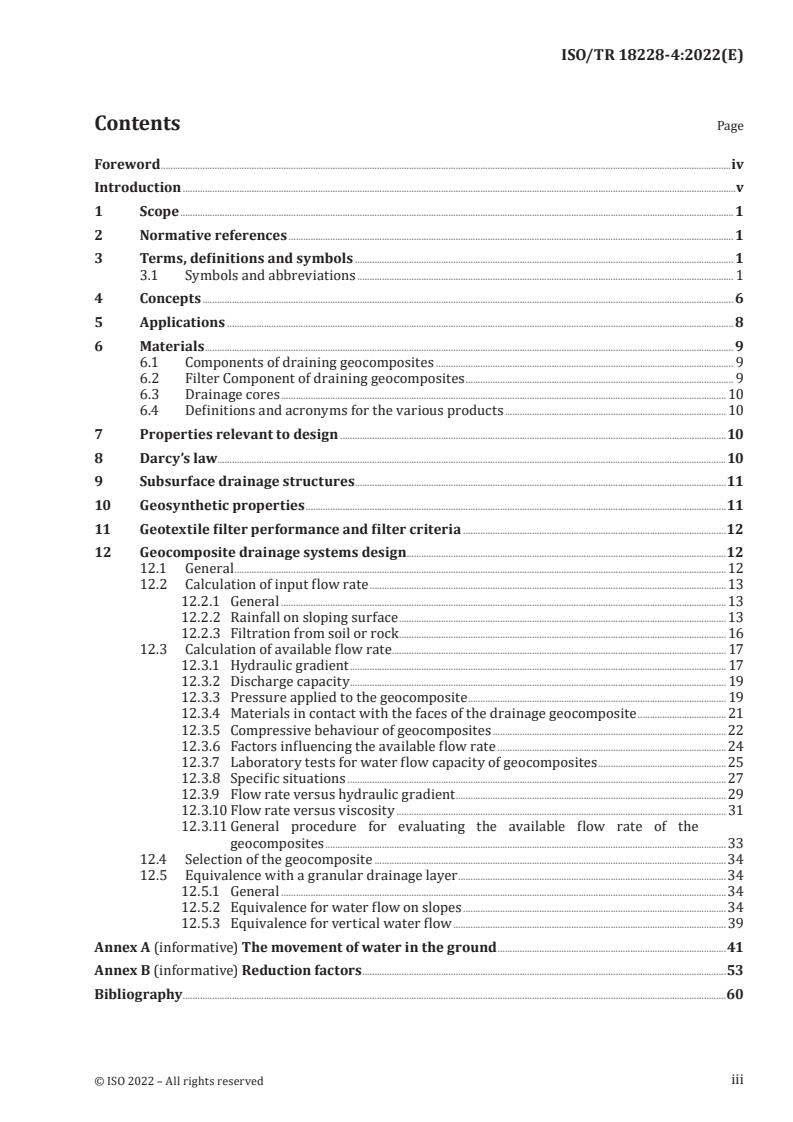
Contents Page
Foreword .iv
Introduction .v
1 Scope . 1
2 Normative references . 1
3 Terms, definitions and symbols . 1
3.1 Symbols and abbreviations . 1
4 Concepts . 6
5 Applications .8
6 Materials . 9
6.1 Components of draining geocomposites . 9
6.2 Filter Component of draining geocomposites . 9
6.3 Drainage cores . 10
6.4 Definitions and acronyms for the various products . 10
7 Properties relevant to design .10
8 Darcy’s law.10
9 Subsurface drainage structures .11
10 Geosynthetic properties .11
11 Geotextile filter performance and filter criteria .12
12 Geocomposite drainage systems design.12
12.1 General .12
12.2 Calculation of input flow rate .13
12.2.1 General .13
12.2.2 Rainfall on sloping surface . 13
12.2.3 Filtration from soil or rock . 16
12.3 Calculation of available flow rate. 17
12.3.1 Hydraulic gradient . 17
12.3.2 Discharge capacity . 19
12.3.3 Pressure applied to the geocomposite . 19
12.3.4 Materials in contact with the faces of the drainage geocomposite . 21
12.3.5 Compressive behaviour of geocomposites .22
12.3.6 Factors influencing the available flow rate . 24
12.3.7 Laboratory tests for water flow capacity of geocomposites .25
12.3.8 Specific situations . 27
12.3.9 Flow rate versus hydraulic gradient .29
12.3.10 Flow rate versus viscosity . 31
12.3.11 General procedure for evaluating the available flow rate of the
geocomposites . 33
12.4 Selection of the geocomposite .34
12.5 Equivalence with a granular drainage layer .34
12.5.1 General .34
12.5.2 Equivalence for water flow on slopes .34
12.5.3 Equivalence for vertical water flow .39
Annex A (informative) The movement of water in the ground .41
Annex B (informative) Reduction factors .53
Bibliography .60
iii
Foreword
ISO (the International Organization for Standardization) is a worldwide federation of national standards
bodies (ISO member bodies). The work of preparing International Standards is normally carried out
through ISO technical committees. Each member body interested in a subject for which a technical
committee has been established has the right to be represented on that committee. International
organizations, governmental and non-governmental, in liaison with ISO, also take part in the work.
ISO collaborates closely with the International Electrotechnical Commission (IEC) on all matters of
electrotechnical standardization.
The procedures used to develop this document and those intended for its further maintenance are
described in the ISO/IEC Directives, Part 1. In particular, the different approval criteria needed for the
different types of ISO documents should be noted. This document was drafted in accordance with the
editorial rules of the ISO/IEC Directives, Part 2 (see www.iso.org/directives).
Attention is drawn to the possibility that some of the elements of this document may be the subject of
patent rights. ISO shall not be held responsible for identifying any or all such patent rights. Details of
any patent rights identified during the development of the document will be in the Introduction and/or
on the ISO list of patent declarations received (see www.iso.org/patents).
Any trade name used in this document is information given for the convenience of users and does not
constitute an endorsement.
For an explanation of the voluntary nature of standards, the meaning of ISO specific terms and
expressions related to conformity assessment, as well as information about ISO's adherence to
the World Trade Organization (WTO) principles in the Technical Barriers to Trade (TBT), see
www.iso.org/iso/foreword.html.
This document was prepared by Technical Committee ISO/TC 221, Geosynthetics.
A list of all parts in the ISO 18228 series can be found on the ISO website.
Any feedback or questions on this document should be directed to the user’s national standards body. A
complete listing of these bodies can be found at www.iso.org/members.html.
iv
Introduction
The ISO 18228 series provides guidance for designs using geosynthetics for soils and below ground
structures in contact with natural soils, fills and asphalt. The series contains 10 parts which cover
designs using geosynthetics, including guidance for characterization of the materials to be used and
other factors affecting the design and performance of the systems which are particular to each part,
with ISO/TR 18228-1 providing general guidance relevant to the subsequent parts of the series.
The series is generally written in a limit state format and guidelines are provided in terms of partial
material factors and load factors for various applications and design lives, where appropriate.
This document includes information relating to the drainage function. Details of design methodology
adopted in a number of regions are provided.
[10]
Parts of this document have been adapted from Comité français des géosynthétiques, 2014 .
v
TECHNICAL REPORT ISO/TR 18228-4:2022(E)
Design using geosynthetics —
Part 4:
Drainage
1 Scope
This document outlines the criteria for evaluating the available and the required flow rate of
geosynthetics in various situations, provides a summary of the available laboratory testing, and lists
the safety factors and reduction factors that can be applied to the parameters when designing using
geosynthetics for drainage systems.
2 Normative references
The following documents are referred to in the text in such a way that some or all of their content
constitutes requirements of this document. For dated references, only the edition cited applies. For
undated references, the latest edition of the referenced document (including any amendments) applies.
ISO 10318-1, Geosynthetics — Part 1: Terms and definitions
3 Terms, definitions and symbols
For the purposes of this document, the terms and definitions given in ISO 10318-1 and the following
apply.
ISO and IEC maintain terminology databases for use in standardization at the following addresses:
— ISO Online browsing platform: available at https:// www .iso .org/ obp
— IEC Electropedia: available at https:// www .electropedia .org/
3.1 Symbols and abbreviations
O characteristic opening size of a geosynthetic (µm)
k coefficient of permeability normal to the plane(m/s)
n
q flux(l/m ⋅s)
n
v-index velocity index(mm/s)
-1
ψ permittivity(s )
ϑ transmissivity (m /s/m or l/s/m)
GCD acronym used for draining geocomposites
dQ/dt volumetric flow rate of water through the soil (m /s or l/s)
A bulk cross-sectional area through which the flow occurs (m )
h hydraulic head (m)
l distance travelled by the bulk water flow (m)
dh/dl hydraulic gradient (dimensionless)
K hydraulic conductivity or permeability of the soil (m/s)
q equal to (dQ/dt), volumetric flow rate (m /s or l/s)
i equal to (dh/dl), hydraulic gradient (dimensionless)
q in-plane flow capacity, equal to the volumetric flow rate of water and/or other liquids
p
per unit width of specimen, at defined gradients in the plane of a product (l/s⋅m).
k coefficient of permeability in the plane, equal to the ratio between in-plane flow capacity
p
q and the product of thickness d and hydraulic gradient i (m/s)
p
3 2
q rainfall per unit horizontal area (m /s/m )
r
P rainfall flow rate (m /s)
A horizontal area (m )
h
3 2
q rainfall per unit sloping area (m /s/m )
s
β slope angle (deg or °)
3 2
q rainfall per unit area entering the drainage system (m /s/m )
D
f coefficient of infiltration (dimensionless)
Q input flow rate due to rainfall (m /s/m or l/s/m)
R
L length of the slope (m)
L horizontal length of the slope (m)
h
h height of rainfall (mm)
r
t duration of the rainfall (h)
j rainfall intensity (mm/h)
-n
a parameter of the pluviometric curve (mm h )
n exponent of the pluviometric curve (-)
F , Factor of Safety on input flow rate (dimensionless)
S Q
Q input flow rate due to additional surficial flow (m /s/m or l/s/m)
S
Q design input flow rate in the geocomposite (m /s/m or l/s/m)
D
Q total rainfall flow on the catchment zone (m /s or l/s)
F
A horizontal area of the catchment zone (m )
c
B running width of the geocomposite drain (m)
g
h maximum thickness of liquid in the granular liquid collection layer
max
Q Specific flow rate = discharge per unit width in the geocomposite, under a specified
hydraulic gradient (m /s/m or l/s/m)
B width of geocomposite specimen in the flow rate test (m)
q measured flow rate for a geocomposite specimen of width B (l/s or m /s)
m
p applied pressure (kPa)
γ saturated unit weight of the soil or material placed on the geocomposite (kN/m )
H thickness of the soil or the material placed on the geocomposite (m)
w distributed surcharge on the ground surface (kPa)
s
H depth of the lowest point of the geocomposite below the ground surface (m)
l
K coefficient of active pressure of the soil (dimensionless)
a
φ friction angle of the soil (deg or °)
t, t geocomposite thickness (m)
GCD
L distance between geotextile support points (m)
sp
Q specific flow rate for the i gradient (l/s/m or m /s)
i1 1
Q specific flow rate for the i gradient (l/s/m or m /s)
i0 0
i hydraulic gradient on the diagram, immediately higher than the actual hydraulic gra-
dient (dimensionless)
i actual hydraulic gradient (dimensionless)
Q discharge or volumetric flow rate (m /s)
v
A cross-sectional area of the geocomposite (m )
g
1/2
χ parameter depending on the roughness of the flow surface (m / s)
R hydraulic radius of the flow conduit (m)
C parameter as a function of geometry and roughness of the flow surface
σ pressure applied in lab tests (kPa)
n
i , i hydraulic gradients applied in lab tests (dimensionless)
1 2
i actual hydraulic gradient (dimensionless)
o
Q(σ , i) flow rate evaluated for the values σ , i (l/s/m or m /s)
n n
Q (σ , i ) flow rate evaluated for the values σ , i (l/s/m or m /s)
i0 n 0 n 0
Q , Q specific flow rates at 20 °C and T °C
20 T
μ , μ viscosity of water at 20 °C and T °C
20 T
T actual temperature of water (°C)
C correction factor for temperature and viscosity (dimensionless)
T
Q available long term flow rate for the geocomposite (l/s/m or m /s)
a
Q short term flow rate obtained from laboratory tests with the appropriate boundary
L
conditions (l/s/m or m /s)
R Reduction Factor for the intrusion of filter geotextiles into the draining core due to tensile
F,in
creep of the geotextile, occurring after the short term flow rate test (dimensionless)
R Reduction Factor for the compressive creep of the geocomposite (dimensionless)
F,cr-Q
R Reduction Factor for chemical clogging of the draining core (dimensionless)
F,cc
R Reduction Factor for biological clogging of the draining core (dimensionless)
F,bc
R Reduction Factor for overall uncertainties on laboratory data and field conditions
F,L
(dimensionless)
3 2
q flow rate of liquid supply (m /s/m )
h
j factor of the Giroud theory (dimensionless)
t prescribed thickness of the granular layer (m)
prescribed
F Factor of Safety on equivalency (dimensionless)
S,E
E equivalency coefficient (dimensionless)
Q minimum short term input flow rate for the geocomposite in order to be considered
GCD
equivalent to the granular layer having thickness larger than h (m /s/m or l/s/m)
max
Q flow rate in the granular soil layer according to Darcy’s law (m /s/m)
Darcy
K long term permeability of the granular soil layer evaluated in situ at the end of its
lt
design life (m/s)
* 3 2
q equivalent flow rate of liquid supply in the granular soil layer at equilibrium (m /s/m )
h
j* factor of the Giroud theory related to Q (dimensionless)
Darcy
E* equivalency coefficient for the thickness t (dimensionless)
prescribed
Q * short term input flow rate for the geocomposite in order to be considered equivalent
GCD
to the granular layer having thickness t (m /s/m)
prescribed
Q flow rate afforded by the granular drainage layer (m /s/m or l/s/m)
GL
U Darcy's velocity (m/s)
z vertical distance in the soil (m)
k intrinsic permeability of the soil, which depends only on properties of the solid matrix
(m )
2 4 3
ρ density of the fluid (N s /m or kg/m )
μ dynamic viscosity of the fluid (N / m s)
C Hazen's empirical coefficient for intrinsic permeability (dimensionless)
-1 -1
C* Hazen's empirical coefficient for permeability (m s )
C coefficient of uniformity of the soil = D / D (dimensionless)
U 60 10
D , D diameter of soil particles for 10 % and 60 % cumulative passing (m)
10 60
g acceleration due to gravity = 9,81 m/s
γ unit weight of water for the given temperature (kN/m )
w
n soil porosity = void volume / total volume (dimensionless)
R Reduction Factor for the intrusion of filter geotextiles into the draining core for Rigid
F,in(R/R) short term
/ Rigid boundaries at short term (dimensionless)
R Reduction Factor for the intrusion of filter geotextiles into the draining core for Soft /
F,in(R/S) short term
Soft boundaries at short term (dimensionless)
R Reduction Factor for the intrusion of filter geotextiles into the draining core for Rigid
F,in(S/S) short term
/ Soft boundaries at short term (dimensionless)
R Reduction Factor for the intrusion of filter geotextiles into the draining core for Rigid
F,in(R/R) long term
/ Rigid boundaries at long term (dimensionless)
R Reduction Factor for the intrusion of filter geotextiles into the draining core for Soft /
F,in(R/S) long term
Soft boundaries at long term (dimensionless)
R Reduction Factor for the intrusion of filter geotextiles into the draining core for Rigid
F,in(S/S) long term
/ Soft boundaries at long term (dimensionless)
Q Specific flow rate for Rigid / Rigid boundaries at short term (m /s/m or l/s/m)
L (R/R) short term
Q Specific flow rate for Rigid / Soft boundaries at short term (m /s/m or l/s/m)
L (R/S) short term
Q Specific flow rate for Soft / Soft boundaries at short term (m /s/m or l/s/m)
L (S/S) short term
Q Specific flow rate for Rigid / Rigid boundaries at long term (m /s/m or l/s/m)
L (R/R) long term
Q Specific flow rate for Rigid / Soft boundaries at long term (m /s/m or l/s/m)
L (R/S) long term
Q Specific flow rate for Soft / Soft boundaries at long term (m /s/m or l/s/m)
L (S/S) long term
R Reduction Factor for thickness (dimensionless)
F,cr,th
t thickness of the geocomposite core before load application (m);
virgin
t thickness measured at long term (1 year, 10 years, . 100 years) in compressive creep
cr
tests (m)
q(σ , i, long term) long term available flow rate for applied pressure σ and hydraulic gradient i (m /s/m
n n
or l/s/m);
q(σ , i) short term available flow rate for applied pressure σ and hydraulic gradient i (m /s/m
n n
or l/s/m);
x(σ , 0) short term thickness of geocomposite for applied pressure σ (m);
n n
x(σ , t) long term thickness of geocomposite for applied pressure σ (m);
n n
F Reduction Factor for thickness (dimensionless)
α Reduction Factor for the long term effect of compressive creep and geotextile intrusion
(dimensionless)
Q long term flow rate (m /s/m or l/s/m)
long term
4 Concepts
Some types of geosynthetics, particularly geocomposites, can be used as planar drainage medium in
subsurface drainage systems.
The design of planar drainage geosynthetics requires hydraulic and geotechnical concepts for defining
the design input flow rates, and a detailed method for defining the allowable long-term flow of
geosynthetics, based on laboratory testing.
Drainage geosynthetics typically consist of a continuous drainage core (geonet, geomat, geospacer)
capable of transporting a fluid along its own plane, and geotextiles and/or geomembranes, coupled to
the drainage core, which prevent the drainage core itself from being clogged by the surrounding soil.
The components of a draining geocomposite with continuous draining core are filtering geotextiles (on
one or both sides), draining core and geomembrane, as shown in Figure 1.
Some geocomposites available on the market include discrete draining elements, such as small diameter
pipes, instead of a continuous draining core (Figure 2). In this type of geocomposite, the geotextiles act
as a filter and also contribute to carrying the water flow. In general, the water flow capacity provided
by geotextiles is very small compared to that provided by the discrete draining elements.
Drainage geosynthetics are widely used in controlled landfills, roads, railways, airports, tunnels and
buildings. Drainage systems with geosynthetics are used within a performance envelope between the
extreme cases of drainage along a sub-horizontal plane and along a vertical plane; between a hydraulic
gradient close to 0 and a hydraulic gradient of 1.
In addition to the hydraulic gradient, the draining capacity of a geocomposite depends on the pressure
applied and the materials in contact with the two faces.
The design of a drainage system with geosynthetics is based on the evaluation of the drainage capacity
available under actual operating conditions and on the flow rate required by the project.
The drainage capacity can be assessed on the basis of appropriate laboratory tests, while the required
flow rate is evaluated on the basis of hydrological and hydraulic considerations.
Key
1 geotextile
2 draining core
3 geomembrane
Figure 1 — Components of a draining geocomposite with continuous draining core: 1) Draining
core + geotextile; 2) Geotextile + draining core + geotextile; 3) Geotextile + draining core +
geomembrane
Key
1 discrete draining elements
2 geotextile
Figure 2 — Draining geocomposite with discrete draining elements
a b e f
c d
Key
a separation function
b filtration function
c protection function
d barrier function
e drainage function
f drainage systems applications
Figure 3 — Functions and Applications of drainage geocomposites (Source: ISO 10318-2)
Key
1 plastic core
2 geotextile
3 protects waterproofing from damage
4 distributes pressure
5 retains its drainage capacity even under high earth pressure
6 transports water to the collector drain
7 removes excess water from the soil
8 prevents the collector drain from silting up with fine soil particles
Figure 4 — Principles of the functions afforded by drainage geocomposites
5 Applications
Drainage geocomposites are made from a plastic drainage core that is thermally or otherwise bonded
to a geotextile on one or both sides or to a waterproofing layer on one side.
They are capable of providing one or more main functions within the application as a drainage system,
shown in Figure 3. The principles of the functions offered by drainage geocomposites are illustrated in
Figure 4.
The main applications of planar drainage geocomposites are the following:
— Drainage of concrete walls
— Drainage of reinforced soil structures
— Drainage in road, railway and airport applications
— Horizontal drainage and capillary break layer in embankments made up of fine and cohesive fill
— Drainage trenches
— Leachate collection and gas ventilation in landfill applications (also used as a protection layer
against geomembrane puncturing)
— Drainage of rainfall water infiltration in landfill applications
— Drainage in natural and artificial tunnel applications
— Drainage layer in roofing and deck pavement applications
— Drainage of sport fields
6 Materials
6.1 Components of draining geocomposites
The most commonly used drainage geosynthetics are the geocomposites which are produced by
laminating one or two geotextiles, with a filter function, onto a drainage element.
— The filtering component can have the following characteristics under operating conditions: adequate
permeability to gases and liquids in the direction perpendicular to the filter plane
— retention capacity of the soil particles
The draining component may have the following characteristics under operating conditions:
— adequate permeability to gases and liquids in the direction planar to the drainage structure
— adequate compressive strength and creep resistance for the loads to be applied
6.2 Filter Component of draining geocomposites
The filters are typically made up of nonwoven geotextiles, yet in certain specific applications some
types of woven fabrics are occasionally used. The most commonly used nonwoven geotextiles are:
— staple fibres nonwoven, mechanically needled;
— continuous fibres nonwoven, thermally bonded or mechanically needled.
The physico-mechanical properties of nonwoven geotextiles are qualitatively as follows:
— Staple or continuous filament fibres needle-punched (only) nonwoven:
— Relatively high thickness
— High compressibility
— Highly deformable over time
— Potential clogging both on the surface and internally and limited blinding
— Staple fibres needle-punched and thermocalandered non-woven:
— Moderate thickness
— Moderate compressibility
— Moderate deformability over time
— Potential clogging both on the surface and internally and blinding risk on the heat-bonded
surface and limited blinding on the other face
— Continuous fibres heat-bonded nonwoven:
— Lowest thickness
— Very low compressibility
— Slightly deformable over time
— Blinding risks
6.3 Drainage cores
The drainage cores are characterized by a three-dimensional structure with a high void ratio, and they
differ according to the mode of manufacture and the type of polymer.
The main types of drainage cores can be grouped into the following categories:
— Geomats: made from a set of filaments which are tangled and welded at the contact points; the
profile of the core can be different (cuspated, channelled, etc.) according to the required thickness
and resistance to compression. These profiles are usually made of polyamide (PA) or polypropylene
(PP).
— Geonets: made by the extrusion of two or three sets of parallel strands. Geonets are typically made
of high-density polyethylene (HDPE).
— Geospacers: cuspated foils produced from extruded laminates, which are profiled during production
into wave-shaped or truncated cuspate cone profiles, on one or both faces. They are typically made
of polypropylene (PP) or high-density polyethylene (HDPE).
It is important for all forms and grades of geosynthetic drains that their strength and long-term creep
and drainage performance is demonstrated to be appropriate for the loadings and design life envisaged.
Since geosynthetic drains may exhibit high resistance to compression in the short term but may be
prone to sudden collapse if the loads are maintained for a long time, it is also important to check if the
draining core behaves as compressible or collapsible for the project conditions of applied load, slope
and design life.
6.4 Definitions and acronyms for the various products
ISO 10318-1 provides definitions and acronyms for many of the various products presently available on
the market. In the present document the acronym GCD is used for draining geocomposites.
7 Properties relevant to design
Geosynthetics testing standards relevant to design for drainage are listed under further reading at the
end of this document.
8 Darcy’s law
The unidirectional movement of water through the soil is represented by Darcy's law.
Information on the movement of water in the ground is provided in Annex A.
9 Subsurface drainage structures
The uncontrolled movement of groundwater can be deleterious to geotechnical structures by:
— reducing or eliminating cohesion in soils;
— originating pore water pressures that reduce effective stresses, thereby lowering shear strength;
— producing horizontally inclined forces which increase the moments acting on them;
— lubricating failure planes;
— supplying water which leads to liquefaction during earthquakes; or
— promoting the uncontrolled movement of soil particles (piping).
The design engineer would normally be aware of all these risks and either account for this presence
of water within their calculations (resulting in a conservative and expensive solution) or provide a
technique to control it.
Subsurface drainage is the technique to control the flow of groundwater, through interception and/or
deviation.
An effective subsurface drainage system will:
— reduce pore water pressures and thus increase effective stresses, thereby increasing shear strength;
— reduce horizontal forces, and thus reduce overturning moments and the possibility of failure;
— prevent the lubrication of failure planes;
— prevent the uncontrolled movement of soil particles (piping).
An essential feature of the successful use of subsurface drainage is that the groundwater can be
removed in a controlled manner (i.e. without causing undue disturbance to surrounding areas). This
is particularly important where its removal causes movements or subsidence in surrounding areas. In
order for a subsurface drainage system to be effective, due consideration would normally be given to
the positioning of the drain and to the materials selected.
All of the three following criteria apply
a) The drainage system may intercept the zone of seepage which can be the cause of the problem. The
proper placement and configuration of the subsurface drainage system are important.
b) The seepage water can enter the subsurface drainage system with minimal resistance whilst at the
same time cause minimal disturbance (piping) at the drain/soil interface. To facilitate this, filters
are positioned around the outside perimeter of the subsurface drains.
c) The subsurface drainage system can remove the required amount of groundwater from the soil
in the required time interval. The dimensions of the drains, the selection of appropriate drainage
media, and the configuration of the drainage system all contribute to its ability to perform
satisfactorily.
10 Geosynthetic properties
When considering drainage projects, the hydraulic properties of the geosynthetics are the most
important.
ISO 10318-1 defines the hydraulic properties of geosynthetics listed in Table 1.
Table 1 — Relevant hydraulic properties of geosynthetics defined in ISO 10318-1
Characteristic opening size O
Permeability
Coefficient of permeability normal to the plane k
n
Flux q
n
Velocity index (v-index)
Permittivity ψ
In-plane flow capacity q
p
Transmissivity θ
Coefficient of permeability in the plane k
p
11 Geotextile filter performance and filter criteria
For designing the geotextile filters of drainage geocomposites see ISO/TR 18228-3.
12 Geocomposite drainage systems design
12.1 General
The design of a geocomposite drainage system may be carried out as follows:
a) Identify/set all the design conditions, including (but not limited to):
— Type of project (landfill bottom or capping, vertical wall, etc.)
— Types of soil involved (stones, gravel, clay, etc.) and their grading curves
— Environment (aggressive for landfill bottom, medium for landfill capping, ordinary for walls or
roof gardens, etc.)
— Chemical and physical properties of the materials in contact with the geocomposite (pH,
chemical and biological content, hardness, stiffness, etc.) and of the liquid to be drained (pH,
chemical and biological content, density, viscosity, turbidity, etc.)
b) Set the boundary conditions, that is the type of materials in contact with the two faces of the
geocomposite;
c) Calculate the maximum applied pressure, the hydraulic gradient and the design input flow rate for
the geocomposite;
d) Select one or more geocomposites and, for each of them, calculate the available flow rate for the
design conditions of materials in contact with the two faces, maximum applied pressure, and
hydraulic gradient;
e) Compare the available flow rate with the design input flow rate and consider only the geocomposites
for which the former is larger than the latter;
f) Make the final selection of the geocomposite;
g) Provide design specifications and details, in particular the method for fixing the geocomposites on
the supporting surface and the connections/overlaps between geocomposite rolls and between the
geocomposites and other elements of the drainage system (manholes, perforated pipes, etc.).
12.2 Calculation of input flow rate
12.2.1 General
The calculation of the input flow rate is project specific, therefore it is possible to provide indications
only for the most common and simple cases.
12.2.2 Rainfall on sloping surface
The input flow from rainfall onto a sloping surface is of interest in many common situations: landfill
bottom and side slopes (before capping), landfill capping, roads, railways, airports, roof gardens and
deck pavements.
In all these cases there is a common calculation scheme applicable, as shown in Figure 5.
With reference to this scheme, the rainfall per unit area is given by Formula (1):
qP= /A (1)
rh
where
P is the rainfall flow rate (m /s);
A is the horizontal area (m );
h
3 2
q is the rainfall per unit horizontal area (m /s/m ).
r
Since the actual surface is sloping, the effective rainfall per unit sloping area is given in Formula (2):
qq=⋅cosβ (2)
sr
where
3 2
q is the rainfall per unit sloping area (m /s/m );
s
β is the slope angle (deg).
Key
1 soil or waste or no cover material
2 geocomposite
Figure 5 — Scheme for the calculation of the input flow rate in case of rainfall on sloping surface
Not all the rainfall reaches the drainage system, since a part of it becomes runoff; therefore, the input
rainfall is given by Formula (3):
qf=⋅qf=⋅q ⋅cosβ (3)
Ds r
where
f is the coefficient of infiltration;
3 2
q is the rainfall per unit sloping area entering the drainage system (m /s/m ).
D
The input rainfall collects along the slope to produce the flow rate Formula (4):
Qq=⋅Lf=⋅qL⋅ (4)
RD rh
where
L is the length of the slope (m);
L is the horizontal length of the slope (m);
h
Q is the input flow rate per unit width of slope due to rainfall (m /s/m).
R
The rainfall per unit area q can be calculated knowing the rainfall intensity j. According to the
r
principles of hydrology it is possible to compute j by the formula of the pluviometric curve relative to
the specific hydrologic region, which is usually written in the form given in Formula (5):
n
ha=⋅t (5)
r
Therefore Formula (6) gives:
n−1
jh==/ta⋅t (6)
r
where
h is the height of rainfall (mm);
r
t is the duration of the rainfall (h);
j is the rainfall intensity (mm/h);
n
a is the parameter of the pluviometric curve (mm/h );
n is the exponent of the pluviometric curve (dimensionless).
3 2
Finally, to pass from j(mm/h) to q (m /s/m = m/s), Formula (7) applies:
r
qj=⋅2,777⋅10 (7)
r
Hence the input flow rate due to rainfall is given in Formula (8):
71n−
Qa=⋅2,c777 10 ⋅⋅tL⋅⋅ f ⋅ osβ (8)
R
or Formula (9):
Qj=⋅2,c777 10 ⋅⋅Lf⋅⋅ osβ (9)
R
It is evident that the rainfall intensity depends on the rainfall duration being considered and hence
such parameters may be carefully selected based on the type of application and/or on hydrologic
considerations.
Only the most intense rainfalls, occurring during storm events, are meaningful for the geocomposite
drainage system design, while the long duration rain events with low intensity do not produce high
water flows. Additionally, very intense yet very short rainfall events might not produce the highest
input flow rates for the geocomposite, since the soil absorbs the rain and delays the filtration flow to a
great extent.
Therefore, a general rule is to consider rainfall durations of 0,5 h to 1 h.
When the hydrologic parameters of the pluviometric curve are not available, Formula (9) is used and the
rainfall intensity j for the duration of 1 h may be estimated or provided by local authorities/agencies.
There are many situations where an additional input flow in the geocomposite needs to be considered,
for example, if there is an upstream slope that produces runoff, a pipe discharging water on the ground
surface just upstream of the geocomposite or if there is a higher roof that discharges the water on the
roof garden below.
In all these cases the additional surficial flow rate per unit width of slope, Q , may be evaluated and
S
added to the rainfall generated flow rate Q .
R
Finally, the design input flow rate can be calculated as given in Formula (10):
QF=⋅()QQ+ (10)
DS,Q RS
where
F is the Factor of Safety on input flow rate;
S,Q
Q is the input flow rate due to rainfall (m /s/m or l/s/m);
R
Q is the input flow rate due to additional surficial flow (m /s/m or l/s/m);
S
Q is the design input flow rate in the geocomposite (m /s/m or l/s/m).
D
12.2.3 Filtration from soil or rock
The condition of input flow produced by water filtration from soil or rock is common to several
situations of practical interest: vertical walls, reinforced slopes, drainage trenches, tunnels.
Only with tunnels is there no simple method for calculating the input flow. Instead, it needs to be
evaluated on the basis of project specific geological and geotechnical analyses.
In the other cases the common feature is that the geocomposite is placed vertically or in a near-vertical
position within the soil.
Therefore, in most cases the input flow is originated by the rainfall on the ground surface, which
subsequently infiltrates the ground and reaches the drainage geocomposite following more or less
curved filtration patterns.
The correct method for calculating the input flow in the geocomposite would be to use the well-
known methods of filtration hydraulics: draw the flow net of the filtration water towards the draining
geocomposite and then integrate the incoming flow over the whole length of the geocomposite. Such
calculation can be carried out using commercially available software.
However, a simpler method is to define the catchment area for the geocomposite, based on the surface
slopes of the ground surface, and to assume that the total flow that infiltrates the ground and reaches,
sooner or later, the geocomposite is given by the total rainfall on the catchment area multiplied by
the infiltration coefficient f. If such a coefficient is properly selected, this simple method results in a
conservative rate.
Including the hypothesis that the filtration flow reaches the geocomposite in a uniform way along
its entire width, the flow rate in the geocomposite due to rainfall on the catchment zone is given in
Formula (11):
71n−
Qa=⋅2,(777 10 ⋅⋅tA⋅⋅/)Bf (11)
Fc g
or Formula (12):
Qj=⋅2,(777 10 ⋅⋅ AB/)⋅ f (12)
Fc g
In this case there is still the possibility of an additional input flow in the geocomposite, produced for
example by an upstream slope that produces runoff or by a pipe discharging water on the ground
surface inside the catchment zone. In these situations, the additional surficial flow rate per unit running
width of wall, Q , may be evaluated and added to the filtration generated flow rate Q .
S F
Hence the input flow rate in the geocomposite is given in Formula (13):
QF=⋅()QQ+ (13)
DS,Q FS
where
Q is the total rainfall flow on the catchment zone (m /s or l/s)
F
A is the horizontal area of the catchment zone (m )
c
B is the running width of the geocomposite drain (m)
g
Q is the input flow rate due to additional surficial flow (m /s/m or l/s/m)
S
F is the Factor of Safety on input flow rate (dimensionless)
S,Q
Q is the input flow rate in the geocomposite (m /s/m or l/s/m)
D
In general, it can be assumed that F = 1,30 but engineering judgement may be applied to define the
S,Q
appropriate value for the specific project conditions.
12.3 Calcula
...