

ISO 69:1998
(Main)Cinematography — 16 mm motion-picture and magnetic film — Cutting and perforating dimensions
General Information
- Abstract
This International Standard specifies the cutting and perforating dimensions for 16 mm motion-picture and magnetic films with one or two rows of perforations for the following two categories: a) 16 mm motion-picture and magnetic films; b) manufacturer-designated 16 mm professional motion-picture camera films with tighter tolerances. This International Standard applies to safety raw stock film as described in ISO 543.
- Status
- Published
- Publication Date
- 01-Jul-1998
- Technical Committee
- ISO/TC 36 - Cinematography
- Drafting Committee
- ISO/TC 36 - Cinematography
- Current Stage
- 9060 - Close of review
- Completion Date
- 04-Mar-2029
Overview
ISO 69:1998 - Cinematography - 16 mm motion-picture and magnetic film - Cutting and perforating dimensions specifies the cutting and perforating geometry and tolerances for 16 mm motion‑picture and magnetic films. It covers films with one or two rows of perforations and defines two categories: general 16 mm film and manufacturer‑designated professional camera films with tighter tolerances. The standard applies to safety raw stock as described in ISO 543 and gives dimensions measured at the time of cutting and perforating under a controlled atmosphere.
Key topics and technical requirements
- Film types covered: 16 mm motion‑picture and magnetic films with one or two rows of perforations; professional camera films with tighter tolerances.
- Reference conditions: dimensions apply at cutting/perforating with film adjusted to 23 °C – 1 °C and relative humidity (50 – 2) % (conditioning/testing atmosphere).
- Perforation geometry: key dimensions and tolerances are specified (see table in ISO 69). Representative values include:
- Long pitch B = 7.620 mm; short pitch B' = 7.605 mm
- 100‑perforation interval L = 762.0 mm; short‑pitch L' = 760.5 mm
- Hole margin C = 1.830 mm, hole position D = 1.270 mm, edge margin E = 0.900 mm
- Professional tolerances: manufacturer‑designated films have tighter repeatability limits across any 50 consecutive perforations and stricter limits between consecutive perforations (specified in the standard).
- Pitch choice and printing: the standard explains use of long pitch (B) and short pitch (B') to accommodate continuous‑sprocket printing. Typical pitch differential target is about 0.3%, with manufacturers often aiming for originals 0.2% shorter than print film to allow for processing/ageing shrinkage.
- Low‑shrinkage film: defined in Annex A - film that shrinks no more than 0.2% under specified handling, processing and storage conditions.
- Reference edge and positioning: rules for identifying the reference edge (perforation side or winding convention) and guidance for equipment to use the reference edge and a consistent perforation (+3 perforation recommended) for vertical positioning.
Applications and users
ISO 69:1998 is practical for:
- Film stock manufacturers and film processors (cutting, perforating and QA)
- Camera and projector designers, telecine and printer manufacturers (mechanical registration and sprocket design)
- Post‑production labs, archives and restoration facilities (compatibility and dimensional stability)
- Equipment designers aiming to optimize image steadiness and cross‑printer compatibility for 16 mm workflows
Related standards
- ISO 543 (safety raw stock film) - normative reference
- ISO 544 (standard atmospheres for conditioning/testing) - referenced for conditioning
- ISO 25:1994 (camera usage reference mentioned in Annex A)
Keywords: ISO 69:1998, 16 mm film, perforating dimensions, cutting dimensions, long pitch, short pitch, low‑shrinkage film, film manufacturers, camera films, motion‑picture film.
Relations
- Effective Date
- 15-Apr-2008
Frequently Asked Questions
ISO 69:1998 is a standard published by the International Organization for Standardization (ISO). Its full title is "Cinematography — 16 mm motion-picture and magnetic film — Cutting and perforating dimensions". This standard covers: This International Standard specifies the cutting and perforating dimensions for 16 mm motion-picture and magnetic films with one or two rows of perforations for the following two categories: a) 16 mm motion-picture and magnetic films; b) manufacturer-designated 16 mm professional motion-picture camera films with tighter tolerances. This International Standard applies to safety raw stock film as described in ISO 543.
This International Standard specifies the cutting and perforating dimensions for 16 mm motion-picture and magnetic films with one or two rows of perforations for the following two categories: a) 16 mm motion-picture and magnetic films; b) manufacturer-designated 16 mm professional motion-picture camera films with tighter tolerances. This International Standard applies to safety raw stock film as described in ISO 543.
ISO 69:1998 is classified under the following ICS (International Classification for Standards) categories: 37.060.20 - Motion picture films. Cartridges. The ICS classification helps identify the subject area and facilitates finding related standards.
ISO 69:1998 has the following relationships with other standards: It is inter standard links to ISO 69:1990. Understanding these relationships helps ensure you are using the most current and applicable version of the standard.
ISO 69:1998 is available in PDF format for immediate download after purchase. The document can be added to your cart and obtained through the secure checkout process. Digital delivery ensures instant access to the complete standard document.
Standards Content (Sample)
INTERNATIONAL ISO
STANDARD 69
Third edition
1998-07-01
Cinematography — 16 mm motion-picture
and magnetic film — Cutting and
perforating dimensions
Cinématographie — Films cinématographiques et magnétiques 16 mm —
Dimensions de coupe et de perforation
A
Reference number
Foreword
ISO (the International Organization for Standardization) is a worldwide
federation of national standards bodies (ISO member bodies). The work of
preparing International Standards is normally carried out through ISO
technical committees. Each member body interested in a subject for which
a technical committee has been established has the right to be represented
on that committee. International organizations, governmental and non-
governmental, in liaison with ISO, also take part in the work. ISO
collaborates closely with the International Electrotechnical Commission
(IEC) on all matters of electrotechnical standardization.
Draft International Standards adopted by the technical committees are
circulated to the member bodies for voting. Publication as an International
Standard requires approval by at least 75 % of the member bodies casting
a vote.
International Standard ISO 69 was prepared by Technical Committee
ISO/TC 36, Cinematography.
This third edition cancels and replaces the second edition (ISO 69:1990),
clauses 2, A.2 and A.6 of which have been technically revised.
Annex A of this International Standard is for information only.
© ISO 1998
All rights reserved. Unless otherwise specified, no part of this publication may be reproduced
or utilized in any form or by any means, electronic or mechanical, including photocopying and
microfilm, without permission in writing from the publisher.
International Organization for Standardization
Case postale 56 • CH-1211 Genève 20 • Switzerland
Internet central@iso.ch
X.400 c=ch; a=400net; p=iso; o=isocs; s=central
Printed in Switzerland
ii
©
INTERNATIONAL STANDARD ISO ISO 69:1998(E)
Cinematography — 16 mm motion-picture and magnetic-film —
Cutting and perforating dimensions
1 Scope
This International Standard specifies the cutting and perforating dimensions for 16 mm motion-picture and magnetic
films with one or two rows of perforations for the following two categories:
a) 16 mm motion-picture and magnetic films;
b) manufacturer-designated 16 mm professional motion-picture camera films with tighter tolerances.
This International Standard applies to safety raw stock film as described in ISO 543.
2 Normative references
The following standards contain provisions which, through reference in this text, constitute provisions of this
International Standard. At the time of publication, the editions indicated were valid. All standards are subject to
revision, and parties to agreements based on this International Standard are encouraged to investigate the
possibility of applying the most recent editions of the standards indicated below. Members of IEC and ISO maintain
registers of currently valid International Standards.
ISO 543:1990, Photography — Photographic films — Specifications for safety film.
ISO 544:1976, Standard atmospheres for conditioning and/or testing — Specifications.
3 Dimensions
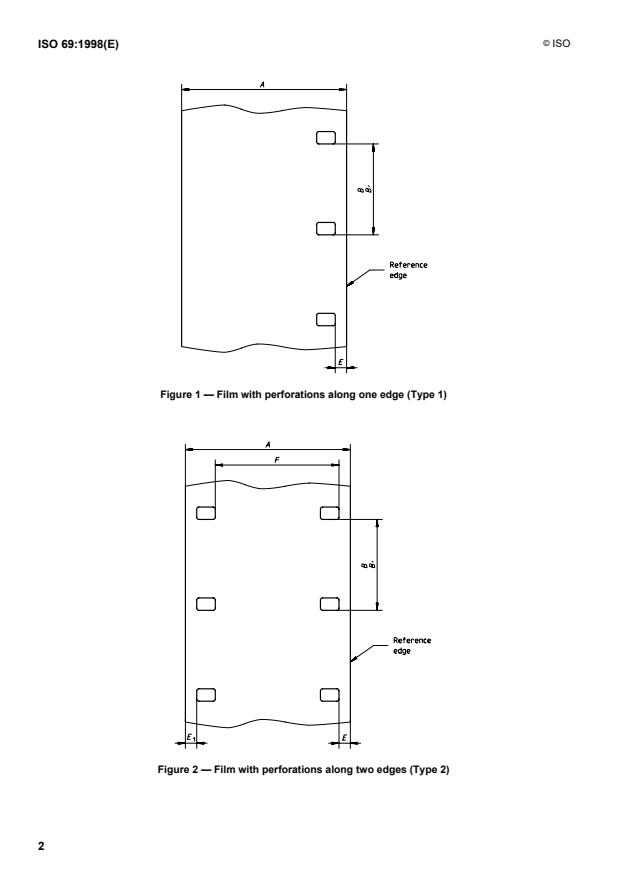
3.1 The dimensions and tolerances shall be as given in table 1 and in the accompanying figures 1 to 4, and apply
to safety raw stock film as described in ISO 543. The dimensions shall apply at the time of cutting and perforating
for film adjusted to a temperature of 23 °C – 1 °C and a relative humidity of (50 – 2) %, which is the recommended
atmosphere for conditioning and/or testing with reduced tolerances specified in ISO 554.
NOTES
1 If required by usage, the manufacturer may indicate other atmospheric conditions which applied to the dimensional control
and testing at the time of cutting and perforating.
2 This International Standard is based on values adopted for film defined as “low-shrinkage”. See annex A, clause A.3 for
definition of “low-shrinkage”.
3.2 The dimensions and tolerances of 16 mm full-coat magnetic materials at the time of cutting and perforating
shall be as specified by dimensions B¢ and L¢ in table 1.
©
ISO
Figure 1 — Film with perforations along one edge (Type 1)
Figure 2 — Film with perforations along two edges (Type 2)
©
ISO
Figure 3 — Detail of perforation
Figure 4 — Permissible alignment deviation of the
rows of perforations (Type 2)
Table 1 — Dimensions and tolerances
Designated professional camera films
All films
(with tighter tolerances in bold type)
Dimension
mm in mm in
Notes
15,950 0,025 0,628 0 0,001 0 15,950 0,025 0,628 0 0,001 0
A – – – –
*)
B 7,620 – 0,010 0,300 0 – 0,000 4 7,620 – 0,010 0,300 0 – 0,000 4 4 and 5
**)
B¢ 7,605 – 0,010 0,299 4 – 0,000 4 7,605 – 0,010 0,299 4 – 0,000 4 4 and 5
C 1,830 – 0,010 0,072 0 – 0,000 4 1,830 – 0,010 0,072 0 – 0,000 44
D 1,270 – 0,010 0,050 0 – 0,000 4 1,270 – 0,010 0,050 0 – 0,000 44
E 0,900 – 0,050 0,035 5 – 0,002 0 0,900 – 0,025 0,035 5 – 0,001 0 4 and 5
E 0,900 – 0,050 0,035 5 – 0,002 0 0,900 – 0,050 0,035 5 – 0,002 0
F 12,32 ref. 0,485 ref. 12,32 ref. 0,485 ref.
G 0,025 max. 0,001 0 max.
0,010 max. 0,000 4 max.
*)
L 762,0 – 0,8 30,00 – 0,03 762,0 – 0,8 30,
...