

ISO 2085:2018
(Main)Anodizing of aluminium and its alloys — Check for continuity of thin anodic oxidation coatings — Copper sulfate test
General Information
- Abstract
This document specifies a method for checking the continuity of thin anodic oxidation coatings on aluminium and its alloys by a copper sulfate contact test. The use of this method is limited to anodic oxidation coatings of thickness less than 5 µm or coatings that have been deformed, which includes those produced by coil anodizing techniques. NOTE The method described enables a rapid check to be made for the continuity of a thin coating of aluminium oxidation on aluminium and its alloys. In cases of doubt regarding a visible fault on the surface of a coating, the use of this method makes it possible to verify whether the fault corresponds to a local gap in the coating that exposes bare metal.
- Status
- Published
- Publication Date
- 21-Aug-2018
- Technical Committee
- ISO/TC 79/SC 2 - Organic and anodic oxidation coatings on aluminium
- Drafting Committee
- ISO/TC 79/SC 2/WG 15 - Anodic oxidation coatings on aluminium
- Current Stage
- 9093 - International Standard confirmed
- Start Date
- 13-May-2024
- Completion Date
- 29-Aug-2026
Buy Documents
ISO 2085:2018 - Anodizing of aluminium and its alloys -- Check for continuity of thin anodic oxidation coatings -- Copper sulfate test
ISO 2085:2018 - Anodizing of aluminium and its alloys — Check for continuity of thin anodic oxidation coatings — Copper sulfate test/22/2018
ISO 2085:2018 - Anodisation de l'aluminium et de ses alliages -- Contrôle de la continuité des couches anodiques minces -- Essai au sulfate de cuivre
ISO 2085:2018 - Anodisation de l'aluminium et de ses alliages — Contrôle de la continuité des couches anodiques minces — Essai au sulfate de cuivre/3/2018
Overview
ISO 2085:2018 specifies a rapid, practical method to check the continuity of thin anodic oxidation (anodized) coatings on aluminium and its alloys using a copper sulfate contact test. The procedure is intended for thin anodic coatings (less than 5 µm) or mechanically deformed coatings such as those produced by coil anodizing. The test helps verify whether visible surface faults are actual local gaps that expose bare aluminium.
Key Topics and Requirements
- Scope: Applicable to anodic oxidation coatings < 5 µm or deformed coatings (including coil anodizing).
- Principle: Drops of a copper sulfate reagent are applied to a defined test area; copper deposits and gas evolution occur at sites where the anodic coating is discontinuous, producing black/dark-reddish spots or lines.
- Reagent: Copper(II) sulfate solution prepared from CuSO4·5H2O (20 g), hydrochloric acid ρ = 1.18 g/ml (20 ml), made up to 1 000 ml with distilled/deionized water.
- Test area: Standard test area is approximately 100 mm² (select a flat, horizontal region away from edges and anodizing contact areas). If a flat area is unavailable, immersion of the specimen is permitted with masking of non-test surfaces.
- Procedure:
- Clean test area (remove dirt/stains; avoid solvents that create protective films or corrode aluminium).
- Apply roughly four drops of reagent to the test area at room temperature.
- Leave reagent in contact for 5 minutes, observe for instantaneous gas release, then rinse.
- Count the number of black/dark-reddish spots or lines per 100 mm²; optionally measure average diameter/length for quantitative assessment.
- Reporting: Test report should reference ISO 2085:2018 and record product identification, numerical results, any unusual observations, and the test date.
Applications and Users
ISO 2085 is used for quality control and inspection in:
- Anodizing plants and coil anodizing operations
- Surface finishing and corrosion-protection laboratories
- Quality assurance and inspection teams for architectural, automotive, electronics, and industrial aluminium components
- Failure analysis when visible surface defects need confirmation as coating breaches
Benefits include fast on-site verification of coating continuity, simple implementation without complex equipment, and targeted evaluation of thin or mechanically stressed anodic layers.
Related Standards
- ISO 7583 - Anodizing of aluminium and its alloys: Terms and definitions (normative reference used by ISO 2085)
Keywords: anodizing of aluminium, anodic oxidation coatings, copper sulfate test, coating continuity, thin anodic coatings, coil anodizing, surface inspection, quality control.
Relations
- Effective Date
- 12-Feb-2026
- Effective Date
- 20-Aug-2016
Buy Documents
ISO 2085:2018 - Anodizing of aluminium and its alloys -- Check for continuity of thin anodic oxidation coatings -- Copper sulfate test
ISO 2085:2018 - Anodizing of aluminium and its alloys — Check for continuity of thin anodic oxidation coatings — Copper sulfate test/22/2018
ISO 2085:2018 - Anodisation de l'aluminium et de ses alliages -- Contrôle de la continuité des couches anodiques minces -- Essai au sulfate de cuivre
ISO 2085:2018 - Anodisation de l'aluminium et de ses alliages — Contrôle de la continuité des couches anodiques minces — Essai au sulfate de cuivre/3/2018
Get Certified
Connect with accredited certification bodies for this standard

DVS-ZERT GmbH
German welding certification society.
CARES (UK Certification Authority for Reinforcing Steels)
UK certification for reinforcing steels and construction.
EWF/IIW (European/International Welding Federation)
International welding personnel certification.
Sponsored listings
Frequently Asked Questions
ISO 2085:2018 is a standard published by the International Organization for Standardization (ISO). Its full title is "Anodizing of aluminium and its alloys — Check for continuity of thin anodic oxidation coatings — Copper sulfate test". This standard covers: This document specifies a method for checking the continuity of thin anodic oxidation coatings on aluminium and its alloys by a copper sulfate contact test. The use of this method is limited to anodic oxidation coatings of thickness less than 5 µm or coatings that have been deformed, which includes those produced by coil anodizing techniques. NOTE The method described enables a rapid check to be made for the continuity of a thin coating of aluminium oxidation on aluminium and its alloys. In cases of doubt regarding a visible fault on the surface of a coating, the use of this method makes it possible to verify whether the fault corresponds to a local gap in the coating that exposes bare metal.
This document specifies a method for checking the continuity of thin anodic oxidation coatings on aluminium and its alloys by a copper sulfate contact test. The use of this method is limited to anodic oxidation coatings of thickness less than 5 µm or coatings that have been deformed, which includes those produced by coil anodizing techniques. NOTE The method described enables a rapid check to be made for the continuity of a thin coating of aluminium oxidation on aluminium and its alloys. In cases of doubt regarding a visible fault on the surface of a coating, the use of this method makes it possible to verify whether the fault corresponds to a local gap in the coating that exposes bare metal.
ISO 2085:2018 is classified under the following ICS (International Classification for Standards) categories: 25.220.20 - Surface treatment. The ICS classification helps identify the subject area and facilitates finding related standards.
ISO 2085:2018 has the following relationships with other standards: It is inter standard links to EN ISO 2085:2018, ISO 2085:2010. Understanding these relationships helps ensure you are using the most current and applicable version of the standard.
ISO 2085:2018 is available in PDF format for immediate download after purchase. The document can be added to your cart and obtained through the secure checkout process. Digital delivery ensures instant access to the complete standard document.
Standards Content (Sample)
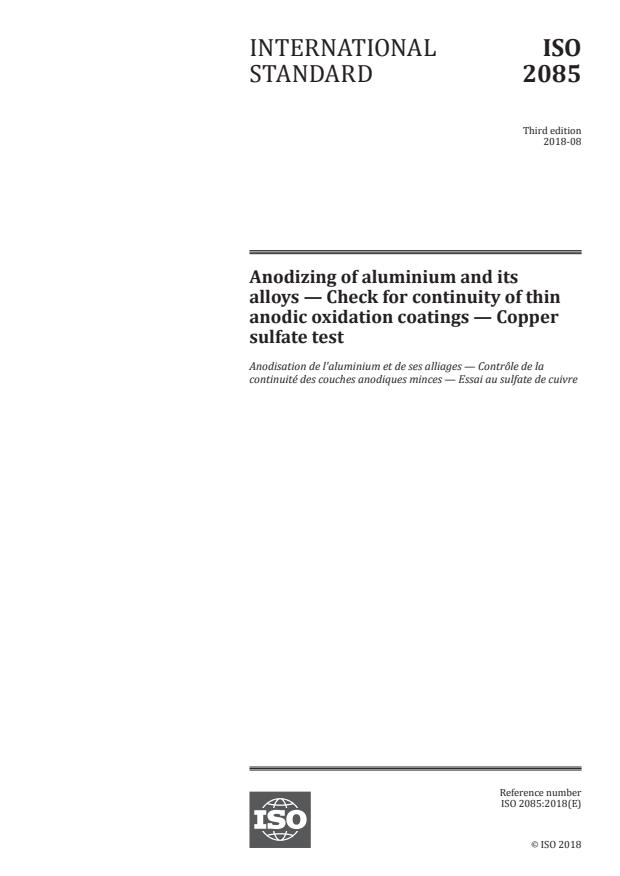
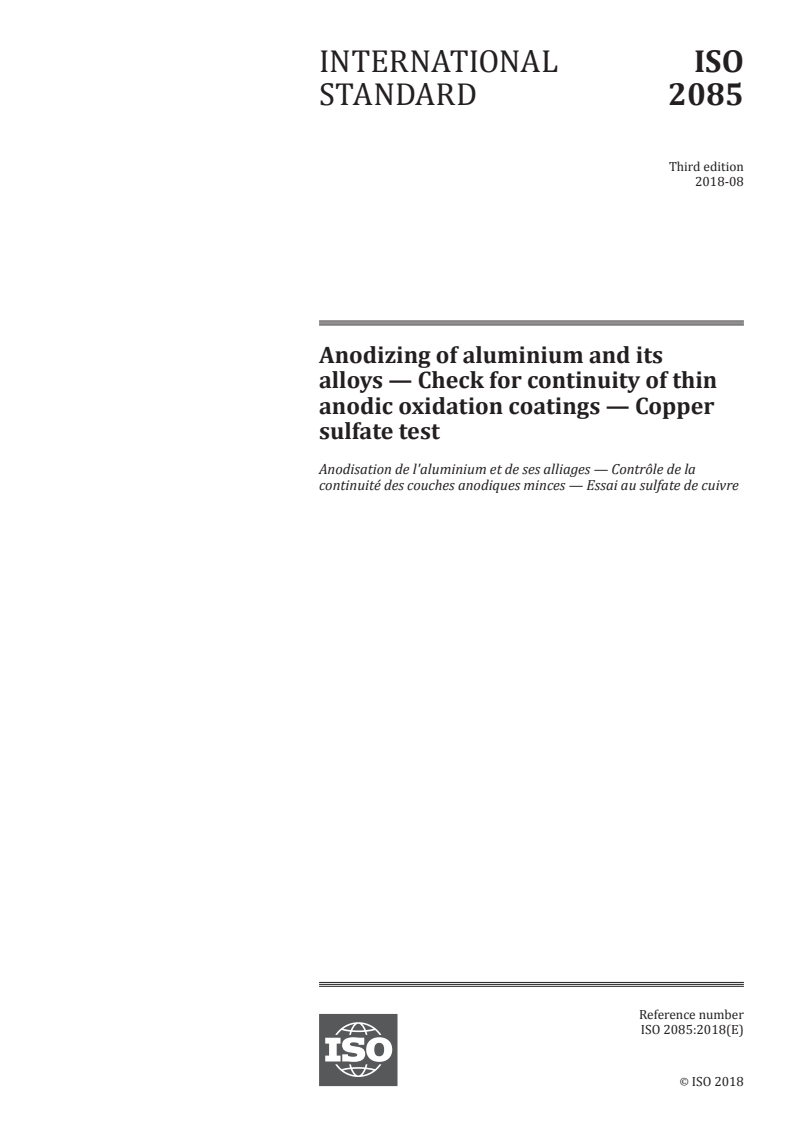
INTERNATIONAL ISO
STANDARD 2085
Third edition
2018-08
Anodizing of aluminium and its
alloys — Check for continuity of thin
anodic oxidation coatings — Copper
sulfate test
Anodisation de l'aluminium et de ses alliages — Contrôle de la
continuité des couches anodiques minces — Essai au sulfate de cuivre
Reference number
©
ISO 2018
© ISO 2018
All rights reserved. Unless otherwise specified, or required in the context of its implementation, no part of this publication may
be reproduced or utilized otherwise in any form or by any means, electronic or mechanical, including photocopying, or posting
on the internet or an intranet, without prior written permission. Permission can be requested from either ISO at the address
below or ISO’s member body in the country of the requester.
ISO copyright office
CP 401 • Ch. de Blandonnet 8
CH-1214 Vernier, Geneva
Phone: +41 22 749 01 11
Fax: +41 22 749 09 47
Email: copyright@iso.org
Website: www.iso.org
Published in Switzerland
ii © ISO 2018 – All rights reserved
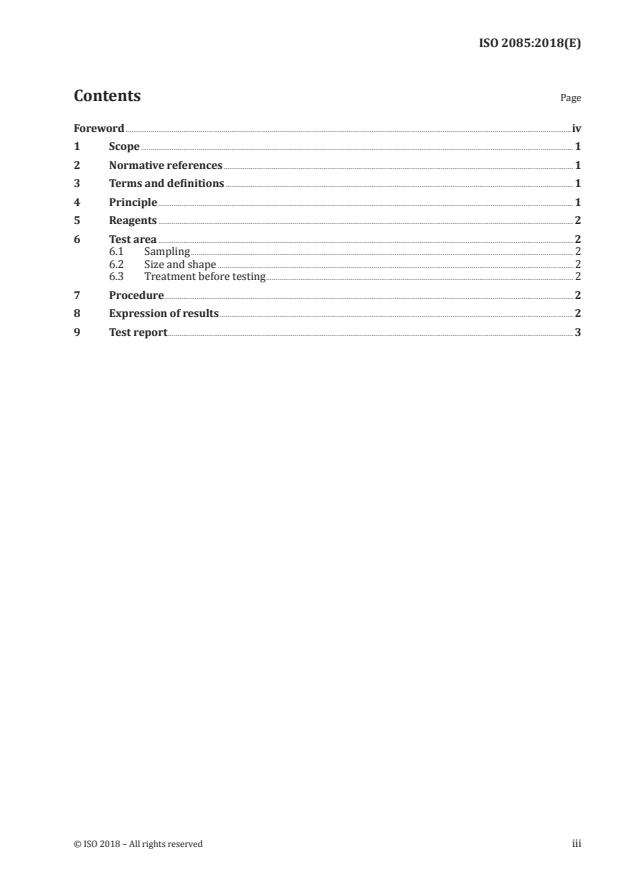
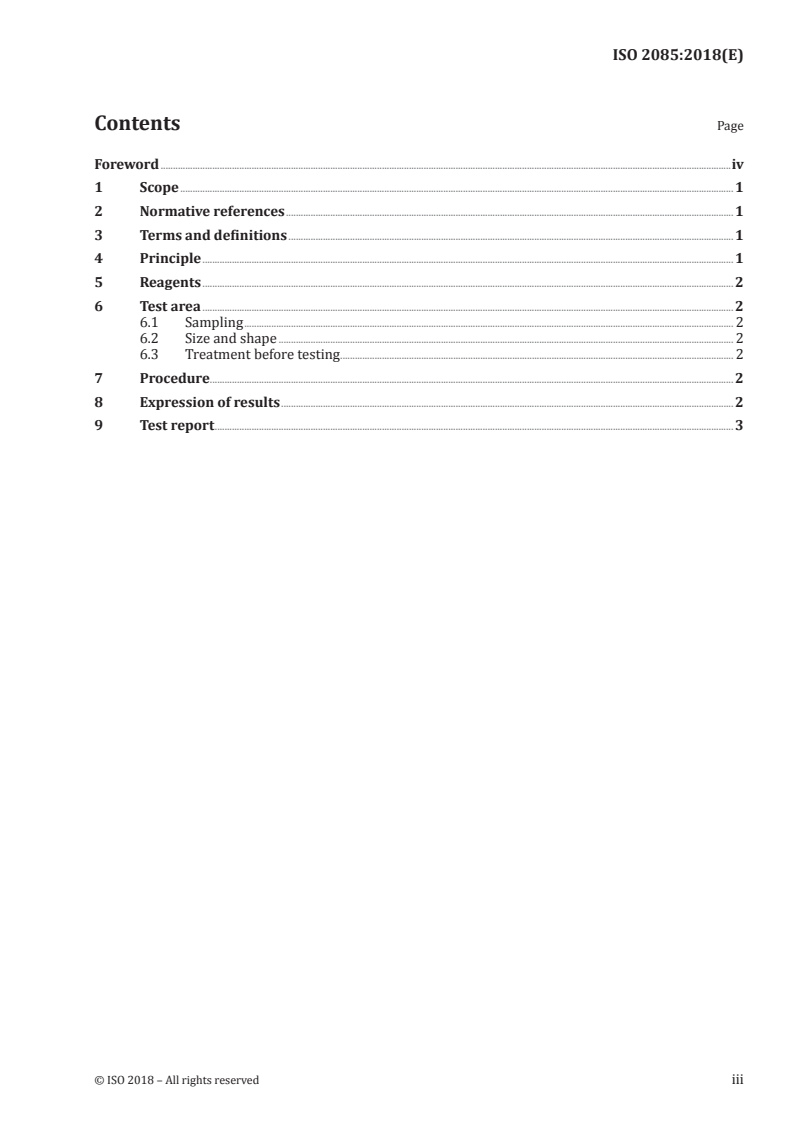
Contents Page
Foreword .iv
1 Scope . 1
2 Normative references . 1
3 Terms and definitions . 1
4 Principle . 1
5 Reagents . 2
6 Test area . 2
6.1 Sampling . 2
6.2 Size and shape . 2
6.3 Treatment before testing . 2
7 Procedure. 2
8 Expression of results . 2
9 Test report . 3
Foreword
ISO (the International Organization for Standardization) is a worldwide federation of national standards
bodies (ISO member bodies). The work of preparing International Standards is normally carried out
through ISO technical committees. Each member body interested in a subject for which a technical
committee has been established has the right to be represented on that committee. International
organizations, governmental and non-governmental, in liaison with ISO, also take part in the work.
ISO collaborates closely with the International Electrotechnical Commission (IEC) on all matters of
electrotechnical standardization.
The procedures used to develop this document and those intended for its further maintenance are
described in the ISO/IEC Directives, Part 1. In particular, the different approval criteria needed for the
different types of ISO documents should be noted. This document was drafted in accordance with the
editorial rules of the ISO/IEC Directives, Part 2 (see www .iso .org/directives).
Attention is drawn to the possibility that some of the elements of this document may be the subject of
patent rights. ISO shall not be held responsible for identifying any or all such patent rights. Details of
any patent rights identified during the development of the document will be in the Introduction and/or
on the ISO list of patent declarations received (see www .iso .org/patents).
Any trade name used in this document is information given for the convenience of users and does not
constitute an endorsement.
For an explanation of the voluntary nature of standards, the meaning of ISO specific terms and
expressions related to conformity assessment, as well as information about ISO’s adherence to the
World Trade Organization (WTO) principles in the Technical Barriers to Trade (TBT) see www .i
...
INTERNATIONAL ISO
STANDARD 2085
Third edition
2018-08
Anodizing of aluminium and its
alloys — Check for continuity of thin
anodic oxidation coatings — Copper
sulfate test
Anodisation de l'aluminium et de ses alliages — Contrôle de la
continuité des couches anodiques minces — Essai au sulfate de cuivre
Reference number
©
ISO 2018
© ISO 2018
All rights reserved. Unless otherwise specified, or required in the context of its implementation, no part of this publication may
be reproduced or utilized otherwise in any form or by any means, electronic or mechanical, including photocopying, or posting
on the internet or an intranet, without prior written permission. Permission can be requested from either ISO at the address
below or ISO’s member body in the country of the requester.
ISO copyright office
CP 401 • Ch. de Blandonnet 8
CH-1214 Vernier, Geneva
Phone: +41 22 749 01 11
Fax: +41 22 749 09 47
Email: copyright@iso.org
Website: www.iso.org
Published in Switzerland
ii © ISO 2018 – All rights reserved
Contents Page
Foreword .iv
1 Scope . 1
2 Normative references . 1
3 Terms and definitions . 1
4 Principle . 1
5 Reagents . 2
6 Test area . 2
6.1 Sampling . 2
6.2 Size and shape . 2
6.3 Treatment before testing . 2
7 Procedure. 2
8 Expression of results . 2
9 Test report . 3
Foreword
ISO (the International Organization for Standardization) is a worldwide federation of national standards
bodies (ISO member bodies). The work of preparing International Standards is normally carried out
through ISO technical committees. Each member body interested in a subject for which a technical
committee has been established has the right to be represented on that committee. International
organizations, governmental and non-governmental, in liaison with ISO, also take part in the work.
ISO collaborates closely with the International Electrotechnical Commission (IEC) on all matters of
electrotechnical standardization.
The procedures used to develop this document and those intended for its further maintenance are
described in the ISO/IEC Directives, Part 1. In particular, the different approval criteria needed for the
different types of ISO documents should be noted. This document was drafted in accordance with the
editorial rules of the ISO/IEC Directives, Part 2 (see www .iso .org/directives).
Attention is drawn to the possibility that some of the elements of this document may be the subject of
patent rights. ISO shall not be held responsible for identifying any or all such patent rights. Details of
any patent rights identified during the development of the document will be in the Introduction and/or
on the ISO list of patent declarations received (see www .iso .org/patents).
Any trade name used in this document is information given for the convenience of users and does not
constitute an endorsement.
For an explanation of the voluntary nature of standards, the meaning of ISO specific terms and
expressions related to conformity assessment, as well as information about ISO’s adherence to the
World Trade Organization (WTO) principles in the Technical Barriers to Trade (TBT) see www .i
...
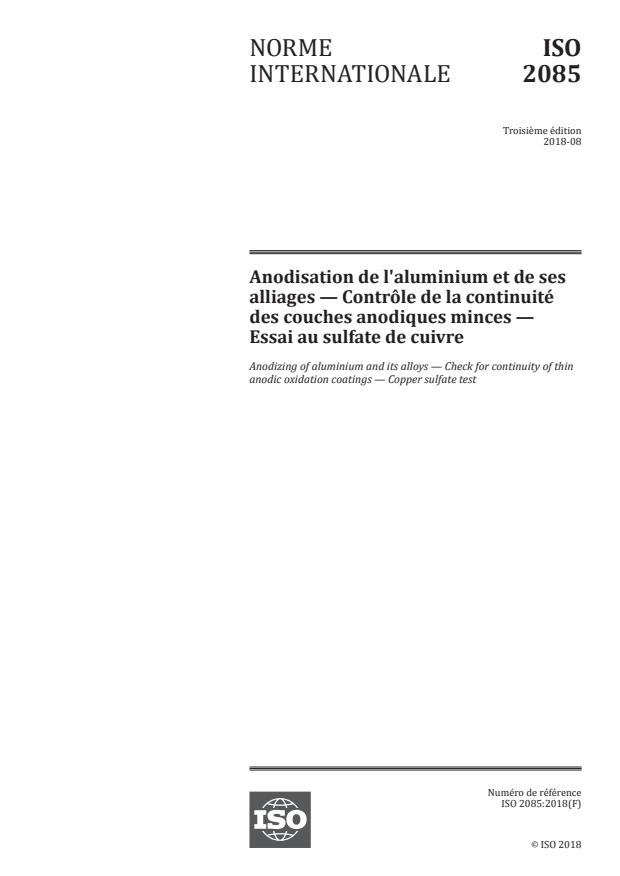
NORME ISO
INTERNATIONALE 2085
Troisième édition
2018-08
Anodisation de l'aluminium et de ses
alliages — Contrôle de la continuité
des couches anodiques minces —
Essai au sulfate de cuivre
Anodizing of aluminium and its alloys — Check for continuity of thin
anodic oxidation coatings — Copper sulfate test
Numéro de référence
©
ISO 2018
DOCUMENT PROTÉGÉ PAR COPYRIGHT
© ISO 2018
Tous droits réservés. Sauf prescription différente ou nécessité dans le contexte de sa mise en œuvre, aucune partie de cette
publication ne peut être reproduite ni utilisée sous quelque forme que ce soit et par aucun procédé, électronique ou mécanique,
y compris la photocopie, ou la diffusion sur l’internet ou sur un intranet, sans autorisation écrite préalable. Une autorisation peut
être demandée à l’ISO à l’adresse ci-après ou au comité membre de l’ISO dans le pays du demandeur.
ISO copyright office
Case postale 401 • Ch. de Blandonnet 8
CH-1214 Vernier, Genève
Tél.: +41 22 749 01 11
Fax: +41 22 749 09 47
E-mail: copyright@iso.org
Web: www.iso.org
Publié en Suisse
ii © ISO 2018 – Tous droits réservés
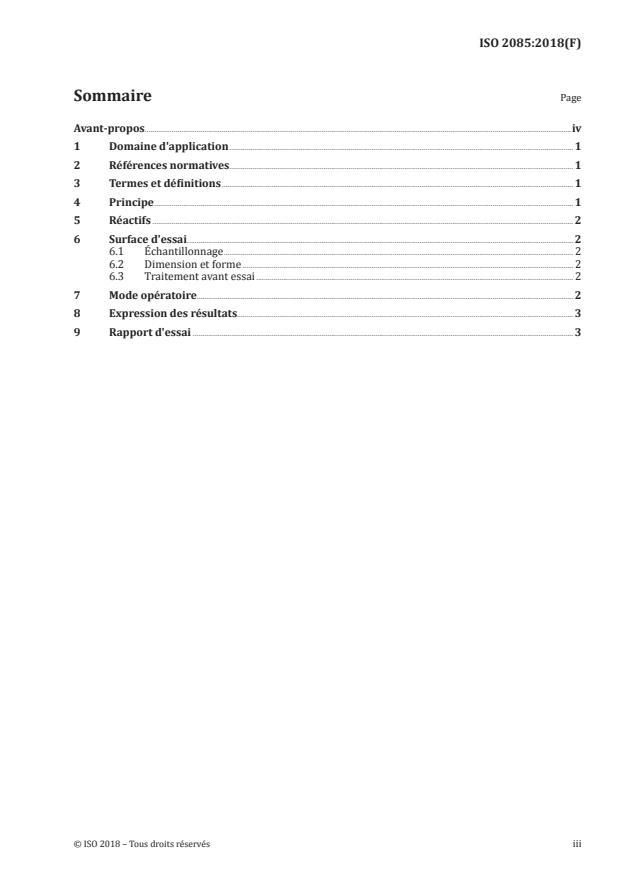
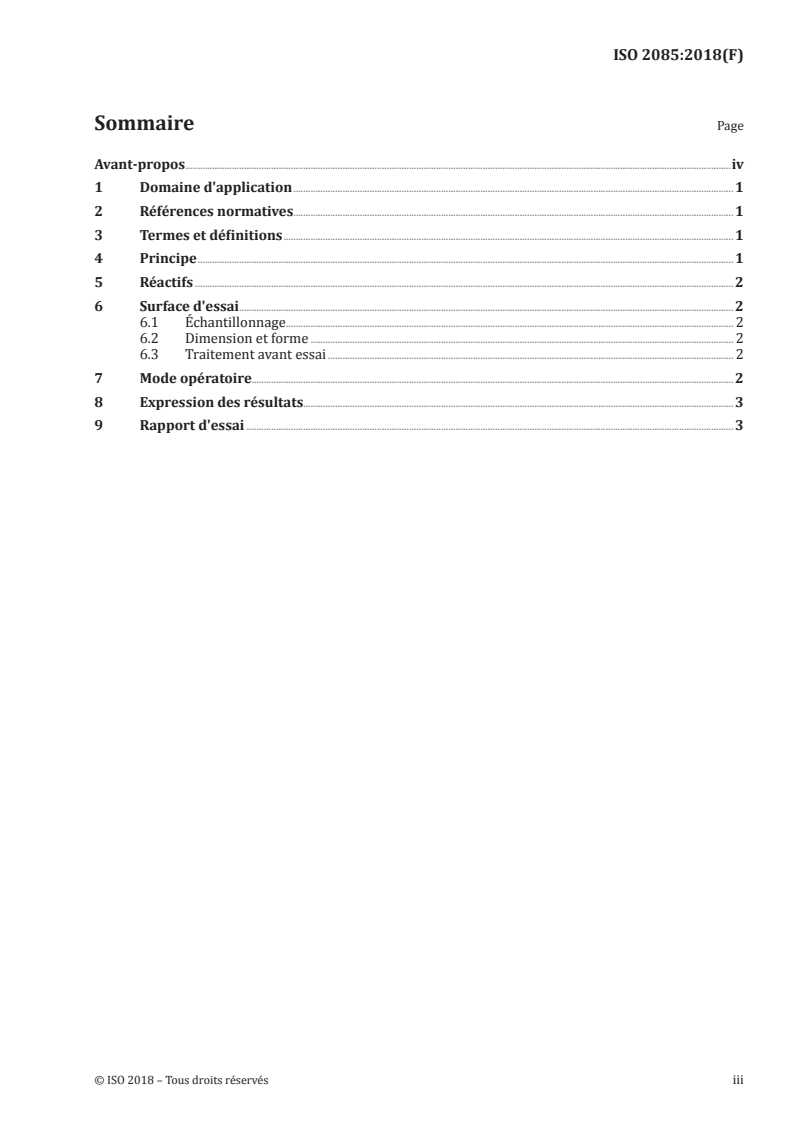
Sommaire Page
Avant-propos .iv
1 Domaine d'application . 1
2 Références normatives . 1
3 Termes et définitions . 1
4 Principe . 1
5 Réactifs . 2
6 Surface d'essai . 2
6.1 Échantillonnage . 2
6.2 Dimension et forme . 2
6.3 Traitement avant essai . 2
7 Mode opératoire. 2
8 Expression des résultats. 3
9 Rapport d'essai . 3
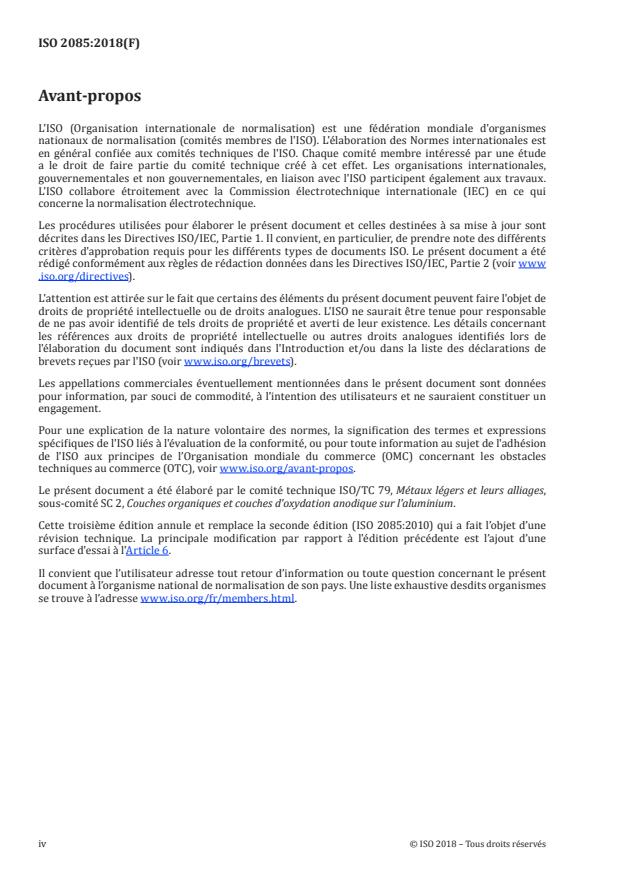
Avant-propos
L'ISO (Organisation internationale de normalisation) est une fédération mondiale d'organismes
nationaux de normalisation (comités membres de l'ISO). L'élaboration des Normes internationales est
en général confiée aux comités techniques de l'ISO. Chaque comité membre intéressé par une étude
a le droit de faire partie du comité technique créé à cet effet. Les organisations internationales,
gouvernementales et non gouvernementales, en liaison avec l'ISO participent également aux travaux.
L'ISO collabore étroitement avec la Commission électrotechnique internationale (IEC) en ce qui
concerne la normalisation électrotechnique.
Les procédures utilisées pour élaborer le présent document et celles destinées à sa mise à jour sont
décrites dans les Directives ISO/IEC, Partie 1. Il convient, en particulier, de prendre note des différents
critères d'approbation requis pour les différents types de documents ISO. Le présent document a été
rédigé conformément aux règles de rédaction données dans les Directives ISO/IEC, Partie 2 (voir www
.iso .org/directives).
L'attention est attirée sur le fait que certains des éléments du présent document peuvent faire l'objet de
droits de propriété intellectuelle ou de droits analogues. L'ISO ne saurait être tenue pour responsable
de ne pas avoir identifié de tels droits de propriété et averti de leur existence. Les détails concernant
les références aux droits de propriété intellectuelle ou autres droits analogues identifiés lors de
l'élaboration du document sont indiqués dans l'Introduction et/ou dans la liste des déclarations de
brevets reçues par l'ISO (voir www .iso .org/brevets).
Les appellations commerciales éventuellement mentionnées dans le présent document sont données
pour information, par souci de commodité, à l’intention des utilisateurs et ne sauraient constituer un
engagement.
Pour une explication de la nature volontaire des normes, la signification des termes et expressions
spécifiques de l'ISO liés à l'évaluation de la conformité, ou pour toute information au sujet de l'adhésion
de l'ISO aux principes de l’Organisation mondiale du commerce (OMC) concernant les obstacles
techniques au commerce (OTC), voir www .iso .org/avant -propos.
Le présent document a été élaboré par le comité technique ISO/TC 79, Métaux légers et leurs alliages,
sous-comité SC 2, Couches organiques et couc
...
NORME ISO
INTERNATIONALE 2085
Troisième édition
2018-08
Anodisation de l'aluminium et de ses
alliages — Contrôle de la continuité
des couches anodiques minces —
Essai au sulfate de cuivre
Anodizing of aluminium and its alloys — Check for continuity of thin
anodic oxidation coatings — Copper sulfate test
Numéro de référence
©
ISO 2018
DOCUMENT PROTÉGÉ PAR COPYRIGHT
© ISO 2018
Tous droits réservés. Sauf prescription différente ou nécessité dans le contexte de sa mise en œuvre, aucune partie de cette
publication ne peut être reproduite ni utilisée sous quelque forme que ce soit et par aucun procédé, électronique ou mécanique,
y compris la photocopie, ou la diffusion sur l’internet ou sur un intranet, sans autorisation écrite préalable. Une autorisation peut
être demandée à l’ISO à l’adresse ci-après ou au comité membre de l’ISO dans le pays du demandeur.
ISO copyright office
Case postale 401 • Ch. de Blandonnet 8
CH-1214 Vernier, Genève
Tél.: +41 22 749 01 11
Fax: +41 22 749 09 47
E-mail: copyright@iso.org
Web: www.iso.org
Publié en Suisse
ii © ISO 2018 – Tous droits réservés
Sommaire Page
Avant-propos .iv
1 Domaine d'application . 1
2 Références normatives . 1
3 Termes et définitions . 1
4 Principe . 1
5 Réactifs . 2
6 Surface d'essai . 2
6.1 Échantillonnage . 2
6.2 Dimension et forme . 2
6.3 Traitement avant essai . 2
7 Mode opératoire. 2
8 Expression des résultats. 3
9 Rapport d'essai . 3
Avant-propos
L'ISO (Organisation internationale de normalisation) est une fédération mondiale d'organismes
nationaux de normalisation (comités membres de l'ISO). L'élaboration des Normes internationales est
en général confiée aux comités techniques de l'ISO. Chaque comité membre intéressé par une étude
a le droit de faire partie du comité technique créé à cet effet. Les organisations internationales,
gouvernementales et non gouvernementales, en liaison avec l'ISO participent également aux travaux.
L'ISO collabore étroitement avec la Commission électrotechnique internationale (IEC) en ce qui
concerne la normalisation électrotechnique.
Les procédures utilisées pour élaborer le présent document et celles destinées à sa mise à jour sont
décrites dans les Directives ISO/IEC, Partie 1. Il convient, en particulier, de prendre note des différents
critères d'approbation requis pour les différents types de documents ISO. Le présent document a été
rédigé conformément aux règles de rédaction données dans les Directives ISO/IEC, Partie 2 (voir www
.iso .org/directives).
L'attention est attirée sur le fait que certains des éléments du présent document peuvent faire l'objet de
droits de propriété intellectuelle ou de droits analogues. L'ISO ne saurait être tenue pour responsable
de ne pas avoir identifié de tels droits de propriété et averti de leur existence. Les détails concernant
les références aux droits de propriété intellectuelle ou autres droits analogues identifiés lors de
l'élaboration du document sont indiqués dans l'Introduction et/ou dans la liste des déclarations de
brevets reçues par l'ISO (voir www .iso .org/brevets).
Les appellations commerciales éventuellement mentionnées dans le présent document sont données
pour information, par souci de commodité, à l’intention des utilisateurs et ne sauraient constituer un
engagement.
Pour une explication de la nature volontaire des normes, la signification des termes et expressions
spécifiques de l'ISO liés à l'évaluation de la conformité, ou pour toute information au sujet de l'adhésion
de l'ISO aux principes de l’Organisation mondiale du commerce (OMC) concernant les obstacles
techniques au commerce (OTC), voir www .iso .org/avant -propos.
Le présent document a été élaboré par le comité technique ISO/TC 79, Métaux légers et leurs alliages,
sous-comité SC 2, Couches organiques et couc
...