

ISO 1812:1976
(Main)Copper alloys — Determination of iron content — 1,10- Phenanthroline spectrophotometric method
General Information
- Abstract
The method is applicable to the determination of iron contents up to 0.4 % (m/m) in any of the copper alloys listed in ISO publications. ISO 1812 specifies principle, reagents, apparatus, sampling, procedure, expression of results and test report.
- Status
- Published
- Publication Date
- 31-Oct-1976
- Technical Committee
- ISO/TC 26 - Copper and copper alloys
- Drafting Committee
- ISO/TC 26 - Copper and copper alloys
- Current Stage
- 9093 - International Standard confirmed
- Start Date
- 31-Dec-2024
- Completion Date
- 29-Aug-2026
Buy Documents

ISO 1812:1976 - Copper alloys -- Determination of iron content -- 1,10- Phenanthroline spectrophotometric method
ISO 1812:1976 - Copper alloys — Determination of iron content — 1,10- Phenanthroline spectrophotometric method/1/1976
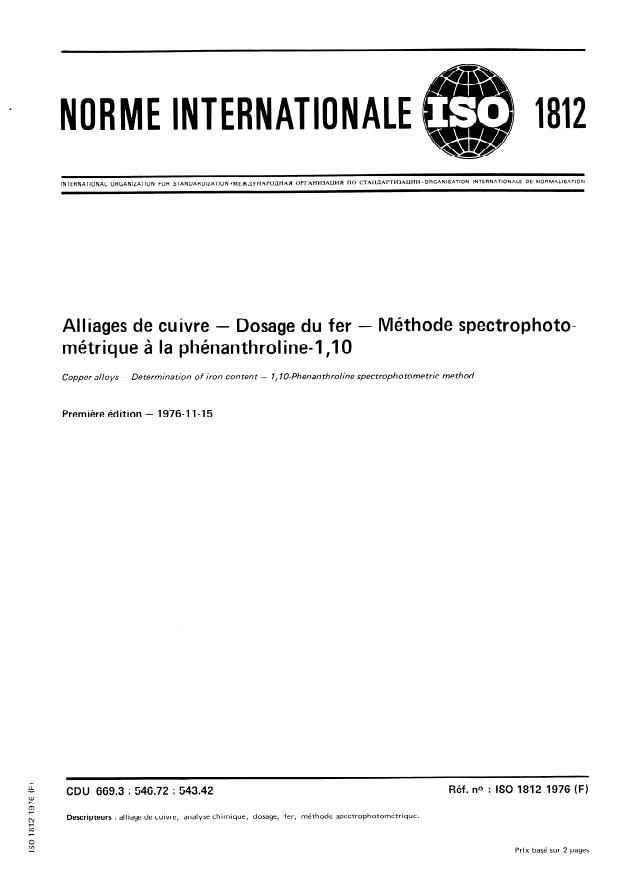

ISO 1812:1976 - Alliages de cuivre -- Dosage du fer -- Méthode spectrophotométrique a la phénanthroline -1,10
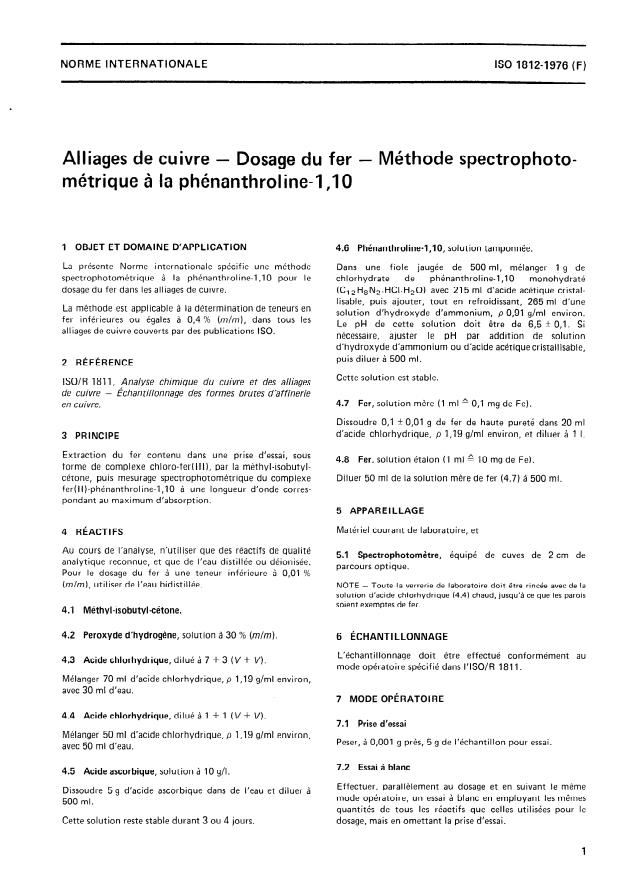

ISO 1812:1976 - Alliages de cuivre -- Dosage du fer -- Méthode spectrophotométrique a la phénanthroline -1,10
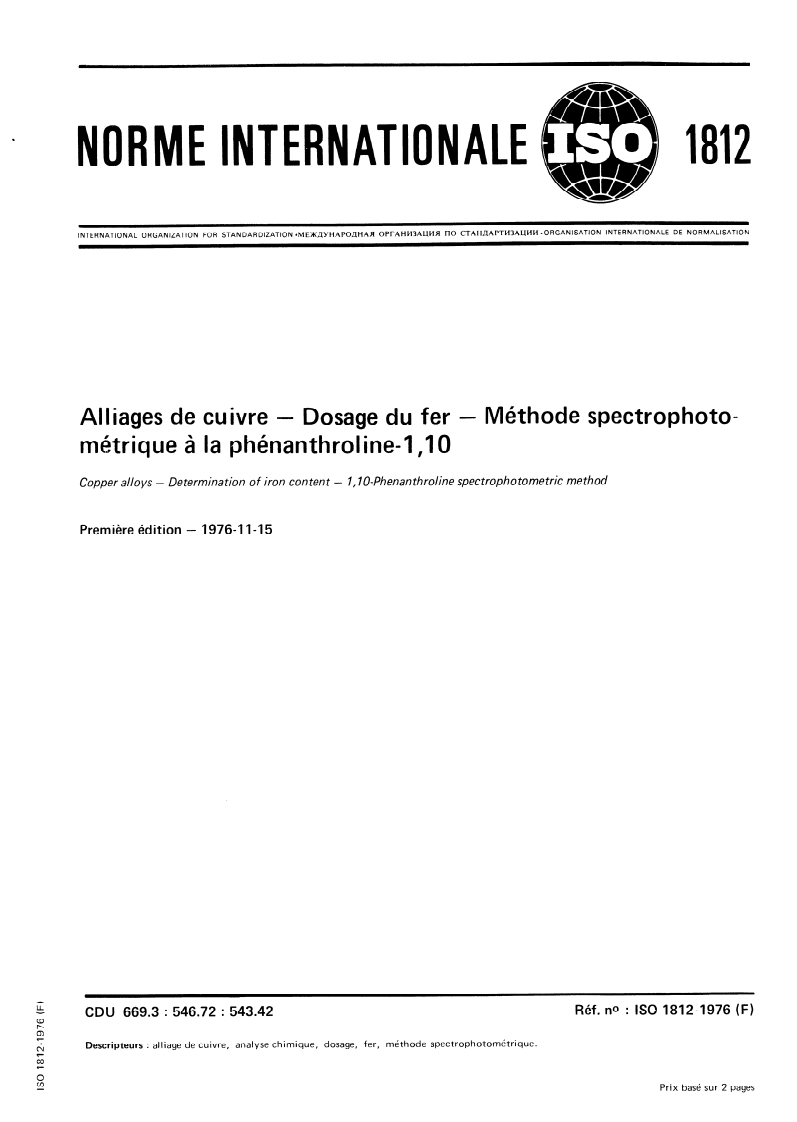
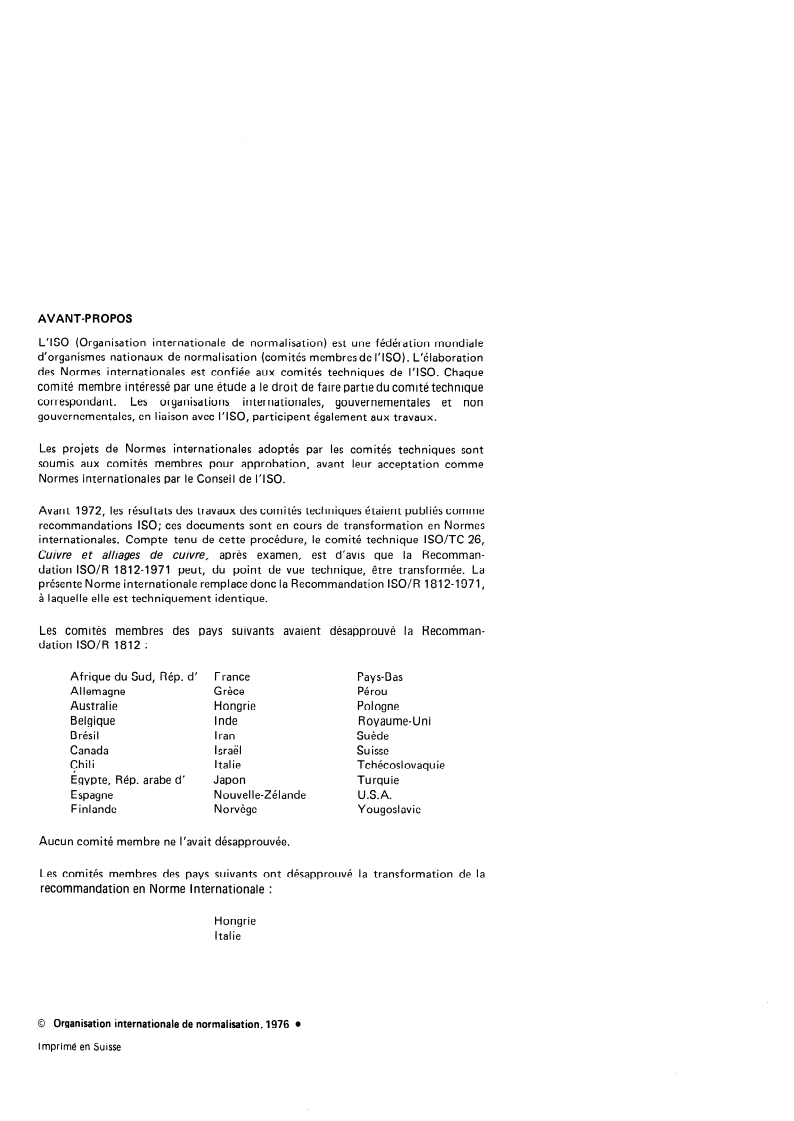
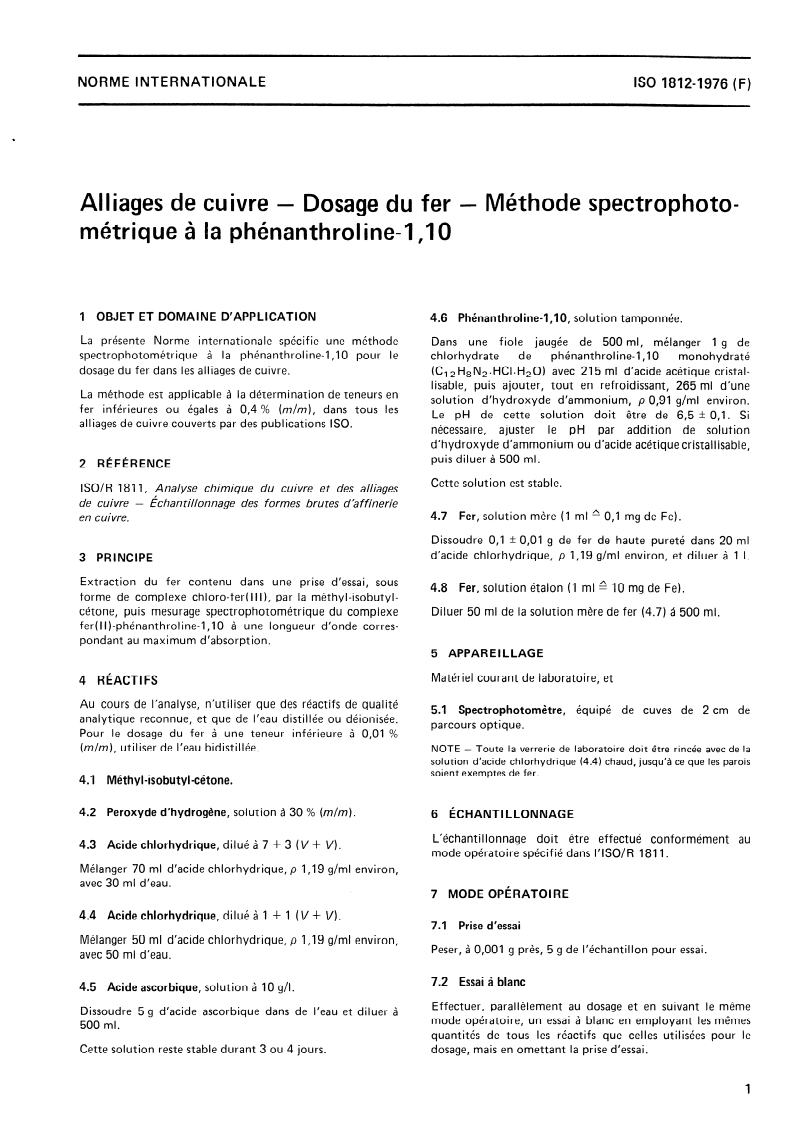
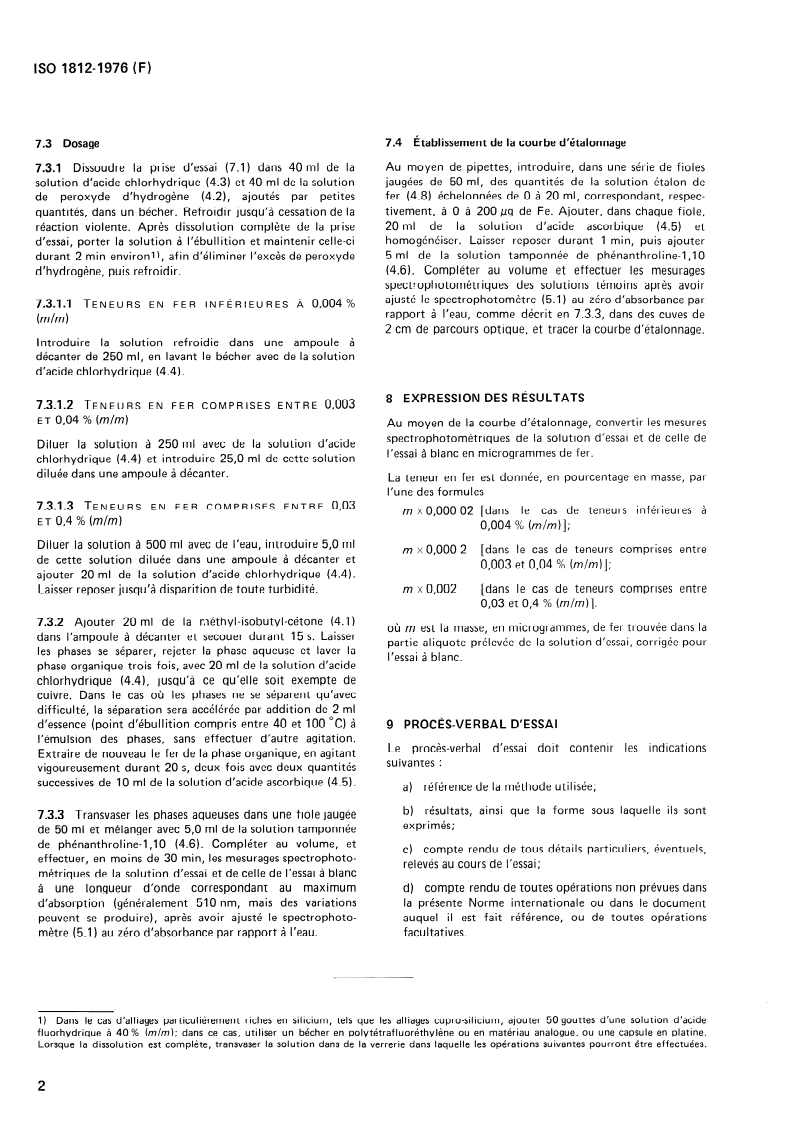
ISO 1812:1976 - Alliages de cuivre — Dosage du fer — Méthode spectrophotométrique à la phénanthroline -1,10/1/1976
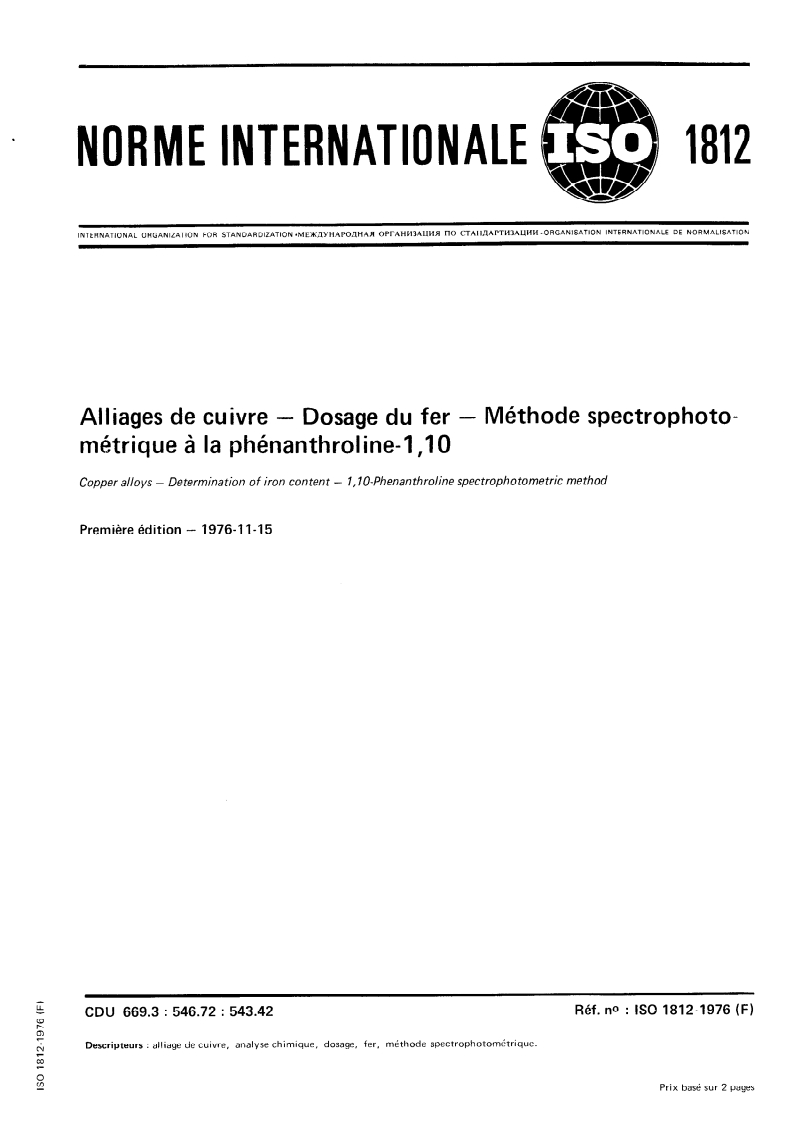
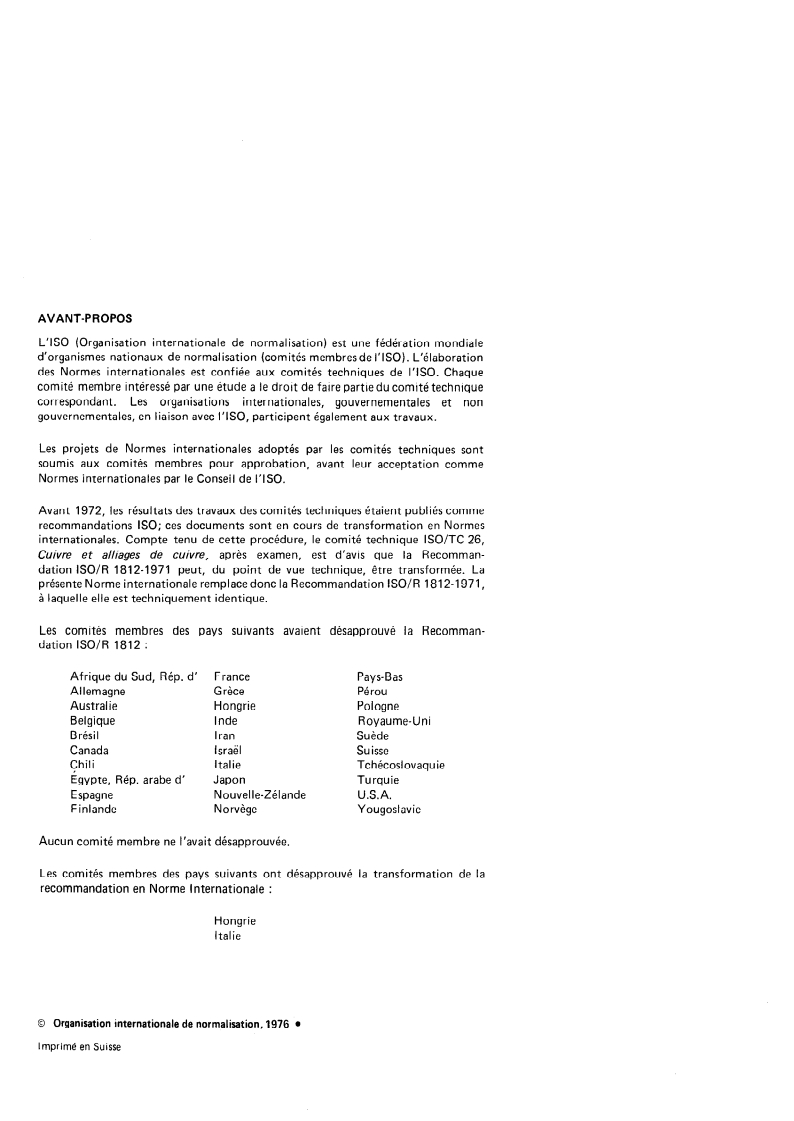
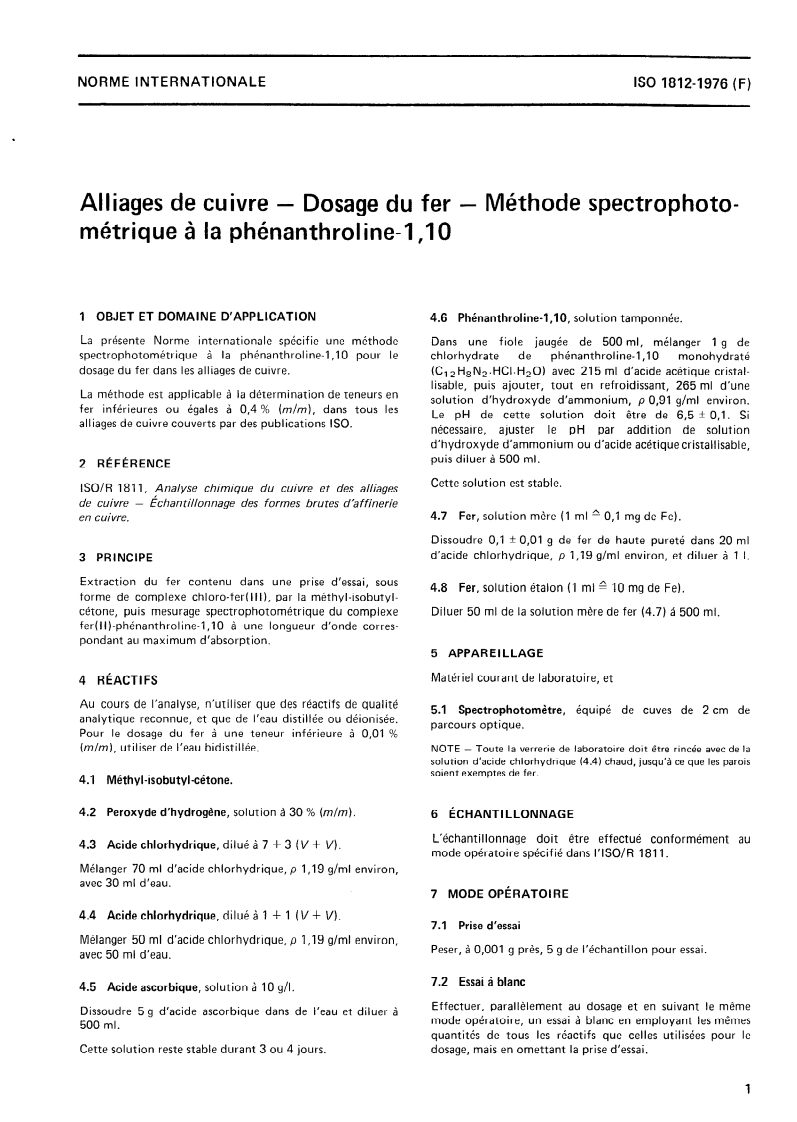
ISO 1812:1976 - Alliages de cuivre — Dosage du fer — Méthode spectrophotométrique à la phénanthroline -1,10/1/1976
Overview
ISO 1812:1976 specifies a spectrophotometric method for determining iron content in copper alloys using the 1,10‑phenanthroline reagent. The procedure is applicable to iron concentrations up to 0.4 % (m/m) and defines principle, reagents, apparatus, sampling, analytical procedure, calibration and reporting requirements. The method is routinely used in chemical analysis and quality control of copper and copper‑alloy products.
Key topics and technical requirements
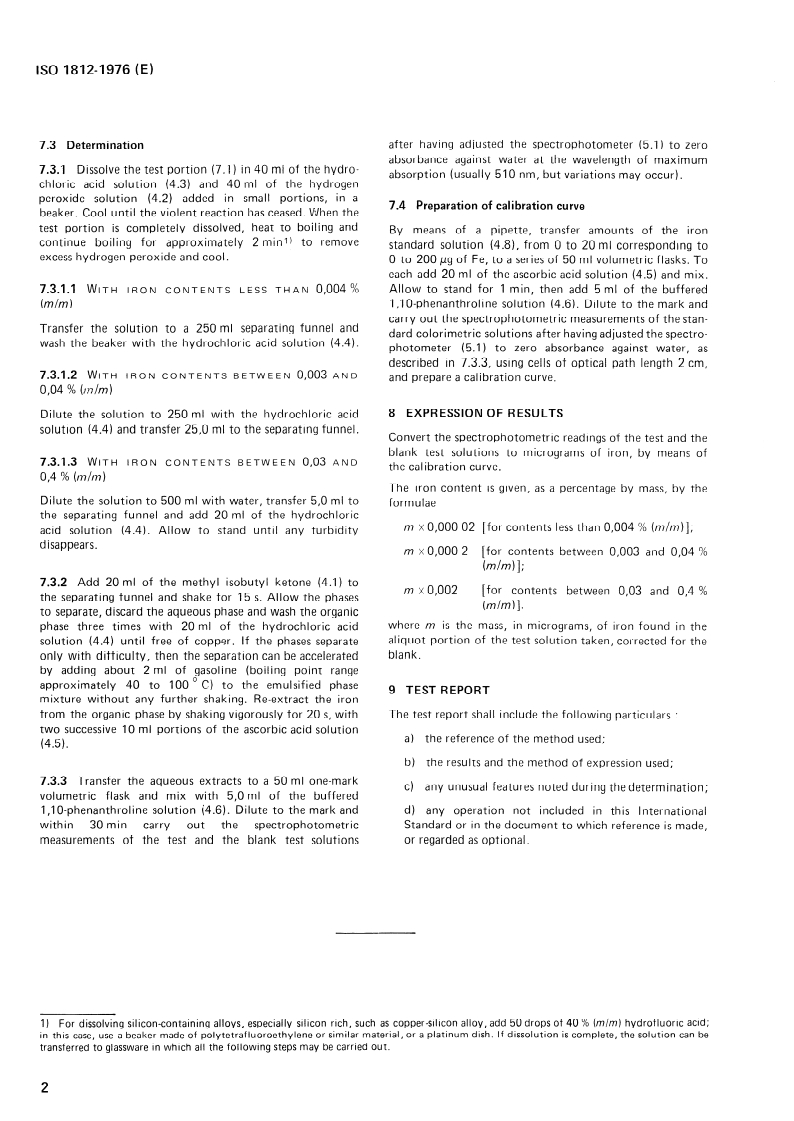
- Scope and principle: Extraction of iron as an iron(III)‑chloro complex into an organic phase, reduction and formation of the iron(II)–1,10‑phenanthroline coloured complex, and spectrophotometric measurement at the wavelength of maximum absorption (typically ~510 nm).
- Detection range: Valid for iron contents from trace levels up to 0.4 % (m/m), with recommended aliquots and dilutions for different concentration ranges.
- Reagents: Uses methyl isobutyl ketone (MIBK) for extraction, hydrochloric acid (various concentrations) for dissolution and phase washes, hydrogen peroxide for sample digestion, ascorbic acid as a reducing agent, and a buffered 1,10‑phenanthroline solution (pH ≈ 6.5 ± 0.1).
- Apparatus: Ordinary laboratory glassware and a spectrophotometer with 2 cm optical path cells.
- Calibration and blanks: Preparation of iron standard solutions and a calibration curve (0–200 µg Fe) is required; a blank test must be run in parallel and used to correct results.
- Procedure highlights: Dissolve the test portion (typically 5 g) with HCl and H2O2, extract iron into MIBK, re‑extract into aqueous ascorbic acid, form the phenanthroline complex and measure absorbance within 30 minutes.
- Expression of results: Results are calculated and reported as % m/m iron using specified multiplication factors according to the aliquot and dilution used.
Applications and users
This standard is relevant for:
- Quality control laboratories in copper refineries and foundries
- Metallurgical and materials testing laboratories performing chemical analysis of copper alloys
- Manufacturers and purchasers verifying alloy composition and impurity levels
- Regulatory or conformity assessment bodies requiring standardized test data
Practical uses include verifying iron impurities that affect electrical, mechanical or corrosion properties of copper alloys, and supporting material certification and acceptance testing.
Related standards
- ISO/R 1811 - Chemical analysis of copper and copper alloys: Sampling of copper refinery shapes (referenced for sampling procedure)
- Developed under ISO/TC 26 (Copper and copper alloys)
Keywords: ISO 1812, copper alloys, iron content, 1,10‑phenanthroline, spectrophotometric method, chemical analysis, methyl isobutyl ketone, calibration curve, spectrophotometer.
Buy Documents
ISO 1812:1976 - Copper alloys -- Determination of iron content -- 1,10- Phenanthroline spectrophotometric method
ISO 1812:1976 - Copper alloys — Determination of iron content — 1,10- Phenanthroline spectrophotometric method/1/1976
ISO 1812:1976 - Alliages de cuivre -- Dosage du fer -- Méthode spectrophotométrique a la phénanthroline -1,10
ISO 1812:1976 - Alliages de cuivre -- Dosage du fer -- Méthode spectrophotométrique a la phénanthroline -1,10
ISO 1812:1976 - Alliages de cuivre — Dosage du fer — Méthode spectrophotométrique à la phénanthroline -1,10/1/1976
ISO 1812:1976 - Alliages de cuivre — Dosage du fer — Méthode spectrophotométrique à la phénanthroline -1,10/1/1976
Get Certified
Connect with accredited certification bodies for this standard

Element Materials Technology
Materials testing and product certification.

Inštitut za kovinske materiale in tehnologije
Institute of Metals and Technology. Materials testing, metallurgical analysis, NDT.
Sponsored listings
Frequently Asked Questions
ISO 1812:1976 is a standard published by the International Organization for Standardization (ISO). Its full title is "Copper alloys — Determination of iron content — 1,10- Phenanthroline spectrophotometric method". This standard covers: The method is applicable to the determination of iron contents up to 0.4 % (m/m) in any of the copper alloys listed in ISO publications. ISO 1812 specifies principle, reagents, apparatus, sampling, procedure, expression of results and test report.
The method is applicable to the determination of iron contents up to 0.4 % (m/m) in any of the copper alloys listed in ISO publications. ISO 1812 specifies principle, reagents, apparatus, sampling, procedure, expression of results and test report.
ISO 1812:1976 is classified under the following ICS (International Classification for Standards) categories: 77.120.30 - Copper and copper alloys. The ICS classification helps identify the subject area and facilitates finding related standards.
ISO 1812:1976 is available in PDF format for immediate download after purchase. The document can be added to your cart and obtained through the secure checkout process. Digital delivery ensures instant access to the complete standard document.
Standards Content (Sample)
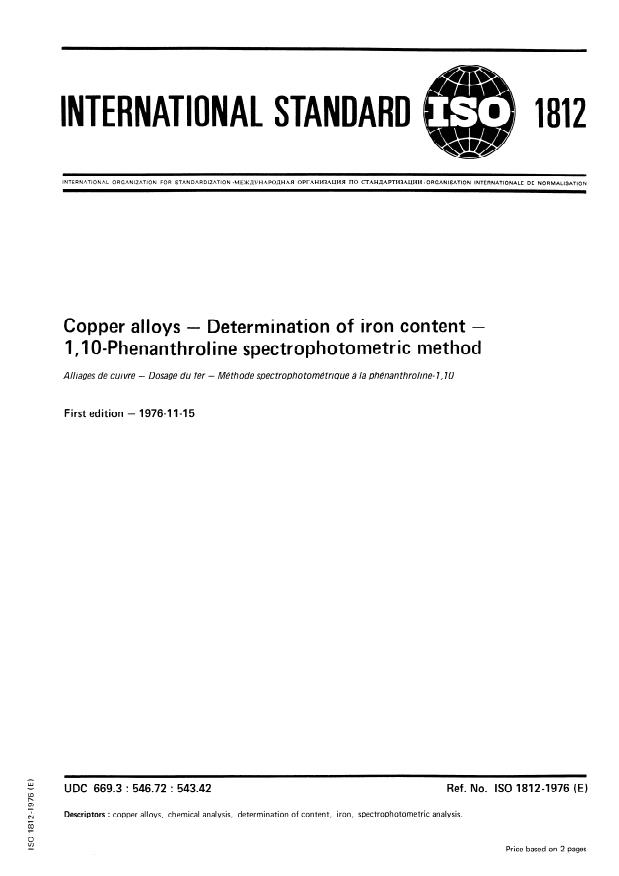
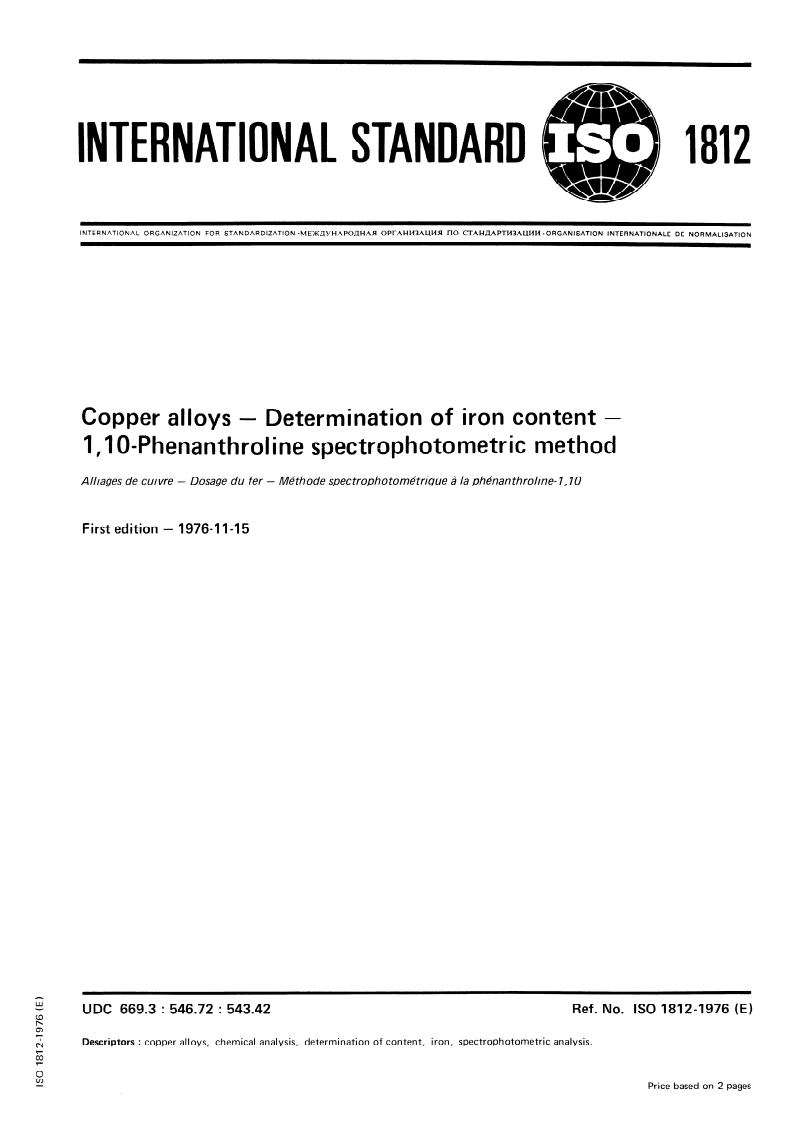
INTERNATIONAL STANDARD
INTERNATIONAL ORGANIZATION FOR STANDARDIZATION l MEXHCLIYHAPOLZHAJl OPI-AHM3ALWW I-Io CTAHLIAPTM3AUMM~ORGANISATION INTERNATIONALE DE NORMALISATION
Copper alloys - Determination of iron content -
1 ,l O-Phenanthroline spectrophotometric method
Alliages de cuivre - Dosage du fer - Mgthode spectrophotomktrique 5 la ph@nanthroline-iJ0
First edition - 1976-11-15
UDC 669.3 : 546.72 : 543.42 Ref. No. ISO 1812-1976 (E)
iron, spectrophotometric analysis.
Descriptors : topper alloys, Chemical analysis, determination of content,
Price based on 2 pages
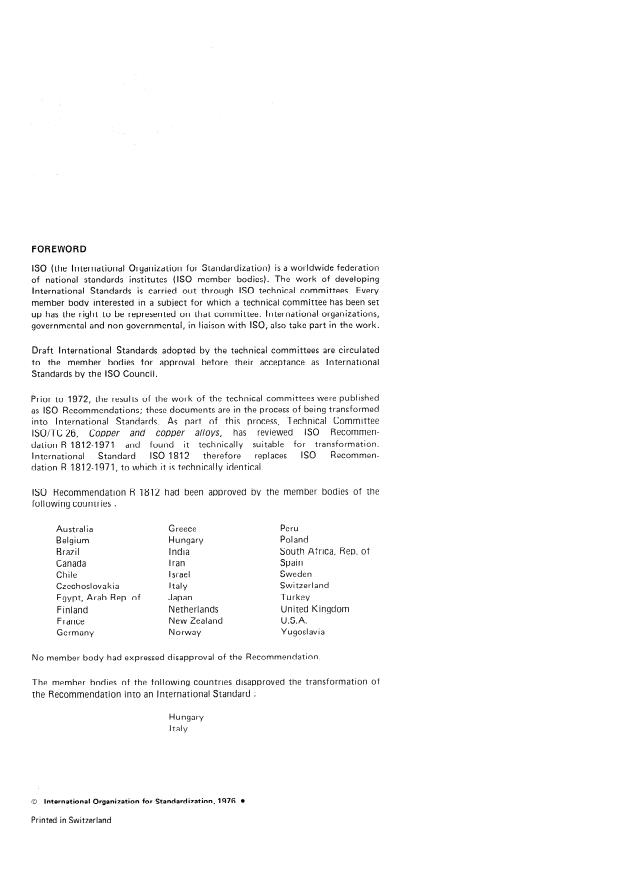
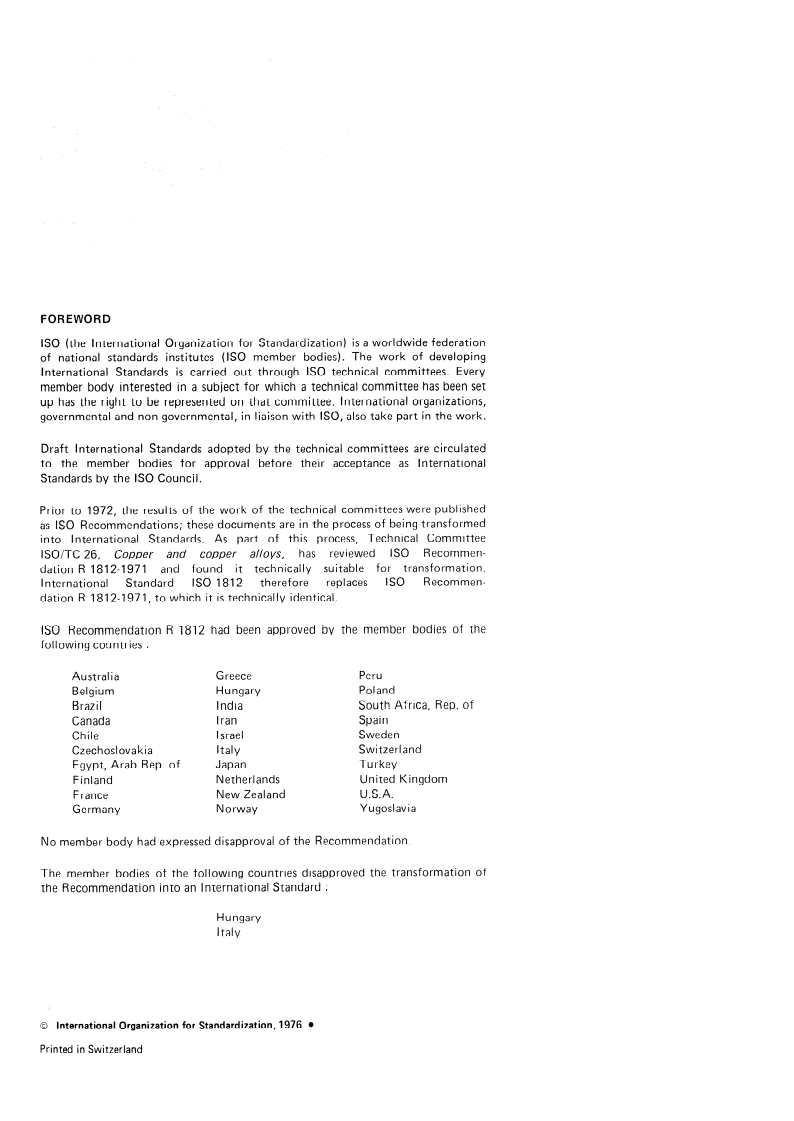
FOREWORD
ISO (the International Organization for Standardization) is a worldwide federation
of national Standards institutes (ISO member bodies). The work of developing
International Standards is carried out through ISO technical committees. Every
member body interested in a subject for which a technical committee has been set
up has the right to be represented on that committee. International organizations,
governmental and non-governmental, in liaison with ISO, also take part in the work.
Draft International Standards adopted by the technical committees are circulated
to the member bodies for approval before their acceptance as International
Standards by the ISO Council.
Prior to 1972, the results of the work of the technical committees were published
as ISO Recommendations; these documents are in the process of being transformed
into International Standards. As part of this process, Technical Committee
ISO/TC 26, Copper and topper alloys, has reviewed ISO Recommen-
dation R 1812-1971 and found it technically suitable for transformation.
replaces ISO Recommen-
l nternational Standard ISO 1812 therefore
dation R 1812-1971, to which it is technically identical.
ISO Recommendation R 1812 had been approved by the member bodies of the
following countries :
G reece Peru
Australia
Hungary Poland
Belgium
South Africa, Rep. of
India
Brazil
I ran Spain
Canada
I srael Sweden
Chile
Italy Switzerland
Czechoslovakia
Japan TU r key
Egypt, Arab Rep. of
Netherlands United Kingdom
Finland
New Zealand U.S.A.
France
Norway Yugoslavia
Germany
No member body had expressed disapproval of the Recommendation.
The member bodi es of the following C ountries disapp roved the transformation of
ndat ion into an Internat io nal Standard :
the Recomme
Hungary
Italy
@ International Organkation for Standardkation, 1976 l
Printed in Switzerland
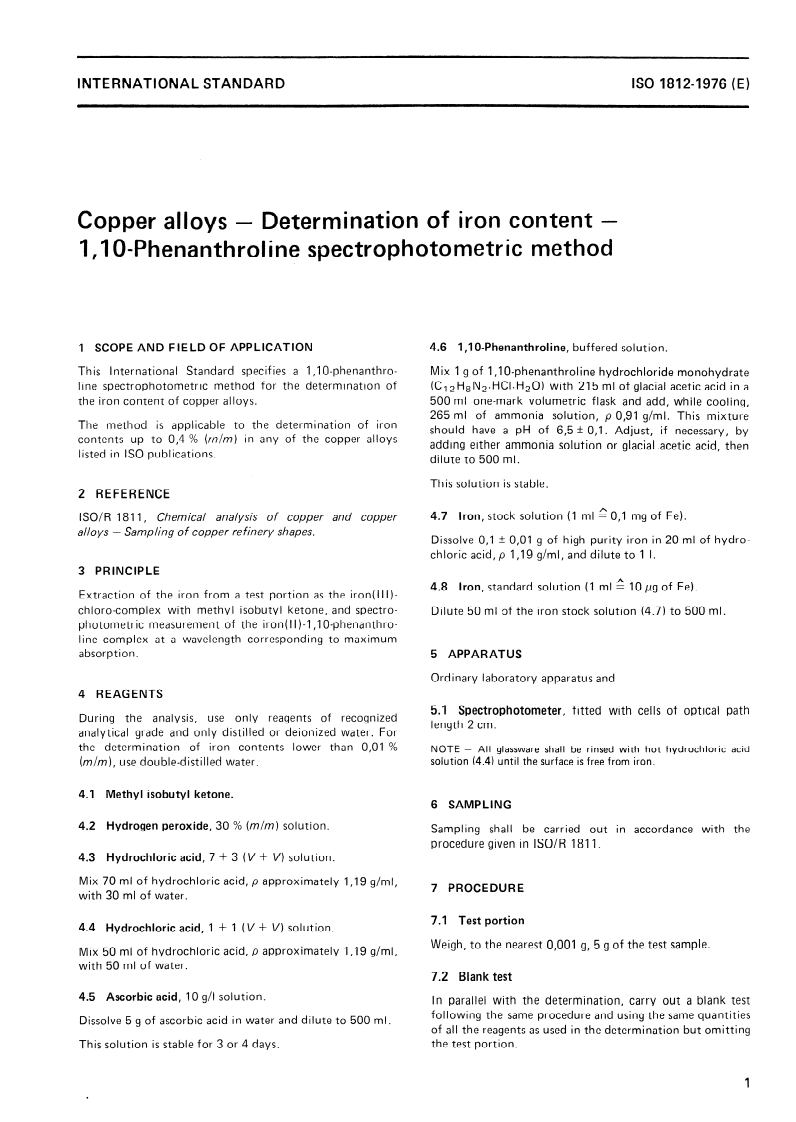
ISO 1812-1976 (E)
INTERNATIONAL STANDARD
Determination of iron content -
Copper alloys -
1 ,IO-Phenanthroline spectrophotometric method
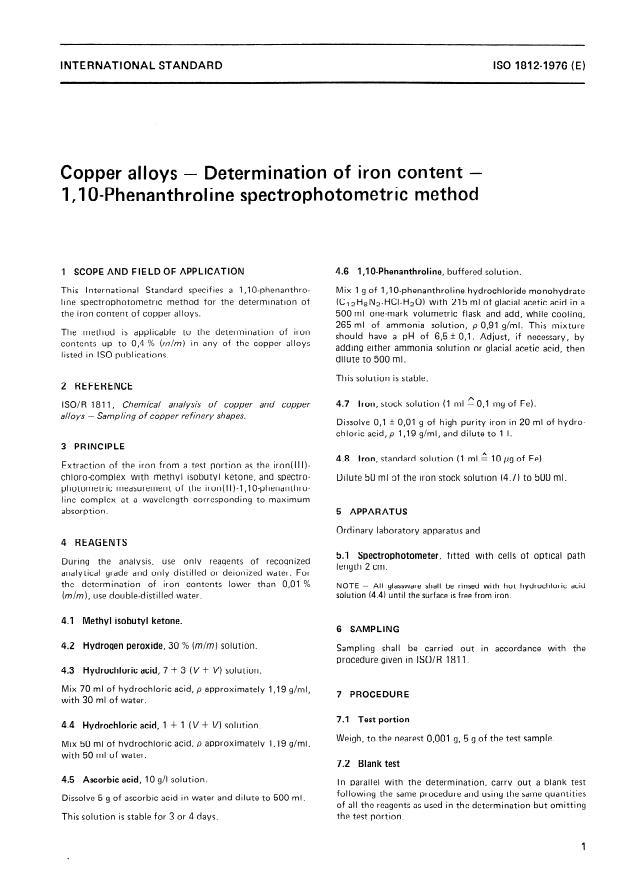
4.6 1 ,IO-Phenanthroline, buffered Solution.
‘1 SCOPE AND FIELD OF APPLICATION
This International Standard specifies a 1 ,lO-phenanthro- Mix 1 g of 1 ,IO-phenanthroline hydrochloride monohydrate
(C12H8N2.HCl.H20) with 215 ml of glacial acetic acid in a
line spectrophotometric method for the determination of
500 ml one-mark volumetric flask and add, while cooling,
the iron content of topper alloys.
265 ml of ammonia Solution, p 0,91 g/mI. This mixture
The method is applicable to the determination of iron
should have a pH of 6,5 + 0,l. Adjust, if necessary, by
contents up to 0,4 % (rn/m) in any of the topper alloys
adding either ammonia Solution or glacial .acetic acid, then
listed in ISO publications.
dilute to 500 ml.
This Solution is stable.
2 REFERENCE
4.7 Iron, stock solution (1 ml f 0,l mg of Fe).
ISOIR 1811, Chemical analysis of topper and topper
alloys - Sampling of topper refinery shapes.
Dissolve 0,l * 0,Ol g of high purity iron in 20 ml of hydro-
chloric acid, p 1,19 g/ml, and dilute to 1 1.
3 PRINCIPLE
4.8 Iron, Standard Solution (1 ml c 10 ,ug of Fe).
Extraction of the iron from a test Portion as the iron( II I)-
chloro-complex with methyl isobutyl ketone, and spectro- Dilute 50 ml of the iron stock Solution (4.7) to 500 ml.
photometric measurement of the iron( I I)-1 ,l O-phenanthro-
line complex at a wavelength corresponding to maximum
absorption. 5 APPARATUS
Ordinary laboratory apparatus and
4 REAGENTS
5.1 Spectrophotometer, fitted with cells of Optical path
During the analysis, use only reagents of recognized
length 2 cm.
analytical grade and only distilled or deionized water. For
the determination of iron contents lower than 0,Ol %
NOTE - All glassware shall be rinsed with hot hydrochloric acid
Solution (4.4) until the surface is free from iron.
(mlm), use double-distilled water.
4.1 Methyl isobutyl ketone.
6 SAMPLING
4.2 Hydrogen Peroxide, 30 % (mlm) solution.
Sampling shall be carried out in accordance with the
procedure given in lSO/R 1811.
4.3 Hydrochlorit acid, 7 + 3 (V + V) solution.
Mix 70 m
...
INTERNATIONAL STANDARD
INTERNATIONAL ORGANIZATION FOR STANDARDIZATION l MEXHCLIYHAPOLZHAJl OPI-AHM3ALWW I-Io CTAHLIAPTM3AUMM~ORGANISATION INTERNATIONALE DE NORMALISATION
Copper alloys - Determination of iron content -
1 ,l O-Phenanthroline spectrophotometric method
Alliages de cuivre - Dosage du fer - Mgthode spectrophotomktrique 5 la ph@nanthroline-iJ0
First edition - 1976-11-15
UDC 669.3 : 546.72 : 543.42 Ref. No. ISO 1812-1976 (E)
iron, spectrophotometric analysis.
Descriptors : topper alloys, Chemical analysis, determination of content,
Price based on 2 pages
FOREWORD
ISO (the International Organization for Standardization) is a worldwide federation
of national Standards institutes (ISO member bodies). The work of developing
International Standards is carried out through ISO technical committees. Every
member body interested in a subject for which a technical committee has been set
up has the right to be represented on that committee. International organizations,
governmental and non-governmental, in liaison with ISO, also take part in the work.
Draft International Standards adopted by the technical committees are circulated
to the member bodies for approval before their acceptance as International
Standards by the ISO Council.
Prior to 1972, the results of the work of the technical committees were published
as ISO Recommendations; these documents are in the process of being transformed
into International Standards. As part of this process, Technical Committee
ISO/TC 26, Copper and topper alloys, has reviewed ISO Recommen-
dation R 1812-1971 and found it technically suitable for transformation.
replaces ISO Recommen-
l nternational Standard ISO 1812 therefore
dation R 1812-1971, to which it is technically identical.
ISO Recommendation R 1812 had been approved by the member bodies of the
following countries :
G reece Peru
Australia
Hungary Poland
Belgium
South Africa, Rep. of
India
Brazil
I ran Spain
Canada
I srael Sweden
Chile
Italy Switzerland
Czechoslovakia
Japan TU r key
Egypt, Arab Rep. of
Netherlands United Kingdom
Finland
New Zealand U.S.A.
France
Norway Yugoslavia
Germany
No member body had expressed disapproval of the Recommendation.
The member bodi es of the following C ountries disapp roved the transformation of
ndat ion into an Internat io nal Standard :
the Recomme
Hungary
Italy
@ International Organkation for Standardkation, 1976 l
Printed in Switzerland
ISO 1812-1976 (E)
INTERNATIONAL STANDARD
Determination of iron content -
Copper alloys -
1 ,IO-Phenanthroline spectrophotometric method
4.6 1 ,IO-Phenanthroline, buffered Solution.
‘1 SCOPE AND FIELD OF APPLICATION
This International Standard specifies a 1 ,lO-phenanthro- Mix 1 g of 1 ,IO-phenanthroline hydrochloride monohydrate
(C12H8N2.HCl.H20) with 215 ml of glacial acetic acid in a
line spectrophotometric method for the determination of
500 ml one-mark volumetric flask and add, while cooling,
the iron content of topper alloys.
265 ml of ammonia Solution, p 0,91 g/mI. This mixture
The method is applicable to the determination of iron
should have a pH of 6,5 + 0,l. Adjust, if necessary, by
contents up to 0,4 % (rn/m) in any of the topper alloys
adding either ammonia Solution or glacial .acetic acid, then
listed in ISO publications.
dilute to 500 ml.
This Solution is stable.
2 REFERENCE
4.7 Iron, stock solution (1 ml f 0,l mg of Fe).
ISOIR 1811, Chemical analysis of topper and topper
alloys - Sampling of topper refinery shapes.
Dissolve 0,l * 0,Ol g of high purity iron in 20 ml of hydro-
chloric acid, p 1,19 g/ml, and dilute to 1 1.
3 PRINCIPLE
4.8 Iron, Standard Solution (1 ml c 10 ,ug of Fe).
Extraction of the iron from a test Portion as the iron( II I)-
chloro-complex with methyl isobutyl ketone, and spectro- Dilute 50 ml of the iron stock Solution (4.7) to 500 ml.
photometric measurement of the iron( I I)-1 ,l O-phenanthro-
line complex at a wavelength corresponding to maximum
absorption. 5 APPARATUS
Ordinary laboratory apparatus and
4 REAGENTS
5.1 Spectrophotometer, fitted with cells of Optical path
During the analysis, use only reagents of recognized
length 2 cm.
analytical grade and only distilled or deionized water. For
the determination of iron contents lower than 0,Ol %
NOTE - All glassware shall be rinsed with hot hydrochloric acid
Solution (4.4) until the surface is free from iron.
(mlm), use double-distilled water.
4.1 Methyl isobutyl ketone.
6 SAMPLING
4.2 Hydrogen Peroxide, 30 % (mlm) solution.
Sampling shall be carried out in accordance with the
procedure given in lSO/R 1811.
4.3 Hydrochlorit acid, 7 + 3 (V + V) solution.
Mix 70 m
...
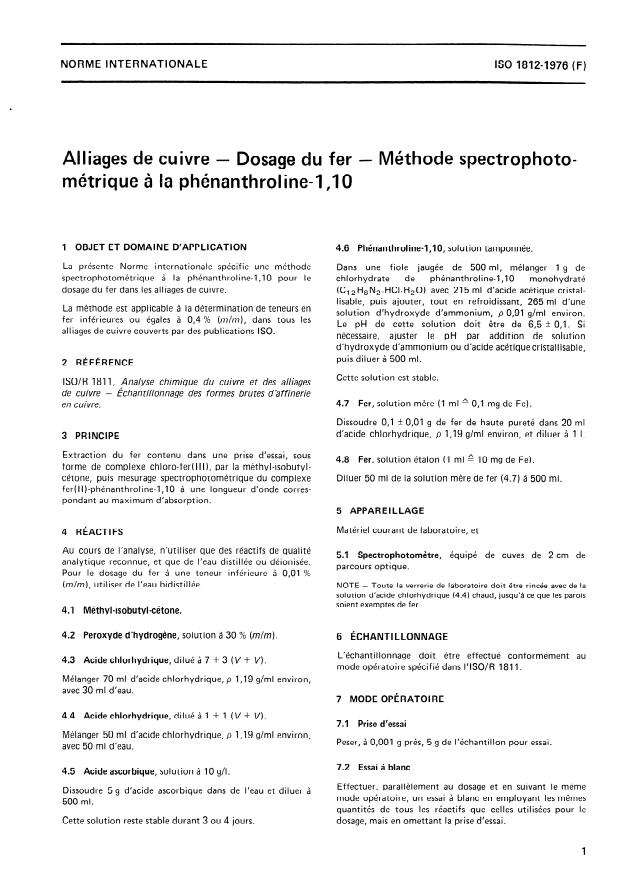
NORME INTERNATIONALE
INTERNATIONAL ORGANIZATION FOR STANDARDIZATION *MEXnYHAPOLIHAA OPI-AHM3ALWl I-I0 CTAHAAPTM3AUMM *ORGANISATION INTERNATIONALE DE NORMALISATION
Alliages de cuivre - Dosage du fer - Méthode spectrophoto-
metrique à la phénanthroline-1 JO
Copper alloys - Determination of iron content - i,IO-Phenanthroline spectrophotometric method
Première édition - 1976-11-15
uz
-
CDU 669.3 : 546.72 : 543.42 Réf. no : ISO 1812-1976 (F)
Descripteurs : alliage de cuivre, analyse chimique, dosage, fer, méthode spectrophotométrique.
Prix basé sur 2 pages
AVANT-PROPOS
L’ISO (Organisation internationale de normalisation) est une fédération mondiale
d’organismes nationaux de normalisation (comités membres de I’ISO). L’élaboration
des Normes internationales est confiée aux comités techniques de I’ISO. Chaque
comité membre intéressé par une étude a le droit de faire partiedu comité technique
correspondant.
Les organisations internationales, gouvernementales et non
gouvernementales, en liaison avec I’ISO, participent également aux travaux.
Les projets de Normes internationales adoptés par les comités techniques sont
soumis aux comités membres pour approbation, avant leur acceptation comme
Normes internationales par le Conseil de I’ISO.
Avant 1972, les résultats des travaux des comités techniques étaient publiés comme
recommandations ISO; ces documents sont en cours de transformation en Normes
internationales. Compte tenu de cette procédure, le comité technique ISO/TC 26,
Cuivre et aliages de cuivre, après examen, est d’avis que la Recomman-
dation lSO/R 18124971 peut, du point de vue technique, être transformée. La
présente Norme internationale remplace donc la Recommandation ISO/R 1812-I 971,
à laquelle elle est techniquement identique.
Les comités membres des pays suivants avaient désapprouvé la Recomman-
dation ISO/R 1812 :
Afrique du Sud, Rép. d’ France Pays-Bas
Allemagne Grèce Pérou
Australie Hongrie
Pologne
Belgique Inde Royaume-Uni
Brésil Iran Suède
Canada Israël Su isse
Chili Italie Tchécoslovaquie
Tu rqu ie
Égypte, Rép. arabe d’ Japon
Nouvelle-Zélande
Espagne U.S.A.
Norvège Yougoslavie
Finlande
Aucun comité membre ne l’avait désapprouvée.
Les comités membres des pays suivants ont désapprouvé la transformation de la
recommandation en Norme Internationale :
Hongrie
Italie
0 Organisation internationale de normalisation, 1976 l
Imprimé en Suisse
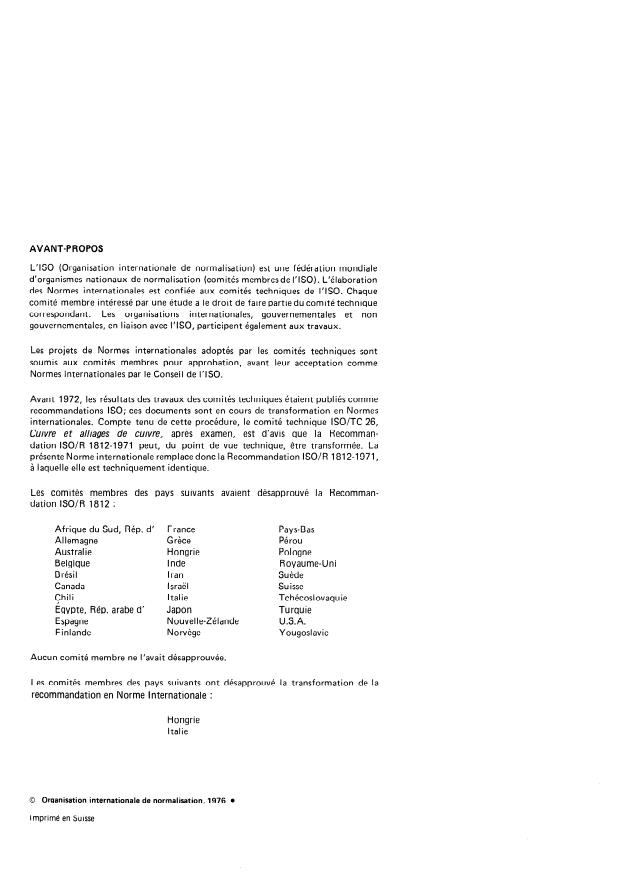
NORME INTERNATIONALE ISO 18124976 (F)
Alliages de cuivre - Dosage du fer - Méthode spectrophoto-
métrique à la phénanthroline-1 ,lO
1 OBJET ET DOMAINE D’APPLICATION 4.6 Phénanthroline-l,lO, solution tamponnée.
La présente Norme internationale spécifie une méthode Dans une fiole jaugée de 500 ml, mélanger 1 g de
spectrophotométrique à la phénanthroline-1 ,lO pour le chlorhydrate de phénanthroline-1 JO monohydraté
dosage du fer dans les alliages de cuivre. (C, 2 H8N2.HCI.H20) avec 215 ml d’acide acétique cristal-
lisable, puis ajouter, tout en refroidissant, 265 ml d’une
La méthode est applicable à la détermination de teneurs en
solution d’hydroxyde d’ammonium, p 0,91 g/ml environ.
fer inférieures ou égales à 0,4 % (mlm), dans tous les
Le pH de cette solution doit être de 6,5 rt 0,l. Si
alliages de cuivre couverts par des publications ISO.
nécessaire, ajuster le pH par addition de solution
d’hydroxyde d’ammonium ou d’acide acétique cristallisable,
puis diluer à 500 ml.
2 RÉFÉRENCE
Cette solution est stable.
ISOI R 18 11, Analyse chimique du cuivre et des alliages
de cuivre - Échantillonnage des formes brutes daffinerie
4.7 Fer, solution mère (1 ml 2 0,l mg de Fe).
en cuivre.
Dissoudre 0,l * 0,Ol g de fer de haute pureté dans 20 ml
d’acide chlorhydrique, p 1,19 g/ml environ, et diluer à 1 1.
3 PRINCIPE
Extraction du fer contenu dans une prise d’essai, sous
4.8 Fer, solution étalon (1 ml 2 10 mg de Fe).
forme de complexe chlore-fer( I II), par la méthyl-isobutyl-
Diluer 50 ml de la solution mère de fer (4.7) a 500 ml
cétone, puis mesurage spectrophotométrique du complexe
fer( II)-phénanthroline-1,lO à une longueur d’onde corres-
pondant au maximum d’absorption.
5 APPAREILLAGE
Matériel courant de laboratoire, et
4 RÉACTIFS
Au cours de l’analyse, n’utiliser que des réactifs de qualité
5.1 Spectrophotomètre, équipé de cuves de 2 cm de
analytique reconnue, et que de l’eau distillée ou déionisée.
parcours optique.
Pour le dosage du fer à une teneur inférieure à 0,Ol %
(mlm), utiliser de l’eau bidistillée. NOTE - Toute la verrerie de laboratoire doit être rincée avec de la
solution d’acide chlorhydrique (4.4) chaud, jusqu’à ce que les parois
soient exemptes de fer.
4.1 Méthyl-isobutyl-cétone.
Peroxyde d’hydrogène, solution à 30 % (m/m).
4.2
6 ÉCHANTILLONNAGE
L’échantillonnage doit être effectué conformément au
4.3 Acide chlorhydrique, dilué à 7 + 3 (V i- V).
mode opératoire spécifié dans l’lSO/R 1811.
Mélanger 70 ml d’acide chlorhydrique, p 1,19 g/ml environ,
avec 30 ml d’eau.
7 MODE OPÉRATOIRE
4.4 Acide chlorhydrique, dilué à 1 -t- 1 (V + V).
7.1 Prise d’essai
Mélanger 50 ml d’acide chlorhydrique, p 1,19 g/ml environ,
Pese
...
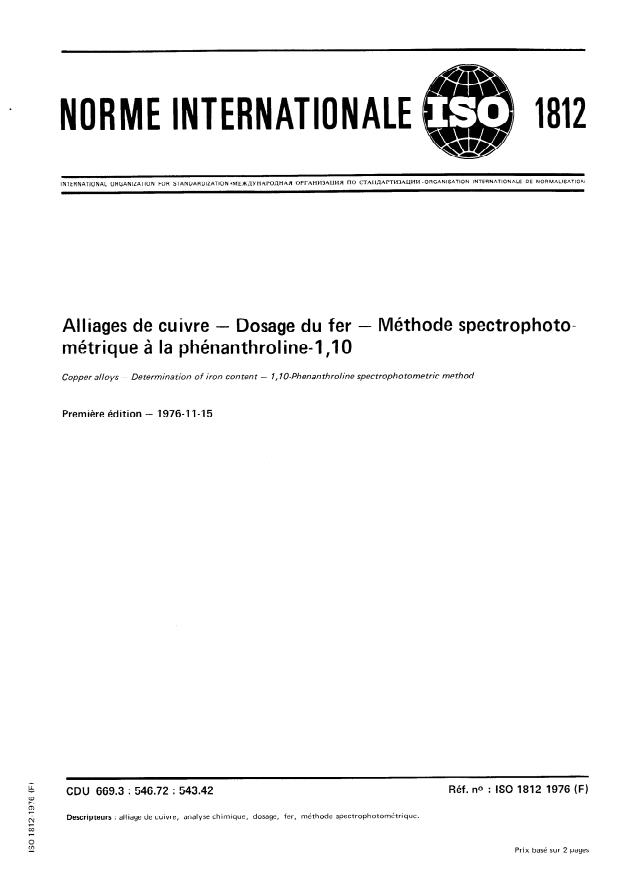
NORME INTERNATIONALE
INTERNATIONAL ORGANIZATION FOR STANDARDIZATION *MEXnYHAPOLIHAA OPI-AHM3ALWl I-I0 CTAHAAPTM3AUMM *ORGANISATION INTERNATIONALE DE NORMALISATION
Alliages de cuivre - Dosage du fer - Méthode spectrophoto-
metrique à la phénanthroline-1 JO
Copper alloys - Determination of iron content - i,IO-Phenanthroline spectrophotometric method
Première édition - 1976-11-15
uz
-
CDU 669.3 : 546.72 : 543.42 Réf. no : ISO 1812-1976 (F)
Descripteurs : alliage de cuivre, analyse chimique, dosage, fer, méthode spectrophotométrique.
Prix basé sur 2 pages
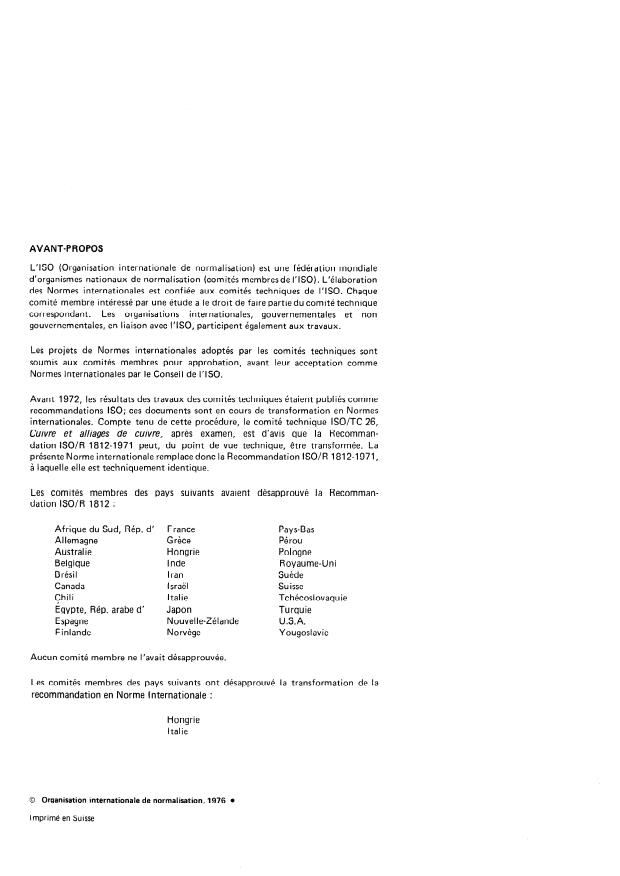
AVANT-PROPOS
L’ISO (Organisation internationale de normalisation) est une fédération mondiale
d’organismes nationaux de normalisation (comités membres de I’ISO). L’élaboration
des Normes internationales est confiée aux comités techniques de I’ISO. Chaque
comité membre intéressé par une étude a le droit de faire partiedu comité technique
correspondant.
Les organisations internationales, gouvernementales et non
gouvernementales, en liaison avec I’ISO, participent également aux travaux.
Les projets de Normes internationales adoptés par les comités techniques sont
soumis aux comités membres pour approbation, avant leur acceptation comme
Normes internationales par le Conseil de I’ISO.
Avant 1972, les résultats des travaux des comités techniques étaient publiés comme
recommandations ISO; ces documents sont en cours de transformation en Normes
internationales. Compte tenu de cette procédure, le comité technique ISO/TC 26,
Cuivre et aliages de cuivre, après examen, est d’avis que la Recomman-
dation lSO/R 18124971 peut, du point de vue technique, être transformée. La
présente Norme internationale remplace donc la Recommandation ISO/R 1812-I 971,
à laquelle elle est techniquement identique.
Les comités membres des pays suivants avaient désapprouvé la Recomman-
dation ISO/R 1812 :
Afrique du Sud, Rép. d’ France Pays-Bas
Allemagne Grèce Pérou
Australie Hongrie
Pologne
Belgique Inde Royaume-Uni
Brésil Iran Suède
Canada Israël Su isse
Chili Italie Tchécoslovaquie
Tu rqu ie
Égypte, Rép. arabe d’ Japon
Nouvelle-Zélande
Espagne U.S.A.
Norvège Yougoslavie
Finlande
Aucun comité membre ne l’avait désapprouvée.
Les comités membres des pays suivants ont désapprouvé la transformation de la
recommandation en Norme Internationale :
Hongrie
Italie
0 Organisation internationale de normalisation, 1976 l
Imprimé en Suisse
NORME INTERNATIONALE ISO 18124976 (F)
Alliages de cuivre - Dosage du fer - Méthode spectrophoto-
métrique à la phénanthroline-1 ,lO
1 OBJET ET DOMAINE D’APPLICATION 4.6 Phénanthroline-l,lO, solution tamponnée.
La présente Norme internationale spécifie une méthode Dans une fiole jaugée de 500 ml, mélanger 1 g de
spectrophotométrique à la phénanthroline-1 ,lO pour le chlorhydrate de phénanthroline-1 JO monohydraté
dosage du fer dans les alliages de cuivre. (C, 2 H8N2.HCI.H20) avec 215 ml d’acide acétique cristal-
lisable, puis ajouter, tout en refroidissant, 265 ml d’une
La méthode est applicable à la détermination de teneurs en
solution d’hydroxyde d’ammonium, p 0,91 g/ml environ.
fer inférieures ou égales à 0,4 % (mlm), dans tous les
Le pH de cette solution doit être de 6,5 rt 0,l. Si
alliages de cuivre couverts par des publications ISO.
nécessaire, ajuster le pH par addition de solution
d’hydroxyde d’ammonium ou d’acide acétique cristallisable,
puis diluer à 500 ml.
2 RÉFÉRENCE
Cette solution est stable.
ISOI R 18 11, Analyse chimique du cuivre et des alliages
de cuivre - Échantillonnage des formes brutes daffinerie
4.7 Fer, solution mère (1 ml 2 0,l mg de Fe).
en cuivre.
Dissoudre 0,l * 0,Ol g de fer de haute pureté dans 20 ml
d’acide chlorhydrique, p 1,19 g/ml environ, et diluer à 1 1.
3 PRINCIPE
Extraction du fer contenu dans une prise d’essai, sous
4.8 Fer, solution étalon (1 ml 2 10 mg de Fe).
forme de complexe chlore-fer( I II), par la méthyl-isobutyl-
Diluer 50 ml de la solution mère de fer (4.7) a 500 ml
cétone, puis mesurage spectrophotométrique du complexe
fer( II)-phénanthroline-1,lO à une longueur d’onde corres-
pondant au maximum d’absorption.
5 APPAREILLAGE
Matériel courant de laboratoire, et
4 RÉACTIFS
Au cours de l’analyse, n’utiliser que des réactifs de qualité
5.1 Spectrophotomètre, équipé de cuves de 2 cm de
analytique reconnue, et que de l’eau distillée ou déionisée.
parcours optique.
Pour le dosage du fer à une teneur inférieure à 0,Ol %
(mlm), utiliser de l’eau bidistillée. NOTE - Toute la verrerie de laboratoire doit être rincée avec de la
solution d’acide chlorhydrique (4.4) chaud, jusqu’à ce que les parois
soient exemptes de fer.
4.1 Méthyl-isobutyl-cétone.
Peroxyde d’hydrogène, solution à 30 % (m/m).
4.2
6 ÉCHANTILLONNAGE
L’échantillonnage doit être effectué conformément au
4.3 Acide chlorhydrique, dilué à 7 + 3 (V i- V).
mode opératoire spécifié dans l’lSO/R 1811.
Mélanger 70 ml d’acide chlorhydrique, p 1,19 g/ml environ,
avec 30 ml d’eau.
7 MODE OPÉRATOIRE
4.4 Acide chlorhydrique, dilué à 1 -t- 1 (V + V).
7.1 Prise d’essai
Mélanger 50 ml d’acide chlorhydrique, p 1,19 g/ml environ,
Pese
...
NORME INTERNATIONALE
INTERNATIONAL ORGANIZATION FOR STANDARDIZATION *MEXnYHAPOLIHAA OPI-AHM3ALWl I-I0 CTAHAAPTM3AUMM *ORGANISATION INTERNATIONALE DE NORMALISATION
Alliages de cuivre - Dosage du fer - Méthode spectrophoto-
metrique à la phénanthroline-1 JO
Copper alloys - Determination of iron content - i,IO-Phenanthroline spectrophotometric method
Première édition - 1976-11-15
uz
-
CDU 669.3 : 546.72 : 543.42 Réf. no : ISO 1812-1976 (F)
Descripteurs : alliage de cuivre, analyse chimique, dosage, fer, méthode spectrophotométrique.
Prix basé sur 2 pages
AVANT-PROPOS
L’ISO (Organisation internationale de normalisation) est une fédération mondiale
d’organismes nationaux de normalisation (comités membres de I’ISO). L’élaboration
des Normes internationales est confiée aux comités techniques de I’ISO. Chaque
comité membre intéressé par une étude a le droit de faire partiedu comité technique
correspondant.
Les organisations internationales, gouvernementales et non
gouvernementales, en liaison avec I’ISO, participent également aux travaux.
Les projets de Normes internationales adoptés par les comités techniques sont
soumis aux comités membres pour approbation, avant leur acceptation comme
Normes internationales par le Conseil de I’ISO.
Avant 1972, les résultats des travaux des comités techniques étaient publiés comme
recommandations ISO; ces documents sont en cours de transformation en Normes
internationales. Compte tenu de cette procédure, le comité technique ISO/TC 26,
Cuivre et aliages de cuivre, après examen, est d’avis que la Recomman-
dation lSO/R 18124971 peut, du point de vue technique, être transformée. La
présente Norme internationale remplace donc la Recommandation ISO/R 1812-I 971,
à laquelle elle est techniquement identique.
Les comités membres des pays suivants avaient désapprouvé la Recomman-
dation ISO/R 1812 :
Afrique du Sud, Rép. d’ France Pays-Bas
Allemagne Grèce Pérou
Australie Hongrie
Pologne
Belgique Inde Royaume-Uni
Brésil Iran Suède
Canada Israël Su isse
Chili Italie Tchécoslovaquie
Tu rqu ie
Égypte, Rép. arabe d’ Japon
Nouvelle-Zélande
Espagne U.S.A.
Norvège Yougoslavie
Finlande
Aucun comité membre ne l’avait désapprouvée.
Les comités membres des pays suivants ont désapprouvé la transformation de la
recommandation en Norme Internationale :
Hongrie
Italie
0 Organisation internationale de normalisation, 1976 l
Imprimé en Suisse
NORME INTERNATIONALE ISO 18124976 (F)
Alliages de cuivre - Dosage du fer - Méthode spectrophoto-
métrique à la phénanthroline-1 ,lO
1 OBJET ET DOMAINE D’APPLICATION 4.6 Phénanthroline-l,lO, solution tamponnée.
La présente Norme internationale spécifie une méthode Dans une fiole jaugée de 500 ml, mélanger 1 g de
spectrophotométrique à la phénanthroline-1 ,lO pour le chlorhydrate de phénanthroline-1 JO monohydraté
dosage du fer dans les alliages de cuivre. (C, 2 H8N2.HCI.H20) avec 215 ml d’acide acétique cristal-
lisable, puis ajouter, tout en refroidissant, 265 ml d’une
La méthode est applicable à la détermination de teneurs en
solution d’hydroxyde d’ammonium, p 0,91 g/ml environ.
fer inférieures ou égales à 0,4 % (mlm), dans tous les
Le pH de cette solution doit être de 6,5 rt 0,l. Si
alliages de cuivre couverts par des publications ISO.
nécessaire, ajuster le pH par addition de solution
d’hydroxyde d’ammonium ou d’acide acétique cristallisable,
puis diluer à 500 ml.
2 RÉFÉRENCE
Cette solution est stable.
ISOI R 18 11, Analyse chimique du cuivre et des alliages
de cuivre - Échantillonnage des formes brutes daffinerie
4.7 Fer, solution mère (1 ml 2 0,l mg de Fe).
en cuivre.
Dissoudre 0,l * 0,Ol g de fer de haute pureté dans 20 ml
d’acide chlorhydrique, p 1,19 g/ml environ, et diluer à 1 1.
3 PRINCIPE
Extraction du fer contenu dans une prise d’essai, sous
4.8 Fer, solution étalon (1 ml 2 10 mg de Fe).
forme de complexe chlore-fer( I II), par la méthyl-isobutyl-
Diluer 50 ml de la solution mère de fer (4.7) a 500 ml
cétone, puis mesurage spectrophotométrique du complexe
fer( II)-phénanthroline-1,lO à une longueur d’onde corres-
pondant au maximum d’absorption.
5 APPAREILLAGE
Matériel courant de laboratoire, et
4 RÉACTIFS
Au cours de l’analyse, n’utiliser que des réactifs de qualité
5.1 Spectrophotomètre, équipé de cuves de 2 cm de
analytique reconnue, et que de l’eau distillée ou déionisée.
parcours optique.
Pour le dosage du fer à une teneur inférieure à 0,Ol %
(mlm), utiliser de l’eau bidistillée. NOTE - Toute la verrerie de laboratoire doit être rincée avec de la
solution d’acide chlorhydrique (4.4) chaud, jusqu’à ce que les parois
soient exemptes de fer.
4.1 Méthyl-isobutyl-cétone.
Peroxyde d’hydrogène, solution à 30 % (m/m).
4.2
6 ÉCHANTILLONNAGE
L’échantillonnage doit être effectué conformément au
4.3 Acide chlorhydrique, dilué à 7 + 3 (V i- V).
mode opératoire spécifié dans l’lSO/R 1811.
Mélanger 70 ml d’acide chlorhydrique, p 1,19 g/ml environ,
avec 30 ml d’eau.
7 MODE OPÉRATOIRE
4.4 Acide chlorhydrique, dilué à 1 -t- 1 (V + V).
7.1 Prise d’essai
Mélanger 50 ml d’acide chlorhydrique, p 1,19 g/ml environ,
Pese
...
NORME INTERNATIONALE
INTERNATIONAL ORGANIZATION FOR STANDARDIZATION *MEXnYHAPOLIHAA OPI-AHM3ALWl I-I0 CTAHAAPTM3AUMM *ORGANISATION INTERNATIONALE DE NORMALISATION
Alliages de cuivre - Dosage du fer - Méthode spectrophoto-
metrique à la phénanthroline-1 JO
Copper alloys - Determination of iron content - i,IO-Phenanthroline spectrophotometric method
Première édition - 1976-11-15
uz
-
CDU 669.3 : 546.72 : 543.42 Réf. no : ISO 1812-1976 (F)
Descripteurs : alliage de cuivre, analyse chimique, dosage, fer, méthode spectrophotométrique.
Prix basé sur 2 pages
AVANT-PROPOS
L’ISO (Organisation internationale de normalisation) est une fédération mondiale
d’organismes nationaux de normalisation (comités membres de I’ISO). L’élaboration
des Normes internationales est confiée aux comités techniques de I’ISO. Chaque
comité membre intéressé par une étude a le droit de faire partiedu comité technique
correspondant.
Les organisations internationales, gouvernementales et non
gouvernementales, en liaison avec I’ISO, participent également aux travaux.
Les projets de Normes internationales adoptés par les comités techniques sont
soumis aux comités membres pour approbation, avant leur acceptation comme
Normes internationales par le Conseil de I’ISO.
Avant 1972, les résultats des travaux des comités techniques étaient publiés comme
recommandations ISO; ces documents sont en cours de transformation en Normes
internationales. Compte tenu de cette procédure, le comité technique ISO/TC 26,
Cuivre et aliages de cuivre, après examen, est d’avis que la Recomman-
dation lSO/R 18124971 peut, du point de vue technique, être transformée. La
présente Norme internationale remplace donc la Recommandation ISO/R 1812-I 971,
à laquelle elle est techniquement identique.
Les comités membres des pays suivants avaient désapprouvé la Recomman-
dation ISO/R 1812 :
Afrique du Sud, Rép. d’ France Pays-Bas
Allemagne Grèce Pérou
Australie Hongrie
Pologne
Belgique Inde Royaume-Uni
Brésil Iran Suède
Canada Israël Su isse
Chili Italie Tchécoslovaquie
Tu rqu ie
Égypte, Rép. arabe d’ Japon
Nouvelle-Zélande
Espagne U.S.A.
Norvège Yougoslavie
Finlande
Aucun comité membre ne l’avait désapprouvée.
Les comités membres des pays suivants ont désapprouvé la transformation de la
recommandation en Norme Internationale :
Hongrie
Italie
0 Organisation internationale de normalisation, 1976 l
Imprimé en Suisse
NORME INTERNATIONALE ISO 18124976 (F)
Alliages de cuivre - Dosage du fer - Méthode spectrophoto-
métrique à la phénanthroline-1 ,lO
1 OBJET ET DOMAINE D’APPLICATION 4.6 Phénanthroline-l,lO, solution tamponnée.
La présente Norme internationale spécifie une méthode Dans une fiole jaugée de 500 ml, mélanger 1 g de
spectrophotométrique à la phénanthroline-1 ,lO pour le chlorhydrate de phénanthroline-1 JO monohydraté
dosage du fer dans les alliages de cuivre. (C, 2 H8N2.HCI.H20) avec 215 ml d’acide acétique cristal-
lisable, puis ajouter, tout en refroidissant, 265 ml d’une
La méthode est applicable à la détermination de teneurs en
solution d’hydroxyde d’ammonium, p 0,91 g/ml environ.
fer inférieures ou égales à 0,4 % (mlm), dans tous les
Le pH de cette solution doit être de 6,5 rt 0,l. Si
alliages de cuivre couverts par des publications ISO.
nécessaire, ajuster le pH par addition de solution
d’hydroxyde d’ammonium ou d’acide acétique cristallisable,
puis diluer à 500 ml.
2 RÉFÉRENCE
Cette solution est stable.
ISOI R 18 11, Analyse chimique du cuivre et des alliages
de cuivre - Échantillonnage des formes brutes daffinerie
4.7 Fer, solution mère (1 ml 2 0,l mg de Fe).
en cuivre.
Dissoudre 0,l * 0,Ol g de fer de haute pureté dans 20 ml
d’acide chlorhydrique, p 1,19 g/ml environ, et diluer à 1 1.
3 PRINCIPE
Extraction du fer contenu dans une prise d’essai, sous
4.8 Fer, solution étalon (1 ml 2 10 mg de Fe).
forme de complexe chlore-fer( I II), par la méthyl-isobutyl-
Diluer 50 ml de la solution mère de fer (4.7) a 500 ml
cétone, puis mesurage spectrophotométrique du complexe
fer( II)-phénanthroline-1,lO à une longueur d’onde corres-
pondant au maximum d’absorption.
5 APPAREILLAGE
Matériel courant de laboratoire, et
4 RÉACTIFS
Au cours de l’analyse, n’utiliser que des réactifs de qualité
5.1 Spectrophotomètre, équipé de cuves de 2 cm de
analytique reconnue, et que de l’eau distillée ou déionisée.
parcours optique.
Pour le dosage du fer à une teneur inférieure à 0,Ol %
(mlm), utiliser de l’eau bidistillée. NOTE - Toute la verrerie de laboratoire doit être rincée avec de la
solution d’acide chlorhydrique (4.4) chaud, jusqu’à ce que les parois
soient exemptes de fer.
4.1 Méthyl-isobutyl-cétone.
Peroxyde d’hydrogène, solution à 30 % (m/m).
4.2
6 ÉCHANTILLONNAGE
L’échantillonnage doit être effectué conformément au
4.3 Acide chlorhydrique, dilué à 7 + 3 (V i- V).
mode opératoire spécifié dans l’lSO/R 1811.
Mélanger 70 ml d’acide chlorhydrique, p 1,19 g/ml environ,
avec 30 ml d’eau.
7 MODE OPÉRATOIRE
4.4 Acide chlorhydrique, dilué à 1 -t- 1 (V + V).
7.1 Prise d’essai
Mélanger 50 ml d’acide chlorhydrique, p 1,19 g/ml environ,
Pese
...