

ISO/IEC TR 11801-9908:2020
(Main)Information technology — Generic cabling systems for customer premises — Part 9908: Guidance for the support of higher speed applications over optical fibre channels
General Information
- Abstract
ISO/IEC TR 11801-9908:2020 (E) which is a Technical Report, provides a listing of the data centre application options currently available or in process of standardization utilizing duplex and parallel optical fibre channels. It also identifies migration considerations when upgrading to higher speed applications.
- Status
- Published
- Publication Date
- 27-May-2020
- Technical Committee
- ISO/IEC JTC 1/SC 25 - Interconnection of information technology equipment
- Current Stage
- 6060 - International Standard published
- Start Date
- 28-May-2020
- Due Date
- 19-May-2022
- Completion Date
- 28-May-2020
Buy Documents

ISO/IEC 11801-9908:2020 - Information technology -- Generic cabling systems for customer premises
ISO/IEC TR 11801-9908:2020 - Information technology — Generic cabling systems for customer premises — Part 9908: Guidance for the support of higher speed applications over optical fibre channels/28/2020
Overview
ISO/IEC TR 11801-9908:2020 is a Technical Report that provides guidance for supporting higher‑speed applications over optical fibre channels in customer premises cabling (especially data centres). It lists current and in‑progress duplex and parallel optical fibre application options (multimode and single‑mode), highlights array‑based cabling/topologies and connectivity choices (e.g., MPO), and identifies migration considerations when upgrading to higher data rates.
Keywords: ISO/IEC TR 11801-9908:2020, generic cabling, optical fibre channels, high-speed applications, data centre cabling, duplex, parallel, multimode, single-mode.
Key topics
- Application catalogue: Multimode and single‑mode applications for 10 Gbit/s and beyond are tabulated (examples: 10GBASE‑SR, 40GBASE‑SR4, 100GBASE‑SR4, 400GBASE‑SR16; single‑mode examples include 100GBASE‑LR4, 400GBASE‑LR8).
- Fibre categories & reach: Guidance references OM3/OM4/OM5 for multimode and OS2 for single‑mode, with maximum reach figures associated with each application.
- Duplex vs parallel channels: Describes trade‑offs and wiring patterns for duplex (single or paired fibres) and parallel solutions (multi‑pair MPO arrays - 4, 8, 16 etc.).
- Array‑based cabling systems: Considerations for deploying MPO/MTP and other array connectors, and how these systems support migration from duplex to parallel topologies.
- Migration planning: Practical factors when upgrading (loss budget, connector/splice counts, cable category, multi‑level encoding, WDM and new cabled fibre categories).
- Standards landscape: Cross‑references IEEE (Ethernet), INCITS (Fibre Channel) standards and Multi‑Source Agreements (MSAs) that define implementations.
Practical applications
- Data centre backbone and server‑to‑top‑of‑rack (ToR) links where high throughput is required (25G/50G/100G/200G/400G and beyond).
- Migration planning for facilities moving from duplex multimode links to parallel MPO solutions to accommodate multi‑lane optics.
- Designing cabling infrastructure that balances cost, future‑proofing and operational reach (choosing OM3/OM4/OM5 or OS2 appropriately).
- Selecting connectors and patching architectures (MPO array systems) to reduce rework during upgrades.
Who should use this standard
- Cabling specifiers and designers, data centre architects, network engineers, installers and facilities managers who plan or operate premises cabling for high‑speed optical applications.
Related standards
- ISO/IEC 11801‑1 (general requirements for generic cabling)
- ISO/IEC 14763‑2 (planning and installation)
- IEEE Ethernet and INCITS Fibre Channel standards, and vendor MSAs (e.g., SR4, DR4, BD4) referenced by the report.
Use ISO/IEC TR 11801‑9908:2020 when evaluating optical fibre topologies, choosing multimode vs single‑mode paths, and defining migration strategies to support evolving high‑speed data centre applications.
Buy Documents
ISO/IEC 11801-9908:2020 - Information technology -- Generic cabling systems for customer premises
ISO/IEC TR 11801-9908:2020 - Information technology — Generic cabling systems for customer premises — Part 9908: Guidance for the support of higher speed applications over optical fibre channels/28/2020
Get Certified
Connect with accredited certification bodies for this standard

BSI Group
BSI (British Standards Institution) is the business standards company that helps organizations make excellence a habit.

NYCE
Mexican standards and certification body.
Sponsored listings
Frequently Asked Questions
ISO/IEC TR 11801-9908:2020 is a standard published by the International Organization for Standardization (ISO). Its full title is "Information technology — Generic cabling systems for customer premises — Part 9908: Guidance for the support of higher speed applications over optical fibre channels". This standard covers: ISO/IEC TR 11801-9908:2020 (E) which is a Technical Report, provides a listing of the data centre application options currently available or in process of standardization utilizing duplex and parallel optical fibre channels. It also identifies migration considerations when upgrading to higher speed applications.
ISO/IEC TR 11801-9908:2020 (E) which is a Technical Report, provides a listing of the data centre application options currently available or in process of standardization utilizing duplex and parallel optical fibre channels. It also identifies migration considerations when upgrading to higher speed applications.
ISO/IEC TR 11801-9908:2020 is classified under the following ICS (International Classification for Standards) categories: 35.200 - Interface and interconnection equipment. The ICS classification helps identify the subject area and facilitates finding related standards.
ISO/IEC TR 11801-9908:2020 is available in PDF format for immediate download after purchase. The document can be added to your cart and obtained through the secure checkout process. Digital delivery ensures instant access to the complete standard document.
Standards Content (Sample)
ISO/IEC TR 11801-9908
Edition 1.0 2020-05
TECHNICAL
REPORT
colour
inside
Information technology – Generic cabling for customer premises –
Part 9908: Guidance for the support of higher speed applications over optical
fibre channels
All rights reserved. Unless otherwise specified, no part of this publication may be reproduced or utilized in any form
or by any means, electronic or mechanical, including photocopying and microfilm, without permission in writing from
either IEC or IEC's member National Committee in the country of the requester. If you have any questions about
ISO/IEC copyright or have an enquiry about obtaining additional rights to this publication, please contact the address
below or your local IEC member National Committee for further information.
IEC Central Office Tel.: +41 22 919 02 11
3, rue de Varembé info@iec.ch
CH-1211 Geneva 20 www.iec.ch
Switzerland
About the IEC
The International Electrotechnical Commission (IEC) is the leading global organization that prepares and publishes
International Standards for all electrical, electronic and related technologies.
About IEC publications
The technical content of IEC publications is kept under constant review by the IEC. Please make sure that you have the
latest edition, a corrigendum or an amendment might have been published.
IEC publications search - webstore.iec.ch/advsearchform Electropedia - www.electropedia.org
The advanced search enables to find IEC publications by a The world's leading online dictionary on electrotechnology,
variety of criteria (reference number, text, technical containing more than 22 000 terminological entries in English
committee,…). It also gives information on projects, replaced and French, with equivalent terms in 16 additional languages.
and withdrawn publications. Also known as the International Electrotechnical Vocabulary
(IEV) online.
IEC Just Published - webstore.iec.ch/justpublished
Stay up to date on all new IEC publications. Just Published IEC Glossary - std.iec.ch/glossary
details all new publications released. Available online and 67 000 electrotechnical terminology entries in English and
once a month by email. French extracted from the Terms and Definitions clause of
IEC publications issued since 2002. Some entries have been
IEC Customer Service Centre - webstore.iec.ch/csc collected from earlier publications of IEC TC 37, 77, 86 and
If you wish to give us your feedback on this publication or CISPR.
need further assistance, please contact the Customer Service
Centre: sales@iec.ch.
ISO/IEC TR 11801-9908
Edition 1.0 2020-05
TECHNICAL
REPORT
colour
inside
Information technology – Generic cabling for customer premises –
Part 9908: Guidance for the support of higher speed applications over optical
fibre channels
INTERNATIONAL
ELECTROTECHNICAL
COMMISSION
ICS 35.200 ISBN 978-2-8322-8311-0
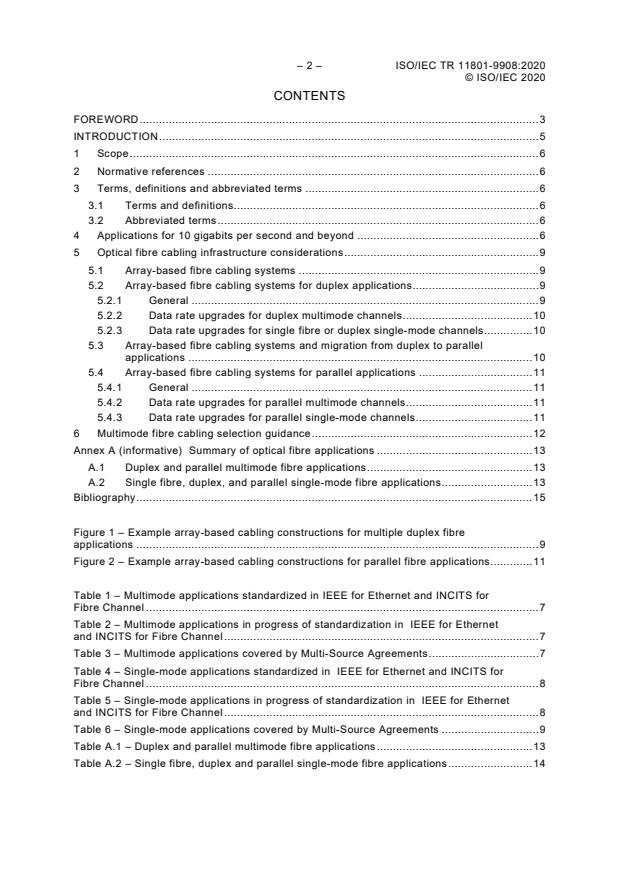
– 2 – ISO/IEC TR 11801-9908:2020
© ISO/IEC 2020
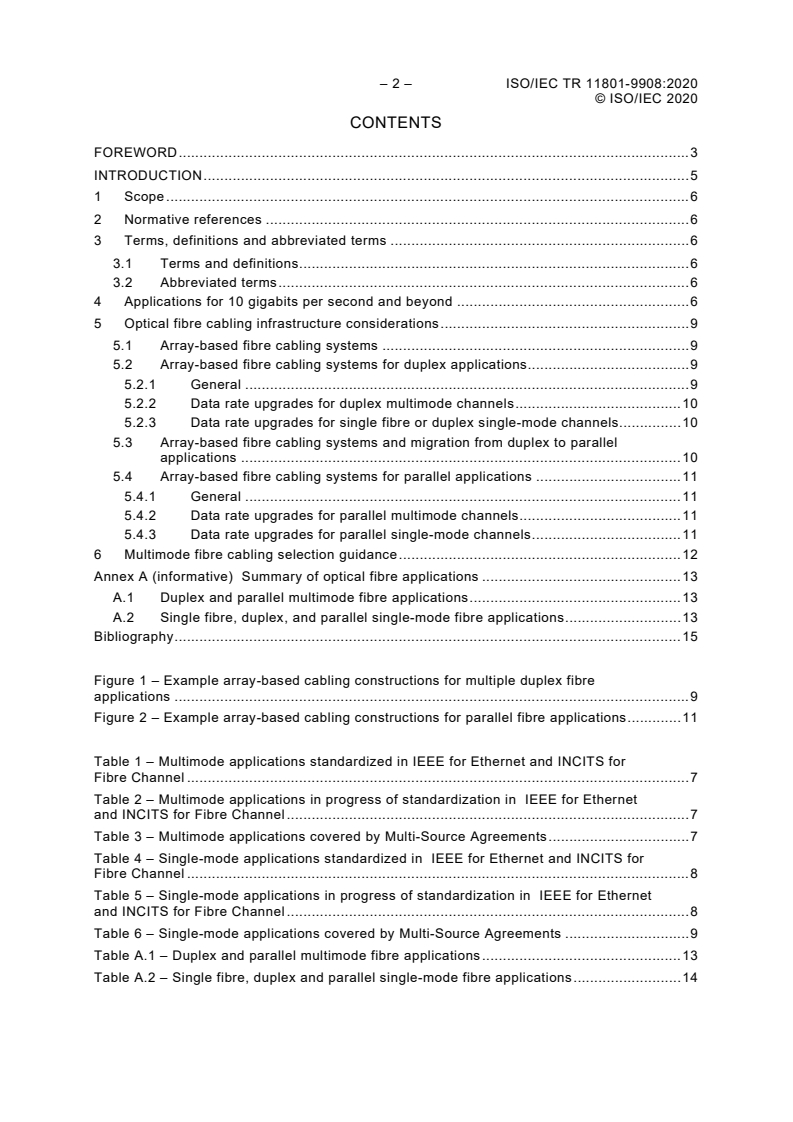
CONTENTS
FOREWORD . 3
INTRODUCTION . 5
1 Scope . 6
2 Normative references . 6
3 Terms, definitions and abbreviated terms . 6
3.1 Terms and definitions . 6
3.2 Abbreviated terms . 6
4 Applications for 10 gigabits per second and beyond . 6
5 Optical fibre cabling infrastructure considerations . 9
5.1 Array-based fibre cabling systems . 9
5.2 Array-based fibre cabling systems for duplex applications . 9
5.2.1 General . 9
5.2.2 Data rate upgrades for duplex multimode channels . 10
5.2.3 Data rate upgrades for single fibre or duplex single-mode channels . 10
5.3 Array-based fibre cabling systems and migration from duplex to parallel
applications . 10
5.4 Array-based fibre cabling systems for parallel applications . 11
5.4.1 General . 11
5.4.2 Data rate upgrades for parallel multimode channels . 11
5.4.3 Data rate upgrades for parallel single-mode channels . 11
6 Multimode fibre cabling selection guidance . 12
Annex A (informative) Summary of optical fibre applications . 13
A.1 Duplex and parallel multimode fibre applications . 13
A.2 Single fibre, duplex, and parallel single-mode fibre applications . 13
Bibliography . 15
Figure 1 – Example array-based cabling constructions for multiple duplex fibre
applications . 9
Figure 2 – Example array-based cabling constructions for parallel fibre applications . 11
Table 1 – Multimode applications standardized in IEEE for Ethernet and INCITS for
Fibre Channel . 7
Table 2 – Multimode applications in progress of standardization in IEEE for Ethernet
and INCITS for Fibre Channel . 7
Table 3 – Multimode applications covered by Multi-Source Agreements . 7
Table 4 – Single-mode applications standardized in IEEE for Ethernet and INCITS for
Fibre Channel . 8
Table 5 – Single-mode applications in progress of standardization in IEEE for Ethernet
and INCITS for Fibre Channel . 8
Table 6 – Single-mode applications covered by Multi-Source Agreements . 9
Table A.1 – Duplex and parallel multimode fibre applications . 13
Table A.2 – Single fibre, duplex and parallel single-mode fibre applications . 14
© ISO/IEC 2020
INFORMATION TECHNOLOGY –
GENERIC CABLING FOR CUSTOMER PREMISES –
Part 9908: Guidance for the support of higher
speed applications over optical fibre channels
FOREWORD
1) ISO (the International Organization for Standardization) and IEC (the International Electrotechnical Commission)
form the specialized system for worldwide standardization. National bodies that are members of ISO or IEC
participate in the development of International Standards through technical committees established by the
respective organization to deal with particular fields of technical activity. ISO and IEC technical committees
collaborate in fields of mutual interest. Other international organizations, governmental and non-governmental,
in liaison with ISO and IEC, also take part in the work.
2) The formal decisions or agreements of IEC and ISO on technical matters express, as nearly as possible, an
international consensus of opinion on the relevant subjects since each technical committee has representation
from all interested IEC and ISO National bodies.
3) IEC and ISO documents have the form of recommendations for international use and are accepted by IEC and
ISO National bodies in that sense. While all reasonable efforts are made to ensure that the technical content of
IEC and ISO documents is accurate, IEC and ISO cannot be held responsible for the way in which they are used
or for any misinterpretation by any end user.
4) In order to promote international uniformity, IEC and ISO National bodies undertake to apply IEC and ISO
documents transparently to the maximum extent possible in their national and regional publications. Any
divergence between any IEC and ISO document and the corresponding national or regional publication shall be
clearly indicated in the latter.
5) IEC and ISO do not provide any attestation of conformity. Independent certification bodies provide conformity
assessment services and, in some areas, access to IEC and ISO marks of conformity. IEC and ISO are not
responsible for any services carried out by independent certification bodies.
6) All users should ensure that they have the latest edition of this document.
7) No liability shall attach to IEC and ISO or their directors, employees, servants or agents including individual
experts and members of its technical committees and IEC and ISO National bodies for any personal injury,
property damage or other damage of any nature whatsoever, whether direct or indirect, or for costs (including
legal fees) and expenses arising out of the publication, use of, or reliance upon, this ISO/IEC document or any
other IEC and ISO documents.
8) Attention is drawn to the Normative references cited in this document. Use of the referenced publications is
indispensable for the correct application of this document.
9) Attention is drawn to the possibility that some of the elements of this ISO/IEC document may be the subject of
patent rights. IEC and ISO shall not be held responsible for identifying any or all such patent rights.
The main task of IEC and ISO technical committees is to prepare International Standards.
However, a technical committee may propose the publication of a Technical Report when it has
collected data of a different kind from that which is normally published as an International
Standard, for example "state of the art".
ISO/IEC TR 11801-9908, which is a Technical Report, was prepared by subcommittee 25:
Interconnection of information technology equipment, of ISO/IEC joint technical committee 1:
Information technology.
The list of all currently available parts of the ISO/IEC 11801 series, under the general title
Information technology – Generic cabling for customer premises, can be found on the IEC and
ISO websites.
– 4 – ISO/IEC TR 11801-9908:2020
© ISO/IEC 2020
The text of this Technical Report is based on the following documents:
DTR Report on voting
JTC1-SC25/2927/DTR JTC1-SC25/2940/RVDTR
Full information on the voting for the approval of this Technical Report can be found in the
report on voting indicated in the above table.
This document has been drafted in accordance with the ISO/IEC Directives, Part 2.
IMPORTANT – The 'colour inside' logo on the cover page of this publication indicates
that it contains colours which are considered to be useful for the correct understanding
of its contents. Users should therefore print this document using a colour printer.
© ISO/IEC 2020
INTRODUCTION
The need to support cost-efficient high-speed applications over optical fibre has resulted in the
availability of a wide variety of applications and implementation options. The available options
to support high-speed applications over optical fibre have multiplied in recent years, and the
trend towards higher speeds can be expected to continue. Innovative techniques to maximize
the useful life of installed infrastructure include the use of multi-level encoding schemes,
wavelength division multiplexing, parallel fibre transmission, and new cabled optical fibre
categories. In order to make informed decisions regarding the optimal infrastructure choices to
support deployment of high-speed applications today, and enable the optimal migration path to
higher speeds in the future, cabling system specifiers, designers and users need to have a good
understanding of the duplex and parallel application options, and their connectivity choices.
This document describes the options for high-speed applications utilizing duplex and parallel
optical fibre channels and identifies relevant migration considerations when upgrading or
planning to upgrade to higher speed applications.
– 6 – ISO/IEC TR 11801-9908:2020
© ISO/IEC 2020
INFORMATION TECHNOLOGY –
GENERIC CABLING FOR CUSTOMER PREMISES –
Part 9908: Guidance for the support of higher
speed applications over optical fibre channels
1 Scope
This part of ISO/IEC 11801, which is a Technical Report,
• provides a listing of the data centre application options currently available or in process of
standardization utilizing duplex and parallel optical fibre channels;
• identifies migration considerations when upgrading to higher speed applications.
2 Normative references
The following documents are referred to in the text in such a way that some or all of their content
constitutes requirements of this document. For dated references, only the edition cited applies.
For undated references, the latest edition of the referenced document (including any
amendments) applies.
ISO/IEC 11801-1, Information technology – Generic cabling for customer premises – Part 1:
General requirements
ISO/IEC 14763-2, Information technology – Implementation and operation of customer premises
cabling – Part 2: Planning and installation
3 Terms, definitions and abbreviated terms
3.1 Terms and definitions
For the purposes of this document, the terms and definitions given in ISO/IEC 11801-1 and
ISO/IEC 14
...
ISO/IEC TR 11801-9908
Edition 1.0 2020-05
TECHNICAL
REPORT
colour
inside
Information technology – Generic cabling for customer premises –
Part 9908: Guidance for the support of higher speed applications over optical
fibre channels
All rights reserved. Unless otherwise specified, no part of this publication may be reproduced or utilized in any form
or by any means, electronic or mechanical, including photocopying and microfilm, without permission in writing from
either IEC or IEC's member National Committee in the country of the requester. If you have any questions about
ISO/IEC copyright or have an enquiry about obtaining additional rights to this publication, please contact the address
below or your local IEC member National Committee for further information.
IEC Central Office Tel.: +41 22 919 02 11
3, rue de Varembé info@iec.ch
CH-1211 Geneva 20 www.iec.ch
Switzerland
About the IEC
The International Electrotechnical Commission (IEC) is the leading global organization that prepares and publishes
International Standards for all electrical, electronic and related technologies.
About IEC publications
The technical content of IEC publications is kept under constant review by the IEC. Please make sure that you have the
latest edition, a corrigendum or an amendment might have been published.
IEC publications search - webstore.iec.ch/advsearchform Electropedia - www.electropedia.org
The advanced search enables to find IEC publications by a The world's leading online dictionary on electrotechnology,
variety of criteria (reference number, text, technical containing more than 22 000 terminological entries in English
committee,…). It also gives information on projects, replaced and French, with equivalent terms in 16 additional languages.
and withdrawn publications. Also known as the International Electrotechnical Vocabulary
(IEV) online.
IEC Just Published - webstore.iec.ch/justpublished
Stay up to date on all new IEC publications. Just Published IEC Glossary - std.iec.ch/glossary
details all new publications released. Available online and 67 000 electrotechnical terminology entries in English and
once a month by email. French extracted from the Terms and Definitions clause of
IEC publications issued since 2002. Some entries have been
IEC Customer Service Centre - webstore.iec.ch/csc collected from earlier publications of IEC TC 37, 77, 86 and
If you wish to give us your feedback on this publication or CISPR.
need further assistance, please contact the Customer Service
Centre: sales@iec.ch.
ISO/IEC TR 11801-9908
Edition 1.0 2020-05
TECHNICAL
REPORT
colour
inside
Information technology – Generic cabling for customer premises –
Part 9908: Guidance for the support of higher speed applications over optical
fibre channels
INTERNATIONAL
ELECTROTECHNICAL
COMMISSION
ICS 35.200 ISBN 978-2-8322-8311-0
– 2 – ISO/IEC TR 11801-9908:2020
© ISO/IEC 2020
CONTENTS
FOREWORD . 3
INTRODUCTION . 5
1 Scope . 6
2 Normative references . 6
3 Terms, definitions and abbreviated terms . 6
3.1 Terms and definitions . 6
3.2 Abbreviated terms . 6
4 Applications for 10 gigabits per second and beyond . 6
5 Optical fibre cabling infrastructure considerations . 9
5.1 Array-based fibre cabling systems . 9
5.2 Array-based fibre cabling systems for duplex applications . 9
5.2.1 General . 9
5.2.2 Data rate upgrades for duplex multimode channels . 10
5.2.3 Data rate upgrades for single fibre or duplex single-mode channels . 10
5.3 Array-based fibre cabling systems and migration from duplex to parallel
applications . 10
5.4 Array-based fibre cabling systems for parallel applications . 11
5.4.1 General . 11
5.4.2 Data rate upgrades for parallel multimode channels . 11
5.4.3 Data rate upgrades for parallel single-mode channels . 11
6 Multimode fibre cabling selection guidance . 12
Annex A (informative) Summary of optical fibre applications . 13
A.1 Duplex and parallel multimode fibre applications . 13
A.2 Single fibre, duplex, and parallel single-mode fibre applications . 13
Bibliography . 15
Figure 1 – Example array-based cabling constructions for multiple duplex fibre
applications . 9
Figure 2 – Example array-based cabling constructions for parallel fibre applications . 11
Table 1 – Multimode applications standardized in IEEE for Ethernet and INCITS for
Fibre Channel . 7
Table 2 – Multimode applications in progress of standardization in IEEE for Ethernet
and INCITS for Fibre Channel . 7
Table 3 – Multimode applications covered by Multi-Source Agreements . 7
Table 4 – Single-mode applications standardized in IEEE for Ethernet and INCITS for
Fibre Channel . 8
Table 5 – Single-mode applications in progress of standardization in IEEE for Ethernet
and INCITS for Fibre Channel . 8
Table 6 – Single-mode applications covered by Multi-Source Agreements . 9
Table A.1 – Duplex and parallel multimode fibre applications . 13
Table A.2 – Single fibre, duplex and parallel single-mode fibre applications . 14
© ISO/IEC 2020
INFORMATION TECHNOLOGY –
GENERIC CABLING FOR CUSTOMER PREMISES –
Part 9908: Guidance for the support of higher
speed applications over optical fibre channels
FOREWORD
1) ISO (the International Organization for Standardization) and IEC (the International Electrotechnical Commission)
form the specialized system for worldwide standardization. National bodies that are members of ISO or IEC
participate in the development of International Standards through technical committees established by the
respective organization to deal with particular fields of technical activity. ISO and IEC technical committees
collaborate in fields of mutual interest. Other international organizations, governmental and non-governmental,
in liaison with ISO and IEC, also take part in the work.
2) The formal decisions or agreements of IEC and ISO on technical matters express, as nearly as possible, an
international consensus of opinion on the relevant subjects since each technical committee has representation
from all interested IEC and ISO National bodies.
3) IEC and ISO documents have the form of recommendations for international use and are accepted by IEC and
ISO National bodies in that sense. While all reasonable efforts are made to ensure that the technical content of
IEC and ISO documents is accurate, IEC and ISO cannot be held responsible for the way in which they are used
or for any misinterpretation by any end user.
4) In order to promote international uniformity, IEC and ISO National bodies undertake to apply IEC and ISO
documents transparently to the maximum extent possible in their national and regional publications. Any
divergence between any IEC and ISO document and the corresponding national or regional publication shall be
clearly indicated in the latter.
5) IEC and ISO do not provide any attestation of conformity. Independent certification bodies provide conformity
assessment services and, in some areas, access to IEC and ISO marks of conformity. IEC and ISO are not
responsible for any services carried out by independent certification bodies.
6) All users should ensure that they have the latest edition of this document.
7) No liability shall attach to IEC and ISO or their directors, employees, servants or agents including individual
experts and members of its technical committees and IEC and ISO National bodies for any personal injury,
property damage or other damage of any nature whatsoever, whether direct or indirect, or for costs (including
legal fees) and expenses arising out of the publication, use of, or reliance upon, this ISO/IEC document or any
other IEC and ISO documents.
8) Attention is drawn to the Normative references cited in this document. Use of the referenced publications is
indispensable for the correct application of this document.
9) Attention is drawn to the possibility that some of the elements of this ISO/IEC document may be the subject of
patent rights. IEC and ISO shall not be held responsible for identifying any or all such patent rights.
The main task of IEC and ISO technical committees is to prepare International Standards.
However, a technical committee may propose the publication of a Technical Report when it has
collected data of a different kind from that which is normally published as an International
Standard, for example "state of the art".
ISO/IEC TR 11801-9908, which is a Technical Report, was prepared by subcommittee 25:
Interconnection of information technology equipment, of ISO/IEC joint technical committee 1:
Information technology.
The list of all currently available parts of the ISO/IEC 11801 series, under the general title
Information technology – Generic cabling for customer premises, can be found on the IEC and
ISO websites.
– 4 – ISO/IEC TR 11801-9908:2020
© ISO/IEC 2020
The text of this Technical Report is based on the following documents:
DTR Report on voting
JTC1-SC25/2927/DTR JTC1-SC25/2940/RVDTR
Full information on the voting for the approval of this Technical Report can be found in the
report on voting indicated in the above table.
This document has been drafted in accordance with the ISO/IEC Directives, Part 2.
IMPORTANT – The 'colour inside' logo on the cover page of this publication indicates
that it contains colours which are considered to be useful for the correct understanding
of its contents. Users should therefore print this document using a colour printer.
© ISO/IEC 2020
INTRODUCTION
The need to support cost-efficient high-speed applications over optical fibre has resulted in the
availability of a wide variety of applications and implementation options. The available options
to support high-speed applications over optical fibre have multiplied in recent years, and the
trend towards higher speeds can be expected to continue. Innovative techniques to maximize
the useful life of installed infrastructure include the use of multi-level encoding schemes,
wavelength division multiplexing, parallel fibre transmission, and new cabled optical fibre
categories. In order to make informed decisions regarding the optimal infrastructure choices to
support deployment of high-speed applications today, and enable the optimal migration path to
higher speeds in the future, cabling system specifiers, designers and users need to have a good
understanding of the duplex and parallel application options, and their connectivity choices.
This document describes the options for high-speed applications utilizing duplex and parallel
optical fibre channels and identifies relevant migration considerations when upgrading or
planning to upgrade to higher speed applications.
– 6 – ISO/IEC TR 11801-9908:2020
© ISO/IEC 2020
INFORMATION TECHNOLOGY –
GENERIC CABLING FOR CUSTOMER PREMISES –
Part 9908: Guidance for the support of higher
speed applications over optical fibre channels
1 Scope
This part of ISO/IEC 11801, which is a Technical Report,
• provides a listing of the data centre application options currently available or in process of
standardization utilizing duplex and parallel optical fibre channels;
• identifies migration considerations when upgrading to higher speed applications.
2 Normative references
The following documents are referred to in the text in such a way that some or all of their content
constitutes requirements of this document. For dated references, only the edition cited applies.
For undated references, the latest edition of the referenced document (including any
amendments) applies.
ISO/IEC 11801-1, Information technology – Generic cabling for customer premises – Part 1:
General requirements
ISO/IEC 14763-2, Information technology – Implementation and operation of customer premises
cabling – Part 2: Planning and installation
3 Terms, definitions and abbreviated terms
3.1 Terms and definitions
For the purposes of this document, the terms and definitions given in ISO/IEC 11801-1 and
ISO/IEC 14
...