

ISO/IEC 23005-4:2018
(Main)Information technology — Media context and control — Part 4: Virtual world object characteristics
General Information
- Abstract
The technologies of this document specified are description languages and vocabularies to describe virtual world objects. The adaptation engine is not within the scope of this document. This document specifies syntax and semantics of the tools used to characterize a virtual world object related metadata: — Virtual World Object Characteristics (VWOC) as an XML Schema-based language which enables one to describe a basic structure of avatars and virtual world objects in virtual environments.
- Status
- Published
- Publication Date
- 24-Sep-2018
- Current Stage
- 9093 - International Standard confirmed
- Start Date
- 20-Jul-2026
- Completion Date
- 29-Aug-2026
Buy Documents

ISO/IEC 23005-4:2018 - Information technology -- Media context and control
ISO/IEC 23005-4:2018 - Information technology — Media context and control — Part 4: Virtual world object characteristics/25/2018
Overview
ISO/IEC 23005-4:2018 - part of the ISO/IEC 23005 “Media context and control” family - specifies Virtual World Object Characteristics (VWOC) as an XML Schema–based language for describing avatars and virtual world objects. The standard defines the syntax and semantics for metadata used to characterize virtual objects in virtual environments. It focuses on description languages and vocabularies; the actual adaptation engine that consumes this metadata is explicitly out of scope.
Keywords: ISO/IEC 23005-4:2018, virtual world object characteristics, VWOC, virtual world metadata, XML Schema, virtual objects, avatars, media context and control.
Key Topics and Technical Requirements
- XML Schema-based metadata model: VWOC provides formal schema definitions to describe object structure, attributes and relationships in virtual worlds.
- Syntax and semantics: The standard documents both XML representation syntax and corresponding binary representation syntax for many types, ensuring consistent interpretation.
- Core object and avatar types: Detailed element types include virtual world object base types and extensive avatar metadata (appearance, animation, communication skills, control features).
- Specialized object characteristics: Definitions for sensory and behavior types such as VWOSoundType, VWOScentType, VWOHapticPropertyType, VWOBehaviorModelType, VWOControlType, VWOEventType, and animation resource descriptions.
- Common data types: Reusable primitives and complex types for haptics, animation descriptions, identifiers and resource lists.
- Schema wrapper and top-level conventions: Root elements, wrapper rules and examples showing valid XML instances and binary encodings are included to guide implementers.
Practical Applications and Who Uses It
- Developers and architects building virtual reality (VR), augmented reality (AR), gaming, simulation and training platforms use VWOC to standardize object metadata.
- Content creators and 3D asset pipelines adopt the schema to ensure interoperability of avatars and objects across engines and services.
- System integrators and middleware vendors implement the schemas to enable consistent metadata exchange between scene management, physics, animation and sensory subsystems.
- Researchers and standards groups use the vocabulary for experiments in multimodal virtual environments, haptics, sound/scents and behavior modeling.
Benefits: improves interoperability, accelerates integration of heterogeneous virtual content, and enables metadata-driven content discovery and reuse.
Related Standards
- Part of the broader ISO/IEC 23005 series (Media Context and Control). Implementers should consider other parts of the 23005 family for complementary architecture, protocols and use-case guidance when designing complete solutions.
Relations
- Effective Date
- 06-Jun-2022
- Effective Date
- 15-Apr-2017
Buy Documents
ISO/IEC 23005-4:2018 - Information technology -- Media context and control
ISO/IEC 23005-4:2018 - Information technology — Media context and control — Part 4: Virtual world object characteristics/25/2018
Get Certified
Connect with accredited certification bodies for this standard

BSI Group
BSI (British Standards Institution) is the business standards company that helps organizations make excellence a habit.

NYCE
Mexican standards and certification body.
Sponsored listings
Frequently Asked Questions
ISO/IEC 23005-4:2018 is a standard published by the International Organization for Standardization (ISO). Its full title is "Information technology — Media context and control — Part 4: Virtual world object characteristics". This standard covers: The technologies of this document specified are description languages and vocabularies to describe virtual world objects. The adaptation engine is not within the scope of this document. This document specifies syntax and semantics of the tools used to characterize a virtual world object related metadata: — Virtual World Object Characteristics (VWOC) as an XML Schema-based language which enables one to describe a basic structure of avatars and virtual world objects in virtual environments.
The technologies of this document specified are description languages and vocabularies to describe virtual world objects. The adaptation engine is not within the scope of this document. This document specifies syntax and semantics of the tools used to characterize a virtual world object related metadata: — Virtual World Object Characteristics (VWOC) as an XML Schema-based language which enables one to describe a basic structure of avatars and virtual world objects in virtual environments.
ISO/IEC 23005-4:2018 is classified under the following ICS (International Classification for Standards) categories: 35.040.40 - Coding of audio, video, multimedia and hypermedia information. The ICS classification helps identify the subject area and facilitates finding related standards.
ISO/IEC 23005-4:2018 has the following relationships with other standards: It is inter standard links to ISO/TS 14827-4:2022, ISO/IEC 23005-4:2016. Understanding these relationships helps ensure you are using the most current and applicable version of the standard.
ISO/IEC 23005-4:2018 is available in PDF format for immediate download after purchase. The document can be added to your cart and obtained through the secure checkout process. Digital delivery ensures instant access to the complete standard document.
Standards Content (Sample)
INTERNATIONAL ISO/IEC
STANDARD 23005-4
Fourth edition
2018-09
Information technology — Media
context and control —
Part 4:
Virtual world object characteristics
Technologies de l'information — Contrôle et contexte de supports —
Partie 4: Caractéristiques d'objet du monde virtuel
Reference number
©
ISO/IEC 2018
© ISO/IEC 2018
All rights reserved. Unless otherwise specified, or required in the context of its implementation, no part of this publication may
be reproduced or utilized otherwise in any form or by any means, electronic or mechanical, including photocopying, or posting
on the internet or an intranet, without prior written permission. Permission can be requested from either ISO at the address
below or ISO’s member body in the country of the requester.
ISO copyright office
CP 401 • Ch. de Blandonnet 8
CH-1214 Vernier, Geneva
Phone: +41 22 749 01 11
Fax: +41 22 749 09 47
Email: copyright@iso.org
Website: www.iso.org
Published in Switzerland
ii © ISO/IEC 2018 – All rights reserved
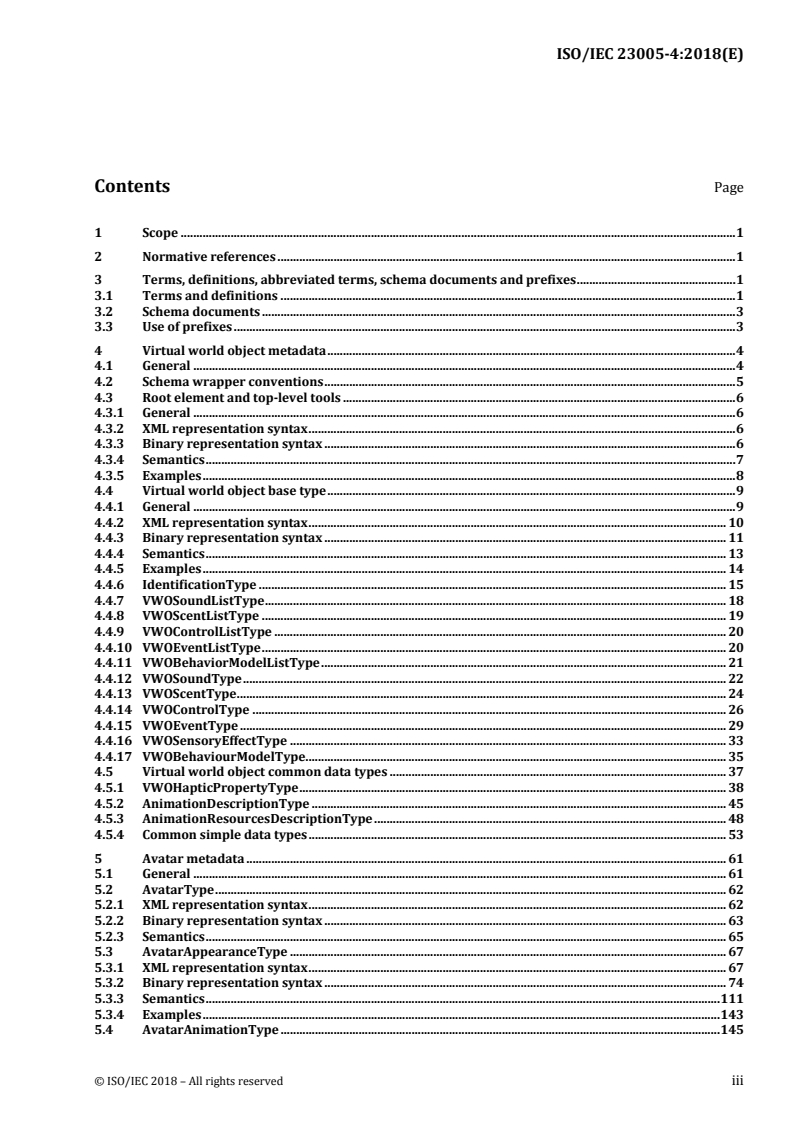
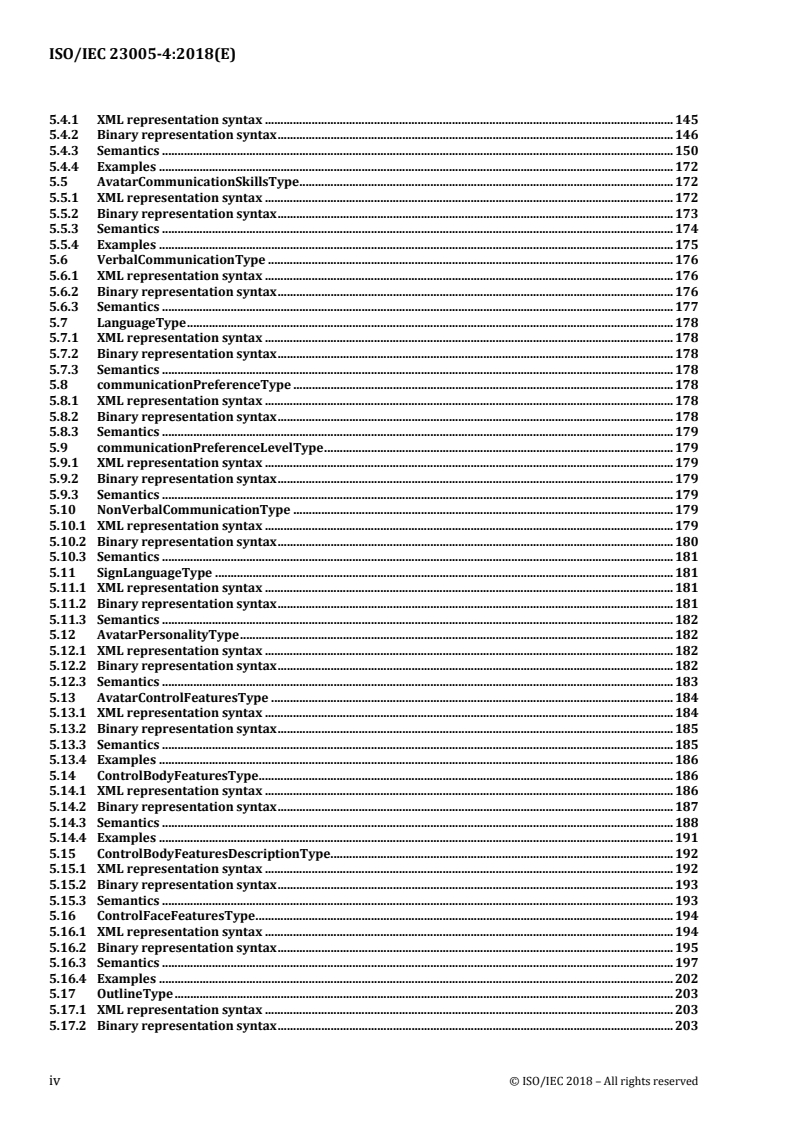
Contents Page
1 Scope . 1
2 Normative references . 1
3 Terms, definitions, abbreviated terms, schema documents and prefixes . 1
3.1 Terms and definitions . 1
3.2 Schema documents . 3
3.3 Use of prefixes . 3
4 Virtual world object metadata . 4
4.1 General . 4
4.2 Schema wrapper conventions . 5
4.3 Root element and top-level tools . 6
4.3.1 General . 6
4.3.2 XML representation syntax . 6
4.3.3 Binary representation syntax . 6
4.3.4 Semantics . 7
4.3.5 Examples . 8
4.4 Virtual world object base type . 9
4.4.1 General . 9
4.4.2 XML representation syntax . 10
4.4.3 Binary representation syntax . 11
4.4.4 Semantics . 13
4.4.5 Examples . 14
4.4.6 IdentificationType . 15
4.4.7 VWOSoundListType . 18
4.4.8 VWOScentListType . 19
4.4.9 VWOControlListType . 20
4.4.10 VWOEventListType . 20
4.4.11 VWOBehaviorModelListType . 21
4.4.12 VWOSoundType . 22
4.4.13 VWOScentType . 24
4.4.14 VWOControlType . 26
4.4.15 VWOEventType . 29
4.4.16 VWOSensoryEffectType . 33
4.4.17 VWOBehaviourModelType . 35
4.5 Virtual world object common data types . 37
4.5.1 VWOHapticPropertyType . 38
4.5.2 AnimationDescriptionType . 45
4.5.3 AnimationResourcesDescriptionType . 48
4.5.4 Common simple data types . 53
5 Avatar metadata . 61
5.1 General . 61
5.2 AvatarType . 62
5.2.1 XML representation syntax . 62
5.2.2 Binary representation syntax . 63
5.2.3 Semantics . 65
5.3 AvatarAppearanceType . 67
5.3.1 XML representation syntax . 67
5.3.2 Binary representation syntax . 74
5.3.3 Semantics . 111
5.3.4 Examples . 143
5.4 AvatarAnimationType . 145
© ISO/IEC 2018 – All rights reserved iii
5.4.1 XML representation syntax . 145
5.4.2 Binary representation syntax . 146
5.4.3 Semantics . 150
5.4.4 Examples . 172
5.5 AvatarCommunicationSkillsType . 172
5.5.1 XML representation syntax . 172
5.5.2 Binary representation syntax . 173
5.5.3 Semantics . 174
5.5.4 Examples . 175
5.6 VerbalCommunicationType . 176
5.6.1 XML representation syntax . 176
5.6.2 Binary representation syntax . 176
5.6.3 Semantics . 177
5.7 LanguageType . 178
5.7.1 XML representation syntax . 178
5.7.2 Binary representation syntax . 178
5.7.3 Semantics . 178
5.8 communicationPreferenceType . 178
5.8.1 XML representation syntax . 178
5.8.2 Binary representation syntax . 178
5.8.3 Semantics . 179
5.9 communicationPreferenceLevelType . 179
5.9.1 XML representation syntax . 179
5.9.2 Binary representation syntax . 179
5.9.3 Semantics . 179
5.10 NonVerbalCommunicationType . 179
5.10.1 XML representation syntax . 179
5.10.2 Binary representation syntax . 180
5.10.3 Semantics . 181
5.11 SignLanguageType . 181
5.11.1 XML representation syntax . 181
5.11.2 Binary representation syntax . 181
5.11.3 Semantics . 182
5.12 AvatarPersonalityType . 182
5.12.1 XML representation syntax . 182
5.12.2 Binary representation syntax . 182
5.12.3 Semantics . 183
5.13 AvatarControlFeaturesType . 184
5.13.1 XML representation syntax . 184
5.13.2 Binary representation syntax . 185
5.13.3 Semantics . 185
5.13.4 Examples . 186
5.14 ControlBodyFeaturesType . 186
5.14.1 XML representation syntax . 186
5.14.2 Binary representation syntax . 187
5.14.3 Semantics . 188
5.14.4 Examples . 191
5.15 ControlBodyFeaturesDescriptionType . 192
5.15.1 XML representation syntax . 192
5.15.2 Binary representation syntax . 193
5.15.3 Semantics . 193
5.16 ControlFaceFeaturesType . 194
5.16.1 XML representation syntax . 194
5.16.2 Binary representation syntax . 195
5.16.3 Semantics . 197
5.16.4 Examples . 202
5.17 OutlineType . 203
5.17.1 XML representation syntax . 203
5.17.2 Binary representation syntax . 203
iv © ISO/IEC 2018 – All rights reserved
5.17.3 Semantics . 204
5.18 Outline4PointsType . 204
5.18.1 XML representation syntax . 204
5.18.2 Binary representation syntax . 205
5.18.3 Semantics . 205
5.19 Outline5PointsType . 205
5.19.1 XML representation syntax . 205
5.19.2 Binary representation syntax . 206
5.19.3 Semantics . 206
5.20 Outline8PointsType . 206
5.20.1 XML representation syntax . 206
5.20.2 Binary representation syntax . 207
5.20.3 Semantics . 207
5.21 Outline14PointsType . 208
5.21.1 XML representation syntax . 208
5.21.2 Binary representation syntax . 209
5.21.3 Semantics . 209
5.22 VWOHapticPropertyListType . 210
5.22.1 XML representation syntax . 210
5.22.2 Binary representation syntax . 210
5.22.3 Semantics . 210
5.23 MakeupAvatarType . 211
5.23.1 XML representation syntax . 211
5.23.2 Binary representation syntax . 212
5.23.3 Semantics . 212
5.24 CosmeticType . 213
5.24.1 XML representation syntax . 213
5.24.2 Binary representation . 214
5.24.3 Semantics . 218
5.25 MakeupInfoType . 222
5.25.1 XML representation syntax . 222
5.25.2 Binary Representation . 222
5.25.3 Semantics . 222
5.26 MakeupToolType . 223
5.26.1 XML representation syntax . 223
5.26.2 Binary representation . 223
5.26.3 Semantics . 224
5.27 MakeupRegionType . 226
5.27.1 XML representation syntax . 226
5.27.2 Binary representation . 227
5.27.3 Semantics . 227
5.27.4 Examples . 229
6 Virtual object metadata. 231
6.1 General . 231
6.2 VirtualObjectType . 231
6.2.1 XML representation syntax . 231
6.2.2 Binary representation syntax . 232
6.2.3 Semantics . 233
6.2.4 Examples . 233
6.2.5 VOAnimationType . 234
Annex A (normative) Classification schemes . 238
Annex B (informative) Virtual world object characteristics schema . 288
Annex C (informative) Possible usage of the schema in this document . 289
Bibliography . 291
© ISO/IEC 2018 – All rights reserved v
Foreword
ISO (the International Organization for Standardization) and IEC (the International Electrotechnical
Commission) form the specialized system for worldwide standardization. National bodies that are
members of ISO or IEC participate in the development of International Standards through technical
committees established by the respective organization to deal with particular fields of technical activity.
ISO and IEC technical committees collaborate in fields of mutual interest. Other international
organizations, governmental and non‐governmental, in liaison with ISO and IEC, also take part in the
work. In the field of information technology, ISO and IEC have established a joint technical committee,
ISO/IEC JTC 1.
The procedures used to develop this document and those intended for its further maintenance are
described in the ISO/IEC Directives, Part 1. In particular, the different approval criteria needed for the
different types of document should be noted. This document was drafted in accordance with the
editorial rules of the ISO/IEC Directives, Part 2 (see www.iso.org/directives).
Attention is drawn to the possibility that some of the elements of this document may be the subject of
patent rights. ISO and IEC shall not be held responsible for identifying any or all such patent rights.
Details of any patent rights identified during the development of the document will be in the
Introduction and/or on the ISO list of patent declarations received (see www.iso.org/patents).
Any trade name used in this document is information given for the convenience of users and does not
constitute an endorsement.
For an explanation on the voluntary nature of standards, the meaning of ISO specific terms and
expressions related to conformity assessment, as well as information about ISO's adherence to the
World Trade Organization (WTO) principles in the Technical Barriers to Trade (TBT) see the following
URL: www.iso.org/iso/foreword.html.
This document was prepared by Technical Committee ISO/IEC JTC 1, Information technology,
Subcommittee SC 29, Coding of audio, picture, multimedia and hypermedia information.
This fourth edition cancels and replaces the third edition (ISO/IEC 23005‐4:2016), which has been
technically revised.
The main changes compared to the previous edition are the addition of:
— new element “SensoryEffectList” to VWOBaseType.
A list of all parts in the ISO/IEC 23005 series can be found on the ISO website.
Any feedback or questions on this document should be directed to the user’s national standards body. A
complete listing of these bodies can be found at www.iso.org/members.html.
vi © ISO/IEC 2018 – All rights reserved
Introduction
The ISO/IEC 23005 series provides an architecture and specifies information representation of data
flowing in and out of the real world and virtual worlds.
The data for the real world are communicated through sensors and actuators. The data for virtual
worlds consist of properties of virtual objects and multi‐sensorial data embedded in audio‐visual
content. MPEG‐V specifies data formats for sensors, actuators, virtual objects, and audio‐visual content.
Data captured from the real world may need to be adapted for use in a virtual world and data from
virtual worlds may also need to be adapted for use in the real world. The ISO/IEC 23005 series does not
specify how the adaptation is carried out but only specifies the interfaces.
Data for sensors are sensor capabilities, sensed data, and sensor adaptation preferences.
Data for actuators are sensory device capabilities, sensory device commands, and sensory effect
preferences.
Data for virtual objects are characteristics of avatars and virtual world objects.
Sensory effect may be needed to enrich audio‐visual contents.
The system architecture of the ISO/IEC 23005 series is depicted in Figure 1 and the scope of this
document is highlighted in yellow. The information representation that acts as an input to the possible
RV/VR Adaptation and as an exchangeable information format to support interoperability between
the virtual worlds – as defined in ISO/IEC 23005‐1 – is specified in this document.
NOTE The actual RV/VR Adaptation is deliberately informative and left open for industry competition.
© ISO/IEC 2018 – All rights reserved vii
Figure 1 — Scope of the ISO/IEC 23005 series (showing this document in yellow)
This document contains the tools for describing the virtual world object characteristics making it
possible to migrate a virtual world object (or only its characteristics) from one virtual world to another
and to control a virtual world object in a virtual world by real world devices (Annex C). It addresses the
normative aspects of the virtual world object characteristics including avatars and virtual objects, and
also illustrates some non‐normative examples.
The International Organization for Standardization (ISO) and the International Electrotechnical
Commission (IEC) draw attention to the fact that it is claimed that compliance with this document may
involve the use of patents.
ISO and the IEC take no position concerning the evidence, validity and scope of these patent rights. The
holders of these patent rights have assured ISO and the IEC that they are willing to negotiate licences
under reasonable and non‐discriminatory terms and conditions with applicants throughout the world.
In this respect, the statements of the holders of these patents right are registered with ISO and the IEC.
Information may be obtained from the companies listed below.
Attention is drawn to the possibility that some of the elements of this document may be the subject of
patent rights other than those identified in this annex. ISO and the IEC shall not be held responsible for
identifying any or all such patent rights.
ISO (www.iso.org/patents) and IEC (http://patents.iec.ch) maintain online databases of patents
relevant to their standards. Users are encouraged to consult the databases for the most up to date
information concerning patents.
viii © ISO/IEC 2018 – All rights reserved
Company Address
Samsung Electronics Co.Ltd. 416, Maetan‐dong, Yeongtong‐gu, Suwon‐si,
Gyeonggi‐do, 152‐848, Republic of Korea
Gwangju Institute of Science and Technology 261 Cheomdan ‐ gwagiro (Oryong‐dong), Buk‐gu,
Gwangju 500‐712, Republic of Korea
Electronics and Telecommunications 218 Gajeongno, Yuseong‐gu, Daejeon, 305‐700,
Research Institute (ETRI) Republic of Korea
Konkuk University 1 Hwayang‐dong, Gwangjin‐gu, Seoul, 143‐701,
Republic of Korea
Myongji University 116 Myongji‐ro, Cheoin‐gu, Yongin, 449‐728,
Republic of Korea
© ISO/IEC 2018 – All rights reserved ix
INTERNATIONAL STANDARD ISO/IEC 23005-2:2018(E)
Information technology — Media context and control —
Part 4:
Virtual world object characteristics
1 Scope
The technologies of this document specified are description languages and vocabularies to describe
virtual world objects.
The adaptation engine is not within the scope of this document.
This document specifies syntax and semantics of the tools used to characterize a virtual world object
related metadata:
— Virtual World Object Characteristics (VWOC) as an XML Schema‐based language which enables one
to describe a basic structure of avatars and virtual world objects in virtual environments.
2 Normative references
The following documents are referred to in the text in such a way that some or all of their content
constitutes requirements of this document. For dated references, only the edition cited applies. For
undated references, the latest edition of the referenced document (including any amendments) applies.
ISO 639 (all parts), Codes for the representation of names of languages
ISO/IEC 15938‐5:2003, Information technology — Multimedia content description interface — Part 5:
Multimedia description schemes
ISO/IEC 21000‐5, Information technology — Multimedia framework (MPEG-21) — Part 5: Rights
Expression Language
ISO/IEC 23005‐6:—, Information technology — Media context and control — Part 6: Common types and
tools
3 Terms, definitions, abbreviated terms, schema documents and prefixes
3.1 Terms and definitions
For the purposes of this document, the terms and definitions given in ISO/IEC 23005‐6 and the
following apply.
Under preparation. Stage at time of publication: ISO/IEC FDIS 23005‐6:2018.
© ISO/IEC 2018 – All rights reserved 1
ISO and IEC maintain terminological databases for use in standardization at the following addresses:
— IEC Electropedia: available at http://www.electropedia.org/
— ISO Online browsing platform: available at https://www.iso.org/obp
3.1.1
avatar
entity that can be used as a (visual) representation of the user inside the virtual environments
EXAMPLE A player's representation in the video game and human or fantastic representations of a person's
self in non‐gaming online worlds.
3.1.2
avatar metadata
definition of the description schemes and descriptors to represent avatars (3.1.1)
3.1.3
extensible markup language
XML
set of rules for encoding documents in machine‐readable form
3.1.4
rights expression language
REL
machine‐readable language that declares rights and permissions
3.1.5
uniform resource identifier
URI
compact string of characters for identifying an abstract or physical resource
3.1.6
uniform resource locator
URL
compact string representation for a resource available via the Internet
3.1.7
virtual object
entity that is any (visual) object except for avatars in the virtual environment
3.1.8
virtual object metadata
definition of the description schemes and descriptors to represent virtual objects (3.1.7)
3.1.9
virtual world object
entity that includes avatars and virtual objects in the virtual world
3.1.10
virtual world object metadata
definition of the description schemes and descriptors to represent virtual world objects (3.1.9)
2 © ISO/IEC 2018 – All rights reserved
3.2 Schema documents
In the main text of this document, the syntax of description schemes and descriptors is provided
whenever possible as a single schema document.
In order to form a valid schema document, these schema components should be gathered in a same
document with the schema wrapper provided at the head of the clause. For better readability, the
relevant schema documents are provided in Annex B.
In all cases, each schema document has a version attribute, the value of which is "ISO/IEC 23005‐4".
Furthermore, an informative identifier is given as the value of the id attribute of the schema
component. This identifier is non‐normative and used as a convention in this document to reference
another schema document. In particular, it is used for the schemaLocation attribute of the include
and import schema components.
In addition, Annex A specifies a set of classification schemes that may be used by applications using
description tools specified in this document.
3.3 Use of prefixes
For clarity, throughout this document, consistent namespace prefixes are used.
"xsi:" prefix is not normative. It is a naming convention in this document to refer to an element of the
http://www.w3.org/2001/XMLSchema-instance namespace.
"xml:" and "xmlns:" are normative prefixes defined in [1]. The prefix "xml:" is by definition
bound to "http://www.w3.org/XML/1998/namespace". The prefix "xmlns:" is used only for
namespace bindings and is not itself bound to any namespace name.
All other prefixes used in either the text or examples of this document are not normative, e.g., "sedl:",
"sev:", "dia:", "si:", "mpeg7:".
In particular, most of the informative examples in this document are provided as XML fragments
without the normally required XML document declaration and, thus, miss a correct namespace binding
context declaration. In these descriptions fragments the different prefixes are bound to the namespaces
as given in Table 1.
Table 1 — Mapping of prefixes to namespaces in examples and text
Prefix Corresponding namespace
ct urn:mpeg:mpeg-v:2018:01-CT-NS
sedl urn:mpeg:mpeg-v:2018:01-SEDL-NS
sev urn:mpeg:mpeg-v:2018:01-SEV-NS
dia urn:mpeg:mpeg21:2003:01-DIA-NS
si urn:mpeg:mpeg21:2003:01-DIA-XSI-NS
mpeg7 urn:mpeg:mpeg7:schema:2004
xsi http://www.w3.org/2001/XMLSchema-instance
xsd http://www.w3.org/2001/XMLSchema
© ISO/IEC 2018 – All rights reserved 3
4 Virtual world object metadata
4.1 General
A specificity of virtual environments (VEs) with respect to other multimedia applications consists in the
representation of virtual world objects inside the environment. The "virtual world object” can be
classified into two types: avatars and virtual objects. An avatar can be used as a (visual) representation
of the user inside the environment. These virtual world objects serve different purposes:
— characterize various kinds of objects within the VE;
— provide an interaction with the VE.
In general, creating an object is a time consuming task. Even though some components of the object may
be related to the VE (e.g. the avatar wearing a medieval suit in a contemporary style VE may be
inappropriate), there is a real need of being able to create the object once and import/use it in different
VEs. To serve the latter purpose, it should be possible to control the object from external applications
(e.g. the emotions one avatar exposes in the VE can be obtained by processing the associated user's
physiological sensors). This document proposes an XML schema, called virtual world object
characteristics XSD, for describing an object by considering three main requirements:
— it should be possible to easily create importers/exporters from various VEs implementations;
— it should be easy to control an object within an VE;
— it should be possible to modify a proprietary template (specific to the virtual world) of the object by
using data contained in the virtual world object characteristics file.
In detail, once the object is created (possibly by an authori
...
INTERNATIONAL ISO/IEC
STANDARD 23005-4
Fourth edition
2018-09
Information technology — Media
context and control —
Part 4:
Virtual world object characteristics
Technologies de l'information — Contrôle et contexte de supports —
Partie 4: Caractéristiques d'objet du monde virtuel
Reference number
©
ISO/IEC 2018
© ISO/IEC 2018
All rights reserved. Unless otherwise specified, or required in the context of its implementation, no part of this publication may
be reproduced or utilized otherwise in any form or by any means, electronic or mechanical, including photocopying, or posting
on the internet or an intranet, without prior written permission. Permission can be requested from either ISO at the address
below or ISO’s member body in the country of the requester.
ISO copyright office
CP 401 • Ch. de Blandonnet 8
CH-1214 Vernier, Geneva
Phone: +41 22 749 01 11
Fax: +41 22 749 09 47
Email: copyright@iso.org
Website: www.iso.org
Published in Switzerland
ii © ISO/IEC 2018 – All rights reserved
Contents Page
1 Scope . 1
2 Normative references . 1
3 Terms, definitions, abbreviated terms, schema documents and prefixes . 1
3.1 Terms and definitions . 1
3.2 Schema documents . 3
3.3 Use of prefixes . 3
4 Virtual world object metadata . 4
4.1 General . 4
4.2 Schema wrapper conventions . 5
4.3 Root element and top-level tools . 6
4.3.1 General . 6
4.3.2 XML representation syntax . 6
4.3.3 Binary representation syntax . 6
4.3.4 Semantics . 7
4.3.5 Examples . 8
4.4 Virtual world object base type . 9
4.4.1 General . 9
4.4.2 XML representation syntax . 10
4.4.3 Binary representation syntax . 11
4.4.4 Semantics . 13
4.4.5 Examples . 14
4.4.6 IdentificationType . 15
4.4.7 VWOSoundListType . 18
4.4.8 VWOScentListType . 19
4.4.9 VWOControlListType . 20
4.4.10 VWOEventListType . 20
4.4.11 VWOBehaviorModelListType . 21
4.4.12 VWOSoundType . 22
4.4.13 VWOScentType . 24
4.4.14 VWOControlType . 26
4.4.15 VWOEventType . 29
4.4.16 VWOSensoryEffectType . 33
4.4.17 VWOBehaviourModelType . 35
4.5 Virtual world object common data types . 37
4.5.1 VWOHapticPropertyType . 38
4.5.2 AnimationDescriptionType . 45
4.5.3 AnimationResourcesDescriptionType . 48
4.5.4 Common simple data types . 53
5 Avatar metadata . 61
5.1 General . 61
5.2 AvatarType . 62
5.2.1 XML representation syntax . 62
5.2.2 Binary representation syntax . 63
5.2.3 Semantics . 65
5.3 AvatarAppearanceType . 67
5.3.1 XML representation syntax . 67
5.3.2 Binary representation syntax . 74
5.3.3 Semantics . 111
5.3.4 Examples . 143
5.4 AvatarAnimationType . 145
© ISO/IEC 2018 – All rights reserved iii
5.4.1 XML representation syntax . 145
5.4.2 Binary representation syntax . 146
5.4.3 Semantics . 150
5.4.4 Examples . 172
5.5 AvatarCommunicationSkillsType . 172
5.5.1 XML representation syntax . 172
5.5.2 Binary representation syntax . 173
5.5.3 Semantics . 174
5.5.4 Examples . 175
5.6 VerbalCommunicationType . 176
5.6.1 XML representation syntax . 176
5.6.2 Binary representation syntax . 176
5.6.3 Semantics . 177
5.7 LanguageType . 178
5.7.1 XML representation syntax . 178
5.7.2 Binary representation syntax . 178
5.7.3 Semantics . 178
5.8 communicationPreferenceType . 178
5.8.1 XML representation syntax . 178
5.8.2 Binary representation syntax . 178
5.8.3 Semantics . 179
5.9 communicationPreferenceLevelType . 179
5.9.1 XML representation syntax . 179
5.9.2 Binary representation syntax . 179
5.9.3 Semantics . 179
5.10 NonVerbalCommunicationType . 179
5.10.1 XML representation syntax . 179
5.10.2 Binary representation syntax . 180
5.10.3 Semantics . 181
5.11 SignLanguageType . 181
5.11.1 XML representation syntax . 181
5.11.2 Binary representation syntax . 181
5.11.3 Semantics . 182
5.12 AvatarPersonalityType . 182
5.12.1 XML representation syntax . 182
5.12.2 Binary representation syntax . 182
5.12.3 Semantics . 183
5.13 AvatarControlFeaturesType . 184
5.13.1 XML representation syntax . 184
5.13.2 Binary representation syntax . 185
5.13.3 Semantics . 185
5.13.4 Examples . 186
5.14 ControlBodyFeaturesType . 186
5.14.1 XML representation syntax . 186
5.14.2 Binary representation syntax . 187
5.14.3 Semantics . 188
5.14.4 Examples . 191
5.15 ControlBodyFeaturesDescriptionType . 192
5.15.1 XML representation syntax . 192
5.15.2 Binary representation syntax . 193
5.15.3 Semantics . 193
5.16 ControlFaceFeaturesType . 194
5.16.1 XML representation syntax . 194
5.16.2 Binary representation syntax . 195
5.16.3 Semantics . 197
5.16.4 Examples . 202
5.17 OutlineType . 203
5.17.1 XML representation syntax . 203
5.17.2 Binary representation syntax . 203
iv © ISO/IEC 2018 – All rights reserved
5.17.3 Semantics . 204
5.18 Outline4PointsType . 204
5.18.1 XML representation syntax . 204
5.18.2 Binary representation syntax . 205
5.18.3 Semantics . 205
5.19 Outline5PointsType . 205
5.19.1 XML representation syntax . 205
5.19.2 Binary representation syntax . 206
5.19.3 Semantics . 206
5.20 Outline8PointsType . 206
5.20.1 XML representation syntax . 206
5.20.2 Binary representation syntax . 207
5.20.3 Semantics . 207
5.21 Outline14PointsType . 208
5.21.1 XML representation syntax . 208
5.21.2 Binary representation syntax . 209
5.21.3 Semantics . 209
5.22 VWOHapticPropertyListType . 210
5.22.1 XML representation syntax . 210
5.22.2 Binary representation syntax . 210
5.22.3 Semantics . 210
5.23 MakeupAvatarType . 211
5.23.1 XML representation syntax . 211
5.23.2 Binary representation syntax . 212
5.23.3 Semantics . 212
5.24 CosmeticType . 213
5.24.1 XML representation syntax . 213
5.24.2 Binary representation . 214
5.24.3 Semantics . 218
5.25 MakeupInfoType . 222
5.25.1 XML representation syntax . 222
5.25.2 Binary Representation . 222
5.25.3 Semantics . 222
5.26 MakeupToolType . 223
5.26.1 XML representation syntax . 223
5.26.2 Binary representation . 223
5.26.3 Semantics . 224
5.27 MakeupRegionType . 226
5.27.1 XML representation syntax . 226
5.27.2 Binary representation . 227
5.27.3 Semantics . 227
5.27.4 Examples . 229
6 Virtual object metadata. 231
6.1 General . 231
6.2 VirtualObjectType . 231
6.2.1 XML representation syntax . 231
6.2.2 Binary representation syntax . 232
6.2.3 Semantics . 233
6.2.4 Examples . 233
6.2.5 VOAnimationType . 234
Annex A (normative) Classification schemes . 238
Annex B (informative) Virtual world object characteristics schema . 288
Annex C (informative) Possible usage of the schema in this document . 289
Bibliography . 291
© ISO/IEC 2018 – All rights reserved v
Foreword
ISO (the International Organization for Standardization) and IEC (the International Electrotechnical
Commission) form the specialized system for worldwide standardization. National bodies that are
members of ISO or IEC participate in the development of International Standards through technical
committees established by the respective organization to deal with particular fields of technical activity.
ISO and IEC technical committees collaborate in fields of mutual interest. Other international
organizations, governmental and non‐governmental, in liaison with ISO and IEC, also take part in the
work. In the field of information technology, ISO and IEC have established a joint technical committee,
ISO/IEC JTC 1.
The procedures used to develop this document and those intended for its further maintenance are
described in the ISO/IEC Directives, Part 1. In particular, the different approval criteria needed for the
different types of document should be noted. This document was drafted in accordance with the
editorial rules of the ISO/IEC Directives, Part 2 (see www.iso.org/directives).
Attention is drawn to the possibility that some of the elements of this document may be the subject of
patent rights. ISO and IEC shall not be held responsible for identifying any or all such patent rights.
Details of any patent rights identified during the development of the document will be in the
Introduction and/or on the ISO list of patent declarations received (see www.iso.org/patents).
Any trade name used in this document is information given for the convenience of users and does not
constitute an endorsement.
For an explanation on the voluntary nature of standards, the meaning of ISO specific terms and
expressions related to conformity assessment, as well as information about ISO's adherence to the
World Trade Organization (WTO) principles in the Technical Barriers to Trade (TBT) see the following
URL: www.iso.org/iso/foreword.html.
This document was prepared by Technical Committee ISO/IEC JTC 1, Information technology,
Subcommittee SC 29, Coding of audio, picture, multimedia and hypermedia information.
This fourth edition cancels and replaces the third edition (ISO/IEC 23005‐4:2016), which has been
technically revised.
The main changes compared to the previous edition are the addition of:
— new element “SensoryEffectList” to VWOBaseType.
A list of all parts in the ISO/IEC 23005 series can be found on the ISO website.
Any feedback or questions on this document should be directed to the user’s national standards body. A
complete listing of these bodies can be found at www.iso.org/members.html.
vi © ISO/IEC 2018 – All rights reserved
Introduction
The ISO/IEC 23005 series provides an architecture and specifies information representation of data
flowing in and out of the real world and virtual worlds.
The data for the real world are communicated through sensors and actuators. The data for virtual
worlds consist of properties of virtual objects and multi‐sensorial data embedded in audio‐visual
content. MPEG‐V specifies data formats for sensors, actuators, virtual objects, and audio‐visual content.
Data captured from the real world may need to be adapted for use in a virtual world and data from
virtual worlds may also need to be adapted for use in the real world. The ISO/IEC 23005 series does not
specify how the adaptation is carried out but only specifies the interfaces.
Data for sensors are sensor capabilities, sensed data, and sensor adaptation preferences.
Data for actuators are sensory device capabilities, sensory device commands, and sensory effect
preferences.
Data for virtual objects are characteristics of avatars and virtual world objects.
Sensory effect may be needed to enrich audio‐visual contents.
The system architecture of the ISO/IEC 23005 series is depicted in Figure 1 and the scope of this
document is highlighted in yellow. The information representation that acts as an input to the possible
RV/VR Adaptation and as an exchangeable information format to support interoperability between
the virtual worlds – as defined in ISO/IEC 23005‐1 – is specified in this document.
NOTE The actual RV/VR Adaptation is deliberately informative and left open for industry competition.
© ISO/IEC 2018 – All rights reserved vii
Figure 1 — Scope of the ISO/IEC 23005 series (showing this document in yellow)
This document contains the tools for describing the virtual world object characteristics making it
possible to migrate a virtual world object (or only its characteristics) from one virtual world to another
and to control a virtual world object in a virtual world by real world devices (Annex C). It addresses the
normative aspects of the virtual world object characteristics including avatars and virtual objects, and
also illustrates some non‐normative examples.
The International Organization for Standardization (ISO) and the International Electrotechnical
Commission (IEC) draw attention to the fact that it is claimed that compliance with this document may
involve the use of patents.
ISO and the IEC take no position concerning the evidence, validity and scope of these patent rights. The
holders of these patent rights have assured ISO and the IEC that they are willing to negotiate licences
under reasonable and non‐discriminatory terms and conditions with applicants throughout the world.
In this respect, the statements of the holders of these patents right are registered with ISO and the IEC.
Information may be obtained from the companies listed below.
Attention is drawn to the possibility that some of the elements of this document may be the subject of
patent rights other than those identified in this annex. ISO and the IEC shall not be held responsible for
identifying any or all such patent rights.
ISO (www.iso.org/patents) and IEC (http://patents.iec.ch) maintain online databases of patents
relevant to their standards. Users are encouraged to consult the databases for the most up to date
information concerning patents.
viii © ISO/IEC 2018 – All rights reserved
Company Address
Samsung Electronics Co.Ltd. 416, Maetan‐dong, Yeongtong‐gu, Suwon‐si,
Gyeonggi‐do, 152‐848, Republic of Korea
Gwangju Institute of Science and Technology 261 Cheomdan ‐ gwagiro (Oryong‐dong), Buk‐gu,
Gwangju 500‐712, Republic of Korea
Electronics and Telecommunications 218 Gajeongno, Yuseong‐gu, Daejeon, 305‐700,
Research Institute (ETRI) Republic of Korea
Konkuk University 1 Hwayang‐dong, Gwangjin‐gu, Seoul, 143‐701,
Republic of Korea
Myongji University 116 Myongji‐ro, Cheoin‐gu, Yongin, 449‐728,
Republic of Korea
© ISO/IEC 2018 – All rights reserved ix
INTERNATIONAL STANDARD ISO/IEC 23005-2:2018(E)
Information technology — Media context and control —
Part 4:
Virtual world object characteristics
1 Scope
The technologies of this document specified are description languages and vocabularies to describe
virtual world objects.
The adaptation engine is not within the scope of this document.
This document specifies syntax and semantics of the tools used to characterize a virtual world object
related metadata:
— Virtual World Object Characteristics (VWOC) as an XML Schema‐based language which enables one
to describe a basic structure of avatars and virtual world objects in virtual environments.
2 Normative references
The following documents are referred to in the text in such a way that some or all of their content
constitutes requirements of this document. For dated references, only the edition cited applies. For
undated references, the latest edition of the referenced document (including any amendments) applies.
ISO 639 (all parts), Codes for the representation of names of languages
ISO/IEC 15938‐5:2003, Information technology — Multimedia content description interface — Part 5:
Multimedia description schemes
ISO/IEC 21000‐5, Information technology — Multimedia framework (MPEG-21) — Part 5: Rights
Expression Language
ISO/IEC 23005‐6:—, Information technology — Media context and control — Part 6: Common types and
tools
3 Terms, definitions, abbreviated terms, schema documents and prefixes
3.1 Terms and definitions
For the purposes of this document, the terms and definitions given in ISO/IEC 23005‐6 and the
following apply.
Under preparation. Stage at time of publication: ISO/IEC FDIS 23005‐6:2018.
© ISO/IEC 2018 – All rights reserved 1
ISO and IEC maintain terminological databases for use in standardization at the following addresses:
— IEC Electropedia: available at http://www.electropedia.org/
— ISO Online browsing platform: available at https://www.iso.org/obp
3.1.1
avatar
entity that can be used as a (visual) representation of the user inside the virtual environments
EXAMPLE A player's representation in the video game and human or fantastic representations of a person's
self in non‐gaming online worlds.
3.1.2
avatar metadata
definition of the description schemes and descriptors to represent avatars (3.1.1)
3.1.3
extensible markup language
XML
set of rules for encoding documents in machine‐readable form
3.1.4
rights expression language
REL
machine‐readable language that declares rights and permissions
3.1.5
uniform resource identifier
URI
compact string of characters for identifying an abstract or physical resource
3.1.6
uniform resource locator
URL
compact string representation for a resource available via the Internet
3.1.7
virtual object
entity that is any (visual) object except for avatars in the virtual environment
3.1.8
virtual object metadata
definition of the description schemes and descriptors to represent virtual objects (3.1.7)
3.1.9
virtual world object
entity that includes avatars and virtual objects in the virtual world
3.1.10
virtual world object metadata
definition of the description schemes and descriptors to represent virtual world objects (3.1.9)
2 © ISO/IEC 2018 – All rights reserved
3.2 Schema documents
In the main text of this document, the syntax of description schemes and descriptors is provided
whenever possible as a single schema document.
In order to form a valid schema document, these schema components should be gathered in a same
document with the schema wrapper provided at the head of the clause. For better readability, the
relevant schema documents are provided in Annex B.
In all cases, each schema document has a version attribute, the value of which is "ISO/IEC 23005‐4".
Furthermore, an informative identifier is given as the value of the id attribute of the schema
component. This identifier is non‐normative and used as a convention in this document to reference
another schema document. In particular, it is used for the schemaLocation attribute of the include
and import schema components.
In addition, Annex A specifies a set of classification schemes that may be used by applications using
description tools specified in this document.
3.3 Use of prefixes
For clarity, throughout this document, consistent namespace prefixes are used.
"xsi:" prefix is not normative. It is a naming convention in this document to refer to an element of the
http://www.w3.org/2001/XMLSchema-instance namespace.
"xml:" and "xmlns:" are normative prefixes defined in [1]. The prefix "xml:" is by definition
bound to "http://www.w3.org/XML/1998/namespace". The prefix "xmlns:" is used only for
namespace bindings and is not itself bound to any namespace name.
All other prefixes used in either the text or examples of this document are not normative, e.g., "sedl:",
"sev:", "dia:", "si:", "mpeg7:".
In particular, most of the informative examples in this document are provided as XML fragments
without the normally required XML document declaration and, thus, miss a correct namespace binding
context declaration. In these descriptions fragments the different prefixes are bound to the namespaces
as given in Table 1.
Table 1 — Mapping of prefixes to namespaces in examples and text
Prefix Corresponding namespace
ct urn:mpeg:mpeg-v:2018:01-CT-NS
sedl urn:mpeg:mpeg-v:2018:01-SEDL-NS
sev urn:mpeg:mpeg-v:2018:01-SEV-NS
dia urn:mpeg:mpeg21:2003:01-DIA-NS
si urn:mpeg:mpeg21:2003:01-DIA-XSI-NS
mpeg7 urn:mpeg:mpeg7:schema:2004
xsi http://www.w3.org/2001/XMLSchema-instance
xsd http://www.w3.org/2001/XMLSchema
© ISO/IEC 2018 – All rights reserved 3
4 Virtual world object metadata
4.1 General
A specificity of virtual environments (VEs) with respect to other multimedia applications consists in the
representation of virtual world objects inside the environment. The "virtual world object” can be
classified into two types: avatars and virtual objects. An avatar can be used as a (visual) representation
of the user inside the environment. These virtual world objects serve different purposes:
— characterize various kinds of objects within the VE;
— provide an interaction with the VE.
In general, creating an object is a time consuming task. Even though some components of the object may
be related to the VE (e.g. the avatar wearing a medieval suit in a contemporary style VE may be
inappropriate), there is a real need of being able to create the object once and import/use it in different
VEs. To serve the latter purpose, it should be possible to control the object from external applications
(e.g. the emotions one avatar exposes in the VE can be obtained by processing the associated user's
physiological sensors). This document proposes an XML schema, called virtual world object
characteristics XSD, for describing an object by considering three main requirements:
— it should be possible to easily create importers/exporters from various VEs implementations;
— it should be easy to control an object within an VE;
— it should be possible to modify a proprietary template (specific to the virtual world) of the object by
using data contained in the virtual world object characteristics file.
In detail, once the object is created (possibly by an authori
...