

ISO 22498:2005
(Main)Plastics — Vinyl chloride homopolymer and copolymer resins — Particle size determination by mechanical sieving
General Information
- Abstract
ISO 22498:2005 specifies a method for the determination of the size distribution of particles of vinyl chloride homopolymer and copolymer resins by measuring the amounts retained on a selection of sieves having meshes of various aperture sizes. The results can be expressed either in terms of the amount retained on the individual sieves or as the mean particle size for the whole test sample.
- Status
- Published
- Publication Date
- 02-Aug-2005
- Technical Committee
- ISO/TC 61/SC 9 - Thermoplastic materials
- Drafting Committee
- ISO/TC 61/SC 9/WG 20 - Poly(vinyl chloride)
- Current Stage
- 9093 - International Standard confirmed
- Start Date
- 07-Oct-2024
- Completion Date
- 29-Aug-2026
Overview
ISO 22498:2005 specifies a mechanical sieving method for determining the particle size distribution of vinyl chloride homopolymer and copolymer resins (PVC resins). The standard covers sample preparation, apparatus, test procedure and calculation of results so that outcomes can be reported either as the percentage retained on each sieve or as a single mean particle size for the test sample. The method is intended for routine quality control and material characterization and is not recommended for sieve meshes smaller than 0.038 mm.
Key topics and requirements
- Test sample: 20.0 g ± 0.1 g of resin; anti‑static agent (e.g., aluminium oxide or carbon black) may be added up to 0.1% by mass.
- Sieves and apparatus:
- Nominal 200 mm diameter sieves conforming to ISO 565; recommended mesh sizes include 0.425, 0.250, 0.150, 0.106, 0.075 and 0.063 mm as a minimum.
- Mechanical sieve shaker delivering a vertical motion with a “tap” at each stroke; tapping rate 150 ± 15 taps/min; timer set to 13 min ± 2 min.
- Balances: precision to ±0.001 g and ±0.1 g for weighing sieves/pans and retained resin.
- Other items: soft‑bristle brush, vacuum cleaner for cleaning, rubber blocks (approx. 40×10×15 mm, Shore A hardness ~70–80).
- Procedure essentials:
- Clean and inspect sieves, weigh empty sieves and pans, assemble stack in ascending order of mesh size (largest aperture on top).
- Run two determinations per sample, weigh retained resin on each sieve and the pan.
- Calculations:
- Compute average mass retained on each sieve (mean of two determinations) and express as percentage of the test sample.
- For mean particle size, compute an average particle size for adjacent sieve pairs (midpoint of adjacent mesh sizes) and calculate a weighted mean using the percentage retained on the smaller aperture in each pair. Ignore material retained on the largest sieve and in the pan for this mean-size calculation.
- Cumulative retention across the stack and pan must exceed 99% or the test must be repeated.
- Precision: Interlaboratory precision data are not available (precision unknown).
Applications and users
- Typical users: PVC resin manufacturers, QC/analytical laboratories, compounders, material suppliers, and R&D teams.
- Practical uses:
- Routine quality control and acceptance testing of vinyl chloride homopolymer and copolymer resins.
- Specification compliance and supplier qualification.
- Process optimization in extrusion, compounding and molding - particle size distribution affects flow, dispersion and final product properties.
- Batch-to-batch consistency checks and troubleshooting (e.g., dust levels, fines content).
- Benefits: Standardized, replicable mechanical sieving provides clear, comparable particle‑size data for material selection and process control.
Related standards
- ISO 565 - Test sieves (nominal opening sizes and construction)
- ISO 868 - Plastics - Shore hardness (used for rubber block specification)
- Prepared by ISO/TC 61/SC 9 (thermoplastic materials)
Keywords: ISO 22498:2005, particle size determination, mechanical sieving, vinyl chloride homopolymer, copolymer resins, sieve shaker, mean particle size, particle size distribution, PVC resin quality control.
Relations
- Referred By
EN 15344:2007 - Plastics - Recycled Plastics - Characterisation of Polyethylene (PE) recyclates - Effective Date
- 25-Aug-2026
- Referred By
EN 15344:2021 - Plastics - Recycled plastics - Characterization of Polyethylene (PE) recyclates - Effective Date
- 25-Aug-2026
Get Certified
Connect with accredited certification bodies for this standard

DIN CERTCO
DIN Group product certification.

Smithers Quality Assessments
US management systems and product certification.
Sponsored listings
Frequently Asked Questions
ISO 22498:2005 is a standard published by the International Organization for Standardization (ISO). Its full title is "Plastics — Vinyl chloride homopolymer and copolymer resins — Particle size determination by mechanical sieving". This standard covers: ISO 22498:2005 specifies a method for the determination of the size distribution of particles of vinyl chloride homopolymer and copolymer resins by measuring the amounts retained on a selection of sieves having meshes of various aperture sizes. The results can be expressed either in terms of the amount retained on the individual sieves or as the mean particle size for the whole test sample.
ISO 22498:2005 specifies a method for the determination of the size distribution of particles of vinyl chloride homopolymer and copolymer resins by measuring the amounts retained on a selection of sieves having meshes of various aperture sizes. The results can be expressed either in terms of the amount retained on the individual sieves or as the mean particle size for the whole test sample.
ISO 22498:2005 is classified under the following ICS (International Classification for Standards) categories: 83.080.20 - Thermoplastic materials. The ICS classification helps identify the subject area and facilitates finding related standards.
ISO 22498:2005 has the following relationships with other standards: It is inter standard links to EN 15344:2007, EN 15344:2021. Understanding these relationships helps ensure you are using the most current and applicable version of the standard.
ISO 22498:2005 is available in PDF format for immediate download after purchase. The document can be added to your cart and obtained through the secure checkout process. Digital delivery ensures instant access to the complete standard document.
Standards Content (Sample)
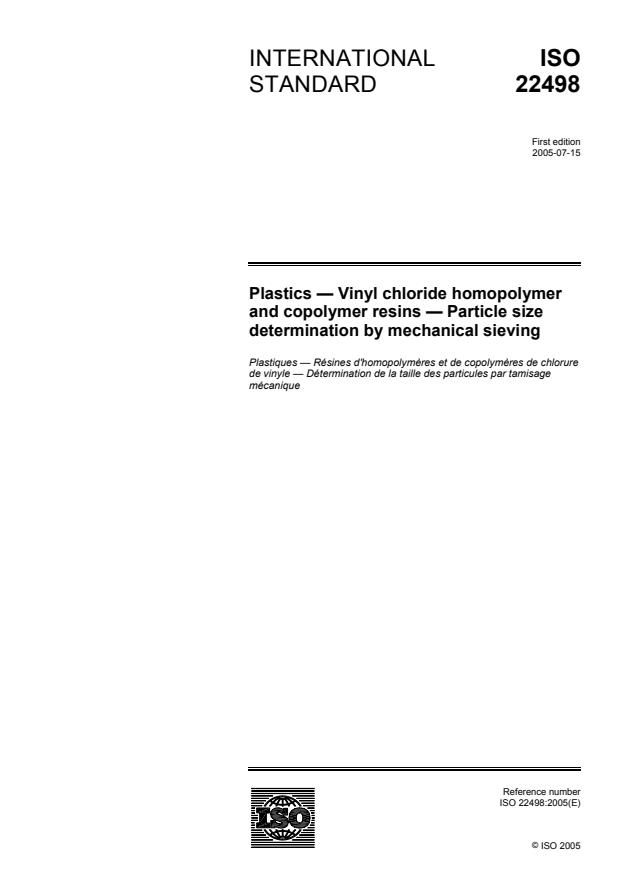
INTERNATIONAL ISO
STANDARD 22498
First edition
2005-07-15
Plastics — Vinyl chloride homopolymer
and copolymer resins — Particle size
determination by mechanical sieving
Plastiques — Résines d'homopolymères et de copolymères de chlorure
de vinyle — Détermination de la taille des particules par tamisage
mécanique
Reference number
©
ISO 2005
PDF disclaimer
This PDF file may contain embedded typefaces. In accordance with Adobe's licensing policy, this file may be printed or viewed but
shall not be edited unless the typefaces which are embedded are licensed to and installed on the computer performing the editing. In
downloading this file, parties accept therein the responsibility of not infringing Adobe's licensing policy. The ISO Central Secretariat
accepts no liability in this area.
Adobe is a trademark of Adobe Systems Incorporated.
Details of the software products used to create this PDF file can be found in the General Info relative to the file; the PDF-creation
parameters were optimized for printing. Every care has been taken to ensure that the file is suitable for use by ISO member bodies. In
the unlikely event that a problem relating to it is found, please inform the Central Secretariat at the address given below.
© ISO 2005
All rights reserved. Unless otherwise specified, no part of this publication may be reproduced or utilized in any form or by any means,
electronic or mechanical, including photocopying and microfilm, without permission in writing from either ISO at the address below or
ISO's member body in the country of the requester.
ISO copyright office
Case postale 56 • CH-1211 Geneva 20
Tel. + 41 22 749 01 11
Fax + 41 22 749 09 47
E-mail copyright@iso.org
Web www.iso.org
Published in Switzerland
ii © ISO 2005 – All rights reserved
Contents Page
Foreword. iv
1 Scope . 1
2 Normative references . 1
3 Terms and definitions. 1
4 Principle. 2
5 Materials . 2
6 Apparatus . 2
7 Procedure . 2
8 Number of determinations . 3
9 Calculation and expression of results. 3
10 Precision. 4
11 Test report . 4
Foreword
ISO (the International Organization for Standardization) is a worldwide federation of national standards bodies
(ISO member bodies). The work of preparing International Standards is normally carried out through ISO
technical committees. Each member body interested in a subject for which a technical committee has been
established has the right to be represented on that committee. International organizations, governmental and
non-governmental, in liaison with ISO, also take part in the work. ISO collaborates closely with the
International Electrotechnical Commission (IEC) on all matters of electrotechnical standardization.
International Standards are drafted in accordance with the rules given in the ISO/IEC Directives, Part 2.
The main task of technical committees is to prepare International Standards. Draft International Standards
adopted by the technical committees are circulated to the member bodies for voting. Publication as an
International Standard requires approval by at least 75 % of the member bodies casting a vote.
Attention is drawn to the possibility that some of the elements of this document may be the subject of patent
rights. ISO shall not be held responsible for identifying any or all such patent rights.
ISO 22498 was prepared by Technical Committee ISO/TC 61, Plastics, Subcommittee SC 9, Thermoplastic
materials.
iv © ISO 2005 – All rights reserved
INTERNATIONAL STANDARD ISO 22498:2005(E)
Plastics — Vinyl chloride homopolymer and copolymer
resins — Particle size determination by mechanical sieving
1 Scope
This International Standard specifies a method for the determination of the size distribution of particles of vinyl
chloride homopolymer and copolymer resins by measuring the amounts retained on a selection of sieves
having meshes of various aperture sizes.
The results can be expressed either in terms of the amount retained on the individual sieves or as the mean
particle size for the whole test sample.
The method is not recommended for use with sieves having mesh sizes smaller than 0,038 mm.
2 Normative references
The following referenced documents are indispensable for the application of this document. For dated
references, only the edition cited applies. For undated references, the latest edition of the referenced
document (including any amendments) applies.
ISO 565, Test sieves — Metal wire cloth, perforated metal plate and electroformed sheet — Nominal sizes of
openings
ISO 868, Plastics and ebonite — Determination of indentation hardness by means of a durometer (Shore
hardness)
3 Terms and definitions
For the purposes of this document, the following terms and definitions apply.
3.1
sieve retention
percentage, by mass, of the resin test sample retained on a given sieve at the end of the test procedure
3.2
pan retention
percentage, by mass, of the resin test sample retained in the pan at the bottom of the stack of sieves, or under
a single sieve, at the end of the test procedure
3.3
mean particle size
single value, expressed to the nearest 0,001 mm, representing the dominant particle of the whole test sample
4 Principle
A test s
...