


ISO 11124-4:2018
(Main)Preparation of steel substrates before application of paints and related products - Specifications for metallic blast-cleaning abrasives - Part 4: Low-carbon cast-steel shot
Preparation of steel substrates before application of paints and related products - Specifications for metallic blast-cleaning abrasives - Part 4: Low-carbon cast-steel shot
This document specifies requirements for 12 grades of low-carbon cast-steel shot abrasive, as supplied for blast-cleaning processes. Values are specified for hardness, density, defect/structural requirements and chemical composition. The requirements specified in this document apply to abrasives supplied in the "new" condition only. They do not apply to abrasives either during or after use. Test methods for metallic blast-cleaning abrasives are given in the various parts of ISO 11125. Low-carbon cast-steel shot abrasives are used in both static and site blasting equipment. They are most often selected where a facility exists for recovery and re-use of the abrasive. NOTE 1 Information on commonly referenced national standards for metallic abrasives and their approximate relationship with ISO 11124 is given in Annex A. NOTE 2 Although this document has been developed specifically to meet requirements for preparation of steelwork, the properties specified will generally be appropriate for use when preparing other material surfaces, or components, using blast-cleaning techniques. These techniques are described in ISO 8504-2.
Préparation des subjectiles d'acier avant application de peintures et de produits assimilés — Spécifications pour abrasifs métalliques destinés à la préparation par projection — Partie 4: Grenaille ronde en acier coulé à bas carbone
Le présent document spécifie des exigences pour 12 granulométries de grenailles rondes en acier coulé à bas carbone, telles qu'elles sont fournies pour la préparation par projection. Des valeurs sont spécifiées pour la dureté, la masse volumique, les exigences relatives aux défauts structuraux et la composition chimique. Les exigences spécifiées dans le présent document s'appliquent seulement aux abrasifs fournis à l'état «neuf». Elles ne s'appliquent pas aux abrasifs pendant ou après utilisation. Les méthodes d'essai relatives aux abrasifs métalliques destinés à la préparation par projection sont indiquées dans les différentes parties de l'ISO 11125. Les grenailles rondes en acier coulé à bas carbone sont utilisées à la fois avec les équipements de grenaillage en atelier et sur site. Ils sont le plus souvent choisis lorsqu'il existe un système de récupération et de réutilisation de l'abrasif. NOTE 1 L'Annexe A donne des informations sur les normes nationales généralement consultables portant sur les abrasifs métalliques, en relation avec l'ISO 11124. NOTE 2 Bien que le présent document ait été spécialement établi pour satisfaire aux exigences de préparation des ouvrages en acier, les propriétés spécifiées seront généralement appropriées pour l'emploi en préparation de subjectiles ou éléments d'autres matériaux, par les techniques de décapage par projection. Ces techniques sont décrites dans l'ISO 8504‑2.
General Information
Relations
Overview
ISO 11124-4:2018 - Preparation of steel substrates before application of paints and related products - Part 4: Low‑carbon cast‑steel shot defines requirements for metallic blast‑cleaning abrasives in their new condition. The standard covers 12 grades of low‑carbon cast‑steel shot supplied for blast‑cleaning processes, specifying particle sizing (grade codes), hardness, apparent density, permissible defects, microstructure and chemical composition. It is intended for surface preparation of steelwork and is generally applicable to other substrates prepared by blast cleaning.
Key topics and technical requirements
- Grade and designation: Products are designated e.g. “Abrasive ISO 11124 M/LCS/S100” where M/LCS = metallic low‑carbon cast‑steel, S = shot, and the 3‑digit code denotes nominal particle size.
- Particle size distribution: 12 grades with sieve retention limits defined (see Table 1 of the standard). Grade codes map to common national codings (Annex A, e.g., SAE J444 equivalences).
- Hardness: 90% of tested particles must be within 390 HV to 520 HV (ISO 11125‑3).
- Apparent density: Minimum 7.0 × 10^3 kg/m^3 (7.0 kg/dm^3) (ISO 11125‑4).
- Defects and shape (ISO 11125‑5):
- Max 15% non‑round particles
- Max 15% voids; max 5% shrinkage defects
- No cracks allowed; total defects max 20%
- Foreign matter (including slag) max 1% (ISO 11125‑6)
- Microstructure: Bainitic or martensitic structure required; grain boundary ferrite/pearlite < 5% per particle; undesirable microstructure limited to ≤15% of sampled particles.
- Chemical composition (mass fraction): Carbon 0.08–0.20%, Manganese 0.35–1.50%, Silicon 0.10–2.00%, Sulfur ≤ 0.05%, Phosphorus ≤ 0.05% (test methods ISO 9556, ISO 629, ISO 439, ISO 4935, ISO 10714).
- Moisture: Max 0.2% (ISO 11125‑7).
- Sampling and testing: Refer to ISO 11125 series (Parts 1–7) for sampling and test methods.
- Traceability and labelling: Packaging must show full product coding; lot traceability is recommended and test reports must be provided on request.
Applications and users
- Used in static and site blast‑cleaning equipment, especially where recovery and reuse of abrasives is practiced.
- Typical users: surface preparation engineers, paint and corrosion control specifiers, blast‑cleaning contractors, steel fabricators, coatings manufacturers, and procurement teams requiring certified abrasives.
- Practical benefits: consistent abrasive performance, improved blasting efficiency, predictable surface profile for coating adhesion, and conformity with procurement/specification requirements.
Related standards
- ISO 11125 (Parts 1–7) - test methods for metallic blast‑cleaning abrasives
- ISO 8504‑2 - blast‑cleaning techniques
- National/industry equivalents referenced in Annex A (e.g., SAE J444, SAE J2175, JIS standards)
Keywords: ISO 11124‑4, low‑carbon cast‑steel shot, metallic blast‑cleaning abrasives, blast cleaning, surface preparation, abrasive grading, hardness, apparent density, ISO 11125.
Standards Content (Sample)
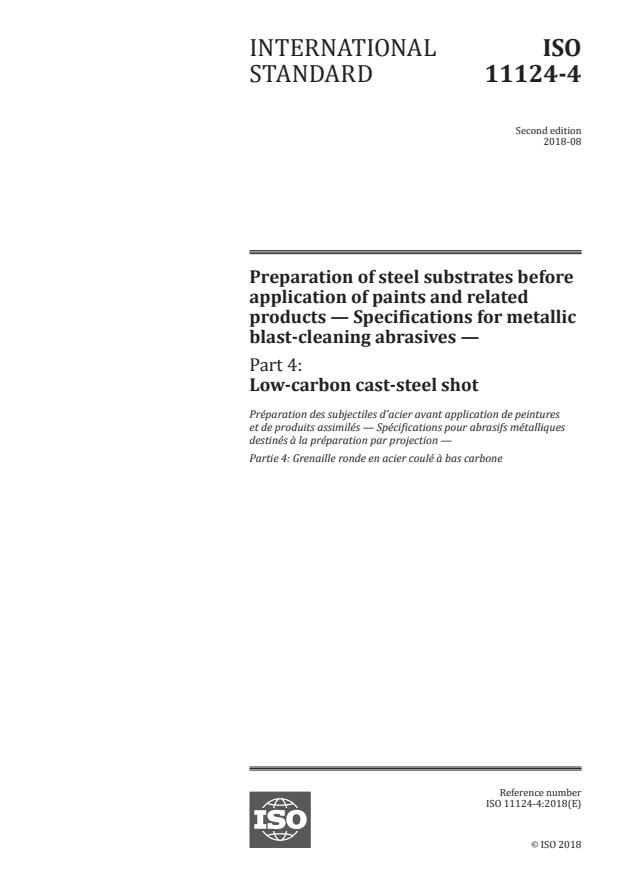
INTERNATIONAL ISO
STANDARD 11124-4
Second edition
2018-08
Preparation of steel substrates before
application of paints and related
products — Specifications for metallic
blast-cleaning abrasives —
Part 4:
Low-carbon cast-steel shot
Préparation des subjectiles d'acier avant application de peintures
et de produits assimilés — Spécifications pour abrasifs métalliques
destinés à la préparation par projection —
Partie 4: Grenaille ronde en acier coulé à bas carbone
Reference number
©
ISO 2018
© ISO 2018
All rights reserved. Unless otherwise specified, or required in the context of its implementation, no part of this publication may
be reproduced or utilized otherwise in any form or by any means, electronic or mechanical, including photocopying, or posting
on the internet or an intranet, without prior written permission. Permission can be requested from either ISO at the address
below or ISO’s member body in the country of the requester.
ISO copyright office
CP 401 • Ch. de Blandonnet 8
CH-1214 Vernier, Geneva
Phone: +41 22 749 01 11
Fax: +41 22 749 09 47
Email: copyright@iso.org
Website: www.iso.org
Published in Switzerland
ii © ISO 2018 – All rights reserved
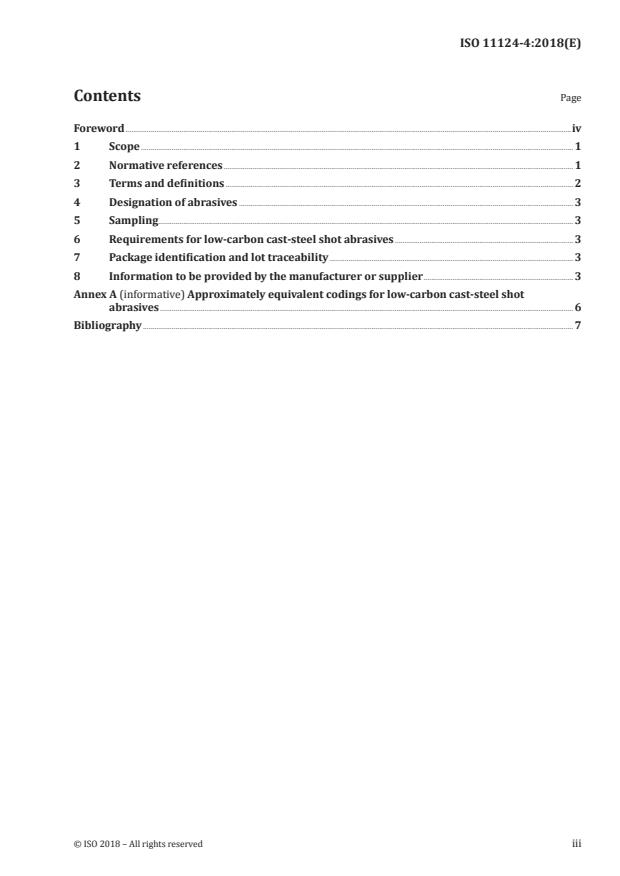
Contents Page
Foreword .iv
1 Scope . 1
2 Normative references . 1
3 Terms and definitions . 2
4 Designation of abrasives . 3
5 Sampling . 3
6 Requirements for low-carbon cast-steel shot abrasives . 3
7 Package identification and lot traceability . 3
8 Information to be provided by the manufacturer or supplier . 3
Annex A (informative) Approximately equivalent codings for low-carbon cast-steel shot
abrasives . 6
Bibliography . 7
Foreword
ISO (the International Organization for Standardization) is a worldwide federation of national standards
bodies (ISO member bodies). The work of preparing International Standards is normally carried out
through ISO technical committees. Each member body interested in a subject for which a technical
committee has been established has the right to be represented on that committee. International
organizations, governmental and non-governmental, in liaison with ISO, also take part in the work.
ISO collaborates closely with the International Electrotechnical Commission (IEC) on all matters of
electrotechnical standardization.
The procedures used to develop this document and those intended for its further maintenance are
described in the ISO/IEC Directives, Part 1. In particular the different approval criteria needed for the
different types of ISO documents should be noted. This document was drafted in accordance with the
editorial rules of the ISO/IEC Directives, Part 2 (see www .iso .org/directives).
Attention is drawn to the possibility that some of the elements of this document may be the subject of
patent rights. ISO shall not be held responsible for identifying any or all such patent rights. Details of
any patent rights identified during the development of the document will be in the Introduction and/or
on the ISO list of patent declarations received (see www .iso .org/patents).
Any trade name used in this document is information given for the convenience of users and does not
constitute an endorsement.
For an explanation on the voluntary nature of standards, the meaning of ISO specific terms and
expressions related to conformity assessment, as well as information about ISO's adherence to the
World Trade Organization (WTO) principles in the Technical Barriers to Trade (TBT) see the following
URL: www .iso .org/iso/foreword .html.
This document was prepared by Technical Committee ISO/TC 35, Paints and varnishes, Subcommittee
SC 12, Preparation of steel substrates before application of paints and related products.
This second edition cancels and replaces the first edition (ISO 11124-4:1993), which has been
technically revised.
The main changes compared to the previous edition are as follows:
— Annex A has been technically revised.
A list of all parts in the ISO 11124 series can be found on the ISO website.
iv © ISO 2018 – All rights reserved
INTERNATIONAL STANDARD ISO 11124-4:2018(E)
Preparation of steel substrates before application of paints
and related products — Specifications for metallic blast-
cleaning abrasives —
Part 4:
Low-carbon cast-steel shot
WARNING — Equipment, materials and abrasives used for surface preparation can be hazardous.
It is important to ensure that adequate instructions are given and that all required precautions
are exercised.
1 Scope
This document specifies requirements for 12 grades of low-carbon cast-steel shot abrasive, as supplied
for blast-cleaning processes. Values are specified for hardness, density, defect/structural requirements
and chemical composition.
The requirements specified in this document apply to abrasives supplied in the "new" condition only.
They do not apply to abrasives either during or after use.
Test methods for metallic blast-cleaning abrasives are given in the various parts of ISO 11125.
Low-carbon cast-steel shot abrasives are used in both static and site blasting equipment. They are most
often selected where a facility exists for recovery and re-use of the abrasive.
NOTE 1 Information on commonly referenced national standards for metallic abrasives and their approximate
relationship with ISO 11124 is given in Annex A.
NOTE 2 Although this document has been developed specifically to meet requirements for preparation of
steelwork, the properties specified will generally be appropriate for use when preparing other material surfaces,
or components, using blast-cleaning techniques. These techniques are described in ISO 8504-2.
2 Normative references
The following documents are referred to in the text in such a way that some or all of their content
constitutes requirements of this document. For dated references, only the edition cited applies. For
undated references, the latest edition of the referenced document (including any amendments) applies.
ISO 439, Steel and iron — Determination of total silicon content — Gravimetric method
ISO 629, Steel and cast iron — Determination of manganese content — Spectrophotometric method
ISO 4935, Steel and iron — Determination of sulfur content — Infrared absorption method after combustion
in an induction furnace
ISO 9556, Steel and iron — Determination of total carbon content — Infrared absorption method after
combustion in an induction furnace
ISO 10714, Steel and iron — Determination of phosphorus content — Phosphovanadomolybdate
spectrophotometric method
ISO 11125-1, Preparation of steel substrates before application of paints and related products — Test
methods for metallic blast-cleaning abrasives — Part 1: Sampling
ISO 11125-2, Preparation of steel substrates before application of paints and related products — Test
methods for metallic blast-cleaning abrasives — Part 2: Determination of particle size distribution
ISO 11125-3, Prepar
...
NORME ISO
INTERNATIONALE 11124-4
Deuxième édition
2018-08
Préparation des subjectiles d'acier
avant application de peintures et de
produits assimilés — Spécifications
pour abrasifs métalliques destinés à la
préparation par projection —
Partie 4:
Grenaille ronde en acier coulé à bas
carbone
Preparation of steel substrates before application of paints and
related products — Specifications for metallic blast-cleaning
abrasives —
Part 4: Low-carbon cast-steel shot
Numéro de référence
©
ISO 2018
DOCUMENT PROTÉGÉ PAR COPYRIGHT
© ISO 2018
Tous droits réservés. Sauf prescription différente ou nécessité dans le contexte de sa mise en œuvre, aucune partie de cette
publication ne peut être reproduite ni utilisée sous quelque forme que ce soit et par aucun procédé, électronique ou mécanique,
y compris la photocopie, ou la diffusion sur l’internet ou sur un intranet, sans autorisation écrite préalable. Une autorisation peut
être demandée à l’ISO à l’adresse ci-après ou au comité membre de l’ISO dans le pays du demandeur.
ISO copyright office
Case postale 401 • Ch. de Blandonnet 8
CH-1214 Vernier, Genève
Tél.: +41 22 749 01 11
Fax: +41 22 749 09 47
E-mail: copyright@iso.org
Web: www.iso.org
Publié en Suisse
ii © ISO 2018 – Tous droits réservés
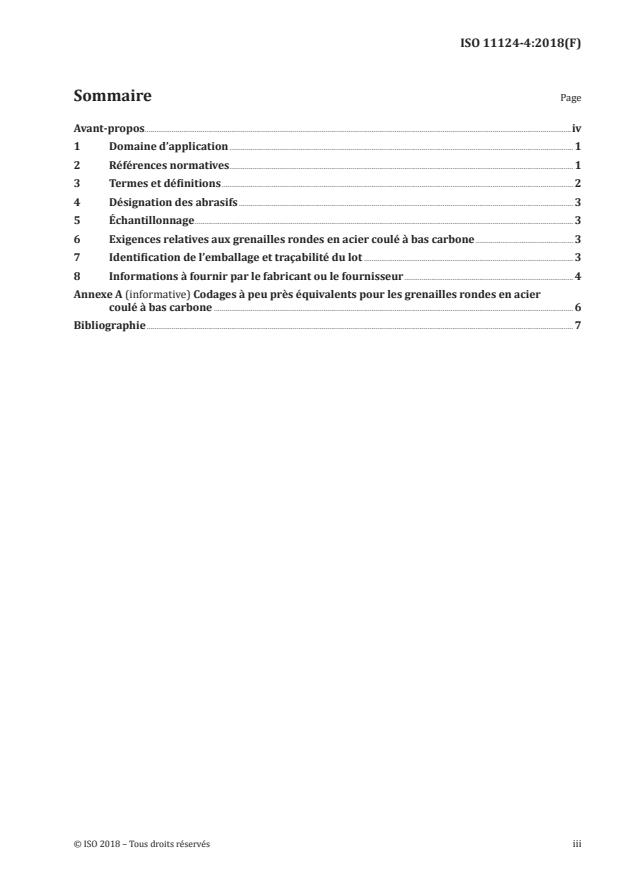
Sommaire Page
Avant-propos .iv
1 Domaine d’application . 1
2 Références normatives . 1
3 Termes et définitions . 2
4 Désignation des abrasifs . 3
5 Échantillonnage . 3
6 Exigences relatives aux grenailles rondes en acier coulé à bas carbone .3
7 Identification de l’emballage et traçabilité du lot . 3
8 Informations à fournir par le fabricant ou le fournisseur . 4
Annexe A (informative) Codages à peu près équivalents pour les grenailles rondes en acier
coulé à bas carbone . 6
Bibliographie . 7
Avant-propos
L’ISO (Organisation internationale de normalisation) est une fédération mondiale d’organismes
nationaux de normalisation (comités membres de l’ISO). L’élaboration des Normes internationales est
en général confiée aux comités techniques de l’ISO. Chaque comité membre intéressé par une étude
a le droit de faire partie du comité technique créé à cet effet. Les organisations internationales,
gouvernementales et non gouvernementales, en liaison avec l’ISO participent également aux travaux.
L’ISO collabore étroitement avec la Commission électrotechnique internationale (IEC) en ce qui
concerne la normalisation électrotechnique.
Les procédures utilisées pour élaborer le présent document et celles destinées à sa mise à jour sont
décrites dans les Directives ISO/IEC, Partie 1. Il convient, en particulier de prendre note des différents
critères d’approbation requis pour les différents types de documents ISO. Le présent document a été
rédigé conformément aux règles de rédaction données dans les Directives ISO/IEC, Partie 2 (voir www
.iso .org/directives).
L’attention est attirée sur le fait que certains des éléments du présent document peuvent faire l’objet de
droits de propriété intellectuelle ou de droits analogues. L’ISO ne saurait être tenue pour responsable
de ne pas avoir identifié de tels droits de propriété et averti de leur existence. Les détails concernant
les références aux droits de propriété intellectuelle ou autres droits analogues identifiés lors de
l’élaboration du document sont indiqués dans l’Introduction et/ou dans la liste des déclarations de
brevets reçues par l’ISO (voir www .iso .org/brevets).
Les appellations commerciales éventuellement mentionnées dans le présent document sont données
pour information, par souci de commodité, à l’intention des utilisateurs et ne sauraient constituer un
engagement.
Pour une explication de la nature volontaire des normes, la signification des termes et expressions
spécifiques de l’ISO liés à l’évaluation de la conformité, ou pour toute information au sujet de l’adhésion
de l’ISO aux principes de l’Organisation mondiale du commerce (OMC) concernant les obstacles
techniques au commerce (OTC), voir le lien suivant: www .iso .org/iso/fr/avant -propos .html.
Le présent document a été élaboré par le comité technique ISO/TC 35, Peintures et vernis, sous-comité
SC 12, Préparation de subjectiles d’acier avant application de peintures et de produits assimilés.
Cette deuxième édition annule et remplace la première édition (ISO 11124-4:1993), qui a fait l’objet
d’une révision technique.
Les principales modifications par rapport à l’édition précédente sont les suivantes:
— l’Annexe A a fait l’objet d’une révision technique.
Une liste de toutes les parties de la série ISO 11124 se trouve sur le site Web de l’ISO.
iv © ISO 2018 – Tous droits réservés
NORME INTERNATIONALE ISO 11124-4:2018(F)
Préparation des subjectiles d'acier avant application
de peintures et de produits assimilés — Spécifications
pour abrasifs métalliques destinés à la préparation par
projection —
Partie 4:
Grenaille ronde en acier coulé à bas carbone
AVERTISSEMENT — Les équipements, matériaux et abrasifs utilisés pour la préparation des
subjectiles peuvent présenter des risques. Il est important de s’assurer que les instructions
nécessaires sont données et que toutes les précautions sont prises.
1 Domaine d’application
Le présent document spécifie des exigences pour 12 granulométries de grenailles rondes en acier
coulé à bas carbone, telles qu’elles sont fournies pour la préparation par projection. Des valeurs sont
spécifiées pour la dureté, la masse volumique, les exigences relatives aux défauts structuraux et la
composition chimique.
Les exigences spécifiées dans le présent document s’appliquent seulement aux abrasifs fournis à
l’état «neuf». Elles ne s’appliquent pas aux abrasifs pendant ou après utilisation.
Les méthodes d’essai relatives aux abrasifs métalliques destinés à la préparation par projection sont
indiquées dans les différentes parties de l’ISO 11125.
Les grenailles rondes en acier coulé à bas carbone sont utilisées à la fois avec les équipements
de grenaillage en atelier et sur site. Ils sont le plus souvent choisis lorsqu’il existe un système de
récupération et de réutilisation de l’abrasif.
NOTE 1 L’Annexe A donne des informations sur les normes nationales généralement consultables portant sur
les abrasifs métalliques, en relation avec l’ISO 11124.
NOTE 2 Bien que le présent document ait été spécialement établi pour satisfaire aux exigences de préparation
des ouvrages en acier, les propriétés spécifiées seront généralement appropriées pour l’emploi en préparation de
subjectiles ou éléments d’autres matériaux, par les techniques de décapage par projection. Ces techniques sont
décrites dans l’ISO 8504-2.
2 Références normatives
Les documents suivants cités dans le texte constituent, pour tout ou partie de leur contenu, des
exigences du présent document. Pour les références datées, seule l’édition citée s’applique. Pour les
références non datées, la dernière édition du document de référence s’applique (y compris les éventuels
amendements).
ISO 439, Aciers et fontes — Dosage du silicium total — Méthode gravimétrique
ISO 629, Aciers et fontes — Dosage du manganèse — Méthode spectrophotométrique
ISO 4935, Aciers et fontes — Dosage du soufre — Méthode par absorption dans l'infrarouge après
combustion dans un four à induction
ISO 9556, Aciers et fontes — Dosage du carbone total — Méthode par absorption dans l'infrarouge après
combustion dans un four à induction
ISO 10714, Aciers et fontes — Dosage du phosphore — Méthode par spectrophotométrie au
phosphovanadomolybdate
ISO 11125-1, Préparation des subjectiles d’acier avant application de peintures et de produits assimilés —
Méthodes d’essai pour abrasifs métalliques destinés à la préparation par projection — Partie 1:
Échantillonnage
ISO 11125-2, Préparation des subjectiles d’acier avant application de peintures et de produits assimilés —
Méthodes d’essai pour abrasifs métalliques destinés à la préparation par projection — Partie 2: Analyse
granulométrique
ISO 11125-3, Préparation des subjectiles d’acier avant application de peintures et de produits assimilés —
Méthodes d’essai pour abrasifs métalliques destinés à la préparation par projection — Partie 3:
Détermination de la dureté
ISO 11125-4, Préparation des subjectiles d’acier avant application de peintures et de produits assimilés —
Méthodes d’essai pour abrasifs métalliques destinés à la préparation par projection — Partie
...
Frequently Asked Questions
ISO 11124-4:2018 is a standard published by the International Organization for Standardization (ISO). Its full title is "Preparation of steel substrates before application of paints and related products - Specifications for metallic blast-cleaning abrasives - Part 4: Low-carbon cast-steel shot". This standard covers: This document specifies requirements for 12 grades of low-carbon cast-steel shot abrasive, as supplied for blast-cleaning processes. Values are specified for hardness, density, defect/structural requirements and chemical composition. The requirements specified in this document apply to abrasives supplied in the "new" condition only. They do not apply to abrasives either during or after use. Test methods for metallic blast-cleaning abrasives are given in the various parts of ISO 11125. Low-carbon cast-steel shot abrasives are used in both static and site blasting equipment. They are most often selected where a facility exists for recovery and re-use of the abrasive. NOTE 1 Information on commonly referenced national standards for metallic abrasives and their approximate relationship with ISO 11124 is given in Annex A. NOTE 2 Although this document has been developed specifically to meet requirements for preparation of steelwork, the properties specified will generally be appropriate for use when preparing other material surfaces, or components, using blast-cleaning techniques. These techniques are described in ISO 8504-2.
This document specifies requirements for 12 grades of low-carbon cast-steel shot abrasive, as supplied for blast-cleaning processes. Values are specified for hardness, density, defect/structural requirements and chemical composition. The requirements specified in this document apply to abrasives supplied in the "new" condition only. They do not apply to abrasives either during or after use. Test methods for metallic blast-cleaning abrasives are given in the various parts of ISO 11125. Low-carbon cast-steel shot abrasives are used in both static and site blasting equipment. They are most often selected where a facility exists for recovery and re-use of the abrasive. NOTE 1 Information on commonly referenced national standards for metallic abrasives and their approximate relationship with ISO 11124 is given in Annex A. NOTE 2 Although this document has been developed specifically to meet requirements for preparation of steelwork, the properties specified will generally be appropriate for use when preparing other material surfaces, or components, using blast-cleaning techniques. These techniques are described in ISO 8504-2.
ISO 11124-4:2018 is classified under the following ICS (International Classification for Standards) categories: 25.220.10 - Surface preparation. The ICS classification helps identify the subject area and facilitates finding related standards.
ISO 11124-4:2018 has the following relationships with other standards: It is inter standard links to ISO 11124-4:1993. Understanding these relationships helps ensure you are using the most current and applicable version of the standard.
You can purchase ISO 11124-4:2018 directly from iTeh Standards. The document is available in PDF format and is delivered instantly after payment. Add the standard to your cart and complete the secure checkout process. iTeh Standards is an authorized distributor of ISO standards.
Questions, Comments and Discussion
Ask us and Technical Secretary will try to provide an answer. You can facilitate discussion about the standard in here.
Loading comments...