

ISO 8504-5:2024
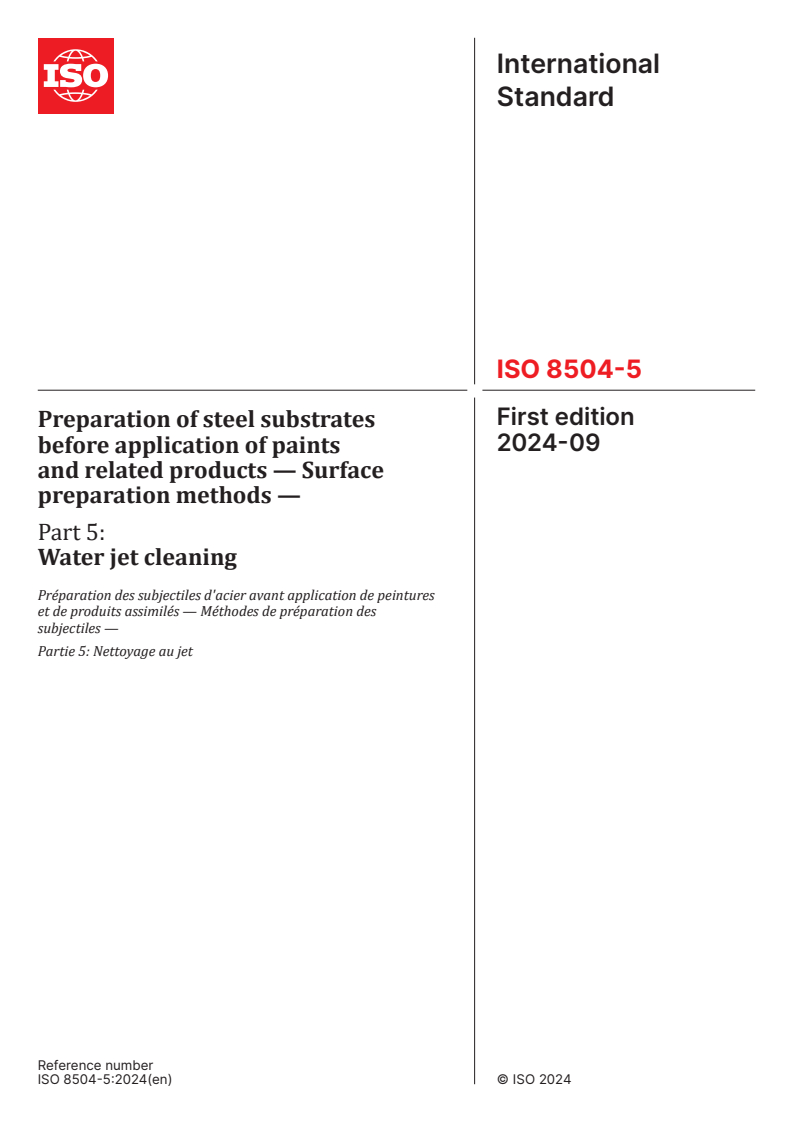
(Main)Preparation of steel substrates before application of paints and related products — Surface preparation methods — Part 5: Water jet cleaning
General Information
- Abstract
This document specifies water jet cleaning methods for the removal of the existing coatings and rust during surface preparation of steel surfaces before application of paints and related products. It provides information on the effectiveness of the individual methods and their fields of application. It also describes the equipment and the procedures to follow.
- Status
- Published
- Publication Date
- 05-Sep-2024
- Current Stage
- 6060 - International Standard published
- Start Date
- 06-Sep-2024
- Due Date
- 22-Sep-2024
- Completion Date
- 06-Sep-2024
Buy Documents
ISO 8504-5:2024 - Preparation of steel substrates before application of paints and related products — Surface preparation methods — Part 5: Water jet cleaning Released:6. 09. 2024
ISO 8504-5:2024 - Préparation des subjectiles d'acier avant application de peintures et de produits assimilés — Méthodes de préparation des subjectiles — Partie 5: Nettoyage au jet d'eau
REDLINE ISO 8504-5:2024 - Préparation des subjectiles d'acier avant application de peintures et de produits assimilés — Méthodes de préparation des subjectiles — Partie 5: Nettoyage au jet d'eau
Overview
ISO 8504-5:2024 - Preparation of steel substrates before application of paints and related products - Part 5: Water jet cleaning - specifies water jet cleaning methods for removing existing coatings, rust and water‑soluble contaminants from steel surfaces prior to painting. The standard describes the effectiveness and fields of application of each water‑jet method and gives guidance on equipment, system types, procedures and health & safety considerations.
Key topics and requirements
- Scope and purpose: Defines water jetting as a secondary surface preparation method suitable where an existing surface profile is adequate or for Grade C/D substrates. Emphasises removal of salts, oils, grease and partial coating removal.
- Pressure/flow methods: Categorises methods including low-pressure (LP WC), high-pressure (HP WC / HP WJ), very high-pressure (VHP WJ) and ultra high-pressure (UHP WJ) and links selection to effectiveness and surface condition.
- Components and systems: Specifies essential components - pump, hoses and fittings, nozzles, manual and remote guns, water path, vacuum recovery and containment for water management.
- System operation: Covers continuous vs. pulsed systems, interactive productivity parameters, additives, maintenance and hydraulic pressure drop considerations.
- Procedure and assessment: Guidance for preparation before/during/after jetting, selection of preparation grade, field tests, visual assessment, management of flash rust, and detection of non‑visible inorganic contaminants.
- Health & safety: General requirements for safe operation, including grounding/earthing in flammable environments and protective measures for operators.
- Annexes: Includes normative pressure level definitions and informative guidance on UHP theory/practice and flash rust control.
Applications and practical value
- Effective for removing old coatings, salts and surface contaminants prior to recoating or new painting.
- Useful where dust‑free preparation is preferred (e.g., occupied facilities, offshore platforms, confined spaces).
- Enables high production rates, potential single‑pass removal of coatings and salts, and compatibility with mobile or stationary setups.
- Helps specifiers and contractors match cleaning method to substrate condition and coating system requirements.
Who should use this standard
- Coating specifiers, project engineers and asset owners determining surface preparation requirements.
- Inspection and quality control personnel evaluating cleaned surfaces.
- Surface preparation and painting contractors selecting equipment, containment and operating procedures.
- Health & safety officers responsible for safe water jetting operations.
Related standards
- ISO 8504 series (other parts on surface preparation methods)
- ISO 8501, ISO 8502, ISO 8503 series (visual and test methods for surface condition and contaminants)
Keywords: ISO 8504-5:2024, water jet cleaning, surface preparation, steel substrates, high-pressure water jetting, ultra high-pressure, flash rust, containment, coatings.
Buy Documents
ISO 8504-5:2024 - Preparation of steel substrates before application of paints and related products — Surface preparation methods — Part 5: Water jet cleaning Released:6. 09. 2024
ISO 8504-5:2024 - Préparation des subjectiles d'acier avant application de peintures et de produits assimilés — Méthodes de préparation des subjectiles — Partie 5: Nettoyage au jet d'eau
REDLINE ISO 8504-5:2024 - Préparation des subjectiles d'acier avant application de peintures et de produits assimilés — Méthodes de préparation des subjectiles — Partie 5: Nettoyage au jet d'eau
Get Certified
Connect with accredited certification bodies for this standard

DVS-ZERT GmbH
German welding certification society.
CARES (UK Certification Authority for Reinforcing Steels)
UK certification for reinforcing steels and construction.
EWF/IIW (European/International Welding Federation)
International welding personnel certification.
Sponsored listings
Frequently Asked Questions
ISO 8504-5:2024 is a standard published by the International Organization for Standardization (ISO). Its full title is "Preparation of steel substrates before application of paints and related products — Surface preparation methods — Part 5: Water jet cleaning". This standard covers: This document specifies water jet cleaning methods for the removal of the existing coatings and rust during surface preparation of steel surfaces before application of paints and related products. It provides information on the effectiveness of the individual methods and their fields of application. It also describes the equipment and the procedures to follow.
This document specifies water jet cleaning methods for the removal of the existing coatings and rust during surface preparation of steel surfaces before application of paints and related products. It provides information on the effectiveness of the individual methods and their fields of application. It also describes the equipment and the procedures to follow.
ISO 8504-5:2024 is classified under the following ICS (International Classification for Standards) categories: 25.220.10 - Surface preparation. The ICS classification helps identify the subject area and facilitates finding related standards.
ISO 8504-5:2024 is available in PDF format for immediate download after purchase. The document can be added to your cart and obtained through the secure checkout process. Digital delivery ensures instant access to the complete standard document.
Standards Content (Sample)
International
Standard
ISO 8504-5
First edition
Preparation of steel substrates
2024-09
before application of paints
and related products — Surface
preparation methods —
Part 5:
Water jet cleaning
Préparation des subjectiles d'acier avant application de peintures
et de produits assimilés — Méthodes de préparation des
subjectiles —
Partie 5: Nettoyage au jet
Reference number
© ISO 2024
All rights reserved. Unless otherwise specified, or required in the context of its implementation, no part of this publication may
be reproduced or utilized otherwise in any form or by any means, electronic or mechanical, including photocopying, or posting on
the internet or an intranet, without prior written permission. Permission can be requested from either ISO at the address below
or ISO’s member body in the country of the requester.
ISO copyright office
CP 401 • Ch. de Blandonnet 8
CH-1214 Vernier, Geneva
Phone: +41 22 749 01 11
Email: copyright@iso.org
Website: www.iso.org
Published in Switzerland
ii
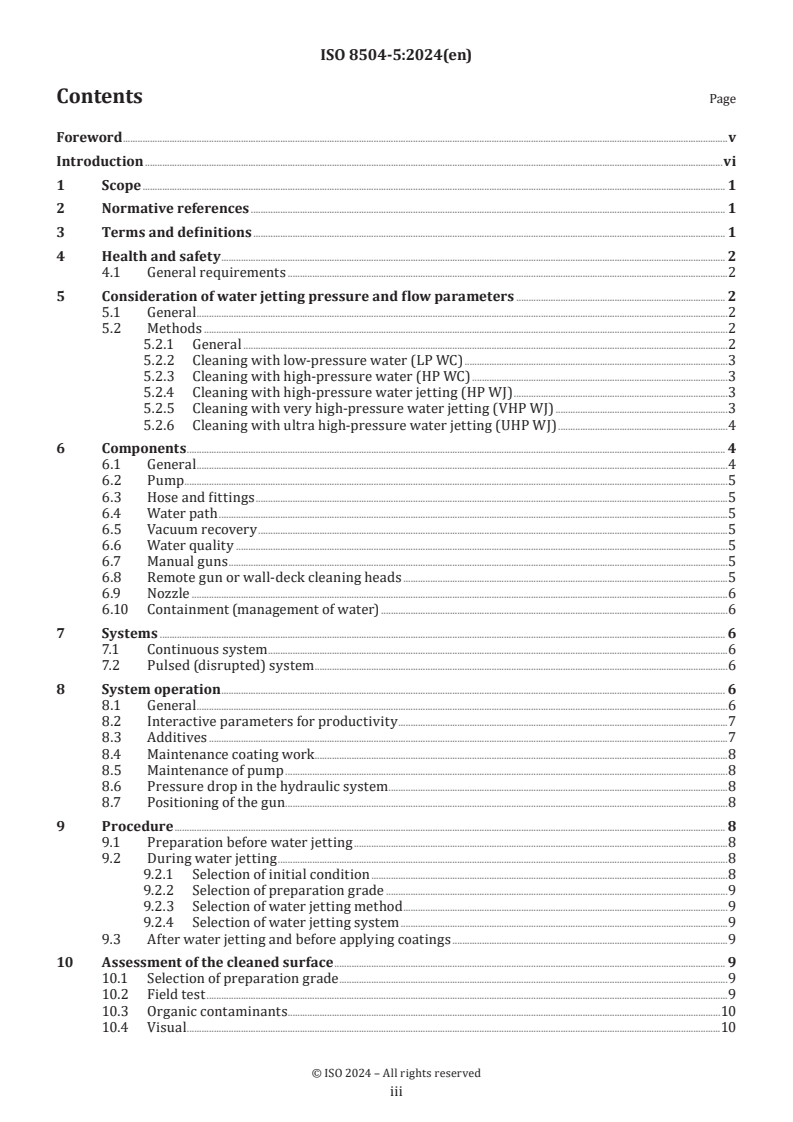
Contents Page
Foreword .v
Introduction .vi
1 Scope . 1
2 Normative references . 1
3 Terms and definitions . 1
4 Health and safety . 2
4.1 General requirements .2
5 Consideration of water jetting pressure and flow parameters . 2
5.1 General .2
5.2 Methods .2
5.2.1 General .2
5.2.2 Cleaning with low-pressure water (LP WC) .3
5.2.3 Cleaning with high-pressure water (HP WC) .3
5.2.4 Cleaning with high-pressure water jetting (HP WJ) .3
5.2.5 Cleaning with very high-pressure water jetting (VHP WJ) .3
5.2.6 Cleaning with ultra high-pressure water jetting (UHP WJ) .4
6 Components . 4
6.1 General .4
6.2 Pump . .5
6.3 Hose and fittings .5
6.4 Water path .5
6.5 Vacuum recovery .5
6.6 Water quality .5
6.7 Manual guns .5
6.8 Remote gun or wall-deck cleaning heads .5
6.9 Nozzle .6
6.10 Containment (management of water) .6
7 Systems . 6
7.1 Continuous system .6
7.2 Pulsed (disrupted) system .6
8 System operation . 6
8.1 General .6
8.2 Interactive parameters for productivity .7
8.3 Additives .7
8.4 Maintenance coating work .8
8.5 Maintenance of pump .8
8.6 Pressure drop in the hydraulic system .8
8.7 Positioning of the gun.8
9 Procedure . 8
9.1 Preparation before water jetting .8
9.2 During water jetting .8
9.2.1 Selection of initial condition .8
9.2.2 Selection of preparation grade .9
9.2.3 Selection of water jetting method .9
9.2.4 Selection of water jetting system .9
9.3 After water jetting and before applying coatings .9
10 A ssessment of the cleaned surface . 9
10.1 Selection of preparation grade .9
10.2 Field test .9
10.3 Organic contaminants . .10
10.4 Visual .10
iii
10.4.1 Visual assessment of preparation grade .10
10.4.2 Flash rust .10
10.5 Non-visible inorganics contaminants .10
10.6 Third-party representation .10
10.7 Conformity .10
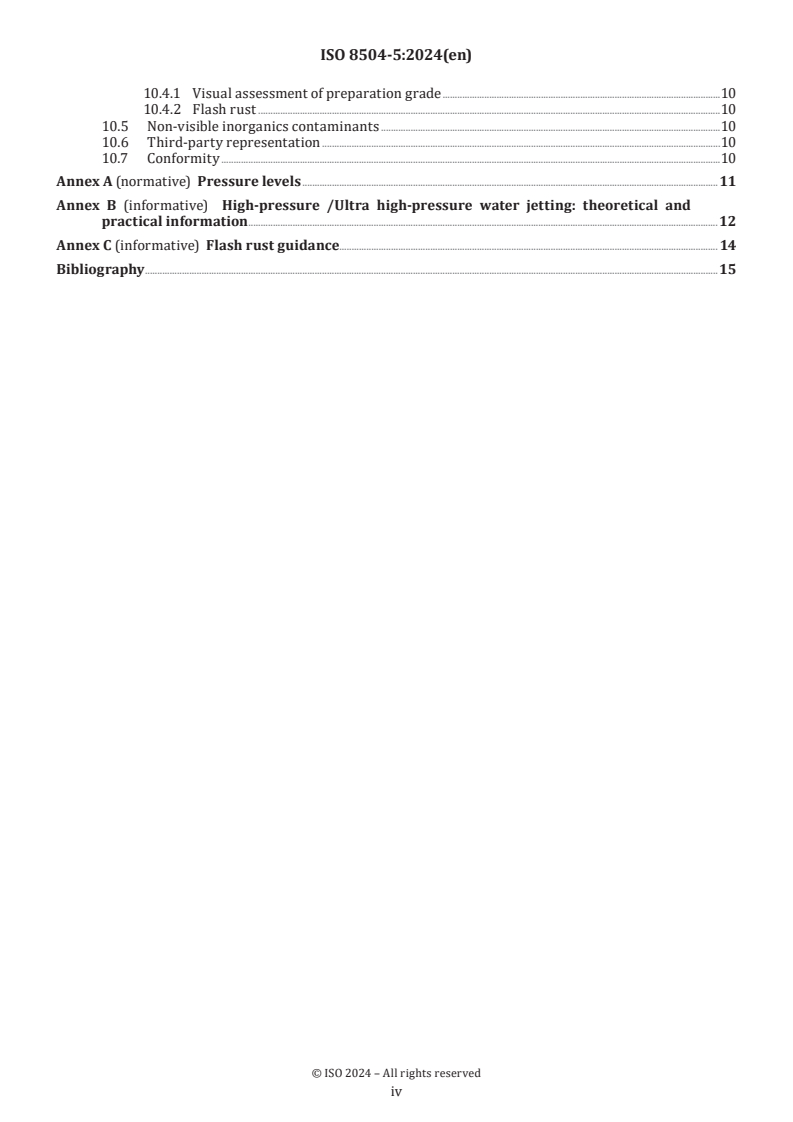
Annex A (normative) Pressure levels .11
Annex B (informative) High-pressure /Ultra high-pressure water jetting: theoretical and
practical information .12
Annex C (informative) Flash rust guidance. 14
Bibliography .15
iv
Foreword
ISO (the International Organization for Standardization) is a worldwide federation of national standards
bodies (ISO member bodies). The work of preparing International Standards is normally carried out through
ISO technical committees. Each member body interested in a subject for which a technical committee
has been established has the right to be represented on that committee. International organizations,
governmental and non-governmental, in liaison with ISO, also take part in the work. ISO collaborates closely
with the International Electrotechnical Commission (IEC) on all matters of electrotechnical standardization.
The procedures used to develop this document and those intended for its further maintenance are described
in the ISO/IEC Directives, Part 1. In particular, the different approval criteria needed for the different types
of ISO document should be noted. This document was drafted in accordance with the editorial rules of the
ISO/IEC Directives, Part 2 (see www.iso.org/directives).
ISO draws attention to the possibility that the implementation of this document may involve the use of (a)
patent(s). ISO takes no position concerning the evidence, validity or applicability of any claimed patent
rights in respect thereof. As of the date of publication of this document, ISO had not received notice of (a)
patent(s) which may be required to implement this document. However, implementers are cautioned that
this may not represent the latest information, which may be obtained from the patent database available at
www.iso.org/patents. ISO shall not be held responsible for identifying any or all such patent rights.
Any trade name used in this document is information given for the convenience of users and does not
constitute an endorsement.
For an explanation of the voluntary nature of standards, the meaning of ISO specific terms and expressions
related to conformity assessment, as well as information about ISO's adherence to the World Trade
Organization (WTO) principles in the Technical Barriers to Trade (TBT), see www.iso.org/iso/foreword.html.
This document was prepared by Technical Committee ISO/TC 35, Paints and varnishes, Subcommittee SC 12,
Preparation of steel substrates before application of paints and related products.
A list of all parts in the ISO 8504 series can be found on the ISO website.
Any feedback or questions on this document should be directed to the user’s national standards body. A
complete listing of these bodies can be found at www.iso.org/members.html.
v
Introduction
The performance of protective coatings of paint and related products applied to steel is significantly
affected by the state of the steel surface immediately prior to painting. The principal factors that are known
to influence this performance are:
— the presence of rust and mill scale,
— the presence of surface contaminants, including salts, dust, oils and greases, and
— the surface profile.
The ISO 8501 series, the ISO 8502 series and the ISO 8503 series provide methods for assessing these
factors, while the ISO 8504 series provides requirements and guidance on the preparation methods that
are available for cleaning steel substrates, indicating the capabilities of each in attaining specified levels of
cleanliness.
The ISO 8504 series is applicable to new and corroded steel surfaces and to steel surfaces that are uncoated
or have been previously coated with paints and related products.
The ISO 8501, ISO 8502, ISO 8503 and ISO 8504 series do not contain provisions for the protective coating
system to be applied to the steel surface. They do not contain provisions for the surface quality requirements
for specific situations, even though surface quality can have a direct influence on the choice of protective
coating to be applied and on its performance. Such provisions can be found in other documents such as
national standards and codes of practice. Users of the ISO 8501, ISO 8502, ISO 8503 and ISO 8504 series
should ensure the qualities specified are:
— compatible and appropriate both for the environmental conditions to which the steel will be exposed
and for the protective coating system to be used, and
— within the capability of the cleaning procedure specified.
The primary objective of surface preparation is to ensure the removal of deleterious matter and to obtain
a surface that permits satisfactory adhesion of the priming paint to steel. It is also intended to assist in
reducing the amounts of contaminants that initiate corrosion.
Water jetting is an effective method for removing coatings from previously painted surfaces, removing
water-soluble contaminants, and producing partially removed coatings. While water jetting by itself can
produce a granular profile in metals under some conditions, water jetting is considered a secondary surface
preparation method and is not used to provide the primary anchor pattern on the metallic substrate known
as “surface profile.” Water jetting is primarily used for surfaces where there is an adequate pre-existing
surface profile or for Grade C and Grade D substrates. Water jetting can remove oil, grease, and corrosion-
stimulating substances such as chlorides and sulphates. Water jetting is widely applicable because this
method of surface preparation has several features listed below.
— The method allows a high production rate.
— Coatings and salts can be removed in one pass.
— Production rates can be similar to conventional abrasive blast cleaning.
— A work atmosphere is present without particulate dust pollution.
— Other trades can work nearby during the surface preparation.
— Surface preparation can generally be performed in unsafe explosive or flammable areas without
interruption with suitable control measures, for example, earthing of equipment to prevent static
discharges from water jetting guns, pumps, and hoses.
— The equipment can be stationary or mobile and is adaptable to the objects to be cleaned.
— The equipment can be remotely or manually controlled.
vi
— The method is applicable to most types and forms of metal surfaces.
— Different surface preparation grades can be produced.
— It is possible to remove selectively partial failed coatings to leave sound coatings intact.
Representative photographic examples in ISO 8501-4:2020, Clause 8 can be used for assessing some new
and previously coated steel surfaces. Owing to the many different situations that arise in the preparation
of surfaces, these photographs are not always sufficient to describe specific instances. It is therefore
recommended to produce specific photographs of a treated reference area that are acceptable to the
interested parties for use as a basis for further surface preparation procedures.
vii
International Standard ISO 8504-5:2024(en)
Preparation of steel substrates before application of paints
and related products — Surface preparation methods —
Part 5:
Water jet cleaning
1 Scope
This document specifies water jet cleaning methods for the removal of the existing coatings and rust
during surface preparation of steel surfaces before application of paints and related products. It provides
information on the effectiveness of the individual methods and their fields of application. It also describes
the equipment and the procedures to follow.
2 Normative references
The following documents are referred to in the text in such a way that some or all of their content constitutes
requirements of this document. For dated references, only the edition cited applies. For undated references,
the latest edition of the referenced document (including any amendments) applies.
ISO 4628-3, Paints and varnishes — Evaluation of degradation of coatings — Designation of quantity and size of
defects, and of intensity of uniform changes in appearance — Part 3: Assessment of degree of rusting
ISO 8501-4:2020, Preparation of steel substrates before application of paints and related products — Visual
assessment of surface cleanliness — Part 4: Initial surface conditions, preparation grades and flash rust grades
in connection with water jetting
3 Terms and definitions
For the purposes of this document, the following terms and definitions apply.
ISO and IEC maintain terminology databases for use in standardization at the following addresses:
— ISO Online browsing platform: available at https:// www .iso .org/ obp
— IEC Electropedia: available at https:// www .electropedia .org/
3.1
field test
cleaning of selected surfaces, carried out before the start of work, intended to achieve the specified
preparation grades
Note 1 to entry: ISO 8501-4:2020, Clause 5 defines the preparation grades that should be obtained through the field test.
Note 2 to entry: The field test can be referred to as the control specimen.
3.2
flash rust
rapid rusting of the surface prepared by water jet or water-abrasive blast cleaning, which occurs as the
substrate is drying
Note 1 to entry: ISO 8501-4:2020, Clause 6 defines the flash rust grades.
Note 2 to entry: Flash rust in this document is more limited than the definition given in ISO 4618:2023, 3.120.
3.3
nozzle
device that modifies the stream of water as it discharges from the system
Note 1 to entry: Nozzle openings can be referred to as bits, tips, or orifices.
3.4
threshold pressure
minimum pressure required to penetrate the material
3.5
water jetting
continuous or discontinuous stream of water in air with defined geometry, velocity and, if discontinuous,
frequency
[SOURCE: ISO/TS 19392-3:2018, 3.1]
4 Health and safety
4.1 General requirements
The procedures described in this document shall be carried out by either suitably trained or supervised
personnel or both. The substances and procedures used in these methods can be injurious to health
if adequate precautions are not taken. Attention is drawn in the text to certain specific hazards. This
document refers only to the technical suitability of the methods and does not absolve the user from statutory
obligations relating to health and safety.
WARNING — Equipment and materials used for surface preparation can be hazardous. It is important
to ensure that adequate instructions are given and that all required precautions are exercised. Only
trained or certified operatives or both should use the equipment.
5 Consideration of water jetting pressure and flow parameters
5.1 General
The contract documents describe the final condition of the substrate. Depending on the initial condition of
the area and the materials intended to be cleaned, the method to achieve the preparation grades described
in ISO 8501-4 can be low-pressure, high-pressure, or ultra high-pressure methods. The methods of water
cleaning or water jetting are based on the capabilities of the equipment and its components. Dwell time,
traverse rate, pressure, flow, stand-off distances, the number of nozzles, and rotational speed all interact
in determining what material remains and what will be removed. Removal of loose material such as dirt,
detritus, or bird faeces, which is an example of the preparation grade Wa 1, requires different equipment
than the stripping of a coating system which is an example of the preparation grade Wa 2 1/2. Cleaning to a
preparation grade of Wa 1 requires a different set of parameters than cleaning to a preparation grade of Wa
2 1/2. See ISO 8501-4:2020, Clause 5 for definitions of Wa preparation grades.
Pressurized water cleans by hydraulic shear (mass) at the lower pressures, and by implosion or cavitation
at the upper pressures or both. The removal of material by mass or implosion is a continuum, not a discrete,
abrupt change. This mix is discussed in greater depth in Annex B.
5.2 Methods
5.2.1 General
It is important to carefully consider the historic concept of linking the pressure and flow to material
removal. The operating parameters specified in Table A.1 shall apply. Ultra high-pressure water jetting
can accomplish all of these end results by changing the stand-off distance and traverse time, but it is not
economical to use ultra high-pressure water jetting, for purposes such as removing loose dirt or achieving
the preparation grade Wa 1. Low-pressure water cleaning cannot deliver the energy density, expressed as
kJ/mm , or threshold pressure to the surface to break the cohesion force of old rust or coating systems.
Contractors use the pump and flow conditions which are most economical to achieve the desired result.
Pressurized water cleaning is accomplished when droplets of water impact the substrate. The droplets force
their way into pits and crevices and hydraulically shear between the interface of the metal and the corrosion
or paint layers. Water jetting (water jet cleaning or water jet stripping) uses cavitation or implosion to cut
through the different layers of coating or corrosion.
5.2.2 Cleaning with low-pressure water (LP WC)
Low-pressure water cleaning is performed at pressures less than 34 MPa. The stream of water jetting shears
the surface with the load parallel to the surface. The predominant energy characteristic is the mass.
Low-pressure water cleaning depends upon the mass flow of the water stream to remove coatings by
shearing between the substrate and the material to be removed. The achieved result is removal of loose dirt,
grime, bird droppings, some of the soluble contaminants and possibly weathered paint or chalk. The stream
flows parallel to the substrate, so it is possible that the water stream does not get into pits and crevices.
A typical usage is to wash surfaces which are intended to be cleaned by abrasive blast or a hand or power
tool before starting that method. LP WC is typically conducted with a fan jet or non-rotating multi-orifice
nozzle. When a multiple orifice nozzle is rotated, it produces a flexure stressing by a repetitive loading and
unloading of the coatings system as the stream passes over the surface. The rapid load and unloading reveals
areas of low adherence and other nonvisible defects in the coating system.
5.2.3 Cleaning with high-pressure water (HP WC)
Water cleaning which is performed at pressures from 34 MPa to 70 MPa combines shear and implosion
to remove unwanted material. The predominate energy characteristic is a combination of the mass and
velocity.
High-pressure water cleaning depends upon a combination of the mass flow of the water stream and the
impact energy to remove coatings by predominately shearing between the substrate and the material to
be removed with subordinate impact and implosion. The result is the partial removal of adhered coatings,
revelation of incipient blisters or areas of low adhesion, and partial removal of rust layers. Oxidized paint
is removed from the adherent layer. The water stream can get into the pits and craters and crevices. In
removal of old rust, the typical appearance is clean, shiny pits with adherent rust layers at the top surface. It
is the opposite visual appearance of a dry abrasive blast method where the shiny top is cleaned, and the pits
are filled with dark, detrital material.
5.2.4 Cleaning with high-pressure water jetting (HP WJ)
Water cleaning which is performed by pressurized water jetting between 70 MPa and 140 MPa is considered
high-pressure water jetting by some industries.
At 70 MPa, the effect of the energy density starts to predominate over the shear forces of the mass flow as
the velocity of the water stream increases through a smaller diameter tip.
High-pressure water cleaning depends upon a combination of the mass flow of the water stream and the
energy density, in order to remove coatings by predominately impact and implosion and by subordinately
shearing between the substrate and the material to be removed. The achieved result is the removal of
adhered coatings with lower cohesion, removal of coatings over areas of low adhesion or incipient blisters,
and partial to full removal of rust layers.
5.2.5 Cleaning with very high-pressure water jetting (VHP WJ)
Water cleaning which is performed by pressurized water jetting between 140 MPa and 210 MPa removes
material predominately by implosion.
Systems operating greater than 140 MPa clean predominately by impact implosion perpendicular to the
surface, resulting in the sharp cut where the jet impacts the surface. The predominant energy characteristic
is velocity.
The cleaning mechanism is a combination of shear and energy density. The side shear (mass flow) becomes
less predominant as the energy density increases, and the stand-off distance becomes more critical. The
jetter requires more experience and training to maintain a narrow stand-off distance and guide the sharp
cut-off edge. The use of >140 MPa is suitable to economically achieve preparation grades Wa 2 or Wa 2 1/2,
depending on the coating and rust. See ISO 8501-4:2020 Clause 5 for descriptions of preparation grades.
NOTE VHP WJ is referred to as THP WJ (see Reference [3]).
5.2.6 Cleaning with ultra high-pressure water jetting (UHP WJ)
Water cleaning which is performed by pressurized water jetting greater than 210 MPa removes material
predominately by implosion.
Ultra high-pressure water jetting is typically used to achieve preparation grades Wa 2 1/2 and Wa 3 to
bare substrate. The cleaning action is caused by impact intensity, which is an implosion or cavitation of the
individual droplets on the substrate. The cleaning is a straight cut through the material yielding a sharp
edge. The pressured water is heated by the compression and rapidly vaporizes off the surface. The drying
time is fast compared to de-energized water in low-pressure or high-pressure water systems. The stripping
of coatings with none to light flash rusting can be achieved and held with a full recovery vacuum system.
This recovery vacuum system prevents water mist from subsequent, near-by activities from settling on the
previously prepared Wa substrates.
The threshold pressure of the target substrate is crucial when the objective is to remove existing coatings or
corrosion and to not significantly change the texture or profile.
6 Components
6.1 General
A wide variety of pumps and delivery systems are used for water je
...
Norme
internationale
ISO 8504-5
Première édition
Préparation des subjectiles d'acier
2024-09
avant application de peintures et de
produits assimilés — Méthodes de
préparation des subjectiles —
Partie 5:
Nettoyage au jet d'eau
Preparation of steel substrates before application of paints and
related products — Surface preparation methods —
Part 5: Water jet cleaning
Numéro de référence
DOCUMENT PROTÉGÉ PAR COPYRIGHT
© ISO 2024
Tous droits réservés. Sauf prescription différente ou nécessité dans le contexte de sa mise en œuvre, aucune partie de cette
publication ne peut être reproduite ni utilisée sous quelque forme que ce soit et par aucun procédé, électronique ou mécanique,
y compris la photocopie, ou la diffusion sur l’internet ou sur un intranet, sans autorisation écrite préalable. Une autorisation peut
être demandée à l’ISO à l’adresse ci-après ou au comité membre de l’ISO dans le pays du demandeur.
ISO copyright office
Case postale 401 • Ch. de Blandonnet 8
CH-1214 Vernier, Genève
Tél.: +41 22 749 01 11
E-mail: copyright@iso.org
Web: www.iso.org
Publié en Suisse
ii
Sommaire Page
Avant-propos .v
Introduction .vi
1 Domaine d’application . 1
2 Références normatives . 1
3 Termes et définitions . 1
4 Santé et sécurité . 2
4.1 Exigences générales .2
5 Prise en compte des paramètres de pression et de débit du jet d’eau . 2
5.1 Généralités .2
5.2 Méthodes.3
5.2.1 Généralités .3
5.2.2 Nettoyage à l’eau à basse pression (LP WC) .3
5.2.3 Nettoyage à l’eau à haute pression (HP WC) .3
5.2.4 Nettoyage par décapage à l’eau à haute pression (HP WJ) .4
5.2.5 Nettoyage par décapage à l’eau à très haute pression (VHP WJ) .4
5.2.6 Nettoyage par décapage à l’eau à ultra haute pression (UHP WJ) .4
6 Composants . 4
6.1 Généralités .4
6.2 Pompe .5
6.3 Tuyau et raccords .5
6.4 Circuit hydraulique .5
6.5 Récupération sous vide .5
6.6 Qualité de l’eau.6
6.7 Pistolets manuels .6
6.8 Pistolets à distance et têtes de nettoyage de pont-mur .6
6.9 Buse .6
6.10 Confinement (gestion de l’eau) .6
7 Systèmes . 7
7.1 Système continu .7
7.2 Système pulsé (interrompu) .7
8 Fonctionnement du système . . 7
8.1 Généralités .7
8.2 Paramètres influençant la productivité .8
8.3 Additifs .8
8.4 Travaux de maintenance de revêtement .8
8.5 Entretien de la pompe .8
8.6 Perte de charge dans le système hydraulique .8
8.7 Positionnement du pistolet .9
9 Mode opératoire . 9
9.1 Préparation avant décapage à l’eau sous pression .9
9.2 Pendant le décapage à l’eau sous pression .9
9.2.1 Sélection de l’état initial .9
9.2.2 Sélection du grade de préparation .9
9.2.3 Sélection de la méthode de décapage à l’eau sous pression .9
9.2.4 Sélection du système de décapage à l’eau sous pression .10
9.3 Après le décapage à l’eau sous pression et avant l’application des revêtements .10
10 Évaluation de la surface nettoyée . .10
10.1 Sélection du grade de préparation .10
10.2 Essai sur site .10
10.3 Contaminants organiques .11
10.4 Visuel .11
iii
10.4.1 Évaluation visuelle du grade de préparation .11
10.4.2 Fleurette de rouille.11
10.5 Contaminants inorganiques non visibles.11
10.6 Représentation par une tierce partie .11
10.7 Conformité.11
Annexe A (normative) Niveaux de pression .12
Annexe B (informative) Décapage à l’eau à haute pression /Ultra haute pression: informations
théoriques et pratiques .13
Annexe C (informative) Recommandations relatives à la fleurette de rouille.16
Bibliographie . 17
iv
Avant-propos
L'ISO (Organisation internationale de normalisation) est une fédération mondiale d'organismes nationaux
de normalisation (comités membres de l'ISO). L'élaboration des Normes internationales est en général
confiée aux comités techniques de l'ISO. Chaque comité membre intéressé par une étude a le droit de faire
partie du comité technique créé à cet effet. Les organisations internationales, gouvernementales et non
gouvernementales, en liaison avec l'ISO participent également aux travaux. L'ISO collabore étroitement avec
la Commission électrotechnique internationale (IEC) en ce qui concerne la normalisation électrotechnique.
Les procédures utilisées pour élaborer le présent document et celles destinées à sa mise à jour sont
décrites dans les Directives ISO/IEC, Partie 1. Il convient, en particulier, de prendre note des différents
critères d'approbation requis pour les différents types de documents ISO. Le présent document a
été rédigé conformément aux règles de rédaction données dans les Directives ISO/IEC, Partie 2 (voir
www.iso.org/directives).
L’ISO attire l’attention sur le fait que la mise en application du présent document peut entraîner l’utilisation
d’un ou de plusieurs brevets. L’ISO ne prend pas position quant à la preuve, à la validité et à l’applicabilité de
tout droit de brevet revendiqué à cet égard. À la date de publication du présent document, l’ISO n'avait pas
reçu notification qu’un ou plusieurs brevets pouvaient être nécessaires à sa mise en application. Toutefois,
il y a lieu d’avertir les responsables de la mise en application du présent document que des informations
plus récentes sont susceptibles de figurer dans la base de données de brevets, disponible à l'adresse
www.iso.org/brevets. L’ISO ne saurait être tenue pour responsable de ne pas avoir identifié tout ou partie de
tels droits de propriété.
Les appellations commerciales éventuellement mentionnées dans le présent document sont données pour
information, par souci de commodité, à l’intention des utilisateurs et ne sauraient constituer un engagement.
Pour une explication de la nature volontaire des normes, la signification des termes et expressions
spécifiques de l'ISO liés à l'évaluation de la conformité, ou pour toute information au sujet de l'adhésion de
l'ISO aux principes de l’Organisation mondiale du commerce (OMC) concernant les obstacles techniques au
commerce (OTC), voir www.iso.org/avant-propos.
Le présent document a été élaboré par le comité technique ISO/TC 35, Peintures et vernis, sous-comité SC 12,
Préparation de subjectiles d’acier avant application de peintures et de produits assimilés, en collaboration
avec le comité technique CEN/TC 139, Peintures et vernis, du Comité européen de normalisation (CEN)
conformément à l’Accord de coopération technique entre l’ISO et le CEN (Accord de Vienne).
Une liste de toutes les parties de la série ISO 8504 se trouve sur le site web de l’ISO.
Il convient que l’utilisateur adresse tout retour d’information ou toute question concernant le présent
document à l’organisme national de normalisation de son pays. Une liste exhaustive desdits organismes se
trouve à l’adresse www.iso.org/fr/members.html.
v
Introduction
L’efficacité des peintures et produits assimilés appliqués comme revêtements de protection sur de l’acier
dépend beaucoup de l’état du subjectile juste avant l’application de la peinture. Les principaux facteurs
connus influant sur cette efficacité sont:
— la présence de rouille et de calamine,
— la présence de contaminants-de surface tels que sels, poussières, huiles et graisses, et
— le profil de surface.
La série ISO 8501, la série ISO 8502 et la série ISO 8503 fournissent des méthodes d’évaluation de ces facteurs.
La série ISO 8504 fournit des exigences et des recommandations relatives aux méthodes de préparation
existantes pour le nettoyage des subjectiles d’acier et indique l’aptitude de chacune à atteindre des niveaux
de propreté spécifiés.
La série ISO 8504 s’applique aux subjectiles d’acier neufs ou corrodés, non revêtus ou précédemment revêtus
de peintures ou de produits assimilés.
Les séries ISO 8501, ISO 8502, ISO 8503 et ISO 8504 ne contiennent pas de dispositions relatives au
système de revêtement de protection à appliquer sur le subjectile d’acier. Elles ne contiennent pas non plus
de dispositions quant aux exigences sur la qualité du subjectile dans des cas particuliers bien que celle-ci
puisse avoir une influence directe sur le choix du revêtement de protection à appliquer et sur son efficacité.
Ce type de dispositions peuvent être trouvées dans d’autres documents, tels que les normes nationales ou
les codes de bonnes pratiques. Il convient que les utilisateurs des séries ISO 8501, ISO 8502, ISO 8503 et
ISO 8504 s’assurent que les qualités spécifiées sont:
— compatibles et adaptées tant à l’environnement auquel l’acier sera exposé qu’au système de revêtement
de protection à utiliser, et
— compatibles avec la méthode de nettoyage spécifiée.
Le principal objectif de la préparation d’un subjectile est d’assurer l’élimination des salissures et d’obtenir
un subjectile permettant une adhérence satisfaisante de la peinture primaire sur l’acier. Elle vise également
à réduire les quantités de contaminants, facteurs de corrosion.
Le décapage à l’eau sous pression est une méthode efficace pour éliminer les revêtements de subjectiles
préalablement peints, les contaminants solubles dans l’eau et éliminer partiellement des revêtements. Bien
que le décapage à l’eau sous pression en lui-même ne puisse produire un profil granulaire sur les métaux sous
certaines conditions, il est considéré comme une méthode secondaire de préparation des subjectiles et n’est
pas utilisé pour fournir le motif d’ancrage principal sur le subjectile métallique connu sous le nom de «profil
de surface». Le décapage à l’eau sous pression est principalement utilisé pour les subjectiles présentant
un profil de surface préexistant adéquat ou pour les subjectiles de grade C et de grade D. Le décapage à
l’eau sous pression peut éliminer les huiles, les graisses et les substances favorisant la corrosion telles que
les chlorures et les sulfates. Le décapage à l’eau sous pression est largement répandu car il présente des
caractéristiques variées énumérées ci-dessous.
— La méthode permet un bon rendement de production.
— Les revêtements et les sels peuvent être éliminés en une seule passe.
— Le rendement de production peut être aussi élevé que celui du décapage conventionnel par projection
d’abrasif.
— L’atmosphère du lieu de travail est dénuée de pollution par des particules de poussières.
— D’autres professionnels peuvent travailler à proximité pendant la préparation des subjectiles.
— La préparation des subjectiles peut généralement être effectuée dans des zones explosives ou
inflammables dangereuses sans interruption en mettant en place des mesures de contrôle appropriées,
vi
par exemple la mise à la terre de l’équipement pour empêcher les décharges statiques des pistolets à jet
d’eau, des pompes et des flexibles.
— L’équipement peut être fixe ou mobile et s’adapte aux objets à nettoyer.
— L’équipement peut être commandé à distance ou manuellement.
— La méthode est applicable aux subjectiles métalliques de la plupart des types et des formes.
— La méthode permet d’obtenir différents grades de préparation des subjectiles.
— Il est possible d’éliminer sélectivement des revêtements en mauvais état, tout en gardant intacts des
revêtements sains.
Les photographies d’exemples représentatifs de l’ISO 8501-4:2020, Article 8 peuvent être utilisées pour
caractériser certains subjectiles d’acier neufs ou précédemment revêtus. Des situations très différentes
se présentent dans la préparation des subjectiles, par conséquent ces photographies ne sont pas toujours
suffisantes pour décrire des exemples spécifiques. Il est donc recommandé de produire des photographies
spécifiques d’une zone de référence traitée qui soient acceptables pour les parties intéressées afin de servir
de base à d’autres procédures de préparation de surface.
vii
Norme internationale ISO 8504-5:2024(fr)
Préparation des subjectiles d'acier avant application
de peintures et de produits assimilés — Méthodes de
préparation des subjectiles —
Partie 5:
Nettoyage au jet d'eau
1 Domaine d’application
Le présent document spécifie des méthodes de nettoyage au jet d’eau permettant d’éliminer les revêtements
existants et la rouille durant la préparation des subjectiles d’acier avant application de peintures et de
produits assimilés. Il fournit des informations sur l’efficacité des différentes méthodes et leurs domaines
d’application. Il décrit également l’appareillage à utiliser et le mode opératoire à suivre.
2 Références normatives
Les documents suivants sont cités dans le texte de sorte qu’ils constituent, pour tout ou partie de leur
contenu, des exigences du présent document. Pour les références datées, seule l’édition citée s’applique. Pour
les références non datées, la dernière édition du document de référence s'applique (y compris les éventuels
amendements).
ISO 4628-3, Peintures et vernis — Évaluation de la quantité et de la dimension des défauts, et de l’intensité des
changements uniformes d’aspect — Partie 3: Évaluation du degré d’enrouillement
ISO 8501-4:2020, Préparation des subjectiles d'acier avant application de peintures et de produits assimilés —
Évaluation visuelle de la propreté d'un subjectile — Partie 4: États de surface initiaux, degrés de préparation et
degrés de fleurette de rouille après décapage à l'eau sous haute pression
3 Termes et définitions
Pour les besoins du présent document, les termes et définitions suivants s’appliquent.
L’ISO et l’IEC tiennent à jour des bases de données terminologiques destinées à être utilisées en normalisation,
consultables aux adresses suivantes:
— ISO Online browsing platform: disponible à l’adresse https:// www .iso .org/ obp
— IEC Electropedia: disponible à l’adresse https:// www .electropedia .org/
3.1
essai sur site
nettoyage de subjectiles sélectionnés, réalisé avant de commencer le travail, destiné à atteindre les grades
de préparation spécifiés
Note 1 à l'article: L’ISO 8501-4:2020, Article 5 définit les grades de préparation qu’il convient d’obtenir lors de l’essai
sur site.
Note 2 à l'article: Le test sur le terrain peut être considéré comme l’échantillon de contrôle.
3.2
fleurette de rouille
enrouillement rapide du subjectile préparé par décapage à l’eau sous pression ou par hydro-sablage, qui
survient au cours du séchage du subjectile
Note 1 à l'article: L’ISO 8501-4:2020, Article 6 définit les grades de fleurette de rouille.
Note 2 à l'article: La définition de l’enrouillement instantané du présent document est plus restrictive que celle donnée
dans l’ISO 4618:2023, 3.120.
3.3
buse
dispositif qui modifie l’écoulement d’eau à sa sortie du système
Note 1 à l'article: Les ouvertures de buse peuvent être appelées pointes, embouts ou orifices.
3.4
pression seuil
pression minimale requise pour pénétrer le matériau
3.5
décapage à l’eau
écoulement d’eau continu ou discontinu dans l’air ayant une géométrie, une vitesse et, s’il est discontinu, une
fréquence définies
[SOURCE: ISO/TS 19392-3:2018, 3.1]
4 Santé et sécurité
4.1 Exigences générales
Les modes opératoires décrits dans le présent document doivent être mis en œuvre par du personnel
spécifiquement formé ou supervisé, ou les deux. Les substances et modes opératoires utilisés dans le cadre
de ces méthodes peuvent être nocifs pour la santé si des précautions adéquates ne sont pas prises. Le texte
attire l’attention sur certains risques spécifiques. Le présent document se réfère seulement à l’adéquation
technique des méthodes et ne dispense pas l’utilisateur des obligations réglementaires en matière de santé
et de sécurité.
AVERTISSEMENT — L’équipement et les matériaux utilisés pour la préparation des subjectiles
peuvent être dangereux. Il est important de s’assurer que les instructions utiles sont données et
que toutes les précautions exigées sont mises en œuvre. Il convient que seul du personnel formé ou
certifié ou les deux utilise l’équipement.
5 Prise en compte des paramètres de pression et de débit du jet d’eau
5.1 Généralités
Les documents contractuels décrivent l’état final du subjectile. En fonction de l’état initial de la zone et
des matériaux destinés à être nettoyés, la méthode permettant d’obtenir les grades de préparation décrits
dans l’ISO 8501-4 peut être une méthode à basse pression, à haute pression ou à très haute pression. Les
méthodes de nettoyage ou de décapage à l’eau sous pression reposent sur les capacités de l’équipement et de
ses composants. Le temps de maintien, la vitesse de déplacement, la pression, le débit, les distances de recul,
le nombre de buses et la vitesse de rotation sont autant de paramètres qui déterminent ce que le décapage
laissera et ce qui sera éliminé. L’élimination des matériaux non adhérents tels que les saletés, les débris ou
les déjections d’oiseaux, qui est un exemple du grade de préparation Wa 1, exige un équipement différent du
décapage d’un système de revêtement qui est un exemple du grade de préparation Wa 2 1/2. Le nettoyage à
un grade de préparation Wa 1 exige un ensemble de paramètres différent de celui du nettoyage à un grade
de préparation Wa 2 1/2. Voir l’ISO 8501-4:2020, Article 5 pour les définitions des grades de préparation Wa.
L’eau sous pression agit par cisaillement hydraulique (masse) aux pressions inférieures et par implosion ou
cavitation aux pressions supérieures ou les deux. L’élimination de matériau par masse ou implosion est un
continuum, et non un changement brusque et distinct. Cette transition est décrite plus en détail à l’Annexe B.
5.2 Méthodes
5.2.1 Généralités
Il est important d’examiner attentivement le principe historique de relation entre la pression et le débit
et l’élimination des matériaux. Les paramètres de fonctionnement spécifiés dans le Tableau A.1 doivent
s’appliquer. Le décapage à l’eau à ultra haute pression peut atteindre tous ces résultats finaux en modifiant
la distance de recul et le temps de déplacement, mais il n’est pas économique d’utiliser un tel décapage pour
éliminer les saletés non adhérentes ou obtenir le grade de préparation Wa 1. Le nettoyage à l’eau à basse
pression ne peut pas fournir au subjectile la densité d’énergie, exprimée en kJ/mm , ou la pression seuil
nécessaire pour briser la cohésion de systèmes de rouille ou de revêtement anciens. Les sous-traitants
utilisent les conditions de pompe et de débit les plus économiques pour obtenir le résultat souhaité.
Le nettoyage à l’eau sous pression est réalisé par l’impact des gouttelettes d’eau sur le subjectile. Les
gouttelettes pénètrent dans les piqûres et les fissures et exercent une force de cisaillent hydraulique
à l’interface entre le métal et les couches de corrosion ou de peinture. Le décapage à l’eau sous
pression (nettoyage au jet d’eau ou décapage au jet d’eau) utilise la cavitation ou l’implosion pour décoller les
différentes couches de revêtement ou de corrosion.
5.2.2 Nettoyage à l’eau à basse pression (LP WC)
Le nettoyage à l’eau à basse pression est réalisé à des pressions inférieures à 34 MPa. Le jet d’eau exerce une
force de cisaillement parallèle à la surface. La caractéristique énergétique prédominante est la masse.
Le nettoyage à l’eau à basse pression dépend du débit massique du jet d’eau pour éliminer les revêtements
par cisaillement entre le subjectile et le matériau à éliminer. Il permet d’éliminer les saletés non adhérentes,
les débris, les déjections d’oiseaux, certains contaminants solubles et éventuellement la peinture dégradée
ou les particules formées par farinage. Le jet d’eau s’écoule parallèlement au subjectile, il est donc possible
qu’il ne pénètre pas dans les piqûres et les fissures. Une utilisation typique consiste à laver les surfaces
destinées à être nettoyées par projection d’abrasif ou à l’aide d’un outil manuel ou électrique avant de
procéder à ce nettoyage. Le LP WC est généralement conduit avec un jet éventail ou une buse non rotative à
plusieurs orifices. Dans le cas d’une buse rotative à plusieurs orifices, une contrainte de flexion est générée
par charge et décharge répétées du système de revêtement lorsque le jet passe sur la surface. La charge et la
décharge rapides révèlent des zones de faible adhérence et d’autres défauts non visibles dans le système de
revêtement.
5.2.3 Nettoyage à l’eau à haute pression (HP WC)
Le nettoyage à l’eau, réalisé à des pressions comprises entre 34 MPa et 70 MPa, combine le cisaillement
et l’implosion pour éliminer les matières indésirables. La caractéristique d’énergie prédominante est une
combinaison de la masse et de la vitesse.
Le nettoyage à l’eau à haute pression dépend d’une combinaison du débit massique du jet d’eau et de l’énergie
d’impact pour éliminer les revêtements par cisaillement prédominant entre le subjectile et le matériau à
éliminer avec un impact subordonné et une implosion. Il permet d’éliminer partiellement les revêtements
adhérents, de révéler les cloques naissantes ou les zones de faible adhérence et d’éliminer partiellement les
couches de rouille. La peinture oxydée est éliminée de la couche adhérente. Le jet d’eau peut pénétrer dans
les piqûres, les cratères et les fissures. Dans le cas d’une élimination de rouille ancienne, l’aspect typique
est des piqûres propres et brillantes avec des couches de rouille adhérentes à la surface supérieure. C’est
l’opposé de l’aspect visuel obtenu par une méthode de décapage à sec par projection d’abrasif où la surface
supérieure est décapée et brillante et les piqûres sont remplies de matériau sombre et résidus.
5.2.4 Nettoyage par décapage à l’eau à haute pression (HP WJ)
Le nettoyage à l’eau qui est effectué par décapage à l’eau à une pression comprise entre 70 MPa et 140 MPa
est considéré comme un décapage à l’eau à haute pression par certaines industries.
À 70 MPa, l’effet de la densité d’énergie commence à prédominer sur les forces de cisaillement du débit
massique à mesure que la vitesse du jet d’eau augmente à travers un embout de plus petit diamètre.
Le nettoyage à l’eau à haute pression dépend d’une combinaison du débit massique du jet d’eau et de la
densité d’énergie, afin d’éliminer les revêtements principalement par impact et implosion et deuxièmement
par cisaillement entre le subjectile et le matériau à éliminer. Il permet d’éliminer les revêtements adhérents
de plus faible cohésion, les revêtements sur les zones de faible adhérence ou les cloques naissantes, et
d’éliminer partiellement voire complètement les couches de rouille.
5.2.5 Nettoyage par décapage à l’eau à très haute pression (VHP WJ)
Le nettoyage à l’eau qui est réalisé par décapage à l’eau à une pression comprise entre 140 MPa et 210 MPa
élimine la matière principalement par implosion.
Les systèmes fonctionnant à plus de 140 MPa agissent principalement par implosion d’impact perpendiculaire
à la surface, donnant une coupe nette à l’endroit où le jet entre en contact avec la surface. La caractéristique
d’énergie prédominante est la vitesse.
Le mécanisme de nettoyage est une combinaison de cisaillement et de densité d’énergie. Le cisaillement
latéral (débit massique) devient moins prédominant à mesure que la densité d’énergie augmente, et la
distance de recul devient plus critique. L’utilisation d’un dispositif de ce type exige une formation plus
poussée et une plus grande expérience pour maintenir une étroite distance de recul et guider le bord
tranchant. L’utilisation d’une pression > 140 MPa est une méthode économique appropriée pour obtenir des
grades de préparation Wa 2 ou Wa 2 1/2, en fonction du revêtement et de la rouille. Voir l’ISO 8501-4:2020,
Article 5 pour les descriptions des grades de préparation.
NOTE VHP WJ est appelé THP WJ (voir la Référence [3]).
5.2.6 Nettoyage par décapage à l’eau à ultra haute pression (UHP WJ)
Le nettoyage à l’eau qui est réalisé par décapage à l’eau à une pression supérieure à 210 MPa élimine la
matière principalement par implosion.
Le décapage à l’eau à ultra haute pression est généralement utilisé pour obtenir les grades de préparation
Wa 2 1/2 et Wa 3 pour décaper à nu un subjectile. L’action de nettoyage est provoquée par l’intensité de
l’impact, qui est une implosion ou une cavitation des gouttelettes individuelles sur le subjectile. Le nettoyage
est une coupe droite dans le matériau donnant une coupe nette. L’eau sous pression est chauffée par
compression et s’évapore rapidement de la surface. Le temps de séchage est rapide par rapport aux systèmes
d’eau à basse pression ou haute pression, où l’eau n’est pas pressurisée. Le décapage des revêtements ne
présentant pas ou peu de fleurette de rouille peut être réalisé et préservé à l’aide d’un système de récupération
sous vide total. Ce système de récupération sous vide empêche qu’un brouillard d’eau provenant d’activités
ultérieures réalisées à proximité ne se dépose sur les subjectiles préalablement préparés au grade Wa.
La pression seuil du subjectile cible est cruciale lorsque l’objectif est d’éliminer les revêtements existants ou
la corrosion sans modifier de manière significative le profil de surface ou le profil.
6 Composants
6.1 Généralités
Une grande variété de pompes et de systèmes d’application sont utilisés pour le décapage à l’eau sous
pression. Les composants de base sont l’arrivée d’eau, la pompe, le tuyau, la vanne de dérivation ou le
mécanisme d’arrêt, le pistolet et les buses.
Les facteurs tels que la pression de l’eau, le volume d’eau, la conception de la buse, la distance de recul et
la vitesse de déplacement ont une influence sur l’efficacité de l’élimination des contaminants tels que les
matières solubles dans l’eau, la rouille et les revêtements de peinture.
Lors du choix d’un système de décapage à l’eau sous pression, les facteurs suivants sont pris en compte:
— vitesse de sortie de l’eau au niveau de la buse (pression);
— volume d’eau (débit);
— projection manuelle ou commandée à distance;
— puissance de sortie exprimée en kW;
— complexité du site et de la structure;
— contraintes en termes d’espace;
— types de revêtements ou de rouille à éliminer;
— grade de propreté à obtenir;
— équilibre entre pression, débit, recul et vitesse de déplacement pour obtenir le résultat souhaité;
— disponibilité et qualité de l’eau;
— coût d’un système à passage unique (système ouvert) et de la purification de l’eau utilisée par rapport à
celui d’une remise en circulation de l’eau utilisée (système fermé).
6.2 Pompe
La pompe est sélectionnée en fonction de la puissance requise et du type d’énergie utilisée (par exemple
moteurs diesel ou électriques), de la capacité à alimenter des buses commandées à distance ou de multiples
systèmes de décapage à l’eau sous pression, et de la facilité de transport, de manutention et d’installation sur
site.
Les pompes intensificateurs fonctionnant selon le principe des vérins hydrauliques sont principalement
utilisées dans les opérations de fabrication stationnaires. Les pompes à piston à entraînement direct sont
utilisées dans les opérations sur le terrain ou mobiles. Pour de plus amples informations sur la sécurité, voir
la Référence [4].
6.3 Tuyau et raccords
Le tuyau et les raccords doivent être adaptés aux pressions qu’ils supporteront. Le tuyau de pression
nominale adaptée ayant le plus grand diamètre est utilisé de la pompe jusqu’à un point juste avant le pistolet,
un tuyau court et plus souple (un flexible) étant fixé au pistolet. Les tuyaux et les raccords sont certifiés pour
la plage de pression.
6.4 Circuit hydraulique
Le nombre de branchements et de raccords est réduit le plus possible afin de limiter la perte de charge entre
la pompe et la buse. Le circuit hydraulique comporte un trajet de retour pour l’eau qui ne passe pas par la
buse. Le système arrêtera la pompe, la fera tourner au ralenti, détournera l’écoulement ou réduira la pression
de refoulement à un niveau bas lorsque l’eau ne passe pas par la buse.
6.5 Récupération sous vide
Le pistolet ou la tête de buse peut être équipé d’un système de vide pour retirer l’eau non pressurisée vers une
zone de stockage. L’utilisation d’un vide pour collecter l’eau allège le système de collecte et de confinement
de l’eau.
6.6 Qualité de l’eau
Concernant la qualité de l’eau d’entrée, il s’agit le plus souvent d’eau potable ou d’eau de réseau de distribution
ayant subi un traitement de filtration.
L’eau de préparation des subjectiles (jet d’eau) est d’une pureté et d’une qualité suffisantes pour ne pas
empêcher que l’objet nettoyé puisse atteindre le grade spécifié de propreté du subjectile et le critère
de contamination non visible. L’eau de préparation des subjectiles est exempt de sédiments ou d’autres
impuretés qui pourraient empêcher le bon fonctionnement de l’équipement de nettoyage. Pour de plus
amples informations, voir les Références [5], [6], [7], [8].
NOTE Une eau de qualité inférieure peut être acceptable durant un nettoyage à l’eau à basse pression. Voir 5.2.1
6.7 Pistolets manuels
Les pistolets doivent être équipés de dispositifs de sécurité appropriés. Le débit d’eau est soit dirigé vers le
pistolet, soit dévié par un autre mécanisme de dérivation. La lance du pistolet est suffisamment longue pour
éviter que l’opérateur ne se blesse aux extrémités, par exemple au pied.
6.8 Pistolets à distance et têtes de nettoyage de pont-mur
Les pistolets à distance ou les têtes de nettoyage de pont-mur comportent plusieurs embouts et ne se
limitent pas à la poussée manuelle. Les embouts tournent généralement à grande vitesse. Une récupération
sous vide est disponible. Plusieurs variantes d’équipement sont disponibles. La buse est commandée par un
opérateur à distance. L’ensemble de buse peut se trouver à l’extrémité d’un bras robotisé ou être maintenu
sur le subjectile à l’aide d’aimants ou par vide.
Les équipements commandés à distance ou automatisés sont largement utilisés dans le domaine des
opérations de nettoyage industriel, des espaces restreints aux grandes surfaces extérieures, mais leur
utilisation est moins fréquente pour la préparation des subjectiles. Les unités commandées à distance
ou automatisées fournissent des résultats homogènes, réduisent la fatigue des opérateurs et permettent
d’utiliser une puissance supérieure pour les revêtements durs ou les couches de corrosion. Le facteur
important concernant le choix entre systèmes manuels ou automatisés est le coût. Des exemples de
dispositifs commandés à distance sont des «nettoyeurs de pont» dont la largeur peut aller de 5 cm à 90 cm,
et des robots à trois axes avec des buses de nettoyage ciblées qui peuvent être utilisés, par exemple, sur des
angles ou à l’intérieur de poutres en I ou en U.
6.9 Buse
La buse peut comporter plusieurs embouts ou un seul zéro degré ou à ouverture de jet en éventail. La buse
ou la lance du pistolet peut tourner. Les matériaux utilisés pour l’orifice d’embout (l’ouverture par laquelle
l’eau sort) sont choisis pour supporter la pression et peuvent être de l’acier percé, du carbure percé, du saphir
ou du diamant percé.
6.10 Confinement (gestion de l’eau)
Le ruissellement et le brouillard d’eau sont contenus par des tissus ou des bâches étanches qui dirigent le
brouillard dans une zone de stockage au niveau du sol pour recueillir l’eau. Les rejets de l’eau utilisée et de
résidus de peinture dans l’environnement ne sont typiquement pas autorisés.
Des équipements sont disponibles pour éliminer les solides et les produits chimiques dissous et renvoyer
l’eau à la pompe pour la remettre en circulation. L’utilisation de systèmes de remise en circulation de l’eau
utilisée dépend des spécificités du site, des objectifs en matière de durabilité et du coût du traitement de l’eau
utilisée dans une installation dédiée comparé au coût de la purification de l’eau en vue de sa réutilisation.
7 Systèmes
7.1 Système continu
Les systèmes continus de décapage à l’eau sous pression sont équipés d’accessoires pour des applications
spécifiques de revêtement et de nettoyage. Le système de pompe à piston direct ou intensificateur fournit
un débit d’eau continu. Le nettoyage s’effectue par interruption du flux par des têtes rotatives ou par un
mouvement manuel afin de maximiser la pression d’impact initiale. Le changement des lignes d’écoulement
des gouttelettes d’eau produit un effet de charge-décharge sur la cible, contrairement à une tête statique.
7.2 Système pulsé (interrompu)
Le principe du système à impulsions de pression est de produire des gouttes ou des jets d’eau individuels.
Les systèmes à impulsions de pression ou à décharge électrique sont décrits à titre d’exemple. L’écoulement
de l’eau est pulsé ou interrompu par une décharge électrique ou une céramique piézoélectrique, qui est une
unité auxiliaire placée entre une pompe, généralement dans la plage de 20,7 MPa, et la buse. Les jets d’eau
ainsi formés agissent différemment d’un jet d’eau continu, étant donné que la dynamique d’impact change
rapidement. Lorsqu’une goutte ou un jet d’eau frappe la surface, la pression d’impact initiale (coup de bélier/
coup de marteau) est nettement supérieure à la pression en statique. La brièveté de l’impact amplifie la
pression exercée sur la surface. La décomposition du matériau dépend de la pression et de la durée d’impact.
Les systèmes à impulsions de pression ou à décharge électrique amplifient une pression de 34,5 MPa à une
pression d’impact de 400 MPa. Les systèmes à jet d’eau pulsé ont une efficacité de nettoyage nettement
supérieure à celle des jets d’eau continus.
8 Fonctionnement du système
8.1 Généralités
Il est nécessaire de sélectionner un système d’équipement en tenant compte des conditions de fonctionnement
de pression et de débit appropriées, afin d’atteindre le niveau requis de préparation des subjectiles.
L’élimination du revêtement dégradé s’accompagne d’une contrainte importante sur le revêtement conservé.
L’énergie du jet (exprimée en joules) est produite lorsque le jet frappe verticalement la surface du revêtement
afin de solliciter la cohésion. Une contrainte de cisaillement se développe contre les parois verticales des
piqûres et des fractures plus importantes se forment à la surface du
...
ISO/TC 35/SC 12
Date : ISO 2024-09
ISO/TC 35/SC 12/GT
Secrétariat : BSI
Première édition
2024-09
Date: 2026-07-24
Préparation des subjectiles d’acierd'acier avant application de
peintures et de produits assimilés — Méthodes de préparation des
subjectiles — Partie 5 : Nettoyage au jet d’eau
Partie 5:
Nettoyage au jet d'eau
Preparation of steel substrates before application of paints and related products — Surface preparation
methods — —
Part 5: Water jet cleaning
Type du document : Norme internationale
Sous-type du document :
Stade du document : (60) Publication
Langue du document : F
ISO/FDIS 8504-5:2023(F2024(fr)
DOCUMENT PROTÉGÉ PAR COPYRIGHT
Tous droits réservés. Sauf prescription différente ou nécessité dans le contexte de sa mise en œuvreoeuvre, aucune partie
de cette publication ne peut être reproduite ni utilisée sous quelque forme que ce soit et par aucun procédé, électronique
ou mécanique, y compris la photocopie, ou la diffusion sur l’internet ou sur un intranet, sans autorisation écrite préalable.
Une autorisation peut être demandée à l’ISO à l’adresse ci-après ou au comité membre de l’ISO dans le pays du
demandeur.
ISO copyright office
Case postaleCP 401 • Ch. de Blandonnet 8
CH-1214 Vernier, GenèveGeneva
Tel. : Phone: + 41 22 749 01 11
Fax : + 41 22 749 09 47
E-mail: copyright@iso.org
Web : www.iso.org
Website: www.iso.org
Publié en Suisse
ii
Sommaire
Page
Avant-propos . v
Introduction . vi
1 Domaine d’application . 1
2 Références normatives . 1
3 Termes et définitions . 1
4 Santé et sécurité . 3
4.1 Exigences générales . 3
5 Prise en compte des paramètres de pression et de débit du jet d’eau . 3
5.1 Généralités . 3
5.2 Méthodes . 4
6 Composants . 6
6.1 Généralités . 6
6.2 Pompe . 6
6.3 Tuyau et raccords . 6
6.4 Circuit hydraulique . 7
6.5 Récupération sous vide . 7
6.6 Qualité de l’eau . 7
6.7 Pistolets manuels . 7
6.8 Pistolets à distance et têtes de nettoyage de pont-mur . 7
6.9 Buse . 7
6.10 Confinement (gestion de l’eau) . 8
7 Systèmes . 8
7.1 Système continu . 8
7.2 Système pulsé (interrompu) . 8
8 Fonctionnement du système . 8
8.1 Généralités . 8
8.2 Paramètres influençant la productivité . 9
8.3 Additifs. 9
8.4 Travaux de maintenance de revêtement. 10
8.5 Entretien de la pompe . 10
8.6 Perte de charge dans le système hydraulique . 10
8.7 Positionnement du pistolet . 10
9 Mode opératoire . 10
9.1 Préparation avant décapage à l’eau sous pression . 10
9.2 Pendant le décapage à l’eau sous pression . 11
9.3 Après le décapage à l’eau sous pression et avant l’application des revêtements . 11
10 Évaluation de la surface nettoyée . 11
10.1 Sélection du grade de préparation . 11
10.2 Essai sur site . 12
10.3 Contaminants organiques . 12
10.4 Visuel . 12
10.5 Contaminants inorganiques non visibles . 13
10.6 Représentation par une tierce partie . 13
10.7 Conformité . 13
iii
ISO/FDIS 8504-5:2023(F2024(fr)
Annexe A (normative) Niveaux de pression . 14
Annexe B (informative) Décapage à l’eau à haute pression /Ultra haute pression: informations
théoriques et pratiques . 15
Annexe C (informative) Recommandations relatives à la fleurette de rouille . 18
Bibliographie . 19
iv
Avant-propos
L’ISOL'ISO (Organisation internationale de normalisation) est une fédération mondiale
d’organismesd'organismes nationaux de normalisation (comités membres de l’ISO). L’élaborationl'ISO).
L'élaboration des Normes internationales est en général confiée aux comités techniques de l’ISOl'ISO. Chaque
comité membre intéressé par une étude a le droit de faire partie du comité technique créé à cet effet. Les
organisations internationales, gouvernementales et non gouvernementales, en liaison avec l’ISOl'ISO
participent également aux travaux. L’ISOL'ISO collabore étroitement avec la Commission électrotechnique
internationale (IEC) en ce qui concerne la normalisation électrotechnique.
Les procédures utilisées pour élaborer le présent document et celles destinées à sa mise à jour sont décrites
dans les Directives ISO/IEC, Partie 1. Il convient, en particulier, de prendre note des différents critères
d’approbationd'approbation requis pour les différents types de documents ISO. Le présent document a été
rédigé conformément aux règles de rédaction données dans les Directives ISO/IEC, Partie 2 (voir
www.iso.org/directives).
L’ISO attire l’attention sur le fait que la mise en application du présent document peut entraîner l’utilisation
d’un ou de plusieurs brevets. L’ISO ne prend pas position quant à la preuve, à la validité et à l’applicabilité de
tout droit de brevet revendiqué à cet égard. À la date de publication du présent document, l’ISO n’avaitn'avait
pas reçu notification qu’un ou plusieurs brevets pouvaient être nécessaires à sa mise en application. Toutefois,
il y a lieu d’avertir les responsables de la mise en application du présent document que des informations plus
récentes sont susceptibles de figurer dans la base de données de brevets, disponible à l'adresse
www.iso.org/brevetsl’adresse www.iso.org/brevets. L’ISO ne saurait être tenue pour responsable de ne pas
avoir identifié tout ou partie de tels droits de propriété et averti de leur existence.
Les appellations commerciales éventuellement mentionnées dans le présent document sont données pour
information, par souci de commodité, à l’intention des utilisateurs et ne sauraient constituer un engagement.
Pour une explication de la nature volontaire des normes, la signification des termes et expressions spécifiques
de l’ISOl'ISO liés à l’évaluationl'évaluation de la conformité, ou pour toute information au sujet de
l’adhésionl'adhésion de l’ISOl'ISO aux principes de l’Organisation mondiale du commerce (OMC) concernant
les obstacles techniques au commerce (OTC), voir www.iso.org/avant-propos.
Le présent document a été élaboré par le comité technique ISO/TC 35, Peintures et vernis, sous-comité SC 12,
Préparation de subjectiles d’acier avant application de peintures et de produits assimilés., en collaboration avec
le comité technique CEN/TC 139, Peintures et vernis, du Comité européen de normalisation (CEN)
conformément à l’Accord de coopération technique entre l’ISO et le CEN (Accord de Vienne).
Une liste de toutes les parties de la série ISO 8504 se trouve sur le site web de l’ISO.
Il convient que l’utilisateur adresse tout retour d’information ou toute question concernant le présent
document à l’organisme national de normalisation de son pays. Une liste exhaustive desdits organismes se
trouve à l’adresse www.iso.org/fr/members.html.
v
ISO/FDIS 8504-5:2023(F2024(fr)
Introduction
L’efficacité des peintures et produits assimilés appliqués comme revêtements de protection sur de l’acier
dépend beaucoup de l’état du subjectile juste avant l’application de la peinture. Les principaux facteurs connus
influant sur cette efficacité sont:
— — la présence de rouille et de calamine,
— — la présence de contaminants-de surface tels que sels, poussières, huiles et graisses, et
— — le profil de surface.
La série ISO 8501, la série ISO 8502 et la série ISO 8503 fournissent des méthodes d’évaluation de ces facteurs.
La série ISO 8504 fournit des exigences et des recommandations relatives aux méthodes de préparation
existantes pour le nettoyage des subjectiles d’acier et indique l’aptitude de chacune à atteindre des niveaux de
propreté spécifiés.
La série ISO 8504 s’applique aux subjectiles d’acier neufs ou corrodés, non revêtus ou précédemment revêtus
de peintures ou de produits assimilés.
Les séries ISO 8501, ISO 8502, ISO 8503 et ISO 8504 ne contiennent pas de dispositions relatives au système
de revêtement de protection à appliquer sur le subjectile d’acier. Elles ne contiennent pas non plus de
dispositions quant aux exigences sur la qualité du subjectile dans des cas particuliers bien que celle-ci puisse
avoir une influence directe sur le choix du revêtement de protection à appliquer et sur son efficacité. Ce type
de dispositions peuvent être trouvées dans d’autres documents, tels que les normes nationales ou les codes
de bonnes pratiques. Il convient que les utilisateurs des séries ISO 8501, ISO 8502, ISO 8503 et
ISO 8504 s’assurent que les qualités spécifiées sont:
— — compatibles et adaptées tant à l’environnement auquel l’acier sera exposé qu’au système de
revêtement de protection à utiliser, et
— — compatibles avec la méthode de nettoyage spécifiée.
Le principal objectif de la préparation d’un subjectile est d’assurer l’élimination des salissures et d’obtenir un
subjectile permettant une adhérence satisfaisante de la peinture primaire sur l’acier. Elle vise également à
réduire les quantités de contaminants, facteurs de corrosion.
Le décapage à l’eau sous pression est une méthode efficace pour éliminer les revêtements de subjectiles
préalablement peints, les contaminants solubles dans l’eau et éliminer partiellement des revêtements. Bien
que le décapage à l’eau sous pression en lui-même ne puisse produire un profil granulaire sur les métaux sous
certaines conditions, il est considéré comme une méthode secondaire de préparation des subjectiles et n’est
pas utilisé pour fournir le motif d’ancrage principal sur le subjectile métallique connu sous le nom de «profil
de surface». Le décapage à l’eau sous pression est principalement utilisé pour les subjectiles présentant un
profil de surface préexistant adéquat ou pour les subjectiles de grade C et de grade D. Le décapage à l’eau sous
pression peut éliminer les huiles, les graisses et les substances favorisant la corrosion telles que les chlorures
et les sulfates. Le décapage à l’eau sous pression est largement répandu car il présente des caractéristiques
variées énumérées ci-dessous.
— — La méthode permet un bon rendement de production.
— — Les revêtements et les sels peuvent être éliminés en une seule passe.
— — Le rendement de production peut être aussi élevé que celui du décapage conventionnel par projection
d’abrasif.
vi
— — L’atmosphère du lieu de travail est dénuée de pollution par des particules de poussières.
— — D’autres professionnels peuvent travailler à proximité pendant la préparation des subjectiles.
— — La préparation des subjectiles peut généralement être effectuée dans des zones explosives ou
inflammables dangereuses sans interruption en mettant en place des mesures de contrôle appropriées,
par exemple la mise à la terre de l’équipement pour empêcher les décharges statiques des pistolets à jet
d’eau, des pompes et des flexibles.
— — L’équipement peut être fixe ou mobile et s’adapte aux objets à nettoyer.
— — L’équipement peut être commandé à distance ou manuellement.
— — La méthode est applicable aux subjectiles métalliques de la plupart des types et des formes.
— — La méthode permet d’obtenir différents grades de préparation des subjectiles.
— — Il est possible d’éliminer sélectivement des revêtements en mauvais état, tout en gardant intacts des
revêtements sains.
Les photographies d’exemples représentatifs de l’ISO 8501-4:2020, Article 8 peuvent être utilisées pour
caractériser certains subjectiles d’acier neufs ou précédemment revêtus. Des situations très différentes se
présentent dans la préparation des subjectiles, par conséquent ces photographies ne sont pas toujours
suffisantes pour décrire des exemples spécifiques. Il est donc recommandé de produire des photographies
spécifiques d’une zone de référence traitée qui soient acceptables pour les parties intéressées afin de servir
de base à d’autres procédures de préparation de surface.
vii
Norme internationale ISO 8504-5:2024(fr)
Préparation des subjectiles d’acierd'acier avant application de
peintures et de produits assimilés — Méthodes de préparation des
subjectiles —
Partie 5 : :
Nettoyage au jet d’eaud'eau
1 Domaine d’application
Le présent document spécifie des méthodes de nettoyage au jet d’eau permettant d’éliminer les revêtements
existants et la rouille durant la préparation des subjectiles d’acier avant application de peintures et de produits
assimilés. Il fournit des informations sur l’efficacité des différentes méthodes et leurs domaines d’application.
Il décrit également l’appareillage à utiliser et le mode opératoire à suivre.
2 Références normatives
Les documents suivants sont cités dans le texte de sorte qu’ils constituent, pour tout ou partie de leur contenu,
des exigences du présent document. Pour les références datées, seule l’édition citée s’applique. Pour les
références non datées, la dernière édition du document de référence s’appliques'applique (y compris les
éventuels amendements).
ISO 4628-3, Peintures et vernis — Évaluation de la dégradation des revêtements — Désignation de la quantité
et de la dimension des défauts, et de l’intensité des changements uniformes d’aspect — Partie 3: Évaluation du
degré d’enrouillement
ISO 8501-4:2020, Préparation des subjectiles d’acierd'acier avant application de peintures et de produits
assimilés — Évaluation visuelle de la propreté d’und'un subjectile — Partie 4: États de surface initiaux, degrés de
préparation et degrés de fleurette de rouille après décapage à l’eaul'eau sous haute pression
3 Termes et définitions
Pour les besoins du présent document, les termes et définitions suivants s’appliquent.
L’ISO et l’IEC tiennent à jour des bases de données terminologiques destinées à être utilisées en normalisation,
consultables aux adresses suivantes ::
— — ISO Online browsing platform: disponible à l’adresse https://www.iso.org/obp
— — IEC Electropedia: disponible à l’adresse https://www.electropedia.org/
3.1 3.1
essai sur site
nettoyage de subjectiles sélectionnés, réalisé avant de commencer le travail, destiné à atteindre les grades de
préparation spécifiés
Note 1 à l’article : l'article: L’ISO 8501-4:2020, Article 5 définit les grades de préparation qu’il convient d’obtenir lors de
l’essai sur site.
ISO/FDIS 8504-5:2023(F2024(fr)
Note 2 à l’article : l'article: Le test sur le terrain peut être considéré comme l’échantillon de contrôle.
3.2 3.2
fleurette de rouille
enrouillement rapide du subjectile préparé par décapage à l’eau sous pression ou par hydro-sablage, qui
survient au cours du séchage du subjectile
Note 1 à l’article : l'article: L’ISO 8501-4:2020, Article 6 définit les grades de fleurette de rouille.
Note 2 à l’article : l'article: La définition de l’enrouillement instantané du présent document est plus
restrictive que celle donnée dans l’ISO 4618:2023, 3.120.
3.3 3.3
buse
dispositif qui modifie l’écoulement d’eau à sa sortie du système
Note 1 à l’article : l'article: Les ouvertures de buse peuvent être appelées pointes, embouts ou orifices.
3.4 3.4
pression seuil
pression minimale requise pour pénétrer le matériau
3.5 3.5
décapage à l’eau
écoulement d’eau continu ou discontinu dans l’air ayant une géométrie, une vitesse et, s’il est discontinu, une
fréquence définies
[SOURCE: ISO/TS 19392--3:2018, 3.1]
4 Santé et sécurité
4.1 Exigences générales
Les modes opératoires décrits dans le présent document doivent être mis en œuvre par du personnel
spécifiquement formé ou supervisé, ou les deux. Les substances et modes opératoires utilisés dans le cadre de
ces méthodes peuvent être nocifs pour la santé si des précautions adéquates ne sont pas prises. Le texte attire
l’attention sur certains risques spécifiques. Le présent document se réfère seulement à l’adéquation technique
des méthodes et ne dispense pas l’utilisateur des obligations réglementaires en matière de santé et de sécurité.
AVERTISSEMENT — L’équipement et les matériaux utilisés pour la préparation des subjectiles
peuvent être dangereux. Il est important de s’assurer que les instructions utiles sont données et que
toutes les précautions exigées sont mises en œuvre. Il convient que seul du personnel formé ou certifié
ou les deux utilise l’équipement.
5 Prise en compte des paramètres de pression et de débit du jet d’eau
5.1 Généralités
Les documents contractuels décrivent l’état final du subjectile. En fonction de l’état initial de la zone et des
matériaux destinés à être nettoyés, la méthode permettant d’obtenir les grades de préparation décrits dans
l’ISO 8501-4 peut être une méthode à basse pression, à haute pression ou à très haute pression. Les méthodes
de nettoyage ou de décapage à l’eau sous pression reposent sur les capacités de l’équipement et de ses
composants. Le temps de maintien, la vitesse de déplacement, la pression, le débit, les distances de recul, le
nombre de buses et la vitesse de rotation sont autant de paramètres qui déterminent ce que le décapage
laissera et ce qui sera éliminé. L’élimination des matériaux non adhérents tels que les saletés, les débris ou les
déjections d’oiseaux, qui est un exemple du grade de préparation Wa 1, exige un équipement différent du
décapage d’un système de revêtement qui est un exemple du grade de préparation Wa 2 1/2. Le nettoyage à
ISO/FDIS 8504-5:2023(F2024(fr)
un grade de préparation Wa 1 exige un ensemble de paramètres différent de celui du nettoyage à un grade de
préparation Wa 2 1/2. Voir l’ISO 8501-4:2020, Article 5 pour les définitions des grades de préparation Wa.
L’eau sous pression agit par cisaillement hydraulique (masse) aux pressions inférieures et par implosion ou
cavitation aux pressions supérieures ou les deux. L’élimination de matériau par masse ou implosion est un
continuum, et non un changement brusque et distinct. Cette transition est décrite plus en détail à
l’Annexe Bl’Annexe B.
5.2 Méthodes
5.2.1 Généralités
Il est important d’examiner attentivement le principe historique de relation entre la pression et le débit et
l’élimination des matériaux. Les paramètres de fonctionnement spécifiés dans le Tableau A.1Tableau A.1
doivent s’appliquer. Le décapage à l’eau à ultra haute pression peut atteindre tous ces résultats finaux en
modifiant la distance de recul et le temps de déplacement, mais il n’est pas économique d’utiliser un tel
décapage pour éliminer les saletés non adhérentes ou obtenir le grade de préparation Wa 1. Le nettoyage à
l’eau à basse pression ne peut pas fournir au subjectile la densité d’énergie, exprimée en kJ/mm , ou la
pression seuil nécessaire pour briser la cohésion de systèmes de rouille ou de revêtement anciens. Les sous-
traitants utilisent les conditions de pompe et de débit les plus économiques pour obtenir le résultat souhaité.
Le nettoyage à l’eau sous pression est réalisé par l’impact des gouttelettes d’eau sur le subjectile. Les
gouttelettes pénètrent dans les piqûres et les fissures et exercent une force de cisaillent hydraulique à
l’interface entre le métal et les couches de corrosion ou de peinture. Le décapage à l’eau sous
pression (nettoyage au jet d’eau ou décapage au jet d’eau) utilise la cavitation ou l’implosion pour décoller les
différentes couches de revêtement ou de corrosion.
5.2.2 Nettoyage à l’eau à basse pression (LP WC)
Le nettoyage à l’eau à basse pression est réalisé à des pressions inférieures à 34 MPa. Le jet d’eau exerce une
force de cisaillement parallèle à la surface. La caractéristique énergétique prédominante est la masse.
Le nettoyage à l’eau à basse pression dépend du débit massique du jet d’eau pour éliminer les revêtements
par cisaillement entre le subjectile et le matériau à éliminer. Il permet d’éliminer les saletés non adhérentes,
les débris, les déjections d’oiseaux, certains contaminants solubles et éventuellement la peinture dégradée ou
les particules formées par farinage. Le jet d’eau s’écoule parallèlement au subjectile, il est donc possible qu’il
ne pénètre pas dans les piqûres et les fissures. Une utilisation typique consiste à laver les surfaces destinées à
être nettoyées par projection d’abrasif ou à l’aide d’un outil manuel ou électrique avant de procéder à ce
nettoyage. Le LP WC est généralement conduit avec un jet éventail ou une buse non rotative à plusieurs
orifices. Dans le cas d’une buse rotative à plusieurs orifices, une contrainte de flexion est générée par charge
et décharge répétées du système de revêtement lorsque le jet passe sur la surface. La charge et la décharge
rapides révèlent des zones de faible adhérence et d’autres défauts non visibles dans le système de revêtement.
5.2.3 Nettoyage à l’eau à haute pression (HP WC)
Le nettoyage à l’eau, réalisé à des pressions comprises entre 34 MPa et 70 MPa, combine le cisaillement et
l’implosion pour éliminer les matières indésirables. La caractéristique d’énergie prédominante est une
combinaison de la masse et de la vitesse.
Le nettoyage à l’eau à haute pression dépend d’une combinaison du débit massique du jet d’eau et de l’énergie
d’impact pour éliminer les revêtements par cisaillement prédominant entre le subjectile et le matériau à
éliminer avec un impact subordonné et une implosion. Il permet d’éliminer partiellement les revêtements
adhérents, de révéler les cloques naissantes ou les zones de faible adhérence et d’éliminer partiellement les
couches de rouille. La peinture oxydée est éliminée de la couche adhérente. Le jet d’eau peut pénétrer dans les
piqûres, les cratères et les fissures. Dans le cas d’une élimination de rouille ancienne, l’aspect typique est des
piqûres propres et brillantes avec des couches de rouille adhérentes à la surface supérieure. C’est l’opposé de
l’aspect visuel obtenu par une méthode de décapage à sec par projection d’abrasif où la surface supérieure est
décapée et brillante et les piqûres sont remplies de matériau sombre et résidus.
5.2.4 Nettoyage par décapage à l’eau à haute pression (HP WJ)
Le nettoyage à l’eau qui est effectué par décapage à l’eau à une pression comprise entre 70 MPa et 140 MPa
est considéré comme un décapage à l’eau à haute pression par certaines industries.
À 70 MPa, l’effet de la densité d’énergie commence à prédominer sur les forces de cisaillement du débit
massique à mesure que la vitesse du jet d’eau augmente à travers un embout de plus petit diamètre.
Le nettoyage à l’eau à haute pression dépend d’une combinaison du débit massique du jet d’eau et de la densité
d’énergie, afin d’éliminer les revêtements principalement par impact et implosion et deuxièmement par
cisaillement entre le subjectile et le matériau à éliminer. Il permet d’éliminer les revêtements adhérents de
plus faible cohésion, les revêtements sur les zones de faible adhérence ou les cloques naissantes, et d’éliminer
partiellement voire complètement les couches de rouille.
5.2.5 Nettoyage par décapage à l’eau à très haute pression (VHP WJ)
Le nettoyage à l’eau qui est réalisé par décapage à l’eau à une pression comprise entre 140 MPa et 210 MPa
élimine la matière principalement par implosion.
Les systèmes fonctionnant à plus de 140 MPa agissent principalement par implosion d’impact perpendiculaire
à la surface, donnant une coupe nette à l’endroit où le jet entre en contact avec la surface. La caractéristique
d’énergie prédominante est la vitesse.
Le mécanisme de nettoyage est une combinaison de cisaillement et de densité d’énergie. Le cisaillement latéral
(débit massique) devient moins prédominant à mesure que la densité d’énergie augmente, et la distance de
recul devient plus critique. L’utilisation d’un dispositif de ce type exige une formation plus poussée et une plus
grande expérience pour maintenir une étroite distance de recul et guider le bord tranchant. L’utilisation d’une
pression > 140 MPa est une méthode économique appropriée pour obtenir des grades de préparation Wa 2
ou Wa 2 1/2, en fonction du revêtement et de la rouille. Voir l’ISO 8501-4:2020, Article 5 pour les descriptions
des grades de préparation.
NOTE VHP WJ est appelé THP WJ (voir la Référence [3] [3]).).
5.2.6 Nettoyage par décapage à l’eau à ultra haute pression (UHP WJ)
Le nettoyage à l’eau qui est réalisé par décapage à l’eau à une pression supérieure à 210 MPa élimine la matière
principalement par implosion.
Le décapage à l’eau à ultra haute pression est généralement utilisé pour obtenir les grades de préparation
Wa 2 1/2 et Wa 3 pour décaper à nu un subjectile. L’action de nettoyage est provoquée par l’intensité de
l’impact, qui est une implosion ou une cavitation des gouttelettes individuelles sur le subjectile. Le nettoyage
est une coupe droite dans le matériau donnant une coupe nette. L’eau sous pression est chauffée par
compression et s’évapore rapidement de la surface. Le temps de séchage est rapide par rapport aux systèmes
d’eau à basse pression ou haute pression, où l’eau n’est pas pressurisée. Le décapage des revêtements ne
présentant pas ou peu de fleurette de rouille peut être réalisé et préservé à l’aide d’un système de récupération
sous vide total. Ce système de récupération sous vide empêche qu’un brouillard d’eau provenant d’activités
ultérieures réalisées à proximité ne se dépose sur les subjectiles préalablement préparés au grade Wa.
La pression seuil du subjectile cible est cruciale lorsque l’objectif est d’éliminer les revêtements existants ou
la corrosion sans modifier de manière significative le profil de surface ou le profil.
ISO/FDIS 8504-5:2023(F2024(fr)
6 Composants
6.1 Généralités
Une grande variété de pompes et de systèmes d’application sont utilisés pour le décapage à l’eau sous pression.
Les composants de base sont l’arrivée d’eau, la pompe, le tuyau, la vanne de dérivation ou le mécanisme
d’arrêt, le pistolet et les buses.
Les facteurs tels que la pression de l’eau, le volume d’eau, la conception de la buse, la distance de recul et la
vitesse de déplacement ont une influence sur l’efficacité de l’élimination des contaminants tels que les
matières solubles dans l’eau, la rouille et les revêtements de peinture.
Lors du choix d’un système de décapage à l’eau sous pression, les facteurs suivants sont pris en compte:
— — vitesse de sortie de l’eau au niveau de la buse (pression) ;);
— — volume d’eau (débit) ;);
— — projection manuelle ou commandée à distance;
— — puissance de sortie exprimée en kW;
— — complexité du site et de la structure;
— — contraintes en termes d’espace;
— — types de revêtements ou de rouille à éliminer;
— — grade de propreté à obtenir;
— — équilibre entre pression, débit, recul et vitesse de déplacement pour obtenir le résultat souhaité;
— — disponibilité et qualité de l’eau;
— — coût d’un système à passage unique (système ouvert) et de la purification de l’eau utilisée par rapport
à celui d’une remise en circulation de l’eau utilisée (système fermé).
6.2 Pompe
La pompe est sélectionnée en fonction de la puissance requise et du type d’énergie utilisée (par exemple
moteurs diesel ou électriques), de la capacité à alimenter des buses commandées à distance ou de multiples
systèmes de décapage à l’eau sous pression, et de la facilité de transport, de manutention et d’installation sur
site.
Les pompes intensificateurs fonctionnant selon le principe des vérins hydrauliques sont principalement
utilisées dans les opérations de fabrication stationnaires. Les pompes à piston à entraînement direct sont
utilisées dans les opérations sur le terrain ou mobiles. Pour de plus amples informations sur la sécurité, voir
la Référence [4][4].
6.3 Tuyau et raccords
Le tuyau et les raccords doivent être adaptés aux pressions qu’ils supporteront. Le tuyau de pression nominale
adaptée ayant le plus grand diamètre est utilisé de la pompe jusqu’à un point juste avant le pistolet, un tuyau
court et plus souple (un flexible) étant fixé au pistolet. Les tuyaux et les raccords sont certifiés pour la plage
de pression.
6.4 Circuit hydraulique
Le nombre de branchements et de raccords est réduit le plus possible afin de limiter la perte de charge entre
la pompe et la buse. Le circuit hydraulique comporte un trajet de retour pour l’eau qui ne passe pas par la
buse. Le système arrêtera la pompe, la fera tourner au ralenti, détournera l’écoulement ou réduira la pression
de refoulement à un niveau bas lorsque l’eau ne passe pas par la buse.
6.5 Récupération sous vide
Le pistolet ou la tête de buse peut être équipé d’un système de vide pour retirer l’eau non pressurisée vers une
zone de stockage. L’utilisation d’un vide pour collecter l’eau allège le système de collecte et de confinement de
l’eau.
6.6 Qualité de l’eau
Concernant la qualité de l’eau d’entrée, il s’agit le plus souvent d’eau potable ou d’eau de réseau de distribution
ayant subi un traitement de filtration.
L’eau de préparation des subjectiles (jet d’eau) est d’une pureté et d’une qualité suffisantes pour ne pas
empêcher que l’objet nettoyé puisse atteindre le grade spécifié de propreté du subjectile et le critère de
contamination non visible. L’eau de préparation des subjectiles est exempt de sédiments ou d’autres
impuretés qui pourraient empêcher le bon fonctionnement de l’équipement de nettoyage. Pour de plus amples
informations, voir les Références [5],[6],[7],[8][5], [6], [7], [8].
NOTE Une eau de qualité inférieure peut être acceptable durant un nettoyage à l’eau à basse pression. Voir 5.2.15.2.1
6.7 Pistolets manuels
Les pistolets doivent être équipés de dispositifs de sécurité appropriés. Le débit d’eau est soit dirigé vers le
pistolet, soit dévié par un autre mécanisme de dérivation. La lance du pistolet est suffisamment longue pour
éviter que l’opérateur ne se blesse aux extrémités, par exemple au pied.
6.8 Pistolets à distance et têtes de nettoyage de pont-mur
Les pistolets à distance ou les têtes de nettoyage de pont-mur comportent plusieurs embouts et ne se limitent
pas à la poussée manuelle. Les embouts tournent généralement à grande vitesse. Une récupération sous vide
est disponible. Plusieurs variantes d’équipement sont disponibles. La buse est commandée par un opérateur
à distance. L’ensemble de buse peut se trouver à l’extrémité d’un bras robotisé ou être maintenu sur le
subjectile à l’aide d’aimants ou par vide.
Les équipements commandés à distance ou automatisés sont largement utilisés dans le domaine des
opérations de nettoyage industriel, des espaces restreints aux grandes surfaces extérieures, mais leur
utilisation est moins fréquente pour la préparation des subjectiles. Les unités commandées à distance ou
automatisées fournissent des résultats homogènes, réduisent la fatigue des opérateurs et permettent d’utiliser
une puissance supérieure pour les revêtements durs ou les couches de corrosion. Le facteur important
concernant le choix entre systèmes manuels ou automatisés est le coût. Des exemples de dispositifs
commandés à distance sont des «nettoyeurs de pont» dont la largeur peut aller de 5 cm à 90 cm, et des robots
à trois axes avec des buses de nettoyage ciblées qui peuvent être utilisés, par exemple, sur des angles ou à
l’intérieur de poutres en I ou en U.
6.9 Buse
La buse peut comporter plusieurs embouts ou un seul zéro degré ou à ouverture de jet en éventail. La buse ou
la lance du pistolet peut tourner. Les matériaux utilisés pour l’orifice d’embout (l’ouverture par laquelle l’eau
sort) sont choisis pour supporter la pression et peuvent être de l’acier percé, du carbure percé, du saphir ou
du diamant percé.
ISO/FDIS 8504-5:2023(F2024(fr)
6.10 Confinement (gestion de l’eau)
Le ruissellement et le brouillard d’eau sont contenus par des tissus ou des bâches étanches qui dirigent le
brouillard dans une zone de stockage au niveau du sol pour recueillir l’eau. Les rejets de l’eau utilisée et de
résidus de peinture dans l’environnement ne sont typiquement pas autorisés.
Des équipements sont disponibles pour éliminer les solides et les produits chimiques dissous et renvoyer l’eau
à la pompe pour la remettre en circulation. L’utilisation de systèmes de remise en circulation de l’eau utilisée
dépend des spécificités du site, des objectifs en matière de durabilité et du coût du traitement de l’eau utilisée
dans une installation dédiée comparé au coût de la purification de l’eau en vue de sa réutilisation.
7 Systèmes
7.1 Système continu
Les systèmes continus de décapage à l’eau sous pression sont équipés d’accessoires pour des applications
spécifiques de revêtement et de nettoyage. Le système de pompe à piston direct ou intensificateur fournit un
débit d’eau continu. Le nettoyage s’effectue par interruption du flux par des têtes rotatives ou par un
mouvement manuel afin de maximiser la pression d’impact initiale. Le changement des lignes d’écoulement
des gouttelettes d’eau produit un effet de charge-décharge sur la cible, contrairement à une tête statique.
7.2 Système pulsé (interrompu)
Le principe du système à impulsions de pression est de produire des gouttes ou des jets d’eau individuels. Les
systèmes à impulsions de pression ou à décharge électrique sont décrits à titre d’exemple. L’écoulement de
l’eau est pulsé ou interrompu par une décharge électrique ou une céramique piézoélectrique, qui est une unité
auxiliaire placée entre une pompe, généralement dans la plage de 20,7 MPa, et la buse. Les jets d’eau ainsi
formés agissent différemment d’un jet d’eau continu, étant donné que la dynamique d’impact change
rapidement. Lorsqu’une goutte ou un jet d’eau frappe la surface, la pression d’impact initiale (coup de bélier/
coup de marteau) est nettement supérieure à la pression en statique. La brièveté de l’impact amplifie la
pression exercée sur la surface. La décomposition du matériau dépend de la pression et de la durée d’impact.
Les systèmes à impulsions de pression ou à décharge électrique amplifient une pression de 34,5 MPa à une
pression d’impact de 400 MPa. Les systèmes à jet d’eau pulsé ont une efficacité de nettoyage nettement
supérieure à celle des jets d’eau continus.
8 Fonctionnement du système
8.1 Généralités
Il est nécessaire de sélectionner un système d’équipement en tenant compte des conditions de fonctionnement
de pression et de débit appropriées, afin d’atteindre le niveau requis de préparation des subjectiles.
L’élimination du revêtement dégradé s’accompagne d’une contrainte importante sur le revêtement conservé.
L’énergie du jet (exprimée en joules) est produite lorsque le jet frappe verticalement la surface du revêtement
afin de solliciter la cohésion. Une contrainte de cisaillement se développe contre les parois verticales des
piqûres et des fractures plus importantes se forment à la surface du revêtement érodé. En termes bruts, il
s’agit d’une charge hydraulique qui impacte les forces d’adhérence entre le revêtement (rouille) et le subjectile
métallique.
La contrainte en flexion est induite par la charge et la décharge répétées des revêtements par les jets lorsqu’ils
balayent la surface. Une charge et une décharge rapides sont essentielles pour révéler les zones de faible
adhérence et les défauts d’adhérence non visibles dans le système de revêtement.
La classification des systèmes d’eau sous pression en fonction de la pression et du débit n’est pas précisément
définie. La classification en basse pression, haute pression, très haute pression et ultra haute pression provient
des fabricants des systèmes et des industries spécifiques. Pour de plus amples informations, voir
l’Article 5l’Article 5, l’Annexe A, l’Annexe A et l’Annexe Bl’Annexe B.
L’effet des buses rotatives en termes de taux d’élimination est considérable par comparaison aux buses non
rotatives. Il convient que le sous-traitant soit conscient de l’effet de la pression, ou d’une charge et d’une
décharge, par rapport à une charge statique. Par exemple, un élévateur hydraulique est une charge statique
qui a une pression élevée mais pas de mouvement. Cette charge statique ne nettoie pas la surface. Cependant,
même à basse pression, si l’eau est mise en rotation, provoquant un cycle de charge-décharge sur la cible, celle-
ci commencera à s’éroder.
Une méthode type pour sélectionner la pression et le débit est la suivante: le sous-traitant détermine la
pression seuil pour retirer le matériau. Ensuite, il augmente progressivement la pression jusqu’à environ deux
fois la pression seuil.
Pour de plus amples informations sur les paramètres généraux du jet d’eau, voir l’Annexe Bl’Annexe B.
8.2 Paramètres influençant la productivité
Les paramètres suivants interagissent tous pour modifier l’efficacité de la productivité du nettoyage:
— — distance de recul;
— — vitesse de rotation;
— — vitesse de déplacement;
— — débit (masse) ;);
— — pression (vitesse) ;);
— — puissance de sortie;
— — cisaillement entre les matériaux par rapport à l’implosion (cavitation) ;);
— — température.
8.3 Additifs
L’efficacité d’élimination du procédé de nettoyage peut être améliorée par l’utilisation d’additifs. Les additifs
peuvent être constitués d’une variété de produits chimiques, tels que des détergents, des émulsifiants, acides,
basiques, neutres, moléculaires ou ioniques. Sauf si cela n’est pas recommandé par le fabricant de l’additif, si
un additif est utilisé, il est recommandé de rincer ensuite avec de l’eau de préparation des subjectiles.
De plus amples informations sur la compatibilité des additifs avec les revêtements peuvent être obtenues
auprès du fournisseur des revêtements. De plus amples informations sur la compatibilité et l’interaction avec
l’équipement de décapage à l’eau sous pression peuvent être obtenues auprès du
...