

ISO 11126-11:2025
(Main)Preparation of steel substrates before application of paints and related products — Specifications for non-metallic blast-cleaning abrasives — Part 11: Volcanic lava
General Information
- Abstract
This document specifies requirements for volcanic lava, as supplied for blast-cleaning processes. It specifies ranges of particle sizes and values for apparent density, Mohs hardness, moisture content, conductivity of aqueous extract and water-soluble chlorides. The requirements specified in this document apply to abrasives supplied in “new” condition only. They do not apply to abrasives either during or after use. Test methods for non-metallic blast-cleaning abrasives are given in the various parts of ISO 11127 series. NOTE Although this document has been developed specifically to meet requirements for the preparation of steelwork, the properties specified will generally be appropriate for use when preparing other material surfaces, or components, using blast-cleaning techniques. These techniques are described in ISO 8504-2.
- Status
- Published
- Publication Date
- 23-Jan-2025
- Current Stage
- 6060 - International Standard published
- Start Date
- 24-Jan-2025
- Due Date
- 27-Oct-2025
- Completion Date
- 24-Jan-2025
Buy Documents
ISO 11126-11:2025 - Preparation of steel substrates before application of paints and related products — Specifications for non-metallic blast-cleaning abrasives — Part 11: Volcanic lava Released:24. 01. 2025
ISO 11126-11:2025 - Préparation des subjectiles d'acier avant application de peintures et de produits assimilés — Spécifications pour abrasifs non métalliques destinés a la préparation par projection — Partie 11: Lave volcanique Released:24. 01. 2025
Overview
ISO 11126-11:2025 is an international standard published by the International Organization for Standardization (ISO). It outlines the specifications for using volcanic lava as a non-metallic blast-cleaning abrasive. This document is part of the ISO 11126 series, which covers a range of non-metallic abrasives used for the preparation of steel substrates prior to the application of paints and related coatings. ISO 11126-11:2025 specifically details the requirements for particle size, density, hardness, moisture content, and water-soluble contaminants for volcanic lava abrasives supplied in "new" condition.
Key Topics
- Volcanic Lava Abrasives: Defines volcanic lava as a natural, non-metallic abrasive material processed by washing, drying, sieving, and possibly mechanical crushing.
- Particle Size Distribution: Specifies detailed requirements for particle sizes and grading, helping ensure consistent performance in blast-cleaning processes.
- Physical and Chemical Properties: Includes requirements for:
- Apparent density
- Minimum Mohs hardness
- Maximum moisture content
- Maximum conductivity of aqueous extract
- Maximum water-soluble chlorides
- Quality Assurance: Details identification, marking, and supplier information to be provided, ensuring traceability and compliance with the standard.
- Safety Note: Emphasizes safe handling and awareness of hazards associated with blast-cleaning processes.
Applications
The primary application of ISO 11126-11:2025 is in the surface preparation of steelwork prior to painting or coating. By specifying the characteristics and quality of volcanic lava abrasive, the standard helps to achieve optimal surface cleanliness and profile, promoting better adhesion and longevity of protective coatings.
While developed specifically for steel substrate preparation, volcanic lava abrasives compliant with this standard may also be suitable for preparing other materials and components using blast-cleaning techniques, such as aluminum and non-ferrous metals, depending on project requirements.
Typical industries and use cases include:
- Shipbuilding and marine structures
- Bridges and large infrastructure projects
- Petrochemical plants and storage tanks
- General industrial maintenance and refurbishment
- OEM manufacturing with surface-coating processes
Related Standards
ISO 11126-11:2025 is closely connected with other standards in the field of abrasive blast-cleaning:
- ISO 11127 Series – Provides test methods for non-metallic blast-cleaning abrasives, including:
- ISO 11127-1: Sampling
- ISO 11127-2: Particle size distribution
- ISO 11127-3: Apparent density
- ISO 11127-4: Hardness determination
- ISO 11127-5: Moisture determination
- ISO 11127-6: Conductivity measurement
- ISO 11127-7: Water-soluble chlorides determination
- ISO 8504-2 – Describes abrasive blast-cleaning techniques for surface preparation of steel substrates.
By adhering to ISO 11126-11:2025 and its related references, manufacturers, suppliers, and end-users can ensure the consistent quality, safety, and performance of volcanic lava abrasives for industrial surface preparation. This standard supports reliable coating application processes and enhances the durability of treated surfaces.
Relations
- Effective Date
- 12-Aug-2026
Buy Documents
ISO 11126-11:2025 - Preparation of steel substrates before application of paints and related products — Specifications for non-metallic blast-cleaning abrasives — Part 11: Volcanic lava Released:24. 01. 2025
ISO 11126-11:2025 - Préparation des subjectiles d'acier avant application de peintures et de produits assimilés — Spécifications pour abrasifs non métalliques destinés a la préparation par projection — Partie 11: Lave volcanique Released:24. 01. 2025
Get Certified
Connect with accredited certification bodies for this standard

DVS-ZERT GmbH
German welding certification society.
CARES (UK Certification Authority for Reinforcing Steels)
UK certification for reinforcing steels and construction.
EWF/IIW (European/International Welding Federation)
International welding personnel certification.
Sponsored listings
Frequently Asked Questions
ISO 11126-11:2025 is a standard published by the International Organization for Standardization (ISO). Its full title is "Preparation of steel substrates before application of paints and related products — Specifications for non-metallic blast-cleaning abrasives — Part 11: Volcanic lava". This standard covers: This document specifies requirements for volcanic lava, as supplied for blast-cleaning processes. It specifies ranges of particle sizes and values for apparent density, Mohs hardness, moisture content, conductivity of aqueous extract and water-soluble chlorides. The requirements specified in this document apply to abrasives supplied in “new” condition only. They do not apply to abrasives either during or after use. Test methods for non-metallic blast-cleaning abrasives are given in the various parts of ISO 11127 series. NOTE Although this document has been developed specifically to meet requirements for the preparation of steelwork, the properties specified will generally be appropriate for use when preparing other material surfaces, or components, using blast-cleaning techniques. These techniques are described in ISO 8504-2.
This document specifies requirements for volcanic lava, as supplied for blast-cleaning processes. It specifies ranges of particle sizes and values for apparent density, Mohs hardness, moisture content, conductivity of aqueous extract and water-soluble chlorides. The requirements specified in this document apply to abrasives supplied in “new” condition only. They do not apply to abrasives either during or after use. Test methods for non-metallic blast-cleaning abrasives are given in the various parts of ISO 11127 series. NOTE Although this document has been developed specifically to meet requirements for the preparation of steelwork, the properties specified will generally be appropriate for use when preparing other material surfaces, or components, using blast-cleaning techniques. These techniques are described in ISO 8504-2.
ISO 11126-11:2025 is classified under the following ICS (International Classification for Standards) categories: 25.220.10 - Surface preparation. The ICS classification helps identify the subject area and facilitates finding related standards.
ISO 11126-11:2025 has the following relationships with other standards: It is inter standard links to EN ISO 21809-2:2026. Understanding these relationships helps ensure you are using the most current and applicable version of the standard.
ISO 11126-11:2025 is available in PDF format for immediate download after purchase. The document can be added to your cart and obtained through the secure checkout process. Digital delivery ensures instant access to the complete standard document.
Standards Content (Sample)
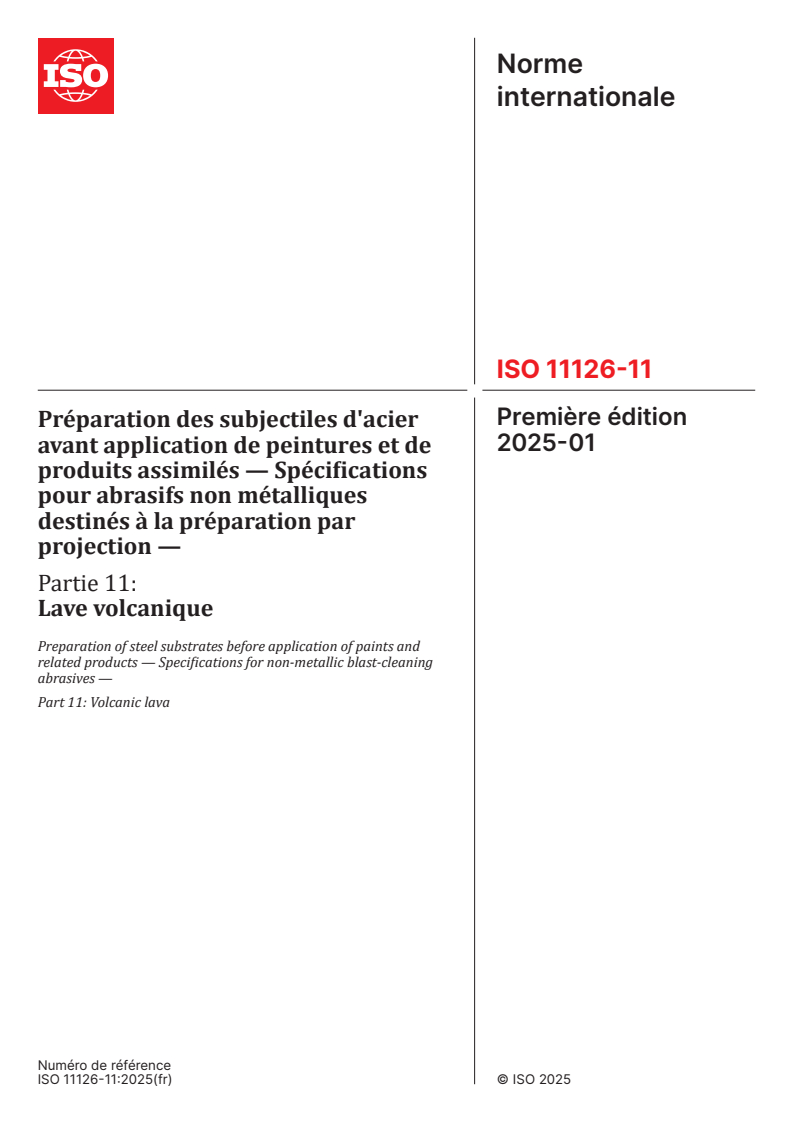
International
Standard
ISO 11126-11
First edition
Preparation of steel substrates
2025-01
before application of paints and
related products — Specifications
for non-metallic blast-cleaning
abrasives —
Part 11:
Volcanic lava
Préparation des subjectiles d'acier avant application de peintures
et de produits assimilés — Spécifications pour abrasifs non
métalliques destinés à la préparation par projection —
Partie 11: Lave volcanique
Reference number
© ISO 2025
All rights reserved. Unless otherwise specified, or required in the context of its implementation, no part of this publication may
be reproduced or utilized otherwise in any form or by any means, electronic or mechanical, including photocopying, or posting on
the internet or an intranet, without prior written permission. Permission can be requested from either ISO at the address below
or ISO’s member body in the country of the requester.
ISO copyright office
CP 401 • Ch. de Blandonnet 8
CH-1214 Vernier, Geneva
Phone: +41 22 749 01 11
Email: copyright@iso.org
Website: www.iso.org
Published in Switzerland
ii
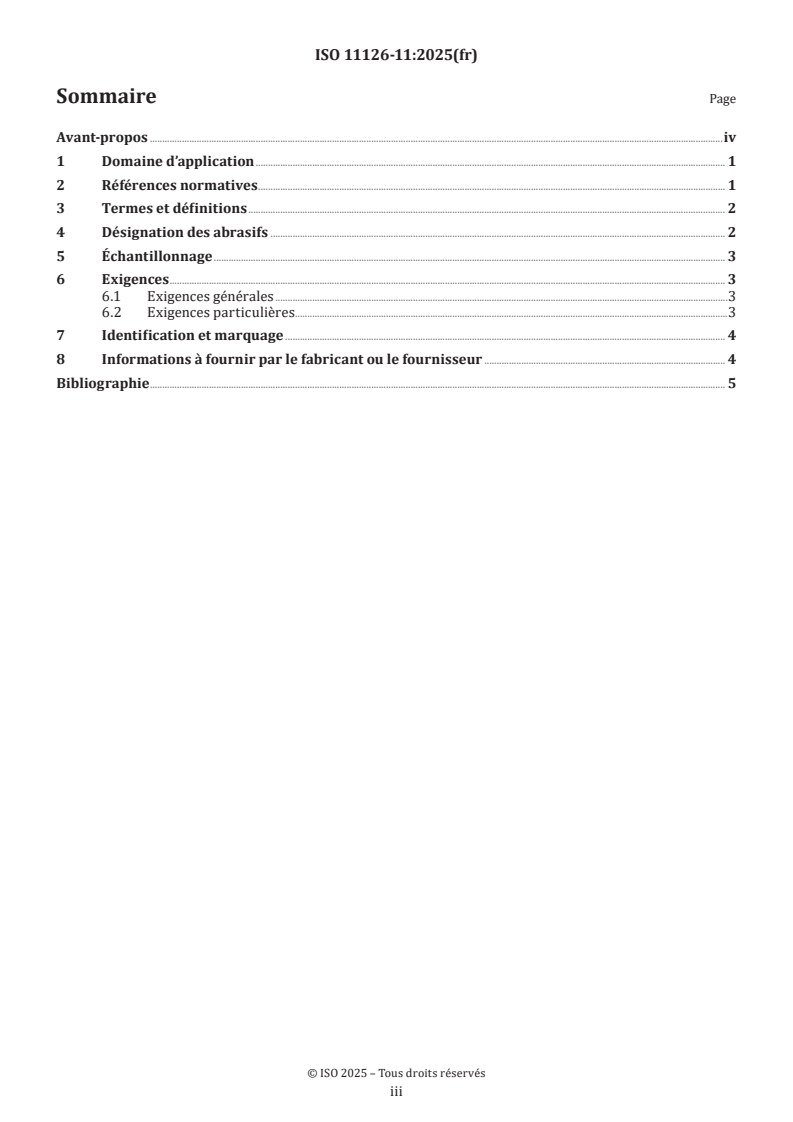
Contents Page
Foreword .iv
1 Scope . 1
2 Normative references . 1
3 Terms and definitions . 2
4 Designation of abrasives . 2
5 Sampling . 2
6 Requirements . 3
6.1 General requirements .3
6.2 Particular requirements .3
7 Identification and marking. 3
8 Information to be supplied by the manufacturer or supplier . 3
Bibliography . 4
iii
Foreword
ISO (the International Organization for Standardization) is a worldwide federation of national standards
bodies (ISO member bodies). The work of preparing International Standards is normally carried out through
ISO technical committees. Each member body interested in a subject for which a technical committee
has been established has the right to be represented on that committee. International organizations,
governmental and non-governmental, in liaison with ISO, also take part in the work. ISO collaborates closely
with the International Electrotechnical Commission (IEC) on all matters of electrotechnical standardization.
The procedures used to develop this document and those intended for its further maintenance are described
in the ISO/IEC Directives, Part 1. In particular, the different approval criteria needed for the different types
of ISO document should be noted. This document was drafted in accordance with the editorial rules of the
ISO/IEC Directives, Part 2 (see www.iso.org/directives).
ISO draws attention to the possibility that the implementation of this document may involve the use of (a)
patent(s). ISO takes no position concerning the evidence, validity or applicability of any claimed patent
rights in respect thereof. As of the date of publication of this document, ISO had not received notice of (a)
patent(s) which may be required to implement this document. However, implementers are cautioned that
this may not represent the latest information, which may be obtained from the patent database available at
www.iso.org/patents. ISO shall not be held responsible for identifying any or all such patent rights.
Any trade name used in this document is information given for the convenience of users and does not
constitute an endorsement.
For an explanation of the voluntary nature of standards, the meaning of ISO specific terms and expressions
related to conformity assessment, as well as information about ISO's adherence to the World Trade
Organization (WTO) principles in the Technical Barriers to Trade (TBT), see www.iso.org/iso/foreword.html.
This document was prepared by Technical Committee ISO/TC 35, Paints and varnishes, Subcommittee SC 12,
Preparation of steel substrates before application of paints and related products.
A list of all parts in the ISO 11126 series can be found on the ISO website.
Any feedback or questions on this document should be directed to the user’s national standards body. A
complete listing of these bodies can be found at www.iso.org/members.html.
iv
International Standard ISO 11126-11:2025(en)
Preparation of steel substrates before application of paints
and related products — Specifications for non-metallic blast-
cleaning abrasives —
Part 11:
Volcanic lava
WARNING — Equipment, materials and abrasives used for surface preparation can be hazardous. It
is important to ensure that adequate instructions are given and that all required precautions are
exercised.
1 Scope
This document s
...
Norme
internationale
ISO 11126-11
Première édition
Préparation des subjectiles d'acier
2025-01
avant application de peintures et de
produits assimilés — Spécifications
pour abrasifs non métalliques
destinés à la préparation par
projection —
Partie 11:
Lave volcanique
Preparation of steel substrates before application of paints and
related products — Specifications for non-metallic blast-cleaning
abrasives —
Part 11: Volcanic lava
Numéro de référence
DOCUMENT PROTÉGÉ PAR COPYRIGHT
© ISO 2025
Tous droits réservés. Sauf prescription différente ou nécessité dans le contexte de sa mise en œuvre, aucune partie de cette
publication ne peut être reproduite ni utilisée sous quelque forme que ce soit et par aucun procédé, électronique ou mécanique,
y compris la photocopie, ou la diffusion sur l’internet ou sur un intranet, sans autorisation écrite préalable. Une autorisation peut
être demandée à l’ISO à l’adresse ci-après ou au comité membre de l’ISO dans le pays du demandeur.
ISO copyright office
Case postale 401 • Ch. de Blandonnet 8
CH-1214 Vernier, Genève
Tél.: +41 22 749 01 11
E-mail: copyright@iso.org
Web: www.iso.org
Publié en Suisse
ii
Sommaire Page
Avant-propos .iv
1 Domaine d’application . 1
2 Références normatives . 1
3 Termes et définitions . 2
4 Désignation des abrasifs . 2
5 Échantillonnage . 3
6 Exigences . 3
6.1 Exigences générales .3
6.2 Exigences particulières .3
7 Identification et marquage . 4
8 Informations à fournir par le fabricant ou le fournisseur . 4
Bibliographie . 5
iii
Avant-propos
L'ISO (Organisation internationale de normalisation) est une fédération mondiale d'organismes nationaux
de normalisation (comités membres de l'ISO). L'élaboration des Normes internationales est en général
confiée aux comités techniques de l'ISO. Chaque comité membre intéressé par une étude a le droit de faire
partie du comité technique créé à cet effet. Les organisations internationales, gouvernementales et non
gouvernementales, en liaison avec l'ISO participent également aux travaux. L'ISO collabore étroitement avec
la Commission électrotechnique internationale (IEC) en ce qui concerne la normalisation électrotechnique.
Les procédures utilisées pour élaborer le présent document et celles destinées à sa mise à jour sont
décrites dans les Directives ISO/IEC, Partie 1. Il convient, en particulier, de prendre note des différents
critères d'approbation requis pour les différents types de documents ISO. Le présent document a
été rédigé conformément aux règles de rédaction données dans les Directives ISO/IEC, Partie 2 (voir
www.iso.org/directives).
L’ISO attire l’attention sur le fait que la mise en application du présent document peut entraîner l’utilisation
d’un ou de plusieurs brevets. L’ISO ne prend pas position quant à la preuve, à la validité et à l’applicabilité de
tout droit de brevet revendiqué à cet égard. À la date de publication du présent document, l’ISO n'avait pas
reçu notification qu’un ou plusieurs brevets pouvaient être nécessaires à sa mise en application. Toutefois,
il y a lieu d’avertir les responsables de la mise en application du présent document que des informations
plus récentes sont susceptibles de figurer dans la base de données de brevets, disponible à l'adresse
www.iso.org/brevets. L’ISO ne saurait être tenue pour responsable de ne pas avoir identifié tout ou partie de
tels droits de propriété.
Les appellations commerciales éventuellement mentionnées dans le présent document sont données pour
information, par souci de commodité, à l’intention des utilisateurs et ne sauraient constituer un engagement.
Pour une explication de la nature volontaire des normes, la signification des termes et expressions
spécifiques de l'ISO liés à l'évaluation de la conformité, ou pour toute information au sujet de l'adhésion de
l'ISO aux principes de l’Organisation mondiale du commerce (OMC) concernant les obstacles techniques au
commerce (OTC), voir www.iso.org/avant-propos.
Le présent document a été élaboré par le comité technique ISO/TC 35, Peintures et vernis, sous-comité SC 12,
Préparation de subjectiles d’acier avant application de peintures et de produits assimilés.
Une liste de toutes les parties de la série ISO 11126 se trouve sur le site web de l’ISO.
Il convient que l’utilisateur adresse tout retour d’information ou toute question concernant le présent
document à l’organisme national de normalisation de son pays. Une liste exhaustive desdits organismes se
trouve à l’adresse www.iso.org/fr/members.html.
iv
Norme internationale ISO 11126-11:2025(fr)
Préparation des subjectiles d'acier avant application de
peintures et de produits assimilés — Spécifications pour
abrasifs non métalliques destinés à la préparation par
projection —
Partie 11:
Lave volcanique
AVERTISSEMENT — Les équipements, matériaux et abrasifs utilisés pour la préparation des
subjectiles peuvent présenter des risques. Il est important de s’assurer que les instructions
nécessaires sont données et que toutes les précautions sont prises.
1 Domaine d’application
Le présent document spécifie les exigences relatives à la lave volcanique telle qu’elle est fournie pour la
préparation par projection. Il spécifie les intervalles granulométriques et les valeurs de masse volumique
apparente, la dureté Mohs, la teneur en humidité, la conductivité de l’extrait aqueux ainsi que la teneur en
chlorures solubles dans l’eau.
Les exigences spécifiées dans le présent document s’appliquent aux abrasifs fournis à «l’état neuf»
uniquement. Elles ne s’appliquent pas aux abrasif
...